Hours before the final results from Israel’s elections were in, several things were clear. Benjamin Netanyahu’s far-right coalition had lost its mandate, and the opposition had a firm majority.
But most of Israel’s Jewish opposition ruled out governing with Palestinian-led parties, in the course of a racist election campaign in which Netanyahu painted Palestinian citizens as an enemy inside the state.
Anxious Israelis watched election results near completion Wednesday after the highest voter turnout in over a quarter-century, as no clear winner emerged and weeks of negotiating could lie ahead for Prime Minister Benjamin Netanyahu and an array of opposition parties trying to unseat him.
With nearly all votes counted, Netanyahu’s coalition government has lost its majority, but main opponents also fail to gain outright majority; marked gains by Palestinian parties
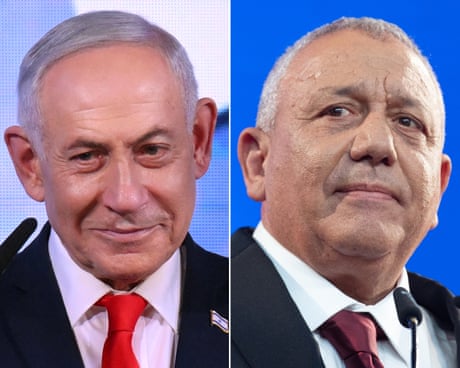
With almost all votes counted, Benjamin Netanyahu’s coalition government has lost its majority, but his main opponents, an alliance of Jewish Israeli parties unofficially led by Gadi Eisenkot, have also failed to gain an outright majority.
Israeli media report that Netanyahu’s bloc is ahead, with projections he could take 53 seats under the current vote share, but this could change further. The projections put Gadi Eisenkot’s opposition bloc on 48 seats and the Palestinian parties on 19 seats. Sixty-one seats are needed to form a majority to govern in the Knesset.
The remainder of votes to be counted come from absentee ballots, according to Israeli media. We can expect absentee ballots to be counted on Wednesday night, with final results by Thursday.
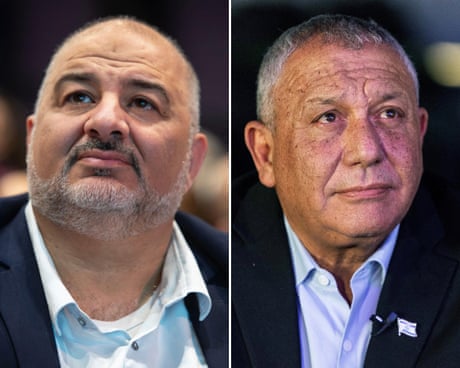
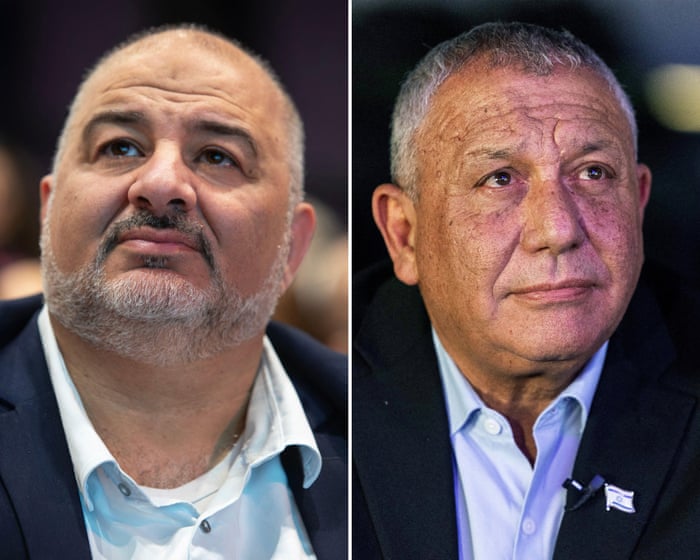
The Palestinian Israeli parties have received a historically strong vote. The Joint List, a new ticket of several Arab-majority parties, triumphed with at least 12 seats, while Ra’am, the other Islamic party, won seven.
The key question is whether the Eisenkot-led “Change” bloc (consisting of the rightwinger Naftali Bennett’s Together party, the centre-left Yair Golan’s Democrats and the rightwing Yisrael Beiteinu party) will partner with Palestinian Israeli parties or if they will resort to a new election, or even working with Netanyahu.
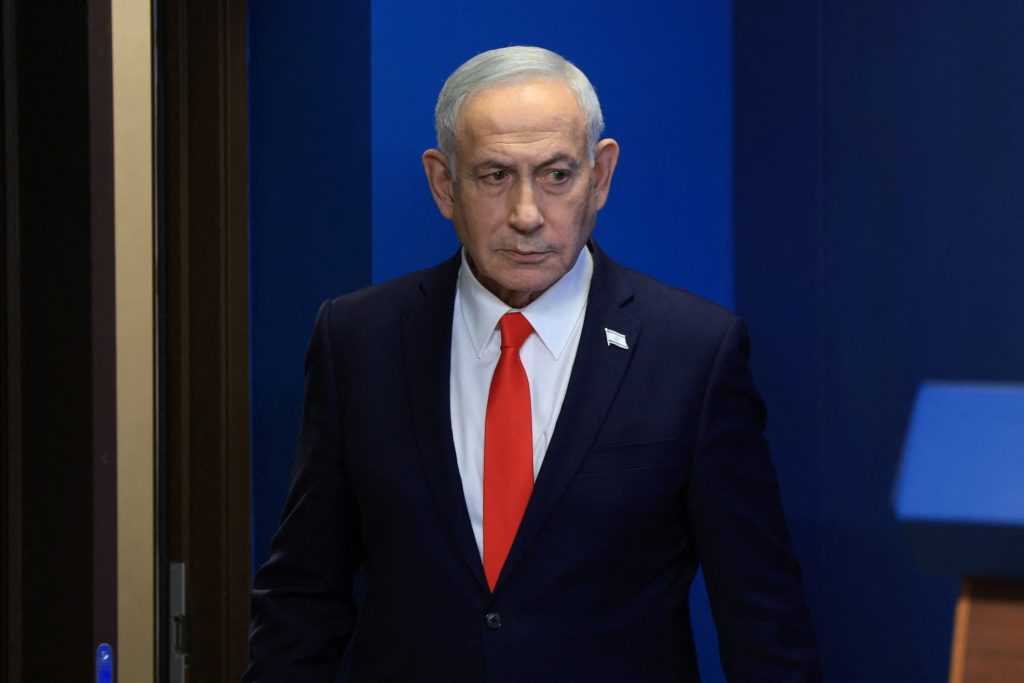
Netanyahu took the stage at a post-election rally in Jerusalem just after 3am, telling his supporters that official results will show that “Likud is the largest party in Israel”. He told his supporters that the country must “establish a strong, rightwing national government” – adding that a government that relied on the support of Palestinian parties must not be formed.
Eisenkot told cheering supporters in Tel Aviv that the “Israeli public has voted against Netanyahu’s service as Israel’s prime minister … a worthy leader would have accepted the people’s non-confidence and announced today his retirement from politics”. In his speech, he also warned Netanyahu not to “use Israel’s security” for political ends, playing on fears that the prime minister could use this period of uncertainty to launch a new attack on Iran.
The Palestinian Israeli vote, which represents about 20% of the population, had long been seen as a decisive factor for who will be able to form government, and the high turnout of this election was driven by the community experiencing increased racism and discrimination under Netanyahu’s government.
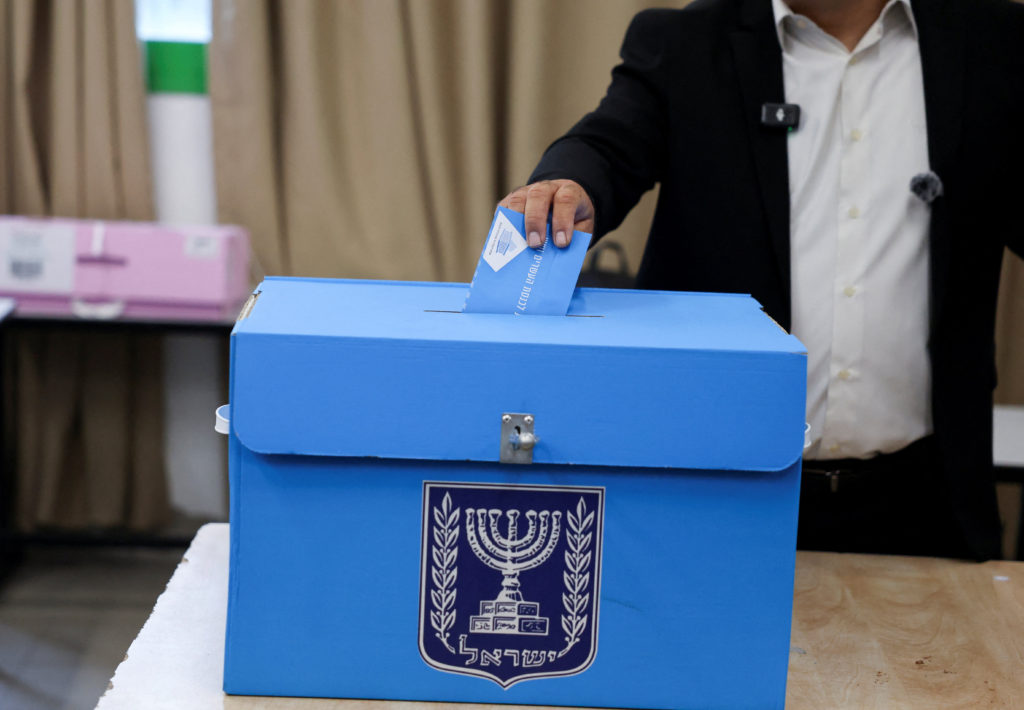
This is the most voted-for election in Israel’s political history, with many Israelis flying back into the country to cast their vote, and nearly 80% of IDF soldiers voting.
Donald Trump said his endorsement had helped Netanyahu perform better than polling estimates.
Votes are still being counted, and much is in flux. But as the stage was set for bitter talks over forming a government, nearly all sides could face disappointment.
Israel’s future hung in the balance on Wednesday as it became clear that Benjamin Netanyahu had lost his governing majority. His political fate now depends on whether opposition Jewish parties are prepared to forge a common front with Palestinian parties, whose support surged in Tuesday’s elections.
The leader of the Jewish opposition bloc, the retired general Gadi Eisenkot, appeared to rule out such a broad coalition in a premature declaration of victory overnight for what he called a “Zionist majority”.
Few countries in the Middle East expect a turning point in relations with Israel. But the outcome of the vote has implications for the regional conflict with Iran.
Parts of Lebanon have been greatly damaged in fighting between Israel and Hezbollah since March, including the Dahiya neighborhood, a Hezbollah stronghold in the capital, Beirut.
The move to strip citizens of their passports and their rights is not a new one, nor is it limited to the United States and Rep. Ilhan Omar. | Stephen Maturen/Getty Images
What do a Bollywood actor, a member of Congress, and Israeli directors have in common?
It sounds like the beginning of a bad joke. The punchline, though, is that governments of India, the United States, and Israel, respectively, think they should be stripped of their national status.
Bollywood star Imran Khan, nephew of Bollywood superstar Aamir Khan, was told he has until October 28(and since extended to November 2) to leave India, where he resides on an Overseas Citizen of India (OCI) card. India doesn’t allow dual citizenship, but OCI status gives individuals of Indian descent and their family members the right to permanently live, work, and study in India; its revocation uproots its holders from their homes and their lives. Khan had protested in a demonstration demanding the resignation of Gyanesh Kumar, India’s chief election commission. He is challenging the order in court.
Earlier this month, US Rep. Ilhan Omar’s home was raided by federal authorities who are reportedly preparing a case to strip her of citizenship, alleging that her father said she was 17 when she was really 18 when he filed her naturalization paperwork. President Donald Trump subsequently said that, because a federal court filing allegedly referred to her as “Ilhan Nur Said Elmi, a/k/a Ilhan Abdullahi Omar,” she should have to resign from Congress.
Israeli Prime Minister Benjamin Netanyahu has intimated that Yuval Abraham and Rachel Szor, directors of the film NAZA, in which Abraham interviews Israeli soldiers and intelligence officers on Tel Aviv rooftops about how they assessed and decided to kill civilians in Gaza, could be stripped of their Israeli citizenship, saying he would pursue legislation to go after critics of the military who crossed a line. “We will revoke citizenship for anyone who defames IDF soldiers around the world — he will be deeply hurt in his pocket,” said Netanyahu, who cited the filmmakers as a potential example and called their work “intolerable.”
The move to strip citizens of their passports and their rights is not a new one, nor is it limited to these three countries. Perhaps most famously, Jews were stripped of citizenship by the Nazis in Germany and elsewhere in Europe in the 1930s and ’40s. To take a more recent example, over the summer, Russia passed legislation that effectively strips Russians abroad facing domestic prosecution on political grounds of their citizenship (the law takes away their property, freezes their bank accounts, and refuses them consular services).
Still, that three high-profile cases are coming from three countries that claim to be democracies raises the question: Why do reactionary leaders in democracies reach for denaturalization (or quasi-denaturalization, in the case of loss of OCI) as a weapon against political and cultural elites? What do they hope to gain? And, relatedly: What might they lose instead?
It’s not just about the high-profile targets
Reactionary leaders do not typically threaten to make an example of high-profile political opponents or cultural elites as a first step. In each of these cases, there are demographic groups — whole swathes of the population — whose governments have been trying to disenfranchise, denaturalize, or deport them (or some combination of the three) long before the recent spate of high-profile headlines.
In India, there’s currently a politicized election integrity push that experts warn could illegitimately prevent tens of millions of voters from marginalized groups, especially Muslims, from participating in elections. What should have been a routine clean up of voter rolls ended up with 130 million — nearly 10 percent of the population — struck off the lists. The sweeping approach has raised widespread concern from critics that many voters will be incorrectly removed — and deep suspicions that this disenfranchisement is targeted and intentional.
Mukulika Banerjee, a professor of anthropology at the London School of Economics, noted this happened after the position of chief election commissioner was made partisan and given immunity for life. And while normally in India (unlike in the United States) the onus is on the state, not individuals, to register voters, in this case, the state said that if people were to be put back on the voter rolls, they “had to produce a whole bunch of documents…which by implication affected the socially disadvantaged,” per Banerjee.
That meant women, people from lower castes, rural voters — and, since “the Muslim population amongst the most seriously socially disadvantaged, the likelihood of Muslims falling in this category is very high,” Banerjee, author of Cultivating Democracy: Politics and Citizenship in Agrarian India, said. In places like West Bengal, where Muslims make up nearly 30 percent of the population, there were some assembly constituencies where, in elections earlier this year, the number of names deleted from the rolls was greater than the margin of victory, and while anti-incumbent sentiment was high and the BJP may well have won anyway, some, per Banerjee, are asking, “was this an attempt to choose the electorate, so to speak.”
In the United States, the Trump administration has made denaturalization a priority, hoping to find people they can make an example of as part of their broader immigration crackdown. They have already filed to strip dozens of Americans of their citizenship by claiming they lied on their naturalization paperwork (“Justice Department Moves to Strip Citizenship from 40 Criminals in Largest Single-Period Filing Under the Trump Administration,” a press release from earlier this month crowed). The White House also tried, unsuccessfully, to revoke America’s constitutional right to birthright citizenship, which could have left future generations far more vulnerable to removal or persecution.
And in Israel, Palestinians have long been made to feel the weight of citizenship — and the heft of its absence. This is not only true in, say, the West Bank, where Jews live as citizens but Palestinians live under occupation and military law, but in East Jerusalem, where most Palestinians are permanent residents, not citizens, meaning they cannot vote in general elections for the Israeli legislature.
“That is a tool that Israel has used in a different way that could easily be transplanted to citizens,” said Mairav Zonszein, senior analyst on Israel at Crisis Group. And if you can strip residency from Palestinians in Jerusalem, maybe you can strip citizenship, too. “If this government is reelected, I could see that becoming a less and less crazy idea” as what was once unthinkable becomes “normalized.” Palestinian citizens in Israel have expressed the same concern.
The chilling effect of deportation threats
How — and why — does an aspiring authoritarian move from threatening the rights and status of demographic groups to going after elites?
Sometimes, the elites are — in addition to being outspoken and high profile — from the demographic group under threat.
Several years before Khan’s OCI status came under threat, the Modi government took journalist Aatish Taseer’s OCI card from him. This happened in 2019 — months after Taseer authored a Time story with “India’s Divider in Chief” plastered across the cover, after which the prime minister himself said, “Time Magazine is foreign. The writer has also said he comes from a Pakistani political family. That is enough for his credibility.” Taseer’s father was indeed a Pakistani political figure, but this was hardly some secret of which Taseer had made offhand mention; Taseer had written about his father and the role his absence and rediscovery in his life, including in his first book, Stranger to History: A Son’s Journey Through Islamic Lands.
And so with Imran Khan, Taseer said in a phone interview, there is an element of, “Just get the Muslim out” (Khan’s mother is Muslim). In Taseer’s own case, he said, he became “the Paki.”
The same is true at least in one high-profile case in the United States: Omar is Muslim and from Somalia, two groups that frequently attract the ire of the Trump administration. Recently, Trump urged Minnesotans to “fight back” against Somali immigrants before the state is “taken over.” Omar is also a prominent and progressive member of Congress.
“It’s got these two levels,” Taseer said. “One is an ethnonationalist agenda. The other is a blunt instrument of coercion.” If you speak out too freely, Taseer added, “you won’t be able to return home.”
The blunt instrument, though, is more narrowly applied than, say, stripping people from voter rolls en masse. It is designed to cause fear among elites: journalists and actors and academics.
And it is meant, Banerjee said, to raise the price of protest.
The government’s first instinct, she said, is to call protesters terrorists and anti-nationals, rather than citizens exercising their rights: “They don’t seem to understand that to peacefully protest is there in…the constitution.”
And by taking a Bollywood star’s OCI status, the government can “make an example and say, look, we can take the biggest and the richest and the most prominent.” It is a message to the rich and the famous and the powerful: Do not think you are bigger than government coercion. You are not.
Whether it works is almost beside the point. Trump is facing an uphill legal battle in proving that an error committed by Omar’s father, if indeed any error exists, means she should lose her citizenship. Omar has said she sees the administration’s goal as exhausting and intimidating her to the point she leaves politics — something she says will not happen.
And, it’s unlikely, Zonszein said, that Abraham and Szor will actually be stripped of citizenship given Israel’s own judicial protections. But, “It’s an empty threat, but one that works, because it chills dissent, it stifles it, it makes people scared.”
It also suggests that, regardless of whether you’re a member of the targeted group, or have some special status that could set you apart, power can come for you, too. That can scare people out of speaking out for the marginalized. It can also alert them into the need for doing so.
“When it happens in a democracy, one has to always keep one’s radar attuned to who is suddenly becoming prey, whether it’s LGBT in Russia or now in Turkey or in this case in India, Muslims, Taseer said. ”It’s sort of — what they’re going to those people, they’re going to eventually do to the population at large. It’s not one of those things where they’re like, ah, let us do this little thing, and then you guys can all live happily ever after. It’s generally always accompanied by a deeper authoritarian turn.”
For example, in addition to threatening Abraham and Szor, Israel has revoked the entry permits of American Jews who volunteered to work with and protect Palestinian farmers during harvests and froze aliyah — the name for the process by which Jews abroad immigrate — of two Jews over their pro-Palestinian West Bank activism, which, as Israeli outlet Haaretz reported, could be a violation of Israeli law guaranteeing the right of all Jews around the world the right to move to Israel and become citizens.
“I mean, anybody with their head on straight would say, if you treat one person this way, it’s not that hard to treat another person this way,” Zonszein said. “That’s pretty basic, obvious stuff.”
This live blog is now closed – you can read the latest elections news here
One apparent loser from Tuesday’s election was far-right national security minister Itamar Ben-Gvir, who was expected to better his party’s result of six seats from the 2022 elections.
But instead there was stunned silence at the watch party for Otzma Yehudit (Jewish Power) in central Israel as results from the exit polls flashed across the screen, with most channels suggesting the party would remain on just six seats.
Israelis turned out in record numbers for their first election since the Oct. 7 attacks and the war in Gaza. Projections show opposition parties won more seats than the coalition led by Prime Minister Netanyahu, potentially setting the stage for a change in government. But Netanyahu's opponents do not have enough seats to form a majority, leading to weeks of negotiations. Nick Schifrin reports.
The big gains made by Palestinian parties in Israel’s general election pose an urgent and fundamental challenge to the country’s mainstream opposition: either cooperate with Arab Israelis or hand Benjamin Netanyahu a roadmap to political survival.
In the wake of Tuesday’s exit polls, the leader of the opposition bloc, Gadi Eisenkot, declared them a victory for “Israel’s Zionist national majority” but the real outcome looks as if it will be far more complex than that.
Israel’s election appeared to have delivered no clear winner on Tuesday night after a historic turnout by voters for an election described by some as the most consequential in the country’s history, and marked by a record participation by Israeli Arab voters.
Exit polls published on Tuesday evening suggested that the opposition bloc of parties led by the former chief of staff of the Israel Defense Forces, Gadi Eisenkot, would win most seats in the Knesset by a slight margin, edging out Benjamin Netanyahu’s right and far-right coalition despite the prime minister’s Likud emerging as the largest party.
The three siblings used their wealth and influence to lure and sexually assault women for more than a decade. Eleven of the victims spoke on Tuesday before the brothers were sentenced.

 Login