Ex-Breitbart editor has vocally supported immediate deportations for anyone who can’t prove US residency
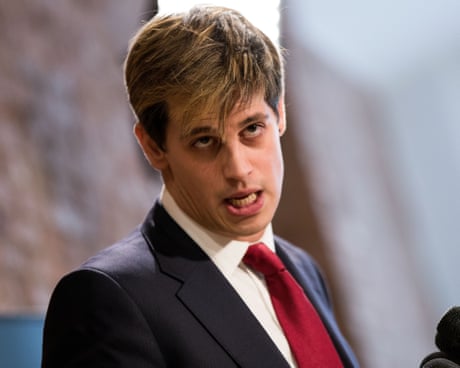
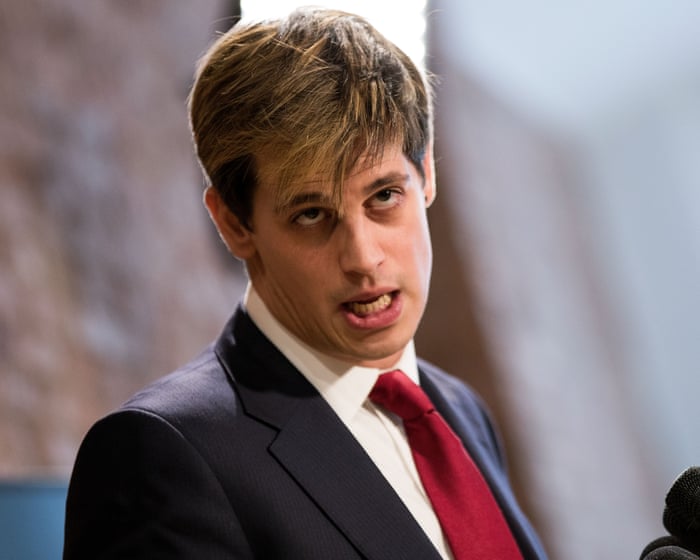
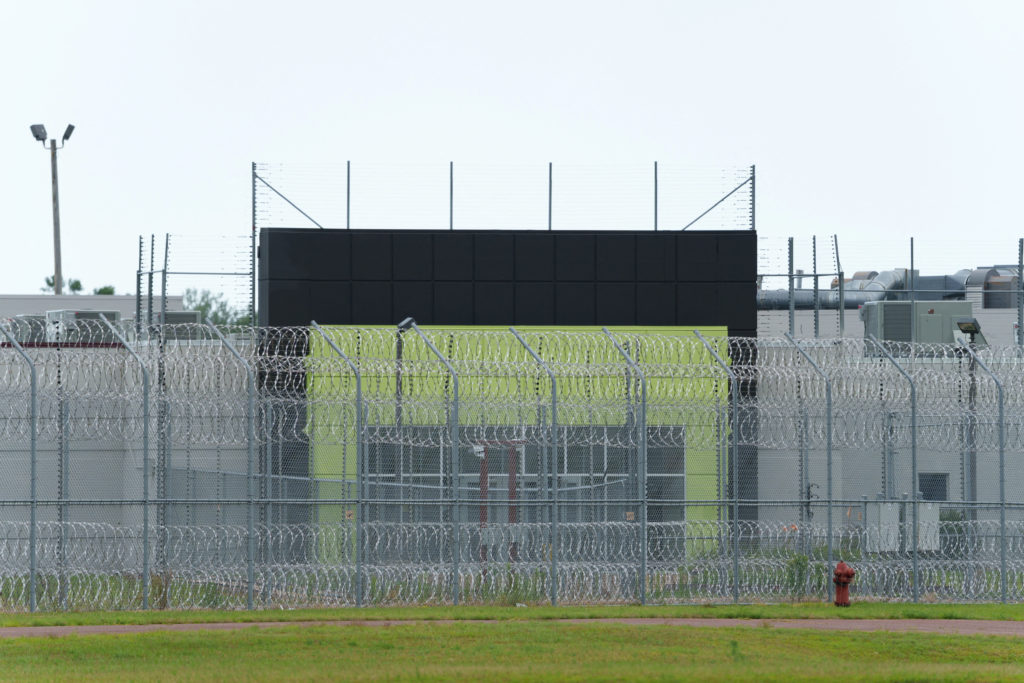
Far-right British media provocateur Milo Yiannopoulos has been deported from the US after being detained on Thursday by Immigration and Customs Enforcement (ICE) in New Orleans in connection with what the agency said was expired authorization to be in the country and a deportation order.
Yiannopoulos’s deportation to the UK occurred on Friday, said a statement on Saturday from a spokesperson for the US Department of Homeland Security (DHS), which oversees ICE.
Ex-Breitbart editor has vocally supported immediate deportations for anyone who can’t prove US residency
Far-right British media provocateur Milo Yiannopoulos has been deported from the US after being detained on Thursday by Immigration and Customs Enforcement (ICE) in New Orleans in connection with what the agency said was expired authorization to be in the country and a deportation order.
Yiannopoulos’s deportation to the UK occurred on Friday, said a statement on Saturday from a spokesperson for the US Department of Homeland Security (DHS), which oversees ICE.
The Trump administration has deported thousands of immigrants to countries where they have no ties. Dozens were on the latest flight, to the Central African Republic.
Our White House correspondent Zolan Kanno-Youngs explains how so-called third-country deportations are sending immigrants to countries across the globe.
Senator Jon Ossoff, the youngest sitting senator and the only Democrat seeking re-election this year in a state President Trump won in 2024, hasn’t moderated his message in his critical race.
At rallies across Georgia this summer, Senator Jon Ossoff has delivered a series of blistering rebukes of the president and a challenger for his seat, Representative Mike Collins.
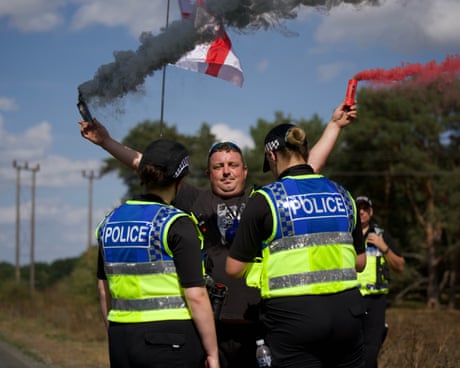
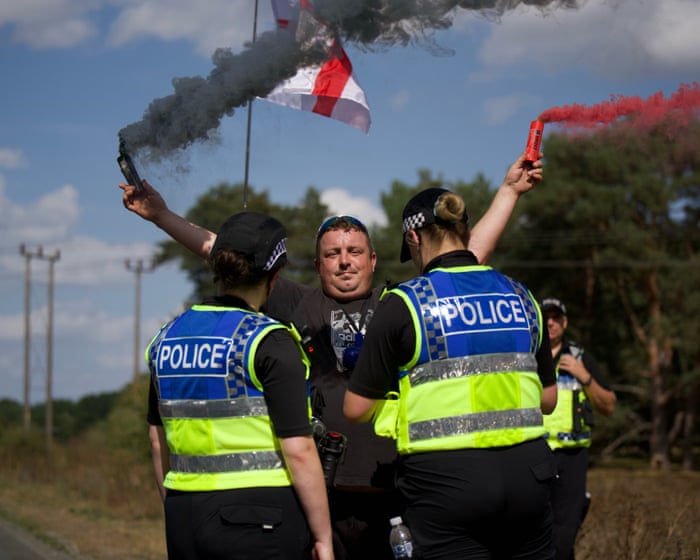
Thetford has a welcoming history. So why have there been so many demonstrations this summer over plans to house asylum seekers at a nearby military base – as well as nights of violent disorder?
‘I don’t talk to mainstream media,” says a young man in an Arsenal shirt. I’ve just asked what brought him to the latest protest against the housing of asylum seekers in Thetford, Norfolk, and his disdain is clear as he goes to warn other protesters of the Guardian’s presence. This isn’t exactly the unity promised by the flyer advertising today’s march: “Everyone welcome: families, friends, dogs. Including the media.”
The protest is planned as a two-mile march from Thetford’s market square to RAF Barnham, a site just over the border in Suffolk, which is due to house asylum seekers while they progress through the system. It is the latest part of a campaign that has lasted the whole summer. Banners line the square, the largest succinctly describing why people are gathering here today: “Thetford and Barnham says no to asylum seekers.”
Haitian immigrants at a protest in Salisbury, Maryland, on August 26, 2026. | Dominic Gwinn/SOPA Images/LightRocket via Getty Images
This story appeared in Today, Explained, a daily newsletter that helps you understand the most compelling news and stories of the day. Subscribe here.
After ending legal protections for 350,000 Haitians living in the United States, the Trump administration is ramping up its efforts to deport them back to a country engulfed in violence — and bragging about it.
“Those with terminated TPS are in our nation Illegally,” the Department of Homeland Security X account posted on Thursday evening, alongside a video of chained Haitian immigrants set to cheery music. “They have two options: LEAVE IMMEDIATELY or be DEPORTED.”
Temporary protected status (TPS) is extended to immigrants for whom conflict, natural disaster, or another catastrophe means returning home would be unsafe, and Haiti certainly qualifies: The island nation has been in crisis since its president was assassinated in 2021, with armed gangs controlling most of the capital city; earlier this week, dozens were killed and kidnapped near the capital.
Despite all that, the administration first attempted to end TPS protections for Haitians living in the US last year, and succeeded after the Supreme Court gave its blessing in June.
Now, it’s sending them back to a country where the State Department warns Americans not to travel “for any reason” because of “crime, terrorism, kidnapping, unrest, and limited health care.” On Thursday, that effort included a deportation flight carrying families with young children born in the US.
Haitian immigrants in the US aren’t the only people whom Immigrations and Customs Enforcement is targeting more aggressively. According to immigration data released this week by the Deportation Data Project at UC Berkeley and UCLA, ICE arrested a record number of people in two consecutive months this summer: first 43,000 in June, then nearly 50,000 last month.
As arrests surge, who’s being targeted is changing, too. More and more ICE arrestees don’t have a criminal record; in July, immigrants with only civil immigration violations made up a majority of arrests. Often, they also have active immigration cases pursuing asylum, a green card, or some other legal status, as the Seattle Times reported this week.
Overall, ICE detentions are also rising again, though they’re still lower than they were at the start of the year.
The pace of arrests reflects ICE’s growing size — 29,000 employees in June, according to the New York Times, compared to 21,000 in January 2025 — as well as its glut of cash after Trump’s reconciliation bill forked over $75 billion to the agency last year.
Nonetheless, the agency still wants more: As the New York Times reported in July, its internal target for arrests is 2,000 per day. That would mean a record of at least 60,000 people per month, the majority likely guilty of no crime at all.
One link for later
➨ Shop local. With food getting recalled left and right for all kinds of dire reasons (both related to Health Secretary Robert F. Kennedy Jr. and not), farmers markets are getting more attention as an option for leafy greens that won’t leave you in crisis. But how do small farms pull it off, and how much of a difference does it make? The Vox video team headed to Camarillo, California, to investigate.
Before you go…
Did you know…that three words might be all that’s standing between us and autonomous killer robots? As my colleague Kylie Jones explains, it’s the semantic difference between “meaningful human control” and “appropriate human judgment,” which is the Pentagon’s current standard.
Today’s trivia: In which athletic conference does Georgia Tech compete? (You can find this and other brain puzzles in Vox’s daily crossword. Look for the answer in Monday’s edition.)
Yesterday’s trivia: Yesterday, we asked you which city serves as the headquarters of the National Collegiate Athletic Association. That would be Indianapolis.
Mr. Yiannopoulos, a prominent early supporter of President Trump, was detained at the New Orleans airport. The Trump administration publicized his arrest and shared a mug shot.
U.S. immigration officials arrested controversial British far-right commentator Milo Yiannopoulos on Thursday in New Orleans, according to the Department of Homeland Security.
A former lieutenant colonel in Venezuela’s National Guard living in Florida was deported, interrupting a lawsuit that accused him of ordering violent raids and torture.
Flights to the Caribbean nation will increase from once a month to once a week now that the Supreme Court allowed President Trump to cancel a humanitarian program.
Texas and Florida accounted for nearly 20,000 of the July arrests. The agency has been bolstered by billions of dollars from Congress and has hired 12,000 new deportation officers and agents.
Luis Manuel Aviles, 48, was arrested after leaving his house to take his car to the mechanic, according to his wife, Argelia Aviles. She said her husband, a handyman in Key West, Florida, has a permit to work in the United States.
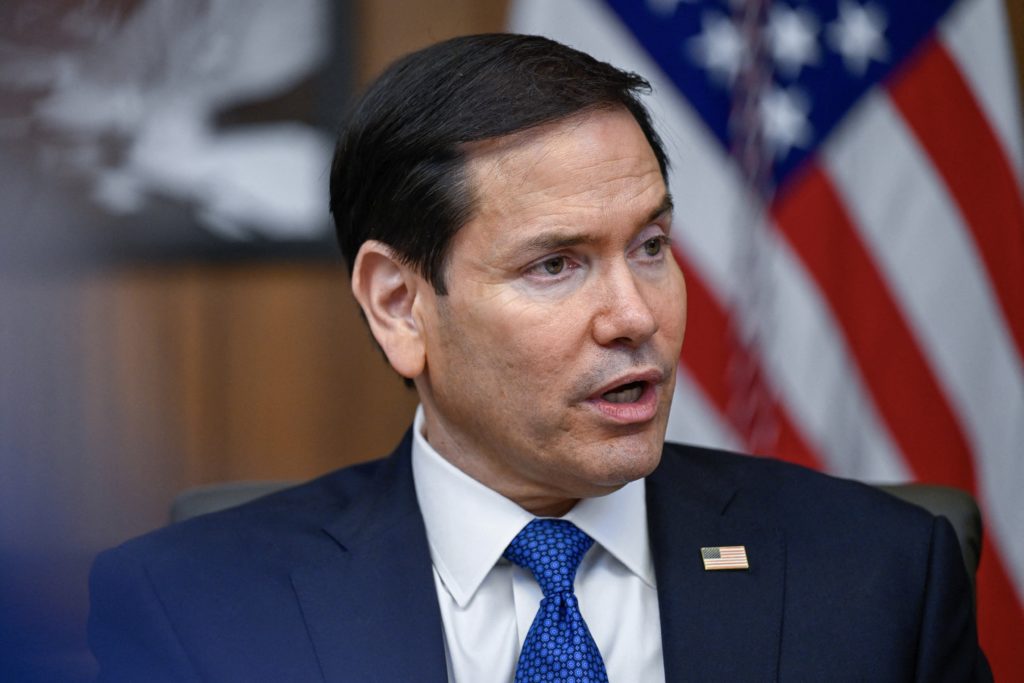
The judge ruled that Secretary of State Marco Rubio exceeded his authority by issuing the policy, which "runs afoul" of the Immigration and Nationality Act by mandating "the refusal of visas to eligible applicants without any basis in law."
President Donald Trump walks by Chief Justice John Roberts. | ANDREW CABALLERO-REYNOLDS / AFP via Getty Images
Last week, President Donald Trump issued a new executive order that purports to strip citizenship from some Americans.
This isn’t our first time here: Last year, Trump issued an executive order that attempted to strip citizenship from many Americans born in this country. Months later, in response to a lawsuit brought over Trump’s order, the Supreme Court reaffirmed that everyone born in the United States who is subject to US law is a citizen. The Court’s decision in Trump v. Barbara (2026) was hardly a surprise, as the Court first ruled that everyone born in the US and subject to its laws are citizens in United States v. Wong Kim Ark (1898).
Still, the Barbara decision did invalidate an executive order from Trump. And that made him very angry. The new order appears to be a response to that 2025 Supreme Court decision, though it is much narrower than his original one.
In this sense, Trump appears to be experimenting with where the line is for the justices when it comes to birthright citizenship. When Trump’s first order came before the Court in Barbara, there was more than a century of precedent establishing that the order was unconstitutional. Nevertheless, four justices voted to overrule at least some of that precedent.
Now, with the new order, Trump is testing whether a smaller bite at the apple is enough to win over one of the justices who voted with the majority in Barbara — two of whom are Republicans. If he manages to hold onto the four dissenters in Barbara and pick up just one more justice’s vote, his new order will stand. It’s a plausible outcome, and one that could potentially foreshadow future efforts to chip away at birthright citizenship.
What does the order actually do?
Trump’s first citizenship order, the one struck down in Barbara, attempted to strip citizenship from many Americans whose mothers were either undocumented or legally-but-temporarily present in the United States when they were born. Had this order been in effect at their birth, it would have stripped citizenship from many prominent Americans, including former Vice President Kamala Harris.
The new order, entitled “Continuing to Protect the Meaning and Value of American Citizenship” is much narrower; indeed, it’s unclear some of the categories of people it hopes to denaturalize actually exist. The new order, for example, purports to strip citizenship from children of two non-citizen parents when either parent belongs to a “designated Foreign Terrorist Organization.”
So, in the unlikely event that, say, a member of Al-Qaeda impregnated a non-US citizen woman who later gave birth on US soil, Trump’s order would mandate that the child’s US citizenship would be taken away.
Another provision purports to strip citizenship from the children of foreign nationals who work in their nation’s embassies or in similar diplomatic capacities but who do not enjoy diplomatic immunity from US law. Again, it’s unlikely that all that many children fall into this category, given the relatively small number of these jobs.
The largest group of people that Trump targets in his new order is children whose parents “engage in a commercial transaction to ensure that the person’s mother is present in the United States” for their birth, such as by buying a plane ticket to enter the United States while pregnant. But this category is also fairly small.
In 2024, the Centers for Disease Control and Prevention reported that 9,576 people were born in the United States to residents of foreign countries — out of about 3.6 million annual births — though it is unclear how many of these babies would be affected by Trump’s new executive order, because we don’t know if their mothers entered the United States “to ensure” that their child we be on US soil when born.
So, what does the Constitution actually say about birthright citizenship?
The question of whether people born in the United States are citizens was, until fairly recently, one of the most uncontroversial questions in US law. When Judge John Coughenour, a Reagan appointee, handed down the first court decision blocking Trump’s original attack on birthright citizenship, he commented that he’d “been on the bench for over four decades [and]…can’t remember another case where the question presented is as clear as this one is.”
The relevant provision of the Constitution’s 14th Amendment provides that “all persons born or naturalized in the United States, and subject to the jurisdiction thereof, are citizens of the United States.” So, everyone born in the US, regardless of their parent’s immigration status, past behavior, or membership in a particular organization are citizens — unless they are not “subject to the jurisdiction” of the United States.
As the Court recently reaffirmed in Barbara, moreover, a child is within US jurisdiction if they are “subject to American law.” So, if undocumented immigrants and their children were not subject to US jurisdiction, that would mean that it was illegal to arrest and deport them. And, if members of foreign terrorist organizations were not subject to US law, that would mean that it is illegal for the US government to prosecute them for committing terrorist acts.
That said, Wong Kim Ark did recognize a few narrow categories of individuals who are present in the US but not subject to its laws — two of which are still relevant today. Children of invading foreign armies do not receive birthright citizenship, nor do children of foreign ambassadors and other diplomats who are immune from US law.
As the Court clarified in Barbara, both of these exemptions are derived from an old English rule that provided that the King could not convey citizenship to “those born in lands that he did not control.” Thus, when a foreign military occupied English soil and stripped the King of his ability to rule over those lands, children born to members of that military were not citizens.
The exemption for ambassadors and some other foreign diplomats, meanwhile, flows from what Barbara described as a “fiction of extraterritoriality.” While senior diplomats are present in the United States, they are nonetheless deemed to “remain on foreign soil” and thus are not subject to US law.
But not all employees of foreign governments qualify for this diplomatic immunity. Consider, for example, the tragic facts of Moncadav. Rubio (2025), a recent federal appeals court decision holding that a man who lived as a US citizen for nearly seven decades was not, in fact, a citizen.
Roberto Moncada is the son of a Nicaraguan diplomat who worked in the United Nations when Moncada was born in 1950. The US government previously concluded that Moncada’s father served as a “consul” when his son was born, and, thus, Moncada was a US citizen, because consuls and their families do not enjoy diplomatic immunity. But, in 2018, the US government discovered that Moncada’s father was actually an “attaché,” a more senior diplomat who does enjoy immunity. And then, the father’s diplomatic immunity cut the son off from US citizenship.
Under these principles, several provisions of Trump’s new executive order are unconstitutional, at least in part. The provisions stripping citizenship from the children of employees of foreign governments are lawful to the extent that they apply to children of people with diplomatic immunity but unconstitutional to the extent they apply to lower-ranking individuals with no immunity.
The provision dealing with members of foreign terrorist organizations is also unconstitutional, since people who engage in terrorism on US soil are very much subject to US law — as are babies born on US soil to parents connected to terrorism.Although, in the unlikely event that a foreign terrorist group actually seized control of some portions of US soil, then the exemption for children of invading armies would likely apply.
The provision dealing with so-called “birth tourists” is also unconstitutional, because a pregnant woman who enters the United States to ensure that their child is a US citizen is subject to US law, as is her child.
Indeed, Trump appears to concede this later point in a separate executive order handed down at the same time as his “Continuing to Protect” order. The second order, entitled “Ending Birth Tourism,” instructs two federal cabinet departments to update their rules to discourage alleged birth tourists from entering the country, including by taking “appropriate action to prevent the entry into the United States of, or the granting of any visa or other travel authorization” to such individuals. But, again, if the United States has the power to deny visas or otherwise bar these individuals from entering the country, that means that they are subject to US jurisdiction.
Why Trump keeps trying to restrict birthright citizenship
So, the Constitution’s text, the Court’s venerable decision in Wong Kim Ark, and its brand new decision in Barbara are all clear about who qualifies for birthright citizenship. All of these authoritiesestablish that much of Trump’s new executive order is unconstitutional, because it purports to strip citizenship from people who are subject to US jurisdiction.
But that doesn’t necessarily mean that the order will be struck down. While Barbara did little more than reaffirm the same rule the Court announced nearly 130 years ago in Wong Kim Ark, four justices dissented in Barbara — although, these justices also released four separate opinions with four separate definitions of who does and does not qualify for birthright citizenship. So, on this Supreme Court, the mere fact that a legal question has been settled for more than a century does not prevent many of the justices from voting to unsettle it.
So, while two of the Court’s Republicans joined all three of its Democrats in Barbara, it is possible that at least one of those Republicans will vote with the dissenters on a narrower question, like whether Trump can strip citizenship from the children of so-called birth tourists. And even if all of the justices in the Barbara majority hold the line, if one of them leaves the Court while Trump is still in office, he will almost certainly replace them with someone who opposes birthright citizenship.
So, while Trump’s executive orders often defy the Constitution’s explicit text, Trump also understands something important about US law: It doesn’t actually matter what the Constitution says if you have five votes on the Supreme Court who are willing to do what you want them to do.
An immigration court sign is seen as federal agents patrol the halls of the Ted Weiss Federal Building in New York City on May 12, 2026. | Michael M. Santiago/Getty Images
This story appeared in The Logoff, a daily newsletter that helps you stay informed about the Trump administration without letting political news take over your life. Subscribe here.
Welcome to The Logoff: The Trump administration is further limiting due process for asylum-seekers in the US.
What’s happening? On Tuesday, the administration issued a rule changing how some asylum requests are handled. Under the new policy, immigrants in more than 444,000 asylum cases could be denied the chance to speak with an asylum officer and claim asylum, which requires them to have experienced persecution, or the threat of persecution, in their home country because of their race, religion, nationality, political opinions, or another characteristic.
Instead, those immigrants would be redirected to immigration judges — who could order their deportation without any additional process.
The change, according to the administration, is intended to help clear a substantial backlog in the US asylum system, which has 1.4 million cases currently pending. But it fits a pattern by the Trump administration of dramatically curtailing access to asylum in the US.
What’s the context? Under the second Trump administration, many previous immigration judges have been forced out or fired from their roles. Their replacements, as Bloomberg reported earlier this year, are minimally trained and instructed to deny most asylum claims outright.
What’s the big picture? The Trump administration also has a long record of sending immigrants back into dangerous situations in their home countries, or even to countries to which they have no connection.
And those deportations are poised to get worse: In June, the Court also cleared the way for Trump to end temporary protected status for immigrants from Haiti and Syria, without consideration of procedural rules. Now, Immigration and Customs Enforcement is reportedly preparing to target hundreds of thousands of Haitians living in the US for deportation, even though the island nation is dealing with serious and widespread gang violence.
With less than 100 days until the 2026 midterm elections, don’t miss my colleague Astead Herndon’s new newsletter, The Midterms, Actually. Every week, Astead breaks down the big ideas and key people behind the political shifts shaping the 2026 elections. You can subscribe here.
And with that, it’s time to log off…
Want to spend less time on social media? Here’s some excellent advice from my colleague Constance Grady, available here with a gift link.
Thanks for reading, have a great evening, and we’ll see you back here tomorrow!

 Login
Login