Dress up the barbie however you like – it’s toxic, tiresome and, more to the point, malnourishing
“If you’re invited to a barbecue, have your dinner before you go.” It is the wisest advice my dad has ever given me. Barbecues are one of life’s perennial disappointments. The romance of eating outside quickly degenerates into a recipe for mucky fingers, smelly clothes and more mess than you bargained for, with grills that you can never get clean, uncomfortable seating that makes your back ache or, dafter still, eating while standing up. Worst of all is the true barbecue legacy – the nagging hunger that follows bitty dining, leaving you with the aggrieved sense that you missed a mealtime you’re never getting back.
I grew up in Cornwall, where beach barbecues were a rite of passage. The flame under the sandy grill was blown out by the Atlantic wind, so these gatherings were impractical, unpredictable and interminable. One minute the sausages were raw and looked like they’d never be ready, the next they were hard and black and basically inedible. Rain frequently sent us scrambling to pack up and flee for shelter.
Weekend mornings are for family – and whoever happens to be over. Forget fussing and focus on just one big lovely thing for the middle of the table. Here’s how
Family life has had a bigger impact on how I cook at home than almost anything else. There’s a lot of pasta on the menu these days, and potato wedges with different sauces. A lot of meatballs. And a great many pancakes – more than I would have ever predicted before I had kids.
My weekend pancakes – which made their way into my book Simple Too – are supposed to be a batch-cooking exercise: lots made on Sunday, then reheated through the week, in the toaster or a dry pan on the stove, so breakfast is more or less solved until Friday. That’s the theory. In practice, all 22 pancakes the recipe makes are gone by Sunday lunch – eaten by the boys, their friends, or whoever happens to be over for breakfast.
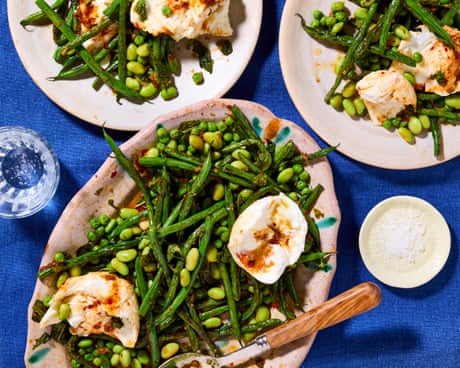
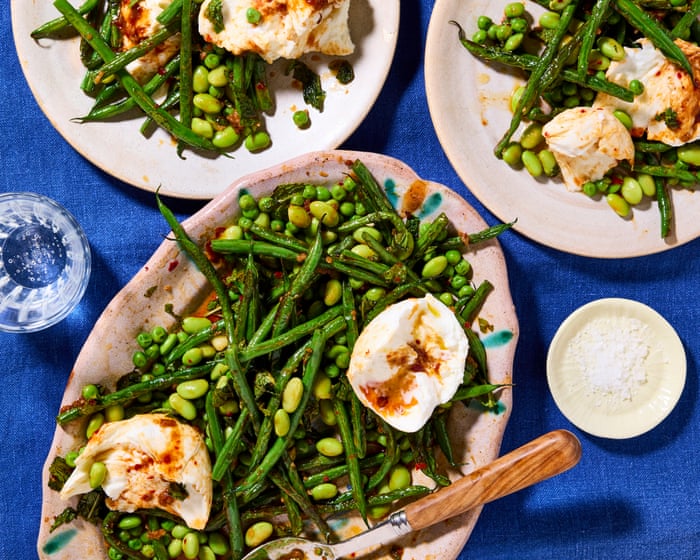
An enticing, slightly spicy, east/west fusion stacked with vigour and colour
One thing I learned during the recent hot weather is that I don’t have enough “substantial but quick salads” in my locker. A salad one could call lunch (or a light dinner when served with other bits). On rotation in my “throw-together” category is my no-cook chickpea, tomato and cucumber salad, to which I’m also going to add my favourite summer vegetable, bulgur and pesto salad, which isn’t quite an assembly job, but near-enough and a family favourite. To that line-up, I’m happy to introduce this gently spicy, green beauty.
Brazil has failed to prove compliance with EU rules on use of antibiotics in cattle and poultry farming
The UK’s leading farming organisations and animal health experts have called for an urgent ban on imports of Brazilian meat, in light of concerns over the safety of imports.
The National Farmers’ Union in England and its sister organisations in the devolved administrations wrote to the government on Friday warning that public health was at risk.
Make a batch of this vodka- and vermouth-infused tipple to keep fresh in the fridge and sip over the weeks ahead
We came up with this when we were looking to create some fun, bespoke but easy-to-serve cocktails that we could pre-batch for busy services but that still had an edge. Vodka is an especially good base for infusions because it’s so neutral, while martinis are having a real moment right now, so this ended up ticking all our boxes, being something that’s recognisable but fun, and also noticeably our own.
Alex Mammone, general manager, and Matt Beardmore, executive chef, Legare and Luna, London SE1
These sweet and fruity frozen refreshers will get you in the carnival spirit
It’s only right that on the weekend of the Notting Hill carnival, rum punch is your drink of choice. Whether or not you’re heading to west London to celebrate, these ice lollies will get you in the party mood. They’re fruity, sweet and balanced with plenty of fresh lime, and I always like to make sure there’s enough leftover rum mixture to pour over ice to drink while the lollies are setting.
Mayor Karen Bass said food vendors discourage restaurant patrons, mentioning them alongside homeless encampments. Her opponent, Nithya Raman, said vendors should be brought into the system.
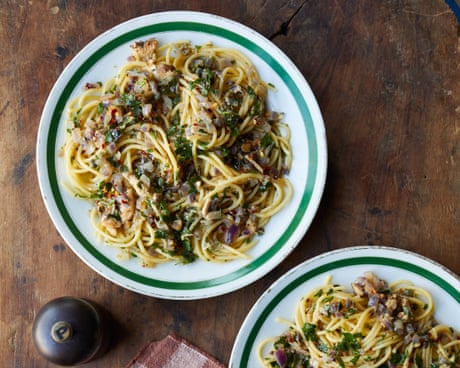
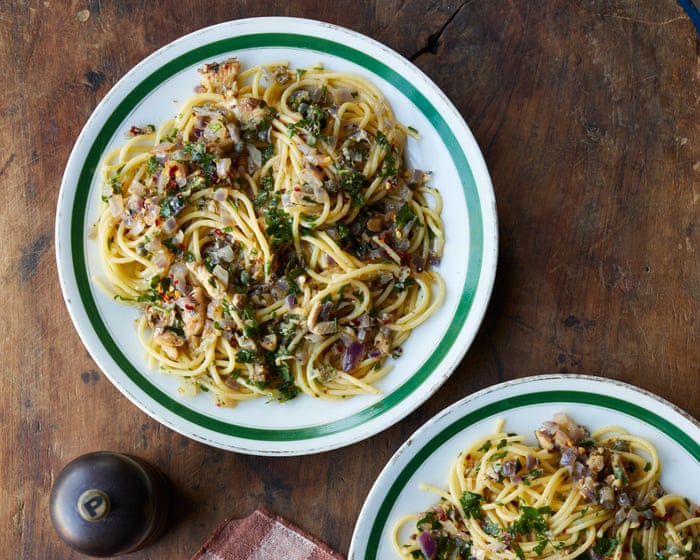
I can’t find it, despite having spent the past 35 minutes looking, but somewhere in the house is The Crisis Cook Book. It’s a standard paperback, postbox-red with white writing on the cover, and full of recipes from chefs including Rowley Leigh, Heston Blumenthal and Jeremy Lee. Not having found it, I needed Amazon to tell me it was published in 2007 and compiled by Nick Lander, at the time the Financial Times’ restaurant correspondent. He asked 28 chefs to donate three recipes – their favourite starter, main course and dessert – and proceeds from the book went to the national homelessness charity Crisis.
The reason I needed (and still need – it is now a mission) to find the book is because inside it is Rowley’s recipe for pasta with tinned sardines, fennel, chilli and lemon zest. It’s a recipe that I have made so many times, and for so many years, that I don’t need to look at the book; but, equally, because I’ve made it so many times and so much time has passed, I have no idea how far I have drifted from the original, and want to check. I’ve even written about this recipe in my weekly Guardian column, without referring to the book or even mentioning Rowley! Not that a store-cupboard version of the Sicilian pasta con le sarde (pasta with sardines and wild fennel) is owned by anyone, although Rowley did teach me.
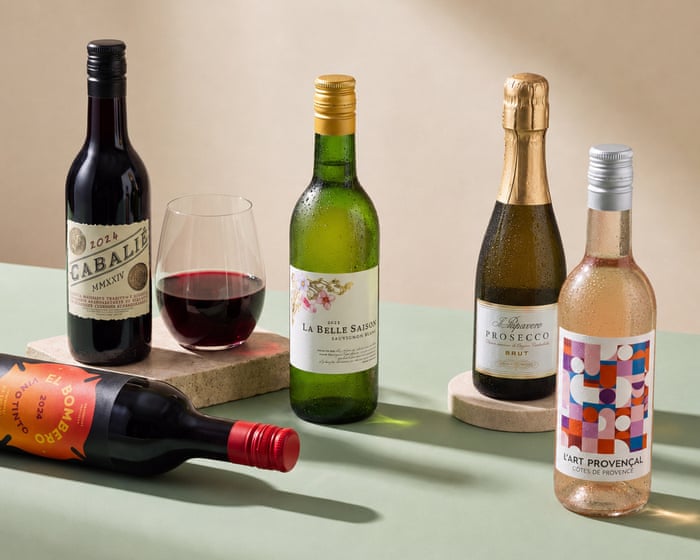
Whether they’re consumed as a considered glass for one or something to sip on a short trip, miniature wine bottles are back with a bang
In the 1920s, the London wine merchant Berry Bros & Rudd was asked to create a wine cellar for a doll’s house, commissioned by Queen Mary, to showcase the best of British craftsmanship. Designed by Edwin Lutyens, it had running water, electricity, a library of tiny books and, naturally, a wine cellar stocked with 1,200 miniature bottles, including vintage ports, an 1889 Montrachet and top-tier bordeaux. These days, the doll’s house resides in Windsor Castle, but Berry Bros has a replica of that cellar in its own Mayfair cellar, complete with 5ml bottles of those same wines.
It is fair to say that this is not representative of the calibre of wine one generally finds in miniature bottles, a format associated with air travel and what I once called “journey juice” – ie, a drop that would last me the six stops from home to London Victoria on a Friday night. Google “miniature bottles of wine” and you’ll overwhelmingly be served examples from the very biggest wine brands in the world. This is also true of canned wines, although I’d argue there’s more interesting wine going into cans than small bottles.
Although I’m un peu fatiguée of chocolates in bonbon shape with coloured cocoa-butter splashes atop, I appreciate this is the way many chocolates truffles are made. Overcoming that prejudice, I tucked into a box of Scoff chocolates. They were beautifully fresh tasting – they are made in batches throughout the year and the latest batch has just been let loose. I liked every one of the nine flavours I tested, from lemon to malted milk. But the ingredient list is long and a bit mainstream; a cleaner, more artisan approach and this would be a winning brand.
Marks & Spencer has brought out some 1980s classics in original packaging for those wanting to go full Rivals: look out for Now!, Jet, Sparks and Coconut Grove and see which chocolate classics they remind you of. My testers loved them.
What we eat and where it comes from is a critical part of human health. According to a 2025 survey, 59 percent of Americans think it’s important to know where their food comes from, and 54 percent prioritize food that is consistently available locally. And one of the best places to get that locally sourced food? Farmers markets.
The US has more than 8,700 farmers markets, where roughly 40,000 farmers sell their products. Recently, the markets have been getting a bit more attention thanks to a series of high-profile food recalls. Americans’ confidence in the safety of their food is being tested, and buying direct from your local farm could be the answer.
Some produce travels hundreds or thousands of miles from where it’s grown to where it’s sold, passing through processing, storage, and distribution facilities. One advantage of a small local farm is the direct journey the produce takes from the field to the customer. But how does a small family farm business compete with major grocery stores for customers, and what’s behind their sales pitch for safer and fresher food? We drove out to Camarillo, California, to a small family farm to find out.
This video is presented by Verizon Business. Verizon Business doesn’t have a say in our editorial decisions, but they help make videos like this one possible.
Packages of chicken breasts at a Costco Wholesale store in San Diego, California. | Kevin Carter/Getty Images
Organic chicken costs on average more than twice as much as conventional chicken, and people buy it in part because they believe that the animals are given a much better life.
Key takeaways
Consumers expect animals on organic farms to be treated better, but a new investigation found a Costco organic chicken supplier severely neglecting and abusing animals.
The investigation illustrates how easy it is for farms to flout organic rules, and how at every step of the supply chain, animal cruelty can appear to slip through the cracks.
Animal advocacy groups have called for companies like Costco to raise their standards, for the federal government to improve organic oversight, and for consumers to eat less chicken.
If you’re one of those people, maybe you envision a small farm where flocks of healthy birds split their time between green pastures and spacious barns. When a chicken gets sick or injured, you might picture a veterinarian tending to them, and if they can’t be saved, they’re humanely euthanized. While the chickens aren’t pets, you’d assume that they’re at least not abused.
These are reasonable expectations, given how organic farming is marketed. And organic chicken certification does, on paper, legally require better animal welfare than conventional rearing: more space, fresh air, outdoor access, and other improvements.
But a new undercover investigation reveals that these expectations may often be far from reality.
Earlier this year, an investigator with the nonprofit Mercy for Animals worked at an organic North Carolina farm that raises chickens for Pilgrim’s Pride, a major supplier of conventional and organic chicken. Pilgrim’s Pride then slaughters the chickens and sells them to Costco and other brands. The farm is also certified as humane by the nonprofit American Humane Society. (Disclosure: I worked at Mercy for Animals prior to joining Vox in 2020.)
During his roughly 2.5-month stint at the farm, the investigator documented unsanitary living conditions, along with severe neglect — like birds with twisted necks and open wounds — and disturbing cases of outright abuse, including the farm manager leaving birds to die slowly in deadpiles, and euthanizing birds by bludgeoning them with PVC pipes and rakes.
“It was every day that the manager would be bludgeoning chickens to death or burying them alive,” the investigator, who goes by the pseudonym Sam due to the covert nature of his work, told me.
But many of those in the industry don’t seem to want to talk about it. The farm could not be reached for comment. Hiland Global Certifications, a certifier of organic foods that audits the farm, declined an interview request for this story and did not respond to detailed questions. Costco didn’t respond to an interview request and detailed questions. Pilgrim’s Pride declined an interview request and didn’t answer specific questions.
In a statement, a spokesperson for Pilgrim’s Pride said that it is “deeply disturbed by the conduct” at the farm, that it has dropped it as a supplier, and that it will initiate additional third-party audits at its supplier farms.
However, when chicken companies — or supermarkets, for that matter — drop farms as suppliers, they shouldn’t expect that whatever farm they supply from instead will be extraordinarily different; such cruelty has been found over and over and overagain in the US poultry industry, including numerous past investigations of farms that supply Pilgrim’s Pride.
What’s notable about this new investigation is that it exposes problems within two beloved, and supposedly more ethical, institutions in American life: Costco — with its higher employee wages and stated commitments to progressive causes — and organic farming, which has long been perceived as a more moral sector of the food industry.
The investigation also reveals the immense shortcomings of governmental oversight, corporate animal welfare guidelines, and third-party inspectors, because at each step of the supply chain — from the farm, to the chicken supplier, to the organic certifiers and American Humane Society auditors, and finally, to Costco and other corporate buyers — severe animal cruelty appeared to slip through the cracks.
Organic may not mean what you think (for animals)
The USDA launched its organic certification program in the early 2000s, a time when consumers were increasingly hungry for alternatives to America’s highly industrialized food system.
When it comes to crops, organic farms can’t grow genetically modified plants or spray their crops with synthetic fertilizers and pesticides. Organic livestock operations must give their animals organic feed and are also required to give them outdoor access, more barn space, cleaner air, and other higher welfare standards than conventionally raised animals. Euthanasia must also be humane.
The investigated farm at the center of this latest Mercy for Animals investigation has about 100,000 or so live chickens on its premises at any given time, and it does give the birds more room in their barns than a conventional farm.
Among the main welfare requirements in the USDA organic program, though, this was the only one it appeared to follow. Mercy for Animals alleges that it uncovered numerous organic standard violations at the farm, including:
Outdoor access: While the farm did have outdoor space for the birds, Sam said he never saw them have access to it. (He said the manager told him Pilgrim’s Pride had a temporary exemption on this rule for farms in the area due to inclement weather that winter and spring, though “there were no major weather events during my employment,” Sam told me.)
Safe ammonia levels: Chicken waste emits a lot of ammonia, which at high enough levels can cause respiratory issues and even blindness for the birds. Levels must remain below 25 parts per million, but Sam recorded it reaching up to at least 100 ppm in one barn, which was the highest his reader went.
Darkness: Organically raised chickens must be given a minimum of eight hours of continuous darkness per day so they can sleep. However, the manager said she only gives them three to four hours (she also told Sam she planned to increase it to eight hours on the day an employee from Pilgrim’s Pride was scheduled to arrive). Chicken producers restrict darkness in order to increase profits, as more light makes the birds eat more and grow faster.
Sam said he documented more than 70 incidences of improper euthanasia, with the farm manager regularly euthanizing sick and injured chickens by bludgeoning them with PVC pipes and rakes. In one instance, the farm manager crushed a bird with a bucket, and in another, slammed a chicken against a wall.
Sam also recorded instances of chickens kicked and thrown. Many birds suffered from severe injuries, like torticollis (twisted neck), leg deformities, and lesions on their bodies and feet, while others were too weak and sick to even stand and walk.
The investigation illustrates that organic and even basic welfare standards are only as good as their enforcement. The USDA requires organic farms to be inspected yearly, which means that for the vast majority of a given year, farms that flout the rules likely won’t have any meaningful repercussions.
A spokesperson with the USDA said it is unable to comment on investigations. “Upholding organic integrity and protecting organic producers and consumers is a core mission of NOP [the National Organic Program],” a spokesperson wrote in a statement to Vox. “Part of that mission includes providing due process under the law and allowing certified organic farms to come into compliance when problems occur.”
The farm is also certified as humane by the nonprofit American Humane Society, which is known to have relatively low standards that are similar to the industry’s own general guidelines. The American Humane Society declined an interview request for this story and didn’t respond to detailed questions. “We have zero tolerance for animal cruelty and abuse,” a spokesperson wrote in a statement to Vox. “We are aware of the video and have launched an independent investigation.”
How to make organic chicken better
Mercy for Animals alleges that the farm in question violated several USDA organic standards. But it’s also important to look at what organic standards don’t include in the first place, like more humane slaughter methods and better breeding.
Breeding may sound dull and unimportant, but it’s by far the most pressing welfare issue in chicken farming, including on organic farms. The modern chicken has been bred to have abnormally large breasts, which consumers most prize. That makes it hard for their tiny legs to support their top-heavy bodies, and as a result, many have trouble walking and standing, as Sam documented.
They also grow incredibly fast, which causes some chickens to die prematurely on the farm from painful lung and heart conditions; some die from dehydration or starvation because they can’t stand and walk to reach food and water. Even the president of the World’s Poultry Science Association has acknowledged that chickens’ “existence is painful.”
So many chickens die prematurely on farms that collecting and disposing of them is a primary responsibility for chicken farmhands. “My main job duty was mostly collecting the dead,” Sam told me.
In the wake of these investigations, it’s not uncommon for companies to condemn the cruelty and drop the farm as a supplier. Similarly, many consumers vow to boycott the companies affiliated with an investigated farm.
To reinforce that point, Sam said that what he witnessed wasn’t exclusive to this one farm or meat company but is rather emblematic of the overall industry’s culture: “Every time we go into a [farm], we find the same things; it’s always animal abuse, animal cruelty.”
In a formal complaint, supported by an affidavit with photo and video evidence, Mercy for Animals is demanding the sheriff’s department in Lee County, North Carolina, to investigate and pursue criminal charges against the farm’s manager for animal cruelty and false advertising based on the many documented organic violations. But the organization’s bigger goal is to push large companies like Costco and its competitors to adopt higher animal welfare standards — and make sure they stick to them.
“This isn’t really about one investigation. … It’s about whether companies with enormous influence are willing to take responsibility for the systems that they create,” Arash Yomtobian, president and CEO of Mercy for Animals, told me. “Costco has the power to reduce suffering for more than [an estimated] 250 million chickens annually through proven reforms, like slower-growing breeds and improved living conditions, yet the company continues to choose profit over accountability.”
In 2021, Mercy for Animals released an investigation into Costco’s conventional chicken line that found many of the same welfare problems as the latest investigation. Months later, Costco said it gives its birds a little more space than the industry standard and that it was experimenting in giving birds environmental enrichment. The company didn’t follow the group’s urging to use slower-growing breeds that have less painful existences by way of fewer leg deformities and fractures, and lower rates of metabolic disorders.
SeveralEuropean countries are moving away from fast-growing chicken breeds, though the US poultry and grocery sectors have largely resisted activist pressure.
Costco says animal welfare is a “moral and ethical obligation.” Pilgrim’s Pride says providing safe and high-quality chicken housing is a priority. The American Humane Society says its standards ensure humane treatment. The USDA says its organic standards strive to align with consumer expectations on animal welfare. These are the nice things companies that sell meat, and the institutions that certify the meat, say. But Sam’s investigation — and more than 200 other ones — prove that reality rarely matches corporate platitudes.
Passing basic federal welfare laws for conventionally raised livestock (currently there are none for animals on farms and ranches).
Unannounced, frequent, and thorough organic farm audits; stricter penalties for violators; and making audits free (currently, farms pay certifier companies, which could incentivize certifiers to minimize violations and penalties in order to maintain their clientele).
Installing CCTV cameras on farms and inside slaughterhouses.
Some groups even want to see the federal government create a dedicated animal welfare agency.
There is no shortage of ideas on the table to reduce animal suffering on farms and bring more integrity to the many “humane” claims on meat, milk, and egg packages. The question is whether lawmakers and regulators have the courage to implement them.
A weekly email from our star chefs featuring the latest recipes and seasonal eating ideas
Each week we’ll send you an exclusive newsletter from our star food writers. We’ll also send you the latest recipes from our star chefs, stand-out food features and seasonal eating inspiration, plus restaurant reviews from Grace Dent.
Sign up below to start receiving the best of our culinary journalism in one mouth-watering weekly email.

 Login
Login