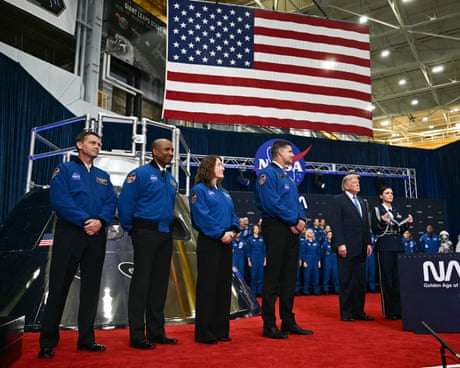
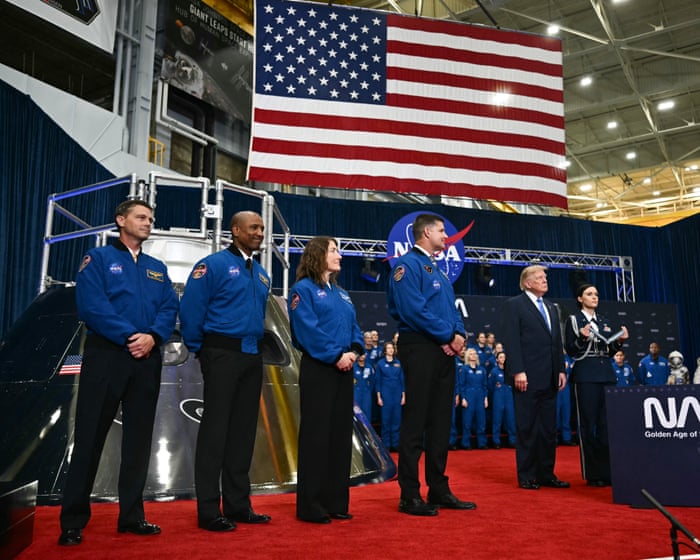
Reid Wiseman, Victor Glover, Christina Koch and Jeremy Hansen receive Congressional Space Medal of Honor
The Artemis II astronauts who flew around the moon in April received the US’s highest space honor on Friday.
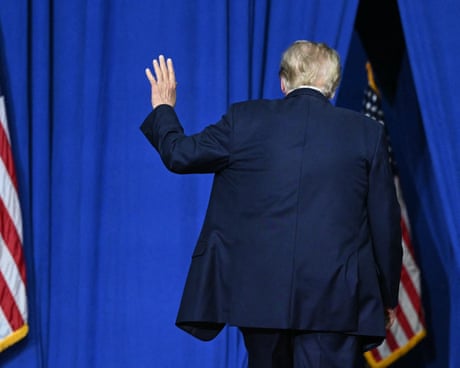
Donald Trump presented the Congressional Space Medal of Honor to the three Americans and one Canadian whose lunar flyby for the US space agency Nasa set a new distance record for humanity.
Reid Wiseman, Victor Glover, Christina Koch and Jeremy Hansen receive Congressional Space Medal of Honor
The Artemis II astronauts who flew around the moon in April received the US’s highest space honor on Friday.
Donald Trump presented the Congressional Space Medal of Honor to the three Americans and one Canadian whose lunar flyby for the US space agency Nasa set a new distance record for humanity.
Commodity Futures Trading Commission said Gabriel Perez wagered on Kalshi about words president used in speeches
A White House teleprompter operator who left his post amid accusations that he used inside knowledge to make bets on Donald Trump’s speeches on an online prediction market has been fined $172,000, according to federal regulators.
Gabriel Perez illicitly exploited “material, nonpublic information” that he gathered through his work for the president in order to place wagers on the Kalshi platform “for his personal benefit”, the Commodity Futures Trading Commission (CFTC) maintained in a news release on Friday.
In deep red South Carolina, the president helped stoke apprehension of a deeper red surge ahead of November’s US midterm elections
After casting his vote in South Carolina, a man who introduced himself as Chestnut was unwilling to give his full name. “You don’t have a need to know,” the air force veteran declared. He was, however, happy to share his views.
“I’m a true American. I believe in the USA,” said the man, outside Christ the Servant Lutheran church in Conway. “And I don’t believe in communism or socialism.”
Ignore Iran, the Epstein files, and your wallet – not to mention Trump’s plummeting approval ratings
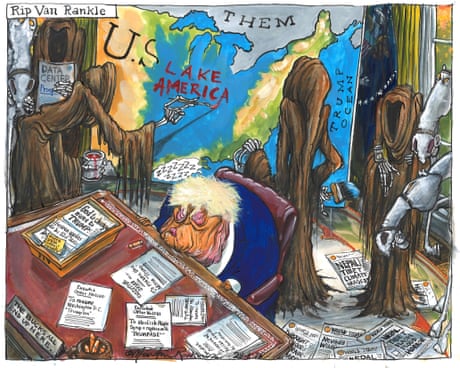
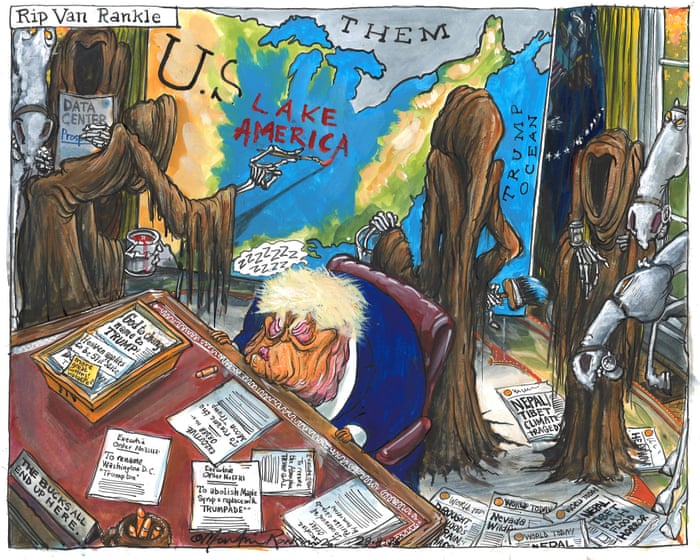
Don’t mention the war! Or the economy, for that matter. Or the Epstein files. Or Natalie Harp. Or “affordability”, which, as Donald Trump recently said at a rally, is a word that was “never used” by the media before he took office. Best not to talk about anything that affects ordinary people or embarrasses the president, really. Instead, let’s all rejoice in Trump’s latest triumph: renaming Lake Ontario, which is shared by Canada and the US, as Lake America.
On Thursday, Trump signed an executive order directing federal agencies to America-fy the lake’s name on US maps and documents, which is an excellent use of time and resources. I suppose we can at least be thankful that the president, who is trying to slap his own name on everything from airports to the Kennedy Center, didn’t decree that the body of water be called Lake Trump.
Searching for exoplanets and clues on planet formation, the Roman telescope begins million-mile journey from Florida launchpad
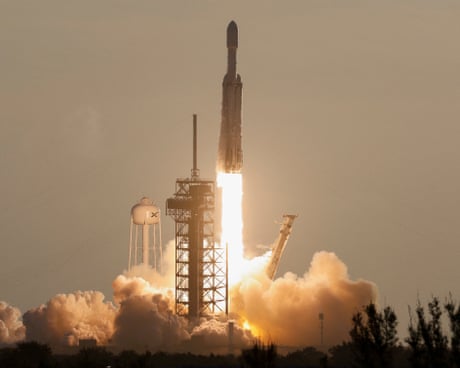
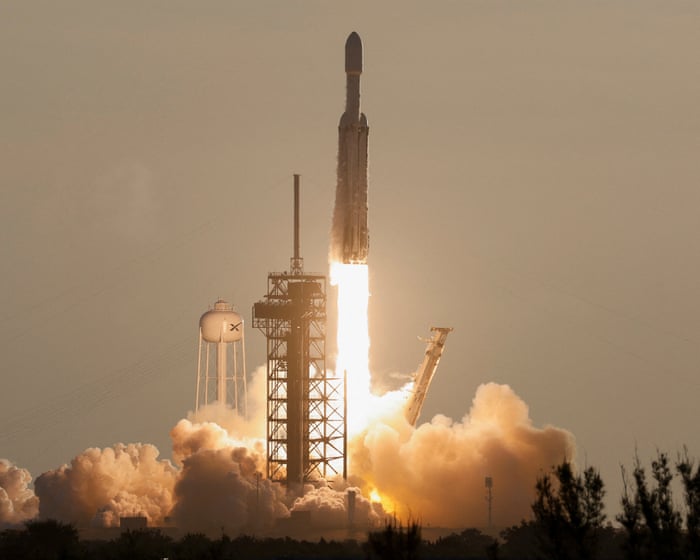
A $4.3bn space telescope that Donald Trump tried to kill has lifted off from Florida as Nasa embarks on the next stage of its quest to unlock the secrets of the universe.
The Nancy Grace Roman space telescope survived two rounds of proposed White House budget cuts, and began a million-mile journey into deep space from a launchpad at the Kennedy Space Center on Sunday morning. .
Searching for exoplanets and clues on planet formation, the Roman telescope begins million-mile journey from Florida launchpad
A $4.3bn space telescope that Donald Trump tried to kill has lifted off from Florida as Nasa embarks on the next stage of its quest to unlock the secrets of the universe.
The Nancy Grace Roman space telescope survived two rounds of proposed White House budget cuts, and began a million-mile journey into deep space from a launchpad at the Kennedy Space Center on Sunday morning. .
US president says US will have ‘majority’ control of 65bn barrels of proven oil reserves
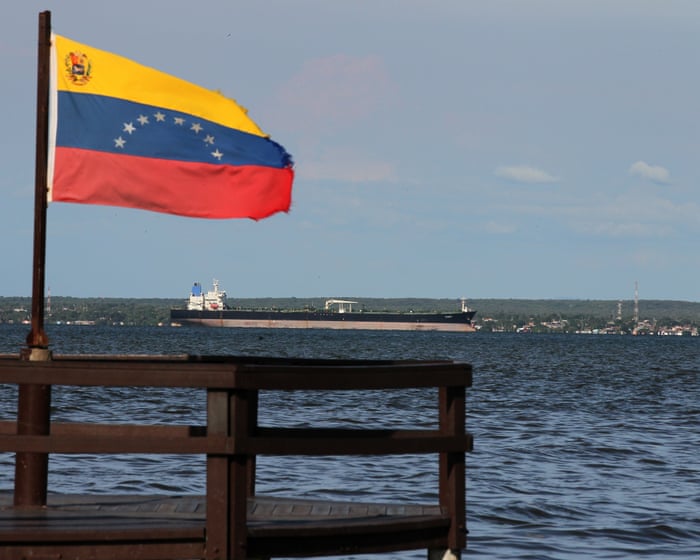
Donald Trump announced Friday a new US oil agreement with Venezuela’s interim president Delcy Rodríguez, saying the US will have “majority” control of 65bn barrels of proven oil reserves.
The terms of the agreement remain to be seen, but the US president said on his social-media platform that it had been brokered “through a partnership with private business” by his secretary of state, Marco Rubio, and defense secretary, Pete Hegseth.
US president says US will have ‘majority’ control of 65bn barrels of proven oil reserves
Donald Trump announced Friday a new US oil agreement with Venezuela’s interim president Delcy Rodríguez, saying the US will have “majority” control of 65bn barrels of proven oil reserves.
The terms of the agreement remain to be seen, but the US president said on his social-media platform that it had been brokered “through a partnership with private business” by his secretary of state, Marco Rubio, and defense secretary, Pete Hegseth.
Nearly 600 days after the devastating 2025 fires, thousands of Los Angeles residents are still waiting for more than $15bn in federal funds to rebuild their communities
As thousands of residents in Spokane, Washington, begin to grapple with a long recovery after a destructive set of blazes that consumed hundreds of homes in the state’s second most populated city this month, victims of the Los Angeles firestorm broke a grim record – they have faced the longest delay in modern history for federal aid.
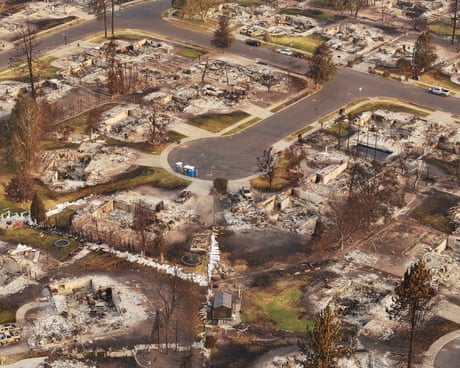
Nearly 600 days since a historic firestorm roared into communities across Los Angeles, reducing more than 16,000 structures to ash and toxic debris, the Trump administration has failed to appropriate more than $15bn in long-term recovery funds that are crucial to rebuilding. The delay in supplying the badly needed funds is months longer than the last record set when victims of the Maui fires had to wait 500 days to receive the support, LAist noted this week.
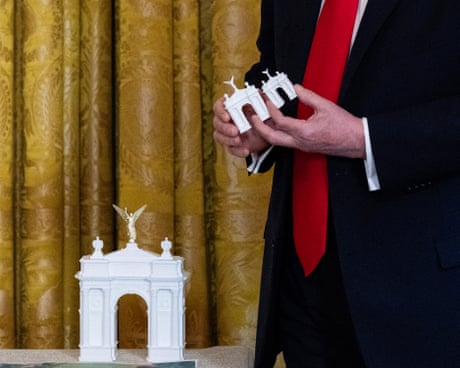
National Park Service, which backs the 250ft arch, says it is likely to disrupt historical significance of dozens of sites
A new National Park Service report backs Donald Trump’s proposed arch, despite what it says are adverse effects to the sightlines of a host of landmarks in Washington, including the Washington Monument and the Lincoln and Jefferson memorials.
The report released on Friday says the 250ft-tall (76-meter) memorial arch is likely to disrupt the historical significance of dozens of sites near its planned location adjacent to the Arlington Memorial Bridge.
Terrified of being seen as a loser, Donald Trump is nonsensically lashing out – even against our old friend Canada
I’m still grieving Dolly Parton. I never met her and always wanted to. She was almost exactly my age and my height and had values I deeply admired. Her death leaves a hole in the firmament.
Which brings me to the person whose values are as far from Dolly Parton’s as any human could possibly be and still claim to be human. I’m referring, of course, to the current occupant of the Oval Office.
The president senses a crisis in his cult of personality. He believes the path to victory is through unwavering devotion
Donald Trump has framed his theme for the midterm elections. It has come to him as naturally and inevitably as staring into the mirror, beyond any logic or argument, his definitive answer to no specific issue, providing no understanding of any particular problem, but transcending all of them. His political theme is more primal than programmatic, more instinctive than analytical, a heartfelt expression to protect his greatest romantic attachment, his obsessive fixation, his idealized object: himself.
Trump’s campaign theme is unrequited love. Unlike the pollsters, media consultants and pundits, he alone has grasped the magnitude and the source of the existential crisis threatening his politics. He has identified the problem for the Republicans as the faltering measure of complete devotion to him. His demand has nothing to do with mutual affection. It is a ploy to reassert his slipping control, a manipulative test to prove loyalty to him, or else. There can be no absolute rule without an absolute ruler; no absolute ruler without absolute submission; no absolute submission without the expression of absolute love. His sadness at its fading gives way to anger, paranoia and greater acts of retribution. He equates the fear he instills as a form of love. Trump accepts subservience, from whatever motive, as affection or its closest equivalent. He cares nothing about sincerity, so it’s all in the show. The less love displayed, the more fear required. Yet there is no rebound, but only deeper rejection.
President denies visit was to gain support for Iran sanctions or due to fears that Putin plans to ‘test Nato resolve’
Donald Trump has downplayed a visit to Moscow by the CIA director, John Ratcliffe, as “semi-routine” after he turned up in the Russian capital unannounced, triggering a wave of speculation about the reasons for his trip.
Ratcliffe was reported to have flown to Moscow on a government transport plane on Tuesday in a rare visit after taking off from the Andrews air force base in Maryland.
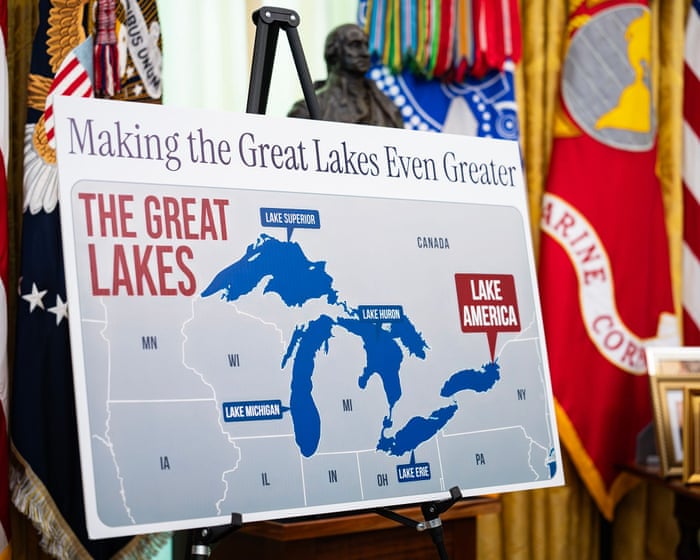
Donald Trump displays a map labeling Lake Ontario as "Lake America" in the Oval Office of the White House on August 27, 2026. | Andrew Harnik/Getty Images
This story appeared in The Logoff, a daily newsletter that helps you stay informed about the Trump administration without letting political news take over your life. Subscribe here.
Welcome to The Logoff: Donald Trump says he’s renaming Lake Ontario. Let’s talk about it.
Can he really do that? Probably, though it doesn’t mean anyone will listen.
Strictly speaking, Trump’s executive order, signed Thursday in the Oval Office, directs the Interior Department to update the lake’s name to “Lake America” in the US’s Geographic Names Information System. It remains to be seen whether products like Apple and Google maps will follow suit, but New York Gov. Kathy Hochul, whose state contains the US portion of the lake, says she won’t.
Why is he doing that? The immediate answer is that Trump launched a trade war with Canada over the weekend, and he’s mad that Canadian Prime Minister Mark Carney won’t give him what he wants; this is a petty way to lash out.
That doesn’t explain the trade war itself, though. Unfortunately, when my colleague, noted Canadian resident Zack Beauchamp, went looking earlier this week, he couldn’t find an explanation either. As he writes, there’s absolutely no constituency for this fight — other than Trump’s own imperial desires as he keeps joking-but-maybe-not-joking about making Canada the 51st state.
Isn’t this just a stupid stunt? It’s a stupid stunt — but not just that. As my colleague Caitlin Dewey wrote earlier this week and Zack can attest, Canadians are royally pissed at the US. The trade war might feel like one more Trump fit of pique to Americans, but for Canadians, it’s a serious threat.
Thursday’s executive order further ratchets up those tensions, and it specifically plays into the (very credible) school of thought that Trump isn’t really in this to redress US-Canada trade imbalances; as with many things Trump, it’s about dominance and the desire to claim a “win” at any cost.
Lastly, it’s worth dwelling for a second on the stunt itself. One, Lake Ontario isn’t Canada’s name for it; it predates either country. And two, ad hoc renaming of bodies of water — this isn’t even the first time this Trump term — puts Trump in some fairly uncomfortable company.
And with that, it’s time to log off…
My colleague Sara Herschander just debuted her new newsletter, Nice Things, which feels like a great fit for this section. It’s all about dreaming big to build a better America, one with widespread high-speed rail, affordable housing, and infrastructure that works. You can subscribe here and read a story from the first edition here.
Thanks for reading, have a great evening, and we’ll see you back here tomorrow!
Even people sympathetic to President Donald Trump’s economic nationalism seem confused about the trade war with Canada. | Andrew Harnik/Getty Images
LONDON, Ontario — President Donald Trump seems dead set on escalating his trade war with Canada. And no one is really sure why.
On Monday, Trump threatened another round of 50 percent tariffs on top of the ones he just implemented — this one targeting Canada’s auto industry, which is so deeply integrated with its American counterpart that large duties would do major damage on both sides of the border. By Tuesday morning, he had begun musing about renaming Lake Ontario “Lake America” to spite Canadians. And throughout all of this, he and Vice President JD Vance had renewed their “jokes” about absorbing Canada as the 51st state.
But who is this even for? While the White House’s behavior infuriates Canadians — it is palpable on the ground here in Canada — it’s unusual by Trump standards in that nobody seems to want this conflict but him.
Even the most fringe, or unpopular, foreign policy ideas he’s pursued typically have think tanks devoted to pushing them, or a loyal ally to please, or a voting bloc to rile up before the midterms. But unlike, say, Trump’s conflicts with Iran, or Cuba, or China, it’s hard to find a highly visible corner of conservatism that’s the driving force behind a nationalist campaign against Canada.
When I reached out to trade experts, political scientists, and in-the-know Republicans of the pro- and anti- Trump persuasion to try to trace the origins of Trump’s trade war, they had trouble pointing to anything solid. As one veteran GOP lobbyist put it, there doesn’t seem to be any ideological, business, or congressional coalition devoted to egging on the trade fight.
Even people sympathetic to Trump’s economic nationalism seem confused: Michael Lind, a populist pundit who last year penned a piece titled “Why tariffs are good,” has just written a follow-up titled “The madness of Trump’s Canada trade war.” And while there are some affected industries — autos, steel — they don’t seem to be main characters: United Auto Workers, which backed some prior tariffs, came out strongly against the proposed auto tariffs.
The politics don’t make much sense either. American voters have long disapproved of Trump’s tariffs on Canadian-made goods, and the current escalation threatens to be the largest and most economically damaging yet. Republicans sound anxious about its impact on the midterms; several key Senate races are in states right on the Canadian border, and any tariff-related price spike there could supercharge Democrats’ core midterm message about affordability.
“This has never been a particularly well-thought strategy. I think that the biggest, most coherent explanation is that this is about power.”
Kim Clausing, UCLA trade economist
“If I were [Senate Majority Leader] John Thune, I’d be very pissed at Trump right now,” says Adam Carlson, a Democratic pollster at Zenith Research.
So why are we at (economic) war?
The best answer is deceptively simple: because Trump, and Trump alone, wants to be.
There is no good strategic rationale for the way Trump has gone about badgering America’s northern neighbor, even if you share his broadly nationalist view about trade. Rather, Trump has become fixated on dominating or even possessing Canada. And his top deputies are backfilling his fixation, including by offering terms of surrender the Canadians simply couldn’t accept.
“This has never been a particularly well-thought strategy,” says Kim Clausing, a trade economist at UCLA. “I think that the biggest, most coherent explanation is that this is about power.”
It’s the latest example of the risks of governance by one man’s whims — one that could both damage America’s economy and burn its relationship with its staunchest ally before it resolves.
Trump’s northern power trip
Typically, when you try to explain the policy of any government, you look at two main factors: interests and ideology. In this case, neither is close to sufficient to explain the intensity of Trump’s war on Canada.
It is true that, for decades, the United States has had meaningful trade disputes with Canada over issues like lumber and dairy. But these issues never boiled over into a massive trade war, for the simple reason that they simply aren’t that large as a percentage of GDP. There’s a reason that every administration prior to this one — including Trump’s first — handled these issues through normal negotiating processes rather than loud bullying.
On the ideology front, it is true that Trump’s 2016 victory has revived conservative interest in economic nationalism — leading to the creation of groups like American Compass, a think tank dedicated to putting policy meat on the bones of the right’s nationalist spirit. But these nationalists largely converged on China as their principal economic enemy. While Trump trade adviser Peter Navarro is helping run Canada policy now, there was no sign in his essay in Project 2025 — or from other allies — that anyone was contemplating a full-on trade war with Canada beforehand. And American Compass does not appear to be involved in the current fight, offering no official comment on its press page or founder Oren Cass’s X feed.
“I really do think it is Trump’s idiosyncrasies that caused him to settle on Canada,” says Phil Magness, an economic historian who closely tracks intra-right economic disputes. “Others in the admin are going along with it.”
The timeline backs up Magness’s assessment.
In November 2024, shortly after winning the election, Trump began feuding with then-Prime Minister Justin Trudeau — calling him “governor” and beginning his talk of Canada as the 51st state. Less than two months after taking office, Trump targeted Canada with (at that point) historically high 25 percent across-the-board tariffs.
When the Washington Post investigated the rationale behind these tariffs at the time, they found a void. There was no policy paper behind the Canadian tariffs, nor any clear intellectual godfather or industry backer. People inside the administration put all the credit (or blame?) solely at the president’s feet. Within MAGA media, the closest to radical anti-Canada sentiment might have been Tucker Carlson’s trollish musing about “regime change” in 2023.
After Mark Carney replaced Trudeau as prime minister, and won the general election primarily on an anti-Trump platform, tensions cooled to a somewhat surprising degree, at least when it came to trade talks. Prior to this week, the 51st state rhetoric had declined dramatically; negotiations on trade looked like they had a real chance of success. Indeed, just this Tuesday, Trump himself declared they had reached a deal and postponed tariff implementation as a result. The Friday breakdown thus felt like a bit of a shock.
But reading detailedaccounts of the negotiation collapse, including a brand-new ticktock from the New York Times, it’s clear that overweening American conditions were a major part of the failure. Most strikingly, and relevant, were US demands that it have control over Canada’s tariff rates with other countries and that it be able to reimpose American tariffs on Canada at will.
The key point here is that the Trump administration was not, and never has been, interested in a reciprocal trade deal between allies based on clear and cogent principles. Instead, they want to vassalize Canada — to bully it into surrendering elements of its sovereignty, or even its sovereign existence altogether. It is clear that this is the direct result of the president’s personal fixation.
Why exactly Trump has become so obsessed with controlling Canada is harder to say. Per the Post, there are theories ranging from bitterness around a legal battle over Trump Tower Toronto to his friendship with Kevin O’Leary, Canadian entrepreneur and host of the reality show Shark Tank. Certainly, his more recent rivalry with Carney hasn’t helped: “Canada lives because of the United States,” Trump declared, menacingly, after the prime minister delivered a critical foreign policy speech in January.
My own personal theory is that it’s of a piece with Trump’s desire to acquire Greenland, another cause that’s largely unique to him. He is looking toward his presidential legacy, and nothing makes a real estate developer think “legacy” more than literally enlarging the size of the United States on the map.
But in practical terms, the reason may be immaterial. Whatever the roots of Trump’s Canada fixation, we know that it is real and a major driver in US foreign policy — one so important, in fact, that he is willing to jeopardize his party’s all-important Senate majority in order to pursue it.
As photojournalist sentenced to 15 years, rights groups warn law would turn civic engagement into security crime
Iran has taken the first step towards criminalising contact with foreign media, in a move human rights groups have said attempts to “sever the entire Iranian society from the rest of the world”.
For journalists, researchers and even ordinary citizens, the proposed law being discussed by Iranian lawmakers this month could make speaking to international audiences and groups a potential criminal act and restrict coverage of events such as January’s mass anti-regime protests.
Scaffolding and tarps cover the facade of the John F. Kennedy Center for the Performing Arts on June 30, 2026. | Al Drago/Washington Post via Getty Images
This story appeared in The Logoff, a daily newsletter that helps you stay informed about the Trump administration without letting political news take over your life. Subscribe here.
Welcome to The Logoff: President Donald Trump is threatening that if he can’t have the Kennedy Center, no one can.
What’s going on? Trump has been trying to get his name back on the John F. Kennedy Center for Performing Arts since June, when it was removed in response to a court order. On Monday night, the Justice Department revealed its latest ploy to make that happen.
In a court filing, the DOJ argued that if its renovation plans for the Kennedy Center aren’t allowed to go forward, “the center will deteriorate further into an unsafe, decrepit structure that will be required to be taken down” and replaced by another structure, “such as a large outdoor amphitheater.”
Tied up in the proposed $250 million renovation are three new tributes to Trump, which the Kennedy Center board (stacked with Trump appointees) voted to add earlier this month: the text “renovated and restored by President Donald J. Trump” and “endowed by The Trump Kennedy Center Fund” on the building’s facade, and the renaming of the Kennedy Center grounds as “President Donald J. Trump Plaza.”
Those changes are currently being challenged in court by Rep. Joyce Beatty (D-OH), who successfully sued to undo Trump’s first renaming of the center. But the Trump administration claims her suit endangers the entire project.
What does Trump’s name have to do with the renovations? According to the DOJ filing, “an order blocking the Board from appropriately recognizing President Trump will cause donors to flee, financial contributions to dry up, and structural rehabilitation to stop.”
“There will simply not be the expertise or funding necessary to rebuild and renovate this decimated structure,” it adds.
Is that true? No. Congress already approved $257 million for the renovation last year, which the Kennedy Center board touted in a press release crediting Trump.
And far from being a draw, the Washington Post reported Tuesday, Trump’s previous renaming of the Kennedy Center caused ticket sales and donations to plummet, creating a $23 million deficit even after deep spending cuts.
And with that, it’s time to log off…
Universally beloved country music star Dolly Parton died on Tuesday at age 80. Here’s one song to remember her, and a story about what she described as “one of the greatest things that I’ve ever done in my life”: a literacy program that, as of this year, has gifted more than 332 million books to children.
Earlier this month, Trump sent a letter to Lisa Cook, a Joe Biden appointee to the Federal Reserve, demanding that she respond to exceedingly flimsy allegations that she committed mortgage fraud. This is the first step in a process that is likely to end in Trump attempting to remove her from the Federal Reserve’s board a second time — which means that the courts will inevitably have to get involved once again.
It’s tempting to blame this bout of déjà vu on Trump, but the Supreme Court is at least as responsible for his actions as the president itself. If the Court didn’t want Trump to thumb its nose at their decision in Trump v. Cook (2026), they should have written that decision clearly enough that lawyers could actually figure out what the president is and is not allowed to do.
The Cook decision, which involved Trump’s first attempt to fire Cook, is similarly incomprehensible. It was handed down the same morning as Trump v. Slaughter (2026), which seems to hold that Trump can fire anyone who leads a federal agency. But Cook does not even cite the Slaughter decision, much less explain why the two cases are different.
Slaughter was grounded in the “unitary executive,” a theory shared by all six of the Court’s Republicans which claims that the president must have full control over federal agencies, including the power to fire their leaders — and thus agencies that have some ability to act independently of the president, such as the Federal Reserve, are unconstitutional. Cook suggests that there’s a Federal Reserve exception to this theory, although the opinion does not offer a clear explanation of why this exception exists.
There are very good policy reasons why Trump should not be able to fire Cook, or any other member of the Federal Reserve’s board. The Fed has the power to inject cocaine into the US economy, temporarily giving it a boost at the price of much greater turmoil and higher inflation down the road. If presidents are allowed to fire the Fed’s leaders, they can remove anyone who refuses to give the economy a bump during an election year — boosting the president or his party’s reelection chances, and triggering consequences that won’t be felt until after the election is over.
But the fact that preserving the Fed’s independence from the president is a good idea does not mean that the Constitution permits it. And, in Slaughter and several related cases, the Court’s Republican majority endorsed an interpretation of the Constitution that is completely incompatible with the idea of an independent Federal Reserve.
That means that, until the Court resolves this tension between Slaughter and Cook, there’s likely to be a great deal of confusion about who really controls the Fed — Trump or its current board — and whether Trump may effectively order the Fed to take actions that benefit him, but that could cause lasting harm to the US economy.
The unitary executive, briefly explained
The issue at the heart of Cook was whether the president is able to fire a member of the Federal Reserve.
Federal law provides that the Federal Reserve’s governors may only be fired “for cause,” and not simply because the president does not like them or disagrees with their policy views. The Republican justices have also long argued that Congress is forbidden from limiting the president’s power to fire federal agency leaders, because this would give the president less than full control over the federal government’s executive branch.
These justices point to a line in the Constitution that states that “the executive power shall be vested in a President of the United States of America.” According to the Court’s Republican majority, this means that the president must have full control over any federal agency that wields power that is “executive” in nature, including the power to fire that agency’s leaders for any reason whatsoever. As Justice Antonin Scalia wrote in an influential 1988 dissenting opinion, this constitutional provision “does not mean some of the executive power, but all of the executive power” is held by the president.
There are numerous problems with this unitary executivetheory. The biggest one is that, while the Constitution does say that there is something called the “executive power” that belongs to the president, it does not define what this power is, and the Court’s decisions embracing the idea of a unitary executive often rely on dubious historical claims.
But, regardless of whether the unitary executive rests on a sound reading of the Constitution, it is now the law. And Slaughter suggests that this Court’s definition of the term “executive power” is quite expansive. In that case, the Court indicated that any agency leader who “enforces and administers” a federal statute wields “executive” power, and thus must be fireable at will by the president.
But then, almost immediately after the Court handed down Slaughter, it ruled in Cook that Trump could not fire one of the Fed’s leaders — or, at least, that he could not do so right away.
The Cook decision is word salad
Under the Republican justices’ definition of which officials wield executive power, and thus must be fireable at will by the president, Cook clearly should qualify. But five justices, the three Democrats plus Chief Justice John Roberts and Justice Brett Kavanaugh, joined a majority opinion by Roberts that, at least, temporarily delayed Trump’s ability to fire Cook. Three other justices took the coward’s way out, arguing in dissent that Trump should win on narrow procedural grounds that would have allowed him to fire Cook, but that also might permit a court to reinstate her at some point in the future.
Only Justice Clarence Thomas seemed to fully embrace the unitary executive theory, in Cook, and with it the idea that firing Cook is well within Trump’s power.
Thus, if Slaughter is correct that an agency leader who “enforces and administers” a federal statute must be fireable at will by the president, Trump should have the power to fire Cook.
Roberts’s majority opinion doesn’t really make a legal argument. But it does make a couple of historical and policy claims that point in the direction of allowing an independent Federal Reserve to exist. Roberts begins his opinion with a history of nationally chartered banks, noting that the first such bank “predates even our Constitution “And he alludes to a “‘long tradition’ of ‘monetary policy … exercised independent of … executive influence.’”
But it’s hard to tell why this tradition matters, at least in a world where every other federal agency is subject to the unitary executive. The Republican justices have previously claimed, for example, that the president must have full control over all federal prosecutions. But historical evidence suggests that, at the founding, prosecutions were often led by private attorneys or by judicial appointees — that is, not by the president or his appointees. So why doesn’t this historical evidence exempt the Justice Department from the unitary executive?
And, if the legal reasoning in Cook is thin, the decision’s actual holding is largely toothless. After laying out his half-baked argument for why the Federal Reserve is unlike any other federal agency, Roberts doesn’t actually write that Trump may not fire Cook. He simply says that “Cook was entitled to notice and some opportunity to respond prior to her termination” — although Roberts also writes that, once Cook has a chance to respond to the allegations against her, “only then can the courts assess the validity and sufficiency of such charges.”
So, by sending a letter to Cook informing her of the allegations against her and giving her a little bit of time to respond, Trump has complied with the Supreme Court’s decision. He will likely then attempt to fire her no matter what she says in response, and then there will be another round of litigation where some poor trial judge will have to “assess the validity and sufficiency” of the allegations against Cook without any guidance from the Supreme Court regarding how strong those allegations must be.
That said, it is likely that when Cook does respond to Trump’s allegations, those allegations will prove quite flimsy indeed. Trump alleges that Cook committed mortgage fraud by claiming two separate properties as her principal residence in bank documents. But Reuters examined those bank documents and discovered that she disclosed to the lender that one of those properties would be used as a vacation home. So it appears that no fraud actually occurred.
Will that be enough for Cook to keep her job? The short answer is “probably” — why would the Supreme Court have handed down such an incoherent opinion in Cook if it intended to apply the unitary executive to her anyway? But the Cook opinion itself offers little guidance to the judges who will need to sort through this mess.

 Login
Login