Terrified of being seen as a loser, Donald Trump is nonsensically lashing out – even against our old friend Canada
I’m still grieving Dolly Parton. I never met her and always wanted to. She was almost exactly my age and my height and had values I deeply admired. Her death leaves a hole in the firmament.
Which brings me to the person whose values are as far from Dolly Parton’s as any human could possibly be and still claim to be human. I’m referring, of course, to the current occupant of the Oval Office.
The president senses a crisis in his cult of personality. He believes the path to victory is through unwavering devotion
Donald Trump has framed his theme for the midterm elections. It has come to him as naturally and inevitably as staring into the mirror, beyond any logic or argument, his definitive answer to no specific issue, providing no understanding of any particular problem, but transcending all of them. His political theme is more primal than programmatic, more instinctive than analytical, a heartfelt expression to protect his greatest romantic attachment, his obsessive fixation, his idealized object: himself.
Trump’s campaign theme is unrequited love. Unlike the pollsters, media consultants and pundits, he alone has grasped the magnitude and the source of the existential crisis threatening his politics. He has identified the problem for the Republicans as the faltering measure of complete devotion to him. His demand has nothing to do with mutual affection. It is a ploy to reassert his slipping control, a manipulative test to prove loyalty to him, or else. There can be no absolute rule without an absolute ruler; no absolute ruler without absolute submission; no absolute submission without the expression of absolute love. His sadness at its fading gives way to anger, paranoia and greater acts of retribution. He equates the fear he instills as a form of love. Trump accepts subservience, from whatever motive, as affection or its closest equivalent. He cares nothing about sincerity, so it’s all in the show. The less love displayed, the more fear required. Yet there is no rebound, but only deeper rejection.
President denies visit was to gain support for Iran sanctions or due to fears that Putin plans to ‘test Nato resolve’
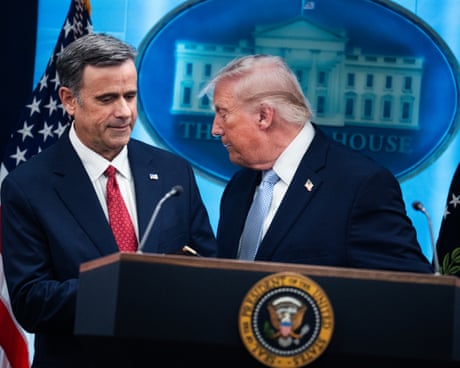
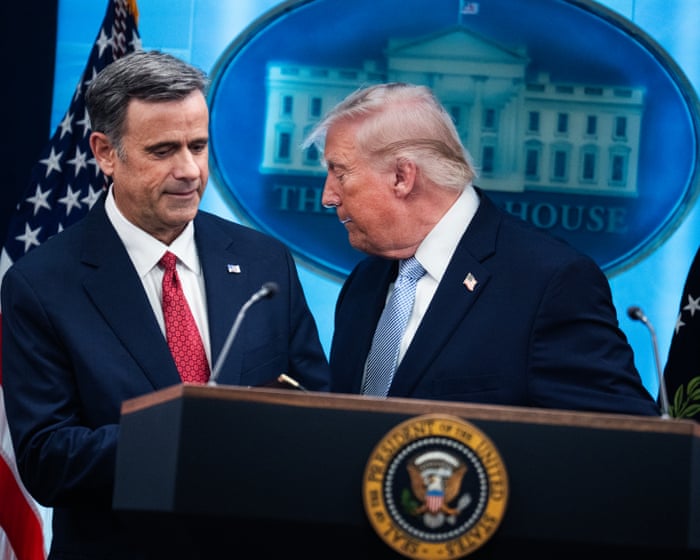
Donald Trump has downplayed a visit to Moscow by the CIA director, John Ratcliffe, as “semi-routine” after he turned up in the Russian capital unannounced, triggering a wave of speculation about the reasons for his trip.
Ratcliffe was reported to have flown to Moscow on a government transport plane on Tuesday in a rare visit after taking off from the Andrews air force base in Maryland.
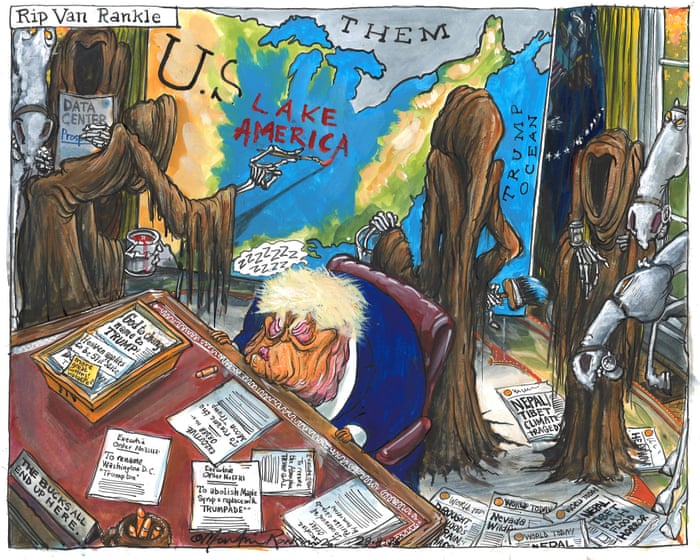
Donald Trump displays a map labeling Lake Ontario as "Lake America" in the Oval Office of the White House on August 27, 2026. | Andrew Harnik/Getty Images
This story appeared in The Logoff, a daily newsletter that helps you stay informed about the Trump administration without letting political news take over your life. Subscribe here.
Welcome to The Logoff: Donald Trump says he’s renaming Lake Ontario. Let’s talk about it.
Can he really do that? Probably, though it doesn’t mean anyone will listen.
Strictly speaking, Trump’s executive order, signed Thursday in the Oval Office, directs the Interior Department to update the lake’s name to “Lake America” in the US’s Geographic Names Information System. It remains to be seen whether products like Apple and Google maps will follow suit, but New York Gov. Kathy Hochul, whose state contains the US portion of the lake, says she won’t.
Why is he doing that? The immediate answer is that Trump launched a trade war with Canada over the weekend, and he’s mad that Canadian Prime Minister Mark Carney won’t give him what he wants; this is a petty way to lash out.
That doesn’t explain the trade war itself, though. Unfortunately, when my colleague, noted Canadian resident Zack Beauchamp, went looking earlier this week, he couldn’t find an explanation either. As he writes, there’s absolutely no constituency for this fight — other than Trump’s own imperial desires as he keeps joking-but-maybe-not-joking about making Canada the 51st state.
Isn’t this just a stupid stunt? It’s a stupid stunt — but not just that. As my colleague Caitlin Dewey wrote earlier this week and Zack can attest, Canadians are royally pissed at the US. The trade war might feel like one more Trump fit of pique to Americans, but for Canadians, it’s a serious threat.
Thursday’s executive order further ratchets up those tensions, and it specifically plays into the (very credible) school of thought that Trump isn’t really in this to redress US-Canada trade imbalances; as with many things Trump, it’s about dominance and the desire to claim a “win” at any cost.
Lastly, it’s worth dwelling for a second on the stunt itself. One, Lake Ontario isn’t Canada’s name for it; it predates either country. And two, ad hoc renaming of bodies of water — this isn’t even the first time this Trump term — puts Trump in some fairly uncomfortable company.
And with that, it’s time to log off…
My colleague Sara Herschander just debuted her new newsletter, Nice Things, which feels like a great fit for this section. It’s all about dreaming big to build a better America, one with widespread high-speed rail, affordable housing, and infrastructure that works. You can subscribe here and read a story from the first edition here.
Thanks for reading, have a great evening, and we’ll see you back here tomorrow!
Even people sympathetic to President Donald Trump’s economic nationalism seem confused about the trade war with Canada. | Andrew Harnik/Getty Images
LONDON, Ontario — President Donald Trump seems dead set on escalating his trade war with Canada. And no one is really sure why.
On Monday, Trump threatened another round of 50 percent tariffs on top of the ones he just implemented — this one targeting Canada’s auto industry, which is so deeply integrated with its American counterpart that large duties would do major damage on both sides of the border. By Tuesday morning, he had begun musing about renaming Lake Ontario “Lake America” to spite Canadians. And throughout all of this, he and Vice President JD Vance had renewed their “jokes” about absorbing Canada as the 51st state.
But who is this even for? While the White House’s behavior infuriates Canadians — it is palpable on the ground here in Canada — it’s unusual by Trump standards in that nobody seems to want this conflict but him.
Even the most fringe, or unpopular, foreign policy ideas he’s pursued typically have think tanks devoted to pushing them, or a loyal ally to please, or a voting bloc to rile up before the midterms. But unlike, say, Trump’s conflicts with Iran, or Cuba, or China, it’s hard to find a highly visible corner of conservatism that’s the driving force behind a nationalist campaign against Canada.
When I reached out to trade experts, political scientists, and in-the-know Republicans of the pro- and anti- Trump persuasion to try to trace the origins of Trump’s trade war, they had trouble pointing to anything solid. As one veteran GOP lobbyist put it, there doesn’t seem to be any ideological, business, or congressional coalition devoted to egging on the trade fight.
Even people sympathetic to Trump’s economic nationalism seem confused: Michael Lind, a populist pundit who last year penned a piece titled “Why tariffs are good,” has just written a follow-up titled “The madness of Trump’s Canada trade war.” And while there are some affected industries — autos, steel — they don’t seem to be main characters: United Auto Workers, which backed some prior tariffs, came out strongly against the proposed auto tariffs.
The politics don’t make much sense either. American voters have long disapproved of Trump’s tariffs on Canadian-made goods, and the current escalation threatens to be the largest and most economically damaging yet. Republicans sound anxious about its impact on the midterms; several key Senate races are in states right on the Canadian border, and any tariff-related price spike there could supercharge Democrats’ core midterm message about affordability.
“This has never been a particularly well-thought strategy. I think that the biggest, most coherent explanation is that this is about power.”
Kim Clausing, UCLA trade economist
“If I were [Senate Majority Leader] John Thune, I’d be very pissed at Trump right now,” says Adam Carlson, a Democratic pollster at Zenith Research.
So why are we at (economic) war?
The best answer is deceptively simple: because Trump, and Trump alone, wants to be.
There is no good strategic rationale for the way Trump has gone about badgering America’s northern neighbor, even if you share his broadly nationalist view about trade. Rather, Trump has become fixated on dominating or even possessing Canada. And his top deputies are backfilling his fixation, including by offering terms of surrender the Canadians simply couldn’t accept.
“This has never been a particularly well-thought strategy,” says Kim Clausing, a trade economist at UCLA. “I think that the biggest, most coherent explanation is that this is about power.”
It’s the latest example of the risks of governance by one man’s whims — one that could both damage America’s economy and burn its relationship with its staunchest ally before it resolves.
Trump’s northern power trip
Typically, when you try to explain the policy of any government, you look at two main factors: interests and ideology. In this case, neither is close to sufficient to explain the intensity of Trump’s war on Canada.
It is true that, for decades, the United States has had meaningful trade disputes with Canada over issues like lumber and dairy. But these issues never boiled over into a massive trade war, for the simple reason that they simply aren’t that large as a percentage of GDP. There’s a reason that every administration prior to this one — including Trump’s first — handled these issues through normal negotiating processes rather than loud bullying.
On the ideology front, it is true that Trump’s 2016 victory has revived conservative interest in economic nationalism — leading to the creation of groups like American Compass, a think tank dedicated to putting policy meat on the bones of the right’s nationalist spirit. But these nationalists largely converged on China as their principal economic enemy. While Trump trade adviser Peter Navarro is helping run Canada policy now, there was no sign in his essay in Project 2025 — or from other allies — that anyone was contemplating a full-on trade war with Canada beforehand. And American Compass does not appear to be involved in the current fight, offering no official comment on its press page or founder Oren Cass’s X feed.
“I really do think it is Trump’s idiosyncrasies that caused him to settle on Canada,” says Phil Magness, an economic historian who closely tracks intra-right economic disputes. “Others in the admin are going along with it.”
The timeline backs up Magness’s assessment.
In November 2024, shortly after winning the election, Trump began feuding with then-Prime Minister Justin Trudeau — calling him “governor” and beginning his talk of Canada as the 51st state. Less than two months after taking office, Trump targeted Canada with (at that point) historically high 25 percent across-the-board tariffs.
When the Washington Post investigated the rationale behind these tariffs at the time, they found a void. There was no policy paper behind the Canadian tariffs, nor any clear intellectual godfather or industry backer. People inside the administration put all the credit (or blame?) solely at the president’s feet. Within MAGA media, the closest to radical anti-Canada sentiment might have been Tucker Carlson’s trollish musing about “regime change” in 2023.
After Mark Carney replaced Trudeau as prime minister, and won the general election primarily on an anti-Trump platform, tensions cooled to a somewhat surprising degree, at least when it came to trade talks. Prior to this week, the 51st state rhetoric had declined dramatically; negotiations on trade looked like they had a real chance of success. Indeed, just this Tuesday, Trump himself declared they had reached a deal and postponed tariff implementation as a result. The Friday breakdown thus felt like a bit of a shock.
But reading detailedaccounts of the negotiation collapse, including a brand-new ticktock from the New York Times, it’s clear that overweening American conditions were a major part of the failure. Most strikingly, and relevant, were US demands that it have control over Canada’s tariff rates with other countries and that it be able to reimpose American tariffs on Canada at will.
The key point here is that the Trump administration was not, and never has been, interested in a reciprocal trade deal between allies based on clear and cogent principles. Instead, they want to vassalize Canada — to bully it into surrendering elements of its sovereignty, or even its sovereign existence altogether. It is clear that this is the direct result of the president’s personal fixation.
Why exactly Trump has become so obsessed with controlling Canada is harder to say. Per the Post, there are theories ranging from bitterness around a legal battle over Trump Tower Toronto to his friendship with Kevin O’Leary, Canadian entrepreneur and host of the reality show Shark Tank. Certainly, his more recent rivalry with Carney hasn’t helped: “Canada lives because of the United States,” Trump declared, menacingly, after the prime minister delivered a critical foreign policy speech in January.
My own personal theory is that it’s of a piece with Trump’s desire to acquire Greenland, another cause that’s largely unique to him. He is looking toward his presidential legacy, and nothing makes a real estate developer think “legacy” more than literally enlarging the size of the United States on the map.
But in practical terms, the reason may be immaterial. Whatever the roots of Trump’s Canada fixation, we know that it is real and a major driver in US foreign policy — one so important, in fact, that he is willing to jeopardize his party’s all-important Senate majority in order to pursue it.
As photojournalist sentenced to 15 years, rights groups warn law would turn civic engagement into security crime
Iran has taken the first step towards criminalising contact with foreign media, in a move human rights groups have said attempts to “sever the entire Iranian society from the rest of the world”.
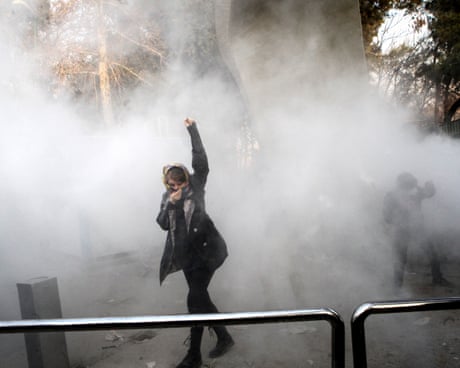
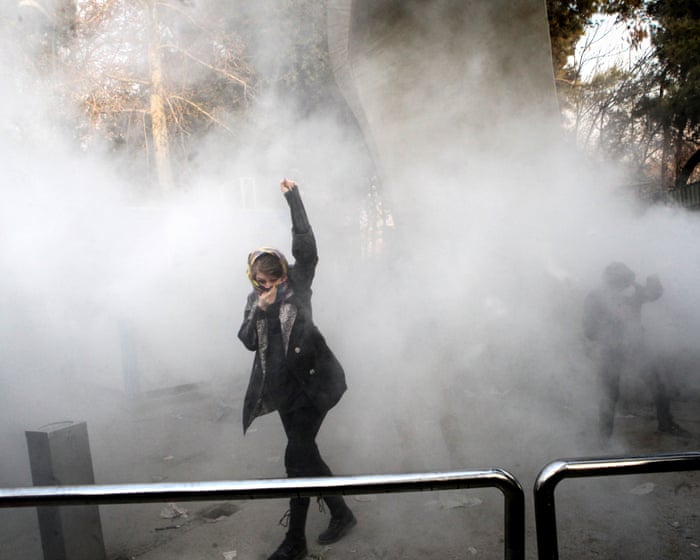
For journalists, researchers and even ordinary citizens, the proposed law being discussed by Iranian lawmakers this month could make speaking to international audiences and groups a potential criminal act and restrict coverage of events such as January’s mass anti-regime protests.
Scaffolding and tarps cover the facade of the John F. Kennedy Center for the Performing Arts on June 30, 2026. | Al Drago/Washington Post via Getty Images
This story appeared in The Logoff, a daily newsletter that helps you stay informed about the Trump administration without letting political news take over your life. Subscribe here.
Welcome to The Logoff: President Donald Trump is threatening that if he can’t have the Kennedy Center, no one can.
What’s going on? Trump has been trying to get his name back on the John F. Kennedy Center for Performing Arts since June, when it was removed in response to a court order. On Monday night, the Justice Department revealed its latest ploy to make that happen.
In a court filing, the DOJ argued that if its renovation plans for the Kennedy Center aren’t allowed to go forward, “the center will deteriorate further into an unsafe, decrepit structure that will be required to be taken down” and replaced by another structure, “such as a large outdoor amphitheater.”
Tied up in the proposed $250 million renovation are three new tributes to Trump, which the Kennedy Center board (stacked with Trump appointees) voted to add earlier this month: the text “renovated and restored by President Donald J. Trump” and “endowed by The Trump Kennedy Center Fund” on the building’s facade, and the renaming of the Kennedy Center grounds as “President Donald J. Trump Plaza.”
Those changes are currently being challenged in court by Rep. Joyce Beatty (D-OH), who successfully sued to undo Trump’s first renaming of the center. But the Trump administration claims her suit endangers the entire project.
What does Trump’s name have to do with the renovations? According to the DOJ filing, “an order blocking the Board from appropriately recognizing President Trump will cause donors to flee, financial contributions to dry up, and structural rehabilitation to stop.”
“There will simply not be the expertise or funding necessary to rebuild and renovate this decimated structure,” it adds.
Is that true? No. Congress already approved $257 million for the renovation last year, which the Kennedy Center board touted in a press release crediting Trump.
And far from being a draw, the Washington Post reported Tuesday, Trump’s previous renaming of the Kennedy Center caused ticket sales and donations to plummet, creating a $23 million deficit even after deep spending cuts.
And with that, it’s time to log off…
Universally beloved country music star Dolly Parton died on Tuesday at age 80. Here’s one song to remember her, and a story about what she described as “one of the greatest things that I’ve ever done in my life”: a literacy program that, as of this year, has gifted more than 332 million books to children.
Earlier this month, Trump sent a letter to Lisa Cook, a Joe Biden appointee to the Federal Reserve, demanding that she respond to exceedingly flimsy allegations that she committed mortgage fraud. This is the first step in a process that is likely to end in Trump attempting to remove her from the Federal Reserve’s board a second time — which means that the courts will inevitably have to get involved once again.
It’s tempting to blame this bout of déjà vu on Trump, but the Supreme Court is at least as responsible for his actions as the president itself. If the Court didn’t want Trump to thumb its nose at their decision in Trump v. Cook (2026), they should have written that decision clearly enough that lawyers could actually figure out what the president is and is not allowed to do.
The Cook decision, which involved Trump’s first attempt to fire Cook, is similarly incomprehensible. It was handed down the same morning as Trump v. Slaughter (2026), which seems to hold that Trump can fire anyone who leads a federal agency. But Cook does not even cite the Slaughter decision, much less explain why the two cases are different.
Slaughter was grounded in the “unitary executive,” a theory shared by all six of the Court’s Republicans which claims that the president must have full control over federal agencies, including the power to fire their leaders — and thus agencies that have some ability to act independently of the president, such as the Federal Reserve, are unconstitutional. Cook suggests that there’s a Federal Reserve exception to this theory, although the opinion does not offer a clear explanation of why this exception exists.
There are very good policy reasons why Trump should not be able to fire Cook, or any other member of the Federal Reserve’s board. The Fed has the power to inject cocaine into the US economy, temporarily giving it a boost at the price of much greater turmoil and higher inflation down the road. If presidents are allowed to fire the Fed’s leaders, they can remove anyone who refuses to give the economy a bump during an election year — boosting the president or his party’s reelection chances, and triggering consequences that won’t be felt until after the election is over.
But the fact that preserving the Fed’s independence from the president is a good idea does not mean that the Constitution permits it. And, in Slaughter and several related cases, the Court’s Republican majority endorsed an interpretation of the Constitution that is completely incompatible with the idea of an independent Federal Reserve.
That means that, until the Court resolves this tension between Slaughter and Cook, there’s likely to be a great deal of confusion about who really controls the Fed — Trump or its current board — and whether Trump may effectively order the Fed to take actions that benefit him, but that could cause lasting harm to the US economy.
The unitary executive, briefly explained
The issue at the heart of Cook was whether the president is able to fire a member of the Federal Reserve.
Federal law provides that the Federal Reserve’s governors may only be fired “for cause,” and not simply because the president does not like them or disagrees with their policy views. The Republican justices have also long argued that Congress is forbidden from limiting the president’s power to fire federal agency leaders, because this would give the president less than full control over the federal government’s executive branch.
These justices point to a line in the Constitution that states that “the executive power shall be vested in a President of the United States of America.” According to the Court’s Republican majority, this means that the president must have full control over any federal agency that wields power that is “executive” in nature, including the power to fire that agency’s leaders for any reason whatsoever. As Justice Antonin Scalia wrote in an influential 1988 dissenting opinion, this constitutional provision “does not mean some of the executive power, but all of the executive power” is held by the president.
There are numerous problems with this unitary executivetheory. The biggest one is that, while the Constitution does say that there is something called the “executive power” that belongs to the president, it does not define what this power is, and the Court’s decisions embracing the idea of a unitary executive often rely on dubious historical claims.
But, regardless of whether the unitary executive rests on a sound reading of the Constitution, it is now the law. And Slaughter suggests that this Court’s definition of the term “executive power” is quite expansive. In that case, the Court indicated that any agency leader who “enforces and administers” a federal statute wields “executive” power, and thus must be fireable at will by the president.
But then, almost immediately after the Court handed down Slaughter, it ruled in Cook that Trump could not fire one of the Fed’s leaders — or, at least, that he could not do so right away.
The Cook decision is word salad
Under the Republican justices’ definition of which officials wield executive power, and thus must be fireable at will by the president, Cook clearly should qualify. But five justices, the three Democrats plus Chief Justice John Roberts and Justice Brett Kavanaugh, joined a majority opinion by Roberts that, at least, temporarily delayed Trump’s ability to fire Cook. Three other justices took the coward’s way out, arguing in dissent that Trump should win on narrow procedural grounds that would have allowed him to fire Cook, but that also might permit a court to reinstate her at some point in the future.
Only Justice Clarence Thomas seemed to fully embrace the unitary executive theory, in Cook, and with it the idea that firing Cook is well within Trump’s power.
Thus, if Slaughter is correct that an agency leader who “enforces and administers” a federal statute must be fireable at will by the president, Trump should have the power to fire Cook.
Roberts’s majority opinion doesn’t really make a legal argument. But it does make a couple of historical and policy claims that point in the direction of allowing an independent Federal Reserve to exist. Roberts begins his opinion with a history of nationally chartered banks, noting that the first such bank “predates even our Constitution “And he alludes to a “‘long tradition’ of ‘monetary policy … exercised independent of … executive influence.’”
But it’s hard to tell why this tradition matters, at least in a world where every other federal agency is subject to the unitary executive. The Republican justices have previously claimed, for example, that the president must have full control over all federal prosecutions. But historical evidence suggests that, at the founding, prosecutions were often led by private attorneys or by judicial appointees — that is, not by the president or his appointees. So why doesn’t this historical evidence exempt the Justice Department from the unitary executive?
And, if the legal reasoning in Cook is thin, the decision’s actual holding is largely toothless. After laying out his half-baked argument for why the Federal Reserve is unlike any other federal agency, Roberts doesn’t actually write that Trump may not fire Cook. He simply says that “Cook was entitled to notice and some opportunity to respond prior to her termination” — although Roberts also writes that, once Cook has a chance to respond to the allegations against her, “only then can the courts assess the validity and sufficiency of such charges.”
So, by sending a letter to Cook informing her of the allegations against her and giving her a little bit of time to respond, Trump has complied with the Supreme Court’s decision. He will likely then attempt to fire her no matter what she says in response, and then there will be another round of litigation where some poor trial judge will have to “assess the validity and sufficiency” of the allegations against Cook without any guidance from the Supreme Court regarding how strong those allegations must be.
That said, it is likely that when Cook does respond to Trump’s allegations, those allegations will prove quite flimsy indeed. Trump alleges that Cook committed mortgage fraud by claiming two separate properties as her principal residence in bank documents. But Reuters examined those bank documents and discovered that she disclosed to the lender that one of those properties would be used as a vacation home. So it appears that no fraud actually occurred.
Will that be enough for Cook to keep her job? The short answer is “probably” — why would the Supreme Court have handed down such an incoherent opinion in Cook if it intended to apply the unitary executive to her anyway? But the Cook opinion itself offers little guidance to the judges who will need to sort through this mess.
President Donald Trump greats Chief Justice John Roberts, and Justices Elena Kagan, Brett Kavanaugh, and Amy Coney Barrett as he arrives for the State of the Union address on February 24, 2026. | Win McNamee/Getty Images
In March, President Donald Trump issued a blatantly illegal executive order claiming that he had the power to unilaterally rewrite US election law. The order threatens prosecutions against state officials who allow certain people to vote, and it also requires states to include several federally mandated design elements in the envelopes that they use to mail ballots to voters.
On Monday, the Supreme Court’s Republican majority allowed that order to go into effect. All three of the Court’s Democrats dissented.
Yet while the Court’s new decision in Trump v. California is troubling, it’s not necessarily a sign that the justices will permit Trump’s illegal order to take full effect. The Court’s actual holding in California is that two lower federal courts moved too quickly when they blocked the executive order. But California does not opine on whether the order is actually legal.
The Supreme Court’s decisionreinstates Trump’s order for now, but there are several active cases challenging this order in the lower courts. So it is likely that a judge will issue a new decision blocking the executive order again very soon.
Still, the Court’s decision to reinstate this order, even temporarily, is likely to confuse state election officials who are racing to prepare for an upcoming election. And the provision threatening prosecutions might deter these officials from doing their jobs until that provision is blocked by another court.
The Court is divided on whether Trump’s threat targeting state elections officials is actually a threat
The case concerns two sections of Trump’s March order, one of which threatens state election officials with prosecution if they allow the wrong people to vote, and the other which appears to be an attempt to sabotage voting by mail during the 2026 midterms.
The first one of these, Section 2, itself contains two provisions, one of which orders the Department of Homeland Security to “compile and transmit to the chief election official of each State a list of individuals confirmed to be United States citizens who will be above the age of 18 at the time of an upcoming Federal election and who maintain a residence in the subject State.”
This simple command to compile a list would be unproblematic, except that the second provision of Section 2 orders the attorney general to prioritize prosecutions against “State and local officials or any others involved in the administration of Federal elections who issue Federal ballots to individuals not eligible to vote in a Federal election.” Thus, when both provisions of Section 2 are read together, they threaten prosecutions against any state official who issues a ballot to a voter whose name does not appear on Trump’s list of approved voters.
Such a threat is unconstitutional, as the Constitution gives states, and not the federal government, the power to decide who may vote in congressional and presidential elections. The justices, however, primarily split on whether to give Trump’s order a hyperliteral reading.
In dissent, Justice Sonia Sotomayor argues the two clauses are clearly connected and she cites a previous Supreme Court decision warning that “[p]eople do not lightly disregard public officers’ thinly veiled threats to institute criminal proceedings against them if they do not come around.”
But the majority ignores Section 2’s purpose, and instead notes that Trump’s executive order does not explicitly require states to use Trump’s list of approved voters. They also note that the executive order’s call for the Justice Department to prosecute state officials does not include any reference to Trump’s list.
In any event, even the Republican justices do not hold that the Constitution permits Trump to create a list of approved voters and prosecute state officials who depart from that list. Instead, the Republicans hold that it is too soon to block Section 2. DHS must first compile its list of approved voters, or DOJ must actually prosecute someone, before a challenge to Trump’s new policy can proceed.
The effect of the Republican justices’ decision, in other words, is to leave Trump’s threat in place, but also water it down considerably: The Court does state that Trump’s executive order does not actually require states to use Trump’s approved voter list. So that may be a sign that, if Trump actually did try to prosecute someone for allowing someone not on DHS’s list to vote, the justices would reject that prosecution — but for now, there’s little standing in the way of him doing it.
The rest of the Court’s decision was obsolete the minute it was handed down
The remainder of the Court’s decision deals with Section 3 of Trump’s executive order, which orders the United States Postal Service (USPS) to design an envelope which states must use when they mail ballots to voters. It also forbids USPS from delivering ballots that do not comply with this new design.
The Republican justices conclude that the lower court decisions blocking Section 3 were also premature because, at the time when those courts handed down their decisions, USPS had not yet formally issued a rule that announces the new mandatory envelope design. But USPS issued that rule on Friday. So the Supreme Court’s decision was out of date days before the justices decided it, but that does nothing to change the immediate effect of the decision.
Among other things, the Trump administration’s new rule requires states to mail ballots in envelopes that include several federally mandated design elements, including a mandatory logo and a unique identifier for each voter. If the new rule takes effect, USPS will refuse to deliver any ballots that do not comply with these new, Trump-approved design requirements.
Democrats are significantly more likely to vote by mail than Republicans. So the Trump administration’s new rule is likely to skew the 2026 election towards his political party if it is allowed to take effect.
If Section 3 is eventually allowed to take effect, that will be a catastrophe for US democracy, and may even make it impossible for many states to hold midterm elections. That’s because the states couldn’t possibly have known what specific design requirements the Trump administration would impose on them until USPS issued its rule. Many states have already purchased envelopes that do not comply with the new federal mandate. And it’s not like new envelopes can simply be printed on the fly.
In some states, millions or even tens of millions of voters will vote by mail, which means that, in order to comply with the Trump administration’s new order, these states will somehow need to obtain truckloads of envelopes in time for this November’s election, comply with the considerable procedural requirements laid out in Trump’s order, and distribute these ballots to voters fast enough for them to actually return them by the deadline.
Several US states, moreover, conduct their elections almost entirely by mail. While these states often set up voting centers where voters can also vote in person, these in-person voting centers are merely a backup. And these states are unlikely to have the infrastructure, voting machines, or network of election workers that are required to run an entirely in-person election if mail-in voting fails.
So Trump wants to impose impossible deadlines on many states. But Monday’s decision does not actually hold that it is legal for him to do so. Indeed, the federal judge who initially blocked Trump’s executive order has already signaled that she is likely to block the USPS’s new rule. We will find out if the Supreme Court will allow Trump to sabotage voting by mail after that new decision makes its way back to the justices.
The Trump administration’s legal argument for the new USPS rule is quite thin
Trump’s lawyers only barely make a legal argument in favor of the new rule. After the USPS issued its new rule, Trump’s Justice Department did file a supplemental brief in the Supreme Court arguing that the new rule is lawful. But that brief is only three pages long, and its legal analysis is exceedingly thin.
As Indira Talwani, one of the judges who blocked Trump’s executive order, noted in her opinion, there is no federal law that explicitly “delegates authority to control mail-in voting to USPS.” So the Trump administration must rely instead on broadly worded statutes that simply state that the Postal Service may deliver mail and take related steps that are necessary to deliver the mail.
And, even if these vague statutes could authorize the Trump administration to impose granular restrictions on voting by mail, the fact remains that it is impossible for many states to comply with these restrictions in 2026. Some states, such as North Carolina, are supposed to start mailing ballots at the end of next week.
It would be one thing if Trump tried to impose new envelope design requirements that will take effect in future elections. But there’s simply no time for states to design compliant envelopes, get those designs approved by USPS order dozens of pallets worth of these envelopes, and distribute them to voters in time for the 2026 midterm elections.
So the stakes in this dispute remain quite high. Trump has literally issued an executive order that, if implemented, might prevent many states from holding the midterm elections in the first place. But it is still unclear if this Supreme Court will allow that to happen.
President Donald Trump at Joint Base Andrews, Maryland, on August 21, 2026. | Win McNamee/Getty Images
This story appeared in The Logoff, a daily newsletter that helps you stay informed about the Trump administration without letting political news take over your life. Subscribe here.
Welcome to The Logoff: Donald Trump’s trade war with Canada is back in full force.
What’s happening? Remember last week, when Trump said that the US and Canada had a trade deal in place? It turns out they do not. After negotiations fell through on Friday, Trump responded with a 50 percent tariff on some $20 billion in Canadian goods, plus threats of higher tariffs on cars, car parts, and steel to come in 2027.
Trump, Vice President JD Vance, and other administration officials are also leaning into ever more inflammatory rhetoric, with Vance taunting Canada on Monday as “a state” that “quite literally would get invaded by a foreign country were it not for the umbrella of protection provided by the United States of America.”
How is Canada responding? With outrage, as my colleague Caitlin Dewey explains, and with tariffs of their own: On Saturday, Canadian Prime Minister Mark Carney said that his country would match US tariffs “dollar for dollar,” starting early next month.
“We cannot accept what the U.S. has offered,” he wrote, “and we will not give what they have asked.”
In addition to trade terms, the US allegedly made requests to weaken Canada’s French-language protections, which Carney said would have infringed on Canadian “sovereignty.”
Why does this matter? Immediately speaking, tariffs make things more expensive at a time when voters are already incensed over prices and the Iran war is making inflation worse; their impact could be especially felt in border states like Maine and Michigan, which also happen to have high-stakes, closely contested Senate races coming up in 72 days.
On a longer timeline, the Trump administration is doing damage to the US-Canada relationship that goes far deeper than specific tariffs and will be far harder to reverse. Already, in January, Carney delivered a speech charting a plan to move past relying on the US as a global partner; Trump’s latest trade war will only accelerate that rupture.
And with that, it’s time to log off…
Violent crime rates in the US are falling across the board, according to new 2025 statistics released by the FBI, including the murder rate, which just hit a 70-year low — tied for the lowest ever recorded. That’s good news in any context, but if you want to learn more, my colleague Bryan Walsh took a crack at explaining how it happened. You can read his article here with a gift link.
Thanks for reading, have a great evening, and we’ll see you back here tomorrow!
Canadian Prime Minister Mark Carney (right) and Dominic LeBlanc, the minister responsible for Canada-US trade, arrive at a press conference in Ottawa, Ontario on August 22, 2026. | Dave Chan/AFP via Getty Images
This story appeared in Today, Explained, a daily newsletter that helps you understand the most compelling news and stories of the day. Subscribe here.
President Donald Trump is putting the “war” in “trade war.” Or so his senior officials really want you to believe.
“At dawn begins an economic D-Day,” Treasury Secretary Scott Bessent wrote Sunday night, previewing the latest round of sanctions against Iran.
“It’s a country that doesn’t have a military,” Transportation Secretary Sean Duffy said, incorrectly, of Canada over the weekend. “To think that they’re going to go to war with Donald Trump and actually win that war…is foolish.”
The war with Iran is literal, of course. The war with Canada, slightly less so. But in both cases, the Trump administration is trying to weaponize America’s economic might to get its way in otherwise stalled negotiations.
Iran and the US have been locked in on-again, off-again talks for almost the entire six months since the US-Israeli strikes began. And last week, trade negotiations between the US and Canada collapsed amid disputes over tariffs on key Canadian industries, as well as US demands that Canada weaken protections for its culture and the French language. Now, both countries are promising steep retaliatory tariffs on goods ranging from cars and steel to anoraks.
Trump is betting that economic pain will produce the concessions diplomacy hasn’t. But Americans also suffer the fallout from these kinds of tactics.
I am one such American. Hello! Bonjour! I am planning to visit Montreal over Labor Day weekend…and have begun to fear that my New York plates might provoke some patriotic ne’er-do-well to key my car.
As someone who grew up on the Canadian border, with Canadian friends and Canadian radio stations and Canadian flags on most every pole, the notion that I might be newly unwelcome — or, quelle horreur, despised — in Canada is a new and unpleasant one.
Not to fear, said my colleague Zack Beauchamp. (Zack lives 90 minutes northwest of me in Ontario, and is Vox’s go-to expert on Canadian concerns.) Most Canadians “are actually quite chill toward individual Americans,” he said, and he therefore rates it “unlikely” that anyone will vandalize my vehicle.
At the same time, Zack said, most Americans fail to realize how dramatically, and perhaps permanently, Canadians have turned on the US as a country. To many of us, the trade war is a tedious or incomprehensible policy dispute. To Canadians, it’s seen as a real threat to their sovereignty.
Zack shared this example from his own family, which — existential stakes notwithstanding — kind of cracked me up. His wife, who is Canadian, is participating in a popular boycott movement and has “shifted literally everything she purchases” to avoid American products.
That includes buying terrible Canadian-made dishwasher pods whose wrapping doesn’t dissolve in the machine. Or purchasing him a deodorant from the puzzlingly named brand Green Beaver, which is “somewhat worse at repelling smell,” Zack said.
“Whenever I ask her about why she does these things, she points to those World War II posters about reducing gas use — carpooling so you aren’t riding with Hitler,” Zack said. “Because that is literally how Canadians think about these things: as a war for their survival.”
The rupture is existential for Americans, too, I think — albeit in a different and less urgent way. It has to do with what American identity represents in the world today.
That’s more abstract than something like the cost of a car (which, by the way, will likely rise dramatically if Trump implements the tariffs he threatened this morning on Truth Social). But the way the world sees America also matters.
One link for later
➨ Hold the eggs. A new study found that raising cage-free hens generates more greenhouse gas emissions than conventional egg farming. If you don’t want to choose between animal welfare and climate change…may we suggest switching your eggs out for tofu or beans? (Sorry, sorry! But not every tip in this newsletter can be uplifting.)
Before you go…
Did you know…that researchers believe young children’s brains don’t record permanent memories because they’re busy prioritizing other patterns and skills? It’s a phenomenon called “infantile amnesia,” and we’re still a long way from fully understanding it.
Today’s trivia: What’s the traditional, three-letter nickname for students and graduates of Yale? (You can find this and other brain puzzles in Vox’s daily crossword. Look for the answer in tomorrow’s edition.)
Yesterday’s trivia: Last week we asked you for the insect stage after the larva. That would be the pupa or pupal stage — basically, insect adolescence.
Attendees at a Trump rally in Racine, Wisconsin, on June 18, 2024. | Scott Olson/Getty Images
It’s the Democrats who have mostly had to answer questions about electability this midterm season, but why are there so few questions about the “E” word for the other side?
Gas prices are still skyrocketing. A number of Republican candidates, such as Ohio Rep. Max Miller and former Texas Attorney General Ken Paxton, who’s running for a Senate seat, are mired in scandal. The Iran war was unpopular from the start, but it is getting even less popular as it drags on. And Trump’s approval rating recently hit 33 percent, the lowest of his presidency yet.
On this week’s episode of America, Actually, host Astead Herndon speaks with one of Trump’s most vocal defenders, conservative influencer CJ Pearson, about whether we’re seeing Trump’s brand slip even among his supporters and the young people who helped him win in 2024, and how that could affect the midterm elections.
Pearson, a conservative content creator and influencer, first went viral when he posted himself, then 12 years old, criticizing Barack Obama in a YouTube video. Now 24, Pearson is one of MAGA’s most prominent Black voices.
In this episode, Astead and Pearson discussed how Republicans should answer questions about whether voters’ lives are better than they were two years ago; whether Trump still has any cultural cachet left over from his last presidential campaign; and when Pearson started to see young Republicans turning away from the MAGA movement.
Below is an excerpt of Astead’s conversation with Pearson, edited for length and clarity. There’s much more in the full show, so listen to America, Actually wherever you get your podcasts or watch it on Vox’s YouTube channel.
That “E” word’s been thrown around a lot about Democrats, but we want to think about how Republicans are on their own. If you could rate Donald Trump’s second term one through 10, what would you give it?
I think the president’s doing incredibly well for the American people. Promises made, promises kept in many ways.
I think if you look at this president who ran on securing our southern border, he’s done it. You look at this president who’s talked about bringing down costs, he’s brought down the cost of dairy, eggs. He’s achieved that.
And I think also this president is only just getting started. He ran on “no tax on tips.” He did that. He ran on “no tax on overtime.” He did that. Oftentimes I tell people the challenge of this administration is keeping up the messaging at the same pace as the accomplishments of this president.
And so I think that there’s a lot more work to do. Thankfully, we have two more years to do it.
Can I get a number?
I think he’s doing well. I will say I grew up in a place where there’s always room for improvement, so I’ll give him an eight.
You’re giving him an eight. I wanted to just start there because Trump’s approval rating has fallen, as I’m sure you have seen. Why do you think the country isn’t maybe on the same page as you?
I think a lot of people are focused on their pocketbooks, right? They’re focused on domestic issues, and I think that we have been very internationally focused over the course of the past few months as we’ve navigated and dealt with the Iran conflict.
But I think that as we get ready to get through this last wave of primaries, I think you’re going to see a change in his messaging and a reset at the midterm convention in Dallas next month in September.
And I think you’re going to hear this president talking about how he’s made America more affordable, how he’s kept Americans safe, far safer than they were under President Joe Biden.
And I think that you’ll see those numbers start to change. And a reminder, the only poll that matters is on Election Day. There are many polls that had Kamala Harris beating President Trump, in 2024, and that didn’t happen.
Yeah, I don’t want to be overly poll-reliant, but we’ve heard some of this directly from Republicans even.
We were at Donald Trump’s UFC event in DC talking to young men, and even there we heard people really come to be critical on three issues specifically: tariffs, the Iran war, and the handling of the Epstein files.
You mentioned the question of affordability. Donald Trump has said, quote, “I love the inflation.” And when asked by reporters about the public strain that has come from the conflicts with Iran, he said, “I don’t think about Americans’ financial situation. I don’t think about anybody.”
How can you say that Republicans are gonna run on affordability if the president’s saying he doesn’t care if Americans’ lives are unaffordable?
Well, I’ve often said that we can’t cede this entire affordability debate to the Democrats. The reason that I think a lot of young people are giving a little bit, even a flirtatious nod to the DSA and their socialist and communist candidates, is because they’re talking about an issue that’s top of mind for them.
In the same way that when President Trump won in 2024, he was talking about issues that were top of mind of the American voter, which was the cost of living.
And so I think that we need to get back to that messaging. I think that this president has continued to deliver on that front. Costs are coming down.
The economy is resurging. We’re seeing economic and global investment in this country unlike anything we’ve seen before. In Oklahoma, we’re bringing back manufacturing with the aluminum smelting plant.
But the president’s not saying this. The president’s saying, “I love the inflation, and I don’t think about Americans’ financial situation.” Do those words help Republican midterm candidates?
Well, I think the president has a lot of time to say a lot more things because Election Day is pretty far away from now. I think we have two or three months left, and I think the president will make this case.
But I think what will also make the case is that the candidates that the Democrats are running and nominating all across this country, who are now affiliating themselves with the socialist movement, are not actually fighting for things that will actually ever work.
Socialism has never worked anywhere it’s been tried, and I think that this is going to be an election between common sense versus crazy. Do you wanna run a candidate that hates Thanksgiving?
For the record, that candidate lost in the primary. She will not be on the ballot in November.
She did. She almost was there, though, and that’s the thing. I’m glad common sense won the day in Wisconsin, that the good people there love turkey.
I know that you say that the argument is based on how Democrats are out of touch, but we have talked about some ways in which Donald Trump has not lived up to folks’ expectations, particularly on things like prices and on things like the Iran war.
How does the GOP overcome that electability question? What is their message when folks ask, is their life better than two years ago?
I think we’ve got to lock in. I think we also need to prosecute the case that it’s going to be a lot worse under the Democrats if these crazy communists get into office. And so I think that when you’re looking at costs, we need to make that argument central. We need to make that what we lead with.
And I think that we have to pump the brakes on a lot of the international stuff. And I think that we need to talk about the things that are actually affecting people’s everyday lives at grocery stores, at gas stations, wherever it may be. And I think that is how we can kind of turn the ship around.
When we talk about the Democratic candidates, you’re saying the DSA candidates are far left, and we’ve certainly explored some electability questions for them and some ways that I think they might have stances that are misaligned with the American people. But so does Donald Trump, and he’s endorsed scandal-plagued candidates like Ken Paxton in Texas, like Max Miller in Ohio.
Why is that not just as much a sign of a conservative version of extremism, just as you are arguing that there’s a Democratic or leftist version of that?
Because I think you’re talking about folks who have dealt with issues in their personal lives, not necessarily their voting record.
Okay, maybe I should say Tom Tiffany, who didn’t vote to certify the 2020 election, but I imagine you agree with him.
Well, no, I think that was six years ago. I don’t think about 2020 anymore. I think about 2026 and I think about 2028. So when I look at that … it’s important that we really make the case for crazy communism versus common sense. And I think that the American people are not going to vote for that.
I guess I’m saying, does Donald Trump win the commonsense argument? Like, isn’t crazy versus commonsense an argument that Democrats can make and say Donald Trump is said crazy?
No, because I think Donald Trump definitely wins the common sense argument when we’re running against folks who belong to a party that is now, you know, waging a war against Thanksgiving, who believe that biological men should be playing women’s sports. Again, these are 80/20 issues, and so I actually really like our odds here.
It’s going to be hard, right? It’s always hard for the party that controls the White House to fare all too well in any midterm election. But I think that we’re going to overperform. I think we’re going to hold onto the Senate. The House will be a dogfight, but I like our chances.
Construction of Trump’s East Wing ballroom continues at the White House on August 18, 2026. | Win McNamee/Getty Images
This story appeared in The Logoff, a daily newsletter that helps you stay informed about the Trump administration without letting political news take over your life. Subscribe here.
Welcome to The Logoff: President Donald Trump’s ballroom is still happening.
What’s the latest? On Friday, Supreme Court Chief Justice John Roberts stayed a lower court injunction threatening to halt construction on Trump’s East Wing ballroom, hours before it would have taken effect.
The order came from Roberts alone, and it isn’t final. But the new stay will remain in place “pending further order” (likely, the Court’s full decision), allowing construction to continue for now. It’s the latest in a series of escapes for the project, despite adverse rulings in lower courts.
What have other judges said? Earlier this month, the DC Circuit Court of Appeals upheld a previous district court ruling that Trump had exceeded his authority in unilaterally pursuing the ballroom project and would need to seek congressional approval to continue. (Trump, meanwhile, has attempted to justify the project on national security grounds, describing it as a “Military Complex” and its opponents as “TREASONISTS.”)
Both the appeals court decision and the previous district court decision had been paused, however, to allow the appeals process to play out. That pause would have expired on Friday, but for Roberts’s order.
How far along is the project? Trump has been working fast. According to Trump’s solicitor general, the ballroom was already 65 percent complete last week, standing around 70 feet tall and five stories below ground. Crews have been working on the project nearly around the clock — 20 hours per day, seven days a week.
What else should I know? When the full Supreme Court does weigh in, it could have implications far beyond just the ballroom.
As my colleague Ian Millhiser explained earlier this week, the ability of the plaintiffs challenging the ballroom to bring their case in the first place hinges on the “aesthetic injury” theory of standing, which also underpins a great deal of US environmental law. If the Court clears the way for the ballroom, those laws could go with it.
And with that, it’s time to log off…
Hi readers, happy Friday! If you’re looking for something to do this weekend, you could take my colleague Adam Clark Estes’s suggestion and rescue some of your favorite photos from your phone’s camera roll by printing them out. He explains why it’s worth doing — and how to do it — here (it’s a gift link).
Have a great weekend, and we’ll see you back here on Monday!
Sailors prepare to assist an F/A-18 Hornet jet for takeoff while steam billows from the catapult aboard USS Theodore Roosevelt in the South China Sea on April 10, 2018. | Ted Aljibe/AFP via Getty Images
This story appeared in The Logoff, a daily newsletter that helps you stay informed about the Trump administration without letting political news take over your life. Subscribe here.
Welcome to The Logoff: The Trump administration’s meddling with the US military is getting more direct — and potentially more dangerous.
What’s going on? Fresh on the heels of coverage last week about the plight of the USS Abraham Lincoln (now on its way home), a flurry of recent stories underscores just how much the Trump administration is micromanaging the Pentagon.
Last week, President Donald Trump directed the Defense Department to overhaul the aircraft carrier mechanism for launching jets — by reverting from electromagnetic catapults to old-fashioned steam catapults.
And on Thursday, the Wall Street Journal reported that the Army is axing its new drone assault battalion, which was established in January. The decision to do so comes from Defense Secretary Pete Hegseth’s new acting chief of staff of the Army, who took over the role after Hegseth forced out its previous occupant this spring.
What’s the context? Neither of these moves seem poised to help the military succeed at its core objectives. As naval expert Bryan Clark pointed out Wednesday in the Washington Post, the catapult switch won’t only limit the next generation of aircraft carriers, but cost an exorbitant amount of money — contrary to Trump’s insistence that steam is “much less expensive” — and delay the rollout of new ships (badly needed, as the Lincoln debacle proves). Trump may also name one after himself.
If possible, the demise of the drone unit makes even less sense. Innovative drone designs and tactics are revolutionizing warfare in Ukraine and elsewhere; being ahead of the curve on these changes has allowed Ukraine to hold its own against a numerically superior opponent.
And it’s very clear that the US hasn’t mastered these tactics yet: As the Journal reported last week, Ukrainian drone operators flattened the US in war games held earlier this year.
Why does this matter? To be clear, Trump is the commander in chief. None of this is beyond his authority as president. But the steam catapults in particular are a strange obsession that would normally be well below his pay grade, and none of it gives the impression of a steady hand at the rudder.
And with that, it’s time to log off…
Here’s some good news from my colleague Constance Grady: The kids might be all right. Or at least, they might be reading more thanks to a new generation of “middle-grade books,” and that’s a step in the right direction. You can read her story about what those are and what’s changing here with a gift link.
Thanks for reading, have a great evening, and we’ll see you back here tomorrow!
President Donald Trump speaks with Canadian Prime Minister Mark Carney at the G7 summit, in Evian, France, on June 16, 2026. | Evelyn Hockstein/AFP via Getty Images
This story appeared in The Logoff, a daily newsletter that helps you stay informed about the Trump administration without letting political news take over your life. Subscribe here.
Welcome to The Logoff: President Donald Trump’s planned Canada tariffs are off — for now.
What happened? Trump had previously threatened 50-percent tariffs on about $20 billion worth of Canadian goods, but delayed them late on Tuesday, hours before they were set to take effect.
In a social media post, he wrote that the tariffs were on hold for “a three day period, based on the fact that Canada and the U.S.A., subject to the finalization of documents, have a DEAL!”
Is there actually a deal? We’ll find out in the next three days. Trump’s claims should always be taken with a grain of salt, and Canadian Prime Minister Mark Carney said only that “substantial progress” had been made toward a deal, with “important work still to be done.”
On Wednesday, the Wall Street Journal reported that the US could reduce previous tariffs on Canadian goods —which applied to cars, steel, and aluminum — as part of a potential trade deal. Trump has also suggested that a deal could resurrect the Keystone XL oil pipeline.
Can Trump still impose new tariffs? He can. Earlier this year, the Supreme Court struck down Trump’s use of a specific law, the International Emergency Economic Powers Act, to impose tariffs. In doing so, the Court ended many of his most sweeping tariffs and took away his favorite way to impose them.
He has plenty of other tools to keep at it, though, albeit on a more limited basis. Trump was threatening to use a never-tested section of the 1930 Smoot-Hawley Tariff Act to impose his most recent Canada tariffs. (Other existing Canadian tariffs fall under yet another law.)
What’s the big picture? This trade fight could preview an even bigger one to come, as the US, Mexico, and Canada attempt to renegotiate the US-Mexico-Canada Agreement that Trump struck in his first term. Trump declined to renew the deal last month, kicking off new negotiations.
And with that, it’s time to log off…
We got some incredibly good news about cancer treatment on Wednesday from the pharma companies Moderna and Merck, which announced a successful trial of an mRNA vaccine for melanoma, a particularly dangerous type of skin cancer.
The idea of using vaccines — and specifically mRNA, which helped produce Covid vaccines in record time — to treat cancer isn’t new, but the Moderna and Merck trial is a big step on the path to getting a cancer vaccine approved by the FDA.
As always, thanks for reading, and we’ll see you back here tomorrow!
President Donald Trump and North Korea's Kim Jong Un talk before a meeting in the demilitarized zone on June 30, 2019, in Panmunjom, Korea. | Brendan Smialowski/AFP via Getty Images
Can President Donald Trump pen a new chapter in his love story with North Korea’s Kim Jong Un?
In Trump’s first term, the two leaders, in Trump’s words, “fell in love” after exchanging letters and held three historic meetings, but failed to make much progress toward the goal of denuclearizing the heavily armed hermit state.
Now, Trump appears to be trying to recapture the magic, reportedly urging aides to set up a meeting with Kim as soon as this fall. This news comes soon after Trump’s Truth Social post on Sunday announcing he had ordered the US military to “substantially reduce” joint military exercises with ally South Korea in part because it would send “a signal that is totally inappropriate and hostile, to a Country that, as long as Donald J. Trump has been President, has been unthreatening and respectful” — North Korea.
Key takeaways
Trump is trying to restart talks with North Korea’s Kim Jong Un, scaling back a planned joint military exercise with South Korea and instructing aides to prioritize setting up a new meeting.
Trump’s three historic meetings with Kim were a diplomatic high point of his first term, but since Trump returned to office, the North Koreans have been rebuffing American advances.
Much has chanced in North Korea since the last time the two met: The country is wealthier, less isolated, and more militarily secure. A Trump meeting might not have the same appeal it once did.
Trump has claimed, without elaborating, that Kim has responded to this overture, but there’s been no public response from Pyongyang yet.
Trump’s outreach didn’t come entirely out of nowhere. Trump has made clear since the beginning of his term that he would like to meet with Kim again, and there was speculation that a meeting might happen when Trump traveled to South Korea for a summit last fall. North Korea’s UN Mission in New York has also rebuffed several attempts by US officials to deliver a personal letter from Trump seeking to restart dialogue.
In the midst of an unpopular conflict with Iran that seems unlikely to end in anything resembling a victory, it makes sense that Trump might be reaching back to what he sees as one of the foreign policy high points of his first term. “Kim Jong Un has always treated me with great respect,” Trump told reporters on Monday. “I understand him. He understands me.”
Beyond reconnecting with an old friend, it’s not entirely clear what Trump actually wants out of North Korea. But if his goal is a new diplomatic breakthrough, that will be even harder than it was the first time: The country is a much different place than it was the last time the two leaders sat down and even if they were to meet again, Kim seems even less likely to make real concessions.
Like it or not, North Korea is a nuclear power now
“There is no chance that North Korea is going to denuclearize. Zero chance,” said Joseph Yun, a veteran US-North Korea negotiator who recently served as acting US ambassador to South Korea. “They have seen what happened to Iran. They have seen what happened to Ukraine. The way they see it, their nuclear weapons are what protects them.” Last year, the country’s official news agency dismissed denuclearization as an “unrealizable pipe dream.”
On top of that, North Korea is in a much stronger negotiating position than it was the last time these two leaders met for a photo op.
“It’s a very different North Korea now. It’s stronger geopolitically, and Kim is stronger domestically.”
Jung Pak, served as US special representative for North Korea in the Biden administration
In 2018, North Korea was heavily isolated and struggling under an international sanctions regime that was at least officially — if not always in practice — supported by China and Russia as well as the United States. For a young leader still looking to establish his internal legitimacy and international standing, a meeting with the sitting US president was a major coup.
But things improved dramatically for North Korea after the pandemic.After it began lifting its Covid-era lockdown — one of the toughest in the world — North Korea has become what the Wall Street Journal has called“the world’s most unlikely growth story.”
The country’s economy has grown for three straight years, and while it’s still an impoverished country where nearly half the population is malnourished, Pyongyang is by all accounts booming, with thousands of new homes built along with a surge in Western-style restaurants and ride-hailing apps.
“North Korea emerged from the pandemic stronger, despite the odds,” said Jung Pak, who served as US special representative for North Korea in the Biden administration. “It’s a very different North Korea now. It’s stronger geopolitically, and Kim is stronger domestically.”
North Korea has been one of the main beneficiaries of the war in Ukraine, sending thousands of soldiers and munitions to help the Russian war effort. While thousands of those troops have died, the North Korean regime has gained billions of dollars in revenue and military aid from Russia in response, as well as invaluable battlefield experience for its commanders and weapons systems.
Russian President Vladimir Putin has come through for the North Koreans in other ways. In 2024, Russia vetoed the mandate of the UN body that monitored the enforcement of international sanctions on North Korea, effectively shredding the international sanctions regime. In 2025, trade between North Korea and China, its main economic partner, rose 25 percent.
The regime has found other innovative ways of raising revenue, reportedly netting billions through cybercrime targeted at foreign banks and cryptocurrency exchanges.
Kim is also less desperate for legitimacy these days. In September 2025, he stood alongside Xi Jinping and Vladimir Putin at a massive military parade in Beijing, a powerful demonstration of unity among three US adversaries. These days, Kim likely feels he’s the one being wooed. Xi’s high profile trip to Pyongyang in June was interpreted by many as a sign that China, warily eyeing the increasingly close relationship between Russia and North Korea, was looking to shore up its ties with its longtime ally.
Domestically, when the world’s first millennial dictator took power after his father died in 2011, many wondered how long he would last. Today, he’s feeling secure enough to be thinking about long-term handoff plans, publicly positioning his 13-year-old daughter as his future successor.
Kim is clearly not desperate to meet with Trump, and these days, the United States has fewer means to pressure him. Without Chinese and Russian support, the US can only dial up international sanctions so much. As for military pressure, the US has been moving military assets out of the Korean peninsula to the Middle East and recently redeployed its last aircraft carrier out of Asia.
As Trump’s actions this week demonstrate, he’s not all that interested in working with US allies in the region to pressure the North Koreans. But if he were considering pairing his warm overtures to Kim with a stick, a “fire and fury” threat wouldn’t pack the same punch today.
Is there any reason for new US-North Korea talks?
Still, there are reasons Kim might want to sit down with Trump again. North Korea would still like US sanctions lifted. Kim’s influential sister has stated that the regime is looking for the US to formally accept its status as a nuclear power, as Russia has now done.
Former US State Department North Korea negotiator Joel Wit suspects that given Trump’s desperation for talks, Pyongyang might try to press its advantage even further.
“If I was a North Korean, I would ask the United States for what I would call a ‘peace agenda,’” he said. “That would mean more than just reducing the size of US-[South Korean] exercises. It could include cutting back on US troops in South Korea or even Guam.”
Trump, who has repeatedly, including in his recent Truth Social post, made clear that he sees the US military presence in South Korea as a waste and the South Koreans as coddled, wealthy freeloaders, might be amenable to concessions like this.
But what could the US get out of talking to North Korea if denuclearization is off the table? Some analysts have suggested a limited deal might be possible, which could see North Korea dismantle its reactors or some of its centrifuges, slowing down the growth of its nuclear program if not eliminating it.
Pak also noted that given North Korea’s refusal to engage in nearly any diplomacy with the US since 2019, just holding talks and building some confidence between the two sides would be progress. “The meeting itself would be the win,” Pak said.
On the other hand, holding talks that do not explicitly aim at eliminating North Korea’s nuclear program would be seen as effectively accepting that North Korea is a nuclear power now. At this point, there’s a strong realist case to be made for accepting North Korea’s nuclear status and proceeding from there, but it’s hard to square with the administration’s stance on Iran’s nuclear program.
It’s also likely that the kind of incremental concessions North Korea might, in the best of circumstances, be willing to offer, would not satisfy a US president with a penchant for grand bargains.
In his first term, just the fact that Trump and Kim sat down made history. Now that that’s been accomplished, they may find that, like many a romance a few years in, they’ve run out of things to talk about.
The Tongass National Forest is seen during sunset on Prince of Wales Island, Alaska, on June 30, 2021. | Salwan Georges/The Washington Post via Getty Images
This story appeared in The Logoff, a daily newsletter that helps you stay informed about the Trump administration without letting political news take over your life. Subscribe here.
Welcome to The Logoff: The Trump administration is trying to open up more public lands to logging,
What’s happening? On Tuesday, the administration filed a proposal to repeal the “roadless rule,” a 2001 regulation protecting nearly 45 million acres of national forests not just from having roads built through them, but from logging.
The majority of the forests that would be affected fall in 10 Western states: Alaska, Arizona, California, Montana, Nevada, New Mexico, Oregon, Utah, Washington, and Wyoming, while two — Colorado and Idaho — have their own state-level roadless protections.
The next step in the rulemaking process is a 30-day public comment period, after which the repeal can be finalized — though it’s likely to face legal challenges that could delay implementation.
Why is the Trump administration doing this? According to the Agriculture Department, the change is intended to reduce the “regulatory burden” and return decisions about forest management to a more local level; the US Forest Service and some Republican governors in affected states have pointed to fire management concerns and the need to clear out accumulated fuel in forests.
As Wall Street Journal reporter Robbie Gramer pointed out, however, only a tiny fraction of wildfires start in roadless areas of national forests (unsurprisingly, given the relative lack of people).
Why are public lands advocates alarmed? Opponents of the repeal say ending the rule could irreversibly damage some of America’s most pristine forests and cause a long list of environmental harms. They have good reason to be wary: In 2025, Trump signed an executive order directing the “immediate expansion” of timber production in the US, including a 25 percent increase in logging in federal forests.
And with that, it’s time to log off…
The Smithsonian National Zoo is welcoming three new red panda cubs, who were born earlier this summer. According to the zoo, right now, the cubs are “really just balls of fur that eat and sleep.” But they’re also pretty dang cute, and the zoo shared some photos here. Enjoy, and we’ll see you back here tomorrow!
US President Donald Trump speaks to the media alongside posters of his proposed White House ballroom. | Chip Somodevilla/Getty Images
The question of whether President Donald Trump may, without seeking permission from Congress, demolish much of the White House and replace it with his own projects is now before the Supreme Court.
Last fall, construction crews acting under Trump’s orders abruptly tore down the East Wing of the White House, the first step in Trump’s plan to replace the historic building with an enormous ballroom. A conservationist organization, the National Trust for Historic Preservation, soon sued to stop the construction on the ballroom in a case that is still ongoing. Lower courts have thus far agreed with this plaintiff that the ballroom is illegal.
Trump’s claim that he may tear down large sections of the White House and replace them with the ballroom is not supported by law. A federal statute provides that “a building or structure shall not be erected on any reservation, park, or public grounds of the Federal Government in the District of Columbia without express authority of Congress.” Although Trump’s lawyers claimed that two separate statutes allow him to get around this provision, the federal appeals court that heard National Park Servicethoroughly dismantled that claim in a 101-page opinion.
That said, the Court could potentially hand Trump a victory by prohibiting anyone from bringing a lawsuit against his ballroom to begin with. Should this argument succeed, it could have major ramifications for a wide range of laws that seek to conserve environmental resources or preserve sacred or historical sites.
Under current law, a plaintiff who alleges that a defendant’s actions will illegally damage such a site may file a federal lawsuit so long as they can demonstrate that they plan to visit the site in the near future and will find the site less attractive if it is altered. This is exactly what happened in National Park Service: A member of a conservationist group — the National Trust for Historic Preservation — who often went by the White House said the new construction would diminish the beauty of the site.
More broadly, the Court has long held that plaintiffs who wish to observe something beautiful may often sue to enforce environmental statutes that seek to preserve that beauty. As the Court said in Lujan v. Defenders of Wildlife (1992), a seminal case that is often cited because it laid out limits on who is allowed to bring federal lawsuits, “the desire to use or observe an animal species, even for purely esthetic purposes, is undeniably a cognizable interest” that can be asserted in federal court.
Trump’s brief, however, rejects this longstanding rule. Without it, numerous environmental, conservationist, and historical preservation laws could effectively cease to function, because no one would be able to file a lawsuit enforcing them.
The stakes in National Park Service, in other words, are far greater than whether Trump can replace the East Wing with an eyesore. And they are even greater than the question of whether Trump can remake one of America’s most cherished landmarks without congressional authorization. If Trump prevails in National Park Service, he could fundamentally wound America’s environmental protection regime in the process.
Trump’s ballroom is illegal
Recall that federal law bars new construction on federal lands within the District of Columbia “without express authority of Congress.” So, unless there is some existing statute that allows Trump’s ballroom to move forward, the ballroom is illegal.
But Trump cited no such law in his brief. Instead, he relied on two statutes that might be read to authorize parts of what Trump needs permission to do.
The first is a provision that permits Congress to appropriate money that the president may use to pay for “the care, maintenance, repair, alteration, refurnishing, improvement, air-conditioning, heating, and lighting (including electric power and fixtures) of the Executive Residence at the White House.” But, as the appeals court that ruled against Trump explained, there are numerous reasons why this statute cannot be read to permit the ballroom.
The most straightforward reason is that Congress only gave the president a $2.475 million budget to spend under this statute. But Trump’s lawyers claimed this project will be funded by “approximately $400 million in private donations.” So, even if Trump’s ballroom counts as an “alteration” or “improvement” of the existing “Executive Residence at the White House” — and all three of these points are contested — Trump cannot use his White House maintenance budget to fund a $400 million project.
To get around this problem, Trump’s lawyers argued that the National Park Service is allowed to accept private donations, so it can use donated money to build the ballroom.
But, while it is true that the Park Service may accept donated funds, that doesn’t mean that it can use these funds to tear down an historic federal building and replace it with something completely different. The relevant federal law permits the Park Service to “promote and regulate the use of the National Park System by means and measures that conform to the fundamental purpose of the System units, which purpose is to conserve the scenery, natural and historic objects, and wild life in the System units and to provide for the enjoyment of the scenery, natural and historic objects, and wild life in such manner and by such means as will leave them unimpaired for the enjoyment of future generations.”
This law could not be clearer that it calls on the Park Service to “conserve” historic objects such as the East Wing and to leave them “unimpaired for the enjoyment of future generations.” So, if anything, this law prohibits Trump from using Park Service funds to build his ballroom. Tearing down an historical structure and replacing it with a different, much larger, and architecturally distinct structure is the opposite of conservation.
Still, there’s one big reason why Trump’s argument might win over the justices anyway. According to Trump’s brief in the case, the ballroom will sit on top of an enormous bunker that extends five stories underground and that includes “bomb shelters,” “secret military structures and equipment,” and “state of the art hospital and medical facilities.” The lower courts have already permitted construction on this bunker to continue; its legality isn’t before the justices.
Trump’s lawyers’ attempt to characterize the ballroom as part of what their brief calls an “integrated military complex” is savvy, as the courts often defer to the other branches on questions of national security. And Trump’s Justice Department also makes an argument that plausibly could persuade this Supreme Court to rule in Trump’s favor despite the fact that the ballroom has no legal support.
The most significant legal issue in National Park Service is whether anyone is allowed to sue in order to challenge the ballroom
As a general rule, no one is allowed to file a federal lawsuit unless they have been injured in some way by the defendant that they are suing; this requirement is known as “standing.” But the Court has long held that plaintiffs may challenge illegal practices that might alter the aesthetic beauty of a site that is protected by law. As the Court said in Friends of the Earth v. Laidlaw Environmental Services (2000), “environmental plaintiffs adequately allege injury in fact when they aver that they use the affected area and are persons ‘for whom the aesthetic and recreational values of the area will be lessened’ by the challenged activity.’”
Friends of the Earth does not permit literally anyone to challenge any alteration to protected lands or buildings. Such a plaintiff only has standing if they can show that they will visit the site at issue in their lawsuit and that the planned alterations to that site will actually reduce their aesthetic enjoyment of it — but that’s enough.
The plaintiff in National Park Service is a conservationist organization whose members include a professor emerita of architectural history who said that she travels “to the White House neighborhood frequently”; that she “regularly view[s] the White House”; and that she believes that Trump’s proposed ballroom would render the White House less attractive because it would “diminish the primacy of the White House,” because “no longer would the eye be drawn to the jewel of the building at the center,” aka the residential section of the White House complex.
Thus, because organizations are typically allowed to sue on behalf of their members, this conservationist group has standing. They have at least one member who clears the low bar the Court set in Friends of the Earth.
Trump’s brief, however, dismissed this “seeing-is-standing theory,” claiming that the professor’s mere discomfort, produced by “‘observation of conduct” that she disagreed with is “not an injury sufficient to confer standing.” Trump, in other words, is effectively asking the Court to overrule Friends of the Earth, along with many other cases establishing that plaintiffs may often sue over aesthetic injuries.
If that gambit succeeds, the consequences for conservationist laws of all kinds would likely be catastrophic. As the appeals court explained, Trump’s “cramped standing theory would deem no one injured by a decision to raze the Statue of Liberty, to obscure the names on the Vietnam War Memorial, or to install a political billboard atop Mount Rushmore.” It could also prevent private lawsuits against a company that dumps foul-smelling chemicals in a national park.
The whole point of many environmental and historical preservation laws is to ensure that something that Congress believes is beautiful will remain beautiful. If no plaintiff can assert an aesthetic injury, that means that laws intended to preserve pristine, sacred, or historical sites will go unenforced — and may become completely unenforceable.
So, the stakes in National Park Service are quite high. While Trump’s statutory arguments are meritless, this case is potentially an existential threat to numerous environmental laws. The question is whether the justices will be persuaded by some combination of Trump’s attacks on Friends of the Earth and his allusions to national security to upend many decades of established law.

 Login
Login