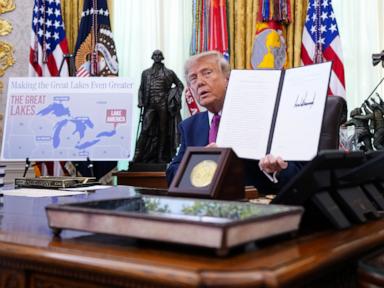
President Donald Trump on Thursday signed an Executive Order instructing Interior Secretary Doug Burgum to rename Lake Ontario as “Lake America.”
President Donald Trump on Thursday signed an Executive Order instructing Interior Secretary Doug Burgum to rename Lake Ontario as “Lake America.”
The change is set to take effect immediately, he said. Trump earlier in the week had floated the idea of a new moniker for the lake, which borders the Canadian province of Ontario and the U.S. state of New York.
Trump signed a similar order upon returning to the White House last year, renaming the Gulf of Mexico as the "Gulf of America."
This most recent name change is the latest in a series of tit-for-tat measures amid an all-out trade war between the U.S. and Canada.
British Columbia’s Premier David Eby on Tuesday called for residents not to travel to America unless it's absolutely essential.
“I’m asking British Columbians: If you have a choice, please don’t travel to the United States. Choose another place to do your tourism,” Eby said at a press briefing. “If you can choose a Canadian product, instead of an American one, please choose it… by being our own best customer, we can help respond and support Canadians in every corner of this amazing country.”
While Eby is leading the charge on a travel boycott from the Canadian province, other lawmakers are further clamping down on a boycott of U.S. products.
“When you’re at war, you protect your own, you protect your own backyard,” said Ontario Premier Doug Ford on Wednesday. “You don’t go down to the U.S. and buy a product. There’s nothing that we can’t make here in Ontario, or across the country.”
Finance Minister François-Philippe Champagne expressed a similar sentiment, telling reporters: “The biggest power we have, each and every one of us, is our purchasing power. We can choose when we go to the grocery store or to the hardware store to buy Canadian.”
Has Canadian travel to the U.S. declined since Trump returned to office?
Prior to Eby’s tourism plea, Canadian travel to the U.S. had shown a jump in visitors after a widely-reported decline.
In May, the number of Canadians visiting the U.S. was up by 9.9% compared to the same month a year prior, according to Statistics Canada. In June, the number of Canadian-resident return trips from the United States increased 5.0% year over year. The number of Americans visiting Canada was also higher, with a 6.1% rise year over year.
However, in the first quarter of 2026, Canadian residents took 5.5 million trips that included an outbound visit to the United States, a year over year decline of 10.6%. Spending while visiting the U.S. by Canadians during this period was also down by 13.6%.
Figures for the start of 2026 fall in line with a trend that has seen Canadian travel to the U.S. decline since Trump returned to Office last year.
Cell phone data analysis published by the University of Toronto in May found a 42% year-over-year median decline in Canadian travel to U.S. metropolitan areas.
The research also found that “when Canadians travel to the U.S., they are visiting fewer locations and staying for less time than they used to.”
Some metro areas such as Myrtle Beach, South Carolina, and Panama City, Florida, saw drops in Canadian tourism of at least 60%. In Florida, the decline in visits has persisted with an average decrease of just under 14% across the state during the first six months of 2026.
How U.S.-Canada talks collapsed into an all-out trade war
Relations between the U.S. and Canada have deteriorated further since the collapse of high-stakes trade talks last week resulted in U.S. tariffs of 50% on various Canadian products going into effect on Aug. 22, with no CUSMA exception.
In response, Canada has imposed retaliatory tariffs of up to 50% on certain U.S. goods.
Trump has threatened to increase automobile tariffs on Canada to 50%, claiming: We don’t need Canada, they need us.”
The Trump Administration has also revived its rhetoric of referring to Canada as a “state”—a nod to Trump’s vocal ambition to annex Canada and make it the 51st state, an idea he has floated repeatedly since returning to the White House last year.
Vice President J.D. Vance during a speech in Brewer, Maine, on Monday said: “We have to remember, Canada is a state—sorry, Freudian slip.”
Canadian Prime Minister Mark Carney, meanwhile, has drawn focus to Canada’s burgeoning trade relations with other countries.
“Over the last year alone, Canada has signed more than 20 trade and security deals across five continents,” he said Wednesday. “Canada is now the best connected economy in the world,” he claimed, pointing towards trade alliances with countries in South Asia and Europe.
Carney in January met with China’s President Xi Jinping to forge what he called a “new strategic partnership” to end Canada's economic reliance on the American market. While meeting with Canada’s second-largest export market, Carney agreed to cut his country’s 100% tariff on Chinese electric cars in return for lower tariffs on Canadian farm products, including canola seeds, a major Canadian export.
Children sleep during nap time at Minnesota Child Care in Minneapolis, on December 30, 2025. | Renee Jones Schneider/The Minnesota Star Tribune via Getty Images
Affordability is the top political problem of the moment, and lawmakers in both parties have increasingly blamed large investors for buying up housing, hospitals, and other staples families can’t do without, while jacking up prices and degrading quality.
Earlier this year, Sen. Jeff Merkley (D-OR), who has backedbills on both fronts, turned his attention to childcare. The ranking member of the Senate Budget Committee sent sweeping documentrequests to KinderCare Learning Companies and Learning Care Group, the two largest private-equity-owned childcare companies in the country, seeking information like board minutes, subsidy totals, staffing ratios, dividend records, and the investment memos the firms wrote when they bought in. Private equity, Merkley said in announcing the requests, has increasingly prioritized “investor profits over the well-being of the families and communities that depend on these services.”
The federal inquiry follows severalyears of national childcare advocacy groups warning that private equity, an industry known for acquiring businesses for quick-turnaround sales, should be kept far away from kids.
In 2022, Elliot Haspel, a progressive childcare expert, wrote in the New Republicthat private-equity owned childcare chains “ultimately answer to investors or shareholders first, parents second.” Citing their record in nursing homes, where acquisitions have been associated with declines in quality, Haspel wrote that there’s “little reason to think that early care and education would be magically exempt from these sideways influences.” In 2024 the Open Markets Institute, the National Women’s Law Center, and Community Change put out a report contending that private equity-owned centers would not only seek to soak up public funding, but stall reforms limiting their reach long enough to capture local market share, until they could argue they’d become too embedded to remove without harming families.
Since then, lawmakers in at least five states — Colorado, Connecticut, Massachusetts, New York, and Pennsylvania — have introduced or passed bills that write ownership structure into childcare policy, cap what large for-profit chains can draw from state grants, or attach strings to public dollars that apply to those providers alone. The coalition of national groups published model state legislation of its own this past February, built partly on those state experiments.
But a forthcoming paper reviewed by Vox from two leading national researchers focused on the economics of childcare — Jessica Brown at the University of South Carolina and Chris Herbst of Arizona State University — complicates the case that has been building against the private-equity owned centers. In the country’s first systematic, descriptive look at how far private equity has actually spread through American childcare, the scholars found no smoking guns.
If anything in the findings gives Herbst pause, it’s the geography.
Private equity is not sweeping the childcare sector, the researchers report. Its share of the childcare workforce stopped growing around 2010 and has hovered near 10 percent ever since. It isn’t everywhere, either — three-quarters of private-equity childcare centers sit in just 5 percent of US counties, clustered around Phoenix, Las Vegas, Denver, Atlanta, and northern Virginia. Nor do the centers look uniformly distressed. They have been operating for 18 years on average, longer than other chains — and between 2021 and 2024, while non-private-equity providers cut staff, these programs added workers.
“Given what we see,” Brown told me, “private equity is notthe reason that childcare is unaffordable.”
Herbst agreed: “You know, we jokingly at one point said we’re gonna call our paper, ‘Much Ado About Nothing.’”
This is not to say the researchers have no further questions. Their work explores the recent past, but their findings are not causal, so they couldn’t say specifically what happened when private equity took the centers over. And their data also couldn’t confirm what the chains pay their teachers, or what benefits they offer. Critics have guessed both ways — that they squeeze wages for profit, or that their size allows them to pay more than a small provider could offer and muscle out competitors.
An important question is what actually separates private equity-owned chains from other large childcare companies. Herbst and Brown found that on price, private-equity chains operate not so differently from large competitors that aren’t investor-owned. They are less likely to take public subsidies (70 percent do) than other large chains (78 percent), but are more likely to hold their state’s top quality rating. Large chains, private-equity-owned or not, tend to locate in wealthier areas with more college-educated families. Private-equity providers, though, seem distinctly drawn to states with looser staffing rules and to counties with the tightest childcare markets in the country.
If anything in the findings gives Herbst pause, it’s the geography. “It may not be that they are rendering low-quality care,” he said. “They may be rendering very high-quality care, but inaccessible to a large number of families because of where they are doing business.”
How this study came to be
Despite the amount of national attention, very little research has existed on private equity and childcare up to this point.
“People were sort of copying and pasting evidence from these other domains like nursing homes and hospitals, extrapolating results from these other sectors to childcare, and we were skeptical about this,” Herbst said.
While they were gathering information, new international evidence did come out — a working paper on Dutch childcare, which found that private-equity centers charged more and had fewer regulatory violations overall, but more staffing-related violations. The Netherlands sets its childcare rules nationally, though, which makes the findings harder to apply in the US, where staffing ratios and teacher qualifications are set state by state.
Nobody had done a deep US analysis before, largely because it’s expensive. With funding from the Alfred P. Sloan Foundation and the Washington Center for Equitable Growth, Brown and Herbst had to stitch together at least seven sources, including two proprietary databases costly enough to be out of reach for most researchers even with a grant — one tracking every business in the country year by year since 1997, the other tracking private equity deals. Then they merged all of it against state licensing records, accreditation files, and an original survey they fielded themselves in three states.
“It took an extraordinary amount of resources — both monetary and labor — to put our datasets together,” Herbst said. The lack of quality national data on childcare providers broadly has been a major barrier for researchers, and leaves the terms of the debate often set by interest groups. No federal survey tracks what providers charge, and most states don’t collect it either. Brown and Herbst could compare prices in only two states, the ones that require providers to report them as a condition of licensing.
Why is private equity interested in childcare?
One of the main questions looming over the conversation is that, broadly speaking, childcare is a low-margin business — so why is private equity involved at all?
“My answer right now is they’re not interested in childcare writ large,” said Herbst. “They’re interested in childcare in very select communities.”
The classic private-equity playbook is to buy a company, raise its value through expansion, consolidation, or cost-cutting, and sell within three to seven years. This is the model that ran through Toys ‘R’ Us, Payless, and a long line of local newspapers, and helped earn the industry a reputation for loading businesses with unmanageable debt they couldn’t carry.
But not every private-equity strategy is a short-term flip. Over the past decade Blackstone, KKR, and Carlyle have all raised long-hold funds designed to keep companies for 15 years or more. It’s a small slice of the industry, but both childcare companies now under Senate scrutiny fit that longer pattern, with Partners Group having held KinderCare since 2015 and still controlling roughly 69 percent of it after an IPO, and American Securities having owned Learning Care Group since 2014.
A representative from KinderCare did not return a request for comment, but in an interview, Brian Gutman, the senior vice president of public policy at Learning Care Group, told me that yes, their investors want to see a profit and “be a sustainable company.” Something like childcare, he said, is “a long-term play, not a short-term play” because the costs that matter most can’t be recovered inside a short window. Refurnishing a single school might run $100,000 to $300,000, and a firm looking to exit in three years would have to push that into tuition, which wouldn’t be feasible. He put the company’s reinvestment at more than $1 billion dollars.
Merkley’s letter tells a different side of that story. In 2018 Learning Care Group borrowed to pay its owners at least $636 million, and now carries roughly $5.50 in debt for every dollar it earns. In other words, the money went out the door to the owners, but the loan stayed on the company’s books, and the interest is serviced out of the same tuition that pays teachers.
Asked how that squared with the long-term picture he described, Gutman did not address the 2018 payout or the debt load. He said that under American Securities’ ownership Learning Care has spent more than $1 billion on capital expenditures and maintenance — building upgrades, safety systems, classroom technology, not counting acquisitions — and that the company’s average wage growth has outpaced its own tuition increases, inflation, and national wage growth in each of the past three fiscal years.
What private capital buys, he says, is scale. The clearest example is cameras: Before the pandemic, Learning Care put livestreaming cameras in classrooms near military bases so deployed parents could watch their kids during the day. When Covid hit and parents couldn’t come inside, the company put one in every classroom across the chain, meaning tens of thousands of cameras. It’s the kind of investment he said families appreciate and an operator with two or three buildings can’t afford. Access to capital, he argued, is what made it possible.
The right target?
I reached out to Merkley’s office to learn more about their federal investigation and a staffer told me that it had been prompted by the number of concerning stories his team had been seeing in the media. KinderCare is also headquartered in Merkley’s home state of Oregon, though they said their inquiry wasn’t driven by complaints from his local constituents specifically.
The staffer said they hope to get their report out by the end of the year, but acknowledged that “a lot of the [companies]’ responses have been lackluster” so far. “Legislation is definitely something my boss is thinking about,” they added, but said they are waiting to hash out details until their probe is finalized.
Gutman said Learning Care responded to Merkley’s request, but sees the focus on private equity as a bit of a scapegoat, or red herring. The company isn’t opposed to new regulation, he said, including more transparency about investors, decision-making, and wages. His objection is to rules that sort providers by who owns them. “Where there’s a need for enhanced regulation,” he said, “that’s a need for the sector, not a need for a couple of actors within the sector.”
He said that plenty of large childcare operators, like family-owned regional chains and big nonprofits, aren’t private-equity backed, and that ownership structure doesn’t reliably predict behavior. He cited a venture-capital-backed Montessori chain in Colorado that closed its five locations abruptly. Because the bills moving through statehouses key on private equity ownership specifically, a company like that one wouldn’t trigger regulation.
Haspel said he’s fine with legislation that targets large for-profit chains more broadly, but emphasized that the focus on institutional investors will only become more important as the conversation around universal childcarepicks up momentum in the United States. “I don’t think the focus is a red herring…[private equity] presents some real threats potentially if you have bad actors that are attracted by the increased public funding,” he said. He pointed to England, where the competition regulator just launched an investigation last month to examine whether private-equity ownership is serving families or driving up childcarecosts. Provisional findings are due early next year.
Gutman said Learning Care Group will fight being cut out of public programs. Some of the state proposals would restrict which providers can access grants or participate in state pre-K, and Gutman argued that in much of the country there isn’t a backup. About 85 percent of the company’s families live within a 10-minute drive of their center, he said. “If we’re the only game in town, and we can’t access a grant program that helps us pay teachers better, I’m not sure who that serves,” Gutman said.
Brown and Herbst’s own immediate recommendation is more public information. More states could collect prices at licensing, they argue, and make wage and staff turnover data easier for researchers to find which in turn would help generate more targeted policy fixes. “I think in some ways people are trying to look for an easy solution,” Brown said, “but the thing is there is no easy solution in childcare.”
This work was supported by a grant from the Bainum Family Foundation. Vox Media had full discretion over the content of this reporting.
Update, August 27, 11 am ET: This article was originally published on August 27 and has been updated to includemore details about the study funders.
You have questions about data centers, and WIRED has answers. Join our livestream on September 10 and our panel of experts will tell you everything you need to know.
Bo French, a candidate for Texas railroad commissioner, speaks at a CPAC panel to discuss the threat of Islam in Texas. | Eleanor Dearman/Fort Worth Star-Telegram/Tribune News Service via Getty Images
The Great American Conflict, a 75-minute documentary produced by a Texas-based organization dedicated to converting Iran to Christianity, declares its goal right at the beginning: “to reveal the true Islam to all people, especially in the West,” Iran Alive Ministries’s founder Hormoz Shariat says. “This film is also meant to be a warning to America. There is a serious threat of Islam in our nation.”
Released at the start of summer and having premiered at a gathering of the Dallas County Republican Party, it’s an obscure film — you’ve probably never heard of it — but it has so far had a surprising political influence. It’s been shown at gatherings of local Republicans and conservative activists in Texas, where Islamophobic rhetoric and policy proposals have played a key role in activating the Republican base, candidates, and party leaders over the course of this year’s elections. The documentary is both a symptom and a cause of a larger trend unfolding in American politics in 2026 that is picking up steam now: the rise of a new iteration of blatant Islamophobia paired with Christian nationalist sentiment on the American right.
Iran Alive Ministries did not respond to requests for comment.
It’s no surprise who some of the backers and voices of this documentary are: Some members of this collection of right-wing, conservative, and evangelical activists are a throwback to early-2000s and 2010s Islamophobia, when some of the same figures spoke out against “radical Islamism” and “radical Islamic terror.” One of them, for instance, is the activist Brigitte Gabriel, the controversial founder of ACT for America, an early-2000s anti-Islamic extremism group. As the film makes clear, this latest version of Islamophobia in America has its roots in this post-9/11 era and borrows heavily from it, while making some modern-day tweaks.
What’s different now is how mainstream this stance is becoming in politics and how it appears to be getting only more mainstream.
“Islamophobia has passed the dinner table test. You can say things about Muslims with basic impunity today,” Nathan Lean, a researcher, assistant teaching professor at North Carolina State University and author of the book The Islamophobia Industry, told me. “And it’s institutionalized in the way that prejudice that targets other marginalized communities is not.” He pointed to the Sharia-Free America Caucus in Congress, which is composed of 68 elected members of Congress representing 25 states. He also pointed to efforts in Texas to make eliminating “sharia” law an official stance of the Texas GOP, and then the subsequent vote to recommend Gov. Greg Abbott “ban” it on the Texas 2026 primary ballot.
Now, politicians, content creators, and politically connected advocacy groups are using films like The Great American Conflict, selectively edited clips spread on social media,and investigative-style pseudo-documentaries to spread this sentiment further and wider, power more wins of right-wing candidates, and take aim in particular at Muslim candidates and politicians.
This is all playing out as antisemitism and Islamophobia are peaking during the 2026 midterm cycle, accelerated by demographic change across America, increased Muslim visibility and engagement in politics, including elections of Zohran Mamdani in New York City and the Senate campaign of Abdul El-Sayed in Michigan, and moreRepublican politicians feeling comfortable using Islam as a scapegoat and cudgel, particularly in Texas. It all paints a worrying picture of what’s to come.
What The Great American Conflict argues is coming
As a cinematic project, The Great American Conflict isn’t much of an accomplishment; it can broadly be described as a collection of testimonials from evangelical Christians and former Muslims who’ve converted to Christianity who each make a case against Islam. Though poorly organized, it starts with some rough accounting of the rise of Islam in world history, lays out the case through interviews that Islam is an ideology and not a religion, then zooms in on specific Texan communities and examples of how Muslim politicians and activists are using democratic processes to achieve “domination.”
There are broadly three core themes that these speakers come back to:
Islam is inherently violent and imperialistic: The documentary’s interview subjects argue that true believers seek to expand the faith and establish a cross-national Islamic state. They rely on some sketchy history of the prophet Muhammed and the contemporary history of Lebanon and Iran as examples of this “violence.”
Islam is incompatible with the American Constitution and Western liberalism: Speakers also argue that, as opposed to other religions, Islam does not tolerate diversity of thought and seeks to enforce its rules and guidelines on nonbelievers. They claim that Islam rejects the separation between church and state, and that mosques can function as political or military centers.
There is an ongoing effort by Muslims to infiltrate American politics and replace “Judeo-Christian” America: The rise of Muslim American politicians in Congress, in New York City, and at the state and local government level are all part of an effort to whittle away religious liberty and replace American values with “Islamic” values. Liberal and progressive allies are enabling this takeover. And they interpret public calls to prayer, halal food, school prayer rooms, Ramadan accommodations, mosque construction, and Muslim residential developments as evidence that American institutions are yielding to Islamic demands.
Interspersed throughout these testimonials are fearmongering compilations of social media clips of Muslim prayers and veiled women, and short selections of purportedly Muslim speakers making inflammatory comments about 9/11, about Jews and Christians, and about Islamic domination in the West, and violent clips of terrorist actions abroad.
And though the film’s main backer, Hormoz Shariat, says at the beginning of the film that his goal is not to inspire fear or hate, that’s precisely what the speakers seem to do for an hour.
For example, the Christian pastor Shahram Hadian, the founder of Truth in Love Ministry in Tennessee, repeatedly argues that America is at a turning point. “Western societies are right now at a critical decision point. Either they’re going to maintain, preserve, [and] fight for their Judeo-Christian values, or they’re succumbing,” he says.
And he takes a natalist turn, arguing that Muslims in the US are happy to continue to raise families as Western birth rates drop. “We continue to see the demise of Christianity, of our Judeo-Christian values, family values, family ethics, marriage — one man, one woman,” he says. “They’re just waiting us out. They’ll just wait us out. They’ll aid us in our own demise and destruction.”
To drill down on this, various speakers point to demographic change in Michigan and Texas as early signs of what they see as the capitulation of the United Kingdom and continental Europe to Islam. They point to self-segregating Muslim communities in Europe being mirrored in the US, particularly focusing on a housing developmentproject in East Plano, Texas, centered around a mosque and Islamic center, that has been a focal point for Republican politicians.
Other speakers argue against accepting Islam as a religion at all, instead casting it as a political ideology that is seeking to take over American institutions. Some, like Gabriel, allege a coordinated strategy to “infiltrate” and “dominate the West and establish an Islamic government,” tracing this back to the Muslim Brotherhood, and a supposed decades-long plan to infiltrate political parties, schools, media, and churches to use democratic institutions to establish Islamic law. She points to Mamdani as an example of this, and ropes in Reps. Ilhan Omar of Minnesota and Rashida Tlaib of Michigan as being loyal to a foreign Islamic identity rather than to the United States.
And they contrast this all with an idealized “Judeo-Christian” America defined by constitutional government, traditional marriage, Christianity, and cultural assimilation. The final call to arms is to preserve and promote this Christian vision of America, on top of defending the Constitution, religious liberty, and “American” culture against what is a coming ideological and demographic conflict.
The danger of rising Islamophobia
Iran Alive Ministries itself doesn’t seem primarily dedicated to anti-Muslim American advocacy and activism. Most of its YouTube and internet presence is focused on digital Christian evangelism, particularly in Iran. It’s not entirely hard to see how a group focused on conversions would drift into Islamophobic preaching, but it does seem like a peculiar move, Lean told me.
“There is a group of people who form a faction of this sort of anti-Muslim movement in the United States who are, by their own description, evangelical Christians,” Lean said. “And it’s no surprise that a group like Iran Alive Ministries, that is formed on the basis of, as they say, transforming Iran into a Christian nation, one soul at a time, would go there.”
Emphasizing that Christian proselytism and evangelism are not inherently Islamophobic, Lean told me that there has been a more overt merging of religious convictions with Republican politics in recent years.
“The…driving mission of the group leads to a marriage of, we want a Christian world on the one hand, versus there are active agents in the world that are potentially preventing that. And who represents that biggest threat to that right now? Well, in the eyes of these people, Muslims do,” Lean said.
Lean told me that he expects to see this momentum build as midterms approach. At the local level, it’s most visible in Texas, where the New York Times recently reported on the stunning rise in Islamophobia and fearmongering across the state, and in Michigan, where cities like Dearborn and Hamtramck have seen white nationalist and anti-Islam demonstrations.
Lean said many of these lines of Islamophobic thinking sound like familiar tropes, smears, and lies of the last couple of waves of fearmongering around Muslims. Still, as opposed to the post-9/11 era, he noteda worrying difference: the scale of Islamophobia, given its increasing presence on both social and traditional media.
Much of the growth of these sentiments is happening online, too. Since Mamdani’s election as New York City mayor, and especially since El-Sayed’s victory in the Democratic Senate primary in Michigan, these kinds of views have surged online and in conservative media, while conservative activists and influencers have been pushing similar narratives of infiltration and under-the-radar Muslim “encroachment.”
A recent survey of internet discourse and activity by the research group Magnitude Media found something similar, centered on Dearborn: “Since the beginning of the month, there have been 690 posts mentioning Dearborn, generating 5.1 million engagements. Right-leaning accounts drove 88% of that engagement, compared to just 7% from left-leaning accounts,” the authors write. “The broader anti-Muslim conversation online has been substantial for months. Over the past six months, 68% of posts that either mentioned Islamophobia or contained common Islamophobic language came from right-leaning accounts. Dearborn appears less like the cause of a new Islamophobia conversation than the right’s newest focal point.”
So the documentary certainly isn’t the only cause for concern — but the fact that Texas Republicans have used it in official events, on top of strategists saying they are pivoting to “sharia” and fearmongering, suggests just how politically useful the party thinks these messages can be.
Which all suggests more ugliness to come. And as Lean told me, talking about a coming conflict and a threat to survival indicates an existential threat that should be fought by any means.
“Where does the logic of all of this take us? What’s the solution?” he said. “You can’t help but wonder when they’re issuing statements about fertility rates and these overtures are being kind of taken over, that this could very easily go to a dark place.”
Update, August 28, 11:45 amET: This piece was updated to reflect Nathan Lean’sfull job title.
Symbolic urbanism is having a moment, especially this summer in New York City, where the air is far too humid, but the potholes increasingly get filled. | Adam Gray/Bloomberg via Getty Images
“If this is democratic socialism,” wrote one New Yorker under a mayoral Facebook post, “maybe it is the change we need.” She was referring neither to Mayor Zohran Mamdani’s heavily scrutinized plan for city-run grocery stores, nor to his pied-à-terre tax on the rich, nor even to his trademark — though thus far, unrealized — vision for fast, free buses and universal childcare.
No, she was talking about candy-colored scaffolding. The mayor recently made good on his plan to give a facelift to the city’s ubiquitous scaffolding, that odiously ugly green eyesore that envelops hundreds of miles of New York City sidewalks. Another New Yorker posted on TikTok complaining about a smattering of potholes on his street. By the time he got home from work, they had all been filled, setting off a maelstrom of viral requests, including one from a dateless Brooklynite looking for love: “Zohran, what are you gonna do to fix this?” (The mayor cheekily obliged with a list of local meet-cute spots.)
Symbolic urbanism is having a moment, especially this summer in New York City, where the air is far too humid, but the potholes increasingly get filled, sometimes personally by the internet’s favorite millennial mayor himself.
Mamdani’s embrace of what he calls “pothole politics” — a shrewd modern-day twist on the “sewer socialism” that once propelled some 20th-century leftists into office — has delighted and exhilarated New Yorkers who’ve long yearned for a City Hall that heeded their most mundane municipal calls over a scorching-hot subway station or a sidewalk full of cracks.
With a smile plastered on his face, Mamdani has, in fact, filled potholes at a faster rate than any New York City mayor in years. In cities where everything seems to take forever to build, literally covering over these sites of everyday urban friction has become a powerfully visible form of political currency.
“There’s just this thirst for competence right now,” Don Moynihan, a professor of public policy at the University of Michigan, told me, and Mamdani in particular has “brought a sense of joy and fun to the nuts and bolts of public administration.” It may even be enough to help restore some of the public trust needed for the more arduous, less palatable work involved in making our cities more liveable in the long run.
Sixty-nine percent of New Yorkers currently have a favorable view of Mamdani, according to a Siena Research Institute poll conducted earlier this month, meaning that he has already won over at least some of the one-third of residents who told the New York Times last September that they would never vote for him. He has higher ratings at this point in office than any NYC mayor in decades.
He is even more popular now than he was a few months ago, when the Knicks clinched their first NBA championship in decades, the sort of sports victory that can quantifiably boost an incumbent’s electoral prospects. So, no, it’s not the Knicks that have made Mamdani even more popular than he was during his mayoral honeymoon.
It is, quite possibly, the potholes.
“There are easy issues for voters to understand about their local government, and then there are much more difficult issues,” said Justin de Benedictis-Kessner, a public policy professor at Harvard and author of the forthcoming book The Fog of Accountability. “When you make campaign promises about more difficult issues, you might pair them with some clear issues like potholes,” which are decidedly easy for voters to understand.
But the bigger question is whether Mamdani or others like him can borrow from the public trust they earn from filling them to help move the needle on the hard stuff, “especially when those next things aren’t going to be what your constituents like as much,” like large-scale zoning reforms or tax hikes, he said. “They might be tougher policies to swallow.”
Pothole populism, explained
“If government can’t do the small things,” Mamdani declared at a rally to mark his first 100 days in office, “how could you ever trust it to do the big ones? How can we promise to transform our city if we can’t pave your street?”
There’s plenty of data to back him up on this, not just in New York City but across the nation. For every extra week it takes their city to fix a nearby pothole, Chicagoans report being measurably less satisfied with their lives, according to one study. A separate survey found that Bostonites became 14 percent more trustingof their government after they were able to see it respond to complaints like potholes or broken street lamps. Much as doing the dishes or taking out the trash can be more romantic than the occasional pricey date night, these everyday municipal acts of service resonate with beleaguered urbanites.
Mamdani is not the first politician to build political capital on the strength of small, some even symbolic or aesthetic, infrastructural upgrades. Milwaukee, for example, elected a slew of leftists roughly a century ago who earned the pejorative moniker “sewer socialists” for their focus on small-scale engineering projects. These mayors understood that “it was not manifestos or ideological pamphlets that would win hearts and minds. It was about proving to people that the government could do things that had a sort of broadly shared benefit,” said Philip Rocco, a professor of political science at Marquette University. “They were picking really low-hanging fruit as a way of building a coalition.”
“There are easy issues for voters to understand about their local government, and then there are much more difficult issues. When you make campaign promises about more difficult issues, you might pair them with some clear issues like potholes.”
Justin de Benedictis-Kessner, public policy professor at Harvard
Milwaukee’s 20th-century socialist mayors went on to double the city’s size through annexation and new housing, built a pioneering sewage treatment plant, and set up the nation’s first Bureau of Economy and Efficiency. Along the way, they installed new street lights, drinking fountains, park benches, and countless other low-cost urban fixes that made everyday life safer, healthier, and more joyful. By 1936, Time was running a cover story about how six-term Mayor Daniel Hoan, “one of the nation’s ablest public servants,” had transformed Milwaukee into “perhaps the best-governed city in the US.” Hoan won election after election not because of his party affiliation (to be clear, literally Socialist with a capital S), but in spite of it, wrote Time, his competence and charisma charmingeven most conservative Milwaukeeans.
Mamdani, who often invokes Milwaukee’s sewer socialists, clearly craves a similar legacy. He is actively attempting to disprove the idea that progressives today “are disconnected from reality, and that they have a lot of pie-in-the-sky ideas,” Moynihan said, “but that they can’t actually govern” when it comes to the often unglamorous, nitty-gritty demands of public service.
According to Moynihan, Mamdani may also be inheriting elements of another lineage; “broken windows” theory, though he may be less apt to say so. While it’s best known now for justifying controversial policing policies like stop-and-frisk, he said the approach also took seriously the idea that your “quality of life depends upon fixing the small things in your neighborhood.”
Now what?
If imitation is the greatest form of flattery, then take note of the other local electeds beginning to engage in botched attempts to recreate Mamdani’s pothole politik. Los Angeles Mayor Karen Bass earned scorn a few weeks ago for voluntarily posting a video in which she fails to fix a pothole because of a car parked atop it. The road ahead will not, in fact, be paved with good intentions alone.
But while Mamdani has clearly earned the trust of much of his city, what he will do with it is just starting to take shape. As Mayor Hoan showed a century ago, it’s one thing to fill a pothole with a scoop of asphalt, but it’s another to make your city’s housing more affordable or make the buses run faster.
And yet, it is possible that the political symbolism he is curating today might indeed make the path ahead easier. Just this week, Mamdani announced his biggest infrastructure project to date, a mammoth 10-year, $4 billion rebuild of a crumbling section of the Brooklyn-Queens Expressway, which two past mayoral administrations have tried and failed to fix. Whether or not he can be the one to pull it off will hinge on the public trust he cultivates today.
“If Mamdani wants to get things done quickly, he’s going to have to implement a lot of policies that are a mix of really popular but perhaps minimally effective,” said de Benedictis-Kessner, “and ones that are much more effective but definitely not as popular.”
Take rent control, which is very popular with voters, but, as my colleague Marina Bolotnikova has pointed out, does little to fix the roots of our dysfunctional housing market. By embracing it anyway, Mamdani is signaling that “he’s doing something that listens to his constituents,” said de Benedictis-Kessner, and the trust he earns from doing so could ultimately make “less popular policies that are actually much bigger in scale” more politically viable, like zoning reforms or density bonuses for developers.
What I really want, my own personal North Star for good municipal governance in New York, is the Interborough Express, a long-awaited light rail line connecting Brooklyn and Queens that probably won’t be finished until at least 2031. Those are the kind of large-scale urban renovations that I’ll be writing about — and sometimes advocating for — in my new Vox newsletter, Nice Things. (Seriously, sign up!) But in the interim, I will settle for somewhere I can lock up my bike without lugging it up the stairs, or a subway station that isn’t quite so sweltering in the summertime. The little fixes that make our days just a little smoother, while also maybe laying the foundations for big changes.
No barrage of pothole-fixing blitzes will make the trains run on time or protect a city’s shore from flooding. But at a time when nobody thinks the government can do much of anything anymore, it’s a start. “To be able to argue, ‘Look, if you give me money, I will make things work,’” said Moynihan, “is a much more compelling argument if you can show that you are actually making things work.”
Lawyers claim Eman el-Shazly, from Birmingham, was detained in effort to silence her sister, a critic of Sisi regime
The UK Foreign Office has been asked to intervene to secure the release of a British-Egyptian woman who it is claimed has been arrested in Cairo because of her sister’s political activism.
Eman el-Shazly, a 45-year-old based in Birmingham, was arrested on 16 August while visiting Egypt. Her lawyers say she has been detained in an attempt to silence her sister Mona, a relentless and harsh critic of the Egyptian government on her UK-based YouTube channel.
A federal judge will consider whether to free Andrew and Tristan Tate from a Miami detention center while they challenge extradition to face rape and sex trafficking charges in the United Kingdom
Strategists in both parties have long thought that everything would need to go right for Democrats to take over Congress this fall. Their map, though, is becoming more forgiving.
In June, a FEMA official infamous for claiming to have teleported to a Waffle House was reportedly ousted. He’s still employed by the government, though—and meeting with a Trump fixer.
More than 15 politicians from across the country have signed on to the AI Pact, vowing to regulate data centers and AI. “We’ve got to get this right,” says Senate candidate Dan Osborn of Nebraska.
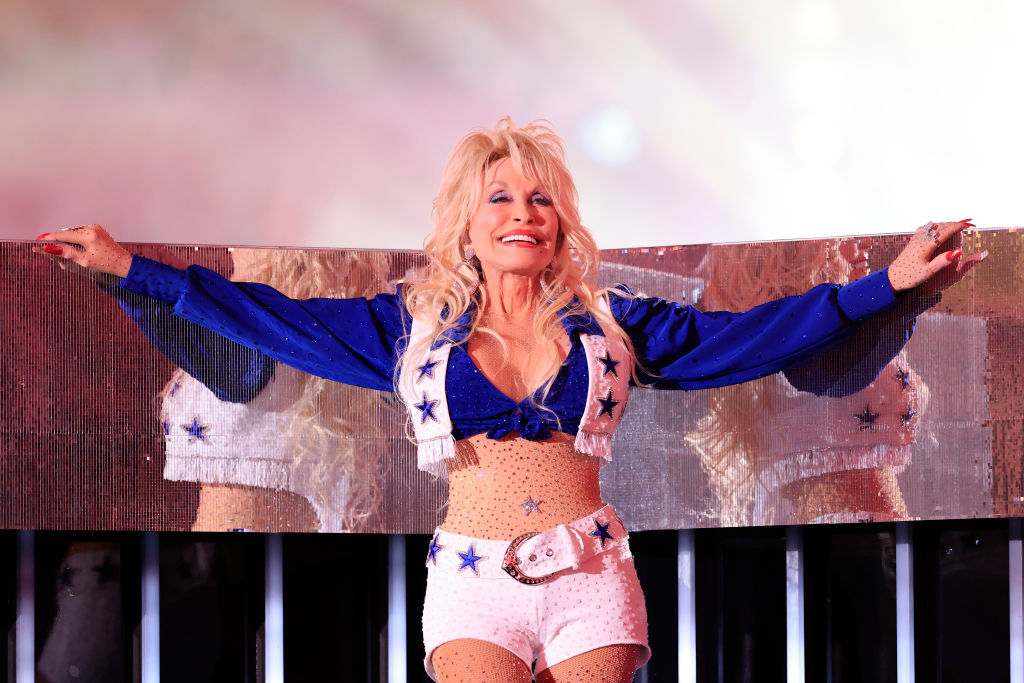
Dolly Parton performs during halftime in the game between the Washington Commanders and the Dallas Cowboys at AT&T Stadium on Nov. 23, 2023, in Arlington, Texas. —Ron Jenkins––Getty Images
The death of country music legend, actor, and philanthropist Dolly Parton has prompted a rare moment of bipartisanship, with tributes pouring in from both sides of the political aisle.
Parton, who died at the age of 80 on Tuesday, was widely loved and celebrated around the world and leaves behind a life that touched the lives of millions of Americans.
“Dolly Parton’s legacy is one of love, compassion, and resilience. With a seven-decade career, she inspired multiple generations of artists and fans with her music and an unwavering commitment to making the world a better place,” read a statement shared on Parton’s social media page.
President Donald Trump ordered U.S. flags at the White House and other federal facilities to be flown at half-staff through Sept. 1.
Trump called Parton an "amazing" person who and "to lose her is like to lose her a member of the family."
"She wasn't a very political person," Trump said during a live radio interview Wednesday morning with conservative host Glenn Beck.
Despite her grand public presence and persona, Parton often chose to stay out of political discourse.
“Everybody knows I don't do politics because my mother was a Democrat, my daddy was a Republican, so I'm a hypocrat,” she joked in 2017 when asked on Fox & Friends why she had not joined Jane Fonda and Lily Tomlin’s anti-Trump remarks at the Emmys.
“I've got as many Republican fans as Democrats, and I don't want to make any of them mad at me, so I don't play politics. Plus, I'm an entertainer, I don’t usually voice my opinion in a situation like that,” Parton added.
Parton reiterated her apolitical stance during an interview with ABC's David Wright in 2018, where she again repeated, “I'm not being political.”
“I don't do politics. I'm not getting into any of that because I have a lot of fans out there, and I don't want to offend anybody,” she said.
When pressed to answer questions about Trump, who at the time was just over a year into his first term as President, Parton said: “I have my opinion about everybody and everything, but I learned a long time ago: Keep your damn mouth shut if you want to stay in show business.”
“I'm not in politics. I'm an entertainer,” she said.
That broad appeal was reflected in tributes from across the political spectrum.
How Democrats are remembering Parton’s advocacy
Major Democratic figures have cast Parton as a progressive figure who advocated for minority rights through her music, philanthropy, and public comments.
Sen. Bernie Sanders of Vermont, an independent who caucuses with Democrats and is a leading voice of the progressive movement, said Parton “was one of the great entertainers of our era” whose “music and humanity touched millions.”
“She was not only a talented musician & songwriter, but a lifelong philanthropist and advocate for literacy, education, LGBTQ+ rights, healthcare and disaster relief,” he said.
Despite Parton’s desire to remain politically neutral, her reputation as an advocate for LGBTQ+ rights stems from both her public comments and her work.
When asked in an interview aired in 2009 with Joy Behar whether she supported gay marriage, Parton said: “I always say, sure, why can't they get married? They should suffer like the rest of us do.”
At the time, the statement was politically significant, with same-sex marriage not becoming legal nationwide in the U.S. until 2015 and the issue still a source of intense political division.
Again in 2016, Parton underscored her support for the community, saying: “I do not believe that we should criticize and judge other people.”
“I think we should be accepting and loving. We are all God's children. We are who we are, and we should be allowed to be who we are,” she told Larry King during an interview.
Similarly, Tennessee Democratic gubernatorial nominee Jerri Green said Parton was one of "Tennessee's finest," noting that Parton "always used her platform to lift others up."
"She was also an unapologetic advocate for the most marginalized, including our LGBTQ+ neighbors. The world is brighter and better simply because she existed,” she added.
Asked in 2023 about Tennessee’s anti-trans legislation, Parton said she wanted “everybody to be treated good,” described the queer and transgender people in her life, and said their identities were as intrinsic to them as hers was to her.
“That’s who they are. They cannot help that any more than I can help being Dolly Parton, you know, the way people know me. If there’s something to be judged, that is God’s business. But we are all God’s children and how we are is who we are,” she toldThe Hollywood Reporter.
Former President Joe Biden also reflected on Parton’s legacy, describing her as “an American original” who “was an inspiration to millions” and “a relentless advocate for women and for equality.”
Rep. Ro Khanna of California said Parton “chose to continue her life pursuing the arts, and pushing boundaries to advocate for inclusion, women’s rights, children’s literacy, and more.”
The Country Music Hall of Fame credits Parton and her female contemporaries with revolutionizing country music through their “strong feminine stances.”
In 1995, Parton began her Imagination Library project, which sent an age-appropriate book to children in the U.S. every month until they turned 5. The program has since expanded to multiple countries around the world and delivered more than 300 million books to over 3 million children from all backgrounds.
New York City Mayor Zohran Mamdani called Parton “an extraordinary person and an irreplaceable champion of the working class.”
How Republicans are honoring Parton as an American icon
On the other side of the political aisle, Republicans have sought to highlight Parton as a symbol of American and Appalachian identity.
“Today our nation lost an American icon. Dolly Parton stood on the global stage for many decades and helped define the cultural image of our nation,” said Secretary of State Marco Rubio. “Dolly was an Ambassador for American music and entertainment. She will be missed, but her legacy will continue.”
House Republicans, in a statement, described Parton as an “unmistakable voice” and “joyful presence” whose “deep love of country made her a national treasure.”
Parton was one of 12 children and was raised in poverty in rural Tennessee amid church music and a strong extended-family tradition. Rather than leaving the region behind, she invested heavily in East Tennessee with the opening of the Dollywood amusement park, which became a major tourism and employment engine, while the separate Dollywood Foundation funded scholarship opportunities.
Sen. Marsha Blackburn of Tennessee said that all Tennesseans feel “the loss of Dolly Parton.”
“Dolly’s life and career are forever woven into Tennessee’s music, culture, and history. Her extraordinary talent, generosity, and love for the Volunteer State (the nickname for Tennessee) touched hearts around the world and will continue to inspire generations to come. Tennessee will forever be grateful for Dolly,” she added.
Rep. Diana Harshbarger, who represents East Tennessee's 1st Congressional District, where Parton was born and raised, said the singer “never forgot where she came from” and praised her ability to appeal to people across the political aisle.
“She was so apolitical. She did not want to be on one side or the other, and that made people love her,” she said. “She remained true to who she was, she was a genuine person. She was authentic as all get out, and nothing could sway her.”
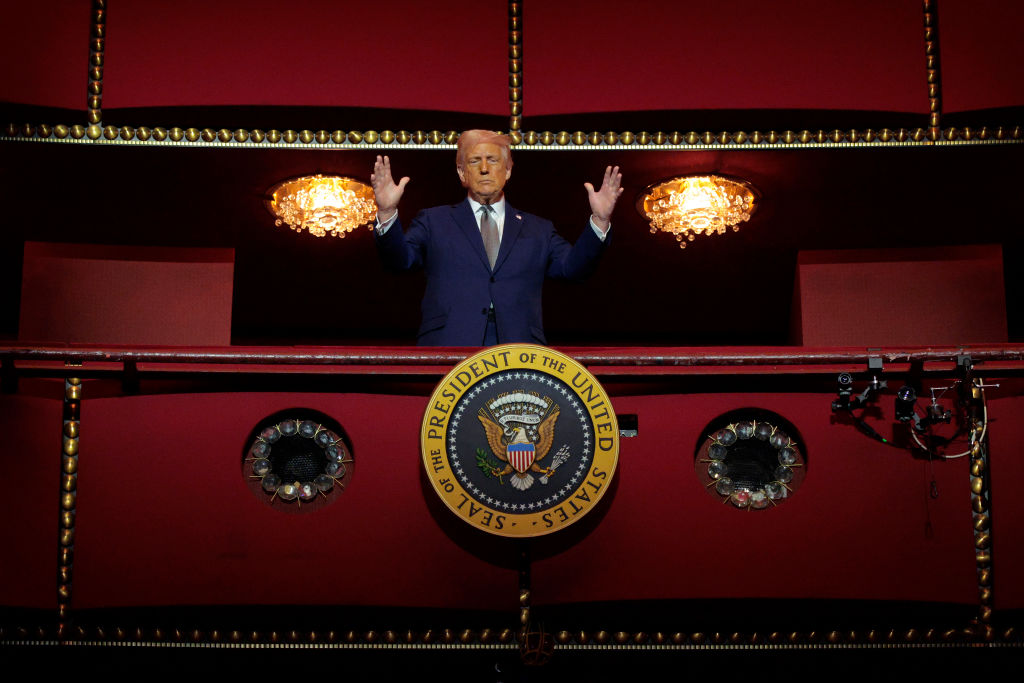
President Donald Trump tours the John F. Kennedy Center for the Performing Arts and leads a board meeting in Washington, D.C., on March 17, 2025. —Chip Somodevilla—Getty Images
In the filing, Justice Department lawyers representing the center argued that Trump’s proposed renovations were necessary to prevent what they called "a financial and structural death spiral." They described the building as ‘structurally unsound, fundamentally unsafe, and embarrassing to the Nation’s Capital’ and warned that without the work, it could deteriorate to the point that it would need to be demolished.
The filing suggested that the building could be replaced by a large outdoor amphitheater overlooking the Potomac River. The lawyers said that “such a replacement will fail to adequately honor President John F. Kennedy, but would be simpler and more economical to build, operate, and maintain.”
The filing marks an unusually explicit reference by the Trump Administration to the possibility of demolishing the venue, which first opened its doors in 1971 as a living memorial to President John F. Kennedy, who was assassinated in 1963.
How the fight over the Kennedy Center escalated to demolition threats
At the start of Trump’s second term, he overhauled the center’s governing board and replaced several members with allies. That board voted in December 2025 to rename the venue as the “Trump Kennedy Center.” In February, he also ordered the center to close for two years to make way for renovations.
In May, a judge ruled that only Congress could rename the center and temporarily blocked both the name change and the planned closure. The judge ordered Trump’s name removed from the building.
Earlier this month, the board voted to rename the building “The John F. Kennedy Center for the Performing Arts Restored and Renovated by President Donald J. Trump,” setting up a new test of the court’s ruling.
Internal records obtained byThe Washington Post showed that ticket revenue and fundraising fell sharply after Trump’s name was added to the building.
The reference to demolition comes as Trump has pursued major changes to other Washington landmarks. His Administration demolished the White House’s East Wing to make way for a ballroom costing hundreds of millions of dollars—a project facing its own legal challenges.
In a statement Tuesday, lawyers for Ohio Rep. Joyce Beatty, an ex officio member of the center’s board, called the Justice Department’s threat “unconscionable.”
“This is a not-so-subtle threat to demolish the Kennedy Center if the President doesn’t get his way,” attorneys Norm Eisen and Nathaniel Zelinsky said. “This is unconscionable, it is unbecoming of the Department of Justice to even put this in a filing, and we will answer in court.”
A hearing is scheduled for 2 p.m. on Thursday, Aug. 27, on Beatty’s emergency motion seeking to block the board’s latest attempt to add Trump’s name to the center.
TIME has reached out to the Justice Department and the Kennedy Center for comment.
Even people sympathetic to President Donald Trump’s economic nationalism seem confused about the trade war with Canada. | Andrew Harnik/Getty Images
LONDON, Ontario — President Donald Trump seems dead set on escalating his trade war with Canada. And no one is really sure why.
On Monday, Trump threatened another round of 50 percent tariffs on top of the ones he just implemented — this one targeting Canada’s auto industry, which is so deeply integrated with its American counterpart that large duties would do major damage on both sides of the border. By Tuesday morning, he had begun musing about renaming Lake Ontario “Lake America” to spite Canadians. And throughout all of this, he and Vice President JD Vance had renewed their “jokes” about absorbing Canada as the 51st state.
But who is this even for? While the White House’s behavior infuriates Canadians — it is palpable on the ground here in Canada — it’s unusual by Trump standards in that nobody seems to want this conflict but him.
Even the most fringe, or unpopular, foreign policy ideas he’s pursued typically have think tanks devoted to pushing them, or a loyal ally to please, or a voting bloc to rile up before the midterms. But unlike, say, Trump’s conflicts with Iran, or Cuba, or China, it’s hard to find a highly visible corner of conservatism that’s the driving force behind a nationalist campaign against Canada.
When I reached out to trade experts, political scientists, and in-the-know Republicans of the pro- and anti- Trump persuasion to try to trace the origins of Trump’s trade war, they had trouble pointing to anything solid. As one veteran GOP lobbyist put it, there doesn’t seem to be any ideological, business, or congressional coalition devoted to egging on the trade fight.
Even people sympathetic to Trump’s economic nationalism seem confused: Michael Lind, a populist pundit who last year penned a piece titled “Why tariffs are good,” has just written a follow-up titled “The madness of Trump’s Canada trade war.” And while there are some affected industries — autos, steel — they don’t seem to be main characters: United Auto Workers, which backed some prior tariffs, came out strongly against the proposed auto tariffs.
The politics don’t make much sense either. American voters have long disapproved of Trump’s tariffs on Canadian-made goods, and the current escalation threatens to be the largest and most economically damaging yet. Republicans sound anxious about its impact on the midterms; several key Senate races are in states right on the Canadian border, and any tariff-related price spike there could supercharge Democrats’ core midterm message about affordability.
“This has never been a particularly well-thought strategy. I think that the biggest, most coherent explanation is that this is about power.”
Kim Clausing, UCLA trade economist
“If I were [Senate Majority Leader] John Thune, I’d be very pissed at Trump right now,” says Adam Carlson, a Democratic pollster at Zenith Research.
So why are we at (economic) war?
The best answer is deceptively simple: because Trump, and Trump alone, wants to be.
There is no good strategic rationale for the way Trump has gone about badgering America’s northern neighbor, even if you share his broadly nationalist view about trade. Rather, Trump has become fixated on dominating or even possessing Canada. And his top deputies are backfilling his fixation, including by offering terms of surrender the Canadians simply couldn’t accept.
“This has never been a particularly well-thought strategy,” says Kim Clausing, a trade economist at UCLA. “I think that the biggest, most coherent explanation is that this is about power.”
It’s the latest example of the risks of governance by one man’s whims — one that could both damage America’s economy and burn its relationship with its staunchest ally before it resolves.
Trump’s northern power trip
Typically, when you try to explain the policy of any government, you look at two main factors: interests and ideology. In this case, neither is close to sufficient to explain the intensity of Trump’s war on Canada.
It is true that, for decades, the United States has had meaningful trade disputes with Canada over issues like lumber and dairy. But these issues never boiled over into a massive trade war, for the simple reason that they simply aren’t that large as a percentage of GDP. There’s a reason that every administration prior to this one — including Trump’s first — handled these issues through normal negotiating processes rather than loud bullying.
On the ideology front, it is true that Trump’s 2016 victory has revived conservative interest in economic nationalism — leading to the creation of groups like American Compass, a think tank dedicated to putting policy meat on the bones of the right’s nationalist spirit. But these nationalists largely converged on China as their principal economic enemy. While Trump trade adviser Peter Navarro is helping run Canada policy now, there was no sign in his essay in Project 2025 — or from other allies — that anyone was contemplating a full-on trade war with Canada beforehand. And American Compass does not appear to be involved in the current fight, offering no official comment on its press page or founder Oren Cass’s X feed.
“I really do think it is Trump’s idiosyncrasies that caused him to settle on Canada,” says Phil Magness, an economic historian who closely tracks intra-right economic disputes. “Others in the admin are going along with it.”
The timeline backs up Magness’s assessment.
In November 2024, shortly after winning the election, Trump began feuding with then-Prime Minister Justin Trudeau — calling him “governor” and beginning his talk of Canada as the 51st state. Less than two months after taking office, Trump targeted Canada with (at that point) historically high 25 percent across-the-board tariffs.
When the Washington Post investigated the rationale behind these tariffs at the time, they found a void. There was no policy paper behind the Canadian tariffs, nor any clear intellectual godfather or industry backer. People inside the administration put all the credit (or blame?) solely at the president’s feet. Within MAGA media, the closest to radical anti-Canada sentiment might have been Tucker Carlson’s trollish musing about “regime change” in 2023.
After Mark Carney replaced Trudeau as prime minister, and won the general election primarily on an anti-Trump platform, tensions cooled to a somewhat surprising degree, at least when it came to trade talks. Prior to this week, the 51st state rhetoric had declined dramatically; negotiations on trade looked like they had a real chance of success. Indeed, just this Tuesday, Trump himself declared they had reached a deal and postponed tariff implementation as a result. The Friday breakdown thus felt like a bit of a shock.
But reading detailedaccounts of the negotiation collapse, including a brand-new ticktock from the New York Times, it’s clear that overweening American conditions were a major part of the failure. Most strikingly, and relevant, were US demands that it have control over Canada’s tariff rates with other countries and that it be able to reimpose American tariffs on Canada at will.
The key point here is that the Trump administration was not, and never has been, interested in a reciprocal trade deal between allies based on clear and cogent principles. Instead, they want to vassalize Canada — to bully it into surrendering elements of its sovereignty, or even its sovereign existence altogether. It is clear that this is the direct result of the president’s personal fixation.
Why exactly Trump has become so obsessed with controlling Canada is harder to say. Per the Post, there are theories ranging from bitterness around a legal battle over Trump Tower Toronto to his friendship with Kevin O’Leary, Canadian entrepreneur and host of the reality show Shark Tank. Certainly, his more recent rivalry with Carney hasn’t helped: “Canada lives because of the United States,” Trump declared, menacingly, after the prime minister delivered a critical foreign policy speech in January.
My own personal theory is that it’s of a piece with Trump’s desire to acquire Greenland, another cause that’s largely unique to him. He is looking toward his presidential legacy, and nothing makes a real estate developer think “legacy” more than literally enlarging the size of the United States on the map.
But in practical terms, the reason may be immaterial. Whatever the roots of Trump’s Canada fixation, we know that it is real and a major driver in US foreign policy — one so important, in fact, that he is willing to jeopardize his party’s all-important Senate majority in order to pursue it.
 Login
Login