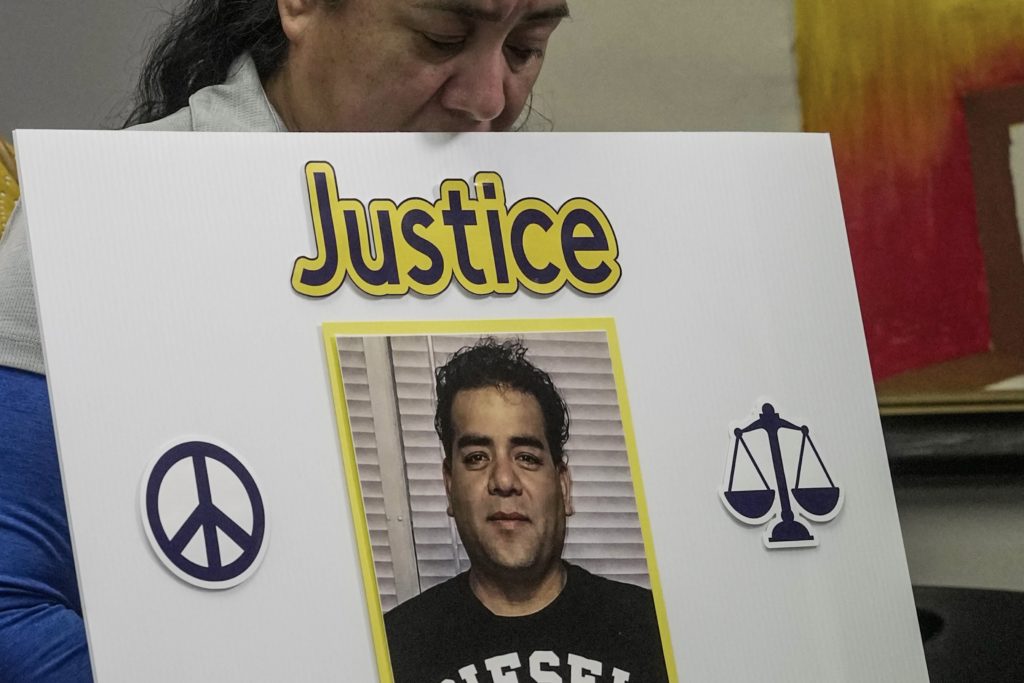
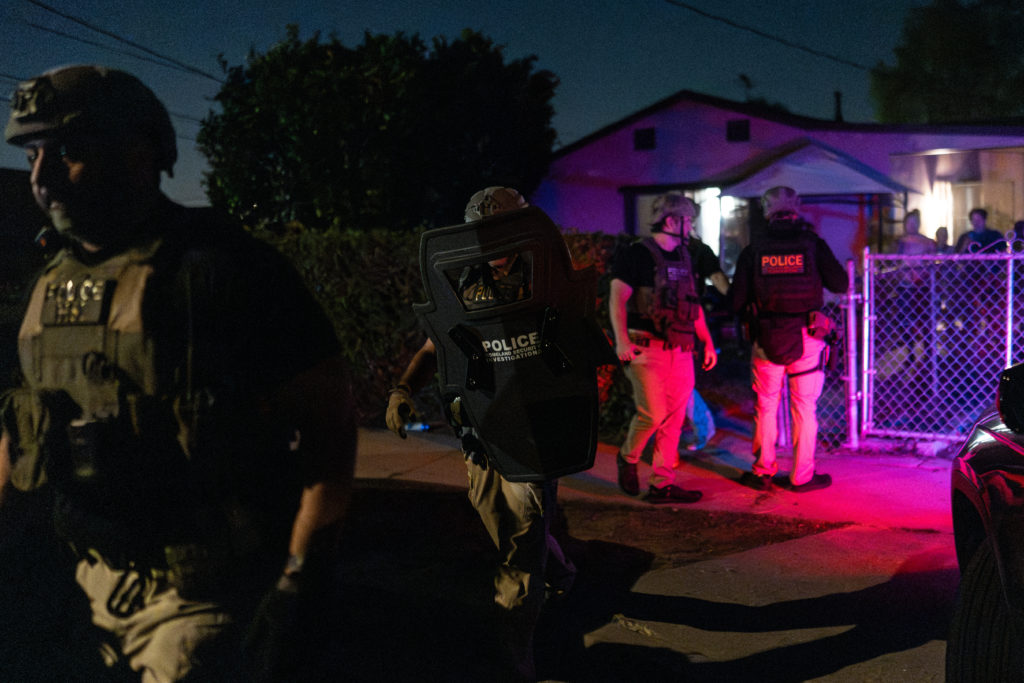
The officer, Mario Alberto Morales, was driving an unmarked SUV on Oct. 10 when he struck and ran over Miguel Parra Hernandez, 48, who was running away during a pursuit through a parking lot, the Harris County District Attorney's Office said.
The Trump administration plans to fly the Afghan immigrants from Louisiana to Pakistan, where they are expected to be expelled over the border to Afghanistan.
Immigrants at Texas detention facility, protesting against harsh conditions, say they face threats of force-feeding
Members of Congress sent a scathing letter to federal immigration officials this week demanding answers about conditions inside a Texas immigration jail, as detained immigrants on a prolonged hunger strike claim officials are retaliating against them and threatening them with force-feeding.
A group of seven congressional Democrats sent the letter earlier this week to Markwayne Mullin, the Department of Homeland Security (DHS) secretary, and David Venturella, the Immigration and Customs Enforcement (ICE) acting director, protesting about the treatment of hunger strikers.
Are the Democrats really going to take Texas? If there is going to be a blue wave, as polling suggests, winning the Lone Star state is going to be essential. James Talarico, the Democratic candidate for US Senate, is currently leading against Ken Paxton, a scandal-ridden political survivor. Even the gubernatorial race in Texas, pitting Greg Abbot, the current governor, against Gina Hinojosa is within the margin of error. These elections, and ultimately control of the US Congress, are likely to be decided by one key demographic – Latinos. Hispanic men were key to Donald Trump’s 2024 win. But Carlos Eduardo Espina, a news commentator, and Stephanie Valencia, a pollster, tell Kai Wright there are signs that the economy, the Trump administration’s mass deportation campaign and Republican redistricting efforts are backfiring – and Latinos seem to be swinging back to Democrats this year. Espina and Valencia break down what we really mean by 'the Latino vote' and how those voters might just swing right back next election if Democrats aren’t careful.
Are the Democrats really going to take Texas? If there is going to be a blue wave, as polling suggests, winning the Lone Star state is going to be essential. James Talarico, the Democratic candidate for US Senate, is currently leading against Ken Paxton, a scandal-ridden political survivor. Even the gubernatorial race in Texas, pitting Greg Abbot, the current governor, against Gina Hinojosa is within the margin of error. These elections, and ultimately control of the US Congress, are likely to be decided by one key demographic – Latinos. Hispanic men were key to Donald Trump’s 2024 win. But Carlos Eduardo Espina, a news commentator, and Stephanie Valencia, a pollster, tell Kai Wright there are signs that the economy, the Trump administration’s mass deportation campaign and Republican redistricting efforts are backfiring – and Latinos seem to be swinging back to Democrats this year. Espina and Valencia break down what we really mean by 'the Latino vote' and how those voters might just swing right back next election if Democrats aren’t careful.
Several current and former law enforcement officials said an Obama-era investigation found some evidence that Ms. Omar had entered into a sham marriage with a man suspected of being her brother.
The move to strip citizens of their passports and their rights is not a new one, nor is it limited to the United States and Rep. Ilhan Omar. | Stephen Maturen/Getty Images
What do a Bollywood actor, a member of Congress, and Israeli directors have in common?
It sounds like the beginning of a bad joke. The punchline, though, is that governments of India, the United States, and Israel, respectively, think they should be stripped of their national status.
Bollywood star Imran Khan, nephew of Bollywood superstar Aamir Khan, was told he has until October 28(and since extended to November 2) to leave India, where he resides on an Overseas Citizen of India (OCI) card. India doesn’t allow dual citizenship, but OCI status gives individuals of Indian descent and their family members the right to permanently live, work, and study in India; its revocation uproots its holders from their homes and their lives. Khan had protested in a demonstration demanding the resignation of Gyanesh Kumar, India’s chief election commission. He is challenging the order in court.
Earlier this month, US Rep. Ilhan Omar’s home was raided by federal authorities who are reportedly preparing a case to strip her of citizenship, alleging that her father said she was 17 when she was really 18 when he filed her naturalization paperwork. President Donald Trump subsequently said that, because a federal court filing allegedly referred to her as “Ilhan Nur Said Elmi, a/k/a Ilhan Abdullahi Omar,” she should have to resign from Congress.
Israeli Prime Minister Benjamin Netanyahu has intimated that Yuval Abraham and Rachel Szor, directors of the film NAZA, in which Abraham interviews Israeli soldiers and intelligence officers on Tel Aviv rooftops about how they assessed and decided to kill civilians in Gaza, could be stripped of their Israeli citizenship, saying he would pursue legislation to go after critics of the military who crossed a line. “We will revoke citizenship for anyone who defames IDF soldiers around the world — he will be deeply hurt in his pocket,” said Netanyahu, who cited the filmmakers as a potential example and called their work “intolerable.”
The move to strip citizens of their passports and their rights is not a new one, nor is it limited to these three countries. Perhaps most famously, Jews were stripped of citizenship by the Nazis in Germany and elsewhere in Europe in the 1930s and ’40s. To take a more recent example, over the summer, Russia passed legislation that effectively strips Russians abroad facing domestic prosecution on political grounds of their citizenship (the law takes away their property, freezes their bank accounts, and refuses them consular services).
Still, that three high-profile cases are coming from three countries that claim to be democracies raises the question: Why do reactionary leaders in democracies reach for denaturalization (or quasi-denaturalization, in the case of loss of OCI) as a weapon against political and cultural elites? What do they hope to gain? And, relatedly: What might they lose instead?
It’s not just about the high-profile targets
Reactionary leaders do not typically threaten to make an example of high-profile political opponents or cultural elites as a first step. In each of these cases, there are demographic groups — whole swathes of the population — whose governments have been trying to disenfranchise, denaturalize, or deport them (or some combination of the three) long before the recent spate of high-profile headlines.
In India, there’s currently a politicized election integrity push that experts warn could illegitimately prevent tens of millions of voters from marginalized groups, especially Muslims, from participating in elections. What should have been a routine clean up of voter rolls ended up with 130 million — nearly 10 percent of the population — struck off the lists. The sweeping approach has raised widespread concern from critics that many voters will be incorrectly removed — and deep suspicions that this disenfranchisement is targeted and intentional.
Mukulika Banerjee, a professor of anthropology at the London School of Economics, noted this happened after the position of chief election commissioner was made partisan and given immunity for life. And while normally in India (unlike in the United States) the onus is on the state, not individuals, to register voters, in this case, the state said that if people were to be put back on the voter rolls, they “had to produce a whole bunch of documents…which by implication affected the socially disadvantaged,” per Banerjee.
That meant women, people from lower castes, rural voters — and, since “the Muslim population amongst the most seriously socially disadvantaged, the likelihood of Muslims falling in this category is very high,” Banerjee, author of Cultivating Democracy: Politics and Citizenship in Agrarian India, said. In places like West Bengal, where Muslims make up nearly 30 percent of the population, there were some assembly constituencies where, in elections earlier this year, the number of names deleted from the rolls was greater than the margin of victory, and while anti-incumbent sentiment was high and the BJP may well have won anyway, some, per Banerjee, are asking, “was this an attempt to choose the electorate, so to speak.”
In the United States, the Trump administration has made denaturalization a priority, hoping to find people they can make an example of as part of their broader immigration crackdown. They have already filed to strip dozens of Americans of their citizenship by claiming they lied on their naturalization paperwork (“Justice Department Moves to Strip Citizenship from 40 Criminals in Largest Single-Period Filing Under the Trump Administration,” a press release from earlier this month crowed). The White House also tried, unsuccessfully, to revoke America’s constitutional right to birthright citizenship, which could have left future generations far more vulnerable to removal or persecution.
And in Israel, Palestinians have long been made to feel the weight of citizenship — and the heft of its absence. This is not only true in, say, the West Bank, where Jews live as citizens but Palestinians live under occupation and military law, but in East Jerusalem, where most Palestinians are permanent residents, not citizens, meaning they cannot vote in general elections for the Israeli legislature.
“That is a tool that Israel has used in a different way that could easily be transplanted to citizens,” said Mairav Zonszein, senior analyst on Israel at Crisis Group. And if you can strip residency from Palestinians in Jerusalem, maybe you can strip citizenship, too. “If this government is reelected, I could see that becoming a less and less crazy idea” as what was once unthinkable becomes “normalized.” Palestinian citizens in Israel have expressed the same concern.
The chilling effect of deportation threats
How — and why — does an aspiring authoritarian move from threatening the rights and status of demographic groups to going after elites?
Sometimes, the elites are — in addition to being outspoken and high profile — from the demographic group under threat.
Several years before Khan’s OCI status came under threat, the Modi government took journalist Aatish Taseer’s OCI card from him. This happened in 2019 — months after Taseer authored a Time story with “India’s Divider in Chief” plastered across the cover, after which the prime minister himself said, “Time Magazine is foreign. The writer has also said he comes from a Pakistani political family. That is enough for his credibility.” Taseer’s father was indeed a Pakistani political figure, but this was hardly some secret of which Taseer had made offhand mention; Taseer had written about his father and the role his absence and rediscovery in his life, including in his first book, Stranger to History: A Son’s Journey Through Islamic Lands.
And so with Imran Khan, Taseer said in a phone interview, there is an element of, “Just get the Muslim out” (Khan’s mother is Muslim). In Taseer’s own case, he said, he became “the Paki.”
The same is true at least in one high-profile case in the United States: Omar is Muslim and from Somalia, two groups that frequently attract the ire of the Trump administration. Recently, Trump urged Minnesotans to “fight back” against Somali immigrants before the state is “taken over.” Omar is also a prominent and progressive member of Congress.
“It’s got these two levels,” Taseer said. “One is an ethnonationalist agenda. The other is a blunt instrument of coercion.” If you speak out too freely, Taseer added, “you won’t be able to return home.”
The blunt instrument, though, is more narrowly applied than, say, stripping people from voter rolls en masse. It is designed to cause fear among elites: journalists and actors and academics.
And it is meant, Banerjee said, to raise the price of protest.
The government’s first instinct, she said, is to call protesters terrorists and anti-nationals, rather than citizens exercising their rights: “They don’t seem to understand that to peacefully protest is there in…the constitution.”
And by taking a Bollywood star’s OCI status, the government can “make an example and say, look, we can take the biggest and the richest and the most prominent.” It is a message to the rich and the famous and the powerful: Do not think you are bigger than government coercion. You are not.
Whether it works is almost beside the point. Trump is facing an uphill legal battle in proving that an error committed by Omar’s father, if indeed any error exists, means she should lose her citizenship. Omar has said she sees the administration’s goal as exhausting and intimidating her to the point she leaves politics — something she says will not happen.
And, it’s unlikely, Zonszein said, that Abraham and Szor will actually be stripped of citizenship given Israel’s own judicial protections. But, “It’s an empty threat, but one that works, because it chills dissent, it stifles it, it makes people scared.”
It also suggests that, regardless of whether you’re a member of the targeted group, or have some special status that could set you apart, power can come for you, too. That can scare people out of speaking out for the marginalized. It can also alert them into the need for doing so.
“When it happens in a democracy, one has to always keep one’s radar attuned to who is suddenly becoming prey, whether it’s LGBT in Russia or now in Turkey or in this case in India, Muslims, Taseer said. ”It’s sort of — what they’re going to those people, they’re going to eventually do to the population at large. It’s not one of those things where they’re like, ah, let us do this little thing, and then you guys can all live happily ever after. It’s generally always accompanied by a deeper authoritarian turn.”
For example, in addition to threatening Abraham and Szor, Israel has revoked the entry permits of American Jews who volunteered to work with and protect Palestinian farmers during harvests and froze aliyah — the name for the process by which Jews abroad immigrate — of two Jews over their pro-Palestinian West Bank activism, which, as Israeli outlet Haaretz reported, could be a violation of Israeli law guaranteeing the right of all Jews around the world the right to move to Israel and become citizens.
“I mean, anybody with their head on straight would say, if you treat one person this way, it’s not that hard to treat another person this way,” Zonszein said. “That’s pretty basic, obvious stuff.”
Together, they have pursued cases against the president’s enemies and protesters and amplified false claims of widespread election fraud, often citing thin evidence.
The parents of the Minneapolis nurse who was fatally shot by federal agents in January said on Tuesday that the government had ignored and misled them.
State and local plans for Election Day include how to react to potential ICE raids, misbehavior by federal election monitors and attempts to seize votes or machines.
Struggling to find steady work, many migrants who have arrived recently from Senegal have adapted with a relentless sidewalk hustle, sustaining their families through street vending.
Marva Cook was adopted as a toddler and had always assumed she was a U.S. citizen, she told Homeland Security investigators earlier this month, according to the criminal complaint.
Oscar Belgal, a Dominican immigrant, was shot in the neck on Oct. 8 and detained at a federal prison. His lawyers had said he needed outside medical care.
Immigration agents descended upon Oscar Belgal, an undocumented Dominican immigrant, as he drove with his son along a strip of small stores in New York on Oct. 8.
Most of the immigrants targeted by federal authorities in California this week for alleged voter fraud had applied for U.S. citizenship and now face charges related to lying on forms or during interviews. Those charges could lead to years in prison and thwart their efforts to naturalize.
Rep. Ilhan Omar (D-MN) speaks at a press conference at the US Capitol on January 13, 2026, in Washington, DC. | Heather Diehl/Getty Images
President Donald Trump has been attacking Rep. Ilhan Omar (D-MN) since she first entered Congress in 2019. At various points, he’s called for Omar — a progressive lawmaker who came to the United States as a child refugee from Somalia and who is one of Trump’s most vociferous critics — to be investigated, arrested, and deported.
Now, Trump’s Justice Department is seemingly trying to make good on his threats. Last week, Omar’s Washington, DC, home was raided by federal agents from Homeland Security Investigations, an arm of the US Immigration and Customs Enforcement. According to the Wall Street Journal, the raid was part of an investigation into her immigration paperwork with the explicit goal of denaturalizing and deporting her.
The timing alone would make the raid unusual — it’s rare for the Justice Department to take action in political cases so close to an election — and as Washington Post immigration reporter Ted Hesson explains, it also feels uncomfortably pretextual. “It’s almost as if the outcome of the investigation has been stated before anything has taken off,” he told Today, Explained co-host Sean Rameswaram.
Hesson joined Sean to talk about the long history of Trump’s attacks on Omar, what the agents might have been looking for, and whether the administration could actually undermine Omar’s citizenship or even deport her.
Below is an excerpt of their conversation, edited for length and clarity. There’s much more in the full podcast, so listen to Today, Explained wherever you get podcasts, including Apple Podcasts, Pandora, and Spotify.
What do we know about what federal agents were looking for in Rep. Ilhan Omar’s Washington, DC, residence?
What we’ve learned through our reporting is that the investigation has looked at both her birth date and whether [Omar or her father] may have lied about it on the naturalization application.
A second piece is whether, looking at her father’s military service, she was born in Somalia and was there during the civil war and fled with her family as a young child to a refugee camp in Kenya and was there for years before they eventually came to the US as refugees.
This is the president of the United States and his administration entering a sitting representative’s home to figure out what her original birthday is. What is the motivation here, to the best of our knowledge?
For years, President Trump has criticized Rep. Omar and made unsubstantiated accusations related to immigration fraud.
There have been theories circulating on the far right — again, unsubstantiated — that she had married her brother as part of an immigration fraud scheme. President Trump himself has repeated that. And several top Trump administration officials in the last few months have said that they believe that there is fraud in her background. They’re making these statements prior to there being an investigation, prior to there being evidence put forward. And it’s almost as if the outcome of the investigation has been stated before anything has taken off.
One thing I should say is that while it does appear that they’re looking at her birthdate, when refugees come into the US, it’s extremely common that their birth records are unreliable because people are fleeing countries that are often in disarray, whether it’s due to civil war or other reasons.
Often, nations like Somalia don’t maintain accurate birth records. So it’s common that refugees who’ve left their country as children, spent time in refugee camps, and then come to the US don’t have a solid understanding of when exactly they were born. I don’t know for sure that that’s the case here, but I know that generally when you’re dealing with refugees, that is true.
I know there’s a lot we don’t know here, but investigators enter Rep. Omar’s home. Potentially they’re looking for some documents that may list her birthday. If they find some information that’s maybe contrary to official government records, what could that mean, in theory?
It’s unclear what sort of charges could be brought from this. And part of the question is, was she 17 and a child at the time of that application or was she 18?
Even if it was determined that she was not a child, I don’t believe they would be able to, say, launch a denaturalization process based on that fact alone. And even if they did attempt to do something like that, these things are not taken lightly and it’s a long involved legal process and very uncommon to pursue something like this over something as simple as this sort of paperwork discrepancy.
The president has a long history of hating on Somalia and Somali immigrants to this country.
How does this investigation into Rep. Ilhan Omar fit into the president and his administration’s broader efforts to take away American citizenship?
In the past year especially, we’ve seen President Trump use really inflammatory and derogatory language to refer to Somali Americans and Somali immigrants in the US. Even for someone who frequently employs anti-immigrant rhetoric, and the president has in his past, some of the things he said went beyond even that. He does seem to have particularly targeted Somalis in the US and Somali Americans, and Rep. Omar has been part of that.
I think what’s interesting here or what could be interesting is that this case wades into different territory of taking somebody who’s a naturalized citizen, who’s been in the US for decades as a citizen, and saying, “We’re potentially going to reopen that and go back and look at your file and see, do we find anything that might be out of line?”
The idea that you could do that with someone who’s a sitting lawmaker could mean that you could potentially do that to any other person who may have applied.
Now, one thing we’ve learned is that in the case of Rep. Omar, the administration has looked at the idea, in the event that criminal charges can’t be brought, of potentially canceling her citizenship certificate. It’s almost like a fast-track way to disrupt someone’s citizenship.
It doesn’t remove it. You remain a citizen, but you lose the document that is the underlying proof of that, which could then cause problems with federal government documents, and it could even lead to immigration proceedings where the government tries to make the case that you should be deported.
In regard to the search, they’ve actually said that there was a court-ordered guideline that should have been followed, and that involved consulting the counsel for the House of Representatives before the search happened. They said that never happened, and if it had, it would’ve given Rep. Omar perhaps time to prepare for this or some sort of legal recourse.
They’re saying that not only is this continuation of President Trump’s attack on her politically motivated, but also that the actual legal guidelines that were outlined in that search warrant were not followed.
The interesting part is that President Obama does not often weigh in on public debates like this or is at least measured in the opportunities when he does. So it comes with more gravity to hear him stepping in and raising concerns about this.
I think it speaks to the fact that he thought this was very significant. And if you remember, President Trump’s political career was built on the narrative that Barack Obama was not born in the US.
I do remember, Ted.
And the hunt for his birth certificate. You can imagine that former President Obama saw a parallel here and realizes that this mirrors the sort of attacks that were made on him when he was in office.
We’ve talked about President Trump a bunch in this conversation, and he’s made no secret of his disdain for Rep. Omar and the country from which she comes. What has he explicitly said about this investigation?
He’s saying that the Justice Department is acting independently. That said, he has been extremely critical of Rep. Omar in his public statements and continues to be. And the president himself and other top officials have said that it should be investigated.
We’ve had, for months now, a sort of public encouragement of top officials and saying that they should be looking into this. So whether he’s directly liaising with them or whether they’re just reading his social posts, it may be kind of a nuanced distinction. He’s publicly saying he wants this to be pursued.

 Login