Under a new rule proposed Friday by the Treasury Department, the Emirati branches of Banque Misr, Egypt's second-largest bank, would be severed from access to the U.S. financial system.
Terrified of being seen as a loser, Donald Trump is nonsensically lashing out – even against our old friend Canada
I’m still grieving Dolly Parton. I never met her and always wanted to. She was almost exactly my age and my height and had values I deeply admired. Her death leaves a hole in the firmament.
Which brings me to the person whose values are as far from Dolly Parton’s as any human could possibly be and still claim to be human. I’m referring, of course, to the current occupant of the Oval Office.
Iranians have become increasingly desperate, as they grapple with an economic crisis made worse by the conflict and grow increasingly skeptical about President Trump’s motives.
Iranians have become increasingly desperate, as they grapple with an economic crisis made worse by the conflict and grow increasingly skeptical about President Trump’s motives.
From the first US and Israeli strikes six months ago to the battle for Hormuz, this timeline plots how Trump’s war on Iran quickly became a regional conflict with global economic consequences
On 28 February 2026, the US and Israel began large-scale strikes on Iran. Tehran responded by attacking Israeli and US allies across the Gulf.
Iran’s supreme leader, Ali Khamenei, was killed on the first day of strikes, and the strait of Hormuz – a crucial waterway for transporting oil – was effectively closed soon after. The conflict quickly became a regional war with global economic consequences.
President denies visit was to gain support for Iran sanctions or due to fears that Putin plans to ‘test Nato resolve’
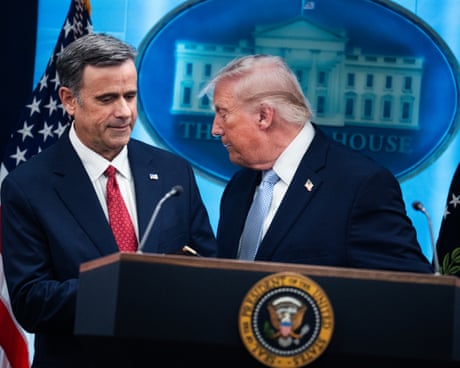
Donald Trump has downplayed a visit to Moscow by the CIA director, John Ratcliffe, as “semi-routine” after he turned up in the Russian capital unannounced, triggering a wave of speculation about the reasons for his trip.
Ratcliffe was reported to have flown to Moscow on a government transport plane on Tuesday in a rare visit after taking off from the Andrews air force base in Maryland.

 Login
Login