Reading view

The GOP'S Data Center Panic

—Photo-Illustration by TIME (Source Image: Cnv Studio via Canva)

Not even a year ago, state leaders of all stripes were clamoring for data centers, the A.I.-warehouses of the future. Incentives here. Promises of infrastructure there. Sweetheart deals all around. But as voters started to view the centers as a resource suck and potentially job killers, sentiment moved quicker than a ChatGPT prompt; between March and July, public opinion shifted 12 points against new data centers, according to one national poll. 

The result has been a massive reset of assumptions about the wisdom of these campuses of computing power. The backlash is stealthily turning midterm elections across the country into referendums on anxieties about an economy overrun by A.I., and specifically the role of those data centers that appear to be sending both electricity bills and NIMBY-ism spiking. The shift also sets in motion a messy collision between the GOP candidates adjusting to voter sentiment and the parochial whims of their party leader.

In Texas, Republican Ken Paxton rolled out a proposal on Monday to block data centers that could use Chinese technology and hold data centers responsible if those automated A.I. bots “undermine children’s safety.” It was the latest sign this month of Republicans in the red state recalibrating on the issue, following Gov. Greg Abbott’s announcement of a pause on new data centers—after calling his state the “epicenter of AI development” in November.

In Michigan, GOP Senate nominee Mike Rogers last week called for a one-year moratorium on new data centers after earlier supporting their construction. His opponent, Abdul El-Sayed, has called for data centers to cover their own power costs, limit water consumption, and work with local communities to give them a “meaningful say.” El-Sayed previously said Michigan shouldn’t move forward with such projects until there were “federal-level guardrails.”

And in Florida, Rep. Byron Donalds, widely seen as the state’s next Governor after winning this month’s Republican primary, dumped more than $2 million on just one ad in his primary promising to “protect” the state from data centers. It was a stunning reversal from just a few weeks earlier, when Donalds mocked opponents of the data centers as yesteryear nostalgists. “There ain’t no bans coming,” he said. 

You’re not imagining the whiplash. President Donald Trump has remained a cheerleader for the data centers, seeing the prospect of high-powered computer chips cementing U.S. dominance across all industries. It also hasn’t hurt that the Trump administration has extracted ownership stakes in semiconductor companies in exchange for funds allocated during President Joe Biden’s term.

"Communities that don't take a data center, they're making a mistake,” Trump said of the swelling number of localities banning such sites during an interview last week.

It usually goes poorly for Republican candidates running counter to Trump. But on this issue, Trump's position will only make it tougher for Republicans to convince voters that they are really willing to push back on the A.I. buildout.

But it’s not just Republicans facing heat on the issue. In Wisconsin, the Republican nominee for Governor, Rep. Tom Tiffany, has labeled his Democratic opponent “Data Center David Crowley” and has been highlighting his own opposition to Wisconsin’s tax incentives for data centers. Crowley has tried to underscore the need for a balanced approach to the issue. As Crowley told me just this month before he won his primary: “All data centers are not all created equal.”

And in Pennsylvania, Republican Stacy Garrity, the state Treasurer running for Governor, recently backed a temporary moratorium on new data centers, after saying earlier this year that Pennsylvania should welcome more of them. Garrity’s new approach is actually a click further than incumbent Gov. Josh Shapiro, who last year touted an Amazon data center as the largest investment in state history, but has since revoked fast-track approval for new data warehouses. Garrity is now hitting Shapiro for welcoming “data centers in our backyards.”

A warning from Ohio

Ohio may be where the data center backlash is playing the most visible role in a topline Senate race, as Sen. Jon Husted is trailing the Democrat, former Sen. Sherrod Brown.

“More than any other thing in this race, data centers are the anchor hanging around Husted’s neck,” Senate Republicans’ campaign arm wrote in a memo last week first reported by Axios.  

In one ad, Brown casts the data-center spree as a consequence of Husted’s advocacy when he worked as the state’s Lieutenant Governor. “Husted is a chief reason Ohio has so many of those centers,” the ad says. “He force-fed the massive energy-sucking facilities.”

Brown’s strategy here dovetails neatly into his long-standing reputation as a working-class champion, with data centers serving as physical manifestations of an A.I. revolution that is poised to cost workers’ jobs, concentrate power in the hands of the elite, and feed tech oligarchs who do not have middle-class worries at the fore.

The memo continues: “Brown is using it because it works.” 

In the Senate, Husted has introduced legislation to encourage states to require companies to pay for their own power and ensure that the cost of new transmission infrastructure is not passed on to consumers. 

To be clear, the leaked memo was the campaign equivalent of putting out a Bat Signal to deep-pocketed and influential A.I. players to do something, and fast, to counteract this backlash. If the industry doesn’t get the message, it may find itself fighting this with far fewer allies heading into the 2028 presidential cycle. 

"If [Husted] loses and data centers get the blame, politicians across the country will take notices—and they will not go near the next one," the memo warns.

It’s not just the Senate race where data centers are dominating Ohio politics. In an unexpectedly close contest for Governor, Republican Vivek Ramaswamy has adopted a tough stance against free-riding data centers and thrown in one more populist proposal: “If a data center is built in your community, then … you will no longer have to pay for your home’s electricity.” The tech investor is running against Amy Acton, a former state health chief who has her own raft of demands for tech centers, including mandatory union workers.

The Data Center Backlash, By the Numbers

The speed with which the tech industry has moved to build out their computing power is quickly bumping up against the speed of communities now banning them. Last month alone saw 150 localities banning such data centers, bringing the total north of 500, according to the tracking project by The Information.

There are roughly 1,600 data centers in the United States these days by one count. They consume 4% of total U.S. electric consumption. The biggest hub is Virginia, with 184 sites—using enough electricity to serve 2.3 million homes, according to a Tyler, Texas,-based consulting firm that tracks the industry. Eisenbach Consulting’s tracking estimates a full 25% of Virginia’s energy now goes to data centers. 

The math gets fuzzy fast, though. Some counts put it at more than 3,000 data centers nationally with another 1,500 on deck. It’s that uncertainty that has helped make the murky topic even more potent for those who view the data center buildout as akin to a virus spreading across the heartland. (If one company has two warehouses on the same street, are they even separate?) 

Faced with the combined threats of resource depletion, higher energy costs, and potential job losses to motherboards, it’s no wonder this tech revolution has voters seeing a scary future. 

In politics, it’s seldom a bad instinct to find a villain and throw everything against it. But candidates doing a total 180 in the span of weeks may leave voters questioning its sincerity, especially when Trump has shown no willingness to join the spin.

  •  

‘Another Trump Attempt to Rig Elections’: Lawmakers Respond to Supreme Court Win for Trump Mail-in Voting Restrictions

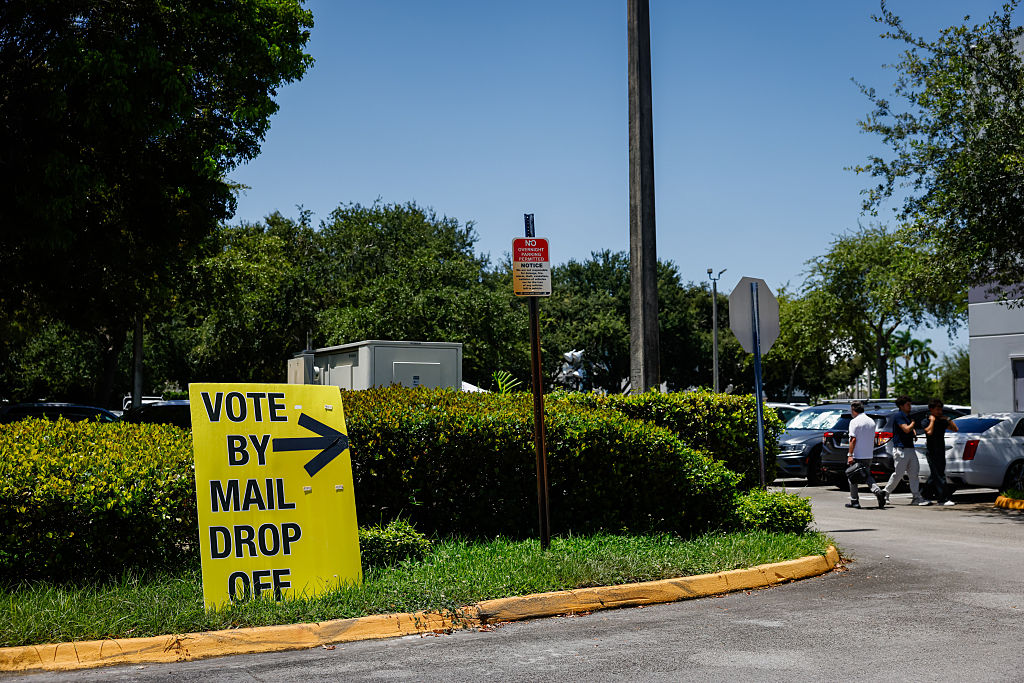
Signage of mail-in voting drop off at the Miami-Dade County Supervisor of Elections Office during a primary election in Doral, Florida, on Aug. 18, 2026. —Eva Marie Uzcategui - Bloomberg via Getty Images

The Supreme Court has handed President Donald Trump a victory in his efforts to restrict mail-in voting ahead of November’s crucial midterm elections

In an unsigned 6-3 ruling, with the court’s liberal justices dissenting, the Supreme Court lifted a lower court’s June block on the President’s Executive Order targeting mail-in voting after 23 Democratic states and Washington D.C. sued the Administration for the order’s alleged unconstitutionality and presidential overreach.

Democrat lawmakers have responded furiously to Monday’s decision. “Another day, another Trump attempt to rig elections and destroy democracy,” said California Governor Gavin Newsom on social media. “We can stop this. Vote this November.”

Trump, in his push to remake American elections, has repeatedly blamed mail-in voting for widespread electoral fraud. He claimed that mail-in ballots helped him lose in the 2020 election despite audits already refuting those claims, and his own voting by mail in recent elections.

The ruling does not settle whether the Executive Order will proceed ahead of the November midterms, where the Republican Party needs to defend its narrow majority in Congress. Part of the order covering the U.S. Postal Service remains blocked under a separate injunction in August, which still needs to be resolved.

The Supreme Court also did not outright rule on the legality of Trump’s order—only on the timing of the challenges to it—and left it open to future lawsuits, which critics have signaled they will file.

Here’s how other Democrats, as well as some Republicans, have responded to the decision, and what it means for November’s pivotal midterms. 

Democrats vow legal challenges against “terrible” Supreme Court decision 

Gov. Josh Shapiro of Pennsylvania said Monday that the legal battle against Trump’s Executive Order would continue, after a previous challenge put a temporary halt on the directive. 

“Not so fast. Today’s SCOTUS decision does not deal with the substance of Trump’s unconstitutional Executive Order and does not mean his illegal attempt to restrict mail-in voting will go forward,” argued Shapiro. “We’ll see the Trump Administration in court.”

Gov. Mikie Sherrill of New Jersey also vowed a response to the decision. “This is a terrible decision from Trump’s Supreme Court,” she said. “States run elections, not Donald Trump. I will do everything I can to protect New Jerseyans’ right to vote – by mail and in person.”

Newsom built upon his condemnation on Monday. “California will be suing again to block these Orwellian rules from being implemented,” he said

“This decision is a painful setback,” Attorney General Letitia James of New York, one of the plaintiff states from June’s challenge against the Order, said in a statement. “But it will not be the final word.”

More widely, other Democrat lawmakers criticized the Supreme Court’s decision and the impact it could have on the upcoming midterms. 

Senate Minority Leader Chuck Schumer said: “It’s a disgrace that the highest court in the nation is allowing Trump to put a dagger into the heart of our democracy,” following the decision. 

Schumer argued the Order was “blatantly unconstitutional,” and that “his MAGA Supreme Court is refusing to stop it from going forward.”

Hitting out at the President more broadly, the lawmaker continued: “[Trump] wants to make it harder for Americans to vote so they don’t hold him accountable for the skyrocketing costs, illegal war, and rampant corruption that are a hallmark of his administration.”

Sen. Catherine Cortez Masto of Nevada issued another direct response at the President himself. “Trump voted by mail eleven days ago. Apparently it’s good enough for him, but he wants to take away your right to vote in the same way,” she said. 

“Trump’s voter suppression order is about making it harder for Americans to hold him accountable - it is shameful that the Supreme Court is enabling it,” the lawmaker continued. 

Sen. Maria Cantwell also expressed concerns over the privacy of voters. “Today’s Supreme Court decision gets the Trump Administration one step closer to implementing its voter suppression order and forcing states to hand over personal voter data to the federal government,” she said. 

Republicans celebrate Supreme Court decision

“With today’s SCOTUS ruling, President Trump has made a giant leap forward in securing our 2026 elections,” said Utah Sen. Mike Lee, a long-standing supporter of Trump’s efforts to restrict mail-in voting. 

“Congress must still pass the SAVE America Act to secure future elections. We should’ve passed it months ago,” he continued in reference to the Act which is still awaiting approval in the Senate. 

Lee also responded to Gov. Shapiro’s commitment to continue legal challenges against the President’s Executive Order. “Why are you so determined to let non-citizens vote?” he said

“Bravo! Glad to see the Supreme Court get this one right. Election integrity is nonnegotiable,” said Rep. Keith Self of Texas, also pushing the Senate to approve the SAVE Act. 

“This is a major win for the security of American elections,” said White House spokesperson Lauren Bis in a statement to TIME. “These are commonsense measures that protect the security of mail-in ballots and ensure only Americans are electing American leaders.

What does the ruling mean for federal elections, and how did we get here?

On June 25, U.S. District Judge Indira Talwani in Boston ordered an injunction on provisions of Trump’s March Executive Order. Those provisions direct the Department of Homeland Security and Social Security Administration to create “state citizenship lists” that cover eligible voters, and the Postal Service to create rules that would end sending absentee ballots to individuals not on a state’s mail-in or absentee participation list.

Talwani’s block covered the 23 plaintiff states and Washington, D.C. On July 25, the First Circuit rejected the Trump Administration’s request to block Talwani’s order pending appeal.

The Trump Administration sought the Supreme Court’s intervention in July, arguing that the lower court “lacked jurisdiction” to resolve the dispute, as implementing rules based on the President’s Order haven’t been finalized.

In the Monday ruling, the Supreme Court’s conservative majority agreed with the Trump Administration and paused Talwani’s injunction.

The top court said that Trump’s order regarding state citizenship lists was “an internal directive from the President to a subordinate” and that it “imposes no obligations on the States,” which in turn “suffer no concrete harm.”

It added that, in the case of Trump directing the Postal Service to propose rules on mail-in ballots, the legal challenge was premature and lacked standing. When states filed the suit, the Postal Service had not issued a final rule.

The Supreme Court’s majority said the district court had to engage in a “string of speculations” to arrive at its June injunction: “Federal courts review final rules, not proposed rules—and certainly not antecedent internal directives to propose a rule.”

What the ruling did not cover

While the Supreme Court’s majority paused Talwani’s June injunction for being premature, it does not cover a separate injunction—also from Talwani—on Aug. 11. Ruling on another suit, Talwani barred the Postal Service from implementing the same Executive Order for the November midterms nationwide.

The Supreme Court ruling also simply granted the Trump Administration’s emergency request to pause Talwani’s June injunction. The case on Trump’s Executive Order is still pending before the First Circuit.

It also explicitly left room for challenges on the legality of the rules stemming from Trump’s order, especially with the Postal Service’s final rule.

Norm Eisen, a voting-rights advocate leading one of several legal challenges to Trump’s order, downplayed the Supreme Court’s decision. “Please don’t overreact to Roberts Court decision on the contemplated [Postal Service] ballot moves,” Eisen posted on microblogging platform Bluesky Monday. “They simply held that the injunction came too early in the process, before there was a final rule.”

  •  

The real reason voters hate data centers so much

Protesters walk together and hold  anti-data center signs in the March for Water and a Sustainable Future
A protest against data centers in central Texas. | Sara Diggins/The Austin American-Statesman

Welcome to The Midterms, Actually. Every week I’ll be writing about two things: one big idea or trend I see forming across the 2026 primaries, and one thing I’m hearing from a voice on the ground. You can sign up here to get it in your inbox every week. Let’s get into it.

One big idea: The data center backlash is a democracy story

This week, OpenAI CEO Sam Altman acknowledged a small hurdle in his quest to integrate artificial intelligence into all parts of human life and the economy: the rest of us. 

In an episode of the Founders podcast with David Senra, Altman confronted the growing public backlash against tech leaders and their AI tools, conceding that he’d overrated the speed at which they’d be adopted across the economy and that the industry hasn’t made its case to the public.

“We have not, as a field, done a very good job of explaining to people what the benefits are and how the downsides can be mitigated,” Altman said. He added that “it’s probably a good feature of human society that we have some built-in inertia, some skepticism of rapid change.”

You think?

Survey after survey shows how deep — and how bipartisan — the backlash against AI, and specifically data centers, already runs. The pressure has been building all year: A Gallup poll in March) found that 71 percent of Americans said they oppose building AI data centers in their area — 48 percent of them strongly. That opposition runs across the aisle: 75 percent of Democrats, 74 percent of independents, and 63 percent of Republicans. For perspective, Americans are more opposed to a data center going up near them than a nuclear power plant (53 percent). This is not some fringe opposition. It is a consensus. 

The shift is already scrambling candidates’ positions ahead of the midterms, where data centers, artificial intelligence, and the future of work will be front and center. Michigan Democrat Abdul El-Sayed’s refusal to back a data center moratorium (which he reiterated on America, Actually) has given Republicans an opportunity. His opponent in Michigan, GOP Senate candidate Mike Rogers, recently came out for a one-year moratorium — an attempt to get to the left of El-Sayed (!). The shift reflects our new political reality. At this point, being pro-data center isn’t just a minority position overrepresented among C-suite executives — it’s become a moral and cultural signal. An us-vs.-them litmus test in an age of elite distrust.

The political world did not see this coming. A year ago — before Zohran Mamdani’s win in New York, before DSA congressional wins in New York and Colorado, before El-Sayed in Michigan and Angie Nixon in Florida — the Democratic establishment was all about Abundance, the 2025 Ezra Klein–Derek Thompson book that had become something like an electoral manual for Washington Democrats and the press that covers them. But Abundance was (and is) powered by advanced technology and its mass adoption — the book says so on its first pages — and, like Altman, its proponents may have underestimated how unwilling neighbors would be to hand still more of their lives over to our Silicon Valley overlords. In a recent piece, my colleague Andrew Prokop wrote that Abundance flopped among voters because leftists adopted their best ideas, and issues like Israel became more of a motivating force among primary voters. But I’d also add that it replicated the same mistake tech leaders made: reveling in the benefits of a transformed economy before building consensus among the people who must live with it. 

We’ve been covering this issue throughout the year, including attending an early-summer town hall in New Jersey over a proposed data-center expansion in the state’s poorest county. But even I have been surprised at how much we hear about AI and data centers from voters on America, Actually — and how tied those fears are to a larger anxiety about the future of work and a growing resentment of tech CEOs like Altman and Elon Musk. If the 2020 election was defined by both parties’ silence on AI, the years since have been defined by elites telling the underclass that they have no agency in the disruption to come.

Based on our reporting this year, here are four things that I think explain the shift in sentiment — and forecast where this goes in the midterms and the presidential race to come.

1. It’s about agency, not “the environment” 

The thing that comes through loudest on the ground isn’t a technical objection to server farms, or even a concern with their potential impact on the environment. It’s the feeling that this change was done to communities — not in consultation with them. At the New Jersey town hall, one resident put it this way: “Folks feel unheard. And we don’t feel that way — we are unheard.” Another related it to a broader anxiety about artificial intelligence, which she said felt imposed on society from the upper class: “Everything relates from the top down, and what we’re getting from the top has spread all the way to the local level. And it isn’t good.” 

Sen. Ruben Gallego — no AI opponent himself — suggested the resentment often came from how the industry picks its targets. “They’re gonna put a data center all because it’s cheap land, and also because they think it’s a Black and brown area, so they’re gonna have less pushback,” he said. And that feeling of powerlessness is not only amplified in the absence of federal regulation, but by the knowledge that most elected officials don’t even understand the technology themselves. 

In New Jersey, residents suspected the game was rigged against the people with the least power to say no, and it often is. One word in particular, from a data center developer, had enraged them. The developer had called the project an “experiment.” That means  “we’re the guinea pigs,” the resident said. 

2. These are not all Luddites

Recently, I’ve seen the data center backlash dismissed as a “psyop” — a foreign plot to undermine the US economy — or a symptom of technophobia. Simpletons who can’t understand what’s to come. 

But that’s a convenient and self-serving misread. In New Jersey, one of the most striking voices at the town hall was a man who runs a civic-tech project: “I use AI all the time — for project management. If you use it responsibly, you can leverage it to get real-world tasks done.” He was still, firmly, against the data center. And he’s not alone: Gallup also finds concerns about the local impact of data centers are much bigger drivers of opposition than more general anti-tech ideas, as does Fox News’ polling. People weren’t rejecting the tools altogether — there were plenty of ChatGPT users in that room. They were rejecting the pace, and the secrecy, of a project reshaping their community. 

3. The costs are visible. The benefits are a pitch.

A resident in New Jersey pointed out something important: “A couple hundred jobs for two and a half million square feet? How can that possibly be supported with today’s grid? There’s no plan for the future. … Who benefits with that building? It’s not the people of this town.” 

I think this speaks to one of the challenges the pro-data center crowd has faced. Once the construction jobs leave, the noise, the water draw, the rising electricity bills, the fear about home values, and the sheer brutalist ugliness of the structure all stay. One homeowner told us: “I can’t sell my house — it’s been for sale since February. A woman came back twice, had cash, then realized it was near the data center. Her kids said, ‘Mom—’ and she said, ‘I just can’t do this.’”

And even if local concerns are the dominant issue, AI isn’t offering much of a bigger-picture national argument to overcome them. As Gallego put it to me, “there is no massive-scale benefit to society when it comes to AI” that voters see in their lives so far, and they have competing concerns about tech’s impact on children, privacy, and job losses. 

Rep. Greg Casar, the Congressional Progressive Caucus chair, told me this is the reason the left has found success tying anxiety about artificial intelligence to their broader message of affordability. 

A lot of the establishment traditional Democratic politics…are telling candidates, ‘Don’t even say the words AI.’ And if you do, say there needs to be safety but innovation — and then shut up…because maybe AI lobbyists are gonna spend tons of money against you.

Being progressive means uniting all the people getting their costs jacked up and having them vote for a politician even if the AI industry spends against them.

4. The left has their answer. What’s the center’s? 

As I wrote previously, I think a defining characteristic of this ongoing ideological battle in the Democratic Party is the collapse of the center — even more than the rise of the left. And on artificial intelligence and data centers, I think you see that crumble clearly. 

Progressives like Bernie Sanders and Ro Khanna have made clear cases for the need for a data center moratorium to prioritize the potential impact of AI on workers. And candidates like El-Sayed have laid out a proposed regulatory framework even if they don’t support a moratorium. 

But the most shocking answers on the topic that I’ve heard have both been from elected officials more representative of the liberal center. Gallego called data centers a “necessary evil” — quite possibly the least inspiring words in American politics. Rep. Jim Clyburn’s answer on artificial intelligence was even worse. He told me he hadn’t heard about ChatGPT until recently and that he’s never used an LLM or visited a data center. 

“I have a great staff,” he told me. “I know how to legislate, I know how to build relationships, and I hire people to bring knowledge into the game.” It’s a fine answer for most of governing. It is a terrifying one for a technology moving this fast.

In examining the public backlash against data centers, it’s important to remember statements like these. People don’t want to feel like they’re guinea pigs in an experiment, and it’s not just Sam Altman who has contributed to that feeling. It’s also the politicians who have treated technological change as something they retroactively legislate after a crisis arrives, whether it’s in the economy, or the environment, or society. You can’t govern a revolution you refuse to understand. 

What I’m hearing

This week, I called Adrian Walker, longtime political columnist at the Boston Globe and one of the moderators of the recent debate between Sen. Ed Markey (D-MA) and Rep. Seth Moulton (D-MA), the 47-year-old member of Congress who’s challenging him in a September 1 primary election. The debate also featured a viral moment from Markey on artificial intelligence, where the 80-year-old incumbent did not seem to fully grasp the technology. You can watch that exchange here

So is this all about age? What have been the lines of division beyond that? 

You know, it’s surprising that when you poll people, and you ask them about age, they have concerns about Markey being 80 (and 86 potentially at the end of this next term). But it’s not what’s really driving votes. It’s really kind of become more of a race about who’s more progressive, and Markey has successfully, I think, pitched himself as the more progressive candidate.

What are the ways in which they are both seeking to prove their progressive credentials?

Markey constantly touts the Green New Deal, and he talks a lot about his endorsements from AOC and Ayanna Pressley and people like that. It’s basically the same playbook he ran six years ago when he beat Joe Kennedy, when he also did better than anybody expected among young voters.

So he’s still riding that Green New Deal/AOC connection.

He’s running the exact same campaign. And Moulton came in with a lot of skepticism. People are still mad about him going against Pelosi (in 2018). And he had this very high-profile attack about trans kids in youth sports — and people have been skeptical about him as a progressive. So he’s sort of trying to reinvent himself while Markey, you know, kind of rides the same thing that got him a little success. 

So is there a reason we should be watching this beyond just the question of age? 

I think the AI question really speaks to something very fundamental in this debate. I think people really have concerns about the fact that the whole Senate seems to be in their 70s and 80s, and I think it was reflected in that question. You have Markey up there saying, you know, it doesn’t matter whether you call it Siri or Claude or whatever. And people walk away thinking this is not the dude who should be regulating AI; they think “Yeah, you know, the 47-year-old actually understands this, and the 80-year-old pretty clearly does not.”

And it kind of speaks to, I think, the sort of hunger I think a lot of people are feeling for generational change in the Senate: You watch Senate hearings, you watch congressional hearings about things like AI, but they’re really not that impressive. It really does look like a bunch of people who don’t really understand this at a very deep level. And that’s driving this frustration. 

  •  

Trump’s new attempt to seize control of the Federal Reserve, explained

Lisa Cook
Federal Reserve Board of Governors member, and target of President Donald Trump’s ire, Lisa Cook. | David Paul Morris/Bloomberg via Getty Images

Less than two months after the Supreme Court ruled against President Donald Trump’s attempt to fire a member of the Federal Reserve Board of Governors — a move that would have allowed him to seize control over the nation’s central bank if it had succeeded — Trump is once again trying to fire the very same member.

Earlier this month, Trump sent a letter to Lisa Cook, a Joe Biden appointee to the Federal Reserve, demanding that she respond to exceedingly flimsy allegations that she committed mortgage fraud. This is the first step in a process that is likely to end in Trump attempting to remove her from the Federal Reserve’s board a second time — which means that the courts will inevitably have to get involved once again.

Cook has until Wednesday to respond to Trump’s allegations.

It’s tempting to blame this bout of déjà vu on Trump, but the Supreme Court is at least as responsible for his actions as the president itself. If the Court didn’t want Trump to thumb its nose at their decision in Trump v. Cook (2026), they should have written that decision clearly enough that lawyers could actually figure out what the president is and is not allowed to do.

This is a perennial issue with the Court’s current majority, which is unusually bad at explaining themselves. They invent bold new doctrines that give them a near-complete veto power over the executive branch, then only apply this doctrine to Democratic presidents. They once handed down an anti-abortion decision that, if taken seriously, would allow any state to nullify literally any constitutional right. Every single one of their Second Amendment decisions are so incoherent that it is impossible for lower court judges to figure out how to apply them.

The Cook decision, which involved Trump’s first attempt to fire Cook, is similarly incomprehensible. It was handed down the same morning as Trump v. Slaughter (2026), which seems to hold that Trump can fire anyone who leads a federal agency. But Cook does not even cite the Slaughter decision, much less explain why the two cases are different.

Slaughter was grounded in the “unitary executive,” a theory shared by all six of the Court’s Republicans which claims that the president must have full control over federal agencies, including the power to fire their leaders and thus agencies that have some ability to act independently of the president, such as the Federal Reserve, are unconstitutional. Cook suggests that there’s a Federal Reserve exception to this theory, although the opinion does not offer a clear explanation of why this exception exists.

There are very good policy reasons why Trump should not be able to fire Cook, or any other member of the Federal Reserve’s board. The Fed has the power to inject cocaine into the US economy, temporarily giving it a boost at the price of much greater turmoil and higher inflation down the road. If presidents are allowed to fire the Fed’s leaders, they can remove anyone who refuses to give the economy a bump during an election year — boosting the president or his party’s reelection chances, and triggering consequences that won’t be felt until after the election is over.

But the fact that preserving the Fed’s independence from the president is a good idea does not mean that the Constitution permits it. And, in Slaughter and several related cases, the Court’s Republican majority endorsed an interpretation of the Constitution that is completely incompatible with the idea of an independent Federal Reserve.

That means that, until the Court resolves this tension between Slaughter and Cook, there’s likely to be a great deal of confusion about who really controls the Fed — Trump or its current board — and whether Trump may effectively order the Fed to take actions that benefit him, but that could cause lasting harm to the US economy.

The unitary executive, briefly explained

The issue at the heart of Cook was whether the president is able to fire a member of the Federal Reserve.

Federal law provides that the Federal Reserve’s governors may only be fired “for cause,” and not simply because the president does not like them or disagrees with their policy views. The Republican justices have also long argued that Congress is forbidden from limiting the president’s power to fire federal agency leaders, because this would give the president less than full control over the federal government’s executive branch.

These justices point to a line in the Constitution that states that “the executive power shall be vested in a President of the United States of America.” According to the Court’s Republican majority, this means that the president must have full control over any federal agency that wields power that is “executive” in nature, including the power to fire that agency’s leaders for any reason whatsoever. As Justice Antonin Scalia wrote in an influential 1988 dissenting opinion, this constitutional provision “does not mean some of the executive power, but all of the executive power” is held by the president.

There are numerous problems with this unitary executive theory. The biggest one is that, while the Constitution does say that there is something called the “executive power” that belongs to the president, it does not define what this power is, and the Court’s decisions embracing the idea of a unitary executive often rely on dubious historical claims.

But, regardless of whether the unitary executive rests on a sound reading of the Constitution, it is now the law. And Slaughter suggests that this Court’s definition of the term “executive power” is quite expansive. In that case, the Court indicated that any agency leader who “enforces and administers” a federal statute wields “executive” power, and thus must be fireable at will by the president. 

But then, almost immediately after the Court handed down Slaughter, it ruled in Cook that Trump could not fire one of the Fed’s leaders — or, at least, that he could not do so right away

The Cook decision is word salad

Under the Republican justices’ definition of which officials wield executive power, and thus must be fireable at will by the president, Cook clearly should qualify. But five justices, the three Democrats plus Chief Justice John Roberts and Justice Brett Kavanaugh, joined a majority opinion by Roberts that, at least, temporarily delayed Trump’s ability to fire Cook. Three other justices took the coward’s way out, arguing in dissent that Trump should win on narrow procedural grounds that would have allowed him to fire Cook, but that also might permit a court to reinstate her at some point in the future.

Only Justice Clarence Thomas seemed to fully embrace the unitary executive theory, in Cook, and with it the idea that firing Cook is well within Trump’s power. 

As Thomas wrote in his dissent, the Federal Reserve enforces or administers numerous federal statutes. It can “change the fees on consumer debit-card transactions,” or “impose monetary penalties, levy assessments, and examine private books and records.” Its power to set interest rates flows from federal statutes requiring it to “promote effectively the goals of maximum employment, stable prices, and moderate long-term interest rates.” 

Thus, if Slaughter is correct that an agency leader who “enforces and administers” a federal statute must be fireable at will by the president, Trump should have the power to fire Cook.

Roberts’s majority opinion doesn’t really make a legal argument. But it does make a couple of  historical and policy claims that point in the direction of allowing an independent Federal Reserve to exist. Roberts begins his opinion with a history of nationally chartered banks, noting that the first such bank “predates even our Constitution “And he alludes to a “‘long tradition’ of ‘monetary policy … exercised independent of … executive influence.’” 

But it’s hard to tell why this tradition matters, at least in a world where every other federal agency is subject to the unitary executive. The Republican justices have previously claimed, for example, that the president must have full control over all federal prosecutions. But historical evidence suggests that, at the founding, prosecutions were often led by private attorneys or by judicial appointees — that is, not by the president or his appointees. So why doesn’t this historical evidence exempt the Justice Department from the unitary executive?

And, if the legal reasoning in Cook is thin, the decision’s actual holding is largely toothless. After laying out his half-baked argument for why the Federal Reserve is unlike any other federal agency, Roberts doesn’t actually write that Trump may not fire Cook. He simply says that “Cook was entitled to notice and some opportunity to respond prior to her termination” — although Roberts also writes that, once Cook has a chance to respond to the allegations against her, “only then can the courts assess the validity and sufficiency of such charges.”

So, by sending a letter to Cook informing her of the allegations against her and giving her a little bit of time to respond, Trump has complied with the Supreme Court’s decision. He will likely then attempt to fire her no matter what she says in response, and then there will be another round of litigation where some poor trial judge will have to “assess the validity and sufficiency” of the allegations against Cook without any guidance from the Supreme Court regarding how strong those allegations must be.

That said, it is likely that when Cook does respond to Trump’s allegations, those allegations will prove quite flimsy indeed. Trump alleges that Cook committed mortgage fraud by claiming two separate properties as her principal residence in bank documents. But Reuters examined those bank documents and discovered that she disclosed to the lender that one of those properties would be used as a vacation home. So it appears that no fraud actually occurred.

Will that be enough for Cook to keep her job? The short answer is “probably” — why would the Supreme Court have handed down such an incoherent opinion in Cook if it intended to apply the unitary executive to her anyway? But the Cook opinion itself offers little guidance to the judges who will need to sort through this mess.

  •  

The Supreme Court just revived Trump’s attempt to sabotage the 2026 election

President Donald Trump greats Supreme Court Chief Justice John Roberts, and Justices Elena Kagan, Brett Kavanaugh, and Amy Coney Barrett
President Donald Trump greats Chief Justice John Roberts, and Justices Elena Kagan, Brett Kavanaugh, and Amy Coney Barrett as he arrives for the State of the Union address on February 24, 2026. | Win McNamee/Getty Images

In March, President Donald Trump issued a blatantly illegal executive order claiming that he had the power to unilaterally rewrite US election law. The order threatens prosecutions against state officials who allow certain people to vote, and it also requires states to include several federally mandated design elements in the envelopes that they use to mail ballots to voters. 

On Monday, the Supreme Court’s Republican majority allowed that order to go into effect. All three of the Court’s Democrats dissented.

Yet while the Court’s new decision in Trump v. California is troubling, it’s not necessarily a sign that the justices will permit Trump’s illegal order to take full effect. The Court’s actual holding in California is that two lower federal courts moved too quickly when they blocked the executive order. But California does not opine on whether the order is actually legal.

The Supreme Court’s decision reinstates Trump’s order for now, but there are several active cases challenging this order in the lower courts. So it is likely that a judge will issue a new decision blocking the executive order again very soon.

Still, the Court’s decision to reinstate this order, even temporarily, is likely to confuse state election officials who are racing to prepare for an upcoming election. And the provision threatening prosecutions might deter these officials from doing their jobs until that provision is blocked by another court.

The Court is divided on whether Trump’s threat targeting state elections officials is actually a threat

The case concerns two sections of Trump’s March order, one of which threatens state election officials with prosecution if they allow the wrong people to vote, and the other which appears to be an attempt to sabotage voting by mail during the 2026 midterms.

The first one of these, Section 2, itself contains two provisions, one of which orders the Department of Homeland Security to “compile and transmit to the chief election official of each State a list of individuals confirmed to be United States citizens who will be above the age of 18 at the time of an upcoming Federal election and who maintain a residence in the subject State.”

This simple command to compile a list would be unproblematic, except that the second provision of Section 2 orders the attorney general to prioritize prosecutions against “State and local officials or any others involved in the administration of Federal elections who issue Federal ballots to individuals not eligible to vote in a Federal election.” Thus, when both provisions of Section 2 are read together, they threaten prosecutions against any state official who issues a ballot to a voter whose name does not appear on Trump’s list of approved voters.

Such a threat is unconstitutional, as the Constitution gives states, and not the federal government, the power to decide who may vote in congressional and presidential elections. The justices, however, primarily split on whether to give Trump’s order a hyperliteral reading.

In dissent, Justice Sonia Sotomayor argues the two clauses are clearly connected and she cites a previous Supreme Court decision warning that “[p]eople do not lightly disregard public officers’ thinly veiled threats to institute criminal proceedings against them if they do not come around.” 

But the majority ignores Section 2’s purpose, and instead notes that Trump’s executive order does not explicitly require states to use Trump’s list of approved voters. They also note that the executive order’s call for the Justice Department to prosecute state officials does not include any reference to Trump’s list.

In any event, even the Republican justices do not hold that the Constitution permits Trump to create a list of approved voters and prosecute state officials who depart from that list. Instead, the Republicans hold that it is too soon to block Section 2. DHS must first compile its list of approved voters, or DOJ must actually prosecute someone, before a challenge to Trump’s new policy can proceed.

The effect of the Republican justices’ decision, in other words, is to leave Trump’s threat in place, but also water it down considerably: The Court does state that Trump’s executive order does not actually require states to use Trump’s approved voter list. So that may be a sign that, if Trump actually did try to prosecute someone for allowing someone not on DHS’s list to vote, the justices would reject that prosecution — but for now, there’s little standing in the way of him doing it. 

The rest of the Court’s decision was obsolete the minute it was handed down

The remainder of the Court’s decision deals with Section 3 of Trump’s executive order, which orders the United States Postal Service (USPS) to design an envelope which states must use when they mail ballots to voters. It also forbids USPS from delivering ballots that do not comply with this new design.

The Republican justices conclude that the lower court decisions blocking Section 3 were also premature because, at the time when those courts handed down their decisions, USPS had not yet formally issued a rule that announces the new mandatory envelope design. But USPS issued that rule on Friday. So the Supreme Court’s decision was out of date days before the justices decided it, but that does nothing to change the immediate effect of the decision.

Among other things, the Trump administration’s new rule requires states to mail ballots in envelopes that include several federally mandated design elements, including a mandatory logo and a unique identifier for each voter. If the new rule takes effect, USPS will refuse to deliver any ballots that do not comply with these new, Trump-approved design requirements.

Democrats are significantly more likely to vote by mail than Republicans. So the Trump administration’s new rule is likely to skew the 2026 election towards his political party if it is allowed to take effect.

If Section 3 is eventually allowed to take effect, that will be a catastrophe for US democracy, and may even make it impossible for many states to hold midterm elections. That’s because the states couldn’t possibly have known what specific design requirements the Trump administration would impose on them until USPS issued its rule. Many states have already purchased envelopes that do not comply with the new federal mandate. And it’s not like new envelopes can simply be printed on the fly.

In some states, millions or even tens of millions of voters will vote by mail, which means that, in order to comply with the Trump administration’s new order, these states will somehow need to obtain truckloads of envelopes in time for this November’s election, comply with the considerable procedural requirements laid out in Trump’s order, and distribute these ballots to voters fast enough for them to actually return them by the deadline.

Several US states, moreover, conduct their elections almost entirely by mail. While these states often set up voting centers where voters can also vote in person, these in-person voting centers are merely a backup. And these states are unlikely to have the infrastructure, voting machines, or network of election workers that are required to run an entirely in-person election if mail-in voting fails.

So Trump wants to impose impossible deadlines on many states. But Monday’s decision does not actually hold that it is legal for him to do so. Indeed, the federal judge who initially blocked Trump’s executive order has already signaled that she is likely to block the USPS’s new rule. We will find out if the Supreme Court will allow Trump to sabotage voting by mail after that new decision makes its way back to the justices.

The Trump administration’s legal argument for the new USPS rule is quite thin

Trump’s lawyers only barely make a legal argument in favor of the new rule. After the USPS issued its new rule, Trump’s Justice Department did file a supplemental brief in the Supreme Court arguing that the new rule is lawful. But that brief is only three pages long, and its legal analysis is exceedingly thin. 

As Indira Talwani, one of the judges who blocked Trump’s executive order, noted in her opinion, there is no federal law that explicitly “delegates authority to control mail-in voting to USPS.” So the Trump administration must rely instead on broadly worded statutes that simply state that the Postal Service may deliver mail and take related steps that are necessary to deliver the mail.

One permits USPS to adopt rules “as may be necessary in the execution of its functions.” The other permits it to “provide for the collection, handling, transportation, delivery, forwarding, returning, and holding of mail, and for the disposition of undeliverable mail.”

And, even if these vague statutes could authorize the Trump administration to impose granular restrictions on voting by mail, the fact remains that it is impossible for many states to comply with these restrictions in 2026. Some states, such as North Carolina, are supposed to start mailing ballots at the end of next week.

It would be one thing if Trump tried to impose new envelope design requirements that will take effect in future elections. But there’s simply no time for states to design compliant envelopes, get those designs approved by USPS order dozens of pallets worth of these envelopes, and distribute them to voters in time for the 2026 midterm elections.

So the stakes in this dispute remain quite high. Trump has literally issued an executive order that, if implemented, might prevent many states from holding the midterm elections in the first place. But it is still unclear if this Supreme Court will allow that to happen.

  •  

J.D. Vance Calls Canada a ‘State,’ Claims ‘Freudian Slip’

U.S. Vice President J.D. Vance delivers remarks in Brewer, Maine, on Aug. 24, 2026. —Anna Moneymaker—POOL/AFP/Getty Images

Vice President J.D. Vance on Monday called Canada a “state,” before claiming it was an accident.

“We have to remember, Canada is a state—sorry, Freudian slip,” Vance said during a political event in Maine, after being asked about the recent heated trade talks between the U.S. and its northern neighbor. “That was actually an accident.”

He went on to say that “Canada is a country that has underinvested in its military that quite literally would get invaded by a foreign country were it not for the umbrella of protection provided by the United States of America.”

Vance’s slip-up comes after President Donald Trump has hurled a number of barbs at Canada and its political leaders since he took office for a second term. The President has repeatedly referred to Canada as the “51st state,” suggesting that the U.S. should annex its northern neighbor. In March, Trump called Canadian Prime Minister Mark Carney the “future Governor of Canada.” 

Carney has repeatedly and firmly pushed back on Trump’s comments; last year, the Canadian Prime Minister said of the suggestion of annexing Canada: “As I’ve said to anyone who’s raised this issue in private or in public, including the President, it will never happen.”

When TIME asked Trump last year whether he was “trolling a little bit” when he speaks about making Canada a U.S. state, Trump replied, “Actually, no, I’m not.”

Trump: ‘Without the United States, Canada couldn’t survive’

In a Truth Social post on Monday afternoon, Trump continued to fling digs at Canada.

“America has been carrying Canada for decades, but no longer!” Trump said in his post. “The U.S.A. will always be far bigger, richer, and stronger than Canada. Without the United States, Canada couldn’t survive — It’s where they get all of their money and, because of their current bad leadership, primarily Governor Carney, and his Flunky, Ford, they will not be allowed to keep taking advantage of the United States — Their key to survival.”

Trump referred to Ontario Premier Doug Ford, who has been a vocal critic of the tariffs that the Trump Administration has imposed or threatened to impose on Canadian goods. In addition to calling Ford Carney’s “Flunky,” Trump said the Premier was “the less charismatic, intelligent, and overall unimpressive brother of the late, great, Rob Ford,” a former mayor of Ontario’s capital, Toronto.

Tensions between the allied countries have escalated in recent days. Trump claimed earlier last week that, “subject to the finalization of documents,” the two nations had reached a deal, but trade negotiations between the two broke down on Friday, and both sides have pointed the finger at the other.

In a statement shared late on Friday, Carney said that “progress has not been enough to meet our objectives for Canadians” and so he “decided to suspend trade negotiations with the U.S.” He accused the U.S. of proposing “last-minute changes” that he called “unfair, uneconomic, and called into question the reliability of any deal."

On Monday, Trump said that he plans to raise automobile tariffs on Canada to 50% starting on Jan. 1, 2027. His 50% tariffs on about $20 billion worth of goods imported into the U.S. from Canada went into effect over the weekend, and Carney said that Canada would respond with retaliatory tariffs on U.S. goods that will take effect on Sept. 8.

At a press conference on Monday, Carney said that Canada was still open to trade talks, but that any deal would have to “be one that respects Canada’s sovereignty.”

“When the Americans go to the negotiation table first with the right attitude towards our industries and a true partnership, of course we’ll come to the negotiating table,” he said.

“An attitude at the negotiation table that Canada is a subsidiary of the United States,” he continued, “that’s not something we’re going to accept.”

Canada retaliates against Trump’s tariffs with Levies of up to 50% on U.S. goods
  •  

Trump blows up the US-Canada relationship

Donald Trump, wearing a navy suit and a red tie, walks across the tarmac away from the Marine One helicopter.
President Donald Trump at Joint Base Andrews, Maryland, on August 21, 2026. | Win McNamee/Getty Images

This story appeared in The Logoff, a daily newsletter that helps you stay informed about the Trump administration without letting political news take over your life. Subscribe here.

Welcome to The Logoff: Donald Trump’s trade war with Canada is back in full force. 

What’s happening? Remember last week, when Trump said that the US and Canada had a trade deal in place? It turns out they do not. After negotiations fell through on Friday, Trump responded with a 50 percent tariff on some $20 billion in Canadian goods, plus threats of higher tariffs on cars, car parts, and steel to come in 2027. 

Trump, Vice President JD Vance, and other administration officials are also leaning into ever more inflammatory rhetoric, with Vance taunting Canada on Monday as “a state” that “quite literally would get invaded by a foreign country were it not for the umbrella of protection provided by the United States of America.” 

How is Canada responding? With outrage, as my colleague Caitlin Dewey explains, and with tariffs of their own: On Saturday, Canadian Prime Minister Mark Carney said that his country would match US tariffs “dollar for dollar,” starting early next month. 

“We cannot accept what the U.S. has offered,” he wrote, “and we will not give what they have asked.”

In addition to trade terms, the US allegedly made requests to weaken Canada’s French-language protections, which Carney said would have infringed on Canadian “sovereignty.”

Why does this matter? Immediately speaking, tariffs make things more expensive at a time when voters are already incensed over prices and the Iran war is making inflation worse; their impact could be especially felt in border states like Maine and Michigan, which also happen to have high-stakes, closely contested Senate races coming up in 72 days. 

On a longer timeline, the Trump administration is doing damage to the US-Canada relationship that goes far deeper than specific tariffs and will be far harder to reverse. Already, in January, Carney delivered a speech charting a plan to move past relying on the US as a global partner; Trump’s latest trade war will only accelerate that rupture.

And with that, it’s time to log off…

Violent crime rates in the US are falling across the board, according to new 2025 statistics released by the FBI, including the murder rate, which just hit a 70-year low — tied for the lowest ever recorded. That’s good news in any context, but if you want to learn more, my colleague Bryan Walsh took a crack at explaining how it happened. You can read his article here with a gift link. 

Thanks for reading, have a great evening, and we’ll see you back here tomorrow!

  •  

The view from a very angry Canada

Mark Carney and the minister responsible for Canada-US trade arrive at a press conference
Canadian Prime Minister Mark Carney (right) and Dominic LeBlanc, the minister responsible for Canada-US trade, arrive at a press conference in Ottawa, Ontario on August 22, 2026. | Dave Chan/AFP via Getty Images

This story appeared in Today, Explained, a daily newsletter that helps you understand the most compelling news and stories of the day. Subscribe here.

President Donald Trump is putting the “war” in “trade war.” Or so his senior officials really want you to believe. 

“At dawn begins an economic D-Day,” Treasury Secretary Scott Bessent wrote Sunday night, previewing the latest round of sanctions against Iran. 

“It’s a country that doesn’t have a military,” Transportation Secretary Sean Duffy said, incorrectly, of Canada over the weekend. “To think that they’re going to go to war with Donald Trump and actually win that war…is foolish.”

The war with Iran is literal, of course. The war with Canada, slightly less so. But in both cases, the Trump administration is trying to weaponize America’s economic might to get its way in otherwise stalled negotiations. 

Iran and the US have been locked in on-again, off-again talks for almost the entire six months since the US-Israeli strikes began. And last week, trade negotiations between the US and Canada collapsed amid disputes over tariffs on key Canadian industries, as well as US demands that Canada weaken protections for its culture and the French language. Now, both countries are promising steep retaliatory tariffs on goods ranging from cars and steel to anoraks. 

Trump is betting that economic pain will produce the concessions diplomacy hasn’t. But Americans also suffer the fallout from these kinds of tactics. 

Go a little deeper

I am one such American. Hello! Bonjour! I am planning to visit Montreal over Labor Day weekend…and have begun to fear that my New York plates might provoke some patriotic ne’er-do-well to key my car. 

As someone who grew up on the Canadian border, with Canadian friends and Canadian radio stations and Canadian flags on most every pole, the notion that I might be newly unwelcome — or, quelle horreur, despised — in Canada is a new and unpleasant one.

Not to fear, said my colleague Zack Beauchamp. (Zack lives 90 minutes northwest of me in Ontario, and is Vox’s go-to expert on Canadian concerns.) Most Canadians “are actually quite chill toward individual Americans,” he said, and he therefore rates it “unlikely” that anyone will vandalize my vehicle. 

At the same time, Zack said, most Americans fail to realize how dramatically, and perhaps permanently, Canadians have turned on the US as a country. To many of us, the trade war is a tedious or incomprehensible policy dispute. To Canadians, it’s seen as a real threat to their sovereignty. 

Zack shared this example from his own family, which — existential stakes notwithstanding — kind of cracked me up. His wife, who is Canadian, is participating in a popular boycott movement and has “shifted literally everything she purchases” to avoid American products.

That includes buying terrible Canadian-made dishwasher pods whose wrapping doesn’t dissolve in the machine. Or purchasing him a deodorant from the puzzlingly named brand Green Beaver, which is “somewhat worse at repelling smell,” Zack said. 

“Whenever I ask her about why she does these things, she points to those World War II posters about reducing gas use — carpooling so you aren’t riding with Hitler,” Zack said. “Because that is literally how Canadians think about these things: as a war for their survival.”

The rupture is existential for Americans, too, I think — albeit in a different and less urgent way. It has to do with what American identity represents in the world today. 

That’s more abstract than something like the cost of a car (which, by the way, will likely rise dramatically if Trump implements the tariffs he threatened this morning on Truth Social). But the way the world sees America also matters.

One link for later

➨ Hold the eggs. A new study found that raising cage-free hens generates more greenhouse gas emissions than conventional egg farming. If you don’t want to choose between animal welfare and climate change…may we suggest switching your eggs out for tofu or beans? (Sorry, sorry! But not every tip in this newsletter can be uplifting.)

Before you go…

  • Did you know…that researchers believe young children’s brains don’t record permanent memories because they’re busy prioritizing other patterns and skills? It’s a phenomenon called “infantile amnesia,” and we’re still a long way from fully understanding it. 
  • Today’s trivia: What’s the traditional, three-letter nickname for students and graduates of Yale? (You can find this and other brain puzzles in Vox’s daily crossword. Look for the answer in tomorrow’s edition.)
  • Yesterday’s trivia: Last week we asked you for the insect stage after the larva. That would be the pupa or pupal stage — basically, insect adolescence. 
  •  
❌