Judge blocks Trump administration's Medicaid rule forcing sick recipients to prove frailty
Sax Institute is recruiting for 18 and Up, an intergenerational study of wellbeing and ageing that follows its landmark 45 and Up study
Get our breaking news email, free app or daily news podcast
Researchers hope to better understand the drivers of major health challenges facing younger people, such as mental illness and rising cancer rates, through the recruitment of 100,000 people for Australia’s largest intergenerational study of wellbeing and ageing.
The independent and not-for-profit research institute the Sax Institute on Thursday launched the 18 and Up study, which will follow the health of those aged 18 to 45 throughout their lives.
Continue reading...
© Photograph: Rawpixel/Getty Images/iStockphoto

© Photograph: Rawpixel/Getty Images/iStockphoto

© Photograph: Rawpixel/Getty Images/iStockphoto
Prime minister vows not to slash health and education funding amid political problem over handling of economy
Get our daily political email, free app or daily news podcast
Anthony Albanese has ruled out major cuts to health, education and essential services in December’s mid-year budget update, but conceded savings are required as Labor struggles to curb accelerating inflation.
Amid growing pressure from within Labor’s own ranks, as well as from the opposition and business, Albanese said the Coalition was hypocritical in not supporting existing savings proposals, including the government’s plan to reduce the private health insurance rebate for people over 65.
Continue reading...
© Photograph: Lukas Coch/AAP

© Photograph: Lukas Coch/AAP

© Photograph: Lukas Coch/AAP
Richard Norton, 75, went into cardiac arrest in March 2025 after injecting prescribed but unapproved CJC1295 and ipamorelin
Get our breaking news email, free app or daily news podcast
The death of an Australian actor after injecting unapproved peptides could result in tougher restrictions on the substances.
Richard Norton, 75, an experienced film industry fight choreographer, stuntman and martial artist, went into cardiac arrest in March 2025 after injecting a prescribed but unapproved peptide.
Continue reading...
© Photograph: Aivolie/Getty Images

© Photograph: Aivolie/Getty Images

© Photograph: Aivolie/Getty Images
Exclusive: Case in Pimlico is latest instance of tensions between small countries seeking a space in capital and residents
It is not a classic neighbour-from-hell dispute, what with the protagonist inviting everyone over for evening drinks and canapés. But the sudden conversion of a five-bedroom family home in Pimlico, central London, into the embassy of Montenegro has triggered a neighbourhood row that has gone all the way to the desk of a high court judge.
The first stirrings of trouble came when one resident argued in a submission to the council this spring that the new embassy’s “flagpole and rather tacky-looking flag stick out like a sore thumb” among Cambridge Street’s Grade II-listed homes.
Continue reading...
© Photograph: Linda Nylind/The Guardian

© Photograph: Linda Nylind/The Guardian

© Photograph: Linda Nylind/The Guardian
Get our breaking news email, free app or daily news podcast
Gas reservation policy set for lower house vote today
Australia’s domestic gas reservation is set to be debated and voted on in the lower house today.
Rather than international base companies, determining through algorithms what Australians receive, it empowers people themselves to determine what you receive on your devices, so that you should have that control.
This isn’t about government having a greater role. It’s about people having a greater role, having more control themselves, and it’s deserving of support of this parliament.
Continue reading...
© Photograph: Mick Tsikas/AAP

© Photograph: Mick Tsikas/AAP

© Photograph: Mick Tsikas/AAP

The U.S. Department of Health and Human Services (HHS) will not take action against licensed pharmacists who dispense certain unapproved peptides to consumers, according to a new policy published Oct. 28 in the Federal Register.
Peptides are short chains of amino acids that people inject into their bodies. HHS Secretary Robert F. Kennedy Jr. has said in the past that he is a “big fan” of the unapproved drugs, whose benefits are largely scientifically unproven.
The U.S. Food and Drug Administration (FDA) essentially banned peptides in 2023 because of safety concerns. But an FDA committee met in July to review the evidence on peptides and recommend whether or not to take the highly unusual step of allowing pharmacies to dispense them absent scientific review. The committee was made up of new appointees who consulted with or were employed by companies that were interested in promoting or dispensing peptides; it recommended allowing specialty pharmacies to dispense six peptides, despite FDA staff advising against the move.
The new policy—which was signed by Kennedy—says that after the July meetings, HHS believed there was “significant interest” in the use of obtaining these peptides from compounding pharmacies. “Therefore, to expand and improve patient access, HHS does not intend to take enforcement action against a State-licensed pharmacy, Federal facility, or licensed physician compounding a drug product using a peptide bulk drug substance found in Appendix A,” the notice said. The policy said that it was going to be published in the Federal Register on Oct. 30. The peptides listed in Appendix A were BPC-157, Epitalon, KPV, MOTS-c, Semax, and TB-500—the same ones the committee recommended allowing this summer.
A separate document posted on the HHS website says that after reviewing the recommendations of the committee that met in July, “the Secretary has determined that the policy advances patient choice and freedom while appropriately protecting patient safety.”
The decision to allow the compounding of peptides is a boon for companies like Hims & Hers, which had reportedly been preparing to offer peptides in 2026. Analysts have said the market for peptides could be as high as $3.3 billion. Hims stock shot up 5% after the Oct. 28 announcement.
The move “represents a vital step toward eliminating the unsafe gray and black markets, restoring safe patient access through legitimate, physician-supervised care,” said Lee Rosebush, chair of the American Academy of Peptide Medicine, a new advocacy group, in a statement.
Other public-health professionals raised alarm about the decision, which they say allows compounding pharmacies to dispense these medications absent scientific evidence. “American consumers should not be treated like guinea pigs,” said Fred Mills, chief policy officer for Americans for Safe and Effective Medicines, in a statement. “It is possible to advance both patient safety and access to legitimate medicines, but this is not it.”
At the July hearings, consumer advocacy groups including the Center for Science in the Public Interest had argued that allowing peptides to skip a rigorous evidence-based FDA approval process would be unprecedented and dangerous to consumers.
Many physicians have spoken up against allowing peptides to be compounded. “The peptides under consideration here are untested and poorly characterized experimental drugs that should not be allowed in compounded products,” said Dr. Adriane Fugh-Berman, a professor of pharmacology and physiology at Georgetown University Medical Center, at the public comment portion of the July meeting, reminding the committee that two women had required emergency treatment after receiving peptides at a Las Vegas festival.
Critics also expressed concern that people were turning to compounding pharmacies for untested drugs. Compounding pharmacies are often used to fill specific prescriptions from a doctor, but in recent years, they have mass-produced drugs like GLP-1s for patients looking to save money. The peptide boom will put even more pressure on compounding pharmacies to quickly make drugs for telehealth sites, said Annie Lambert, a pharmacist and clinical program manager for compliance solutions at Wolters Kluwer Health.
"Compounding can and should play a legitimate clinical role, from hospitals to home infusion to filling gaps during drug shortages. But it is not a substitute for FDA-approved manufacturing, and that distinction is where a lot of today's risk sits,” she said in a statement. “My concern is that pharmacies rushing into this space will move to make a dollar faster rather than make sure they meet every requirement, from ingredient sourcing and facilities to staff training and sterility testing.”
Shortly after the new notice was published, a number of telehealth websites were already marketing the six peptides, each for a price of anywhere from $199 to $249 a month.
Effort to loosen rules on unproven peptide drugs, favored by RFK Jr, faced fierce pushback from agency scientists
A plan to give people in the United States easier access to unproven peptide drugs favored by the US health secretary, Robert F Kennedy Jr, was opposed by most Food and Drug Administration scientific staff members, who had limited input in drafting the policy, according to six people familiar with its development.
The document posted online on Wednesday by Kennedy’s Department of Health and Human Services (HHS) covers a handful of injectable peptides promoted within the wellness industry for building muscle, healing injuries and boosting energy.
Continue reading...
© Photograph: Alex Wong/Getty Images

© Photograph: Alex Wong/Getty Images

© Photograph: Alex Wong/Getty Images
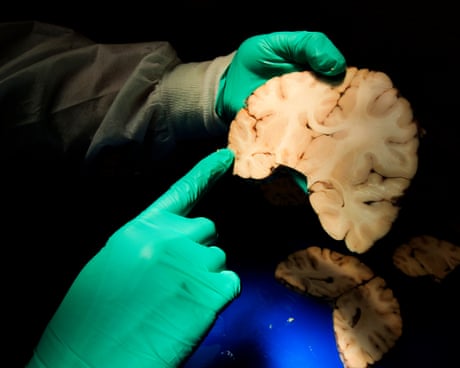
Research looked at prevalence of chronic traumatic encephalopathy in 2,362 players who died in 2008-2023
A new study published on Wednesday estimates that about 75% of former NFL players who died over a 15-year period had evidence of chronic traumatic encephalopathy (CTE).
The research, published in Jama Network Open and conducted by a Boston-based team, examined the estimated prevalence of the degenerative brain disease among NFL players who died from 2008 through 2023. Researchers found that the estimated rate of CTE among these players was substantially higher than the rates observed in brain samples collected from the general population.
Continue reading...
© Photograph: Stan Grossfeld/The Boston Globe via Getty Images

© Photograph: Stan Grossfeld/The Boston Globe via Getty Images

© Photograph: Stan Grossfeld/The Boston Globe via Getty Images

Have you ever had a disturbing thought pop into your head out of nowhere—something you'd never consider actually doing?
Intrusive thoughts are unwanted thoughts, images, or urges that can feel upsetting, confusing, or wildly out of character. They're more common in people with obsessive-compulsive disorder (OCD) but can happen to anyone, and they can involve everything from violence and sex to religion, relationships, and the fear of having done something wrong.
Many people are able to brush off the occasional intrusive thought and move on quickly. People with OCD, on the other hand, can get stuck trying to figure out what the thought means—and whether they might act on it. “We stop and we treat that thought as super important and meaningful,” says Alissa Jerud, a clinical psychologist and clinical assistant professor of psychiatry at the University of Pennsylvania.
Intrusive thoughts can feel especially disturbing because they often involve someone or something the person cherishes. “We tend to have intrusive thoughts about the things we care most about,” Jerud says.
Some of Jerud’s patients have kept their intrusive thoughts to themselves for 20 years before telling her. They might be thinking: “Why am I having these thoughts? What does it say about me? Maybe I’m a monster,” she says.
A calm, compassionate response can make it easier to keep talking. “It can help them feel like there’s hope,” Jerud says. “Maybe I don’t have to beat myself up for having these thoughts in the first place.”
Here’s what to say if a loved one tells you they’re having intrusive thoughts.
Start by thanking your friend for trusting you. Skip responses like “How could you think that?” or “Don’t say that,” which can reinforce the shame they’re already feeling.
It’s helpful, too, to make it clear that what they told you won’t affect your relationship: “This doesn’t change how I think about you,” suggests Madeline Thompson Smith, an Atlanta-based licensed professional counselor who specializes in OCD. Then acknowledge how upsetting the thoughts sound: “That sounds really scary to have stuck in your head.”
Pay attention to how you sound and look, too. A warm invitation to explain more can feel like judgment if you’re staring intensely or using a sharp tone. If you look startled, acknowledge it instead of hoping they didn’t notice. Kimberly Leonte, a psychologist in Boston who specializes in OCD, suggests wording it like this: “I guess I wasn’t expecting that, but I want to hear more.”
When someone you love is distressed by an intrusive thought, reassuring them can feel like the kindest thing to do. But if they keep coming back with the same question, answering it again and again can become part of the OCD cycle.
Say your partner keeps asking whether an unwanted thought means they’re dangerous. You reassure them, they feel better, and you both get back to your evening. Until another question arrives: But what if you’re wrong? What if they didn’t explain the thought accurately enough? Next thing you know, they’re asking for reassurance again.
A single reassuring response isn’t necessarily a problem, Thompson Smith says. The concern is when seeking reassurance becomes a compulsion—a behavior someone feels driven to repeat to relieve their distress. Each answer briefly helps them feel better, but it leaves them needing another answer when the doubt returns.
Instead of debating what the thought means, acknowledge how they’re feeling and express confidence in their ability to get through the discomfort. Thompson Smith suggests: “I know this feels really uncomfortable right now. I’m not going to help you go down the rabbit hole, but I’m happy to sit with you while it’s hard.”
If reassurance has become a routine between you, talk about changing it together, ideally with guidance from their therapist. Abruptly refusing to answer can leave your loved one wondering what happened. “It’s tough if the person’s used to getting reassurance, and you just stop giving it and they don’t know why,” Leonte says. Instead, discuss how you’ll respond the next time they ask—and make sure you both understand why you’re trying something different.
Meanwhile, aim to avoid suggestions like “Just stop thinking about it” or “Replace it with a happy thought.” Besides being considerably easier said than done, trying to force an intrusive thought away can keep someone preoccupied with whether it’s gone yet.
Find out what your loved one wants from the conversation. They might be seeking support in taking a step toward getting mental-health help, or they may simply want you to know what they’ve been going through.
“Do you want me to just listen, or do you want help figuring out what to do next?” Thompson Smith suggests asking. If this is the first time they’ve said their intrusive thoughts out loud, they might not be ready to discuss next steps.
If they’re already in therapy, ask how you can support what they’re learning: “What would your therapist recommend trying right now?” Leonte suggests asking. If they’re interested in learning more about intrusive thoughts but feel overwhelmed, you could offer to read about them together.
Sometimes, they simply want someone to listen. Your loved one might be telling you because “they just don’t want to be alone in this, and you can help them hold it,” Thompson Smith says. Or they may need to know “you’re not gonna judge me or people aren’t gonna run away if I start trying to be open and get help.”
If unwanted thoughts are causing significant distress or interfering with daily life, offer to help your loved one find a therapist. Keep it low-pressure: “If you ever want me to help you find a therapist, I’d be happy to do so,” Jerud suggests saying.
For OCD, look for a therapist trained in exposure and response prevention, or ERP, Jerud suggests. It helps people learn to tolerate intrusive thoughts without turning to rituals like repeated reassurance. The International OCD Foundation maintains a directory to help people find one.
There’s also an important distinction between an unwanted thought about harm and wanting or intending to act. Don’t assume that every disturbing thought is benign, Thompson Smith says. If you’re unsure what someone means, ask calmly and directly: “Is this a thought that scares you, or something you want to do?” If they describe wanting to act, ask about plans and help them get professional support right away.
After someone opens up about their intrusive thoughts, keep treating them like you always have. Send the ridiculous meme, ask whether they’re still coming to dinner, and keep including them in the things you usually do together.
People often fear that sharing their intrusive thoughts will change how others see them, Thompson Smith says. Pulling away—or asking about their mental health every time you talk—can leave them wishing they’d kept quiet.
You might get frustrated or struggle to find the right words, Leonte says. If you react in a way you regret, apologize and let them know you’re still there for them. “No one’s perfect,” she says. “The goal isn’t to be perfect, it’s just to be supportive.”

Increase will add strain on healthcare system already struggling amid cuts by Trump administration, experts say


The number of people with dementia in the United States is projected to increase dramatically over the next 25 years, which will place increasing strain on a healthcare system already struggling to help them amid cuts by the Trump administration, experts say.
According to a new study in Jama Neurology, the annual incidence of new dementia cases globally will more than double, from 11.4m in 2023 to 24.7m in 2050. In the United States, the number of adults diagnosed with dementia each year will increase from 514,000 in 2020 to 1m by 2060, according to a Jama study published in 2024.
Continue reading...
© Photograph: Yaraslau Saulevich/Getty Images

© Photograph: Yaraslau Saulevich/Getty Images

© Photograph: Yaraslau Saulevich/Getty Images

© Adriano Machado/Reuters
Jean Kaseya, of the Africa CDC, warns of the illness spreading like Covid unless more funding is secured to increase preparedness and possible treatment
The “unprecedented” spread of the Ebola outbreak means it could reach the UK and other countries, according to one of Africa’s top health officials.
As the current outbreak reached 10,000 cases, with almost 5,000 deaths, Dr Jean Kaseya, director general of the Africa Centres for Disease Control and Prevention (CDC), compared the outbreak to the Covid pandemic, which first took hold in China before spreading to countries across the world, claiming millions of lives, and ravaging health systems and economies.
Continue reading...
© Photograph: Sodiq Adelakun/Reuters

© Photograph: Sodiq Adelakun/Reuters

© Photograph: Sodiq Adelakun/Reuters
Exclusive: Health secretary to extend role of watchdog, which backers say helps hold service in England to account
Yvette Cooper has abandoned plans to abolish the NHS’s independent patient champion after an outcry from MPs across the political spectrum.
The health secretary has decided to keep and extend the role of Healthwatch England, which was due to be axed as part of the government’s reorganisation of the health service in England.
axe the Health Services Safety Investigations Body.
end councils’ automatic representation on the boards of ICBs.
remove the requirement for a nurse on every NHS foundation trust board.
Continue reading...
© Photograph: SolStock/Getty Images

© Photograph: SolStock/Getty Images

© Photograph: SolStock/Getty Images
Experts say symptoms such as dark circles under the eyes, grey skin, cracked lips and hair loss can be a warning sign – but there are other factors too
TikTok is rife with influencers warning of “ferritin face”, a term they use to describe the pallor, dark circles, dry skin, and hair loss claimed to indicate low iron stores. But is this based on fact or fiction, and when is it time to head to the GP?
Continue reading...
© Photograph: Alamy/PA

© Photograph: Alamy/PA

© Photograph: Alamy/PA