Speaking to reporters on the tarmac before departing for a campaign event in Michigan, JD Vance responded to a question about President Trump’s remarks branding Democratic Senate candidate Abdul El-Sayed as a “jihadist.”
Vance, who has sparred with the progressive El-Sayed repeatedly on the campaign trail, took a somewhat softer tone. But he didn’t walk away from Trump’s remarks.
Rubio’s decision not to meet Narendra Modi last week was seen by some as a snub – but by focusing on business leaders and oil, the secretary of state made American priorities clear. Plus: the artist bringing a female perspective to men’s clothing
When the US secretary of state, Marco Rubio, visited India for the second time this year, headlines concentrated on who he met and where he went.
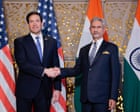
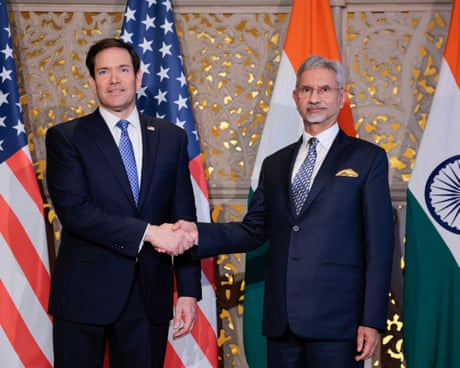
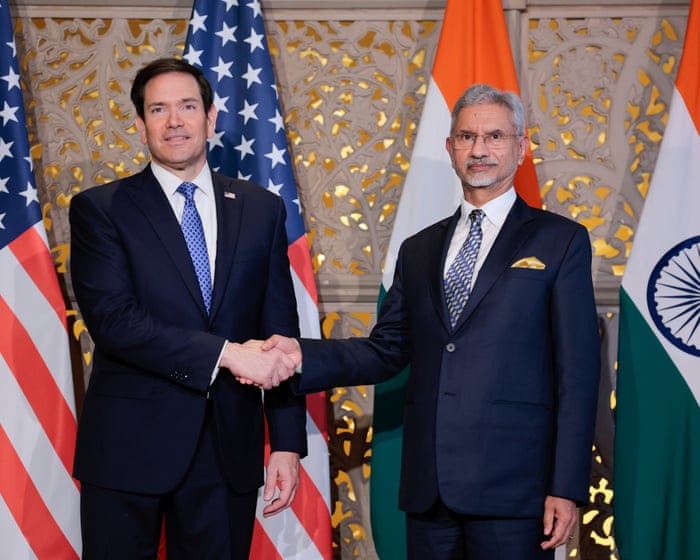
The fact that Rubio bypassed New Delhi and did not meet the prime minister, Narendra Modi, during his trip last week, and instead traveled to the financial capital, Mumbai, where he met India’s foreign minister, Subrahmanyam Jaishankar (pictured top with Rubio), and business leaders, did not go unnoticed. Nor did his decision to travel to Jamnagar, the small Gujarati town that is home to Reliance Industries’ colossal oil refinery complex.
State and local plans for Election Day include how to react to potential ICE raids, misbehavior by federal election monitors and attempts to seize votes or machines.
A federal judge stopped the Trump administration from cutting trees and prohibited other changes at the park where the president has sought to overhaul a golf course.
Trees that have been cut down at East Potomac Golf Links are seen earlier this month in Washington. The Trump administration and the National Park Service moved to cut down up to 529 trees at East Potomac Golf Links.
The new book by the reporter Matthew Cole connects $2 billion in slush funds from gulf state leaders to Trump’s son-in-law in an effort to influence U.S. policy.
By a 2-1 vote, a federal appeals court panel denied the Trump administration’s request that it immediately order the state to set aside 20,000 mail-in ballots.
Seeking new elections, María Corina Machado will need to tread carefully to avoid offending the Trump administration, while also asserting her own leadership.
Lawyers for James B. Comey said the case centered on an issue that had already been investigated and had not led to charges, of a purported leak of national security information to The Times in October 2016.
The day after former President Barack Obama and Michigan Senate candidate Abdul El-Sayed campaigned together in Detroit, President Donald Trump launched an anti-Muslim attack against El-Sayed. | Emily Elconin/Bloomberg via Getty Images
This story appeared in The Logoff, a daily newsletter that helps you stay informed about the Trump administration without letting political news take over your life. Subscribe here.
Welcome to The Logoff: Donald Trump’s midterm barnstorming is getting uglier and more desperate.
What’s happening? At a campaign rally in Port Huron, Michigan, on Sunday, Trump launched a new round of anti-Muslim attacks against Michigan Democratic Senate nominee Abdul El-Sayed, describing him as a “jihadist” who “should never be allowed inside the halls of our great beautiful Capitol.”
“If Abdul and the Democrats win,” Trump told supporters, “they will open the floodgates and invite hordes of jihadists to our shores, creating a nightmare of violence and terror until you cannot even have a Christmas.”
What’s the context? Trump’s speech marks the crescendo — so far — of what has become an increasingly Islamophobic midterm campaign by the Republican Party, centered on El-Sayed.
Former Rep. Mike Rogers, Michigan’s Republican Senate nominee, has repeatedly tried to link El-Sayed to the Muslim Brotherhood, and Republicans have also attempted to wield Islamophobia against the Democratic Party as a whole.
On Sunday, Texas Gov. Greg Abbott told Fox News that his Democratic opponent, Gina Hinojosa, “supports Sharia law,” while at the Republican midterm convention in September, Texas Sen. Ted Cruz said that “communism” and “Islamism” were allying against Republicans.
What’s the big picture? In addition to his overt Islamophobia, Trump’s presence on the campaign trail in the final few weeks of the midterm elections has been decidedly strange and surprisingly heavy on physical descriptions of Sen. Jon Husted (R-OH).
Now, with just eight days to go, Trump’s itinerary features rallies in Mississippi, Texas, Ohio, South Carolina, and Florida — all Republican states where the party has found itself, to one degree or another, with a tougher-than-expected Senate race on its hands.
It’s hardly the travel schedule of a president who feels good about his party’s chances— such as in Michigan, where El-Sayed is leading in most recent polls.
And with that, it’s time to log off…
US elections may not be until next week, but two other countries held theirs over the weekend: Serbia and Brazil. As my colleague Caitlin Dewey reports in Vox’s Today, Explained newsletter, both resulted in surprise victories over right-wing nationalist parties, with Serbia ousting its incumbent strongman, Aleksandar Vučić.
Brazilian President Luiz Inácio Lula da Silva’s victory over Flávio Bolsonaro is also especially good news for the climate: As the New York Times reported earlier this month, the fate of the Amazon rainforest may well have hinged on the outcome of the election.
Thanks for reading, have a great evening, and we’ll see you tomorrow!
Examining President Trump’s praise of a rallygoer who punched a protester last week, David E. Sanger, a White House and national security correspondent for The New York Times, studied the atmosphere at Mr. Trump’s recent events. What he found was a faint echo of the moments that made Mr. Trump’s 2016 rallies so shocking.
Ms. Comey, the daughter of James Comey, the former director of the F.B.I., worked for the U.S. attorney’s office in Manhattan, handling the prosecutions of Jeffrey Epstein and Sean Combs.
The left says its populist message can attract moderates and conservatives in addition to liberals. That theory will be put to the test in a series of competitive races on Election Day.
Democrats are targeting G.O.P. strongholds that could set them up for new majorities. But if they don’t win those races now, it could be a long time before they have another chance.
Protesters outside of an event for Senator Roger Marshall in Topeka, Kan. Soaring fuel costs and economic struggles have made some Republican senators like Mr. Marshall vulnerable on their home turf.
Brazilian President Luiz Inacio Lula da Silva, the Workers’ Party (PT) candidate for presidential re-election, speaks alongside his wife, Rosangela “Janja” da Silva, and Vice President Geraldo Alckmin after winning the presidential runoff election, in Sao Paulo, Brazil, on Sunday.

 Login