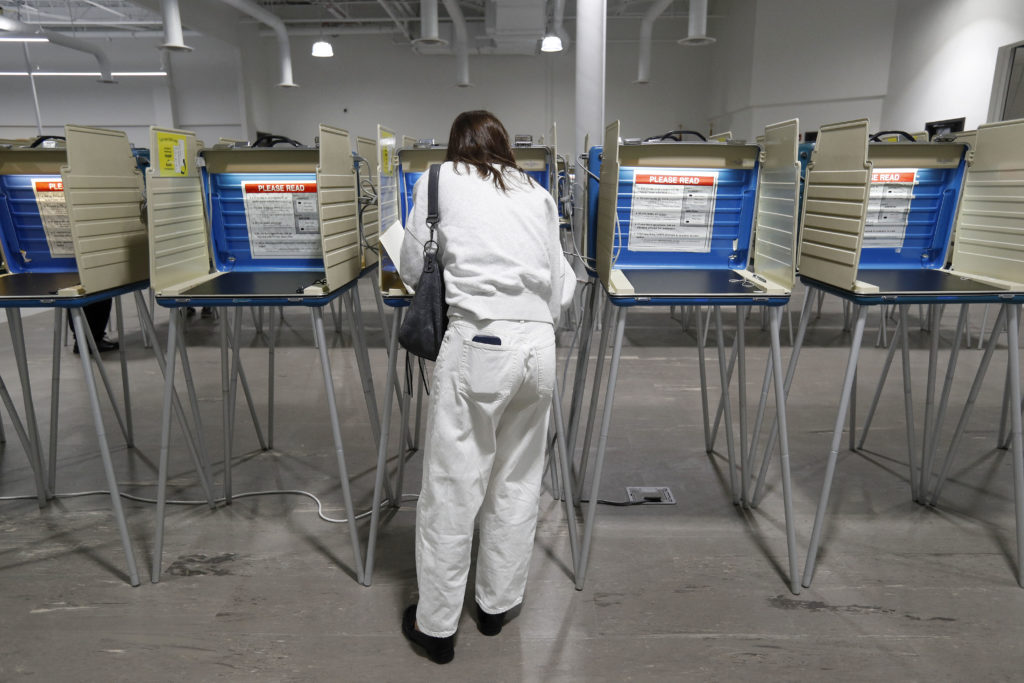
The letters are the latest escalation in a legal battle between California and President Donald Trump's Department of Justice, which has recently focused on the state in its efforts to root out noncitizen voting ahead of the midterm elections.
The U.S. government has ordered diplomats and other federal employees to leave Saudi Arabia. It is also drawing down staff at other missions in the region.
The Trump administration wants to move Forest Service headquarters from Washington to Salt Lake City, shutter 23 research stations, and close many regional offices and replace them with state offices.
Oscar Belgal, a Dominican immigrant, was shot in the neck on Oct. 8 and detained at a federal prison. His lawyers had said he needed outside medical care.
Immigration agents descended upon Oscar Belgal, an undocumented Dominican immigrant, as he drove with his son along a strip of small stores in New York on Oct. 8.
The agency regularly monitors polling places. But this year's effort on Nov. 3 will more than double the number of federal monitors deployed during the 2022 midterms.
A complaint I hear a lot from my millennial peers is that our parents didn’t teach us enough about money. I can say that personal finance wasn’t dinner table conversation in my house, and even as I went off to college and started fending for myself, it was almost a taboo subject. When it came to money, people either had it or they didn’t, and you definitely didn’t talk about it.
Maybe this is why the average American isn’t exactly fluent in personal finance, and the situation is getting worse. Americans can only answer about 50 percent of basic questions about borrowing, savings, and risk on a financial literacy survey, according to a 2026 study by TIAA, a retirement services company. About a third of those surveyed said they have a hard time making ends meet and are debt-constrained. These figures have remained relatively unchanged for nearly a decade, but dropped to their lowest level in this year’s study.
It makes sense: It’s hard to learn about money when it’s not taught in schools, and it’s such an intensely private topic. It’s also hard to make good financial decisions when you’re one of the growing number of American households struggling to pay bills, repay debts, and save for the future — and feeling very stressed about it.
In a perfect world, each of us could sit down with a financial adviser to get help — but most of us can’t afford that. Instead, average Americans tend to find personal finance tips on TikTok, in Reddit threads, by watching Suze Orman on YouTube or How to Get Rich on Netflix, or by Googling their questions.
Now we have AI tools, too.
With access to an internet’s worth of information and financial advice, ChatGPT, Claude, and other AI chatbots can answer any question you ask. They can help you put together a basic budget or, armed with your bank statements and the details of your student loans and your retirement accounts, tailor solutions to your specific situation. Or, at least, that’s the promise.
Key takeaways
More people are turning to AI for financial advice:One in five Americans have used AI to help manage their money, and some experts think chatbots could be better than the status quo.
AI works best if you know what questions to ask: Those with basic financial literacy will be able to make the most of these tools, while those without it — who might need help the most — could be led astray.
Better advice comes with greater risks: Sharing your financial information with a chatbot helps personalize its recommendations. This raises privacy concerns, so you might want to delete your data when you’re done.
Think of AI as a financially savvy friend:Chatbots can answer money questions you might be embarrassed to ask someone else and use that context to help build your budget.
AI could create a more utopian, more equitable future, where reliable, hyper-personalized advice is just a prompt or two away for people who can’t afford to meet with an expert in real life. But machines are built by people, and there’s good reason to be concerned that these machines will simply replicate the biases and disparities built into our current system.
Here’s what experts say about how to make the most of these tools — and how to think about all of the inherent risks of uploading a lot of personal financial information to a chatbot or, worse, giving an AI agent the keys to your bank account.
The steep rise, risks, and rewards of AI financial advisers
Nearly 20 percent of Americans have used AI tools like ChatGPT for financial advice, and close to 25 percent for Gen Z adults and millennials have tried it, according to an August Gallup poll. These numbers could tick up too: In October, OpenAI started rolling out a dedicated personal finance tool to its ChatGPT Free and Go users in the United States, which effectively means anyone can try it. ChatGPT Finances lets you securely connect your bank account to the tool using a platform called Plaid, and then you can basically have a conversation with the chatbot about your real-time finances down to the penny. It’s like an AI-powered Mint (RIP) that you can talk to directly.
Regardless of where you encounter a chatbot or how much data you give it, experts say these tools could genuinely help improve financial literacy. You can talk to them about money problems you’re too embarrassed to discuss with friends and family, or ask questions and receive actionable, personalized information. There are real upsides to using AI this way.
Taha Choukhmane, an associate professor of finance at the MIT Sloan School of Management, has been studying outcomes when people turn to chatbots for financial advice. In general, these AI tools give pretty good advice, and that advice gets better as people become more practiced in asking the right question, according to research he published earlier this year.
“We were actually quite surprised that relative to the status quo, the average American would be better off if they were to follow the advice,” Choukhmane told me. But he added a caveat: “Just following the advice without understanding the advice puts you at risk of not fully understanding the risk.”
But you shouldn’t trust everything a chatbot tells you and should verify everything before making any decisions.
Chatbot advice has some significant limitations. First, it’s not impartial. The finance industry has a vested interest in steering you toward certain ways of managing your money, and that typically means selling you products, like loans. If you’ve ever searched for personal finance tips on Google, you’ve probably noticed that a lot of the top results come from banks and other financial institutions. This is by design, according to John Campbell, an economics professor at Harvard. But because AI is aggregating all of that advice, the specific influences and possible bias is less obvious.
“AI is very promising for providing low-cost financial advice in plain English that will arguably be better than what many people would be able to do on their own,” said Campbell, who’s also the co-author of Fixed: Why Personal Finance Is Broken and How to Make It Work for Everyone. “One caveat is that chatbot advice is quite likely — unless a model has been carefully trained — to reflect the average of whatever’s being posted on the internet, and that may or may not be first-rate advice.”
An example Campbell gives is the question of when to start taking Social Security benefits. While you’re eligible at age 62, many economists agree that you should delay your benefits, which, based on the way the government calculates your monthly payouts, will allow you to enjoy much higher benefits later in life. But paid financial advisers can recommend starting as early as possible, since waiting longer reduces the amount of money that needs to be managed, which reduces the adviser’s fees. That means there’s a lot of conflicting advice online, much of it supplied by the finance industry. And that’s the information used to train AI models.
“The advice is much more mixed,” Campbell said. “And so if a chatbot is learning from that, it may not actually give the best advice.”
It can be hard to recognize bad advice anywhere in life, but especially when you’re talking to a machine that’s programmed to please you. A chatbot could encourage you to consider a balance transfer, to lean in on credit card rewards, or to refinance your mortgage — all decisions with upsides and downsides for you, but definite upsides for banks — without you realizing how much of its training data comes from the finance industry selling these products. What’s worse is that if you do end up taking bad advice, it might be years before you realize it. You won’t know that you refinanced a mortgage at a bad time until a better time comes along.
That leads me to the other major issue with using chatbots for money advice: People who lack financial literacy are the most likely to fall for bad advice, because they simply don’t recognize it as such. They also tend to be less wealthy, which means they can’t afford big mistakes.
One way to mitigate risk, oddly enough, is to give the AI chatbot more personal information. The more details about your situation it has to consider, the more it can offer personalized advice. More context also means better advice, according to Choukhmane.
“There’s a trade-off there,” Choukhmane said. “There’s real risk around privacy, and so I think everyone needs to find their level of control.”
Don’t assume your data is safe
Any time you’re talking to a chatbot, you’re putting a lot of trust in tech companies to take care of the personal details you’re sharing. Sending sensitive financial data is an especially risky proposition. While tech companies, including OpenAI, promise to keep your data secure, there’s already a long list of breaches, leaks, and privacy violations that serve as cautionary tales.
It’s also impossible to know what tech companies might do with your data in the future. Most of them will use it to train their models, unless you tell them not to. Some of them will use the data to serve you personalized ads.
Then there’s the risk of bad actors getting into your ChatGPT, Claude, or Gemini account. If you’ve been using a chatbot for financial advice and uploading your bank statements, a hacker could gain access to a stunning amount of information that could enable them to do all kinds of terrible things to your life.
“They could steal your identity and open accounts and then quickly bankrupt a person,” said Delicia Reynolds Hand, a senior director at Consumer Reports. “It’s not even so much the primary underlying accounts that could be at risk, it’s more just access to this information.”
The steady march of AI progress is making this situation even more complicated. The previous era of chatbots offering financial advice is quickly bleeding into a new phase of AI agents logging into bank accounts on users’ behalf. If you’re using a tool like Claude Cowork or even an AI assistant like Muse, you can give an agent the login credentials to your bank account, and because the agent is operating its own computer, it can actually make transfers, apply for loans, or really do anything in your account. This is reportedly driving major banks wild, since they don’t know which logins are coming from humans and which are agents. And because we know that AI agents are unpredictable, it’s hard to know how that access might go wrong.
Beyond data security and privacy, you should also be aware of the simple fact that nobody’s really at fault if you end up losing money using these tools. Chatbots are not regulated in the way that human financial advisers, who have a fiduciary duty to act in your best interest, are.
“If I get bad tax advice from H&R Block or a tax adviser, there are a clear set of rules and guardrails in place to manage what I can expect in that relationship and where the service they use has liability and where that liability ends,” Hand said. “Currently, that’s not the case for these tools.”
Trust but verify — and then delete your data
In the final years of the Cold War, Ronald Reagan popularized an old Russian proverb: Trust, but verify. The phrase is somewhat nonsensical, since trusting someone implies that you don’t need to verify what they’re saying, and verifying what’s said implies you didn’t trust them in the first place. But if you are willing to shoulder a bit of risk, consider approaching AI this way, especially when your life savings are on the line. I’d also suggest adding a coda to the phrase: And then delete your data.
Chatbots are not stand-ins for licensed financial advisers, he said, and you shouldn’t let them make decisions for you.
The great paradox with tools like ChatGPT and Claude is that they’re very good at generating truthy text. It sounds authoritative and looks correct — and usually is. Except when it isn’t. AI is famously unpredictable and prone to hallucinations. You can ask the same question twice and get two different answers. That doesn’t mean these tools are useless. It just means you have to approach them with caution. You have to interrogate these chatbots, challenge whatever advice they give you, and then crosscheck that with other, more reputable, sources.
“If you’ve never used these tools, I would not encourage you to just change all your financial plans based on your first conversation,” Choukhmane said. “You want to be quite careful. Start using these tools, start understanding, ask a lot of follow-up questions.”
When it comes to mitigating risk, consider giving ballpark figures for your income or spending when you’re talking to a chatbot about your finances. Uploading financial documents, even if they’re redacted, is inevitably filling a tech company’s vault with your sensitive information without necessarily knowing what will happen to it next. You should also dig into your privacy and security settings to make sure you’ve turned on multi-factor authentication and that your personal data is not being used to train AI models and gets deleted after 30 days.
Ethan Bloch, the product lead for ChatGPT for Financial Services, made a similar set of recommendations when I talked to him recently. Chatbots are not stand-ins for licensed financial advisers, he said, and you shouldn’t let them make decisions for you. They’re designed to inform and help you think through complex topics.
“You should liken it to just talking to a friend who has some very informed opinions about finance,” Bloch told me. “But if you’re actually making some large financial decision — your portfolio or retirement — you still need to seek out the help.”
Regardless of how experienced you are with chatbots or how much data you’re prepared to hand over, remember what Campbell, the Harvard professor, said. If your financial literacy isn’t great, AI chatbots can be trouble. And if you’re like most Americans, you could probably stand to learn a little bit more about things like mortgages and interest rates.
Yes, Chatbots can be a good way to brush up on financial literacy. You can ask them the money questions you’re too embarrassed to discuss with friends and family. But you can also learn about money the old-fashioned way: Reading books and websites written by reputable, independent sources. The Federal Deposit Insurance Corp. has a portal of financial education resources, including games and quizzes. Khan Academy has a course that covers everything from credit scores to college savings. There’s a personal finance subreddit that I joined years ago and read almost daily. There are budgeting apps, like YNAB which has its own huge Reddit presence.
Whatever you do to learn more about personal finance, simply doing something is progress. Talking about personal finance isn’t the taboo it once was in the US, and it’s even a required course in the vast majority of American high schools now. And while AI won’t magically solve your money problems, it can help get you started. Just be careful. Your livelihood could be on the line.
The lawsuit centers on one of the president's longstanding complaints in the Senate race — the presence of a second candidate named Dan Sullivan who Republicans fear could siphon away votes from the incumbent in what's likely to be a photo-finish contest with Democrat Mary Peltola.
With the midterm elections less than two weeks away, a new legal battle is raising questions about the federal government's role in policing who is eligible to vote. A federal judge in California has blocked a Department of Homeland Security effort to identify noncitizens on voter rolls. White House correspondent Liz Landers reports.
Ancient plants reveal that the vestiges of the North American ice sheet started expanding a few thousand years ago, but that climate change caused it to reverse course.
Democrats have tended to voice sympathy with the accuser, saying that they stand with her and other victims. Rep. Alexandria Ocasio-Cortez (D-NY) said there was “a culture of rape, sexual assault, and pedophilia” in elite institutions across the country. Michigan Senate candidate Abdul El-Sayed said Cornell “protected her abusers, letting them off with a slap on the wrist.”
Key takeaways
In the wake of the Cornell rape allegations, advocates for victims of rape and sexual assault are renewing a push for New York to close what they call the “voluntary intoxication loophole” in state law.
This proposed change would make it easier for prosecutors to argue that people can be too intoxicated to consent to sex, even if they are conscious and haven’t explicitly said no.
But this reform effort has met resistance from key parts of the progressive coalition who are skeptical of the criminal justice system; they fear new tough laws will be weaponized against minority groups and contribute to mass incarceration.
New York Gov. Kathy Hochul said the accuser was “failed” by local police and county prosecutors who did not bring charges, so Hochul appointed state Attorney General Letitia James to take over the investigation. Days before that appointment, James posted on social media that “what this young woman has been forced to endure is horrific and unacceptable,” adding: “To her, and to all survivors: you’re not alone. We stand with you.”
Some Republicans, meanwhile, are accusing Democrats of rushing to judgment. Saritha Komatireddy, who is running for attorney general of New York against James, said in a debate that James had “screwed this one up by prejudging it.” The investigation, Komatireddy said, “requires someone who approaches the case with fairness, impartiality and integrity.” And right-wing commentators like Megyn Kelly and Ben Shapiro have questioned the accuser’s story.
But beyond the procedural fight over this particular investigation, many Democrats have also called for changing the law to make cases like it that involve drugs or alcohol easier to prosecute in general.
This might seem like a clean issue for the party, in line with prior progressive efforts to crack down on sexual assault via Title IX and expanding statute of limitations laws.
However, it’s not so simple: According to my conversations with experts and advocates involved in these reform conversations, this is where the Democratic unity begins to fray, because of a divide between two key parts of the progressive coalition.
The impulse to create stronger protections for victims has crashed into the left’s longstanding suspicion of the criminal justice system. And as a result, a coherent policy response has been hard to craft — and may end up being impossible to get agreement on.
On one side are advocacy groups for women and for victims of rape or sexual assault. They argue that current law — in New York and other states — makes it far too difficult to successfully prosecute perpetrators, and that it should be changed. They’ve advocated for closing what they call the “voluntary intoxication loophole,” which they say makes it harder to prosecute abusers of victims who have willingly consumed drugs or alcohol.
On the other side are various progressive or left constituencies that are deeply skeptical of the criminal justice system. These constituencies — which include key figures in New York’s Black political establishment, public defenders, supporters of criminal justice reform, and members of the Democratic Socialists of America — are united by a shared antipathy to mass incarceration and what they see as disproportionate police targeting of minority communities.
The former camp argues that false rape and sexual assault allegations are vanishingly rare, that these crimes are hugely underpunished, and that the law needs to be updated to make these prosecutions easier. But the latter camp argues that Black and other nonwhite men are oftenfalsely accused, and that it would be unwise to hand prosecutors another tool they could use to put men in jail in cases where ascertaining consent is more difficult.
It’s a fraught debate. Modern-day progressives have strongly backed the Me Too movement as well as campaigns for racial justice and criminal justice reform. Progressives want to be on the side of victims against the privileged and powerful — but sometimes, they have different ideas about who falls into which category.
The legal issues around “voluntary intoxication” and rape charges, explained
The current controversy in New York focuses on efforts to close what advocates call the “voluntary intoxication loophole” in rape and sexual assault law.
Every state says rape is a crime. Every state says it’s a crime to have sex with someone who is unconscious. And every state says it’s a crime to have sex with someone who is incapacitated due to unknowingly being dosed with drugs.
But what about someone who chooses to drink or take drugs, who remains conscious, and who doesn’t outright refuse consent? Should there be a standard by which the law deems that person incapable of meaningfully consenting, because they are too intoxicated?
Many states have long had laws on the books saying yes — that someone who voluntarily drinks or does drugs can reach a state where they are too mentally impaired to consent to sex, even if they’re conscious and capable of communicating. But about half of states don’t have such a law, according to the Associated Press. And this hasn’t been an especially partisan issue to this point, with a mix of red and blue states adopting each standard.
The push to change the law in New York predates the Cornell case, and goes back to the late 2010s. At that time, the Me Too movement had put Manhattan District Attorney Cyrus Vance Jr. in the hot seat, with advocates criticizing him for not initially prosecuting Harvey Weinstein and arguing he was soft on rape and sex crimes generally.
In the midst of pivoting on the issue (he had Weinstein indicted in 2018), Vance claimed that, in certain of these cases, his office was hamstrung by what he called a “loophole” in New York law involving intoxication. “Prosecutors cannot bring sex crime charges in cases where the victim became voluntarily intoxicated and was unable to consent,” he wrote in a letter. So really, Vance said, it was on the legislature to change the law.
Quickly, critics argued that Vance had misstated the law, saying it was not actually true that a loophole allowed people to rape voluntarily intoxicated New Yorkers with impunity. Vance’s office later acknowledged that his initial comments were “inartfully put.”
The problematic cases, Vance’s team argued, were about victims who were “too intoxicated to consent” but who were also at least partially conscious and didn’t outright express their unwillingness — this, they said, was the “gap in the law.” “There’s a real problem that we have with people getting drunk and then being taken advantage of,” Vance said.
So some Democrats and groups advocating for victims of sexual assault and rape kicked off an effort to change that law, in New York and elsewhere. Their favored bill says that lack of consent can be established if an alleged victim is “temporarily incapable of appraising or controlling their conduct” — and if the accused knew or reasonably should have known that.
Critics argue, though, that such bills go too far, and could make it easier to prosecute sexual encounters that, to the accused, seemed consensual.
“The proposed legislation fails to provide any objective guidance about when a partner is too intoxicated to legally agree to engage in sexual conduct,” the New York State Association of Criminal Defense Lawyers said in an emailed statement.
Skeptics of the bill outlined several scenarios that concerned them, including scenarios where one person seems to consent but later decides that, in retrospect, they were too intoxicated for it to have truly been consensual.
“You get all these scenarios where two people meet up at a bar and they both become voluntarily intoxicated,” said Yung-Mi Lee, a public defender and a former president of New York’s criminal defense lawyers association. “So then, if someone later says, ‘I was voluntarily incapable of appraising my conduct, I lost my inhibitions,’ they could say, ‘You committed a rape against me.’”
To advocates for victims’ rights, these concerns are overstated. “The burden that’s placed on a victim of sexual violence is such a large burden to bear in the first place that these changes to the law are really just slightly opening the door,” Rebecca Zipkin of the advocacy group World Without Exploitation told me.
“The current situation is not working to provide justice for survivors,” Stefan Turkheimer of RAINN, a network for rape and abuse survivors, told me. “The status quo is not okay.”
Why it hasn’t passed in New York
Versions of the voluntary intoxication bill have been signed into law in recent years in Minnesota, Michigan, and Texas. The bill has also repeatedly passed the New York state Senate by overwhelming margins. But it has never been brought to a vote in the lower chamber, the New York state Assembly.
That’s because, advocates for the bill told me, they’ve faced resistance from some influential parts of the Democratic Party and progressive coalition.
Indeed, the skeptics are said to include two factions that are often at odds: New York’s Black political establishment and the Democratic Socialists of America.
Assembly Speaker Carl Heastie controls which bills come to a vote in his chamber. He was an architect of the state’s sweeping bail reform law, a critic of what he called the existing “racist and classist system,” and has said he would be “a failure as a Black man” if he did not pass criminal justice reform.
“It is generally known that Speaker Heastie does not believe in creating new crimes because he believes New York suffers from overincarceration,” Lizzie Asher, an advocate for changing the law and a co-founder of the Justice Without Exclusion Coalition, told me. (Heastie has said that he did not bring the bill to a vote because it lacked enough support among his chamber’s Democrats.)
Assembly member Latrice Walker is another champion of criminal justice reform; she even did a hunger strike in 2023 to protest rollbacks to the bail reform law. She spoke out about her concerns about the voluntary intoxication bill earlier this year, telling the New York Times that while she wanted survivors to get justice, she was “cautious about the creation of new laws and our duty to preserve due process protections.”
Zipkin and other advocates have also pointed to the six DSA-affiliated members of the assembly, who are associated with a general skepticism about the criminal justice system and incarceration, as a potential obstacle. None are currently listed as cosponsors of the bill. Back when Zohran Mamdani was in the assembly, he too declined to sign on, advocates noted.
The DSA as an organization is very critical toward the police and prison system; many DSA members have called for defunding or abolishing the police in the past, and the DSA’s national platform still holds out “fully abolishing the police and prison system” as a long-term goal.
These objections may be harder to maintain amidst a wave of outrage around the Cornell case. Speaker Heastie announced he was creating a working group to reexamine the voluntary intoxication issue. The group includes Walker, whose office told Vox she would not comment on the law while “they undertake their important work.” Heastie told the group to give him recommendations by the end of the year, for consideration in New York’s 2027 legislative session.
Is this a bigger divide among progressives?
The divide is coming into public view due to national attention on the Cornell case — but it’s long predated the current moment.
Back in 2016, a California judge gave Brock Turner, a Stanford swimmer convicted of sexually assaulting an unconscious woman behind a dumpster, a six-month jail sentence. Advocates for victims’ rights were furious at what they deemed an inexcusably lenient punishment; nationwide outrage and an ultimately successful campaign to recall the judge ensued.
But some progressive supporters of criminal justice reform felt queasy about the idea of punishing a judge for not locking up a defendant long enough. Skeptical of the criminal justice system and the value of incarceration, they worried this public fury would incentivize judges to be harsher across the board.
“What ultimately will happen is that the people that we represent — people of color, minorities, the disenfranchised, the poor in our communities that make up the people ensnared in our criminal justice system — they’re the ones that are going to bear the cost of this recall,” Sajid Khan, a public defender in Santa Clara County, California, said in 2018.
In practice, these two groups of advocates have generally managed to coexist in the progressive coalition. That’s in part because the Me Too cases that get the most attention have tended to be from white-collar work environments or college campuses, rather than in the dispossessed or marginalized populations that criminal justice reformers are more typically focused on.
But some argue that there’s a more fundamental tension here. Aya Gruber, a professor at the USC Gould School of Law, has written a book arguing that feminists’ efforts to ensure rape and domestic violence are punished more severely have, in practice, ended up contributing to racist mass incarceration.
“I just think it is a really dangerous thing to start expanding the criminal law in ways that grant all this power to prosecutors,” Gruber told me. “This idea that somehow all this cultural power is going to be used against already privileged people and thus have some sort of egalitarian aspect to it makes it very tempting. But we can identify populations that are more heavily policed, and they are generally not privileged populations.”
Another needless, endless war. Rising living costs and gas prices. The fact that the richest 1 percent of Americans own more than the bottom 90 percent combined, or the straight-up corruption happening in the White House. As the old saying goes, if you’re not mad, you’re not paying attention.
But what does spirituality teach us about how to respond to our anger? Is it wise to try to let it go? Should we practice imagining clouds floating gently by and take a deep breath?
I don’t think so. For one, it’s not that simple! There’s way too much happening inside my heart when I’m pissed off to pretend that I’m full of calm and kindness. Plus, this kind of spiritual bypassing is as insulting as it is ineffective. When we try to force a feeling, we fundamentally misunderstand the gift that anger has to give us: a deeper insight into our pain and a genuine compassion that enables wise action for justice.
That said, I don’t want to walk around like a fire-breathing dragon or endlessly stew in my resentment either. So I reached out to some trustworthy religious voices to see what spiritual traditions can teach us about effective responses to our rage — and how it can give us insight without overwhelming us.
Underneath your anger is a broken heart
Lama Rod Owens is a Buddhist teacher in Atlanta and the author of Love and Rage: The Path of Liberation Through Anger. The first thing he tells me is that we have to acknowledge our anger. “A lot of us actually don’t know what anger feels like. We’re just reacting to it,” he says. And that rings true. I’m still learning to notice the physical signs of rage: My head gets hot; my stomach tight; my throat fills with the scream that I’m only just able to contain.
That physicality is central to Owens’s definition of anger: The mental and physical tension out of which aggression arises. And that aggressive response is what gets me into trouble — when I snap at my husband or give demon eyes at those who surely have headphones but are choosing not to use them. If I’m not careful, I won’t even notice how rageful I am until my simmering pot of fury suddenly comes to a boil.
Noticing that tension can be tricky, Owens says, because “a lot of people get gaslit around their anger, particularly women and femme folks.” It can be radical to simply admit that anger is arising in you. Owens is very careful with language here. Instead of saying that we are angry, he encourages us to say that we feel angry. “I know it’s very nuanced,” he explains, “but when people start thinking about an experience rather than being something, it really opens up space.”
And that space gives us what we need to take the next step. Which, surely, is to move past our anger?
No, he argues. The path of liberation is through anger — not to “get over it.” Owens learned this through personal experience, as well as through the wisdom teachings of his Buddhist lineage. As a Black, queer man living in America, he’s had plenty to be angry about (while also having to navigate the harmful stereotype that as a Black man he’s inherently angry). But, he writes in his book, “I wasn’t pissed off because of racism or homophobia or something else. I was actually deeply, deeply hurt.” Through disciplined meditation, Owens realized that his anger was a secondary emotion. Meaning, there was a primary experience that sat underneath the anger. And that primary experience was pain and sadness and a deeper sense of heartbrokenness.
“It’s like you’re not just angry, experiencing anger about the world. You’re hurt by the world, you’re saddened by the world, you’re grieving the world,” he says.
Learning to sit with that anger shifted things over time. As Owens practiced noticing and naming his rage instead of trying to push it away or acting out in aggression, he found a way to be with it instead.
His Buddhist lineage taught him to think of anger simply as energy. And like any energy, he learned to experience it rather than to react to it: “In Buddhism, we would consider the essence [of anger] to be empty…it’s just energy that can be shaped or misunderstood by consciousness.”
To be clear, he says, “It’s not like the anger disappeared,” but rather that Owens experienced enough space around the anger that allowed him to name the heartbreak that was underneath it.
And once he could do that, he noticed a completely different feeling flooding in.
Moving through anger to tender compassion
Nate DeGroot has seen the same connection. DeGroot is a rabbi based in Detroit and the director of the Shalom Center. In his Jewish tradition, anger isn’t just something only humans experience — God gets angry, too. Think of the flood sent to punish humankind that Noah avoids by building the ark, for example. But, DeGroot explains, God’s anger only lasts a moment.
In fact, in Jewish tradition, the Talmud records people questioning exactly how long God’s anger lasts — with some claiming that it remains only for a 15,888th of an hour (which comes to just under half a second), and others saying God’s wrath lasts as long as it takes to say the word “moment” in Hebrew, a word with two syllables. Either way, it only lasts a short while, because a deeper, more enduring compassion quickly emanates from God’s being.
As the parent of two small kids, DeGroot empathizes with both God’s anger — and the love that supersedes it. When his kids mess around, he says, “I’m frustrated!…why did they fling the blue toothpaste on the white shade in the bathroom and now it’s forever stained? I’ve got to bring the rug into the rug cleaner for the fifth time in two years because they peed on it in the middle of the night!” he says, laughing. But those temporary flares of frustration sit within a wider circle of parental care. “I really relate to… this notion of the moment of anger [being] situated within a broader, more expansive, everlasting love,” he tells me.
Once we’ve properly noticed our anger and named the heartbreak it masks, what will (hopefully!) follow is waves of compassion for ourselves and everyone else that is hurting. And it is from that place that you can actually take action.
From compassion comes a community for justice
Najeeba Syeed is the executive director of Interfaith at Augsburg in Minneapolis and has a long history of doing conflict resolution work. She explains that in Islam, too, the Prophet Muhammad experiences anger. Early in his mission as he travels from one place to another, he’s stoned by angry villagers who reject him. “He was given a choice,” she tells Vox. “Should the divine force go and destroy this community, or should this community have reprieve for what they’ve done?”
The Prophet Muhammad chooses forgiveness over revenge. But there’s both spiritual wisdom and strategy at play in that choice: Anger can separate us from the very people we need to be connected to when seeking justice, Syeed says. “It makes us incapable of seeing the experience of others,” she says. And it is precisely the experience of other people we need to be aware of when building coalitions that will be able to solve the problems that make us angry. Inequality and corruption and rising health care costs are not going to change if we remain atomized and mad. We have to work together.
“Okay, you’re angry,” Syeed affirms, “But who is the you? Who is in the collective? Who is impacted? If we don’t have a larger identity than our political affiliation — by that I mean the neighborliness, some sense of community that transcends that identitarian political affiliation alone — then we may actually destroy ourselves in the process.”
“If you [take action] by yourself, is it really going to change at the social level?” she asks. “You still have to be able to build allies, and you still have to be able to build connection.”
That’s what the Prophet Muhammad was doing in exhibiting restraint with the angry villagers. In leaving them unpunished, he was later able to build an alliance with them in his campaign to spread his message through the region.
In the Muslim tradition, a judge is forbidden from making a ruling when angry because it is understood that justice cannot come from rage. Anger helps us cut through distractions and focus on the work that needs to be done — but that work for justice must come from a deeper place of love.
So, how should we think of anger? Not as something to indulge — but nor should we try to avoid it. Anger is like an alarm bell, telling us something is wrong. When we notice it arising, we must inspect the heartbreak that lies underneath and allow for our innate compassion to emerge. And then guided by that love — and a dash of strategy — we can decide how to act.
And act we should! Syeed shares a popular saying in the Islamic world: One must tie their own camel. It means that we humans have to intervene in the world; it isn’t just up to the divine to act for us. So: Have hard conversations guided by your morals! Vote in the midterms and in local elections! Call your electeds! Organize your neighbors and your workplace! But do it out of that deeper compassion that guides wise decision-making.
Editor’s note, October 18, 8 am ET: We’re bringing you some of our best-loved Your Mileage May Vary columns while Sigal Samuel is on parental leave. The one below was originally published in September 2024.
This unconventional advice column offers you a unique framework for thinking through moral dilemmas. It’s based on value pluralism: the idea that each of us has multiple values that are equally valid but that often conflict with each other. Submit your own question here.
I think I have a duty to help people much poorer than me, and I give 10 percent of my salary to charities that I think are effective at preventing early death due to poverty. I also live in a city with a lot of visible homelessness, and am often solicited for money. My brain says that this is not an effective way to help people; the people asking might not be the neediest among the homeless in my city, and the people I’m sending malaria bednets and pills to are even needier. At the same time, I feel callous simply ignoring all these requests. What should I do?
Dear Would-Be Optimizer,
Nine times out of ten, when someone’s got an ethical dilemma, I think it’s because a couple of their core values are conflicting with each other. But you’re that tenth case. I say that because I don’t actually believe your question represents a battle royale between two different values. I think there’s one core value here — helping people — and one strategy that’s masquerading as a value.
That strategy is optimization. I can tell from your phrasing that you’re really into it. You don’t just want to help people — you want to help people as effectively as possible. Since extreme poverty is concentrated in developing countries, and since your dollar goes much further there than it would in your home country, your optimizing impulse is telling you to send your charity money abroad.
Optimization started as a technique for solving certain math problems, but our society has elevated it to the status of a value — arguably one of the dominant values in the Western world. It’s been on the rise since the 1700s, when utilitarian thinkers seeded the idea that both economics and ethics should focus on maximizing utility (meaning, happiness or satisfaction): Just calculate how much utility each action would produce, and choose the one that produces the most.
You can see this logic everywhere in modern life — from work culture, with its emphasis on productivity hacks and agile workflows, to wellness culture, with its emphasis on achieving perfect health and optimal sleep. The mandate to “Live your best life!” is turbocharged by Silicon Valley, which urges us to quantify every aspect of ourselves with Fitbits, Apple Watches, and Oura Rings, because the more data you have on your body’s mechanical functions, the more you can optimize the machine that is you.
Have a question you want answered in the next Your Mileage May Vary column?
Fill out this anonymous form! Newsletter subscribers will get my column before anyone else does and their questions will be prioritized for future editions. Sign up here!
Optimization definitely has its place, including in the world of charity. Some charitable organizations are much more effective than others trying to achieve the same goal. All things being equal, we don’t want to blow all our money on the wildly ineffective ones. Effective altruists, members of the utilitarian-flavored social movement that aims to do the most good possible, are fond of noting that the most effective charities out there actually produce 100 times more benefit than the average ones. Why not get the biggest bang for your buck?
The problem is that we’ve stretched optimization beyond its optimal limits. We try to apply it to everything. But not every domain in life can be optimized, at least not without compromising on some of our values.
In your case, you’re trying to optimize how much you help others, and you believe that means focusing on the neediest. But “neediest” according to what definition of needy? You could assume that financial need is the only type that counts, so you should focus first on lifting everyone out of extreme poverty, and only then help people in less dire straits. But are you sure that only the brute poverty level matters?
Consider an insight from the Jewish tradition. The ancient rabbis were exquisitely sensitive to the psychological needs of poor people, and they argued that these needs should also be taken into account. So they decreed that you shouldn’t only give poor people enough money to survive on — they need to have more than that so they themselves can give charity to others. As Rabbi Jonathan Sacks writes, “On the face of it, the rule is absurd. Why give X enough money so that he can give to Y? Giving to Y directly is more logical and efficient. What the rabbis understood, however, is that giving is an essential part of human dignity.”
The rabbis also figured that those who used to be well-off but who fell into poverty might feel an especially acute sense of shame. So they suggested helping these people save face by offering them not just bare necessities, but also — when possible — some of the nicer things that graced their former lifestyles. In the Talmud, we hear about one rabbi who gave a newly poor person a fancy meal, and another who acted as the person’s servant for a day! Clearly, the ancient rabbis weren’t only aiming to alleviate poverty. They were also alleviating the shame that can accompany it.
The point is that there are many ways to help people and, because they’re so different, they don’t submit to direct comparison. Comparing poverty and shame is comparing apples to oranges; one can be measured in dollars, but the other can’t. Likewise, how can you ever hope to compare preventing malaria with alleviating depression? Saving lives versus improving them? Or saving the life of a kid versus saving the life of an adult?
Yet if you want to optimize, you need to be able to run an apples-to-apples comparison — to calculate how much good different things do in a single currency, so you can pick the best option. But because helping people isn’t reducible to one thing — it’s lots of incommensurable things, and how to rank them depends on each person’s subjective philosophical assumptions — trying to optimize in this domain will mean you have to artificially simplify the problem. You have to pretend there’s no such thing as oranges, only apples.
And when you try to do that, an unfortunate thing happens. You end up rushing past all the unhoused people in your city and, as you put it, you “feel callous simply ignoring all these requests.” Ignoring these human beings comes at a cost, not only to them, but to you. It has a damaging effect on your moral conscience, which feels moved to help but is being told not to.
Even some leaders in effective altruism and the adjacent rationalist community recognize this as a problem and advise people not to shut up that part of themselves. Rationalist Eliezer Yudkowsky, for example, says it’s okay to donate some money to causes that make us feel warm and fuzzy but that aren’t producing maximum utility. His advice is to “purchase fuzzies and utilons separately” — meaning, devote one pot of money to pet causes and another (much bigger) pot of money to the most cost-effective charities. You can, he says, get your warm fuzzies by volunteering at a soup kitchen and “let that be validated by your other efforts to purchase utilons.”
I would also suggest diversifying your giving portfolio, but it’s not because I think you need to “validate” the warm fuzzies. Instead, it’s because of another value: integrity.
When 20th-century British philosopher and critic of utilitarianism Bernard Williams talked about integrity, he meant it in the literal sense of the word, which has to do with a person’s wholeness (think of related words like “integration”). He argued that moral agency does not sit in a contextless vacuum — it is always some specific person’s agency, and as specific people we have specific commitments.
For example, a mother has a commitment to ensuring her kid’s well-being, over and above her general wish for all kids everywhere to be well. Utilitarianism says she has to consider everyone’s well-being equally, with no special treatment for her own kid — but Williams says that’s an absurd demand. It alienates her from a core part of herself, ripping her into pieces, wrecking her wholeness — her integrity.
It sounds like that’s what you’re feeling when you pass a person experiencing homelessness and ignore them. Ignoring them makes you feel bad because it alienates you from the part of you that is moved by this person’s suffering — that sees the orangebut is being told there are only apples. That core part of you is no less valuable than the optimizing part, which you liken to your “brain.” It’s not dumber or more irrational. It’s the part that cares deeply about helping people, and without it, the optimizing part would have nothing to optimize!
So rather than trying to override it, I would encourage you to honor your wish to help in all its fullness. You won’t be able to run a direct apples-to-apples comparison, but that’s okay. Different types of help are useful in their own way and you can divvy up your budget between them, even though there’s no perfect formula to spit out the “optimal” allocations.
Diversifying your giving portfolio might look something like this. You keep a small amount of cash or gift cards on you, which you hand out to unhoused people you encounter directly. You put aside a larger amount to donate to a local or national charity with a strong track record. And you devote another amount to a highly effective charity abroad.
You might feel annoyed that there’s no universal mathematical formula that can tell you the best thing to do. If so, I get it. I want the magic formula too! But I know that desire is distinct from the core value here. Don’t let optimization eat the real value you hold dear.
Bonus: What I’m reading
I recently read Optimal Illusions, a book by mathematician Coco Krumme that traces the roots of optimization’s overreach. As she puts it, “Over the past century, optimization has made an impressive epistemic land grab.”
When torn between competing moral theories, does it make sense to diversify your donations in proportion to how much you believe in each theory? Some philosophers argue against that view, but Michael Plant and coauthors defend it in this new paper.
This gorgeously written essay by anthropologist Manvir Singh introduced me to the term “cooperating without looking” (or, because it’s a New Yorker essay, “coöperating without looking”). This “tendency to willfully ignore costs and benefits when helping others” — to help without calculating what you’ll gain from the altruistic act — is “a key feature of both romantic love and principled behavior.” When we help this way, people trust us more.
If there’s one thing a busy person doesn’t need, it’s more information. More emails, more notifications, more infinite feeds — the steady drip of data spells doom for the overstimulated American. And if you’re a busy parent, like me, sometimes it feels like a flood: school emails, doctor’s appointments, so many little things to buy.
Even things that used to be simple are harder. I recently listed an item on Facebook Marketplace, which quickly meant I was replying to offers and getting ghosted for the better part of a weekend before finding someone who, after a detailed back-and-forth about the most likely place to find a parking spot in my neighborhood, finally took my old baby swing away.
If only I’d had Muse. You’ve probably seen the ads on Instagram promising “AI that gets it done for you.” The new personal AI agent app from Meta can not only automate your Facebook Marketplace tasks, but also sort your emails, manage your calendar, and buy your groceries. And it’s free — unless you’re using it most of the day or you want access to Meta’s most powerful models, at which point it costs $20 or $100 a month. It all sounds, in a word, magical.
Muse is probably the personal AI agent you’ve heard of — and it’s currently the market leader with more than 8 million downloads in its first month, according to one estimate — but there’s now a small army of these bots: OpenAI recently announced Dots, X has Grok Bot, and there’s Instinct, which is currently invite-only and operates entirely in iMessage or WhatsApp. They all offer the same promise: to remove friction from your busy life.
For the last two weeks, I’ve been handing over more and more of my life to AI agents in pursuit of making my life a little simpler. What I found is that AI is unpredictable, and so are AI agents. When I first began using Muse, it started doing things I didn’t ask it to do. It offered to help with random email threads and created dossiers on people in my work meetings. It generated a detailed report on nearby apple-picking destinations based on a calendar invite from my wife. To me, an AI agent doing these things without prompting isn’t helpful. It’s unnerving.
But ultimately, I came away believing that AI agents can make your life easier.
That might mean giving an AI agent more access than you’re comfortable with — handing over lots of login credentials and possibly even your credit card. The more you rely on an AI agent, the more you risk outsourcing your decision-making. This raises real questions about how much agency we want to hold onto in our lives — even the tedious parts.
The leap of faith
Let’s get one thing out of the way first: To make an agent work for you, you’ll have to sacrifice a tremendous amount of privacy and grant it permission to access a lot of personal information.
Muse and its competitors can do the classic generative AI tricks, like draft emails or make you a fitness plan. If you’d like the agent to send one of those emails, however, you’ll have to grant it permission to access pretty much everything in your Gmail account. If you want it to schedule workouts, it will need access to your calendar. If you want the agent to buy anything on your behalf, it will need your credit card. If you want it to book your doctor’s appointments, it will need the credentials to log into your healthcare portal. The more permission you grant it, the more the agent can do for you, but that also opens up more opportunities for the agent to misunderstand you or your instructions (more on this in a moment).
This process of sharing your digital life with an AI agent means you’re giving an untold amount of personal information to tech companies, who don’talwaysbehaveethically, and who sell user data for profit. For now, Meta says that it does not share Muse data or conversations with its ad systems, although privacy experts warn that doesn’t really matter since those systems monitor what Muse does on your behalf. Nevertheless, Muse’s early days were filled with security and privacy blunders.
But without all of this info and access, the AI agents aren’t very useful. So if you’re not comfortable letting a bot into all of your accounts, an AI agent is probably never going to be the solution to your digital administrative exhaustion. But even if you are willing to hand that over, there are still other barriers to an agent’s efficiency and effectiveness.
The blank slate problem
AI agents, like a lot of new software tools (including chatbots), suffer from the blank slate problem. The blank slate problem essentially means that people don’t know how to get started. This might be because you don’t know about the tool’s capabilities, or because you simply don’t know what would be helpful. There might be some trust issues, too.
As with AI in general, we don’t exactly know how AI agents work. That means we don’t know exactly what they can do or how they’ll do it, according to Pattie Maes, a professor of media technology at MIT — so it’s necessary to do a lot of babysitting. “I feel like I’m not gaining a lot of time because I can’t completely trust the system,” Maes told me about her experience with Muse, “and I can’t predict how it will behave and what it will do.”
Some advice I heard from early adopters of these tools, however, is to start small. “In the beginning, it’s very hard to trust that it’s going to just magically do a really big thing,” Julie Zhuo, founder of the AI company Sundial and an early Facebook employee, told me about her experience using personal agents. “So you give it smaller tasks, and once you see it succeed, then I feel like you develop more trust that it can tackle bigger things.”
This is surely why Meta decided that Muse needed an Ideas tab full of small tasks the AI agent can do. Muse will also send you a lot of push notifications to prompt you to do stuff, like reply to specific emails or prepare for a meeting. That detailed report on apple-picking destinations? That was a notification about something I didn’t ask Muse to do. Muse also sent me a notification about a show hosted by a podcast I don’t listen to and another one with details about a Halloween party I wasn’t invited to, as well as several evening digests that included lists of things it had already bugged me about that day. Notifications are either helpful nudges or time-consuming attention thieves, depending on your worldview. However, if you fall into the latter category and turn off the notifications from your always-on personal agent, you’re inevitably forfeiting some friction reduction opportunities.
This gets to the heart of one of the big questions I have about AI agents: How helpful are they, really, if it’s this difficult to know what to do with them?
These agents worked much better when I drove the conversation. While wondering what to do with my new agents, literally staring at the blank slate, cost me some time, I found myself thrilled at how easy basic productivity tasks became. Adding events to my calendar, making to-do lists and then being held accountable for stuff not getting done, being reminded to reply to an email — it was these kinds of simple, administrative chores where I saw personal AI agents really start to save me time.
Other tech journalists seemed to have similar experiences. Eli Tan at the New York Times raved about Muse handling a call to his insurance company. Nicole Nguyen saved time by enlisting Dots for help canceling unwanted subscriptions. Allison Johnson at The Verge had Muse do a whole list of “pebble-in-your-shoe annoyances” she’d been putting off, and among other things, the agent succeeded in helping her buy an entire camping kitchen. Still, she wrote something that stuck with me: “the dirty secret of productivity hacks is that doing more stuff often doesn’t feel like things are being removed from your plate; somehow it just invites more tasks.”
This gets to the heart of one of the big questions I have about AI agents: How helpful are they, really, if it’s this difficult to know what to do with them? There’s a learning curve, sure, where succeeding at one thing gives you an idea to try something else and have some certainty about how well the AI agent will handle the task. But as the notifications roll in, and you spend more and more time texting with a piece of software, how much time are you really freeing up by using these tools? At a point, enlisting an agent with its own computer to do your chores still amounts to using one app to save yourself from using a different app.
The ironies of automation
Even when they have access to a lot of your information, and you’ve come up with some things for them to do, AI agents can be unpredictable. Because despite reading every email in your inbox or scanning every purchase on your latest bank statement, AI agents still can’t read your mind, and you can’t necessarily guess how they’ll interpret your commands. They can misunderstand you and, armed with the keys to your digital life, do some real damage.
Some people are already learning about the unpredictability of AI agents the hard way. One early adopter, Matt Robb, gave Muse the keys to his Facebook Marketplace account and was surprised when buyers started showing up at his front door ready to pick up their purchase. Muse, without asking Robb, had told them where to go. It turns out, without realizing it, Robb had given the agent permission to do so, and the agent had simply decided that the most efficient way to get buyers to Robb’s door was to give them his home address.
This dilemma is an example of a decades-old set of concepts known as the “ironies of automation.” Identified by psychologist Lisanne Bainbridge in a paper published in 1983, the ironies of automation help explain why things go wrong when humans give a machine too much control. As Vera Liao, an electrical engineering and computer science professor at the University of Michigan who studies human–AI interaction, explained to me: More advanced automation leads to more consequential errors, and the more humans rely on automation, the worse we get at catching those errors. “Even in simple tasks like judging whether AI output is wrong, people consistently accept wrong AI outputs even if they could have gotten it right on their own,” Liao said.
In some cases, like the time Muse read a journalist’s private messages, things go wrong as a result of poorly designed software, but more often than not, it’s the fault of the user who gives instructions that are too vague, giving the agent space to get creative, which isn’t always a good thing.
I had my own misunderstanding with Instinct. In a text message, the agent reminded me about a couple of emails I’d received and prompted me to follow up. When I replied to the text, I asked Instinct to show me possible replies to these emails. The AI agent instead just sent the responses it wrote. I audibly gasped.
Looking back at our chat history, I could see why Instinct interpreted my instructions that way. I effectively gave the machine too much control and then failed to manage the automation properly.
Leaning on AI to do your thinking is an example of what psychologists call cognitive offloading, where you employ an external tool to reduce your effort to complete a task. It makes completing the task easier, sure, but you also open yourself to mistakes. In this case, an AI agent took my instructions too literally, and I failed to catch the error. I can only imagine how a small oversight could turn into a cascade of catastrophes that need cleaning up. All it takes is one poorly worded email sent to the wrong person, and you might have hours of explaining to do — all because you were trying to save yourself 30 seconds of writing.
The real world slop
While I was testing all these agents, I talked to a mix of experts and early adopters. Their opinions were decidedly split about whether these tools were useful out of the box, without a ton of oversight and training by the user. The experts, who had all studied AI in academic settings, all brought up the ironies of the automation problem, where AI makes errors that humans can’t catch. And Maes, the MIT professor, pointed at another consequence: By outsourcing so many tasks to agents, we’re actually creating more work for everyone, including the human service workers who have to interact with this technology instead of us.
“There’s just more and more slop,” Maes told me. “We risk, in a world where agents do all the tasks for us, becoming so dependent on them that the world also isn’t created for us to interact with anymore, but it’s only created for our agents to interact with others, with services.” (We’re already seeing versions of how dominant tech platforms can fundamentally reshape real-world spaces: Think of how Starbucks no longer looks like a coffee shop where you can hang out all day, and is instead built and staffed around mobile order pick-up.)
The early adopters were decidedly more optimistic. Matt Van Horn, an entrepreneur who co-founded the ridesharing service that became Lyft, has been tinkering with agents since the craze started late last year. He’s currently telling his friends and family to use Instinct, which he described to me as “the most ambitious and aggressive” AI agent.
“I’ve been pushy with my mom and my wife,” Van Horn told me, “and saying, ‘Hey, you should sign up for this. It’s magical.’”
“My wife does not care about living in the future, but we have four kids,” Van Horn continued. She recently took a picture of a parking ticket and sent it to Instinct, no description, no instructions. Instinct, which had her credit card, just paid the ticket.
At the same time, outsourcing certain chores to AI agents causes real-world problems. Some of these AI agents can make phone calls, for instance, which can lead to some confusion when a human is on the other end of the line. Van Horn told me about the unfortunate time he enlisted an AI agent to reserve a room at a karaoke bar. “The karaoke place said, ‘Are you an AI?’” Van Horn said. “‘I don’t want to talk to an AI. Please connect me to Matt, the person.’ And so Muse had failed to book that for me.” Van Horn, undeterred, found something called Fo, an AI agent that will bring in human help to complete a task. Fo succeeded at making the reservation, although the entire ordeal surely took longer than if Van Horn had picked up the phone himself and talked to the karaoke bar himself.
At best, the times these tools worked and actually saved me time were rather mundane. I made a doctor’s appointment online using Instinct. Zhuo, the early Facebook employee, planned a party for her college reunion — everything from tracking down everyone’s emails to sending out invitations via Paperless Post. But she’s also said these kinds of applications of agentic AI “read more like vitamins than painkillers.” In the startup world, “vitamins” refers to a product that offers a vague benefit, and “painkillers” solve a big, immediate problem. If you’re a startup, you want to sell painkillers.
If you’re ready to give an agent a go, be prepared for the bot to make mistakes, and assume you won’t catch all of them. As Liao, the University of Michigan professor, put it, “Choose to use agents for tasks that you can tolerate the consequences of errors.”
In an effort not to create more emails or alerts or feeds to sift through, I’ve stopped using Muse. Like any new tool, it will get better and more useful as more people use it, so maybe I’ll revisit it in the future. I still have a text thread going with Instinct, however. It messages me from time to time, flagging an email or offering to help with an upcoming event. When there’s a clear payoff to giving the agent the go-ahead, I reply. Otherwise, I leave it on read.
Update, October 21, 11:45 am ET: The Supreme Court released a brief order on October 21, which ruled against the Trump administration’s request to deny gender-affirming care to transgender prisoners. The order is two sentences long. It is temporary. And it does not explain the Court’s reasoning. So it is not clear why the Court ruled against Trump or even whether Trump will lose if this case reaches the Court again after it has be fully litigated in lower courts. Justices Clarence Thomas and Samuel Alito dissented.The article below was originally published on October 13.
On the first day of his second term, President Donald Trump issued an executive order requiring the Bureau of Prisons to “ensure that no Federal funds are expended for any medical procedure, treatment, or drug for the purpose of conforming an inmate’s appearance to that of the opposite sex.” Issued alongside a record 26 other orders that day, it was an unsurprising development, because Trump had made this issue one of the centerpieces of his 2024 campaign.
The fate of that executive order, as well as the US Bureau of Prisons’ (“BOP”) memoranda implementing the order, is now before the Supreme Court in a case called Trump v. Kingdom. And, while this case obviously has high stakes for incarcerated transgender people specifically, the Court’s resolution of this case could potentially have far greater reach — cutting off many cis and transgender people’s access to healthcare while they are incarcerated.
That’s because one of the central questions in Kingdom — though this issue is not yet before the justices — is when the Constitution requires prisons to provide medical care to incarcerated people.In Estelle v. Gamble(1976), the Supreme Court held that the Eighth Amendment’s ban on “cruel and unusual punishments” imposes on the government an “obligation to provide medical care for those whom it is punishing by incarceration.” People in prison, after all, cannot simply drive themselves to the hospital if they get sick. If the prison does not give them adequate medical care, they will suffer untreated and potentially die.
For procedural reasons, the Court is unlikely to opine on whether Estelle requires prisons to provide gender-affirming care to trans people right away. But the question of when the Eighth Amendment requires prisons to provide medical care to incarcerated people is front and center in the Kingdom case, which means the Court could potentially use Kingdom to limit all imprisoned people’s access to healthcare — or even to undercut the Constitution’s protections against cruel and unusual punishments more broadly.
Ironically, this case also arises out of a famous political blunder by pro-trans advocates. In 2019, when then-Sen. Kamala Harris was seeking her party’s 2020 presidential nomination, the ACLU circulated a questionnaire to candidates that asked if they would use presidential authority “to ensure that transgender and nonbinary people who rely on the state for medical care — including those in prison and immigration detention — will have access to comprehensive treatment associated with gender transition, including all necessary surgical care?”
Harris responded that she would, and also said that she “pushed the California Department of Corrections and Rehabilitation to provide gender transition surgery to state inmates” while she was state attorney general.
Years later, during his 2024 debate with Harris, Trump claimed that the then-vice president “wants to do transgender operations on illegal aliens that are in prison.” And not long after, his opposition to gender-affirming care for trans people in prison became a keypart of his campaign.
It’s unclear why the ACLU thought it was a good idea to shine a light on this issue in 2019 because, at the time, the BOP provided gender-affirming care to people in federal prison. The ACLU — which represents the pro-trans side in the Kingdom case — now argues that transgender people in federal prison have had access to at least some forms of gender-affirming care “since at least 1992.”
Indeed, Trump’s own administration concluded in a 2018 memo that the Bureau of Prisons’ “statutory mandate to provide basic medical and mental health care” to incarcerated people obligated it to provide “pharmaceutical interventions (e.g., cross-gender hormone therapy), hair removal and surgery (if individualized assessment indicates surgical intervention is applicable)” to transgender people in prison if their doctors determined that these interventions are “medically necessary care.”
In any event, regardless of why Trump fixated on cutting off trans healthcare for people in federal prison, Kingdom is now before the Court. That means that the fate of trans people in prison — and, if the Eighth Amendment issue eventually reaches the Court, all incarcerated people — is now in the hands of a Republican Court that is oftenhostile to trans litigants, and that has, at times, signaled that it wants to drastically roll back the scope of the Eighth Amendment.
What are the legal issues in the Kingdom case?
At least since Estelle, the Court has held that people who are incarcerated are not also sentenced to live and die without medical care. As the Court said in Brown v. Plata (2011), “a prison that deprives prisoners of basic sustenance, including adequate medical care, is incompatible with the concept of human dignity and has no place in civilized society.”
Under Estelle and Brown, transgender people often have a right to gender-affirming care during their incarceration. As the US Court of Appeals for the Ninth Circuit held in Edmo v. Corizon (2019), such a person must show that they have a “serious medical need” for such care — typically by demonstrating that the care was prescribed to them by their health provider. But the Constitution does not permit prisons to deny medically necessary care to incarcerated people.
In Kingdom, the ACLU raised this Eighth Amendment argument in the lower courts, but those lower courts ruled in favor of transgender people in prison on different, much more technical legal grounds.
Both the ACLU and the lower courts that heard Kingdom argue that the Trump administration did not comply with this obligation when it cut off care for trans people in prison.
Among other things, the district court that heard this case determined that the administration cited “zero evidence from its own medical or mental health care professionals to support its conclusions” against providing transgender healthcare. While the Trump administration argues that providing gender-affirming care makes prisons less safe, the district court also noted that “the government has not cited a single instance of gender-affirming care giving rise to safety concerns despite having provided such care for many years.”
Is this a persuasive legal argument against the Trump administration’s new policy? I think it is. And so did three federal judges that previously heard the Kingdom case. But the fate of trans people in prison is now in the hands of a Supreme Court that rarely rules in favor of transgender litigants, and that has a history of handing down legally incoherent opinions that are inconsistent with the Court’s own precedents, and that also deny legal rights to trans people.
The current Court’s uncertain commitment to the Eighth Amendment
Because the lower courts that heard Kingdom did not rule on the Eighth Amendment question, Kingdom should not currently give the justices an opportunity to roll back Estelle. But, in the likely event that this Court rejects the ACLU’s argument that the Trump administration did not adequately explain its new policy, the case will return to the lower courts and the Eighth Amendment issue will be fully litigated — teeing up the Eighth Amendment question for the justices to decide in the near future.
This issue could arise, moreover, at the exact moment that some justices are pushing for sweeping changes to how their Court understands the term “cruel and unusual punishments.” Indeed,at least some of the Supreme Court’s recent Eighth Amendment precedents suggest that the Republican justices want a wholesale rewrite of the Court’s previous precedents laying out what constitutes cruel and unusual punishment.
Since the mid-to-late twentieth century, the Court has held that, in Chief Justice Earl Warren’s words, the Eighth Amendment “must draw its meaning from the evolving standards of decency that mark the progress of a maturing society.” Thus, as certain forms of punishment grow more uncommon, they become more constitutionally dubious.
This “evolving standards of decency” framework is front and center in nearly every major Supreme Court decision interpreting the Eighth Amendment for the last five or six decades, including Estelle.
In Bucklew v. Precythe (2019), however, the Court’s Republican majority seemed to abandon this framework. Although decades worth of pre-Bucklew decisions established that a punishment is unconstitutional if it is considered cruel and unusual today, Bucklew suggested that a method of punishment is unconstitutional only if it“had fallen out of use” at “the time of the founding.”
Thus, if taken seriously, Bucklew’s new approach to Eighth Amendment cases would dramatically expand the government’s power to impose harsh punishments. The late Justice Antonin Scalia, for example, argued that a Bucklew-like approach to the Eighth Amendment does not prohibit the government from executing most intellectually disabled offenders, and that it does not limit the government’s ability to impose excessive punishments for minor crimes.
In fairness, some of the Court’s post-Bucklew decisions are inconsistent with the framework the Court laid out in that case. So at least some of the justices who joined Bucklew may have since decided that it’s a bad idea to toss out the Court’s entire framework for Eighth Amendment cases. But Bucklew was one hell of a warning shot over the bow of the Eighth Amendment. And the mere fact that the Bucklew decision exists means that advocates for humane punishments must hold their breath any time this Court is asked whether a particular punishment is cruel and unusual.
In the worst-case scenario for people in prison, a case like Kingdom could inspire the Republican justices to overrule — or, at least, drastically limit — decisions like Estelle and Brown. That would mean that all incarcerated people, regardless of their gender identity, could lose access to medically necessary care unless the government decides to give it to them as an act of grace.

 Login