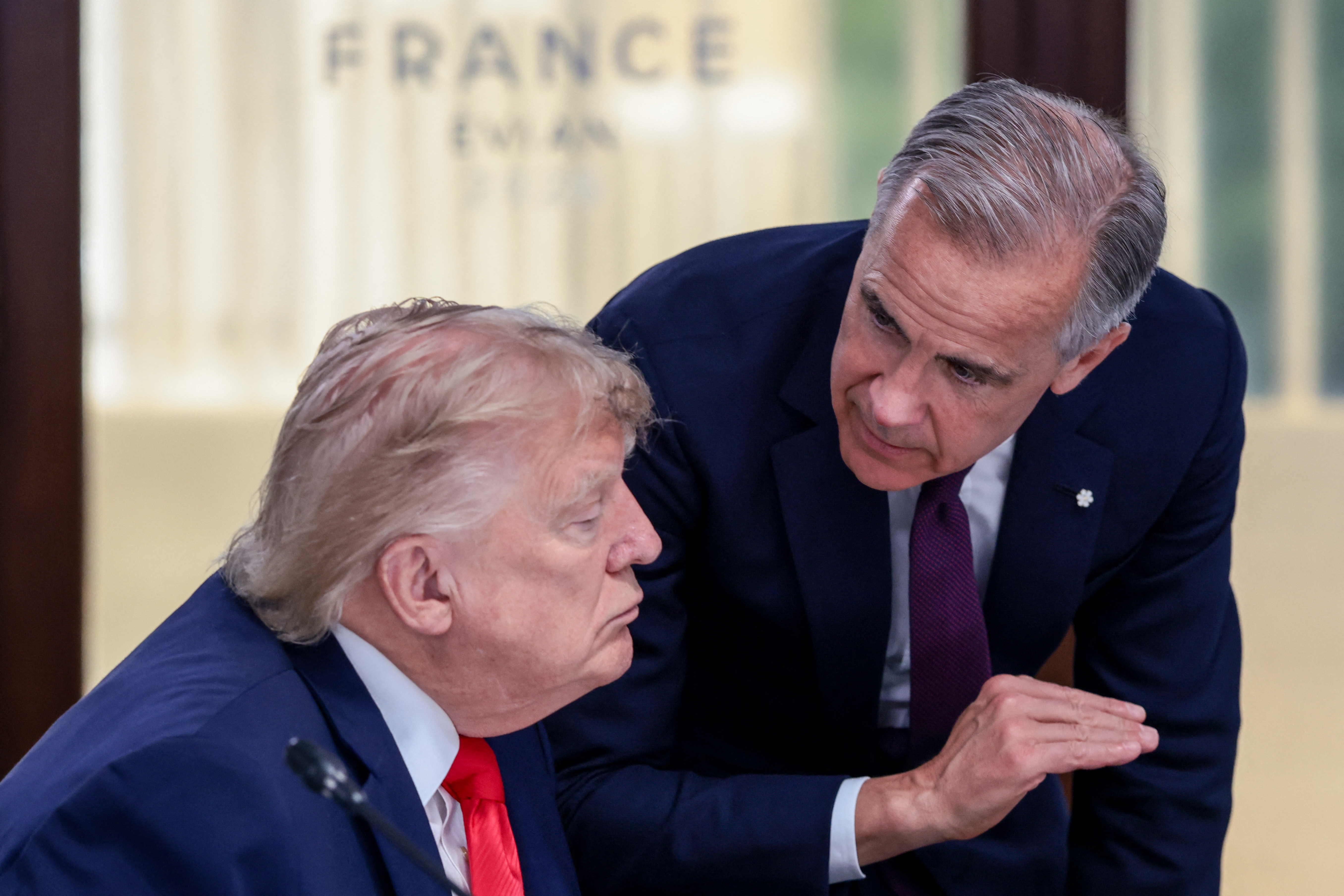
U.S. President Donald Trump and Canadian Prime Minister Mark Carney at the G7 summit, in Evian, France, on June 16, 2026. —Evelyn Hockstein—Getty Images
Canadian Prime Minister Mark Carney on Thursday warned that the United States is trying to sow discord as he urged Albertans not to vote for a separation referendum.
“The stakes are high. This referendum, it comes at the worst possible time. The world has become more dangerous and divided,” Carney said at a rally in Calgary ahead of Monday’s vote, which will see residents decide whether the oil-rich province should hold a referendum on independence. “There are some outside our borders who are working to break us, so they can own us.”
While Carney didn’t explicitly name the U.S., the remarks echoed his previous warnings of the dangers of American dominance. Carney's statement came a day after U.S. President Donald Trump revisited his ambitions to annex Canada, telling the crowd at a rally in Arizona that the country will “end up being the 51st state, because it's the only way it works.” Trump again accused Canada of treating the U.S. “very badly” and vowed he won’t allow it to happen anymore as “it’s a whole different ballgame now [that] Trump is in town.”
The U.S. and Canada remain in a contentious trade standoff after negotiations collapsed in August. Canada’s retaliatory tariffs came into effect last month, matching the economic pressure imposed by the U.S. Carney has encouraged Canadians to band together and take back their economic power by choosing Canadian products over those made in the U.S. The trade tussle comes after months of Trump repeatedly threatening Canada’s sovereignty—a move that has stoked tensions between the U.S. Administration and Canadian officials.
In light of Trump’s most recent remarks about possible annexation, Canada’s former deputy Prime Minister Chrystia Freeland said it would be dangerous to deepen or maintain close economic ties with a neighbor that “openly says they want to take you over.”
Carney admitted in an interview with the New York Times last month that he had studied the risk of a U.S. invasion, given Trump’s charged rhetoric. “I think you have a responsibility in these roles to look at extreme tail risk,” he said. “That’s just risk management. That’s not a base case, but it would be irresponsible not to [prepare].”
Amid the U.S.-Canada tensions, Carney is desperately trying to promote his “Canada Strong” strategy—one that he hopes will very much include Alberta. Polling conducted by 338Canada suggests that as of Oct. 11, 75% of Albertans would vote to remain part of Canada. But Carney’s resolve is being tested on more than one front, after the separatist Parti Québécois won Quebec's provincial election earlier this month. Incoming Premier Paul St-Pierre Plamondon has already stated his intention to hold a referendum on Quebec independence. While he has vowed not to initiate a vote so long as Trump is in office, the looming presence of a separatist movement undoubtedly complicates matters for Carney at a time when he is striving to show that Canada is strong enough to prosper without relying on the American market.
With the U.S. and Canada locked in a trade stalemate, and with annexation threats once again dominating the conversation, here’s a look at the reality Carney is facing as he deals with both domestic and international pressures.
Trump's remarks complicate Carney’s unity efforts
Trump’s accusations that Canada has taken advantage of the U.S. on matters of trade and security date back to before Carney became Prime Minister in March 2025, meaning the friction we’re currently seeing goes deeper than a simple clash between Trump and Carney. Trump would often refer to Carney's predecessor Justin Trudeau as the "governor" of the "great state of Canada."
In terms of any physical threat facing Canada, Patrick Leblond, a professor of public and international affairs at the University of Ottawa, says that Carney “put it best when he talked about tail risk” in his interview with the Times. “It’s the financial term for something that has potentially high impact, but low probability,” Leblond explains.
Trump’s economic actions and threats have proven to be far more damaging than his annexation remarks, experts note.
“He has weaponized market access to the U.S.,” says Leblond. “What we can expect is more economic pressure from the White House in the coming months. Trump and his acolytes certainly [appear to] see Canada as a small, weak country that the United States should try to squeeze further.”
The U.S. is Canada’s largest trading partner, with almost $2.6 billion worth of goods and services passing across the border daily in 2024. According to the Office for the U.S. Trade Representative, trade between the two was down 4.6% from 2024 to 2025, but still saw $872.3 billion worth of goods and services cross the border.
Still, there are concerns that any suggestion of annexation, however unlikely it may be, could damage Carney’s high-stakes domestic campaign to unite the country.
On the home front, the success of a separatist party in Quebec is another threat to the unity that Carney is striving for. However, despite the Parti Québécois' victory (they fell five seats short of securing a majority government), the desire for separatism among Quebec residents remains low—with only 31% in favor of sovereignty for the province, according to data from 338 Canada released on Oct. 11.
“If Quebec is on a path to separation or not, it would never be because they were looking for further alignment with the United States,” argues Lori Turnbull, a professor in political science at Dalhousie University. “Quebec has a variety of cultural protections in the Canadian federation. They would have none of that in the United States.”
The more immediate risk for Carney lies in Alberta, with residents preparing to vote on whether the province should hold a referendum on independence.
Carney, who was raised in Edmonton, Alberta, on Thursdayframed the referendum as an opportunity for voters to “stand up for Alberta, the heart of Canada” and “recognize that we're all responsible for each other.”
Ahead of the vote, residents express their views with signs outside their homes in Edmonton, Alberta, on Sep. 28, 2026. —John Diep—Getty Images
How Trump’s threats could also help Carney
The pressure and rhetoric from the U.S. could actually work in Carney’s favor, experts tell TIME.
“The effect of Trump's comments has been unifying,” says Turnbull. Despite discussions of independence in Alberta and Quebec, she says “there isn't widespread panic that the country is coming apart.”
In fact, research conducted by the Environics Institute for Survey Research in 2025 found that “in almost every province, the proportion of residents who are very attached to Canada is greater than the proportion who are very attached to their province.”
Between Trudeau’s resignation on Jan. 6, 2025, and a federal election in Canada months later on April 28, Carney’s Liberal Party went from 20% to 42.8% in the polls, according to CBC, with Carney’s message of defiance in the face of Trump proving to be a rallying point.
This falls in line with depleting favorable views of the U.S. among Canadians. In July, 44% of Canadians had a favorable opinion of China compared to 33% of Canadians who held the same view of the U.S., according to a Pew Research Center survey. “When China is more popular than the U.S. in a country like Canada, you have to ask yourself: ‘What's going on?’” says Leblond.
Continued annexation threats could bring Canadians even closer together. “Already, trust is very low, and [more threats] would confirm even more that the United States is [perhaps] not a trustworthy partner at this time,” Leblond argues.
Since the U.S.-Canada trade war reignited in August, Carney has seen his domestic approval rating bounce back up. On Oct. 15, it stood at 62% according to Poliwave, compared to 56% in mid-July. Carney’s resistance against American economic pressures could help his cause, particularly in possible separatist provinces.
“In August, when Carney walked out of the negotiations with the U.S., the highest levels of support for him were found in Quebec,” says Leblond. Indeed, Carney’s approval rating in Quebec grew from 76% to 80% between Aug. 17, and Sep. 7, the highest in any province, according to Liaison Strategies.
Turnbull says the support behind Carney’s decision to walk away from negotiations prompted a strong sense of “patriotism and loyalty.”
That attitude among Canadians has been reflected in the burgeoning “Buy Canadian” movement, in which consumers across the country have joined a boycott of U.S. products in an effort to feed back into the Canadian economy.
Carney strengthens international alliances to end reliance on American market
In September, European Commission president Ursula von der Leyen invited Canada to work toward becoming the bloc’s first “associate member,” in what she described as an “urgent” reimagining of partnerships.
While addressing the European Parliament as a guest of honor in Strasbourg, France, Carney insisted “Europe and Canada are stronger together” and said “Canada and the European Union can anchor our ground to hold our values while forming a protective canopy under which our citizens can thrive.”
Trump called the unique membership proposal “laughable” and has threatened economic punishments if the E.U. moves forward with von der Leyen’s plan.
Carney’s shift towards other partnerships “doesn't mean that Canada is not going to do business with the U.S., but it's no longer a preferred partner,” says Leblond, noting that Carney wants to build relations with partners that “share the same values in terms of rules-based trade and investment.”
In January, after meeting with Chinese President Xi Jinping, Carney announced a new strategic partnership with China, focused on “energy, agri-food, and trade.” Carney agreed to cut his country’s 100% tariff on Chinese electric cars in return for lower tariffs on Canadian farm products, including canola seeds, a major Canadian export.
These stronger international ties that diversify trade and security away from the U.S. are proving popular on the homefront, according to data.
According to Abacus Data, a survey conducted in September found that 49% of Canadians would support Canada joining the E.U. An Ipsos poll conducted in January, in light of Carney’s visit to China, found that 54% of Canadians also said they support stronger trade ties with China.
Katie Zacharia is exiting her job as White House Press Secretary after just five days in the position, according to a person familiar with the situation. President Donald Trump on Friday said to reporters that he told Zacharia to reconsider her role, amid reports that she had already been relieved of the job.
“I said to her honestly, if I were you, I'd reconsider,” Trump said outside of the White House, adding, “Katie, do you need this? I don’t think you need this.”
Trump said that the decision was ultimately hers, and that he would speak with Zacharia following a trip to Georgia. “I just want her to be happy,” he said.
Zacharia’s brief stint as press secretary is bound to draw comparisons to Anthony Scaramucci’s 11-day run as Trump's White House communications director in 2017. Then-White House Chief of Staff John Kelly fired Scaramucci after he had given a fiery interview to The New Yorker in which he attacked his colleagues. In Washington parlance, the tenures of prominent White House officials have since been jokingly measured in “Scaramuccis.”
Trump said that Zacharia has been treated “pretty nastily” and “very unfairly” by the media since taking over for former Press Secretary Karoline Leavitt.
“I said you should reconsider because you don't want to go through this,” he said in reference to the critical media response Zacharia received following her first press briefing on Tuesday.
Trump called Zacharia “an attorney” in his Truth Social post announcing her position, and Zacharia has described herself as a lawyer. But when asked by a reporter where she had passed the bar, Zacharia responded “when I moved to China.” She later said that she had misheard the question. Zacharia then acknowledged while speaking on Fox that she had failed the bar exam.
"You went to Pepperdine law school but you did not pass the bar exam, correct?" Fox host Sean Hannity asked Zacharia on Thursday.
"Correct," Zacharia replied.
When asked whether she regretted never having told the White House that she failed the bar, Zacharia responded “those questions weren’t asked,” and “I’m being hired as White House press secretary, not White House counsel.”
Zacharia previously worked as a general counsel at a the conservative non-profit Fix California. She also has experience working as a communications adviser at Trump Media and Technology Group, which houses the President’s social media platform Truth Social. She previously worked as a spokesperson for former Homeland Security Secretary Kristi Noem, and is a regular on conservative media outlets like Fox News and Newsmax.
Zacharia received a wave of criticism following her first press briefing, which lasted just 14 minutes and during which she only took questions from three reporters.
Leavitt, the youngest press secretary in White House history, stepped down in August after returning from maternity leave. She recently joined Fox News as an on-air contributor.
The JPMorgan Chase data center in Orangeburg, New York, on October 14, 2026. | Kena Betancur/Getty Images
Lately, AI data centers are public enemy No. 1. The concerns are legion: how much water and electricity they consume, the noise they generate, the sprawling buildings they bring to communities, and the technology they’re powering that may or may not take all of our jobs and usher in the robot apocalypse.
Earlier this year, Gallup found that 71 percent of Americans oppose building data centers that support AI in their communities. And the backlash is bipartisan: Majorities of Democrats, Republicans, and independents opposed local construction.
Even in Texas, where data center development has been booming, Republican Gov. Greg Abbott has hit the brakes. In September, he directed state regulators to halt permits for data centers pending audits examining their effects on the power grid and water resources.
But while many data center projects have run aground, others are still getting built — and the companies behind them are employing experts like Nicole Thomas to smooth the way.
Thomas is the senior vice president of media and community engagement at JSA, a marketing and public relations firm that represents data center companies. She spoke with Today, Explained co-host Sean Rameswaram about how the industry is responding to public opposition — and why she argues that these facilities can still be good neighbors.
Below is an excerpt of their conversation, edited for length and clarity. There’s much more in the full podcast, so listen to Today, Explained wherever you get podcasts, including Apple Podcasts, Pandora, and Spotify.
You’ve been at this for 21 years. Obviously, 21 years ago, data centers were not the hot-button issue they are today. When did you notice the shift?
I’d say about two years ago. I came into this industry myself about four and a half years ago. I come from a state transportation background where community engagement is just paramount. When you’re putting a new traffic intersection up, they expect you to interact with the public.
When I got to this industry, I said, “Oh, what’s your community engagement like?” And they said, “We don’t even have any community engagements in this industry.” And they weren’t wrong. Because 21 years ago, [data centers] were just like infrastructure. It was like building a warehouse for your computers. And so it was very similar to the way that you would build a Costco.
You would just go in, request a zoning permit, the zoning board would say, “Yeah, that works. Stamp, boom.” And you build your data center. And as a matter of fact, it was very secretive before, because data, and having that data in the wrong hands, has a lot of [cybersecurity] implications. About two years ago is when we started noticing the mainstream journalists coming around asking questions about data centers. And that’s, to me, when it started.
It still feels secretive, I think, to a lot of people, and that’s why people are mad. If you read about this data center that was proposed in Utah by Mr. Wonderful, Kevin O’Leary, it caught a lot of people off guard. Seventy percent of Americans, at the moment, do not want them in their backyards. How do you go about trying to change that 70 percent’s minds?
First and foremost, I think education is really important. And so one of the things that we did notice very early on because of the previously secretive nature of data centers, there wasn’t a lot of education out there about what they even are. And so that’s something we need to change. We need to make the connection between [phones] and data centers so that people understand what a data center means to their life on a daily basis.
Every app on your cellphone requires a data center to save your information in there. When you put your password into anything, you are interacting with a data center, which will verify your password and then let you into that app. Not to mention all of the information about you that you store in that app is then stored in a data center so that it can be recalled at any time.
We could not be having this call without digital infrastructure. It doesn’t work that way. We can’t have email without digital infrastructure. And that stat about 70 percent of people not wanting the data center in their backyard — I’d be interested in seeing the stat of how many people actually live near a data center and don’t realize it.
Because there are nondescript data centers doing work quietly in your neighborhood that have been there for decades and you don’t even know it. And so in some ways I feel, and I think the industry does as a whole, but I won’t speak for them, that the pushback on data centers is somewhat related to the pushback on AI, because people can’t control AI.
You even have Sam Altman telling us that AI will destroy society. So you have this concern about AI and you don’t know how to control it, but you can push back on data centers. And so it becomes the physical manifestation of AI are these data centers that people are trying to get overturned or get to not be in their neighborhoods.
It’s understandable. I’m a citizen too. You’re a citizen, and if things come into my neighborhood, I want to know about them. I have questions. There’s a big data center that just came to my community not long ago and their community engagement was horrible, absolutely horrible.
Can I ask where you are?
I’m in Indiana and I won’t say which hyperscaler it is, but a hyperscaler came into — I would say, not my neighborhood, into my city. They’re definitely not in my backyard, but they’re in my city. And so we took them to task because their community engagement was basically non-existent.
Wait, you work in data center PR, but you took a data center in your community to task for not being transparent enough?
Yeah, absolutely.
Which side are you on?
I’m on the side of responsible development.
We’ve all kind of accepted that we need a cloud for X, Y, and Z. And that it’s worth it so I can take lots of photos. I think everyone’s cool with that.
But the issue here is that people aren’t necessarily cool with AI, but we’re barreling forward anyway. How do you separate this essential need we have from AI, which people don’t necessarily feel is essential to their lives?
I think it goes back to education. Educating consumers on the difference between data centers: a small data center, a medium data center, a large data center. Educating them on why data centers exist and how they interact with data centers on a daily basis multiple times.
I hear you. But again, I feel like the issue here is not the data centers my cellphone needs, but instead is the data centers these AI companies need and these AI companies who the public doesn’t necessarily trust because they keep telling us that they’re going to kill us, and who the public is wary of because they don’t want their jobs being replaced by AI.
There’s all sorts of reasons that people are skeptical of new technology. So how do you specifically respond to that fear and to those people?
I think it’s, again, understanding the actual data center that’s being built in your community. Is it a 5-megawatt data center? That’s never going to house AI. That’s not enough power to house AI. Is it a one-gigawatt data center like Mr. Wonderful in Utah? That’s different.
But I think that AI is probably going to be something that is a lightning rod in the American public for a very long time. There are going to be people who are going to be anti-AI and pro-AI, and there’s going to be some people in the middle. I think it’s just, again, for us, it’s education, educating the community.
Have you ever been part of a project that a community rejected and you guys just packed up and said, “Okay, we’ll go find another community?”
Yeah. We have some clients who have had pushback from residents and they have said, “Let’s do a one-on-one community meeting where people can come in and ask us questions.”
And after the questions were answered, the community leaves and says, “Okay, this isn’t as bad as I thought it was.” Or we have a community that says, “No, we now have a moratorium and we’re pushing all data centers away.“
Sometimes they’ll wait for their client — my client is a developer and they’ve got clients that they’re developing for. If that client will wait, then maybe it is something that we’ll try to work out with the community. But oftentimes, they’ll just say, there’s communities who are literally raising their hand saying, “We’ll take a data center. We’ll take one. We’ll take two. Bring it here.”
So there are communities who recognize the benefits of data centers. And there are going to be other communities who say, “No, we don’t want this.” And then in five, six, eight years, they’re going to be like, “Wow, that county has a lot of tax dollars. They have a lot of really cool stuff. Why don’t we have that?” And the answer will be data centers.
I don’t think this ends anytime soon though, right? I counsel my clients that we could still be here in three to five years, really trying to help the American public understand the benefit of data centers. But it’s going to take a lot of education across the industry, and once we get those seeds planted, I’m a firm believer that they grow into educated community members who make educated decisions to bring community-minded data centers to their community.
Protest signs seen at protect Medicaid lights up Capitol amid budget showdown, on May 7, 2025, in Washington, DC. | Leigh Vogel/Getty Images for Caring Across Generations
Twelve years ago, Vermont Democrats tried to make their state the first in the nation to have a single-payer government-financed healthcare system — a bold experiment to push the limits of American health coverage when Obamacare was just being launched.
Their plan failed, and rebooting it became politically impossible, even in Vermont: The Democrats lost the governorship to Republican Phil Scott for what turned out to be a decade.
This year, that could finally change. A progressive political newcomer named Amanda Janoo is taking on Scott in what polls show is a tight governor’s race.
And if she wins, the state could be poised to try a whole new national experiment: One of Janoo’s central campaign promises is to create a pioneering health system where the state pays the full tab for primary and preventive care, while leaving the rest to the existing system.
Key takeaways
Amanda Janoo, the Democratic nominee for governor of Vermont, wants to move primary and preventive healthcare to a single-payer system — where the state would pay providers for such care, make it free for patients, and cut insurers out.
Previous attempts to pass or enact full single-payer systems have failed at the state level, including in Vermont in 2014.
Janoo is trying to focus first on this one relatively smaller slice of the health system, but hopes it could be a starting point to full single-payer reform eventually.
Yet even this more limited reform faces difficult political and practical challenges.
Janoo’s candidacy is an example of the policy experiments that are becoming possible nationwide in a projected “blue wave” year, when Democrats could sweep into power in a number of states. But in the healthcare universe, her plan is also an example of how even progressive policy idealists are trying to learn from past failures and focus on what they think can actually be achieved.
Compared to the sweeping ambition of Vermont’s 2014 effort, or Bernie Sanders’s signature “Medicare-for-all” idea, Janoo’s proposal for single-payer has very specific limits. Under Janoo’s proposal for “universal primary and preventive care” (she typically avoids the term “single-payer”), the state government would pay for Vermonters seeing primary care providers such as doctors and nurse practitioners. This government coverage would be universal and free for patients, and insurance companies would be cut out.
However, other parts of the health system — such as hospitals, specialists, and prescription drug companies — would remain under the existing insurance system, for now.
Every effort so far to enact full single-payer at the state level has failed — even in blue states, bills and ballot initiatives have regularly gone down to defeat. Vermont’s previous single-payer experiment made it the furthest — it was signed into law but abandoned before being implemented, when the governor concluded it was unworkable. Wherever it’s gained steam, politicians and voters have blanched at the high costs of moving their health systems onto state budgets, and the high taxes that would be necessary to fund them.
Now, Janoo is making an attempt to refurbish single-payer as something more achievable, by cutting off a smaller slice of it.
“I think it’s clear at this point that a profit-oriented healthcare system is a terrible idea,” Janoo told me in an interview on Monday. But after assessing that the state budget made it “unrealistic” to do single-payer immediately, she concluded, “we could do universal primary and preventive care,” financed by a tax on the wealthiest.
Indeed, single-payer for primary care seems more achievable precisely because primary care is a relatively less expensive part of the healthcare system. But Janoo hopes it will pay major dividends — that better preventive care will improve Vermonters’ health, reducing costs elsewhere in the system by, for instance, making some hospital visits unnecessary.
In speaking to health policy experts about this idea, I heard much sympathy for the goal of universal primary care, but many questions about the details. Would Janoo’s plan be sufficient to bring more primary care doctors to Vermont — and, not unrelatedly, would it pay them more? Would her hoped-for cost savings from preventive care actually materialize? Is picking up the tab for a relatively less expensive part of the healthcare system the best use of sparse state funding?
These questions are becoming national ones, as healthcare gains traction as a political issue again. It isn’t just Vermont where primary care reform ideas are gaining steam: Democrats in Minnesota, Washington state, and elsewhere have discussed them. “There is growing interest in a number of states across the country in doing a universal primary care for all program,” Kevin Grumbach, a family physician and a professor of family and community medicine at the University of California San Francisco, told me. Even Scott, Janoo’s opponent, signed a law calling for a study of universal primary care.
One dividing line emerging, though, is whether to keep insurers involved, or to clear them out with a single-payer system, as Janoo wants. Insurers are unpopular with the public, but they can be a formidable political opponent when they argue that the benefits voters currently enjoy might be lost. Scott has said that the idea of universal primary care is appealing — but that if universal is “just code for single payer, I’m not interested. We’ve already been through that.”
Yet Janoo is hoping that single-payer for primary care will be a stepping stone — a trial run for eventually making the rest of the state’s health system single-payer down the road.
“I think about this often,” Janoo told me. “How do you build the new system as you transition the old — or hospice the old?”
Amanda Janoo is tired of “corporate neoliberal bullshit”
Janoo has long been an unorthodox economic policy thinker. Her rise is part of a broader trend in which progressives and leftists are winning primaries and gaining influence in the Democratic Party — but she doesn’t fit the prototype of the democratic socialist candidates in New York City, Colorado, and elsewhere who’ve gotten much attention this year. Instead, she comes from a different strand of the left, a movement based on a dissident strain of economics and openly skeptical of the benefits of economic growth.
Dating back to when she graduated from college in 2010, in the aftermath of the financial crisis, she was part of a younger cohort rebelling against what seemed the glaring failures of the economic establishment. “The one thing coming out of university I was clear on was that neoliberalism was the worst,” Janoo said on a podcast last year. “This whole idea that governments should just take a hands-off approach to the economy and trust in sort of the disciplinary powers of the global free market to lead them to infinite growth seemed highly problematic and very anti-democratic.”
So for graduate school, Janoo attended Cambridge to study development economics under the “heterodox” economist Ha-Joon Chang. She then spent several years working abroad in international development for the United Nations and other organizations, before moving back to Vermont and working as an economic policy consultant.
In recent years, Janoo became deeply involved with the “well-being economy” movement: an international group of advocates, academics, and experts who criticize what they deem modern capitalism’s obsession with economic growth, and say the “well-being” of humans and the environment should be prioritized instead. They overlap with the “degrowth” movement, which outright argues economic growth should be reduced; last year, Janoo led a workshop at a DeGrowth Institute event on “Degrowth Policy Design.”
Trump’s return to power horrified Janoo. “I’m feeling angry about the rise of fascism and the growing threat of world war, because I feel like we don’t have time for this shit,” she said in a speech at an environmental event last year. ”The planet is on fire and ecosystems are collapsing, and that should really be the focus of all of our attention.” But, she said, “I believe I was born in this moment of history for a reason” and vowed “to fight for democracy — for life.”
So Janoo decided to jump in the race for governor of Vermont. While she is not running on a degrowth platform, her campaign is deeply informed by aspects of the movement’s thought: skepticism about growth’s benefits, a sense that untrammeled capitalism is leading the world to disaster, and that localism provides a better way. For instance, candidates for governor typically pledge that they’d help bring business investment in, but Janoo said in a July debate: “A lot of the problems we’re facing is because we focus so much on attracting external business.”
“Our economy is not super-diversified, and it is not really centered in the most essential kinds of goods and services you want to make sure people have access to no matter what happens — because honestly, things are bad now and they’re going to get worse,” Janoo told me. “I feel a little bit like a collective prepper right now. My motto is, protect what we love, produce what we need.”
In the Democratic primary, Janoo’s opponent, Aly Richards, had closer ties to the party establishment and led in fundraising. But Janoo ran as a progressive outsider; she promised to advance a “more economically populist vision” instead of “corporate neoliberal bullshit.” Her health plan became a point of contrast with Richards, who said she wouldn’t run on “magical thinking,” and that she wanted a version of universal primary care that would keep insurance companies involved. Janoo won the primary by 2.5 percentage points.
Now, she’s facing Governor Scott, who’s long been viewed as politically untouchable in the state — in 2024, he won his fifth two-year term by a margin of 52 points. But polls show a much closer race this time around, and Janoo could have a national blue wave at her back. If that wave helps carry her into the governor’s mansion. And if she makes it there, Vermont will have its first Democratic trifecta in a decade — and with it, the opportunity for major progressive policy change.
Amanda Janoo’s plan: Single-payer for primary care
Advocates for primary care reform argue that it should be at the top of Democrats’ agenda, in Vermont and elsewhere, because the system is in crisis.
Primary care providers are overwhelmed and underfunded, they say — and, as a result, there aren’t enough. Grumbach, the family physician and UCSF professor, said “the workload, the lack of resources, and the gap in compensation” — as compared to more highly paid specialists — “has made it very hard to recruit people coming out of medical school to want to be family doctors like me.”
Patients, then, are having trouble finding doctors they like, and aren’t getting sufficient access to preventive care that could help them be healthier. “The emergency rooms are functioning and doing a lot of the work that normally primary care would do,” Janoo told me. “People are waiting a really long time to see anyone, and so often health issues that could have been caught sooner become more serious and dangerous.”
Finally, both providers and patients complain that insurance companies make the preceding problems worse, by adding administrative burdens and bureaucratic hassle.
So what would Janoo’s plan do?
First, her plan would guarantee free, government-paid primary and preventive healthcare for all in the state, by cutting insurers out of that part of the system.
Second, she wants to phase out the “fee-for-service” model of care, where primary care providers are paid based on specific services. She’s suggested, instead, either government-paid annual salaries, or per-patient per-month payments.
Third, she wants to try and try and make sure there are more primary care providers in the state, via more spending. “We would need some relocation incentives, so maybe $100 grand if you want to move here, or a student loan repayment program,” she told me. “My hope would also be that we could be a place for foreign-trained medical professionals to come here and be safe and accepted and to bring some cultural diversity,” she added.
As for how it would be paid for, Janoo proposes an income tax increase on the wealthiest Vermonters that, she said, would be comparable to the tax break they got in President Trump’s One Big Beautiful Bill Act last year. Though she hasn’t settled on a final amount, she hopes these new taxes would raise hundreds of millions of dollars.
Would Janoo’s plan work in practice?
In speaking with health policy experts both inside and outside Vermont, though, I heard various questions and doubts about Janoo’s plan.
Some of the problems mix the practical and political. For instance, under this plan, primary care visits would be free, but tests such as MRIs would likely still require the existing insurance system, as would most prescription drugs. Janoo acknowledged to me that deciding how many things the government should pay for would “always be a challenge,” but said her first priority was access to getting people at least some healthcare.
There are also questions about whether this primary spending is really targeted at patients’ most urgent problems. Erasing the copay for your doctor visit might be nice, but those copays weren’t driving people into medical bankruptcy. Janoo’s reform plan leaves the bulk of hefty health spending from hospitals and treatments for very sick people untouched.
The core challenge to Janoo’s reform will be the one that has dogged single-payer reform attempts everywhere: money.
Other questions are about whether Janoo’s hoped-for benefits from better preventive care — she’s said the state could save as much as $300 million a year — will materialize.
“There’s no question that better access to primary and preventive care makes people healthier in the end,” Larry Levitt, executive vice president of the health policy nonprofit KFF, told me. “But advocates have long tried to sell prevention as saving money. I think it’s more likely that it costs money, but keeps people healthier.” One reason for this, he said, is that better preventive care could help identify more underlying illnesses and conditions in patients, and spur more spending to try and address them.
The shift to a salaried model for providers could bring other practical challenges. Though Janoo hopes that ditching fee-for-service will free up providers to see more patients, others suspect a guaranteed salary might incentivize them to see fewer, and wonder what role the government would play in trying to hold such providers accountable.
Finally, I also heard some disconnect between what providers said they wanted, and what Janoo thought they wanted. When we talked, she told me her impression was that primary care providers were most eager for changes in their work environment. “I’ve asked them, ‘If you could get paid a good annual salary — like, average for the nation — and you didn’t have to deal with insurance and the fee-for-service structure, would you do that?’ They say, ‘Absolutely.’”
Yet Grumbach told me that, for the primary care system, “Problem number one is not enough money, problem two is not enough money, and problem three is not enough money.” In his telling, it’s more money that’s the real key to incentivize more new doctors to practice primary care, and help pay other staff and health workers who could actually deliver good preventive care.
If so, the core challenge to Janoo’s reform will be the one that has dogged single-payer reform attempts everywhere: money.
If the government takes on the responsibility of paying primary care providers and setting salaries for them, providers will want those salaries to be high. If they aren’t high enough, the shortfall in primary care providers will worsen. But the higher such salaries are, the higher the taxes the state would need to raise to pay them. Essentially, taxpayers would be asked to shore up doctors’ salaries to keep them in the state — turning the healthcare argument from one kind of difficult political issue to another.
Getting the balance right would be a challenge for the government, with much at stake. But Janoo says her background in industrial policy has convinced her that it’s possible. Furthermore, she hopes, it will be just a starting point for the full single-payer system she still thinks is urgently needed.
“My hope is, when I’m governor, that I can start to work with some of our neighboring states,” Janoo said. “Because if we could create a New England-wide system, we could move to universal healthcare really quickly. “I think it’s a moment where people recognize we need a universal healthcare system.”
And, she added, “If we had done it previously, it would be much cheaper than it is now.”
Rep. Ilhan Omar (D-MN) during a news conference at the US Capitol on February 24, 2026. | Daniel Heuer/Bloomberg via Getty Images
This story appeared in The Logoff, a daily newsletter that helps you stay informed about the Trump administration without letting political news take over your life. Subscribe here.
Welcome to The Logoff: Donald Trump wants to deport a member of Congress.
What’s happening? On Monday, Homeland Security officers raided the Washington, DC, home of US Rep. Ilhan Omar (D-MN) in an investigation reportedly tied to immigration paperwork filled out by her father when she was a minor.
That was, at the time, more than enough cause for alarm. Trump’s animosity toward Omar, who is Somali-American and an outspoken critic of the administration, is well-known, and the raid is an extraordinary violation of the Justice Department’s usual rule to avoid taking visible action around politically sensitive cases within 60 days of an election.
On Wednesday evening, however, we learned more about the raid from the Wall Street Journal. The Omar investigation, the Journal reported, is explicitly aimed at stripping Omar of her citizenship — and thus her ability to hold office — and deporting her.
How would they do that? Omar came to the US as a refugee when she was 12 and became a US citizen when she was 17. The Trump administration’s investigation is said to focus on whether she or her family misrecorded her age in order to more easily gain citizenship.
The government cannot unilaterally denaturalize a citizen, however; it would have to ask a court to do so.
What’s the context? Historically, it’s rare for the US to strip citizenship from naturalized US citizens. But doing so at volume has been a major, if less visible, priority for the second Trump administration.
Why does this matter? Trump’s campaign to bend the traditionally nonpartisan DOJ into a tool to punish and harass his enemies has been one of the major stories of his second term.
Even if it never advances beyond Monday’s raid, an investigation targeting Omar’s citizenship with the eventual goal of deporting her from the US represents a new and even more dangerous evolution of that effort — and it threatens to move the US to a far darker place, where citizenship and the rights it guarantees are predicated on the president’s goodwill.
And with that, it’s time to log off…
Hi readers — if you’ll allow me to depart a little from my normal approach to this section, I have a story about politics to share. It’s not, however, about the politics we’re currently dealing with, but about what could be: Democrats’ plan for a quietly ambitious “Project 2029” should they win the White House in 2028. You can read it with a gift link here.
Alternatively, if you’d prefer to just log off, here’s an adorable snow leopard cub with massive paws. Thanks for reading, have a great evening, and we’ll see you tomorrow!
As the midterm campaign enters its home stretch, Americans’ expenses are rising — and the GOP’s prospects are consequently dimming.
Last month, consumer prices were 3.7 percent higher than they had been one year earlier, according to a Consumer Price Index report released on Wednesday. That represented an acceleration in the inflation rate, one driven largely by skyrocketing fuel prices: Gasoline was 9.1 percent more expensive in September than it had been in August. As a result, America’s average real wage has fallen by 44 cents since January.
In less than three weeks, Americans will head to the polls to decide which party controls Congress, along with a slew of state and local offices. As we count down to that momentous and potentially messy day, this newsletter is partnering with our colleague Astead Herndon and Vox’s The Midterms, Actually team for weekly editions on the biggest issues shaping the midterms. We’re breaking down one issue each week and suggesting further reading and races to watch in November.
Last week, we tackledthe data center backlash. And this week, we’re digging into affordability.
These upward trends in prices aren’t lost on voters. In a recent Pew Research survey, just 21 percent of Americans said economic conditions were “excellent” or “good” — while 65 percent said that Trump’s policies had made the economy worse.
The high cost of living is weighing on Republican candidates in all battleground races. Maine provides just one example of how potent the issue could prove on Election Day.
From one angle, the state’s Senate race might seem like a gimme for Democrats. Kamala Harris won Maine by nearly 7 points in 2024. Thus, in 2026 — when Democrats are poised to win in a national landslide — one might expect the party to easily triumph.
But Republican incumbent Susan Collins is an unusually formidable foe. The race has been a dead heat, with Democratic nominee Troy Jackson leading by just 2 points in a recent Suffolk University poll.
Fortunately for Jackson, Mainers’ energy bills are expected to soar in the campaign’s final weeks, plausibly increasing voters’ appetite for change in the process.
Maine is America’s second coldest state and unusually reliant on oil for home heat. As autumn advances, its residents will use more heating oil, thereby driving up both their personal bills and market prices. Thanks to the global energy crunch, a gallon of such fuel is already nearly twice as expensive as it was this time last year.
Jackson has been hitting Collins on the issue relentlessly. That could put a chill in Collins’s reelection odds — and thus, the GOP’s hopes of retaining Senate control.
➨ Other races to watch:
Similar dynamics are playing out in perennially icy Alaska, where Democratic Senate candidate Mary Peltola has hammered incumbent Republican Dan Sullivan for his complicity in sky-high diesel prices, which many Alaskans use for home heat.
In Ohio’s Senate race, Democrat Sherrod Brown has tried to pin rising electricity bills on Republican Sen. Jon Husted, due to his support for data center development.
And in Texas, Democratic Senate candidate James Talarico has attacked his Republican rival, state Attorney General Ken Paxton, for supporting “this disastrous war in Iran that’s driving up our costs.”
In other news
A brief ceasefire ends: Ukrainian drones attacked a Russian oil refinery early Thursday, days after Trump demanded both Russia and Ukraine halt such attacks.
Execution livestream canceled: Trump canceled a plan to livestream the execution of Fort Hood shooter Nidal Malik Hasan by firing squad.
On the podcast: A recent rash of violence between Saudi Arabia and Yemen’s Houthis threatens to destabilize the region — and make the Iran war much larger. Listen to the whole thing here.
One link for later
Rethink confidence. Research shows confidence is good for your job and good for your romantic prospects. Unsurprisingly, then, a whole industry has sprung up teaching people to be more confident. One writer signed up to work with a confidence coach for the first time, and ended up doubting that her self-doubt was all that bad.
Today’s trivia: What is the answer to the ultimate question of life, the universe, and everything in The Hitchhiker’s Guide to the Galaxy? (You can find this and other brain puzzles in Vox’s daily crossword. Look for the answer in tomorrow’s edition.)
Yesterday’s trivia: We asked which percussion instrument is famously played by Mississippi State University fans at home football games. That would be the cowbell.
President Donald Trump speaks on stage at the Butler-Vandalia Student Activity Center during a campaign rally on October 3, 2026, in Vandalia, Ohio. | Roberto Schmidt/Getty Images
Welcome to The Midterms, Actually. Every week I’ll be writing about two things: one big idea or trend I see forming across the 2026 primaries, and one thing I’m hearing from a voice on the ground. Let’s get into it.
One big idea: How much can Democrats slow down Trump?
A tricky thing to communicate about the upcoming midterms is that, at the federal level, the impact may not be what’s expected, at least when it comes to slowing President Donald Trump’s agenda.
Hear me out. Say the blue wave predicted by most polling materializes on November 3, and Democrats take the House and even squeak out a slim Senate majority. What happens next? Does that stop Trump from executing his agenda? Does the White House moderate its message in response to an electoral backlash?
The evidence suggests no.
Because the backlash is real, the political incentives aren’t.
Let me explain: The numbers do look rough for Trump. Pew had his approval rating at 30 percent in a survey conducted September 28 to October 4, the lowest of his second term, with Democrats up eight on the generic House ballot. Reuters/Ipsos had him at 32 percent in early October. Polling averages are a bit higher, roughly 37 percent to 39 percent depending on the aggregator. Ballotpedia’s September average put Democrats at 50 percent on the generic ballot to Republicans’ 43 percent.
But none of that is moving him. Trump is fundamentally shameless, untethered to traditional political incentives, and increasingly unhinged in his second term. He initiated a war with Iran that quite literally no one wanted. He’s plowing ahead with renewed mass deportation efforts even as Republicans urge him to abort the mission. He’s more unpopular by the month, and more consumed by vanity projects in Washington: the White House ballroom, a federal takeover of a DC golf course, whatever’s happening at the reflecting pool.
More importantly, he’s been quietly preparing for this moment of backlash, legally and politically. If there’s one theme of Trump’s second term, beyond the promises of retribution, it’s his drive to grow executive power to the point where he’s insulated from political consequences. And the courts have largely backed him.
Let’s run the tape
The legacy of Elon Musk’s Department of Government Efficiency was less about finding waste, fraud, and abuse than about asserting presidential power over the federal bureaucracy. Trump has brought independent agencies to heel, firing members of the National Labor Relations Board and the Federal Trade Commission. In Trump v. Slaughter, the Supreme Court sided with him 6-3, overturning the 90-year-old Humphrey’s Executor precedent that had limited when presidents could remove agency heads. (The one notable exception: The Court refused, 5-4, to let him remove Fed governor Lisa Cook for now.)
His immigration push included federalizing National Guard troops for domestic purposes. He’s pursued unilateral military action that breaks precedent, like the Caribbean boat strikes on suspected drug smugglers. And he’s picked another fight with Congress that’s headed to court, unilaterally withholding roughly $800 million in congressionally approved funds from 11 programs supporting refugees and asylum-seekers, minority business development, housing counseling, and more.
To be clear, I don’t believe this anti-democratic throughline is happenstance. Trump has systematically used his first two years back in office to grow the power of the presidency and find ways to execute his agenda without Congress, as he did with his many tariffs — which he also claims, wrongly, that he can use to personally authorize $5,000 checks. His MAGA base has always believed the ends justify the means, but this White House has gone a step further, making clear it won’t be constrained by pesky things like federal law, separation of powers, and checks and balances. More explicitly, it openly subscribes to the “unitary executive” theory advanced in Project 2025, which argues, in essence, that the president has total control over the executive branch, including agencies like the FBI and Justice Department that have traditionally exercised some independence.
Don’t believe me? Here’s Trump at a Turning Point conference in 2019: “Then I have an Article II, where I have the right to do whatever I want as president.” Or early in his second term: “He who saves his Country does not violate any Law.”
Stephen Miller said the quiet part out loud last year, too. In an interview on CNN’s News Central, he froze after asserting that the president has “plenary authority,” meaning Trump’s power is unreviewable and unquestioned.
And here’s a line from Project 2025, which basically foretold our current constitutional crisis: The next Republican White House “must take seriously the duty to protect the powers and privileges of the President from encroachments by Congress, the judiciary, and the administrative components of departments and agencies.”
Is that how democracy works?
So what does that mean for the midterms?
Of course, it’s tricky to be predictive. But when I hear Democrats say a new congressional majority will hold Trump accountable, I wonder if they should qualify those promises with a reality check.
No blue wave can overcome the structural realities of gerrymandering, which has collapsed the number of competitive districts and disincentivized compromise. Cook Political Report found that mid-decade redistricting cut the number of competitive House seats from 87 to 77, meaning Democrats now need to win 57 of those 77 to take the chamber, up from 59 of 87 under the old lines. Cook projected Republicans gaining roughly eight seats from the redraws, Democrats two. Cook’s David Wasserman has noted that fewer than 5 percent of Americans are living in the districts that will truly decide House control. Control of the House is still up for grabs, but the narrower playing field makes sweeping change much harder.
No wave can overcome conservative control of the courts, which has only grown in Trump’s second term. And most crucially, a wave matters less to a White House that thinks in such absolute terms, and sees Congress as something to be overcome, not worked with.
In a typical administration, all the conditions for Trump’s last two years would point toward de-escalation. The public has fallen out of love with the administration’s priorities, he won’t be on the ballot in 2028, and Republicans would theoretically be freer to chart their own course.
But as Trump has proven time and again, there’s no guarantee those rules apply to him, or to this version of the GOP. If anything, the 2024 presidential primary showed that Republicans are more likely to rally around Trump when they feel he’s being targeted by liberal Democrats.
That doesn’t mean the midterms don’t matter
Far from it. As we explored on America, Actually last week, there are important state and local races that will determine Americans’ access to healthcare, abortion rights, and more. The results will shape how each party approaches 2028. And a Democratic-led House or Senate could certainly make Trump’s life harder, particularly through investigations or impeachment efforts or by blocking cabinet picks and judicial nominees.
Trump will go down fighting to make Project 2025 our reality, and no matter what happens in November, the first two years were just the start.
But the question I get most often on the road is: Will November stop Trump’s agenda? To that, I think it’s important to be skeptical.
Politically, Trump is unlikely to exit stage left gracefully, and will likely hog the spotlight even as the GOP kicks off its primary to replace him. More importantly, he’s spent two years showing his hand, prioritizing an all-powerful executive branch that can thumb its nose at anyone who interferes.
The lame-duck stretch of a presidency is typically its sleepiest, as the administration focuses on limiting damage to its legacy and setting up a smooth succession. With Trump, I expect the opposite. He’ll go down fighting to make Project 2025 our reality, and no matter what happens in November, the first two years were just the start.
One thing I’m hearing
This week, we talked to Estefanía Pinto Ruiz, a democracy‚ immigration, and rural communities reporter for Enlace Latino NC. Considering how central Latino voters are to this year’s midterm elections, I wanted to ask her about her coverage of that community in North Carolina, an important battleground state.
You reported on Latino voters’ exposure to political misinformation in Spanish. What did you learn about how language and platforms shape the information voters encounter?
One key lesson I learned from my reporting is that language and other media-related factors affect access to and understanding of political information․
A survey conducted by Marisa Abrajano‚ a political science professor at the University of California San Diego‚ found that Latinos who got news from Spanish-language social media were 11 percentage points more likely to believe political falsehoods in the survey than Latinos who got news from English-language social media․
But a major distinction is that the research found a correlation but not a causal link between the two behaviors․ Reading news in Spanish doesn’t mean people are more likely to be exposed to misinformation․
Another important takeaway is the role of social media and video sites like WhatsApp and YouTube․ Many Latino adults rely on these sites along with or in place of Spanish-language media sources for political news․ News they receive on WhatsApp from family and friends can shape their views of information from other sources․
Your newsroom has asked readers to share election information they’re unsure about.What questions or claims are coming in, and what do they reveal about the confusionvoters are facing?
Oftentimes people are unsure about the basic mechanism of voting: where they are supposed to vote, what their ballot will look like, or what happens if they encounter an issue at the polls. The confusion can also often come from information shared by official sources. For example, we’ve covered voters who received letters from the State Board of Elections asking them to review their registration information and worried about what that meant for their right to vote. We’ve also reported on allegations of misinformation during voter registration drives, including cases in which canvassers were falsely presented as election officials.
Beyond those stories, what are you hearing locally about the midterms that you think the national political conversation is missing?
First, the top issue is the cost of living: groceries, rent, utilities, and gas. Immigration enforcement comes close behind, but voters hold both worries at once, and they don’t vote as a monolithic bloc. Conservative and progressive groups here both say voters judge candidates on tangible outcomes, not party loyalty.
Second, this electorate is young, and that youth is often mistaken for apathy. Roughly a third of eligible Latino voters in North Carolina are under 25, and the median age is 35, compared with 48 for the state’s electorate overall. In my reporting at Enlace Latino NC, I see many first-generation citizens whose parents stayed away from US politics because of experiences with corruption or violence in their home countries. Emanuel Ramirez, 20, an NC State student, said his father fled a military coup in Guatemala and his mother violence in Colombia, and that his parents avoided US politics because they knew how dangerous political involvement could be. Emanuel taught himself the process and pre-registered at 16. Grassroots groups are using peer-to-peer outreach, often in Spanglish, to make voting less intimidating for families navigating it for the first time.
Third, national attention tends to center on federal policy, but state and local decisions are directly shaping how this election is run. Voters and advocates tell us that changing rules can create real hurdles, especially for first-time voters. Wake County replaced the long-standing Talley Student Union polling site at NC State with the Business Services Center as part of a record 18 early voting sites. While officials say they have expanded access countywide, students note that far more people voted early at Talley in 2020 and 2024 than at the replacement site.
Meanwhile, state election guidelines for processing mail-in ballots have tightened: Mail-in ballots will not be counted if the inner envelope is unsealed or signatures do not match, among other changes. Additionally, the State Board of Elections is sending letters asking 1,599 registered voters, flagged as potential noncitizens by a federal database, to confirm their citizenship or face removal from the rolls. While officials clarify that letter recipients can still vote, critics note the database is prone to errors, and advocates worry the notices could discourage eligible citizens right before early voting.
Donald Trump started his second term in office with a plan: Project 2025.
The document — a detailed policy blueprint put together by the right-wing Heritage Foundation — outlined not just a hardline policy agenda, but a novel theory of how to wield power to get it done. Its chapters showed how a conservative president could aggressively use executive authority to strengthen the parts of the government he liked, like immigration enforcement, and smash the parts he didn’t, like foreign aid and the civil service.
During his presidential campaign, Democrats attacked Project 2025 as a nightmarish glimpse into what Trump would do if reelected, while Trump dismissed it as an outside plan irrelevant to his presidency. We now know Democrats had it right: Trump embraced Project 2025 for real. After winning, he appointed Russell Vought — the intellectual force behind Project 2025 — to lead his Office of Management and Budget (OMB) and put its ideas into practice.
Key takeaways
Democrats are developing their own equivalent to the GOP’s Project 2025 — a radical new vision for remaking the US government if they take power in 2028.
Their ideas would do two things: boost the government’s ability to deliver services efficiently, and constrain the anti-democratic abuses of the Trump era.
The goal isn’t just to rebuild the systems that Trump broke, but to use his destruction to rebuild the federal government into something new and more modern.
A lot remains to be worked out. The vision is emerging from different groups, only loosely connected. And there’s a built-in tension between empowering government and keeping a tighter leash on the White House.
By now, its slash-and-burn tactics have fundamentally broken many parts of the federal government. The administration has managed to fire or push out hundreds of thousands of its employees and tear up the procedures that govern policymaking and implementation. It has also demolished the guardrails that protect democracy from power: bulling through constraints on executive authority, usurping Congress’s core responsibilities, and attacking the civil rights and electoral rules that underpin American democracy.
As a result, the next president will not just inherit whatever policy messes Trump leaves behind. They will also be leading a government that may be structurally incapable of enacting appropriate fixes to those problems.
Democrats have bemoaned the results, but it’s long been unclear if they actually understood the real lesson here. Project 2025 showed that wielding power now requires not just policy vision, but also a theory of government — a plan to manipulate and reshape the very structure of the state to make sure new laws can be more than just words on paper.
With the Trump administration collapsing in popularity, and Democrats surging in the polls, we may see a test as soon as 2029. If they indeed win the next presidential election, will Democrats have anything as potent as Project 2025 in store?
The most prominent Democratic response to Project 2025 — an effort from a leading think tank, officially called “Project 2029” — seems undersized. A grab-bag series of conventional policy proposals, addressing issues like kids’ online safety and “the annoyance economy,” it does not even seek to grapple with the fundamental problem of a broken government.
But after months of reporting, I’ve learned that there is a quieter effort underway to build a true equivalent to Project 2025: a set of ideas for remaking the government just as sharply as Trump and Vought did — and perhaps more permanently.
The real Project 2029, as I’ve taken to calling it, isn’t yet a public document. But its broad agenda has become a point of consensus across the Democratic Party’s major factions. And importantly, its core ideas have real buy-in among both congressional Democrats and the top 2028 presidential hopefuls.
Unlike with Project 2025, no one organization is leading the charge. Rather, the real Project 2029 has been emerging from collaboration between loose groupings of NGOs, ex-Obama and Biden officials, and academics. Unlike the official Project 2029, they have no interest in developing campaign-trail-ready proposals on issues like childcare. Instead, they are laser-focused on responding to the Trump-Vought assault on democracy and the state.
“If you’re focused on the outcomes, you’re missing the real work that’s going on,” a top Democratic policy mind involved in these efforts told me.
The brain trust involved does not see its goal as simply restoring the pre-Trump status quo. Quite the opposite: Their central premise is that the government was broken before Trump’s second term. The hope now is to use Trump’s demolition derby as an opportunity to (ahem) build back better: to take the federal government, at once a tangled mess and an authoritarian menace, and turn it into a 21st-century democracy.
Where Project 2025 was dedicated to breaking the administrative state — firing bureaucrats and destroying entire agencies — the Democratic counterstrategy aims to create a government that can implement duly enacted policies with speed and competence. And where Project 2025 aimed to demolish democratic guardrails, Project 2029 aims to right-size the presidency and put in new barriers to prevent abuse of power.
This renovated federal government would be simultaneously more efficient and more constrained: capable of reacting to economic crises and delivering benefits at lightning speed, while simultaneously incapable of prosecuting the president’s political enemies or wielding ICE against peaceful protesters.
These general goals are increasingly being sharpened into concrete proposals. While there isn’t an authoritative policy document at Project 2025’s level of specificity, some key ideas include:
Eliminating barriers that block policies at the front end, like the Paperwork Reduction Act, while creating new judicial remedies for federal abuses — like permitting citizens to personally sue government officials who violate their rights;
Rewriting the basic structures of US government by blowing up the filibuster; Washington, DC, and Puerto Rico statehood; and overhauling the Supreme Court — though these remain far more contentious than the others.
While most of these ideas sound hyper-wonky, so did much of Project 2025. And experts on federal policymaking say that changes like these could have a transformative effect. Moreover, the degree to which Democrats are prioritizing government overhaul in their planning process is unprecedented — with clear evidence suggesting their interest extends across factional divides and up to its top leaders.
“These are themes that are motivating people, that people genuinely care about [and] are putting time, energy, and money behind,” Don Moynihan, a political scientist at the University of Michigan, told me. “They see the stakes as paramount — we have to do this or our democracy is imperiled.”
Policy advocates who have been toiling away on these issues, for their part, believe that there’s a unique window for their ideas to become reality. “It feels like there has been a turning point,” said Jen Pahlka, a former Obama official who has become one of the leading lights of the government reform movement. “I think people see, in their own lives…the way that [government] is just breaking down.”
This new Democratic approach is beset by internal contradictions. There are some difficult trade-offs between efficiency and restraining power, a tension the movement is only beginning to grapple with. And there’s a major question of whether Congress, even when dominated by Democrats, is capable of passing reforms on this level of ambition.
But if these problems can be worked out, and its ideas turned into practical legislation and executive orders, the next Democratic administration could accomplish far more than anyone might expect.
What the real Project 2029 is
If one person embodies the real Project 2029’s vision, it would be K. Sabeel Rahman.
Rahman, who has a PhD in political theory, with a focus on the relationship between democracy and capitalism, emerged as a leading Democratic thinker in the mid-2010s — ascending to the leadership of Demos, a think tank associated with the party’s progressive wing. After Joe Biden won the presidency, he tapped Rahman to help lead the Office of Information and Regulatory Affairs (OIRA), an obscure but exceptionally important White House bureau governing policy implementation.
Today, Rahman is a professor at Cornell Law School and, though he modestly suggests otherwise, one of the central figures in the Democratic project to reconceive American government. His forthcoming book, Remaking the State, will be an unofficial debut for many of its ideas.
This effort functions very differently from its conservative predecessor. While Heritage’s Project 2025 was a specific, dedicated group that produced a big blueprint document, the Democrats’ equivalent is more diffuse: a thinly connected network of people at think tanks, advocacy groups, and universities. Some involved organizations, like the Roosevelt Institute, are already prominent groups with a seat at the Washington table; others are obscure even by think tank standards.
“There is no one plan — this is the biggest thing I want to convey,” Rahman said. “We desperately keep wanting a central planner, and we keep not having one. So instead, let’s stop trying to have one.”
Rahman and a handful of others have been trying to direct a process that can be — like a lot of Democratic Party processes — a little scattered and out of public view. He describes people coming together at conferences and convenings; collaborating on writing projects and sharing ideas through group chats and email chains.
“Efforts…have been happening below the water line, so to speak, with a lot of overlapping but often slightly distinct casts of characters,” said Alexander Hertel-Fernandez, a political scientist at Columbia University and former Biden official who held high-level positions in OIRA and the Department of Labor.
A core task for this effort has been unifying ideas from two somewhat separate prongs of the Democratic brain trust. The first group focuses on restoring the power of the government to do useful things, quickly. The second aims to make democracy itself stronger, so future would-be autocrats can’t seize the reins the way Trump is trying to.
Both of those groups are responding to the Project 2025 agenda of blowing up the federal bureaucracy while empowering Trump. But they arise from different parts of the Democratic policy universe — and in some ways, the biggest challenge is making them cohere.
The focus on building a more effective federal government has its roots in a set of ideas often called “state capacity,” a major intellectual influence on the abundance movement. Its leading thinkers, like Pahlka, believe that the US government has been unable to function properly for decades due to bureaucratic hurdles — strict rules on data sharing, extensive multiagency review processes, and a glacially cumbersome hiring-and-firing process that protects incompetent workers and deters talented ones from going into public service. This bureaucratic mess, they argue, is the common thread underpinning liberal governance failures, from the healthcare.gov rollout debacle under Barack Obama to the disastrously slow and partial implementation of Biden’s Inflation Reduction Act.
Like many conservatives, this group is very interested in cutting red tape and adopting a more corporate level of efficiency. But they staunchly oppose Vought-style demolition of the administrative state. Instead, their ultimate aim is creating a more empowered government, one that is more nimble so it can deliver services and enforce regulation quickly and effectively.
The ideas for constraining executive power, by contrast, come from what might be termed the pro-democracy movement. Originating largely in response to widespread alarm about Trump’s rise a decade ago, this movement thinks about government reform from the broadly opposite lens from the state capacity types. Looking at cases of democratic collapse abroad, they see an overly empowered executive branch as one of the chief threats to the republic’s survival — and have spent the past decade developing ways to constrain it.
Until very recently, the two groups’ work has almost exclusively operated on separate tracks. State capacity people often work in different think tanks, activist organizations, and academic fields than pro-democracy types. Their visions for policy reform have mostly proceeded independently, with virtually nobody trying to combine them.
The catalyst for change was the second Trump term — or, more specifically, Russell Vought and Elon Musk.
The twinned assaults on the structure of government from Vought’s OMB and Musk’s DOGE, their mass firings, and blatant power grabs, tore apart the policymaking basics Democrats had long taken for granted. Both the brokenness of the federal government and the health of democracy suddenly became immediately urgent concerns for the American left — and money and energy began pouring into developing a bold response.
Since then, the movements have begun to build out their respective policy visions. In October 2025, the Roosevelt Institute — the leading think tank for the party’s economic progressives — released a report essentially aligning itself with much of the state capacity movement’s vision of government repair. In January 2026, the center-left Searchlight Institute announced a new project involving Obama vet Mikey Dickerson, called Tech Viaduct, aimed at coming up with actionable reforms in this area. The Vanderbilt Policy Accelerator, an academic project led by longtime Elizabeth Warren adviser Ganesh Sitaraman, published a paper on civil service reform in February that made the Trump-driven subtext of this new energy explicit.
On the democracy side, the Brennan Center for Justice — a longstanding voting rights group — debuted a comprehensive plan for democracy reform, including multiple specific reforms for topics ranging from restoring congressional authority to reining in executive branch corruption. In October 2025, Vanita Gupta, an associate attorney general under Biden, became the director of a new center at NYU aimed at developing “blueprints” for rebuilding “institutions that have been so core to our democracy.”
While most of the people and institutions involved still focus primarily on their policy silo, government efficiency or democratic guardrails, Rahman and others have worked to develop a consensus that pulls these ideas into one big agenda — not by issuing a single document but by getting people with compatible ideas on how to fix the problem into the same (literal and digital) rooms.
Hertel-Fernandez, for example, focuses on the democracy side of the question — leading something called the Empowering Democracy Initiative (EDI) that develops ideas for changing the distribution of political power in American society. But he’s in close contact with other progressive outfits, like Roosevelt, that focus much more on state capacity.
“There is a lot more alignment on the overall vision,” Hertel-Fernandez said. “We see ourselves as working on different parts of this broader effort.”
The real Project 2029’s vision
Project 2025 was, from the outset, a very public undertaking. Think tank ideas don’t accidentally become major issues in a presidential election: Heritage wanted its ideas out there, using publicity to claim its role as the defining voice in the GOP’s future.
Project 2029’s key leaders, for the most part, have a different theory. Topics of vital importance to them, like restoring the independence of inspectors general and reforming interagency review processes, are not liable to capture most people’s attention. Instead, they aim primarily to build elite consensus in private conversations. Key figures in the effort insisted on speaking with me anonymously or off the record to avoid attracting unwanted attention.
That being said, there are a few venues where you can see their ideas breaking containment. Multiple sources pointed to The Reconstruction Papers, an essay collection published by the magazine Liberal Currents, as a place containing specific policy proposals that people in 2029 circles are taking seriously. EDI has also published a series of relevant policy papers.
But perhaps the single best publicly available guide to Project 2029 thinking is a recent series of policy papers published on the website Just Security called the “Reinvention Blueprints,” edited jointly by Rahman and Sam Berger (another Biden OIRA vet, who also works with Hertel-Fernandez at EDI).
In their inaugural essay in the series, Rahman and Berger explicitly synthesize the work of both the government efficiency reformers and the pro-democracy advocates into a coherent and unified agenda. They claim that the efforts of these two camps are not opposed, as they might seem, but actually two sides of the same coin.
Drawing on an influential article by law professors Emily Chertoff and Jessica Bulman-Pozen, Rahman and Berger argue the federal government is actually two “faces” rolled into one. There’s a civil state, which delivers benefits and promulgates regulations, and a coercive state, which arrests, prosecutes, and makes war. While the civil state is bogged down by endlessly procedural hoops, the coercive state can move at lightning speed — using broadly worded emergency and national security powers to sidestep any checks designed to safeguard democracy and human rights. Vought has done much to break or politicize the civil state liberals prize, while further empowering its coercive sibling.
“The levers of state power most unrestrained,” they write, “are the ones most prone to abuse.”
In this view, there’s also a crucial difference between government efficiency and executive discretion. On paper, Congress is supposed to set policy, and the president is supposed to implement it. In practice, however, the president has usurped a lot of policymaking authority. It’s possible to give some of that back to Congress by (for example) limiting presidential emergency powers, while simultaneously eliminating barriers to swift implementation of duly passed laws.
An emerging goal of the real Project 2029 is to turn these theoretical syntheses into policy: to build a plan for speeding up “good” government and slowing down “bad” government at the same time.
Berger and Rahman believe this could create a virtuous feedback loop between government efficiency and democratic health. Part of the reason that the Biden administration failed in its central purpose — preventing Trump from returning to power — is because its attempts to provide benefits to the American public were hamstrung by the government’s inability to implement policy swiftly and effectively. A state that works better is also one that (in theory) should enjoy greater support from the public — and thus be less vulnerable to anti-system demagoguery.
So how do you fix all this in practice? Here, the answer is a bit murkier. Without a central hub that can authoritatively say “this is the agenda,” it takes a long time to translate political principles into consensus policy proposals. It’s also somewhat early: Project 2025’s final document wasn’t released till after the April after Biden’s midterm elections. But some concrete ideas are nonetheless gaining traction.
As part of the Reinvention Blueprint series, two former high-level Biden officials working on personnel — Loren DeJonge Schulman and Rob Shriver — published a detailed proposal for fixing the civil service. This is one of the clearest areas where the efficiency and democracy concerns intersect. It is both the case that the slow and hidebound federal bureaucracy is a key reason that policy implementation fails, and that political interference with the civil service has been one of Trump’s most effective tools for enacting unlawful and authoritarian policies.
Their piece is thus focused on recommending efficiency reforms that do not create dangerous room for executive interference. They call for reform of Title 5, the provision governing civil service hiring, to cut through the thicket of contradictory rules governing personnel onboarding — shortening hiring processes that currently take months or years. They call for a new merit-based assessment of civil service performance. And they call for a reform of the federal pay scale, increasing the top-level salaries of civil servants to allow the government to compete with the private sector for top talent. All of this, in their view, can be done without creating more avenues for political interference with the bureaucracy — so long as there are clear safeguards written in to insulate civil service decisions from presidential dictates.
This proposal shows how the two theoretically contradictory approaches to fixing government can, with a little policy creativity, be accomplished at the same time — and even as part of the same legislative reform package or executive order.
You can see similar thinking at work in the EDI papers. Collectively, they focus on proposals for “power-shifting” — which means, among other things, using public policy to build up constituencies like organized labor that can check abuses of state (and corporate) power. But they also are deeply interested in power-shifting as a way to provide better services; one paper, by Biden Department of Labor vet Rajesh Nayak, focuses explicitly on how strengthening certain civil society groups could improve state capacity.
And there are plenty of other ways, often implicitly stated in the existing literature, in which the two areas of concern overlap. Democrats could, in a single bill, eliminate widely hated barriers to swift implementation — like the ironically named Paperwork Reduction Act, which mostly increased bureaucratic hurdles to policy implementation — while also curtailing executive discretion over declaring emergencies. They could reform the Privacy Act of 1974, the key act governing data-sharing inside the federal government, to get rid of months-long holdups for key information (like database access passwords) while empowering citizens to sue if their rights were violated.
Most of the prior ideas require legislation, which obviously makes them harder to implement, but also ensures they would persist. While many have been awed by the blitz of unilateral executive action during the Trump administration, his many reversals of Biden’s executive actions have also demonstrated the long-term fragility of this approach. Indeed, much of what seems like Trump’s legacy today could be just as swiftly undone the next time Democrats take the White House.
Understanding this dynamic, as well as the legal limits on the presidency, the most impactful Democratic ideas for transforming government are designed as new legislation. The danger of this approach is veto points: the Senate filibuster and a Supreme Court override. As such, many of the people I’ve spoken to are — following the new consensus among congressional Democrats — open to ideas for radically changing the balance of political power. Ideas here include filibuster abolition, Washington, DC, and Puerto Rico statehood, expanding the size of the House, and various ideas for Supreme Court reform ranging from court-packing to jurisdiction-stripping.
“To do the things we all want to do, you just need to pass massive sweeping legislation,” Adam Jentleson, president of the Searchlight Institute, told me. “You’re going to need a lot of Senate seats to do it. And you’re also going to need to shift the balance of the courts.”
Not everyone involved is on board with steps this radical. The emerging consensus, inasmuch as it exists, is on executive branch reform. Ideas beyond that remain deeply contentious.
Its ideas, despite their shaggy structure, have penetrated nearly every corner of the party — and even brought people together across entrenched factional lines.
But the need for aggressive procedural moves was a major point of conversation at a conference I attended at Cornell in May, where I heard core elements of the Project 2029 vision floated for the first time. The event, titled “Rebuilding Democracy After Backsliding,” was held under Chatham House rules, meaning I can’t report the names of individuals attending nor attribute any remarks to specific individuals.
But it was clear to most of the attendees that the Senate and Supreme Court would be the biggest barriers to any kind of reform agenda — and that if Democrats win in 2028, they should be ready with ideas for muscling past veto points.
“A confrontation with the Court is coming,” one conferencegoer, a key figure in the Project 2029 conversations, said during their panel.
How this could happen for real
Given how loose this Democratic policy apparatus’ organizational structure is, it’s easy to be skeptical about its actual, real-world influence. What does it matter what a bunch of people are writing in obscure white papers or chatting about at conferences when none of them are going to be in Congress (let alone the next president)?
But what’s remarkable about the real Project 2029 is that its ideas, despite their shaggy structure, have penetrated nearly every corner of the party — and even brought people together across entrenched factional lines. They are widely popular among the people who will staff any future administration; in fact, they are already showing up in the rhetoric of party leaders and top 2028 candidates.
There is, in short, every sign that Democrats are actually serious about making dual-track government reform a central part of their next president.
Elizabeth Wilkins, president of the Roosevelt Institute, is the person who helped me appreciate this point most fully. An attorney and former Supreme Court clerk, she served in two senior roles in the Biden administration — first with Chief of Staff Ron Klain, and then with Federal Trade Commission chair Lina Khan. She joined Roosevelt shortly after the 2024 election, putting her in charge of what is arguably the most influential policy shop on the Democrats’ left flank.
On paper, Wilkins looks like she should be a factional knife fighter. Khan’s FTC was the nerve center of the neo-Brandeisian movement, a subfaction of the progressive movement (in)famous for assailing intra-party rivals as corporate shills. Neo-Brandesians have a special hatred for the abundance and state capacity types — the Pahlkas of the world — and have spent much of the past year trying to paint them as neoliberal sellouts whose efficiency agenda is really Republican-style deregulation in drag.
Yet under Wilkins’ leadership, Roosevelt has embraced many state capacity ideas. In the past year, they have formally partnered with both Searchlight and the Niskanen Center, a centrist think tank that serves as a hub for state capacity thinking, on events designed to build a shared left-center vision for fixing government.
“There is, at least in some corners, a useful consensus to be had about some of these reforms,” Wilkins said. “If you’re anywhere on the center-left to left-spectrum, there’s an opening to talk about what it looks like to [better] design and implement policy.”
Making government work should, in her view, quite obviously be a left-wing priority. She points to New York City Mayor Zohran Mamdani, who has made cutting red tape central to his democratic socialist mayoralty, as proof of the left’s seriousness here.
“Mamdani is probably the most abundance-pilled mayor we have in America,” she said. “He’s got this idea that if you want the state to have a major role in public life, you should be most laser-focused on making government work.”
If state capacity reforms seem controversial but quietly aren’t, pro-democracy reform is universally and loudly agreed upon by virtually everyone. Obama, Kamala Harris, and nearly every top congressional leader have called for new policy changes designed to rein in the power of the presidency and restore Congress’s power. The Democratic congressional delegation has proposed detailed legislation on multiple different related fronts, ranging from protecting civil service independence to imposing restrictions on ICE activity.
The flag-carriers may be running for president
It’s tempting to see support for this whole program as wide but shallow — something Democrats talk about, but won’t actually care about acting on once they regain power. Yet the top-polling 2028 candidates have demonstrated real personal interest in some aspects of this, and some have gone even further.
Former Transportation Secretary Pete Buttigieg has gone the furthest in embracing the Project 2029 worldview, making institutional reform pretty much his central pitch in interviews and public appearances. While his specific policy ideas tend to focus on some broader structural reforms — like expanding the Supreme Court and ending partisan gerrymandering — his general diagnosis is strikingly similar to the Project 2029 synthesis of state capacity and executive branch limitations (building on related ideas in his 2020 presidential run).
In one interview, he defined “the foundational issue” in American politics as figuring out “what it’s going to take for our democracy to function properly.” Proper functioning, in his mind, consists of two things: “a government that can provide basic services, and that can protect you from anyone who would make you unfree, including itself.” In another, he echoed the democracy reformers in putting executive branch overreach at the center of America’s problems: “If you have an executive branch that has shredded any institutions — even in the private sector — that could hold it accountable, you’re going to get really bad outcomes in your day-to-day life.”
When I spoke with him in May, he told me that the abundance and state capacity crowd “identified a bunch of things that are inarguably part of the [problem] with trying to build anything.” He also agreed with the basic view of his fellow Biden vets involved in Project 2029 — that their experience proved more radical reform to governing structures is the only path forward.
“If return to normal could be done, and could succeed, the last administration would have done it,” Buttigieg said.
This institutional message has become so central to his political identity that he’s turned it into a stump speech applause line. “I have come to believe that the kitchen table cannot be improved unless we are also reforming the institutional and political floor on which that kitchen table sits,” he said in an August address at a Black church in South Carolina.
There is, in short, both wide and deep investment in Project 2029-style ideas across the Democratic Party — which gives good reason to think that they will make up a pretty significant part of the next Democratic president’s agenda.
Will it really work?
The notion that Democrats are united around a set of policies that would, in a stroke, address the central pathologies of both the Biden and second Trump administrations almost sounds too good to be true. Alex Mechanick worries that it might be.
A professor at Johns Hopkins and a senior fellow at the Niskanen Institute, where he has become one of the leading voices in the state capacity movement, Mechanick has thought deeply about the interplay between these issues and constraining authoritarian power, and earlier this year he published the first academic paper to address the relationship in real depth. When we spoke, he expressed concern that much of the thinking in Project 2029 circles might be skating over some pretty significant conflicts.
Start with the premise, articulated by Rahman and Berger, that you can draw a useful distinction between authoritarian and beneficial forms of state capacity. Mechanick points out that many of the most worrying abuses of the Trump administration — like its use of the Federal Communications Commission and antitrust law to attack the free press, or its use of tariff exemptions to make corporations dependent on the president’s personal goodwill — all involve traditional areas of economic policymaking that liberal state capacity types want to make more efficient. Liberating the civic state to deliver better policy, he worries, could just as easily turn it into a more effective tool for political repression.
“If you go down the line of the things the government ordinarily does, and you cross-reference them against abuses of power, I’m not sure that you get a clean separation,” he told me.
Nor does he think this problem can be solved merely by empowering Congress and constraining executive discretion. Even a well-functioning legislature cannot write self-executing laws. You also need the executive branch to have real latitude to decide how Congress’s general guidance applies in specific cases. In fact, he argues, doing Congress’s will almost requires a strong executive branch to carry it out. “You cannot run an effective state demanding constant legislative micromanagement,” he said.
If he’s right on both counts, then there is a real problem for the Project 2029 thinkers: They are minimizing the degree to which their two objectives — a more effective government and a constrained White House — are competing objectives.
“The frustrating reality is that there probably isn’t a solution that is going to eliminate all trade-offs,” Moynihan, the Michigan professor, tells me.
To see this in specific, look at debates over an issue that fascinates wonks on both sides of the project: the data-sharing provisions of the Privacy Act of 1974. It was initially passed to protect against the misuse of government data in Richard Nixon’s era. The law creates barriers to agencies cross-referencing information on citizens, like Social Security records being shared with the White House to facilitate political attacks on the opposing party.
Clearly, the regulation of government data use has become more important rather than less. But should it be made stricter — or looser?
When democracy reformers talk, as in the third essay in the Reinvention Blueprints series, they tend to call for a strengthening of data-sharing rules — treating them as necessary to prevent rogue actors like DOGE and ICE from building data-powered tools for corruption or repression. But when state capacity thinkers like Pahlka talk about the law, they see it primarily as a barrier to good government — adding friction to efforts to swiftly implement policy in the internet-and-AI age.
These kinds of specific tensions could pull apart the broad Project 2029 alignment.
“It’s a mistake to think that guardrails that will make it harder for us to deliver benefits will somehow stop an authoritarian,” Jentleson of Searchlight Institute said. “If I was faced with a trade-off [between efficiency and guardrails], I would generally — probably almost always — opt for the version that made it easier to deliver benefits.”
Mechanick’s paper suggests some thoughtful solutions to dilemmas like this, most notably empowering courts to respond more aggressively to executive aggrandizement. But many of the other 2029 thinkers I’ve spoken with have been pretty hostile to judicial power, seeing a system ultimately controlled by a 6-3 conservative majority as more of a danger to their vision than a potential ally.
Which raises another question: Is everyone a little too sanguine about the politics here?
It’s easy to say today that Democrats will pass whatever legislation they want come 2029. But it’s hardly guaranteed that Democrats win a trifecta in the 2028 election. And even if they do, their Senate majority may depend on the type of moderates who are unwilling to abolish the filibuster — let alone admit new states or expand the Supreme Court. There is a chance, maybe even a big chance, that the optimism about getting the real Project 2029 agenda passed is wishful thinking.
Bipartisan legislation isn’t out of the question here. Some, like Mechanick and Pahlka, think this might actually be more viable than a party-line push. Republicans have historically been quite willing to cut red tape; on the democracy side, they might be more amenable to new laws constraining the executive with a Democrat in the White House. This isn’t just conjecture: In 2022, Democrats and Republicans worked together to pass the Electoral Count Reform Act, a bill explicitly designed to cut off the avenues Trump used to try and overturn the 2020 election.
The problem is that this route might require untenable amounts of compromise. Already, the current policy package needs to bring together the center-left and left — leading them to skate over areas of reform, like the influence of public sector unions, that divide the Democratic coalition. Try to bring in Republicans, and it’s possible the entire thing becomes too unwieldy to get across the finish line.
That both key policy and political strategy issues remain so unsettled illustrates just how far the real Project 2029 has to go before it’s ready for prime time.
Yet it is only 2026. Democrats have two and a half years, at the earliest, before they’d be able to retake power and win the White House. And the amount of intellectual firepower being brought to bear on these questions, along with major institutional backing and high-level political interest, shows that they are serious about finding answers — and implementing them once they retake power.
“When you have a next president in, there will be a set of plans for how we actually try and fix things,” a senior policy adviser involved in these efforts tells me. “Not just fix things, but make them better.”
Correction, October 15, 12:45 pm ET: A previous version of this post misstated Alex Mechanick’s job title.
Donald Trump walks to the White House from the South Lawn on October 10, 2026. | Alex Wroblewski/AFP via Getty Images
This story appeared in The Logoff, a daily newsletter that helps you stay informed about the Trump administration without letting political news take over your life. Subscribe here.
Welcome to The Logoff: Is Trump turning on Ukraine?
What’s happening? Ukraine says its access to Starlink, the satellite internet system run by Elon Musk’s SpaceX company, and Starshield, the military version of the same technology, is being throttled as President Donald Trump’s animosity toward the country mounts.
Why is Trump angry with Ukraine? Trump has been hot and cold on Ukraine since he returned to office, but his current anger is driven by oil prices and successful Ukrainian strikes on Russian oil refineries — particularly ahead of the US midterm elections.
Last week, Trump announced a US-Russia diesel deal, which has elicited bipartisan anger and probably won’t do much, if anything, for diesel prices in the US. Ukrainian President Volodymyr Zelenskyy has criticized the deal, leading Trump to lash out and call for Zelenskyy’s replacement.
Over the weekend, Trump also announced an “ENERGY CEASEFIRE” between Ukraine and Russia that doesn’t really seem to exist. “Both parties have agreed,” he wrote. “Do not break it!” (Russia appears to have broken it the same day, while Ukraine is complying for now.)
Is Ukraine actually to blame for high oil prices? Partially, but not primarily; as the BBC explains, while Ukrainian refinery strikes play a role, ongoing disruptions to the Strait of Hormuz and the Gulf oil industry from Trump’s war with Iran have had a greater impact (though Trump has tried to shift the blame to Ukraine).
Why is Starlink so important? Starlink and Starshield provide vital communications infrastructure in Ukraine, especially on the battlefield. The technology is also used to control offensive and defensive Ukrainian drones, which have emerged as a key part of Ukraine’s military efforts against Russia.
What’s next? Despite the fact that neither Russia nor Ukraine seemingly signed on to Trump’s “ENERGY CEASEFIRE” and Russia is still attacking Ukrainian energy facilities, Trump is trying to bind Ukraine to it: The US has reportedly threatened to suspend US intelligence sharing, which has helped give Ukraine early warning of Russian missile attacks, if Ukraine strikes more Russian refineries.
And with that, it’s time to log off…
I appreciated this New York Times story, pegged to Pope Leo XIV’s diagnosis yesterday, about all of the ways that science has made lung cancer massively more survivable than in years past, with a fatality rate half of what it was in the 1990s. You can read it here with a gift link.
Thanks for reading, have a great evening, and we’ll see you tomorrow!
The Trump administration’s transit policies won’t “make travel family-friendly again” in the ways that matter most. | GraphicaArtis/Getty Images
“We should look for love!” Transportation Secretary Sean Duffy bellowed while flanked by his nine children at the Great American State Fair in June: “Get married, and have lots of kids!”
If the plan goes into effect, then communities with a high number of traditional nuclear families could get a 10 percent funding boost to build new trains, bus routes, and ferry lines. “If you want federal funding,” Duffy’s Transportation Department said in a statement, then “your project needs to align with where communities and families are actually growing.”
Trump, who has dubbed himself the “fertilization president,” and his bevvy of neopatriarchaltrad–pilleddeputies have long nursed a fixation with the country’s declining birth rate. But dubious as this new policy may be, it stumbles upon a genuine pain point in the nation’s public transit systems: They are not nearly as family friendly as they should be. And regardless of whether these discomfitingly pronatalist guidelines ever go into effect as written — and they probably will — they raise important questions about how American families use our transit systems now, and the policies could actually make their lives easier in the long run.
The same woes that affect all riders — long wait times, inaccessible stations, inadequate reach, and crowded rush hours — often doubly affect families. That’s one reason why so many of them have fled the nation’s densest, most transit-oriented cities in search of suburbs where they need not lug a stroller up yet another broken escalator to reach a subway platform.
Families who can’t afford to trade in their MetroCards and bus passes for minivans may find themselves priced into housing served by especially substandard transit options, funneling them into brutal, hours-long commutes. According to one landmark study, the single strongest factor in predicting social mobility in the US is neither crime nor test scores nor the presence of “traditional” two-parent households, but access to adequate transportation. With every extra minute a child spends commuting to school, they become less likely to move out poverty as an adult.
And for that reason alone, American families with kids do deserve special attention when it comes to how and where and why we build public transit. On this, the Trump administration got something right, even if they got there for all the wrong reasons — ones that I, a childless woman of childbearing age, find vaguely ethnonationalist, and above all, personally creepy.
But families often need public transportation most in the places where it’s otherwise hardest to raise kids — which is to say in dense cities rather than in already car-centric suburbs. In that sense, especially, In fact, it might make circumstances even worse for the families that really rely on public transit every day.
What family-friendly public transit actually looks like
Marriage and birth rates might sound like a reasonable proxy for where families live, but in reality, according to an analysis by the Urban Institute, the places with the most “traditional” nuclear families tend to be whiter and wealthier than the population at large, and are much more likely to get around by car, not trains or buses.
We are talking about the suburbs here, which, while certainly deserving of their own transit infrastructure, rarely rely on trains or buses the way that a carless family living on the outer edges of a major city might. And yet the Trump administration has typically treated those very communities — some of which do, in fact, have high birth rates — with contempt or even outright antipathy.
Consider Chicago’s Red Line, the busiest corridor of the city’s L rail system, which serves some 138 million people per year. The line has long been in need of expansion, and a $5.7 billion extension close to 60 years in the making finally broke ground earlier this year. It will add 5.5 more miles of track with four new stations in the city’s southernmost neighborhoods.
For over half a century, families in the far South Side of Chicago have cobbled together grueling commutes that force them to transfer from buses and trains to reach downtown Chicago, which helps explain why unemployment and poverty rates in the area remain so stubbornly high. Communities like Roseland, where many of the new stations will be built, are considered to be among the most challenging places in the nation to raise a child, but thousands of local families still find ways to do so.
Roseland has a much higher birth rate than the national average, meaning that in theory, Duffy’s transportation department should be itching to send extra funds to transit projects there. But first they have to be willing to fund it at all, and if past policies hold, they may be reluctant to do just that. Just last year, the Trump administration opted to freeze federal funds already allocated to the Red Line extension, plunging the long-awaited project into yet another prolonged period of infrastructural purgatory.
That move plays into a broader pattern: The Trump administration has hampered dozens of transit projects like the Red Line, seemingly in its broader push to starve Democratic-led cities of federal infrastructure dollars. While a federal judge eventually intervened to allow the Red Line extension to proceed, if the Trump administration’s new guidelines go into effect after public comments close in November, then more projects like it in other urban communities will likely be deprioritized.
Ultimately, it is the suburbanites who are most poised to benefit from the Trump administration’s proposed policy.
An example is FrontRunner 2X in Utah, a commuter rail project that will slash travel time for Utahns traveling across the state, and will also help Salt Lake City shoulder an influx of tourists when it hosts the Olympics in 2034. It received federal support through the same tranche of funding as Chicago’s Red Line extension. In stark contrast with that more urban initiative, FrontRunner 2X has been the rare public transit project to receive continued support under the Trump administration.
Utah has some of the highest birth and marriage rates in the country, so it’s not a stretch of the imagination to say that if the Trump administration has its way, then the United States will see more projects like FrontRunner 2X get funded, while others like the Red Line extension face bureaucratic bottlenecks and funding freezes. Roseland’s high birth rate notwithstanding, the neighborhood has some of the lowest marriage rates in the country, meaning that even if a project there did manage to eke out federal support, then according to this new calculus, it would still receive significantly less funding from the federal government than a place like the suburbs of Salt Lake City where married families with children are more common.
Trump’s new pronatalist transit agenda is, at the very least, an indication that after two years spent twiddling their thumbs, firing Amtrak executives, and venerating cars big and small, he may finally be building a semi-coherent transit strategy. And his Transportation Department has allowed a few genuinely family-friendly upgrades for the country’s transit infrastructure to proceed, including grants to add space for strollers on trains and buses.
But you can’t claim to support American families while siphoning federal dollars away from the projects that could actually be transformational to their lives. I am not one to decry a commuter rail renaissance, but it shouldn’t come at the expense of places where American families — the ones Duffy says he’s so keen on having more babies — don’t have any other choice but to wait an hour for the bus to get to work.
In late September, Democratic Rep. Ro Khanna of California introduced the Free Child Care for America Act, an $80 billion-a-year proposal to make childcare free for nearly every family with kids under six. The bill would let families choose between sending their child to a daycare center, having a relative, friend, or neighbor paid a living wage to care for them, or taking a $1,000 monthly stipendto keep the child homefor the first three years. It comes from a lawmaker who openly says he’s considering a run for president. “I want 2028 to be a big-ideas primary,” Khanna told ABC. “A contest on who’s going to have ideas of the future that meet the moment.”
Khanna’s is not the only big Democratic childcare proposal released in the last few months. In July, Project 2029 — a group of liberal policy experts developing an agenda for the next Democratic administration — proposed something similar to Khanna’s plan:giving families a choice between free daycare and $1,000 a month to provide care at home or pay a trusted caregiver. The group estimates that would cost about $200 billion annually. Third Way, a centrist Democratic think tank, unveiled its own universal childcare pitch, guaranteeing every family at least three affordable options within a 15-minute drive of home or work by expanding home-based, infant, and after-hours care, and leveraging employers as partners.
Key takeaways
Childcare is emerging as a major 2028 issue, with big new proposals from Rep. Ro Khanna, Project 2029, and Third Way.
“Universal childcare” means different things to different people — free for all, affordable for most, or simply enough slots to go around.
Polls show broad, bipartisan appetite for government action on childcare, with debate over how much families should chip in.
Early childhood policy is quickly becoming a defining issue for 2028 hopefuls. On the right, Vice President JD Vance has staked out an early and controversial position, to pay married stay-at-home parents roughly $9,000 per child annually using existing federal childcare funds. On the left, Rep. Alexandria Ocasio-Cortez is spearheading a new House working group to develop a federal childcare plan. Kentucky Gov. Andy Beshear has been pushing free pre-K for all 4-year-olds, something California Gov. Gavin Newsom has already enacted in his state. And New York City Mayor Zohran Mamdani, who can’t run for president but is widely seen as an influential voice in the party’s future, has made universal childcare one of the top goals of his administration.
Michelle Lujan Grisham, the Democratic governor of New Mexico, recently told Semafor that any politician seeking to run for president in 2028 “absolutely should” run on universal childcare proposals. Last year New Mexico became the first state to offer free childcare to families regardless of income. Her advice echoed David Plouffe, a Democratic strategist who managed Barack Obama’s 2008 campaign, who said that universal childcare should be in the Democrats’ 2028 party platform.
This new wave of enthusiasm marks a pivot for an idea that has long been seen as a distant pipe dream in American politics. It wasn’t always that way: When women filled factories during World War II, the federal government funded thousands of daycare centers to watch their kids. In 1971, Congress actually passed a bipartisan childcare bill, though President Richard Nixon vetoed it, saying it would weaken the family. In the 50 years since, Washington lawmakers have focused their energies on other big battles, offering little on childcare beyond subsidies for some low-income families. Over that time, the US has fallen out of step with nearly all its peer nations around the world, which help parents pay for childcare, on top of offering paid parental leave after birth.
It’s not hard to understand why the idea is finally getting a serious look in the US. With voters citing affordability as a top concern, politicians are looking for ways they can bring down costs facing families. After paying rent or a mortgage, childcare often stands as many parents’ biggest monthly expense. Businesses have started to care too, as access to reliable care affects both people’s ability to hold down jobs and businesses’ ability to attract and retain workers. It’s why organizations like the Chamber of Commerce have taken up the issue and why red, blue, and purple states alike have been elevating childcare in recent years.
In Congress and in the Democratic campaign world, there’s a strong sense that childcare, long overshadowed by climate, infrastructure, voting rights, and health care, is now at the front of the line should Democrats regain power. Insiders credit both donor influence and a feeling that childcare advocates have duly waited their turn.
But as Democrats begin jockeying for 2028 and universal childcare becomes a rallying cry, it’s also become clear that there’s a big unanswered question at the heart of the politicking:No one yet agrees on what “universal childcare” actually means. Does it refer to care that’s totallyfree, or just affordable? Is it for everyone, like public school, or targeted at families below an income line? Does it start at birth, and include parents who stay home? Are employers involved, or neighbors and grandparents?
The answers will determine who benefits, how much it costs, and whether the party’s next big promise to families is one it can actually keep.
What is universal childcare?
When I asked Rep. Khanna how he defines universal childcare, he said that it means “childcare should be free” and that families should have flexibility and choice of how to get that care. Workers, he added, should also be paid a living wage in a universal childcare system.
Later, he described the vision for universal childcare as a public good, akin to public school. “From the time a child is born to the time they’re finished college,” he argued, America has the wealth to provide for kids’ education and development.
Others, however, are defining the idea differently. Linda Smith, who leads Child Care Trust, a national policy think tank, helped design the military’s well-regarded childcare system and oversaw federal early childhood programs under Obama. Earlier this summer, she released a framework for universal childcare that emphasized it does not inherently mean free care.
Smith says she wrote it after realizing that even the legislative staffers drafting childcare bills didn’t mean the same thing by the term. “After some candid conversations with congressional staff this summer working on child care policy, it became clear that there are many interpretations of ‘universal child care,’” she wrote on LinkedIn. “If we can’t agree on what the term means, we can’t build durable policy around it.”
She argues the “universal childcare” slogan tends to blur three separate goals: universal access, universal affordability, and universal free care. To Smith, the urgent priority is access. Her vision for universal childcare policy would be a system where all families have access to “affordable, high-quality options” that reflect their needs. Her organization estimates that about 4.2 million children under six with all available parents in the workforce lack a childcare slot within a reasonable distance of home, and she warns that cutting costs without addingnew supply could worsen shortages and leave families without available options.
Her answer is a mix of building more supply and sharing the cost. She recommends families paying what they can and employers and government covering the rest. Spreading the cost across several payers, she argues, is likelier to sustain the full mix of care families actually use — including home-based care — than leaning on government or parents alone.
Chris Herbst, a childcare policy expert and professor at Arizona State University, told me he agrees with Smith that there’s no consensus regarding what universal childcare means today. Even in New Mexico, he pointed out, which is regularly touted as an example of universal childcare, a light work requirement exists for families to be eligible. “These are fluid definitions, and as such they are a bit up for grabs at the moment,” Herbst said.
His own view is that a universal childcare system should make the subsidy easy to get and be guaranteed by law, so eligible families get it automatically instead of landing on waitlists when funding runs short.
Another childcare expert, Elliot Haspel, has embraced a definition closer to Khanna and Sen. Elizabeth Warren, arguing that universal childcare means all families can easily secure the type of care they want, and pay no fees to do so. He acknowledged, though, that many things can be called “universal” and be technically correct. “The ambiguity of the term is both what lends it rhetorical power and what can present a major weakness,” he writes.
Some states are adding benefits — but avoiding “universal”
With federal childcare legislation stalled, many states have spent the past few years trying to patch the system themselves. Some states are investing in making care cheaper for families, others in paying childcare workers more, and most in trying to get more providers to open their doors.
The National Conference of State Legislatures has also aimed to get involved. Over the course of a year and a half, state lawmakers across 13 states worked together to hash out a bipartisan policy framework for strengthening childcare systems, a rare cross-party effort on the issue. The NCSL report, released this past summer, steers clear of the term “universal childcare,” but does describe state systems under strain and concludes that incremental fixes alone are unlikely to solve it. The lawmakers stressed there is no one-size-fits-all solution and offered a menu of options organized around seven priorities, from expanding access to investing in the childcare workforce.
In interviews with the working group’s two co-chairs, I asked why their cohort stayed away from the “universal” language. Jim Burgin, a Republican state senator from North Carolina, told me he doesn’t find it to be a helpful term because it could conjure up the image of public schools, which are mandatory and government-run. “I don’t like the term,” he said. “I think we ought to have safe, affordable childcare available to everybody and I don’t want everybody to immediately think we’re setting up government indoctrinated childcare…a lot of people would just push back from that.”
The Democratic co-chair, Washington state Sen. Claire Wilson, said her hesitation was more about precision. “When you say ‘universal’, I think that alone is a question about what do we mean by universal?” she said. In Washington, she explained, it means care open to all families regardless of income, employment status, or immigration status, “but for other states, universal may mean something different.”
Where the public stands
Polling suggests Americans do want to see lawmakers take action on childcare, even if it’s not voters’ top priority when asked to rank among different issue areas. An AP-NORC poll from last year found about three-quarters of Americans say childcare is a “major problem,” and majorities across both parties backed federally funded “free or low-cost” daycare. More recently, YouGov and the 19th News found 52 percent of Americans think the federal government should increase its spending on childcare.
The evidence that most Americans want childcare to be free rather than affordable is less clear. The recent YouGov/19th News found about 40 percent of Americans think parents and government should share in the cost of daycare, compared to 21 percent who thought the government should pay the full cost, and 26 percent who thought parents should cover it all.
A recent New America survey found similar results. When asked if K–12 public education should be a free, taxpayer-funded right, 60 percent of respondents agreed. But only 38 percent said the same of childcare. And among those who “somewhat” or “strongly agree” that childcare should be offered to families for free, paid by taxes, and considered a right, only 31 percent of independents agreed, and just 23 percent of Republicans.
Lena Bilik, a childcare researcher at the Roosevelt Institute, a progressive think tank, told me she thinks public opinion will shift more in favor of free universal childcare when public programs can demonstrate a track record of success, as the country saw with Social Security and more recently the Affordable Care Act. “If we build high-quality public goods that work, I think that with time that problem solves itself,” she said. “But they have to be well-resourced.”
The politics ahead
While states like New Mexico, Vermont, and Connecticut have taken major steps in recent years to expand access to affordable childcare, Bilik of the Roosevelt Institute said even those places vary in how explicitly they pursue the goal of universal childcare, or define it.
The last time Democrats went big on childcare, via the Build Back Better Act, they failed. The bill packaged much of the Democratic agenda into one piece of legislation — climate, healthcare, housing — with childcare bundled alongside paid family leave, elder care, universal preschool, and an expanded child tax credit. It collapsed in late 2021 after talks with West Virginia Sen. Joe Manchin fell apart.
When I interviewed lawmakers, advocates, funders, congressional aides, and policy experts in 2024 about what lessons they drew from that experience, I found the field divided over strategy. Childcare never got a vote of its own, and the argument ever since has been whether it should have been pulled out and pursued separately. Some argued activists should have narrowed their focus to one or two care priorities. Others saw that critique as premature capitulation, a sign of a limiting “scarcity mentality.” Many of those advocates emphasized that they had come very close to passing everything, losing in the Senate by a single vote, and pointed to the climate movement, which took decades of sustained organizing and spending to win major federal legislation. Care advocates, they said, just needed to keep pushing.
Two years later, the consensus view among Congressional Democrats and national childcare advocates has shifted, with far more now saying what’s needed first and foremost are “big and bold” solutions that the party can run on — even bigger than the ideas laid out in the Build Back Better Act.
Sen. Elizabeth Warren argued this year that childcare failed in Build Back Better because not enough Democrats were “willing to fight for it” and because the $400 billion proposed spending package for childcare and universal pre-K wasn’t nearly big enough. It was “an exercise in how weak and ineffective we could make the childcare program and still call it childcare,” she said.
Bilik has watched the same change from the research side. The coalition she works with, she told me, has moved away from programs that help only families below a certain income.“What I’m excited about is that we’ve gotten more ambitious with our proposals across the board since Build Back Better,” she said. “We’re finally having conversations about whether implementing something halfway will cause more problems than solutions, so I think the field has moved really far towards being open to a true public program.”
These sentiments are reflected in the recently released Khanna bill, the Project 2029 proposal, and comments over the summer from Democratic Rep. Sara Jacobs, who said free childcare for all should be at the top of the House’s legislative agenda if Democrats take control after the midterms.
How that vision translates into legislation remains an open question. Some advocates I talked to for this story, who spoke off the record to describe private coalition conversations candidly, said they worried their allies were going to make the same mistake of over-promising and then failing to prioritize goals when faced with tough budget realities. Should Democrats take power, leaders will also face pressure to restore Medicaid and SNAP funding, expand ACA subsidies, and address housing costs, all while large federal deficits make new spending harder to finance.
Khanna told me his proposals could be funded by shifting priorities away from increased military spending, particularly the $200 billion increase in the Pentagon budget and the war with Iran. The Project 2029 proposal suggests financing through raising the corporate tax rate, repealing the pass-through business tax deduction, and reforming estate taxes and the “stepped-up basis” tax break on inherited assets. Third Way would also fund its plan partly through a corporate tax increase. But those same dollars could be claimed by other Democratic priorities, which means childcare advocates may end up competing for them.
“Everyone is excited to put out the biggest idea, but there’s no real conversation about how to get there, and I feel like that’s the frustration, where ‘how to get there’ just means electing Democrats and demonizing any incremental progress,” one advocate told me. “That is not a strategy.”
For now, think tanks, presidential hopefuls, and congressional working groups are testing the waters, floating ideas that meet families where they are and, in some cases, go further than what voters say they want. The practical details are unlikely to get settled once the 2028 race is fully underway. If a Democrat wins, the window will narrow further, with unresolved details colliding with other priorities in the first months of a new administration.
“Universal childcare” may remain an amorphous term, meaning free care to one politician, shared costs to another, and a menu of state options to lawmakers who avoid the word altogether. But all of us voters should expect to hear much more of it.
This work was supported by a grant from the Bainum Family Foundation. Vox Media had full discretion over the content of this reporting.
President Donald Trump and US Ambassador to Greece Kimberly Guilfoyle in the White House on March 26, 2026. | Aaron Schwartz/Bloomberg via Getty Images
This story appeared in The Logoff, a daily newsletter that helps you stay informed about the Trump administration without letting political news take over your life. Subscribe here.
Welcome to The Logoff: Donald Trump’s ambassador to Greece, Kimberly Guilfoyle, is out of a job after serious corruption allegations.
What happened? Guilfoyle resigned on Tuesday after being shown the door earlier in the day by Trump’s brand-new White House press secretary, who announced at a briefing that Guilfoyle had been asked to resign.
Her departure comes just six days after a bombshell Wall Street Journal story, which described Guilfoyle’s efforts to solicit money from a Trump donor, including $100,000 to pay down a credit card bill, in exchange for access to Trump officials and conservative media figures.
Guilfoyle also attempted to conceal those efforts: In one text to the donor, Eric Deters, she wrote, “What a nightmare you’ll literally cost me my ambassadorship stop writing.”
Who is Guilfoyle? Fallen MAGA royalty. Guilfoyle, a former Fox News personality, is also the ex-fiancée of Trump’s eldest son, Donald Trump Jr. (and, more distantly, the ex-wife of current California Gov. Gavin Newsom, a Democrat).
There appears to be little love lost between Guilfoyle and Trump, however. On Tuesday, he told reporters that Guilfoyle “wasn’t a member of my family. She I guess dated my son a long time ago.” (The Don Jr.-Guilfoyle relationship is thought to have ended in 2024.)
Why was she forced out?Corruption allegations are not, generally speaking, dealbreakers in Trumpworld; the president and his children are all innovators when it comes to profiting off the presidency, and there’s plenty of self-dealing going on around them.
That being said, Guilfoyle may have crossed the line in two specific ways: one, her alleged corruption benefited her and not the Trump family. And two, the allegations are embarrassingly unsubtle even by the standards of the second Trump administration. The combination appears to have been too much.
And with that, it’s time to log off…
This New York Times story, about what a potential superhabitable world elsewhere in the cosmos could look like, was a very cool, very sci-fi read — and we may find out more about the existence of such planets soon, with new space telescopes planned for next year and beyond.
You can read the full story here with a gift link. Enjoy, have a great evening, and we’ll see you tomorrow!
Update, October 21, 11:45 am ET: The Supreme Court released a brief order on October 21, which ruled against the Trump administration’s request to deny gender-affirming care to transgender prisoners. The order is two sentences long. It is temporary. And it does not explain the Court’s reasoning. So it is not clear why the Court ruled against Trump or even whether Trump will lose if this case reaches the Court again after it has be fully litigated in lower courts. Justices Clarence Thomas and Samuel Alito dissented.The article below was originally published on October 13.
On the first day of his second term, President Donald Trump issued an executive order requiring the Bureau of Prisons to “ensure that no Federal funds are expended for any medical procedure, treatment, or drug for the purpose of conforming an inmate’s appearance to that of the opposite sex.” Issued alongside a record 26 other orders that day, it was an unsurprising development, because Trump had made this issue one of the centerpieces of his 2024 campaign.
The fate of that executive order, as well as the US Bureau of Prisons’ (“BOP”) memoranda implementing the order, is now before the Supreme Court in a case called Trump v. Kingdom. And, while this case obviously has high stakes for incarcerated transgender people specifically, the Court’s resolution of this case could potentially have far greater reach — cutting off many cis and transgender people’s access to healthcare while they are incarcerated.
That’s because one of the central questions in Kingdom — though this issue is not yet before the justices — is when the Constitution requires prisons to provide medical care to incarcerated people.In Estelle v. Gamble(1976), the Supreme Court held that the Eighth Amendment’s ban on “cruel and unusual punishments” imposes on the government an “obligation to provide medical care for those whom it is punishing by incarceration.” People in prison, after all, cannot simply drive themselves to the hospital if they get sick. If the prison does not give them adequate medical care, they will suffer untreated and potentially die.
For procedural reasons, the Court is unlikely to opine on whether Estelle requires prisons to provide gender-affirming care to trans people right away. But the question of when the Eighth Amendment requires prisons to provide medical care to incarcerated people is front and center in the Kingdom case, which means the Court could potentially use Kingdom to limit all imprisoned people’s access to healthcare — or even to undercut the Constitution’s protections against cruel and unusual punishments more broadly.
Ironically, this case also arises out of a famous political blunder by pro-trans advocates. In 2019, when then-Sen. Kamala Harris was seeking her party’s 2020 presidential nomination, the ACLU circulated a questionnaire to candidates that asked if they would use presidential authority “to ensure that transgender and nonbinary people who rely on the state for medical care — including those in prison and immigration detention — will have access to comprehensive treatment associated with gender transition, including all necessary surgical care?”
Harris responded that she would, and also said that she “pushed the California Department of Corrections and Rehabilitation to provide gender transition surgery to state inmates” while she was state attorney general.
Years later, during his 2024 debate with Harris, Trump claimed that the then-vice president “wants to do transgender operations on illegal aliens that are in prison.” And not long after, his opposition to gender-affirming care for trans people in prison became a keypart of his campaign.
It’s unclear why the ACLU thought it was a good idea to shine a light on this issue in 2019 because, at the time, the BOP provided gender-affirming care to people in federal prison. The ACLU — which represents the pro-trans side in the Kingdom case — now argues that transgender people in federal prison have had access to at least some forms of gender-affirming care “since at least 1992.”
Indeed, Trump’s own administration concluded in a 2018 memo that the Bureau of Prisons’ “statutory mandate to provide basic medical and mental health care” to incarcerated people obligated it to provide “pharmaceutical interventions (e.g., cross-gender hormone therapy), hair removal and surgery (if individualized assessment indicates surgical intervention is applicable)” to transgender people in prison if their doctors determined that these interventions are “medically necessary care.”
In any event, regardless of why Trump fixated on cutting off trans healthcare for people in federal prison, Kingdom is now before the Court. That means that the fate of trans people in prison — and, if the Eighth Amendment issue eventually reaches the Court, all incarcerated people — is now in the hands of a Republican Court that is oftenhostile to trans litigants, and that has, at times, signaled that it wants to drastically roll back the scope of the Eighth Amendment.
What are the legal issues in the Kingdom case?
At least since Estelle, the Court has held that people who are incarcerated are not also sentenced to live and die without medical care. As the Court said in Brown v. Plata (2011), “a prison that deprives prisoners of basic sustenance, including adequate medical care, is incompatible with the concept of human dignity and has no place in civilized society.”
Under Estelle and Brown, transgender people often have a right to gender-affirming care during their incarceration. As the US Court of Appeals for the Ninth Circuit held in Edmo v. Corizon (2019), such a person must show that they have a “serious medical need” for such care — typically by demonstrating that the care was prescribed to them by their health provider. But the Constitution does not permit prisons to deny medically necessary care to incarcerated people.
In Kingdom, the ACLU raised this Eighth Amendment argument in the lower courts, but those lower courts ruled in favor of transgender people in prison on different, much more technical legal grounds.
Both the ACLU and the lower courts that heard Kingdom argue that the Trump administration did not comply with this obligation when it cut off care for trans people in prison.
Among other things, the district court that heard this case determined that the administration cited “zero evidence from its own medical or mental health care professionals to support its conclusions” against providing transgender healthcare. While the Trump administration argues that providing gender-affirming care makes prisons less safe, the district court also noted that “the government has not cited a single instance of gender-affirming care giving rise to safety concerns despite having provided such care for many years.”
Is this a persuasive legal argument against the Trump administration’s new policy? I think it is. And so did three federal judges that previously heard the Kingdom case. But the fate of trans people in prison is now in the hands of a Supreme Court that rarely rules in favor of transgender litigants, and that has a history of handing down legally incoherent opinions that are inconsistent with the Court’s own precedents, and that also deny legal rights to trans people.
The current Court’s uncertain commitment to the Eighth Amendment
Because the lower courts that heard Kingdom did not rule on the Eighth Amendment question, Kingdom should not currently give the justices an opportunity to roll back Estelle. But, in the likely event that this Court rejects the ACLU’s argument that the Trump administration did not adequately explain its new policy, the case will return to the lower courts and the Eighth Amendment issue will be fully litigated — teeing up the Eighth Amendment question for the justices to decide in the near future.
This issue could arise, moreover, at the exact moment that some justices are pushing for sweeping changes to how their Court understands the term “cruel and unusual punishments.” Indeed,at least some of the Supreme Court’s recent Eighth Amendment precedents suggest that the Republican justices want a wholesale rewrite of the Court’s previous precedents laying out what constitutes cruel and unusual punishment.
Since the mid-to-late twentieth century, the Court has held that, in Chief Justice Earl Warren’s words, the Eighth Amendment “must draw its meaning from the evolving standards of decency that mark the progress of a maturing society.” Thus, as certain forms of punishment grow more uncommon, they become more constitutionally dubious.
This “evolving standards of decency” framework is front and center in nearly every major Supreme Court decision interpreting the Eighth Amendment for the last five or six decades, including Estelle.
In Bucklew v. Precythe (2019), however, the Court’s Republican majority seemed to abandon this framework. Although decades worth of pre-Bucklew decisions established that a punishment is unconstitutional if it is considered cruel and unusual today, Bucklew suggested that a method of punishment is unconstitutional only if it“had fallen out of use” at “the time of the founding.”
Thus, if taken seriously, Bucklew’s new approach to Eighth Amendment cases would dramatically expand the government’s power to impose harsh punishments. The late Justice Antonin Scalia, for example, argued that a Bucklew-like approach to the Eighth Amendment does not prohibit the government from executing most intellectually disabled offenders, and that it does not limit the government’s ability to impose excessive punishments for minor crimes.
In fairness, some of the Court’s post-Bucklew decisions are inconsistent with the framework the Court laid out in that case. So at least some of the justices who joined Bucklew may have since decided that it’s a bad idea to toss out the Court’s entire framework for Eighth Amendment cases. But Bucklew was one hell of a warning shot over the bow of the Eighth Amendment. And the mere fact that the Bucklew decision exists means that advocates for humane punishments must hold their breath any time this Court is asked whether a particular punishment is cruel and unusual.
In the worst-case scenario for people in prison, a case like Kingdom could inspire the Republican justices to overrule — or, at least, drastically limit — decisions like Estelle and Brown. That would mean that all incarcerated people, regardless of their gender identity, could lose access to medically necessary care unless the government decides to give it to them as an act of grace.
Homeland Security Investigations outside the home of Rep. Ilhan Omar on October 12, 2026 in Washington, DC. | Andrew Leyden/Getty Images
This story appeared in Today, Explained, a daily newsletter that helps you understand the most compelling news and stories of the day. Subscribe here.
When life gives you lemons, make it rain. Or…something like that! On Tuesday morning, Minnesota Rep. Ilhan Omar launched a fundraising drive in response to the Trump administration’s unusual predawn raid of her Washington, DC, residence.
The raid, which went down Monday, is reportedly part of a criminal investigation into Omar’s immigration history. The Democratic Congress member was born in Somalia and came to the US as a child, becoming a naturalized citizen in 2000 at age 17.
Omar has since become one of the most prominent progressive voices in Congress and a regular thorn in the side of President Donald Trump, who on Monday called her “terrible” and “totally crooked.” Vice President JD Vance has similarly claimed, without evidence, that Omar “committed immigration fraud.” On Monday, the New York Post reported that the investigation may have sprung from mistakes Omar’s late father made while filling out her citizenship application roughly 30 years ago.
Needless to say, decades-old citizenship paperwork is not the kind of threat to public safety that typically commands the resources of the Department of Homeland Security’s investigations branch. (That same branch is charged with investigating transnational gangs and terrorists.)
And the raid is unusual for another reason, too: By longstanding practice, the Justice Department avoids taking any public steps in investigations involving political candidates within 60 days of an election. The midterms are just three weeks from now.
This investigation is unlikely to affect Omar in the midterms, however. In the words of her longshot Republican challenger, John Nagel, Minnesota’s Fifth District is among “the ‘bluest’…in the country.” The raid may have even galvanized Omar’s supporters, dozens of whom rallied at a Minneapolis park on Monday afternoon. Some held banners that read “we stand with Ilhan.” Another sign read, simply, “see you at the polls.”
Omar now belongs to an unenviable and surprisingly populous club: political opponents of Trump whom his administration has threatened with criminal indictments and investigations.
I initially planned to list them out for you here, but then realized that list would be perilously long. By my back-of-the-envelope count, there are at least 30 Democratic politicians, public officials, and Trump-world defectors who have been accused of, investigated for, or charged with crimes during the second Trump administration.
It’s easy to forget the scale of that campaign, however, because many of these efforts have (thus far!) stalled out or collapsed. Inseveralcases, the administration opened much-publicized and thinly supported investigations that have yet to yield charges. (See, for instance, the criminal probe into writer E. Jean Carroll or former New York Gov. Andrew Cuomo.)
In at least two cases — that of then-Federal Reserve chair Jerome Powell and several Minnesota officials — federal judges tossed out subpoenas for lack of evidence. And in one high-profile instance earlier this year, a grand jury refused to indict six Democratic members of Congress who released a video reminding soldiers to refuse illegal orders. The legal bar for issuing such an indictment is actually pretty low — which makes this grand jury’s refusal a telling rebuke of the administration.
But these judicial setbacks aren’t exactly reason for optimism. The federal court system is becoming increasingly partisan, and as long as Republicans hold the Senate, they’ll be able to stack it with ever-more conservative and deferential judges. And several of the most partisan judges already on the bench are “openly auditioning” for Supreme Court slots, as my colleague Ian Millhiser recently put it.
In other words, in the not-so-distant future, the court system may provide a weaker check on presidential overreach. And that’s bad news not only for the Ilhan Omars of the world…but also for American democracy.
One link for later
➨ Turn off your sleep tracker. If your sleep hygiene and underlying health are both good, but you still struggle to catch enough ZZs, then you might actually want to tone down your quest for better sleep. “What you see in people with insomnia is that they’re trying too hard,” one sleep scientist told Vox. Analyzing your sleep scores and timing your naps can create anxiety that further fuels insomnia.
Before you go…
Did you know…that Coke, Pepsi, and Dr. Pepper were all invented by 19th-century pharmacists? At the time, it was widely believed that carbonated water could cure illnesses. And sugary syrups made said water vastly more delicious.
Today’s trivia: What’s the name of the 2025 Pixar film set in the “Communiverse”? (You can find this and other brain puzzles in Vox’s daily crossword. Look for the answer in tomorrow’s edition.)
Yesterday’s trivia: Last week we asked you for the three-letter successor of tube TVs. That would be LCD, which stands for liquid crystal display.
A priest speaks to parishioners during Sunday Catholic Mass inside the Our Lady of Guadalupe Church on August 10, 2025, in Mission, Texas. | Tom Brenner for the Washington Post via Getty Images
To the average observerconcerned with the future of American democracy, it might be easy to conclude that religion has been part of the problem — particularly over the last few years. Right-wing religious leaders, including the leading Southern Baptist televangelist Robert Jeffress, have endorsed “Christian nationalism”; other evangelical pastors and conservative Catholic intellectuals have been openly pondering if America should become more of a theocracy; Secretary of Defense Pete Hegseth, who once called for an “American crusade,” evoking bloody medieval religious campaigns, has referenced Christian theology in statements about the Iran war.
To critics, these examples show that American religion is becoming an active threat to pluralism and tolerance — the ideas that make American democracy work.
But what if the solution to this anti-democratic slide is also religion — more religion than the US currently has?
Key takeaways
The authors of a new book argue that declining levels of religiosity have worsened polarization, which has led to a backslide in democracy.
To reverse this trend, the authors suggest everyone, but particularly liberals and secular people, engage with religion more and take lessons on debate and disagreement from faith traditions.
For those who do identify as religious already, this would mean participating in organized religion; for those who are not religious, this would mean approaching religion and religious people with more openness and curiosity.
This argument has limitations, but there are signs it is becoming more widespread, including the rise of religious Democrats and the pope’s recent comments.
A new book by two thinkers from opposing ends of the ideological spectrum argues that declining levels of religiosity across the board, but particularly among liberals, have deepened political polarization, which in turn has corroded democratic norms. Now, they argue, one of the most effective ways for liberals to stand up for democracy is to engage with religious communities and their scriptural traditions with more respect, openness, and curiosity. The authors also urge liberals who are believers themselves to embrace organized religion and return to it themselves.
Conservative evangelical Christian Matthew Kaemingk and liberal Muslim writer Shadi Hamid argue in Can Religion Save Democracy? that there’s a necessary and unique role that religious institutions and organized religion must play in American public life. Religion serves a fundamental regulating purpose, tempering emotions, fundamentalism, and nihilism. And when that fades away, those base instincts and emotions get channeled into our politics.
They write:
As Americans exit churches in droves, they’re not leaving behind their religious passions. Instead, they’re transferring those passions to the political battlefield. In this new post-religious context, Christian faith and Scripture function less as moral constraints within evangelical circles and more as political cudgels to use against one’s opponents.
“We’re not trying to convert [nonbelievers],” Hamid told me in an interview. “Believing is one thing, but believing that religion can play a positive role is another. And we want to encourage secular readers to embrace the second proposition, even if they don’t believe religion is true or don’t believe God exists.”
What happens when religion recedes from the public square
At the core of Kaemingk and Hamid’s argument is a simple case: There is an innate religion-shaped hole in people in the 21st century, which has been slowly replaced with politics, unbridled passions, and secular ideologies. The loss of religion hasn’t meant a loss of religious convictions, but instead has meant the rise of a new fanaticism, either secular or fundamentalist, while depriving everyone of the good things that organized and institutional religion can do.
It’s not a completely novel argument; it’s a combination of St. Augustine’s famous line that “our hearts are restless until they rest in [God]” and of the political scientist Robert Putnam’s modern case that churches and religious communities provided the third spaces that fostered civic partnership, trust, meaning, and belonging.
But they also connect these lines of thinking to what the Dutch philosopher Abraham Kuyper used to argue around the turn of the 19th century: that all people are religious, and that something very similar to religious fervor quietly powers all political movements. Religion is “pervasive, public, and pluriform” — an essential part of being human, whose absence leaves nihilism, fear, and distrust in isolated, but still fanatical, individuals.
“If Kuyper is correct that all human beings desire ultimate belief and belonging, then erasing or sequestering religion won’t extinguish our spiritual passions. They will simply shift elsewhere,” Kaemingk and Hamid write. And that shift has been toward politics, candidates, elections, and secular “creeds” that provide identity, belonging, moral certainty, and salvific promises without the accountability, guidance, and caution that religious traditions can provide.
It’s not hard to find examples of what Kaemingk and Hamid mean here. From 2016 to 2024, many observed elements of quasi-religious fervor in movements powering Trump and Woke 1.0. Trump’s strongman appeal generated a cult of personality around him, while anti-Trump resistance efforts and progressive social movements often took on qualities people also found quasi-religious: in-group markers, language, and customs, BlueAnon theories. What’s left is a stalemate, with more conservative religious believers bunched up on one end, and nonreligious but equally passionate citizens on the other end.
Kaemingk and Hamid argue that people on the left often respond by denigrating religion and religious people, dismissing those who try to defend or practice it in the public square, or forcing them to adopt secular language and thinking instead of letting religious people bring their full selves to the public space. But the way out of this current stalemate, Kaemingk and Hamid suggest, is for people on the left to be open, curious, and respectful with the devoutly faithful, whether they’re neighbors or candidates running for office.
“For that audience, my desire is to say, ‘Hey, you don’t have to believe in religion, but you can recognize the positive aspects of religion,’” Hamid told me.
That involves practical, daily activities and more high-minded appeals. In regular life, the authors recommend prayer, or prayer-like practices for nonbelievers, to help better understand and forgive opponents. They suggest there can be benefits for both nonreligious and religious people to meditate on scriptural and theological teachings about forgiveness, debate, disagreement, salvation, and why earthly politics shouldn’t be taken so seriously.
And they urge liberals in particular to reengage with religious communities and congregations. Religious liberals should avoid isolation or solitary, individualized faith, the authors recommend, and instead return to congregations and specific churches or places of worship to become part of a community and find purpose. For nonreligious liberals, Kaemingk and Hamid suggest they reexamine their own ideological priorities and be open to the possibility of being wrong on some of them, and potentially engage with organized religion to better understand a religious worldview.
Kaemingk and Hamid offer a specific challenge for liberals and secular Americans that might seem a bit unsavory: They have to realize that they are not blameless for the polarization and radical religious fervor that exists right now through their dismissal of organized religion. Their earlier denigration of organized religion around the turn of this century (think of the New Atheist movement), combined with many leaving institutional churches or failing to participate in religious life, has all contributed to the capture of these institutions by unsavory political opponents, or helped in the decline of more moderate congregations. And any attempt to stop this continued slide away from pluralistic democracy hinges on a collective effort between religious and nonreligious Americans to reverse these trends.
This argument has its limitations
Here’s an obvious question: If religion is so good at moderating people, why hasn’t it been able to temper emotions among the religious already? The most loyal Republican voters over the past few cycles have tended to be evangelical and nondenominational Christians, followed by white Catholics — both of which tend to report above-average levels of religious participation. They’ve stuck with Trump and the GOP over the last decade, which has been defined by polarization, authoritarian policies, and even moments of political violence, that both Kaemingk and Hamid say religion can fix.
Here’s an obvious question: If religion is so good at moderating people, why hasn’t it been able to temper emotions among the religious already?
More generally, while there is evidence to suggest that evangelicals who leave their churches become more cynical and individualistic — a point in Kaemingk and Hamid’s favor — there’s not much evidence to suggest that the converse is true: that religious participation has actually tempered emotions, passions, and politics. Instead, there’s a case to be made, as the writer Robert P. Jones laid out recently, that the opposite seems to be true: The most religious folks tend to still be the most likely to support harsher Trump-era policies.
Hamid acknowledged that this is a challenge,but argued this isn’t about the religion itself — rather a Trump-specific phenomenon:“Many evangelicals have let partisan loyalties take precedence over religious commitments,” he told me. “This is the distorting effect that Trump has had on the evangelical movement.”
He emphasizedthat evangelicalism has suffered because many of the most fervent MAGA supporters who identify with that religious movement are not actually very religious. “Evangelicals aren’t going to church as much as they used to on average,” he said. “There has been a kind of process of de-institutionalization in the kind of Protestant domain. And the people who tend to be more fervent MAGA supporters tend to go to church less.” He compared the level of evangelical support that Ted Cruz and Trump got in 2016: Trump had an upper hand among unchurched evangelicals.
Beyond this, the practical reality is that, as things stand today, religiosity does not seem likely to bounce back to the levels it was at two decades ago — at least, not without the help of secular Americans.
What the authors prescribe for politics and elections
Still, it’s an attractive idea, and it’s not hard to see why people might be open to it. Even Democrats themselves seem to understand that writing off religious voters for years was a bad idea. Some of the most promising Democratic candidates in red states in upcoming midterm elections are religious, including Texas Senate nominee James Talarico and Kansas Senate nominee the Rev. Adam Hamilton. A dozen other pastors or believers are running in down-ballot races across the country, while potential 2028 presidential candidates like Democratic Kentucky Gov. Andy Beshear and Democratic Pennsylvania Gov. Josh Shapiro talk openly about their personal faiths, the role of organized, institutional religion, and seem comfortable doing so.
“It’s promising,” Hamid told me about this trend. “Part of what we argue in the book is that Americans should be able to bring their full convictions into the public arena. If they’re editing themselves or suppressing their religiosity out of fear of alienating constituencies, that’s not good for democracy.”
And Kaemingk and Hamid also have a very influential intellectual ally in this mission: Pope Leo XIV just made a similar case in France for secular liberals to reexamine their understanding of religious liberty and how to balance it against the rise of right-wing religious politics.
“A Christian engaged in public service and guided by the light of his or her conscience, illumined by faith, cannot be considered a proselytizer or a threat to the unity of the nation,” he said in Paris, appealing directly to France’s fiercely secularized civic leaders. “Indeed, authentic secularity does not exclude religion but is capable of valuing it as an educational resource.”
Aboard a plane back to Rome, Leo continued, arguing that religion must have a role in the public square and pointing to the decline of religion in Germany as something that may have facilitated the rise of a far-right movement that cloaks itself in religious language.
“It would be interesting to study, analyze if and how there may be a relationship, for example, between the growth of these groups on the far right,” Leo said mid-flight, “…with some expression of a combination of these far-right points of view with a certain kind of religion, which…is not an authentic expression of Christianity.”
This may be an unsavory ask for liberals and secularists most upset about creeping religious nationalism in the Trump administration and around the country. The recent creation of a new Office of Religious Affairs in the Pentagon, the invocation of God and Scripture to support military action and immigration enforcement, and the attacks on the wave of religious candidates running as Democrats this year all make it understandable why there may be hesitancy in accepting this challenge. But Kaemingk and Hamid are undeniably right about one thing: In a diverse and pluralistic nation, we have no choice but to live with each other.
Vivek Ramaswamy, the Republican candidate for governor of Ohio, at a campaign event in Vandalia, Ohio, on October 3, 2026. | Jessica Phelps/Bloomberg via Getty Images
In early October, Vivek Ramaswamy, the Republican candidate for governor of Ohio, went for a classic “politician on the stump” move: He picked up a kid. Or at least he tried to. Ramaswamy fumbled the boy a bit, producing a clip that quickly went viral on social media.
The next day, Ramaswamy posted a picture of himself with his son in his arms on social media. It was a cute retort. But many of the responses were ugly — racist attacks against Ramaswamy that drew on anti-Indian stereotypes.
It was the latest example of a broader shift on the right, where Indian Americans and Indian immigrants have become a conspicuous target of online conservative anger.
“The people who had negative stereotypes about Indians in their mind said, ‘Hey, look, the guy can’t even pick up a kid…he can’t even act like a normal American family man,’” freelance journalist Zaid Jilani told Today, Explained co-host Noel King.
Jilani, who recently wrote about the surge in anti-Indian racism for Vox, joined the podcast for a conversation about how he sees the bigotry as rooted in status envy, how Indian Americans and Indian immigrants are responding, and his surprisingly hopeful outlook for the future.
Below is an excerpt of their conversation, edited for length and clarity. There’s much more in the full podcast, so listen to Today, Explained wherever you get podcasts, including Apple Podcasts, Pandora, and Spotify.
American racism is very interesting, always has been. And there is a type that says, immigrants are dirty, they come here, they’re uneducated, they leach off the government, they’re taking our resources.
The stereotype of Indian immigrants to America and Indian Americans is people who go to college, people who often have advanced degrees, people who often live in nice neighborhoods, make good money, are family-values people.
Why do you think these values that seem as if they mesh with what Republicans want are so triggering to people these days? Is it just yes, but they’re brown?
I think that is a component of it. I spoke to one Indian American advocate who told me that Indians and South Asians more broadly are visible minorities, right? If you think about other minorities who are highly successful, that’s not always the case.
For instance, I think that Jewish Americans have been known since the late 20th century as being a successful minority group, but they’re not necessarily highly visible. You can’t always identify someone. If [Texas Railroad Commissioner candidate] Bo French saw a bunch of white people in the stadium with the Longhorns, I’m not sure he would be picking out who’s Protestant, who’s Catholic, who’s Jewish. But with Indian Americans, they are highly visible.
That being said, I think you have to think about where Indian Americans are in society and the kind of feelings that can create among everyone else. If you look, for instance, at Silicon Valley, the major tech companies, Microsoft, Google — the head of [Microsoft’s] Xbox division is an Indian American woman now.
You have a group of people who I think are in many ways a very micro minority — we’re talking about 1 percent to 2 percent of the United States — visibly rising into so many positions that I think a lot of people have typically associated with white folks. White people generally run the Fortune 500, white folks run the universities, white folks are the most successful doctors and engineers. And that was true for the 20th century.
But when you start seeing a much larger influx of Asian immigrants, starting with liberalization of immigration laws in the ’60s, but also when there was a rapid growth of the technology sector in the early 2000s, you start to understand a little bit more where the resentment comes from because it’s more, I would say, analogically similar to antisemitism than it is to the racism that Mexican Americans face or the racism that Black Americans face.
“It’s a much larger anti-globalization backlash on the right, not only when it comes to things like immigration, but also trade and tariffs and restrictions like that.”
It’s not that Indian Americans are necessarily being stereotyped as antisocial, criminal, coming here illegally, so on and so forth. It’s more that they’re being seen as a status threat to a lot of particularly middle-class Americans, people who want their kids to rise to the top of their school, who want their kids to have the corner office. They want their kids to be able to get the most prestigious positions.
I think in the minds of a lot of these people, not only now does their kid have to compete with all the other normal white kids in their community, they have to compete against the entire world. It’s a much larger anti-globalization backlash on the right, not only when it comes to things like immigration, but also trade and tariffs and restrictions like that.
When you talked to Indian Americans for this piece, what did you hear from them that surprised you?
Probably the most surprising thing was how much pragmatism they responded to all of this with. Nine times out of 10, when you have stories about racism, the victims of racism are outraged — understandably and justifiably outraged. Nobody wants to be mistreated. Nobody wants to be denigrated. They certainly don’t want to see restrictions on the right to immigration, or other things to limit their numbers, which is the end point of a lot of this.
At the same time, I think a lot of the people I spoke to were very upfront. They’re like, “Hey, look, we have found a lot of success in America. We got the golden ticket to be able to come here, for our kids to study here, to be able to really seek these opportunities, but we understand what’s happening in the economy. We understand there’s a lot of people who are struggling and then they see us rising to the top of all these organizations. They see us with our kind of well-ensconced place in the economy. And I think it’s important for us not to flaunt our success that much.” At least a couple people said something to that respect. They almost empathize with the people who were hating on them.
It struck me as such a classic immigrant pragmatism that you see from the first or second wave of immigrants: people who realize that they are newcomers to a society or maybe their parents were newcomers to a society, and that there is a certain level of grappling they have to do with, “Hey, how can we continue to have success? How can we continue to grind and resist this racism, but also not rub it in people’s faces that we’re doing well because the more they do that, the tougher it can be?”
A number brought up Vivek Ramaswamy in the sense that Vivek happened to go on social media and talk about what he felt like were deficiencies in American culture when it comes to studying, when it comes to working hard.
I think that in bringing that up, they were saying that that wasn’t particularly helpful because whatever positive aspects there may be to Indian immigrant culture, we shouldn’t talk about them in ways that denigrate other people because that’s obviously going to rub people the wrong way.
You’re making the point that some of the surge in anti-Indian racism on the right is about status anxiety. I was listening to this podcast that Chris Rufo and Jonathan Keeperman did. These are two influential right-wing activists. They called it “The Indian Question” — a lot of people’s eyebrows shot up — and they seem to be making the argument that it is about status anxiety.
They also were making less coherent arguments about how it’s un-American to study for the spelling bee, which is what South Asian kids do, and that white kids are more American because they play football, then they go to a party and get drunk, and then they get 1,500 on the SAT.
I’m not saying any of this makes sense. I’m saying it was fascinating. I’m assuming you watched that exchange. What did you make of that?
There’s a certain level of coping mechanism being deployed there in the sense that they are trying to explain the success of Indian Americans as a deficiency: “Maybe they’re getting to the top schools, but that’s because they’re shut in all day studying.”
But it’s not really true that Indian Americans are necessarily cloistered into unhealthy habits. They’re actually finding success across society. For instance, I’ve tutored kids for five, six years. I just really enjoy working with kids. And something you’ll find with a lot of the Indian American kids, they are actually getting increasingly well-rounded.
Part of that is because you have to, to have success, to get college admissions and so on and so forth. They almost always play sports. They’re involved in extracurriculars. You’re seeing a lot more Indian Americans go into the arts, into cultural fields, into Hollywood. I think that’s actually a very normal path for immigrants.
I think the first or second wave of immigrants has to be very pragmatic. They have to keep their heads down. They have to grind, study, and their parents encourage them to do the same thing. Indian American parents are always like, “You got to be a doctor. You got to be an engineer. Don’t be foolish and try to be a journalist or go to Hollywood.”
But as they establish themselves, as they build nest eggs, they have a little more breathing room, and so they can do different things. I know that Christopher Rufo, for instance, is an Italian American, and I believe I read one time that he even speaks Italian at home because he really values that culture so much and he wants to raise his kids in that. The first wave of Italian immigrants were no different than that. They cloistered into a few sectors where they felt they could find success that was necessary for their integration into the economy and to get their footing. But now we don’t think of Italian Americans as stereotyped into just a few parts of the country or a few parts of society — we barely notice, unless maybe you notice from someone’s name that there even are Italian Americans.
What they’re describing about Indian Americans is very normal. It’s actually very normal for first waves of immigrants to cluster in a few areas and then they spread themselves out as they’re able to get that a little bit of breathing room and room to ground to stand on.
House Minority Leader Hakeem Jeffries speaks to the press on the steps of the US Capitol on September 30, 2026. | Finn Gomez/Getty Images
Barring a catastrophic midterm polling miss, Democrats are on track to win a majority in the House of Representatives next month. Come the new Congress in January, that will mean a new House speaker — and if all goes to plan, that will be current House Minority Leader Hakeem Jeffries.
If elected, Jeffries, from New York, will be the first Black speaker of the House. Though Jeffries has been in Congress for nearly 14 years now — and many of those years have been spent in Democratic leadership — he also remains something of an enigma.
The New Yorker’s Jason Zengerle profiled Jeffries back in May. He spoke with Today, Explained co-host Sean Rameswaram about who Jeffries really is, his path to what would be a historic speakership, and what he really stands for.
Below is an excerpt of their conversation, edited for length and clarity. There’s much more in the full podcast, so listen to Today, Explained wherever you get your podcasts, including Apple Podcasts, Pandora, and Spotify.
In your profile of potential future Speaker of the House Hakeem Jeffries, you start with a story that people might find surprising. And I was wondering if you could tell us said story.
[Jeffries] was in Florida, raising money, which is one of his central responsibilities as a minority leader. And he was being driven to a Democratic donor’s house in Palm Beach. And while he was being driven there, he got an alert on his phone letting him know that Donald Trump had posted a message to Truth Social in which he rehashed a bunch of the 2020 election conspiracies. More significantly, [Trump] had included a depiction of Barack Obama and Michelle Obama as apes.
Jeffries has this reputation for being a very calm, deliberate, not angry person, oftentimes to his detriment. I think a lot of Democratic partisans wish he would be more angry. But the way he told me the story, he was legitimately pissed off. And he realized that he needed to respond in some way. And he didn’t think that a tweet would be sufficient.
He wanted to do an Instagram post, and he looked into his aide’s iPhone, and he said, “Fuck Donald Trump.” And as soon as he was done recording the video, I think he started to have second thoughts. And they sent the video up to Washington for a social media team to edit, and he told them, “Let’s bleep out the word fuck.” And for him, it was a smashing social media success.
I was in his office in the Capitol six days later, and he was telling me this story and basking in some of the reflected glory and talking about all the social media love and talking about the real-world love. But then he kind of paused, and he said something like, “You know, but I still haven’t heard from my mom, and I’m a little worried about that.” Which I thought captured him pretty well.
“I don’t think you’re going to see a new Hakeem Jeffries if he’s speaker. I think he’s going to, especially rhetorically, perform the same way he has before.”
Why did you want to start your profile of him with that story? What does it tell us about who this individual is?
I thought it captured the dilemma he faces in some ways, just in the sense that he is this very deliberate, calculated political figure, very conventional. And he is operating in a political space these days that doesn’t really reward or appreciate that approach.
Oftentimes that approach is not successful. I think he’s trying to adapt to the new rules of the road, and he’s kind of doing it in fits and starts, and sometimes he’s more successful than others. But I still think, even when he is successful, he has some qualms about it.
How long has Hakeem Jeffries wanted to be speaker of the House?
When he got to Congress, in 2012, he definitely wanted to become a player. He wanted to be in leadership, chair a committee, whatever. He was someone who had his eye on that.
But at the same time, the Congressional Black Caucus had started to think a little bit differently about what they could achieve in Congress. For a long time, they wanted their members to get chairmanships and things like that, or maybe be majority whip. But by the time Jeffries got there, they started to think that we could actually get a speaker. And his arrival kind of coincided with this realization on the part of the CBC. And I think a lot of CBC members viewed Jeffries as a potential future speaker, and they started to groom him for that.
Pretty soon after that, Nancy Pelosi started to think of him as someone who would be a good member of her leadership team. And I think by 2018, that’s when it really became apparent that he was going to be someone who could potentially be speaker.
What does he actually stand for as the most powerful Democrat in the House?
I think, quite intentionally, he doesn’t stand for anything. I think that in some ways has been key to his success. He has managed for the most part to avoid being kind of pigeonholed or put anywhere on the ideological spectrum. He is very critical of the far left of the party, especially the DSA. He views the DSA as college-educated young white people who are coming to Brooklyn and displacing older Black working-class people.
I was talking to this former Democratic congressional aide and basically asking this person the question you’re asking me: What does he stand for? And this person was trying to explain it and finally just was sort of exasperated, and he said he’s intentionally trying not to stand for anything. He’s sort of like hotel art. He just is, and it’s satisfactory.
We don’t have a lot of case studies for how he manages his caucus because they haven’t been in power. But I think maybe one of the most telling examples was the shutdown, because Democrats were, in a way, the power brokers there. Tell us how Hakeem Jeffries managed that.
That was probably his greatest success as minority leader. When Trump took office for the second time, especially for those first few months, I think all of the congressional Democrats, and Jeffries especially, were really on their heels. They could not figure out how to deal with this guy and what they were going to do to stop him. Jeffries was even complaining that he didn’t have any leverage. But then he eventually realized that a shutdown would be at least a little bit of leverage.
The real question was, what was the shutdown going to be about? And there were a lot of Democratic members of Congress who wanted it to be about authoritarianism or corruption. They wanted it to be at all these different issues. And Jeffries was really insistent that we need to make this about one issue, and we need to make it about healthcare.
The Democrats were the ones who caused the shutdown. And normally, the way shutdowns have worked in the past, it’s the party that causes the shutdown that gets the heat from the public. But this time around, I think because Democrats were so consistent in saying that this is about healthcare, and Republicans were so scattered in their own messaging and their own explanations of what was going on, Democrats’ polling numbers went up, Trump’s and Republicans’ went down, and that was a real victory for Jeffries.
Did that whole incident put Jeffries on the president’s radar in a way that he wasn’t?
It comes, and it goes. For a long time, he wouldn’t mention Jeffries at all.
I guess the way to tell if Trump is thinking about you is if he posts about you on Truth Social, and he started to post about Jeffries a lot — all the usual kind of insults he lobs, especially at Black politicians, that Jeffries was low IQ and a thug. But yeah, he does seem to be paying a little bit more to Jeffries now than he was before.
And do we think Jeffries is ready to go toe to toe with the president of the United States if that’s what voters decide he’s to do this November?
In his mind, he’s ready. And I think in his own stilted, rehearsed, steady fashion, he will go toe to toe with Donald Trump. He will talk about affordability, and he’ll talk about corruption, and he’ll talk about the “so-called president.”
I don’t think it will necessarily be satisfying for a lot of Democratic voters out there and Democratic partisans, but I don’t think you’re going to see a new Hakeem Jeffries if he’s speaker. I think he’s going to, especially rhetorically, perform the same way he has before. But I think it’s going to take him a little while to figure out how to do the job.
CNN and Politico have been banned from traveling with the press pool on Trump trips. | Oliver Contreras/AFP via Getty Images
On his first day back in office in January 2025, President Donald Trump signed an executive order “restoring freedom of speech and ending federal censorship.” More than a year and a half later, his administration is instead busy using government power to go after speech it dislikes.
Last year, Federal Communications Commission chair Brendan Carr urged broadcasters to take action against Jimmy Kimmel over his comments following Charlie Kirk’s killing, and in September, Kimmel said the FCC again intervened to stop Kimmel’s late-night show from airing an interview with James Talarico, Democratic Senate candidate for Texas.
Also last month, Trump barred three news outlets — CNN, MS NOW, and Politico — from the White House over their coverage. That ban was quickly blocked by a federal judge, but both CNN and Politico have since been banned from traveling with the press pool on Trump trips.
Outside of the White House, the fight over free speech is also raging on college campuses. In states like Texas, Republican lawmakers have restricted when students can protest and given governor-appointed university boards more say over what gets taught. In 2025, 15 states passed laws that restrict what can be taught or weaken protections for free expression on college campuses.
To break down what all of this means for the state of free speech in the US — and the future of our First Amendment rights — Today, Explained co-host Noel King spoke with Greg Lukianoff, president and CEO of the Foundation for Individual Rights and Expression (FIRE).
Below is an excerpt of their conversation, edited for length and clarity. There’s much more in the full podcast, so listen to Today, Explained wherever you get podcasts, including Apple Podcasts, Pandora, and Spotify.
How would you describe the kind of status of free speech on campus these days?
The status of free speech is in great peril, both on and off campus. I’ve been doing this for 25 years, and it’s about as bad as I’ve ever seen it.
When it comes to the Charlie Kirk backlash cases, we saw about 90 of them. It’s a remarkably high number. We saw an ex-cop go to jail for 37 days just for forwarding a Trump meme in response to a request to go to a candlelight vigil for Charlie Kirk. It’s not good.
If you look at the last two years, we’ve done so many episodes about free speech concerns. There was Jimmy Kimmel; there’s CNN being banned from the White House.
It really does seem like we’re at a moment where so many different types of people claim that their speech is being restricted in so many different types of ways. What is happening in the country?
My worry is I’m very much a small-L liberal. I come from an old ACLU background. That’s where I interned in law school. I went to law school to do First Amendment law. I hyper-specialize in it. This is my passion.
For most of my 25-year career, you could rely on a civil libertarian aspect of the left and a libertarian aspect of the right that would often agree on almost nothing except for things like freedom of speech. And right now, I think we’ve become all culture war all the time, and we have more of a progressive left and more of a populist right.
The only way that you show you believe in freedom of speech is by saying, “I hate that guy, but I think you should have freedom of speech.” If you’re saying, “I think my side should have freedom of speech,” that’s just self-interest. That doesn’t even count.
All the worst people in history wanted free speech for their side. So I’m afraid we’re losing — or maybe even, I hate to say this dramatically, but maybe even have lost it as a shared value as a society.
Well, that’s quite grim.
Yeah. I’m feeling a little grim.
The Trump administration came into office with a promise. And I remember it sounding something like this: “The woke left went too far. They canceled people. They restricted speech. They got out of control. President Trump is going to come back in, and we are going to restore sanity to the country. And as part of sanity, that will include your right to freely express yourself.”
How do you square the promise versus what we’ve seen?
I think Trump is constantly frustrating everyone around him by being Trump. I think there probably were people in the administration who were like, “Yeah, we’re going to be pro-free speech.” And then Trump decides to declare — I mean, I think the recent White House press pool case is hysterical in a lot of ways because he had to get his team to give a sort of constitutional justification for why he was kicking out the press pool. But on Truth Social, he’s like, “It’s because of their viewpoint,” which is, by the way, something you can’t do under the Constitution.
“I’m hopeful for the long-term future of free speech, but in the short term, I’m worried.”
His instincts are very authoritarian. They’re very top-down. So maybe there were people in the administration who, in their heart of hearts, are good on free speech, but Trump isn’t. And it’s the reason why when it came to the new administration, there were a lot of people on the right, but also people on the sort of heterodox left who were like, “Oh, this is going to be good for free speech.”
I was like, “Don’t kid yourself, guys. This is going to be bad.” Although I will say, it’s even worse than I was expecting.
President Trump at some point will be out of office. And what happens then? What do you think? Is there an optimistic scenario where we’re like, “Okay, we’re kind of tired of this crap. Let’s just go back to the way it was in the ’90s”?
It has been cyclical, to a degree. American society gets out of whack, and usually one of the things that does bring us together is that we were lucky enough to have…I’ll just say it, we have a brilliant Constitution. It is unusually clever about human nature, and the Constitution itself — you can have whatever opinion you want about the founders, but it is something to be proud of. And a lot of times those values kind of bring us back together.
That’s my hope. But another thing I will say about Trump: He has played havoc with my ability to predict anything. So what it’s going to look like over the event horizon of 2028, I hope it will be better, and we will fight like hell to make sure it’s better here at FIRE, but will it be better? I’m not sure, and it definitely won’t be better if we think of free speech as something that belongs to my side, not yours.
One of the reasons why I do have hope for free speech in the long term is that free speech works really well. It’s how you know what your fellow citizens think. It’s how you get ideas out there. It’s how you actually be your authentic self.
Societies that actually have freedom of speech are always going to have advantages, real and serious advantages, over ones that don’t. So I’m hopeful for the long-term future of free speech, but in the short term, I’m worried.
Francesca Hong, a representative in the Wisconsin State Assembly, poses for a photo with a supporter in Racine, Wisconsin, on July 19, 2026. | Sara Stathas for the Washington Post via Getty Images
The Wisconsin gubernatorial race was one of the most closely watched Democratic primaries in the country this year, pitting a democratic socialist, state Rep. Francesca Hong, against Milwaukee Democrat David Crowley, who received the endorsement of the state’s sitting Democratic governor, Tony Evers.
Hong lost the race, setting up Crowley to face Republican Rep. Tom Tiffany in the general election this fall. But she’s already back on the campaign trail, this time trying to help Democrats win a trifecta in the state: the governor’s race and both legislative chambers.
Unifying the state’s voters to achieve that won’t be easy, though. Hong spoke with America, Actually host Astead Herndon about her own loss, Evers’s role in it, and whether or not the voters who felt so passionate about her own campaign would find enough to love in Crowley’s campaign — in particular on the increasingly important issue of data centers.
Astead and Hong also talked about what Wisconsin means for the Democrats nationally, and what lessons the party should take from her race, including her loss.
“I said this, and I will continue to say it — the person who is most electable is the person who ended up getting the most votes, and that was Crowley this time around,” Hong said. “But I think there’s a disservice when you have the most powerful Democrat in the state choosing to ignore a lot of voters and people who were inspired and energized and coming out to participate in politics for the first time through our campaign. I think it was shortsighted to use electability almost as a fear tactic.”
Below is an excerpt of Astead’s conversation with Hong, edited for length and clarity. There’s much more in the full show, so listen to America, Actually wherever you get your podcasts or watch it on Vox’s YouTube channel.
Part of the reason we wanted to come here was because we saw you were getting back on the campaign trail, and specifically around that idea of energizing Wisconsin toward a trifecta.
Now, just tell me the difference in terms of the importance of Democrats winning it all — not only the governor’s mansion, but both houses of the state legislature — versus just the governor’s mansion. How does that change the possibilities of what the party could do?
For the last 16 years, a Republican majority in the state legislature has meant that passing the types of policies that we know can drastically improve the lives of everyday folks here in Wisconsin stalled. And we have a historic opportunity to flip the assembly and the state Senate and hold the governor’s mansion and the entire executive branch to a Democratic majority, meaning the opportunity to pass the policies that the majority of our state supports — things like increasing minimum wage, things like legalizing marijuana, codifying abortion.
We also need to repeal Act 10 [which dramatically restricted collective bargaining rights for public-sector employees]. Wisconsin is where workers’ rights, things like unemployment insurance, Social Security were born, and we moved backwards with the Republican majority. That’s all on the table with the Democratic trifecta.
It also, though, raises the political standard of what Democrats would have to do to achieve that, and some of it goes through these more rural communities.
Why do we think the party has fallen behind in more rural communities, and what could be done to reverse that?
I think it’s important to look at what’s happened in the rural communities when we’ve seen manufacturing jobs leave the state, when we’ve seen fewer and fewer supports for our small farmers.
And so much of this — what connects it — is actually the growth of massive wealth and corporate control and corporate greed, and more people feeling the impacts of that. There’s an opportunity right now to say, ‘Hey, Republicans have been in the legislature, they’ve been in power, and things have not improved for you or your community … Now’s the opportunity to make sure that we’re actually able to see our shared Wisconsin values of working hard and taking care of our kids be reflected back in Madison through laws.’
So much of your campaign was focused on data centers, stopping data centers. Should I think of that as a rural issue?
I think the issue around data centers is an everyone issue. It’s a democracy issue. It’s people wanting to feel like there are folks who care about what happens to communities, and that they have control and an actual say in what happens in their communities.
To that point, is it a mistake for David Crowley, the Democratic nominee, to have not gone as far as you did and say, “We won’t be building more data centers for a period of time”?
He’s fighting for communities and community control when it comes to data centers.
But it’s not a moratorium.
But it’s not a moratorium. It isn’t, but he’s also committed to 100 percent renewable energy, clean energy to power data centers.
And achieving that is going to be incredibly difficult, and it is going to be the developers having to pay their own way, and these are things that he’s committed to that we know can slow down the growth and development of data centers.
Have you had time to reflect on your primary loss? If you had to diagnose, why do you think you lost?
I’m still doing a lot of reflection. But I think that I want to continue to look forward. And what I’ve learned from our election is that it’s so important to continue to stay grounded in becoming accessible to people. I think that as an organizer and an elected official, it’s my responsibility to continue to go to the people and remain very in touch with what’s going on on the ground.
I have a couple more questions about the nature of the loss. Evers’s endorsement changed that race, so much so that your opponent David Crowley was able even to win in some smaller communities, like places where you were pitching yourself as the voice of more rural communities.
Does that disprove any of this thesis around, say, data centers? If that was the top priority for Wisconsin voters, wouldn’t you be the nominee?
I think it wasn’t all rural communities. It wasn’t all suburban communities. We saw certain demographics but also ZIP codes where we outperformed David significantly.
And I think that where the governor’s endorsement played a bigger role was areas where he was also more popular.
Did it surprise you when Evers endorsed Crowley?
I was disappointed.
Why?
I was disappointed because I was getting a lot of feedback from folks who hadn’t committed to any candidate yet that this felt like the governor was putting his thumb on the scale.
I wanted to ask about electability, because it seemed as if Evers’s endorsement was about a fear that maybe you couldn’t win in November.
So much of the primary concern was around the DSA label, even campaigning with folks like Hasan Piker. In retrospect, was any of that a mistake?
We knew going in that we would have to encourage new voters to come out, folks who typically do not come out for primaries, quote-unquote low-propensity voters. And we knew that we would have to campaign in places where folks weren’t expecting to see a gubernatorial candidate. And those included Twitch streams.
Those also included going to dive bars and bowling alleys and making sure that we were accessible and shaping our policies based on what the people were telling us they wanted to see happen and also what they wanted to see out of their governor. I think electability… I said this, and I will continue to say it — the person who is most electable is the person who ended up getting the most votes, and that was Crowley this time around.
But I think there’s a disservice when you have the most powerful Democrat in the state choosing to ignore a lot of voters and people who were inspired and energized and coming out to participate in politics for the first time through our campaign.
I think it was shortsighted to use electability almost as a fear tactic, when Democrats need to be inspiring and project a vision where everyone can see themselves in it as everyday working-class folks.
When you’ve got a party that has struggled with elitism to then cave to an establishment narrative … being more afraid of labels when I’m hearing from people on the ground that they’re interested in solutions and solving problems, maybe somebody who knows the hustle of the service industry and running restaurants and has worked across the aisle to pass bipartisan legislation. There are ways that we can maneuver around labels and what the loudest narrative might be.
I wish our governor hadn’t fed into that.
To be fair, to your point, the establishment label doesn’t fully fit even someone like Crowley, who comes from a working-class background. But am I hearing that you think Evers’s move made your life in the general election more difficult?
Is it harder to re-inspire if young people who are invested in the Hong campaign think that the establishment squashed them out?
We still had over 300,000 votes. We lost by fewer than 4,000 votes. I had more votes than Evers did during his primary. That’s not squashing our voices.
We’re still here, and it’s so important that people find avenuesto continue to exercise their voice and their new organizing power. And I’m definitely going to continue to work to make sure that we get results and that we win the trifecta, and that’s the most important thing we should be focusing on right now.
I hear why a trifecta matters in the state context, particularly the state policy.
If I’m someone, though, who’s not in Wisconsin, who’s just worried about Donald Trump running amok in Washington, why should I care if Democrats win the governor’s mansion and the state legislature? Does that matter for folks outside of the state?
Because we will start to see that when you feel government actually working and you see change happening in your lives, these are then voters who are going to continue to come out and vote for Democrats.
We’re a pivotal state when it comes to the federal elections as well. We’re actually in a swing district right now.
We have an opportunity, through Wisconsin, to actually start improving the brand for Democrats. And if we do that here, this trickles out to the rest of the country.
The premise being that delivering creates a connection for Democrats that is helpful in the presidential election, and it’s helpful in all these other ways too.
Yeah. We’re not going to be fighting every single midterm and presidential for our lives based on what’s happening in just one state.
But I think if we can start showing durable power for Democrats in a state like ours because of the policies that we’re prioritizing, and you have more folks coming out to vote for Democrats, that’s good for the health of democracy.

 Login