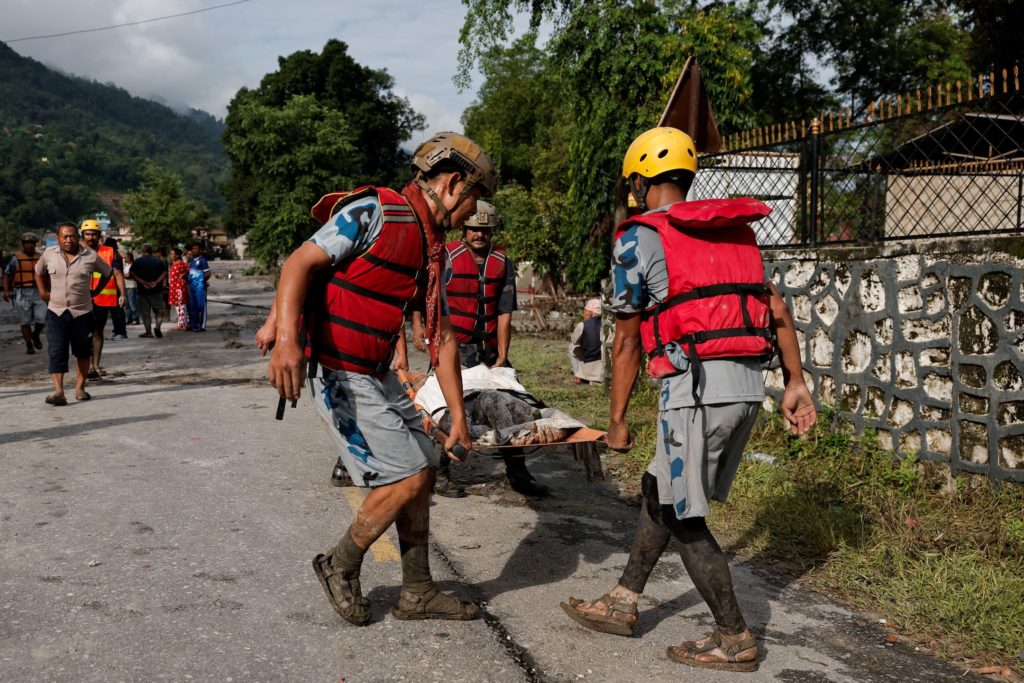
The Nepal Army, which is leading rescue efforts, turned to the trapped workers more than a day after the flood, according to army officials, industry groups and private rescuers.
Rescuers evacuating people from the tunnel of a hydropower project in Rasuwa, Nepal, in an image released by Nepal’s Prime Minister Secretariat on Friday.
Homes were heavily damaged and partially buried in thick mud and debris after a catastrophic flash flood in the Devighat area of Nuwakot district in Nepal on Wednesday.
The loss of power-generating capacity has raised questions about an ambitious expansion of renewable energy in one of the world’s most hazard-prone mountain regions.
A catastrophic deluge of ice and debris knocked out over 12 percent of Nepal’s hydropower capacity within minutes, striking a heavy blow to the nation’s economic engine.
Three days after a catastrophic wall of water, mud and rock tore through Nepal's Himalayan valleys, the scale of the disaster is still coming into focus. At least 579 people are now confirmed dead, nearly 2,000 remain missing, and the danger is not over. Authorities are closely watching lakes formed in the wake of the glacier collapse, amid fears of further flooding. Stephanie Sy reports.
Given the challenges in forecasting and detecting such calamities, researchers advised banning construction on floodplains and marking out clear evacuation routes.
The widened channel of the Bhote Koshi River in Nepal on Thursday after the flash flooding. Most monitoring and early-warning systems for glacial hazards focus on a specific area of risk.
Given the challenges in forecasting and detecting such calamities, researchers advised banning construction on floodplains and marking out clear evacuation routes.
The widened channel of the Bhote Koshi River in Nepal on Thursday after the flash flooding. Most monitoring and early-warning systems for glacial hazards focus on a specific area of risk.
Glaciers and permafrost in the Himalayas are melting faster as temperatures rise, though scientists are still studying the exact causes of this week’s landslide.
A visit near the border with Tibet laid bare the effects of a swollen river’s furious speed. Miles of devastation were left behind in a flash flood that killed more than 300.
Residents waiting to be airlifted by helicopter in the Rasuwa district of Nepal.
Scientists and disaster response researchers said Nepal’s early flood warning system relied on a conventional network of river gauges in this remote region.
Survivors described the terrifying speed and power of the “boulders, sand and thick sludge” that killed hundreds and wiped out villages on the border between Nepal and Tibet.
An ice avalanche that started high in the Himalayas tumbled thousands of feet, releasing vast amounts of energy that pulverized the ice into a significant volume of flood water.
An aerial view on Thursday of buildings partly submerged in muddy water along a riverside after a flash flood at Trishuli Bazaar in the Nuwakot district of Nepal.

 Login
Login