Democratic Senate nominee is eager to push past series of controversies involving allegations of antisemitism
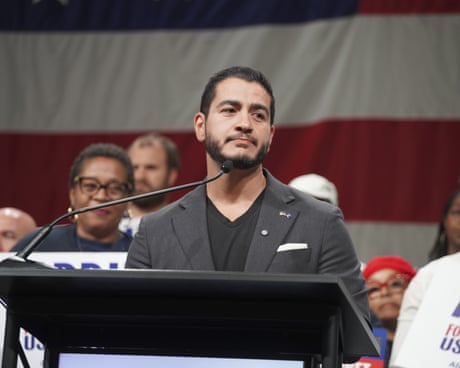
Michigan’s Democratic US senate candidate Abdul El-Sayed apologized to the state’s Jewish Democratic Caucus on Saturday for comments he made after an attack on a synagogue in March, which he tied to Israel’s actions in the Middle East.
“My comments may have been misconstrued to justify something I did not mean to justify,” El-Sayed told reporters after he addressed the caucus at a party convention in Lansing. “To anyone who feels like my comments might have been hurtful, I’m really sorry. That was not my intention.”
Sen. Jon Ossoff (D-GA) during a campaign event in Atlanta, Georgia, on May 31, 2026. | Ben Hendren/Bloomberg via Getty Images
Until recently, Natalie Harp was an omnipresent but low-profile aide to President Donald Trump: always there, but rarely part of the story herself. That changed abruptly earlier this month, when Sen. Jon Ossoff (D-GA), who is currently running for reelection, name-dropped her in a speech.
Trump “doesn’t want to do the job. He wants to build his ballroom and travel with Natalie on their apparently defenseless flying palace gifted by the Emir of Qatar,” Ossoff told supporters at a rally.
The line was a reference to reporting on Trump’s catering-cart maneuver as he was flying back from Turkey in July; Harp and other Trump aides joined the president on an alternate plane by way of a catering cart, while Secretary of State Marco Rubio was left behind on Air Force One.
The “Natalie” jab from Ossoff quickly took on a life of its own, spurred by a furious response from the Trump White House and right-wing media. Somewhat lost in the flurry of attention on Harp was Ossoff himself — but Greg Bluestein, chief political reporter for the Atlanta Journal-Constitution and co-host of the Politically Georgia podcast, told Today, Explained that the remark was “by design.”
Bluesteinspoke with Today, Explained co-host Sean Rameswaram about Ossoff’s disciplined, savvy messaging strategy, his political rise, and why his rhetorical jabs at Trump are fueling speculation about an Ossoff 2028 presidential run.
Below is an excerpt of their conversation, edited for length and clarity. There’s much more in the full podcast, so listen to Today, Explained wherever you get podcasts, including Apple Podcasts, Pandora, and Spotify.
It’s time on this show, Greg, that we remind people who Jon Ossoff is. I’m told that is a job with which you can help.
I go way back with Sen. Ossoff. The first time I met him, or at least I talked to him, was way back in early 2017 where I got a call out of the blue from a name, a number I didn’t recognize, and the voice on the line said, “Hi, I’m Jon Ossoff and I’m running for US House, this special election.” And I said, “Well, welcome to the show. There’s about 17 other candidates already in the race.”
And he goes, “Well, I’ve got something they don’t. I have John Lewis’s endorsement, and I have about $250,000 in cash commitments.” So I was like, “Okay.”
It still was an uphill battle because we’re talking about a deep red Republican seat in the northern suburbs of Atlanta at a time when all those suburban seats were still Republican. So I said, “Okay, good luck, sir.”
But lo and behold, he became a national figure in that loss.
So you’ve been covering Sen. Ossoff just about as long as anybody. At any point over the course of that almost-decade, did you expect “Natalie” from him?
No. I mean, look, you expect him to be really, really careful and calculated about what he says. Even back then, he rarely uttered an imprecise statement. There have been times where folks have caught him off-message, but it’s been very, very rare even at the beginning of his political career, certainly now.
When he uttered the “Natalie” line that sparked a thousand thought pieces and national takes and all that, that was done by design.
Tell us a bit about his backstory for people who have forgotten who Jon Ossoff is.
When I first got that call in early 2017, I had no idea who he was. Little did I know he’d become a national figure that we’d be talking about in the context of a presidential campaign not even a decade later.
He’s a former documentarian, a former intern of the legendary Georgia Congressman John Lewis, whose parents, especially his mom, were involved in Democratic politics in Georgia, but definitely not household names — definitely not a known quantity when he called me all those years ago to say “I’m running.”
Ossoff came within a whisker of an outright win, which would’ve been a huge, monumental upset. But in the process, he showed that Democrats have a path with suburban voters that long voted Republican in the Trump era. He started with the sort of campaign slogan of “Make Trump Furious.”
He was leaning into the Democratic activism, but then within weeks shifted his message toward a more friendly, more mainstream argument about bringing jobs to the district, bringing more tech-savvy investment to the district.
When he announced for US Senate against David Perdue, very few people gave him a shot when he got in the race. But that race ended with this epic double-header runoff because Rev. Raphael Warnock was also in the race against [Sen.] Kelly Loeffler. Democrats hadn’t won in Georgia in decades. So it was an epic election and a real nail-biter to the end.
Ossoff becomes the first Jewish US senator in Georgia history, Warnock becomes the first Black US senator in Georgia history, and together they flip control of the Senate and allow Joe Biden to to actually implement some of his broad-ranging agenda those first two years that they were in office.
It makes a lot of noise when Ossoff helps flip the US Senate along with Warnock. And he’s making a lot of noise now with “Natalie.” But I can’t say that I feel like he’s made a lot of noise in the intervening six years. What’s he been like as a senator?
That’s by design. It’s only been really recently where he’s been very willing to go on the national cable shows, to talk to national reporters more, to do a lot of the things that you see other nationally prominent Democratic figures do much more regularly.
We both know there are folks in Washington who love going to the White House Correspondents’ Dinner and they love going to this or that luncheon or this or that dinner. Sen. Ossoff is much more likely to quietly go home and spend time with his two kids.
I’m not just saying that because that’s the senator I know. He is much more reserved and guarded about his private life and will bend over backwards to figure out ways to get back to Georgia — even when there are important votes, [he’ll] find ways after those votes to get back for events with his kids and that kind of thing.
It feels a little contrary to think about this guy who keeps a low profile, who wants to go back home to Georgia to be with his family, who doesn’t want the limelight, because as you’ve already mentioned, he isn’t just running for reelection in the Senate right now. Everyone seems to believe that he’s running for president.
I’m going to go out on a limb saying that I believe him when he said publicly — and privately too — to folks all over the spectrum, media folks and activists and supporters and you name it, that he is focused on this election and he’s not running for president.
If someone like Sen. Ossoff wins by a huge margin over Mike Collins in an important battleground state that is tilted both ways the last decade, the chatter will not stop. It’ll only get louder.
[He is] someone who is adept at making the arguments that so many core Democratic voters want to hear about President Trump, but at the same time can win over swing voters like he has in 2021. And he’s already seeming like he’s certainly making that outreach to them in 2026.
Do you think that if he does end up there, we’ll look back at Nataliegate as a big moment for him where it was just clear that this guy had the stuff? Or does this feel like, a week and a half out or whatever it is now, that it’s already fading into the background?
The biggest takeaway from that to me was how — and I think Jonathan Martin from Politico was the first to say it — Ossoff was essentially the nation’s assignment editor because it spurred countless stories for the next week and a half about who Natalie Harp is.
It was Ossoff who showed that he has this extraordinary staying power in the media. These rallies — he doesn’t hold them every day or every week. These are like once every month or so rallies.
The stagecraft is impressive. He’s got these multi-camera shots that are immediately farmed out to all these social media accounts who amplify them. It’s very, very impressive how he pulls this off. And they’ve become these sort of national spectacles that have inevitably given rise to more ruminations about whether he’ll run for president or not, but also of course boost his campaign itself.
That to me was one of the takeaways — that he has this impressive grip on not only what the media’s covering, but triggering them to cover even more of it.
Angie Nixon won one of the biggest upsets in US midterm primaries – and if elected, the Democrat would be the first African American senator in Florida history
The Democratic establishment had the money, the machinery and the candidate with national name recognition. Angie Nixon had a bookshop called Café Resistance and a grassroots campaign for the Senate. On primary election night in Florida, Nixon won in arguably the biggest upset of the primary season. But at least one person was not shocked: Angie Nixon herself. “We weren’t surprised,” the 42-year-old reflects after overcoming a vast fundraising disadvantage to defeat Alex Vindman, a combat veteran who testified against Donald Trump during his first impeachment. “We actually knew we were going to win; we just didn’t know that we were going to win by that much. We put in the work and so super excited about the outcome. It shows that good old-fashioned grassroots organising will beat big money each and every day.”
Nixon won 56.1% of the vote to Vindman’s 43.9%. The result stirred tensions within the Democratic party in a year defined by the struggle between moderates and economic populists. In Florida – a state that has trended increasingly Republican in recent years and is now Trump’s home state – Democrats have now nominated a member of the Democratic Socialists of America (DSA) who speaks openly about class war.
It is unclear whether this Supreme Court will allow President Donald Trump to make sweeping and unilateral changes to how the country runs its elections so close to the midterms. | Andrew Caballero-Reynolds/ AFP via Getty Images
Well, that was quick.
On Thursday evening, federal district Judge Indira Talwani issued a new order that temporarily blocks an effort by the Trump administration that appears designed to sabotage voting by mail in the upcoming midterm election. Talwani previously blocked an executive order that President Donald Trump issued in March, which ordered the US Postal Service (USPS) to impose a byzantine array of new regulations on voting by mail, but the Supreme Court reinstated the order on Monday.
Talwani’s new order sets up a new legal fight that is almost certain to return to the justices, and it is unclear whether this Court, with its 6-3 Republican majority, will allow Trump to make sweeping and unilateral changes to how the United States conducts its elections so close to an actual Election Day.
That said, while Talwani’s new order in League of Women Voters v. Trump is brief, it is well-crafted to persuade at least some members of the Court’s Republican majority to break with the leader of their political party.
Talwani relies on a fairly new legal concept known as the “major questions doctrine,” that the Court’s Republican majority invented in the later part of the Obama administration, and that the Court has only actually used against one president: Joe Biden. Briefly, the doctrine claims that the executive branch may not make policy changes that are too sweeping or too aggressive, often even if a federal statute appears to give it the power to do so.
As the Court summarized this idea in Utility Air Regulatory Group v. EPA (2014), the first Supreme Court decision to articulate the major questions doctrine, “we expect Congress to speak clearly if it wishes to assign to an agency decisions of vast ‘economic and political significance.’”
This doctrine, as Talwani indicated in her recent order, cuts sharply against Trump’s rules governing voting by mail. The Trump administration’s new rules impose so many layers of bureaucracy on mail ballots that it likely would be impossible for many states to comply with these regulations. Trump’s new rules, in other words, would effectively shut down voting by mail in much of the United States. And there are several states who conduct their elections almost entirely by mail, which means that Trump’s rules could effectively cancel the 2026 midterms in those states.
If that’s not a decision of “vast economic and political significance,” nothing is.
The uncertain question, however, is whether the Court will actually apply its major questions doctrine to Trump — something that several justices have thus far been reluctant to do. In Learning Resources v. Trump (2026), the tariffs case,three Republican members of the Court (Chief Justice John Roberts and Justices Neil Gorsuch and Amy Coney Barrett) did say that this doctrine prohibits many of Trump’s tariffs. But the other three Republican justices (Clarence Thomas, Samuel Alito, and Brett Kavanaugh)refused to apply this doctrine to a member of their own party.
If Roberts, Gorsuch, and Barrett hold to the view they expressed in Learning Resources — the view that the major questions doctrine applies to both Trump and Biden — then it is likely that these three justices plus the Court’s three Democrats will form a majority that willstrike down Trump’s latest attempt to sabotage voting by mail.
A brief history of the major questions doctrine
Many federal laws lay out a broad policy goal, and then empower a federal agency to write rules that will achieve that goal. Federal law, for example, requires the EPA to determine when power plants must install cutting-edge technology to reduce their emissions. It tasks a body within the Department of Health and Human Services with determining which vaccines must be covered by health insurers. And it gives the Federal Communications Commission some control over the cost of cable television.
Often, the federal statutes granting these powers are written quite broadly. During the later part of the Obama administration, however, many voices within the conservative legal movement grew concerned that Democratic presidents could use these broadly worded statutes to make major policy changes. Indeed, in the late Obama administration, the Federalist Society’s annual lawyers’ convention, probably the most important annual gathering of influential Republican attorneys, became a showcase of proposals to restrict federal agencies and prevent them from using their congressionally granted authority too aggressively.
Ultimately, the Supreme Court’s Republican majority settled on the major questions doctrine as their solution to this clamor within the Federalist Society and other conservative legal groups. The doctrine effectively gives the justices a veto power over any policy proposal advanced by the executive branch if the justices deem that policy to be too ambitious.
The doctrine effectively gives the justices a veto power over any policy proposal advanced by the executive branch if the justices deem that policy to be too ambitious.
One common critique of this doctrine is that it appears nowhere in the Constitution or in any federal law. The Court first announced the doctrine in its 2014 opinion in Utility Air, which merely invoked it to criticize a hypothetical EPA regulation that never actually existed. The Court has also never handed down a majority opinion explaining where the justices’ new power to veto federal regulations comes from. Moreover, while some individual justices have attempted to do so, their explanations conflict with each other, and are often ridiculous. Barrett has argued, for example, that the major questions doctrine derives from a parable about a babysitter.
Another criticism of the doctrine is that the Court has never applied it to a Republican administration — indeed, the Court has thus far only applied it to Biden. The doctrine, after its first appearance in 2014, laid dormant for the entire first Trump administration — only to spring back to life in order to block several of Biden’s attempts to respond to the Covid-19 pandemic.
Yet, while the major questions doctrine is hard to defend as a good faith effort to interpret the Constitution or any statute, the pragmatic case for allowing someone to rein in a too aggressive president has undoubtedly gotten stronger in the last two years. Trump is a walking advertisement for the idea that there should be limits on executive power. If the Court decided to apply its major questions doctrine to Trump, it’s unlikely that many Democrats would object to such a decision.
Thus far, however, the Court’s three Democrats have kept this recently fabricated doctrine at arms length — in Learning Resources v. Trump (2026), for example, they concluded that it was unnecessary to invoke the major questions doctrine to strike down Trump’s tariffs that were at issue in that case because federal law was clear that those tariffs could not exist.
The Court’s Republicans, meanwhile, have split on whether the doctrine should be applied to Trump. While Roberts, Gorsuch, and Barrett all concluded that Trump’s attempt to impose trillions of dollars worth of new taxes on imports was a decision of “vast ‘economic and political significance,’” the other three Republicans joined an opinion by Justice Brett Kavanaugh, which said that the doctrine does not apply “in the foreign affairs context, including foreign trade.”
Kavanaugh, in other words, would have invented a new exception to a brand new legal doctrine, which just happened to be perfectly tailored to exempt a Republican president’s signature economic policy.
Still, there are three Republican justices who have previously concluded that the major questions doctrine may be used against a Republican president. If these justices hold to that view in League of Women Voters, that’s enough to form a majority against Trump’s restrictions on voting by mail because the Court’s three Democrats have already signaled that they oppose those restrictions.
League of Women Voters gives the Roberts Court a second chance to legitimize one of its most consequential changes to US law
Because the Court has neither offered a plausible explanation of where the major questions doctrine comes from, nor applied this doctrine in a nonpartisan way, both the Democratic justices and a wide array of legal scholars have treated the doctrine as illegitimate. So have I. Kavanaugh’s dissenting opinion calling for a Trump-sized exemption to the major questions doctrine certainly didn’t help the case for it.
But if any case justifies a court decision that overrides a presidential power grab, League of Women Voters is that case.
Trump has carried out a vendetta against voting by mail since the 2020 election. During the Covid pandemic, disease-shy Democrats were much more likely to vote-by-mail than Republicans, because voting by mail allowed Democrats to avoid a trip to the polls where they might catch Covid. And these voting patterns continued even after the pandemic receded. According to the Pew Research Center, 44 percent of Democrats, and only 26 percent of Republicans, voted by mail in the 2024 election.
The new restrictions on voting by mail, in other words, are almost certainly motivated by Trump’s desire to shut down a method of voting that is preferred by Democrats, and thus skew the 2026 election towards Republicans.
Among other things, the new rules require states to mail ballots in a special envelope which must include certain design elements mandated by the federal government. These envelopes must be preapproved by the Postal Service, and individually scanned in a process that the Trump administration claims will take “less than a minute per mailpiece.”
But, as several states point out in a legal filing challenging Trump’s rules, California alone needs to mail 23 million ballots to individual voters. So that potentially adds up to “23 million minutes … or more than 43 years” that state officials would need to spend just to comply with one small part of the new regulations.
If the major questions doctrine applies to Republican administrations, however, there is no need to parse whether these two laws should be read to allow the Trump administration to effectively shut down voting by mail. The question of whether to quash a method of voting that tens of millions of US voters have used in the past is undoubtedly a question of “vast … political significance.” And thus, under Utility Air’s holding that Congress must “speak clearly” before it can give a federal agency the power to resolve this question, the two vague statutes that Trump’s lawyers cite to justify the new rules are not enough.
League of Women Voters, in other words, should be a very easy case — even for the Court’s Republicans. All they need to do to strike down Trump’s attack on voting by mail is apply the same rules to Trump that they previously applied to Biden.
Ex-House intel committee chair, now running against Abdul El-Sayed, instead saw photo of Osama bin Laden’s body
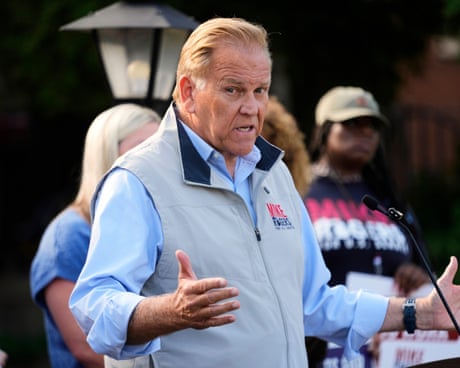
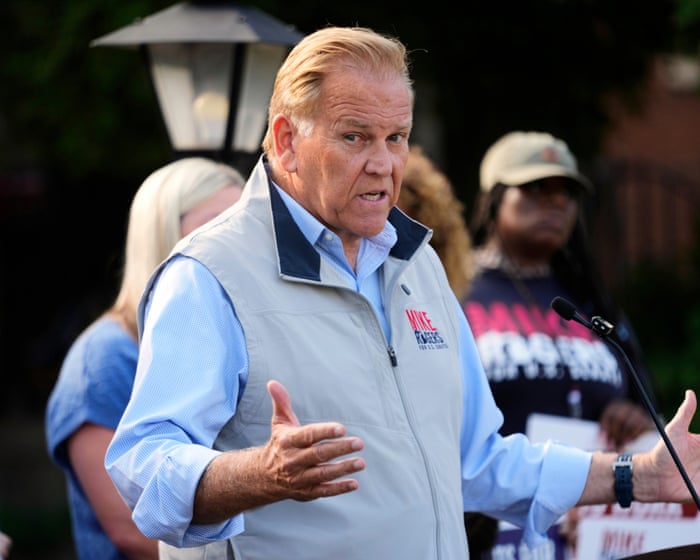
In a recent fundraising email, the Republican candidate for Michigan’s open US Senate seat, former congressman Mike Rogers, appeared to mislead supporters about his past by suggesting that he had played an active role in the killing of Osama bin Laden, the leader of al-Qaida who was shot and killed in an American military raid on his compound in Pakistan in 2011.
“When I served as a US army officer and an FBI special agent, I swore a sacred oath to defend the United States against all enemies, foreign and domestic,” Rogers wrote, according to a screenshot of the email shared online by Azi Paybarah, a former Washington Post reporter now with Straight Arrow News. “I dedicated my life to keeping our families safe – working in the shadows, hunting down terrorists, and standing on the frontlines of our national security.”
Ex-House intel committee chair, now running against Abdul El-Sayed, instead saw photo of Osama bin Laden’s body
In a recent fundraising email, the Republican candidate for Michigan’s open US Senate seat, former congressman Mike Rogers, appeared to mislead supporters about his past by suggesting that he had played an active role in the killing of Osama bin Laden, the leader of al-Qaida who was shot and killed in an American military raid on his compound in Pakistan in 2011.
“When I served as a US army officer and an FBI special agent, I swore a sacred oath to defend the United States against all enemies, foreign and domestic,” Rogers wrote, according to a screenshot of the email shared online by Azi Paybarah, a former Washington Post reporter now with Straight Arrow News. “I dedicated my life to keeping our families safe – working in the shadows, hunting down terrorists, and standing on the frontlines of our national security.”
In deep red South Carolina, the president helped stoke apprehension of a deeper red surge ahead of November’s US midterm elections
After casting his vote in South Carolina, a man who introduced himself as Chestnut was unwilling to give his full name. “You don’t have a need to know,” the air force veteran declared. He was, however, happy to share his views.
“I’m a true American. I believe in the USA,” said the man, outside Christ the Servant Lutheran church in Conway. “And I don’t believe in communism or socialism.”
The president senses a crisis in his cult of personality. He believes the path to victory is through unwavering devotion
Donald Trump has framed his theme for the midterm elections. It has come to him as naturally and inevitably as staring into the mirror, beyond any logic or argument, his definitive answer to no specific issue, providing no understanding of any particular problem, but transcending all of them. His political theme is more primal than programmatic, more instinctive than analytical, a heartfelt expression to protect his greatest romantic attachment, his obsessive fixation, his idealized object: himself.
Trump’s campaign theme is unrequited love. Unlike the pollsters, media consultants and pundits, he alone has grasped the magnitude and the source of the existential crisis threatening his politics. He has identified the problem for the Republicans as the faltering measure of complete devotion to him. His demand has nothing to do with mutual affection. It is a ploy to reassert his slipping control, a manipulative test to prove loyalty to him, or else. There can be no absolute rule without an absolute ruler; no absolute ruler without absolute submission; no absolute submission without the expression of absolute love. His sadness at its fading gives way to anger, paranoia and greater acts of retribution. He equates the fear he instills as a form of love. Trump accepts subservience, from whatever motive, as affection or its closest equivalent. He cares nothing about sincerity, so it’s all in the show. The less love displayed, the more fear required. Yet there is no rebound, but only deeper rejection.
Bo French, a candidate for Texas railroad commissioner, speaks at a CPAC panel to discuss the threat of Islam in Texas. | Eleanor Dearman/Fort Worth Star-Telegram/Tribune News Service via Getty Images
The Great American Conflict, a 75-minute documentary produced by a Texas-based organization dedicated to converting Iran to Christianity, declares its goal right at the beginning: “to reveal the true Islam to all people, especially in the West,” Iran Alive Ministries’s founder Hormoz Shariat says. “This film is also meant to be a warning to America. There is a serious threat of Islam in our nation.”
Released at the start of summer and having premiered at a gathering of the Dallas County Republican Party, it’s an obscure film — you’ve probably never heard of it — but it has so far had a surprising political influence. It’s been shown at gatherings of local Republicans and conservative activists in Texas, where Islamophobic rhetoric and policy proposals have played a key role in activating the Republican base, candidates, and party leaders over the course of this year’s elections. The documentary is both a symptom and a cause of a larger trend unfolding in American politics in 2026 that is picking up steam now: the rise of a new iteration of blatant Islamophobia paired with Christian nationalist sentiment on the American right.
Iran Alive Ministries did not respond to requests for comment.
It’s no surprise who some of the backers and voices of this documentary are: Some members of this collection of right-wing, conservative, and evangelical activists are a throwback to early-2000s and 2010s Islamophobia, when some of the same figures spoke out against “radical Islamism” and “radical Islamic terror.” One of them, for instance, is the activist Brigitte Gabriel, the controversial founder of ACT for America, an early-2000s anti-Islamic extremism group. As the film makes clear, this latest version of Islamophobia in America has its roots in this post-9/11 era and borrows heavily from it, while making some modern-day tweaks.
What’s different now is how mainstream this stance is becoming in politics and how it appears to be getting only more mainstream.
“Islamophobia has passed the dinner table test. You can say things about Muslims with basic impunity today,” Nathan Lean, a researcher, assistant teaching professor at North Carolina State University and author of the book The Islamophobia Industry, told me. “And it’s institutionalized in the way that prejudice that targets other marginalized communities is not.” He pointed to the Sharia-Free America Caucus in Congress, which is composed of 68 elected members of Congress representing 25 states. He also pointed to efforts in Texas to make eliminating “sharia” law an official stance of the Texas GOP, and then the subsequent vote to recommend Gov. Greg Abbott “ban” it on the Texas 2026 primary ballot.
Now, politicians, content creators, and politically connected advocacy groups are using films like The Great American Conflict, selectively edited clips spread on social media,and investigative-style pseudo-documentaries to spread this sentiment further and wider, power more wins of right-wing candidates, and take aim in particular at Muslim candidates and politicians.
This is all playing out as antisemitism and Islamophobia are peaking during the 2026 midterm cycle, accelerated by demographic change across America, increased Muslim visibility and engagement in politics, including elections of Zohran Mamdani in New York City and the Senate campaign of Abdul El-Sayed in Michigan, and moreRepublican politicians feeling comfortable using Islam as a scapegoat and cudgel, particularly in Texas. It all paints a worrying picture of what’s to come.
What The Great American Conflict argues is coming
As a cinematic project, The Great American Conflict isn’t much of an accomplishment; it can broadly be described as a collection of testimonials from evangelical Christians and former Muslims who’ve converted to Christianity who each make a case against Islam. Though poorly organized, it starts with some rough accounting of the rise of Islam in world history, lays out the case through interviews that Islam is an ideology and not a religion, then zooms in on specific Texan communities and examples of how Muslim politicians and activists are using democratic processes to achieve “domination.”
There are broadly three core themes that these speakers come back to:
Islam is inherently violent and imperialistic: The documentary’s interview subjects argue that true believers seek to expand the faith and establish a cross-national Islamic state. They rely on some sketchy history of the prophet Muhammed and the contemporary history of Lebanon and Iran as examples of this “violence.”
Islam is incompatible with the American Constitution and Western liberalism: Speakers also argue that, as opposed to other religions, Islam does not tolerate diversity of thought and seeks to enforce its rules and guidelines on nonbelievers. They claim that Islam rejects the separation between church and state, and that mosques can function as political or military centers.
There is an ongoing effort by Muslims to infiltrate American politics and replace “Judeo-Christian” America: The rise of Muslim American politicians in Congress, in New York City, and at the state and local government level are all part of an effort to whittle away religious liberty and replace American values with “Islamic” values. Liberal and progressive allies are enabling this takeover. And they interpret public calls to prayer, halal food, school prayer rooms, Ramadan accommodations, mosque construction, and Muslim residential developments as evidence that American institutions are yielding to Islamic demands.
Interspersed throughout these testimonials are fearmongering compilations of social media clips of Muslim prayers and veiled women, and short selections of purportedly Muslim speakers making inflammatory comments about 9/11, about Jews and Christians, and about Islamic domination in the West, and violent clips of terrorist actions abroad.
And though the film’s main backer, Hormoz Shariat, says at the beginning of the film that his goal is not to inspire fear or hate, that’s precisely what the speakers seem to do for an hour.
For example, the Christian pastor Shahram Hadian, the founder of Truth in Love Ministry in Tennessee, repeatedly argues that America is at a turning point. “Western societies are right now at a critical decision point. Either they’re going to maintain, preserve, [and] fight for their Judeo-Christian values, or they’re succumbing,” he says.
And he takes a natalist turn, arguing that Muslims in the US are happy to continue to raise families as Western birth rates drop. “We continue to see the demise of Christianity, of our Judeo-Christian values, family values, family ethics, marriage — one man, one woman,” he says. “They’re just waiting us out. They’ll just wait us out. They’ll aid us in our own demise and destruction.”
To drill down on this, various speakers point to demographic change in Michigan and Texas as early signs of what they see as the capitulation of the United Kingdom and continental Europe to Islam. They point to self-segregating Muslim communities in Europe being mirrored in the US, particularly focusing on a housing developmentproject in East Plano, Texas, centered around a mosque and Islamic center, that has been a focal point for Republican politicians.
Other speakers argue against accepting Islam as a religion at all, instead casting it as a political ideology that is seeking to take over American institutions. Some, like Gabriel, allege a coordinated strategy to “infiltrate” and “dominate the West and establish an Islamic government,” tracing this back to the Muslim Brotherhood, and a supposed decades-long plan to infiltrate political parties, schools, media, and churches to use democratic institutions to establish Islamic law. She points to Mamdani as an example of this, and ropes in Reps. Ilhan Omar of Minnesota and Rashida Tlaib of Michigan as being loyal to a foreign Islamic identity rather than to the United States.
And they contrast this all with an idealized “Judeo-Christian” America defined by constitutional government, traditional marriage, Christianity, and cultural assimilation. The final call to arms is to preserve and promote this Christian vision of America, on top of defending the Constitution, religious liberty, and “American” culture against what is a coming ideological and demographic conflict.
The danger of rising Islamophobia
Iran Alive Ministries itself doesn’t seem primarily dedicated to anti-Muslim American advocacy and activism. Most of its YouTube and internet presence is focused on digital Christian evangelism, particularly in Iran. It’s not entirely hard to see how a group focused on conversions would drift into Islamophobic preaching, but it does seem like a peculiar move, Lean told me.
“There is a group of people who form a faction of this sort of anti-Muslim movement in the United States who are, by their own description, evangelical Christians,” Lean said. “And it’s no surprise that a group like Iran Alive Ministries, that is formed on the basis of, as they say, transforming Iran into a Christian nation, one soul at a time, would go there.”
Emphasizing that Christian proselytism and evangelism are not inherently Islamophobic, Lean told me that there has been a more overt merging of religious convictions with Republican politics in recent years.
“The…driving mission of the group leads to a marriage of, we want a Christian world on the one hand, versus there are active agents in the world that are potentially preventing that. And who represents that biggest threat to that right now? Well, in the eyes of these people, Muslims do,” Lean said.
Lean told me that he expects to see this momentum build as midterms approach. At the local level, it’s most visible in Texas, where the New York Times recently reported on the stunning rise in Islamophobia and fearmongering across the state, and in Michigan, where cities like Dearborn and Hamtramck have seen white nationalist and anti-Islam demonstrations.
Lean said many of these lines of Islamophobic thinking sound like familiar tropes, smears, and lies of the last couple of waves of fearmongering around Muslims. Still, as opposed to the post-9/11 era, he noteda worrying difference: the scale of Islamophobia, given its increasing presence on both social and traditional media.
Much of the growth of these sentiments is happening online, too. Since Mamdani’s election as New York City mayor, and especially since El-Sayed’s victory in the Democratic Senate primary in Michigan, these kinds of views have surged online and in conservative media, while conservative activists and influencers have been pushing similar narratives of infiltration and under-the-radar Muslim “encroachment.”
A recent survey of internet discourse and activity by the research group Magnitude Media found something similar, centered on Dearborn: “Since the beginning of the month, there have been 690 posts mentioning Dearborn, generating 5.1 million engagements. Right-leaning accounts drove 88% of that engagement, compared to just 7% from left-leaning accounts,” the authors write. “The broader anti-Muslim conversation online has been substantial for months. Over the past six months, 68% of posts that either mentioned Islamophobia or contained common Islamophobic language came from right-leaning accounts. Dearborn appears less like the cause of a new Islamophobia conversation than the right’s newest focal point.”
So the documentary certainly isn’t the only cause for concern — but the fact that Texas Republicans have used it in official events, on top of strategists saying they are pivoting to “sharia” and fearmongering, suggests just how politically useful the party thinks these messages can be.
Which all suggests more ugliness to come. And as Lean told me, talking about a coming conflict and a threat to survival indicates an existential threat that should be fought by any means.
“Where does the logic of all of this take us? What’s the solution?” he said. “You can’t help but wonder when they’re issuing statements about fertility rates and these overtures are being kind of taken over, that this could very easily go to a dark place.”
Update, August 28, 11:45 amET: This piece was updated to reflect Nathan Lean’sfull job title.
President Donald Trump greats Chief Justice John Roberts, and Justices Elena Kagan, Brett Kavanaugh, and Amy Coney Barrett as he arrives for the State of the Union address on February 24, 2026. | Win McNamee/Getty Images
In March, President Donald Trump issued a blatantly illegal executive order claiming that he had the power to unilaterally rewrite US election law. The order threatens prosecutions against state officials who allow certain people to vote, and it also requires states to include several federally mandated design elements in the envelopes that they use to mail ballots to voters.
On Monday, the Supreme Court’s Republican majority allowed that order to go into effect. All three of the Court’s Democrats dissented.
Yet while the Court’s new decision in Trump v. California is troubling, it’s not necessarily a sign that the justices will permit Trump’s illegal order to take full effect. The Court’s actual holding in California is that two lower federal courts moved too quickly when they blocked the executive order. But California does not opine on whether the order is actually legal.
The Supreme Court’s decisionreinstates Trump’s order for now, but there are several active cases challenging this order in the lower courts. So it is likely that a judge will issue a new decision blocking the executive order again very soon.
Still, the Court’s decision to reinstate this order, even temporarily, is likely to confuse state election officials who are racing to prepare for an upcoming election. And the provision threatening prosecutions might deter these officials from doing their jobs until that provision is blocked by another court.
The Court is divided on whether Trump’s threat targeting state elections officials is actually a threat
The case concerns two sections of Trump’s March order, one of which threatens state election officials with prosecution if they allow the wrong people to vote, and the other which appears to be an attempt to sabotage voting by mail during the 2026 midterms.
The first one of these, Section 2, itself contains two provisions, one of which orders the Department of Homeland Security to “compile and transmit to the chief election official of each State a list of individuals confirmed to be United States citizens who will be above the age of 18 at the time of an upcoming Federal election and who maintain a residence in the subject State.”
This simple command to compile a list would be unproblematic, except that the second provision of Section 2 orders the attorney general to prioritize prosecutions against “State and local officials or any others involved in the administration of Federal elections who issue Federal ballots to individuals not eligible to vote in a Federal election.” Thus, when both provisions of Section 2 are read together, they threaten prosecutions against any state official who issues a ballot to a voter whose name does not appear on Trump’s list of approved voters.
Such a threat is unconstitutional, as the Constitution gives states, and not the federal government, the power to decide who may vote in congressional and presidential elections. The justices, however, primarily split on whether to give Trump’s order a hyperliteral reading.
In dissent, Justice Sonia Sotomayor argues the two clauses are clearly connected and she cites a previous Supreme Court decision warning that “[p]eople do not lightly disregard public officers’ thinly veiled threats to institute criminal proceedings against them if they do not come around.”
But the majority ignores Section 2’s purpose, and instead notes that Trump’s executive order does not explicitly require states to use Trump’s list of approved voters. They also note that the executive order’s call for the Justice Department to prosecute state officials does not include any reference to Trump’s list.
In any event, even the Republican justices do not hold that the Constitution permits Trump to create a list of approved voters and prosecute state officials who depart from that list. Instead, the Republicans hold that it is too soon to block Section 2. DHS must first compile its list of approved voters, or DOJ must actually prosecute someone, before a challenge to Trump’s new policy can proceed.
The effect of the Republican justices’ decision, in other words, is to leave Trump’s threat in place, but also water it down considerably: The Court does state that Trump’s executive order does not actually require states to use Trump’s approved voter list. So that may be a sign that, if Trump actually did try to prosecute someone for allowing someone not on DHS’s list to vote, the justices would reject that prosecution — but for now, there’s little standing in the way of him doing it.
The rest of the Court’s decision was obsolete the minute it was handed down
The remainder of the Court’s decision deals with Section 3 of Trump’s executive order, which orders the United States Postal Service (USPS) to design an envelope which states must use when they mail ballots to voters. It also forbids USPS from delivering ballots that do not comply with this new design.
The Republican justices conclude that the lower court decisions blocking Section 3 were also premature because, at the time when those courts handed down their decisions, USPS had not yet formally issued a rule that announces the new mandatory envelope design. But USPS issued that rule on Friday. So the Supreme Court’s decision was out of date days before the justices decided it, but that does nothing to change the immediate effect of the decision.
Among other things, the Trump administration’s new rule requires states to mail ballots in envelopes that include several federally mandated design elements, including a mandatory logo and a unique identifier for each voter. If the new rule takes effect, USPS will refuse to deliver any ballots that do not comply with these new, Trump-approved design requirements.
Democrats are significantly more likely to vote by mail than Republicans. So the Trump administration’s new rule is likely to skew the 2026 election towards his political party if it is allowed to take effect.
If Section 3 is eventually allowed to take effect, that will be a catastrophe for US democracy, and may even make it impossible for many states to hold midterm elections. That’s because the states couldn’t possibly have known what specific design requirements the Trump administration would impose on them until USPS issued its rule. Many states have already purchased envelopes that do not comply with the new federal mandate. And it’s not like new envelopes can simply be printed on the fly.
In some states, millions or even tens of millions of voters will vote by mail, which means that, in order to comply with the Trump administration’s new order, these states will somehow need to obtain truckloads of envelopes in time for this November’s election, comply with the considerable procedural requirements laid out in Trump’s order, and distribute these ballots to voters fast enough for them to actually return them by the deadline.
Several US states, moreover, conduct their elections almost entirely by mail. While these states often set up voting centers where voters can also vote in person, these in-person voting centers are merely a backup. And these states are unlikely to have the infrastructure, voting machines, or network of election workers that are required to run an entirely in-person election if mail-in voting fails.
So Trump wants to impose impossible deadlines on many states. But Monday’s decision does not actually hold that it is legal for him to do so. Indeed, the federal judge who initially blocked Trump’s executive order has already signaled that she is likely to block the USPS’s new rule. We will find out if the Supreme Court will allow Trump to sabotage voting by mail after that new decision makes its way back to the justices.
The Trump administration’s legal argument for the new USPS rule is quite thin
Trump’s lawyers only barely make a legal argument in favor of the new rule. After the USPS issued its new rule, Trump’s Justice Department did file a supplemental brief in the Supreme Court arguing that the new rule is lawful. But that brief is only three pages long, and its legal analysis is exceedingly thin.
As Indira Talwani, one of the judges who blocked Trump’s executive order, noted in her opinion, there is no federal law that explicitly “delegates authority to control mail-in voting to USPS.” So the Trump administration must rely instead on broadly worded statutes that simply state that the Postal Service may deliver mail and take related steps that are necessary to deliver the mail.
And, even if these vague statutes could authorize the Trump administration to impose granular restrictions on voting by mail, the fact remains that it is impossible for many states to comply with these restrictions in 2026. Some states, such as North Carolina, are supposed to start mailing ballots at the end of next week.
It would be one thing if Trump tried to impose new envelope design requirements that will take effect in future elections. But there’s simply no time for states to design compliant envelopes, get those designs approved by USPS order dozens of pallets worth of these envelopes, and distribute them to voters in time for the 2026 midterm elections.
So the stakes in this dispute remain quite high. Trump has literally issued an executive order that, if implemented, might prevent many states from holding the midterm elections in the first place. But it is still unclear if this Supreme Court will allow that to happen.
Attendees at a Trump rally in Racine, Wisconsin, on June 18, 2024. | Scott Olson/Getty Images
It’s the Democrats who have mostly had to answer questions about electability this midterm season, but why are there so few questions about the “E” word for the other side?
Gas prices are still skyrocketing. A number of Republican candidates, such as Ohio Rep. Max Miller and former Texas Attorney General Ken Paxton, who’s running for a Senate seat, are mired in scandal. The Iran war was unpopular from the start, but it is getting even less popular as it drags on. And Trump’s approval rating recently hit 33 percent, the lowest of his presidency yet.
On this week’s episode of America, Actually, host Astead Herndon speaks with one of Trump’s most vocal defenders, conservative influencer CJ Pearson, about whether we’re seeing Trump’s brand slip even among his supporters and the young people who helped him win in 2024, and how that could affect the midterm elections.
Pearson, a conservative content creator and influencer, first went viral when he posted himself, then 12 years old, criticizing Barack Obama in a YouTube video. Now 24, Pearson is one of MAGA’s most prominent Black voices.
In this episode, Astead and Pearson discussed how Republicans should answer questions about whether voters’ lives are better than they were two years ago; whether Trump still has any cultural cachet left over from his last presidential campaign; and when Pearson started to see young Republicans turning away from the MAGA movement.
Below is an excerpt of Astead’s conversation with Pearson, edited for length and clarity. There’s much more in the full show, so listen to America, Actually wherever you get your podcasts or watch it on Vox’s YouTube channel.
That “E” word’s been thrown around a lot about Democrats, but we want to think about how Republicans are on their own. If you could rate Donald Trump’s second term one through 10, what would you give it?
I think the president’s doing incredibly well for the American people. Promises made, promises kept in many ways.
I think if you look at this president who ran on securing our southern border, he’s done it. You look at this president who’s talked about bringing down costs, he’s brought down the cost of dairy, eggs. He’s achieved that.
And I think also this president is only just getting started. He ran on “no tax on tips.” He did that. He ran on “no tax on overtime.” He did that. Oftentimes I tell people the challenge of this administration is keeping up the messaging at the same pace as the accomplishments of this president.
And so I think that there’s a lot more work to do. Thankfully, we have two more years to do it.
Can I get a number?
I think he’s doing well. I will say I grew up in a place where there’s always room for improvement, so I’ll give him an eight.
You’re giving him an eight. I wanted to just start there because Trump’s approval rating has fallen, as I’m sure you have seen. Why do you think the country isn’t maybe on the same page as you?
I think a lot of people are focused on their pocketbooks, right? They’re focused on domestic issues, and I think that we have been very internationally focused over the course of the past few months as we’ve navigated and dealt with the Iran conflict.
But I think that as we get ready to get through this last wave of primaries, I think you’re going to see a change in his messaging and a reset at the midterm convention in Dallas next month in September.
And I think you’re going to hear this president talking about how he’s made America more affordable, how he’s kept Americans safe, far safer than they were under President Joe Biden.
And I think that you’ll see those numbers start to change. And a reminder, the only poll that matters is on Election Day. There are many polls that had Kamala Harris beating President Trump, in 2024, and that didn’t happen.
Yeah, I don’t want to be overly poll-reliant, but we’ve heard some of this directly from Republicans even.
We were at Donald Trump’s UFC event in DC talking to young men, and even there we heard people really come to be critical on three issues specifically: tariffs, the Iran war, and the handling of the Epstein files.
You mentioned the question of affordability. Donald Trump has said, quote, “I love the inflation.” And when asked by reporters about the public strain that has come from the conflicts with Iran, he said, “I don’t think about Americans’ financial situation. I don’t think about anybody.”
How can you say that Republicans are gonna run on affordability if the president’s saying he doesn’t care if Americans’ lives are unaffordable?
Well, I’ve often said that we can’t cede this entire affordability debate to the Democrats. The reason that I think a lot of young people are giving a little bit, even a flirtatious nod to the DSA and their socialist and communist candidates, is because they’re talking about an issue that’s top of mind for them.
In the same way that when President Trump won in 2024, he was talking about issues that were top of mind of the American voter, which was the cost of living.
And so I think that we need to get back to that messaging. I think that this president has continued to deliver on that front. Costs are coming down.
The economy is resurging. We’re seeing economic and global investment in this country unlike anything we’ve seen before. In Oklahoma, we’re bringing back manufacturing with the aluminum smelting plant.
But the president’s not saying this. The president’s saying, “I love the inflation, and I don’t think about Americans’ financial situation.” Do those words help Republican midterm candidates?
Well, I think the president has a lot of time to say a lot more things because Election Day is pretty far away from now. I think we have two or three months left, and I think the president will make this case.
But I think what will also make the case is that the candidates that the Democrats are running and nominating all across this country, who are now affiliating themselves with the socialist movement, are not actually fighting for things that will actually ever work.
Socialism has never worked anywhere it’s been tried, and I think that this is going to be an election between common sense versus crazy. Do you wanna run a candidate that hates Thanksgiving?
For the record, that candidate lost in the primary. She will not be on the ballot in November.
She did. She almost was there, though, and that’s the thing. I’m glad common sense won the day in Wisconsin, that the good people there love turkey.
I know that you say that the argument is based on how Democrats are out of touch, but we have talked about some ways in which Donald Trump has not lived up to folks’ expectations, particularly on things like prices and on things like the Iran war.
How does the GOP overcome that electability question? What is their message when folks ask, is their life better than two years ago?
I think we’ve got to lock in. I think we also need to prosecute the case that it’s going to be a lot worse under the Democrats if these crazy communists get into office. And so I think that when you’re looking at costs, we need to make that argument central. We need to make that what we lead with.
And I think that we have to pump the brakes on a lot of the international stuff. And I think that we need to talk about the things that are actually affecting people’s everyday lives at grocery stores, at gas stations, wherever it may be. And I think that is how we can kind of turn the ship around.
When we talk about the Democratic candidates, you’re saying the DSA candidates are far left, and we’ve certainly explored some electability questions for them and some ways that I think they might have stances that are misaligned with the American people. But so does Donald Trump, and he’s endorsed scandal-plagued candidates like Ken Paxton in Texas, like Max Miller in Ohio.
Why is that not just as much a sign of a conservative version of extremism, just as you are arguing that there’s a Democratic or leftist version of that?
Because I think you’re talking about folks who have dealt with issues in their personal lives, not necessarily their voting record.
Okay, maybe I should say Tom Tiffany, who didn’t vote to certify the 2020 election, but I imagine you agree with him.
Well, no, I think that was six years ago. I don’t think about 2020 anymore. I think about 2026 and I think about 2028. So when I look at that … it’s important that we really make the case for crazy communism versus common sense. And I think that the American people are not going to vote for that.
I guess I’m saying, does Donald Trump win the commonsense argument? Like, isn’t crazy versus commonsense an argument that Democrats can make and say Donald Trump is said crazy?
No, because I think Donald Trump definitely wins the common sense argument when we’re running against folks who belong to a party that is now, you know, waging a war against Thanksgiving, who believe that biological men should be playing women’s sports. Again, these are 80/20 issues, and so I actually really like our odds here.
It’s going to be hard, right? It’s always hard for the party that controls the White House to fare all too well in any midterm election. But I think that we’re going to overperform. I think we’re going to hold onto the Senate. The House will be a dogfight, but I like our chances.
Protesters gather for a statewide data center day of action at the Wisconsin State Capitol on February 12, 2026, in Madison, Wisconsin. | Wisconsin Watch via Getty Images
The general election for Wisconsin governor is now a week old. But the past seven days of debate between the race’s Republican and Democratic candidates can be paraphrased in just two lines:
“My opponent is a shill for Big Tech who wants to build data centers over Wisconinites’ farms, parks, preserves, graves — and, possibly, Lambeau Field.”
“I know you are, but what am I?”
The Republican nominee, Congressman Tom Tiffany, has been the aggressor in this argument. Tiffany has branded his Democratic rival David Crowley as “Data Center David,” spotlighting the Milwaukee County Executive’s past support for turning Wisconsin into a “data hub” for “the entire globe.” In the Republican’s telling, Crowley is a corporate stooge eager to let Wisconsin’s “lakes run dry” and its “family farms” get “paved over,” just to generate higher profits for his Silicon Valley paymasters.
Key takeaways
• Republican Tom Tiffany has made data centers the focus of Wisconsin’s governor’s race. • But his policies on hyper scale development aren’t much different than David Crowley’s. • Some Wisconsin labor unions and municipalities benefit a lot from data center projects. • Crowley and Tiffany have held off on embracing a moratorium for that reason.
Crowley has returned fire. The Democrat has insisted that every Wisconsin community should have veto power over any data center project within its territory — and that new computing campuses anywhere in the state must comply with strict regulations. Meanwhile, Crowley has argued that Tiffany is the race’s true corporate shill, noting that the member of Congress voted for tax cuts that benefit Big Tech (paid for with cuts to Medicaid and food stamps), permitting reforms that made data centers easier to build, and a ban on state and local AI regulations. “Congressman Tiffany loves data centers,” Crowley warned in a recent statement.
Meanwhile, it’s not clear how much they actually disagree on what they would do about the issue as governor.
The Wisconsin governor’s race has quickly become the most prominent flashpoint in the national war over data centers. And it’s not hard to tell which side is winning. On Tuesday, Josh Shapiro, the moderate Democratic governor of Pennsylvania, announced a suite of measures to slow and block “predatory” data center developments, after having previously led efforts to attract them.
If the public’s views on data centers are increasingly clear, the substantive issues remain unsettled. And the politics are more complicated than polling alone would indicate: Key constituencies in both the Democratic and Republican parties remain invested (literally and figuratively) in hyperscale development. Even as Tiffany and Crowley spar over who would do more to curb the data center menace, their actual policies quietly reflect these tensions.
How data centers became a flashpoint in Wisconsin
On first glance, Crowley and Tiffany’s back-and-forth on data centers looks odd in multiple respects. For one thing, Republicans do not typically accuse Democrats of trying too hard to spur corporate investment — nor of doing too little to protect the environment. For another, Crowley and Tiffany seem to appear to largely agree about data center policy, which makes their emphasis on the issue sound a bit strange.
Upon closer inspection, however, Tiffany’s emphasis on the subject isn’t hard to understand.
Crowley just barely defeated socialist Assembly member Francesca Hong in the Democratic gubernatorial primary. And data center policy was among the key divides in that contest, according to Crowley himself: Hong championed a statewide moratorium on data centers, while Crowley merely favored imposing tight guardrails on their development.
What’s more, Crowley really did tout the potential benefits of data center development in the past. And he is closely allied with sitting Democratic Governor Tony Evers, who enacted large tax subsidies for new computing campuses in the state. Thanks in part to that largesse, Wisconsin witnessed a sudden wave of hyperscale (in other words, AI) data center development over the past two years.
Thus, by staking out a more (ostensibly) hardline, anti-data center position, Tiffany hopes to fracture the Democratic coalition — and isolate Crowley from the 76 percent of Wisconsin voters who say that the server farms’ costs outweigh their benefits.
In reality, however, the distinctions between Crowley and Tiffany’s positions on data center construction are much narrower than the latter’s attacks suggest. And to the extent that Crowley is more sympathetic to hyperscale development, this has less to do with his alleged fealty to Big Tech than his support for organized labor.
Crowley and Tiffany mostly agree about data centers
Crowley and Tiffany’s positions on data centers heavily overlap.
Neither candidate supports a statewide moratorium. Both say that local communities should have the power to veto new computing campuses; that data centers must pay the full price of their energy needs (including the costs of any new power and transmission infrastructure that their consumption necessitates); and that companies should not be allowed to enter into nondisclosure agreements with local governments that temporarily conceal negotiations over new data center developments from the public.
Likewise, as their respective attacks suggest, Crowley and Tiffany were both friendlier to the AI industry in the past, before the backlash to artificial intelligence — and the infrastructure it requires — took off. Crowley really did express a desire for Wisconsin to become a global leader in artificial intelligence. Tiffany, meanwhile, has indeed voted to cut taxes on AI companies and shield them from state and local regulations. And the Republican is aligned with an even more unabashed champion of data centers than Evers, President Donald Trump.
Further, many of the distinctions between Crowley and Tiffany’s data center platforms reflect perennial left-right divides on other issues, rather than any difference in each candidate’s degree of chumminess with Big Tech.
For example, Crowley wants to require data center projects to finance new renewable energy installations — both so that they can meet their own power needs in a sustainable way and so that Wisconsin’s broader electric grid becomes less dependent on coal.
Tiffany also recognizes that data center development could be leveraged to fund new renewable energy. But he sees this as a bug, not a feature: After all, new solar and wind farms could eat up Wisconsin’s precious farmland, which Tiffany has sworn to protect. The Republican instead prefers for new data centers to run on coal, thereby propping up that embattled industry.
Crowley is more pro-data center in one way
All this said, Tiffany’s platform is genuinely less pro-data center than Crowley’s in one respect: The Republican has promised to end all taxpayer subsidies for data centers in Wisconsin.
Crowley’s position is comparatively nuanced. In an interview with the Milwaukee Journal Sentinel in July, the Democrat said, “I do not believe Wisconsin should automatically roll back all data center tax incentives, but I do believe we need a more rigorous review of whether taxpayers are receiving sufficient value for the incentives being provided.”
In response to Tiffany’s recent attacks, Crowley has embraced far more adversarial rhetoric towards the tech industry in general and the AI sector in particular. And he has called for imposing a set of requirements on new data center development so numerous and profound, it is unclear whether many companies would be interested in pursuing new projects under his leadership, subsidies or no subsidies.
Nevertheless, as of this writing, Crowley has yet to abandon his July position on tax incentives. Instead, he has countered Tiffany’s charges on that front by noting that, in supporting Donald Trump’s tax bill, his Republican opponent effectively “signed over $70 billion in tax handouts to the same companies now steamrolling over our local communities with data centers.”
This is a fair hit. But it’s also a little evasive. How high the corporate tax rate should be federally — and whether Wisconsin should offer tax breaks to data center developments — are two different questions.
And Wisconsin’s subsidies to hyperscalers are not small. Under Evers, the state exempted large data center projects from sales taxes. This means that a data center developer need not pay taxes — to either the state or localities — on construction materials, IT equipment, on-site power infrastructure, cooling systems, or electricity.
Critically, these exemptions do not sunset: Tech companies don’t just avoid sales taxes when initially building their data centers. Rather, they pay no taxes on their facilities’ electricity consumption forever, while also avoiding any levies when updating their servers or other equipment.
All this adds up. According to a report from Wisconsin’s Legislative Fiscal Bureau, the state is poised to forgo $1.5 billion in sales tax revenue during the construction of certified data center projects, and then another $369 million annually after the facilities are fully operating. This is an especially sensitive issue in Wisconsin, where voters are still upset over an effort to lure tech manufacturer Foxconn to the state in Trump’s first term, a costly gambit that failed to deliver on its promised benefits.
To be clear, the Fiscal Bureau’s projections do not mean that data centers are likely to subtract billions of dollars from Wisconsin’s state and local budgets. Even if the hyperscale facilities are exempt from sales levies they must still pay property taxes. And their owners could owe corporate taxes while their construction workers and permanent employees will pay income taxes.
Their spending also generates business — and thus, income tax obligations — for other Wisconsin enterprises, such as utilities. On net, the projects will almost certainly increase the amount of revenue available to Wisconsin state and local governments. The debate is over whether the projects could have generated even more revenue, in the absence of subsidies — or whether these developments would have gone to a different state, had Wisconsin not made their funders such a sweetheart deal.
The evidence on that question is mixed. On the one hand, tax subsidies of some kind were plausibly necessary to spur hyperscale data center investment in Wisconsin. At present, 38 states provide tax incentives to data center developers.
On the other hand, Wisconsin’s subsidies are unusually generous. States commonly spare servers and capital equipment from sales taxes, but many do not extend that exemption to electricity. And the indefinite nature of Wisconsin’s subsidies is also far from standard. In nearby Illinois, data center projects enjoy a sales tax exemption for only 20 years.
Meanwhile, Wisconsin has some structural assets that might make it appealing to tech companies, even if it offered far lower subsidies. Due to its proximity to the Great Lakes, Wisconsin boasts abundant water. And it also has relatively cool temperatures, which limit hyperscalers’ cooling costs.
Crowley has not ruled out dramatically scaling back the state’s subsidies. But unlike Tiffany, he has thus far declined to endorse abolishing those subsidies in their entirety.
In Wisconsin, banning data centers is not the pro-union position
At this point, you might be asking why Crowley doesn’t simply go “full populist” on data centers. Why give Tiffany any room to get to the Democratic Party’s left on this issue? Why not shore up your left flank by simply calling for a statewide moratorium — or at a minimum, for ending all data center tax breaks? After all, roughly three-quarters of Wisconsinites think the facilities are net harmful to the state.
In Tiffany’s telling, the answer to these questions is simple: Crowley is a bought-off puppet of the AI industry. But this is almost certainly wrong.
In truth, Crowley’s refusal to fully disavow data center construction likely reflects his ties to labor, not capital.
In his attack ad, Tiffany alleges that Crowley’s campaign is funded by “the people building” data centers and then flashes this image:
Tiffany’s claim is true — but in a misleadingly literal sense: The figure cited appears to be a reference to Crowley’s support from Wisconsin’s building trades unions. As of August 13, unions representing Wisconsin electricians, pipefitters, carpenters, construction workers, and other laborers had collectively contributed $412,000 to Crowley’s campaign. The Democrat has received no comparable support from corporate PACs of any kind, much less AI industry-affiliated ones.
The building trades are strongly supportive of data center construction — and for good reason. A data center serving OpenAI and Oracle in Port Washington, Wisconsin is being built through an explicit partnership with the Wisconsin Building Trades Council.
Separately, the Democrat has evinced concern for municipalities that do desire data center development, saying that Wisconsin can protect its ratepayers and environment “while also not preempting communities that have done their due diligence to allow for different types of economic development investments.”
For some Wisconsin communities, the fiscal benefits of data center development can be profound.
Consider Port Washington: In recent decades, the city’s manufacturing base shrank — and its business tax revenues declined with it. As a result, homeowners shouldered more and more of the burden of financing local government. But its new hyperscale data center promises to dramatically change its finances. According to the city’s Mayor Ted Neitzke, the project is expected to add between $1.3 and $1.8 billion in property value to a municipality whose entire existing valuation is scarcely over $1 billion.
By doubling the tax base, the data center could finance property tax cuts or public service expansions for Port Washington residents. Many of Wisconsin’s other post-industrial towns face similar challenges — and thus, could reap similar benefits from data center development. This may be why neither Crowley nor Tiffany have felt comfortable endorsing a moratorium, despite their increasingly populist rhetoric about data centers and AI.
For most voters, data centers aren’t central
Add it up, and you have two candidates who are balancing the interests of the data center boom’s material beneficiaries against its growing political toxicity — and giving more and more weight to the latter.
It is unclear whether data centers will remain at the forefront of governors’ race as the campaign enters its homestretch. Although hyperscale facilities are increasingly unpopular in Wisconsin, they also are not a top-tier concern for the vast majority of the state’s voters. In a July poll from Marquette Law School, only 5 percent of Wisconsin voters named “data centers” as the state’s most important issue, putting it behind inflation, “illegal immigration,” health insurance, property taxes, “jobs and the economy,” and housing affordability.
Nevertheless, the fact that Crowley and Tiffany are sparring over who dislikes data centers the most — months after both expressed positive sentiments about the facilities — shows which way the wind is blowing.
Dan Bilzerian attends Ignite's Angels and Devils Pre-Valentine's Day Party on February 13, 2019, in Bel Air, California. | Randall Michaelson/Getty Images for Ignite
You might think that such a person would obviously be the most repugnant candidate in tonight’s FL-6 primary. But then there’s Dan Bilzerian, the right-wing influencer who challenged him.
Bilzerian is an open antisemite and Holocaust denier with millions of social media followers who has said that “most of the problems today are caused by Jewish supremacy.” He has called the mastermind of the October 7 attacks a “hero” and fantasized about personally killing Israelis. During the campaign, he regularly called Fine a “fat Jew” and released an AI-generated music video on X that muses about a second Holocaust: “Jewish supremacist, Satan’s creepy little minions / should we revisit that Austrian painter’s opinions?”
Lest the reference be too subtle, the line is overlaid over a graphic of Adolf Hitler wearing a painter’s apron.
House leaders in both parties condemned the antisemitic attacks and Fine won easily, but Bilzerian appeared poised to finish with about 19 percent of the vote with over 90 percent of ballots counted, making him the top vote-getter out of four Republicans challenging the incumbent.
This should all be a giant flashing warning sign for the GOP’s post-Trump future.
As on the Democratic side, divides over Gaza and October 7 have created a schism inside the GOP. But the right has rejected the very idea of gatekeeping against bigotry as either “woke” or needlessly divisive. For all his anti-Muslim statements, Fine is a Republican in good standing, with President Donald Trump’s “complete and total” endorsement to prove it. And he and others with similarly vicious views have turned the right’s debate over the Middle East into an increasingly nasty fight over American Muslims and Jews themselves.
Fine and Bilzerian may be unusually blunt and cruel. But the tendencies they represent have much wider purchase in the GOP — and could end up derailing its future.
How the country’s worst primary came to be
Prior to 2025, Randy Fine was a Florida state legislator best known nationally for his intervention in the most recent Republican presidential primary — during which he initially endorsed Gov. Ron DeSantis, but then flipped to Trump. In 2025, he ran for the US House in a special election to replace Mike Waltz, the member of Congress Trump initially picked to serve as national security adviser.
Fine coasted to victory in the GOP primary, but underperformed Trump by about 10 points in the general election. That was still easily good enough to win, as FL-6 is very red, but it pointed to Fine’s weakness as a candidate.
“He repels people,” DeSantis said in a press conference after the special election.
Since joining the House, Fine has made a name for himself for two things: his unshaking personal devotion to Trump and his frequent bigoted comments about Palestinians and Muslims, which he revels in using to generate controversy.
After his February comment about dogs — “the choice between dogs and Muslims is not a difficult one” — prompted outrage from leading Democrats and civil rights groups, Fine went on the far-right TV station NewsMax to suggest that the United States should force Muslims out of the country. On his social media accounts, he started posting images of dogs superimposed on a Gadsden “don’t tread on me” flag.
As Fine was making a name for himself through explicit anti-Muslim bigotry, Bilzerian was doing the same with antisemitism.
Bilzerian, who retains a fortune of uncertain size from his prior career as a professional poker player, is best known for the hard-partying lifestyle portrayed on his Instagram. A manosphere influencer and self-proclaimed sex addict, he has claimed to be dating 50 women at once and to have suffered two heart attacks at age 25 due to a combination of sleep deprivation, Viagra, and cocaine abuse. He currently has 29 million followers on Instagram and 2.1 million on Twitter.
In November 2024, he did an interview with Piers Morgan — still pinned to his Twitter profile — that served as a kind of mainstream coming-out party for his antisemitic worldview. In the interview, he said, among other things, that Jews control the media, exaggerated the Holocaust, and killed JFK. He has escalated into eliminationist antisemitism from there.
When he entered the primary in the spring, Bilzerian framed his challenge against Fine entirely around the congressman’s religion. “This fat jew @RepFine…has no place in our govt,” Bilzerian wrote in a March post. “When I unseat him I’m going to draft laws to have anyone putting Israel before America tried for treason.”
Fine, ever the class act, responded by going after Bilzerian’s dual Armenian citizenship. “We don’t want Armenians to be able to serve in Congress,” he said in a May interview. The ensuing campaign has seen Bilzerian posting a pro-Holocaust video, a swastika spray-painted on a Fine campaign sign, and Fine attempting to get Bilzerian investigated by the FBI.
In a year full of ugly primaries across the country, this is without question the ugliest and most hateful.
What the Fine-Bilzerian race says about the right’s future
The scary thing about Florida’s Sixth District is that it might not be an isolated incident.
Among elected Republicans, Randy Fine may have made the most violently offensive anti-Muslim comments — but he is not the only one doing so. In fact, one of the most striking trends among congressional Republicans in the past year has been an uptick in more of them talking like Randy Fine.
Sen. Tommy Tuberville (R-AL) posted on Facebook that “Islam is not a religion. It’s a cult.” Former Rep. Andy Ogles (R-TN) posted on X that “Muslims don’t belong in American society.” Rep. Nancy Mace (R-SC) tweeted that “every single Muslim holding public office in America is a Trojan horse.” Rep. Chip Roy (R-TX) declared there should be “no more Muslims” in Texas, and (per a Washington Post count) posted on the topic 244 times in the first three-and-a-half months of the year on the topic. Rep. Barry Moore (R-AL) even introduced legislation — called The CRUSADE Act — that would effectively require Muslim immigrants to disavow the Islamic legal-moral code, called sharia, as a condition of receiving a visa.
This isn’t entirely new territory for Republicans. In 2010, there was also a wave of right-wing panic about sharia conquering American law that led to over a dozen state-level attempts to ban it. Trump’s proposal to impose a “total and complete ban” on Muslim immigration was, of course, a huge part of his message in his first campaign. And the national security team in his first administration was heavily influenced by a group of anti-Islam activists who called themselves “counter-jihadists.”
What’s new about the current wave of Republican Islamophobia is the explicitness. In the past, Republicans typically differentiated between ordinary Muslims and extremists, claiming to merely be targeting the latter even when their proposals would have restricted the former’s rights. Today, however, Republican officials have become increasingly comfortable dispensing with this fig leaf — saying that Muslims and Islam are the problem, period.
This is rooted in some combination of genuine bigotry and a cynical read of the GOP primary electorate. Polls consistently show high levels of hostility to Islam and Muslims among Republican voters; in May, for example, the pollster PRRI released a survey showing that 76 percent of Republicans agreed that “the values of Islam are at odds with American values and the American way of life.”
Disturbingly, Bilzerian’s antisemitic strategy might be similarly in tune with elements of the GOP base.
Antisemitism is still far less tolerated within the Republican Party — in fact, condemnation of Bilzerian has been notably bipartisan and his support on Tuesday, while unnervingly high, was nowhere near enough to threaten Fine. But his hyper-online cohort of far-right influencers has been growing in relevance, especially among Gen Z conservatives, who (per recent polling) form the demographic epicenter of America’s growing antisemitism problem.
In fact, Bilzerian wasn’t even the most prominent extremist candidate in Florida on Tuesday. That would be James Fishback, the GOP candidate for governor who ran a longshot campaign against Rep. Byron Donalds that was frequently accused of racism and antisemitism and had a visible following among young “groypers.” He appeared set to finish with around 10 percent of the vote with over 90 percent of ballots counted. Both are following the trail blazed by Nick Fuentes, the right-wing livestreamer who has made a name for himself as a leading voice of antisemitism.
Increasingly, this overt antisemitism is becoming a normal part of the lexicon in certain corners of right-wing media. Tucker Carlson, who has long taken care to hide his more inflammatory ideas under layers of innuendo and plausible deniability, recently accused Jewish conservative Ben Shapiro of wanting everyone to eat “goyslop” — an antisemitic term popular with far-right young people that implicitly accuses Jews of ruining the lives of non-Jewish Americans. Candace Owens, the right-wing podcaster second only to Carlson in reach, has been even more brazen.
And while their clashes with the White House over the Iran war have recently alienated Trump, it’s still an open question what will happen when his influence wanes and whether the next Republican nominee — whether it’s Vice President JD Vance or someone else — will bring these figures in from the cold.
There is, of course, both Islamophobia and antisemitism on the Democratic side as well. But there are also some antibodies in that the party has, however imperfectly, long made anti-bigotry one of its core values — many of the critiques of “Woke 1” were about excesses in this regard.
By contrast, Republicans have turned on the very idea of imposing guardrails, making it harder to repel candidates who cross the line into hate. Last week, a pair of conservative writers — professor Greg Conti and journalist Aaron Sibarium — warned that this rejection was setting the party up for disaster.
“Frustrated by the suppression of mainstream, center-right views, conservatives increasingly reject as cancel culture any public repudiation of genuinely fringe ideas, creating a subculture of racism, sexism and antisemitism that did not exist to the same degree even five years ago,” they wrote in the New York Times.
The Fine-Bilzerian race shows that this concern is not hypothetical. Trends on the right are moving swiftly to normalize the unthinkable, to make it so two candidates in a primary race could think that the gutterest of gutter bigotry could be a ticket to victory (or at least, enhanced stardom).
If things keep going this way, the future of the Republican Party could end up looking a lot like Florida’s Sixth.
President Donald Trump speaks as Rep. Lisa McClain (R-MI) claps at General Motors’ Milford Proving Grounds on July 27, 2026, in Milford, Michigan. | Andrew Harnik/Getty Images
Welcome to The Midterms, Actually. Every week I’ll be writing about two things: one big idea or trend I see forming across the 2026 primaries, and one thing I’m hearing from a voice on the ground. Let’s get into it.
One Big Idea: The electability conversation we should be having
Here’s something you wouldn’t know from most of the coverage of this year’s midterm elections: The biggest electability problem belongs to President Donald Trump and the Republicans.
GOP candidates in the midterm elections must contend with defending an unpopular president leading an unpopular war, not to mention $4 gas (if they’re lucky). The administration has upset its own base at various moments — first tariffs, then the release of the Epstein files, now a worsening war — and the party has followed Trump into backing scandal-plagued candidates in the general election, including Ken Paxton in Texas and Max Miller in Ohio. To top things off, more than six years after the January 6 insurrection, any Republican who wants to remain in the president’s good standing cannot acknowledge the fact that he lost the 2020 election, an issue that helped cost the party major races in 2022 and could still bite in 2026.
Tom Tiffany, the Republican Senate candidate in Wisconsin, has stood side by side with Trump’s efforts to overturn the 2020 election, as my colleague Zack Beauchamp wrote about recently. Just this weekend, Tiffany said he did not regret his efforts at all, even after events like the Jan. 6 insurrection. And Trump has done nothing to help candidates move past these concerns; his pardons for January 6 defendants and (so-far failed) attempts at creating a government fund for payouts have kept the issue fresh.
Yet still, the focus of Politics World (and to some extent this Substack) has often been the story that’s more dynamic: the changing nature of the Democratic Party. In doing so, “electability” has become synonymous with the ideological battle between moderates and progressives, and specifically the idea that left-wing candidates, in particular, are electoral underperformers.
Take the latest edition of the New York Times political newsletter by chief polling correspondent Nate Cohn, which asks, “Could El-Sayed Cost Democrats Michigan?”
These candidates of the activist left often seem to fare much worse than mainstream progressives, even though they may not be very different on the issues. The members of Justice Democrats, which includes the Squad and many of their congressional allies, fare about five points worse than other Democrats. Elizabeth Warren, who might count as part of that broader group of activist-backed progressives who aren’t democratic socialist, has underperformed the Democratic baseline in Massachusetts by as much as 10 points on net.
On one hand, Cohn’s point is real — there is a trend of electoral underperformance among the most activist progressives worth analyzing. But the sample size is small (there are only nine members of Justice Democrats) and there are some complicating factors — mainly that the most progressive candidates often compete in uber-blue areas, so their organizing efforts are more focused on the primary than the general.
There is also the reality of identity: Candidates of the left are often from a marginalized background — a woman, a person of color, maybe even both — and while the piece doesn’t mention the reality of things like racism, sexism, and (especially lately) Islamophobia, I’d argue that it’s a force multiplier in these conversations about progressive electability. What was Andrew Cuomo’s closing message against Zohran Mamdani if not dripping in Islamophobia? Prominent “Squad” members like Ilhan Omar and Rashida Tlaib continuously face even uglier rhetoric and conspiracy theories, and few politicians in America get more gendered attacks than Alexandria Ocasio-Cortez. Would Democrats have been so willing to discard Francesca Hong as unserious if she weren’t a woman?
These are ultimately questions batted around between political insiders that will be resolved in November, but the conversation also does the work of flattening just how unpopular Trump’s second-term MAGA agenda has been. That Democrats have a shot at retaking the House — much less the Senate — seemed far from certain in early 2025, considering the tough election map and partisan gerrymandering advantages. The president has upended the landscape through his sheer unwillingness to moderate, and there are no signs he’s hit his electoral floor.
As we turn to November, it’s important for political coverage to reflect the main character of these elections (Trump). The president’s drag on electability should be front and center, with Republican candidates pressed about the administration’s actual policy at least as much as Democrats have been asked about Zohran Mamdani or Hasan Piker. Whichever party wins control of Congress, Trump will have far more power come January 2027 than any of the Democratic factions we’re discussing.
This is not to say we should “ignore the polls” — Trump’s plummeting approval ratings and voter discontent with issues like Iran and inflation are also derived from surveys, after all. But, as we saw in some surprising results in primaries this month in Michigan, Wisconsin, and Minnesota, the polling side of the midterms should also not be treated as predictive gospel — and that goes double for platforms like Kalshi and Polymarket that have become integrated into mainstream media coverage and narrative-setting platforms like X. I’d also add that only bettors care about the spread — to most voters, who won is all that matters.
Cohn and other top polling analysts like Nate Silver acknowledge the limits of predictive certainty in their writing, of course, and discuss Trump as well. But I do worry whether focusing on these kinds of small-bore distinctions between candidates risks getting ahead of things, especially after the primaries — a time when voters do consider electability as a factor — are over.
It reminds me a bit of 2016, when the poll-driven anticipation of a Hillary Clinton victory pushed political coverage beyond the actual questions facing the public at the moment. That year, it sometimes felt like the press wanted a head start on holding Future President Hillary accountable, which presented a false balance between her inconsistencies and Trump’s overt extremism that — in my opinion — helped change the expected result in the process.
This November, there’s a risk of repeating the same cycle. And in overfocusing on the supposed unelectability of the progressive left, we underplay the central story of this midterms: the massive delta between the actions of this administration and the voting public, and whether Republicans can either find a way to reframe that agenda or push Americans to weigh other issues instead. That’s what this election will be about.
Last month, I was re-reminded of all this after reporting for a recent episode on gas prices for America, Actually. We stood outside of a Speedway in Allentown, Pennsylvania — the heart of the state’s Seventh Congressional District, a key battleground in the midterms — and asked people about the most important issues for them heading into the general election. There, it was clear that people were mostly wrestling with their own financial struggles, but also their feelings about Trump, and the gap between his promised priorities on the campaign trail and the current reality.
“I voted for him with his promises to the American people. And I think he’s let us down,” one Allen voter told me in our episode. I asked what the biggest broken promise was. “The prices…it’s skyrocketed. … My main objective is a roof over our head, pay our bills, and then what’s left? There’s hardly anything left.”
So consider this a coverage corrective. I have tracked the changes within the Democratic Party in our election coverage (and will continue to!), but I think this portion of the calendar requires us to update our language. The most toxic and consequential bromance in politics isn’t between a mayor and a Twitch streamer — it’s between the president and the party he’s reshaped in his image.
What I’m hearing
This week, we’re back in Michigan! I asked a few questions to Orlando Bailey, executive director at Outlier Media, the Detroit-based newsroom that focuses on finding innovative stories in Black communities and beyond. He is also the co-founder of the award-winning podcast, Authentically Detroit, and a regular contributor to WDIV-TV and Detroit PBS.
Abdul El-Sayed will likely be the most-watched Senate race in the country this fall, after he survived a bruising primary against Haley Stevens. What’s one thing about that campaign you’ve seen on the ground that’s been less visible in the national coverage?
The national conversation has largely focused on two fronts: first, trying to understand and define the values of the Democratic Socialists of America while assigning El-Sayed to that wing of the Democratic Party — a label he rejects, noting that he considers himself a “capitalist.” Second, his call for the United States to stop funding weapons for Israel in its current conflict with Hamas, a position that has also been incorrectly conflated with holding antisemitic views.
What has been less visible in the coverage I’ve seen on the ground is the multiracial, multigenerational progressive coalition across the state that is supporting El-Sayed because they feel aligned with his message. I was on the west side of the state in Saugatuck, and my waitress was wearing an Abdul for Senate button. That surprised me because Allegan County tends to be more conservative. His lawn signs were everywhere, too. His message is connecting in ways I didn’t expect, and in places I didn’t expect.
Part of the reason the margins were closer than expected is that progressive candidates still seem to lag behind moderate Democrats in Black communities. Why do you think some Black Democrats preferred Stevens to El-Sayed — and can he improve with those voters ahead of the general?
I always take polls with a grain of salt, of course. I knew he wasn’t going to win the primary by double digits based on what I had been watching play out on the ground and online. El-Sayed actually lost Detroit to Stevens. I want to draw a distinction between Detroit’s large Black population and the Black electorate — the two are not synonymous. Black voters are still holding his feet to the fire over his participation in the Uncommitted movement during the last Democratic presidential primary, although he eventually came around to support Vice President Harris’ bid for office. Harris also endorsed him [after] the most recent primary.
There’s another issue, and I’ll say the quiet part out loud: There is a fraught relationship between Black communities and Arab American communities in southeastern Michigan. There is a history of conflict and mistrust between the two. Arab Americans own many of the commercial establishments that Black residents frequent, and tensions can reach a boiling point when people feel surveilled, cheated, or otherwise mistreated. Those tensions have, at times, escalated into violence, including incidents involving gas stations. El-Sayed is now being forced to have that hard conversation. He will also have to localize his policy priorities and explain plainly to people who are struggling how his agenda will affect their bottom lines.
I’ve found the Donavan McKinney race interesting. He’s a Black candidate near Detroit associated with DSA, and he’s maybe flown under the national radar. Tell me about McKinney and his race?
McKinney started as a community organizer on Detroit’s east side, which is where I’m from. He was elected to the state House in November 2024 and has aligned himself with the progressive caucus in Lansing. He regularly holds town halls in his district and shows up when residents and advocates call on him.
A little bit of history: Charles Diggs was first elected to Congress in 1954, and until Shri Thanedar’s election in 2022 — after the independent redistricting commission redrew the congressional maps — Detroit had always had Black representation in Congress. Since then, there has been a longing for Black representation to return to Detroit, and McKinney proved to be the right candidate at the right time. What’s interesting is that he and El-Sayed agree on a lot, but El-Sayed didn’t win Detroit.
Rep. Ilhan Omar (D-MN) and Hasan Piker stand with Wisconsin gubernatorial candidate Francesca Hong during a campaign rally for Hong on August 2, 2026, in Milwaukee, Wisconsin. | Joshua Lott/Getty Images
Hasan Piker has for years now been both an asset and a liability for Democrats. The Twitch streamer has elevated base-energizing progressives, such as Darializa Avila Chevalier and Zohran Mamdani, in interviews and with endorsements. But he’s also stoked controversy with past anti-Israel commentary and generally caused headaches for establishment Democrats who would rather not see Hasan’s favored candidates get any more oxygen.
Why? A familiar concept for these kinds of centrist Democrats: electability.
That concept has been on many left-leaning voters’ minds over the past few weeks, as primaries have put progressive candidates to the test — with very mixed results. Last week, Wisconsin gubernatorial candidate and democratic socialist Francesca Hong lost her primary to establishment favorite David Crowley. Not long before that, though, progressive Michigan Senate candidate Abdul El-Sayed won his primary against the more mainstream Democratic candidate, Rep. Haley Stevens — albeit by a much smaller margin than many polls predicted.
America, Actually host Astead Herndon caught up with Piker to talk about whether the recent primary results have refined his understanding of how prepared Americans are to vote for democratic socialists, what support for unabashedly progressive candidates tells us about the changing working class in America, and the “pundit brain” problem in the Democratic Party.
Below is an excerpt of Astead’s conversation with Piker, edited for length and clarity. There’s much more in the full show, so listen to America, Actually wherever you get your podcasts or watch it on Vox’s YouTube channel.
The last two weeks have produced mixed results for left-wing candidates: a big win in Michigan and a win this week in Minnesota for Peggy Flanagan, but a loss for Francesca Hong, which was a surprise in Wisconsin.
What have been your takeaways from the last set of results?
I think the ground game is phenomenal. There’s a lot of excitement on the platform. There’s a lot of excitement for the first time for “Change Candidates.” It’s still a good environment to be in if you are a socialist.
The establishment does have a lot of juice still, for sure. And when they can put together a similar strategy to what happened in 2020 against Bernie Sanders with Joe Biden, especially in a place like Wisconsin where Tony Evers is very clearly still a very popular governor, they were able to elevate David Crowley’s campaign, who actually had dropped out and consolidated support behind Sara Rodriguez initially. And he had to drop out because he was only performing at, like, 6 percent.
Yeah, the consolidation was swift, and it was complete. I mean, you’re comparing it to 2020, in which the establishment lined up behind Joe Biden and kind of nixed that Bernie Sanders campaign in the blink of an eye. I imagine you were surprised at the result.
I never underestimate my opponents, whether they be Republicans or whether they be establishment Democrats. You have to always operate as though you’re down 10 points. I don’t believe in the notion that we are going to win easy victories at the end of the day.
There are a lot of powerful interests at play here. There are a lot of people in positions of power that don’t wanna lose their seats. So they’re gonna fight like hell, so we have to also fight like hell. We have to fight extra hard, as a matter of fact, because we’re almost always outspent, right?
I got an alert right before we started talking from the New York Times that said, “A democratic socialist lost in Wisconsin, which shows the movement’s surging wave might crash before rippling out from big cities.” Is that wrong?
Oh, I love that. Look, people are gonna have their opinions. I’ll just say it like this.
Abdul El-Sayed’s one-point victory margin showed that the Democratic socialist-aligned movement or the progressive movement was in tatters. It was obviously a failure. And now, David Crowley’s less-than-one-point victory proves that the centrist bulwark is still here, and that the Democratic socialist movement is dying.
It kind of feels like it’s wish-casting for the most part, from a lot of people who maybe want to go back to the way things used to be. My assessment on this is definitely a little bit different. I think, at the end of the day, these are insurgencies, right? These are insurgent candidacies.
We’re talking about no name recognition for a state legislator that was entirely propped up by local Wisconsin DSA chapters. These people didn’t have a lot of money necessarily, and they were able to defy the odds, and they continued defying the odds all the way until the end.
The idea that the polls showed that Francesca was a clear frontrunner and was running away with this race is utterly irrelevant. Especially if you were to look at this with a broader perspective, like thinking about where Democratic Socialists of America have gotten to in the last two years.
I mean, I remember how I felt in 2024, in the aftermath of the DNC, about where the American socialist movement was as opposed to where it is now. We are clearly a force to be reckoned with, and that’s precisely the reason why a lot of people are paying close attention to what’s going on.
And I’ll say it like this. The fact that the Hong campaign did not have any major progressive national endorsements, and that I was like their top surrogate.
There was no Bernie Sanders endorsement, there was no AOC endorsement. That did make the Hong campaign unique on that front.
I think there were a couple other races that I was also involved in where my candidates lost, right?
I mean, Saikat Chakrabarti was another great example of this as well. It wasn’t a statewide race, and obviously, there’s always clear local differences that play a formative role in how these races turn out.
But we’ve looked back at this data. There are a couple different endorsement trackers out there, and they’ll put my endorsement up there, and they’ll put, like, AOC and Bernie Sanders. And it’s very clear that the best likelihood of success usually comes from a consolidation of national progressive forces, whether it be outside expenditures coming from Justice Democrats or things like that. And with the Francesca Hong campaign, I think it’s a testament to their success. It’s a testament to how popular the platform is in general.
And one thing I will have to stress here is the salience of the electability narrative. I think that’s still a real motivator for a lot of people.
Yeah, I hear that. Both El-Sayed’s campaign and Hong’s campaign did better among middle-class voters — I should say, than the data would tell us, among working-class voters. Considering how central working-class and bottom-up issues are to the DSA message, why has it not produced results that actually get it more working-class votes? Because that does seem to be something we’ve learned over the last three, four weeks.
I think that we have to dramatically reconstruct how we understand what it means to be working-class in this country. I think a lot of people will disagree with what I’m about to say here, but we have to do away with this fantastical notion that the working-class is one specific thing.
I think for the longest time, people have thought about this hardhat-wearing coal miner as the true working class, oftentimes White as well. And the working class is unbelievably diverse in this country, and it’s also a lot more college-educated than people actually give it credit for.
I think partially this is because if you look back to the ’90s as opposed to right now, yes, if you had a college education, you were upwardly mobile. You were probably a professional managerial class individual that was going to be able to retire at a reasonable age. You were doing fairly well. It was a guarantee for getting a good job, right?
That’s not the case in America any longer. There are a lot more people who have a college degree who are downwardly mobile, who are having a very tough time in the current job market, who do not own a home, and it’s seemingly less likely than before that they will ever be able to own a home.
And that is the actual working class. It’s much broader, right? So we’ve seen in Zohran’s race and in Abdul’s race, there’s this massive group of working-class folks that constantly get cast aside as not being a true representation of the American working class, when I think like, No, that is the true representation.
Former New York City Comptroller Brad Lander holds a Muslim-Jewish unity campaign rally with Mayor Zohran Mamdani and Palestinian activist Moshen Mahdaw as Lander campaigned for the New York 10th Congressional District on June 14, 2026, in New York City. | Andrew Lichtenstein/Corbis via Getty Images
There’s a lot of discussion about Jewish voters in politics this cycle.
With Democrats embroiled in loud arguments over Israel and Gaza, Republicans have been hoping to capture more of the Jewish vote by linking criticism of Israel to antisemitism. “How a Jewish person can vote for a Democrat is beyond me,” President Donald Trump said last month. His administration has made cracking down on anti-Israel campus activists — a top early priority — and has called Democrats “Palestinian” or “jihadists.”
Meanwhile, Democrats have pointed to the rise of openly antisemitic influencers within the conservative movement, which has become a divisivetopic on the right that also runs into debates over Israel, as a pressing threat to Jews.
But what do Jewish voters themselves actually want? That’s a nuanced question, and one that we have fresh polling and voting data on to help us dissect this cycle.
American Jews aren’t a large voting bloc — just over 2 percent of the population — but there are also significant communities in some key swing states and competitive districts. As a matter of partisan politics, Jews have historically voted Democratic by wide margins, but Republicans have long hoped to peel them off, often by emphasizing their support for Israel. Though it’s been a common refrain from pro-Israel and Republican activists for decades that a GOP realignment was justaround thecorner, it wasn’t until the 2024 presidential election that these voices got a firm boost. Nationally, and in local communities, Jewish support for the Democratic Party seemed to drop slightly.
Key takeaways
Jewish voters remain strongly and consistently Democratic overall, despite a modest Republican shift in 2024.
Domestic concerns — especially democracy, affordability, healthcare, and abortion rights — are key issues, while rising antisemitism and personal safety have become major unifying anxieties.
Views on Israel are complex: Most Jewish Americans identify as pro-Israel while criticizing Netanyahu or Israeli policies, and many distinguish legitimate policy debate from antisemitism — even as they worry that anti-Israel rhetoric can cross that line.
Elections since then have been difficult to parse. In last year’s New York City mayoral election, for example, Zohran Mamdani won about 33 percent of Jewish voters, compared to the 63 percent that went for Andrew Cuomo in a race where divisions over Israel and antisemitism featured strongly. In the primary, many Cuomo voters also backedMamdani ally Brad Lander, a Jewish progressive who was sharply critical of Israel — and who went on to easily defeat Rep. Dan Goldman in a congressional primary in a heavily Jewish district this year while running to his left on Israel issues.Meanwhile, in New Jersey, left-wing Democrat Analilia Mejia won a special election for a House seat while harshly criticizing Israel. But her candidacy led some Jewish strongholds to swing massively toward Republicans.
So, what happens to the Jewish vote in the 2026 midterms? This segment of voters is no monolith, experts say, and finding the “right” way to talk about Israel is no guarantor of electoral success. Polls show Jewish voters hold competing priorities in their minds: They’re increasingly concerned about antisemitism and their personal safety in America, and they hold complex and divergent views on Israel, which often is not a defining voting issue, even as it seems to be the dominant way strategists and pundits talk about this electorate.
Here’s what the latest data has to say about what Jewish voters want and how their politics are changing this cycle.
The remarkable consistency of the Jewish electorate
Aside from Black voters, there have traditionally been no more loyal Democratic voters than Jewish Americans. Since 2008, between 60 and 80 percent of these voters picked the Democratic candidate, while about 60 percent have consistently identified with the party over the last two decades.
That changed slightlyafter 2024, when exit polls suggested a six-point swing toward Donald Trump compared to 2020. Jewish communities in New Jersey, New York, and Pennsylvania, meanwhile, shifted more dramatically — which analysts for the election data site Split Ticket argued last year represented a 5 to 10 percentage-point swing against Democrats.
There are plenty of arguments over how and why this happened — pollsters and experts I spoke with told me that, despite the majority of Jewish American voters still siding with Democrats, the voting group mirrored other traditionally Democratic voting groups’ swing against the incumbent.
“Biden won the election, Harris lost the election,” Tali deGroot, the national political director of J Street, told Vox. “That means that every single community likely saw shifts with fewer people voting for the Democrat.”
Others argue it was a return to more of a baseline of voter behavior. 2020 was the aberration, with remarkably high support for Biden because of pandemic conditions.
But what still stands out beyond these trendlines is the steady support Democrats receive from these voters — whether because of the high level of college education among these constituents(a blue-coded trait in the Trump era), the geographic location of these voters (primarily in Democratic states like New York and California), or the socially liberal beliefs many of these voters hold (Jews historically support abortion rights, for example).
Even heading into 2026, Democrats still hold overwhelmingly strong support from these voters, Jim Gerstein, a founding partner of the polling firm GBAO, told me.
“What’s remarkable is actually how consistent Jewish voting behavior and political beliefs and values have been for years and still through today,” Gerstein said. “You have these massive developments in domestic, international, political events, actual things that happen in the real world, and the Jewish vote is just remarkably stable.”
Entering 2026, Gerstein argues, two dynamics remain at play that are preserving their Democratic lean. The long-held liberal ideological bent of Jewish Americans, along with the issues they prioritize, broadly align with the Democratic Party. And, on the other end, their antipathy to Trump and the Republican Party is “intense,” a force that pushes these voters away from the GOP, even if there were broader reasons to realign.
“Not only do they identify with the Democrats, they share positions on the major issues, shared values,” Gerstein said. “And they also have a strong opposition to the Republican Party and leading Republican figures.”
These dynamics also reveal themselves when looking at various denominations within the Jewish electorate. The largest segments — nondenominational, Reform, and Conservative Jews — lean heavily Democratic and have remained more or less steadily Democratic over the last few years. A smaller segment, Orthodox Jews — who make up about a tenth of the Jewish population but are growing — lean toward Republicans, are more strongly supportive of Trump and Israel, and have been shifting right over the last five years.
“The Orthodox population is in its own political world relative to the rest of the Jewish population,” Gerstein said. “To the extent there’s any shifting [broadly], there’s been some shifting among Orthodox to make them even more Republican. That is offset by the fact that the Reform population is much larger. They are extraordinarily Democratic, and if anything, are moving a little bit more Democratic.”
How Jewish American voters are feeling about 2026
Polls of Jewish voters this year suggests these dynamics are largely baked into the electorate at this point. A national AP-NORC survey of voters, with an oversampling of Jewish Americans, in June found that Jewish adults’ approval of how Trump is handling his job is nearly 10 points lower than among all American adults generally.
“We see that same pattern on most of the issues that we asked about, such as the economy, immigration, and Iran,” Emily Alvarez, a senior research scientist at NORC, told me. “But when it comes to his handling of Israel, they’re actually slightly more likely than the general public to approve. It’s a very small difference, but it is a difference, and it’s kind of a reversal of that trend that we saw with the other issues.”
NORC’s polling also suggests that domestic, kitchen table issues continue to be the dominant priorities of these voters generally. More than 80 percent of Jewish adults say the economy and healthcare are top priorities for them this year. About 56 and 66 percent say Israel or foreign policy are important concerns.
This June finding roughly matches the priorities that two other pollsters identified this year. The Mellman Group’s polling for the Jewish Electorate Institute from March found that Jewish voters largely say Democrats are better aligned with their views on abortion rights, healthcare, fair elections, and supporting the middle class.
And polling from GBAO on behalf of the Jewish Voters Resource Center in the spring found that the future of democracy (37 percent) and the cost of living/affordability (32 percent) are the top two issue priorities of Jewish voters, broadly speaking. Concerns over antisemitism round out the top three (25 percent).
Fear of discrimination and antisemitism is the biggest unifying concern for Jewish adults. When GBAO asked respondents about dealbreaker issues, 20 percent cited antisemitism as being their red line for supporting a candidate. And AP-NORC’s polling found that 62 percent of Jewish adults feel they are less safe than before October 7.
And while Jewish voters tend to be more aligned with Democrats on issues, the polling also found they remain wary of partisan politics — a common trait among many demographics in recent cycles.
“Jewish Americans really feel a sense of political dissatisfaction. They don’t feel particularly well supported by either political party. Very few say Democrats or Republicans support them well,” Alvarez said. “Republicans tend to feel a lot better supported by Republicans, and then they feel really supported by President Trump, but then far fewer Democrats feel the same way about their own party or about the president.”
The Israel factor
It’s hard to disentangle the effect of the Israel-Gaza war from the current political environment for Jewish voters.
Sam Markstein, the political director of the Republican Jewish Coalition, told me that October 7 was a defining moment for many Jewish voters who had preexisting misgivings about the Democratic Party. Changing political and public opinion on Israel and acts of violence against Jewish people and at places of worship, as well as shifts among Democrats and the left’s broader tension with AIPAC, suddenly made safety and antisemitism more pressing issues.
“After October 7, American Jews focused a lot more on their safety,” Markstein told me. “The main questions we heard, time and time, was who would best keep us safe, who would stand up for our students on the college campus quad, who would make us feel better about walking with our young kids to shul on Saturday morning, who would actually stand with the Jewish community and empower us to wear our Stars of David in public and not have to hide it.”
While concerns about antisemitism are widespread, views on Israel and the Israeli-Palestinian conflict itself are nuanced, particularly among Jewish Democrats, various pollsters told me.
AP-NORC’s polling, for example, found that Israeli Prime Minister Benjamin Netanyahu was broadly disliked by American Jews, with six-in-10 adults expressing unfavorable views. By contrast, Mamdani, the New York City mayor who recently explored arresting Netanyahu, was viewed favorably by 44 percent of Jews, with 39 percent expressing an unfavorable view. 30 percent of Jews said they believed Israel had committed genocide in its war in Gaza, while 49 percent said it had not.
One important wrinkle that’s often divided Israel critics is the context of that criticism. Many Jews are concerned about Israel’s security and direction and hope to see a new government with a stronger commitment to forging peace with Palestinians and neighboring states. Michael Bloomfield, a lead pollster and managing director for the Mellman Group, told me that “what often gets forgotten is that almost all American Jews, 86 percent, consider themselves pro-Israel,” including a similar share of Jewish Democrats.
But a rising segment of the left — including candidates like Abdul El-Sayed — often describe Israel’s founding vision of a homeland for Jews as inherently oppressive and sometimes calls for replacing the country with a secular and binational Arab-Jewish state. By contrast, New York’s Brad Lander, also on the left, describes himself as a “liberal Zionist” who wants a peaceful two-state solution that preserves Israel’s existence.
Polling this year, sponsored by the Jewish Electorate Institute, found that, while many Jewish Democrats are critical of Israeli government policies and the US partnership with Israel in the war in Iran, they are still strongly supportive of Israel as a state.
Overall, nearly nine in 10 American Jews describe themselves as pro-Israel, they found, but only about a quarter, 23 percent, consider themselves both pro-Israel and supportive of Israeli government policies. Six in 10 are pro-Israel and critical, half of whom are critical of “some” and another half who are critical of “many” policies. That broadly aligns with partisan identification. While 84 perfect of Jewish Democrats are “pro-Israel,” 73 percent of them are critical of Israeli policies. Republicans, a smaller share overall, are less likely to be critical.
There are also differences based on religious and cultural identity within the Jewish electorate, apparent in the NORC polling. Jews with a religious affiliation or strong attachment to Israel as part of their religious identity tend to be more supportive of Israel’s actions than secular Jews. About half of those with religious affiliation say the Gaza military campaign is justified, while a quarter believe Israel has committed genocide, compared to about two in 10 secular Jews who say the Gaza campaign is justified, and 4 in 10 who agree with the genocide charge. Three-quarters of that cohort say they are “not too” or “not at all” emotionally attached to Israel.
While concerns about antisemitism are rising, there’s room for nuance, Bloomfield told me.
“There is a policy debate about how much aid Israel should get, there’s a policy debate about where our relationship should be,” Bloomfield told me. “That is different than the worry when it gets to antisemitism and feeling uncomfortable in the Democratic Party.” The Mellman poll for JEI found that a majority of American Jews agree with the statement that “too many supporters of Israel claim any criticism of Israel is antisemitism as a way to avoid legitimate debate over Israeli policy.”
Nearly half of Jewish Republicans (47 percent) agree with that, along with 59 percent of Democrats. At the same time, 83 percent of Jewish Americans agree that “too many critics of Israel use tropes and generalizations about Jews to play into antisemitism, whether they mean to or not.”
Those nuanced views speak to the moment of uncertainty that many Jewish Democrats feel right now, he said. Israel, and the US relationship with it, does not dominate their vote choice or decision-making, but the way the party’s rising leaders, activist class, and press talk about it may become a bigger pressure point later this cycle. In the latest Mellman/JEI polling, few Jews say they’ve been following the discourse and debate over AIPAC and other pro-Israel groups’ spending in primary contests. Some 62 percent of all Jews say they have not heard much — including a majority of Jewish Democrats.
That number has likely gone up since then, given high-profile contests like Michigan’s Senate primary this month, which featured extensive arguments about pro-Israel spending and whether criticizing them shaded into antisemitism. And the salience of these debates may change in either direction depending on the news. Democrats could pursue a more aggressive policy to pressure Israel if they win the House, for example, or Israel might find room for a reset if Netanyahu loses his premiership later this year.
“There are cross currents and Jews can feel both ways at the same time,” Bloomfield said. “We ourselves can be concerned where people use antisemitism as cries as a way to get out of legitimate debate. On the other hand, there’s even more of us concerned that a lot of what is being debated by Israel often does veer too quickly into something that’s antisemitism. We can have both feelings at the same time.”
Abdul El-Sayed overcame a major financial disadvantage to win Michigan’s Senate Democratic primary. | Bill Pugliano/Getty Images
The 2026 midterm cycle is projected to be the most expensive election cycle in US history, with candidates across the board raising money at a record pace. And voters are taking notice: Big-donor groups tied to issues like Israel policy, AI, and crypto have become major flashpoints in primary races in both parties.
Campaign spending alone doesn’t determine elections. The recent Democratic Senate primary in Michigan was the most expensive Democratic congressional primary in terms of outside spending — but ended with Abdul El-Sayed overcoming a major financial disadvantage to win the nomination. In California, billionaire Tom Steyer spent over $200 million of his own money on his bid for governor, but lost.
But the ever-rising tide of cash helped fuel voter concerns about corruption and the campaign finance landscape is only getting more confusing: In June, the Supreme Court struck down limits on how much political parties can spend in coordination with their own candidates, further blurring the line between what candidates raise directly and what parties can spend on their behalf.
How can voters follow the money? How much difference does outside spending actually make in the outcomes of these races? And how much can candidates rely on grassroots donors to push back?
Let’s start with a race like the recent Michigan Senate Democratic primary. Abdul El-Sayed was massively outspent by outside interest groups like AIPAC and still won. Does that change how you think about money’s role in politics, or is it generally consistent with what we know?
The bulk of my research is looking at US House primaries, and I think you could probably draw similar conclusions for Senate primaries, except that in most cases, Senate primaries have way more information. So in the case of Michigan, I think people knew largely what the choices were. And after you get to that stage, largely through money and advertising and voter outreach, and campaigning, after that point, money might matter less because voters become more familiar with choices. But this is a really steep hurdle in most congressional primaries.
I think that people forget how low information these contests usually are. Many primary voters really don’t know much about candidates. I think in the Michigan Senate example, that was less true. Money isn’t irrelevant, but when you have other pieces of information, that can override money. And furthermore, in that case, both of the candidates were spending millions of dollars in the primary. I mean, this is just so unique in a lot of ways.
Is there a minimum level of money congressional candidates need to be viable? Do we know?
The average for non-incumbent successful candidates in open seat primaries is about three to $400,000 in the first quarter. And if you look at incumbents who lost or struggled, well, their challengers for the most part, are not, you know, broke jokes. They’re raising $200,000 to $300,000 in their first quarter, which resembles what quote unquote “open seat candidates” are raising too in many districts. Maybe not your super wealthy districts like in New York or in California, but in many districts, $300,000 in your first quarter is a really good showing. So I would say money is money, and early money in particular is a prerequisite.
And that’s not going to mean that if you raise a lot of money, you definitely will win. That’s never been the case and that’s still not the case. But it does matter for you, it matters for who is seen to be seriously in the mix, who is perceived to be relevant. And in this cycle, just like in most cycles, virtually all contenders who are either successful or are seen as successful show support through early fundraising.
Your view is that fundraising works largely as a signal of viability and strength — to the public, party leaders, media, everyone. Is that the consensus view in political science, or are there competing frameworks?
In many ways the argument of my book is not very groundbreaking if you talk to practitioners, but it hasn’t been empirically documented in the ways that I did. Some other people in political science call attention to endorsements. The other theory is that money matters not as a signal of viability but for material goods — so to buy advertisements, office infrastructure, hiring staff, and consultants.
“Among those who run, rich candidates are also more likely to win.”
Within a candidate’s total haul, does it matter where the money comes from, like a broad base of small donors, a candidate self-funding, or a super PAC backed by a few wealthy people?
I’ve recently begun to look at this. With a graduate student of mine, Ryan Mundy, we collected data and wrote a paper on why wealthy candidates are likely to win. Because it’s not just the case that rich candidates are more likely to run, which most people know and prior research has shown, but among those who run, rich candidates are also more likely to win.
And what we show is that rich candidates are more likely to raise early money. In particular, they’re more likely to raise large-dollar donations, which then have a greater return in subsequent quarters.
What do we know about candidates who fully self-fund?
So I’ve learned that fully self-funded candidates, meaning those who don’t supplement with financial support from others, typically lose. Self-funding on its own is not as valuable as getting money from others, and in particular large-dollar donations from others.
However, many, many candidates supplement with their own money. Something like 40 percent of non-incumbent general election winners self-fund at least $10,000. I think people don’t really understand the prevalence of self-funding as a supplement, and how that keeps some people disadvantaged, particularly those who can’t self-fund at all.
For some self-funders, I think some of them just don’t want to raise money. It can be pretty unpleasant! And while self-funding with no supplemental money from others is overwhelmingly a bad strategy, there are a couple handful of people who have done this and won out of our sample that looked at 2014 to 2024. There were 407 non-incumbent general election winners in that period. And 17 of them did bankroll at least 90 percent of their first-quarter dollars and won. So not very many, but there are a handful of exceptions who do it and win, and they are all rich. So funding is complicated.
And on the “friends and family” side of early money, who’s actually writing those first checks?
Almost all early money comes from individual contributors. Most of that is itemized, so contributors over $200. Most of our elections are driven by the upper class. On average non-incumbent general election winners are getting like 50 percent of their early money from max-out donors, meaning people who pay the maximum of $6,600. Who can afford to pay that? Not normal Americans. It’s basically politically engaged, politically connected upper-middle class people who know people who run for office.
And the other thing is most of them are not repeat donors! Most of them don’t even give to more than one candidate. Because they’re probably just giving to the one rich person they know who is running for office that year. That’s why in political circles the first quarter is called the “friends and family quarter” — that’s when political consultants tell candidates to open up their Rolodex and call everybody they know from when they started kindergarten to who their coworkers are now.
Is there a point, empirically, where more spending stops helping or even backfires? I’m thinking of a case like Tom Steyer in California.
So the assumption has always been that money has diminishing returns. That goes back to Gary Jacobson’s work from forever ago. But nobody in political science puts a number on it. What they do is they say things like, Oh, the relationship is positive until at some point it goes down.
When outside groups pour money into a race, like AIPAC now, or the charter school lobby and the NRA in earlier cycles, can that spending become politically useful to the candidate it’s targeting, from backlash or otherwise?
“Most candidates are raising the bulk of their money from itemized donors. And most money is still from large donors.”
Yeah, so I don’t think there’s actually good research on this. I don’t think there’s enough information. But I think in general most people don’t know where money comes from. So the backlash is minimal. I’ve asked candidates who raised a lot of money from self-funding, “Did your self-funding ever come up?” And they’d say, “No, it never came up. I thought it would either help me, to show that I wasn’t beholden to special interests, or it would hurt me because I didn’t have the support that having fundraising money from others would demonstrate. But it didn’t come up.” Another candidate who raised a lot of money out of state told me that while it was raised a few times by people on Twitter, no one in person ever asked him about it.
Many people don’t know their own members of Congress. So you can imagine why there wouldn’t be a backlash, because people don’t know enough for there to be one — except in these cases where it does become an issue, like the recent Michigan Senate Democratic primary. It’s certainly part of the narrative for candidates like Elizabeth Warren, her stance against big money is a big part of her persona, same with Bernie Sanders and AOC. But those are real celebrity candidates.
In the 2010s, small-dollar fundraising was talked about as a democratizing counterweight to big money, but I remember reading that research found it could also make politics more polarized. Where did that political science literature land, and has the rise of small donors changed anything as Super PACs and mega-donors have grown more powerful?
So I would say the research is exactly how you describe it. There are so many studies that have shown that small-dollar donors tend to be more liberal Democrats and more conservative Republicans. So they are coming from the ideological edges of the spectrum. And there’s a lot of evidence of that. So that’s the finding, that’s the literature.
If you look at how candidates raise money by and large today, it’s not coming from small donations or unitemized donations. Most candidates are raising the bulk of their money from itemized donors. And most money is still from large donors.
So your read is that, despite all the attention on small-dollar fundraising, the underlying picture hasn’t shifted much either direction?
There’s a tendency to look at the cases that don’t conform to the rule rather than the rule. Like Eric Cantor [who lost in 2014] and AOC [who won in 2018]. In some cases, the losers raised way more than the partisanship of the district in those cases would predict, and then you have candidates who raised no money and unpredictably won. So there’s always this tendency to prop up the exceptions to the rule. In political science, though, we like to look at the rule.
Rep. Tom Tiffany (R-WI) participates in a ceremonial swearing-in at the US Capitol on May 19, 2020, in Washington, DC. | Drew Angerer/Getty Images
Tom Tiffany, the new Republican nominee for governor in Wisconsin, is not just a passive supporter of President Donald Trump’s lies about the 2020 presidential election. He is an active promoter of them.
In December 2020, when he was a member of Congress, he signed on to a Texas lawsuit seeking to invalidate Joe Biden’s victory. On January 6, 2021, he voted against certifying the results in Pennsylvania and Texas just hours after rioters threatened to kill his colleagues. He has stated he would have overturned Wisconsin’s results too, and just this year endorsed an FBI investigation into the state’s elections. And though the national climate in 2026 favors Democrats, Wisconsin is a closely divided state: Tiffany could beat the odds and win the general.
There is, in short, a very real chance that someone who doesn’t believe American elections are legitimate may soon be supervising them in one of the 2028 presidential cycle’s most important swing states.
It’s not just Wisconsin. In each of the other most critical 2028 states — Michigan, Georgia, Pennsylvania, Arizona, and Nevada — Republicans have chosen an election denier as their nominee for governor, secretary of state, or both. If any of these candidates win, they will have at least some degree of authority over the administration of elections in a state that could determine the outcome of the next presidential election.
So could the outcome of the 2026 midterms ultimately lead to a stolen election in 2028, as some are alreadywarning? Election experts say it’s very unlikely.
State election laws contain numerous overlapping checks on interference from top officials. The judiciary has a pretty strong track record in stopping election malfeasance. A reform to the Electoral Count Act, passed quietly during the Biden presidency, significantly improved federal protections against election interference. And in 2028, the man uniquely responsible for previous pushes to invalidate the 2020 election won’t be on the ballot.
“[There are many] reasons why one should not be concerned,” said Rebecca Green, the co-director of the Election Law Program at the College of William and Mary. “Even in circumstances where there is a single partisan in control of a state’s election process, there are numerous checks on that power.”
That said, the risk isn’t zero. There is a remote chance, if the election is extremely close, that a well-placed election denier could swing the outcome. And even if they don’t outright steal an election, someone like Tiffany could still use their office to damage the electoral system in some pretty important ways.
“We have to be walking between complacency and alarmism,” said Rick Hasen, an expert on election law at UCLA. “Both of those are bad.”
Why the 2028 election is more secure than you think
Election law varies from state to state. Most of the time, the state’s secretary of state (SOS) is in charge of elections, but sometimes it’s the state board of elections. Sometimes the SOS is directly elected, and sometimes they’re appointed by the governor.
But in broad strokes, there are three ways for governors or an allied SOS to attack an election. They can try to suppress opposition voters before the voting starts, by (for example) purging them from the rolls or putting insufficient polling stations in their neighborhoods. They can try to interfere during the vote count, by trying to disqualify outparty ballots or even falsifying the vote count. Or they can try to interfere afterward, by refusing to certify election results.
“Courts have shown themselves to be pretty good against election denialism. That’s true of both Democratic and Republican appointed and elected judges.”
Rick Hasen, UCLA election expert
Each of those is exceptionally, perhaps even prohibitively, difficult to pull off — even for a committed election denier.
Voter suppression is hard because the tactics are legally limited. Current federal law bans voter roll purges within 90 days of the election, which allowed Democrats to simply re-register voters disqualified in previous Republican purges (though the Supreme Court may overturn this provision in an upcoming case). Impediments like polling station placement are, per Hasen, hard to target; they are most likely to affect low-income and low-propensity voters, who have trended Republican in recent elections.
Interfering with the counting of votes is made difficult by what Green terms “adversarial election administration”: basically, the fact that partisans from both parties are involved in multiple different stages of the counting process. Every state has strict rules governing the counting process, and observers from both parties can see if they’re being breached in the other party’s favor. If there is an irregularity, courts are empowered to step in and correct it.
And it is simply illegal for governors or secretaries of state to refuse to certify legitimate elections. State laws in all relevant battleground states allow courts to issue a writ of mandamus requiring officials to certify duly counted results, which they have done repeatedly since 2020 when Republican-controlled county election boards withheld certification.
“Courts have shown themselves to be pretty good against election denialism,” Hasen said. “That’s true of both Democratic and Republican appointed and elected judges.”
And all of that assumes that a Republican who denied the result of the 2020 election would necessarily attempt to steal future elections. That may not be the case.
“Just because you have partisan control of an election, and just because that person has cast doubt on previous elections, doesn’t mean that person is not going to be committed to running a fair election,” Green said.
Such a sentiment may sound naive, but it also may reflect the reality of post-Trump politics. The president was the driving force behind the attempt to overturn the 2020 election; his insistence that he did not lose, and his iron grip on the hearts and minds of the GOP base, pushed the party onto grounds that its other leaders clearly feared to tread.
While Republicans certainly attempted to stack the electoral deck in their favor prior to Trump, these brazen attempts to overturn or steal legitimate elections are a product of his time in office. Whether he has permanently changed the Republican Party into an entity that will regularly reject elections they lose is very much an open question.
Why electing election deniers could still matter
All of this should give us some comfort about the upcoming state-level races: It is simply very hard for a governor or SOS to steal a presidential election even if they want to. While American democracy is weak in many different ways, the security of its election architecture specifically is actually one of its strong points.
But even the most impregnable-seeming fortresses can be breached. And there are reasons to worry that, in an extreme case, an election denier in key positions could well damage the integrity of the 2028 presidential election.
In a 2022 paper, the law professor Lisa Marshall Manheim argued that conventional legal analysis has proven inadequate for addressing the threat of election subversion. While legal experts are correct to say that the law makes stealing an election hard, the most dangerous threat to US elections — Trump’s 2020 campaign — was essentially extra-legal in character.
While American democracy is weak in many different ways, the security of its election architecture specifically is actually one of its strong points.
While “superficially” operating through the legal system, Trump was actually asking officials from Congress on down to engage in obviously unlawful behavior. When Trump asked Georgia Secretary of State Brad Raffensperger to “find” just enough votes to overturn the state’s results, or for Mike Pence to find the “courage” to nullify the results on January 6, he wasn’t asking these two men to act according to their legal duties. He was asking them to step beyond law, to embrace a reading of their office’s powers so obviously absurd that it amounts to declaring the text of the law to be no limit at all.
This is the nightmare scenario: one in which officials in key positions simply decide that they no longer have to follow a good-faith reading of the law. If enough officials in the right places decide to cast off legal shackles, no carefully crafted statute can stop them. We will, as Hasen put it, exit the domain of law into “something else”: the politics of raw power.
Anyone who endorsed Trump’s lies about the 2020 election — let alone actively attempted to act on them — has already shown a degree of contempt for election law. That means that one can’t rule out a similar display of contempt in the future, only this time with the power to turn that into impactful defiance of law.
It’s vastly too early to say the conditions under which such a radical breach might occur, in 2028 or in the future. A lot depends on the makeup of the Republican Party; whether leaders after Trump embrace or downplay his hostility to the electoral system itself. But we now know that the risk is there. And the more election deniers we have in key positions, the greater the odds are that the risk becomes real — even if the baseline probability remains low in absolute terms.
This connects to another, more insidious risk: that electing election deniers could exacerbate the ongoing crisis of electoral confidence since 2020.
Even if Tiffany or someone like him doesn’t try to outright prevent or nullify Democratic victories in their state, they could still declare that they lack confidence in the result’s integrity. That they tried to run a fair election, but that Democrats or the courts prevented them from doing so — and thus, despite their lack of legal powers to stop it, that they believe the election to have been compromised or even stolen.
This may not lead to a series of January 6s across the country. But even if it didn’t, it would deepen the lack of trust Republican voters have in the electoral system. If Republicans post-Trump continue to believe that Democrats are engaged in widespread cheating, that could contribute to an environment where the kind of extra-legal shenanigans Manheim warned of could look more tempting.
So while it is quite unlikely that the 2026 elections will lead to a crisis in 2028, it could play a role in dashing the possibility that American democracy moves on from the dangerous Trump-era fighting over elections. And as long as that fighting persists, another 2020-style crisis will remain a live possibility.
Pro-Palestinian Jewish American demonstrators rally in Manhattan on February 22, 2024. | Selcuk Acar/Anadolu via Getty Images
The American Israel Public Affairs Committee — better known by its short name, AIPAC — bills itself as a bipartisan advocate “for policies that strengthen the US-Israel partnership.” In 2026, it’s become something else: a major — and seemingly, losing — issue in Democratic politics.
Progressive Democratic candidates in primaries across the country are explicitly calling out their opponents’ relationship with AIPAC, often using the connection as a rallying point to persuade voters about the problem of “dark money” in politics. Most recently, in Michigan, AIPAC spent about $30 million boosting Rep. Haley Stevens in her bid for the state’s Democratic Senate nomination. Her opponent, Abdul El-Sayed, drew attention to it again and again. She lost.
As one of the biggest spenders in US elections, the group has gone well beyond its origins lobbying members of Congress to support its agenda. According to David Dayen, executive editor of the American Prospect, AIPAC is spending millions of dollars against candidates who speak out against Israel’s actions in Palestine — sometimes using advertisements that have nothing to do with Israel, and may appear unrelated to AIPAC.
Dayen spoke with Today, Explained co-host Noel King about the backlash surrounding AIPAC’s spending, the group’s complicated web of shell PACs, and what it all means for the Democratic Party’s quickly evolving stance on Israel.
Below is an excerpt of their conversation, edited for length and clarity. There’s much more in the full podcast, so listen to Today, Explained wherever you get podcasts, including Apple Podcasts, Pandora, and Spotify.
What is AIPAC?
AIPAC started out as a lobbying organization. It was inaugurated in the 1950s. It has historically been seen as one of the more powerful lobbying organizations in Washington. And its goal is to strengthen and maintain the relationship between the US and Israel.
They have annual conventions where pretty much everybody across the political spectrum attends and gives speeches.But something changed about five years ago. AIPAC was not content to just lobby members of Congress. They wanted to influence who actually got to Washington. And they began to engage in the use of super PACs to run advertising and other forms of political engagement in campaigns, and particularly in primary campaigns that determine who actually gets to a general election.
Why did they want to influence who got to Washington? Maybe that sounds like an obvious question, but it wasn’t happening before, so why did it start happening?
One thing that happened is in 2018, we saw the rise of what is known as “The Squad,” and that included Alexandria Ocasio-Cortez, Ilhan Omar, and Rashida Tlaib — people who had very strident views, particularly about the US-Israel relationship. Those progressive Democrats were very successful in winning safe seat races. And I’m not in their head, but it could be that AIPAC wanted to try to provide a counterweight, and stop that from happening, and use their resources — very prodigious resources — to spend money in these campaigns and to make sure that doesn’t happen again.
Once upon a time, an endorsement from AIPAC was a powerful thing. It could be a huge benefit to a candidate. What exactly did it get you when AIPAC said, “This is our guy, this is our gal?”
I mean, in practical terms, it probably got you $5,000 because that’s the limit on a corporate PAC. But because AIPAC was powerful and also a bipartisan organization, getting your name on the list of AIPAC endorsees was something that you could tout in your election. It was something that showed that you had a commitment to what has historically been an important bond between the US and Israel.
It certainly wasn’t as controversial in the years before 2023 as it is today. After October 7, we saw what a lot of people have termed a genocide against the Palestinian people. The changing attitudes around the US-Israel relationship more broadly, where large numbers of Americans now view that relationship negatively, have changed what the meaning of an AIPAC endorsement really is.
I know that you’ve dug into the numbers. What do we know about how much money AIPAC is specifically spending this midterm cycle?
It’s a hard question to answer. If you go by the Federal Election Commission disclosures, AIPAC has raised about a hundred million dollars this election cycle, and has spent in independent expenditures — that’s TV ads and mailers and these kinds of things — about $28 million.
But that is an undercount for a couple different reasons. When I say those numbers, I am going by the specific super PAC that AIPAC has created. It’s called United Democracy Project. United Democracy Project has sent money to other PACs — about $9 million worth.
Is this a lot of money?
I think the real innovation here is the transfer of money from, in this case, pro-Israel PACs, to these pop-up PACs, these shell PACs that are created specifically for a particular election and then funded through AIPAC and, in some cases, other other pro-Israel PACs.
They are sort of laundering this money through to other PACs, so those other PACs run the ads and it doesn’t look like it’s coming from AIPAC. A perfect example was the first real major primary state of the cycle, which was Illinois.
There were four open seats in the Chicago area that are pretty strongly blue. A Democrat is going to win the general election. And so these primaries were highly contested. AIPAC set up two PACs, one called Elect Chicago Women and the other called Affordable Chicago Now. And millions of dollars went from AIPAC’s super PAC, which is called United Democracy Project, into these two pop-up PACs.
And those two PACs then funded ads for four candidates in those four open seat races. Now, if you were watching that on television, you would say, “Hey, elect Chicago women. That sounds like a good idea. I’m gonna watch this ad” or “Affordable Chicago now. I like affordability.” The truth is that this money was coming from AIPAC into these ads and supporting candidates that were generally supportive of the US-Israel relationship.
Now, those four races — AIPAC won two of them and they lost two of them. And it was really interesting, I think, where they were successful, and where they weren’t. In one race up in the Evanston area, it became a big issue that AIPAC actually was behind these ads from Elect Chicago Women and Affordable Chicago Now.
The [AIPAC] candidate, a state senator named Laura Fine, actually was harmed, I think, in the election by this fact that this got out, and that this became a major issue in the campaign. And she ended up finishing third in that primary, despite having millions of dollars supporting her.There were other races where this wasn’t sort of as explicit a factor in the election itself, and those candidates were able to win.
This all sounds quite shady and yet I wonder — how unusual is it for an interest group in politics to be doing something like this?
I think it’s pretty unusual. It’s not something I’ve seen a whole lot of. We saw it to a smaller degree in some other election cycles — two years ago, four years ago — but it has become a concerted strategy this time.
And so there are these pop-up PACS that are specific to a campaign, but also some established PACs that have been around for a while are receiving money from AIPAC and affiliated groups and using that in campaigns.
Emily’s List is a very well-known political organization that supports pro-choice women. They took [hundreds of thousands of dollars] from an organization called Democratic Majority for Israel that is not affiliated with AIPAC per se, but aligns on similar candidates.
There are other examples of this, more obscure examples. Like there’s a PAC called Crush MAGA PAC. And it’s affiliated with a different, I’m gonna sound crazy when I say this, but Crush MAGA PAC is affiliated with a different pack called Save Democracy, and Save Democracy has received $100,000 from United Democracy Project, which is AIPAC Super PAC. So sometimes the layers here are two or three or even four PACs deep.
And it can be really hard to untangle all this and figure out where the money has come from, because AIPAC certainly isn’t saying, “We’re funding that campaign.” They’re releasing disclosures as required by the Federal Election Commission, but they’re not saying where the money is earmarked for, if it’s for a specific race, if it’s for a specific candidate.
AIPAC at times has responded to criticism of it by appearing to conflate it with criticism of Israel or criticism of Jews. Last year, Sen. Bernie Sanders comes out with a statement. He denounces Benjamin Netanyahu’s government for what he says is the “extermination of Gaza.” He calls for an end to military aid to Israel. He says people are starving to death.
AIPAC attacks Sanders’s statement, calling it a hate-filled rant and blood libel, and pointing out that in his statement, he didn’t mention Hamas’s attack on Israel. So AIPAC is now public in a way that historically it has not been. And it is tying criticism of Israel to antisemitic sentiment. Does this help or hurt AIPAC’s cause, do you think?
It depends on the messenger, but the issue is that there’s a very straight line between how this money is being used, transferred, spent, concealed, and a broader critique that I think a lot of Democrats have about money in politics. And so when AIPAC decides, “Okay, we’re going respond to criticism that is rooted in what AIPAC believes, and the conditions in Israel and Gaza and the West Bank, et cetera,” to saying, you know, “Any criticism of what we’re doing is antisemitic — I think people who see this as a broader problem about money in politics see that as an extremely cynical take.”
I don’t think that really connects to one of the big reasons why people are really objecting to this, which is that they don’t want to see their politicians essentially bought.
But it’s additionally fraught because there are antisemitic tropes where, you know, a cabal of Jews is secretly controlling the government and finance, right? It feels triply complicated.
Look, I’m Jewish, and in having to cover this, I have to try to follow money from Jewish groups from one place to another, and that can certainly be uncomfortable. And it does add some weight to this issue.
But I feel like we are talking here not about somebody’s religion, but about a policy. And it’s a twofold policy. One is the policy of the US government funding, to the tune of billions of dollars, the destruction of an entire region, and also the policy of allowing super PACs to dictate who ends up making decisions in Washington.
Democratic Wisconsin gubernatorial candidate Francesca Hong speaks to reporters after voting in the primary election on August 11, 2026, in Madison, Wisconsin. | Scott Olson/Getty Images
It turns out there is a limit to how far left Democrats are willing to go with a crucial swing state on the line.
Francesca Hong ran up against that wall on Tuesday, falling short in her race against Milwaukee County Executive David Crowley for the Democratic gubernatorial nomination in Wisconsin.
He’ll go up against Rep. Tom Tiffany, a Republican backed by President Donald Trump and closely associated with his MAGA movement, setting up a major contrast in a state where elections are often decided by paper-thin margins.
Had Hong won, she would have had a chance to become the first democratic socialist governor in any state in US history. And Hong was the story of the election for most of the last month: She led recent polls by a double-digit margin, and Crowley’s campaign was considered a last-second rescue mission by party leaders — he had previously dropped out of the race, and only rejoined it last month with Gov. Tony Evers’s encouragement after other candidates faltered.
Despite his earlier stumbles, however, Crowley managed to consolidate Democratic support amid widespread concerns about Hong’s viability in a general election.
Hong’s rise and fall showcased multiple trends in the party — the growing appeal of progressive populism, the struggles of center-left party leaders to contain it, and an ongoing debate about electability that ultimately proved too much for her to overcome.
The issue that helped propel Hong’s campaign
Hong, 37, is a chef by trade and first ran for state assembly in 2020 while struggling to keep her ramen restaurant afloat during the pandemic. She tapped into the same well of progressive activism that’s powered other insurgent campaigns this year, positioning herself as a candidate who would aim higher in office than her opponents.
“Incrementalism is irresponsible,” she told Vox’s Andrew Prokop last month. “Pushing for the middle or the moderate has not yielded us the wins that we need.”
But state political experts credited one issue in particular for helping her stand out the most: data centers.
Hong was an early and vocal opponent just as public opposition was beginning to surge. Running on a pledge to “Control-Alt-Delete” the AI buildout, she pledged to cut off tax incentives and implement a moratorium on new projects.
The rest of the field imploded
Though Hong’s populist-left politics dominated the headlines, the story of her rise was also about a cascading series of failures among the rest of the Democratic field.
Just as Democratic leaders hoped to consolidate behind a more conventional candidate to head off Hong, things started going off the rails in the final weeks of the contest, leaving them little time to course-correct.
In July, Lt. Gov. Sara Rodriguez dropped out of the race just as her campaign was gaining some traction, citing campaign finance irregularities that made it impossible to continue.
That left former Lt. Gov. Mandela Barnes, who lost a close Senate race in 2022, as Hong’s only significant rival. But Evers, concerned about Barnes’s viability, encouraged Crowley to reenter the race after he had already dropped out, and then endorsed his revived campaign.
Barnes and Crowley split the vote in polls while Hong surged — but then Barnes dropped out just as the Milwaukee Journal-Sentinel revealed it was investigating allegations of sexual misconduct.
Republicans, meanwhile, were happy to take advantage of the mess to try to build momentum for Hong, who they saw as a weaker opponent. A group associated with the Republican Governors Association spent over $3 million on “attack” ads to help elevate her profile with Democratic primary voters.
With just weeks to rally support, Crowley looked to assemble a coalition of moderates along with Black voters, a demographic that left-wing candidates have often struggled to win over in primaries.
“When people try to call me the establishment, I look at that as a slur, particularly as an African American candidate,” Crowley said ahead of the primary. “I have never run for office to protect the establishment. I’ve always been here to protect people.”
Hong’s campaign split the left
Even as Hong rocketed to frontrunner status, cracks began to show. Unlike Michigan’s Abdul El-Sayed, whose campaign became a massive rallying point for progressive leaders around the country, the lesser-known Hong was greeted with somewhat less enthusiasm on the left.
Most notably, Sen. Bernie Sanders (I-VT), a frequent booster of left-wing insurgent campaigns, did not endorse her, saying he was not focused on the race.
Some of that may have had to do with electability concerns, a sensitive issue for the Sanders-led movement as it looks to prove it can win in swing states this cycle, something that has eluded them since 2016.
As Hong rose in the polls, she gave a series of interviews to national media outlets where she faced questions about old rhetoric, like a call to “cancel Thanksgiving,” and some past controversial positions, like abolishing prisons and defunding the police. While she eventually made clear she would not pursue either idea in office, her sometimes disjointed answers worried allies on the left, who publicly urged her to refocus her campaign on more friendly topics.
The divide over Hong ended up sparking a broader national discussion among progressives about how — and whether — to move past the more strident language and policies around social justice issues that hit their peak during the pandemic.
“I have a local city councilman who has this saying,” Rep. Alexandria Ocasio-Cortez (D-NY) said on ABC News on Sunday. “Woke 1 was crazy.”
The debate clearly resonated with voters in Wisconsin, who were looking to their nominee to be a bulwark against a Republican nominee who had sided with Trump’s efforts to overturn the 2020 election. Democrats have proven willing to break with tradition and embrace new arguments about what makes a candidate electable in 2026, but Hong wasn’t able to convince them she was worth the bet.

 Login
Login