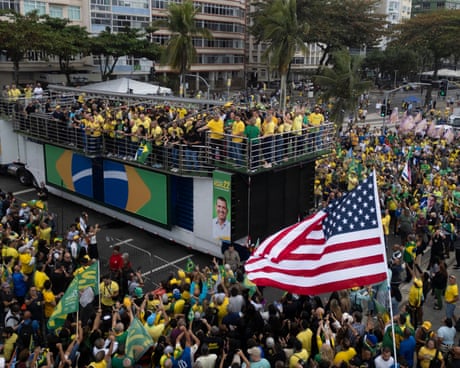
Claims that Trump and Rubio are trying to influence result have parallels with CIA intervention 64 years ago
The year was 1962 and the Kennedy administration was desperate to swing Brazil’s congressional elections against its leftwing president, João Goulart, as a way of countering the supposed communist threat sweeping a region the US considered its back yard.
Historians say that in the lead-up to the vote, the CIA and the Department of State secretly channelled millions of dollars to opposition candidates and a group tasked with spreading rightwing propaganda and stirring up unrest.
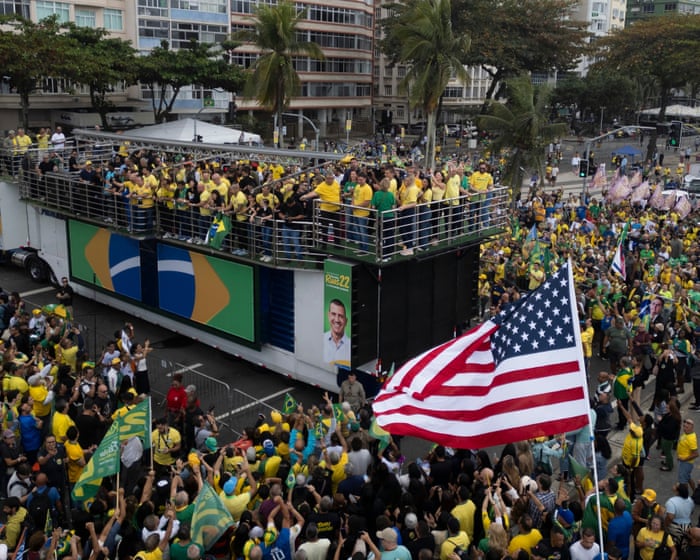
Claims that Trump and Rubio are trying to influence result have parallels with CIA intervention 64 years ago
The year was 1962 and the Kennedy administration was desperate to swing Brazil’s congressional elections against its leftwing president, João Goulart, as a way of countering the supposed communist threat sweeping a region the US considered its back yard.
Historians say that in the lead-up to the vote, the CIA and the Department of State secretly channelled millions of dollars to opposition candidates and a group tasked with spreading rightwing propaganda and stirring up unrest.
Questions over Trump’s ballroom and other structures might not feel urgent. But when his reign ends, Trumpism must be repudiated
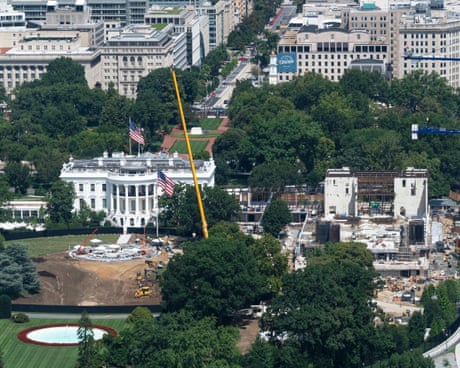
On Monday, a majority on the supreme court found a technical way to overrule a lower court’s imperative to stop work, while not taking a stance on whether the whole enterprise might be illegal to begin with. Preservationists, the majority held, appear to lack legal grounds for filing a suit blocking Trump’s ballroom; that means construction will proceed, even if none other than John Roberts, in a dissent, held that “those responsible” were breaking the rules in deciding “what to build up at the People’s House”. The solicitor general John Sauer is on record claiming that 65% of the project is completed (of course, he might have exaggerated – such things are known to have happened in Trump administrations). Either way, it is thus likely that there will be a massive structure next to the original White House; and, given that the ruling will embolden the president dramatically to change Washington DC’s landscape by spending money never approved by Congress, we might be cursed with a triumphal arch as well. All of which raises the question: what to do with a monstrous architectural legacy in post-Trump America?
Some might dismiss the question as a bit of a luxury problem. After all, a war that also demonstrates the ongoing disempowerment of Congress keeps dragging on; ICE continues its cruel day-to-day work; Trump is trying every tactic to make the midterms go his way. But the built environment, and especially the civic landscape of a capital, is never just an afterthought. Buildings and monuments make values visible, as the philosopher Susan Neiman once put it. And the decision to leave Trump’s structures in place as if his reign had just been another normal era in US history is not neutral – just like leaving Confederate monuments in place is not neutral.
Jan-Werner Müller is a Guardian US columnist and a professor of politics at Princeton University
Rollback of ‘roadless rule’ expected to benefit companies US Forest Service chief, Tom Schultz, previously lobbied for
Donald Trump this month announced plans to rescind a landmark rule that has protected old-growth forests in the US for 25 years. If finalized, the rollback is expected to benefit the companies that Tom Schultz, chief of the US Forest Service, represented in his previous roles as a timber industry lobbyist and executive, according to research by consumer advocacy non-profit Public Citizen.
The Roadless Area Conservation Rule, more commonly known as the “roadless rule”, was adopted in 2001 to limit development in roughly 45m acres of national forest. Industry interests and Republican representatives have long lobbied for the rule’s rescission, which would open up those swaths of untouched land to road construction, drilling and logging.
American Scoundrel tells story of McCarthy attack dog, mob lawyer and Trump mentor – will the president be thumbing its pages?
Kai Bird and Susan Goldmark have written a book Trumpworld doesn’t want you to read. Published on Tuesday, American Scoundrel is a propulsive, horrifying biography of Roy Cohn, the New York mob lawyer whose extraordinary life charted, as the book’s subtitle has it, a “Dark Journey from Joe McCarthy to Donald Trump”.
“I told my publicist to reach out to any of the Fox News hosts and reporters, to Joe Rogan, Steve Bannon,” Bird said. “We haven’t gotten a peep, other than Joe Rogan. He said he looked at the galleys, and he got back to my publicist and said, ‘I’m not interested.’ I’m kind of surprised. This is a serious biography of the president’s mentor, whom he publicly admires and says he still misses.”
The US will aim to persuade G20 members to take a hands-off approach to regulating AI, according to a Trump White House official, at a gathering of industry titans and commerce ministers that begins on Tuesday in North Carolina.
Leaders are convening at a key moment in the AI sector’s development and the global debate over how to govern it, and as the US faces an increasing threat from China for AI supremacy, Reuters reported.
A report detailed “grave concerns” that a new system being rushed into use by the U.S. Postal Service could imperil millions of mail ballots ahead of the midterm elections.
As Xi Jinping gathered with the leaders of Russia and Iran, Europe challenged the Trump administration at the G20, offering a split-screen view of a changing world.
After Justice Scalia died, the justices held private negotiations about locking away their papers. We may not see the ultimate record of the Roberts court for decades.
The non-profit Leaving Maga is built on the premise that abandoning the Trump-built movement is like fighting a disease or breaking an addiction
Stephania Messina kept birthing boys. In the Quiverfull conservative Christian church she belonged to outside Detroit, Michigan, that made her a community celebrity. Your quiver, as the church taught it, is your womb, meant to be filled with as many arrows – a metaphor for children – as you can shoot unto the Lord. She shot five. “They treated me like I was Mother Mary, like I was this gift to the church,” she said.
But while she was quickly pushed into leading worship and Bible study groups for women and children, she wasn’t permitted to talk about politics.
The Defense Department’s Office of Strategic Capital, founded by the Biden administration to give loans to bolster the U.S. defense industry, is helping lead President Trump’s oil deal.
President Trump said his defense secretary and secretary of state reached an agreement with the Venezuelan government on securing billions of barrels of oil reserves “through a partnership with private business.”
Lower-court rulings would have blocked construction of the 90,000-square-foot ballroom after finding that the Trump administration should have first sought approval from Congress.
Comments signal president prepared to use dispute to push UK to raise defence spending and Nato contributions
Donald Trump has suggested he is reconsidering US support for Britain’s sovereignty over the Falkland Islands, in a move likely to strain the “special relationship” between Washington and London.
“I always review every position – that’s just one of many,” the US president told reporters in the White House, in response to a question about whether he was reviewing the US’s position over the South Atlantic islands, an archipelago whose status has long been disputed by Argentina, which claims sovereignty.
President Donald Trump talks to reporters on May 19, 2026 about his proposed White House ballroom next to what used to be the East Wing. | Chip Somodevilla/Getty Images
Welp, the Supreme Court has decided that President Donald Trump gets to build his ballroom. The decision in National Park Service v. National Trust for Historic Preservation is 5-4, with Republican Chief Justice John Roberts joining the three Democratic justices in dissent.
Notably, no member of the Court argued that Trump’s ballroom, an enormous structure that the president plans to build on the former site of the White House’s East Wing, is legal. As Roberts points out in dissent, a federal law prohibits the construction of any “building or structure … on any reservation, park, or public grounds of the Federal Government in the District of Columbia without express authority of Congress.” And, as Roberts writes, “Congress has not passed any law resembling ‘express authority’ for the Executive’s construction of” Trump’s ballroom.
Nevertheless, the five Republicans in the majority manage to rule in favor of Trump by effectively immunizing his ballroom from federal lawsuits.
Their opinion highlights two of the most troubling things about the current Supreme Court: its reluctance to impose limits on Trump’s imperial-style presidency, and the frequent incoherence of its reasoning, especially in Trump cases.
Their opinion suggests that no one is allowed to sue to challenge Trump’s decision to destroy and replace much of the White House. But it is short, does not explain key points of its argument, and relies on several distinctions that do not make any sense.
As a general rule, no one is allowed to file a federal lawsuit unless they can show that they were injured in some way by the defendant they are suing — a requirement known as “standing.” But the Court has long held that plaintiffs suing under conservationist laws that seek to preserve a pristine, sacred, historical, or otherwise beautiful site have standing to bring a suit enforcing such laws against defendants who would damage or destroy such a site’s beauty.
In Lujan v. Defenders of Wildlife (1992), for example, the Court said that “the desire to use or observe an animal species, even for purely esthetic purposes, is undeniably a cognizable interest” that can be asserted in federal court. Similarly, the Court held in Friends of the Earth v. Laidlaw Environmental Services (2000) that “environmental plaintiffs adequately allege injury in fact when they aver that they use the affected area and are persons ‘for whom the aesthetic and recreational values of the area will be lessened’ by the challenged activity.’”
So that’s how standing worked right up until Monday afternoon, when the Court handed down its latest opinion. The new rule is…well, it is difficult to parse.
The plaintiff in National Park Service is a conservationist organization whose members include a retired professor who would frequently walk by the White House and who admired its beauty. Under decisions like Lujan and Friends of the Earth, that was enough to give her standing to sue in order to challenge the ballroom.
The five Republicans in the majority, however, falsely claim that this individual merely argued that she is offended by Trump’s construction project, and that past decisions have involved “more than mere offense.” The Republicans note that, in Friends of the Earth, the plaintiffs not only wanted to view a river, but also to fish and swim in it and to camp nearby. But they don’t really even attempt to distinguish Lujan beyond a vague statement that Lujan requires a plaintiff’s injury to be “concrete and particularized.”
Thus, because the majority opinion is so poorly explained, it is hard to tell what its implications will be. If the Court had explicitly overruled its past decisions holding that a plaintiff may often sue to challenge the destruction of something beautiful, that would be an existential threat to countless environmental, conservationist, and historical preservation laws that all exist to preserve natural or historic beauty.
But the Court’s failure to explain why Lujan does not require them to rule against Trumpleaves lawyers and judges to guess at what the Court just did to the rules governing standing. Perhaps this is a one-off decision intended solely to do a favor for Trump. Or maybe it’s the harbinger of a future decision setting much of America’s environmental protection regime on fire. The five justices in the majority barely explain themselves, so we cannot yet know what National Park Service means.
But one thing that is clear is that the decision makes no sense. As Roberts writes in dissent, “it now is the case that ‘I want to look at a crocodile’ can adequately answer the ever-critical ‘what’s it to you?’ question of Article III standing, while ‘I want to look at the White House’ cannot.” But the justices in the majority couldn’t even be bothered to explain why.
A Patriot missile is launched as part of the Patriot Air Defense System at White Sands Missile Range in New Mexico. | Corbis via Getty Images
This story appeared in Today, Explained, a daily newsletter that helps you understand the most compelling news and stories of the day. Subscribe here.
President Donald Trump’s on-again, off-again war with Iran is officially on again. (So recursive is this never-ending conflict, in fact, that I had to search my inbox to confirm I hadn’t already written that sentence!)
On Sunday, the US attacked rocket launchers Sunday on Iran’s Larak Island, claiming the strikes were necessary to prevent Iran from laying mines that could once again disrupt shipping through the Strait of Hormuz. Iran, meanwhile, responded by firing a volley of ballistic missiles at US sites in the United Arab Emirates and Jordan, where they were reportedly intercepted.
The latest skirmish comes after a month of relative peace and quiet, and six months after the war began. You’ll recall that Trump initially said it would last four to five weeks at the very longest.
But in the grand scheme of Trump’s Iran fictions, that optimistic timeline isn’t even the most flagrant. On Sunday night, the president also posted a video that purportedly showed Kharg Island, a central hub of Iran’s oil industry, “being blown to smithereens!!!” The video was, in fact, AI-generated.
The persistence of the war in Iran isn’t merely exhausting for those of us following along at home. As a group of high-ranking military commanders recently warned the Pentagon, the drawn-out conflict could also make America less safe by limiting the military’s ability to respond to threats in other parts of the world.
That unusual warning — first reported over the weekend by the Washington Post — suggested that the war in Iran is tying up ships and surveillance planes that the US needs elsewhere. Several top military leaders explicitly warned that the war had forced them to give up resources they needed to protect the US itself.
None of this means we’re defenseless, of course. But the war in Iran is taking up a lot of bandwidth. And should another conflict break out anywhere else on earth…the US and its allies could feel it.
One general warned the Pentagon that, without more resources, he could be forced to choose between protecting Israel and the US from ballistic missile attacks. And the Navy just moved its only dedicated aircraft carrier in the Pacific to the waters near Iran. “We are really robbing Peter to pay Paul,” one military expert told Vox in late February, even before we had any idea how long the war would last.
One link for later
➨ Ditch the doorbell camera. More than 62 percent of respondents in a recent US News survey said they had an outdoor security camera at home. But there’s not much evidence that those cameras reduce crime — and they can damage your relationship with your neighbors.
Before you go…
Did you know…that the known world basically ended around 1200 BCE? A number of sophisticated civilizations collapsed at the same time, probably due to some combination of prolonged drought, earthquakes, migration, war and political instability.
Today’s trivia: What was the name of Japan’s capital city before it was renamed Tokyo? (You can find this and other brain puzzles in Vox’s daily crossword. Look for the answer in tomorrow’s edition.)
Yesterday’s trivia: Last week we asked you for the name of the athletic conference where Georgia Tech competes. That would be the ACC, or Atlantic Coast Conference, which confusingly includes a number of schools in the West and Midwest.
Amid a backlash, Gov. Josh Shapiro is pumping the brakes on enormous data centers. But in a region scarred by the collapse of the steel industry, some welcome billions in construction.
Justices’ 5-4 ruling permits Trump administration appeal to block lower court order halting above-ground work
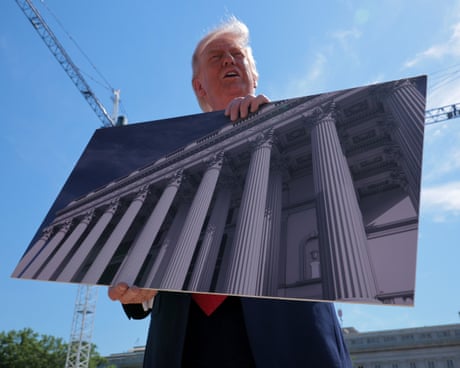
A divided US supreme court has permitted Donald Trump to continue building his controversial $400m White House ballroom despite legal challenges, raising the likelihood it will be completed.
In a 5-4 ruling, the justices permitted the Trump administration’s request to block a lower court order that had halted above-ground construction of the project while a lawsuit by a historic preservation group seeks to block it.
Justices’ 5-4 ruling permits Trump administration appeal to block lower court order halting above-ground work
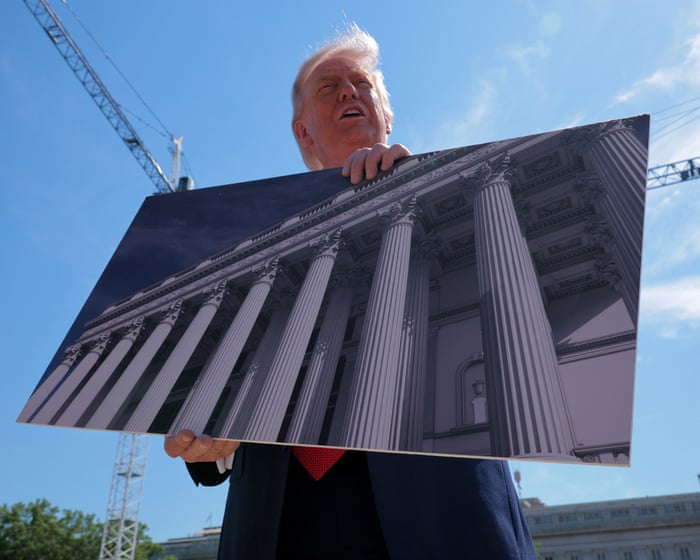
A divided US supreme court has permitted Donald Trump to continue building his controversial $400m White House ballroom despite legal challenges, raising the likelihood it will be completed.
In a 5-4 ruling, the justices permitted the Trump administration’s request to block a lower court order which had halted above-ground construction of the project while a lawsuit by a historic preservation group seeks to block it.

 Login
Login