A man dressed as President Donald Trump poses for photographs next to Phoenix Bloomfield from Toronto, as he holds up a large Canadian flag outside the White House on March 13, 2025. | Andrew Harnik/Getty Images
Welcome to The Logoff: President Donald Trump announced giant new tariffs on Canada, which are scheduled to start in 30 days. Now negotiators from both countries are scrambling to see if they can be avoided.
What happened? Late on Monday, the White House announced 50 percent tariffs on a slew of Canadian goods — including whiskey, cheese, down jackets, and (naturally) hockey sticks. Because the Supreme Court sharply limited his tariff powers earlier this year, Trump is invoking a largely forgotten and possibly defunct authority under Section 338 of the Tariff Act of 1930.
Previously, these goods had been covered under the USMCA, the trade deal Trump negotiated with Canada and Mexico in his first term to replace NAFTA. But on July 1, the agreement expired and the US declined to renew it.
Why is Trump doing this? The White House claimed three key grievances: Canadian duties and restrictions on American alcohol, dairy products, and automobiles. Liquor appears to be a special irritant: All but two Canadian provinces have pulled US-made booze from government liquor stores, and even some Democrats have complained.
However, the alcohol boycott began as retaliation for the trade war Trump launched in early 2025, when he was talking regularly about Canada becoming America’s 51st state. Much like his effort to reopen the Strait of Hormuz, Trump is trying to fix a problem he caused in the first place.
Interestingly, the tariffs will not go into effect for 30 days. This suggests that they may be less a serious policy initiative than a negotiating tactic.
What’s the takeaway: Trump’s lifelong fascination with economic warfare has survived the Supreme Court’s rebuke, and he continues to fixate on Canada as a special target of his ire. It is unclear why; both countries have suffered from the breakdown in bilateral relations.
But whatever the motivation, the ultimate outcome is clear: Icy relations to the north are a permanent fixture of the Trump presidency.
The Trump administration’s funding cuts to USAID have stalled global HIV prevention. | Arlette Bashizi/The Washington Post
If the US wanted to be the world’s police officer, then why not try to be its doctor too?
Just two months before the invasion of Iraq in 2003, George W. Bush announced an ambitious plan to pump $15 billion into the global fight against HIV, stunning his allies in Congress, health advocates, and heads of state of the program’s intended beneficiaries.
The President’s Emergency Plan for AIDS Relief, or PEPFAR, was the largest commitment by any nation in history dedicated to addressing a single disease, a disease that killed about 3 million people in 2003, most of them living in sub-Saharan Africa, and infected 5 million more. “Ladies and gentlemen,” Bush proclaimed in his State of the Union address that year, “seldom has history offered a greater opportunity to do so much for so many.”
On that, he was right. In the two decades to follow, PEPFAR would save an astounding 25 million people’s lives through lifesaving HIV therapies, and prevent millions of babies from being born with HIV in the first place, all at a cost of about 0.08 percent of the federal budget.
And yet, in the wake of the Trump administration’s foreign aid cuts, one of the greatest achievements in American history is now at risk. PEPFAR, mercifully, still exists, saved from the sledgehammer by an outpouring of bipartisan support last February. But experts say the program has been transformed beyond recognition by countless small cuts, and the abrupt gutting of global health architecture, reshaped not by decades of accumulated wisdom around HIV prevention, but by at times absurdly petty ideology.
Key takeaways
The Trump administration has severely disrupted the global fight against HIV, with 77 percent of formerly funded health groups losing funding or experiencing payment delays, according to a new survey by amfAR.
Those most at risk of HIV — like young women and LGBTQ people — have been disproportionately affected, in part because of the administration’s war on DEI.
For decades, presidents have pushed aside ideology to maintain funding for vital HIV services, like contraceptives and outreach workers. With President Donald Trump now shifting those norms, the consequences could be catastrophic.
Over the past year, more than 77 percent of PEPFAR grantees have lost funding or had their payments delayed, according to a survey released Tuesday by the HIV research group amfAR.
Nearly two-thirds of grantees — especially those supporting vulnerable populations such as LGBTQ people, young women, and sex workers — said the cuts had disrupted their ability to offer HIV treatments and other services. The Trump administration released limited data showing a deep reduction in HIV prevention services, but a relative consistency in access to treatment earlier this year. However, this new survey paints one of the first pictures available of how PEPFAR cuts are actually being felt on the ground, and how the administration’s priorities are reshaping who and what gets funded.
According to the survey’s authors, at least 1,700 HIV-related sites or clinics have shut down as a result of cuts. Well over 16,000 health workers — including those going door to door to make sure pregnant parents get tested for HIV or children get on treatment — have lost their jobs.
Many organizations surveyed reported receiving emails when their PEPFAR grants were terminated, noting that their work violated President Donald Trump’s executive order against “unlawful diversity, equity, and inclusion.” It appears, they say, that many of these groups were flagged not because they embraced the distinctly American concept of DEI in their work, but because their name or mission description included a phrase like “gender” or “LGBTQ.”
A health clinic serving survivors of domestic violence in Mozambique, for example, might now be flagged just for using the phrase “gender-based violence” in their name. This may be part of the reason why even pregnant women — who even the Trump administration has emphasized as a critical demographic in its HIV goals — have lost access to services.
Back in 2003, Bush defied conservative critics in his own party who attempted to redirect PEPFAR funding to abstinence-only programs. For decades, American presidents have been able to see past their ideology in service of saving lives. They largely understood that contraceptives like condoms and special interventions for those most at risk, including LGBTQ people, were necessary for stopping the spread of HIV. Under the Trump administration, this norm is unraveling.
“This administration has zero interest in addressing clinical outcomes for vulnerable people with HIV,” said Asia Russell, executive director of the advocacy group Health GAP, who noted that “to be effective, HIV prevention and treatment services actually have to go where the disease is, and that risk is not evenly distributed,” surging in certain geographies like South Africa or within key populations like trans people or young women. Getting support to these groups is “morally right,” she said, but it is also “the only way to do effective HIV work, regardless of your stance on the morals or the merits.”
The fight against HIV is running on fumes
When HIV aid does get doled out these days, it is distributed with far less transparency than in the past, and in ways that often appear to be ideologically or politically driven, both in terms of the populations they serve and the countries they operate in, rather than guided by best practices.
In theory, lifesaving HIV care was exempted from sweeping aid cuts last year. But in reality, access to even the most basic HIV services and treatments has also atrophied across the board, while falling disproportionately on at-risk populations.
That’s come both in the form of direct cuts and as a byproduct of broader disruptions to the kind of outreach services, testing, and socioeconomic programs that get patients in the door to begin with.
“You can’t cut pieces of the architecture of how PEPFAR functions and expect to maintain a really robust treatment program in the long term,” said Jennifer Sherwood, director of research and public policy at amfAR. “If you cut the testing program, the prevention programs, the kind of services that allow people to stay in care and return to care, you’re going to see that you can’t maintain a treatment program.”
The number of people getting on treatment for the first time has sharply declined over the past year, even according to the administration’s own limited data drop, while access to testing, contraceptives, and other preventative services — all critical to keeping infections down in the long run — face cuts that threaten their ability to function at all.
To make matters worse, amfAR’s survey shows that services designed for the populations most at risk of HIV — such as sex workers, LGBTQ people, young women, and teenage girls — have been disproportionately affected by PEPFAR cuts. Among those who lost funding, a staggering 90 percent of organizations that serve gay and bisexual men were forced to slash access to PrEP — which strongly protects against HIV infection — and many stopped offering it entirely. The same was true for over half of organizations serving pregnant women, whose children now face a higher risk of contracting HIV in the womb.
The majority of new HIV infections are concentrated in these “key populations,” as they’re known in public health parlance, many of whom face stigma or other obstacles to obtaining care. “One really powerful aspect” of how PEPFAR used to work, said Thomas McHale, public health director at Physicians for Human Rights, was that it consistently “followed the science and followed the epidemiology” to serve “groups that are at the margins of society.” That approach appears to have been thrown out under the new administration, and in at least some cases, actively discouraged.
McHale has been documenting the impact of PEPFAR cuts in South Africa in recent months, and “what we saw was a system under severe stress and strain,” he said. It is one in which a bisexual man stopped taking his HIV medications for weeks because the LGBTQ clinic he used to go to closed. “He just couldn’t bear the stigma of accessing services in a place that’s not meant for him,” according to McHale. Similarly, a young woman was forced to wait in line for 10 hours just to refill her PrEP prescription.
“If we’re not focusing on preventing disease,” McHale said, “it’s just a more expensive and more devastating challenge to address in the future.”
Some countries may soon stop receiving PEPFAR funding altogether
As I’ve written previously, the Trump administration has attempted to remake foreign aid into a dealmaking enterprise, one in which money flows directly through national governments rather than through large, western-led non-governmental organizations or NGOs.
In theory, there are benefits to this approach, because it prioritizes the expertise of local health groups and policymakers who are often best equipped to evaluate and address the needs of those in their care. In practice, however, amfAR’s survey shows that so far, under the Trump administration, local organizations have actually lost more funding and been forced to close more sites than international groups have. “These cuts fell heavily on locally-based organizations” while NGOs have fared somewhat better, said Sherwood, “and that really runs counter to all of our global health goals.”
“I’m concerned because public health is no longer how we’re measuring success” when it comes to reaching PEPFAR’s goals, said Jirair Ratevosian, a senior fellow at the Duke Global Health Institute who served as chief of staff of PEPFAR under the Biden administration. He is especially alarmed by the decision last month to end PEPFAR support for South Africa, which has the largest HIV epidemic in the world. The administration appears to have done so in part because of Trump’s insistence that the nation is waging a nonexistent “genocide” against white Afrikaners.
“If we’re not focused on preventing disease, it’s just a more expensive and more devastating challenge to address in the future.”
Thomas McHale, Physicians for Human Rights
“HIV control is not their chief concern,” said Ratevosian, who recently ran the numbers on a separate fissure with Zimbabwe, finding that cutting PEPFAR would lead to 75,000 new HIV infections in just one year. In South Africa, similar cuts could lead to over 2 million more infections over the next two decades, a toll that would invariably cross borders, and could threaten the world’s immense, hard-won progress against HIV. “You can’t have a global HIV strategy,” said Ratevosian, “if you’re not engaging these countries.”
Priorities shift under any new administration, and it’s not abnormal for an organization to tweak its language or services to adapt. But PEPFAR, the bipartisan program which began under Republican leadership, and thrived and expanded under three successive presidencies, including during Trump’s first term, has never faced such turmoil.
“Even among organizations who didn’t lose US funding, we’re still picking up changes to the way they work, the populations they serve, the words they use,” said Sherwood of amfAR. Her group’s survey showed that nearly 80 percent of organizations that did not lose funding still altered the way their organization worked to comply with new policies. “This network of changes from the US,” she said, “are prompting a lot of changes on the ground.”
Gut health is everywhere right now. The hashtag #GutTok has over 6 billion views on TikTok, the global digestive health product market is worth over $60 billion, and viral trends that promise to “hack your gut” through miracle products, cleanses, and restrictive diets are all the rage. But what does gut health really mean, and what can science tell us about how to make sure our gut is in good shape?
The gut microbiome, a complex network of trillions of microorganisms living inside our digestive system, may hold the key to the mysteries of gut health. We have a symbiotic relationship with all of those little guys; we keep them well-fed and they produce substances that can benefit our body and brain. These microbes help regulate bodily functions, protect against disease, and recover from illnesses like cyclosporiasis, which is spreading right now across the US.
But with so many voices chiming in on gut health, pushing everything from probiotic foods and supplements to wellness shots and coffee enemas, it can be hard to tell what information is based on real research and what might just be a marketing gimmick or social media clickbait. Vox spoke to doctors and visited Cedars-Sinai in Los Angeles to bust some gut health myths for science-backed advice.
Read more about gut health and gut microbiome research:
If you’re looking to wean yourself off social media and replace it with a more productive habit — and who among us isn’t — a lot of the common advice can sound like it’s coming from a drill instructor: Go outside and touch grass. Routine is key. Get your butt in the chair and don’t get up until you’ve done the work. They might as well be telling you to do a hundred pushups while they’re at it.
Key takeaways
Curiosity is one of the most powerful human motivators. That’s why social media preys on it.
To reclaim your time, find a question that interests you.
Try to answer that question.
Let the process spark another question for you.
Repeat.
Repeat.
Repeat.
As valuable as that advice may be when you need a kick in the pants, these imperatives create an uneasy tension between leisure and labor. It’s all well and good to try to turn away from the siren song of your phone, but how likely are you to stick with the alternatives — reading books, drawing, meditating — if they feel like homework?
It’s a lot more fun, and a lot less arduous, to try to beat social media at its own game instead, and harness your curiosity.
Social media apps work in part by playing off our natural curiosity. Every time we refresh the endless scroll, they promise to give us new information, capturing the parts of our brains that always wonder what’s about to happen next. But they rarely actually satisfy that curiosity. They just repeat it endlessly: What’s going to happen when I scroll this far? Or this far? Or this far? The answer is almost always: the same thing as last time.
Away from social media, however, the world works differently. If you get curious about a question off the algorithm, it can lead you somewhere new and interesting.
Even when we begin with a utilitarian goal, curiosity can take us in surprising directions. A few years ago, I got interested in running. At first I would just lace up my shoes, do a few perfunctory stretches, and jog straight out of my front door. But I gradually became curious about the mechanics of what I was trying to do. I began investigating running form, which led me to theories about how you should be doing different kinds of running every week. From there I learned about how strength training was important to support running, and then weight lifting led me to nutrition. I’m still not a particularly fast runner, but I am a data bank on all the ways there are for a person to make themselves just a little bit faster, and I know there’s more for me to keep looking into.
The goal here should be to get away from simple goals (running more, as in my example) to a more open and adventurous experience of what interests and engages us (understanding how I can support my body when I’m running). The experience is simple: Find something that fascinates you, learn a little more about that — whether from your friends, a documentary, or even an old-school internet search — then try to figure out what new questions that opens up and keep asking them. It’s a process that allows us to become our guides, whether we know where we’re headed or not.
In a recent essay, the writer John Paul Brammer explains that that’s exactly how he got himself to read more.
“Curiosity is a child,” Brammer writes. “When it wants something, when it truly wants something, it’s nearly impossible to keep its hands away.” Brammer found his way to reading by getting curious about David Foster Wallace, which in turn led him to Wallace’s influences: from Donald Barthelme to Thomas Pynchon to Clarice Lispector.
“I read out of strict obedience to curiosity, the desire to know what these words in this sequence might hold,” Brammer writes. “I had to make it fun at first. This was messy. I sipped from this book, then that one. It wasn’t formal or rigorous. I read whenever I felt like it.”
Where habits are mindless and rote, curiosity is something to be indulged: It’s fun, even hedonistic. Embracing curiosity means finding ways to play with art and ideas, as if they’re clay, instead of chipping away at them, as if they’re solid stone.
“The relevant science isn’t something I’m qualified to parse,” Brammer writes in his essay. But when I looked into that very science, I found that his experience aligned with it quite well.
“If you link curiosity to the accumulation of knowledge, you can actually self-boost your curiosity over time, with the end result of more continued interest.”
Kou Murayama, University of Tübingen
“People have likened the state of being curious about something to an aversive state,” says Celeste Kidd, an associate professor of psychology at UC Berkeley. “It’s unpleasant, akin to something like an itch. When you have that aversive state, when you really want some piece of information, it feels very satisfying to scratch it. There’s all sorts of positive feelings that come with satisfying specific curiosity.”
The endless scroll of our phone apps can function like a hydrocortisone cream, offering a balm for the irritation without really dealing with the cause. It’s not actually scratching the itch. To do that, you have to get curious about a question that can guide you through an idiosyncratic and looping itinerary that is never fully determined in advance.
Writer and tech designer Celine Nguyen has written about letting her curiosity guide her down rabbit holes in her essay on “research as leisure activity,” a phrase she borrowed from librarian Karly Wildenhaus. Speaking to me, Nguyen describes getting interested in the way the rise of vibe coding is affecting app design.
“This idea around shifting design processes made me think of this art historian Claire Bishop,” Nguyen says. Bishop’s most recent book deals with the way technology changes our response to contemporary art, and Nguyen says that “after reading that, I was like, ‘I really like reading about contemporary art and performance. What else can I read in this vein?’”
Nguyen followed her new interest in dance to a fixation on choreographer Pina Bausch, and soon found herself scouring the internet for still images from Bausch dances.
“It’s sort of like this pleasantly fizzy, almost like ADHD brain thing,” Nguyen says. “It sort of feels like I’m wandering around this massive information landscape and I’m just coming off all these images or all these reference points or quotes that speak to me, and maybe at the end of this process I can sum up what it is I’m interested in.”
The point at which you satisfy your curiosity can be dangerous. Once the itch is gone, the desire to learn can disappear completely — even if you don’t know as much as you think.
Kidd describes a study in which she tried to motivate people to learn a new fact about something they thought they already completely understood, but were actually wrong about.
“When we paid them to look up the right answer, they weren’t motivated to seek out more information,” she says. “They did it, but it was like they were out to lunch. They were thinking about something else. That information did not go in.”
According to Kou Murayama, a professor of psychology at the University of Tübingen in Germany, the best way to maintain your momentum is to marshal your ephemeral curiosity into long-term interest by letting the answer to one question prompt a new one, as if you were figuring out where to eat each meal in a new city by asking your waiters where they like to eat.
“If you link curiosity to the accumulation of knowledge, you can actually self-boost your curiosity over time, with the end result of more continued interest,” Murayama says. “Curiosity is basically short-lived, but if it’s linked to accumulating knowledge, or if you can link it to your self identity or importance, then you can self-booster interest.”
The trick is to, like Brammer and Nguyen, guide your curiosity toward a topic that can keep surprising you over time. What that usually means is to look for a topic that you already know a little bit about that can keep surprising you.
“We’ve done studies with 7-month-old babies, and they’re seeking out particular kinds of things in the world that violate their expectations, just a little bit but not too much,” Kidd says. “It tends to be the case that people want to elaborate on knowledge they already have as opposed to going into other domains. If there’s some way to relate a desired new set of expertise to something that you already have some background in, that’s a thing that you could absolutely do intentionally.”
So if you want to find some creative outlet for your time — or even if you just want to read more — there are straightforward steps to take: Look for something that excites your curiosity. Look for something that you are uncertain about, something so maddeningly unclear that you can’t help but itch at it.
This mystery doesn’t have to be about science or philosophy. It could be about what happens to a character in a particular thriller, or how to capture a likeness in charcoal, or what a certain part of your city looks like. The point is that it should be the kind of question that you can’t let go of.
Then indulge in finding the answer — and let that question prompt another one. Then another. Then another.
Iran-made ballistic missiles and two satellite carriers are displayed at a war museum in Tehran, Iran, on April 2, 2026, amid US-Israeli military operations in Iran. | Morteza Nikoubazl/NurPhoto via Getty Images
Even as the US conflict with Iran threatens to escalate once again, diplomatic talks break down, and US and Israel officials again flirt with the idea of pushing for regime change, President Donald Trump remains reportedly very reluctant to send US ground forces into Iran. That would risk causing large numbers of American casualties and pushing a war that many Americans have largely tuned out, even if they oppose it, back to the center of public debate.
But that, tragically, does not mean that American troops involved in the conflict are necessarily safe. The past few days have been the deadliest for US forces since an initial ceasefire went into effect in April. On Friday, two US servicemembers were killed in a missile strike on a base in Jordan, marking the second time in two days that Iranian missiles had managed a direct hit on the base. On Saturday, a third US servicemember was killed in Iraq during the attempted controlled detonation of a downed Iranian attack drone. Altogether at least 17 US servicemembers have now been killed since the beginning of Operation Epic Fury in February.
The US escalated its own attacks on Iran in retaliation, including a strike against the missile base in Tabriz, Iran where the attack on Jordan is thought to have originated. Iran has also fired missiles and drones at targets in Bahrain, Kuwait, and Qatar in recent days, most of them intercepted, as well as at several commercial ships in the Strait of Hormuz, where traffic has again ground to a near halt.
If Iran’s ability to shut down the strait has been the biggest surprise of this war, it’s ability to hold targets on land throughout the region at risk, including energy infrastructure and US military bases, with missiles and drones, may be the second.
This suggests the risks to the US military as well as US allies from Iranian retaliation may only grow, the longer this conflict drags on, even if Trump never commits to “boots on the ground.” The president has sought to portray this as a war where the risk of death and destruction is borne only by one side, and certainly Iran has sustained far more damage. But there have already been a number of surprises in this war and the risks to the American military may be higher than most anticipated a few months ago.
The growing risk to US troops in the Middle East
In the early days of the war, the military began shifting troops and equipment from bases in Persian Gulf countries like Bahrain, the United Arab Emirates, and Qatar farther west to Jordan and Israel, where they are subject to fewer local restrictions and where they sit farther from Iranian missile launchers. Satellite imagery and subsequent reporting has revealed that Iranian strikes did far more damage to these bases during the first phase of this war than was revealed at the time.
More distant US bases may be harder to hit, but they are clearly still within the range of Iran’s missiles and Shahed drones. Some analysts also say the shift may have created new vulnerabilities by concentrating US personnel and equipment in fewer locations.
The missile strike that killed Lt. Tyler James Feehan and Pvt. Isabella Gonzales on Friday was one of four Iranian attacks against bases in Jordan in just five days. The Iranians in fact appear to be striking Jordan more than Israel in recent days, which could be because these targets are less well-defended than Israeli bases or because they carry less escalation risk: Israeli leaders, unlike Trump, are eager to rejoin the war.
US officials suggested to the Wall Street Journal that Iran is adapting to US air defenses by “firing missiles that travel at extremely high speeds and can maneuver as they streak toward the earth,” making them harder to intercept. The officials also suggested the Iranians may be receiving targeting assistance from China or Russia.
Or it may simply be that if Iranians can keep firing missiles and drones, no system will be able to provide perfect protection.
“What it actually shows is that Iran is in a lot better shape than was assumed,” said Nicole Grajewski, an expert on Iran’s missile program and professor at Sciences Po in Paris. “Contrary to a lot of the US statements from early parts of the war, Iran still retains quite a significant amount of missile and drone capabilities, and because they’re not operating now under constant aerial bombardment, they may have been able to reconstruct part of it.”
According to assessments reported in June, Iran still has access to most of its missile sites and around 70 percent of its prewar stockpile.
And while Iran still possesses the ability to punch, there are growing questions about whether the US air defense capabilities are depleting. At the time of the April ceasefire, the Center for Strategic and International Studies estimated, the US had likely burned through more than 1,000 of its roughly 2,300 stockpile of Patriot interceptors, and between 50-80 percent of the highly advanced THAAD interceptors, designed for use against high-altitude, long-range ballistic missiles.
The Pentagon has been pushing defense manufacturers to accelerate the production and bring down the costs of advanced interceptors, but that will take months if not longer, depending on the system. In the short term, missile defense scarcity is going to continue to be a source of stress if this conflict escalates.
“We do not have enough [munitions] to safely sustain operations, and I don’t think the White House is aware of that,” one US official told the Washington Post this week.
The US no longer dominates the skies the way it once did
US troops in the Middle East have long been vulnerable to missile attacks. One particularly infamous Iraqi Scud missile strike killed 27 American soldiers during the first Gulf War in 1991.
But the proliferation of one-way attack drones like Iran’s Shaheds have shifted the balance, giving weaker adversaries the ability to target US bases at low cost. The attack that killed the two servicemembers on Friday was, like many of Iran’s attacks in this war, a combined missile and drone barrage intended to overwhelm the facility’s defenses. The best-case scenario from these strikes, from a US perspective, is that they are intercepted, albeit at the cost of draining valuable air defense resources. In the worst case, US soldiers are killed.
A strike on another base in Jordan in early 2024 by the Iran-backed militia group the Islamic Resistance in Iraq, during the war in Gaza, that killed three US servicemembers was in some ways a warning of the risks US troops would face in a scenario where Iran itself targeted them with its full capabilities. Since at least the Korean War, the US military has gotten used to fighting with more or less full control of the skies. As far back as 2022, Gen. Frank McKenzie, commander of US forces in the Middle East, warned that “air superiority is something that we no longer have all the time” due to the proliferation of low-cost drones, which he compared to the improvised explosive devices, many planted by Iranian proxies, that killed hundreds of US troops during the war in Iraq.
Thankfully, US casualties in this war are still nowhere close to those of either Iraq war. Trump told reporters on Sunday that “We feel very badly” about the deaths but that “those great patriots were out there fighting so that Iran does not have a nuclear weapon.” In recent weeks, the main focus of the war has been control of the Strait of Hormuz, rather than Iran’s nuclear program.
The hard logic is that just as high fuel prices and declining poll numbers have not yet been enough to deter Trump from continuing to fight Iran, a few American casualties are not enough to be a deterrent to military action. In fact, as this weekend’s retaliatory strikes against Tabriz showed, they may only pull the US deeper into the war.
As long as Trump avoids a ground invasion, Iran’s ability to target and kill US troops will remain limited. But as this past weekend’s events showed, that ability exists, and there is only so much the US can do to prevent it. The risk of an even larger catastrophe for American troops in the Middle East will only grow the longer this war goes on.
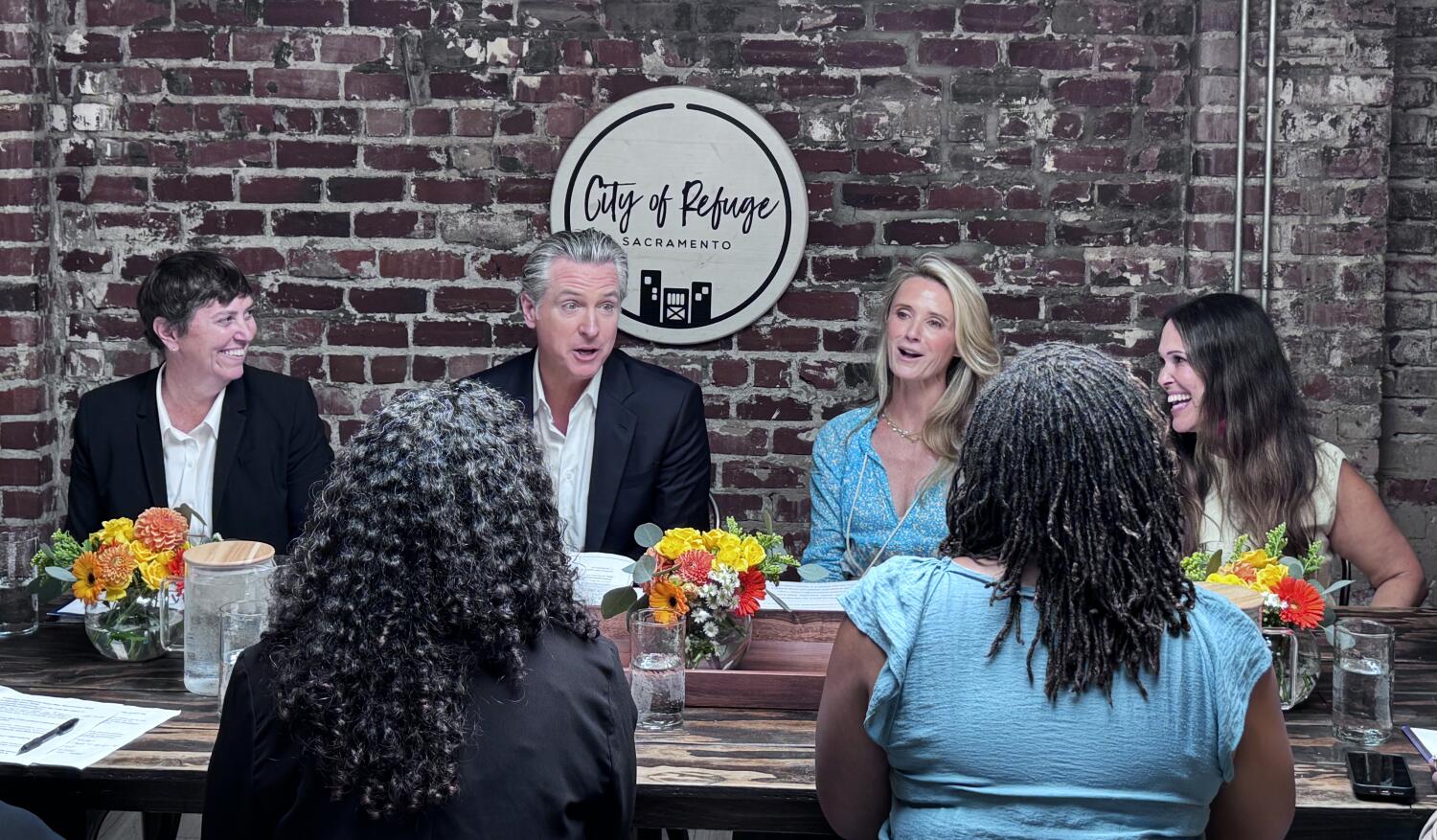
Gov. Gavin Newsom signed an executive order calling major state agencies to come up with a plan within 60 days to work together to curb trafficking and help survivors.
Gov. Gavin Newsom and First Partner Jennifer Siebel Newsom at an event to sign an executive order on sex trafficking in Sacramento. Anita Chabria / Los Angeles Times
Rep. Alexandria Ocasio-Cortez (D-NY), Michigan Democratic candidate for Senate Abdul El-Sayed and Sen. Bernie Sanders (I-VT) greet the crowd after El-Sayed spoke at a rally on July 18, in Detroit, Michigan. | Sarah Rice/Getty Images
A decade’s worth of grudges and feuds between the Democratic establishment and the insurgent left is coming to a head in one election this year: Michigan’s Senate primary.
Key takeaways
Many long-simmering grudges between the establishment Democratic Party faction and a faction supporting Sen. Bernie Sanders have come to the fore in Michigan’s Senate primary.
Dynamics involving gender and race, concerns over electability, and claims of establishment malfeasance closely mirror dynamics in Sanders’s two presidential runs.
Every intra-Democratic controversy over Israel — from the influence of AIPAC to claims of antisemitism — has come up too, showcasing a party with some bitter divides.
The contest between Rep. Haley Stevens and Abdul El-Sayed has somehow unearthed every fault line that’s divided the two factions over the years — from gender and racial politics, to Israel and Gaza, to questions of electability and fair play, to money in politics, and much more.
On one side there’s Stevens, a four-term House member who is the preferred candidate of the Democratic establishment — and of AIPAC, which has spent nearly $30 million to support her campaign.
On the other is El-Sayed, a former public health official who’s been backed by Sen. Bernie Sanders, Rep. Alexandria Ocasio-Cortez, and their network of supporters and fans.
But the race has quickly gone beyond just them and become about something bigger — the national struggle for influence in the Democratic Party.
“This is the quintessential contest between the establishment wing of the Democratic Party and the economically populist wing,” said Joseph Geevarghese, executive director of the left group Our Revolution.
In contrast, Jonathan Cowan, president of the center-left group Third Way, argued that nominating El-Sayed — a “super extreme candidate who will alienate lots of voters in the middle” — is a dangerous risk.
In this one race, the Democratic factions are relitigating the 2016 presidential primary, the 2020 presidential primary, and several major controversies of the past few years, all at once. And whoever wins will have to find a way to somehow unite the party and win a competitive general election against presumptive Republican nominee Mike Rogers.
On gender and racial politics, we’re doing 2016 again
When Sanders challenged Hillary Clinton for the 2016 presidential nomination, her supporters frequently implied he had blind spots related to gender and race. They argued, for instance, that certain criticisms of Clinton (and remarks by Sanders) were sexist, and that Sanders’s poor performance with Black voters demonstrated the limits of his appeal.
The discourse also sometimes focused on so-called “Bernie Bros” — online Sanders supporters who, critics argued, directed toxic abuse and vitriol toward people not in his camp. Sanders’s backers argued that the accusations of sexism were themselves a dishonest and inaccurate smear to distract from Clinton’s own shortcomings.
All of this is happening again now in Michigan.
On gender, a comment from El-Sayed a few weeks back — he said Stevens was unable to “string together two coherent sentences” — was criticized by the Stevens camp as sexist.
Then, last week, a video of an enthusiastic speech by Stevens on the campaign trail went viral as online El-Sayed supporters mocked her diction and delivery, viewing her way of speaking as self-evidently ridiculous.
Seeking to tamp down this behavior, El-Sayed posted Friday that the way “people online” were making fun of Stevens “for things that have nothing to do with her policies” was “unkind and unhelpful.” He also told Vox’s America, Actually podcast that the accusations of him being disrespectful to women have gotten back to his daughter, and been hurtful.
Meanwhile, on race, a poll last week shows Black Democrats splitting 67 percent for Stevens, and 21 percent for El-Sayed. Days later, the Congressional Black Caucus PAC endorsed Stevens. Just like Clinton in 2016, Stevens is hoping support among Black voters who are longtime stalwarts of the Democratic base will be enough to carry her to victory. And just like Sanders in 2016 and 2020, El-Sayed is facing questions about whether the party’s left vanguard can expand its support beyond white, college-educated voters.
“The progressive brand really, really underperforms with Black voters all around the country,” said Adrian Hemond of the Democratic advocacy firm Grassroots Midwest. “I think it’s worth Democrats, media, and people in the nonprofit blob asking themselves why that is.”
The establishment vs. insurgent tension, and the Obama of it all
In both of Sanders’s presidential runs, his team griped about the behavior of the Democratic establishment, arguing that they weren’t truly playing fair. For instance, they pointed to how the DNC initially scheduled very few debates for the 2016 presidential contenders, arguing the supposedly neutral committee was in fact trying to help the frontrunner, Clinton, by limiting attention on her opponents.
To Sanders’s supporters, the bitterest pill was the perceived late intervention of former President Barack Obama into the 2020 campaign just as Sanders appeared well-positioned to win the nomination. (Days before the crucial Super Tuesday primaries, two other candidates, Pete Buttigieg and Amy Klobuchar, dropped out and endorsed Joe Biden. Obama was publicly neutral, but privately called Biden and Buttigieg during this key period, raising speculation about his role.)
In Michigan, again, the Democratic Senatorial Campaign Committee is officially neutral, but Senate Minority Leader Chuck Schumer has long been understood to favor Stevens, and reportedly has privately asked donors to back her.
Obama, too, has become a flashpoint. An AIPAC-linked group has spent millions on an ad showing Obama praising Stevens — even though he has not endorsed her in this race. The praise is from comments Obama made during Stevens’s first House campaign, in 2018. (Stevens had worked on his presidential task force to rescue the auto industry during the Great Recession.)
El-Sayed’s supporters have argued that this is an attempt to mislead Michigan voters into thinking Stevens has Obama’s backing. “It is disgusting that AIPAC — which spent tens of millions attacking Obama — is now spending like crazy to lie and suggest he endorsed Haley Stevens,” Ben Rhodes, a former Obama White House official who supports El-Sayed, posted on X.
Others suspect that Obama does in fact tacitly support Stevens, and that’s why he’s letting the ad stand without clarifying things. (El-Sayed thought Obama was too “centrist” and “middle of the road,” he told Vox in 2017.) And yet again, people are fighting over 2016: Some Stevens supporters point out that Sanders used footage of Obama praising him in a 2020 primary ad despite the senator’s own criticism of the former president.
Israel/Gaza, AIPAC, antisemitism, money in politics, Hasan Piker, etc…
Of course, the issue that has come up repeatedly in tense Democratic primaries this cycle — Israel — is present in this race in a major way.
Many on the left argue that the war in Gaza contributed to former Vice President Kamala Harris’s defeat by disillusioning some of her potential supporters and dissuading them from turning out. The evidence that this phenomenon occurred in significant numbers due to Gaza specifically is thin. But it arguably may have been a factor in Michigan, where 2 percent of the population is Muslim and Trump worked hard to court disaffected voters with vague promises to end the war.
Here, Stevens is an unapologetically pro-Israel candidate who wants to continue US military aid to the country and does not believe Israel committed genocide in Gaza. (She said during a Hanukkah event once that “Israel comes to me in my dreams.”) El-Sayed, in contrast, has been sharply critical of Israel throughout this race.
The center-left group Third Way has spent months attacking El-Sayed for campaigning with left-wing streamer Hasan Piker, arguing that comments of Piker’s — that “America deserved 9/11,” and that a certain sect of Israeli Orthodox Jews was “inbred” — are un-American and antisemitic. (Piker has said he calls lots of different groups he dislikes inbred.)
Meanwhile, Stevens has been the beneficiary of that nearly $30 million in AIPAC-linked spending — a topic she generally tries to avoid discussing. The ads in question don’t talk about Israel at all and instead praise Stevens on other issues. “It is just a clear indication of where the base of the party is right now that AIPAC has to continually do this spending through their allied outside groups,” Dani Negrete of Indivisible, a progressive group backing El-Sayed, told me.
Electability and the question of: who can’t win?
After a decade of factional squabbling, the left and the mainstream factions have each honed their talking points for why, when a Democrat loses the general election, it’s the other faction’s fault.
To the establishment, left candidates are risky bets: They’ve taken positions that may alienate swing voters and are less dependable than candidates with longer electoral pedigrees.
In endorsing Stevens this month, Sen. Gary Peters (D-MI) warned they needed someone who was “fully vetted.” El-Sayed’s supporters viewed these and other remarks from Stevens supporters as baselessly linking their candidate to Graham Platner, who dropped out of his race in Maine over sexual assault allegations that he denies. However, unlike Platner, who was plucked from obscurity, El-Sayed has been a political figure for nearly a decade and faced significant media scrutiny already.
Another version of the critique is more about whether El-Sayed’s policy positions — for instance, his past support for defunding the police, and his backing of Medicare-for-all — are too far left for this swing state in the general election.
Meanwhile, the left’s argument for why establishment candidates flop is that they fail to excite the base and stimulate turnout. Therefore, they claim, El-Sayed is the safer choice.
Lately, this argument has focused on Israel and Gaza. Left commentators argue that the Biden administration’s support of Israel and failure to stop what they call a genocide in Gaza was a major — perhaps the major — reason Harris lost in 2024, because part of the Democratic base was disillusioned and didn’t turn out. So, some on the left have suggested, if Stevens is the nominee, Democrats are risking the seat by disillusioning the same voters.
The mirror of this argument, from the establishment, blames the left for causing this disillusionment. By criticizing rival Democrats in harsh terms and casting them as pawns of special interests, they prime their voters to sit out the general election after their own candidates fail to win the nomination. “Bernie Sanders is the reason that Donald Trump is president,” famed Democratic consultant James Carville said last week, arguing this was because Sanders convinced his own supporters the Democratic Party was corrupt.
This fight has played out in miniature in Michigan. Stevens has accused El-Sayed of undermining Democrats in 2024 by backing the “Uncommitted” movement, which sought to protest Biden’s Israel policy in the primaries. El-Sayed, conscious of this criticism, has gone out of his way to emphasize his early support for Harris in 2024, in contrast to others who sat out the race. But he’s also warned that the wrong Senate candidate could recreate the conditions that led to her loss.
Last week, a post from one El-Sayed supporter that he would not vote for Stevens in the general election went viral. “The Democratic Party needs to be anti-AIPAC, not pro-AIPAC, and it only happens if candidates like Haley Stevens don’t win in general elections,” Adeeb Hafeez posted on X.
The next day — after critics argued this could lead to an even bigger conservative Supreme Court majority — Hafeez walked it back a bit. He posted that he “may hold my nose and end up voting for” Stevens after all in the general if she advances — but that he’d “be very uncomfortable in doing so.”
The exchange underscored the challenge for Democrats in coming together after the primary. No matter who wins, they’ll carry the scars of not only this race, but election after election pitting left-wing candidates against moderates, each of which have left behind bruised feelings and mutual suspicion.
Some lawmakers appeared frustrated as they sought clarity on the Trump administration’s strategy for the conflict amid renewed hostilities and a $67 billion funding request.
Andy Burnham, then the mayor of Manchester, speaks onstage during the 2023 SXSW Conference in Austin, Texas. | Sean Mathis/Getty Images
This story appeared in Today, Explained, a daily newsletter that helps you understand the most compelling news and stories of the day. Subscribe here.
The first thing you need to know about the UK’s new prime minister is that he’s previously moonlighted as a DJ.
Okay: probably not the first thing you needed to know. And sure: That DJ gig was for charity.
But it still tells you a little something about Andy Burnham, who today became the UK’s seventh prime minister in 10 years. He’s widely seen as a pragmatic, affable, down-to-earth kind of guy — more Zohran Mamdani than Keir Starmer.
As the longtime former mayor of Manchester, the UK’s second-largest city, Burnham won adoration for his focus on improving public transit and affordable housing. His vocal advocacy for England’s post-industrial cities even earned him the nickname “the King of the North.”
Burnham’s first speech as prime minister, delivered (without notes!) on Monday morning, doubled down on some of those populist themes — including the need to bring down Britain’s cost of living and address homelessness.
Political observers don’t expect Burnham’s policies to actually differ all that much from those of Starmer, his predecessor. (They’re both members of Britain’s center-left Labour Party.) And the fundamental relationship between the UK and US is also expected to stay much the same.
Asked how he’d relate to President Donald Trump, Burnham said: “I like to think I’ve got some personality myself.” You can be the judge of that! There’s video of his 2022 DJ set.
Call it a breturn or a brejoinder — it’s a tantalizing prospect for the majority of Britons, who now either have soured on their country’s 2016 vote to depart from the EU or never supported Brexit to begin with.
But undoing Britain’s break with Europe would be a monumental undertaking. First, the government would likely need a clear political mandate from British voters, either through a second referendum or a general election where a breturn figured heavily.
Then the UK would have to negotiate its way back into the bloc…and convince all 27 member states to give it another go. Some could approve accession with parliamentary votes. But others, including France, could require national referendums of their own.
“Countries have very different views of Britain,” one European observer told Vox last month. “There are those that still think that the EU is better off without Britain.”
Did you know…that despite all the evidence to the contrary — license plates, hip-hop lyrics, etc. — a minority of American peaches are actually grown in the great state of Georgia?
Today’s trivia: Nahuatl is still spoken by millions of people today. But it was also the primary language of which former Mesoamerican civilization? (You can find this and other brain puzzles in Vox’s daily crossword. Look for the answer in tomorrow’s edition.)
Friday’s trivia: On Friday, my colleague Dylan Scott asked you for a Russian name that means “holy.” That would be Oleg, as in Oleg Cassini — the Russian count turned designer who dressed former first lady Jackie Kennedy.
The World Cup trophy presentation got awkward when President Trump lingered onstage after Spain's 1-0 win over Argentina, evoking a similar episode at last year's Club World Cup.
Ismael "El Mayo" Zambada, a co-founder and longtime leader of Mexico's Sinaloa cartel, was sentenced to life in U.S. prison by a federal judge in Brooklyn.
Ukraine’s long-range drone attacks, including strikes this weekend on e-commerce warehouses, have undercut the Kremlin’s efforts to shield most Russian citizens from the war.
Sauerkraut in a ceramic bowl. | Natasha Breen/REDA/Universal Images Group via Getty Images
Fermented food is the hottest new trend in the halls of the White House. Members of President Donald Trump’s Cabinet are reportedly walking about with jars of sauerkraut in the hopes that it will give them glowing skin and tiny waists.
Wall Street Journal’s Liz Essley Whyte told Today, Explained co-host Sean Rameswaram that “Health Secretary Robert F. Kennedy Jr. Commerce Secretary Howard Lutnik, Transportation Secretary Sean Duffy, and Vice President JD Vance are all on this eat-a-lot-of-steak-and-sauerkraut diet.”
So, should we all be eating jars of sauerkraut? Or are ferments just the new Florsheims?
Below is an excerpt of their conversation, edited for length and clarity. There’s much more in the full podcast, so listen to Today, Explained wherever you get your podcasts, including Apple Podcasts, Pandora, and Spotify.
Is there a name for this diet?
Kennedy calls it the carnivore diet. I think people mean different things when they say that, but for him, it includes a lot of yogurt, a lot of kimchi or sauerkraut, a lot of steak, a lot of eggs. Kennedy now travels with sauerkraut. His wife has said that he has asked her to carry it in her purse for him, and she has said, “I actually cannot,” which is an amazing phrase. It seems they all think their skin is glowing, and people online have commented that JD Vance is looking good.
Are we sure it’s not Wegovy?
We don’t have any public knowledge of that, but we do know that he is eating eggs, sauerkraut, pickles, blackberries, and raspberries for lunch pretty often — and beef and lamb with sauerkraut for dinner. Then, when he’s on Air Force Two, he snacks on beef jerky and maybe eats a hamburger with cheese, no bun, and a side of fermented vegetables.
Now that you’re mentioning the full spectrum of JD Vance’s diet, it’s kind of reminding me of their new food pyramid. Is this part of that?
Earlier this year, Kennedy and the other health officials like to say they flipped the food pyramid. They recommended a lot more fruits and vegetables, red meat — which was controversial — and whole grains, and whole milk, that kind of thing. They also, and for the first time in the nation’s dietary guidelines, recommended fermented foods, which was something that was actually agreed upon by a lot of people, and they thought that was a good part of this, even if they had qualms about the red meat recommendations, because those can introduce more cardiac risk and risk of bad cholesterol.
How widespread is this in the White House? Does it go up all the way to the top, to the president?
Given what we have seen of his recent public dieting, I don’t think so. At the Knicks game, he was eating pizza and french fries, and, you know, he still has his Diet Coke button on his desk where he just pushes it and a Diet Coke comes. Kennedy said, once said on a podcast about him, “I don’t know how he’s alive.”
Does the science back this up, or is this some kind of quackery that ferments can make your skin healthier and help you lose weight?
I don’t think there are a lot of good studies that show exactly that sauerkraut can help you lose weight, but there have been a number of studies that have shown health benefits. Researchers have generally agreed that sauerkraut and other fermented foods can help with digestion and inflammation. There was a 2025 study from UC Davis that suggested fermented cabbage could protect your gut and protect against illness. Basically, they found that the intestinal cells do better with sauerkraut. They help maintain the integrity of those intestinal cells. And, in general, that has a lot of other good health effects. Mainstream scientists, dieticians, are pro-fermented veggies. This is not something that is hotly debated.
Most people in the scientific community are realizing there’s a lot of good fresh science out there about how important your gut really is in your overall health. The part of the diet that is a little more controversial is the focus on red meat. Obviously, that comes with some cardiac risk and some cholesterol risk. That is why when the new dietary guidelines came out and recommended more of that for Americans, that part, in particular, made some dietitians a little upset.
Do you think fermented foods could help people with this parasite that gives you explosive diarrhea?
I personally have not seen any studies on whether fermented foods help with explosive diarrhea, but let me know if you find one.

 Login
Login