Christina Applegate at the 2023 Screen Actors Guild awards. | Valerie Macon/AFP via Getty Images
Christina Applegate, the actor who has been one of the most visible faces of multiple sclerosis since her 2021 diagnosis, made a stunning revelation this week: She does not have MS after all. And her doctors still don’t know what is causing her debilitating symptoms.
“I’m back at square one,” Applegate told fellow actor Jamie Lynn Sigler, who does have MS, on Sigler’s podcast MeSsy. “I was not happy at all. Everybody else was so happy.”
It is a harrowing predicament for Applegate, and hopefully her medical team is able to get her the diagnosis and treatment she needs. But the fact is, her experience is not unique. Even as more and more Americans get diagnosed with multiple sclerosis, misdiagnosis remains all too common. According to one meta-analysis, roughly 15 percent of MS diagnoses may actually be false positives.
How could such a common medical condition — roughly 1 million Americans are living with the disease, about one in every 350 people — remain such a mystery? After Applegate’s announcement, I called some leading experts on MS to ask why diagnosing the disease is such a challenge, and what they want people to know. Here’s what I learned.
Why MS can be challenging to diagnose
Multiple sclerosis is an autoimmune condition: The body mistakenly attacks cells meant to protect your brain and spinal cord, and the resulting damage interrupts nerve signals and causes the disease’s telltale symptoms of motor impairment, tingling sensations, and vision problems. Some people experience a rollercoaster of relapses and remissions; others see the disease steadily progress, eventually leading to serious disability.
The reality is, scientists still don’t really know what causes MS to develop, said Dr. Andrew Solomon, a neurologist at the University of Vermont who specializes in MS. Smoking is a known risk factor. Obesity and metabolic problems play a role, but we need more research. Even the precise role of genetics remains something of a mystery. “We don’t really know what causes or triggers the autoimmune response in any given individual,” Solomon said.
And that’s where the challenge in diagnosing it begins.
First, the testing can be imprecise; there is not a single test that reliably diagnoses MS. If a doctor suspects their patient may have MS, they usually undergo an MRI, which their physicians then scour for lesions that are typically associated with the disease. But those scans are still subject to interpretation: Other rare conditions sometimes resemble MS in imaging, as can diseases of blood vessels in the brain. You can also receive a spinal fluid analysis to check for abnormalities in your immune system, which the vast majority of MS patients have.
The nature of MS symptoms adds to the difficulty. They can often be vague early on: brain fog or fatigue or a general malaise. The tingling or vision problems can be similar to symptoms for other conditions that are not MS, and they are easily dismissed if they go into temporary remission, as often happens during the initial phases of the disease.
“Neurological symptoms sometimes can be vague — numbness, pins and needles — and it’s usually short-lived,” Dr. Saud Sadiq, chief research scientist and director of the Tisch Multiple Sclerosis Research Center of New York, told me. “Unless they’re taken seriously initially, they may be ignored because by the time the patient goes through the healthcare system and is actually referred to a neurologist, the symptoms have abated.”
If your doctor is diagnosing you with MS, ask directly: What’s the evidence?
“Because it’s so heterogeneous, it doesn’t present in the same way in everybody and can have varying severity, it can be hard to diagnose sometimes,” Solomon said.
Lastly, when people are experiencing debilitating symptoms, there is pressure to deliver some diagnosis — and that may push some doctors to leap to MS even if they are not sure, Solomon said. The recent advent of effective treatments that help manage the disease’s symptoms, especially when it is caught early, may add to that pressure, even if the better course would be to continue monitoring the person before they start a medication.
“There may be a lot of clinicians who, if they can’t find a better explanation than MS, may be inclined to diagnose MS, even if they don’t really meet our diagnostic criteria, because they’re worried about missing a window of opportunity to treat somebody,” Solomon said.
There is reason to hope the MS misdiagnosis problem could get better. The National Multiple Sclerosis Society released new diagnostic criteria in 2024 that Solomon said more physicians should become familiar with to better distinguish MS from problems like migraines or vascular disease. And because imaging is involved in diagnosis, there is optimism that AI could be a powerful new tool in delivering more accurate results.
What everyone should know about MS symptoms and diagnosis
The good news is that MS, when diagnosed properly, is a treatable condition these days. “The prognosis with new drugs is extremely good for long-term care,” Sadiq told me. “If patients stick to treatment at a good MS center, you can look forward to a life without disability in 2026.”
So it is worth being vigilant and talking to your doctor if you experience any concerning symptoms. You should seek care if you have numbness or pins and needles that persists for more than 24 to 48 hours, Sadiq said, or have motor problems, like one hand won’t work as you try to play piano. Dr. Annette Langer-Gould, who develops and evaluates programs for MS care at Kaiser Permanente, said numbness in your abdomen, chest or back, as opposed to your extremities, is a particular cause for concern. If one eye has normal vision and the other is blurred, that’s another good reason to get checked out.
If you do get tested, make sure the actual images of your MRIs end up being reviewed by an expert in MS. “The most common reasons the disease is still misdiagnosed are related to the providers’ lack of expertise usually in reading MRI scans,” Langer-Gould said. The spinal tap may sound scary, and doctors sometimes don’t recommend them because their insurance reimbursement is low — but they add to the confidence of a diagnosis. They are worth it, she said.
“American patients are very afraid of the spinal tap,” Langer-Gould said. “My message to patients is: Listen, just get the spinal. This way we’ll be sure.”
And do not be afraid to seek a second opinion for such a serious diagnosis, Sadiq added. Every state has a recognized MS center. If your doctor is diagnosing you with MS, ask directly: What’s the evidence? If your doctor is recommending that you start treatment, it could also be worth checking whether they have a relationship with a pharmaceutical company that affects how you perceive their judgment, Langer-Gould said.
People who have already been diagnosed may also be shaken by the Applegate news and question whether their own diagnosis might be wrong. Solomon said that folks should have a frank conversation with their physician about how exactly their case met the diagnostic criteria. With proper imaging and the spinal fluid tests, you can get to a confident diagnosis for the vast majority of people. But be your own advocate to make sure you’re satisfied.
“For many people, the diagnosis actually can be very straightforward,” Solomon said. “We really have no question about what it is.”
President Donald Trump points after addressing attendees on the first day of the 2026 Republican National Convention at the American Airlines Center on September 9, 2026 in Dallas. | Andrew Harnik/Getty Images
Wall Street is sending the public a dire warning: President Donald Trump has become a threat to the very foundation of American freedom — your frequent flier miles.
Okay, America’s big banks haven’t been using rhetoric quite that grandiose. But they are accusing Trump of imperiling Americans’ credit card rewards.
The feud between Wall Street and the White House centers on the Credit Card Competition Act (CCCA). Long stalled in Congress, that legislation aims to drive down the “swipe fees” that merchants pay to banks when customers use credit cards. In theory, if those fees fall, retailers might pass on some of the savings to consumers, in the form of lower prices.
Trump first endorsed the bill in January. But he’s ramped up his advocacy for it recently, amid a broader(belated) push to address voters’ affordability concerns ahead of November’s midterms. Last week, the White House urged Congress to “put Main Street over Wall Street” by enacting the law. On Monday, Trump praised Kansas Sen. Roger Marshall for “working tirelessly to pass the Credit Card Competition Act, in order to stop the out of control Swipe Fee ripoff!”
The financial industry is used to taking fire from Trump right before Election Day, then receiving favorable treatment from him thereafter. But in this case, Trump’s threat is not entirely idle. Large retailers are lobbying hard to get the Credit Card Competition Act passed during December’s lame-duck congressional session. Banks have responded by issuing a “code red,” in the words of the Wall Street Journal. In recent days, their lobbyists have warned policymakers that, if swipe fees fall, credit cardholders’ cash rewards and travel points will go down with them.
In truth, the consequences of the Credit Card Competition Act are uncertain. But if the banks’ big-picture story is right — and the law cuts both swipe fees and credit card rewards — that would probably benefit the average American.
Poor people pay for your travel points
To see why, we need to first examine how the credit card system currently works — and whom it does and doesn’t benefit.
Whenever you use a credit card to purchase a banana from Aldi, or volleyball from Dick’s, or an adult-sized Grape Fanta Can Halloween costume from Party City, the retailer must pay a fee to the bank that issued your card. The bank then uses that revenue to fund your rewards.
Critically, merchants don’t just eat the costs of swipe fees. Rather, they pass on part of the expense to consumers, in the form of higher prices. Some businesses concentrate these price hikes on card users (for example, barbershops often charge less if you pay with cash). But most retailers charge every customer the same price, regardless of their payment method.
For this reason, shoppers who pay with cash or debit effectively subsidize those who pay with cards: The former face higher prices than they would in a world without credit cards, yet they receive no “cash back” or travel points in recompense.
This arrangement seems unfair on its face. But it is especially troubling when one considers class disparities in the use of credit cards and receipt of rewards.
As a general rule, the higher a person’s income, the more they use credit cards. In 2024, US households who earned less than $25,000 a year put just 17 percent of their payments on credit cards; among households earning more than $150,000, that figure was 51 percent, according to Federal Reserve data.
What’s more, the rich are also more likely to qualify for premium cards that charge merchants exceptionally high fees, in order to fund extraordinarily lavish benefits.
As a result of all this, swipe fees effectively redistribute money from poor and working-class people to affluent and wealthy ones. According to a 2026 working paper from the National Bureau of Economic Research, the credit card system takes, on average, $88 a year from households with annual incomes below $150,000, while delivering an average yearly benefit of $390 to households with incomes above that threshold.
To be sure, this does not mean that lower-income Americans would be better off in a world where credit cards didn’t exist. Such cards serve a variety of valuable economic purposes, from helping households weather unexpected expenses and irregular incomes to facilitating online commerce. And maintaining a credit card system costs money: Banks need to finance the loans they extend, while payment networks must maintain vast computer systems to process transactions and detect fraud.
Yet America’s credit card system is needlessly expensive. Our nation’s merchants — and thus, consumers — pay far higher swipe fees than their counterparts in other rich countries.
To take one illustrative example: When an American buys $100 worth of groceries using a standard Visa card, the supermarket must pay the issuing bank a minimum of $1.23. Some disfavored stores must pay as much as $1.57 on such a purchase. If a customer uses a premium “Visa Infinite” card, meanwhile, the grocer’s fee can run as high as $2.07.
By contrast, in Canada, a grocery purchase worth $100 US dollars would incur a fee worth 95 cents if the customer used a standard Visa card.
In Australia and the European Union, meanwhile, government regulations would cap that fee at 30 cents (or .3 percent), no matter what kind of card was used.
Suffice to say, Australia and the EU manage to sustain functional credit card systems, despite charging merchants a tiny fraction of the swipe fees absorbed by US businesses. And although retailers have pocketed some of these savings, research suggests that fee caps have also lowered consumer prices.
This affordability gain does come at a cost; American cardholders do tend to reap higher rewards than Australian or European ones. But this is not a good trade from the standpoint of economic justice; few think it is fair to take money from the poor to give to the rich.
The Credit Card Competition Act might not work
All this said, whether the Credit Card Competition Act would actually yield those outcomes is uncertain. The bill does not directly regulate swipe fees. Instead, as the name suggests, it aims to give credit card companies greater competition.
Today, each time you buy an adult-size Grape Fanta Can Halloween costume with a Visa, Party City is required to process your purchase using Visa’s network. Which means it needs to pay whatever swipe fee Visa decrees. The store can protest an exorbitant rate by refusing to accept Visa cards. But this would send a large number of customers into the hands of Spirit Halloween. So its leverage is limited.
Under the CCCA, however, Party City would be able to accept Visa on a transaction — without necessarily using Visa to process the payment. Instead, the bank that issued the customer’s Visa would need to provide Party City with at least one alternative payment processor — a different network that has no relationship with Visa and which might offer lower fees.
The law’s authors hope — and the banking industry fears — that this mandatory competition will force down swipe fees. But it’s not clear how much of a difference the CCCA would actually make.
After all, under the law, banks would still get to choose the alternative payment network available to retailers when their customers pay with Visa (or Mastercard, or American Express, etc.). Party City would no longer need to pony up whatever Visa asks when a shopper pays with a Visa-Bank of America card. But if the store did decline to use Visa’s network, it would then need to partner with Bank of America’s hand-selected alternative. And since banks benefit from high swipe fees, BofA would have an incentive to pick an expensive backup option.
Nevertheless, the banks and retailers both seem to believe that the CCCA will sharply reduce swipe fees. If they’re right, then Congress shouldn’t vote down the bill, merely to protect affluent Americans’ travel points.
It doubtlessly feels nice to receive a free flight or hotel stay, as a reward for spending a lot of money on yourself. But the poor probably should not have to pay higher prices, just so the affluent can enjoy such satisfactions.
If you live in Colorado and buy your own health insurance, there’s a good chance you’re one of the 139,000 people enrolled in a public plan crafted by your state leaders. You’re paying $0 for primary care visits and certain mental health visits, $0 for prenatal and postnatal care, and you don’t have to meet your deductible first.
On average, enrollees in these plans pay an estimated $14 to $33 less a month in premiums than people in comparable plans, and their annual out-of-pocket spending has fallen about 15 percent while holding steady for everyone else on the marketplace.
Colorado didn’t build a government insurance company, rather, it designed the plan itself, down to the copays, and then required private insurers to sell it alongside their own.
A public health insurance option was supposed to be part of the Affordable Care Act. President Barack Obama supported the idea throughout his time in office, endorsing a government plan that could, in his words, “keep insurance companies honest” by giving them a government-backed competitor. But the idea was stripped from the bill before passage, after it became clear Senate leaders couldn’t get garner enough votes. Joe Biden campaigned for president on reviving a public option in 2020, but he never prioritized it once in office, and the progressive activists who championed it under Obama largely turned their sights to single-payer health care, which would cover all Americans.
Key takeaways
Three states built a public option while Congress stalled. In Colorado it’s now half the individual market.
It worked by forcing hospitals to charge less, not by the government selling insurance.
Whether it spreads depends on Medicaid cuts — states won’t pick two fights at once.
The problems a public option was intended to address — access, costs, reliability — have still not gone away and a growing number of policy wonks and elected officials have started to ask if the idea deserves a spot again on the national agenda.
While the debate around public options stalled in Congress, three states have gone ahead and built their own. Washington state launched a public option in 2021, Colorado in 2023, and Nevada earlier this year. They all built on a provision of the Affordable Care Act that lets states apply to run their own version of the law — one Sen. Bernie Sanders fought for in the hopes that Vermont would use it to build a single-payer system.
Their experience also shows the challenges involved: Not only in overcoming political objections from competing insurers, but medical providers as well, who may have to accept lower payments in order to keep the public option’s premiums affordable.
Colorado leaders say this push to control costs was critical to their success.
“The driving point behind what we were doing was to set hospital prices,” said Michael Conway, Colorado’s insurance commissioner and an architect behind the program. “That was what we were driving towards and that’s what we did.”
It’s not clear if other states, or the federal government, will be willing to pick those kinds of fights with the broader medical industry. But if ever there was a time for it to happen it would be now, with affordability a massive political issue, and the public seemingly eager for serious action on health care. Just as the ACA began with a state-level experiment in Massachusetts, the success or failure of these early public-option states could presage much bigger changes nationally.
What Colorado did
The motivation behind the public option in Colorado was simple enough: Healthcare was simply becoming too expensive.
Dylan Roberts, the Colorado state senator who sponsored the bill, represents mountain counties that had some of the highest individual-market premiums in the United States.
“Back then, the top issue on the minds of my constituents was the cost of healthcare and the cost of health insurance,” Roberts told the Century Foundation, which interviewed the officials and advocates behind the Washington and Colorado programs for a report last year.
Colorado Gov. Jared Polis made the issue a priority as well. One of his first acts in office was creating an Office of Saving People Money on Healthcare, run out of his lieutenant governor’s office.
When the state finally moved, it moved against unified opposition. Hospitals and insurers were lined up against essentially everything public officials proposed. Roberts described the opponents as “basically anybody in the status quo health care industry” — meaning insurers, doctors, hospitals, and pharmaceutical companies.
Colorado first introduced a bill for a state-run insurance plan, where the state itself would sell coverage. This is the kind of arrangement closest to Obama’s ACA vision, and what most people think of when they hear “public option.”
“It was really in large part to scare the bejesus out of the insurance companies that we were going to really come in and truly be a state-run competitor against them,” Conway, the state’s insurance commissioner, said last month at a panel in Washington, DC.
But then in 2021, when Colorado officials mapped out what building a state-operated insurance company would involve, they concluded that a state-run plan would not have been able to sell a single policy until 2025 or 2026.
Officials decided that was too long given the urgent need, so they rewrote the bill before it passed, requiring the insurers already operating in Colorado to sell a marketplace plan the state would design. This coverage launched in 2023.
“We would just be starting today if we actually truly stood up a public option,” Conway said on the late September panel. He thinks this is what the federal debate around a public option keeps getting wrong. “People want action now. They’re pissed off, they’re hurting. … They don’t have four years to wait.”
Importantly, while hospitals in Colorado were not mandated to participate, the state gave itself the power to force them. Colorado gave private insurers a target: By 2025, the state-designed plans had to cost 15 percent less than that insurer’s plans had cost in 2021, adjusted for inflation. How they got there was up to them, but an insurer can only squeeze its own profits and overhead so far. So the rest effectively had to come out of the costs insurers paid to hospitals. And if an insurer missed the target, the commissioner could haul both the insurer and the hospitals responsible into a public hearing to defend their prices — and then order the hospitals to take less.
That threat of a hearing was a powerful enforcement mechanism.“No one wants to be called in front of a public hearing where press are going to be there,” Kyla Hoskins, Colorado’s deputy insurance commissioner, told the Century Foundation. The hospitals cared about that more than the insurers did, according to Conway. The state launched complaints against nearly every carrier in the individual market and then pulled hospitals in with them. After that, according to Adam Fox of the Colorado Consumer Health Initiative, the price negotiations started happening, meaning no enforcement hearing actually took place.
Doctors complained early, but Conway said hospitals were the harder fight. The state worried that a single large hospital system refusing to participate could sink the entire plan, but in the end, no hospital refused.
The result is the Colorado Option, a standardized plan that every insurance company in the state’s individual and small-group markets has to sell. There are 36 of these plans on the individual market for 2026.
And people are choosing it. Enrollment went from about 14 percent of the state marketplace’s customers in 2023, the first year, to a third in 2024, to roughly half today.
Researchers at Brown University found the savings weren’t limited to the public option. Across Colorado’s individual market, the cheapest silver plans — a benchmark middle-tier ACA plan — now cost more than $100 a month less than equivalent plans in similar states.
Not everyone is celebrating Colorado’s policy development. Two industry-funded groups, the Partnership for America’s Health Care Future and its state affiliate Colorado’s Health Care Future, have campaigned against the program for years, citing a 10 percent rise in individual market premiums in its first year, anda 2024 report they commissioned from Hoover Institution researchers, which estimated Coloradans in public option plans collectively paid $13.3 million more in 2023 than if they had chosen the cheapest nonpublic options plans.
Andrew Shermeyer, a doctoral candidate in health policy at the University of Minnesota, found the program made coverage cheaper for people receiving federal subsidies but more expensive for those who don’t. Hoskins, who oversees the program, disputed that, pointing to the Brown analysis finding premiums fell across the state, including on private plans.
Cara Welch, a spokesperson for the Colorado Hospital Association, pointed to the looming Medicaid cuts with HR 1. “Public option plans that would further weaken the healthcare system and shut doors to care are the wrong solution,” she told me.
How the public option died in 2009, and where it went
While states are working to implement their own public options, a national version would still have to overcome the same barriers it faced the last time it was tried.
The original idea for a national public option was a government-run insurance plan that would be sold on the new Obamacare exchanges, next to the private plans.
Jeanne Lambrew, who worked on the Affordable Care Act in the Obama administration and now directs health care reform at the Century Foundation, said on the DC panel that there were several reasons that made that particularly hard at the time, and that she doesn’t think those reasons have been resolved.
The first challenge was determining who would end up in the plan, because if sick and expensive patients concentrated in the public option, then it would cost too much to run. But if sick people were concentrated in private plans instead, that could also make it too expensive for those insurers and they could pull out of the market. Something like that second scenario, what economists call “adverse selection,” played out in the early years of Obamacare, when insurers raised prices and pulled out of unprofitable areas, leaving some counties on the brink of having no insurer at all.
The second challenge Lambrew outlined is whether doctors and hospitals would take the public plan, and what they would get paid. In 2009 Democrats pitched participation in a public option as voluntary, which was a problem because it meant that in order to induce the most desirable doctors or the hospital everyone wants, the government would have to pay them high enough rates — which would make the savings effectively disappear.
The third challenge was whether a government agency would sell insurance directly, or whether private companies would sell a plan the government designed, as Colorado later decided to do.
While the public option was ultimately cut from the Affordable Care Act, what survived was a provision letting states apply for federal waivers to try their own designs, so long as coverage stayed as broad and affordable and didn’t cost the federal government more.
That provision’s biggest champion was Sanders, who wanted Vermont to use it to build the first single-payer system in the country. Though Vermont tried and gave up in 2014, the clause instead became a legal opening for Washington, Colorado, and Nevada to later use. So although the ACA didn’t include a public option, Lambrew emphasized, it still built the path to the ones that exist now.
Washington state went first, passing its law in 2019, and made the opposite choice from Colorado on hospital mandates. Instead Washington asked hospitals to participate voluntarily, and many unsurprisingly didn’t. In the first year the plan was sold in 19 of the state’s 39 counties, cost about 11 percent more than the cheapest comparable plan, and drew roughly 1 percent of enrollees.
So the legislature went back and passed a second law in 2021, this time requiring hospitals to contract with at least one public option plan if one made them an offer. The requirement took effect for 2023, and enrollment has climbed every year since. By 2025 the plan was available in every county in the state. About 115,000 people signed up for a public option plan for 2026, or roughly 40 percent of Washington’s marketplace.
Nevada’s plans went on sale this year, and the state gave itself the least leverage of the three. It sets premium targets but cannot set hospital rates, and it suspended its provider participation requirement for the program’s first year. Enrollment has come in below projections. “The story is unfinished here,” Lambrew said of Nevada.
Taking the public option national
The hospital industry uses the plight of rural hospitals, which are often struggling financially, to argue against public options or the government getting involved more generally to lower costs.
Healthcare reformers tend to respond by exempting rural hospitals from price caps, though Conway, Colorado’s insurance commissioner, says that is a mistake. Rural hospitals are generally paid far less by private insurers than large systems are, and at the price levels under discussion, he said, a cap would actually represent a raise for most of them. Tell a rural hospital it will get three times what Medicare pays and “they would think you were the savior,” he stressed.
Conway has been getting a lot of calls from other states interested in adopting what they’ve done. But in every conversation he’s blunt with the person on the phone, saying they’d have to be prepared to take on hospital prices. “When I bring that up with other states, the appetite isn’t there right now,” he said on the September panel.
Conway blames Medicaid cuts for the reticence. The Congressional Budget Office estimates 7.5 million Americans will lose their health insurance by 2034, and states bracing for that are not eager to pick fights with hospitals at the same time. Undoing those Medicaid cuts, Conway said, is “an incredibly important floor” and “the foundation to actually doing anything else past that.”
The federal government does have one tool that Colorado and other states lack: a public insurance program that already exists. Hannah Garden-Monheit, a former Federal Trade Commission official on the healthcare panel, pointed out that Medicare, unlike a private insurer, is “a price setter, not a price taker.” Meaning it can announce what it will pay rather than negotiate for it. Some public option proposals in Congress would let people buy into Medicaid through the marketplace, or create a new plan that pays what Medicare pays, instead of building something from scratch.
Roberts, who sponsored the Colorado bill, told the Century Foundation that the goal should be saving customers money, getting more people insured, and getting them the care they need. He said what the public program “actually looks like at the end of the day doesn’t matter as much as the outcomes of the product that people have.”
Laura Kate Zaichkin, who runs competition and affordability at Washington’s exchange, says the path to a workable public option might not be easy, but the rewards are worth it.
“It takes a lot of political will, collaboration with partners, thoughtful design and implementation,’ she told the Nation’s Health. “It is a long-term investment that states can make to lower healthcare premium costs.”
With Democrats potentially set to expand their statehouse presence after the midterms, there may be more room to act on healthcare in other states next year. Even if Democrats don’t end up enacting a public option at the federal level, they could boost states in their efforts by restoring Medicaid funding, which could give lawmakers more room to stand up to health providers on costs. If these public options continue to grow, they might end up an unexpected ACA legacy.
Protest signs seen at protect Medicaid lights up Capitol amid budget showdown, on May 7, 2025, in Washington, DC. | Leigh Vogel/Getty Images for Caring Across Generations
Twelve years ago, Vermont Democrats tried to make their state the first in the nation to have a single-payer government-financed healthcare system — a bold experiment to push the limits of American health coverage when Obamacare was just being launched.
Their plan failed, and rebooting it became politically impossible, even in Vermont: The Democrats lost the governorship to Republican Phil Scott for what turned out to be a decade.
This year, that could finally change. A progressive political newcomer named Amanda Janoo is taking on Scott in what polls show is a tight governor’s race.
And if she wins, the state could be poised to try a whole new national experiment: One of Janoo’s central campaign promises is to create a pioneering health system where the state pays the full tab for primary and preventive care, while leaving the rest to the existing system.
Key takeaways
Amanda Janoo, the Democratic nominee for governor of Vermont, wants to move primary and preventive healthcare to a single-payer system — where the state would pay providers for such care, make it free for patients, and cut insurers out.
Previous attempts to pass or enact full single-payer systems have failed at the state level, including in Vermont in 2014.
Janoo is trying to focus first on this one relatively smaller slice of the health system, but hopes it could be a starting point to full single-payer reform eventually.
Yet even this more limited reform faces difficult political and practical challenges.
Janoo’s candidacy is an example of the policy experiments that are becoming possible nationwide in a projected “blue wave” year, when Democrats could sweep into power in a number of states. But in the healthcare universe, her plan is also an example of how even progressive policy idealists are trying to learn from past failures and focus on what they think can actually be achieved.
Compared to the sweeping ambition of Vermont’s 2014 effort, or Bernie Sanders’s signature “Medicare-for-all” idea, Janoo’s proposal for single-payer has very specific limits. Under Janoo’s proposal for “universal primary and preventive care” (she typically avoids the term “single-payer”), the state government would pay for Vermonters seeing primary care providers such as doctors and nurse practitioners. This government coverage would be universal and free for patients, and insurance companies would be cut out.
However, other parts of the health system — such as hospitals, specialists, and prescription drug companies — would remain under the existing insurance system, for now.
Every effort so far to enact full single-payer at the state level has failed — even in blue states, bills and ballot initiatives have regularly gone down to defeat. Vermont’s previous single-payer experiment made it the furthest — it was signed into law but abandoned before being implemented, when the governor concluded it was unworkable. Wherever it’s gained steam, politicians and voters have blanched at the high costs of moving their health systems onto state budgets, and the high taxes that would be necessary to fund them.
Now, Janoo is making an attempt to refurbish single-payer as something more achievable, by cutting off a smaller slice of it.
“I think it’s clear at this point that a profit-oriented healthcare system is a terrible idea,” Janoo told me in an interview on Monday. But after assessing that the state budget made it “unrealistic” to do single-payer immediately, she concluded, “we could do universal primary and preventive care,” financed by a tax on the wealthiest.
Indeed, single-payer for primary care seems more achievable precisely because primary care is a relatively less expensive part of the healthcare system. But Janoo hopes it will pay major dividends — that better preventive care will improve Vermonters’ health, reducing costs elsewhere in the system by, for instance, making some hospital visits unnecessary.
In speaking to health policy experts about this idea, I heard much sympathy for the goal of universal primary care, but many questions about the details. Would Janoo’s plan be sufficient to bring more primary care doctors to Vermont — and, not unrelatedly, would it pay them more? Would her hoped-for cost savings from preventive care actually materialize? Is picking up the tab for a relatively less expensive part of the healthcare system the best use of sparse state funding?
These questions are becoming national ones, as healthcare gains traction as a political issue again. It isn’t just Vermont where primary care reform ideas are gaining steam: Democrats in Minnesota, Washington state, and elsewhere have discussed them. “There is growing interest in a number of states across the country in doing a universal primary care for all program,” Kevin Grumbach, a family physician and a professor of family and community medicine at the University of California San Francisco, told me. Even Scott, Janoo’s opponent, signed a law calling for a study of universal primary care.
One dividing line emerging, though, is whether to keep insurers involved, or to clear them out with a single-payer system, as Janoo wants. Insurers are unpopular with the public, but they can be a formidable political opponent when they argue that the benefits voters currently enjoy might be lost. Scott has said that the idea of universal primary care is appealing — but that if universal is “just code for single payer, I’m not interested. We’ve already been through that.”
Yet Janoo is hoping that single-payer for primary care will be a stepping stone — a trial run for eventually making the rest of the state’s health system single-payer down the road.
“I think about this often,” Janoo told me. “How do you build the new system as you transition the old — or hospice the old?”
Amanda Janoo is tired of “corporate neoliberal bullshit”
Janoo has long been an unorthodox economic policy thinker. Her rise is part of a broader trend in which progressives and leftists are winning primaries and gaining influence in the Democratic Party — but she doesn’t fit the prototype of the democratic socialist candidates in New York City, Colorado, and elsewhere who’ve gotten much attention this year. Instead, she comes from a different strand of the left, a movement based on a dissident strain of economics and openly skeptical of the benefits of economic growth.
Dating back to when she graduated from college in 2010, in the aftermath of the financial crisis, she was part of a younger cohort rebelling against what seemed the glaring failures of the economic establishment. “The one thing coming out of university I was clear on was that neoliberalism was the worst,” Janoo said on a podcast last year. “This whole idea that governments should just take a hands-off approach to the economy and trust in sort of the disciplinary powers of the global free market to lead them to infinite growth seemed highly problematic and very anti-democratic.”
So for graduate school, Janoo attended Cambridge to study development economics under the “heterodox” economist Ha-Joon Chang. She then spent several years working abroad in international development for the United Nations and other organizations, before moving back to Vermont and working as an economic policy consultant.
In recent years, Janoo became deeply involved with the “well-being economy” movement: an international group of advocates, academics, and experts who criticize what they deem modern capitalism’s obsession with economic growth, and say the “well-being” of humans and the environment should be prioritized instead. They overlap with the “degrowth” movement, which outright argues economic growth should be reduced; last year, Janoo led a workshop at a DeGrowth Institute event on “Degrowth Policy Design.”
Trump’s return to power horrified Janoo. “I’m feeling angry about the rise of fascism and the growing threat of world war, because I feel like we don’t have time for this shit,” she said in a speech at an environmental event last year. ”The planet is on fire and ecosystems are collapsing, and that should really be the focus of all of our attention.” But, she said, “I believe I was born in this moment of history for a reason” and vowed “to fight for democracy — for life.”
So Janoo decided to jump in the race for governor of Vermont. While she is not running on a degrowth platform, her campaign is deeply informed by aspects of the movement’s thought: skepticism about growth’s benefits, a sense that untrammeled capitalism is leading the world to disaster, and that localism provides a better way. For instance, candidates for governor typically pledge that they’d help bring business investment in, but Janoo said in a July debate: “A lot of the problems we’re facing is because we focus so much on attracting external business.”
“Our economy is not super-diversified, and it is not really centered in the most essential kinds of goods and services you want to make sure people have access to no matter what happens — because honestly, things are bad now and they’re going to get worse,” Janoo told me. “I feel a little bit like a collective prepper right now. My motto is, protect what we love, produce what we need.”
In the Democratic primary, Janoo’s opponent, Aly Richards, had closer ties to the party establishment and led in fundraising. But Janoo ran as a progressive outsider; she promised to advance a “more economically populist vision” instead of “corporate neoliberal bullshit.” Her health plan became a point of contrast with Richards, who said she wouldn’t run on “magical thinking,” and that she wanted a version of universal primary care that would keep insurance companies involved. Janoo won the primary by 2.5 percentage points.
Now, she’s facing Governor Scott, who’s long been viewed as politically untouchable in the state — in 2024, he won his fifth two-year term by a margin of 52 points. But polls show a much closer race this time around, and Janoo could have a national blue wave at her back. If that wave helps carry her into the governor’s mansion. And if she makes it there, Vermont will have its first Democratic trifecta in a decade — and with it, the opportunity for major progressive policy change.
Amanda Janoo’s plan: Single-payer for primary care
Advocates for primary care reform argue that it should be at the top of Democrats’ agenda, in Vermont and elsewhere, because the system is in crisis.
Primary care providers are overwhelmed and underfunded, they say — and, as a result, there aren’t enough. Grumbach, the family physician and UCSF professor, said “the workload, the lack of resources, and the gap in compensation” — as compared to more highly paid specialists — “has made it very hard to recruit people coming out of medical school to want to be family doctors like me.”
Patients, then, are having trouble finding doctors they like, and aren’t getting sufficient access to preventive care that could help them be healthier. “The emergency rooms are functioning and doing a lot of the work that normally primary care would do,” Janoo told me. “People are waiting a really long time to see anyone, and so often health issues that could have been caught sooner become more serious and dangerous.”
Finally, both providers and patients complain that insurance companies make the preceding problems worse, by adding administrative burdens and bureaucratic hassle.
So what would Janoo’s plan do?
First, her plan would guarantee free, government-paid primary and preventive healthcare for all in the state, by cutting insurers out of that part of the system.
Second, she wants to phase out the “fee-for-service” model of care, where primary care providers are paid based on specific services. She’s suggested, instead, either government-paid annual salaries, or per-patient per-month payments.
Third, she wants to try and try and make sure there are more primary care providers in the state, via more spending. “We would need some relocation incentives, so maybe $100 grand if you want to move here, or a student loan repayment program,” she told me. “My hope would also be that we could be a place for foreign-trained medical professionals to come here and be safe and accepted and to bring some cultural diversity,” she added.
As for how it would be paid for, Janoo proposes an income tax increase on the wealthiest Vermonters that, she said, would be comparable to the tax break they got in President Trump’s One Big Beautiful Bill Act last year. Though she hasn’t settled on a final amount, she hopes these new taxes would raise hundreds of millions of dollars.
Would Janoo’s plan work in practice?
In speaking with health policy experts both inside and outside Vermont, though, I heard various questions and doubts about Janoo’s plan.
Some of the problems mix the practical and political. For instance, under this plan, primary care visits would be free, but tests such as MRIs would likely still require the existing insurance system, as would most prescription drugs. Janoo acknowledged to me that deciding how many things the government should pay for would “always be a challenge,” but said her first priority was access to getting people at least some healthcare.
There are also questions about whether this primary spending is really targeted at patients’ most urgent problems. Erasing the copay for your doctor visit might be nice, but those copays weren’t driving people into medical bankruptcy. Janoo’s reform plan leaves the bulk of hefty health spending from hospitals and treatments for very sick people untouched.
The core challenge to Janoo’s reform will be the one that has dogged single-payer reform attempts everywhere: money.
Other questions are about whether Janoo’s hoped-for benefits from better preventive care — she’s said the state could save as much as $300 million a year — will materialize.
“There’s no question that better access to primary and preventive care makes people healthier in the end,” Larry Levitt, executive vice president of the health policy nonprofit KFF, told me. “But advocates have long tried to sell prevention as saving money. I think it’s more likely that it costs money, but keeps people healthier.” One reason for this, he said, is that better preventive care could help identify more underlying illnesses and conditions in patients, and spur more spending to try and address them.
The shift to a salaried model for providers could bring other practical challenges. Though Janoo hopes that ditching fee-for-service will free up providers to see more patients, others suspect a guaranteed salary might incentivize them to see fewer, and wonder what role the government would play in trying to hold such providers accountable.
Finally, I also heard some disconnect between what providers said they wanted, and what Janoo thought they wanted. When we talked, she told me her impression was that primary care providers were most eager for changes in their work environment. “I’ve asked them, ‘If you could get paid a good annual salary — like, average for the nation — and you didn’t have to deal with insurance and the fee-for-service structure, would you do that?’ They say, ‘Absolutely.’”
Yet Grumbach told me that, for the primary care system, “Problem number one is not enough money, problem two is not enough money, and problem three is not enough money.” In his telling, it’s more money that’s the real key to incentivize more new doctors to practice primary care, and help pay other staff and health workers who could actually deliver good preventive care.
If so, the core challenge to Janoo’s reform will be the one that has dogged single-payer reform attempts everywhere: money.
If the government takes on the responsibility of paying primary care providers and setting salaries for them, providers will want those salaries to be high. If they aren’t high enough, the shortfall in primary care providers will worsen. But the higher such salaries are, the higher the taxes the state would need to raise to pay them. Essentially, taxpayers would be asked to shore up doctors’ salaries to keep them in the state — turning the healthcare argument from one kind of difficult political issue to another.
Getting the balance right would be a challenge for the government, with much at stake. But Janoo says her background in industrial policy has convinced her that it’s possible. Furthermore, she hopes, it will be just a starting point for the full single-payer system she still thinks is urgently needed.
“My hope is, when I’m governor, that I can start to work with some of our neighboring states,” Janoo said. “Because if we could create a New England-wide system, we could move to universal healthcare really quickly. “I think it’s a moment where people recognize we need a universal healthcare system.”
And, she added, “If we had done it previously, it would be much cheaper than it is now.”
Rep. Ilhan Omar (D-MN) during a news conference at the US Capitol on February 24, 2026. | Daniel Heuer/Bloomberg via Getty Images
This story appeared in The Logoff, a daily newsletter that helps you stay informed about the Trump administration without letting political news take over your life. Subscribe here.
Welcome to The Logoff: Donald Trump wants to deport a member of Congress.
What’s happening? On Monday, Homeland Security officers raided the Washington, DC, home of US Rep. Ilhan Omar (D-MN) in an investigation reportedly tied to immigration paperwork filled out by her father when she was a minor.
That was, at the time, more than enough cause for alarm. Trump’s animosity toward Omar, who is Somali-American and an outspoken critic of the administration, is well-known, and the raid is an extraordinary violation of the Justice Department’s usual rule to avoid taking visible action around politically sensitive cases within 60 days of an election.
On Wednesday evening, however, we learned more about the raid from the Wall Street Journal. The Omar investigation, the Journal reported, is explicitly aimed at stripping Omar of her citizenship — and thus her ability to hold office — and deporting her.
How would they do that? Omar came to the US as a refugee when she was 12 and became a US citizen when she was 17. The Trump administration’s investigation is said to focus on whether she or her family misrecorded her age in order to more easily gain citizenship.
The government cannot unilaterally denaturalize a citizen, however; it would have to ask a court to do so.
What’s the context? Historically, it’s rare for the US to strip citizenship from naturalized US citizens. But doing so at volume has been a major, if less visible, priority for the second Trump administration.
Why does this matter? Trump’s campaign to bend the traditionally nonpartisan DOJ into a tool to punish and harass his enemies has been one of the major stories of his second term.
Even if it never advances beyond Monday’s raid, an investigation targeting Omar’s citizenship with the eventual goal of deporting her from the US represents a new and even more dangerous evolution of that effort — and it threatens to move the US to a far darker place, where citizenship and the rights it guarantees are predicated on the president’s goodwill.
And with that, it’s time to log off…
Hi readers — if you’ll allow me to depart a little from my normal approach to this section, I have a story about politics to share. It’s not, however, about the politics we’re currently dealing with, but about what could be: Democrats’ plan for a quietly ambitious “Project 2029” should they win the White House in 2028. You can read it with a gift link here.
Alternatively, if you’d prefer to just log off, here’s an adorable snow leopard cub with massive paws. Thanks for reading, have a great evening, and we’ll see you tomorrow!
The promise of GLP-1 drugs has always depended on people being able to afford them. These drugs still cost hundreds of dollars per month if you’re paying cash, at which point access becomes a privilege: The higher-income executive who wants to trim a few pounds might be able to afford them either way, but the low-income worker who needs the drug to lose significant weight might not be able to afford them — unless their health insurance covers it.
For a while, the trend lines for GLP-1 insurance coverage were positive. As of 2026, roughly two-thirds of private employer plans, which insure half of Americans, were covering GLP-1 medications for weight loss to treat obesity. Over the summer, Medicare launched a new $50-per-month prescription program. The US has struggled with an obesity epidemic for decades, but it looked like powerful drugs to treat it were finally starting to be more seamlessly integrated into the health system.
At least that’s how things appeared earlier this year. But now, private plans are pulling back from GLP-1 coverage. People are being left in the lurch, debating whether to try to pay for these drugs on their own or stop taking medicines they feel are making a real difference for their health.
The dilemma reveals one of the structural flaws in American healthcare. For working-age adults, your insurance depends on your job. Unfortunately, because people no longer stay at the same job for decades, there is not a strong financial incentive for employers to make investments that will benefit your health in the long term — but there is a strong incentive to minimize short-term costs as much as possible. It’s the kind of perverse rationale that could compel employer-sponsored health plans to stop covering a drug that, if taken over the full course of a person’s life, could help them not only lose weight but ultimately reduce their risk of heart disease, kidney disease and other chronic health problems, improving their health and saving all of us money as they get older.
“An employer or an insurer making coverage decisions doesn’t necessarily care if they’re saving Medicare money,” said Dan Sacks, a healthcare economist at the University of Wisconsin-Madison. “That’s a classic problem with the American health insurance system, and it’s certainly salient here.”
This mismatch between what’s good for people’s health and what’s good for the corporate bottom line has long been one of the underlying flaws in the US health system. Now access to GLP-1 drugs is shrinking just as these drugs were starting to make a real dent in the US obesity crisis. The stakes couldn’t be higher.
Why employer-sponsored health plans are suddenly dropping GLP-1 coverage
From the beginning, insurance coverage was the big question hanging over GLP-1s and their potential to revolutionize US healthcare. But recently, it looked like we’d turned a corner.
When I attended the Aspen Ideas: Health festival over the summer, pharmaceutical reps seemed visibly relieved that GLP-1 coverage had been picking up among private insurers. In 2026, about two out of every three employer-sponsored plans were covering some of these drugs for weight management, up from about 20 percent just the year before.
“They’re recognizing that this is an investment in their workforce,” said Laura Steele, who leads the cardiometabolic health unit at Eli Lilly, which manufactures Zepbound and Foundayo. “Yes, there is a budget, and there is a benefit design that every employer has. That’s real. That’s not going away. But they’re also recognizing the overall cost that they’re experiencing by not dealing with this too.”
But as employers and private insurers make coverage decisions for next year, they are suddenly pulling back. At least 10 percent of employer plans that currently cover GLP-1s for weight loss say they are likely to discontinue coverage in 2027, according to one survey by the Business Group on Health — and that number may still increase. A Mercer survey of large employers found that 6 percent had dropped coverage in 2026 and another 5 percent were planning to in 2027 or actively considering it. A separate report from the Health Policy Commission in Massachusetts found that the number of commercially insured people in the state taking a GLP-1 drug had fallen by 50 percent between 2025 and the first quarter of 2026 as private coverage started to drop off.
When a lot of people start taking an expensive medication all at once, it’s going to raise costs for employer insurance plans — and they have to figure out how to adapt. Insurers set premiums at the start of each year, based on how many people are on the plan and how much healthcare they are expected to need. But if those estimates are off — say, if more people take an expensive GLP-1 drug than the insurer expected — they have to offset those costs somehow, and raising premiums the following year is a common solution. According to one estimate, premiums are projected to grow by 5 to 13 percent due to GLP-1 costs — and the burden of paying those higher premiums is likely to fall on the workers. The employer can also try to limit GLP-1 use by, for example, asking workers to pay more out of pocket for these drugs; according to Mercer, 27 percent of large US employers instituted some kind of utilization controls for GLP-1 drugs over the past year or plan to next year.
They also have the option to simply stop covering these drugs for weight loss altogether — and that’s the route more and more of them are deciding to take. The abrupt reversal has even caught economists like Sacks off guard.
3 big reasons employer health plans are dropping GLP-1 coverage
Employers aren’t invested in people’s long-term health: As Americans switch jobs more often, companies want to cut short-term costs.
GLP-1 prices are still high, upward of $600 per month per person for insurers.
A lot of people are eligible to take them for weight loss; two in five US adults have obesity.
“I was surprised that anyone would do an about-face because I thought they understood the trade-offs well,” Sacks said. “My guess is that it turned out to be more expensive than they anticipated: Take-up is higher, and possibly more people are sticking with it. That’s one reason that you might not want to continue to offer it.”
For employers, the short-term costs of covering a drug often outweigh the long-term benefits that medication may confer, at least from the employer’s POV. One analysis — notably produced by Blue Cross Blue Shield Kansas — concluded that covering GLP-1s for weight loss increased average employee health costs by $7,000 in the first year and another $4,200 in the second, largely due to the cost of the drugs themselves. And yet at the same time, there were no decreases in obesity-related medical events in that time period. Another study from Sacks and his colleagues at Indiana University and the University of South Carolina found that GLP-1 use did not lead to any cost savings over five years.
So in the short term, these employers are arguably making an economically rational decision — but one that may still come at their employees’ expense. “I’m completely screwed,” said one person on Reddit about Cigna’s plans to drop GLP-1 coverage for their own employees. They’re looking at at least $300 for one month’s supply at cash prices.
They weren’t alone either: “I’m devastated,” said another person, commenting on Starbucks’s decision to stop covering GLP-1 drugs. They said they had an autoimmune condition that had made it difficult to lose weight — until this new class of medicines came along.
Where GLP-1 coverage goes from here
How could we end up here, where it makes good business sense for companies to make a decision that could potentially harm their workers’ health in the long term? It is at least in part a result of the haphazard way the US has ended up insuring people.
When employer-sponsored insurance started to arise in the mid-20th century, eventually becoming the primary way to cover the working-age population, people tended to stay at the same job for a long period of time. In theory, there was a synergy: Companies wanted their workers to stay productive, and so it was worth it for the company to invest in their long-term health via their insurance benefits. And research has found that people who stay with the same company — and the same insurance plan — tend to have better health than those who switch a lot.
But these days, people change jobs all the time or work various gigs to piece together an income. You probably don’t expect to stay at your job for 10 years — and your employer doesn’t expect you to either. Instead, they want to keep their own costs as low as possible in the short term. This leads them to cut GLP-1 coverage, even though doctors do believe that people could benefit tremendously long term from the weight loss these drugs help them achieve and all of its potential health benefits.
“There are very real health benefits of these drugs,” Sacks told me. “The fact that we don’t find offsets or they’re even more expensive than we thought doesn’t necessarily mean that we shouldn’t cover them.”
Sign up for the Good Medicine newsletter
Our political wellness landscape has shifted: new leaders, shady science, contradictory advice, broken trust, and overwhelming systems. How is anyone supposed to make sense of it all? Vox’s senior correspondent Dylan Scott has been on the health beat for a long time, and every week, he’ll wade into sticky debates, answer fair questions, and contextualize what’s happening in American healthcare policy. Sign up here.
In theory, the market is supposed to fix the price problem: Drug companies get a period of exclusivity for the drugs they develop, and then, once that time elapses, cheaper generic versions can come onto the market. But generic semaglutide won’t be available in the US until at least 2031 — and for some versions, the generic competitors aren’t going to debut until the 2040s. Offering GLP-1 coverage could become a competitive advantage for employers, a perk they can offer to entice potential workers as part of their benefits package.
Beyond that, though, the path to more affordable GLP-1s is not immediately obvious right now. A lot of people are already willing to pay cash for these drugs — and that may continue as long as people can afford to do it. But with inflation still steadily rising, these drugs could slip out of reach for more and more Americans.
The government could get involved, but, for now, the federal government’s negotiating authority only covers Medicare, not the private plans that are dropping coverage. Serious healthcare reform is probably off the table until at least 2028, and then only if Democrats win both Congress and the White House and decide to make a healthcare package their legislative priority.
But the lesson of these recent developments is that, at some point, the US may have to look seriously at the underlying problem creating this mess in the first place. A patchwork method of insuring people that privileges short-term cost-cutting over people’s long-term health isn’t a real healthcare system.
The Trump administration’s transit policies won’t “make travel family-friendly again” in the ways that matter most. | GraphicaArtis/Getty Images
“We should look for love!” Transportation Secretary Sean Duffy bellowed while flanked by his nine children at the Great American State Fair in June: “Get married, and have lots of kids!”
If the plan goes into effect, then communities with a high number of traditional nuclear families could get a 10 percent funding boost to build new trains, bus routes, and ferry lines. “If you want federal funding,” Duffy’s Transportation Department said in a statement, then “your project needs to align with where communities and families are actually growing.”
Trump, who has dubbed himself the “fertilization president,” and his bevvy of neopatriarchaltrad–pilleddeputies have long nursed a fixation with the country’s declining birth rate. But dubious as this new policy may be, it stumbles upon a genuine pain point in the nation’s public transit systems: They are not nearly as family friendly as they should be. And regardless of whether these discomfitingly pronatalist guidelines ever go into effect as written — and they probably will — they raise important questions about how American families use our transit systems now, and the policies could actually make their lives easier in the long run.
The same woes that affect all riders — long wait times, inaccessible stations, inadequate reach, and crowded rush hours — often doubly affect families. That’s one reason why so many of them have fled the nation’s densest, most transit-oriented cities in search of suburbs where they need not lug a stroller up yet another broken escalator to reach a subway platform.
Families who can’t afford to trade in their MetroCards and bus passes for minivans may find themselves priced into housing served by especially substandard transit options, funneling them into brutal, hours-long commutes. According to one landmark study, the single strongest factor in predicting social mobility in the US is neither crime nor test scores nor the presence of “traditional” two-parent households, but access to adequate transportation. With every extra minute a child spends commuting to school, they become less likely to move out poverty as an adult.
And for that reason alone, American families with kids do deserve special attention when it comes to how and where and why we build public transit. On this, the Trump administration got something right, even if they got there for all the wrong reasons — ones that I, a childless woman of childbearing age, find vaguely ethnonationalist, and above all, personally creepy.
But families often need public transportation most in the places where it’s otherwise hardest to raise kids — which is to say in dense cities rather than in already car-centric suburbs. In that sense, especially, In fact, it might make circumstances even worse for the families that really rely on public transit every day.
What family-friendly public transit actually looks like
Marriage and birth rates might sound like a reasonable proxy for where families live, but in reality, according to an analysis by the Urban Institute, the places with the most “traditional” nuclear families tend to be whiter and wealthier than the population at large, and are much more likely to get around by car, not trains or buses.
We are talking about the suburbs here, which, while certainly deserving of their own transit infrastructure, rarely rely on trains or buses the way that a carless family living on the outer edges of a major city might. And yet the Trump administration has typically treated those very communities — some of which do, in fact, have high birth rates — with contempt or even outright antipathy.
Consider Chicago’s Red Line, the busiest corridor of the city’s L rail system, which serves some 138 million people per year. The line has long been in need of expansion, and a $5.7 billion extension close to 60 years in the making finally broke ground earlier this year. It will add 5.5 more miles of track with four new stations in the city’s southernmost neighborhoods.
For over half a century, families in the far South Side of Chicago have cobbled together grueling commutes that force them to transfer from buses and trains to reach downtown Chicago, which helps explain why unemployment and poverty rates in the area remain so stubbornly high. Communities like Roseland, where many of the new stations will be built, are considered to be among the most challenging places in the nation to raise a child, but thousands of local families still find ways to do so.
Roseland has a much higher birth rate than the national average, meaning that in theory, Duffy’s transportation department should be itching to send extra funds to transit projects there. But first they have to be willing to fund it at all, and if past policies hold, they may be reluctant to do just that. Just last year, the Trump administration opted to freeze federal funds already allocated to the Red Line extension, plunging the long-awaited project into yet another prolonged period of infrastructural purgatory.
That move plays into a broader pattern: The Trump administration has hampered dozens of transit projects like the Red Line, seemingly in its broader push to starve Democratic-led cities of federal infrastructure dollars. While a federal judge eventually intervened to allow the Red Line extension to proceed, if the Trump administration’s new guidelines go into effect after public comments close in November, then more projects like it in other urban communities will likely be deprioritized.
Ultimately, it is the suburbanites who are most poised to benefit from the Trump administration’s proposed policy.
An example is FrontRunner 2X in Utah, a commuter rail project that will slash travel time for Utahns traveling across the state, and will also help Salt Lake City shoulder an influx of tourists when it hosts the Olympics in 2034. It received federal support through the same tranche of funding as Chicago’s Red Line extension. In stark contrast with that more urban initiative, FrontRunner 2X has been the rare public transit project to receive continued support under the Trump administration.
Utah has some of the highest birth and marriage rates in the country, so it’s not a stretch of the imagination to say that if the Trump administration has its way, then the United States will see more projects like FrontRunner 2X get funded, while others like the Red Line extension face bureaucratic bottlenecks and funding freezes. Roseland’s high birth rate notwithstanding, the neighborhood has some of the lowest marriage rates in the country, meaning that even if a project there did manage to eke out federal support, then according to this new calculus, it would still receive significantly less funding from the federal government than a place like the suburbs of Salt Lake City where married families with children are more common.
Trump’s new pronatalist transit agenda is, at the very least, an indication that after two years spent twiddling their thumbs, firing Amtrak executives, and venerating cars big and small, he may finally be building a semi-coherent transit strategy. And his Transportation Department has allowed a few genuinely family-friendly upgrades for the country’s transit infrastructure to proceed, including grants to add space for strollers on trains and buses.
But you can’t claim to support American families while siphoning federal dollars away from the projects that could actually be transformational to their lives. I am not one to decry a commuter rail renaissance, but it shouldn’t come at the expense of places where American families — the ones Duffy says he’s so keen on having more babies — don’t have any other choice but to wait an hour for the bus to get to work.
In late September, Democratic Rep. Ro Khanna of California introduced the Free Child Care for America Act, an $80 billion-a-year proposal to make childcare free for nearly every family with kids under six. The bill would let families choose between sending their child to a daycare center, having a relative, friend, or neighbor paid a living wage to care for them, or taking a $1,000 monthly stipendto keep the child homefor the first three years. It comes from a lawmaker who openly says he’s considering a run for president. “I want 2028 to be a big-ideas primary,” Khanna told ABC. “A contest on who’s going to have ideas of the future that meet the moment.”
Khanna’s is not the only big Democratic childcare proposal released in the last few months. In July, Project 2029 — a group of liberal policy experts developing an agenda for the next Democratic administration — proposed something similar to Khanna’s plan:giving families a choice between free daycare and $1,000 a month to provide care at home or pay a trusted caregiver. The group estimates that would cost about $200 billion annually. Third Way, a centrist Democratic think tank, unveiled its own universal childcare pitch, guaranteeing every family at least three affordable options within a 15-minute drive of home or work by expanding home-based, infant, and after-hours care, and leveraging employers as partners.
Key takeaways
Childcare is emerging as a major 2028 issue, with big new proposals from Rep. Ro Khanna, Project 2029, and Third Way.
“Universal childcare” means different things to different people — free for all, affordable for most, or simply enough slots to go around.
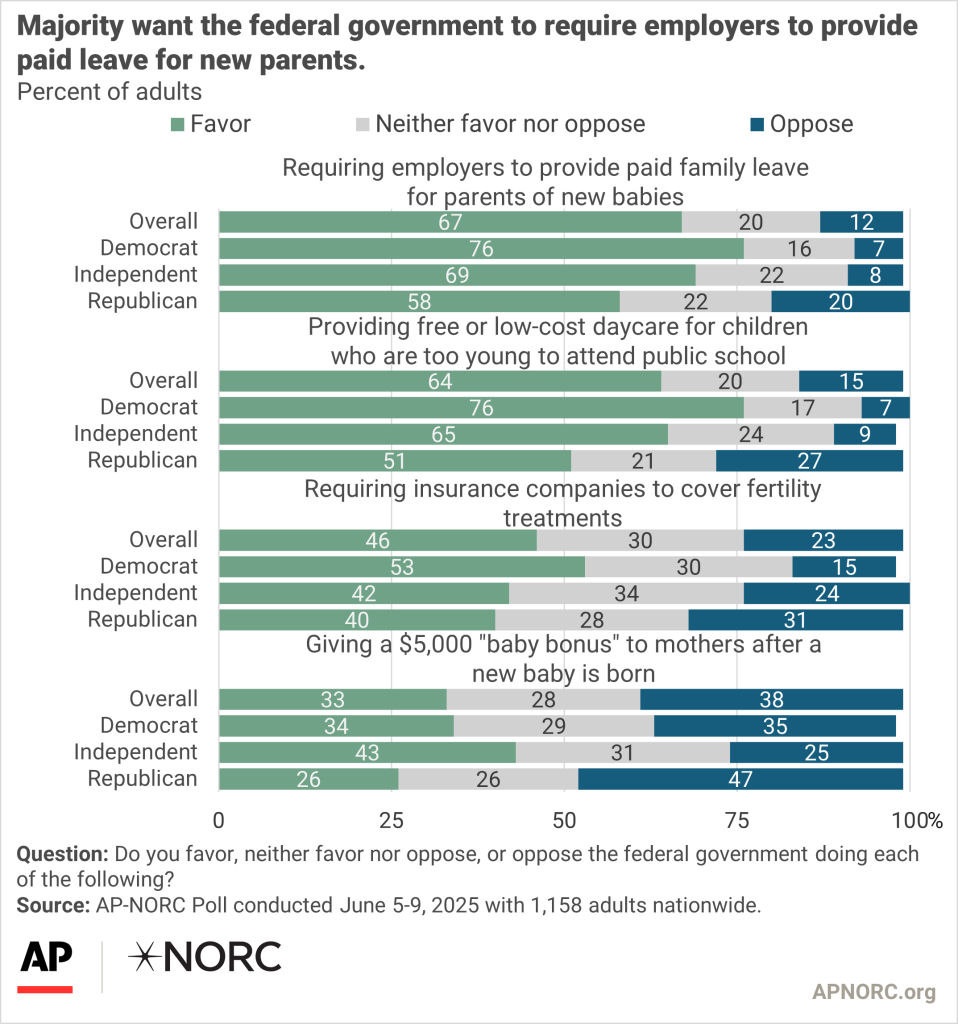
Polls show broad, bipartisan appetite for government action on childcare, with debate over how much families should chip in.
Early childhood policy is quickly becoming a defining issue for 2028 hopefuls. On the right, Vice President JD Vance has staked out an early and controversial position, to pay married stay-at-home parents roughly $9,000 per child annually using existing federal childcare funds. On the left, Rep. Alexandria Ocasio-Cortez is spearheading a new House working group to develop a federal childcare plan. Kentucky Gov. Andy Beshear has been pushing free pre-K for all 4-year-olds, something California Gov. Gavin Newsom has already enacted in his state. And New York City Mayor Zohran Mamdani, who can’t run for president but is widely seen as an influential voice in the party’s future, has made universal childcare one of the top goals of his administration.
Michelle Lujan Grisham, the Democratic governor of New Mexico, recently told Semafor that any politician seeking to run for president in 2028 “absolutely should” run on universal childcare proposals. Last year New Mexico became the first state to offer free childcare to families regardless of income. Her advice echoed David Plouffe, a Democratic strategist who managed Barack Obama’s 2008 campaign, who said that universal childcare should be in the Democrats’ 2028 party platform.
This new wave of enthusiasm marks a pivot for an idea that has long been seen as a distant pipe dream in American politics. It wasn’t always that way: When women filled factories during World War II, the federal government funded thousands of daycare centers to watch their kids. In 1971, Congress actually passed a bipartisan childcare bill, though President Richard Nixon vetoed it, saying it would weaken the family. In the 50 years since, Washington lawmakers have focused their energies on other big battles, offering little on childcare beyond subsidies for some low-income families. Over that time, the US has fallen out of step with nearly all its peer nations around the world, which help parents pay for childcare, on top of offering paid parental leave after birth.
It’s not hard to understand why the idea is finally getting a serious look in the US. With voters citing affordability as a top concern, politicians are looking for ways they can bring down costs facing families. After paying rent or a mortgage, childcare often stands as many parents’ biggest monthly expense. Businesses have started to care too, as access to reliable care affects both people’s ability to hold down jobs and businesses’ ability to attract and retain workers. It’s why organizations like the Chamber of Commerce have taken up the issue and why red, blue, and purple states alike have been elevating childcare in recent years.
In Congress and in the Democratic campaign world, there’s a strong sense that childcare, long overshadowed by climate, infrastructure, voting rights, and health care, is now at the front of the line should Democrats regain power. Insiders credit both donor influence and a feeling that childcare advocates have duly waited their turn.
But as Democrats begin jockeying for 2028 and universal childcare becomes a rallying cry, it’s also become clear that there’s a big unanswered question at the heart of the politicking:No one yet agrees on what “universal childcare” actually means. Does it refer to care that’s totallyfree, or just affordable? Is it for everyone, like public school, or targeted at families below an income line? Does it start at birth, and include parents who stay home? Are employers involved, or neighbors and grandparents?
The answers will determine who benefits, how much it costs, and whether the party’s next big promise to families is one it can actually keep.
What is universal childcare?
When I asked Rep. Khanna how he defines universal childcare, he said that it means “childcare should be free” and that families should have flexibility and choice of how to get that care. Workers, he added, should also be paid a living wage in a universal childcare system.
Later, he described the vision for universal childcare as a public good, akin to public school. “From the time a child is born to the time they’re finished college,” he argued, America has the wealth to provide for kids’ education and development.
Others, however, are defining the idea differently. Linda Smith, who leads Child Care Trust, a national policy think tank, helped design the military’s well-regarded childcare system and oversaw federal early childhood programs under Obama. Earlier this summer, she released a framework for universal childcare that emphasized it does not inherently mean free care.
Smith says she wrote it after realizing that even the legislative staffers drafting childcare bills didn’t mean the same thing by the term. “After some candid conversations with congressional staff this summer working on child care policy, it became clear that there are many interpretations of ‘universal child care,’” she wrote on LinkedIn. “If we can’t agree on what the term means, we can’t build durable policy around it.”
She argues the “universal childcare” slogan tends to blur three separate goals: universal access, universal affordability, and universal free care. To Smith, the urgent priority is access. Her vision for universal childcare policy would be a system where all families have access to “affordable, high-quality options” that reflect their needs. Her organization estimates that about 4.2 million children under six with all available parents in the workforce lack a childcare slot within a reasonable distance of home, and she warns that cutting costs without addingnew supply could worsen shortages and leave families without available options.
Her answer is a mix of building more supply and sharing the cost. She recommends families paying what they can and employers and government covering the rest. Spreading the cost across several payers, she argues, is likelier to sustain the full mix of care families actually use — including home-based care — than leaning on government or parents alone.
Chris Herbst, a childcare policy expert and professor at Arizona State University, told me he agrees with Smith that there’s no consensus regarding what universal childcare means today. Even in New Mexico, he pointed out, which is regularly touted as an example of universal childcare, a light work requirement exists for families to be eligible. “These are fluid definitions, and as such they are a bit up for grabs at the moment,” Herbst said.
His own view is that a universal childcare system should make the subsidy easy to get and be guaranteed by law, so eligible families get it automatically instead of landing on waitlists when funding runs short.
Another childcare expert, Elliot Haspel, has embraced a definition closer to Khanna and Sen. Elizabeth Warren, arguing that universal childcare means all families can easily secure the type of care they want, and pay no fees to do so. He acknowledged, though, that many things can be called “universal” and be technically correct. “The ambiguity of the term is both what lends it rhetorical power and what can present a major weakness,” he writes.
Some states are adding benefits — but avoiding “universal”
With federal childcare legislation stalled, many states have spent the past few years trying to patch the system themselves. Some states are investing in making care cheaper for families, others in paying childcare workers more, and most in trying to get more providers to open their doors.
The National Conference of State Legislatures has also aimed to get involved. Over the course of a year and a half, state lawmakers across 13 states worked together to hash out a bipartisan policy framework for strengthening childcare systems, a rare cross-party effort on the issue. The NCSL report, released this past summer, steers clear of the term “universal childcare,” but does describe state systems under strain and concludes that incremental fixes alone are unlikely to solve it. The lawmakers stressed there is no one-size-fits-all solution and offered a menu of options organized around seven priorities, from expanding access to investing in the childcare workforce.
In interviews with the working group’s two co-chairs, I asked why their cohort stayed away from the “universal” language. Jim Burgin, a Republican state senator from North Carolina, told me he doesn’t find it to be a helpful term because it could conjure up the image of public schools, which are mandatory and government-run. “I don’t like the term,” he said. “I think we ought to have safe, affordable childcare available to everybody and I don’t want everybody to immediately think we’re setting up government indoctrinated childcare…a lot of people would just push back from that.”
The Democratic co-chair, Washington state Sen. Claire Wilson, said her hesitation was more about precision. “When you say ‘universal’, I think that alone is a question about what do we mean by universal?” she said. In Washington, she explained, it means care open to all families regardless of income, employment status, or immigration status, “but for other states, universal may mean something different.”
Where the public stands
Polling suggests Americans do want to see lawmakers take action on childcare, even if it’s not voters’ top priority when asked to rank among different issue areas. An AP-NORC poll from last year found about three-quarters of Americans say childcare is a “major problem,” and majorities across both parties backed federally funded “free or low-cost” daycare. More recently, YouGov and the 19th News found 52 percent of Americans think the federal government should increase its spending on childcare.
The evidence that most Americans want childcare to be free rather than affordable is less clear. The recent YouGov/19th News found about 40 percent of Americans think parents and government should share in the cost of daycare, compared to 21 percent who thought the government should pay the full cost, and 26 percent who thought parents should cover it all.
A recent New America survey found similar results. When asked if K–12 public education should be a free, taxpayer-funded right, 60 percent of respondents agreed. But only 38 percent said the same of childcare. And among those who “somewhat” or “strongly agree” that childcare should be offered to families for free, paid by taxes, and considered a right, only 31 percent of independents agreed, and just 23 percent of Republicans.
Lena Bilik, a childcare researcher at the Roosevelt Institute, a progressive think tank, told me she thinks public opinion will shift more in favor of free universal childcare when public programs can demonstrate a track record of success, as the country saw with Social Security and more recently the Affordable Care Act. “If we build high-quality public goods that work, I think that with time that problem solves itself,” she said. “But they have to be well-resourced.”
The politics ahead
While states like New Mexico, Vermont, and Connecticut have taken major steps in recent years to expand access to affordable childcare, Bilik of the Roosevelt Institute said even those places vary in how explicitly they pursue the goal of universal childcare, or define it.
The last time Democrats went big on childcare, via the Build Back Better Act, they failed. The bill packaged much of the Democratic agenda into one piece of legislation — climate, healthcare, housing — with childcare bundled alongside paid family leave, elder care, universal preschool, and an expanded child tax credit. It collapsed in late 2021 after talks with West Virginia Sen. Joe Manchin fell apart.
When I interviewed lawmakers, advocates, funders, congressional aides, and policy experts in 2024 about what lessons they drew from that experience, I found the field divided over strategy. Childcare never got a vote of its own, and the argument ever since has been whether it should have been pulled out and pursued separately. Some argued activists should have narrowed their focus to one or two care priorities. Others saw that critique as premature capitulation, a sign of a limiting “scarcity mentality.” Many of those advocates emphasized that they had come very close to passing everything, losing in the Senate by a single vote, and pointed to the climate movement, which took decades of sustained organizing and spending to win major federal legislation. Care advocates, they said, just needed to keep pushing.
Two years later, the consensus view among Congressional Democrats and national childcare advocates has shifted, with far more now saying what’s needed first and foremost are “big and bold” solutions that the party can run on — even bigger than the ideas laid out in the Build Back Better Act.
Sen. Elizabeth Warren argued this year that childcare failed in Build Back Better because not enough Democrats were “willing to fight for it” and because the $400 billion proposed spending package for childcare and universal pre-K wasn’t nearly big enough. It was “an exercise in how weak and ineffective we could make the childcare program and still call it childcare,” she said.
Bilik has watched the same change from the research side. The coalition she works with, she told me, has moved away from programs that help only families below a certain income.“What I’m excited about is that we’ve gotten more ambitious with our proposals across the board since Build Back Better,” she said. “We’re finally having conversations about whether implementing something halfway will cause more problems than solutions, so I think the field has moved really far towards being open to a true public program.”
These sentiments are reflected in the recently released Khanna bill, the Project 2029 proposal, and comments over the summer from Democratic Rep. Sara Jacobs, who said free childcare for all should be at the top of the House’s legislative agenda if Democrats take control after the midterms.
How that vision translates into legislation remains an open question. Some advocates I talked to for this story, who spoke off the record to describe private coalition conversations candidly, said they worried their allies were going to make the same mistake of over-promising and then failing to prioritize goals when faced with tough budget realities. Should Democrats take power, leaders will also face pressure to restore Medicaid and SNAP funding, expand ACA subsidies, and address housing costs, all while large federal deficits make new spending harder to finance.
Khanna told me his proposals could be funded by shifting priorities away from increased military spending, particularly the $200 billion increase in the Pentagon budget and the war with Iran. The Project 2029 proposal suggests financing through raising the corporate tax rate, repealing the pass-through business tax deduction, and reforming estate taxes and the “stepped-up basis” tax break on inherited assets. Third Way would also fund its plan partly through a corporate tax increase. But those same dollars could be claimed by other Democratic priorities, which means childcare advocates may end up competing for them.
“Everyone is excited to put out the biggest idea, but there’s no real conversation about how to get there, and I feel like that’s the frustration, where ‘how to get there’ just means electing Democrats and demonizing any incremental progress,” one advocate told me. “That is not a strategy.”
For now, think tanks, presidential hopefuls, and congressional working groups are testing the waters, floating ideas that meet families where they are and, in some cases, go further than what voters say they want. The practical details are unlikely to get settled once the 2028 race is fully underway. If a Democrat wins, the window will narrow further, with unresolved details colliding with other priorities in the first months of a new administration.
“Universal childcare” may remain an amorphous term, meaning free care to one politician, shared costs to another, and a menu of state options to lawmakers who avoid the word altogether. But all of us voters should expect to hear much more of it.
This work was supported by a grant from the Bainum Family Foundation. Vox Media had full discretion over the content of this reporting.
Update, October 21, 11:45 am ET: The Supreme Court released a brief order on October 21, which ruled against the Trump administration’s request to deny gender-affirming care to transgender prisoners. The order is two sentences long. It is temporary. And it does not explain the Court’s reasoning. So it is not clear why the Court ruled against Trump or even whether Trump will lose if this case reaches the Court again after it has be fully litigated in lower courts. Justices Clarence Thomas and Samuel Alito dissented.The article below was originally published on October 13.
On the first day of his second term, President Donald Trump issued an executive order requiring the Bureau of Prisons to “ensure that no Federal funds are expended for any medical procedure, treatment, or drug for the purpose of conforming an inmate’s appearance to that of the opposite sex.” Issued alongside a record 26 other orders that day, it was an unsurprising development, because Trump had made this issue one of the centerpieces of his 2024 campaign.
The fate of that executive order, as well as the US Bureau of Prisons’ (“BOP”) memoranda implementing the order, is now before the Supreme Court in a case called Trump v. Kingdom. And, while this case obviously has high stakes for incarcerated transgender people specifically, the Court’s resolution of this case could potentially have far greater reach — cutting off many cis and transgender people’s access to healthcare while they are incarcerated.
That’s because one of the central questions in Kingdom — though this issue is not yet before the justices — is when the Constitution requires prisons to provide medical care to incarcerated people.In Estelle v. Gamble(1976), the Supreme Court held that the Eighth Amendment’s ban on “cruel and unusual punishments” imposes on the government an “obligation to provide medical care for those whom it is punishing by incarceration.” People in prison, after all, cannot simply drive themselves to the hospital if they get sick. If the prison does not give them adequate medical care, they will suffer untreated and potentially die.
For procedural reasons, the Court is unlikely to opine on whether Estelle requires prisons to provide gender-affirming care to trans people right away. But the question of when the Eighth Amendment requires prisons to provide medical care to incarcerated people is front and center in the Kingdom case, which means the Court could potentially use Kingdom to limit all imprisoned people’s access to healthcare — or even to undercut the Constitution’s protections against cruel and unusual punishments more broadly.
Ironically, this case also arises out of a famous political blunder by pro-trans advocates. In 2019, when then-Sen. Kamala Harris was seeking her party’s 2020 presidential nomination, the ACLU circulated a questionnaire to candidates that asked if they would use presidential authority “to ensure that transgender and nonbinary people who rely on the state for medical care — including those in prison and immigration detention — will have access to comprehensive treatment associated with gender transition, including all necessary surgical care?”
Harris responded that she would, and also said that she “pushed the California Department of Corrections and Rehabilitation to provide gender transition surgery to state inmates” while she was state attorney general.
Years later, during his 2024 debate with Harris, Trump claimed that the then-vice president “wants to do transgender operations on illegal aliens that are in prison.” And not long after, his opposition to gender-affirming care for trans people in prison became a keypart of his campaign.
It’s unclear why the ACLU thought it was a good idea to shine a light on this issue in 2019 because, at the time, the BOP provided gender-affirming care to people in federal prison. The ACLU — which represents the pro-trans side in the Kingdom case — now argues that transgender people in federal prison have had access to at least some forms of gender-affirming care “since at least 1992.”
Indeed, Trump’s own administration concluded in a 2018 memo that the Bureau of Prisons’ “statutory mandate to provide basic medical and mental health care” to incarcerated people obligated it to provide “pharmaceutical interventions (e.g., cross-gender hormone therapy), hair removal and surgery (if individualized assessment indicates surgical intervention is applicable)” to transgender people in prison if their doctors determined that these interventions are “medically necessary care.”
In any event, regardless of why Trump fixated on cutting off trans healthcare for people in federal prison, Kingdom is now before the Court. That means that the fate of trans people in prison — and, if the Eighth Amendment issue eventually reaches the Court, all incarcerated people — is now in the hands of a Republican Court that is oftenhostile to trans litigants, and that has, at times, signaled that it wants to drastically roll back the scope of the Eighth Amendment.
What are the legal issues in the Kingdom case?
At least since Estelle, the Court has held that people who are incarcerated are not also sentenced to live and die without medical care. As the Court said in Brown v. Plata (2011), “a prison that deprives prisoners of basic sustenance, including adequate medical care, is incompatible with the concept of human dignity and has no place in civilized society.”
Under Estelle and Brown, transgender people often have a right to gender-affirming care during their incarceration. As the US Court of Appeals for the Ninth Circuit held in Edmo v. Corizon (2019), such a person must show that they have a “serious medical need” for such care — typically by demonstrating that the care was prescribed to them by their health provider. But the Constitution does not permit prisons to deny medically necessary care to incarcerated people.
In Kingdom, the ACLU raised this Eighth Amendment argument in the lower courts, but those lower courts ruled in favor of transgender people in prison on different, much more technical legal grounds.
Both the ACLU and the lower courts that heard Kingdom argue that the Trump administration did not comply with this obligation when it cut off care for trans people in prison.
Among other things, the district court that heard this case determined that the administration cited “zero evidence from its own medical or mental health care professionals to support its conclusions” against providing transgender healthcare. While the Trump administration argues that providing gender-affirming care makes prisons less safe, the district court also noted that “the government has not cited a single instance of gender-affirming care giving rise to safety concerns despite having provided such care for many years.”
Is this a persuasive legal argument against the Trump administration’s new policy? I think it is. And so did three federal judges that previously heard the Kingdom case. But the fate of trans people in prison is now in the hands of a Supreme Court that rarely rules in favor of transgender litigants, and that has a history of handing down legally incoherent opinions that are inconsistent with the Court’s own precedents, and that also deny legal rights to trans people.
The current Court’s uncertain commitment to the Eighth Amendment
Because the lower courts that heard Kingdom did not rule on the Eighth Amendment question, Kingdom should not currently give the justices an opportunity to roll back Estelle. But, in the likely event that this Court rejects the ACLU’s argument that the Trump administration did not adequately explain its new policy, the case will return to the lower courts and the Eighth Amendment issue will be fully litigated — teeing up the Eighth Amendment question for the justices to decide in the near future.
This issue could arise, moreover, at the exact moment that some justices are pushing for sweeping changes to how their Court understands the term “cruel and unusual punishments.” Indeed,at least some of the Supreme Court’s recent Eighth Amendment precedents suggest that the Republican justices want a wholesale rewrite of the Court’s previous precedents laying out what constitutes cruel and unusual punishment.
Since the mid-to-late twentieth century, the Court has held that, in Chief Justice Earl Warren’s words, the Eighth Amendment “must draw its meaning from the evolving standards of decency that mark the progress of a maturing society.” Thus, as certain forms of punishment grow more uncommon, they become more constitutionally dubious.
This “evolving standards of decency” framework is front and center in nearly every major Supreme Court decision interpreting the Eighth Amendment for the last five or six decades, including Estelle.
In Bucklew v. Precythe (2019), however, the Court’s Republican majority seemed to abandon this framework. Although decades worth of pre-Bucklew decisions established that a punishment is unconstitutional if it is considered cruel and unusual today, Bucklew suggested that a method of punishment is unconstitutional only if it“had fallen out of use” at “the time of the founding.”
Thus, if taken seriously, Bucklew’s new approach to Eighth Amendment cases would dramatically expand the government’s power to impose harsh punishments. The late Justice Antonin Scalia, for example, argued that a Bucklew-like approach to the Eighth Amendment does not prohibit the government from executing most intellectually disabled offenders, and that it does not limit the government’s ability to impose excessive punishments for minor crimes.
In fairness, some of the Court’s post-Bucklew decisions are inconsistent with the framework the Court laid out in that case. So at least some of the justices who joined Bucklew may have since decided that it’s a bad idea to toss out the Court’s entire framework for Eighth Amendment cases. But Bucklew was one hell of a warning shot over the bow of the Eighth Amendment. And the mere fact that the Bucklew decision exists means that advocates for humane punishments must hold their breath any time this Court is asked whether a particular punishment is cruel and unusual.
In the worst-case scenario for people in prison, a case like Kingdom could inspire the Republican justices to overrule — or, at least, drastically limit — decisions like Estelle and Brown. That would mean that all incarcerated people, regardless of their gender identity, could lose access to medically necessary care unless the government decides to give it to them as an act of grace.
The execution chamber in the Texas State Penitentiary at Huntsville in 1984. | Jerry Cabluck/Sygma via Getty Images
Late last month, the state of Tennessee attempted to execute Christa Pike, a woman who has been on death row for decades after killing a classmate as a teenager.
The execution failed: Pike survived two doses of the lethal injection drug pentobarbital, making her the first person ever to do so.
The botched execution comes at a strange moment for capital punishment in America. Support for the death penalty has been declining for decades. And for a long time, the number of executions was falling, too. But since 2021, executions have been increasing again. The recent surge has been driven largely by one state: Florida.
According to Pamela Colloff, who covers the criminal justice system for ProPublica and wrote about Florida’s use of the death penalty for New York Times Magazine this summer, 40 percent of the executions conducted in the US last year were in Florida.
“There are so many things that make the administration of the death penalty interesting and unique in Florida,” Colloff explained on a recent episode of Vox’s The Gray Area podcast. “Among active death penalty states right now, Florida is unique in that one person determines, from the hundreds of men on death row, who will receive an execution date, and what that execution date is.”
I spoke with Colloff earlier this month following Pike’s failed execution about what happened in Tennessee, what’s driving Florida’s recent zeal for executions, and why victims’ families are often unsatisfied by the death penalty process.
Below is an excerpt of our conversation, edited for length and clarity. There’s much more in the full podcast, so listen to The Gray Area wherever you get podcasts, including Apple Podcasts, Pandora, and Spotify. (This interview also appeared more recently on Vox’s Today, Explained podcast.)
We’re taping shortly after news came out that a woman in Tennessee who was on death row, authorities attempted to put her to death. They gave her two doses of lethal injection medication, and she survived.
How much of the decline in the use of the death penalty has to do with, in your estimation, people feeling like there’s no way to do it that’s humane?
This is the second botched execution in Tennessee this year, just to give you a sense of things. This is more common there than in other states. They’ve changed their drug protocols and we don’t know a lot about what went wrong with Christa Pike. In May, it was an issue with accessing veins, which can be an issue with lethal injection.
I think it’s also important for people to remember that we had the electric chair as the method of execution through the ’80s and into the ’90s in some places. While [lethal injection] is considered a far more humane, quote-unquote, way to do this, we can see that nothing is perfect.
I will say that while the issues of botched executions are very important, and I think there are some other ones coming up to be concerned about, I am more interested in how it is that other errors are made, that other people end up with the ultimate punishment when that perhaps was not the right punishment for what occurred.
You’ve also written that death penalty convictions are just expensive, right? And on top of that, DNA evidence has made it clear that many of the people who were being convicted were not guilty, or there wasn’t strong enough evidence to convict them. How do you think about that mix of factors?
Florida, which I’ve spent a lot of time writing about, is the leading place in America by a mile in terms of the number of executions, and has a very large death row. Florida’s also the leader in wrongful death row convictions. Just to give you a sense of things, Florida holds the distinction of 30 death row exonerations.
What that means is in the modern era — the past roughly 50 years — there have been 30 men who were given dates of execution who now walk free. And for anyone who pays any attention to how the criminal justice system works and how incredibly difficult it is to overturn a wrongful conviction, if we have 30 people in Florida who have that distinction, we know that there are many more.
What’s going on in Florida? When did you realize that something was different there?
It really ramped up last year. Last year, Florida executed 40 percent of the people who were executed in the US in the last calendar year. In this year, there have been 16 men who’ve been executed in Florida so far.
Just to give you a comparison, Texas is the next state with the highest number of executions, and they’ve executed six men in that time. We already have outlier states, primarily southern states, and then we have Florida being the ultimate outlier.
There are so many things that make the administration of the death penalty interesting and unique in Florida. The thing that fascinated me the most is, among active death penalty states right now, Florida is unique in that one person determines, from the hundreds of men on death row, who will receive an execution date, and what that execution date is.
Who is it?
Gov. Ron DeSantis. I went back and looked at what were the patterns here, what were the things guiding Gov. DeSantis’s thinking in setting these dates, and was fascinated to see and very troubled to see that there are a number of men who’ve been there so long.
They’ve been there since the 1970s. These are men who were convicted when Gerald Ford was president, just to make this real to people. But the dates are not being set among the men who are what are called death-eligible, meaning that they’ve gone through all their appeals. They aren’t being done chronologically.
There’s no rhyme or reason to the process. And so there’s this speculation game among victims’ families, prisoners, their advocates about who will be next. And men can sit there on death row for decades with that hanging over them, and that is a Florida phenomenon.
You wrote about Florida’s death row turning from something like a purgatory where people stay for a long time into something closer to an assembly line, right?
I was so struck by the fact that in Florida, in order to have this pace of executions, there were people who were receiving their dates 30 days, sometimes fewer, from their execution dates.
Just to give people a sense of why that is unusual, there are so many things that kick into gear when a death warrant is written. There are numerous legal maneuvers and next steps that happen in the courts. To give you a quick example, there was one defendant in Florida this spring who, five days before he was scheduled to be executed, was finally granted the ability to test DNA evidence in his case that had gone untested.
He had great lawyers who didn’t sleep to make that happen, but that it came as close as five days to his execution date. I think that should give us all pause about how fast this is moving.
You have multiple people in the queue at the same time. There’s a place — a different unit than Florida’s death row — that you’re taken to once you get your date, called death watch.
Tell me about death watch. What does it look like and what does it feel like?
Death watch is roughly 30 feet from the execution chamber. There are three cells. When you receive your date, you are taken from death row to death watch where you’re put — I don’t want to say solitary because if there are one or two other men who are held there — but you’re in a far different situation than you would be on death row where there are guards and other people you know.
From that point forward, there are roughly 30 days where you are held within steps of where this will take place. To me, it was chilling that when I was doing my reporting in the spring on the story that I published this summer, all three cells were filled, and as soon as one person was executed, the pattern was that often the next day a new death warrant would be signed, and there would be a new person in place.
Why do they do that? Why do they put these people next to the place where they’ll die?
That’s one of the many questions I had about that. We talk about not wanting to have cruel and unusual punishment. Our Constitution does not uphold that. But it’s such a unique kind of mental torture, I think, to be 30 feet from where you’ll be put to death.
The other thing I was struck by was the waiting aspect. If you’re on death row, again, you always have this hanging over you. I talked about the way in which, when you’re in that kind of sensory deprivation, you become highly attuned to sounds and smells and things like that.
I interviewed someone who’s not on death row anymore, whose sentence was commuted, who talked to me about recognizing that jangle of keys and the steps that this group of people who come to deliver the death warrant take, and knowing that someone is about to be served with a death warrant, but not knowing, “Is it me? Is it the guy next to me? Is it someone down the hall?”
I just want to say, I understand that there’s a counterargument to all of this, which is that these are people who most often committed terrible crimes. Their victims did not know when they were going to be killed.
I do think, however, as a state that administers this thing, there has to be a rhyme or reason to this. Otherwise, you have total chaos, including for victims’ families, who never know. Are they going to wait one month? Are they going to wait 15 years? They don’t know.
Atlanta Mayor Andre Dickens has helped advance the city’s broader effort to build or preserve 20,000 affordable homes by 2030. | Elijah Nouvelage/Bloomberg via Getty Images
As rents and homelessness climbed in San Diego over the last decade,leaders watched in frustrationas affordable housing projects took months to get approved. The longer a project dragged on, the more expensive it became.
Housing in America is notoriously slow and complicated to build, so San Diego Mayor Todd Gloria decided to use one lever he had available. In January 2023, hesigned an executive order to speed up project approvals, so every fully affordable project now had to be reviewed in 30 business days or less.
To meet this new goal, San Diego had to overhaul how it had been handling permitting. The city streamlined work that had been spread across multiple departments and filled positions it had budgeted for but left vacant. Within a year, fully affordable projects were clearing review in nine days on average. Citywide, 2023 marked San Diego’s biggest year for housing permits since at least 2005, with 9,691 homes approved, or an 82 percent jump from the year before.
Key takeaways
Bloomberg Philanthropies is funding up to 30 cities to copy housing fixes that worked in San Diego, Austin, and Atlanta.
The bet is that cities lack the know-how to execute good ideas, not the ideas themselves.
It’s not clear what will happen to city capacity when the foundation funding runs out.
Austin, Texas embraced a different approach to tackling its housing shortage. After years of local zoning reform, the city legalized up to three homes on most single-family lots in late 2023, then cut the minimum lot size from 5,750 square feet to 1,800 in 2024. Those changes made it easier to add homes, including backyard accessory dwelling units (ADUs), and followed a broader construction boom that has helped bring rents down. Austin, which was becoming increasingly unaffordable, is now one of the few major American cities where asking rents have fallen since the pandemic.
Atlanta adopted a third housing strategy that didn’t require changing any laws at all. Mayor Andre Dickens rallied the heads of every public agency that affects housing, from the city’s housing authority and school system to the transit agency and land bank, and convened them in one room on a regular basis. He called it a “housing strike force” and it has helped advance the city’s broader effort to build or preserve 20,000 affordable homes by 2030. Every housing deal now comes to the mayor’s office, Dickens told me, and “I just start pushing buttons to push them out the door.”
Seen as a nationwide issue, the housing shortage is an enormously difficult problem, sitting at the nexus of the economy, the financial system, and decades of local zoning decisions. But the fixes don’t all have to be complex.A mayor can do all three of these — faster permitting, ADUs, a housing strike team — without waiting on Congress or their state legislature to act. And now one major nonprofit is betting that other cities could adopt them too.
On Tuesday, Bloomberg Philanthropies is announcing that it will fund up to 30 cities to adopt one of those three housing ideas. Each will get between $450,000 and $750,000 directly and two years of help from Accelerator for America and the digital consultancy Public Digital, also funded by Bloomberg.The philanthropy has already selected the first 15 cities, including Albuquerque, Chattanooga, Cleveland, Durham, Louisville, Miami, Nashville, Pittsburgh, and San Jose.
By housing construction standards, the money doesn’t go very far. The grants are geared toward hiring city staff, buyingnew software, and helping cities quickly develop the expertise that let San Diego, Austin, and Atlanta do what they did.
“You don’t need everyone to be innovating everything all the time when there are good ideas in the world that are working,” said James Anderson, who leads Bloomberg Philanthropies’ government innovation program. “They need help adapting those ideas to local contexts.”
According to Anderson, the cities were chosen because their mayors had already taken hard political votes on zoning, and wanted help now to do more. Their timing is also intentional. On the federal level, the 21st Century ROAD to Housing Act became law in July, and it creates competitive grants for cities that modernize their permitting, for preapproved housing plans, and that open up their public land. These are the same reforms Bloomberg is now funding, and cities that can show they’ve already done work around it will be better positioned to tap into new federal dollars.
Mayors say they’ve seen big federal programs pass before and then found that actually leveraging those new funding streams in practice can be quite difficult. “We saw that with the Inflation Reduction Act,” Cleveland Mayor Justin Bibb told me. “Even some of the aspects of the bipartisan infrastructure bill, there was a lot of red tape to get some of that stuff across the finish line.”
The Bloomberg bet is that figuring out what to do isn’t as hard as organizing the knowledge of how to do it. The philanthropy thinks that with enough money and hand-holding, good ideas can spread.
It’s an experiment worth testing, but even at the outset there are real limits to what kind of help a short-term infusion of cash can do in practice. San Diego, Austin, and Atlanta all had substantial housing staff in place before they started, and many cities don’t have the same depth to draw on. A two-year grant covers a few staff roles, but doesn’t guarantee they’ll stay long-term in a city where most of the local budget is already committed.
What a “housing strike force” actually is
Dickens had campaigned for office in Atlanta on building 20,000 affordable units in eight years. When he became mayor in 2022, his staff told him the city was on pace to fall 4,000 to 5,000 units short of this goal, and that the main federal subsidy for affordable housing, which gets rationed out by the state in fixed amounts each year, wasn’t going to make up the difference.
What Atlanta did have was land, spread across more than a dozen public entities, each with its own board and its own ideas about what the land was for. One 10-acre city site just northwest of downtown was being used to store trash cans before delivery to residents. “It’s not the highest and best use of the land, but we’ve been doing it for decades,” Josh Humphries, then Dickens’ senior housing adviser, told The Guardian.
So Dickens pulled the heads of those agencies into one body reporting through his chief housing officer. The transit system and school district both answer to their own boards, so his pitch was that they weren’t giving anything up by getting involved. “You are still in charge of your organization, these are your deals, but we are an accelerator,” Dickens told me.
They spent nothing setting it up and hired no new staff for the strike force itself — though when Dickens advises other mayors, he’s blunter about the pressure a mayor would need to exert in convening such a team. An agency that opts out of participating, he said, is “outside of the scope of the mayor’s vision” and “that’s not a safe place to be.”
“I didn’t need another task force,” Dickens added. “Task forces are good, but we know what we’re doing. We don’t have to describe the task. No, this is a strike force. We know the deals, we have the land, we know where the money is for most of these deals, and we have the political will.”
What Dickens did was create “a horizontal way of organizing otherwise vertical players,” as Anderson of Bloomberg Philanthropies put it.
As part of the strike force, agency leaders meet monthly, and quarterly with the mayor. Each one reports what they will produce in the next 30 days, whether that’s a signed agreement, bank financing, or a permit, in front of everyone else. The goal is to move everything as fast as possible to keep down costs.
“You’re in a meeting with 20 colleagues talking about your four or five projects, and everybody is aware of everybody’s projects,” Dickens said. “You don’t want to come back to that meeting saying nothing happened over the last 30 days.”
The limits of the model
Dickens was fairly blunt about where the model stops working. “It works best in cities that have a sizable amount of competent housing development people,” he told me. “A strike force is Army, Navy, Air Force, Marines. You all are capable.” A city still standing up its housing program, he added, should just focus on collaboration, because it would be hard for a small city without “the knowledgeable skills, the capacity” to operate like this.
Most cities can’t easily build that internal bench. Local governments pay less than state or federal employers for the same specialized work, and between half and three-quarters of a typical city’s operating budget is already locked up in salaries, pensions, debt payments, and basic services before the mayor makes a single discretionary call.
In Cleveland, they’re hoping to use the Bloomberg funding to bring in some new support. “Right now it’s a capacity game for us,” Bibb told me. “IT staff, planning staff, development staff, the list goes on. Policy staff as well.”
Cleveland also faces different challenges than Atlanta, which built its strike force for a growth market that already had projects lined up. Cleveland is an older, industrial city with an aging housing stock and a population that has only recently stopped shrinking, so Bibb needs code enforcement and rehab as well as new units. He plans to point the strike force first at a housing innovation district he launched earlier this year, an area spanning parts of three East Side neighborhoods where the city has concentrated its financing and permitting reforms.
Two-year grants can generally be a challenge for cities. Philanthropy often pays for staff long enough to prove a policy works, but when the foundation money goes away, cities can struggle to find the dollars to keep the positions going. While Atlanta’s strike force was organizing around people the city already employed, Cleveland’s will require new ongoing resources for a growing payroll.
Asked what happens when the money runs out, Bibb maintained he’s concentrating on the near term. “Right now we’re just focused on securing the grant, getting the team in place, and really seeing some positive results with the strike force team in our housing innovation district,” he said.
Can a good idea be scaled?
The 30 cities won’t be working alone. Bloomberg is running them as a cohort, meaning each city will pair with the city that pioneered the idea. The goal is to trade advice, mentorship, and opportunities for city leaders to visit and tour. Cleveland is one of roughly 10 cities that will take up the strike force model, meaning Bibb’s team will work with Dickens and his staff.
“One of the major reasons that good ideas do not spread is a lack of clarity around what it took in the original city to get the hard work done,” Anderson said. Adopting cities need to hear from the originals on both a political and a technical level, he told me, to understand “the trade-offs, the costs, the errors, and lessons learned” before they start.
Bloomberghas been testing a version of this model since 2024 through its Idea Exchange, which now includes more than 1,000 cities across 95 countries and has nearly 200 policy replications completed or underway.
Within two years, cities pursuing permitting reform are expected to cut their housing approval timelines in half, those pursuing ADUs to double their pipelines, and participants ultimately to post gains in citywide housing supply.
The housing shortage runs into millions of homes, and these proposed strategies don’t touch challenges like interest rates or the price of lumber. But across the country, they could show how quickly a good idea can spread.
In theory, getting a donor liver in the United States when you need one should be an extremely equitable process: The sickest patients with the greatest chance to benefit from a donated organ should jump to the front of the line regardless of their gender, race, or other factors.
But in practice, things look quite different.
One study from 2020 showed that women were 8.6 percent more likely than men to die waiting for a liver transplant and 14.4 percent less likely to receive a deceased donor liver transplant compared to men. That gap may not seem enormous, but it still represents a significant disparity. As it turns out, it’s rooted in the very system that’s supposed to make the process fairer, a process that unintentionally ranks women lower on the waitlist for livers.
The system in question is known as the Model for End-Stage Liver Disease (MELD). The scoring model has been used since 2002 to rank candidates on the waiting list based on how likely they are to survive without a liver transplant in the short term. The higher your score, the reasoning goes, the sicker you are and the more urgently you need a liver transplant.
One of the values used to calculate the score is creatinine — a waste product made by muscles as they break down proteins or other compounds to release energy. In medicine, the creatinine levels in your blood are used to determine how well your kidneys are functioning because they process and remove creatinine.
And this is where the system designed for equity gets a little less than equitable for some patients.
Creatinine levels are affected by muscle mass, and women typically have lower muscle mass than men. A man and woman experiencing the same level of kidney dysfunction will therefore have different levels of creatinine in the body. The MELD model doesn’t take this difference into account — and so lower levels of creatinine in a woman’s blood can make her seem healthier than she is, bumping her farther down the liver waiting list.
(function(){function e(){window.addEventListener(`message`,function(e){if(e.data[`datawrapper-height`]!==void 0){var t=document.querySelectorAll(`iframe`);for(var n in e.data[`datawrapper-height`])for(var r=0,i;i=t[r];r++)if(i.contentWindow===e.source){var a=e.data[`datawrapper-height`][n]+`px`;i.style.height=a}}})}e()})();
In 2023, Dr. Ray Kim, a transplant hepatologist at Mayo Clinic in Arizona who developed the original system, debuted a new model called MELD 3.0. The model not only seeks to address the sex disparity in liver access but also improve the accuracy of scores for all patients. Among other changes, it takes into account the sex of the transplant candidate and uses it to adjust the MELD score by 1.33 points for women. This is meant to address the difference in creatinine levels between men and women and provide a more accurate understanding of how sick a female patient really is.
Simple fix, right? Even though MELD 3.0 took the sex disparity in liver access seriously and developed changes to combat it, early research on its efficacy found that even this new and improved system hasn’t yet brought men and women to parity on the liver waitlist.
And the problem may lie less with what MELD 3.0 did than with what it did not do, prompting the question: Are we focusing on the wrong problem?
Sex matters…but so does size
Before the MELD score, liver transplants were largely conducted on a first-come, first-served basis. Those who were added to the waiting list first, received livers first. If a really sick candidate was added to the waiting list late, say because of delayed diagnosis, they would almost certainly die while waiting for a liver to become available.
The original MELD fixed that problem by creating a measure of urgency that was easy to calculate. The initial model used three main blood test values — bilirubin, creatinine, and a measure of blood clotting time — and later improvements also took into account the sodium level.
Key takeaways
Women are more likely than men to die waiting for a liver transplant in part because the system used to rank candidates on the liver waiting list underestimates how sick women are.
In 2023, the liver transplant system adopted a new version of that scoring model, which adds 1.33 points to women’s scores to correct for differences in muscle mass between the sexes. Early research shows that the new model increased transplant rates for women, but the gains were transient.
Experts say that the score is only part of the problem. A donated liver has to physically fit inside the body receiving it, so smaller candidates end up waiting longer for a liver they can accept.
The organ allocation system currently has no way to prioritize smaller livers toward smaller patients, who are more often women. Fixing this is likely the key to ensuring equitable liver access for men and women.
Traditionally, the MELD model assigns a score between 6 and 40 to liver transplant candidates. MELD 3.0 adds 1.33 points to women’s scores to account for the differences in creatinine levels between the sexes. The new model also measures albumin, an additional biomarker, and adjusts for interactions between the different variables.
Sommer Gentry, a professor at NYU Grossman School of Medicine and contributor to the paper on MELD 3.0, said that using sophisticated algorithms with more biomarkers not only helps to better predict risk for women, but using a more accurate model also benefits the whole population. The researchers estimate that this fine-tuned MELD 3.0 model will reduce at least 20 waiting list deaths per year. Last year, around 800 liver transplant candidates died while waiting for a liver.
But creatinine is only one of the two main problems that create a disparity in liver access for women. The second, Gentry says, is body size, an issue that’s not addressed by MELD 3.0. A transplanted liver has to physically fit inside the body of a recipient, and women are typically smaller than men, so a very large liver cannot be offered to a small woman. But the reverse is not necessarily true because receiving a liver that is small for the potential recipient doesn’t typically harm the candidate.
“The smaller you are, the less likely you are to be offered something that’s actually going to work for you,” Gentry said, adding that women end up waiting longer to receive a liver that will actually fit their body.
Part of the conversation on sex disparity in liver access is based around which of the two problems — creatinine or body-size interventions — to fix first, and whether it is possible to create equity by addressing just one of the two, Gentry said. MELD 3.0 was an attempt to remove the former barrier.
“I think that some other papers are coming out that suggest that perhaps the other aspect of size matching is still a concern and still possibly not addressed by the resulting liver transplant system,” Gentry said.
Why is the new model still falling short?
Gentry believes that MELD 3.0 has increased liver transplant rates for female candidates since its adoption in 2023. But early research, however, suggests that the new model falls short of fixing the problem.
Studies done on MELD 3.0’s impact on liver transplant rates for women indicate that the model increased the number of liver transplants for female candidates — but the gains were short-lived.
An analysis published in July of nearly 10 million daily records from over 60,000 candidates on the US liver transplant registry found that rates of completed liver transplants for women increased in the period immediately after MELD 3.0 was implemented, but the increase was temporary. Women’s estimated odds of receiving a transplant drifted back to pre-MELD 3.0 levels by the end of the study period, 15 months after the new model was implemented. Women on the waiting list and women who had received a transplant also had higher scores in the three months right after MELD 3.0 took effect, but their scores later fell back to levels comparable to those of men.
Both the successes and shortfalls of MELD 3.0 demonstrate how rethinking existing policies and standards can help reduce inequities in organ access and healthcare.
The authors think that the early surge in liver transplant rates for women was a onetime catchup. MELD 3.0 pushed a group of women who had been stuck on the list — sicker than their old scores suggested — over the priority threshold all at once, leading them to receive liver transplants.
Notably, the one effect that did persist was that under MELD 3.0, women received more “organ offers” than before. Every time a deceased donor liver becomes available, the system generates a ranked list of the patients suitable to receive that organ. Under MELD 3.0, the number of times an available liver was offered to a female candidate increased, probably because their (more accurate) MELD 3.0 scores better reflected how sick they were. But they’re not necessarily receiving those livers, presumably because of organ size issues.
These findings suggest that revising the MELD criteria alone may not be enough to eliminate the sex disparity, especially if the body-size disadvantage is part of the problem.
The authors say that a patient’s sex is merely a poor proxy for the real issue — we don’t have allocation systems in place to ensure that candidates with smaller body sizes also have the same robust access to livers.
Toward liver donation equity for all
If we could figure out how to better address questions of body size in organ donation, the benefits could be enormous. According to Gentry, body-size disparity affects the organ allocation system in general. Similar issues arise with heart and lung transplants too, where the size of the organ relative to body size has to be taken into consideration during organ allocation.
She says that a size-aware organ allocation system would therefore benefit patients on the waiting list across the board. Whether an available organ is the right fit for the potential recipient should be weighed heavily in allocation algorithms, rather than just a list of ranked waitlisted candidates.
“That should be a larger consideration in sorting the patients who will be offered a certain organ — to ask if this organ is especially suited to one kind of patient over another,” Gentry said.
Under such a system, she said, smaller livers could be offered first to the smallest candidates on a ranked list of those who are also sickest. The assumption is that a smaller candidate will have to wait longer for a viable liver that fits them, even if they have a very high MELD score.
For such a policy to be instituted, the Organ Procurement and Transplantation Network – a nonprofit that oversees the distribution of donor organs — would have to approve it. And before such a system could be presented to the regulatory organization, more research is required.
It is often the case in medicine that our definition of what counts as a healthy body is measured against the average white male. This too often lowers access and quality of care for both women and people of other races. For example, the standards for creatinine levels in blood reduced access to kidney transplants for Black transplant candidates for years until recent efforts were made to start correcting it.
In that sense, both the successes and shortfalls of MELD 3.0 demonstrate how rethinking existing policies and standards can help reduce inequities in organ access and healthcare. The conversations and critiques that followed its rollout have exposed a clear gap in organ allocation strategies, one that disadvantages a large group of patients. Closing that gap, not just in liver transplantation but across the board, could bring us a step closer to equity while also making more efficient use of the organs available to save lives.
“There’s no mechanism right now, if a small liver is available, for offering it preferentially to the small women who might not be able to accept lots of other organs that are becoming available,” Gentry said. While fixing the model to rank women more accurately on the liver waiting list is a start, including body-size considerations in the organ allocation system might be the real bottleneck to address.
CNN and Politico have been banned from traveling with the press pool on Trump trips. | Oliver Contreras/AFP via Getty Images
On his first day back in office in January 2025, President Donald Trump signed an executive order “restoring freedom of speech and ending federal censorship.” More than a year and a half later, his administration is instead busy using government power to go after speech it dislikes.
Last year, Federal Communications Commission chair Brendan Carr urged broadcasters to take action against Jimmy Kimmel over his comments following Charlie Kirk’s killing, and in September, Kimmel said the FCC again intervened to stop Kimmel’s late-night show from airing an interview with James Talarico, Democratic Senate candidate for Texas.
Also last month, Trump barred three news outlets — CNN, MS NOW, and Politico — from the White House over their coverage. That ban was quickly blocked by a federal judge, but both CNN and Politico have since been banned from traveling with the press pool on Trump trips.
Outside of the White House, the fight over free speech is also raging on college campuses. In states like Texas, Republican lawmakers have restricted when students can protest and given governor-appointed university boards more say over what gets taught. In 2025, 15 states passed laws that restrict what can be taught or weaken protections for free expression on college campuses.
To break down what all of this means for the state of free speech in the US — and the future of our First Amendment rights — Today, Explained co-host Noel King spoke with Greg Lukianoff, president and CEO of the Foundation for Individual Rights and Expression (FIRE).
Below is an excerpt of their conversation, edited for length and clarity. There’s much more in the full podcast, so listen to Today, Explained wherever you get podcasts, including Apple Podcasts, Pandora, and Spotify.
How would you describe the kind of status of free speech on campus these days?
The status of free speech is in great peril, both on and off campus. I’ve been doing this for 25 years, and it’s about as bad as I’ve ever seen it.
When it comes to the Charlie Kirk backlash cases, we saw about 90 of them. It’s a remarkably high number. We saw an ex-cop go to jail for 37 days just for forwarding a Trump meme in response to a request to go to a candlelight vigil for Charlie Kirk. It’s not good.
If you look at the last two years, we’ve done so many episodes about free speech concerns. There was Jimmy Kimmel; there’s CNN being banned from the White House.
It really does seem like we’re at a moment where so many different types of people claim that their speech is being restricted in so many different types of ways. What is happening in the country?
My worry is I’m very much a small-L liberal. I come from an old ACLU background. That’s where I interned in law school. I went to law school to do First Amendment law. I hyper-specialize in it. This is my passion.
For most of my 25-year career, you could rely on a civil libertarian aspect of the left and a libertarian aspect of the right that would often agree on almost nothing except for things like freedom of speech. And right now, I think we’ve become all culture war all the time, and we have more of a progressive left and more of a populist right.
The only way that you show you believe in freedom of speech is by saying, “I hate that guy, but I think you should have freedom of speech.” If you’re saying, “I think my side should have freedom of speech,” that’s just self-interest. That doesn’t even count.
All the worst people in history wanted free speech for their side. So I’m afraid we’re losing — or maybe even, I hate to say this dramatically, but maybe even have lost it as a shared value as a society.
Well, that’s quite grim.
Yeah. I’m feeling a little grim.
The Trump administration came into office with a promise. And I remember it sounding something like this: “The woke left went too far. They canceled people. They restricted speech. They got out of control. President Trump is going to come back in, and we are going to restore sanity to the country. And as part of sanity, that will include your right to freely express yourself.”
How do you square the promise versus what we’ve seen?
I think Trump is constantly frustrating everyone around him by being Trump. I think there probably were people in the administration who were like, “Yeah, we’re going to be pro-free speech.” And then Trump decides to declare — I mean, I think the recent White House press pool case is hysterical in a lot of ways because he had to get his team to give a sort of constitutional justification for why he was kicking out the press pool. But on Truth Social, he’s like, “It’s because of their viewpoint,” which is, by the way, something you can’t do under the Constitution.
“I’m hopeful for the long-term future of free speech, but in the short term, I’m worried.”
His instincts are very authoritarian. They’re very top-down. So maybe there were people in the administration who, in their heart of hearts, are good on free speech, but Trump isn’t. And it’s the reason why when it came to the new administration, there were a lot of people on the right, but also people on the sort of heterodox left who were like, “Oh, this is going to be good for free speech.”
I was like, “Don’t kid yourself, guys. This is going to be bad.” Although I will say, it’s even worse than I was expecting.
President Trump at some point will be out of office. And what happens then? What do you think? Is there an optimistic scenario where we’re like, “Okay, we’re kind of tired of this crap. Let’s just go back to the way it was in the ’90s”?
It has been cyclical, to a degree. American society gets out of whack, and usually one of the things that does bring us together is that we were lucky enough to have…I’ll just say it, we have a brilliant Constitution. It is unusually clever about human nature, and the Constitution itself — you can have whatever opinion you want about the founders, but it is something to be proud of. And a lot of times those values kind of bring us back together.
That’s my hope. But another thing I will say about Trump: He has played havoc with my ability to predict anything. So what it’s going to look like over the event horizon of 2028, I hope it will be better, and we will fight like hell to make sure it’s better here at FIRE, but will it be better? I’m not sure, and it definitely won’t be better if we think of free speech as something that belongs to my side, not yours.
One of the reasons why I do have hope for free speech in the long term is that free speech works really well. It’s how you know what your fellow citizens think. It’s how you get ideas out there. It’s how you actually be your authentic self.
Societies that actually have freedom of speech are always going to have advantages, real and serious advantages, over ones that don’t. So I’m hopeful for the long-term future of free speech, but in the short term, I’m worried.
Scientists in the US and Europe are exploring whether an experimental surgery can treat Alzheimer’s disease. | Fiordaliso/Getty Images
The videos are astonishing. In one scene, a senior Chinese woman appears lost in the wilderness of dementia, unable to answer basic questions; in the next, she seems to be lucidly chatting and shucking beans for dinner. By all appearances, years of cognitive decline had been rapidly reversed after the patient underwent an experimental new surgery.
The only problem is: No one is sure if it’s real.
It’s difficult to take any video at face value in the age of AI, and this experimental procedure happened in China, a country with a recent history of controversial sciencetouting extraordinary but questionable claims. In the past few years, researchers there have published several papers reporting promising results from a procedure that purports to attack Alzheimer’s disease in a peculiar way: by connecting vessels from the lymph nodes in the neck to nearby veins in an attempt to drain the brain of harmful waste. But these have been small studies that did not include a control group. The doctor who first pioneered the surgery there has reportedly been placed under arrest, and the Chinese government has sought to stop most physicians from performing any more of these operations.
Is that because it’s a scam? Or because it’s dangerous? Or could it be because there have not yet been proper randomized trials, tested against a placebo, to assess the procedure’s safety and efficacy? There are new studies being planned in China to more rigorously evaluate the surgery.
But scientists elsewhere in the world have a lot of questions. And now, a small group of researchers in the US and Europe are endeavoring to find the answers. Within the next few years, we should know whether this surgery really could be the miracle that the viral videos make it appear to be — or another much-hyped treatment that ultimately fizzles out.
Dr. Adnan Siddiqui, a neurosurgeon at the University at Buffalo who is leading an initial US-based study of this procedure, previously helped develop a new treatment for severe stroke patients. This gave doctors a valuable new technique for treating patients during an emergency, and he told me he saw it rapidly change the standard of care around the world. In an interview, he cautioned that a lot more work needs to be done to assess this proposed new Alzheimer’s treatment — but at the same time, he’s optimistic.
“The whole world’s paradigm changed in literally a blink of an eye. It can happen. And I’m hoping this might be that second home run,” he said. In “2027, we’ll start getting clear signals in one direction or the other. By 2028, 2029, we would know whether this is real or not.”
Why this Alzheimer’s surgery really might work
The promise of this controversial new procedure lies in the lymphatic system, which is essentially the body’s drainage system. According to scientists’ best current theories about Alzheimer’s, the brain’s filtration system gets worse as we age, and as a result, plaque made up of amyloid proteins as well as tangles of tau proteins can accumulate in people’s brains and eventually lead to neurological damage, leading to the severe memory loss of Alzheimer’s disease. Researchers have found evidence that those amyloid and tau proteins also accumulate, not just in the brains, but also in the lymph nodes in older people.
So could a minimally invasive surgery to improve the brain’s drainage have such a dramatic impact on Alzheimer’s disease?
Siddiqui, who also runs the Jacobs Institute at the University of Buffalo, which is focused on new technology for vascular and neurological disease, had been interested in the lymphatic system’s role in Alzheimer’s before he ever heard about this experimental work out of China from a colleague years ago. The colleague had gone to see Dr. Qingping Xie, the surgeon who started performing lymphatic surgery on Alzheimer’s patients about six years ago. To investigate further for himself, Siddiqui went to South Korea to meet a plastic surgeon, Dr. Joon Pio Hong, who was performing a new “more refined” version of the same basic procedure, as Siddiqui put it. But as in China, these were not proper randomized experiments. There was no placebo.
So Siddiqui wanted to see if he could test it himself. After performing proof of concept operations in 2025 with a new microrobotic tool (for a rare disorder involving constricted blood vessels in the brain), he and his colleagues decided to take an even bigger swing: testing this new technology to perform the lymphatic surgery for Alzheimer’s.
The researchers applied to the US Food and Drug Administration and received approval late last year for five initial procedures; over the summer, they got the green light to perform the procedure on 15 patients. Several operations have already been performed, and Siddiqui told me he had four more lined up next week.
Sign up for the Good Medicine newsletter
Our political wellness landscape has shifted: new leaders, shady science, contradictory advice, broken trust, and overwhelming systems. How is anyone supposed to make sense of it all? Vox’s senior correspondent Dylan Scott has been on the health beat for a long time, and every week, he’ll wade into sticky debates, answer fair questions, and contextualize what’s happening in American health care policy. Sign up here.
The mechanism makes superficial sense: If Alzheimer’s is the byproduct of amyloid and tau building up in the brain because the body gets worse at filtering them out, bypassing a clogged “drain” in the lymphatic system could help to clear the proteins and relieve symptoms. It is, by a different method, the same therapeutic target as recent breakthrough drugs that slow down the cognitive decline of an Alzheimer’s patient.
But instead of an injection, the procedure involves a small incision in the neck, allowing surgeons to connect lymph nodes to a vein. The hope is that creating this new drainage route will help the brain clear amyloid and tau more effectively and “hopefully bypass whatever plugs that might be there in the system,” Siddiqui said.
This first round of US surgeries are part of what’s called an early feasibility study. “You’re just trying to prove that it’s definitely safe and definitely doable and maybe effective,” Siddiqui said. They’re measuring not only the patients’ cognitive performance but other data points — such as changes to their gait — for any sign of benefit or harm.
If results are promising, a second feasibility study will involve a larger number of patients — 50 or so. After that, if the evidence suggests they should move forward, the scientists would start to introduce placebos. In the case of surgery, that means some patients would receive “sham” surgeries that wouldn’t actually do anything. Then investigators would compare the experiences of the two groups: the people who received the fake surgery and the people who got the real thing.
If the latter group improves significantly more than the former, that would allow scientists to say definitively: Yes, this surgery actually works to treat Alzheimer’s.
“Obviously, this is exactly the kind of disease where there’s so much hype and so much hope,” Siddiqui told me. So it is essential to build out the careful research to substantiate it.
But let’s not get ahead of the science
Siddiqui has been in this position before — and he’s seen it go both ways. There was the new stroke treatment that proved successful and has since become the standard around the world. But he was also an early investigator of a multiple sclerosis treatment, somewhat similar to the Alzheimer’s surgery. After initial promise, it failed when the randomized trials began.
“I wouldn’t be a neurosurgeon if I was not an eternal optimist,” he said. “However, I’m a clinical trialist, and I always respect placebo.”
Placebos are essential, but they are also tricky. If somebody thinks they have received an active treatment in a study, they tend to think they’re going to benefit. This goes for surgical treatments as well. So following patients’ and their symptoms after the intervention is essential to seeing just how much of the effects can be attributed to the treatment and how much could be placebo effect. The latter of which could also be reinforced by loved ones who are desperate to see their parent or spouse get better.
Alzheimer’s is also a complicated disease that we still don’t totally understand. While scientists think there is a relationship between amyloid and tau proteins and Alzheimer’s disease, other factors, such as inflammation and vascular health, could also have a role. Some prior drug candidates have successfully cleared amyloid plaque, but patients didn’t get better. Some people have amyloid build-up in their brains but never develop Alzheimer’s disease.
Dr. Bohdan Pomahac, division chief of plastic and reconstructive surgery at Yale School of Medicine, is overseeing studies designed to establish more of the basics of how these proteins pass through the lymphatic system. This research includes investigating whether obstruction actually occurs in Alzheimer’s patients, and if so, where exactly those blockages usually are. Only after they do this work, he said, would his team be comfortable proposing surgeries to relieve the blockage and see if that helps improve Alzheimer’s patients’ symptoms.
He told me about having seen Xie, the procedure-pioneering Chinese surgeon, speak during a plastic surgery conference a few years ago. (Plastic surgeons are experts in the kind of microsurgery necessary for the procedure, and several are involved in the ongoing Alzheimer’s trials.)
“I think most people, including myself at the time, dismissed it as, ‘This is some sort of a charlatan.’” Pomahac said. “But he kept coming back to conferences every year and started to show more and more videos. We were not sure. Is it actors? You couldn’t tell what’s going on.”
Which is why he is dedicated to doing more of the foundational research to understand Alzheimer’s first. “Rushing to the operating room makes no sense in my mind at this point,” Pomahac said. “I think there’s a lot of work that needs to be done to really identify the site of surgery and what type of intervention would be most effective.”
Even if you set this surgery aside, this is an exciting moment for Alzheimer’s science. And although waiting any longer is excruciating for those watching loved ones with the disease progress, progress’ velocity by all accounts is increasing.
“We are finally doing the kinds of rigorous studies that will give us some degree of confidence that there’s something real here or not,” Siddiqui told me. “We’re not quite there yet.” But in just a year or two, we should know much more.
Across the country, civic paralysis has compelled a legion of guerrilla urbanists to take their city’s matters into their own hands. | Carlin Stiehl/Los Angeles Times via Getty Images
Jonathan Hale was ready to lay down his paint rollers. Hale, a law student turned viral road safety advocate, had run into legal trouble for painting his own DIY crosswalks across some of Los Angeles’s most dangerous intersections. In a meeting with LA Mayor Karen Bass earlier this year, he told her that if the city could commit to making its own streets safer for pedestrians, then he would stop his own vigilante activism.
“Dude, you’re the mayor. Do something about this. It’s you, dude,” he recalls insisting to Bass — in so many words — after she apologized for his arrest on vandalism charges for a paint job last December. For months, Hale upheld his end of the bargain and stopped painting, believing in her office’s emailed assurances that a new executive order was coming soon.
But, eventually, after weeks of unresponsiveness, Hale grew tired of waiting, just as he had the first time he picked up a stencil and a bucket of white paint. “We’re so focused on looking for reasons why we can’t do stuff instead of ways that we can,” he said, “and it’s just paralyzed our institutions.”
Across the country, such civic paralysis has compelled a legion of guerrilla urbanists to take their city’s matters into their own hands. In Boston, a group of cyclists used strips of green and white duct tape to build a bike lane at an intersection where a truck struck and killed 36-year-old Louisa Gag in July. In Nashville, Kansas City, and across the Bay Area, volunteers have built and installed their own public benches at bus stops where city officials had slowly removed places to sit, after years spent curating increasingly hostile public spaces.
Every time one of these friendly neighborhood vigilantes paints a crosswalk, fills a pothole, or builds a bench, they remind us that it is not actually that hard — or even that expensive — to do many of the simple things that can make our cities safer and more pleasant places to live. Though our local governments may seem incapable of getting these basic tasks done, they are probably less constrained by money than they are by a sluggish status quo. And in some cases, they’re so afraid of being sued that they’d rather build nothing at all.
“We see the fear of litigation and liability” so thoroughly sabotaging mundane municipal projects that “a crosswalk takes half-a-million dollars in five years to do when it’s really a bucket of paint in an afternoon,” said Anthony Garcia, a Miami-based urban planner who, with his longtime collaborator Mike Lydon, pioneered the study of tactical urbanism, or low-cost, quick-fix interventions often led by ordinary citizens themselves. Both Garcia and Lydon now advise cities nationally on how to integrate the practices of guerrilla urbanists into the ways they govern and pilot their own new policies. “You don’t have to hold a crosswalk to the same standard that you hold a bridge,” Garcia said.
It can be inspiring when a random citizen feels compelled to pick up a paintbrush and finish what their city can’t seem to start, but it is also an infuriating embodiment of just how stunted some of our most basic systems of governance have become. These industrious urban vigilantes show that making our cities more livable can be an easy, and even joyous practice. But if their work is going to serve as more than mere symbolism, cities themselves will need to learn from their example — or, as some municipalities have recently demonstrated, find new ways to collaborate.
“The point of the crosswalks is the protest. It’s to draw awareness to the issue,” not to create a permanent class of illicit crosswalk painters, Hale told me. “We need to hold the government to a higher standard.”
The quasi-legal case for taking your street into your own hands
While there are some reasons that a municipality would take longer to install a bench or paint a crosswalk than a crew of local residents — compliance with regulations and the installation of proper signage comes to mind — they rarely need to take as long as they often do now.
Take Los Angeles, where even the most basic road safety projects can take years to build, racking up eye-popping bills along the way. Some of these delays have proved deadly. For over a decade, the city sat on funds to improve a perilous intersection in Koreatown, according to Streetsblog, an intersection where, last summer, a drunk driver hit and killed 9-year-old Nadir Gavarrete.
As the city twiddled its thumbs in the days that followed, the Crosswalk Collective LA — a DIY group that gave Hale his start — started painting. It wasn’t until three months after Gavarrete was killed that the city scrubbed the guerrilla crosswalks, replacing them with “official” crosswalks and a tiny, temporary traffic circle. A permanent solution is supposedly on its way this year.
It shouldn’t take this long, and though cities like LA have the resources and expertise to pull off more permanent and often more effective solutions than a group of vigilantes could, it also shouldn’t take a profound tragedy to convince them to finally act. And just as importantly, they should be capable of also making the sort of small, low-cost, even temporary interventions in the interim, ones that don’t require bespoke planning and a prolonged procurement process.
As much as Hale has come to enjoy painting crosswalks along with the group he founded, People’s Vision Zero, he does so not as a hobby, but as an expression of discontent with a government that rarely seems to take the safety of his streets as seriously as he’d like them to. Painting a rogue bike lane or giving bus riders a place to sit might not do all that much to fix what’s wrong with our cities directly, but every single DIY urbanist I’ve spoken to has told me that their efforts have helped them reclaim a sense of collective agency over how their cities function, after years of frustration with seemingly impenetrable civic institutions.
“It’s very easy to feel small, and that nothing that you do matters,” said Carter Lavin, co-founder of the TransBay Coalition, a transit advocacy group with ties to the San Francisco Bay Area Bench Collective, but “one thing about building benches is that every screw you drive, every board you sand makes your neighbor’s life better, and it does it for hundreds of people.”
Unfortunately, getting a city to formalize these often quasi-legal urban interventions is no easy feat, as Pastor Robin Owen, a local nonprofit leader in Nashville who writes a Substack called Jesus Urbanist, knows all too well.
For the past year, Owen has been embroiled in a cat-and-mouse game with the city of Nashville in which she and her growing bunch of bench-building acolytes install a DIY bench that the city later removes, after which they replace it with another bench, which the city will inevitably remove again. For many municipalities, getting rid of useful changes proves far easier than simply implementing them in the first place.
As ill-fated as that dance might seem, it can still feel more meaningful to locals, Owen told me, than the even more hapless task of prodding the government to get something done itself.
“When you care about a place and want to make it better, you’ve very likely spent hours in meetings or emailing elected officials, and progress is just really complicated and slow,” she told me, “and building a bench and then putting it on a street corner, you actually do something that impacts someone’s life.”
How cities can learn to build the simple stuff quickly
Advocates tell me that in almost every case they would much prefer to work with their city governments than against them. And sometimes they do: For well over a decade, the local transit advocacy group Reconnect Rochester has partnered with Rochester, New York to lay out boxy, brightly colored “bus stop cubes” at transit corridors around the city. Critically, these boxes were permitted.
“If we were to have just kind of gone out there and done this in the dark of night without following any sort of process,” Mary Staropoli, co-executive director of Reconnect Rochester, told me, “I think those bus stop cubes would have been quickly removed.”
Owen has tried for months to convince her city to issue a similar permit for her benches. Nashville happens to boast one of the nation’s only programs dedicated explicitly to facilitating tactical urbanism, which should have made this an unusually straightforward process. And yet, because of a new requirement compelling such projects to pay for liability insurance, she says that she cannot obtain a permit without paying thousands of dollars to protect benches that cost just $35 a pop to build.
With the exception of some disability protections, cities are indeed far likelier to get sued over the infrastructure they build than over the infrastructure they never bothered to build at all. A crosswalk that never gets painted is one less crosswalk to worry about. A bench that never gets built can’t lead to a lawsuit. But if they never get built at all, then they also have no chance of protecting a pedestrian from a speeding car, or giving an elderly commuter a place to sit.
“There is this massive moral disconnection where cities are not concerned about liability when it comes to people dying in traffic violence, but are concerned about liability when citizens take action ourselves,” Owen said. “We should be more concerned about our moral liability of people having to suffer as they navigate our cities.”
Nevertheless, when a citizen paints a crosswalk or builds a bench, whether as a stopgap as an act of protest, it can also exert a sort of “productive tension” on a city, said Lydon, one that can compel a static government to act much more quickly than it would otherwise, even if such changes takes time to materialize.
It wasn’t until a group of local wheelchair users took sledgehammers to sidewalks and began pouring their own cement ramps in the 1970s that Berkeley, California became one of the first cities in the nation to mandate curb cuts, now a hallmark of nationally mandated accessible design that benefit almost everyone at some point: parents pushing strollers, travelers pulling roller bags, and the rest of us in one way or another.
And in another famous example, a graduate student named Matt Tomasulo zip tied a few dozen wayfinding signs to street poles around Raleigh, North Carolina in 2012, telling passerby how far away various destinations were by walking. While the city initially tore down the signs, they proved popular enough that Raleigh changed course, eventually integrating them into its own planning.
“We’ve documented this over and over,” Lydon said, noting the shift that comes when a city stops fighting a guerrilla intervention and opts to embrace or iterate upon it instead. “You can do these small things, and it can very much lead to transformational change.”
Products containing kratom from the brand Feel Free on sale at a tobacco store in Huntington, New York. | Alejandra Villa Loarca/Newsday RM via Getty Images
They have fun names like Feel Free, Smurphs, and Hazy Tabz. They come in colorful packages and in gummy form. They’re widely available at gas stations, corner stores, and smoke shops across the country.
The drugs are called Kratom and 7-OH. The first, kratom, is derived from the leaves of a coffee-like plant in Southeast Asia. When taken in small doses, kratom causes a low-key buzz. In higher doses, the high is described as euphoric. It operates like an opioid — a chemical in kratom called mitragynine binds to opioid receptors in the brain, which leads to that euphoric high. It also can lead to addiction and overdose.
Social media is full of videos of people trying to kick the drug, with harrowing stories of dependence and withdrawal.
7-OH is a highly concentrated compound derived from kratom, which dials up both the high and the danger. The drug has caught the attention of US Health Secretary Robert F. Kennedy Jr., who warned in a press conference last year that 7-OH was “marketed for children.”
“They’re gummy bears, they’re bright colors, they’re candy-flavored,” Kennedy said. “This is really a sinister, sinister industry.” In August, federal agencies announced they were taking steps to effectively ban 7-OH nationwide.
To break down the increasing prevalence of both kratom and 7-OH, what the drugs do, and what to do about them, Today, Explained spoke with Mattha Busby, a freelance journalist who covers drugs and drug policy and who wrote about kratom earlier this year.
As Busby explains, kratom and 7-OH are “definitely in the zeitgeist. It’s in the news and for good reason. To have these 7-OH gummies just in gas stations is a really potentially problematic thing. Without the drug education alongside it, this drug has just popped up out of nowhere.”
Busby also talked with Today, Explained co-host Sean Rameswaram about the business interests behind the drugs, why they’re a complicated topic for the Make America Healthy Again movement, and how industry lobbyists have teamed up with several Trump administration officials to try to sway the results of regulatory decisions.
Below is an excerpt of their conversation, edited for length and clarity. There’s much more in the full podcast, so listen to Today, Explained wherever you get podcasts, including Apple Podcasts, Pandora, and Spotify.
Is there an important distinction between kratom and 7-OH? Is 7-OH found in kratom?
7-OH is found in relatively small quantities within kratom, but this businessman, Vince Saunders, who is the self-styled American shaman out of Kansas City,basically figured out how to extract the 7-OH and blow it up into entire pills.
I’ve never tried 7-OH and I’m not interested, just for the record, since I’ve been talking about how I don’t mind kratom, but these 7-OH tablets are uber, uber strong. I think the large number of people that are taking it are using it instead of opioids. And maybe it’s better, maybe it’s not.
Is 7-OH something you can also easily find at your neighborhood gas station?
Yeah. It’s much the same as the kratom formulations, so you’re talking gummies, little shots, capsules, and the brand names for the 7-OH companies are perhaps even more kind of out there — 7-OHeaven is one.
It’s certainly not heaven when you’re going into withdrawals.
And do we know that people are? Are people becoming addicted to 7-OH?
People are becoming addicted to kratom and 7-OH. I think the whole thing, the concern originally sprung up with the Feel Free tonics that are like a mix of kava and kratom. And people just got habituated into drinking several of them per day and realized that it’s very unpleasant if they don’t continue to do that on a daily basis.
We have a federal government that loves to police drugs of all sorts. What are they doing about 7-OH?
It’s this MAHA dilemma, right? Because their ethos is very “natural medicines and freedom.” The idea that this Feel Free tonic, whose owner JW Ross recently gave, or a company related to him recently gave, like $500,000 to the MAHA PAC, and he’s been photographed next to RFK Jr. — he’s perhaps predictably come out on the side of the kratom industry, which is lobbying for a ban of 7-OH.
RFK Jr. called it sinister and said that it targets children, which it appears to do in some cases with the gummies. There’s kratom gummies too and clearly gummies are an easier way, especially for older people, to ingest the medicine or substance, so we shouldn’t just blame the gummies here.
But clearly, when you’ve just got packets of these gummies that are called like 7-OHeaven just on the shelf or indeed behind the counter at the gas station, there’s going to be concern about that.
There are other MAGA figures like Homeland Security Secretary Markwayne Mullin, who’s got a million-dollar investment in the parent company of Feel Free. There’s definitely this nexus of figures in the government that have got some interest, potentially, or relationships with the kratom industry. And indeed the department when I was writing my Wired story reminded us and readers that everything he’s done is ethical and I’m sure it has been.
We usually think of liberal drug policies as a lefty thing. Markwayne Mullin’s about as right as they come. Are kratom and 7-OH making friends across the political spectrum because there’s a big business opportunity here?
You look at Trump’s executive order on psychedelics and then rescheduling cannabis, and it seems that the right has really seized the mantle and is looking at it from a more libertarian perspective of, “Hey, what happens in a man’s head is his own business.”
They’re also being probably more business friendly than people on the left would be, so it’s a really interesting moment, especially with RFK Jr. as health secretary.
Trump has spoken at length about the opioid crisis in the United States and how it’s tearing our communities apart and whatnot. Here we have readily accessible opioids at our gas stations.
Yes, they’re not killing nearly as many people as prescription drugs are. However, they’re a lot easier to get than prescription drugs. Help me understand this administration’s position in relation to what could be a real terror for some people.
They are in the process of banning 7-OH. Last month, the Department of Justice set out an emergency scheduling, so that’s open for comments at the moment. When they ban something, it doesn’t just happen overnight.
I think by the beginning of next year, it’s quite possible that these 7-OH products won’t be in gas stations and indeed some states have already taken action.
And just to get ahead of any confusion here, 7-OH may be banned from gas stations and probably other convenience stores, but not kratom?
Exactly.
Why one and not the other? Obviously 7-OH is stronger, but you could take a lot of kratom and it might feel like taking a little 7-OH, no?
Absolutely. You just need to take a lot and it’s in powder form. So you need to consume a prodigious quantity of it or drink a bunch of these seltzers.
I think that they’re not going to ban kratom because there’s an obvious recognition of the good it does for people that are recovering from opiate addictions and that they do have a kind of natural off-ramp, [which] is very unlikely to kill you even though you might take a huge amount. Whereas, if you’re taking like 26 different medications, including a bunch of opioids for your chronic pain, you might die.
Who do you think wins the argument at the end of the day? We have some strong lobbying forces involved here. You’ve got a lot of people who have come to enjoy or depend on these substances that are, as we’ve established many times now, readily available all over the country.
Do you think we see fewer or more kratom products in our gas stations and convenience stores in the years to come?
The kratom advocates are a lot more eloquent and suited and booted than the 7-OH folks. What I see is that 7-OH will be forced underground and that kratom will continue its long and illustrious ascent in American culture.
We do really have a gas station culture in this country, and I wonder if these substances being so available in them is a particularly American thing. You live in the UK. Are gas station drugs a US thing?
It’s an American thing for sure. But you guys take a lot of drugs!
Most of America’s major cities have made little to no progress reducing racial segregation in their public schools over recent decades. Many have slid backward, and are more polarized today than they were at the turn of the century.
These challenges were highlighted in Nikole Hannah-Jones’s wrenching New York Times Magazine piece in September about her experience sending her daughter to poor, intensely segregated public schools in New York City as part of a campaign to fix them — only for her child to fall behind in her education and demand a change to a more selective school with few Black and Hispanic students. The essay ends with both the writer and subject frustrated: Hannah-Jones with the seemingly insurmountable barriers to improving and integrating schools, and her daughter, with the burden of confronting these structural barriers on her own.
But Washington, DC, the city I’ve called home on and off for most of my adult life, is one of the few standout exceptions to these trends.
During the 2000s and 2010s, its public schools underwent a dramatic set of reforms that helped improve teaching and student achievement. At the same time, the number of white students leapt up, and the share of schools that had been almost uniformly Black or Hispanic plummeted by about 20 percentage points, the largest drop among the country’s 50 biggest cities.
Recently, I called Kaya Henderson, DC’s former top schools official, to ask about that era of progress, and whether she thought the policies she implemented had helped encourage integration. If not, what had? Her answer surprised me a bit: It simply wasn’t a question she had ever really pondered.
“For me, integration was never the point,” Henderson said. “Giving our citizens of the district, no matter where they come from or what they look like, a high-quality school system, that was the point.”
It’s always perilous to read too much into a single example of success in education. Each state and school district is different, and seemingly small differences in how reforms are implemented can make or break them.
Each state and school district is different, and seemingly small differences in how reforms are implemented can make or break them.
But I think DC’s story is an instructive and hopeful counterpoint to the pessimism that seemed to pervade Hannah-Jones’s discourse-devouring essay. Having witnessed the dysfunction of these schools firsthand and concluding she was wrong to sacrifice her daughter’s education in a noble attempt to address it, Hannah-Jones doesn’t offer any explicit solutions. But she does seem to suggest that we won’t be able to fix the deep-seated problems in our education system unless we find a way to end de facto segregation, which she has long argued is a critical prerequisite to improving school quality for historically disadvantaged minority students. In her media tour, she has been more explicit, calling for New York City Mayor Zohran Mamdani to produce “a plan to address and dismantle school segregation in the city.”
“Nothing can help the working class change its material condition more than actually having access to an equal and quality education,” she told radio host Brian Lehrer.
I agree with much of that sentiment. But I can’t help but feel like Hannah-Jones is reversing the order of operations. As DC’s example suggests, the most realistic way to desegregate our schools today might actually be to focus on improving their results first. We don’t need to wait. And while Hannah-Jones famously sought to do that by rallying better-off parents to enroll and advocate for their children on a school-by-school basis, DC shows that, with the right plan, school administrators and teachers can deliver gains as well.
Integrating schools is hard
One of the many reasons integrating public schools has proven so historically difficult is that most modern-day segregation is driven by differences between districts, rather than within them. Well-to-do and white families decamp to wealthy suburbs when it’s time for kindergarten or middle school, while Black and Hispanic families remain within city limits, or in working-class suburbs.
Overcoming municipal boundaries tends to be an insurmountable challenge, both politically and legally. Forced bussing was never popular, and in 1974, the Supreme Court ruled that court-issued integration orders that required swapping students between districts were effectively unconstitutional, taking away one of the few tools activists thought they had to break through borders.
Today, ideas like redrawing school boundaries to make them more diverse poll well when Americans are asked about them in the abstract, but it’s at best unclear how many suburbanites would tolerate such a thing if it was proposed in their town.
Those sorts of options were never available to DC, anyway. It’s a politically isolated city bordered by neighbor-state suburbs like Arlington, Virginia, and Montgomery County, Maryland, where the region’s well-off professionals have long moved for the school systems. The only way to meaningfully integrate its own schools racially and economically was to lure more white or high-earning families into the district and keep them there.
How DC saw a major drop in segregated schools
And that is in fact what happened.
Starting in the early 2000s, DC’s population started to balloon with Gen X and millennial professionals of all races, which had the net effect of raising the overall share of white residents. Many flocked to the city after the financial crisis and Great Recession, since Washington was one of the few places where jobs remained plentiful. And they eventually set down roots. Public school enrollment — including both charters and traditional schools — grew alongside the city’s population, and the share of those students who were white jumped from 3.9 percent in 2000 to 13.7 percent in 2023.
The influx led to a large drop in the number of what the Civil Rights Project at UCLA has defined as “intensely segregated” schools — where fewer than one in 10 students are white. In 2000, 90 percent of DC’s traditional public and charter schools fell into that category, the most of any district covering the country’s 50 largest cities, according to data from the Segregation Tracking Project at Stanford’s Educational Opportunity Project. By 2023, it had fallen to 69 percent, leaving it in the middle of the pack.
I don’t want to oversell DC’s progress. It went from among the worst in the country on this measure to looking more like a typical urban school district — similar to New York City today, where 71 percent of schools remain “intensely segregated.” I doubt many are satisfied with that status quo. There are also obvious downsides to the kind of gentrification that made these gains possible — the city lost thousands of Black families during the 21st century to rising housing prices (though the decline was even larger in the ’80s and ’90s, as its economy was in collapse).
DC’s white students still tend to cluster in public schools serving affluent neighborhoods, such as Capitol Hill or the famously leafy areas west of Rock Creek Park, and there are vanishingly few white families in the city’s poorest wards, east of the Anacostia River. Using the Segregation Tracking Project’s “normalized exposure” index, I found that there were only three other large cities where white students were spread less evenly across their school district. But because white enrollment grew so much, it still spilled out of those enclaves, and helped diversify schools that had previously been overwhelmingly low-income, Black, and Hispanic. As a result, the city became a rare example of progress on one of America’s most stubborn social ills.
The city’s school performance improved
During the same period in which its schools became less segregated, DC was also embarking on a high-profile education reform effort.
That drive began with the arrival of charter schools in the late 1990s, which put new competitive pressure on the district’s traditional public schools; today the charter sector teaches almost half of the city’s students. But the pace of reforms hastened after 2007 when then-Mayor Adrian Fenty took control of the city’s schools. His major changes included a controversial pay-for-performance system for teachers known as IMPACT, as well as stronger curriculum standards tied to the Common Core. Later leaders adopted more rigorous standardized tests that allowed parents to easily compare results between schools, a single citywide school lottery, and the city’s much celebrated universal pre-K program.
These changes did not work miracles — but they did lead to a major rise in students’ reading and math scores. DC became the fastest-improving large urban school district in the country on the National Assessment of Educational Progress (NAEP), considered the gold standard for measuring learning gains, with both Black and white students seeing significant progress. Again, this was largely a game of catchup: Washington went from among the very worst performing urban school districts on the NAEP to matching the large city average. But it led to a broad sense that schools were on the upswing.
It’s difficult, and maybe impossible, to say how much any one of the reform policies actually affected parents’ decisions to stay in the city, or helped reduce segregation in schools. Some have had an obvious impact: DC’s universal pre-K program, which began in 2008, anchors professional families here when their children are young, then acts as a funnel into the public school system. Others are probably less consequential on their own: Studies have found that centralized lotteries like the one DC adopted have only small impacts on integration.
Regardless, the total package seems to have worked. It’s theoretically possible that the army of Sweetgreen-chomping, DC-Brau-chugging millennials who showed up to DC in the Obama era would have decided to raise their kids here no matter what the state of the city’s schools had been. The more reasonable reading, however, is that DC created a virtuous cycle, by taking steps to improve its K-12 system just as its economy was attracting a new influx of relatively well-off transplants. One telling fact: While the number of white children in DC roughly doubled in this time, the number in public and charter schools more than quadrupled, meaning parents were choosing to send them at higher rates.
Still, it’s a model, one that shows how a city can change the makeup of its school system when it realistically can’t just make kids commute in from the suburbs.
It seems telling that one of the only other cities to see similar declines in segregation, Atlanta, put a similar emphasis on education reform early in the century. Although those efforts were eventually sidetracked by a cheating scandal in which schools and teachers were caught faking standardized test scores, it did notch real improvements, as shown on the NAEP.
Some will ask how much of a model DC can really be, given the uniqueness of its circumstances — not every city will have a chance to capitalize on a boom in young professionals. Still, it’s a model, one that shows how a city can change the makeup of its school system when it realistically can’t just make kids commute in from the suburbs.
What Henderson, who served as DC schools chancellor between 2010 and 2016, emphasized to me was that insofar as DC has succeeded more than other cities at integrating in its schools, it was at best a side effect of education reform policies, rather than an explicit goal. At one point in our chat, I started reading a few of the stats I had dug up about the decline in “intense” segregation before she stopped me.
“I don’t even know if people collected that kind of data,” she said. “We prided ourselves on ‘what gets measured, gets done.’ If integration was a goal, that would have showed up on some of my [performance indicators]. And we just literally never had that conversation.” I suspect she was exaggerating slightly — Henderson and her deputy celebrated DC’s increase in white enrollment back in 2011. But it’s hard to think of a deeper contrast with Hannah-Jones’s view — where unless cities take politically implausible steps to desegregate, we’re doomed to failing children.
After the Covid-19 pandemic — which many people, including many scientists, genuinely believe started with the virus escaping from a Chinese laboratory — the worst-case scenario was obvious: What if this is another lab leak that seeds a global outbreak?
That’s not likely, for a number of reasons (the facility is very isolated, plague is not nearly as infectious as Covid, it’s easily treated if caught early). But that doesn’t mean our work with such dangerous pathogens has gotten any safer; in fact, it may be getting less so. The anxiety about the Russian outbreak is a window into two trend lines that do worry global health experts: In the six years since the Covid-19 outbreak, the world has been building even more bioresearch facilities, some in places where that kind of work has never been done before; meanwhile oversight of the science and the security measures at those facilities is struggling to keep up.
Every day, humanity is playing with fire, studying and tinkering with deadly viruses, bacteria, and parasites in laboratories all over the world. And despite the recent debates over rogue AIs or AI-assisted humans intentionally developing bioweapons to wipe out humanity, the Russian incident is a reminder that a simple accident — human error — could pose as much of a threat as malice. While it is hard to confirm the details, local reporting suggests the worker may have been infected after breaking a test tube. And if that’s true, this would, of course, not be the first time that a mistake at a highly secure lab has put people’s lives at risk.
“We are rolling back any progress we made post-Covid, in ways that are going to have long-term effects on our ability to respond to any kind of outbreak.”
Gregory Koblentz, co-founded the Global BioLabs project
Even if this Russian plague threat fizzles out as expected, one day, we may not be so lucky.
“We are rolling back any progress we made post-Covid, in ways that are going to have long-term effects on our ability to respond to any kind of outbreak, whether it’s natural or deliberate or an accident,” Gregory Koblentz, who studies global biosecurity at George Mason University and co-founded the Global BioLabs project, told me.
But there are clear things that can be done, before our luck runs out.
Countries are building more high-level biolabs, but oversight is falling behind
One of the side effects of the pandemic was a biological laboratory building boom that followed in its wake. Global BioLabs, the research initiative Koblentz helps run, has sought to create a comprehensive survey of high-level labs around the world. Take Biosafety Lab, Level 4 facilities, for example; these are built to handle the most dangerous pathogens in existence, like ebola and smallpox. Global BioLabs noted in its 2023 report that “the number of BSL4 labs is rapidly increasing.”
This is not the first time that a public health emergency has led to a biolab buildout: The post-9/11 anthrax scares and the first SARS outbreak in the early 2000s both led to countries constructing new facilities. In the late 1990s, there were fewer than 10 BSL4 labs in the world; by the late 2010s, there were almost 40.
But the pandemic accelerated construction once again. In 2021, there were 59 BSL4 labs either in operation, under construction or actively being planned worldwide; by 2023, 10 more facilities had been completed or were in the works, according to Global BioLabs.
Part of the reason for the buildout is a harsh lesson of the pandemic: Developing countries realized they could not depend on wealthier countries to also prioritize their needs during a serious crisis. So they wanted the capacity to handle deadly biological material themselves in case, for instance, they have a local outbreak and want to be able to safely identify the cause. India alone is planning four new BSL4 facilities; at least five countries — including Brazil, Kazakhstan, Saudi Arabia, Singapore, and Spain— have started building or recently opened their first BSL4 lab. As a result, this construction is happening in places with less institutional experience doing this kind of work, where government oversight and stability have been weaker.
“The more facilities that are working on this raises concerns about whether all this work is necessary,” Koblentz said. “And do they have the appropriate biosafety and biosecurity management systems in place?”
That could raise the risks of unsound safety protocols — and ultimately of more high-stakes accidents. On top of that, according to the 2023 Global BioLabs report, about 75 percent of the existing operational BSL4 labs in the world are located in city centers, having at least 50,000 people living within 2.5 miles of the lab, “where dense populations could exacerbate the impact of an accidental release.”
And yet, even as lab construction takes off, national and international standards for governing these facilities and the research conducted there remain lax. There is no global organization that inspects or regulates these sites. One key voluntary group — the International Experts Group of Biosafety and Biosecurity Regulators — has actually gone defunct in recent years, Koblentz said. And national laws are patchy: Only one of the 27 countries with a BSL4 lab has comprehensive national legislation regulating “dual-use” gain-of-function research, in which scientists can tinker with pathogens to make them more transmissible or more virulent — and better understand how they work.
The WHO’s pandemic treaty initially included stronger biosecurity protections, but those were watered down during the debate over the document — and either way, the treaty has still not been finalized. The US has of course also withdrawn from that and other international efforts to improve pandemic preparedness, further examples of the failure to forge more global cooperation in the wake of Covid.
We need a more transparent approach to dangerous — but potentially life-saving — science
It could be easy to say we should simply stop studying dangerous viruses or enhancing them, even in highly controlled laboratory settings — but the situation is not that simple. Scientists do this kind of work to prepare for the next pandemic, to better understand how the viruses and bacteria that pose the biggest threat to humanity actually function, so that we can beat them back as quickly as possible.
If you told somebody on the street that scientists are tinkering with a virus to see how it could become more dangerous, they would probably want the scientists to stop. But if you told them those scientists are doing work that could lead to faster therapeutics or vaccines during the next pandemic and avoid the need for lockdown and save millions of lives, they might be more open to this kind of research.
“The real question is: ‘What are the risks and what are the benefits?’” Beth Cameron, senior adviser to the Brown Pandemic Center at Brown University, told me. “We need to have a more rational conversation about what we’re actually talking about,” she said about these sorts of threats that are poised to have, as she puts it, “large-scale societal consequences.”
And some of those are still circulating today. The reason Russia has this Siberian lab dedicated to plague research is because plague is still endemic in Russia.
“The dangerous pathogens are there already,” Koblentz said. The question is, he said: “How do you do it safely and securely?”
A starting point would be individual labs adopting new safety protocols, such as those from the International Organization for Standardization that were introduced shortly before the pandemic, Koblentz said. Additionally, as countries are building out their lab facilities, they need to develop strong oversight standards at the same time; the buildings may be flashy and have state-of-the-art equipment, but governments also need to address the mundane work of how to inspect and maintain safety once work begins as an equally important part of the process.
“If this is their first lab, in some cases, they don’t have very strong national legal and regulatory mechanisms for biosafety and biosecurity. They might not have the human capital,” Koblentz said. The regulatory side of the project unfortunately gets “short shrift,” he said.
Ideally, the world would have an international mechanism for auditing these sites, Koblentz said, something like an International Atomic Energy Agency but for biosecurity. There would be more transparent debates about what kind of research is done at high-security labs and whether it is truly important.
Better worldwide biosecurity will also likely require the US once again becoming a global health leader. The withdrawal from multinational groups like the WHO and cuts to government science funding have left everyone more vulnerable. Politics has consequences — including for our risks of a biosecurity catastrophe.
“Our level of preparedness for an outbreak, whether it is a lab accident or a natural outbreak of plague or anything else has been dramatically reduced in the last two years,” Koblentz said. “We’ve got a whole lot of problems that are self-inflicted at this point because of what the Trump administration is doing.”
The pandemic should have been a lesson in how important biosecurity really is. Instead, we’re unlearning its lessons in less than a decade. The Russian plague incident could be an essential wake-up call.
But today, the same gusts that whisked away Dorothy’s home have made Kansas the third-most wind-powered place in the country, its great plains dotted with thousands of twirling turbines responsible for generating over half of the state’s energy.
And for years, Kansas has been trying to share.
But that’s easier said than done in the US, where building power lines across state borders can be an onerous, litigious, and bureaucratic slog. The Grain Belt Express, a proposed 800-mile high-voltage line carrying Kansas’s windy riches across Missouri, Illinois, and Indiana, has been trying to get built for the past 16 years. When completed, it will allow Kansas to pump five times as much wind power into Missouri as it does now. But though the project received its first approval in 2013, it will likely not open until 2029 at the earliest, beset by regulatory hurdles across multiple jurisdictions and an endlessstreamoflegalchallenges that immediately halt progress every time a new injunction is filed. Alas, the express — which only broke ground this year — was forced to run oh so local.
But other projects like it might soon enjoy far more reasonable timelines. On Wednesday, a bipartisan group of Senators announced a deal called the Bipartisan American Affordability and Jobs Act, or BAAJA — an acronym that’s led to a slew of cringeworthy euphoric Baja Blast references from abundance Democrats, clean energy advocates, and oil industry lobbyists alike. If passed, it would significantly curtail Americans’ ability to endlessly litigate against energy projects they don’t like, and empower the federal government to push critical multistate projects forward even if one state or municipality drags its feet. That could remake the way the nation’s energy infrastructure gets built, including its interstate transmission lines, for decades to come.
But the bill also suggests that easing the way for clean energy in the US may require simultaneously creating the conditions for more oil and gas infrastructure in a country that already has a lot of it. It would also mean defanging some of the landmark regulatory norms that for decades have, for example, given Americans a say over developments that could contaminate their drinking water and helped tribes protect sacred heritage sites. These laws were necessary in the first place because prior to the 1970s, American communities frequently found themselves both literally and figuratively steamrolled by developers singularly focused on building things quickly with little regard for the oil spills, river fires, and bifurcated neighborhoods they left in their wake.
And yet today, half a century later, that same dilemma has, in some ways, turned on its head. America builds things too slowly, and in particular, it builds the kind of infrastructure desperately needed to usher in a transition to clean energy with little of the urgency you’d expect from a world in the throes of climate change-related disaster. Exasperatingly, some of the same protections that have played a critical role in making this nation safer may also be standing in the way of building a nation that is more affordable and sustainable in the long run.
This new bill aims to ease many of the bottlenecks that stymie clean energy, but it also throws a bone to fossil fuels, which, like renewables, would benefit from less onerous environmental reviews and quicker permissions. This is, after all, a bipartisan bill in a Congress that, at least for now, remains Republican-led, under the tutelage of an aggrieved president who has sabotaged some of the nation’s most promising clean energy projects with an often petty and relentless fervor. Some Democrats in Congress, along with other environmentalists, have raised serious concerns about the bill. Those initial objections may prophesize an uphill battle for it when it comes to a vote, likely after the November midterms.
Even so, with American electricity bills spiking to frightening new heights, and a data center buildout that could all but snap the power grid in half, this ambitious deal is, at the very least, an indication that some of the nation’s representatives are finally listening. And if it passes into law in the months to come, it could very well remake how Americans get their energy for a generation.
So why are environmentalists mad?
By most accounts, the Bipartisan American Affordability and Jobs Act almost didn’t happen.
For months, the proposed permitting dealhas been stalled by the Trump administration’s failure to assure Democrats that the president would lay off his attacks on “windmills” and other clean energy projects. But in recent days, lawmakers appear to have come close to a fragile détente on the back of a “very reasonable opening proposal” from the White House, according to Sen. Sheldon Whitehouse (D-RI), the ranking member of the Environment and Public Works Committee.
If the BAAJA is passed, it will codify new protections that legally prevent presidents like Trump from meddling with already-permitted energy projects or singling out specific forms of energy, a prohibition that will also apply if a Democratic president attempts to halt an approved gas line or a petroleum refinery. The Biden administration’s freeze on approvals for new natural gas export plants, for example, would not be allowed.
It’s this element of the proposed bill that worries many environmentalists most. According to a transcript obtained by Punchbowl News, during a coalition call on Thursday, dozens of advocates from prominent environmental groups — including the Sierra Club, the National Wildlife Federation, and the Environmental Law & Policy Center — expressed their misgivings about the bill and strategized about how to lobby Democrats against it.
Most environmentalists acknowledge, however, that we need to spruce up the power grid and fix how permitting works for clean energy projects and transmission lines. As clean energy advocates know all too well, the projects they support are, paradoxically, more likely to be hampered by environmental reviews than fossil fuel projects are, because renewables usually require more space and represent the bulk of new energy developments. But many advocates understandably take issue with the idea that reforming this overcomplicated process may require weakening the right to challenge other projects, a right affirmed by the National Environmental Policy Act, the Clean Water Act, the Endangered Species Act, and the National Historic Preservation Act.
The bill’s fate may ultimately depend on whether this trade-off is worth it. The BAAJA still does leave some room for court challenges if they’re filed within 150 days of an approval. But it will still place a much larger burden for determining these damage thresholds on federal agencies, which are, of course, currently controlled by Trump.
“The question’s not whether that would be a good idea — it’s one of the basic building blocks for converting more of our energy system to renewables,” the environmentalist Bill McKibben wroteof grid expansion and permitting reformon his Substack this week. “It’s how many pounds of flesh the fossil fuel industry would demand in return, and how close to vital organs that flesh would be located.”
The problem is, no matter how many Congressional seats Democrats seem poised to scoop up in November, they will still need to get Republicans on board if they want Americans to be able to really see the benefits of solar, the cheapest energy source of all time, reflected on their power bill. And for most of the nation, if not Earth itself, that transition can’t come soon enough.
New York Gov. Kathy Hochul and New York Attorney General Letitia James at a news conference in New York City on October 2, 2026. | Michael Nagle/Bloomberg via Getty Images
In October 2024, students at Cornell University received a campus crime alert about a reported sexual assault. At the time, it was just a campus story. Nearly two years later, on September 16, the victim, known only as “Jane Doe,” filed a civil lawsuit that brought national attention to her story. People across the country are asking what happened and why criminal charges never followed.
Doe alleges that seven men drugged and sexually assaulted her at the Chi Phi fraternity house two years ago. Her lawsuit also accuses the university, fraternity and sorority organizations, and a local bar of failing to protect her.
The lawyers for several of the men have denied the allegations and any wrongdoing. Cornell says its disciplinary actions led to suspensions and expulsions for some of the young men, and that the Chi Phi fraternity remains barred from campus.
Doe went to campus police in November 2024, and the district attorney’s office reviewed her account and declined to bring charges. Tompkins County District Attorney Matthew Van Houten has said that what she described to Cornell police didn’t meet the state’s requirements for criminal charges.
To break down why Van Houten didn’t pursue the case at the time and what should have happened instead, Today, Explained co-host Noel King spoke with Lauren Hersh, a former Brooklyn prosecutor who led the office’s sex trafficking unit and CEO of World Without Exploitation, about how authorities handled Jane Doe’s allegations, the limits of New York’s consent laws, and what needs to change.
Hersh also explains where she believes the case should go next and what a special prosecutor can do to investigate (the interview took place prior to James’s appointment).
Below is an excerpt of Hersh’s conversation with Noel edited for length and clarity. There’s much more in the full podcast, so listen to Today, Explained wherever you get podcasts, including Apple Podcasts, Pandora, and Spotify.
I want to start with what we know in 2024. A young woman who we know as “Jane Doe” goes to the Cornell campus police and says she had gone to a frat house while under the influence of alcohol.
At the frat house, she was given more alcohol and ketamine. Several men had sex with her while she was intoxicated. This is what she tells Cornell campus police. What, in your view, is supposed to happen next?
There are a number of things that could happen. What I would say about these cases is there is no perfect scenario of what is supposed to happen, because what is critically important is we listen to the desire of the survivor.
We want to take this at her pace. We want to be guided by her wishes. We want her to decide if she is ready to go forward, if she wants to speak to campus police, the Title IX office, if she wants to speak to the local law enforcement. There are a lot of variables here, but for me, what is critically important is that we’re listening to the survivor and what she ultimately wants to happen.
In the present day, the district attorney who was involved has said that his office reviewed Jane Doe’s statement at the time and found at the time that what she described didn’t meet the legal definition of a crime.
I think people want to understand, Lauren, how is that possible?
To be really candid with you, Noel, this is an area that seems super unclear to me because the role of the district attorney in that moment is to investigate.
When you first get a case file, you first get a victim statement, and especially with facts as horrific as these facts are, or our understanding of this six-page document that the DA read — I would never say that this is a clear-cut case where there’ll be a conviction at the end. We never know that.
What I can say with 100 percent certainty is if you get a document like that, as a prosecutor, that is a significant investigative lead. And so, as a prosecutor, what I believe to be good practice is starting to pull the layers back, trying to understand what transpired here. Interviewing the victim. That feels critical. That never happened. We now know that there are all these text messages that were shared between these boys, and the prosecutor’s now saying, “I didn’t know about the text messages.”
It’s my understanding that there were a lot of boys on that particular text thread. And so a good investigator would have gone to that fraternity house and tried to interview some of those boys, tried to understand what were the contemporaneous statements made at that time. Were there any text messages? Was there any social media activity? And I believe that had they done that in a timely fashion, they likely would have come up with these text messages at that time and not two years later.
What you’re saying is interesting because the DA has come out publicly and defended himself by saying, essentially, the details of this lawsuit, which was filed in September of this year, are different from the details in the young woman’s 2024 statement to the police.
He has used that in his defense, right? “Here’s what I knew at the time versus what this young woman is saying today.” I think I hear you saying that maybe that’s not an excuse?
You’re asking about the inconsistent statements, and I find it troubling that the DA is leading with this notion that the victim has inconsistent statements because that feels to me like here we are making excuses and blaming the victim.
To my knowledge, the DA has not yet interviewed this victim. Perhaps he’s talking about the civil complaint, which I would think is written in a way where she has worked with her lawyer to put this together. And the initial statement, the initial six-page document that the DA read, my understanding is that it is basically a summary of a conversation.
Inconsistencies come in all shapes and sizes, so it’s hard to know exactly what we’re talking about here, but it is very common for there to be some inconsistencies. That is not a dealbreaker, despite the fact that this prosecutor wants the public to believe that it is.
What do you make of the prosecutor speaking publicly in the way that he is at this moment?
I find it rather confusing. I’m not really understanding why he is doing a media tour rather than sitting in his office doing the work, interviewing this particular victim, interviewing witnesses, seeing what evidence actually exists.
It seems to me that the DA has gotten to a conclusion before he’s done the work in actually investigating the case, and it is deeply troubling. And I think the governor should consider appointing a special prosecutor because I am not certain, based on this media tour, that this DA is able to give this particular survivor a full and fair investigation of the facts.
Drugs and alcohol are central to this case, right? The young woman admits she had been drinking and she was using ketamine. Under New York law, how does that affect whether or not someone is believed to be capable of consenting to sex?
New York law is actually really problematic here. It’s a place where I believe we are desperate for a legislative fix. I think that there have been a lot of advocates who’ve been championing a correction to this voluntary intoxication loophole for a lot of years, and we’ve not been able to get it.
New York law makes it very, very hard to prosecute a person when the victim is voluntarily intoxicated, but not unconscious, and this new law would allow the prosecutors the ability to bring cases when the victim is so severely intoxicated but not physically helpless and where a reasonable person should have known the victim’s condition.
In this particular case, based on what we’re hearing, she was in a condition where a reasonable person should have known her condition. And so in this particular instance, the DA is right. This is a very, very hard case to prove in this moment, but I’m a big believer. We don’t not prosecute cases because they’re hard cases. But at the same time, we know that a change to the law is critically important.
You clearly want more investigation here. What questions do you want asked? Who do you want to be [interviewed]?
Before I say who and how and what that investigation looks like, I think it’s really important to say that when two years have passed and the DA did not investigate these cases immediately, we have a big problem on our hands.
The fact that the DA did not investigate this from the moment he found out about this, it’s really problematic because as we know, evidence disappears, memories fade. When you’re dealing on a college campus with a specific culture, there may be a narrative that takes hold. And so it’s important to talk about the time lapse and how that harms the case.
That said, I still believe that the investigation is critically important. I don’t believe that this DA is the right person to do the investigation. I think a special prosecutor should be appointed. And then I think that the prosecutor and law enforcement should be interviewing everybody who was in that fraternity on that night. Anybody who saw this victim before, saw this victim after. Were there any statements in the immediate aftermath of her leaving that fraternity? Was there an outcry witness? We know that some text messages have come to light. Are there other text messages? I suspect that there are.
I’d want to interview as many of those boys as possible to understand what was going on because some of those text messages that have come to light — one says, “Free pussy” — don’t sound like a mindset that is engaging in consensual sex.
I think it is critically important that we understand all of the correspondence of that night. I think we want to see what is out there that helps us get closer to understanding what transpired that night.
I’ve seen two lines of thinking about this. One is that this is a horrific incident that never should have happened, but it is in some ways singular. But I’ve seen another line of thinking that says, “No, this is a systemic failure. This kind of thing goes on on college campuses, and the steps that follow the outcomes are often the same.”
I wonder if you think this is a systemic failure, and if you think it is, what would need to be done to fix this problem?
That’s a big question. I do think it’s a systemic failure. I also think it’s a cultural failure. And the reason that I would say this is because I don’t think this is isolated to this specific college campus. I think that sexual assault is happening across the country on college campuses everywhere.
In terms of additional systemic failures, I’ve been working with the Epstein survivors for the last year and a half, so I’ve seen so many systemic failures, so many prosecutorial failures, so much failure with law enforcement. I think that this is yet another example of prosecutorial failure.
I think the law enforcement failed this young person — the fact that there’s no investigation that happened immediately in the aftermath of this incident, no investigation. We just continue to fail survivors all over the place, and we have to start doing better.

 Login