
❌

Reading view

Justice Department Files More Charges Against James Comey

Former FBI Director James Comey appears on NBC's "Meet the Press" in Washington, D.C., on May 17, 2026. —Shannon Finney—NBC/Getty Images

The Justice Department has brought charges against former FBI Director James Comey for the third time in 13 months, this time related to alleged leaks of national security information to the media.

According to court documents filed earlier this month and unsealed on Monday, federal prosecutors are accusing Comey of “willfully” mishandling information related to national defense in October 2016, resulting in the information appearing in media reports.

“Having reason to believe such information could be used to injure the United States and to the advantage of any foreign nation,” the court document said Comey “knowingly and willfully communicated, delivered, transmitted, and caused that information to be communicated, delivered, and transmitted to a person not entitled to receive it.”

The inquiry is the latest attempt to prosecute Comey, who is a prominent critic of President Donald Trump. Trump fired Comey in 2017 while Comey was leading the FBI investigation into potential ties between Trump’s 2016 presidential campaign and Russia. The first Trump Administration cited a memo related to Comey’s handling of the FBI investigation into Democratic presidential candidate Hillary Clinton’s emails. Since then, Trump has publicly called for criminal investigations into Comey and celebrated the indictments he’s faced.

In a video posted on Monday, Comey said the latest investigation was an attempt to politically persecute him.

“They’re back, again,” Comey said. “It would almost be funny if it weren’t such an appalling abuse of the Department of Justice, one that we cannot become numb to.”

“I’m still innocent. I’m still not afraid of these people,” he added.

Comey’s attorneys argued in court filings that the alleged leaks had already been investigated twice during the first Trump Administration in 2017 and 2019, and neither had resulted in charges.

The Justice Department has pursued a number of investigations and indictments against prominent Democrats in recent weeks, appearing to break with the unofficial “unwritten 60-day rule” of avoiding filing new charges or taking public investigatory action that could influence an approaching election. Earlier this month, the Department secured a search warrant for the home of Rep. Ilhan Omar (D, Minn.), who called the effort “the latest escalation in [Trump’s] campaign of political intimidation.” The DOJ also secured an indictment against Virginia Senate Leader Louise Lucas, who led the Democrats’ counter-effort against Republican gerrymandering, on drug trafficking and money laundering charges. Lucas denied the allegations and said she would fight back against an attempt by “people in power … to silence those who stand up to them.”

What to know about the new Comey charges

According to court documents, prosecutors allege that around Oct. 4 and 5, 2016, Comey directed FBI staff to speak with the New York Times “about specific accuracy concerns” related to “misinformation which had appeared” in a Reuters report about Yahoo’s cooperation with U.S. surveillance.

In doing so, prosecutors contend, Comey “illegally transferred classified information.”

The Times article had described how Yahoo had adapted its existing email filtering system, used to detect spam, malware, and child sexual abuse material, to comply with a secret surveillance order to search messages for a computer “signature” associated with communications by a foreign, state-sponsored terrorist organization. The article said the Justice Department had obtained the order from a Foreign Intelligence Surveillance Court judge in 2015 and that Yahoo was barred from disclosing it.

A spokesperson for the Times said the newspaper “does not comment on the sourcing behind our reporting, but we know from experience that prosecutions like this one are designed to discourage sources from providing journalists with the kind of valuable and illuminating information that the public needs to know.”

Comey’s lawyers argued in a motion to dismiss the case that the Trump Administration did not file an indictment within the 10-year statute of limitations. On Oct. 5, prosecutors filed the charges in a criminal information under seal in Federal District Court in Washington, which does not require approval from a grand jury or a judicial finding of probable cause, but have not obtained an indictment.

Previous charges against Comey

The Justice Department has brought multiple charges against Comey during Trump’s second term. It secured an indictment against him in September 2025 over allegations that he made false statements to Congress in 2020 related to alleged leaks to the media. The charges were thrown out by a federal judge in November, concluding that the prosecutor, Lindsey Halligan, had been unlawfully appointed.

Comey was also indicted in April over allegedly making a threat against Trump by posting on Instagram a photograph of seashells on a North Carolina beach arranged to spell “86 47.” Prosecutors argued that the arrangement was intended as a threat “to kill” Trump, who is the 47th President. Comey, who deleted the post after initial backlash, said he did not intend the photograph to be a threat against Trump, and that he understood the numbers to be a “political message.” The numbers “86” have commonly been used to mean “to throw out” or “to refuse service to,” according to Merriam-Webster, but have also been used in some instances to mean “to kill.”

That case is set to go to trial in North Carolina in February 2027.

Earlier on Monday, a federal judge in New York ruled that the Justice Department had unlawfully fired Comey’s daughter, Maurene Comey, in July 2025. The judge ordered her retroactive reinstatement with back pay, concluding that the Trump Administration had violated the Constitution and federal law by claiming the President had executive authority to fire civil servants.
  •  

Flávio Bolsonaro Flees to Miami After Brazil Election Loss, Defying Court Order

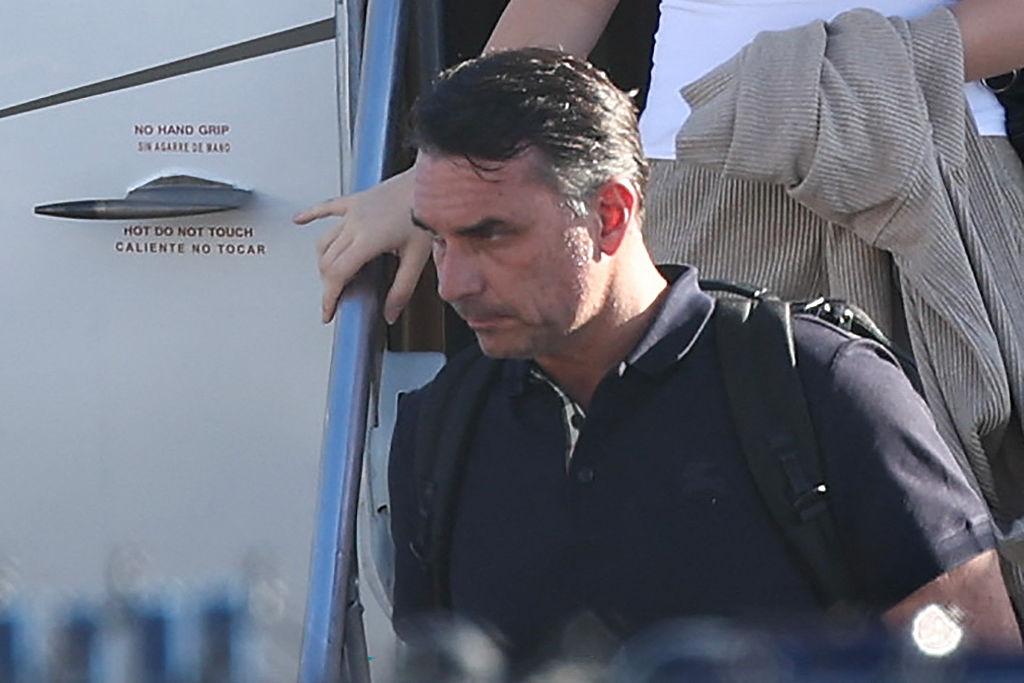
Flavio Bolsonaro arrives at Opa-Locka Executive Airport near Miami on Oct. 28, 2026, despite a court order barring the defeated Brazilian presidential candidate from leaving Brazil. —Ricardo Arduengo—AFP/Getty Images

Brazilian Senator Flávio Bolsonaro arrived in Miami on Wednesday after fleeing the country in defiance of a court order to surrender his passports amid a money laundering investigation, days after losing the presidential election to incumbent Luiz Inácio Lula da Silva.

Bolsonaro traveled from northern Argentina to the Ecuadorian city of Guayaquil, the Argentine government said. From there, Bolsonaro, his wife and two daughters flew to Miami, where they were recorded exiting a private jet at Miami-Opa Locka ​Executive Airport. 

President Donald Trump told reporters he “would approve” of Bolsonaro coming to the U.S. “I think they’re fine people,” Trump said. “The election ‌was very strange, and I thought ⁠it was terrible. It’s gotten bad reviews. You look at what happened to their market.”

On Tuesday, U.S. officials told multiple media outlets that the State Department would grant Bolsonaro and his family entry visas amid reports he had left Brazil to head to the U.S.

A Brazilian Supreme Court justice had ordered federal police to open a separate probe into possible illegal foreign financing of Bolsonaro’s presidential campaign, including alleged ties to U.S. Vice President J.D. Vance’s donor network. Lula’s government had previously accused the Trump Administration of interfering in Brazil’s election, an allegation the U.S. denies. TIME has reached out to Vance’s office for comment.

Bolsonaro initially said he would comply with Brazilian Supreme Court Justice Alexandre de Moraes’s order to surrender his passports and refrain from traveling. The order concerned an investigation into Bolsonaro’s alleged links to a Brazilian lawyer accused of laundering more than $1 billion through a fraud scheme.

The confidential order cited Bolsonaro’s flight risk and “significant financial resources.” The son of convicted former President Jair Bolsonaro, Flávio Bolsonaro will lose certain parliamentary protections from prosecution when his term as senator for Rio de Janeiro ends on Jan. 31.

“I have never thought ‌about leaving ⁠the country,” Bolsonaro said in a social media video Monday. “I will hand over my passports and defend myself against this travesty, which is a clear attempt to intimidate me.”

But Bolsonaro did not comply with the order to hand over his passport by the end of the court’s 24-hour deadline on Tuesday morning. Argentina’s National Directorate of Migrations said Bolsonaro and his family entered the country “with valid travel documentation and without any legal impediment” on Tuesday night before boarding a private flight to Guayaquil, Ecuador.

Lula called Bolsonaro’s flight from Brazil “a shameful act.”

“Those who have nothing to hide have nothing to fear,” Lula added, recalling his own arrest in 2018 on charges of passive corruption and money laundering. His convictions that were later overturned.

Bolsonaro is also being investigated over alleged links to a banker connected to a corruption scheme. He is alleged to have raised millions of dollars from the banker to fund a biopic about his father.

Bolsonaro's departure could inflame political tensions amid claims from Brazil’s right wing and abroad that the election was unfair. Bolsonaro initially said he would seek to annul the vote, although his Liberal Party later conceded defeat. In the video posted Monday, he said he would seek to have Lula’s ticket disqualified, citing alleged disinformation and “vote buying.” He also said he would organize congressional opposition to Lula’s government.

“I wasn’t the one who lost,” he said. “The system won.”

Trump, an ally of the Bolsonaros, said Monday that the election appeared “rigged.” He did not provide evidence for the claim.

“I didn’t take ​sides, but it looked like another rigged election,” Trump said.

“I just think it had a very bad look, the election, the ​way it was tabulated,” he added. “The extension given was very strange.”

Brazil’s Supreme Court had granted a two-hour voting extension on Sunday, citing transport issues raised by Lula’s campaign. Bolsonaro’s campaign had separately requested a two-hour extension due to heavy rainfall in certain areas.

Lula won the election by more than 4 million votes. Roughly 0.03% of all votes—or fewer than 35,000—were recorded in the extra two hours. Vice President Geraldo Alckmin told Rede Vanguarda that Trump’s claims were “completely wrong.”

Money laundering inquiry

The inquiry into Bolsonaro stems from a federal probe into unauthorized deductions from pension payments made by Brazil’s social security agency. The broader operation, launched in April 2025, investigated associations suspected of collecting unauthorized membership fees from pension benefits.

Evidence from the probe led investigators to examine suspected money laundering involving betting platforms and financial transactions linked to Brazilian lawyer Willer Tomaz, who denies wrongdoing.

Police reportedly discovered that Bolsonaro had “master user” access to bank accounts belonging to Alcazar Holdings, a company owned by Tomaz. In May 2025, a person working for Tomaz asked the bank to remove Bolsonaro’s access to the accounts, local media outlets BPMoney and Times Brasil reported earlier this month, citing police findings. Both Bolsonaro and Tomaz deny having a joint account or financial ties.

De Moraes’s order also barred Bolsonaro from contacting Tomaz. Bolsonaro said on Monday that the ruling came after his brother, Eduardo Bolsonaro, had said on a podcast last week that he should leave the country if he lost the election.

AFP reported that Bolsonaro’s Brazilian and diplomatic passports were canceled, but that he has held Italian nationality since 2023. His departure appeared to surprise his political allies, including his campaign manager Rogerio Marinho who told reporters Tuesday that he had no information about Bolsonaro’s whereabouts.

“I received a text message from him this morning, where he said he would let some time pass today and then would talk with us, and that was it,” he said. “That was the only communication we had.”

A critic of Brazil’s justice system

Bolsonaro has repeatedly criticized Brazil’s judiciary and described the investigations into him as politically motivated. The country’s Supreme Court generally assigns cases through a lottery system. The money laundering investigation was assigned to de Moraes on Oct. 16.

De Moraes was the lead justice in last year’s trial of Jair Bolsonaro, who refused to accept his election loss in 2022. A five-member panel of Supreme Court justices convicted Jair Bolsonaro, by a 4-1 vote, of attempting to overturn his election defeat and sentenced him to 27 years and three months in prison. He is serving the sentence under house arrest due to poor health. Prosecutors alleged that the plot included plans to assassinate Lula. Jair Bolsonaro denies wrongdoing.

In June, a Supreme Court panel unanimously convicted Eduardo Bolsonaro of coercion in judicial proceedings. Prosecutors alleged he had attempted to lobby the Trump Administration to use tariffs and sanctions, including on de Moraes, to pressure judicial authorities to drop the prosecution of Jair Bolsonaro. Eduardo Bolsonaro was sentenced to four years and two months in prison, but remains in Texas, where has lived since 2025.

De Moraes has also faced scrutiny over reported ties to Daniel Vorcaro, the former owner of Banco Master, whose financing of a film about Jair Bolsonaro is the subject of the separate inquiry into Flávio Bolsonaro. The New York Times reported, citing a police dossier, that Vorcaro sent text messages to de Moraes asking for help to avoid arrest. In messages to other associates, Vorcaro reportedly mentioned paying millions to the law firm of de Moraes’s wife. De Moraes has denied wrongdoing and said he never acted to favor Vorcaro or Banco Master.

De Moraes also clashed with tech billionaire Elon Musk in 2024 over court orders to block accounts on Musk’s social media platform X. De Moraes temporarily suspended the platform in Brazil after it failed to comply with judicial requirements, which Musk had described as “the most draconian demands of any country on Earth.”

  •  
❌