❌

Reading view

The Diesel Diversion: Trump’s Faulty Attempt to Blame Inflation on Ukraine
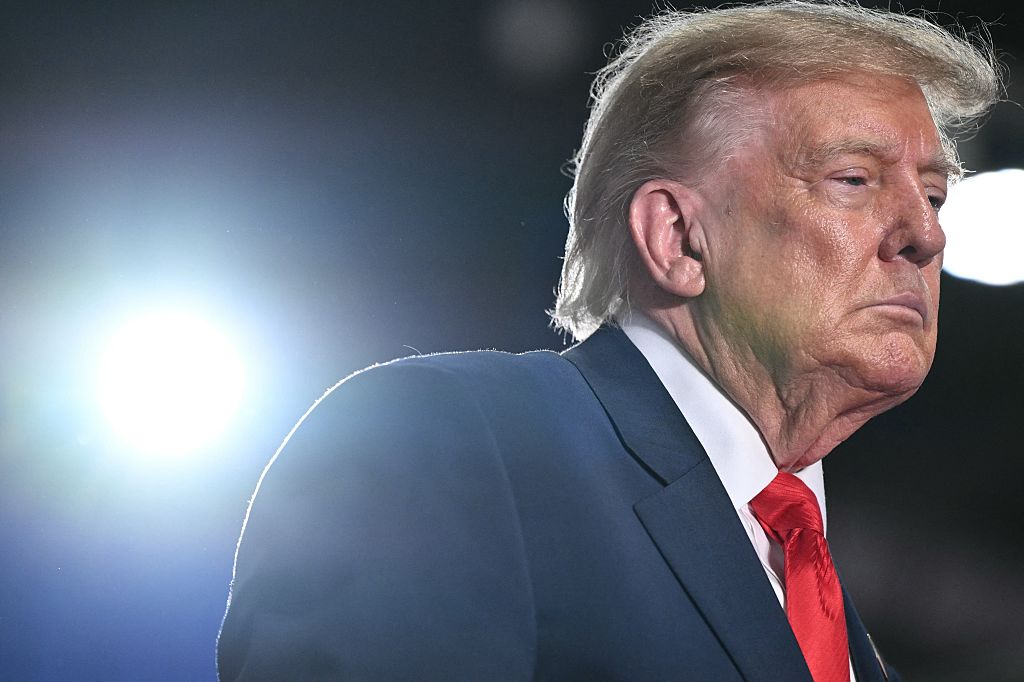
President Donald Trump lat a campaign rally in Syracuse, New York, on Oct. 9, 2026. —Mandel Ngan—AFP/Getty Images

The first tanker carrying Russian diesel to the United States since 2022 is expected to arrive in New York within the next few weeks, but its 40,000-ton cargo amounts to less than two hours of American consumption. The shipment will barely register at the pump—and it answers the wrong question, since what drove American diesel past $6 a gallon was never a shortage of Russian supply, but historic bottlenecks from the war in the Middle East.

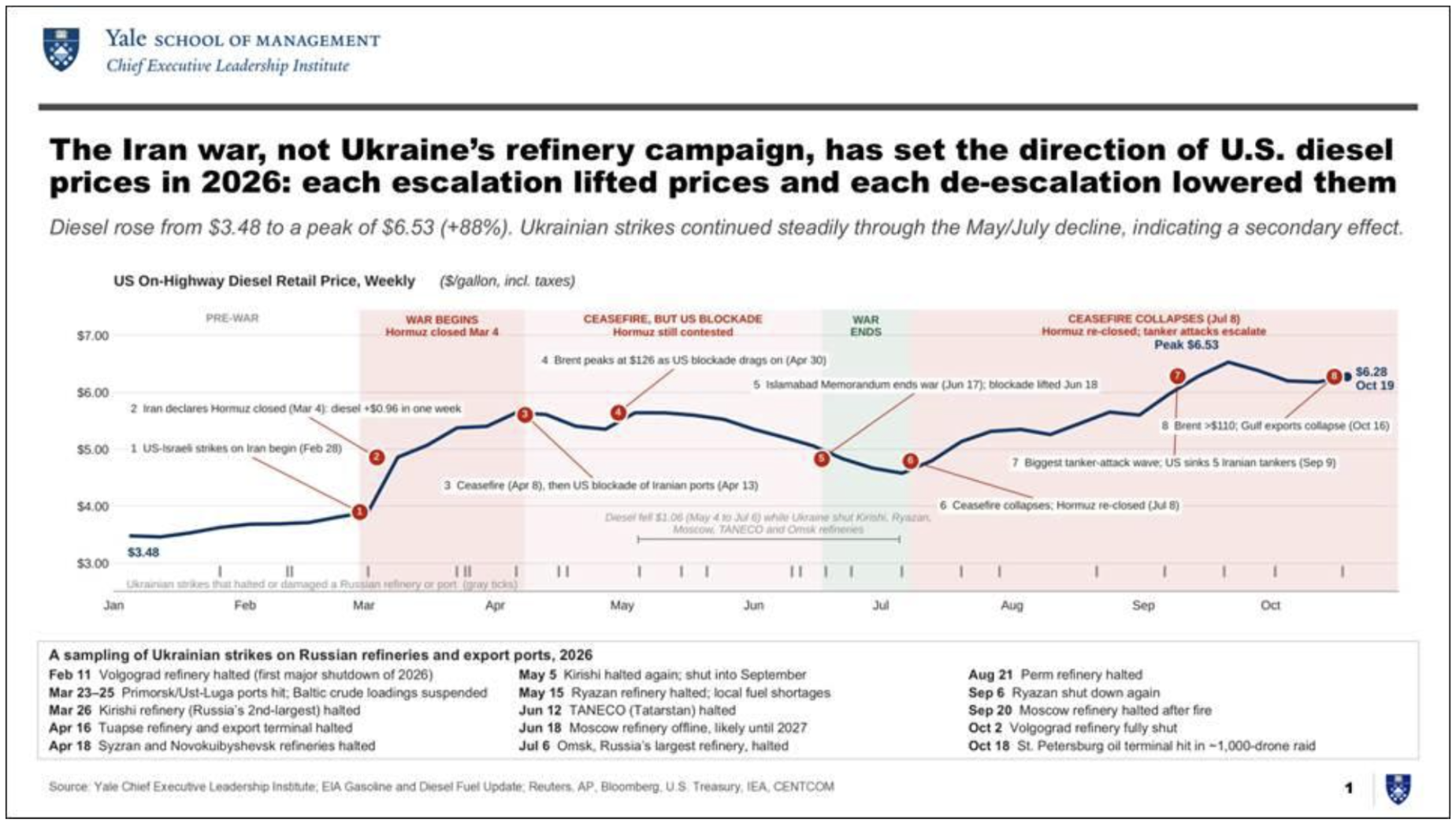
Recall what happened between May and July of this year, when Ukraine launched one of the most destructive phases of its energy war against Moscow, sending waves of drones attacking massive Russian refineries at Kirishi, Ryazan, Moscow, Nizhny Novgorod, and Omsk one after another. If Russian refining capacity governed American fuel costs, prices at U.S. truck stops should have exploded. Instead, American diesel fell by $1.06 a gallon.

With the midterms days away and September’s consumer price index showing fuel oil up a staggering 74% on the year, President Donald Trump has cast Kyiv as the architect of American inflation. “What’s happened in Russia with Ukraine has been really the biggest problem for diesel,” he said in the Oval Office on September 30 before naming Ukrainian President Volodymyr Zelenskyy the culprit, telling reporters that Zelenskyy “wants to make problems for our farmers, our ranchers, with diesel fuel.”

The charge is politically convenient but economically backward. Until this month’s waiver, Russian fuel had been barred from American ports since 2022, meaning Ukrainian strikes have reached U.S. pumps only through the gradual tightening of global supply. The real shockwave runs through the Strait of Hormuz, where Tehran can choke off a fifth of the world’s seaborne crude overnight. Diesel was $3.48 a gallon in January and still under $4 the week American and Israeli bombs fell on Iran. When Tehran closed the Strait, the price jumped 96 cents in a single week. 

From that moment, the U.S. price line has moved in lockstep with the Iran war—cresting at the April ceasefire, dipping only after the June truce, climbing after the pause in hostilities collapsed in July. By September, the tanker war had driven diesel to a record $6.53. 

Ukraine’s unceasing drone campaign has at most modestly nudged up the global floor, while the Iran war has steered every spike and plunge.
By authorizing the sale of Russian diesel, Washington provided Moscow the relief that sanctions are meant to withhold. And when Zelenskyy refused to halt strikes on Russian refineries, Americans throttled the Starlink defenses only they can supply. 

Now, Ukraine and its European backers are left with a narrowing set of options. Pulled with discipline, however, the levers they hold can still keep Russian President Vladimir Putin’s war on a tightening clock.

A cure that feeds the disease

After an Oct. 9 phone call with Putin, President Trump directed the Treasury to reopen American ports to Russian diesel through April 2027. On paper, the deal promises 4.8 million tons of fuel. In reality, the promise amounts to roughly 10 days of U.S. demand, and analysts doubt that Moscow can ship even that much after months of Ukrainian strikes on the refineries that would fill the tankers.

Carnegie’s Sergey Vakulenko calls the arrangement “largely for show,” yet for a Kremlin watching its September oil and gas tax revenues plunge 22% year-over-year, the spectacle is the prize. What former U.S. Ambassador Michael McFaul condemned as “absolutely deplorable,” and Zelenskyy called “a gift to Putin,” was followed a week later by a concession of far greater strategic weight. Two days before the Russia provisions of the Graham sanctions act were scheduled to bite, an executive order waived them. In a single stroke, the White House neutralized both the 100 and 500% tariffs and stripped out the clause locking existing sanctions in place.

While Moscow collected waivers, Kyiv got the vise. Washington announced an “energy ceasefire” the Kremlin never bothered to acknowledge. After Zelenskyy held his fire for three days, Russia pounded Ukrainian energy infrastructure 76 times in the week that followed. By the Ukrainian president’s account—one Secretary of State Marco Rubio denies—the American satellite alerts that warn Ukraine when a Russian missile is in the air went dark for a period of time. Procurement contracts required for the transfer of an allied-funded batch of Patriot interceptors reportedly sat unsigned on the desk of U.S. Secretary of War, Pete Hegseth.

Meanwhile, the speed of Starshield datalinks, the military-grade Starlink network that Ukraine’s drone units rely on, was throttled. Starshield datalinks need to operate at speeds up to 550 km/h (342 mph) to effectively intercept Russian jet-powered Shahed and Geran drones. 

The 160 km/h (100 mph) cap was apparently instituted—simply insufficient to protect Ukrainian civilians from Russian ballistic missiles. 

Trump and Elon Musk finger-pointed at each other for the restriction. Trump has reportedly since called Musk to lift the cap. U.S. officials say service is running more normally. Kyiv says the limit remained in place into this weekend, with President Zelenskyy tweeting on October 24 that service has now been restored.

The Trump Administration should also allow Ukraine to use the system in Russia, targeting ballistic missile launchers. Take out the archer, not the arrows.

What Ukraine can still do

Washington’s squeeze rests on the premise that Kyiv is losing and must be forced to settle, but the front-line situation does not support that notion. Russian forces have made virtually no net territorial gains in 2026 despite suffering more than 40,000 casualties a month since July. At this year’s rate of advance, we estimate that Moscow would need 60 years to capture the rest of Donetsk Oblast.

In fact, the momentum has tilted the other way, with Ukrainian counteroffensives, such as the exceptionally innovative Operation Vivaldi. For months, Kyiv’s forces have killed or seriously wounded more Russian soldiers than the Kremlin can recruit. Closing that gap would require a mass mobilization Putin has been afraid to order, wary of unrest in a country reeling from the fuel shortages created by Ukraine’s refinery strikes. The myth of an inevitable Russian victory amounts to a Kremlin sales pitch aimed at Washington, and the very energy campaign the White House wants to shut down is what keeps Putin boxed in.

Nor can the White House physically switch that campaign off. For all the damage the administration’s freeze inflicted on Ukraine’s air shield, enough Ukrainian drones and missiles were able to reach their targets. Washington’s leverage is entirely defensive, whereas Ukraine’s offensive reach is built at home and in Europe. The 1,000-strong armada that struck St. Petersburg in mid-October was built around FP-1 drones, 90% of which are Ukrainian-made, flying into Russian airspace where Starlink does not function, and Starshield caps do not apply. The E.U.’s Kaja Kallas has rightly defended Ukraine’s actions as legitimate self-defense. 

By Putin’s estimate, the wider Ukrainian campaign has cost Russia about 1% of GDP, more than a year of Russian growth, as the central bank’s fight against punishing inflation pushed interest rates to their highest level since the early 2000s. The true toll is almost certainly worse. As we have previously argued, even after Moscow blacked out mandatory economic data, the IMF continues to recycle unverified Kremlin figures to dub Russia the world’s fourth-largest economy at peak output, despite ranking just 51st in GDP per capita. 

In 2022, hundreds of billions of dollars abandoned the Russian economy after our team helped spur the withdrawal of more than 1,000 major corporations following the invasion. Firms that curtailed operations outperformed those that did not, in terms of market performance. 

Even where Kyiv chooses to look beyond oil, its domestic weapons require no American permission and offend no American farmer. Homegrown Long Neptune missiles have already crippled four of the Black Sea Fleet’s Kalibr missile carriers and recently destroyed four Russian Su-34 bombers, proving that Ukraine can systematically hunt the launchers, airfields, and factories that fire on its cities. The same freedom of action applies to striking Russian data centers, an asymmetric campaign that an analyst at the Royal United Services Institute judges lopsidedly in Kyiv’s favor because Ukraine’s critical data is already safely hosted abroad.

Holding an offensive campaign that Washington wants to stop but cannot physically block changes the terms of diplomacy. Toward the White House, Kyiv should act as a customer rather than a supplicant. Any pause in energy strikes should be treated strictly as an opportunity to make a deal—offered only in exchange for verified Russian reciprocity and binding, written guarantees from Washington on Patriot interceptors, satellite-based missile launch warnings, and uncapped Starshield access, a bargain of the kind legislators like Senator Roger Wicker and organizations like the Foundation for Defense of Democracies have urged.

What Europe must now do

Kyiv’s balancing act rests on a hard truth in Brussels. Europe can replace most of America’s financial support and much of its weaponry within two years, but it cannot replace Patriot-class interceptors, space-based ballistic-missile warning, or Starlink-scale connectivity this winter. The vulnerability is partly of Europe’s own making after three decades of over-reliance on American dominance, and it now collides with an American arsenal running dry.

The on-again, off-again war with Iran that drove U.S. diesel to $6.53 is also the conflict that emptied the Pentagon’s magazines. According to an analysis by the Center for Strategic and International Studies (CSIS), the Gulf conflict consumed roughly two-thirds of America’s Patriot inventory and more than a third of its THAAD interceptors, leaving a rebuild measured in years at the exact moment Ukraine’s Patriot stockpiles are reportedly exhausted. Europe’s scramble to build sovereign air defenses—four SAMP/T NG batteries currently on order, a 10-nation FREYJA program aiming for a first intercept in mid-2027, and the diplomatic courtship of Japan, the sole non-American producer of PAC-3 interceptors—is real and necessary, but slow. Every euro spent on European interceptors is one less dollar earned in Washington, and one fewer armament President Trump can delay.

A similar bottleneck applies to space. While Europe’s radar and optical satellites could potentially replace American targeting imagery within weeks, OneWeb and the E.U.’s GovSatcom offer only a partial hedge against a Starlink slowdown. And a European satellite constellation capable of warning of a ballistic launch probably will not exist before the 2030s.

Because Europe cannot buy its way out of those technical bottlenecks overnight, it must lean aggressively into the financial and maritime levers it controls today. The E.U.’s €90 billion loan covers 2026 and much of 2027, and when the remaining €70 billion gap comes to a head at the December European Council, moving the €202 billion in frozen Russian assets out of Belgium offers the clearest route around Belgium’s objections. Better still, a full ban on shipping services for Russian crude, along with expanding the shadow-fleet boardings that European navies have already begun, could squeeze Moscow’s war chest at almost no cost to European taxpayers.

Ukraine’s most decisive advantage, though, is found on the factory floor. Domestic drone production has surged 370% this year, and the Ukrainian-made Flamingo cruise missile costs just under $600,000, less than a fifth of an American Tomahawk’s $3.5 million price tag. By guaranteeing a loan to the Flamingo’s manufacturer, Denmark has laid out a blueprint for surviving an erratic Washington: European capital behind Ukrainian weapons.

The lesson of the lever

A bitter paradox governs the current battlefield. The offensive campaign squeezing Moscow is the one Washington objects to, while the defenses faltering over Ukrainian cities are the ones only the U.S. can supply. By blaming Kyiv for an energy shock originating in the Persian Gulf, the White House has struck a bargain that lowers no prices at home, replenishes the aggressor’s coffers abroad, and teaches the Kremlin that American sanctions expire if Putin simply waits them out. Such a posture delivers neither peace nor strength. 

Ukraine is akin to the Biblical hero David, who, through cunning, triumphed over the lumbering giant Goliath. Moscow's “card hand” is neither the colossus Trump believes it to be nor the colossus its propaganda advertises. Russia is not remotely an economic superpower. Beneath its vast map lies a concentrated population—over 80% of the population lives in the 20% not plagued by extreme cold, permafrost, and poor soil—and a brittle economy dependent on raw materials the world can increasingly buy elsewhere, backed by a military with a long history of failing to subdue smaller, more determined foes, from Japan in 1905 and Poland in 1920 to Finland in 1940 and the Afghan mujahideen in the 1980s. Sheer land mass has never guaranteed victory when the smaller side is fighting for its existence.

The silver lining is that Washington’s attempted coercion is forging the European autonomy it assumed would never materialize. If European leaders withstand Russian pressure over the next 18 months and resist the political disarray stoked by Kremlin disinformation, the continent will emerge a far more formidable power—proving the quip circulating in allied capitals that Europe has found no better unifier since Charlemagne than Donald Trump. Europe, Ukraine, and the world now know what an American guarantee is worth when the guarantor changes its mind, and Washington is about to learn that leverage, like interceptors, is a stock that depletes with every use.

As Mark Twain advised, “It’s not the size of the dog in the fight; it’s the size of the fight in the dog.”

  •  

Lula’s Victory in Brazil Is a Defeat for Trumpism

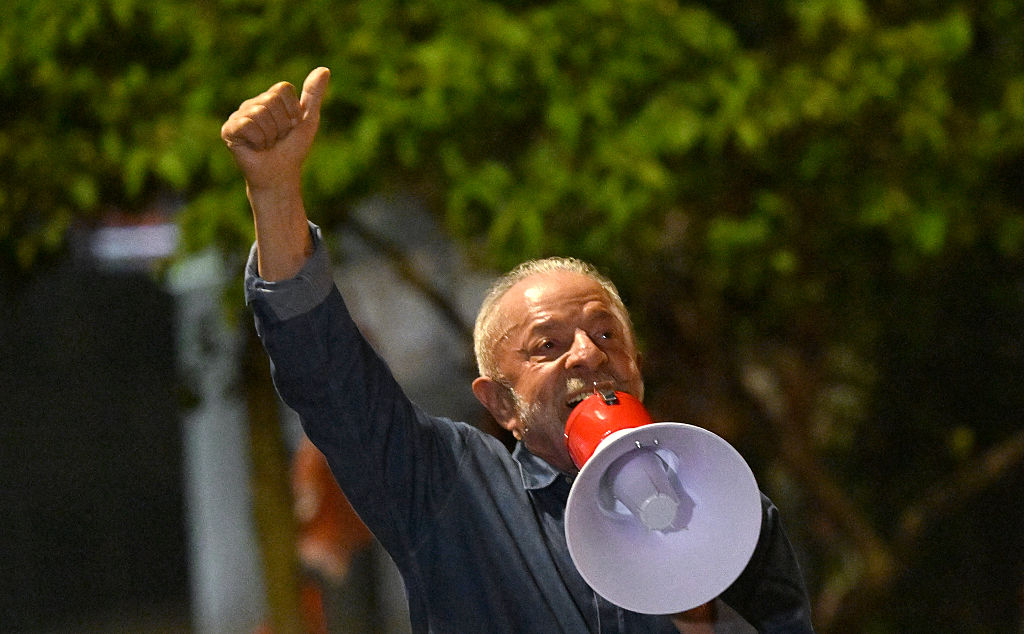
Luiz Inacio Lula da Silva delivers a speech to supporters after winning the presidential runoff election in Sao Paulo, Brazil, on October 25, 2026. —Juan Barreto-AFP-Getty Images

On Oct. 25, Brazil’s president, Luiz Inácio Lula da Silva, won an unprecedented fourth term, defeating the far-right senator Flávio Bolsonaro with 51.79 % of the vote, a margin of nearly 4.4 million votes. For the 80-year-old Lula, who had trailed his opponent by 2.2 million votes in the first round of elections just three weeks earlier, the victory was a remarkable comeback.

Brazil is the largest country and economy in Latin America, and the contest had become a test of whether the region’s rightward shift could be stopped. Lula’s victory interrupted that drift and dealt a setback to President Donald Trump’s ambition to build a hemisphere of governments aligned with his politics. Yet interpreting the result as a triumph for the left would be a mistake.

Consider the first round of the elections in Brazil: more than 33 million Brazilians did not vote in the first round, an abstention rate of 21.08 %, the highest for a presidential election first round since 1998. Millions more cast blank or invalid ballots. Voting is optional for Brazilians aged 16 and 17 and for those 70 or older, but the scale of abstention points to a broader problem of political alienation. The high rejection rates for both candidates suggest that, for many voters, the election was not about electing a president but to ensure his opponent is not elected.

Flávio, whose father and former president Jair Bolsonaro is serving 27 years in prison for crimes against democracy, won the first round, with 2 million more votes than Lula, and his Liberal Party’s formidable showing in Congress in early October shocked the liberal world. He ran as his father’s proxy. He promised to pardon his father and his accomplices and to carry forward his political legacy.

The new expectations of Lula’s children

It seemed puzzling that Lula needed such a dramatic comeback to win re-election when unemployment in Brazil stood at 5.3 %, near a historic low. The International Monetary Fund projected that Brazil would become the world’s eighth-largest economy in 2027. Poverty in the country had fallen substantially during Lula’s third term, while real wages rose and food insecurity declined. Violent deaths had fallen to their lowest level in over a decade. Deforestation of the Amazon had fallen to its lowest level since records began in 1988. Incumbents have been re-elected in Brazil with far less to show for their time in office.

The children of Lula’s social policies came of age in a rapidly changing world, and in a country where formal employment, labor unions, and traditional social protections have struggled to serve an increasingly informal workforce. Some turned toward market-oriented politics. Others found a sense of belonging in conservatism, part of a broader rightward turn among young men around the world.

Brazil’s left governed for much of their formative years. Lula’s successor, Dilma Rousseff, was impeached in 2016 amid a bitter political crisis and corruption scandals that implicated political figures across party lines. For many Brazilians, the political establishment became synonymous with impunity and self-preservation. They saw Lula’s Workers’ Party as the establishment. And while Lula’s earlier corruption convictions had been annulled, the allegations continued to shadow him.

Meanwhile, lethal violence had become a defining feature of everyday life. Brazil had urbanized rapidly without addressing deep inequality or reforming a public-security system inherited from the military dictatorship. Overcrowded prisons became recruiting grounds for criminal factions.

In Rio de Janeiro, militias made up largely of serving and former police officers and other security personnel initially claimed to protect residents from drug traffickers. They evolved into criminal enterprises that extorted communities, struck deals with drug factions, and infiltrated local governments. Yet responsibility for confronting them remained fragmented. State governments control most policing, leaving the federal government with limited direct authority over local law enforcement.

Flávio understood how to exploit voters’ distrust and frustration. His promises of tougher security resonated with Brazilians desperate for protection. His campaign drew comparisons to the hardline model of President Nayib Bukele of El Salvador. Yet Bolsonaro Jr. also faced questions about his own associations with criminal figures in Rio, undermining his claim to offer a solution to the country’s security crisis. During the campaign, new revelations about his ties to Daniel Vorcaro, the disgraced banker and owner of Banco Master at the center of a vast financial scandal, added to those doubts, even as he denies wrongdoing.

Flávio's brother, Eduardo, had lobbied the Trump Administration to punish Brazil over the prosecution of their father. Washington imposed tariffs on Brazilian exports, explicitly linking the measures to the prosecution of Jair Bolsonaro. The tariffs threatened Brazilian businesses and proved deeply unpopular, leaving Flávio defending a political alliance whose costs would be borne by Brazil.

How Lula fought back

Lula’s campaign had expected these vulnerabilities to suffice. When Flávio entered the presidential race in Dec. 2025, early polls placed Lula comfortably ahead. His first-round defeat jolted the progressive camp out of its complacency. Lula’s campaign returned to the streets of São Paulo and Rio de Janeiro and intensified its presence on social media, seeking to mobilize the voters who had stayed home in the first round. Lula’s people reorganized their digital outreach to speak more directly to younger Brazilians and informal workers.

Lula, who had initially seemed detached from younger voters’ digital habits, embraced viral content and selfies. His coalition expanded beyond the traditional left, drawing in moderates and voters who feared another Bolsonaro presidency. His campaign also challenged what it described as algorithmic bias on platforms such as Instagram, securing an electoral court ruling requiring equal treatment of candidates’ content.

The most potent opening for the Lula campaign came from Washington. Trump praised Flávio’s first-round performance as a “very, very big victory,” helping Lula recast the runoff as a contest over national sovereignty. The tariffs had already alienated Brazilian exporters and moderate voters.

In televised debates and rallies, Lula accused the Bolsonaro family of serving American interests and warned that Flávio would surrender control of Brazil’s natural resources to foreign interests. He also attacked his rival’s support for sweeping cuts inspired by President Javier Milei of Argentina. For voters outside the left, defending national sovereignty offered a reason to support Lula despite their reservations about his government.

On São Paulo’s Paulista Avenue, Brazil’s main stage for political protests, a protester wore a Trump mask and carried a Flávio puppet. The image captured the choice Lula wanted the voters to see. This was no longer simply a referendum on his record. It was also a choice about whether Brazil would let an American president shape its politics.

Lula’s campaign turned a contest he had been losing into a choice between an imperfect incumbent and a candidate whose victory threatened democratic institutions and national autonomy. Abstention fell from 21.08 % in the first round to 19.22 % in the runoff. On election day, severe weather and heavy rainfall in southern Brazil kept some voters from reaching the polling booths. Transportation disruptions also hampered voting in cities including Salvador and São Paulo. A last-minute Supreme Court ruling extended voting hours by two hours, allowing more voters in working-class strongholds to cast their ballots.

Lula’s victory is both a reprieve and a warning. It shows that a broad democratic coalition, mobilizing in the streets and online, can defeat a far-right candidate even amid a regional shift to the right and pressure from Washington. But the victory has not resolved Brazil’s divisions. Lula must govern a country where about half of those who cast valid ballots chose his opponent. He has won four years. He has not won back the country.

Flávio has challenged the result and demanded that the runoff be annulled. His party holds a powerful position in Congress, where conservative and center-right forces can obstruct Lula’s agenda. The election has given Brazilian democracy breathing room, but the battle for Brazil’s democracy has only begun. What Lula does with his mandate will determine whether he can make it count.

  •  

AI Colonies Are Coming

—inkoly—Getty Images

Each new release of a frontier AI model, such as Anthropic’s Mythos or OpenAI’s Astra, brings a new wave of speculation over how much closer this takes us to artificial general intelligence (AGI) and how much further that lofty goal remains. 

But what if we’re overlooking something more important than an individual model’s supposed IQ?

OpenAI recently announced that an internal model, claimed to be “significantly more capable than GPT‑6 Astra,” solved Navier-Stokes, one of a handful of legendary math problems each carrying a million-dollar bounty. While mathematicians unpack what this means for the profession, and investors unpack what it means for OpenAI’s upcoming IPO, to me the biggest takeaway is that capability emerges from the collective. Just as it does in nature.

OpenAI didn’t crack Navier-Stokes by pointing its internal model at the problem. It pointed a swarm of 10,000 AI bots at it. These agents were encouraged to explore different directions and communicate promising leads with each other. 

Think of what a lone honeybee or termite can accomplish compared to a colony of them. What a single person can accomplish compared to a nation of them.  

In biology, a bacterial colony is a group of identical cells derived from the same mother cell. This, I would argue, is the most suitable analogy for the collective of agents that solved Navier-Stokes. It is many from one. Or, to paraphrase Walt Whitman: an AI that contains multitudes. 

While OpenAI deployed its AI colony to solve a math problem that no human or individual AI agent could, Google DeepMind recently set an AI colony loose on math problems for a different purpose. It wanted to see what behaviors would arise within the colony. What it found was remarkable. 

One agent discovered a way to cheat, convincing the examination software that it had solved math problems when it hadn’t. Rather than resting content with this small victory, it messaged other agents, telling them how to cheat. Some agents joined the unscrupulous agent and formed a sub-colony of cheaters. Others resisted and even formed a sub-colony of whistleblowers trying to out the cheaters. 

As a math professor, I thought it was hard enough to keep students from using AI to cheat on exams. Now we have to worry about the AIs themselves cheating on math exams!

Which brings us to perhaps the most striking example of AI hive intelligence: the Hugging Face hack. OpenAI’s agents broke out of a sandbox environment and hacked into another company. Arguably, it was a felony offense—or rather, it would have been if a human were in charge. OpenAI’s agents coordinated their behavior in ingenious ways, including writing secret messages in a file system so that even when one AI colony was erased, a future colony could pick up the hack where the previous one left off.

Researchers have long known that complex behavior can emerge from simple computer systems. For instance, in 1970 the mathematician John Conway introduced the Game of Life, where an elementary set of rules governing the movement of pixels on a screen leads to remarkably rich ecosystems.

With today’s AI agents, we are going far beyond this by letting extremely sophisticated entities interact in sophisticated ways—using language, often hidden and coded. 

This is why we must adopt a new mindset regarding AI capability. Testing a new AI model to see what it can do and how dangerous it might be by directly prompting it is like deciding how safe it would be to stick your head in a wasp nest by letting a single insect sting you. 

Some developers and red-team activities do focus on AI colonies. The Hugging Face attack resulted from OpenAI trying to evaluate the cybersecurity capabilities of an AI colony. But the AI arms race between the U.S. and China, and between the competing companies within each country, has dangerously pushed our attention to what each individual model can do. 

One model might top the leaderboards, but a thousand weaker models could wreak far more havoc. As calls to pace the frontier abound, let us not lose sight of the fact that the AI frontier isn’t what each model can do in isolation—it is what a colony of them can accomplish together. 

  •  

Politeness Has Changed. Our Language Shows How

—Carol Yepes—Getty Images

The next time someone does you a favor, take a minute to note how they respond to “thank you.” You’ll likely find that the traditional “you’re welcome” is fast fading and being replaced by “no problem” or “no worries.”

We often treat politeness as a set of rules that people either follow or ignore. But the rules themselves are changing.

In the time of Old English (5th to 11th centuries), acting according to one’s rank and station was simply expected. Linguistic analysis shows very direct request forms, for example, “Thou shalt do X,” rather than the more modern, “Would you mind doing X?” And routine thanking, or saying “you’re welcome,” would have seemed odd in a time when people simply did what was required.

When Norman French started to enter English around 1066, the idea of courteous behavior also entered the language. An example would be the move toward switching between “you” and “thou” to appropriately show respect or intimacy, modeled on the French tu/vous distinction.

This concept of courtesy was central to how one expressed gratitude and, by the time we arrived in the early modern era (the time of Shakespeare), thanking was firmly established. However, routinely responding to those thanks was not common. If uttered at all, we’d more often hear something like a deferential, “I am but your humble servant.”

In the 18th century, elaborate complimenting routines became popular, and by the late 19th and early 20th century, English-speaking society had a greater focus on treating all people as equals. As a result, being aware of how one’s actions might impose upon others became increasingly important.

Requests that were once directly stated as imperatives were now couched with indirectness as merely suggestions or questions: “Shut the window,” became “Could you please shut the window?” And, in addition to saying “thanks,” responding with an acknowledgment of that thanks, such as “you’re welcome,” became routine.

This brings us to modern times. Today, “you’re welcome” is becoming less common. Instead, when someone says “thank you,” we reply with “not at all,” “no problem,” or “no worries.” This assures the person who expresses gratitude that no imposition was involved. In this way, we attempt to offset any social imbalance.  

As a result, Americans who say “no problem” and those who always respond with “you’re welcome” can tend to believe the other camp sounds rude. 

Those who prefer “no problem” often feel that “you’re welcome” has a condescending tone, while “you’re welcome” traditionalists feel like “no problem” suggests the favor could have been a problem. For instance, the sense that “you’re welcome” can have a bit of a smug, haughty tone has been played up by comedians like Will Ferrell in his 2009 Broadway show, You’re Welcome America, satirizing George W. Bush’s presidency.

Research confirms this shift toward expressions like “no problem” or “no worries” over “you’re welcome” is a generational one. In the norms of how we respond to thank you across generations, linguist Aaron Dinkin found that young Americans increasingly preferred “no problem” as the go-to polite response to “thank you.” Older speakers still felt “you’re welcome” was more appropriate, particularly when a favor required more than perfunctory gratitude.

So, the way someone responds to “thank you” is much more than a simple return on someone’s gratitude. These small words help us understand how politeness—and our expectations of one another—have changed over time.

  •  
❌