❌

Reading view

Carney Warns U.S. Is Trying to ‘Break’ Canada as Trump Revives ‘51st State’ Threat
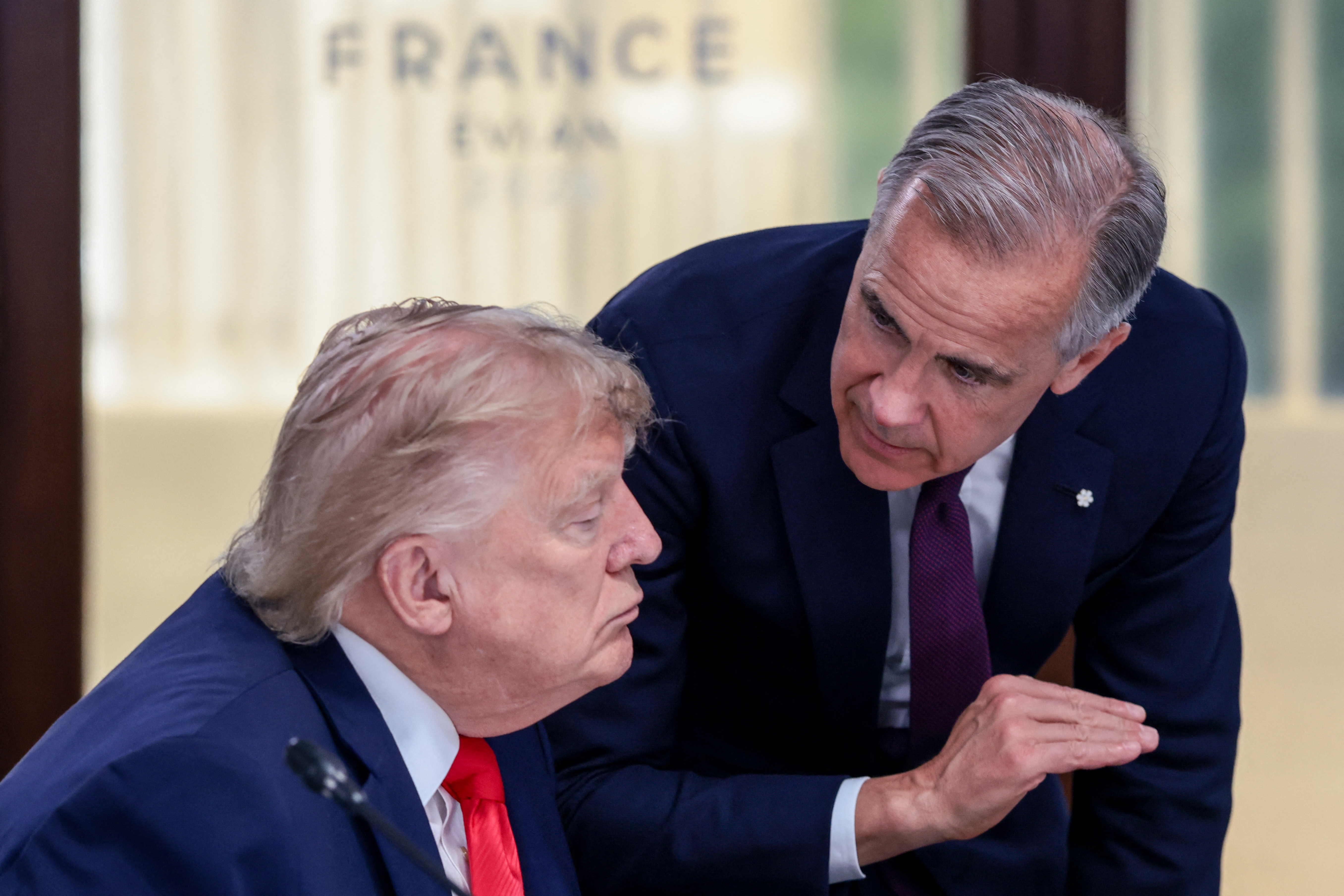
U.S. President Donald Trump and Canadian Prime Minister Mark Carney at the G7 summit, in Evian, France, on June 16, 2026. —Evelyn Hockstein—Getty Images

Canadian Prime Minister Mark Carney on Thursday warned that the United States is trying to sow discord as he urged Albertans not to vote for a separation referendum.

“The stakes are high. This referendum, it comes at the worst possible time. The world has become more dangerous and divided,” Carney said at a rally in Calgary ahead of Monday’s vote, which will see residents decide whether the oil-rich province should hold a referendum on independence. “There are some outside our borders who are working to break us, so they can own us.”

While Carney didn’t explicitly name the U.S., the remarks echoed his previous warnings of the dangers of American dominance. Carney's statement came a day after U.S. President Donald Trump revisited his ambitions to annex Canada, telling the crowd at a rally in Arizona that the country will “end up being the 51st state, because it's the only way it works.” Trump again accused Canada of treating the U.S. “very badly” and vowed he won’t allow it to happen anymore as “it’s a whole different ballgame now [that] Trump is in town.”

The U.S. and Canada remain in a contentious trade standoff after negotiations collapsed in August. Canada’s retaliatory tariffs came into effect last month, matching the economic pressure imposed by the U.S. Carney has encouraged Canadians to band together and take back their economic power by choosing Canadian products over those made in the U.S. The trade tussle comes after months of Trump repeatedly threatening Canada’s sovereignty—a move that has stoked tensions between the U.S. Administration and Canadian officials.

In light of Trump’s most recent remarks about possible annexation, Canada’s former deputy Prime Minister Chrystia Freeland said it would be dangerous to deepen or maintain close economic ties with a neighbor that “openly says they want to take you over.”

Carney admitted in an interview with the New York Times last month that he had studied the risk of a U.S. invasion, given Trump’s charged rhetoric. “I think you have a responsibility in these roles to look at extreme tail risk,” he said. “That’s just risk management. That’s not a base case, but it would be irresponsible not to [prepare].”

Amid the U.S.-Canada tensions, Carney is desperately trying to promote his “Canada Strong” strategy—one that he hopes will very much include Alberta. Polling conducted by 338Canada suggests that as of Oct. 11, 75% of Albertans would vote to remain part of Canada. But Carney’s resolve is being tested on more than one front, after the separatist Parti Québécois won Quebec's provincial election earlier this month. Incoming Premier Paul St-Pierre Plamondon has already stated his intention to hold a referendum on Quebec independence. While he has vowed not to initiate a vote so long as Trump is in office, the looming presence of a separatist movement undoubtedly complicates matters for Carney at a time when he is striving to show that Canada is strong enough to prosper without relying on the American market.

With the U.S. and Canada locked in a trade stalemate, and with annexation threats once again dominating the conversation, here’s a look at the reality Carney is facing as he deals with both domestic and international pressures.

Trump's remarks complicate Carney’s unity efforts

Trump’s accusations that Canada has taken advantage of the U.S. on matters of trade and security date back to before Carney became Prime Minister in March 2025, meaning the friction we’re currently seeing goes deeper than a simple clash between Trump and Carney. Trump would often refer to Carney's predecessor Justin Trudeau as the "governor" of the "great state of Canada."

In terms of any physical threat facing Canada, Patrick Leblond, a professor of public and international affairs at the University of Ottawa, says that Carney “put it best when he talked about tail risk” in his interview with the Times. “It’s the financial term for something that has potentially high impact, but low probability,” Leblond explains.

Trump’s economic actions and threats have proven to be far more damaging than his annexation remarks, experts note.

“He has weaponized market access to the U.S.,” says Leblond. “What we can expect is more economic pressure from the White House in the coming months. Trump and his acolytes certainly [appear to] see Canada as a small, weak country that the United States should try to squeeze further.”

The U.S. is Canada’s largest trading partner, with almost $2.6 billion worth of goods and services passing across the border daily in 2024. According to the Office for the U.S. Trade Representative, trade between the two was down 4.6% from 2024 to 2025, but still saw $872.3 billion worth of goods and services cross the border.

Still, there are concerns that any suggestion of annexation, however unlikely it may be, could damage Carney’s high-stakes domestic campaign to unite the country.

On the home front, the success of a separatist party in Quebec is another threat to the unity that Carney is striving for. However, despite the Parti Québécois' victory (they fell five seats short of securing a majority government), the desire for separatism among Quebec residents remains low—with only 31% in favor of sovereignty for the province, according to data from 338 Canada released on Oct. 11.

“If Quebec is on a path to separation or not, it would never be because they were looking for further alignment with the United States,” argues Lori Turnbull, a professor in political science at Dalhousie University. “Quebec has a variety of cultural protections in the Canadian federation. They would have none of that in the United States.”

The more immediate risk for Carney lies in Alberta, with residents preparing to vote on whether the province should hold a referendum on independence.

Carney, who was raised in Edmonton, Alberta, on Thursday framed the referendum as an opportunity for voters to “stand up for Alberta, the heart of Canada” and “recognize that we're all responsible for each other.”
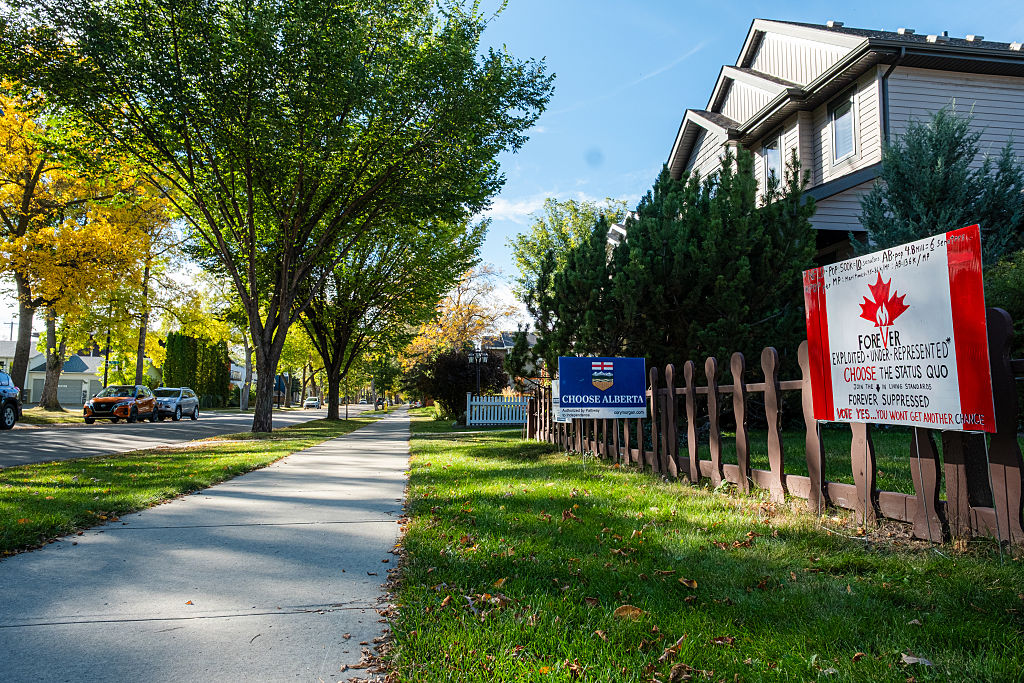
Ahead of the vote, residents express their views with signs outside their homes in Edmonton, Alberta, on Sep. 28, 2026. —John Diep—Getty Images

How Trump’s threats could also help Carney

The pressure and rhetoric from the U.S. could actually work in Carney’s favor, experts tell TIME.

“The effect of Trump's comments has been unifying,” says Turnbull. Despite discussions of independence in Alberta and Quebec, she says “there isn't widespread panic that the country is coming apart.”

In fact, research conducted by the Environics Institute for Survey Research in 2025 found that “in almost every province, the proportion of residents who are very attached to Canada is greater than the proportion who are very attached to their province.”

Between Trudeau’s resignation on Jan. 6, 2025, and a federal election in Canada months later on April 28, Carney’s Liberal Party went from 20% to 42.8% in the polls, according to CBC, with Carney’s message of defiance in the face of Trump proving to be a rallying point.

This falls in line with depleting favorable views of the U.S. among Canadians. In July, 44% of Canadians had a favorable opinion of China compared to 33% of Canadians who held the same view of the U.S., according to a Pew Research Center survey. “When China is more popular than the U.S. in a country like Canada, you have to ask yourself: ‘What's going on?’” says Leblond.

Continued annexation threats could bring Canadians even closer together.  “Already, trust is very low, and [more threats] would confirm even more that the United States is [perhaps] not a trustworthy partner at this time,” Leblond argues.

Since the U.S.-Canada trade war reignited in August, Carney has seen his domestic approval rating bounce back up. On Oct. 15, it stood at 62% according to Poliwave, compared to 56% in mid-July. Carney’s resistance against American economic pressures could help his cause, particularly in possible separatist provinces.

“In August, when Carney walked out of the negotiations with the U.S., the highest levels of support for him were found in Quebec,” says Leblond. Indeed, Carney’s approval rating in Quebec grew from 76% to 80% between Aug. 17, and Sep. 7, the highest in any province, according to Liaison Strategies.

Turnbull says the support behind Carney’s decision to walk away from negotiations prompted a strong sense of “patriotism and loyalty.” 

That attitude among Canadians has been reflected in the burgeoning “Buy Canadian” movement, in which consumers across the country have joined a boycott of U.S. products in an effort to feed back into the Canadian economy. 

Carney strengthens international alliances to end reliance on American market 

In September, European Commission president Ursula von der Leyen invited Canada to work toward becoming the bloc’s first “associate member,” in what she described as an “urgent” reimagining of partnerships.

While addressing the European Parliament as a guest of honor in Strasbourg, France, Carney insisted “Europe and Canada are stronger together” and said “Canada and the European Union can anchor our ground to hold our values while forming a protective canopy under which our citizens can thrive.”

Trump called the unique membership proposal “laughable” and has threatened economic punishments if the E.U. moves forward with von der Leyen’s plan.

Carney’s shift towards other partnerships “doesn't mean that Canada is not going to do business with the U.S., but it's no longer a preferred partner,” says Leblond, noting that Carney wants to build relations with partners that “share the same values in terms of rules-based trade and investment.”

In January, after meeting with Chinese President Xi Jinping, Carney announced a new strategic partnership with China, focused on “energy, agri-food, and trade.” Carney agreed to cut his country’s 100% tariff on Chinese electric cars in return for lower tariffs on Canadian farm products, including canola seeds, a major Canadian export.

These stronger international ties that diversify trade and security away from the U.S. are proving popular on the homefront, according to data. 

According to Abacus Data, a survey conducted in September found that 49% of Canadians would support Canada joining the E.U. An Ipsos poll conducted in January, in light of Carney’s visit to China, found that 54% of Canadians also said they support stronger trade ties with China.

  •  

Katie Zacharia Out as Trump's Press Secretary After 5 Days

Katie Zacharia is exiting her job as White House Press Secretary after just five days in the position, according to a person familiar with the situation. President Donald Trump on Friday said to reporters that he told Zacharia to reconsider her role, amid reports that she had already been relieved of the job.

“I said to her honestly, if I were you, I'd reconsider,” Trump said outside of the White House, adding, “Katie, do you need this? I don’t think you need this.”

Trump said that the decision was ultimately hers, and that he would speak with Zacharia following a trip to Georgia. “I just want her to be happy,” he said.

Zacharia’s brief stint as press secretary is bound to draw comparisons to Anthony Scaramucci’s 11-day run as Trump's White House communications director in 2017. Then-White House Chief of Staff John Kelly fired Scaramucci after he had given a fiery interview to The New Yorker in which he attacked his colleagues. In Washington parlance, the tenures of prominent White House officials have since been jokingly measured in “Scaramuccis.”

Trump said that Zacharia has been treated “pretty nastily” and “very unfairly” by the media since taking over for former Press Secretary Karoline Leavitt. 

“I said you should reconsider because you don't want to go through this,” he said in reference to the critical media response Zacharia received following her first press briefing on Tuesday.

Trump called Zacharia “an attorney” in his Truth Social post announcing her position, and Zacharia has described herself as a lawyer. But when asked by a reporter where she had passed the bar, Zacharia responded “when I moved to China.” She later said that she had misheard the question. Zacharia then acknowledged while speaking on Fox that she had failed the bar exam.

"You went to Pepperdine law school but you did not pass the bar exam, correct?" Fox host Sean Hannity asked Zacharia on Thursday.

"Correct," Zacharia replied.

When asked whether she regretted never having told the White House that she failed the bar, Zacharia responded “those questions weren’t asked,” and “I’m being hired as White House press secretary, not White House counsel.”

Zacharia previously worked as a general counsel at a the conservative non-profit Fix California. She also has experience working as a communications adviser at Trump Media and Technology Group, which houses the President’s social media platform Truth Social. She previously worked as a spokesperson for former Homeland Security Secretary Kristi Noem, and is a regular on conservative media outlets like Fox News and Newsmax.

Zacharia received a wave of criticism following her first press briefing, which lasted just 14 minutes and during which she only took questions from three reporters. 

Leavitt, the youngest press secretary in White House history, stepped down in August after returning from maternity leave. She recently joined Fox News as an on-air contributor. 


  •  

A door to single-payer healthcare could open after November 3

Sign that says healthcare is a human right
Protest signs seen at protect Medicaid lights up Capitol amid budget showdown, on May 7, 2025, in Washington, DC. | Leigh Vogel/Getty Images for Caring Across Generations

Twelve years ago, Vermont Democrats tried to make their state the first in the nation to have a single-payer government-financed healthcare system — a bold experiment to push the limits of American health coverage when Obamacare was just being launched.

Their plan failed, and rebooting it became politically impossible, even in Vermont: The Democrats lost the governorship to Republican Phil Scott for what turned out to be a decade.

This year, that could finally change. A progressive political newcomer named Amanda Janoo is taking on Scott in what polls show is a tight governor’s race.

And if she wins, the state could be poised to try a whole new national experiment: One of Janoo’s central campaign promises is to create a pioneering health system where the state pays the full tab for primary and preventive care, while leaving the rest to the existing system.

Key takeaways

  • Amanda Janoo, the Democratic nominee for governor of Vermont, wants to move primary and preventive healthcare to a single-payer system — where the state would pay providers for such care, make it free for patients, and cut insurers out.
  • Previous attempts to pass or enact full single-payer systems have failed at the state level, including in Vermont in 2014.
  • Janoo is trying to focus first on this one relatively smaller slice of the health system, but hopes it could be a starting point to full single-payer reform eventually.
  • Yet even this more limited reform faces difficult political and practical challenges.

Janoo’s candidacy is an example of the policy experiments that are becoming possible nationwide in a projected “blue wave” year, when Democrats could sweep into power in a number of states. But in the healthcare universe, her plan is also an example of how even progressive policy idealists are trying to learn from past failures and focus on what they think can actually be achieved.

Compared to the sweeping ambition of Vermont’s 2014 effort, or Bernie Sanders’s signature “Medicare-for-all” idea, Janoo’s proposal for single-payer has very specific limits. Under Janoo’s proposal for “universal primary and preventive care” (she typically avoids the term “single-payer”), the state government would pay for Vermonters seeing primary care providers such as doctors and nurse practitioners. This government coverage would be universal and free for patients, and insurance companies would be cut out.

However, other parts of the health system — such as hospitals, specialists, and prescription drug companies — would remain under the existing insurance system, for now.

Every effort so far to enact full single-payer at the state level has failed — even in blue states, bills and ballot initiatives have regularly gone down to defeat. Vermont’s previous single-payer experiment made it the furthest — it was signed into law but abandoned before being implemented, when the governor concluded it was unworkable. Wherever it’s gained steam, politicians and voters have blanched at the high costs of moving their health systems onto state budgets, and the high taxes that would be necessary to fund them.

Now, Janoo is making an attempt to refurbish single-payer as something more achievable, by cutting off a smaller slice of it.

“I think it’s clear at this point that a profit-oriented healthcare system is a terrible idea,” Janoo told me in an interview on Monday. But after assessing that the state budget made it “unrealistic” to do single-payer immediately, she concluded, “we could do universal primary and preventive care,” financed by a tax on the wealthiest.

Indeed, single-payer for primary care seems more achievable precisely because primary care is a relatively less expensive part of the healthcare system. But Janoo hopes it will pay major dividends — that better preventive care will improve Vermonters’ health, reducing costs elsewhere in the system by, for instance, making some hospital visits unnecessary.

In speaking to health policy experts about this idea, I heard much sympathy for the goal of universal primary care, but many questions about the details. Would Janoo’s plan be sufficient to bring more primary care doctors to Vermont — and, not unrelatedly, would it pay them more? Would her hoped-for cost savings from preventive care actually materialize? Is picking up the tab for a relatively less expensive part of the healthcare system the best use of sparse state funding?

These questions are becoming national ones, as healthcare gains traction as a political issue again. It isn’t just Vermont where primary care reform ideas are gaining steam: Democrats in Minnesota, Washington state, and elsewhere have discussed them. “There is growing interest in a number of states across the country in doing a universal primary care for all program,” Kevin Grumbach, a family physician and a professor of family and community medicine at the University of California San Francisco, told me. Even Scott, Janoo’s opponent, signed a law calling for a study of universal primary care.

One dividing line emerging, though, is whether to keep insurers involved, or to clear them out with a single-payer system, as Janoo wants. Insurers are unpopular with the public, but they can be a formidable political opponent when they argue that the benefits voters currently enjoy might be lost. Scott has said that the idea of universal primary care is appealing — but that if universal is “just code for single payer, I’m not interested. We’ve already been through that.”

Yet Janoo is hoping that single-payer for primary care will be a stepping stone — a trial run for eventually making the rest of the state’s health system single-payer down the road.

“I think about this often,” Janoo told me. “How do you build the new system as you transition the old — or hospice the old?”

Amanda Janoo is tired of “corporate neoliberal bullshit”

Janoo has long been an unorthodox economic policy thinker. Her rise is part of a broader trend in which progressives and leftists are winning primaries and gaining influence in the Democratic Party — but she doesn’t fit the prototype of the democratic socialist candidates in New York City, Colorado, and elsewhere who’ve gotten much attention this year. Instead, she comes from a different strand of the left, a movement based on a dissident strain of economics and openly skeptical of the benefits of economic growth.

Dating back to when she graduated from college in 2010, in the aftermath of the financial crisis, she was part of a younger cohort rebelling against what seemed the glaring failures of the economic establishment. “The one thing coming out of university I was clear on was that neoliberalism was the worst,” Janoo said on a podcast last year. “This whole idea that governments should just take a hands-off approach to the economy and trust in sort of the disciplinary powers of the global free market to lead them to infinite growth seemed highly problematic and very anti-democratic.”

So for graduate school, Janoo attended Cambridge to study development economics under the “heterodox” economist Ha-Joon Chang. She then spent several years working abroad in international development for the United Nations and other organizations, before moving back to Vermont and working as an economic policy consultant.

In recent years, Janoo became deeply involved with the “well-being economy” movement: an international group of advocates, academics, and experts who criticize what they deem modern capitalism’s obsession with economic growth, and say the “well-being” of humans and the environment should be prioritized instead. They overlap with the “degrowth” movement, which outright argues economic growth should be reduced; last year, Janoo led a workshop at a DeGrowth Institute event on “Degrowth Policy Design.”

Trump’s return to power horrified Janoo. “I’m feeling angry about the rise of fascism and the growing threat of world war, because I feel like we don’t have time for this shit,” she said in a speech at an environmental event last year. ”The planet is on fire and ecosystems are collapsing, and that should really be the focus of all of our attention.” But, she said, “I believe I was born in this moment of history for a reason” and vowed “to fight for democracy — for life.”

So Janoo decided to jump in the race for governor of Vermont. While she is not running on a degrowth platform, her campaign is deeply informed by aspects of the movement’s thought: skepticism about growth’s benefits, a sense that untrammeled capitalism is leading the world to disaster, and that localism provides a better way. For instance, candidates for governor typically pledge that they’d help bring business investment in, but Janoo said in a July debate: “A lot of the problems we’re facing is because we focus so much on attracting external business.” 

“Our economy is not super-diversified, and it is not really centered in the most essential kinds of goods and services you want to make sure people have access to no matter what happens — because honestly, things are bad now and they’re going to get worse,” Janoo told me. “I feel a little bit like a collective prepper right now. My motto is, protect what we love, produce what we need.”

In the Democratic primary, Janoo’s opponent, Aly Richards, had closer ties to the party establishment and led in fundraising. But Janoo ran as a progressive outsider; she promised to advance a “more economically populist vision” instead of “corporate neoliberal bullshit.” Her health plan became a point of contrast with Richards, who said she wouldn’t run on “magical thinking,” and that she wanted a version of universal primary care that would keep insurance companies involved. Janoo won the primary by 2.5 percentage points.

Now, she’s facing Governor Scott, who’s long been viewed as politically untouchable in the state — in 2024, he won his fifth two-year term by a margin of 52 points. But polls show a much closer race this time around, and Janoo could have a national blue wave at her back. If that wave helps carry her into the governor’s mansion. And if she makes it there, Vermont will have its first Democratic trifecta in a decade — and with it, the opportunity for major progressive policy change.

Amanda Janoo’s plan: Single-payer for primary care

Advocates for primary care reform argue that it should be at the top of Democrats’ agenda, in Vermont and elsewhere, because the system is in crisis.

Primary care providers are overwhelmed and underfunded, they say — and, as a result, there aren’t enough. Grumbach, the family physician and UCSF professor, said “the workload, the lack of resources, and the gap in compensation” — as compared to more highly paid specialists — “has made it very hard to recruit people coming out of medical school to want to be family doctors like me.” 

Patients, then, are having trouble finding doctors they like, and aren’t getting sufficient access to preventive care that could help them be healthier. “The emergency rooms are functioning and doing a lot of the work that normally primary care would do,” Janoo told me. “People are waiting a really long time to see anyone, and so often health issues that could have been caught sooner become more serious and dangerous.” 

Finally, both providers and patients complain that insurance companies make the preceding problems worse, by adding administrative burdens and bureaucratic hassle. 

So what would Janoo’s plan do?

First, her plan would guarantee free, government-paid primary and preventive healthcare for all in the state, by cutting insurers out of that part of the system.

Second, she wants to phase out the “fee-for-service” model of care, where primary care providers are paid based on specific services. She’s suggested, instead, either government-paid annual salaries, or per-patient per-month payments.

Third, she wants to try and try and make sure there are more primary care providers in the state, via more spending. “We would need some relocation incentives, so maybe $100 grand if you want to move here, or a student loan repayment program,” she told me. “My hope would also be that we could be a place for foreign-trained medical professionals to come here and be safe and accepted and to bring some cultural diversity,” she added.

As for how it would be paid for, Janoo proposes an income tax increase on the wealthiest Vermonters that, she said, would be comparable to the tax break they got in President Trump’s One Big Beautiful Bill Act last year. Though she hasn’t settled on a final amount, she hopes these new taxes would raise hundreds of millions of dollars.

Would Janoo’s plan work in practice?

In speaking with health policy experts both inside and outside Vermont, though, I heard various questions and doubts about Janoo’s plan.

Some of the problems mix the practical and political. For instance, under this plan, primary care visits would be free, but tests such as MRIs would likely still require the existing insurance system, as would most prescription drugs. Janoo acknowledged to me that deciding how many things the government should pay for would “always be a challenge,” but said her first priority was access to getting people at least some healthcare.

There are also questions about whether this primary spending is really targeted at patients’ most urgent problems. Erasing the copay for your doctor visit might be nice, but those copays weren’t driving people into medical bankruptcy. Janoo’s reform plan leaves the bulk of hefty health spending from hospitals and treatments for very sick people untouched.

The core challenge to Janoo’s reform will be the one that has dogged single-payer reform attempts everywhere: money.

Other questions are about whether Janoo’s hoped-for benefits from better preventive care — she’s said the state could save as much as $300 million a year — will materialize.

“There’s no question that better access to primary and preventive care makes people healthier in the end,” Larry Levitt, executive vice president of the health policy nonprofit KFF, told me. “But advocates have long tried to sell prevention as saving money. I think it’s more likely that it costs money, but keeps people healthier.” One reason for this, he said, is that better preventive care could help identify more underlying illnesses and conditions in patients, and spur more spending to try and address them.

The shift to a salaried model for providers could bring other practical challenges. Though Janoo hopes that ditching fee-for-service will free up providers to see more patients, others suspect a guaranteed salary might incentivize them to see fewer, and wonder what role the government would play in trying to hold such providers accountable.

Finally, I also heard some disconnect between what providers said they wanted, and what Janoo thought they wanted. When we talked, she told me her impression was that primary care providers were most eager for changes in their work environment. “I’ve asked them, ‘If you could get paid a good annual salary — like, average for the nation — and you didn’t have to deal with insurance and the fee-for-service structure, would you do that?’ They say, ‘Absolutely.’”

Yet Grumbach told me that, for the primary care system, “Problem number one is not enough money, problem two is not enough money, and problem three is not enough money.” In his telling, it’s more money that’s the real key to incentivize more new doctors to practice primary care, and help pay other staff and health workers who could actually deliver good preventive care.

If so, the core challenge to Janoo’s reform will be the one that has dogged single-payer reform attempts everywhere: money.

If the government takes on the responsibility of paying primary care providers and setting salaries for them, providers will want those salaries to be high. If they aren’t high enough, the shortfall in primary care providers will worsen. But the higher such salaries are, the higher the taxes the state would need to raise to pay them. Essentially, taxpayers would be asked to shore up doctors’ salaries to keep them in the state — turning the healthcare argument from one kind of difficult political issue to another.

Getting the balance right would be a challenge for the government, with much at stake. But Janoo says her background in industrial policy has convinced her that it’s possible. Furthermore, she hopes, it will be just a starting point for the full single-payer system she still thinks is urgently needed.

“​​My hope is, when I’m governor, that I can start to work with some of our neighboring states,” Janoo said. “Because if we could create a New England-wide system, we could move to universal healthcare really quickly. “I think it’s a moment where people recognize we need a universal healthcare system.”

And, she added, “If we had done it previously, it would be much cheaper than it is now.”

  •  

What Is Starshield, SpaceX's Military Version of Starlink, and Why Is It So Important to Ukraine?

Ukrainian servicemen walk along a road to military positions in Donetsk Oblast, Ukraine, on Aug. 22, 2026. —Alex Nikitenko/Global Images Ukraine—Getty Images

Ukrainian forces said Wednesday its battlefield efforts had been hampered overnight after losing some access to SpaceX’s military-grade satellite Internet service, which has become a lifeline as Kyiv weathers Moscow's attacks.

Starlink offers Internet connectivity from satellites in low-Earth orbit. Its sister service Starshield, a military version developed for the Pentagon, relies on the Starlink network and has recently been used by Ukrainian forces to strengthen its far-reaching drone strike missions and air defenses.

Serhiy Beskrestnov, a military technology expert who advises Ukrainian President Volodymyr Zelensky, said speed restrictions had been imposed on the "military package" of Starshield services, leading to the “failure” of several military missions. “Our defense forces have not received any warnings about this restriction,” he said. Beskrestnov claimed the restrictions, which he said applied to devices traveling over 100 miles per hour and using Starshield, were “related to the current political situation.” He did not offer further details.

Tensions are high between the U.S. and Ukraine, as Zelensky has been vocal in his disapproval of U.S. President Donald Trump’s plan to import diesel from Russia, despite previous sanctions prohibiting it. The move has also caused a split in Trump’s own party, with several Republican lawmakers urging him to reverse course. After making the deal with Russian President Vladimir Putin last week, Trump announced an “energy cease-fire” between Russia and Ukraine—but Zelensky swiftly accused Moscow of violating any such agreement and Ukraine has, in turn, resumed strikes on Russian oil refineries, despite pressure from Washington. Trump called Ukraine's fresh wave of strikes on Russian refineries a "disgrace" in an interview that aired Thursday.

Speaking from the U.K., Zelensky said Wednesday it was a “pity” Ukrainian forces had experienced “difficulties” with Starlink services and intelligence, adding that he was surprised by the developments in Ukraine’s partnership with the U.S. In an interview on Piers Morgan Uncensored, Zelensky suggested he believed Starlink had been slowed down to damage him, and warned “people will die, if attacks will continue and if Starlink will not work … it’s not helpful.” He said he hoped the restriction was only a “mistake,” suggesting it was perhaps "a huge technical problem” at SpaceX.

However, in another interview, Zelensky said: "It was not a technical problem, it was the will.”

SpaceX founder and CEO Elon Musk addressed the matter, insisting that Starlink and Starshield are different. He cited the U.S. authorities as being in control of the latter’s usage determinations.

“Starshield systems are owned and controlled by the U.S. government. Any limits on speed or usage are decided by the U.S. military and ultimately POTUS,” he said on X. “Starlink is a commercial service owned and controlled by SpaceX. Usage of Starlink is limited to civilian or defensive activities and cannot be used for offensive military action, as doing so would be inappropriate for a commercial company.”

When approached for comment, a senior U.S. official told TIME: “No such request was ever made by the President.”

Reuters, citing three U.S. officials, later reported that the decision came from inside the White House.

TIME has reached out to the White House for further comment.

Meanwhile, Ukrainian national news agency Ukrinform reported Thursday, citing sources within the Ministry of Defense, that the Starshield service had resumed. TIME has reached out to Ukraine’s Ministry of Defense for comment.

The discourse has raised questions about what Starshield is and how uniquely important it has become on the Ukrainian battlefield.

What is Starshield?

Starshield is a program developed by Musk’s SpaceX that draws on the satellite and launch capability behind Starlink, its commercial satellite Internet network, to support national security operations.

According to SpaceX, Starshield is designed for government use, with an initial focus on three areas: Earth observation, communications, and hosted payloads. 

“Starlink is basic interconnectivity, it's like the Internet. Starshield essentially grows out of the experience of Starlink,” Mark Hilborne, a senior lecturer in defense studies at King’s College London, tells TIME.

But the military value of that connectivity extends far beyond access to the Internet, Hilborne adds.

“In and of itself, satellite communications are not military technology, but it enables the military to communicate and amass a real-time, multi-domain picture of the battlefield, which some argue nobody else actually has at this stage,” he says.

Both systems also offer high-speed connectivity because of the satellite technology underpinning them. 

“Starlink and Starshield are low on the Earth’s orbit, and they have a very high bandwidth, so lots of information can pass through those satellites, with virtually no delay on the signal,” Hilborne says.

There are more than 10,000 satellites in the Starlink network, while Hilborne says Starshield uses “a much smaller number of satellites.” However, the exact number of satellites associated with Starshield remains unknown, with experts telling TIME that such details are closely guarded due to national security considerations.

“They keep the contracting details on these things classified,” says Todd Harrison, a senior fellow at the American Enterprise Institute.

SpaceX, on its website, says Starshield is “designed to support U.S. National Defense use cases for the Department of Defense and other government partners.”

How is Starshield different from Starlink?

While both systems rely on closely related satellite technology, they differ in the services they provide and how they are intended to be used.

“Starshield refers to military services that actually operate through Starlink,” Harrison explains, comparing the services to “two different brands of a cell phone provider, even though your phone calls are going through the same towers.”

Starshield offers additional capabilities designed for military operations, including more advanced encryption and satellite imaging, experts tell TIME.

“It's got another extra set of capabilities over and above Starlink,” Hilborne says. “They use some of the same technologies, but it would be highly encrypted, and they have different sensors that allow them to image what they call ‘Earth observation.’ That can give a radar imaging of the Earth [which] has advantages over optical pictures.”

Yet experts say the distinction between the two systems is not always clear, particularly given how closely their underlying technology and operations are connected.

How important is Starshield for Ukraine?

Starshield and the satellite communications technology underpinning it have become vital to Ukraine’s military operations against Russia.

Hilborne describes the technology as “highly critical” to Ukraine, explaining that any restrictions could cut communications with military equipment traveling above that speed, leaving operators without the information needed to guide their missions, as once that speed threshold is exceeded, the connection “suddenly cuts off and it's flying blind,” he says.

The consequences are particularly serious for Ukrainian drone operations, which rely on communications for both strikes against Russian targets and defensive missions against incoming attacks.

“It's really critical for drones, both the offensive medium range strikes, but also affects Ukraine's ability to fly defensive drones against the incoming Russian drones,” says Hilborne. 

Beyond its role in drone missions, experts say satellite communications also offer important advantages over other forms of battlefield connectivity.

Harrison notes that “the big benefit of using satellite-based communications is that you can communicate over longer distances in a variety of terrain, and it does have some jam-resistant features to overcome electronic forms of attack.”

  •  
❌