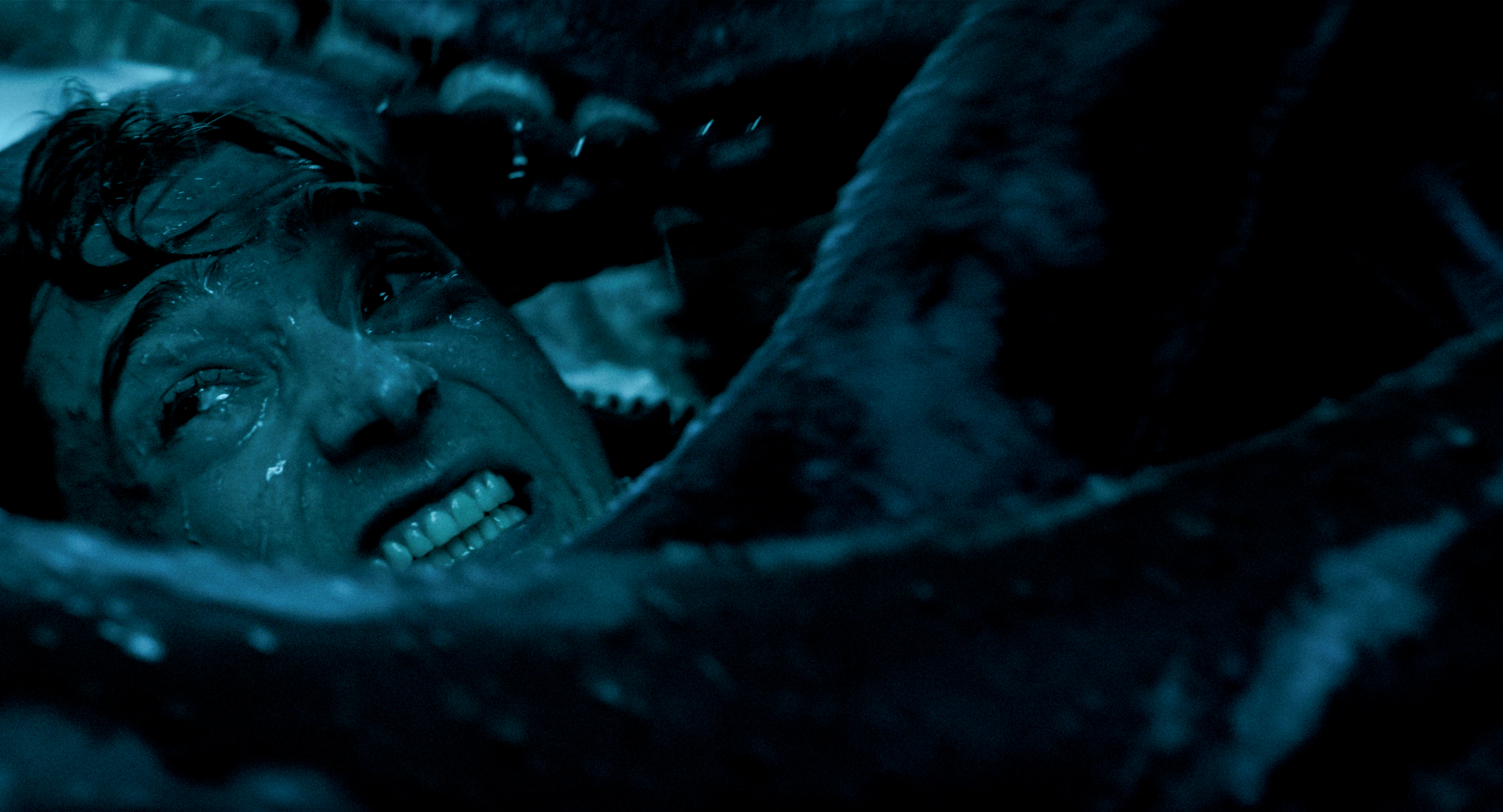
Jay (Austin Abrams) is attacked by a squid inside the belly of a whale in Whalefall. —20th Century Studios
Warning: This post contains spoilers for Whalefall, now in theaters.
It's been a big few months for Austin Abrams moaning and groaning his way through some of the worst situations imaginable. First, as medical courier Bryan Hodukavich in Resident Evil, he was forced to contend with an onslaught of mutant zombie monsters. Now, as Jay Gardiner in Whalefall, he spends the majority of the film's 106-minute runtime getting repeatedly maimed inside the belly of an 80-foot-long sperm whale that weighs 60 tons.
Directed by Brian Duffield (No One Will Save You, Spontaneous) and co-written with Daniel Kraus (the author of the best-selling 2023 novel on which the movie is based), Whalefall follows Jay as he plunges into the treacherous depths off Northern California's Monastery Beach to retrieve the unrecovered remains of his late father Mitt (Josh Brolin), a legendary local diver who became severely ill from advanced, terminal Mesothelioma. The movie's opening scene shows Mitt leaving sealed letters for his wife and three children in a cooler on his boat before taking his own life by strapping diving weights to himself and jumping into the ocean. A year later, Jay still hasn't opened his letter when he is swallowed by a massive whale who's on the hunt for a giant squid in those same waters.
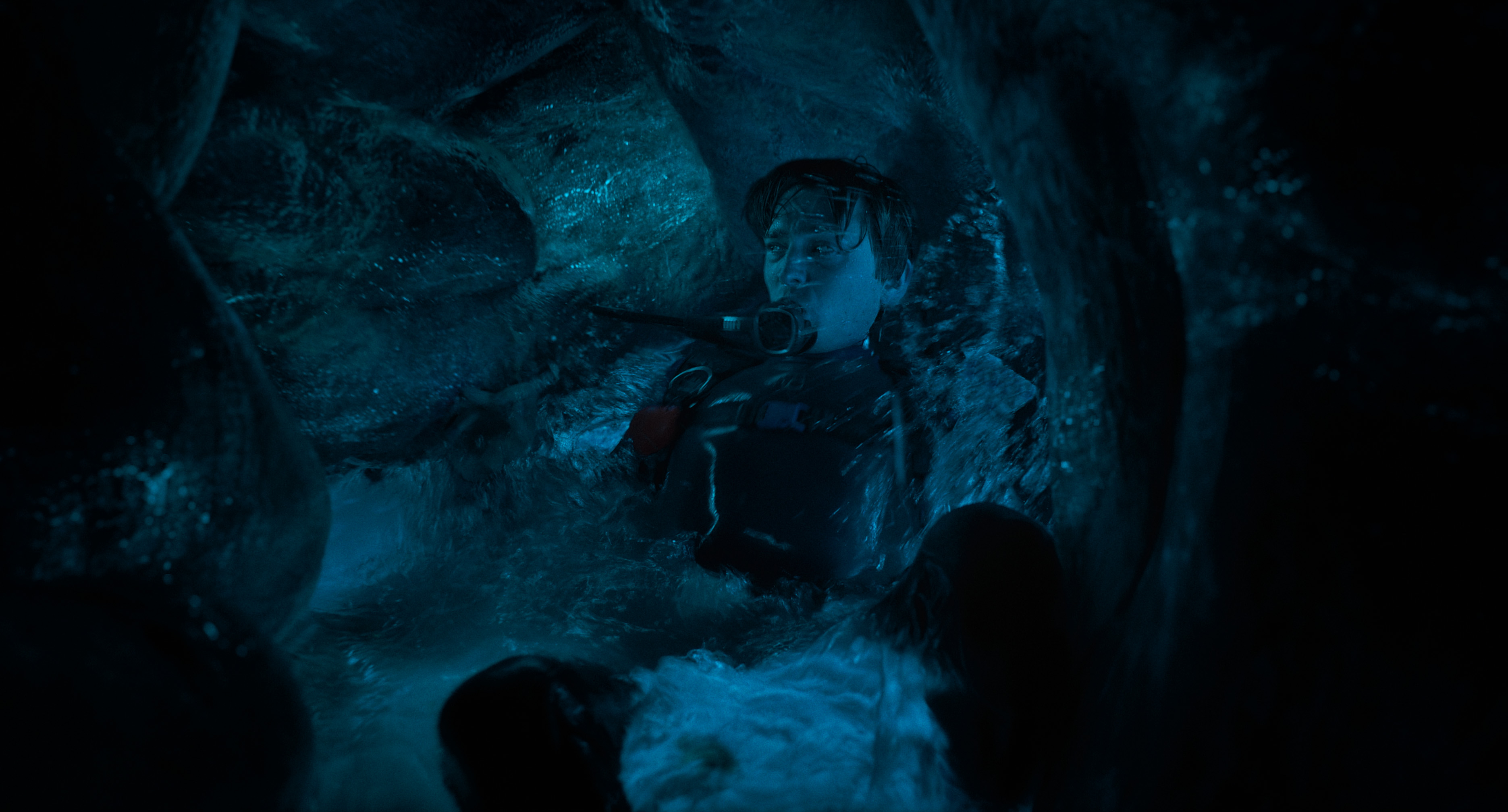
Jay contemplates his situation inside the whale in Whalefall —20th Century Studios
With just about an hour of oxygen left in his diving tank, Jay must endure a series of increasingly agonizing ordeals as he searches for a way to escape his terrifying predicament. There's a nasty encounter with the giant squid's razor-sharp beak, exposure to corrosive stomach acid, and the ever-present threat of being crushed by the whale's constricting organs or suffocating on the toxic, unbreathable methane gas inside its body. Amid the visceral horror of Jay's ingestion, we learn more about his complicated relationship with Mitt, a harsh and often emotionally abusive man, through a series of flashbacks.
Eventually, the whale breaches the surface and Jay nearly manages to break free by climbing out of its open mouth. But he ends up tumbling back inside the whale as it dives deep down into the ocean, causing Jay's eardrums to explode and him to start to hallucinate from lack of oxygen and panic. It's then that Jay, believing he is likely going to die, begins hearing his late father's voice speaking to him through the whale. As the whale is attacked by orcas, saved by its own pod, and returns to the surface, Jay is forced to process his trauma, confront the guilt and grief he feels over not visiting his dad before he died, and come to the realization that the only way he's going to survive is by applying the tough-love diving lessons Mitt drilled into him as a child to his current situation.
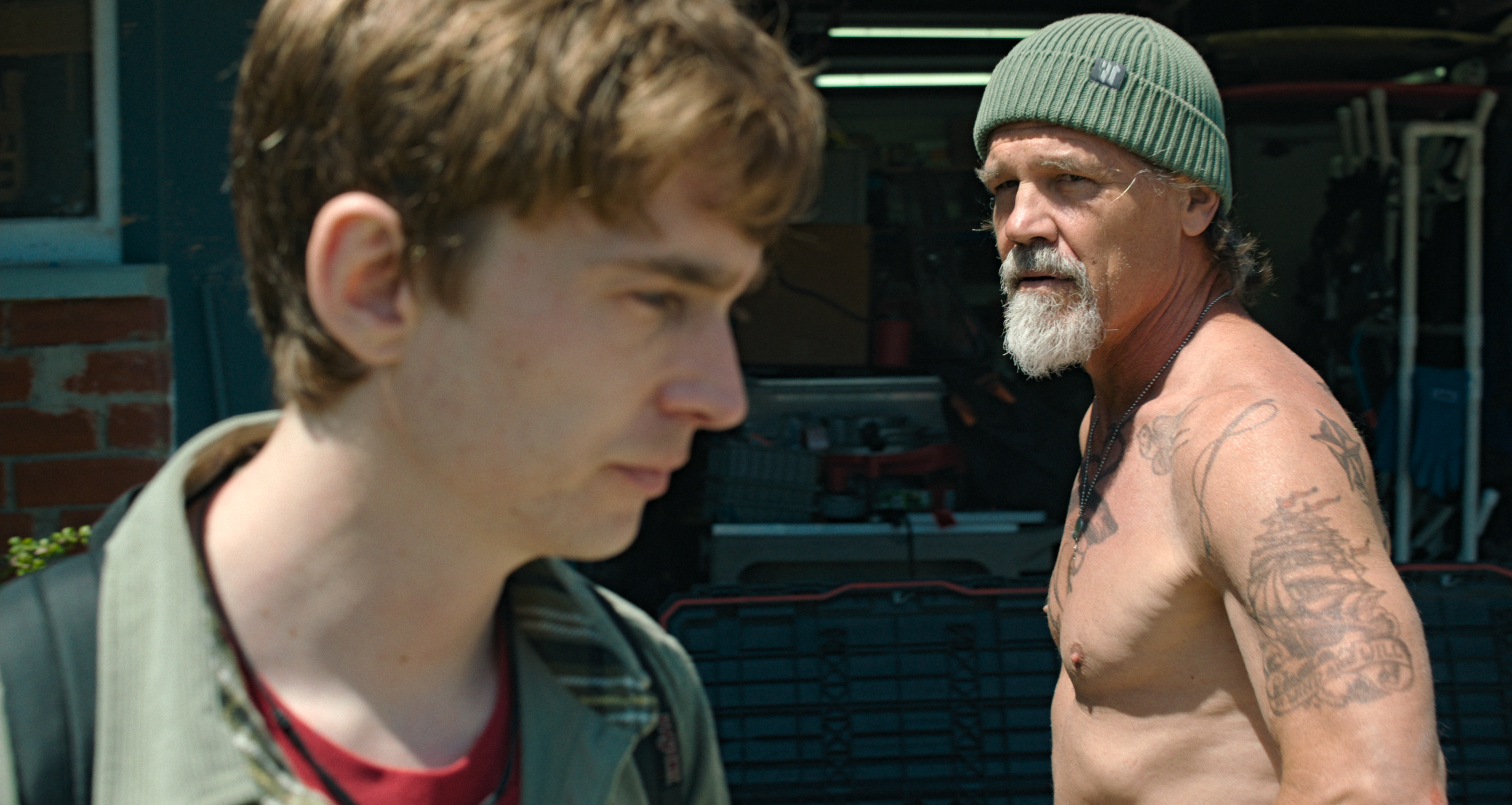
(L-R): Austin Abrams as Jay Gardiner and Josh Brolin as Mitt Gardiner in Whalefall. —20th Century Studios
"The whole story is based on his relationship with his father, and not being able to take in what his father is trying to impart because of his father's personality and the way that he does it," Brolin told the Direct of Whalefall's overarching message. "And I think what the whale represents a symbol of how to get out of our own way in order to inhale those gems that you need, because I think the father really wants him to become self-sustaining, and he does it in a way that's almost paranoid. So the son can't hear it, and then when the son needs it, you see that he heard it. He just didn't hear it in the way that [his father] wanted him to, and I don't blame him, by the way."
In the end, Jay is able to escape the whale, who has already succumbed to its orca injuries, by managing to blow it up from the inside. The whole thing is overly sappy and obviously a bit preposterous, but if you're able overlook the absurdity of the premise and some particularly cheesy lines of dialogue, then you may be left feeling some type of way about the meaning of unconditional love. As the whale version of Mitt somberly reminds Jay, "The whale is forever."
Warning: This post contains spoilers for You Can See Everything
We might like to believe that documentary filmmakers are adamantly neutral parties, aiming their cameras at people who are just being themselves and, later, turning whatever the camera captures into objective truth. But because documentaries are, for now, made by humans and not robots, pure objectivity is impossible. When Albert and David Maysles captured Little Edie Bouvier Beale’s exuberant flag-twirling dance in Grey Gardens, they weren’t just casually showing us some random American eccentric in an outlandish headscarf; they were both in awe of her and, at least somewhat, laughing at her. The sequence is funny, jaw-dropping, a little sad. The camera isn’t human, but for better or worse the sensibility behind it is. It may not tell us what to think, but its job is to lead us there.
Since its surprise debut at the Telluride Film Festival earlier this fall, You Can See Everything, directed by Nathan Fielder and Lance Oppenheim, has been widely praised as a groundbreaking documentary work, one that will change the face of nonfiction filmmaking forever. Not so fast. The first half of Fielder and Oppenheim’s film chronicles the 34 days leading up to the incarceration of Elizabeth Holmes, founder of the blood-testing technology company Theranos. Holmes was convicted of fraud in 2018 and sentenced to just over 11 years in federal prison, commencing in May 2023. To make this documentary, Fielder, Oppenheim, and their crew camped out with Holmes, her partner Billy Evans, and their two small children, observing their lives up-close—or as up-close as possible. The filmmakers had come at Evans’ urging: some time earlier, he and Holmes, who had completely withdrawn from the public eye, had approached A24 to see if the studio might be interested in making a documentary about them. In a roundabout fashion, Fielder and Oppenheim became the filmmakers charged with the task. Early in the film, we hear Evans explaining that he wanted the world to get an accurate picture of the woman he knew, a devoted partner and mother, whom he felt had been unfairly villainized. The film’s title comes from Holmes’ spoken promise to Fielder: She vowed to keep nothing hidden from the filmmakers—but did she fulfill that promise?
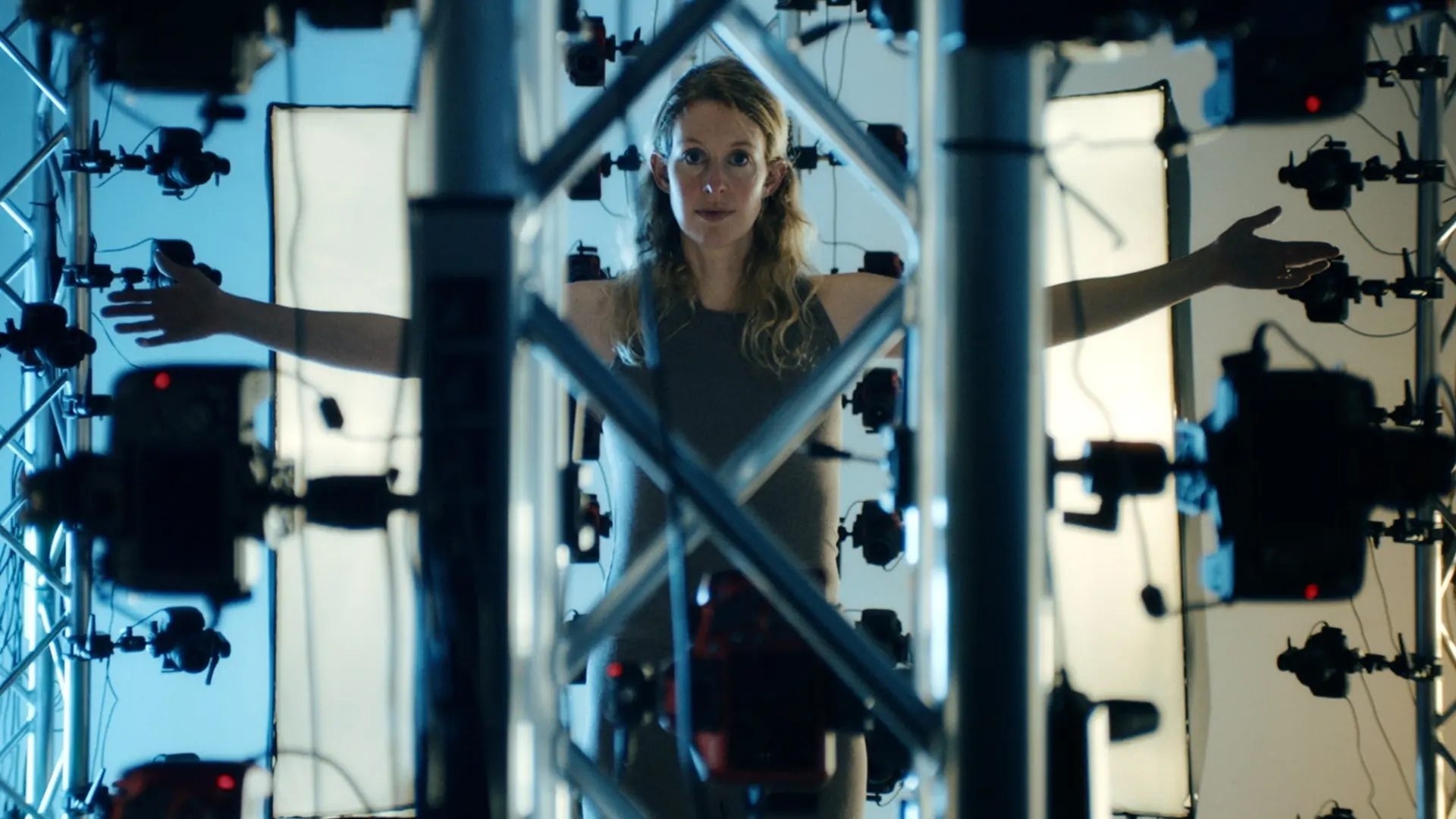
—Courtesy of A24
Throughout You Can See Everything, Fielder is often on-screen, with Oppenheim working behind the scenes. Over and over again, Holmes assures Fielder she has nothing to hide, and over and over again, his probing—if insistently performative—questions catch her in slippery half-truths. Her transparency, to paraphrase the words of Courtney Love, is so real it’s beyond fake. This is the major pattern of the film’s first half. When Fielder isn’t asking the questions, he’s lurking behind the scenes, listening in on Evans and Holmes’ conversations with a headset; when he hears something he can’t believe, his eyes widen dramatically, or his brow furrows, or his jaw hangs as slack as that of a puppet. The audience I saw the movie with giggled every time. Faux-Kabuki irony is the new earnestness. If this is the future of documentary filmmaking—or at least that of its loopier cousin, creative-nonfiction filmmaking—many of us will come to miss the late Frederick Wiseman even more than we already do.
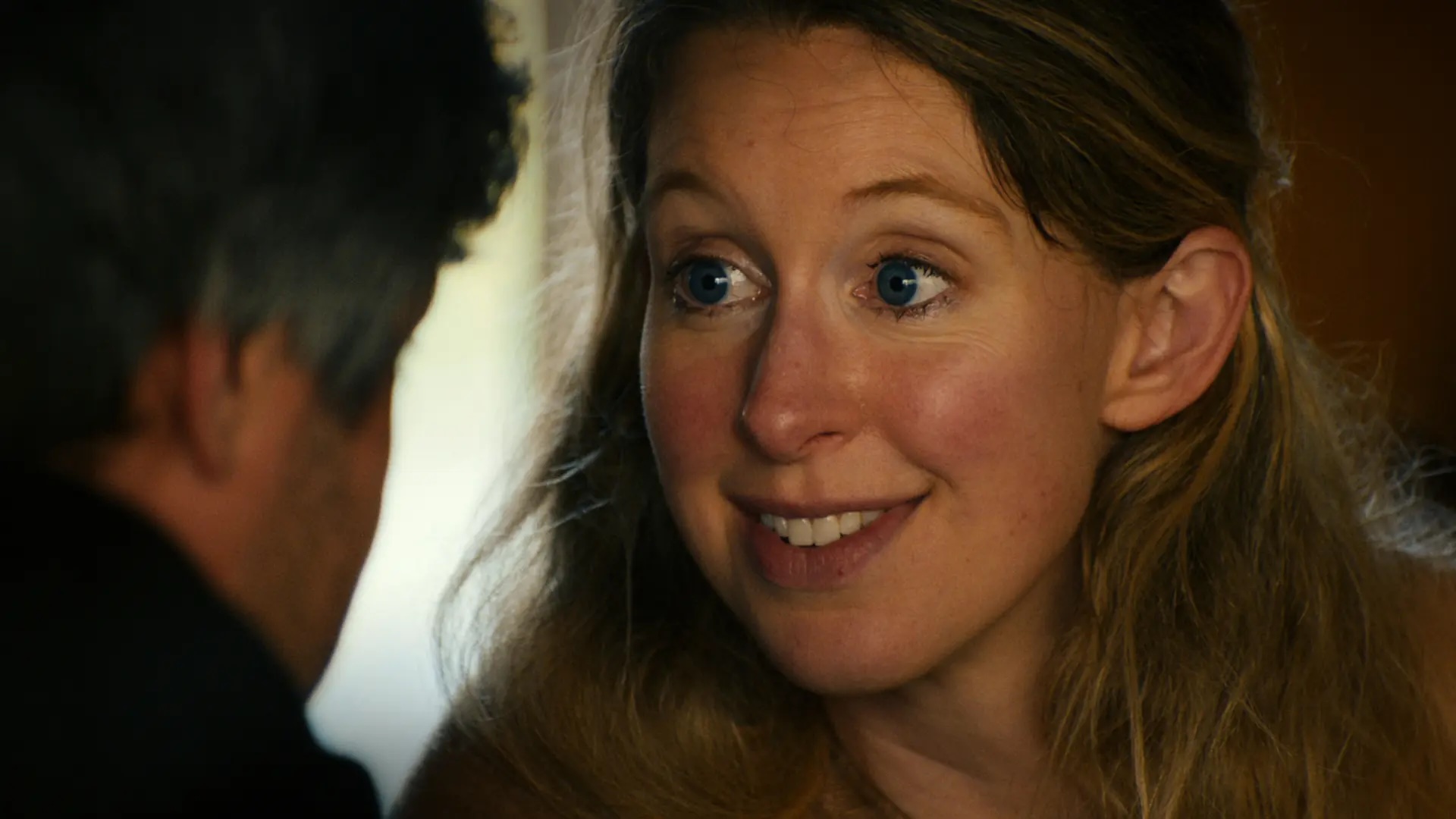
Holmes and her let-it-all-hang-out evasiveness isn’t the problem here. If anything, her whirligig insistence on her inability to lie, or even inadvertently deceive, is at least a kind of self-invented honesty. She spins out phrases like “All I know is my truth,” before speaking tearfully about her fear of being separated from her family. As the camera rolls, Holmes works overtime to convince the filmmakers, and us, of her innocence, with Evans butting in frequently to add his 3,268 cents—2 would never be enough. (He keeps insisting that the couple have plans to start a new company, though he seems to have more invested in this scheme than his partner does.) Holmes is one of those smile-talkers—people who grin as words pour out of their mouths. One of her tricks is to never break eye contact, and we can see her working this voodoo on Fielder. Her eyes are a glassy, translucent blue. I’ve never seen eyes like this, except on creepy European-made porcelain dolls from the 19th century. Are we seriously going to trust this woman?
We’re not, and Fielder doesn’t seem to be headed in that direction either, at least at first. This is a dense picture—there’s almost too much to unpack, if you can be bothered to care about any of it. Holmes is fascinating, and weirdly compelling. But by design, Fielder is as much a player in You Can See Everything as Holmes is, and your feelings about the film overall will depend on how much of him you can take. Fielder has made a name for himself with the shows Nathan for You and The Rehearsal, in which he essentially makes himself look foolish, a little, and makes others look foolish, a lot. Oppenheim, his friend and filmmaking partner, is the director behind the recent nonfiction featurePrimetime, as well as docs like the 2020 Some Kind of Heaven, which turns a sarcastic eye on the Florida retirement community known as The Villages—the ultimate in shooting-fish-in-a-barrel filmmaking. It’s hard to say who’s more responsible for You Can See Everything’s stultifying smirkiness, at least in the first half; these two are clearly of like mind.
But there’s a major shift in the film's second half, one that suddenly, and blessedly, makes it at least watchable. (If you don’t want to know anything about this twist, stop reading here.) The film's second section picks up two years after Holmes has gone off to prison, which means Fielder and Oppenheim have been deprived of their subject. What little access they might have had is severely curtailed by Evans, who now seems less like a caring husband and more like an evil puppetmaster, eager to use his wife’s words and likeness for his own gain. (His increasing aura of evil is unnerving, especially when you consider that he’s almost fully in charge of raising the couple’s two young children.) Fielder and Oppenheim are at a loss—until it occurs to them to enlist the help of Amanda Seyfried, who played Holmes in the 2022 miniseries The Dropout, both to stand in for the disgraced entrepreneur and to weigh in on her plight.
—Courtesy of A24
As evidence mounts that Evans appears to be a megalomaniac, Fielder grows increasingly concerned about Holmes, and his sympathies shift before our eyes: Is she a victim, not just in the court of popular opinion, but also of the person closest to her? Seyfried seems to feel similarly, at least at first. What’s clear is that she hates to see any woman under the thumb of a potentially dangerous man (or any man, for that matter), and she thinks out loud about the possibility that Holmes, as a woman who’d been convinced that the company she’d founded could disrupt the health-care system and actually help people, may have been both manipulated and misjudged. Still, she’s clear-eyed enough to see that Fielder may be going overboard in his emotional attachment to his subject. That’s the dynamic that makes the second half of You Can See Everything click. Seyfried’s presence is the movie’s saving grace: Unlike Fielder, there’s nothing calculating about her, and the film’s second half is uncomfortably alluring.
But is that really enough? You Can See Everything is designed to make us think, hard, about the relationship between a documentarian and his subject. But anyone who's never considered that relationship before probably hasn't been watching documentaries closely enough. The intensity of the filmmaker-subject relationship—in addition to any potential untrustworthiness—is almost always implied, if not explicit. That’s true of all the films made by the great documentary filmmakers—people like Wiseman, the Maysles brothers, Agnès Varda, Werner Herzog, and many others—whether they insert themselves directly into the narrative or not. You Can See Everything has some inventive touches, and no matter what, it’s remarkable that Fielder and Oppenheim were able to keep the film a secret for the three-plus years they were working on it. But they haven’t revolutionized the documentary film; they’ve only reinforced what distinguishes a novelty from a work of genius, mere cleverness and snark from true depth of perception. Their movie feels more like a product they’ve brought to market than an example of the documentarian’s art. Are we buying or not?

 Login