The Trump administration’s transit policies won’t “make travel family-friendly again” in the ways that matter most. | GraphicaArtis/Getty Images
“We should look for love!” Transportation Secretary Sean Duffy bellowed while flanked by his nine children at the Great American State Fair in June: “Get married, and have lots of kids!”
If the plan goes into effect, then communities with a high number of traditional nuclear families could get a 10 percent funding boost to build new trains, bus routes, and ferry lines. “If you want federal funding,” Duffy’s Transportation Department said in a statement, then “your project needs to align with where communities and families are actually growing.”
Trump, who has dubbed himself the “fertilization president,” and his bevvy of neopatriarchaltrad–pilleddeputies have long nursed a fixation with the country’s declining birth rate. But dubious as this new policy may be, it stumbles upon a genuine pain point in the nation’s public transit systems: They are not nearly as family friendly as they should be. And regardless of whether these discomfitingly pronatalist guidelines ever go into effect as written — and they probably will — they raise important questions about how American families use our transit systems now, and the policies could actually make their lives easier in the long run.
The same woes that affect all riders — long wait times, inaccessible stations, inadequate reach, and crowded rush hours — often doubly affect families. That’s one reason why so many of them have fled the nation’s densest, most transit-oriented cities in search of suburbs where they need not lug a stroller up yet another broken escalator to reach a subway platform.
Families who can’t afford to trade in their MetroCards and bus passes for minivans may find themselves priced into housing served by especially substandard transit options, funneling them into brutal, hours-long commutes. According to one landmark study, the single strongest factor in predicting social mobility in the US is neither crime nor test scores nor the presence of “traditional” two-parent households, but access to adequate transportation. With every extra minute a child spends commuting to school, they become less likely to move out poverty as an adult.
And for that reason alone, American families with kids do deserve special attention when it comes to how and where and why we build public transit. On this, the Trump administration got something right, even if they got there for all the wrong reasons — ones that I, a childless woman of childbearing age, find vaguely ethnonationalist, and above all, personally creepy.
But families often need public transportation most in the places where it’s otherwise hardest to raise kids — which is to say in dense cities rather than in already car-centric suburbs. In that sense, especially, In fact, it might make circumstances even worse for the families that really rely on public transit every day.
What family-friendly public transit actually looks like
Marriage and birth rates might sound like a reasonable proxy for where families live, but in reality, according to an analysis by the Urban Institute, the places with the most “traditional” nuclear families tend to be whiter and wealthier than the population at large, and are much more likely to get around by car, not trains or buses.
We are talking about the suburbs here, which, while certainly deserving of their own transit infrastructure, rarely rely on trains or buses the way that a carless family living on the outer edges of a major city might. And yet the Trump administration has typically treated those very communities — some of which do, in fact, have high birth rates — with contempt or even outright antipathy.
Consider Chicago’s Red Line, the busiest corridor of the city’s L rail system, which serves some 138 million people per year. The line has long been in need of expansion, and a $5.7 billion extension close to 60 years in the making finally broke ground earlier this year. It will add 5.5 more miles of track with four new stations in the city’s southernmost neighborhoods.
For over half a century, families in the far South Side of Chicago have cobbled together grueling commutes that force them to transfer from buses and trains to reach downtown Chicago, which helps explain why unemployment and poverty rates in the area remain so stubbornly high. Communities like Roseland, where many of the new stations will be built, are considered to be among the most challenging places in the nation to raise a child, but thousands of local families still find ways to do so.
Roseland has a much higher birth rate than the national average, meaning that in theory, Duffy’s transportation department should be itching to send extra funds to transit projects there. But first they have to be willing to fund it at all, and if past policies hold, they may be reluctant to do just that. Just last year, the Trump administration opted to freeze federal funds already allocated to the Red Line extension, plunging the long-awaited project into yet another prolonged period of infrastructural purgatory.
That move plays into a broader pattern: The Trump administration has hampered dozens of transit projects like the Red Line, seemingly in its broader push to starve Democratic-led cities of federal infrastructure dollars. While a federal judge eventually intervened to allow the Red Line extension to proceed, if the Trump administration’s new guidelines go into effect after public comments close in November, then more projects like it in other urban communities will likely be deprioritized.
Ultimately, it is the suburbanites who are most poised to benefit from the Trump administration’s proposed policy.
An example is FrontRunner 2X in Utah, a commuter rail project that will slash travel time for Utahns traveling across the state, and will also help Salt Lake City shoulder an influx of tourists when it hosts the Olympics in 2034. It received federal support through the same tranche of funding as Chicago’s Red Line extension. In stark contrast with that more urban initiative, FrontRunner 2X has been the rare public transit project to receive continued support under the Trump administration.
Utah has some of the highest birth and marriage rates in the country, so it’s not a stretch of the imagination to say that if the Trump administration has its way, then the United States will see more projects like FrontRunner 2X get funded, while others like the Red Line extension face bureaucratic bottlenecks and funding freezes. Roseland’s high birth rate notwithstanding, the neighborhood has some of the lowest marriage rates in the country, meaning that even if a project there did manage to eke out federal support, then according to this new calculus, it would still receive significantly less funding from the federal government than a place like the suburbs of Salt Lake City where married families with children are more common.
Trump’s new pronatalist transit agenda is, at the very least, an indication that after two years spent twiddling their thumbs, firing Amtrak executives, and venerating cars big and small, he may finally be building a semi-coherent transit strategy. And his Transportation Department has allowed a few genuinely family-friendly upgrades for the country’s transit infrastructure to proceed, including grants to add space for strollers on trains and buses.
But you can’t claim to support American families while siphoning federal dollars away from the projects that could actually be transformational to their lives. I am not one to decry a commuter rail renaissance, but it shouldn’t come at the expense of places where American families — the ones Duffy says he’s so keen on having more babies — don’t have any other choice but to wait an hour for the bus to get to work.
In late September, Democratic Rep. Ro Khanna of California introduced the Free Child Care for America Act, an $80 billion-a-year proposal to make childcare free for nearly every family with kids under six. The bill would let families choose between sending their child to a daycare center, having a relative, friend, or neighbor paid a living wage to care for them, or taking a $1,000 monthly stipendto keep the child homefor the first three years. It comes from a lawmaker who openly says he’s considering a run for president. “I want 2028 to be a big-ideas primary,” Khanna told ABC. “A contest on who’s going to have ideas of the future that meet the moment.”
Khanna’s is not the only big Democratic childcare proposal released in the last few months. In July, Project 2029 — a group of liberal policy experts developing an agenda for the next Democratic administration — proposed something similar to Khanna’s plan:giving families a choice between free daycare and $1,000 a month to provide care at home or pay a trusted caregiver. The group estimates that would cost about $200 billion annually. Third Way, a centrist Democratic think tank, unveiled its own universal childcare pitch, guaranteeing every family at least three affordable options within a 15-minute drive of home or work by expanding home-based, infant, and after-hours care, and leveraging employers as partners.
Key takeaways
Childcare is emerging as a major 2028 issue, with big new proposals from Rep. Ro Khanna, Project 2029, and Third Way.
“Universal childcare” means different things to different people — free for all, affordable for most, or simply enough slots to go around.
Polls show broad, bipartisan appetite for government action on childcare, with debate over how much families should chip in.
Early childhood policy is quickly becoming a defining issue for 2028 hopefuls. On the right, Vice President JD Vance has staked out an early and controversial position, to pay married stay-at-home parents roughly $9,000 per child annually using existing federal childcare funds. On the left, Rep. Alexandria Ocasio-Cortez is spearheading a new House working group to develop a federal childcare plan. Kentucky Gov. Andy Beshear has been pushing free pre-K for all 4-year-olds, something California Gov. Gavin Newsom has already enacted in his state. And New York City Mayor Zohran Mamdani, who can’t run for president but is widely seen as an influential voice in the party’s future, has made universal childcare one of the top goals of his administration.
Michelle Lujan Grisham, the Democratic governor of New Mexico, recently told Semafor that any politician seeking to run for president in 2028 “absolutely should” run on universal childcare proposals. Last year New Mexico became the first state to offer free childcare to families regardless of income. Her advice echoed David Plouffe, a Democratic strategist who managed Barack Obama’s 2008 campaign, who said that universal childcare should be in the Democrats’ 2028 party platform.
This new wave of enthusiasm marks a pivot for an idea that has long been seen as a distant pipe dream in American politics. It wasn’t always that way: When women filled factories during World War II, the federal government funded thousands of daycare centers to watch their kids. In 1971, Congress actually passed a bipartisan childcare bill, though President Richard Nixon vetoed it, saying it would weaken the family. In the 50 years since, Washington lawmakers have focused their energies on other big battles, offering little on childcare beyond subsidies for some low-income families. Over that time, the US has fallen out of step with nearly all its peer nations around the world, which help parents pay for childcare, on top of offering paid parental leave after birth.
It’s not hard to understand why the idea is finally getting a serious look in the US. With voters citing affordability as a top concern, politicians are looking for ways they can bring down costs facing families. After paying rent or a mortgage, childcare often stands as many parents’ biggest monthly expense. Businesses have started to care too, as access to reliable care affects both people’s ability to hold down jobs and businesses’ ability to attract and retain workers. It’s why organizations like the Chamber of Commerce have taken up the issue and why red, blue, and purple states alike have been elevating childcare in recent years.
In Congress and in the Democratic campaign world, there’s a strong sense that childcare, long overshadowed by climate, infrastructure, voting rights, and health care, is now at the front of the line should Democrats regain power. Insiders credit both donor influence and a feeling that childcare advocates have duly waited their turn.
But as Democrats begin jockeying for 2028 and universal childcare becomes a rallying cry, it’s also become clear that there’s a big unanswered question at the heart of the politicking:No one yet agrees on what “universal childcare” actually means. Does it refer to care that’s totallyfree, or just affordable? Is it for everyone, like public school, or targeted at families below an income line? Does it start at birth, and include parents who stay home? Are employers involved, or neighbors and grandparents?
The answers will determine who benefits, how much it costs, and whether the party’s next big promise to families is one it can actually keep.
What is universal childcare?
When I asked Rep. Khanna how he defines universal childcare, he said that it means “childcare should be free” and that families should have flexibility and choice of how to get that care. Workers, he added, should also be paid a living wage in a universal childcare system.
Later, he described the vision for universal childcare as a public good, akin to public school. “From the time a child is born to the time they’re finished college,” he argued, America has the wealth to provide for kids’ education and development.
Others, however, are defining the idea differently. Linda Smith, who leads Child Care Trust, a national policy think tank, helped design the military’s well-regarded childcare system and oversaw federal early childhood programs under Obama. Earlier this summer, she released a framework for universal childcare that emphasized it does not inherently mean free care.
Smith says she wrote it after realizing that even the legislative staffers drafting childcare bills didn’t mean the same thing by the term. “After some candid conversations with congressional staff this summer working on child care policy, it became clear that there are many interpretations of ‘universal child care,’” she wrote on LinkedIn. “If we can’t agree on what the term means, we can’t build durable policy around it.”
She argues the “universal childcare” slogan tends to blur three separate goals: universal access, universal affordability, and universal free care. To Smith, the urgent priority is access. Her vision for universal childcare policy would be a system where all families have access to “affordable, high-quality options” that reflect their needs. Her organization estimates that about 4.2 million children under six with all available parents in the workforce lack a childcare slot within a reasonable distance of home, and she warns that cutting costs without addingnew supply could worsen shortages and leave families without available options.
Her answer is a mix of building more supply and sharing the cost. She recommends families paying what they can and employers and government covering the rest. Spreading the cost across several payers, she argues, is likelier to sustain the full mix of care families actually use — including home-based care — than leaning on government or parents alone.
Chris Herbst, a childcare policy expert and professor at Arizona State University, told me he agrees with Smith that there’s no consensus regarding what universal childcare means today. Even in New Mexico, he pointed out, which is regularly touted as an example of universal childcare, a light work requirement exists for families to be eligible. “These are fluid definitions, and as such they are a bit up for grabs at the moment,” Herbst said.
His own view is that a universal childcare system should make the subsidy easy to get and be guaranteed by law, so eligible families get it automatically instead of landing on waitlists when funding runs short.
Another childcare expert, Elliot Haspel, has embraced a definition closer to Khanna and Sen. Elizabeth Warren, arguing that universal childcare means all families can easily secure the type of care they want, and pay no fees to do so. He acknowledged, though, that many things can be called “universal” and be technically correct. “The ambiguity of the term is both what lends it rhetorical power and what can present a major weakness,” he writes.
Some states are adding benefits — but avoiding “universal”
With federal childcare legislation stalled, many states have spent the past few years trying to patch the system themselves. Some states are investing in making care cheaper for families, others in paying childcare workers more, and most in trying to get more providers to open their doors.
The National Conference of State Legislatures has also aimed to get involved. Over the course of a year and a half, state lawmakers across 13 states worked together to hash out a bipartisan policy framework for strengthening childcare systems, a rare cross-party effort on the issue. The NCSL report, released this past summer, steers clear of the term “universal childcare,” but does describe state systems under strain and concludes that incremental fixes alone are unlikely to solve it. The lawmakers stressed there is no one-size-fits-all solution and offered a menu of options organized around seven priorities, from expanding access to investing in the childcare workforce.
In interviews with the working group’s two co-chairs, I asked why their cohort stayed away from the “universal” language. Jim Burgin, a Republican state senator from North Carolina, told me he doesn’t find it to be a helpful term because it could conjure up the image of public schools, which are mandatory and government-run. “I don’t like the term,” he said. “I think we ought to have safe, affordable childcare available to everybody and I don’t want everybody to immediately think we’re setting up government indoctrinated childcare…a lot of people would just push back from that.”
The Democratic co-chair, Washington state Sen. Claire Wilson, said her hesitation was more about precision. “When you say ‘universal’, I think that alone is a question about what do we mean by universal?” she said. In Washington, she explained, it means care open to all families regardless of income, employment status, or immigration status, “but for other states, universal may mean something different.”
Where the public stands
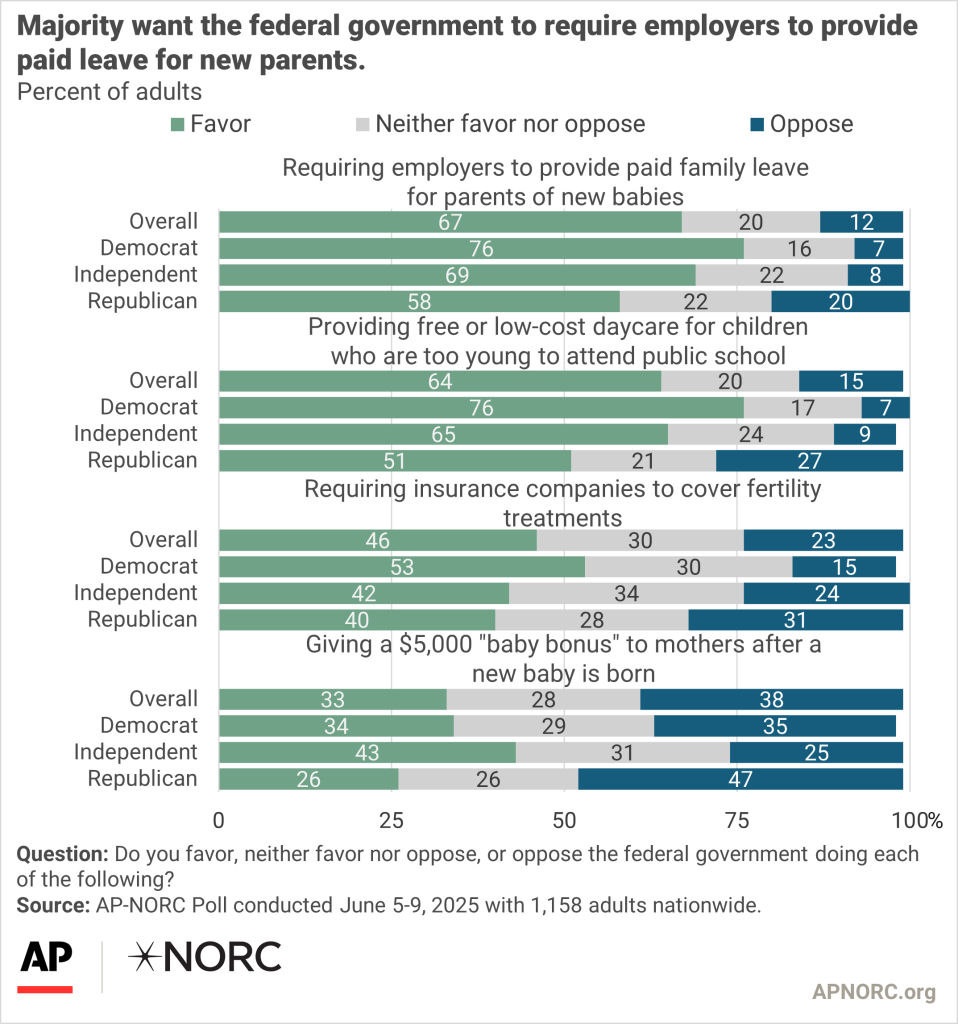
Polling suggests Americans do want to see lawmakers take action on childcare, even if it’s not voters’ top priority when asked to rank among different issue areas. An AP-NORC poll from last year found about three-quarters of Americans say childcare is a “major problem,” and majorities across both parties backed federally funded “free or low-cost” daycare. More recently, YouGov and the 19th News found 52 percent of Americans think the federal government should increase its spending on childcare.
The evidence that most Americans want childcare to be free rather than affordable is less clear. The recent YouGov/19th News found about 40 percent of Americans think parents and government should share in the cost of daycare, compared to 21 percent who thought the government should pay the full cost, and 26 percent who thought parents should cover it all.
A recent New America survey found similar results. When asked if K–12 public education should be a free, taxpayer-funded right, 60 percent of respondents agreed. But only 38 percent said the same of childcare. And among those who “somewhat” or “strongly agree” that childcare should be offered to families for free, paid by taxes, and considered a right, only 31 percent of independents agreed, and just 23 percent of Republicans.
Lena Bilik, a childcare researcher at the Roosevelt Institute, a progressive think tank, told me she thinks public opinion will shift more in favor of free universal childcare when public programs can demonstrate a track record of success, as the country saw with Social Security and more recently the Affordable Care Act. “If we build high-quality public goods that work, I think that with time that problem solves itself,” she said. “But they have to be well-resourced.”
The politics ahead
While states like New Mexico, Vermont, and Connecticut have taken major steps in recent years to expand access to affordable childcare, Bilik of the Roosevelt Institute said even those places vary in how explicitly they pursue the goal of universal childcare, or define it.
The last time Democrats went big on childcare, via the Build Back Better Act, they failed. The bill packaged much of the Democratic agenda into one piece of legislation — climate, healthcare, housing — with childcare bundled alongside paid family leave, elder care, universal preschool, and an expanded child tax credit. It collapsed in late 2021 after talks with West Virginia Sen. Joe Manchin fell apart.
When I interviewed lawmakers, advocates, funders, congressional aides, and policy experts in 2024 about what lessons they drew from that experience, I found the field divided over strategy. Childcare never got a vote of its own, and the argument ever since has been whether it should have been pulled out and pursued separately. Some argued activists should have narrowed their focus to one or two care priorities. Others saw that critique as premature capitulation, a sign of a limiting “scarcity mentality.” Many of those advocates emphasized that they had come very close to passing everything, losing in the Senate by a single vote, and pointed to the climate movement, which took decades of sustained organizing and spending to win major federal legislation. Care advocates, they said, just needed to keep pushing.
Two years later, the consensus view among Congressional Democrats and national childcare advocates has shifted, with far more now saying what’s needed first and foremost are “big and bold” solutions that the party can run on — even bigger than the ideas laid out in the Build Back Better Act.
Sen. Elizabeth Warren argued this year that childcare failed in Build Back Better because not enough Democrats were “willing to fight for it” and because the $400 billion proposed spending package for childcare and universal pre-K wasn’t nearly big enough. It was “an exercise in how weak and ineffective we could make the childcare program and still call it childcare,” she said.
Bilik has watched the same change from the research side. The coalition she works with, she told me, has moved away from programs that help only families below a certain income.“What I’m excited about is that we’ve gotten more ambitious with our proposals across the board since Build Back Better,” she said. “We’re finally having conversations about whether implementing something halfway will cause more problems than solutions, so I think the field has moved really far towards being open to a true public program.”
These sentiments are reflected in the recently released Khanna bill, the Project 2029 proposal, and comments over the summer from Democratic Rep. Sara Jacobs, who said free childcare for all should be at the top of the House’s legislative agenda if Democrats take control after the midterms.
How that vision translates into legislation remains an open question. Some advocates I talked to for this story, who spoke off the record to describe private coalition conversations candidly, said they worried their allies were going to make the same mistake of over-promising and then failing to prioritize goals when faced with tough budget realities. Should Democrats take power, leaders will also face pressure to restore Medicaid and SNAP funding, expand ACA subsidies, and address housing costs, all while large federal deficits make new spending harder to finance.
Khanna told me his proposals could be funded by shifting priorities away from increased military spending, particularly the $200 billion increase in the Pentagon budget and the war with Iran. The Project 2029 proposal suggests financing through raising the corporate tax rate, repealing the pass-through business tax deduction, and reforming estate taxes and the “stepped-up basis” tax break on inherited assets. Third Way would also fund its plan partly through a corporate tax increase. But those same dollars could be claimed by other Democratic priorities, which means childcare advocates may end up competing for them.
“Everyone is excited to put out the biggest idea, but there’s no real conversation about how to get there, and I feel like that’s the frustration, where ‘how to get there’ just means electing Democrats and demonizing any incremental progress,” one advocate told me. “That is not a strategy.”
For now, think tanks, presidential hopefuls, and congressional working groups are testing the waters, floating ideas that meet families where they are and, in some cases, go further than what voters say they want. The practical details are unlikely to get settled once the 2028 race is fully underway. If a Democrat wins, the window will narrow further, with unresolved details colliding with other priorities in the first months of a new administration.
“Universal childcare” may remain an amorphous term, meaning free care to one politician, shared costs to another, and a menu of state options to lawmakers who avoid the word altogether. But all of us voters should expect to hear much more of it.
This work was supported by a grant from the Bainum Family Foundation. Vox Media had full discretion over the content of this reporting.
President Donald Trump and US Ambassador to Greece Kimberly Guilfoyle in the White House on March 26, 2026. | Aaron Schwartz/Bloomberg via Getty Images
This story appeared in The Logoff, a daily newsletter that helps you stay informed about the Trump administration without letting political news take over your life. Subscribe here.
Welcome to The Logoff: Donald Trump’s ambassador to Greece, Kimberly Guilfoyle, is out of a job after serious corruption allegations.
What happened? Guilfoyle resigned on Tuesday after being shown the door earlier in the day by Trump’s brand-new White House press secretary, who announced at a briefing that Guilfoyle had been asked to resign.
Her departure comes just six days after a bombshell Wall Street Journal story, which described Guilfoyle’s efforts to solicit money from a Trump donor, including $100,000 to pay down a credit card bill, in exchange for access to Trump officials and conservative media figures.
Guilfoyle also attempted to conceal those efforts: In one text to the donor, Eric Deters, she wrote, “What a nightmare you’ll literally cost me my ambassadorship stop writing.”
Who is Guilfoyle? Fallen MAGA royalty. Guilfoyle, a former Fox News personality, is also the ex-fiancée of Trump’s eldest son, Donald Trump Jr. (and, more distantly, the ex-wife of current California Gov. Gavin Newsom, a Democrat).
There appears to be little love lost between Guilfoyle and Trump, however. On Tuesday, he told reporters that Guilfoyle “wasn’t a member of my family. She I guess dated my son a long time ago.” (The Don Jr.-Guilfoyle relationship is thought to have ended in 2024.)
Why was she forced out?Corruption allegations are not, generally speaking, dealbreakers in Trumpworld; the president and his children are all innovators when it comes to profiting off the presidency, and there’s plenty of self-dealing going on around them.
That being said, Guilfoyle may have crossed the line in two specific ways: one, her alleged corruption benefited her and not the Trump family. And two, the allegations are embarrassingly unsubtle even by the standards of the second Trump administration. The combination appears to have been too much.
And with that, it’s time to log off…
This New York Times story, about what a potential superhabitable world elsewhere in the cosmos could look like, was a very cool, very sci-fi read — and we may find out more about the existence of such planets soon, with new space telescopes planned for next year and beyond.
You can read the full story here with a gift link. Enjoy, have a great evening, and we’ll see you tomorrow!
Update, October 21, 11:45 am ET: The Supreme Court released a brief order on October 21, which ruled against the Trump administration’s request to deny gender-affirming care to transgender prisoners. The order is two sentences long. It is temporary. And it does not explain the Court’s reasoning. So it is not clear why the Court ruled against Trump or even whether Trump will lose if this case reaches the Court again after it has be fully litigated in lower courts. Justices Clarence Thomas and Samuel Alito dissented.The article below was originally published on October 13.
On the first day of his second term, President Donald Trump issued an executive order requiring the Bureau of Prisons to “ensure that no Federal funds are expended for any medical procedure, treatment, or drug for the purpose of conforming an inmate’s appearance to that of the opposite sex.” Issued alongside a record 26 other orders that day, it was an unsurprising development, because Trump had made this issue one of the centerpieces of his 2024 campaign.
The fate of that executive order, as well as the US Bureau of Prisons’ (“BOP”) memoranda implementing the order, is now before the Supreme Court in a case called Trump v. Kingdom. And, while this case obviously has high stakes for incarcerated transgender people specifically, the Court’s resolution of this case could potentially have far greater reach — cutting off many cis and transgender people’s access to healthcare while they are incarcerated.
That’s because one of the central questions in Kingdom — though this issue is not yet before the justices — is when the Constitution requires prisons to provide medical care to incarcerated people.In Estelle v. Gamble(1976), the Supreme Court held that the Eighth Amendment’s ban on “cruel and unusual punishments” imposes on the government an “obligation to provide medical care for those whom it is punishing by incarceration.” People in prison, after all, cannot simply drive themselves to the hospital if they get sick. If the prison does not give them adequate medical care, they will suffer untreated and potentially die.
For procedural reasons, the Court is unlikely to opine on whether Estelle requires prisons to provide gender-affirming care to trans people right away. But the question of when the Eighth Amendment requires prisons to provide medical care to incarcerated people is front and center in the Kingdom case, which means the Court could potentially use Kingdom to limit all imprisoned people’s access to healthcare — or even to undercut the Constitution’s protections against cruel and unusual punishments more broadly.
Ironically, this case also arises out of a famous political blunder by pro-trans advocates. In 2019, when then-Sen. Kamala Harris was seeking her party’s 2020 presidential nomination, the ACLU circulated a questionnaire to candidates that asked if they would use presidential authority “to ensure that transgender and nonbinary people who rely on the state for medical care — including those in prison and immigration detention — will have access to comprehensive treatment associated with gender transition, including all necessary surgical care?”
Harris responded that she would, and also said that she “pushed the California Department of Corrections and Rehabilitation to provide gender transition surgery to state inmates” while she was state attorney general.
Years later, during his 2024 debate with Harris, Trump claimed that the then-vice president “wants to do transgender operations on illegal aliens that are in prison.” And not long after, his opposition to gender-affirming care for trans people in prison became a keypart of his campaign.
It’s unclear why the ACLU thought it was a good idea to shine a light on this issue in 2019 because, at the time, the BOP provided gender-affirming care to people in federal prison. The ACLU — which represents the pro-trans side in the Kingdom case — now argues that transgender people in federal prison have had access to at least some forms of gender-affirming care “since at least 1992.”
Indeed, Trump’s own administration concluded in a 2018 memo that the Bureau of Prisons’ “statutory mandate to provide basic medical and mental health care” to incarcerated people obligated it to provide “pharmaceutical interventions (e.g., cross-gender hormone therapy), hair removal and surgery (if individualized assessment indicates surgical intervention is applicable)” to transgender people in prison if their doctors determined that these interventions are “medically necessary care.”
In any event, regardless of why Trump fixated on cutting off trans healthcare for people in federal prison, Kingdom is now before the Court. That means that the fate of trans people in prison — and, if the Eighth Amendment issue eventually reaches the Court, all incarcerated people — is now in the hands of a Republican Court that is oftenhostile to trans litigants, and that has, at times, signaled that it wants to drastically roll back the scope of the Eighth Amendment.
What are the legal issues in the Kingdom case?
At least since Estelle, the Court has held that people who are incarcerated are not also sentenced to live and die without medical care. As the Court said in Brown v. Plata (2011), “a prison that deprives prisoners of basic sustenance, including adequate medical care, is incompatible with the concept of human dignity and has no place in civilized society.”
Under Estelle and Brown, transgender people often have a right to gender-affirming care during their incarceration. As the US Court of Appeals for the Ninth Circuit held in Edmo v. Corizon (2019), such a person must show that they have a “serious medical need” for such care — typically by demonstrating that the care was prescribed to them by their health provider. But the Constitution does not permit prisons to deny medically necessary care to incarcerated people.
In Kingdom, the ACLU raised this Eighth Amendment argument in the lower courts, but those lower courts ruled in favor of transgender people in prison on different, much more technical legal grounds.
Both the ACLU and the lower courts that heard Kingdom argue that the Trump administration did not comply with this obligation when it cut off care for trans people in prison.
Among other things, the district court that heard this case determined that the administration cited “zero evidence from its own medical or mental health care professionals to support its conclusions” against providing transgender healthcare. While the Trump administration argues that providing gender-affirming care makes prisons less safe, the district court also noted that “the government has not cited a single instance of gender-affirming care giving rise to safety concerns despite having provided such care for many years.”
Is this a persuasive legal argument against the Trump administration’s new policy? I think it is. And so did three federal judges that previously heard the Kingdom case. But the fate of trans people in prison is now in the hands of a Supreme Court that rarely rules in favor of transgender litigants, and that has a history of handing down legally incoherent opinions that are inconsistent with the Court’s own precedents, and that also deny legal rights to trans people.
The current Court’s uncertain commitment to the Eighth Amendment
Because the lower courts that heard Kingdom did not rule on the Eighth Amendment question, Kingdom should not currently give the justices an opportunity to roll back Estelle. But, in the likely event that this Court rejects the ACLU’s argument that the Trump administration did not adequately explain its new policy, the case will return to the lower courts and the Eighth Amendment issue will be fully litigated — teeing up the Eighth Amendment question for the justices to decide in the near future.
This issue could arise, moreover, at the exact moment that some justices are pushing for sweeping changes to how their Court understands the term “cruel and unusual punishments.” Indeed,at least some of the Supreme Court’s recent Eighth Amendment precedents suggest that the Republican justices want a wholesale rewrite of the Court’s previous precedents laying out what constitutes cruel and unusual punishment.
Since the mid-to-late twentieth century, the Court has held that, in Chief Justice Earl Warren’s words, the Eighth Amendment “must draw its meaning from the evolving standards of decency that mark the progress of a maturing society.” Thus, as certain forms of punishment grow more uncommon, they become more constitutionally dubious.
This “evolving standards of decency” framework is front and center in nearly every major Supreme Court decision interpreting the Eighth Amendment for the last five or six decades, including Estelle.
In Bucklew v. Precythe (2019), however, the Court’s Republican majority seemed to abandon this framework. Although decades worth of pre-Bucklew decisions established that a punishment is unconstitutional if it is considered cruel and unusual today, Bucklew suggested that a method of punishment is unconstitutional only if it“had fallen out of use” at “the time of the founding.”
Thus, if taken seriously, Bucklew’s new approach to Eighth Amendment cases would dramatically expand the government’s power to impose harsh punishments. The late Justice Antonin Scalia, for example, argued that a Bucklew-like approach to the Eighth Amendment does not prohibit the government from executing most intellectually disabled offenders, and that it does not limit the government’s ability to impose excessive punishments for minor crimes.
In fairness, some of the Court’s post-Bucklew decisions are inconsistent with the framework the Court laid out in that case. So at least some of the justices who joined Bucklew may have since decided that it’s a bad idea to toss out the Court’s entire framework for Eighth Amendment cases. But Bucklew was one hell of a warning shot over the bow of the Eighth Amendment. And the mere fact that the Bucklew decision exists means that advocates for humane punishments must hold their breath any time this Court is asked whether a particular punishment is cruel and unusual.
In the worst-case scenario for people in prison, a case like Kingdom could inspire the Republican justices to overrule — or, at least, drastically limit — decisions like Estelle and Brown. That would mean that all incarcerated people, regardless of their gender identity, could lose access to medically necessary care unless the government decides to give it to them as an act of grace.
Homeland Security Investigations outside the home of Rep. Ilhan Omar on October 12, 2026 in Washington, DC. | Andrew Leyden/Getty Images
This story appeared in Today, Explained, a daily newsletter that helps you understand the most compelling news and stories of the day. Subscribe here.
When life gives you lemons, make it rain. Or…something like that! On Tuesday morning, Minnesota Rep. Ilhan Omar launched a fundraising drive in response to the Trump administration’s unusual predawn raid of her Washington, DC, residence.
The raid, which went down Monday, is reportedly part of a criminal investigation into Omar’s immigration history. The Democratic Congress member was born in Somalia and came to the US as a child, becoming a naturalized citizen in 2000 at age 17.
Omar has since become one of the most prominent progressive voices in Congress and a regular thorn in the side of President Donald Trump, who on Monday called her “terrible” and “totally crooked.” Vice President JD Vance has similarly claimed, without evidence, that Omar “committed immigration fraud.” On Monday, the New York Post reported that the investigation may have sprung from mistakes Omar’s late father made while filling out her citizenship application roughly 30 years ago.
Needless to say, decades-old citizenship paperwork is not the kind of threat to public safety that typically commands the resources of the Department of Homeland Security’s investigations branch. (That same branch is charged with investigating transnational gangs and terrorists.)
And the raid is unusual for another reason, too: By longstanding practice, the Justice Department avoids taking any public steps in investigations involving political candidates within 60 days of an election. The midterms are just three weeks from now.
This investigation is unlikely to affect Omar in the midterms, however. In the words of her longshot Republican challenger, John Nagel, Minnesota’s Fifth District is among “the ‘bluest’…in the country.” The raid may have even galvanized Omar’s supporters, dozens of whom rallied at a Minneapolis park on Monday afternoon. Some held banners that read “we stand with Ilhan.” Another sign read, simply, “see you at the polls.”
Omar now belongs to an unenviable and surprisingly populous club: political opponents of Trump whom his administration has threatened with criminal indictments and investigations.
I initially planned to list them out for you here, but then realized that list would be perilously long. By my back-of-the-envelope count, there are at least 30 Democratic politicians, public officials, and Trump-world defectors who have been accused of, investigated for, or charged with crimes during the second Trump administration.
It’s easy to forget the scale of that campaign, however, because many of these efforts have (thus far!) stalled out or collapsed. Inseveralcases, the administration opened much-publicized and thinly supported investigations that have yet to yield charges. (See, for instance, the criminal probe into writer E. Jean Carroll or former New York Gov. Andrew Cuomo.)
In at least two cases — that of then-Federal Reserve chair Jerome Powell and several Minnesota officials — federal judges tossed out subpoenas for lack of evidence. And in one high-profile instance earlier this year, a grand jury refused to indict six Democratic members of Congress who released a video reminding soldiers to refuse illegal orders. The legal bar for issuing such an indictment is actually pretty low — which makes this grand jury’s refusal a telling rebuke of the administration.
But these judicial setbacks aren’t exactly reason for optimism. The federal court system is becoming increasingly partisan, and as long as Republicans hold the Senate, they’ll be able to stack it with ever-more conservative and deferential judges. And several of the most partisan judges already on the bench are “openly auditioning” for Supreme Court slots, as my colleague Ian Millhiser recently put it.
In other words, in the not-so-distant future, the court system may provide a weaker check on presidential overreach. And that’s bad news not only for the Ilhan Omars of the world…but also for American democracy.
One link for later
➨ Turn off your sleep tracker. If your sleep hygiene and underlying health are both good, but you still struggle to catch enough ZZs, then you might actually want to tone down your quest for better sleep. “What you see in people with insomnia is that they’re trying too hard,” one sleep scientist told Vox. Analyzing your sleep scores and timing your naps can create anxiety that further fuels insomnia.
Before you go…
Did you know…that Coke, Pepsi, and Dr. Pepper were all invented by 19th-century pharmacists? At the time, it was widely believed that carbonated water could cure illnesses. And sugary syrups made said water vastly more delicious.
Today’s trivia: What’s the name of the 2025 Pixar film set in the “Communiverse”? (You can find this and other brain puzzles in Vox’s daily crossword. Look for the answer in tomorrow’s edition.)
Yesterday’s trivia: Last week we asked you for the three-letter successor of tube TVs. That would be LCD, which stands for liquid crystal display.
 Login