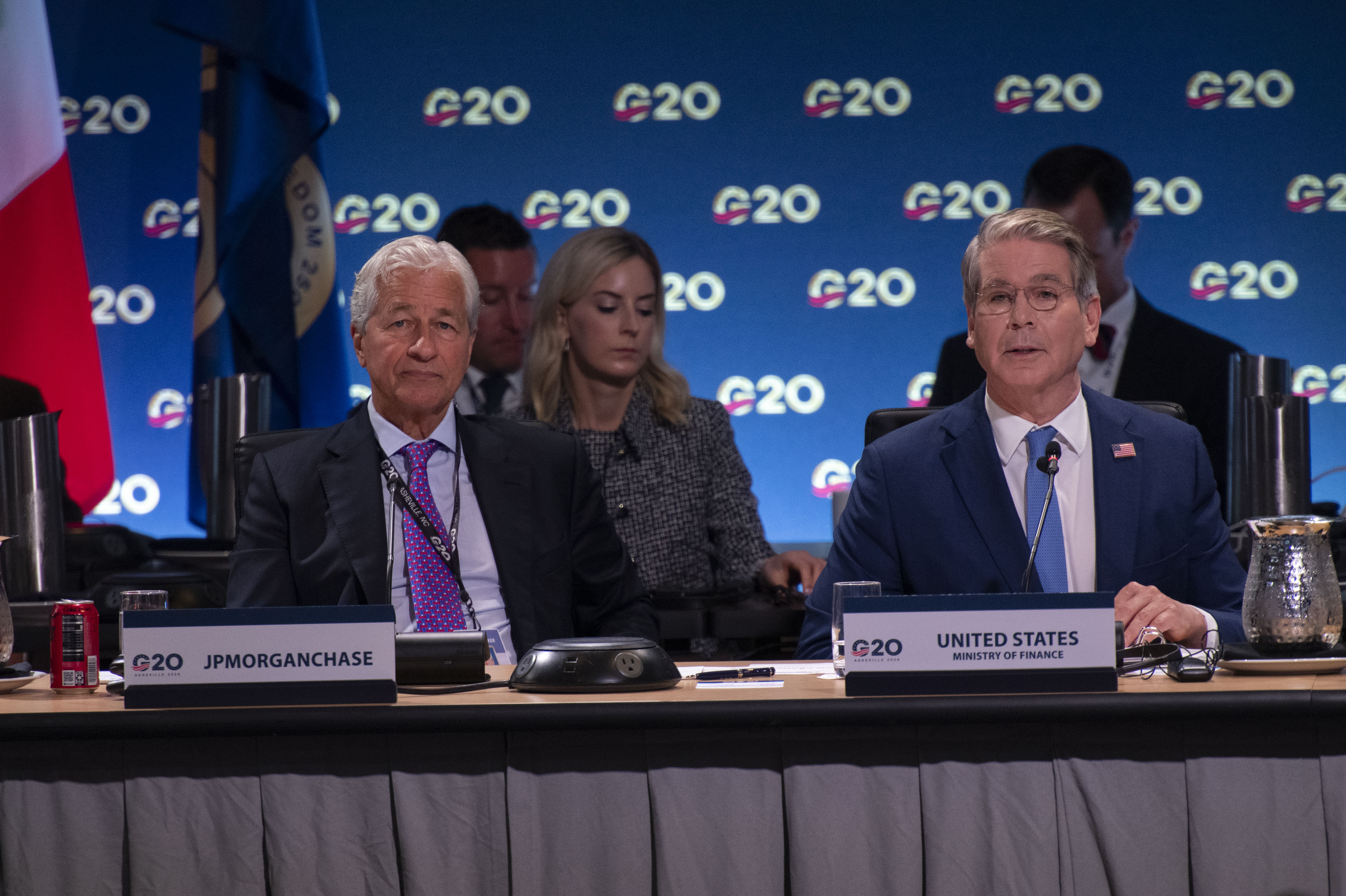
CEO of JPMorgan Chase Jamie Dimon and Treasury Secretary Scott Bessent at the 2026 G20 Financial meetings in Asheville, North Carolina, on Aug. 31, 2026. —Melissa Sue Gerrits—Getty Images
President Donald Trump has defended having Russia at the G20 finance meeting amid backlash from European officials who disapproved of the move.
“We’re going to see what happens, but we like getting along with everybody. One of the reasons that I’m so successful, I get along with everybody,” Trump told reporters when asked about the matter.
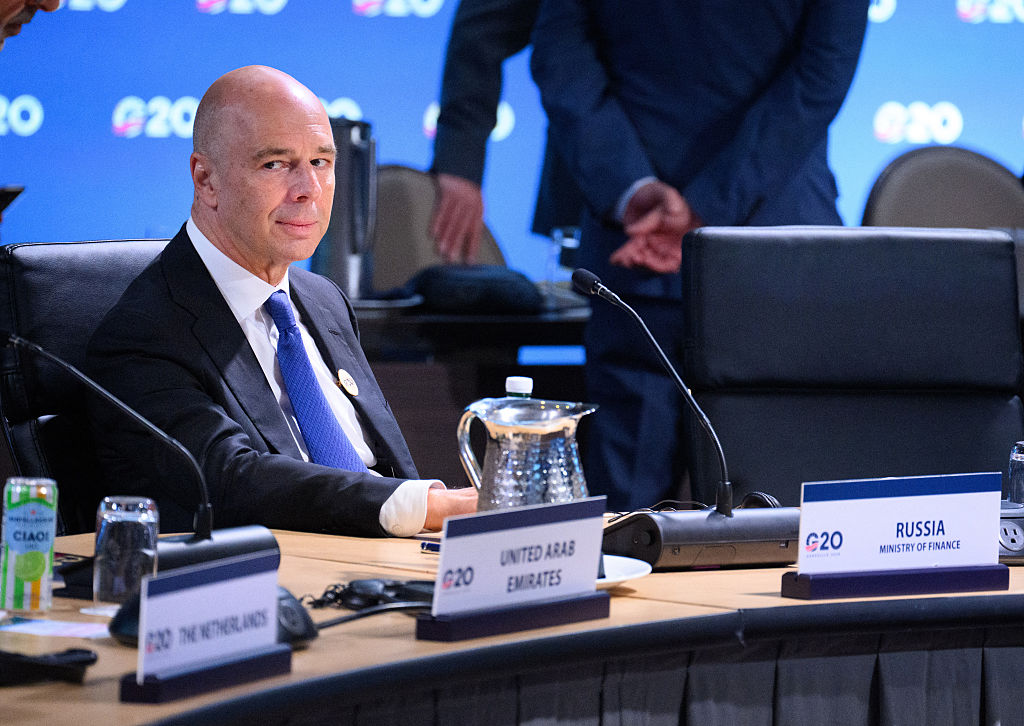
The U.S. hosted Russian Finance Minister Anton Siluanov at the meeting in Asheville, North Carolina, on Monday where finance officials, central bank governors, and other international figureheads from 20 major economies gathered.
Russia has remained a member of the G20, but the country’s Finance Minister had been physically absent from the G20 summits since the country launched its full-scale invasion of Ukraine in February 2022. European officials remain committed to isolating Moscow over the war.
This time, however, U.S. Treasury Secretary Scott Bessent met with his Russian counterpart on the sidelines of the event in Asheville. Russia's Finance Ministry said the pair discussed Russia-U.S. cooperation on financial matters and interaction within the G20 framework.
A Treasury spokesperson told Axios that Bessent and Siluanov spoke about Trump’s Ukraine peace plan and economic growth. A source familiar with the matter is quoted as telling the publication that Bessent ruled out economic relief for Moscow as long as the war in Ukraine continues.
TIME has reached out to the U.S. Treasury and White House for comment.
The U.S. had not publicly announced Russia’s planned attendance ahead of the meeting.
European leaders were irked by the move, with some reportedly refusing to participate in a group photograph if Siluanov was included. Instead, Bessent posed for a photo alongside Siluanov on the sidelines of the summit.
European leaders, U.S. lawmakers voice disapproval over Russia’s inclusion
Germany’s Finance Minister Lars Klingbeil told reporters he “would have wished that the Russian Finance Minister is not received here at the G20 in the USA as a normal guest.”
He added: “Every day, people die due to the Russian attacks. One cannot simply return to normality under those circumstances.”
Klingbeil also expressed he had made clear to his fellow European officials he would not pose alongside Russia’s finance minister for the G20 group photo.
The final so-called “family photo” notably did not include Siluanov alongside the ministers and senior officials from other countries.
Polish Finance Minister Andrzej Domanski told Reuters he was unhappy to see Russia represented, although he recognized the right of G20 hosts to invite guests.
"We do not trust Russia. They lie constantly and you need to be really, really cautious while discussing with them,” he said. "So for me it would be very difficult to have any kind of conversation with Russia.”
Russia’s attendance also drew ire from lawmakers in the U.S.
Democratic Sen. Jeanne Shaheen of New Hampshire, the ranking member of the Senate Foreign Relations Committee, said: “As Russia kills civilians in Ukraine, the White House hosts Putin's sanctioned Finance Minister on U.S. soil. The Trump Admin needs to pressure Putin and his cronies, not offer them a platform. With the House back in D.C., it’s time to pass Russia sanctions.”
Democratic leaders on Monday jointly urged the White House not to wait to restart stalled Russia sanctions.
“Donald Trump already has ample authority to impose sanctions on the companies, individuals, and vessels propping up a Russian war machine that continues its deadly attacks on Ukraine. Congress does not need to greenlight new tariff authority for the President to impose those sanctions on Russia today,” Representatives Don Beyer of Virginia, Gregory Meeks of New York, Richard Neal of Massachusetts, said in a joint statement, alongside Senators Elizabeth Warren of Massachusetts and Ron Wyden of Oregon.
Anton Siluanov, Russia's Finance Minister, attends the G20 meeting on Aug. 31, 2026. —Bernd von Jutrczenka––Getty Images
U.S. officials have previously objected to Russia attending G20 meetings
In the past, U.S. officials have strongly opposed Russia’s participation in G20 meetings.
Asked in March 2022, whether Russia should be removed from the G20, Biden answered: “On the latter point, my answer is yes. That depends on the G20.” If members could not agree to remove Russia, Biden said Ukraine should be invited to attend and observe G20 meetings.
During a finance meeting with global senior finance officials in April 2022 in Washington for the International Monetary Fund-World Bank Spring meetings, former U.S. Treasury Secretary Janet Yellen and officials representing Britain, Canada, and the European Central Bank walked out when Siluanov began addressing the gathering virtually.
“My decision to work with others to leave when the Russian Finance Minister began to speak was intended to make clear Russia’s behavior so violates, is so offensive to international norms, we’re not willing to allow Russia to participate or to listen to what the Russians have to say,” said Yellen during a subsequent press conference.
The Administration underscored their opposition to Russia’s inclusion in international forums during another meeting with G20 finance ministers in Indonesia in July 2022.
“Russia’s actions are not the actions of a government that upholds international norms and laws. Representatives of the Putin regime have no place at this forum,” said Yellen.
Questions over Trump’s ballroom and other structures might not feel urgent. But when his reign ends, Trumpism must be repudiated
On Monday, a majority on the supreme court found a technical way to overrule a lower court’s imperative to stop work, while not taking a stance on whether the whole enterprise might be illegal to begin with. Preservationists, the majority held, appear to lack legal grounds for filing a suit blocking Trump’s ballroom; that means construction will proceed, even if none other than John Roberts, in a dissent, held that “those responsible” were breaking the rules in deciding “what to build up at the People’s House”. The solicitor general John Sauer is on record claiming that 65% of the project is completed (of course, he might have exaggerated – such things are known to have happened in Trump administrations). Either way, it is thus likely that there will be a massive structure next to the original White House; and, given that the ruling will embolden the president dramatically to change Washington DC’s landscape by spending money never approved by Congress, we might be cursed with a triumphal arch as well. All of which raises the question: what to do with a monstrous architectural legacy in post-Trump America?
Some might dismiss the question as a bit of a luxury problem. After all, a war that also demonstrates the ongoing disempowerment of Congress keeps dragging on; ICE continues its cruel day-to-day work; Trump is trying every tactic to make the midterms go his way. But the built environment, and especially the civic landscape of a capital, is never just an afterthought. Buildings and monuments make values visible, as the philosopher Susan Neiman once put it. And the decision to leave Trump’s structures in place as if his reign had just been another normal era in US history is not neutral – just like leaving Confederate monuments in place is not neutral.
Jan-Werner Müller is a Guardian US columnist and a professor of politics at Princeton University
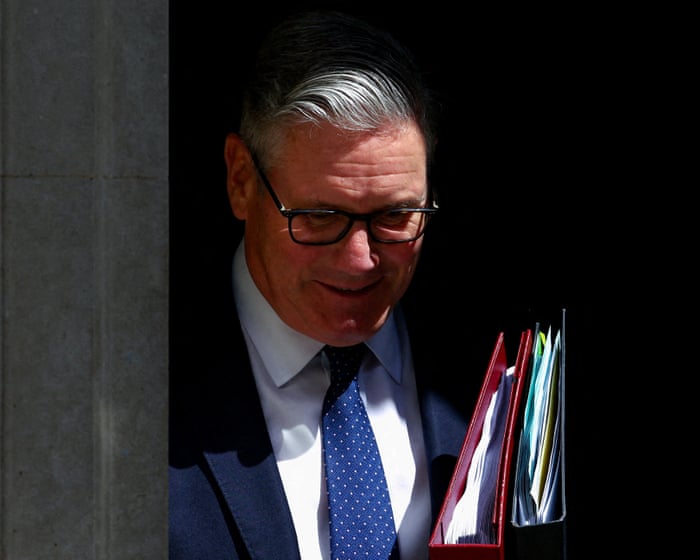
Keir Starmer is to quit as the MP for Holborn and St Pancras, saying it is the right time for him to leave the Commons.
Starmer, who resigned as prime minister in July, told the Camden New Journal he wanted to focus on international affairs and “pass the baton to a successor”.
Rollback of ‘roadless rule’ expected to benefit companies US Forest Service chief, Tom Schultz, previously lobbied for
Donald Trump this month announced plans to rescind a landmark rule that has protected old-growth forests in the US for 25 years. If finalized, the rollback is expected to benefit the companies that Tom Schultz, chief of the US Forest Service, represented in his previous roles as a timber industry lobbyist and executive, according to research by consumer advocacy non-profit Public Citizen.
The Roadless Area Conservation Rule, more commonly known as the “roadless rule”, was adopted in 2001 to limit development in roughly 45m acres of national forest. Industry interests and Republican representatives have long lobbied for the rule’s rescission, which would open up those swaths of untouched land to road construction, drilling and logging.
Demonstrators wave signs during a nationwide protest against AI data center expansion in Imperial, California, on July 18, 2026. | Sandy Huffaker/AFP via Getty Images
In the United States, building a data center now polls roughly as well as abolishing the police. If current trends continue, server warehouses may soon be less popular with Americans than pizza topped with pineapple and shattered glass.
In an August survey from Heatmap Pro and Embold Research, just 15 percent of Americans said they would support a data center being built in their area, while 75 percent expressed opposition. One year earlier, 43 percent of respondents in the same poll had approved of nearby data center development, while just 42 percent opposed it.
Key takeaways
Data center projects are increasingly unpopular and vulnerable to local opposition.
Nevertheless, the AI infrastructure buildout remains massive.
The economic forces driving the data center boom are extremely strong.
Since AI data centers can be located almost anywhere, it’s difficult to stop them from being built somewhere.
This soaring backlash is visible in other surveys — and in the actions of elected officials. In recent weeks, Wisconsin’s gubernatorial candidates sparred over who hates data centers more, Pennsylvania’s center-left Gov. Josh Shapiro enacted new restrictions on AI infrastructure projects (after previously championing such investment), and even Texas’s staunchly pro-business Republican government announced a temporary moratorium on new approvals.
But such panic and celebration are both premature.
In truth, despite exploding opposition, the data center boom is still going strong. Interviews with industry experts and recent construction data suggest that the economic forces driving the buildout remain more powerful than the political winds blowing against it. And unless Congress enacts a national moratorium, AI companies will almost certainly be able to continue finding jurisdictions willing to tolerate hyperscale campuses, in exchange for sufficient revenue and incentives.
America’s data center boom can be slowed and geographically shifted. But it probably can’t be killed, absent a collapse in demand for computing power or a much bigger revolution in American politics.
The boom is bigger than the backlash
There are two fundamental facts about today’s data center boom: 1) The backlash against it is huge, and 2) the buildout is even bigger.
The climate news outlet Heatmap has kept a tracker of new data center restrictions and cancellations. As of late July, it found that more than 500 jurisdictions had enacted severe constraints or bans on data center construction. The vast majority of these measures had been enacted since the beginning of this year.
The publication also found that contested data center projects face a skyrocketing cancellation rate. In late 2024, 20 percent of disputed developments were canceled; in the first half of 2026, that figure was closer to 50 percent. By Heatmap’s tally, more than 100 data center projects have been nixed this year in the face of local opposition, while more than 200 are currently being fought.
This surge of mass resistance is remarkable. And yet, it is also nowhere near sufficient to end the AI buildout.
Although the number of places with severe restrictions (or outright bans) on server farms is rapidly rising, more than 90 percent of US counties had no significant constraints on data center development at July’s end.
What’s more, many of the most eye-catching recent policy changes are less significant than they appear. For example, Texas Gov. Greg Abbott’s pause does not actually halt data center construction in the Lone Star State. Rather, it essentially establishes a more thorough screening process, when server farms apply for electricity from the state’s grid. Projects that supply all of their own power through on-site natural gas — as a rising share of new data centers do — are exempt.
Pennsylvania and New York’s recently enacted restrictions on data center development are more substantial. Yet neither of those states are particularly important to the AI buildout. Taken together, New York and Pennsylvania host only about 6.5 percent of America’s data centers, according to Data Center Map.
And their share of all pending developments is even more negligible, as the trade publication Construction Connect has illustrated:
Meanwhile, although half of contested data center projects are now failing, many still go undisputed. In the aggregate, cancellations have not kept pace with construction or new development. In the first quarter of this year, at least 3.5 gigawatts of data center capacity were canceled amid local opposition, in Heatmap’s tally. During the same three months, at least 36 GW of capacity were added to the US pipeline of proposed and active projects, according to the analytics firm Wood Mackenzie. As of April 1, that pipeline contained a total of 106 GW worth of developments that had alreadysurvived the permitting gauntlet.
To be sure, cancellations have risen sharply since March. By Heatmap’s count, at least 13 gigawatts of capacity have been nixed so far this year. But the capacity of permitted projects has also grown since April 1. And the ratio between blocked and active developments has not radically changed, according to industry analysts.
“At this point, we do not think the recent wave of opposition and policy intervention has materially changed our national capacity growth trajectory,” Maya Barkin, an analyst at the AI industry research firm SemiAnalysis, told me.
Indeed, monthly construction spending on data centers in the US hit a record high this June.
In short, data centers are marching forward despite taking heavy fire, like a pack of gut-shot zombies.
The secrets of the AI buildout’s success
Why has the AI buildout proven so resilient? There are at least two reasons.
First, and most importantly, demand for computing power remains astronomical. As frontier AI companies have built out larger models — and consumers and companies have increased their use of artificial intelligence and digital services — our economy’s appetite for computation has far outstripped supply. According to a recent report from the commercial real estate firm JLL, 99 percent of North America’s data centers are occupied. What’s more, of the 66 GW of data center capacity currently being constructed in JLL’s count, 95 percent has already been reserved.
Second, data center projects are unusually location-flexible. If a housing developer gets chased out of San Francisco’s suburbs by zoning rules and local opposition, it can’t relocate its condo tower to a mostly uninhabited stretch of Nevada desert. By contrast, data centers can — and do — operate in the middle of nowhere.
For certain purposes, these facilities need some proximity to the users they serve; you can’t adequately support online gaming in New York City with data centers on the West Coast. But even in such cases, servers merely need to be in the same broad region. The hyperscale facilities used to train AI models, meanwhile, can be located virtually anywhere with land, fiber optic cables, a modicum of labor, and electricity (and now that many data centers are powering themselves through on-site natural gas plants, even the latter is potentially expendable).
Taken together, these two realities make data center construction extremely difficult to choke off. Sky-high demand for compute means that hyperscalers can afford to throw a lot of money at localities, in order to secure a project’s approval. And location flexibility makes it very difficult for data center developers to run out of host jurisdictions, particularly when so many rural counties throughout the United States are starving for revenue and investment. Thus, unless Congress imposes a national moratorium, development deals will almost certainly keep getting struck.
“I think companies will need to open up their wallets and make sure that communities receive clear benefits,” John Arnold, a billionaire investor and philanthropist who sits on Meta’s board (and whose foundation has given funding to Vox), told me. “There will be places that raise their hands and say, ‘For X amount of benefit, we will welcome you into the community.’”
Just this week, West Virginia Gov. Patrick Morrisey signaled that he was moving forward with plans to encourage data center development and use the consequent revenue to slash the state’s income tax.
Municipal permitting won’t preempt the robot apocalypse
On one level, all this may seem to validate anti-data center activism: If there are countless potential locations for these facilities, then why should any community host one it doesn’t want?
This said, many oppose new data centers out of concern for their aggregate impacts, rather than their local ones. Climate activists fear that the AI buildout will generate perilous increases in carbon emissions. Populists on the right and left, meanwhile, want to slow the progress of artificial intelligence, so as to prevent the technology from causing mass unemployment — and/or human extinction.
For these factions, the buildout’s resilience has more complicated implications. If state and local bans are unlikely to end the boom, then green groups might be unwise to push for such measures in relatively climate-conscious areas. After all, doing so could shift development toward jurisdictions with less renewable energy, and/or fewer restrictions on carbon pollution. Given that risk, blue-state environmentalists may do more to mitigate AI’s climate impacts by regulating data center development than by banning it. Specifically, climate groups could demand that hyperscalers help bankroll the vast expansions of clean energy and transmission infrastructure that the green transition has always required.
For AI doomers, on the other hand, local bans may have some instrumental value. Moratoria and other restrictions are surely slowing the data center buildout at the margin. Still, as long as hyperscale facilities remain location-flexible — and tech companies stay well-capitalized — AI infrastructure will get built somewhere. A national moratorium could buy significant time. But ultimately, humanity’s security from the risks of AI hinges less on whether data centers get built than on what companies are allowed to do with them — and how the wealth they generate is distributed.
The data center rebellion is among the most remarkable popular movements in recent memory. But it is arrayed against one of the largest investment frenzies in human history. Unless or until the AI industry’s alleged “bubble” bursts, its buildout will be exceptionally difficult to stop. Yet where that buildout happens, how it’s powered — and what communities extract from it — are all up for grabs (and, increasingly, being grabbed).
Keir Starmer is to quit as the MP for Holborn and St Pancras, saying it is the right time for him to leave the Commons.
Starmer, who resigned as prime minister in July, told the Camden New Journal he wanted to focus on international affairs and “pass the baton to a successor”.
Democrat senator Chuck Schumer is introducing a bill that would reverse Donald Trump’s most recent tariffs, among them the new %50 duty on Canadian goods, MS Now reported.
While the Senate minority leader’s proposed legislation has virtually no chance of becoming law, Schumer hopes that his proposal shows that Democrats are actively fighting the affordability crisis. Schumer first shared his proposed legislation with MS Now.
Inquiry come after conservative thinktanks claim unions are using member dues to support Democratic causes
House Republicans are investigating several US labor unions based on claims from far-right nonprofits alleging union dues are being used for illegal political funding.
Republicans on the House’s education and workforce committee opened the investigation this summer after multiple reports from the conservative thinktanks targeted unions and their spending, claiming that unions are using member dues to support Democratic causes.
Age on the agenda in Massachusetts but octogenarian leftwinger leads younger rival Seth Moulton in primary poll
Democrats have spent the summer ousting long-serving incumbents in primaries across the country. On Tuesday, Massachusetts voters will decide whether that generational revolt extends to the 80-year-old Ed Markey, whose younger Democratic rival has argued that the incumbent is simply too old to serve another term.
But the Senate primary in this heavily Democratic state flips a central dynamic of previous contests, where youthful progressive insurgents have targeted – and in several cases, toppled – older incumbents they derided as avatars of an outmoded cautious establishment.
Mike Rogers isn’t merely campaigning alongside a controversial supporter. His campaign put an extremist on its faith leadership team
Hasan Piker.
Turn on cable news. Pick up a newspaper. Log on to Twitter. It doesn’t seem to matter where you get your political news: for the past month, the leftist Twitch streamer has become one of the dominant subjects of coverage, conversation and controversy surrounding the crucial Michigan Senate race between the Democrat Abdul El-Sayed and the Republican Mike Rogers.
The non-profit Leaving Maga is built on the premise that abandoning the Trump-built movement is like fighting a disease or breaking an addiction
Stephania Messina kept birthing boys. In the Quiverfull conservative Christian church she belonged to outside Detroit, Michigan, that made her a community celebrity. Your quiver, as the church taught it, is your womb, meant to be filled with as many arrows – a metaphor for children – as you can shoot unto the Lord. She shot five. “They treated me like I was Mother Mary, like I was this gift to the church,” she said.
But while she was quickly pushed into leading worship and Bible study groups for women and children, she wasn’t permitted to talk about politics.
Former PM announces he will no longer represent Holborn and St Pancras on the day his successor, Andy Burnham, is to give first Commons address as prime minister
My colleague Richard Partington, the Guardian’s senior economics correspondent, grew up, like Andy Burnham, in the Warrington suburb of Culcheth. He has been home to find out what people there are saying about the new PM.
Yesterday, Kemi Badenoch announced a reshuffle, replacing Mel Stride with Andrew Griffith as shadow chancellor and Priti Patel with Tom Tugendhat as shadow foreign secretary.
Driscoll has submitted his resignation to President Donald Trump amid growing tension between him and Defense Secretary Pete Hegseth, sources told ABC News.
At the height of her 1998 re-election fight, Pauline Hanson was challenged to give her honest assessment of John Howard.
Two years on from her firebrand maiden speech, the One Nation leader was contesting the Queensland seat of Blair when she was bailed up by a group of punters at a country race meeting. The men had been drinking and one demanded to know if Howard was “a prick”.
Liberal party figure tells inquiry he never asked Jean Nassif ‘for payments for political outcomes’ as lawyer tells him she is ‘gobsmacked’ by his ‘obfuscation’
The younger brother of Dominic Perrottet has insisted he never asked a fugitive property developer for money for political outcomes – including at a meeting at fine-dining restaurant Nobu in Crown Casino, an inquiry has heard.
On Tuesday, the New South Wales Independent Commission Against Corruption (Icac) heard that developer Jean Nassif had withdrawn from a scheduled videolink appearance from Lebanon later this week, after Charles Perrottet faced questions about the dinner meeting between the two men in Melbourne in May 2021.
We send our love and support to the Jewish community in Manchester and beyond who last night gathered to remember Melvin Cravitz and Adrian Daulby, who were killed defending their synagogue last year. My thoughts are with their families and all those who have been affected by the attack.
I know for many Jewish people, the sorrow and fear from that day has not lifted and I know we must do more to protect communities across the country.
Britain is poorer than we often think. We won’t get richer based on higher public spending alone, and we can’t tax billionaires who don’t live here.
We shouldn’t rely on public spending as a route to some romantic version of making Britain great again as we look in the rearview mirror for a great history that is no longer available to us. We must face the future, and I know my colleagues are up to the challenge.
Crucially, we must create the right conditions for a dynamic, thriving market. This includes getting ahead of what artificial intelligence will mean for our services-dominated economy.
Politically, we shouldn’t see conflict between growth and fairness, or business and workers, or the market and the state. These are false choices.
Resignation comes after months of turmoil at Pentagon, from leaked investigation to ousting of senior officials
The army secretary, Dan Driscoll, has handed his resignation to Donald Trump, the White House said on Monday, becoming the latest high-profile figure to depart the defense department.
The army official, who is second in line to the defense secretary, Pete Hegseth, had reportedly been eyeing an exit from the Pentagon amid apparent friction with the secretary.
Christine Edzard’s The Man With the Plan tours the country with a timely message about tackling want, disease, squalor, idleness and ignorance
A new film that addresses issues fundamental to the new prime minister’s declared mission will star Simon Callow as a historical British political figure.
The hero of The Man With the Plan is William Beveridge, who helped to lay the foundations of the postwar welfare state. It shows that the Liberal peer was much more radical than is usually assumed – and certainly far more so than Churchill anticipated when he asked Beveridge to draw up a report into the future of Britain’s fragmented social insurance and national health system after the second world war.
Increase coincides with proscription of Palestine Action last year which has led to thousands of arrests for allegedly supporting the protest group
Almost half of all terrorism arrests in Great Britain since the 9/11 attacks on the twin towers in 2001 have come in the past year, official data shows.
There have been 6,539 arrests for terror-related activity in Great Britain since the 2001 attacks and 3,021 of those arrests were in the year ending 31 March 2026, according to the Home Office.

 Login
Login