Democratic Senate nominee is eager to push past series of controversies involving allegations of antisemitism
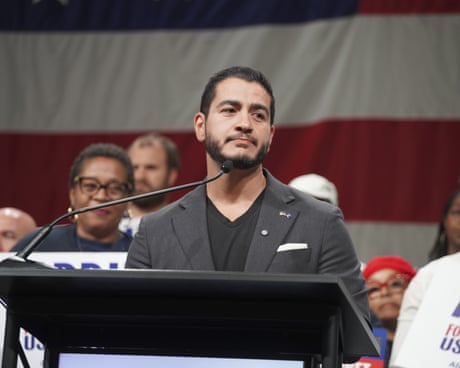
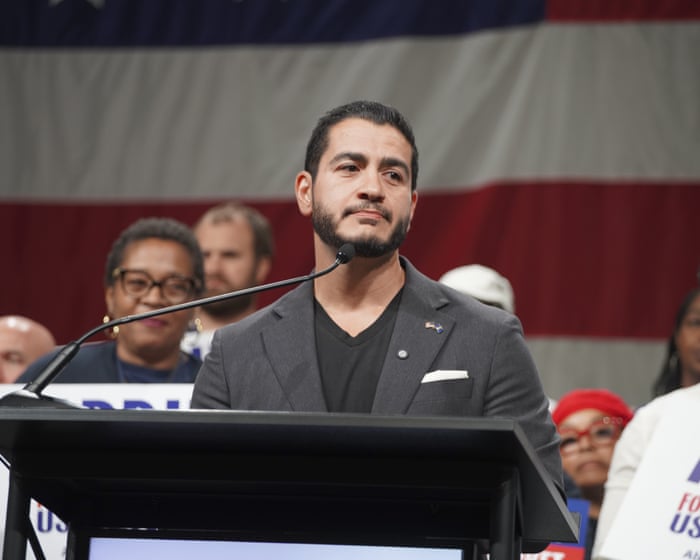
Michigan’s Democratic US senate candidate Abdul El-Sayed apologized to the state’s Jewish Democratic Caucus on Saturday for comments he made after an attack on a synagogue in March, which he tied to Israel’s actions in the Middle East.
“My comments may have been misconstrued to justify something I did not mean to justify,” El-Sayed told reporters after he addressed the caucus at a party convention in Lansing. “To anyone who feels like my comments might have been hurtful, I’m really sorry. That was not my intention.”
Sen. Jon Ossoff (D-GA) during a campaign event in Atlanta, Georgia, on May 31, 2026. | Ben Hendren/Bloomberg via Getty Images
Until recently, Natalie Harp was an omnipresent but low-profile aide to President Donald Trump: always there, but rarely part of the story herself. That changed abruptly earlier this month, when Sen. Jon Ossoff (D-GA), who is currently running for reelection, name-dropped her in a speech.
Trump “doesn’t want to do the job. He wants to build his ballroom and travel with Natalie on their apparently defenseless flying palace gifted by the Emir of Qatar,” Ossoff told supporters at a rally.
The line was a reference to reporting on Trump’s catering-cart maneuver as he was flying back from Turkey in July; Harp and other Trump aides joined the president on an alternate plane by way of a catering cart, while Secretary of State Marco Rubio was left behind on Air Force One.
The “Natalie” jab from Ossoff quickly took on a life of its own, spurred by a furious response from the Trump White House and right-wing media. Somewhat lost in the flurry of attention on Harp was Ossoff himself — but Greg Bluestein, chief political reporter for the Atlanta Journal-Constitution and co-host of the Politically Georgia podcast, told Today, Explained that the remark was “by design.”
Bluesteinspoke with Today, Explained co-host Sean Rameswaram about Ossoff’s disciplined, savvy messaging strategy, his political rise, and why his rhetorical jabs at Trump are fueling speculation about an Ossoff 2028 presidential run.
Below is an excerpt of their conversation, edited for length and clarity. There’s much more in the full podcast, so listen to Today, Explained wherever you get podcasts, including Apple Podcasts, Pandora, and Spotify.
It’s time on this show, Greg, that we remind people who Jon Ossoff is. I’m told that is a job with which you can help.
I go way back with Sen. Ossoff. The first time I met him, or at least I talked to him, was way back in early 2017 where I got a call out of the blue from a name, a number I didn’t recognize, and the voice on the line said, “Hi, I’m Jon Ossoff and I’m running for US House, this special election.” And I said, “Well, welcome to the show. There’s about 17 other candidates already in the race.”
And he goes, “Well, I’ve got something they don’t. I have John Lewis’s endorsement, and I have about $250,000 in cash commitments.” So I was like, “Okay.”
It still was an uphill battle because we’re talking about a deep red Republican seat in the northern suburbs of Atlanta at a time when all those suburban seats were still Republican. So I said, “Okay, good luck, sir.”
But lo and behold, he became a national figure in that loss.
So you’ve been covering Sen. Ossoff just about as long as anybody. At any point over the course of that almost-decade, did you expect “Natalie” from him?
No. I mean, look, you expect him to be really, really careful and calculated about what he says. Even back then, he rarely uttered an imprecise statement. There have been times where folks have caught him off-message, but it’s been very, very rare even at the beginning of his political career, certainly now.
When he uttered the “Natalie” line that sparked a thousand thought pieces and national takes and all that, that was done by design.
Tell us a bit about his backstory for people who have forgotten who Jon Ossoff is.
When I first got that call in early 2017, I had no idea who he was. Little did I know he’d become a national figure that we’d be talking about in the context of a presidential campaign not even a decade later.
He’s a former documentarian, a former intern of the legendary Georgia Congressman John Lewis, whose parents, especially his mom, were involved in Democratic politics in Georgia, but definitely not household names — definitely not a known quantity when he called me all those years ago to say “I’m running.”
Ossoff came within a whisker of an outright win, which would’ve been a huge, monumental upset. But in the process, he showed that Democrats have a path with suburban voters that long voted Republican in the Trump era. He started with the sort of campaign slogan of “Make Trump Furious.”
He was leaning into the Democratic activism, but then within weeks shifted his message toward a more friendly, more mainstream argument about bringing jobs to the district, bringing more tech-savvy investment to the district.
When he announced for US Senate against David Perdue, very few people gave him a shot when he got in the race. But that race ended with this epic double-header runoff because Rev. Raphael Warnock was also in the race against [Sen.] Kelly Loeffler. Democrats hadn’t won in Georgia in decades. So it was an epic election and a real nail-biter to the end.
Ossoff becomes the first Jewish US senator in Georgia history, Warnock becomes the first Black US senator in Georgia history, and together they flip control of the Senate and allow Joe Biden to to actually implement some of his broad-ranging agenda those first two years that they were in office.
It makes a lot of noise when Ossoff helps flip the US Senate along with Warnock. And he’s making a lot of noise now with “Natalie.” But I can’t say that I feel like he’s made a lot of noise in the intervening six years. What’s he been like as a senator?
That’s by design. It’s only been really recently where he’s been very willing to go on the national cable shows, to talk to national reporters more, to do a lot of the things that you see other nationally prominent Democratic figures do much more regularly.
We both know there are folks in Washington who love going to the White House Correspondents’ Dinner and they love going to this or that luncheon or this or that dinner. Sen. Ossoff is much more likely to quietly go home and spend time with his two kids.
I’m not just saying that because that’s the senator I know. He is much more reserved and guarded about his private life and will bend over backwards to figure out ways to get back to Georgia — even when there are important votes, [he’ll] find ways after those votes to get back for events with his kids and that kind of thing.
It feels a little contrary to think about this guy who keeps a low profile, who wants to go back home to Georgia to be with his family, who doesn’t want the limelight, because as you’ve already mentioned, he isn’t just running for reelection in the Senate right now. Everyone seems to believe that he’s running for president.
I’m going to go out on a limb saying that I believe him when he said publicly — and privately too — to folks all over the spectrum, media folks and activists and supporters and you name it, that he is focused on this election and he’s not running for president.
If someone like Sen. Ossoff wins by a huge margin over Mike Collins in an important battleground state that is tilted both ways the last decade, the chatter will not stop. It’ll only get louder.
[He is] someone who is adept at making the arguments that so many core Democratic voters want to hear about President Trump, but at the same time can win over swing voters like he has in 2021. And he’s already seeming like he’s certainly making that outreach to them in 2026.
Do you think that if he does end up there, we’ll look back at Nataliegate as a big moment for him where it was just clear that this guy had the stuff? Or does this feel like, a week and a half out or whatever it is now, that it’s already fading into the background?
The biggest takeaway from that to me was how — and I think Jonathan Martin from Politico was the first to say it — Ossoff was essentially the nation’s assignment editor because it spurred countless stories for the next week and a half about who Natalie Harp is.
It was Ossoff who showed that he has this extraordinary staying power in the media. These rallies — he doesn’t hold them every day or every week. These are like once every month or so rallies.
The stagecraft is impressive. He’s got these multi-camera shots that are immediately farmed out to all these social media accounts who amplify them. It’s very, very impressive how he pulls this off. And they’ve become these sort of national spectacles that have inevitably given rise to more ruminations about whether he’ll run for president or not, but also of course boost his campaign itself.
That to me was one of the takeaways — that he has this impressive grip on not only what the media’s covering, but triggering them to cover even more of it.
Angie Nixon won one of the biggest upsets in US midterm primaries – and if elected, the Democrat would be the first African American senator in Florida history
The Democratic establishment had the money, the machinery and the candidate with national name recognition. Angie Nixon had a bookshop called Café Resistance and a grassroots campaign for the Senate. On primary election night in Florida, Nixon won in arguably the biggest upset of the primary season. But at least one person was not shocked: Angie Nixon herself. “We weren’t surprised,” the 42-year-old reflects after overcoming a vast fundraising disadvantage to defeat Alex Vindman, a combat veteran who testified against Donald Trump during his first impeachment. “We actually knew we were going to win; we just didn’t know that we were going to win by that much. We put in the work and so super excited about the outcome. It shows that good old-fashioned grassroots organising will beat big money each and every day.”
Nixon won 56.1% of the vote to Vindman’s 43.9%. The result stirred tensions within the Democratic party in a year defined by the struggle between moderates and economic populists. In Florida – a state that has trended increasingly Republican in recent years and is now Trump’s home state – Democrats have now nominated a member of the Democratic Socialists of America (DSA) who speaks openly about class war.
It is unclear whether this Supreme Court will allow President Donald Trump to make sweeping and unilateral changes to how the country runs its elections so close to the midterms. | Andrew Caballero-Reynolds/ AFP via Getty Images
Well, that was quick.
On Thursday evening, federal district Judge Indira Talwani issued a new order that temporarily blocks an effort by the Trump administration that appears designed to sabotage voting by mail in the upcoming midterm election. Talwani previously blocked an executive order that President Donald Trump issued in March, which ordered the US Postal Service (USPS) to impose a byzantine array of new regulations on voting by mail, but the Supreme Court reinstated the order on Monday.
Talwani’s new order sets up a new legal fight that is almost certain to return to the justices, and it is unclear whether this Court, with its 6-3 Republican majority, will allow Trump to make sweeping and unilateral changes to how the United States conducts its elections so close to an actual Election Day.
That said, while Talwani’s new order in League of Women Voters v. Trump is brief, it is well-crafted to persuade at least some members of the Court’s Republican majority to break with the leader of their political party.
Talwani relies on a fairly new legal concept known as the “major questions doctrine,” that the Court’s Republican majority invented in the later part of the Obama administration, and that the Court has only actually used against one president: Joe Biden. Briefly, the doctrine claims that the executive branch may not make policy changes that are too sweeping or too aggressive, often even if a federal statute appears to give it the power to do so.
As the Court summarized this idea in Utility Air Regulatory Group v. EPA (2014), the first Supreme Court decision to articulate the major questions doctrine, “we expect Congress to speak clearly if it wishes to assign to an agency decisions of vast ‘economic and political significance.’”
This doctrine, as Talwani indicated in her recent order, cuts sharply against Trump’s rules governing voting by mail. The Trump administration’s new rules impose so many layers of bureaucracy on mail ballots that it likely would be impossible for many states to comply with these regulations. Trump’s new rules, in other words, would effectively shut down voting by mail in much of the United States. And there are several states who conduct their elections almost entirely by mail, which means that Trump’s rules could effectively cancel the 2026 midterms in those states.
If that’s not a decision of “vast economic and political significance,” nothing is.
The uncertain question, however, is whether the Court will actually apply its major questions doctrine to Trump — something that several justices have thus far been reluctant to do. In Learning Resources v. Trump (2026), the tariffs case,three Republican members of the Court (Chief Justice John Roberts and Justices Neil Gorsuch and Amy Coney Barrett) did say that this doctrine prohibits many of Trump’s tariffs. But the other three Republican justices (Clarence Thomas, Samuel Alito, and Brett Kavanaugh)refused to apply this doctrine to a member of their own party.
If Roberts, Gorsuch, and Barrett hold to the view they expressed in Learning Resources — the view that the major questions doctrine applies to both Trump and Biden — then it is likely that these three justices plus the Court’s three Democrats will form a majority that willstrike down Trump’s latest attempt to sabotage voting by mail.
A brief history of the major questions doctrine
Many federal laws lay out a broad policy goal, and then empower a federal agency to write rules that will achieve that goal. Federal law, for example, requires the EPA to determine when power plants must install cutting-edge technology to reduce their emissions. It tasks a body within the Department of Health and Human Services with determining which vaccines must be covered by health insurers. And it gives the Federal Communications Commission some control over the cost of cable television.
Often, the federal statutes granting these powers are written quite broadly. During the later part of the Obama administration, however, many voices within the conservative legal movement grew concerned that Democratic presidents could use these broadly worded statutes to make major policy changes. Indeed, in the late Obama administration, the Federalist Society’s annual lawyers’ convention, probably the most important annual gathering of influential Republican attorneys, became a showcase of proposals to restrict federal agencies and prevent them from using their congressionally granted authority too aggressively.
Ultimately, the Supreme Court’s Republican majority settled on the major questions doctrine as their solution to this clamor within the Federalist Society and other conservative legal groups. The doctrine effectively gives the justices a veto power over any policy proposal advanced by the executive branch if the justices deem that policy to be too ambitious.
The doctrine effectively gives the justices a veto power over any policy proposal advanced by the executive branch if the justices deem that policy to be too ambitious.
One common critique of this doctrine is that it appears nowhere in the Constitution or in any federal law. The Court first announced the doctrine in its 2014 opinion in Utility Air, which merely invoked it to criticize a hypothetical EPA regulation that never actually existed. The Court has also never handed down a majority opinion explaining where the justices’ new power to veto federal regulations comes from. Moreover, while some individual justices have attempted to do so, their explanations conflict with each other, and are often ridiculous. Barrett has argued, for example, that the major questions doctrine derives from a parable about a babysitter.
Another criticism of the doctrine is that the Court has never applied it to a Republican administration — indeed, the Court has thus far only applied it to Biden. The doctrine, after its first appearance in 2014, laid dormant for the entire first Trump administration — only to spring back to life in order to block several of Biden’s attempts to respond to the Covid-19 pandemic.
Yet, while the major questions doctrine is hard to defend as a good faith effort to interpret the Constitution or any statute, the pragmatic case for allowing someone to rein in a too aggressive president has undoubtedly gotten stronger in the last two years. Trump is a walking advertisement for the idea that there should be limits on executive power. If the Court decided to apply its major questions doctrine to Trump, it’s unlikely that many Democrats would object to such a decision.
Thus far, however, the Court’s three Democrats have kept this recently fabricated doctrine at arms length — in Learning Resources v. Trump (2026), for example, they concluded that it was unnecessary to invoke the major questions doctrine to strike down Trump’s tariffs that were at issue in that case because federal law was clear that those tariffs could not exist.
The Court’s Republicans, meanwhile, have split on whether the doctrine should be applied to Trump. While Roberts, Gorsuch, and Barrett all concluded that Trump’s attempt to impose trillions of dollars worth of new taxes on imports was a decision of “vast ‘economic and political significance,’” the other three Republicans joined an opinion by Justice Brett Kavanaugh, which said that the doctrine does not apply “in the foreign affairs context, including foreign trade.”
Kavanaugh, in other words, would have invented a new exception to a brand new legal doctrine, which just happened to be perfectly tailored to exempt a Republican president’s signature economic policy.
Still, there are three Republican justices who have previously concluded that the major questions doctrine may be used against a Republican president. If these justices hold to that view in League of Women Voters, that’s enough to form a majority against Trump’s restrictions on voting by mail because the Court’s three Democrats have already signaled that they oppose those restrictions.
League of Women Voters gives the Roberts Court a second chance to legitimize one of its most consequential changes to US law
Because the Court has neither offered a plausible explanation of where the major questions doctrine comes from, nor applied this doctrine in a nonpartisan way, both the Democratic justices and a wide array of legal scholars have treated the doctrine as illegitimate. So have I. Kavanaugh’s dissenting opinion calling for a Trump-sized exemption to the major questions doctrine certainly didn’t help the case for it.
But if any case justifies a court decision that overrides a presidential power grab, League of Women Voters is that case.
Trump has carried out a vendetta against voting by mail since the 2020 election. During the Covid pandemic, disease-shy Democrats were much more likely to vote-by-mail than Republicans, because voting by mail allowed Democrats to avoid a trip to the polls where they might catch Covid. And these voting patterns continued even after the pandemic receded. According to the Pew Research Center, 44 percent of Democrats, and only 26 percent of Republicans, voted by mail in the 2024 election.
The new restrictions on voting by mail, in other words, are almost certainly motivated by Trump’s desire to shut down a method of voting that is preferred by Democrats, and thus skew the 2026 election towards Republicans.
Among other things, the new rules require states to mail ballots in a special envelope which must include certain design elements mandated by the federal government. These envelopes must be preapproved by the Postal Service, and individually scanned in a process that the Trump administration claims will take “less than a minute per mailpiece.”
But, as several states point out in a legal filing challenging Trump’s rules, California alone needs to mail 23 million ballots to individual voters. So that potentially adds up to “23 million minutes … or more than 43 years” that state officials would need to spend just to comply with one small part of the new regulations.
If the major questions doctrine applies to Republican administrations, however, there is no need to parse whether these two laws should be read to allow the Trump administration to effectively shut down voting by mail. The question of whether to quash a method of voting that tens of millions of US voters have used in the past is undoubtedly a question of “vast … political significance.” And thus, under Utility Air’s holding that Congress must “speak clearly” before it can give a federal agency the power to resolve this question, the two vague statutes that Trump’s lawyers cite to justify the new rules are not enough.
League of Women Voters, in other words, should be a very easy case — even for the Court’s Republicans. All they need to do to strike down Trump’s attack on voting by mail is apply the same rules to Trump that they previously applied to Biden.

 Login
Login