Trump announced Monday morning that U.S. tariffs on all Canadian cars and trucks, automotive parts, and steel will increase to 50% starting Jan. 1, 2027.
“Build in the U.S. and there are zero tariffs. Canada will be treated like a State no longer! On trade, and in other ways, also, they are among the worst nations in the world to deal with,” he said on social media.
Trump’s comments came after trade talks between the two countries broke down, with each side accusing the other of making eleventh-hour demands that derailed negotiations.
“They feel entitled, and yet, we don’t need Canada, they need us!” the President said, repeating his accusation that “Canada has been ripping off the United States of America for years.”
Trump previously touted the nearly finished deal between the two countries last Tuesday.
However, negotiations broke down on Friday, and the Administration's 50% tariffs on about $20 billion worth of imports into the U.S. from Canada took effect Saturday.
“We are stronger now than when the United States started this trade war. More unified, more determined, and more ambitious,” Carney said during a press conference Saturday, referring to the year-long trade rift that has come to affect both countries.
“Last spring, I warned that America is trying to break us so that they can own us. And promised: “That will never, ever happen.” We are keeping that promise. Canada is becoming stronger and less dependent on America.”
Both sides have since blamed the other for making unreasonable demands late in the negotiating process.
“While we believed, earlier this week, that we were moving toward a mutually beneficial agreement, in recent days, the U.S. proposed new terms that were uneconomic, unfair, and undermined the net benefits to Canada, calling into question the reliability of any deal,” Carney said on Saturday. “In short, they asked too much and offered too little.”
U.S. Trade Representative Jamieson Greer, meanwhile, framed the breakdown in negotiations as leaving the U.S. with little choice but to retaliate against Canada.
“We’ve said enough, and so we’ve taken countermeasures. Our interest is in protecting American workers and protecting American supply chains,” he told "Fox & Friends" on Saturday.
Greer said the Republican Administration had offered to cut tariffs on steel, autos, and lumber, “things that are sensitive for them. And they’ve always had the best deal, and they still would have an even better deal, but they didn’t want that.”
As a result, he said, “We’re moving forward with measures that respond to Canadian retaliation.”
The broader 50% tariffs that took effect Saturday were initially announced in July, and would affect around 5% of trade between the U.S.-Canada.
Shortly after the collapse of the talks, Trump took to Truth Social on Sunday and said that Canada “wants the benefits of being a State, without being one” and that it has “also charged our great farmers, for many years, massive amounts of tariffs. No more!!!”
Despite not being clear what the President meant, Trump has repeatedly expressed his desire to annex Canada and make it the 51st U.S. state—an idea Carney has strongly rejected.
Canada retaliates as U.S. lawmakers warn of higher costs
The collapse of the deal and escalating trade tensions between Washington and Ottawa have been met with both praise and criticism on either side of the border.
Ontario Premier Doug Ford praised Carney for standing firm and refusing to accept what he described as a “bad deal.”
“It was a bad deal for Ontario. It was a bad deal for the auto sector, the steel sector and manufacturing sector,” he said. “We never started this fight, but I can assure you we're going to win.”
On the U.S. side, Trump has faced criticism from both sides of the aisle.
Democratic Sen. Amy Klobuchar of Minnesota said Trump’s tariffs “have created higher costs and chaos.”
“His 50% tariffs on Canadian goods will raise prices. And now Canada is retaliating dollar for dollar, which will hurt Minnesota farmers, businesses, and workers,” she said Monday of the newly announced tariffs.
Republican Sen. Susan Collins of Maine similarly warned that the “on-again/off-again trade talks between the U.S. and Canada lead to higher costs, risk, and uncertainty for Maine businesses.”
“If the Administration proceeds with these tariffs, they will increase costs for Maine families, as most businesses will have no choice but to pass on the tariffs to their customers through higher prices,” she said Saturday after trade talks broke down, urging “both sides to return to the negotiating table.”
Democratic Gov. Abigail Spanberger of Virginia warned that this latest round of automobile tariffs will have “devastating consequences.”
“President Trump’s new 50% tariffs on Canada will disrupt supply chains and raise costs for Virginia businesses of every size and in every industry, and retaliatory tariffs will hurt Virginians,” she said Monday.
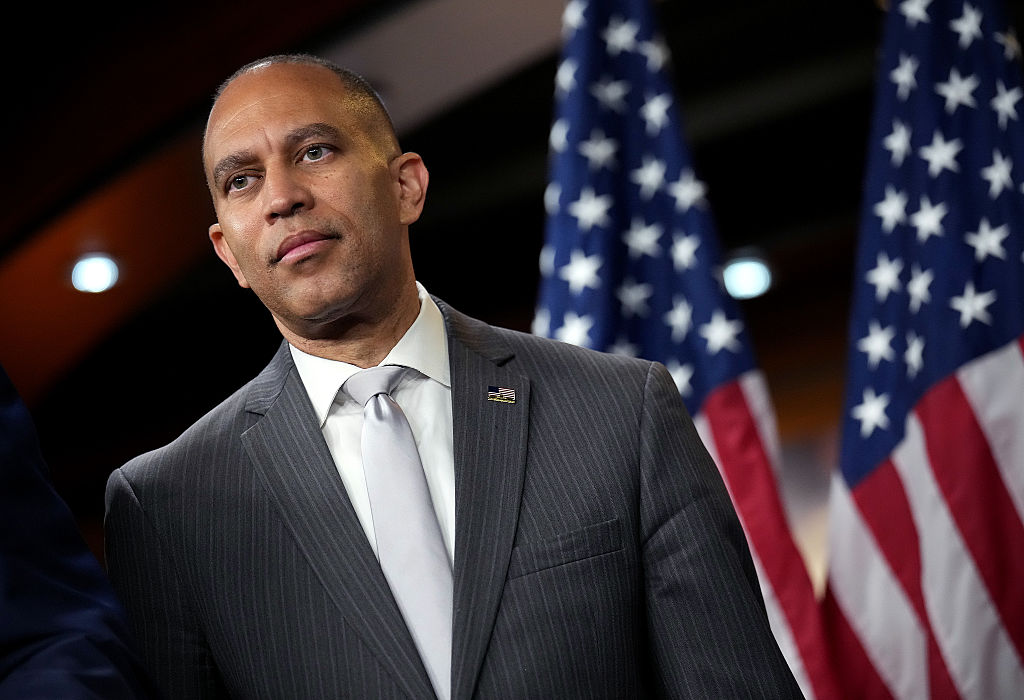
House Minority Leader Hakeem Jeffries speak at a press conference at the U.S. Capitol on June 11, 2025 in Washington, D.C. —Kevin Dietsch––Getty Images
House Minority Leader Hakeem Jeffries met privately with President Donald Trump’s son-in-law and adviser Jared Kushner in recent weeks, prompting criticism from some Democrats ahead of approaching midterm elections, according to reports.
Although Kushner, who served as a senior West Wing adviser during Trump’s first term, does not have a formal role in the current Administration, he has remained involved in Trump’s diplomatic efforts in the Middle East and Russia.
During the meeting, the pair were said to have discussed housing, immigration, and the high cost of living as potential areas of common ground.
The report comes less than three months before the November midterms, when Democrats are favored to retake control of the House from Republicans, who currently hold both chambers of Congress. A Democratic victory would put Jeffries in line to become speaker and give the party greater oversight powers to investigate the Trump Administration.
The meeting—an unusual instance of a top Democrat and a Trump confidant coming together to discuss potential areas of agreement—has drawn scrutiny from some within Democratic circles. It was first reported Sunday by The New York Times and has since been confirmed by multiple outlets.
“Throughout this Congress, Republicans have adopted a my-way-or-the-highway approach to governing that has failed the American people," Jeffries says in a statement to TIME. "To stop the madness, we have repeatedly made clear that an extremist approach will not work and will be met with forceful opposition. The American people want bold change and that’s what House Democrats will deliver.”
“In every conversation that we have with the Trump administration, we will continue to make it explicitly clear that the affordability crisis is not a hoax and nothing short of transformational policy change is acceptable. We are fighting for an affordable America. The question is whether Republicans will join us,” the statement reads.
TIME has also reached out to the White House and Kushner for comment.
Asked whether he supported the meeting during an interview on NBC’s Meet the Press on Sunday, Democratic Sen. Chris Van Hollen of Maryland said: “I’m in favor of people meeting with whoever they want to discuss ideas. But it’s one thing to have a meeting. It’s another thing to see something real come out of that.”
Tommy Vietor, a former aide to President Barack Obama and now a co-host of the podcast Pod Save America, was far less diplomatic.
“Jared Kushner has no actual government job, he just uses his family connections to get money from Gulf autocrats and fund corrupt deals. The only way Jeffries should work with him is with demands for documents and subpoenas,” Vietor said.
House Speaker Mike Johnson said Sunday that he first learned of the meeting that same day, when reports began circulating in the media.
"I don't know what that's about," Johnson said on Fox News. "I know Jared has interests and lots of other things going on. He's not really directly involved in the admin, at least in the day-to-day in the White House."
Johnson, however, remained confident that Republicans could retain control of the House.
“I’m telling you what, you better not bet against the House Republicans,” he said.
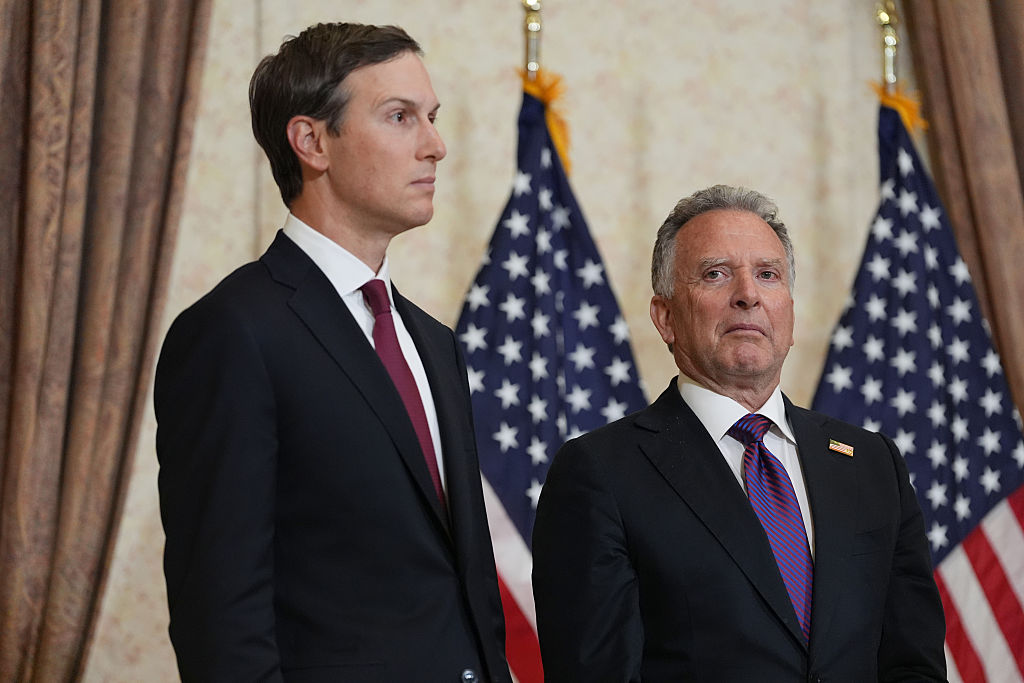
Jared Kushner, left, and Steve Witkoff, Special Envoy for Peace Missions listen as Vice President JD Vance speaks during a news conference after meeting with representatives from Pakistan and Iran, April 12, 2026 in Islamabad, Pakistan. —Jacquelyn Martin––Pool/Getty Images
Trump has met with the top Democratic leaders of the House and Senate only once since returning to office, when the President attempted last year to reach an agreement to prevent a government shutdown. Those talks ultimately failed, leading to the longest government shutdown in U.S. history.
The relationship between Trump, Jeffries, and other members of the Democratic leadership has often been marked by conflict and back-and-forth name-calling.
In late April, Trump called Jeffries a “low IQ person” and attacked Senate Minority Leader Chuck Schumer over their opposition to the Iran war, branding them “traitor Democrats.”
Jeffries, in turn, called Trump the “dumbest President ever” in response to the President’s insults during a press conference.
Trump has continued to attack the top House Democrat as "low IQ" and a "thug” branding him as a “danger” to the country.
More recently, however, Trump’s tone toward Jeffries appears to have softened. In an interview earlier this month with Punchbowl News, the President said he could work with the Democratic leader and described him as a "nice guy."
"People are harsh on me. I'm harsh on them. It's part of the world," Trump said. "I'd probably get along with him very well."
That dynamic could change if Democrats take control of the House, where Republicans currently hold a slim majority of 218 Republicans to 212 Democrats and one independent.
A Democratic-controlled House would give the party the power to block parts of Trump’s legislative agenda, launch high-profile congressional investigations, issue subpoenas, and initiate impeachment proceedings.
Trump—who was impeached twice during his first term—has urged voters to back Republicans in the midterms, arguing that Democrats would use their power to impeach him again.
“I’m going to be impeached. They're going to impeach me. They have no idea why,” he told a crowd during a rally in South Carolina last Friday.
The latest Emerson College polling, released August 20, found congressional Democrats leading Republicans by nearly 8 points. A separate Reuters/Ipsos poll released Aug. 17 found Democrats ahead by 5 points. All 435 House seats are up for election in November.
Vanitas Still Life with a Skull, a Book and Roses, c.1630, from the collection of Nationalmuseum Stockholm. | Fine Art Images/Heritage Images/Getty Images
Americans want to soak the rich. But few have strong opinions about precisely how.
Indeed, even among our nation’s most impassioned class warriors, contemplating the fine details of tax policy is an eccentric pastime. In an interview earlier this month, Democratic Socialists of America co-chair Megan Romer called for taxing “the hell out of” the wealthy. When asked exactly what that meant, Romer conceded that she had no “solid answer.”
Key takeaways
• A loophole in the tax code allows the rich to escape capital gains taxes by dying.
• Closing that loophole would raise a lot of revenue while also making other investment taxes more effective.
• A tax on the unrealized capital gains of the dead poses fewer logistical and judicial challenges than many other approaches to soaking the rich.
On one level, this is understandable. Anyone can freeze up when put on the spot. And in any case, Romer believes in collective ownership of the means of production. When your preferred tax policy is 1,000 times more radical than anything Congress would entertain, sweating its particulars might not feel urgent.
Still, there’s more than one way to soak a fat cat. And some approaches work better than others. Thus, for non-revolutionaries, thinking through the details of a “tax the hell out of them” platform seems worthwhile.
Many of that platform’s potential components have already attracted widespread attention. Wealth taxes — which expropriate a certain fraction of the super-rich’s assets each year — are on the ballot in California and the progressive agenda in Washington, DC. And Democrats perennially call for raising the top income tax rates.
Yet there is a less-discussed, populist tax policy that would raise a lot of revenue, pose relatively few logistical challenges or economic trade-offs, and make other levies on the wealthy more effective: taxing the investment earnings of the dead.
The rich are dying to avoid taxes
Shaking down the deceased might seem distasteful. But doing so would close a large loophole in America’s tax code — one that lets the wealthy cheat Uncle Sam out of hundreds of billions in revenue.
One way that the government currently soaks the super rich is by taxing their investment earnings (also known as “capital gains”). If President Donald Trump buys shares in a hot dog company for $10 million — and then sells them for $110 million — he will need to pay a 23.8 percent tax on his $100 million profit.
If Trump holds onto his stock until death, however, his unrealized capital gain disappears. When the shares are passed down to his heirs, the tax code resets its initial value: If Eric Trump inherits the frankfurter fortune — and then immediately sells it for its market value of $110 million — he will owe $0 in capital gains taxes.
Essentially, the tax code treats Donald’s heir as though he purchased the firm for $110 million, then sold it without turning a profit. This rule is known as “stepped-up basis.” And it costs the Treasury upward of $70 billion a year.
That forgone revenue doesn’t all go to the rich. Middle-class heirs also benefit from stepped-up basis. But the policy’s benefits flow overwhelmingly to the affluent and super-wealthy: As of 2022, the richest 10 percent of Americans held roughly three-quarters of the nation’s unrealized capital gains — while the richest 1 percent lay claim to 43 percent of them, according to the Survey of Consumer Finances.
Beyond directly sapping government revenue, stepped-up basis also creates problems for raising taxes on investment income. Democrats have long called for increasing the top capital gains rate to 39.6 percent — today’s top rate for labor income — so that investors aren’t taxed more lightly than workers.
And yet, in a world with stepped-up basis, the higher you raise the tax rate on capital gains, the more incentive you give the rich to sit on their most lucrative assets until they die. For this reason, hiking the top capital gains rate can theoretically cost the government money. In a 2021 analysis of President Joe Biden’s proposal to lift the top rate on investments to 39.6 percent, economists at the University of Pennsylvania projected that the policy would reduce federal revenue by $33 billion over the next decade, as investors sold off fewer assets.
Critically, when those same researchers modeled how the Biden proposal would impact revenue if stepped-up basis did not exist, they found that his capital gains tax hike would raise $113 billion. Once rich investors lost the death loophole, they became more willing to sell assets, despite the high capital gains rate.
This last point illustrates one final perversity of stepped-up basis: It promotes economic inefficiency.
In an ideal investment market, capital is fluid. Investors shift their savings toward firms that seem capable of putting it to more productive use. If an established company loses its competitive advantages — or some upstart develops better technology or products — capital markets are supposed to redirect investment toward the more promising enterprise.
Stepped-up basis undermines that process. By rewarding wealthy investors for holding assets until death, it encourages them to lock their capital in place, even if they would otherwise reallocate it. In this way, the policy saps both the government’s revenues and the market’s dynamism.
The case for a death tax
There are multiple ways to address the stepped-up basis problem. The typical approach is to change how an heir’s tax liability is calculated, when they sell an inherited asset — a rule known as “carryover basis.” So, in our hypothetical, if Eric Trump inherits and then sells his dad’s $110 million cylindrical sausage stocks, he will pay $23.8 million in taxes on his family’s $100 million capital gain.
But there is a better way of closing the mortality loophole: Treat dying as equivalent to selling one’s assets.
Under this policy, the government doesn’t need to wait for Eric to sell his hot dog holdings before collecting on his father’s capital gain. Rather, the IRS essentially pretends that Donald Trump sold all of his assets at market value on the day that he died — and then adds the resulting capital gains liabilities to the trillionaire’s final tax return. By the time Eric gets his weenie windfall, Uncle Sam has already taken a cut of the proceeds.
This approach has some major advantages. While carryover basis ensures that Donald’s tax bills survive his death, the policy still allows his heirs to put off paying those bills indefinitely: If Eric clings to his tube-steak equity, he can delay paying taxes on his father’s gains for decades (while, perhaps, lobbying the government to restore stepped-up basis in the interim). By contrast, if the government simply collects on Donald’s earnings when he perishes, the waiting game ends.
For this reason, the latter policy generates far more revenue than carryover basis. According to a Congressional Budget Office estimate, establishing carryover basis would raise $197 billion over a decade, while taxing the dead’s accrued gains would raise $536 billion.
The most prominent argument against collecting at death is that it could force the sale of family businesses. Say your dad bought a glue factory for $1 million and now it’s worth $11 million. Even though the adhesive plant has become a lot more valuable on paper, your family might have no way of paying a multimillion-dollar capital gains tax without selling it. Which you don’t want to do, since glue is your passion. Many lobbyists think this scenario should break our hearts.
Personally, I’m not sure that preserving dynastic ownership of businesses should be a priority for tax policy. Firms run by heirs tend to perform worse than those helmed by executives unrelated to the founder. If we must avoid forced sales, however, the government can give closely held businesses the option of paying their dead founders’ tax bill in installments.
Taxing dead billionaires should be the bare minimum
Taxing the deceased’s investment earnings is compatible with myriad other progressive fiscal proposals, such as a wealth tax, a higher capital gains rate, and, of course, a larger estate tax.
This said, there is one prominent tax idea that directly competes with soaking the dead: annually taxing the wealthy’s unrealized capital gains.
In broad outline, that policy is simple: If the value of Mark Zuckerberg’s stock portfolio rises by $1 billion in a year, then he must pay taxes on that appreciation, even if he has sold none of his assets.
This rule makes taxing the Facebook founder’s unrealized earnings at death largely unnecessary: The government will have already collected taxes on most of those gains as they accrued.
A yearly tax on unrealized gains is popular with progressive economists, who persuaded the Biden administration to pursue a limited version of it. And the policy does have much to recommend it. Taxing a rich person’s unrealized capital gains each year would generate more revenue than taxing them at death. And doing so would also combat a fundamental source of unfairness in today’s tax code: If a worker gains $100,000 in 2026 through labor, she needs to pay taxes to the government on that income immediately. By contrast, if Zuckerberg gains $1 billion over the same period through asset appreciation — and holds onto his investments — then he can wait decades to pay the 23.8 percent tax on that gain. Given inflation, this means that the tech billionaire can effectively shrink his tax liability; $238 million will be worth much less in, say, 2052 than it is today.
Closing the death loophole would prevent the Zuckerberg family from avoiding their tax bill forever. Assuming normal life expectancy, however, it still lets them postpone their tax payments for ages, then pay Uncle Sam in depreciated currency.
So, why am I talking so much about closing the death loophole, when we can just tax unrealized capital gains every year? The main reason is that the Supreme Court’s conservative majority probably won’t let Congress do the latter.
In 2024, multiple Republican justices suggested that it is unconstitutional for the federal government to tax capital gains in the absence of a transaction. Fortunately, according to many legal analysts, taxing accrued gains at death would likely remain viable under the justices’ reasoning. This is because death triggers a transfer of assets from one person to another — and the Supreme Court has long held that Congress can tax such transfers. Thus, even if the Court ultimately bars Washington from taxing billionaires’ unrealized gains while they’re alive, the government will probably still be able to do so when they exit this mortal coil.
Less importantly, closing the death loophole arguably presents fewer logistical challenges than annually taxing either unrealized gains (or, for that matter, total wealth). The latter requires the government to determine the value of often hard-to-price assets — such as closely held businesses that aren’t priced on the stock market — year after year.
Taxing gains at death, by contrast, requires determining these valuations only once — and at a moment when estates must already catalog and price their assets for inheritance and tax purposes.
Closing the death loophole isn’t frictionless. To calculate a deceased person’s unrealized capital gains, you need to know how much they paid for all their assets initially. That’s easy enough with public stock. But figuring out what someone paid for a painting or parcel of land in 1955 can be difficult. Nevertheless, the administrative burdens of taxing the dead’s investment earnings are almost certainly lower than those of taxing their unrealized gains annually.
In my view, those latter two policies would be worth the trouble. But the relative simplicity of closing the death loophole may make it an easier sell.
That said, prying capital gains from billionaires’ cold, dead hands won’t necessarily be easy. Biden tried to close the death loophole for the rich, only to see moderate Democrats veto his plans.
If the broad left wants to prevent a repeat of that history, then they’ll need to make opposing taxes on dead billionaires at least as politically radioactive as supporting data centers is today.
Benjamin Franklin famously quipped that nothing is certain “except death and taxes.” For America’s richest investors, however, only the first looks like a sure thing. That can be fixed.

 Login
Login