Reading view

The Art of Mess in the AI Era

—kemalbas—Getty Images

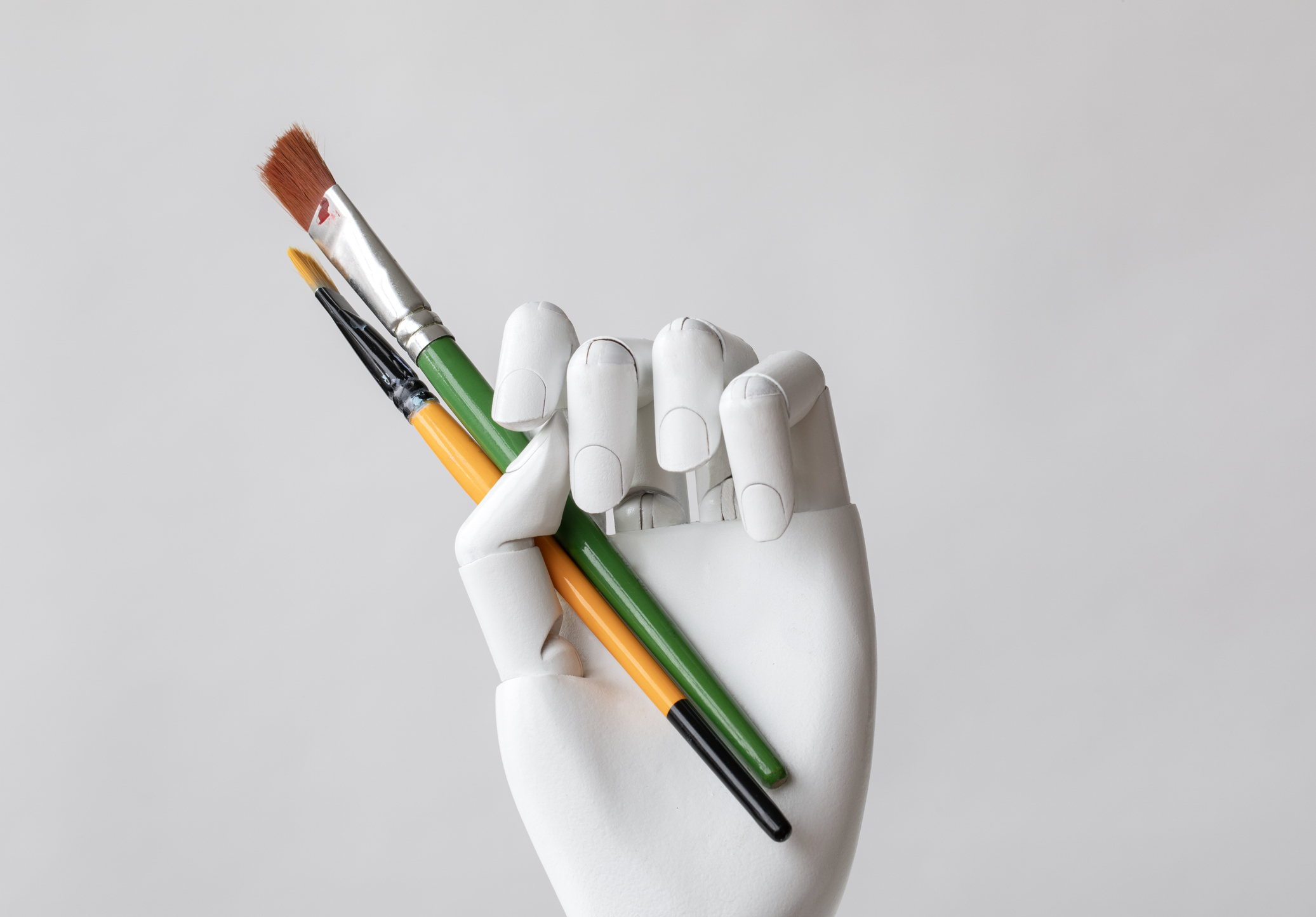
Look closely at a painting, and you might be able to see where an artist changed their mind. Beneath the finished surface, there may be an abandoned line, a figure moved several inches to the left, a color that looked splendid in the morning and became unbearable by night. There may be a smudgy fingerprint at the edge of the canvas. The back may hold a date, a repair, uneven staples, a signature, or the name of a previous owner. These messy marks were once incidental to the artwork. Today they are considered evidence.

AI can produce an image in nano-seconds, then create hundreds of variations before a painter has mixed a color or cleaned a brush. Some of the results are technically bewildering and others inspire disbelief: How is this possible? Yet their abundance is changing our relationship to novelty. When nearly any visual idea can be summoned on demand, newness becomes easier to manufacture but harder to believe in. In an age of effortless images, the mess left behind by making something may become part of what makes it valuable.

So much recent visual culture can appear at once new and strangely familiar. Generative systems learn from immense archives of existing images, then assemble patterns according to statistical relationships. Their output can startle us, though the surprise often arrives cloaked in a recognizable visual fluency: the cinematic light, the dreamlike architecture, the glossy portrait or the eerily composed impossibility. After enough exposure, even the surreal can begin to feel conventional.

A study presented at the 2024 CHI Conference proffers one perspective about how this happens. Participants who used an AI image generator during a visual ideation exercise became more fixed on an initial example and produced fewer ideas, with less variety and originality, than those in the control group. The study involved only 60 people, so its findings should be treated cautiously, though they articulate something many artists and designers have begun to notice: a tool built to accelerate imagination can also narrow it by presenting a polished answer before a more difficult, original idea has had time to form.

Against this flood of frictionless imagery, fine art acquires another kind of presence. A physical artwork occupies time and holds emotion. An artist stood before it, considered it, changed it, ruined it, waited for it, and eventually decided to either finish or abandon it. All artwork contains a sequence of often messy choices that could have gone in any number of directions. The object becomes a record of attention, and attention is becoming one of the scarcest materials we have.

Researchers have already observed a version of this shift. Across six experiments involving 2,965 people, participants consistently valued art labeled “AI-made” less than work labeled “human-made,” even when the images themselves were identical. Awareness of the machine changed the perceived value of the human hand.

This preference extends beyond art. A 2015 study in the Journal of Marketing found that people considered handmade objects more attractive in part because they believed those objects symbolically contained the maker’s love. The participants were projecting on and responding to an imagined human presence embedded in the object, expressed through the perceived time and care required to make it.

Nostalgia is part of the current attraction to the handmade. We remember darkrooms, paste-up boards, paint-stained clothes, and the physical tools that digital technology has made unnecessary or irrelevant, and often forget the expense and tedium the processes demanded. Still, the renewed power of visible erasure or the pleasure of encountering an unrestrained line reaches beyond nostalgia. These marks allow us to envision the intent and the decisions behind them.

AI can attempt to imitate these marks. It can add a false thumbprint, invent pentimenti, reproduce a stray brush bristle, and generate an image that appears to have survived a century in an attic. But mess itself will soon prove very little. Provenance and an intelligible creative process will become more important as appearance ceases to represent authenticity.

In educated hands, AI can still become a profound artistic medium. Photography and digital tools have disrupted ideas about skill and authorship before becoming vehicles for extraordinary art. AI will be shaped by artists whose choices are specific enough to resist its defaults, and those artists may create work we cannot yet imagine. The presence of a tool has never settled the question of artistic value; the depth and consequence of the decisions made with it still matter.

We are entering a period in which polished images and endless variations are available on command. The works we retain or collect may be those that let us encounter another person’s limits: the place where control faltered or the artist had to surrender to something unresolved. 

I think our nostalgia for mess is growing from a hunger for evidence that making something still requires time, effort, commitment, and—dare I say it—love.
  •  

Why Silicon Valley’s Vision of the AI Future Should Worry You

—Andriy Onufriyenko—Getty Images

Everyone has a vision of the ultimate future, some picture of what the world looks like at its best (or worst), and whether that future is even reachable. In religious studies, we call this an “eschatology.” 

Eschatology isn’t just the Book of Revelation or the Rapture. The Greek meaning of eschaton is “last things,” and today the word captures the set of beliefs a person holds about where things are headed and what that implies for the present. 

You don’t have to be religious to have an eschatology. Political optimism is an eschatology, whatever side you’re on. Zohran Mamdani, a democratic socialist, thinks the future is something we build our way toward with free childcare and buses. Stephen Miller, one of the architects of the current immigration crackdown, thinks it’s something we had and lost, but can get back through sealing the border and mass deportations. Neither one just describes the future. Both are telling you what you’re obligated to do about it right now. In other words, your eschatology shapes your ethics, because what you believe is coming determines what you feel obligated to do today.

Silicon Valley has an eschatology too, and some of its leading figures have been pretty candid about what it is: AI surpasses humanity, humans become obsolete as a species, and what matters is making sure your version of AI is the one that wins. Understanding that vision as an eschatology, not just a business strategy, explains why some of the most powerful people alive seem so unbothered by what we seem to be losing—our attention spans, our critical thinking, our basic competence at things we used to just know how to do—and so uninterested in being accountable to anyone about it. 

Shades of Silicon Valley eschatology

To be sure, Silicon Valley CEOs each express their own flavor of this view of AI’s power.

Let’s start with OpenAI’s Sam Altman, because he was explicit about where he believes AI is going years before most people had even heard of a chatbot. In 2015, at a startup conference, he told the audience: “I think that AI will probably, most likely, sort of lead to the end of the world. But in the meantime, there will be great companies created with serious machine learning.” This doomsday eschatology was the basis for his business plan: race to the top because extinction is coming. 

Since then, Altman’s views have shifted widely. “Working towards prosperity for everyone, empowering all people, and advancing science and technology are moral obligations for me,” he wrote in an April 2026 blog post. “AI will be the most powerful tool for expanding human capability and potential that anyone has ever seen. Demand for this tool will be essentially uncapped, and people will do incredible things with it. The world deserves huge amounts of AI, and we must figure out how to make it happen.” 

This is a very different eschatology and a very different business pitch: we must invest in AI because it will help humans do powerful things. 

And then there’s the world’s richest man, Elon Musk, whose life’s work makes sense once you see the eschatology underneath it. The OpenAI co-founder has said that human extinction is a very real threat that he’s personally trying to prevent. “If you think about the future of humanity, it’s going to fundamentally bifurcate in two directions,” he said back in 2013. “Either it’s going to become multiplanetary, or it’s going to be confined to one planet, until some eventual extinction event.” 

You could argue that SpaceX exists as insurance against that second path, a hedge against asteroids, supervolcanoes, pandemics, or an AI that decides to take us out. In this case, his eschatology is that salvation is possible if we can colonize space, but only for those who can get there. This may also be why he has said empathy is “the fundamental weakness of Western civilization.” As bleak as I may personally find this perspective, it is in line with his eschatology. After all, it is illogical to care for others when most of humanity won’t survive.

Since Musk made his now-famous 2013 remarks, he has continued his claims about an AI apocalypse. And during his recent high-profile lawsuit against Altman, OpenAI, and its president, Greg Brockman, for altering OpenAI’s original non-profit structure, Musk referred to his ominous eschatology once more. 

“The worst-case situation is where it is a terminator situation,” said Musk in April, “where AI will kill us all.” 

“We are not going to talk much about extinction in this case,” interrupted Judge Yvonne Gonzalez Rogers. “They got it, that’s enough.” 

By May, an Oakland jury unanimously dismissed Musk’s case. But based on his worldview, you could understand why Musk maintains that OpenAI should remain not-for-profit. OpenAI’s lawyers had another theory: maybe Musk is jealous of OpenAI’s financial success? 

Entrepreneur Peter Thiel has arguably taken eschatology the furthest. He’s taken to giving lectures arguing that the Antichrist of the 21st century is a “Luddite who wants to stop all science.” And he gives examples: AI researcher Eliezer Yudkowsky and climate activist Greta Thunberg. In his framework, caution and regulation are the apocalyptic threat. This is perhaps why, when Pope Leo XIV used his first encyclical this year to call for international AI oversight, Thiel said the Pope was effectively a “Chinese communist agent,” restraining America so that China can beat us in the technology arms race. That seems like a strange thing to say about a pope, until you realize in Thiel’s version of the future anyone suggesting limits is getting in the way.

What our eschatologies excuse 

Three tech leaders, three different pictures of humanity’s ultimate destiny—resignation, survivalism, apocalypticism. But I would assert that they share the same consequences. For one, in each version, the future isn’t something we build together. It’s something they get to build on our behalf. 

And notice who is left out of each version. Altman’s future has room for “great companies” and “expanding human capability,” but arguably less concern for the people whose jobs AI might make irrelevant in the process. Musk’s future may have some room for wealthy people who can book a seat on a colony ship but less for the rest of us. Thiel’s future has room for innovation, but little for those who want to question what we are innovating for and towards. In every case, the very people who have a stake in the future are not part of building that vision of that future.

This also helps explain why some tech bros seem so disinterested in philanthropy or profit-sharing. If you genuinely believe the human era is ending and something else is taking its place, it stands to reason you have no need to feel obligated to the people around you. Why invest in public health, or housing, or building a robust civil society, if the relevant future doesn’t include most of the people who’d benefit? Why fund a school, or fix a subway, or pay taxes toward anything you won’t personally need in twenty years? This eschatology doesn’t just fail to produce ethics. It actively excuses their absence. Empathy stops looking like a virtue and starts looking like a waste of resources on people who, in this version of the future, don’t really count.

And this is where the theology does its real work: it doesn’t just predict the future, it shapes what futures are possible by dictating actions today. If humanity’s time is about to expire regardless of what anyone does, then choosing not to help others doesn’t feel like a moral failure. It feels like realism. That’s the result of every eschatology like these: it allows cruelty to feel like an accurate read of the situation rather than a choice.

What makes this eschatology dangerous is that it is held by the people with the most resources to act on it. Musk, Altman, and Thiel aren’t theologians speculating about the end times. They’re building the thing their theology tells them is coming, funding the politics that protects their ability to build it, and treating anyone who asks them to slow down as a luddite or Antichrist rather than a citizen with a legitimate concern. A belief that the present doesn’t matter, held by people with the power to shape it, doesn’t stay a belief. It becomes policy, product, and precedent, with tech bros deciding the future on behalf of everyone else, without anyone else’s consent.

  •  
❌