
Reading view

What to Know About the USPS’s Rule for Mail-In Ballots
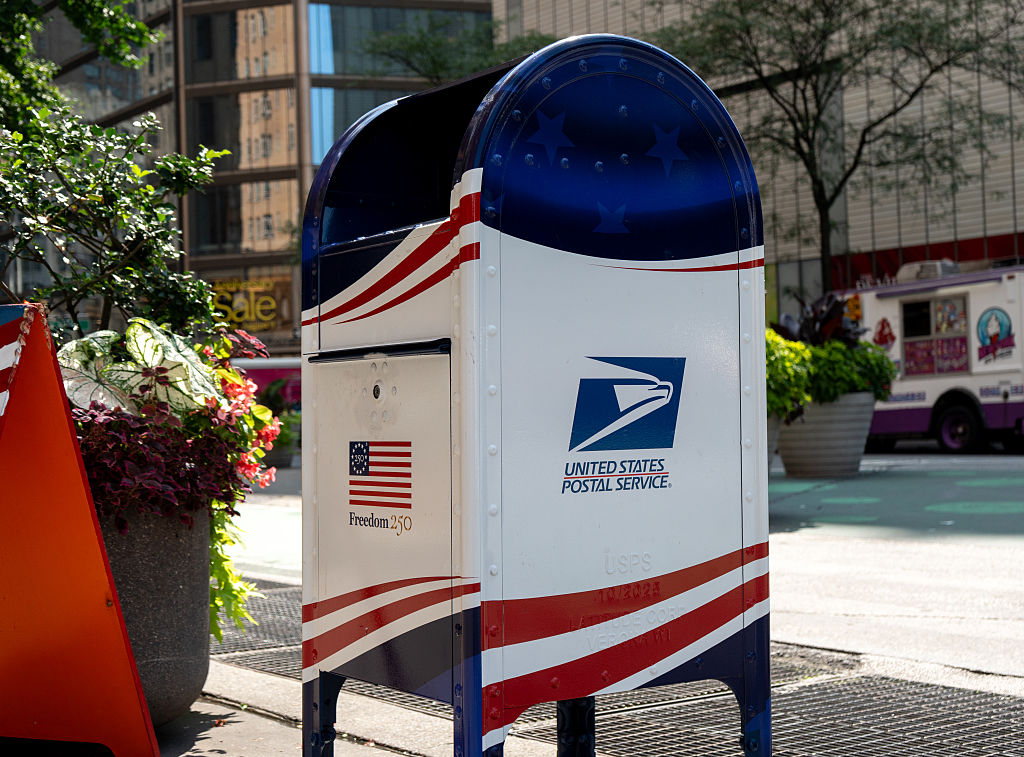
A United States Postal Service mail collection box is seen on a street in New York City, United States, on August 7, 2026. —Marcin Golba—NurPhoto

The United States Postal Service (USPS) on Friday issued a 95-page final rule that it plans to implement immediately if the government obtains relief from two existing injunctions. It would require USPS employees to verify that outbound federal ballot mailings comply with new envelope, barcode, and data-reporting requirements before accepting them from election officials.

The rule was designed to comply with President Donald Trump’s executive order from March 31. It directs the Department of Homeland Security, in coordination with the Social Security Administration, to compile and send lists of adult citizens in each state. Separately, it directs USPS to establish state-specific lists of people to whom election officials intend to send mail-in or absentee ballots, along with unique ballot-envelope identifiers.

A ​pair of court ‌orders blocks the rule from implementing the rule before midterm elections in November.

Read More: Trump’s Order Restricting Mail-In Voting Rebuked by States

About the two injunctions blocking Trump’s mail-in voting order 

Two injunctions bar USPS from implementing its new rule. They were issued by Massachusetts U.S. District Court Judge Indira Talwani on June 25 and Aug. 11.  

What the June Injunction Covers

A coalition of 23 states, along with the District of Columbia, filed a lawsuit on April 3 seeking to block Trump’s executive order, arguing that the President does not have the authority to dictate state voting practices. 

In June, the presiding judge granted summary judgment to the plaintiffs, finding two sections of the order unlawful and constitutionally invalid. It barred federal agencies from implementing those sections against plaintiff states and D.C. for elections held on or before Nov. 3. It also blocked USPS from refusing to transmit ballots based on whether voters appeared on the new state-specific lists.

What the August Injunction Covers

Voting-rights groups brought a separate lawsuit against the Trump Administration on April 2, claiming the executive order was unconstitutional, “dangerous,” and could disenfranchise eligible voters. It resulted in the August injunction, which bars USPS from implementing, enforcing, or giving effect to the executive order’s mail-voting provisions for any elections ahead of or on Nov. 3. It also prohibits USPS from completing the specified rulemaking for those elections.

Talwani wrote that the executive order was “causing confusion and threatening both increasing chaos and an erosion of trust in our democracy.” She also concluded that “the executive branch has no authority to regulate elections.”

Critics of the executive order have echoed that concern, saying that the Trump Administration is looking to force federal oversight on elections even though the duty is  enshrined to states and Congress in the Constitution. 

“Yesterday’s new mail-in voting rule is an attempt to weaponize USPS as part of the Trump administration’s efforts to take over elections,” Michael McNulty, the senior policy director for government-reform nonprofit Issue One, said in a statement Saturday

McNulty argues that the rule would shift postal workers “from neutral transporters of a state-led process to a federal gatekeeper of states’ outbound mail ballots.”

However, the USPS has asserted in the final rule that the requirements “do not amount to election administration, nor do they usurp state resources.”

“Rather, they regulate the use of the mail to improve operational efficiency and support the faithful execution of federal law,” it says within the rule.

Voting-rights groups challenge the USPS mail-in ballot rule

A coalition of voting-rights organizations has filed an emergency motion asking the federal district court to enforce its Aug. 11 injunction against USPS. The plaintiffs argue that issuing an immediately effective final rule, intended for possible use in November, violated the injunction.

USPS acknowledged that it would not implement the final rule for the 2026 election unless the government obtains relief from both injunctions. However, the coalition argued that USPS issued the rule in violation of the Aug. 11 injunction, without seeking a stay or filing an appeal.

It also said that USPS could have given the rule an effective date that falls after the 2026 midterms without violating the injunction, while the “immediate” effective date could sow “chaos” and “confusion” ahead of November. 

“Enforcement of the court’s preliminary injunction is necessary to hold this administration accountable for its unlawful action and make clear that voters can confidently cast their mail ballot free from federal interference this November,” said a statement on behalf of the plaintiffs, which includes the League of Women Voters, Association of Americans Resident Overseas, and the U.S. Vote Foundation. 

Postmaster General David Steiner defended the rule when it was proposed in June, saying at a Senate hearing that he “would think that states would want the information to ensure that the ballots that they think they’re sending out are the ballots that are actually getting sent out.”

TIME has reached out to USPS for comment.

In late July, the Trump Administration asked the Supreme Court to stay the June 25 injunction while its appeal proceeds. After Talwani issued the Aug. 11 injunction, the Administration urged the justices to address that second order as well through the pending proceeding—an approach the plaintiff states opposed. 

But unless the Aug. 11 injunction is separately stayed or lifted, or the Supreme Court expressly addresses it, it continues to bar USPS from implementing its new rule for the midterm elections.

  •  

The Supreme Court Let Trump’s Ballroom Proceed—for Now. Here’s What That Means

Artist renderings relating to White House Ballroom construction, contained in a filing by the Trump Administration to the U.S. Supreme Court, are shown on Aug. 14, 2026. —Jon Elswick—AP

The U.S. Supreme Court has allowed President Donald Trump to continue construction on a new White House ballroom with a temporary stay issued Friday—just before the aboveground portion of the project was about to be halted.

Chief Justice John Roberts, in a one-sentence order, stayed a federal district court judge’s injunction that barred further development. The move gives the full Supreme Court more time to consider the Trump Administration’s request to keep the injunction on hold while it seeks further review. However, there is no established timeline for when Roberts or the Court might take further action. 

The ruling comes after months of debate over a legal challenge brought by the National Trust for Historic Preservation, which argues that a President cannot unilaterally make a major, permanent change to federally owned property when Congress has not authorized it, pointing toward the Property Clause of the Constitution.

“We reiterated that the Administration has no unilateral legal authority—constitutional, statutory, or otherwise—to build a Ballroom on the site of the now-demolished East Wing, unless and until Congress expressly approves,” the National Trust for Historic Preservation said in a statement last week. “Each court that has reviewed this case has agreed with the National Trust. We hope the Supreme Court will uphold the rule of law by stopping this illegal project.”

Read More: What to Know About Trump’s Aide Natalie Harp

Trump reacted to the administrative stay on Truth Social on Friday, praising both the Supreme Court and Roberts, who was appointed by former President George W. Bush in 2005. 

“We are grateful for the Decision of the United States Supreme Court,” Trump said. “The Military/Ballroom Complex being built on the hallowed grounds of the White House, which is so vital for National Security, will be THE GREATEST OF ITS KIND!”

Here’s what to know about the latest updates on the $400 million project.

How did the ballroom case reach the Supreme Court?

Two lower-court decisions brought the dispute before the Supreme Court.

First, Senior Judge Richard Leon of the U.S. District Court for the District of Columbia found that the National Trust was likely to succeed on its claim that the project required congressional approval, and he ruled in March that construction on the aboveground ballroom could not take place while litigation continued. He modified that preliminary injunction on April 16 to clarify that security-related work could continue if it is "strictly necessary to ensure the safety and security of the White House.”

The second decision came when the Trump Administration appealed, and a D.C. Circuit panel upheld the modified injunction. In its August ruling, it said that each President is a “temporary tenant, not the owner,” of the White House.

According to Kimberly Wehle, professor of law at the University of Baltimore School of Law, the injunction is meant to ensure that the project does not advance while the courts review its legality, the limits of presidential authority, and whether it might cause irreparable harm. 

“The court is saying, ‘We just need to stop the bleeding right now, because if this continues, it'll just cause more harm,’” she tells TIME. 

The Trump Administration then asked the Supreme Court to intervene through an emergency application, which is meant for urgent review of time-sensitive matters that fall outside of the typically months- or years-long case review timeline for the country’s highest court.

The case was put in front of Roberts, who oversees emergency appeals filed in the D.C. Circuit. 

That led to the administrative stay—a short-term order that freezes a lower court decision or deadline in order to buy time for a bench to review an emergency request. An administrative stay does not reflect a case’s merits or legality; it acts as an interim measure for a future ruling from Roberts or the Court.

In this case, it paused the preliminary injunction originally handed down by Leon. Therefore, the stop-work order was put aside for the time being, allowing construction to continue. 

"We are aware of the administrative stay," the National Trust tells TIME, in response to the latest developments. "To be clear, this is not a final decision on the merits of the government’s stay application, and we await further action.”

No court has issued a final ruling on the project’s legality. But next steps will likely include determining whether the renovation is two distinct projects—aboveground and below—or a singular build. 

Is Trump building a ballroom or a military complex?

Trump’s 90,000-square-foot construction project comprises a luxury ballroom—which is meant to host 650 seated guests—with an underground military complex beneath it, featuring “protective missile resistant steel columns, beams, drone proof roofing materials, and bullet, ballistic, and blast proof glass,” according to one court document

Lower courts treated the two components separately, finding that the National Trust was likely to establish that the aboveground ballroom required congressional approval while exempting underground security construction from the injunction.

In making his injunction determination, Leon said: “Defendants themselves distinguished between below-ground and above-ground construction, stating that ‘the below-surface work is driven by national security concerns independent of the above-grade construction.’” 

Leon and the D.C. Circuit said the Administration had shifted from treating the components as independent to describing them as inseparable. The Administration disputes that characterization, saying the design became less flexible as construction progressed. It now argues that the entire project is integrated and that halting the aboveground work would compromise its structural integrity and security functions.

“Every day the President does not have access to the vital security features of the military complex presents unacceptable risk, no matter how long the Project takes to complete,” Solicitor General John Sauer argued in court filings last week. “Built with integrated engineering, the Project will provide in a very large way, a ‘safe room’ for the Presidency and the continuity of government.”

Presidents in the past have relied on the White House’s Presidential Emergency Operations Center (PEOC), which dates to World War II, as a safe room or bunker. The Administration has argued that the former East Wing’s security infrastructure had become vulnerable to modern threats, including drones and missiles, making the new construction urgent. 

In court documents, it claimed the former building “cannot protect guests against inclement weather, let alone high-powered weapons.” 

The White House in August shared AI-generated images of drones, military personnel, and vehicles on the roof of the ballroom. Trump has claimed that a “drone port” will feature a launching deck and defense station. 

He told reporters in March on Air Force One that the ballroom would become a “shed for what’s being built under” and that it would have its own security features, such as bulletproof glass.

Whether or not the two components are accepted as a single entity, from a legal standpoint, could determine the outcome of the outstanding emergency relief. 

Could construction outrun judicial review?

In Trump’s post on social media Friday, he said that construction of the ballroom “is under budget and ahead of schedule.”

The Administration claimed in its Aug. 13 application that 65% of construction was done. When the project was announced in 2025, the White House said that construction would be done “long before the end of President Trump’s term.” The Administration is now saying that the framework will be substantially complete by November, with the official completion date set for August 2028, according to appendixes to the emergency application that was submitted by the Trump Administration.

This raises the question of whether a majority of the structure could be completed before the litigation is resolved.

Lawyers for the National Trust accused the Trump Administration in a court filing earlier this month of “trying to outrun judicial review,” pointing to the Administration’s own assertion that the structure will soon be “virtually impossible to deconstruct.”

Wehle says that Roberts’s stay is “giving Trump exactly what he wants” by allowing him to get ever closer to the project’s completion while the courts assess whether he is breaking the law.

“This is the Supreme Court greenlighting unconstitutional, lawless behavior by the President,” Wehle says. She questions whether the President is being accommodated because it seemed like the project had gone too far and might be harder to undo at this point than to simply finish—especially when weighing the potential harm to the public in terms of cost, damage, and timeline.

But if that’s true, she asks, “What kind of precedent does that set?”

“That is a precedent that says the law is optional,” she explains. That could embolden a strategy of acting first and asking permission second, if at all. 

If the project were ultimately found unlawful after construction was substantially or entirely complete, the case could present unusual questions about what remedy remained available—including whether a court could order the structure altered, reverted, or removed.

  •  
❌