
Reading view

U.K. Signals Willingness to Reconsider Digital Services Tax After Trump Tariff Threat

Prime Minister Andy Burnham visits the Met Office in Exeter on Aug. 14, 2026 —Press Association—AP

The U.K. government has indicated its willingness to reconsider its digital services tax amid increasing pressure from the Trump Administration.

The concession came in response to an interview published Monday in which U.S. Trade Representative Jamieson Greer told The Times that President Donald Trump’s threats to scrap a trade deal with Britain and impose a 100% tariff were “not a bluff.”

When asked if the interview might lead Downing Street to change its stance on the tax, a government spokesperson told TIME, “We remain open to discussing U.S. concerns and working with partners internationally.”

The digital services tax imposes a 2% levy on the revenues of “search engines, social media services, and online marketplaces which derive value from U.K. users.” Several other European countries, including Portugal, Spain, and Poland, have also implemented similar taxes.

Greer said Britain was using American companies as “piggy banks” and that he was “not going to tolerate that.”

“We have very good relations with the U.K. We’ve had very constructive relationships, we’d love to keep talking to them about this issue. The President is quite serious about digital services taxes all over the world,” he said.

Read More: Why Trump Is Threatening to Impose a ‘Big Tariff’ on the U.K.

“This tax is about making sure that businesses pay their fair share of U.K. tax based on the value they derive from U.K. activities. It is an interim measure, and we are still committed to removing it once a global solution is in place,” the spokesperson said, adding that both countries “share a strong trading relationship.”

A White House official tells TIME that “the Administration continues to address digital services taxes and other tech issues with our trading partners.”

Rising trade tensions between the U.S. and the U.K.

The U.K. and the U.S. agreed to a “groundbreaking” Tech Prosperity Deal in September 2025, which was expected to bring billions of dollars in investment from U.S. tech companies into the U.K. technology sector.

However, relations between the two countries have splintered since the onset of the Iran war.

"This is not Winston Churchill we're dealing with," Trump said of former British Prime Minister Keir Starmer at the height of tensions in March, as he accused the former U.K. leader of "ruining" relations.

Trump later warned the U.K. that he would implement a “big tariff” in April if the country did not drop its digital services tax on U.S. tech companies. And in June, he threatened to impose a 100% tariff on imports from any country that taxes digital services provided by U.S. companies.

“This tariff will supersede trade deals made with the country, whether implemented, signed, or not,” Trump said June 26.

The Trump Administration has not yet made any official tariff announcements linked to these threats.

However, the U.K. government, which has recently come under new leadership, has signaled that it is open to discussions.

Burnham aims to bridge relations between the two nations

Prime Minister Andy Burnham, who took office in July, has indicated intentions to mend the relationship between the two countries.

Asked whether there was a deadline for discussions with the new Burnham government, Greer declined to set one, instead emphasizing cooperation with the U.K.

“I don’t set artificial timelines. All I know is the President is eager to enforce our trade policy, he’s eager to make sure our companies aren’t discriminated against,” he said.

Since taking office, Burnham has appeared keen to repair relations with Trump. The two have spoken by phone, and Burnham extended an invitation for Trump to visit Manchester in the future—where the 2027 G20 summit is rumored to be taking place and where Burnham served as mayor before becoming Prime Minister.

But he may be hesitant to remove an important source of revenue for the U.K.

Between 2021 and 2025, the tax generated more than £2.4 billion ($3.2 billion) in revenue for the British government.

Read More: ‘We Won’t Be Bullied’: U.K. Responds to Russian Threat Over Ukraine Drone Support

Trump has pushed the U.K. on policy in the past, including his consistent calls for Britain to allow new North Sea oil and gas licenses—something the Starmer government intended to ban.

On the eve of Burnham’s entry to Downing Street, Trump claimed: “The people of Aberdeen, in Scotland, are dancing in the streets because the new Prime Minister, Andy Burnham, has stated that he will be opening up, all the way, the invaluable North Sea Oil."

Burnham has signaled that he is open to reconsidering Britain’s access to North Sea oil and gas.

“I’ve got something of an open mind, you know. I don’t have a sort of fixed position,” he said in early June.

Trump has continued to tout the new British Prime Minister’s willingness to reconsider the issue.

“One of the things he is going to do, I think he's going to open up the North Sea. That'll make the U.K. pretty rich,” Trump said on Monday in the Oval Office.

Burnham, however, has yet to make a final decision.
  •  

Trump Delays 50% Canada Tariffs as the Two Countries Race to Finalize a Deal

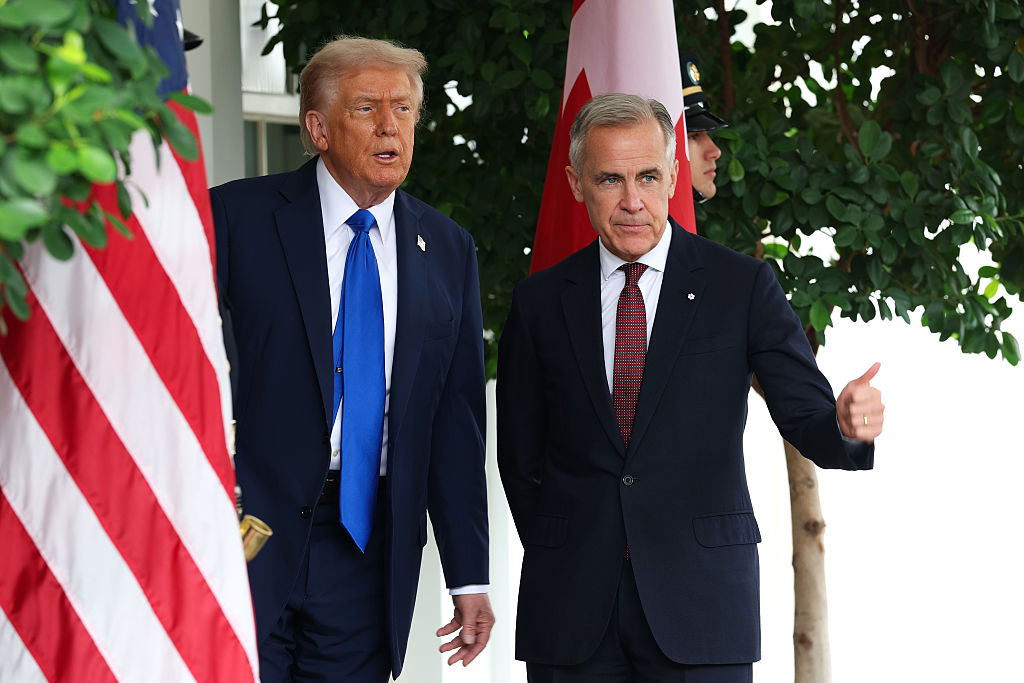
President Donald Trump welcomes Canadian Prime Minister Mark Carney outside the West Wing of the White House on Oct. 7, 2025, in Washington, D.C. —Anna Moneymaker––Getty Images

President Donald Trump announced late Tuesday a temporary pause on 50% tariffs on Canada as both countries race to finalize a trade deal.

The President’s announcement came hours before a series of tariffs set to cover about $20 billion worth of imports into the U.S. from Canada were set to take effect.

“I have paused the 50% tariffs against Canada, that were scheduled to kick in tomorrow morning for a three day period, based on the fact that Canada and the U.S.A., subject to the finalization of documents, have a deal!” Trump said on social media.

Canadian Prime Minister Mark Carney released a statement moments later, confirming that there had been “intensive discussions” with the U.S. to “address outstanding trade issues.”

“Substantial progress has been made, although there is important work still to be done,” he said.

Read More: Trump Imposes 50% Tariff Hike on Canadian Goods

The tariffs will now be paused until Aug. 21, subject to the finalization of an agreement between the two countries.

U.S. Trade Representative Jamieson Greer said the deal will include "comprehensive market access for ​all ⁠American goods, economic security commitments, digital trade alignment," along with other provisions.

Trump added in his social media post that the Keystone XL pipeline—a cross-border oil pipeline project between the U.S. and Canada that was canceled by former President Joe Biden in 2021 after pushback from environmentalists, Native American tribes, and Indigenous advocates—"may be awoken from the grave," but did not provide further details.

The President later posted what appeared to be an AI-generated image of himself dragging the Keystone pipeline out of the ground.

Neither side has provided further confirmation about the contents of the agreement.

TIME has reached out to both the White House and the Prime Minister's office for comment.

U.S. and Canada push toward a deal

Carney said earlier this week that he planned to speak with the U.S. President ahead of the tariff deadline. The announcement follows a period of negotiations between the two sides.

During a tour of a tire factory in Iowa last week, Greer told reporters that the U.S. and Canada were engaged in “constructive negotiations” but warned that if a “country retaliates” they would “take action.”

Canada's minister responsible for U.S. trade, Dominic LeBlanc, and chief trade negotiator Janice Charette have been in Washington since last week for talks.

The negotiations unfolded against a backdrop of ongoing grievances between the two countries, including Trump’s repeated statements about his desire to annex Canada and make it the 51st U.S. state—an idea Carney has strongly pushed back against.

In August, Carney took a swipe at Trump, mocking the U.S. President after a teleprompter malfunctioned in the middle of an on-camera speech.

The tense relationship between the pair has also played out over the Gordie Howe International Bridge—a cross-border bridge connecting the two countries that has repeatedly become a source of disagreement between Washington and Ottawa.

How U.S.-Canada trade tensions escalated

The last-minute tariff pause comes after more than a year of escalations between the two countries.

In February 2025, the White House hit Canada with a 25% tariff on most goods and 10% on energy resources, citing what it regarded as inadequate progress in curbing cross-border illegal immigration and drug trafficking.

Canada then imposed tariffs on some vehicle imports from the U.S. in April 2025, amid a larger trade war sparked by Trump’s global tariffs—the majority of which were struck down by a Supreme Court ruling earlier this year.

The 50% tariff hike on a range of Canadian goods was announced in July, with Trump signing a series of proclamations citing Canada’s “discriminatory treatment” of American products.

The new levy, a retaliation for Canada’s tariffs, would apply to a range of Canadian goods, including electronics, sports equipment, and essential oils.

The Administration had also announced targeted new tariffs on Canadian dairy products and exports of wine and other alcoholic beverages.

According to economists, the tariffs could have had significant economic consequences if enacted. TD Economics estimated that, if maintained, they could reduce Canadian GDP growth by 0.3 to 0.6 percentage points over the following year.

A Canadian Federation of Independent Business survey of 1,833 firms found that 77% of affected exporters expected revenue losses, while 35% expected their revenue to fall by at least half.

In a new proclamation issued Tuesday suspending the tariffs, Trump said: “Canada has expressed a commitment to remove the discriminations or unreasonable and unequal impositions.”

In a statement late Tuesday, the Distilled Spirits Council of the U.S. applauded Trump's announcement and called for "a negotiated solution that gets American spirits back on retail shelves in all Canadian provinces and returns the spirits sector to a zero-for-zero tariff framework."

The new tariffs were set to apply despite the U.S.-Mexico-Canada trade agreement (USMCA)—which had shielded Canadian industries from earlier U.S. tariffs.

The USMCA, which was signed by Trump in 2018, is a trilateral agreement that eliminated or reduced tariffs on goods traded between the nations of North America. It governs nearly $2 trillion in annual trade among the three countries.

In early July, the U.S. declined to renew the U.S.-Mexico-Canada Agreement for a 16-year term. Rather than terminate it outright, this puts the USMCA under annual review. Trade experts told TIME that the move is expected to carry profound long-term economic consequences.

  •  
❌