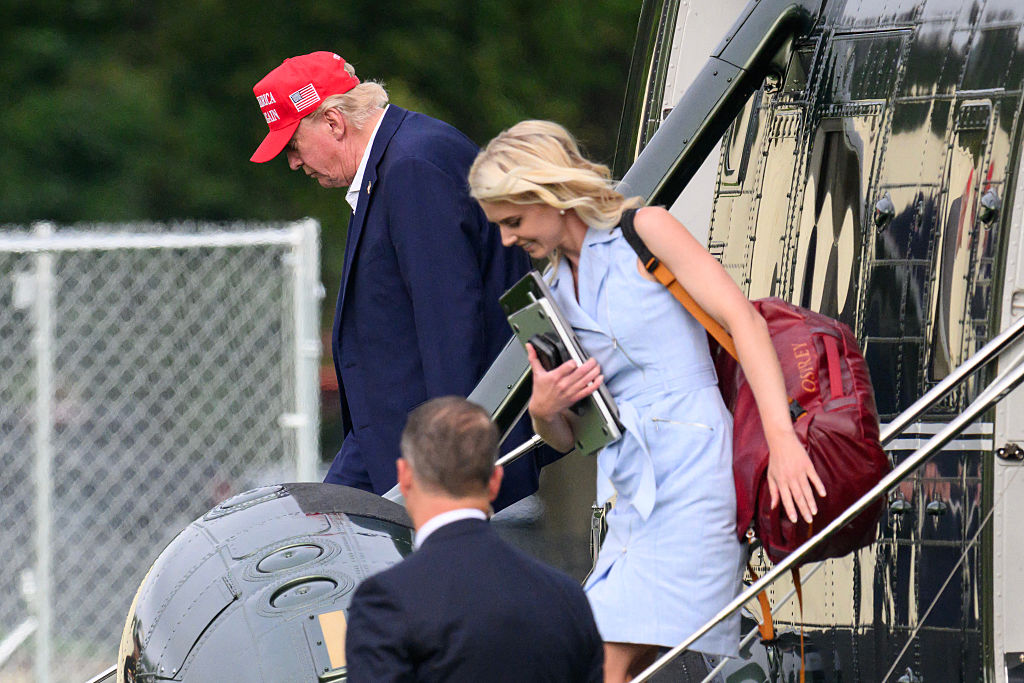
President Donald Trump and aide Natalie Harp (R) exit Marine One on the Ellipse near the White House on Aug. 16, 2026. —Mandel Ngan—AFP/Getty Images
A previously little-known White House aide has garnered growing public attention in recent days after Sen. Jon Ossoff mentioned her while levying an attack on President Donald Trump.
The Georgia Democrat said that Trump “doesn’t want to do the job” of President. Instead, Ossoff continued, “He wants to build his ballroom and travel with Natalie.”
Ossoff was referring to 35-year-old Natalie Harp, a longtime aide to Trump. When asked about Ossoff’s comments, Trump likened the Democrat to “Pee-wee Herman” and said he “would much rather do other things.”
Ossoff has stood by his remark about Trump and Harp. Appearing on MS NOW this week, the Georgia Senator said: “It’s been amazing to watch this White House melt down over this all week.”
So who is Harp, and what is her role in the White House? Here’s what to know.
Harp said that Trump saved her life
In 2019, Harp went on Fox News and thanked Trump for signing the Right to Try law the year before. She told the network that she had stage 2 bone cancer, and that the new law allowed her to access experimental treatments, which she said saved her life.
After hearing her recount her experience, Trump asked her to give a speech at the 2020 Republican National Convention, according to the New York Times.
“When I failed the chemotherapies that were on the market, no one wanted me in their clinical trials,” she said at the event. “They didn’t give me the right to try experimental treatments, Mr. President. You did, and without you, I’d have died waiting for them to be approved.”
But after the convention, the Washington Post reported that medical experts cast doubt on Harp’s claims.Harp has said that she was treated with “an FDA-approved immunotherapy drug for an unapproved use,” and experts said that the federal legislation that Trump signed in 2018 wouldn’t have made that drug accessible to Harp because the medication had already been approved.
About two years after her speech at the Republican National Convention, she became a member of Trump’s staff.
She used to work for a far-right news channel
Before Harp joined Trump’s team, she worked as an anchor for a far-right news channel called One America News Network for a couple years. While working for the network, she propagated Trump’s false claims that the 2020 election was “stolen” from him.
Her official title is ‘special assistant to the President and executive assistant to the President’
In Harp’s role, officially called the “special assistant to the President and executive assistant to the President,” she works closely with Trump. Many of the Truth Social posts that the President shares are ones that he dictated to her to type and hit “post” on.
According to the Times, which cited two people who were aware of the situation, Harp hit the “send” button on the enraged messages that Trump sent to the billionaire and major Republican donor Miriam Adelson in 2024—messages that nearly lost him Adelson’s backing.
Harp was also the one who transcribed dozens of social media posts that Trump dictated to her one day in which he attacked the writer E. Jean Carroll, who alleged that Trump raped her in the 1990s, the Times reported.
Some of Harp’s colleagues have dubbed her the “human printer” because she is known for carrying a portable printer as she trails Trump around so she can give him whatever information he wants or needs in print copies.
When appearing on MS NOW this week, Ossoff accused Harp of “printing out Donald Trump’s daily dose of delusion and flattery.”
She was one of the select number of people who was on Trump’s secret flight out of Turkey
When Trump left Turkey in July on a secret, alternate plane after receiving an Iranian assassination threat, only a few people working in the White House were on his flight, including Harp, CBS News reported. Defense Secretary Pete Hegseth was also on the plane with Trump and Harp, as were a couple other aides. Other higher-up members of his Administration, such as Secretary of State Marco Rubio and Treasury Secretary Scott Bessent, were on the other plane—the one that the Administration had said that Trump would travel on, and that members of the White House press corps were on.
When asked by the Timesabout Harp’s role in the White House and why she was selected to be among the few staffers on the secret flight, White House Press Secretary Karoline Leavitt said: “Natalie Harp is one of the most loyal and hardest-working aides on President Trump’s team.”
CNN Condemns Trump's Attacks on Journalist Kristen Holmes Following Heated Oval Office Response
The nature of her relationship with Trump has been a subject of scrutiny
According to the Times, Harp wrote Trump several letters in 2023 that concerned some people near him. In the letters, which reporters at the Times viewed, Harp wrote messages including: “You are all that matters to me” and “I don’t ever want to let you down.” She called Trump her “Guardian and Protector in this Life,” and thanked him, the outlet reported.
“I want to bring you joy,” she wrote in one of the letters, according to the Times, “to feel like we can get through a day without ever having to talk ‘work.’”
The news outletalso reported, citing two sources with knowledge of the remark, that Trump said at one point in 2023 that Harp was the only person on his team who cared about him.
Harp’s estranged brother, Preston Harp, was asked about the Times’ reporting about the 2023 letters when he appeared on CNN this week. He replied: “I’d say since she was like 16, she’s had an obsession with, gosh, how do I explain this? She’s written letters to other Presidents. Let me put it that way. And so like, her dream came true finally.” When asked which Presidents she wrote letters to, he said: “I didn’t see the letter, but George Bush obviously, during the Iraq war.”
He also described his sister’s relationship with Trump as an “infatuation” but said, “I don’t think it’s a physical attraction.”
“I think that Trump’s best friends are people who are his fan club,” he said. “And so she’s his biggest fan. And so that’s probably why he likes her. And she’s good looking. She’s got a good personality. I don’t know.”
“I mean she thinks that he saved her life, so, like, somebody living with that kind of gratitude—that must feel pretty good,” he continued.
Harp has not publicly spoken about her relationship with Trump in the wake of Ossoff’s comments, but other White House aides and Republicans have jumped to her defense.
In a statement to TIME, White House spokesperson Davis Ingle called Ossoff’s comments “cringeworthy” and criticized the Senator’s voting record, in addition to defending Harp.
“Natalie Harp is one of the most loyal and hardest working aides on President Trump’s team,” Ingle said in the statement.
Eric Trump, one of the President’s sons, slammed CNN’s interview with Preston Harp on Wednesday.
“What absolute trash,” he said in a post on X. “Natalie is an incredible young woman — a cancer survivor, a genuinely good person, and arguably one of the hardest-working people in the White House. She’s deeply committed to my father, to her job, and to this country.”
A federal judge in Los Angeles appointed an independent monitor and "special master" to oversee the Trump administration's compliance with the Flores settlement, an agreement that sets the rules for how migrant children can be detained.
Ships dock at the container terminal in the port of Khor Fakkan, in the United Arab Emirates, on July 14, 2026. —AFP via Getty Images
The United Arab Emirates (UAE) announced Tuesday that “all trade, commercial exchanges, and financial transactions with Iran have been halted until further notice,” alleging that Iran had fired two ballistic missiles toward it.
The country’s foreign ministry said the decision comes “in light of regional escalations that undermine regional and international peace and security.”
Earlier Tuesday, the UAE’s Ministry of Defense reported that two missiles launched from Iran toward the country, both of which fell into the sea. The statement said it “affirms its readiness to respond to any threats and to resolutely counter any attempts to undermine the security of the country or the safety of maritime navigation in the region.”
Esmaeil Baghaei, a spokesperson for Iran’s foreign ministry, rejected the Emirati claim on Tuesday, saying that it “undermines ongoing efforts to strengthen trust between countries in the region and prevent the escalation of insecurity,” according to the semi-official Fars news agency.
“The impact on the Iranian economy could be significant,” Simon Henderson, director of the Bernstein Program on Gulf and Energy Policy at the Washington Institute, tells TIME. “The UAE is one of the top non-oil trading partners with Iran.”
As of April, the UAE accounts for 12.5% of Iran’s exports and 30.43% of its imports, according to Iranian news agency WANA.
Iran’s dollar currently ranks as the least valuable currency in the world, and its government told a Russian news agency in April that the war has already cost it some $270 billion in direct and indirect damages.
Regional instability amid the war in Iran
Stability in the region is fragile, as a number of incidents have been recently reported in the Strait of Hormuz. On Tuesday, a vessel reported that it had been struck by an unknown projectile, causing damage to the engine room and a crew casualty, according to the U.K. Trade Maritime Operations Centre (UKMTO). Last Thursday, a separate vessel was struck by a drone.
The UAE has previously reported the detection of missiles coming toward it, most recently on July 12, when it confirmed that a missile fell outside of its borders.
In May, the defense ministry reported that it had intercepted six unmanned aerial vehicles within 48 hours that “attempted to target civilian and vital areas in the country.”
One drone, launched from the direction of the UAE’s western border, struck an electricity generator near the Barakah Nuclear Energy Plant on May 17. Its origin has not been confirmed and is under investigation.
During the first few weeks of the conflict, Iran launched a series of more aggressive strikes on targets in the UAE, hitting military, energy, and civilian infrastructure. Iran’s Islamic Revolutionary Guard Corps (IRGC) vowed at the time to “punish aggressors throughout the region,” pointing toward U.S. military assets stationed in the country, as well as other Gulf states.
Where do peace plans between the U.S. and Iran stand?
Peace talks between the United States and Iran have made little progress in recent weeks.
President Donald Trump said Tuesday that “there are no talks or conversations going on, or scheduled,” between the U.S. and Iran. He also reaffirmed that the naval blockade on Iranian ports and vessels remains in place, amid ongoing claims that the Strait of Hormuz is “open and operating.”
Marine traffic data suggested Wednesday that some ships were indeed passing through the Strait, but still at significantly lower levels than before the conflict began.
Earlier this week, the President also threatened to “bomb the s---” of Oman, a U.S. ally and mediator between Washington and Tehran, should it “get in the way” of U.S. attempts to gain effective international control of the Strait of Hormuz.
Oman and Iran have reportedly been working toward an agreement to manage traffic through the Strait, which carries roughly a fifth of the world’s oil and gas supply.
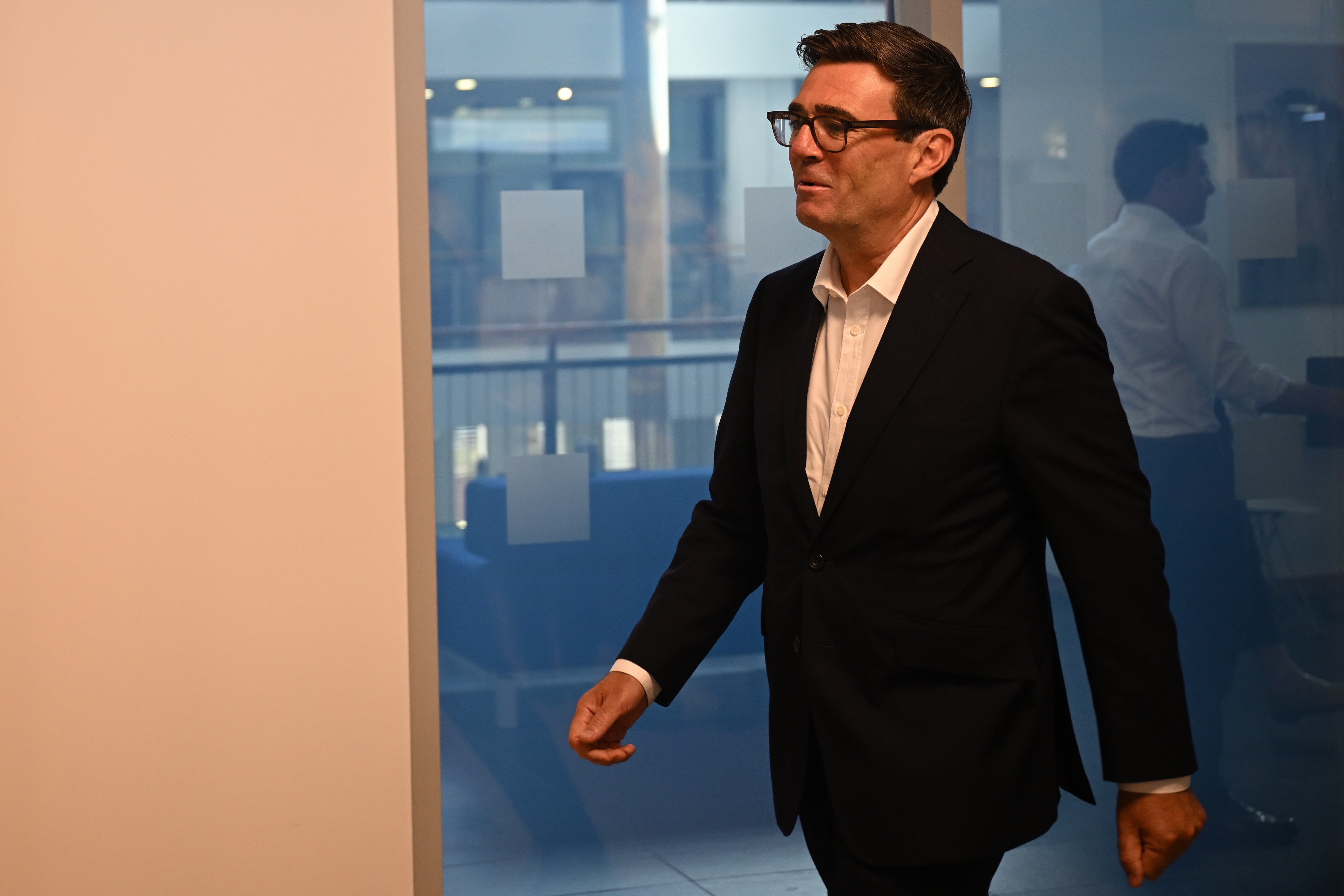
Prime Minister Andy Burnham visits the Met Office in Exeter on Aug. 14, 2026 —Press Association—AP
The U.K. government has indicated its willingness to reconsider its digital services tax amid increasing pressure from the Trump Administration.
The concession came in response to an interview published Monday in which U.S. Trade Representative Jamieson Greer told The Times that President Donald Trump’s threats to scrap a trade deal with Britain and impose a 100% tariff were “not a bluff.”
When asked if the interview might lead Downing Street to change its stance on the tax, a government spokesperson told TIME, “We remain open to discussing U.S. concerns and working with partners internationally.”
The digital services tax imposes a 2% levy on the revenues of “search engines, social media services, and online marketplaces which derive value from U.K. users.” Several other European countries, including Portugal, Spain, and Poland, have also implemented similar taxes.
Greer said Britain was using American companies as “piggy banks” and that he was “not going to tolerate that.”
“We have very good relations with the U.K. We’ve had very constructive relationships, we’d love to keep talking to them about this issue. The President is quite serious about digital services taxes all over the world,” he said.
“This tax is about making sure that businesses pay their fair share of U.K. tax based on the value they derive from U.K. activities. It is an interim measure, and we are still committed to removing it once a global solution is in place,” the spokesperson said, adding that both countries “share a strong trading relationship.”
A White House official tells TIME that “the Administration continues to address digital services taxes and other tech issues with our trading partners.”
Rising trade tensions between the U.S. and the U.K.
The U.K. and the U.S. agreed to a “groundbreaking” Tech Prosperity Deal in September 2025, which was expected to bring billions of dollars in investment from U.S. tech companies into the U.K. technology sector.
However, relations between the two countries have splintered since the onset of the Iran war.
"This is not Winston Churchill we're dealing with," Trump said of former British Prime Minister Keir Starmer at the height of tensions in March, as he accused the former U.K. leader of "ruining" relations.
Trump later warned the U.K. that he would implement a “big tariff” in April if the country did not drop its digital services tax on U.S. tech companies. And in June, he threatened to impose a 100% tariff on imports from any country that taxes digital services provided by U.S. companies.
“This tariff will supersede trade deals made with the country, whether implemented, signed, or not,” Trump said June 26.
The Trump Administration has not yet made any official tariff announcements linked to these threats.
However, the U.K. government, which has recently come under new leadership, has signaled that it is open to discussions.
Burnham aims to bridge relations between the two nations
Asked whether there was a deadline for discussions with the new Burnham government, Greer declined to set one, instead emphasizing cooperation with the U.K.
“I don’t set artificial timelines. All I know is the President is eager to enforce our trade policy, he’s eager to make sure our companies aren’t discriminated against,” he said.
Since taking office, Burnham has appeared keen to repair relations with Trump. The two have spoken by phone, and Burnham extended an invitation for Trump to visit Manchester in the future—where the 2027 G20 summit is rumored to be taking place and where Burnham served as mayor before becoming Prime Minister.
But he may be hesitant to remove an important source of revenue for the U.K.
Between 2021 and 2025, the tax generated more than £2.4 billion ($3.2 billion) in revenue for the British government.
Trump has pushed the U.K. on policy in the past, including his consistent calls for Britain to allow new North Sea oil and gas licenses—something the Starmer government intended to ban.
On the eve of Burnham’s entry to Downing Street, Trump claimed: “The people of Aberdeen, in Scotland, are dancing in the streets because the new Prime Minister, Andy Burnham, has stated that he will be opening up, all the way, the invaluable North Sea Oil."
Burnham has signaled that he is open to reconsidering Britain’s access to North Sea oil and gas.
“I’ve got something of an open mind, you know. I don’t have a sort of fixed position,” he said in early June.
Trump has continued to tout the new British Prime Minister’s willingness to reconsider the issue.
“One of the things he is going to do, I think he's going to open up the North Sea. That'll make the U.K. pretty rich,” Trump said on Monday in the Oval Office.
Burnham, however, has yet to make a final decision.
Warning: This post contains spoilers for the Lucky finale.
Morning is just reaching the shoreline when Lucky (Anya Taylor-Joy) walks barefoot toward the water. The waves slide over her feet, then her ankles. She looks up at a scatter of birds, spreads her arms wide, and the camera moves in close as her expression turns—eyes open, taking it in, then the beginnings of a smile. The ocean was the destination her father dangled in front of her as a child, the reward waiting at the end of a con. She reaches it without him, the only way she was ever going to get there.
These are the final moments of Lucky, an Apple TV limited series that follows Luciana “Lucky” Armstrong, a con artist raised inside the life by her charming grifter father, John (Timothy Olyphant). At John’s urging, Lucky and her husband, Cary (Drew Starkey), lift $10 million from Wayne Whittaker (William Fichtner), the crime boss they all answer to. The money was John’s own skim from the energy-fraud scheme that sent him and Priscilla (Annette Bening), Wayne’s second-in-command and Cary’s mother, to prison years earlier. Then Cary vanishes with the score, leaving Lucky to run from FBI agent Billie Rand (Aunjanue Ellis-Taylor) on one side and a newly sprung Priscilla on the other. By the finale, Cary is dead, the money has resurfaced as cryptocurrency locked behind a seed phrase only Lucky knows, and Lucky is walking into a meeting with Wayne wearing an FBI wire.
Behind all of it, the writers saw one repeating pattern. “The mechanics or the mechanisms of a con are a cycle of trust and betrayal,” says Cassie Pappas, the series’ co-showrunner, who wrote the finale episode. “She’s locked in this cycle of trust and betrayal with all the people in her life: with Cary, with Priscilla, with her father. And so we’re rooting for her to finally break free of that cycle.” The finale lets Lucky stop running, granting her the freedom to wipe the slate clean. “We wanted to make sure it wasn’t a happy ending or a bad ending,” creator and co-showrunner Jonathan Tropper says. “It was really important that she make a sacrifice to basically get to the point where she can start her life again.”
A performance for an audience of one
Before the meeting with Wayne, the episode lingers on Priscilla at her mirror. Dutch (Clifton Collins Jr.), her devoted enforcer, fastens the watch that belonged to Cary on her wrist. “Thought you’d want it,” he says. In the car, Priscilla gives Wayne exactly what he wants: gratitude for springing her from prison and an apology for how long it took to find the money. When he excuses his refusal to claim Cary as his son by saying it was Priscilla’s choice to have him, she absorbs it and keeps up the act, drawing internal strength from Cary’s watch on her wrist. The watch mattered beyond what the camera captured. “The whole car ride with Wayne up to the gas terminal, Annette was touching it, feeling it,” Pappas says. “She let that watch be a part of her performance. Like she could feel him on her wrist.”
Lucky arrives at the gas terminal with her own act to sustain: get Wayne on tape admitting he knew about the gas scam and profited from it, and stay alive long enough for it to matter. But the con she runs is aimed somewhere else entirely. “Who she’s really playing to in that moment is not Wayne, but Priscilla. It’s a performance for Priscilla,” Taylor-Joy says. “She’s performing for somebody else’s eyes.”
That’s why the scene’s most cutting line isn’t really for the man it’s addressed to. When Wayne muses that Lucky could have worked for him, she declines. “I know how you treat the women who work for you,” Lucky says. She tells him about the child Cary wanted: a girl, because he couldn’t imagine raising a son with a father-shaped hole where his own had been. Every word lands on the woman off to the side.
“It’s coded conversation directly to Priscilla, playing to her,” Pappas says. “She doesn’t know if she’s going to [turn on Wayne], but hoping that she will.” Lucky isn’t guessing blindly. In episode 6, Priscilla let slip that she once tried to leave this life and couldn’t. “In another life, if she had gone left instead of right, or if she had made a few different choices, Lucky could have easily become Priscilla,” Pappas continues. “I think that’s why Priscilla’s intrigued by her.”
Midway through the standoff, with Wayne demanding the seed phrase, Lucky drops a revelation she’s just pieced together: he already knew the money had been converted to crypto, she announces, knew how to find Cary in La Jolla, and knows the FBI is listening, because Kershaw (Eric Lange), the FBI supervisor stationed above with Rand, has been feeding him information. Up on the gas tank, Rand pulls her gun on the mole.
The gambit nearly dies anyway. Wayne, meanwhile, produces John, snatched from the hotel in episode 6 and beaten bloody, then hands Priscilla his gun: she can prove she’s “really ready” to be back by executing him herself. Instead, Priscilla presses the barrel to Lucky’s head. A tear runs down Lucky’s cheek. “Priscilla,” Lucky pleads.
“Hon, I’m sorry,” Priscilla says, then turns and shoots Wayne in the stomach. Whether she decided at the mirror, in the car, or in the half-second before the trigger, the episode declines to say.
The same moment splits the frame. Above, Rand, shoved over the tank’s edge by Kershaw and hauling herself back up, shoots him dead; below, Dutch, who trailed Priscilla to the site, emerges firing and cuts down Wayne’s remaining men. Wayne himself crawls. “If you had tried even once to be any kind of a father to my boy, you wouldn’t be in the position you’re in right now,” Priscilla tells him, and fires the last shot.
Wayne’s final rejection of Cary earlier in the finale sealed his fate for Priscilla. Tropper frames her life-saving gesture to Lucky as the episode’s strangest gift: alive, Cary could never make peace between his mother and his wife. “In death, he’s able to reconcile them in a way that he couldn’t in life,” he says. “His absence is the presence.”
When the shooting stops, Priscilla wonders aloud what she’s supposed to do with the two of them. Lucky makes an offer. “I’m asking you to do for me what they didn’t do for you,” she says. “Give me a chance. Or you can kill us, but I’m done running from you, from anyone.”
For Taylor-Joy, the plea is her character’s emotional exhaustion finding words. “Most people walk around waiting for the other shoe to drop without there being a shoe there. Lucky knows there’s a shoe,” she says. “Having the promise of a reality where there is no shoe that’s going to drop is where she would rather be.”
So Priscilla lets Lucky and John go, sending them off with a warning never to return and a parting verdict on John—“Lucky bastard”—as the Brian Jonestown Massacre’s “Anemone” plays, their SUV pulling away.
One hell of a bluff
Lucky’s mole reveal plays like a plan. It wasn’t one. Instead, it was Lucky’s oldest instinct: that in a game built on borrowed trust, even the feds might be playing dirty. At the motel afterward, Lucky admits she’d pieced Kershaw’s defection together from La Jolla (Priscilla couldn't have found Cary unless Wayne had someone inside) but kept the theory to herself because she wasn’t sure. John is incredulous: she detonated a federal sting on a hunch? “Well, I was either right, or it was one hell of a bluff,” she shrugs.
The day’s losses trail Rand into the finale’s quietest confrontation. That night, she finds Priscilla at home in her backyard, sunglasses on in the dark, at the edge of her pool. Rand isn’t there to arrest her; she’s there to promise that one day she will. Priscilla tells her to take the win: Wayne is dead, the FBI mole exposed. Rand refuses. “You killed my partner,” she says, referring to Gates (Mo McRae), the agent gunned down when Wayne’s men stormed the hotel for John. “You didn’t pull the trigger, but you killed him.”
Tropper reads the standoff between Rand and Priscilla as a diagnosis. “They’re both kind of trapped in their cycles,” he says. “These two are still going to be locked in this eternal struggle that Lucky has managed to extricate herself from. But neither of these women will be able to pull that off.” The images say it more simply: Priscilla ends her season the way Lucky ends hers, standing at the water’s edge.
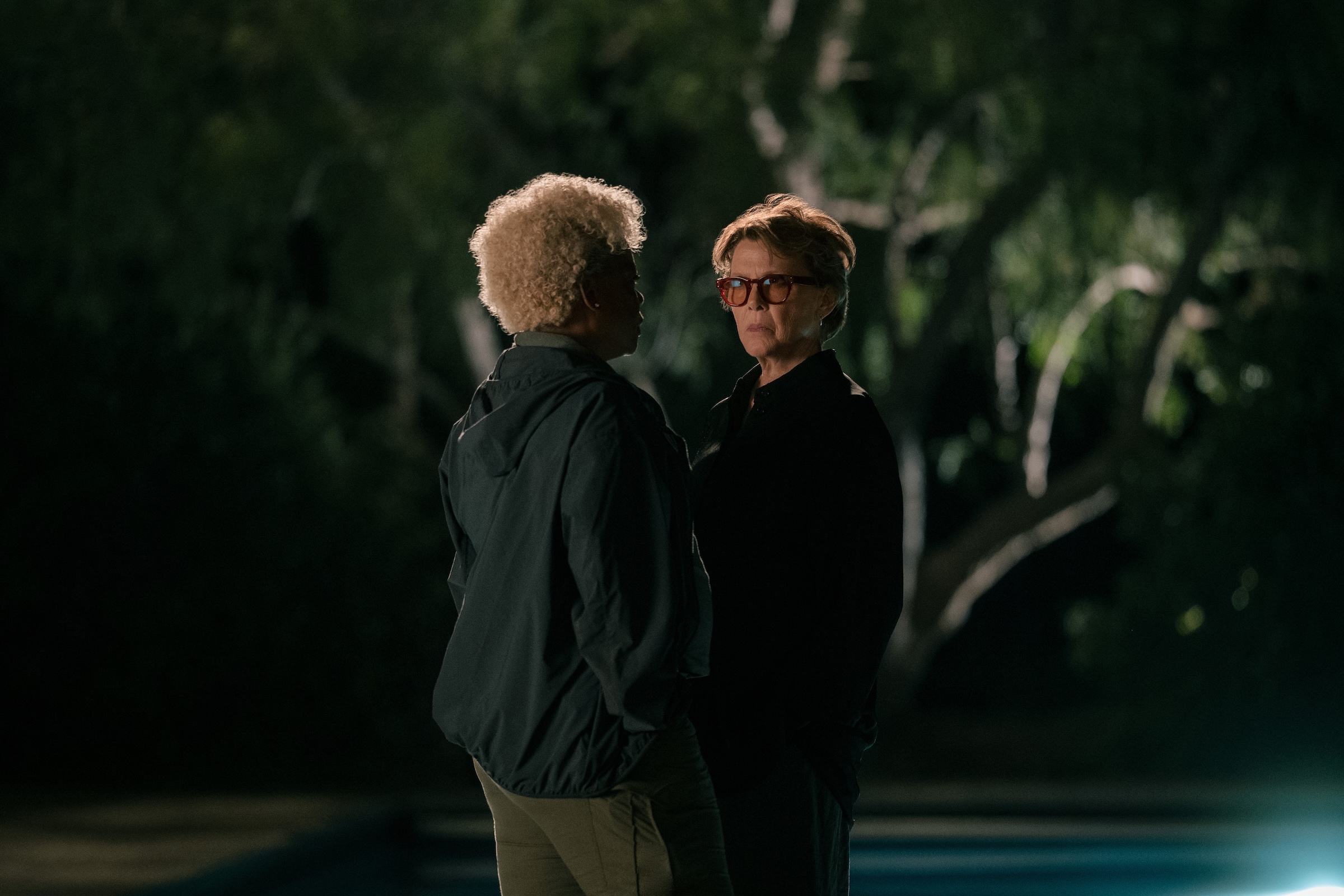
Aunjanue Ellis-Taylor and Annette Bening —Courtesy of Apple TV
The con after the con
A conventional thriller would have rolled credits after the gunfire. But Lucky spends many of its final minutes at a motel instead. “We always looked at this as a character show that has a thriller element to it,” Tropper says. Pappas describes it the way the writers’ room did: the finale holds two cons: an “action set piece” with a con built into it, and an “emotional set piece.”
That second con trades on episode 6’s hotel-room reckoning, when Lucky told John the life she had as a child was never one she wanted, when she admitted she was the reason he went to prison years earlier, and when John apologized, at last, for the childhood he’d mistaken for a good one. The apology was slow in coming; John’s first reflex was to call her an idiot for ever trusting Rand. “You just see her become seven years old,” Taylor-Joy says of the moment. “It’s the face and the feelings of a child that’s been trapped in there the whole time.” Seven, not incidentally, was the age of Lucky’s first haul.
A deeper understanding of her father unfolds over a burger with him. John eats, as Lucky nibbles a pickle. They share their recurring dreams. His: a ball of sheets on his prison bed that turns out to be infant Lucky, whom he straps to his chest and carries past a charmed guard into the sunlight. Hers: “I’m underwater, and I can’t breathe, and then I wake up.”
Pappas, who wrote John’s monologue, built his dream from a question the writers kept circling: why is her nickname Lucky? “You can imagine growing up, he could probably use her as a baby as part of his cons,” she says. “She’s been his lucky charm for as long as she’s been alive.” Lucky’s dream sits at the opposite pole, “almost a nightmare connected to her childhood trauma of the drowning con,” and the fact that John never thought “that was traumatic for her.” When Lucky tries to say what the dream means to her, John cuts in with his own reading and pivots to the money.
Taylor-Joy explains that the father-daughter exchange reveals John for who he really is: a “narcissist.” The cruelty of the motel stretch is that its warmth is real. Tommy Tangles, the imaginary friend John invented to get a squirming girl through hair-brushing, gets a fond retelling. But none of it changes the long-held family dynamic. “She hopes that he will do the right thing, whilst making contingencies for what his actions in the past have told her about who he is,” Taylor-Joy says. By Pappas’ account, Lucky spends the scene deciding, and by the end of the scene, she knows “she’s going to set the trap.”
Ninety percent truth
Lucky wakes the next morning to an empty bed, an empty parking space, and no surprise. John is on the road with the teddy bear that held Cary’s recorded seed phrase riding shotgun. When he presses its stomach, Cary’s voice recording is gone; Lucky’s has replaced it.
“I had a feeling you’d do this,” the recording begins. “A feeling I’ve been ignoring most of my life.” As she speaks, the season’s most persistent image finally resolves. The childhood flashback threaded through the episode, young Lucky at the lip of a hotel pool, completes itself: she goes into the deep end, flails, is hauled out by a stranger while John rushes over performing paternal alarm, then threatens a lawsuit and gets their rooms comped. “You knew I couldn’t swim,” adult Lucky says. “But the best cons are 90% truth, right, Dad? And the truth was I was drowning.”
Taylor-Joy locates the wound in child psychology. “When you’re a kid, your parents are God,” she says. “You rely on them so much for survival that you never stop to think that there’s something wrong with them. You internalize everything as something being wrong with yourself. The one person who was supposed to take care of [Lucky] and value her above anything else was happy to let her almost drown in order to get a free room. And if you really think about that, it’s just so painful.”
Tropper is just as unsparing about what the memory indicts. “Lucky never had a choice,” he says. “[John] is sort of a classic narcissist where he loves her, but only in the way he can, which is as a reflection of himself.” The scene suggests this wasn’t a one-time con, and Tropper confirms it: “You get the sense that it had been done more than once.”
That’s what makes Lucky’s counter-con the season’s real climax. Both showrunners knew from the earliest drafts where the story had to arrive. “The end had to be that the student becomes the master,” Tropper says. Lucky’s final con inverts everything John taught her, building not on a lie but on an honest accounting of who he is. “He trained her so well that he trained her to be better than him,” Pappas says. “She outsmarts him.”
Timothy Olyphant and Anya Taylor-Joy —Courtesy of Apple TV
A proud father
The recording ends with a gift and a form of severance. “I’m not giving you the money, but I’m giving you your freedom. I hope you use it wisely,” Lucky says. “I love you, Dad. But you won’t see me again. Goodbye.” John thumps the bear against the dashboard, pulls over, gets out, stares at the horizon, and laughs.
Ask the showrunners what that laugh contains and they answer, independently, with the same word. “I saw it as pride,” Tropper says, with John thinking, “if she was able to pull this on me, I taught her well.” Pappas echoes the sentiment. “After absorbing the blow, he almost makes it again about himself. Like, look at how well I taught her,” she says. His laugh is also a reversal, of sorts: hours before his abduction, John told Lucky he was proud of the ways she isn’t like him. But the laugh is pride in the way she is.
For Taylor-Joy, the message is the closure the relationship never offered between father and daughter in person. “[John] is a person who will continuously dismiss her, not listen to what she’s saying,” she says, adding, “If she’s going to have a shot in hell of living a decent life, he just can’t come with her.” Pappas calls the goodbye a look at the “tension of opposites.” Two things can both be true: John can be bad for Lucky, and she can know it, but he’s also her dad, and there’s no undoing that. Tropper, meanwhile, has no illusions about what John does with his life. “He’ll be back in jail in a year or two,” he says.
The money goes where the father couldn’t: away. Rand opens a FedEx package at the bureau to find a laptop and the seed phrase taped to it on an index card. The fortune, Tropper argues, was the tether. “John stole this money, and so for Lucky to really be free of her father, she has to get rid of that money,” he says. Pappas reads the FedEx package as a proposed truce. “You stop hunting, and I’m going to stop running,” she says, pointing to the flicker on Ellis-Taylor’s face as Rand takes in the card. “Rand kind of smiles too, in a way. It makes you wonder if Rand is secretly maybe happy that she’s out from underneath her father as well.”
The great big blue
Which leaves the beach Lucky arrives at in the finale’s final moments. The show planted it in that same episode 6 hotel room, in a promise Lucky recited back to her father. “Remember when you used to tell me about the ocean?” she said then. “How some people can go their entire lives without ever seeing the water, but we weren’t going to be like that? One day, Lucky, our feet will be in the sand, and we’ll be looking at the great big blue and we’ll finally be still.” Then she tells him why she’s bringing it up: “I’m ready to be still, Dad.”
In the end, the ocean John teased throughout her childhood became the image that unlocked the season, and also became its sharpest irony, since Lucky must claim the promise alone. “It starts off in trauma in water, and it ends with water being this cleansing, purification moment,” Pappas says. Even the nickname goes. Dropping the alias is what Pappas calls the “last mask” Lucky has to shed.
An alternate finale ending existed on paper. “We did have one that jumped ahead in time, where she’s taking her daughter to school in a very sort of simple suburban life,” Tropper says. They cut it for the same reason they refused her the money: the show should hand her a new beginning, not a future. Still, every version they ever sketched, Pappas says, shared one property: “It was always some image of freedom, and it was always somewhere in nature.”
That the finale spends its last beat on Taylor-Joy’s face in extreme close-up, as Phantogram’s cover of Phil Collins’ “Take Me Home” swells, is no accident. As an executive producer, Taylor-Joy pushed the series toward its visual extremes: faces or vistas, almost nothing between. “It felt like you had to either be seeing thoughts as they were forming on somebody’s face, or be reminded of the scope of the world and the scope of the responsibilities that were about to come crashing down on Lucky,” she says. Her creative fingerprints run through the Americana-inspired color palette—“these places that seem very desolate,” sprinkled with the “touch of the American dream”—and a costume philosophy of making “found clothing” still express a “point of view.”
Taylor-Joy also helped choose the final frame. “I remember when we were picking what the ending shot was going to be, and I was like, it’s got to be this one,” she says. In it, Lucky’s expression is unguarded: the look of someone who’s “genuinely never imagined that they could possibly get to where they are.” It’s also the “first time where she doesn’t have a shoe that’s gonna drop.”
Tropper points out the series returns to a shot of Lucky, transformed. “We started the show with a close-up of Lucky, and we end the show with a close-up of Lucky, because the world has shifted around her, but it’s always been her,” he says. John knew the game, but what he never imagined was a daughter who would run it on him, then walk away for good. That is the con he couldn’t see coming: Lucky trusting what she knows about him over what she wants from him. And the show grants her a glimpse of life on the other side. “It kind of feels like the first inhale of a new life,” Pappas says of that final close-up. “We cut away before she gets to exhale.”
That exhale belongs to Lucky now, somewhere past the edge of the frame. What it took for this woman to stop running turns out to be everything she had: the money, the long-running nickname, her narcissistic father. She gives up all three, and the ocean, which was never really John’s to promise, comes to meet her anyway, with whatever follows finally hers to choose.
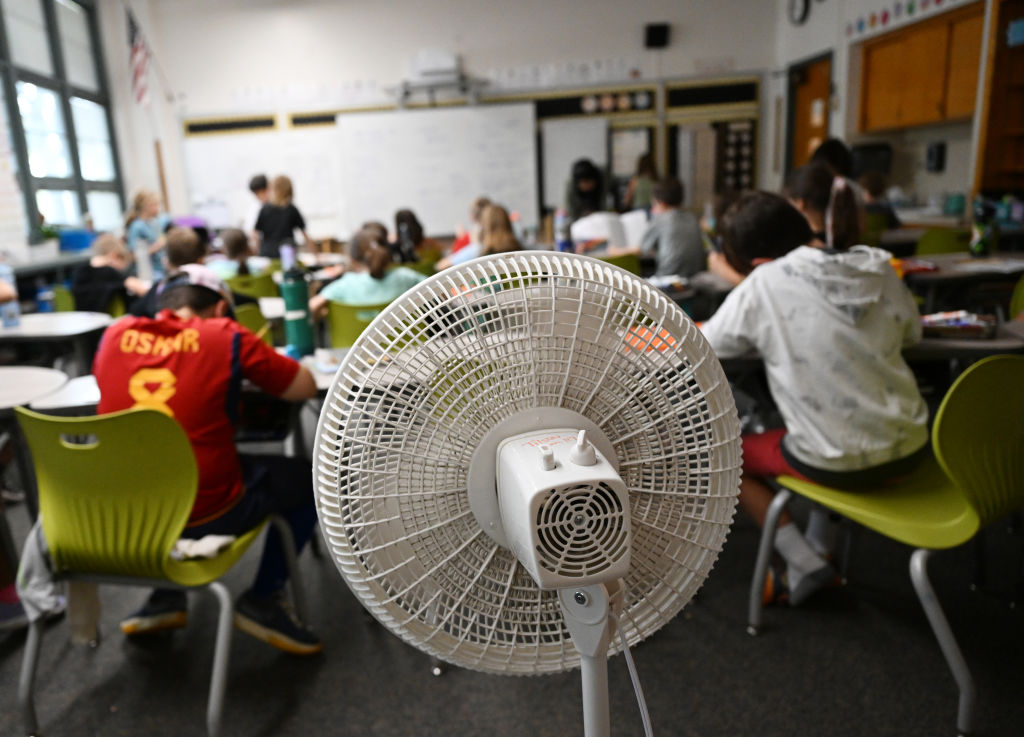
A fan moves air around in a classroom at Corey Elementary in Denver, Colorado on October 8, 2024. —RJ Sangosti—The Denver Post
As students go back to school in the midst of record-breaking summer heat, many are returning to overheating classrooms whose aging air conditioning systems can't keep up with extreme heat waves—if they even have air conditioning at all.
Extreme heat has already caused school closures and disruptions across the country. In July, Milwaukee Public Schools shut down its Summer Academy and other indoor school programs for two days because of extreme heat. One day in May, 57 Philadelphia schools went remote and canceled all in-person activities due to soaring temperatures. That same month, a Washington, D.C. high school carried out a "heat evacuation" as classroom temperatures reached the mid-90s. Eight elementary schools in Doylestown, PA also closed for a day because old buildings couldn’t protect students from the heat. And in recent years, schools in Memphis dismissed students early as temperatures climbed to 110 degrees.
During the 2024-25 school year alone, more than 9 million students at 10,000 schools nationwide experienced extreme heat- and weather-driven school closures or disruptions. These are not isolated inconveniences. They are warning signs that our school buildings and grounds were not designed for today’s new weather patterns.
It’s important to understand that students struggle to learn in hot, stuffy classrooms. Air quality, temperature, and ventilation can affect how students think, focus, and perform. Poor ventilation can impair cognitive function, while excessive heat diverts the body’s energy from learning, slows reaction time, and weakens attention.
In fact, research has shown that in schools without cooling, each 1° Fahrenheit increase in school year temperature reduces the amount learned that year by approximately 1%.
Extreme temperatures (80 to 90 degrees Fahrenheit and above) are known to exacerbate student absenteeism and disciplinary referrals, while poor indoor environments can also contribute to the spread of illness and exacerbate respiratory conditions like asthma, one of the leading causes of missed school days. Younger children, whose bodies and brains are still developing, are especially susceptible.
In medicine and education alike, we have seen how the environments where people spend their time can directly affect their health, well-being, and ability to thrive. We would never accept these conditions in a hospital. We should not accept them in a classroom.
At the same time, outdated heating and cooling systems are placing a growing financial strain on school districts. Across the country, energy costs are rising and becoming more unstable. For school leaders, that often means tradeoffs: dollars spent on inefficient energy systems are dollars not spent directly on teaching and learning. But there is a better path forward.
Modern HVAC systems, often paired with on-site solar energy, offer schools a way to deliver reliable heating and cooling while reducing exposure to volatile fossil fuel costs. These solutions can stabilize energy budgets over time and are increasingly supported by domestic manufacturing, including the production of heat pumps here in the United States.
Just as important, new federal tools make these upgrades far more accessible than they once were. Through energy tax credits and a mechanism known as Elective Pay, public school districts can receive direct financial support to invest in these improvements. That means lower upfront costs and faster payback, turning what was once out of reach into a practical, near-term option.
We are already seeing what this looks like in practice.
In Indiana, Center Grove Community Schools are demonstrating how modern HVAC upgrades can improve classroom comfort while helping manage energy costs, in part by replacing aging boilers, chillers, and fan coils with a geothermal heat pump system. In Virginia’s Prince William County, at the heart of the nation’s data center corridor, district leaders are acting to shield their budgets from steep projected utility increases. And in Wisconsin, a school in Menasha modernized its facility with a ground-source heat pump system, solar panels, and energy storage to deliver better air quality, lower costs, and create local jobs.
The benefits extend well beyond temperature control. Students are better able to focus and learn. Districts gain predictability in their operating costs. And communities benefit from more resilient, efficient infrastructure that reduces strain on the grid during periods of peak demand.
For school and district leaders, this moment calls for action. Now is the time to explore how these solutions can work in your community.
The environments we live in shape the health within us. Nowhere is that more immediate, or more consequential, than in the classroom.
We can improve student health and learning, strengthen our schools, and protect public resources at the same time. And we have real-world proof from communities across the country that this is not only possible, but doable.
The real risk is not the price of modernization, but the cost of continuing to send students and teachers into unhealthy, inefficient buildings unprepared for the realities ahead.
Anthropic announced last week it would include invisible watermarks in AI-generated content to comply with new EU rules. Within hours, overrides were being touted online.
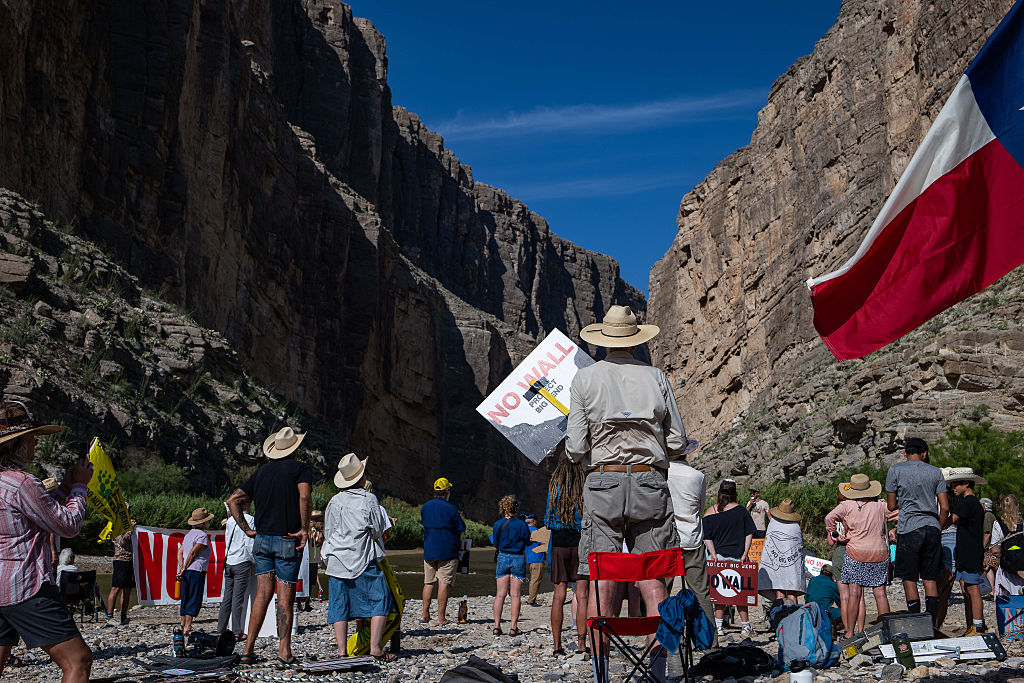
Demonstrators against the construction of a section of the US-Mexico border wall during a protest at Santa Elena Canyon in Big Bend National Park, Texas, on Aug. 12, 2026. —Kaylee Greenlee—Bloomberg/Getty Images
That section of the project, which extends across challenging terrain in Texas’ Big Bend National Park that has historically seen relatively few attempted border crossings, has faced pushback from everyone from public lands advocates to congressional lawmakers to local residents.
The Trump Administration has been pushing the construction of the border wall in Big Bend despite the public outcry, going so far as to bypass a score of environmental laws to expedite the project.
But on Monday, after months of opposition, Customs and Border Patrol (CBP) Commissioner Rodney Scott announced that CBP had paused “all construction” in the park while he visited the site to conduct a “personal, on-the-ground evaluation.” In post on X, Scott wrote that he would be working to “evaluate the terrain and listen to local leadership, community members and stakeholders” over the next “couple of days.”
Texas Gov. Gregg Abbott also said on Mondaythat he had spoken with Department of Homeland Security (DHS) Secretary Markwayne Mullin, who Abbott said had “committed” to not building “a wall or a fence” in Big Bend. Abbott said there were “other tools” to ensure border security.
Here’s what to know about the Trump Administration’s efforts to build the border wall in Big Bend, and the opposition the project is confronting.
What the Trump Administration is seeking to build in Big Bend
Big Bend National Park sits in a remote southwest corner of Texas along the U.S.-Mexico border in Brewster County. The Administration has sought to build 17 miles of barriers across that section of the border as part of the larger border wall project.
Perhaps the most recognizable image of Trump’s wall is the “primary wall,” a structure built from tall steel bollards up to 30 feet tall that makes up the first line of the barrier system that would be encountered by those travelling north from Mexico. The section of the project planned to run through Big Bend, however, would look notably different, according to Scott.
“CBP is building one new access road, improving existing roads, installing detection technology, and placing vehicle barriers in limited, strategic locations,” he said. “We are NOT building a 30-foot wall or stadium lighting through Big Bend National Park, Big Bend Ranch State Park, or the Black Gap Wildlife Management Area.”
The portion of the wall in the park would be made up of a non-contiguous “vehicle barrier system,” according to the CBP, which consists of “steel posts supported by continuous steel rails,” power cables, cameras, roads for patrol cars, and shelters along the border.
According to the agency’s Smart Wall tracker, an interactive and frequently updated map that shows the status of the border wall, CBP has several construction projects interspersed along the border labeled as a “vehicle barriers … technology & patrol road.” A couple of these are located at the southern tip of the park; one sits far west near Presidio County, while others are located at the eastern edge of the park. These sites are in the Chihuahuan Desert, which presents a difficult landscape to navigate filled with steep canyons and mountainous terrain.
A controversial push to speed construction
In June, the Trump Administration waived more than 20 environmental and preservation laws intended to protect Big Bend’s landscape in order to accelerate the construction of the border wall in the park.
To do so, the Administration invoked a section of the Illegal Immigration Reform and Immigrant Responsibility Act of 1996, which allows the government to bypass laws that obstruct the building of border wall.
DHS defended the move at the time by describing Big Bend as an “area of high illegal entry” and saying that “there is presently an acute and immediate need” to build more barriers.
Migrant encounters are relatively rare at the section of the border that runs through the park, however—and have become more so in recent years. The park includes roughly 118 miles of what’s known as the Big Bend Sector of the border, which spans 517 miles from Sierra Blanca, Texas, to Sanderson, Texas, and covers roughly one-quarter of the full length of the U.S.-Mexico boundary. CBP recorded a 74% decrease in border crossings through its Big Bend Sector between fiscal years 2023 and 2025, with apprehensions dropping from 11,823 to 3,096. There were a total of 237,538 migrant encounters along the U.S.-Mexico border in FY 2025, meaning that the 3,096 apprehensions in that sector accounted for just 1.3% of the total number. And CBP’s planned border wall in the park would only cover a fraction of a fraction of the full sector.
The Administration’s move to bypass the environmental laws triggered immediate opposition. Bob Krumenaker, the park’s most recent former superintendent, called the news “devastating” to Marfa Public Radio and referred to it as “giving CBP unfettered authority to do anything they want within the national park.” Legal challenges also followed in the form of multiple federal lawsuits, while members of Congress made efforts to block DHS’s funding for projects in Big Bend.
Why the project has faced opposition, and from who
Grassroots organizations, conservation groups, businesses, local communities, and lawmakers have also made efforts to fight against the construction of the border wall in Big Bend.
Much of the opposition stems from concern over the park’s natural landscape, which is home to an array of wildlife and is effectively undeveloped. Other groups oppose the construction because they view the park as a cultural and heritage site, while still others have voiced concerns for the impact the planned barrier construction could have on the tourism economy there.
A seriesoflawsuits have been filed in an effort to block DHS’s plans to construct the border wall in Big Bend.
One lawsuit from the Center for Biological Diversity challenged DHS’s waiving of laws to carry out construction in the park. “Until now no administration has been heartless enough to waive laws in a national park like Big Bend, so we’re suing to uphold the U.S. Constitution and protect this crown jewel,” Laiken Jordahl, national public lands advocate at the Center for Biological Diversity, said in a statement according to a news release.
The Center for Biological Diversity had previously filed a lawsuit that argued the construction would “devastate the region’s wildlife, recreation economy, and natural and cultural heritage.”
Another lawsuit, filed by The People of La Junta for Preservation and Far
Flung Outdoor Center, a tribal nonprofit and an outdoor recreation company, argued that the construction will cause damage to archaeological sites associated with indigenous peoples and could threaten protected religious freedoms.
Groups have also mounted protests and sent letters to lawmakers to call for the planned construction to be halted.
In March, the grassroots organization No Big Bend Wall sent a letter to several leaders on congressional committees on behalf of 132 organizations asking that the use of any federal funding for the border wall in Big Bend be prohibited.
All the Democratic members of the Texas delegation in Congress sent a letter to Mullin later that same month voicing “staunch opposition” to the wall.
“This proposal threatens preservation of one of America’s crown jewels, Texas’ largest state park, and the state’s only congressionally-designated Wild & Scenic River,” the lawmakers wrote. “Construction and maintenance of a border wall segment and the associated roads, secondary barriers, power lines, towers, and lighting will disrupt natural biodiversity, river dynamics subject to routine flash flooding, and one of the darkest night sky areas in the world.”
Over the following two months, more than 2,000 people rallied at the Texas Capitol building in Austin, and seven former superintendents of Big Bend National Park urged Mullin not to waive federal laws to build the border wall in the park.
In early August, video showed heavy machinery bulldozing the land at Big Bend. A bipartisan group of Texas House lawmakers soon after sent a letter to Gov. Greg Abbott on Thursday in which they urged him to halt the Big Bend construction, citing “damage to one of Texas’ most pristine and irreplaceable landscapes” that they said had already begun with the movement of bulldozers and construction equipment into the park.
Last Wednesday, a large crowd of protesters gathered in the park chanting “No road. No wall. No wire. No way," as they held hands in a circle. They also held a large banner that read “NO WALL,” along with a series of other wildlife-themed flags and signs.
More than 140 local businesses, recreation groups, and outfitters who rely on the tourism economy in the park also penned a letter on Aug. 4 to Cornyn, Cruz, and Abott asking them to halt the border construction to preserve the vibrant tourism economy that lives within the park.
Scott released a statement last week in response to the public reaction specifying that “what people are seeing right now is survey and design work—NOT construction of a wall through the park.”
Following Scott’s later announcement that CBP would be pausing construction on the wall in Big Bend, the National Parks Conservation Association (NPCA), which has pushed back against the Big Bend construction, lamented the damage that it said the project has already done to the park’s lands.
“The people have spoken, and they do not want the Trump administration to bulldoze America’s national parks for border infrastructure,” said NPCA President and CEO Tiernan Sittenfeld in a statement. “Unfortunately, the federal contractors’ bulldozers have already inflicted tremendous damage to one of America’s most iconic national parks. Their heavy equipment has torn through miles of priceless wild landscape, wreaking havoc on sensitive wildlife and irreplaceable habitat.”

 Login
Login