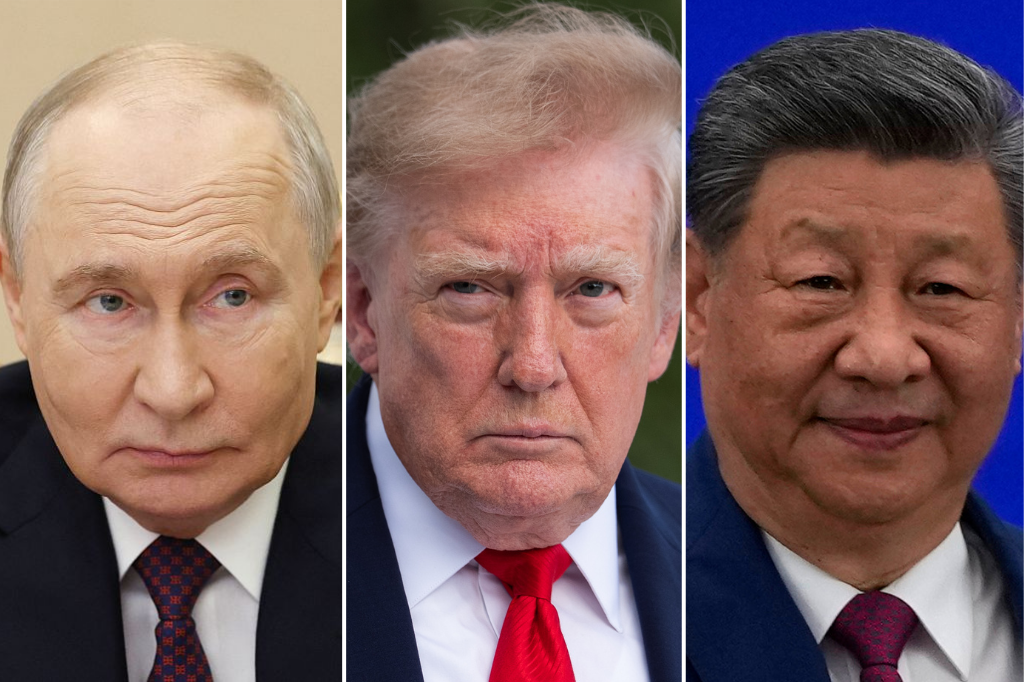
U.S. President Donald Trump takes a meeting at Turnberry, south west Scotland, on July 27, 2025. —Brendan Smialowski—Getty Images
As the Trump Administration forges ahead with its campaign to dismantle the International Criminal Court (ICC) “brick by brick,” Europe is publicly showing a steady stream of support for the institution.
The E.U. last week awarded the court and its officials the Sakharov human rights prize, commending “the important work of the court in upholding international law and justice.” The prestigious recognition came after former ICC judge Navanethem 'Navi' Pillay on Oct. 9 was awarded the 2026 Nobel Peace Prize—an honor long coveted by President Donald Trump. Jørgen Watne Frydnes, chair of the Norwegian Nobel Committee, acknowledged the award was intended to send a “message to those who are attacking, undermin[ing]... the international rules-based system.” Hours after Pillay’s win, U.S. Secretary of State Marco Rubio announced sweeping new sanctions against the ICC. While previous U.S. sanctions had targeted the institution's prosecutors and judges, the new measures were aimed at “cutting off [the court’s] resources” by severing U.S. transactions with the court.
Experts warn that the sanctions could have “extremely disruptive” implications for the court, especially in regards to financial support for case work, travel to the U.S. for judges, and the core functions of the institution itself. “Leaving the political dimension to one side, the rule of law and the just resolution of disputes depends, to a large extent, on the body in question having all available evidence,” says Nabil Khabirpour, an affiliated lecturer in E.U. law and jurisprudence at Cambridge University. “Organizations that are involved in working with witnesses, both on the ground and within the legal infrastructure, are likely to be affected.”
The latest sanctions, which were announced with a six-month initial grace period, are part of a broader push by the Trump Administration to dismantle the institution it accuses of unfairly targeting the U.S. and Israel. The Trump Administration has staunchly criticized the ICC over arrest warrants issued for Israeli leaders, including Prime Minister Benjamin Netanyahu, and former investigations into the actions of American soldiers in Afghanistan. The ICC is recognized as the world’s highest criminal court. It draws its jurisdiction from the Rome Statute, a treaty that went into effect in 2002 and is ratified by 125 countries. Neither the U.S. nor Israel is a state party to the Rome Statute, and therefore they do not recognize the jurisdiction of the court.
Trump has long complained that the ICC oversteps its authority and should not claim jurisdiction over U.S. citizens. He amplified his campaign against the organization at the United Nations General Assembly in New York last month, taking time out of his 45-minute speech to publicly call on “all nations that are members of the ICC to officially resign from this rogue institution, immediately.” He said the U.S. is “opposed to the out-of-control institution known as the ICC” and “will never allow U.S. service members or anyone else to be investigated or given show trials by an anti-American tribunal with no jurisdiction over us.”
His call to action was swiftly rejected by European leaders.
German Foreign Minister Johann Wadephul, shortly after the speech, said: "We will, of course, not be doing that." In an interview with Germany's Deutschlandfunk radio station, he described the court as "an important institution” and said the issue is "one of the areas where we do indeed have to acknowledge a regrettable difference in policy from the U.S. Administration."
Netherlands Prime Minister Rob Jetten also defended the ICC, asking how can anyone “possibly be opposed to prosecuting the very worst crimes?”
“I believe there can be only one response,” he continued, in his own U.N. address. “To say: 'hands off' the ICC, and all those other institutions that protect the international legal order.” The remarks drew loud applause from attending delegates.
Similarly, European Council president Antonio Costa stressed that the E.U. stands “firmly behind” the ICC and argued it’s “unacceptable to threaten or attack the International Criminal Court, its officials, and its staff.”
The European Union as an organization has since strongly criticized the U.S. sanctions against the ICC. In a speech on Oct. 20, E.U. policy chief Kaja Kallas said the most recent “misguided” measures were “against” European interests.
“The U.S. has already adopted individual sanctions, including against nine judges and the chief prosecutor of the ICC. The latest U.S. announcement [on Oct. 9] to impose institutional sanctions puts the entire court at risk,” she argued, adding that Brussels will use the next six months "to open dialogue and look for solutions.”
European lawmakers call for “concrete” action against U.S. sanctions
The European Commission’s choice to take time to consider how to counter the U.S. sanctions has fallen short of what many European lawmakers have called for.
Several leading MEPs, including Germany's David McAllister, chair of the Committee on Foreign Affairs, and France's Mounir Satouri, chair of the Subcommittee on Human Rights, issued a public statement on Oct. 9 calling for the Commission to activate a legislative shield referred to as the “blocking statute,” which would essentially prevent E.U. firms from complying with U.S. sanctions.
“The European Union must now demonstrate unwavering solidarity with the ICC and its personnel—not only with words, but also with concrete acts,” the leading Members of the European Parliament (MEPs) said in a joint statement. “The European Commission must immediately trigger the E.U. blocking statute, shielding the court and European actors from the extraterritorial reach of these sanctions. Europe must stand firm in defence of international law and the rule of law."
This request was bolstered as 58 MEPs reportedly sent a letter to European Commission president Ursula von der Leyen for the Commission to activate the measure.
According to the Commission, the purpose of the European Union’s blocking statute is to “protect E.U. operators from the extra-territorial application of third country laws.” The blocking statute came into force in 1996 in direct response to the U.S. sanctions against Cuba. The aim of the measure was to protect economic operators within the E.U. from the effects of such extraterritorial sanctions, according to the Norton Rose Fulbright law firm. As such, the blocking statute shields European economic operators from the application of the U.S. legislation and sanctions specified in the Annex to the E.U. blocking statute. More recently, the E.U.'s updated blocking statute entered into force in response to U.S. sanctions on Iran after the U.S. withdrew from the nuclear agreement in 2018.
Kallas has expressed an openness to the measure, but also advised caution when delivering her statement on European support for the ICC. “We should keep all options on the table. If we use the blocking statute, we have one shot and we should do it well. So, it should be well prepared," Kallas said, urging companies “not to over comply” with the sanctions, as they are not yet in effect.
ICC prosecutor Nazhat Shameem Khan told the Guardian last week that some ICC staff are already facing "banking difficulties," despite the grace period before the sanctions come into effect. Khan said the banks were “over complying” to minimize risk amid uncertainty over the scope of the measures. She said the court's work has not been hindered.
TIME has reached out to the ICC for comment.
If the E.U. were to activate the blocking statute, it would be a “very important gesture” that could show the Trump Administration how “Europe is serious about protecting the court and that it is prepared to take real steps in that direction,” says Sergey Vasiliev, a professor of international law at Open University Netherlands. But he warns that some may view it as a “very extreme or radical measure, that could perhaps anger the Trump Administration even more” at a time where U.S.-Europe relations are already strained.
Meanwhile, some ICC officials have suggested alternative measures in an effort to mitigate the expected impact of the U.S. sanctions. Osvaldo Zavala Giler, the court's registrar, told Politico that “comfort letters” could be sent out, reassuring firms that they needn’t comply with the U.S. measures.
But Vasiliev argues that this “will not necessarily solve the problem, because businesses are expecting clear assurances of protection… the only such assurance can be provided by the actual triggering of the blocking statute.”
Could the ICC row further escalate U.S.-Europe tensions?
Relations between Europe and the U.S. have been under increasing strain since Trump returned to office in January 2025.
Trump has introduced various waves of tariffs on international trading partners, and has threatened further levies on the E.U. and member states in response to divisive issues.
When Trump’s pursuit of acquiring Greenland as a U.S. territory reached a critical point in January, Trump threatened to tariff European countries that opposed his campaign—a move that earned him strong rebuke from within his own party.
Last month, when von der Leyen invited Canada to work toward becoming the European Union’s first “associate member,” in what she described as an “urgent” reimagining of partnerships, Trump again threatened economic pressure. He called the proposal “laughable” and threatened to “put very serious tariffs or stop trading with Europe on many things” if such an idea were to go ahead.
The Trump Administration has also clashed with its NATO allies. Earlier this year, Trump refused to rule out leaving the alliance over Greenland disputes, and since the start of the Iran war, the President has hit out at NATO countries for refusing to get actively involved in the conflict.
Should Brussels and Washington continue to clash on the ICC sanctions, “this could risk accelerating certain destabilizations, such as what we've seen with the trade wars,” says Khabirpour. International organizations will ultimately stand to suffer if the two remain at odds, he adds.
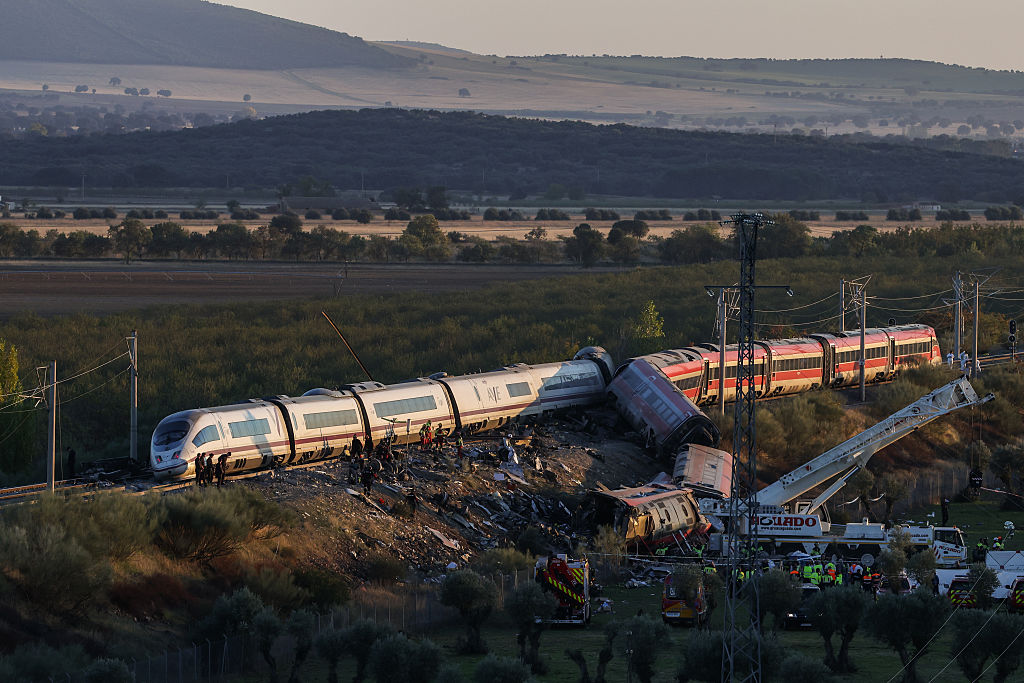
Emergency services at the scene of a train crash near Urda, Toledo, Spain, on Oct. 28, 2026. —Alejandro Martinez Velez—Europa Press/Getty Images
Spain's Transport Ministry has increased the provisional death toll from Wednesday's high-speed train collision to 69. The number of people injured is pending confirmation.
Police have appealed to family members of the crash victims to provide DNA sampling to help with the identification process. The Transport Ministry's website briefly raised the provisional death toll again to 74 late Thursday afternoon, before revising it back to 69.
Spanish Prime Minister Pedro Sánchez said that authorities are "working day and night, not only to provide a response to the victims and their families, but to clarify every last detail of this tragedy and to strengthen security so that it never happens again."
As the country's top institutions continue investigating the cause behind the collision, Transport Minister Óscar Puente has suggested that a combination of “inexplicable” human error and a computer failure was likely behind the tragedy, which occurred near Urda, Toledo, more than 80 miles south of Madrid.
Puente said in a press conference that the state-operated Renfe train slamming into the rear of a stationary private train operated by Iryo was due to an “inexplicable” order from a command center for Spain’s trains. Puente noted that the center had a computer malfunction before the order.
“It was the control center, through its operators, that made the decision to resume traffic, under circumstances that, from our point of view, are inexplicable,” Puente said. He added later: “Clearly, it was a wrong decision.”
Puente said that they have identified the person who decided to let the Renfe train continue moving even though the Iryo one had already stopped, but he has not spoken to the control center operator. “This person is subject to whatever the investigation determines,” Puente said in the press conference.
Renfe said train services between Madrid, Ciudad Real, and Andalusia have been suspended.
The Wednesday collision is now the deadliest train crash in the country since a 2013 incident in Santiago de Compostela that killed 80 people. But the latest collision follows a similarly deadly train crash in January, which involved high-speed trains operated by the same two companies. In that crash, which occurred in Adamuz, Córdoba, 46 people died and 122 sustained injuries.
Sánchez, who visited the crash site, said his government would declare three days of mourning in response.
Despite the accident, Puente insisted that the Spanish rail system is “safe and comparable to that of other countries in our region.” However, while there are “very clear” regulations and protocols in place, he admitted, “failures can obviously occur.”
What happened?
The crashes involved a Renfe high-speed train bound for Seville with 393 people on board, and an Iryo train carrying 151 passengers. The Renfe train departed Madrid at 8:00 a.m. local time, while the Iryo train left a little earlier at 7:54 a.m., plying the same route.
Spain’s rail infrastructure uses the German LZB (Linienzugbeeinflussung) system, a railway safety technology that monitors train speeds and sends traffic instructions to the driver’s cab. Operations are meant to revert to manual control when the automated safety system fails.
Puente, in the press conference, said that at around 8:30 a.m., three computers on the railway network experienced a communication failure, taking the LZB control system offline along a 63 km (39 mi) stretch of the track. This automatically stopped about six trains traveling on that section, Puente said. The central command center would assume manual management of rail traffic.
By 8:36 a.m., the command center authorized the Renfe train to continue its journey “normally,” even though Puente says internal protocols dictate otherwise and that a “red signal” should have prevented the journey from resuming. The Renfe train had 25 km (15.5 mi) to travel before it struck the Iryo train, roughly 17 minutes later, at 8:53 a.m. The speed it reached before the impact is still unknown, but it could reach up to 200 km/h (124 mph) for that stretch of track.
What to know about Spanish high-speed rail
Spain is among the world leaders in investing in domestic high-speed rail infrastructure—defined as rails for trains that can travel 250 km/h (155 mph) and over, according to the European Commission’s Ninth Rail Market Monitoring report last year. The report shows that of European Union countries, Spain allocated the most to high-speed rail between 2018 and 2022, averaging €1.5 billion (around $1.67 billion) per year.
Latest data from the International Union of Railways shows that Spain has laid nearly 4,000 km (2,400 mi) of high-speed track, second only to China, which has laid more than 47,000 km (28,000 mi).
The European country only legally opened its domestic commercial high-speed passenger rail market to private competitors in December 2020, and Iryo became one of the commercial high-speed operators in Spain in 2022.
Spanish news outlet El Debate reported, citing data from the State Railway Safety Agency, that the number of “significant accidents” on the country’s rail network has increased over the years.
A girl walks past an advertisement for an energy drink featuring French soccer player Kylian Mbappé in Wuhan, China, on July 7, 2026. —Wang He—Getty Images
French soccer captain and Real Madrid forward Kylian Mbappé has apologized to China for calling Mao Zedong a “dictator,” a comment that prompted fierce criticism and institutional reprisals.
“My comment was ill-judged,” Mbappé said in a statement in three languages. “I apologize to everyone my words have upset.”
In a video clip from the French talk show “The Bridge” posted on Monday, Mbappé had referred to Mao as “some guy—I think he’s a Chinese dictator” as he described a meme in which his face was photoshopped onto a picture of the late founder and chairman of the Chinese Communist Party. The clip was behind-the-scenes footage from a podcast filmed in March, the podcast said. It has since been removed from the show’s social media accounts. “The Bridge” also apologized to Chinese fans, as well as to Mbappé.
The meme is part of an internet trend where soccer fans have superimposed Mbappé’s face onto pictures of military and political leaders as a play on Mbappé’s nickname “the dictator,” referring to the Real Madrid player’s perceived authority and influence over football clubs and the media. Even Mbappé’s French teammate Ousmane Dembélé made a joke about the moniker during the 2026 World Cup, referring to Mbappé as Mobut after Mobutu Sese Seko, the dictator who ruled the Democratic Republic of Congo for three decades.
Mbappé told French magazine L’Equipe last month that he found some of the memes funny, but that others demonstrated “a lack of political and human awareness.”
“To be compared to people who murder others, or who have made millions and millions of people miserable … I don’t think I’ve ever done anything like that in my life,” he said.
In the clip shared by The Bridge, Mbappé was asked which meme he finds funniest, and he pointed to the one featuring Mao.
Mbappé’s “dictator” label, however, triggered sharp rebuke in China. Several Chinese broadcasters suspended coverage related to Mbappé and Spanish soccer league LaLiga, while some brands pulled ads that featured the sports star. A spokesperson for China’s Foreign Ministry said on Tuesday, before Mbappé’s apology, that “words and deeds that hurt the feelings of the Chinese people will naturally be met with opposition from all sectors of Chinese society.”
Parody of Chinese leaders is politically sensitive in China, not least mockery of Mao, who founded the People’s Republic of China in 1949 and ruled the country till his death in 1976.
Many international scholars have described Mao as an authoritarian leader, pointing to his centralized rule, political purges, and aggressive state campaigns, including the Great Leap Forward and the Cultural Revolution. Historians estimate that tens of millions of people died during Mao’s rule as a result of famine and violence. But within China, many view him as a revolutionary figure who unified the country and transformed a largely agrarian society into an independent nation. While official accounts have condemned the Cultural Revolution as a “grave blunder,” those same accounts argue that Mao’s lifetime contributions to the Chinese revolution outweighed his mistakes. The Chinese Constitution describes the state as the “people’s democratic dictatorship,” defined as a proletarian dictatorship.
“During a recent interview, I reacted to an image of myself,” Mbappé said in his apology. “I now understand that it hurt many people in China and in Chinese communities around the world. … This was absolutely not my intention. I have deep respect for the Chinese people and their history, and I am sincerely sorry.”
In August, artist Gao Zhen was sentenced to three years in prison for “infringing upon the reputation of heroes” because he had made satirical sculptures of Mao, including a 2009 statue called Mao’s Guilt that depicts the late leader kneeling in repentance. Gao, who was based in the U.S., was arrested in August 2024 while visiting family in China.
International sports brands and associations have also come under fire in China over remarks deemed politically offensive.
In October 2019, China paused sponsorship deals with the National Basketball Association after Houston Rockets executive Daryl Morey posted online in support of protests in Hong Kong, which Beijing characterizes as separatist and seditious. CCTV suspended broadcasts of NBA games for a year.
Canceled contracts
Mbappé’s comments may already have cost him.
China’s largest dairy producer, Mengniu, said it would cease its partnerships with Mbappé, as did cheesemaker Shanghai Milkground Food Tech and beverage giant Eastroc Beverage, also known as Dongpeng. The companies said they had a “zero-tolerance policy” towards words or behavior that offend the feelings of the Chinese public.
According to French newspaper Le Monde, Mbappé’s Dongpeng and Mengniu contracts were worth approximately 50 million yuan (€6.7 million) combined. Dongpeng had run adverts featuring AI-generated images of Mbappé drinking its sports drink during the 2026 World Cup and sold bottles of its Bushuila electrolyte drink with Mbappé on its packaging. After Mbappé’s comments and prior to their statements, the two consumer brands saw their stock fall.
Bottled Dongpeng electrolyte drink endorsed by French soccer star Kylian Mbappé are displayed for sale at a shop in Yichang, Hubei Province of China, on Oct. 27, 2026. —Liu Junfeng—VCG/Getty Images
Global brands including Dior, Rimowa, Nike, Hublot, and On Running also removed promotional content featuring Mbappé from their accounts on Chinese social media platform Weibo, Chinese media reported.
China’s state television CCTV suspended broadcasts of all matches and events involving Mbappé and LaLiga, and pulled advertisements featuring Mbappé, Chinese media reported on Tuesday. The state broadcaster said in a statement after Mbappé’s apology that it hoped he “will genuinely learn a lesson from this” and “thoroughly correct” his mistake.
LaLiga President Javier Tebas said on Tuesday that he met with the Chinese Ambassador in Spain to “seek solutions that allow us to overcome this episode.”
“Our commitment is to keep working together so that an individual episode does not harm the important advances achieved nor affect the millions of Chinese fans who follow our competitions,” Tebas said in a post on X. “A relationship built over so many years cannot be damaged by a single incident,” he added in another post.
Online backlash
Mbappé, once a fan favorite in China where he is affectionately nicknamed “Guigui” after a perceived resemblance to a Teenage Mutant Ninja Turtle, now faces a firestorm online.
Calls for brands to terminate partnerships with Mbappé and boycott the player were among the top trending topics on Weibo. Some users accused Mbappé of profiting off the lucrative Chinese sports markets and his millions of fans in the country while disrespecting their national sentiments.
Weibo and Rednote, also known as Xiaohongshu, also appeared to have restricted Mbappé on their platforms, with notices that said his accounts were “banned” or “muted” for violating community guidelines.
French soccer star Kylian Mbappé's Chinese social media Rednote account displays the message: "This account has been muted for violating community guidelines," in Shanghai, China, on Oct. 28, 2026. —Jade Gao—AFP/Getty Images
In an article titled “Mbappé scores an own goal in China,” state media outlet China Daily reported that the backlash from Chinese fans has “threatened his lucrative commercial relationships and offered a sharp reminder of the limits of celebrity influence.”
Several Chinese news outlets condemned Mbappé’s remarks without restating them. Soccer news outlet Dongqiudi said in a statement, “Kylian Mbappé made inappropriate remarks about China in an interview. As these remarks are likely to hurt China and its people, we cannot translate them.”
“What did he say? Many Chinese would rather not repeat it,” state-linked Global Times said in a video commentary. “The message from Chinese consumers is clear: Respect is not optional; one doesn't get to profit from China while disrespecting it. Not a chance.”
Another article from state-linked newspaper Guangming Daily read, “Insulting China’s late great leader is unacceptable! Eating Chinese food and then smashing the Chinese pot? Mbappe is not worthy!”
“However good your football skills are, you cannot trample on fundamental limits,” it said.
Censorship concerns
Outside of China, some have pushed back against the backlash.
French social media users criticized Mbappé for retreating on his comments. Marc Julienne, director of the Asia Centre at French Institute of International Relations (IFRI), told Le Parisien that describing Mao as a “dictator” reflects a consensus among Western historians, though it is a characterization that remains taboo in China—which, Julienne added, Mbappé may not have realized.
The U.S. House Select Committee on China posted on Tuesday that Mbappé “should not apologize for calling Mao Zedong a dictator. Mao was a dictator, and by orders of magnitude, he did more harm to the Chinese people than a comment from a soccer player ever could.”
“The real disgrace,” the committee said, “is the companies rushing to apologize so they can continue to do business in China.”
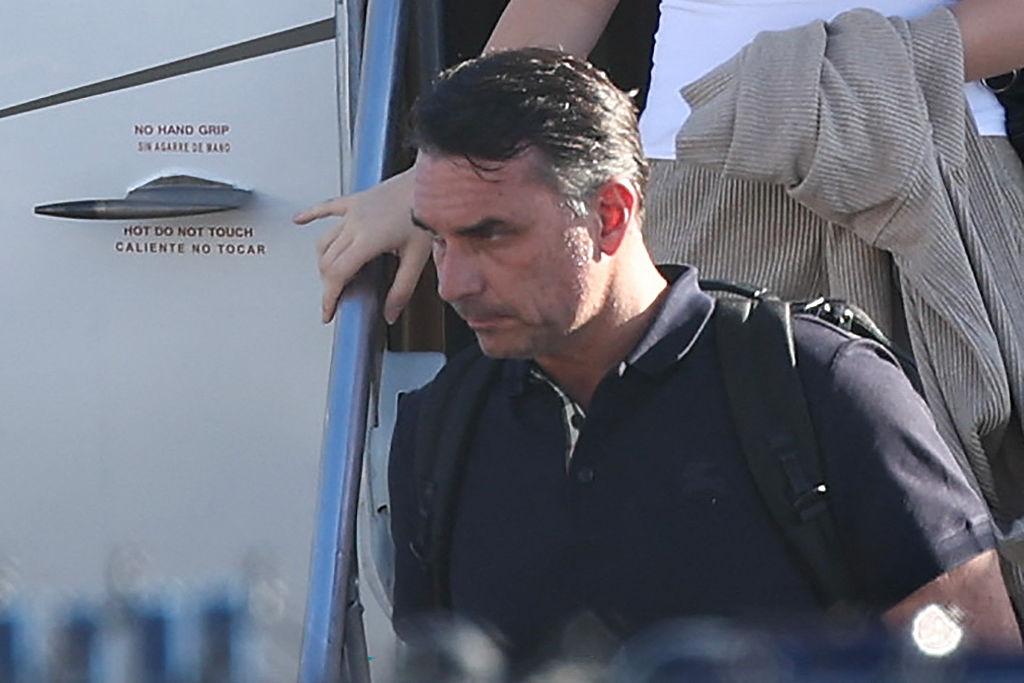
Flavio Bolsonaro arrives at Opa-Locka Executive Airport near Miami on Oct. 28, 2026, despite a court order barring the defeated Brazilian presidential candidate from leaving Brazil. —Ricardo Arduengo—AFP/Getty Images
Brazilian Senator Flávio Bolsonaro arrived in Miami on Wednesday after fleeing the country in defiance of a court order to surrender his passports amid a money laundering investigation, days after losing the presidential election to incumbent Luiz Inácio Lula da Silva.
Bolsonaro traveled from northern Argentina to the Ecuadorian city of Guayaquil, the Argentine government said. From there, Bolsonaro, his wife and two daughters flew to Miami, where they were recorded exiting a private jet at Miami-Opa Locka Executive Airport.
President Donald Trump told reporters he “would approve” of Bolsonaro coming to the U.S. “I think they’re fine people,” Trump said. “The election was very strange, and I thought it was terrible. It’s gotten bad reviews. You look at what happened to their market.”
On Tuesday, U.S. officials told multiple media outlets that the State Department would grant Bolsonaro and his family entry visas amid reports he had left Brazil to head to the U.S.
A Brazilian Supreme Court justice had ordered federal police to open a separate probe into possible illegal foreign financing of Bolsonaro’s presidential campaign, including alleged ties to U.S. Vice President J.D. Vance’s donor network. Lula’s government had previously accused the Trump Administration of interfering in Brazil’s election, an allegation the U.S. denies. TIME has reached out to Vance’s office for comment.
Bolsonaro initially said he would comply with Brazilian Supreme Court Justice Alexandre de Moraes’s order to surrender his passports and refrain from traveling. The order concerned an investigation into Bolsonaro’s alleged links to a Brazilian lawyer accused of laundering more than $1 billion through a fraud scheme.
The confidential order cited Bolsonaro’s flight risk and “significant financial resources.” The son of convicted former President Jair Bolsonaro, Flávio Bolsonaro will lose certain parliamentary protections from prosecution when his term as senator for Rio de Janeiro ends on Jan. 31.
“I have never thought about leaving the country,” Bolsonaro said in a social media video Monday. “I will hand over my passports and defend myself against this travesty, which is a clear attempt to intimidate me.”
But Bolsonaro did not comply with the order to hand over his passport by the end of the court’s 24-hour deadline on Tuesday morning. Argentina’s National Directorate of Migrations said Bolsonaro and his family entered the country “with valid travel documentation and without any legal impediment” on Tuesday night before boarding a private flight to Guayaquil, Ecuador.
Lula called Bolsonaro’s flight from Brazil “a shameful act.”
“Those who have nothing to hide have nothing to fear,” Lula added, recalling his own arrest in 2018 on charges of passive corruption and money laundering. His convictions that were later overturned.
Bolsonaro is also being investigated over alleged links to a banker connected to a corruption scheme. He is alleged to have raised millions of dollars from the banker to fund a biopic about his father.
Bolsonaro's departure could inflame political tensions amid claims from Brazil’s right wing and abroad that the election was unfair. Bolsonaro initially said he would seek to annul the vote, although his Liberal Party later conceded defeat. In the video posted Monday, he said he would seek to have Lula’s ticket disqualified, citing alleged disinformation and “vote buying.” He also said he would organize congressional opposition to Lula’s government.
“I wasn’t the one who lost,” he said. “The system won.”
Trump, an ally of the Bolsonaros, said Monday that the election appeared “rigged.” He did not provide evidence for the claim.
“I didn’t take sides, but it looked like another rigged election,” Trump said.
“I just think it had a very bad look, the election, the way it was tabulated,” he added. “The extension given was very strange.”
Brazil’s Supreme Court had granted a two-hour voting extension on Sunday, citing transport issues raised by Lula’s campaign. Bolsonaro’s campaign had separately requested a two-hour extension due to heavy rainfall in certain areas.
Lula won the election by more than 4 million votes. Roughly 0.03% of all votes—or fewer than 35,000—were recorded in the extra two hours. Vice President Geraldo Alckmin told Rede Vanguarda that Trump’s claims were “completely wrong.”
Money laundering inquiry
The inquiry into Bolsonaro stems from a federal probe into unauthorized deductions from pension payments made by Brazil’s social security agency. The broader operation, launched in April 2025, investigated associations suspected of collecting unauthorized membership fees from pension benefits.
Evidence from the probe led investigators to examine suspected money laundering involving betting platforms and financial transactions linked to Brazilian lawyer Willer Tomaz, who denies wrongdoing.
Police reportedly discovered that Bolsonaro had “master user” access to bank accounts belonging to Alcazar Holdings, a company owned by Tomaz. In May 2025, a person working for Tomaz asked the bank to remove Bolsonaro’s access to the accounts, local media outlets BPMoney and Times Brasil reported earlier this month, citing police findings. Both Bolsonaro and Tomaz deny having a joint account or financial ties.
De Moraes’s order also barred Bolsonaro from contacting Tomaz. Bolsonaro said on Monday that the ruling came after his brother, Eduardo Bolsonaro, had said on a podcast last week that he should leave the country if he lost the election.
AFP reported that Bolsonaro’s Brazilian and diplomatic passports were canceled, but that he has held Italian nationality since 2023. His departure appeared to surprise his political allies, including his campaign manager Rogerio Marinho who told reporters Tuesday that he had no information about Bolsonaro’s whereabouts.
“I received a text message from him this morning, where he said he would let some time pass today and then would talk with us, and that was it,” he said. “That was the only communication we had.”
A critic of Brazil’s justice system
Bolsonaro has repeatedly criticized Brazil’s judiciary and described the investigations into him as politically motivated. The country’s Supreme Court generally assigns cases through a lottery system. The money laundering investigation was assigned to de Moraes on Oct. 16.
De Moraes was the lead justice in last year’s trial of Jair Bolsonaro, who refused to accept his election loss in 2022. A five-member panel of Supreme Court justices convicted Jair Bolsonaro, by a 4-1 vote, of attempting to overturn his election defeat and sentenced him to 27 years and three months in prison. He is serving the sentence under house arrest due to poor health. Prosecutors alleged that the plot included plans to assassinate Lula. Jair Bolsonaro denies wrongdoing.
In June, a Supreme Court panel unanimously convicted Eduardo Bolsonaro of coercion in judicial proceedings. Prosecutors alleged he had attempted to lobby the Trump Administration to use tariffs and sanctions, including on de Moraes, to pressure judicial authorities to drop the prosecution of Jair Bolsonaro. Eduardo Bolsonaro was sentenced to four years and two months in prison, but remains in Texas, where has lived since 2025.
De Moraes has also faced scrutiny over reported ties to Daniel Vorcaro, the former owner of Banco Master, whose financing of a film about Jair Bolsonaro is the subject of the separate inquiry into Flávio Bolsonaro. The New York Times reported, citing a police dossier, that Vorcaro sent text messages to de Moraes asking for help to avoid arrest. In messages to other associates, Vorcaro reportedly mentioned paying millions to the law firm of de Moraes’s wife. De Moraes has denied wrongdoing and said he never acted to favor Vorcaro or Banco Master.
De Moraes also clashed with tech billionaire Elon Musk in 2024 over court orders to block accounts on Musk’s social media platform X. De Moraes temporarily suspended the platform in Brazil after it failed to comply with judicial requirements, which Musk had described as “the most draconian demands of any country on Earth.”
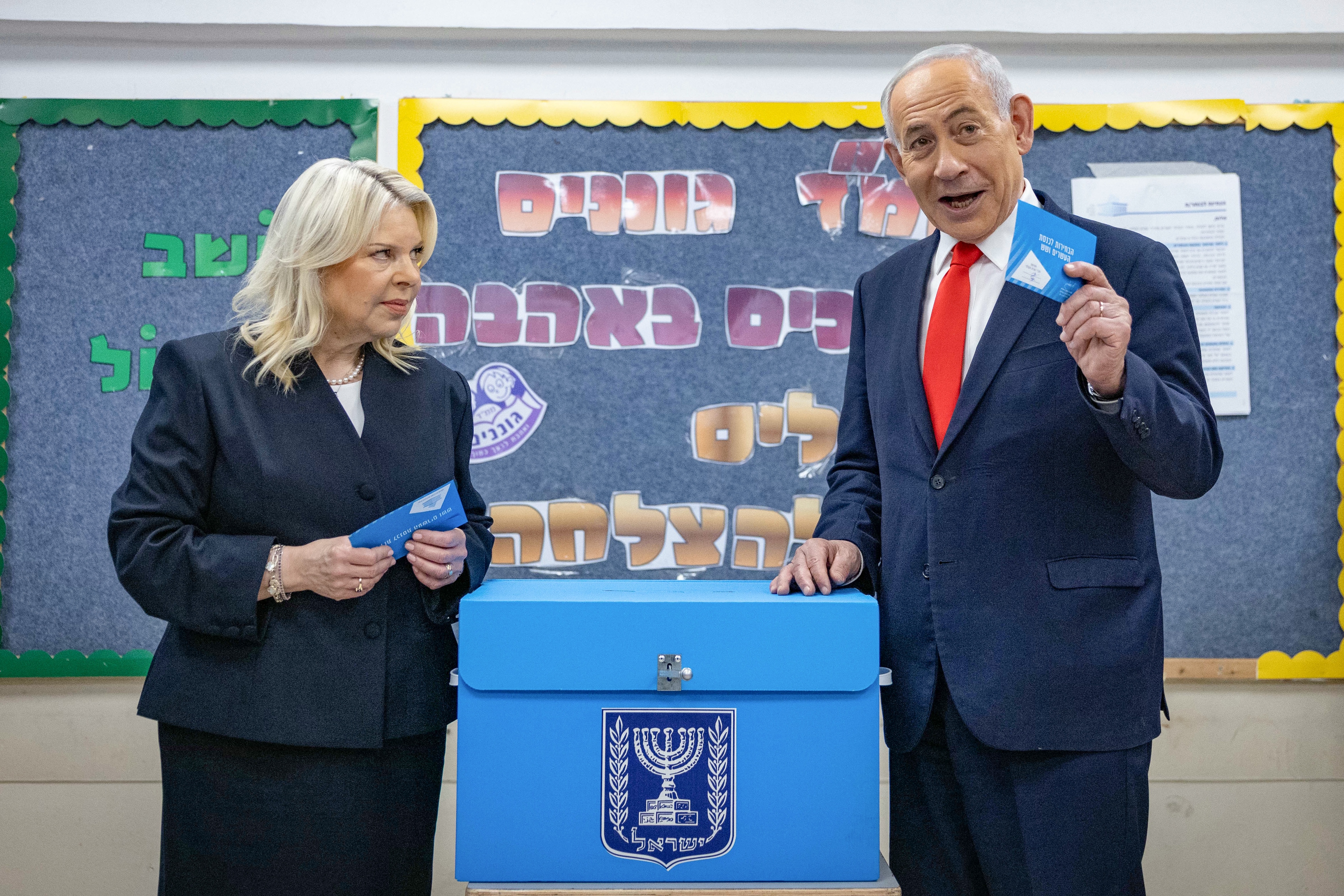
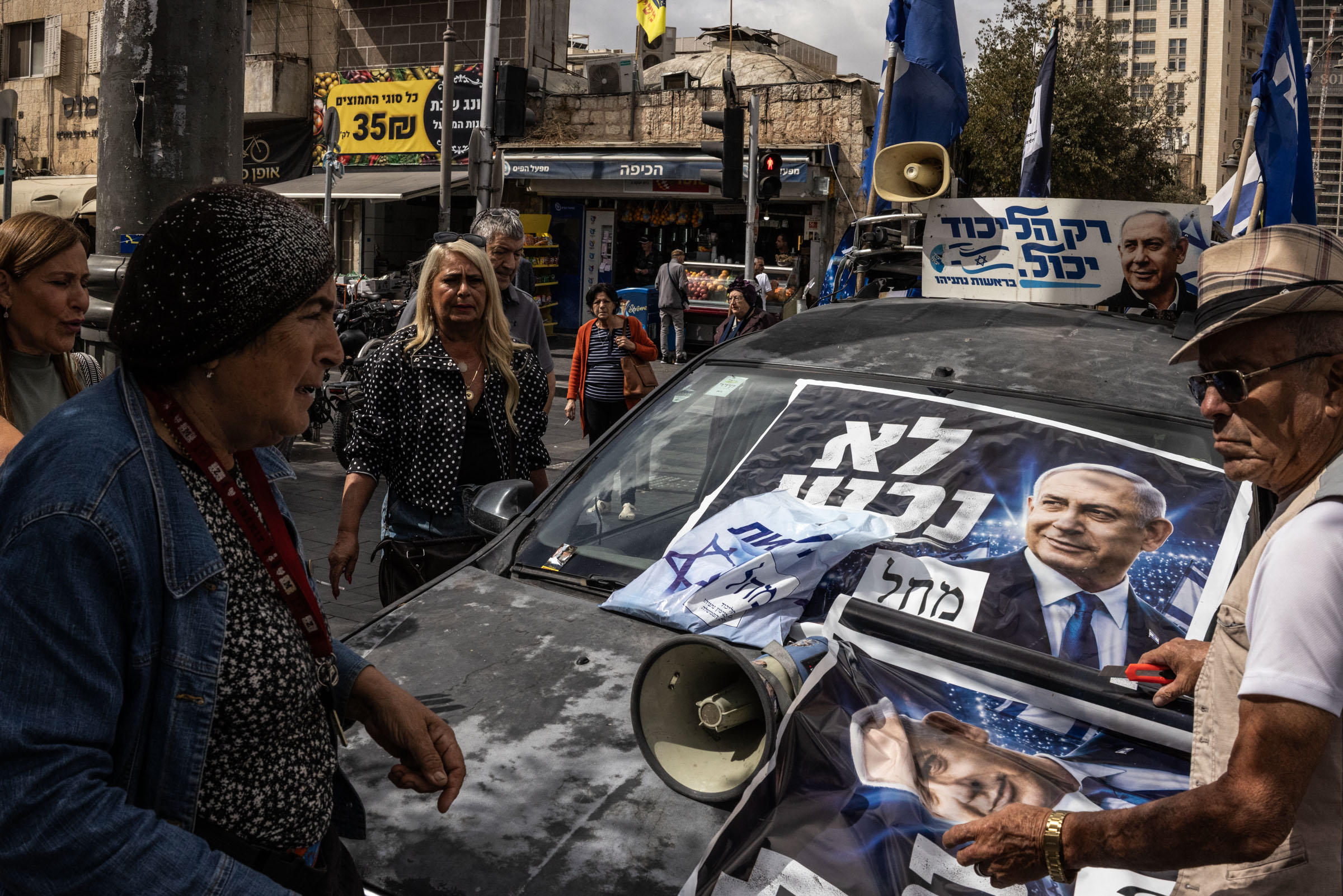
Israel's Prime Minister Benjamin Netanyahu casts his ballot, alongside his wife Sara, at a polling station in Jerusalem on Oct. 27, 2026. —Yonatan Sindel—AP
Israel appears to be on the brink of a political deadlock, with neither Prime Minister Benjamin Netanyahu nor his main rival, former Israel Defense Forces chief of staff Gadi Eisenkot, projected to gain a parliamentary majority.
While partial results show that Netanyahu's Likud party has edged ahead slightly, if the embattled leader is to forge a path for another term, he will likely need to secure a coalition. Such alliances can take weeks or months to form, meaning the future leadership of Israel’s parliament, the Knesset, remains unclear.
As of Wednesday evening in Israel, authorities had counted more than 88% of ballots cast at polling stations across the country. Another set of ballots logged at special polling sites, including military bases, have yet to be counted. Authorities estimate that somewhere between 430,000 and 480,000 votes were cast in this way. As such, it could still take another day or two for the final election results to be released.
Israel's three leading broadcasters have projected that Netanyahu's bloc of right-wing parties is on course to win 53 seats in parliament, with the opposition bloc of Eisenkot looking at 48. Both are short of the 61 seats required for a majority. Parties representing Arab Israelis are projected to secure 19 seats.
Once all the votes have been tallied, Netanyahu looks set to remain as caretaker while President Isaac Herzog holds consultations with all the political factions to determine the formation of the next government—a process that could take weeks.
"Next week, I will invite the representatives of the factions to consultations ahead of assigning the mandate to form the next government," Herzog said on Wednesday. "With the publication of the results, I ask one important thing from everyone who arrives—arrive with an open mind."
Both Netanyahu and Eisenkot have stated their own intentions to form the next coalition.
In a defiant speech made after the polls closed, Netanyahu called for a "strong, right-wing" government."
Eisenkot, in a social media update late Wednesday, said: "Long workdays still await us, but we are focused on the heavy task entrusted to us—bringing change to Israel and establishing a Zionist mobilization government."
While results remain inconclusive, Netanyahu’s longstanding ally, U.S. President Donald Trump, who gave a last-minute endorsement to the longest-serving Israeli premier, already appeared to take credit for Netanyahu’s election performance.
“You know, it's pretty close, which was very well,” Trump said when asked about it by reporters early Wednesday. “Because I think when the endorsement went out, it helped him a lot, but I actually heard he did pretty well. It might be winning or tie. The tie is sort of considered a win in that case because it’s a big chess match.”
As the vote count continues, here’s what to know about the pivotal election—and what comes next.
How Israel's election day unfolded
Israelis flocked to polling stations on Tuesday to decide Netanyahu’s political fate. The election was widely seen as a referendum on Netanyahu’s leadership and Israelis’ willingness to change course amid uncertainty.
It was the first election in the country since the Oct. 7, 2023 terrorist attacks by Palestinian militant group Hamas and the subsequent Israeli war in the Gaza Strip. Since then, Israel under Netanyahu has pursued an aggressive military campaign across the Middle East—going to war with Iran, backing settler attacks and displacement in the West Bank, and carrying out strikes against militant groups in Lebanon and Yemen
From 7 a.m. to 10 p.m. local time on Tuesday (1 a.m. to 4 p.m. EDT), Israelis were able to cast votes for representatives in the Knesset. Numbers from Israel's Central Elections Committee reflected a strong turnout, with 77.7% of eligible voters reported to have cast their ballots by 10 p.m., local time—the highest turnout logged since 1999.
Netanyahu was joined by his wife Sara as he cast his own ballot at a polling station in a Jerusalem school. “This is a very moving and fateful moment. My wife and I are truly overwhelmed,” Netanyahu told reporters after voting. “We know what is at stake, and since I am not allowed to say things explicitly, I will say: Vote correctly.”
Not long after, Netanyahu told his supporters that "buses are heading to the polling stations and huge lines are being reported in the Arab settlements." Complaining that "the right-wing strongholds are not waking up," he again urged people to go out and vote.
Netanyahu’s Likud party said in a statement that it had submitted a request to the Central Elections Committee to extend voting hours past 10 p.m. The committee later announced it would not be extending voting hours past the scheduled closing time.
Two main political blocs are contending to form Israel’s next government. The first is the pro-Netanyahu coalition led by Netanyahu’s Likud party. The coalition includes far-right and ultra-Orthodox parties, such as Otzma Yehudit (Jewish Power) led by national security minister Itamar Ben-Gvir and Religious Zionism-Zehut led by finance minister Bezalel Smotrich. Their ultranationalist policies have found an audience in younger right-wing Israelis.
On the other side are the Jewish-led opposition movements—with Eisenkot and the centrist Yashar (Straight) party at the forefront. Eisenkot, who entered politics in 2022, joined Netanyahu’s emergency war cabinet after the Oct. 7 attack on Israel. But after having lost a son in combat in Israel’s wars, Eisenkot left his post in 2024. Two of his nephews also died fighting in Gaza, a prominent campaign talking point.
The opposition also includes a joint ticket led by former Prime Minister Naftali Bennett and Knesset opposition leader Yair Lapid, the secular nationalist party Yisrael Beiteinu (Israel Our Home) led by former finance minister Avigdor Lieberman, and the Democrats led by former IDF deputy chief of staff Yair Golan.
The Democrats party on Tuesday said Golan had been “approached in a threatening manner” by a man who was found to be carrying a knife. The lawmaker was attending a voting-day mobilization tour in Tel Aviv's HaMesila Park at the time of the incident.
"Golan’s security guards blocked the man, and as they moved toward him, a large knife slipped from beneath his clothing and fell to the ground," the party said in a statement shared with the Guardian. "Police were called to the scene and arrested the suspect." Golan, in his own statement, vowed that "incitement and violence will not deter us" and encouraged people to go out and vote.
Meanwhile, some polls had suggested that Eisenkot’s Yashar party may garner slightly more support than Netanyahu’s Likud, but they also projected that neither the Prime Minister’s right-wing bloc nor the opposition were likely to win the 61 Knesset seats needed to form a government.
Including Arab parties such as United Arab List (Ra’am) and the Joint List, or fringe parties, could be necessary to form a government. Both pro-Netanyahu and anti-Netanyahu coalitions have so far ruled out teaming up with the Arab-led parties. Arab citizens of Israel make up about 20% of the population, though they receive fewer government services and endure higher poverty and unemployment rates. Discrimination and disappointment have historically depressed Arab-Israeli voter turnout. However, on Tuesday, there appeared to be strong turnout in some of Israel’s largest Arab-majority towns.
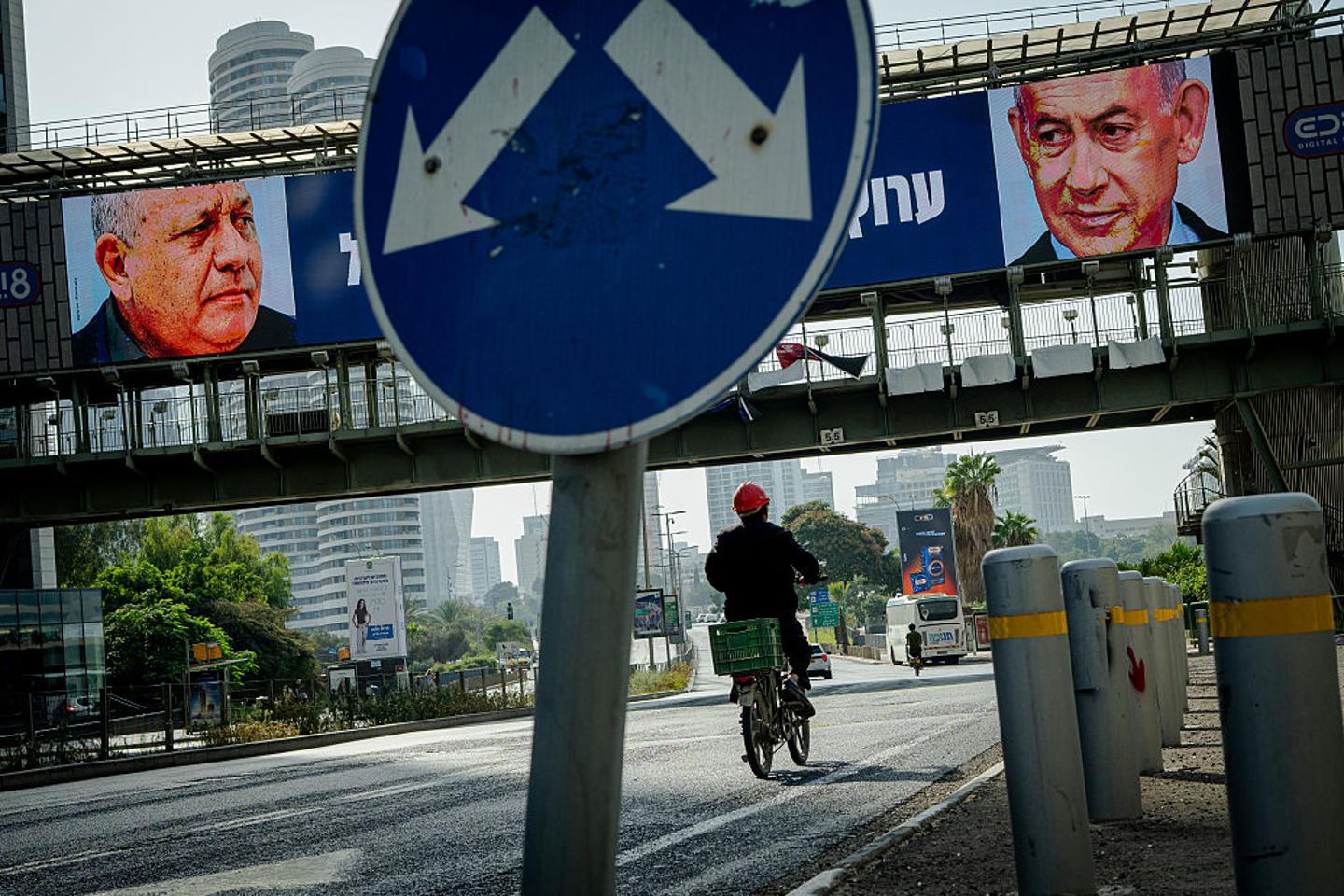
A cyclist rides beneath a pedestrian bridge displaying electronic election billboards showing former IDF chief of staff Gadi Eisenkot (L) and Prime Minister Benjamin Netanyahu (R) in Tel Aviv, Israel, on Oct. 23, 2026. —Erik Marmor—picture alliance/Getty Images
Netanyahu touts Trump endorsement
Netanyahu has brought attention to the support he received from Trump, who only announced his endorsement days before the election as conflict in the Middle East has tested their friendship.
In a late-night TV appearance on Oct. 25, Netanyahu boasted of Trump’s endorsement and said that Trump was willing to take action “that would finally, finally, remove the Iranian threat” so long as Netanyahu stayed in power. Netanyahu added that he has already instructed Israel’s national intelligence agency Mossad as well as the IDF to “bring down” the Iranian regime. Trump remains very popular in Israel.
“The President has the most effective endorsement in American, or international, political history,” said Vance, when asked in an interview if he would also be extending an endorsement of his own. “I endorse American candidates and that’s where I'm focused on, is the midterms, so I'm not getting involved in the Israeli elections.”
When pushed for an answer, Vance added: “I'm not anti-endorsing [Netanyahu], I'm not pro-endorsing him.”
A high-stakes election for Netanyahu
At stake for Netanyahu could be more than his continued leadership. The premier faces an international arrest warrant for alleged crimes related to the Israeli military campaign in Gaza. And even domestically, critics have demanded an inquiry into Netanyahu’s decision-making around Oct. 7. The attack, which resulted in over 1,200 people in Israel killed and around 250 hostages taken, is considered by many to be indicative of a major security failure.
The Gaza health ministry reports that since Oct. 7, 2023, more than 74,000 individuals have been killed. In the absence of independent monitoring on the ground, Gaza’s health ministry is the primary source for casualty data relied upon by humanitarian groups, journalists, and international bodies. Its figures do not differentiate between civilians and combatants and cannot be independently verified by TIME.
Another issue driving the election is public fury over ultra-Orthodox communities’ exemption from military conscription for men engaged in religious studies. Despite a shortage of soldiers, less than 10% of eligible ultra-Orthodox men enlist, amid demands from Netanyahu’s allies to exempt them. Eisenkot, Netanyahu’s main rival, has promised to end the de facto exemptions.
Netanyahu’s repeated attempts to reform the judiciary have also factored into this election, with critics slamming his undermining of democratic institutions and connecting it to his legal interests. Netanyahu is in the middle of a yearslong corruption trial, which he and his allies—including Trump—have claimed is politically motivated. He sought, butdidn’t receive, a presidential pardon from Herzog.
When will we know the results?
About 7.3 million Israeli citizens were eligible to vote on Tuesday. The election fills the Knesset’s 120 seats through proportional representation—which means parties, not personalities, are on these voters’ ballots.
After polling stations closed at 10 p.m. (4 p.m. EDT), local media broadcasted initial exit polls. The final vote tally is expected by Oct. 30, with official results published on Nov. 4.
But getting a clear picture of the Israeli government is likely to take longer.
No single party has ever claimed 61 seats to form a government, meaning Israel has always been governed by coalitions. What those coalitions may look like will depend on the election outcomes for smaller parties, which each need 3.25% of the votes to secure a seat in the Knesset.
Once the election winners are determined, President Herzog will refer to party leaders to choose a preferred Prime Minister and will ask the strongest candidate to form a government within 42 days. If a coalition cannot be formed after multiple attempts, the current Likud-led coalition government will continue to serve as caretaker before another round of elections is held in the coming months.
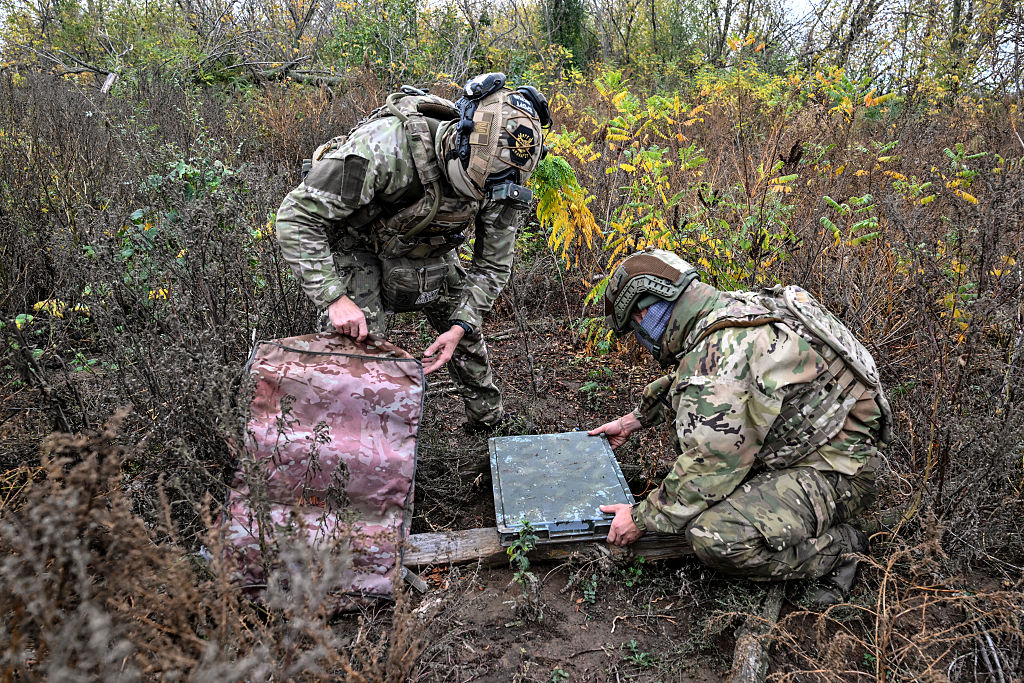
Soldiers take a camouflage case off a Starlink satellite communication terminal to be set up at a combat position in the Donetsk region of Ukraine on Oct. 16, 2026. —Dmytro Smolienko—Ukrinform/Getty Images
SpaceX CEO Elon Musk claimed over the weekend that the Ukrainian military had “violated” the terms of service for Starlink, the company’s commercial satellite internet network, which has become central to the country’s defense against Russia. Musk said SpaceX had restricted Starlink to prevent that alleged misuse. Ukrainian officials disputed his claim. His allegation came after over a week of uncertainty about why the services had been restricted.
Ukrainian officials reported on Oct. 14 that restrictions affecting SpaceX’s satellite communications were disrupting drone operations, blocking a key line of defense amid daily Russian air attacks. Ukraine relies heavily on Starlink for frontline communications, drone capabilities, and reconnaissance; the throttled connection ultimately led to the cancellation of several missions, officials said.
The restrictions also affected Starshield, a military-grade satellite communications service that uses Starlink technology but is supplied through U.S. government contracts.
Over a week after the disruption began, Ukraine's Defense Ministry said on Oct. 24 that both services had been fully restored. It reported that connections remained stable even when terminals were moving at speeds above 400 km/h.
At the time, the cause for the interruption had not yet been clarified, but Defense Minister Yevheniy Khmara emphasized the importance of a strong and stable connection, calling it “vital for our front line, for our military personnel, for the operation of drones, and for logistics and communications.”
Musk maintains that the United States government controls changes to Starshield, leaving questions about who authorized its restrictions—and why.
U.S. President Donald Trump declined to identify those involved in the decision, while a Reuters report from Oct. 15 cited multiple officials who said the order came from inside the White House. The sources did not identify who authorized or implemented the restrictions, but a senior U.S. official denied that it was Trump, the report said.
Experts say that the disruptions expose a growing vulnerability in modern warfare: military reliance on a single private technology supplier.
The company that controls the technology can ultimately wield significant influence over military operations, leaving governments dependent on decisions made by executives and billionaire owners outside traditional diplomatic channels, experts warn.
Why U.S. control of Starshield matters for Ukraine
Ukraine’s access to satellite communications depends on decisions made in Washington as well as at SpaceX. That leaves Kyiv navigating both a private supplier’s restrictions and a fraught relationship with the Trump Administration.
In recent weeks, Trump has repeatedly blamed Ukrainian strikes on Russian oil refineries for rising global fuel prices and called on Ukrainian President Volodymyr Zelensky to stop those attacks—despite the fact that experts have primarily attributed the price surge to the U.S. war with Iran.
Trump said on Oct. 15 that Zelensky was “more difficult to deal with” than Russian President Vladimir Putin and on Oct. 19 suggested that it was “time for somebody else to negotiate on behalf of Ukraine.”
Alex Crowther, an adjunct professor at Florida International University’s Jack D. Gordon Institute for Public Policy, says the Starshield dispute goes beyond Trump’s souring relationship with Zelensky to a more basic question: Who has the authority to restrict Ukraine’s access?
“Usually when [a foreign entity] signs a contract with an American company, it says who has the capability to turn this stuff on and off, and the circumstances under which they can turn it on and off,” Crowther says, questioning who has that authority over the services Ukraine relies upon. “Is it Starlink, which is private, or is it Starshield, which is an American government contract? Is it Musk? Is it Hegseth? Is it Trump?”
“Nobody knows the rules right now,” he says.
Lance Hunter, a professor of political science at Augusta University, tells TIME that this dispute exposes the potential issues of having three different actors—the Trump Administration, SpaceX, and Ukraine—with potentially incompatible priorities.
How dependence on SpaceX limits Ukraine’s military autonomy
Hunter says that what is unfolding in Ukraine underscores warfare’s growing dependence on digital technology. Beyond traditional “tanks, bombs, planes,” he says that includes factors like artificial intelligence, drones, and navigation jamming.
Reliance on ongoing technology services creates a different relationship from a traditional arms purchase, Hunter says.
He points to traditional arms deals in which a private company sells a government a set amount of missiles or interceptors.
“Let's say you purchase a piece of weaponry or vehicle or any type of object that helps you in the conflict: You own it at that point. You have control over it,” Hunter tells TIME.
The relationship between Ukraine and SpaceX, however, is different; purchasing the technology does not guarantee operational sovereignty.
“Ukraine has a lot of transmitters which interface with Starshield and Starlink, and they're very much dependent on SpaceX as far as allowing them to use those when they need to,” Hunter continues. “There's not just a one-time dependence buying the technology; it's continual now.”
That gives the company more “influence and leverage” over conflicts than it has before, he adds.
It shifts the way that countries like Ukraine need to think about who they are willing to work with and how they weigh the potential costs.
Why Ukraine cannot easily replace Starlink and Starshield
In a perfect world, Hunter says, Ukraine would diversify its technology suppliers to decrease reliance on Starlink.
The country has already been expanding its domestic weapons production, including interceptor drones. But it remains dependent on foreign suppliers for critical air-defense weapons like the U.S.-made Patriot interceptor missiles.
That dependence has left it vulnerable to shortages and delays. On Oct. 26, Zelensky said Ukraine had been waiting nearly a month for Defense Secretary Pete Hegseth to approve supplies of missiles for its Patriot and NASAMS air-defense systems.
But replicating satellite communications networks presents a different challenge. Starlink technology is not something a government can easily reproduce domestically, Hunter says, and few providers worldwide offer comparable capabilities.
“Starlink has a monopoly on that technology to a degree, as far as the speed, the availability, the flexibility,” he says. “It's not like they can just flip a switch and diversify that technology. It takes a lot of time. It takes a lot of resources. It takes a lot of effort, and also in Europe we don't see that same level of technology with some of the European countries and also with some of the private companies.”
In the end, he says that Ukraine is stuck between “a rock and a hard place” as the country tries to negotiate its relationships with the Trump Administration and, separately, with Musk.
“You're reliant on the politics of those bodies all matching up,” he says of Ukraine. “All of a sudden, you kind of lose that autonomy.”
“If they really push back against the U.S. government or SpaceX, they have the potential of receiving less of the technology and being cut off to a greater extent,” he adds. “But if they don't really push at all and advocate for their interest as well, then they could be in a weaker position as far as having leverage exerted over them.”
Why Ukraine disputes Musk’s Starlink claims
In a social media post on Oct. 24, Musk said that SpaceX had restricted Starlink access deliberately because Ukraine's military violated Starlink's terms of service by using the civilian satellite network for offensive drone strikes.
“Ukraine military violated Starlink terms of service and used it for offensive drone strikes to kill people. That loophole was closed last week,” Musk said in one post. “Using Starlink, a civilian commercial service, for offensive drone strikes to kill people has never been allowed, nor should it be.”
Musk explained that Starlink continues to be “critical to the defense of Ukraine,” but that it could not be used for offensive military operations.
Defense technology adviser Serhii Beskrestnov wrote in a Telegram post that operational and speed restrictions are in place that make it “physically impossible” for the military to use Starlink for medium- or deep-range offensive strikes.
“It is very strange that Elon Musk is unaware of the operational limitations of Starlink in Ukraine,” he wrote. “Starlink does not function over the territory of Russia.”
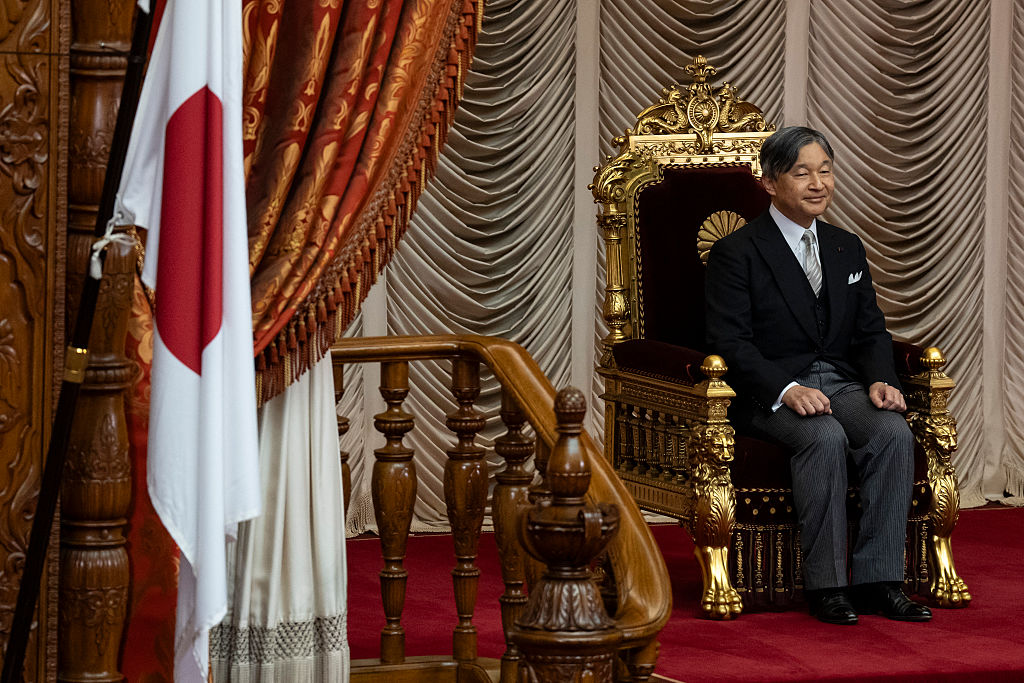
Japan's Emperor Naruhito attends the opening ceremony of an extraordinary Diet session at the House of Councillors at the National Diet in Tokyo, Japan on Oct. 5, 2026. —Yuichi Yamazaki—AFP/Getty Images
Japanese lawmakers are reforming the country’s more-than-a-millennia-old continuous hereditary monarchy in an effort to keep it alive amid a shrinking imperial family.
Amendments to Japan’s Imperial House Law that passed in July took effect on Saturday. One allows Japanese princesses to keep their royal status even if they marry non-royals, though their future children are not considered royals. The other amendment is an apparent roundabout way to preserve patrilineal succession: members of the royal family may adopt a male from former imperial branch families, and those adoptees’ future male offspring can be considered legitimate successors to the throne.
The revisions aim to expand the future pool of eligible heirs to the throne while reinforcing the shutting out of women from leading the Japanese monarchy, which staunch conservatives including the country’s first female Prime Minister, Sanae Takaichi, have repeatedly advocated against upending.
Before the revisions took effect, Emperor Naruhito only had a few viable successors: his younger brother Akishino, followed by his 20-year-old nephew Prince Hisahito, then his 90-year-old uncle Prince Hitachi.
The small pool had raised concerns about the future of the Japanese imperial family. The Japanese public has shown support for female monarchs, signaling a preference to keep the renowned family on the throne. Fans of Princess Aiko, the emperor’s sole daughter, have marched in Japan’s streets in recent weeks in support of her eligibility to become empress.
But extreme right-wing factions in Takaichi’s Liberal Democratic Party have insisted that maintaining only males from the male imperial line as eligible to become emperor preserves the authority of the Chrysanthemum Throne. The revisions were ultimately borne out of the coalition agreement signed in October last year by the LDP and its junior partner, the Japan Innovation Party.
While the Imperial Household Agency has said it will study how to implement the measures, critics are already studying how to turn the policy over, arguing that it violates the country’s anti-discrimination law. Manga artist Yoshinori Kobayashi filed a lawsuit against the government that called the amendment “unconstitutional.”
Experts say the amendments could affect how the Japanese public views the imperial family.
“It could dilute the feeling of closeness or the feeling of holiness that some people might feel towards the royal family,” Jeffrey J. Hall, a lecturer at Kanda University of International Studies, tells TIME, “because they're more used to the royals that they already know.”
Welcoming back the former imperial family branches
The amendments allow members of the imperial family to adopt a male who is 15 years of age or older and is also a legitimate descendant of a male member of the imperial family before it was trimmed down after World War II. That adoptee should not be married or have children.
Several branches of the Japanese imperial family renounced their royal status in 1947 to cut down on costs the monarchy incurred after the war. Government officials previously said that these 11 families split from a common male-line ancestor some 600 years ago, and are now at least 36 degrees of kinship from Naruhito.
However, the adopted males would not be eligible for the throne—only their eligible male offspring would be. The law would be reviewed every 30 years.
Jeff Kingston, a professor of Asian history at Temple University’s Japan campus in Tokyo, tells TIME the government’s offered solution to the dwindling pool raises questions about the legitimacy of the potential heirs. “Would these people be taken as legitimate by the public?” he says remains an open question, especially as reports surface about who those potential additional successors to the throne might be. “The problem of a monarchy is it’s sort of based on—I don't know—a collectively held myth, belief, faith; and a sausage maker probably isn't going to have that magic.”
Hall, from the Kanda University of International Studies, echoes that the Japanese government will find it difficult to convince the public, especially since the move would introduce unfamiliar faces. “It will be a very difficult problem for the Japanese government to try to basically build up an ideology or a PR program that convinces people that the new royal adoptees are just as royal as the other ones that we all know.”
Snubbing the nation’s popular princess
Kingston says that conservatives proposed the amendments to ensure that a female-led monarchy wouldn’t happen in Japan, even when many Japanese people appear fine with it and some even seem to prefer it. Past media surveys have shown that more than 80% of Japanese respondents favored a female emperor.
Protesters took to central Tokyo’s streets on Oct. 10 to call for further debates on the Imperial House Law, claiming that Princess Aiko, who is 24, should be eligible for the throne.
The other amendment that took effect allows Aiko and the four other single princesses to retain royal status if they get married to people outside the imperial family. Before, princesses who did so lost their royal status, meaning their children are ineligible for the line of succession; the most recent being Mako, one of Naruhito’s nieces. Mako married her college boyfriend in 2021 and has since moved to the U.S.
Hall describes the recent amendments as “very strange” and suspects “many Japanese people won't really fully grasp” them. An August poll from the Social Survey Research Center came to a similar conclusion that the revisions to the Imperial House Law “have not gained the understanding of the Japanese public.”
While Naruhito and the royal family have largely ceremonial duties and do not weigh in on the country’s politics, they have even hinted at what they think should be done. In June, the emperor said he hopes any decision to expand the imperial family should have public support: “I hope it will be something that gains the understanding of the people.”
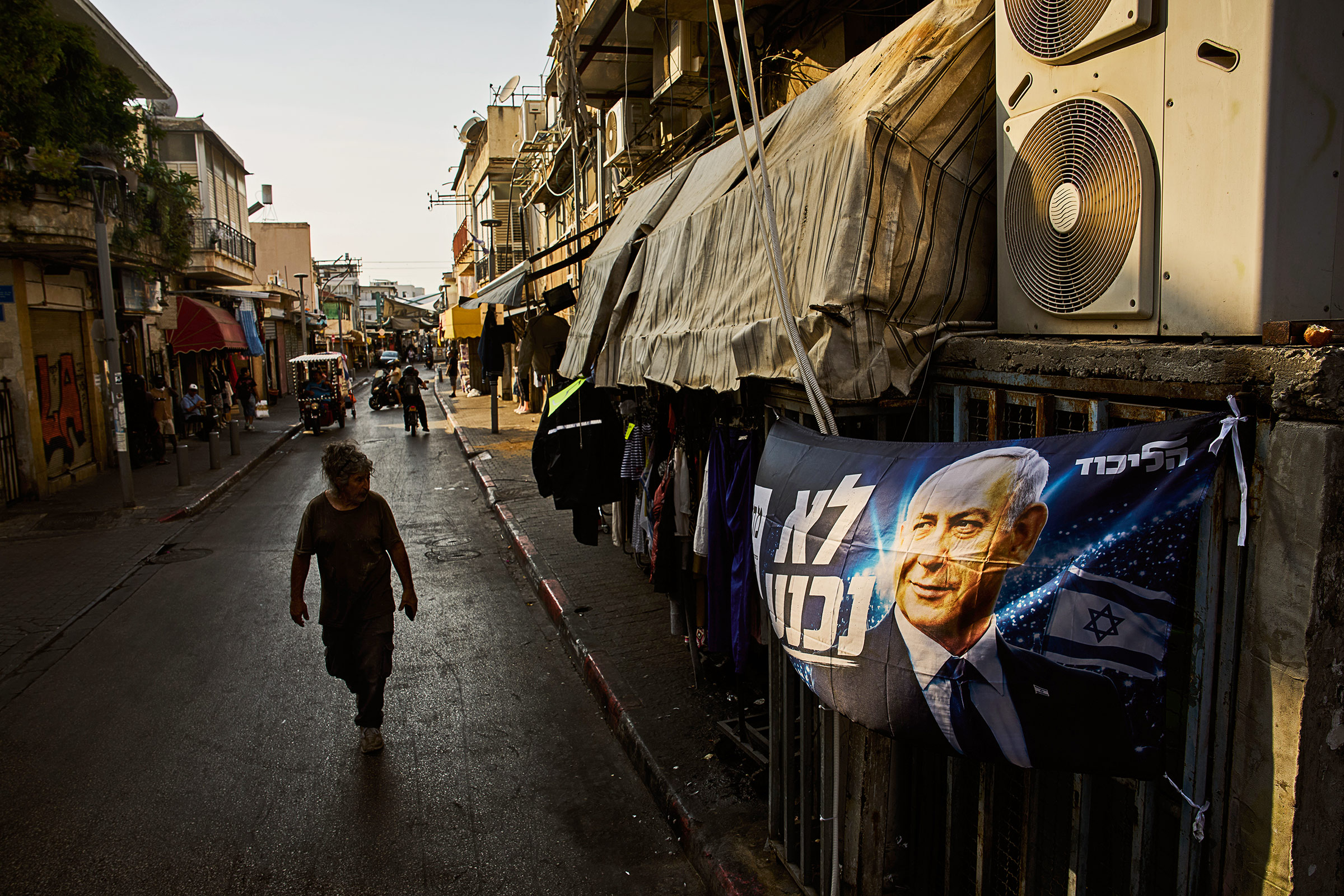
An election campaign banner featuring Israeli Prime Minister Benjamin Netanyahu hangs on a store ahead of Israel's general election in Tel Aviv, Israel, Monday, Oct. 12, 2026. —Oded Balilty—AP
The Israeli settlement of Neve Daniel sits south of Jerusalem, atop one of the highest ridges in the West Bank, nearly 1,000 meters above sea level. The view to the east stretches to the mountains of Jordan, and to the west across the Mediterranean coastal plain—where most Israelis live. But the tranquility of the landscape belies the political fervor animating the Oct. 27 election, a contest with stakes as great as any in the 78-year history of the world’s only Jewish state. When I ask three residents what will ultimately determine their votes, one responds with particular ferocity.
“Seven hundred trucks were delivered to Hamas today by Israel,” says Barak Moore, who has lived in Neve Daniel for 14 years. He’s referring to commercial goods and international aid entering the Gaza Strip. “We’re paying a terrorist organization that committed the greatest atrocity against the Jewish people since Auschwitz.”
While much of the world has come to define Israel by its military actions in Gaza since Oct. 7, 2023, Moore’s views reflect the passions coursing through a society still traumatized by that day. Israelis tend to be less preoccupied by the nearly 75,000 Palestinian fatalities in Gaza since the war began, than by the 1,200 people killed in Israel and 251 hostages taken by Hamas—the women subjected to sexual violence, the children shot at point-blank range, the families burned alive in their homes. In a country so small and intimately connected, scarcely anyone was untouched by events that shattered the assumptions of a people whose nation was founded to give Jews a safe haven in their ancestral homeland.
Both the Hamas massacre and the wars that followed loom over a vote shaping up not only as a referendum on Benjamin Netanyahu, but also the nature of the country that, as Israel’s longest serving prime minister, he has done so much to shape.
Arrayed against Netanyahu is a fractured field of challengers. There is Gadi Eisenkot, the former military chief whose reputation for honesty, sobriety, and competence contrasts with Netanyahu’s polarizing leadership; Naftali Bennett, the right-wing former prime minister seeking a comeback; Yair Lapid, the centrist former premier who has spent years trying to dislodge Netanyahu; and Avigdor Lieberman, the hawkish secular nationalist who has become one of Netanyahu’s fiercest adversaries.
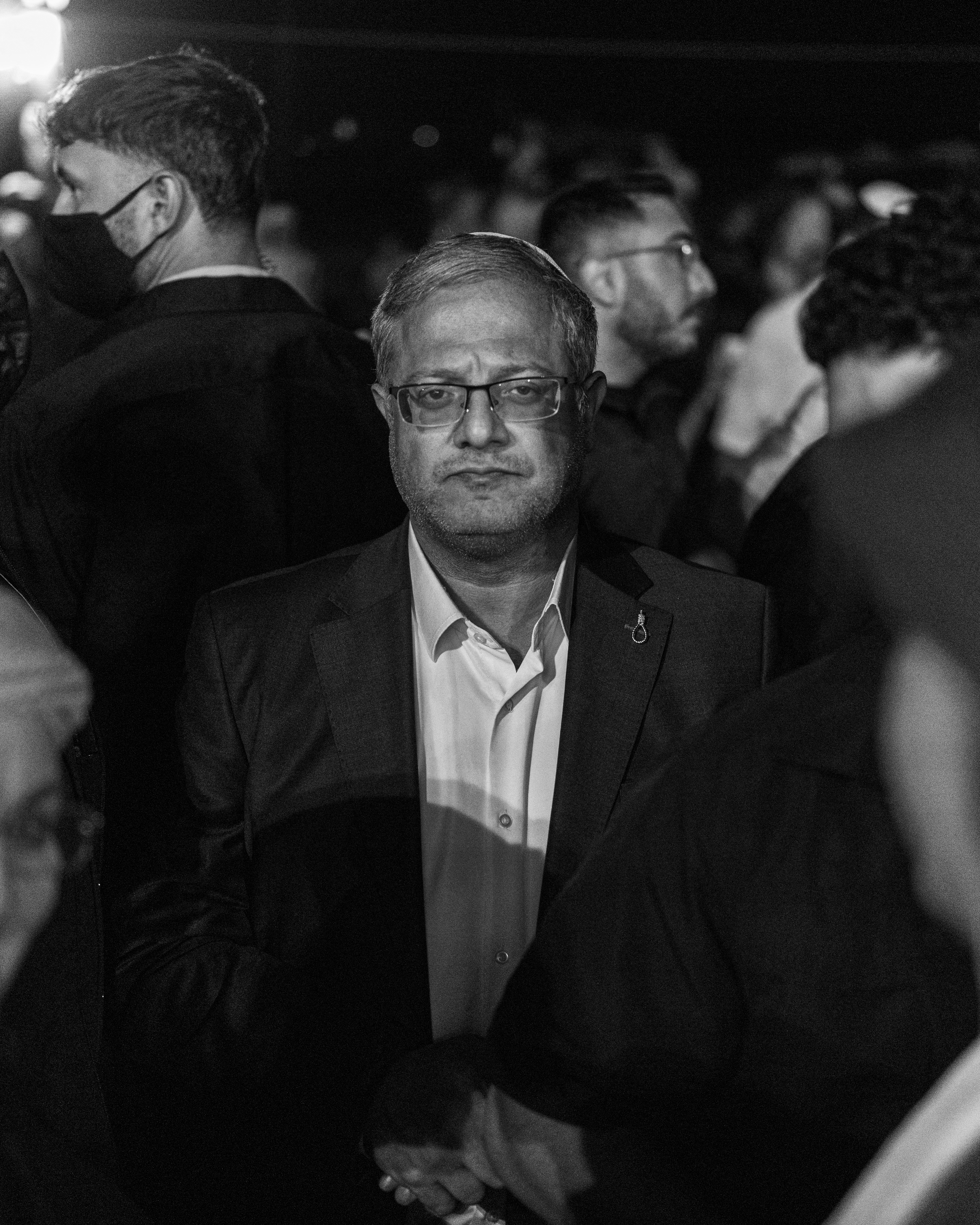
Also on the ballot: Itamar Ben-Gvir and Bezalel Smotrich, far-right extremists whose parties made possible Netanyahu’s current coalition, and whose ambitions to annex the West Bank and resettle Gaza constrain his room to maneuver while damaging Israel’s standing abroad. The next government will either push Israel further down the path of religious nationalism, permanent conflict, and international isolation—or toward a new generation of leadership.
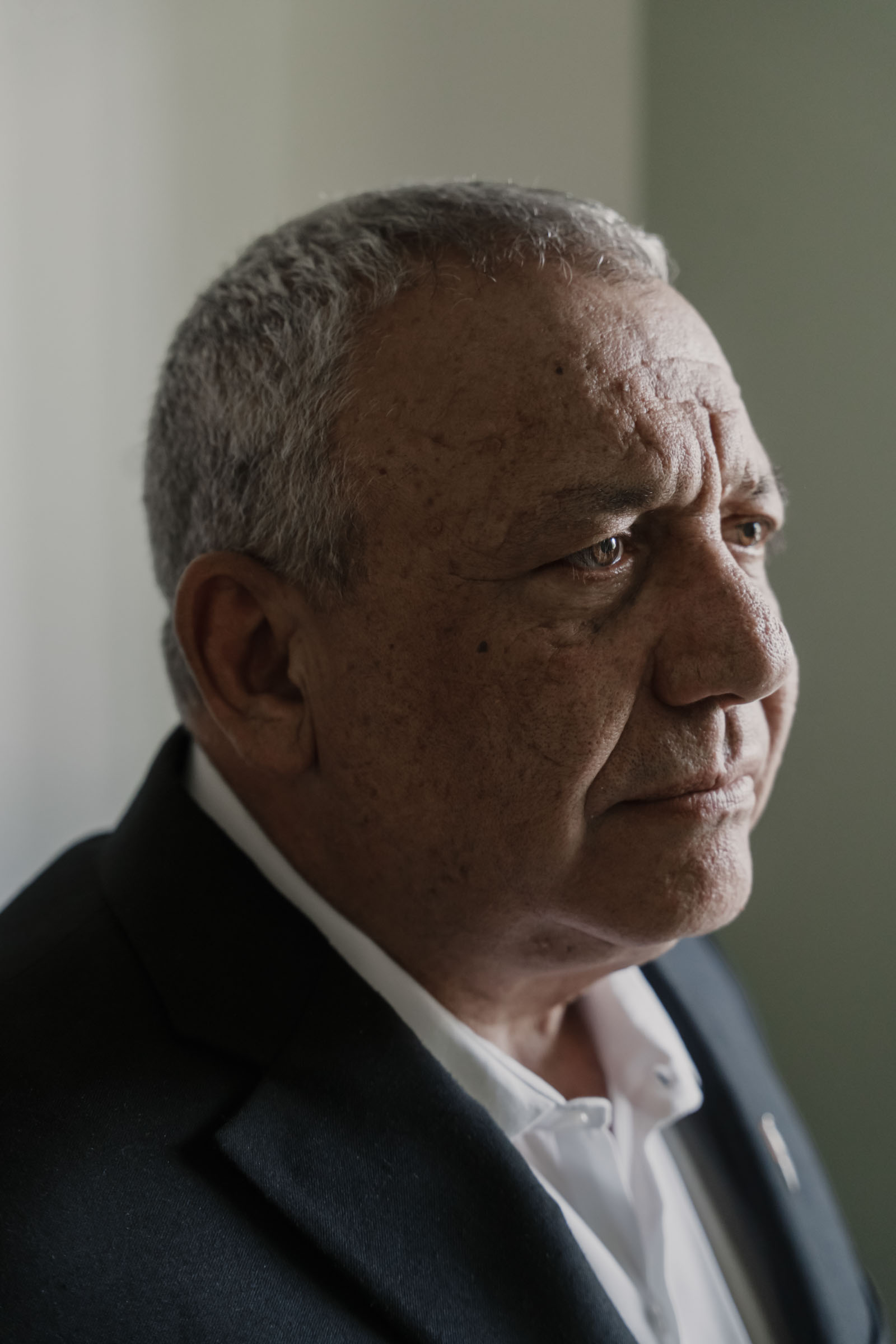
According to the polls, Netanyahu’s strongest challenger is Eisenkot, a soft-spoken, heavyset career soldier running as a centrist. His son, Gal, was killed fighting Hamas in Gaza, and one of his nephews also died in the war. Eisenkot is campaigning on a promise to restore public trust in government, rebuild Israel’s security, and heal the divisions that have fractured the country. “This election is about the identity of Israel,” Eisenkot told TIME in an interview on Oct. 20. “What will be Israel two weeks from now, 10 years from now, 20 years from now? This is the main question.”
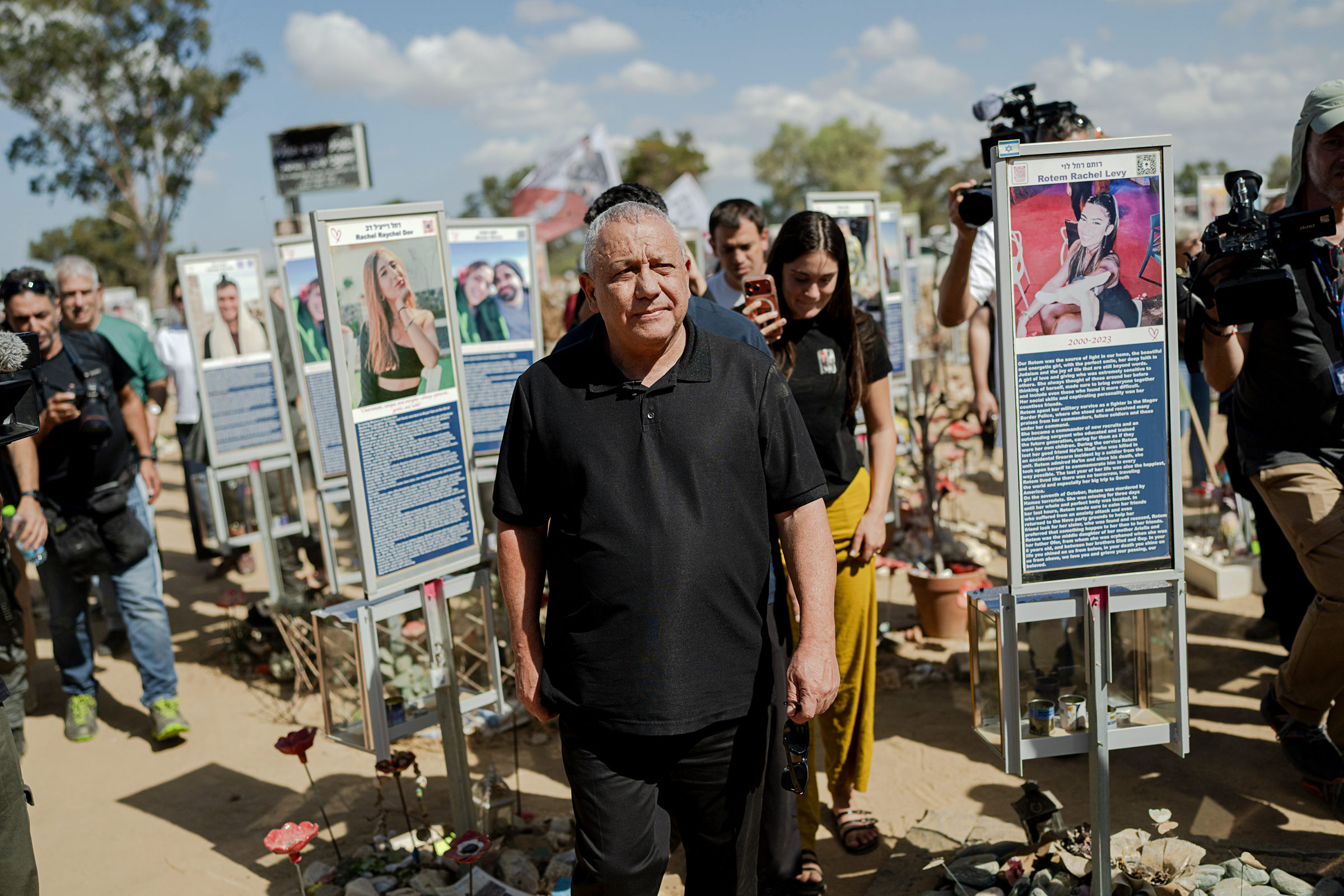
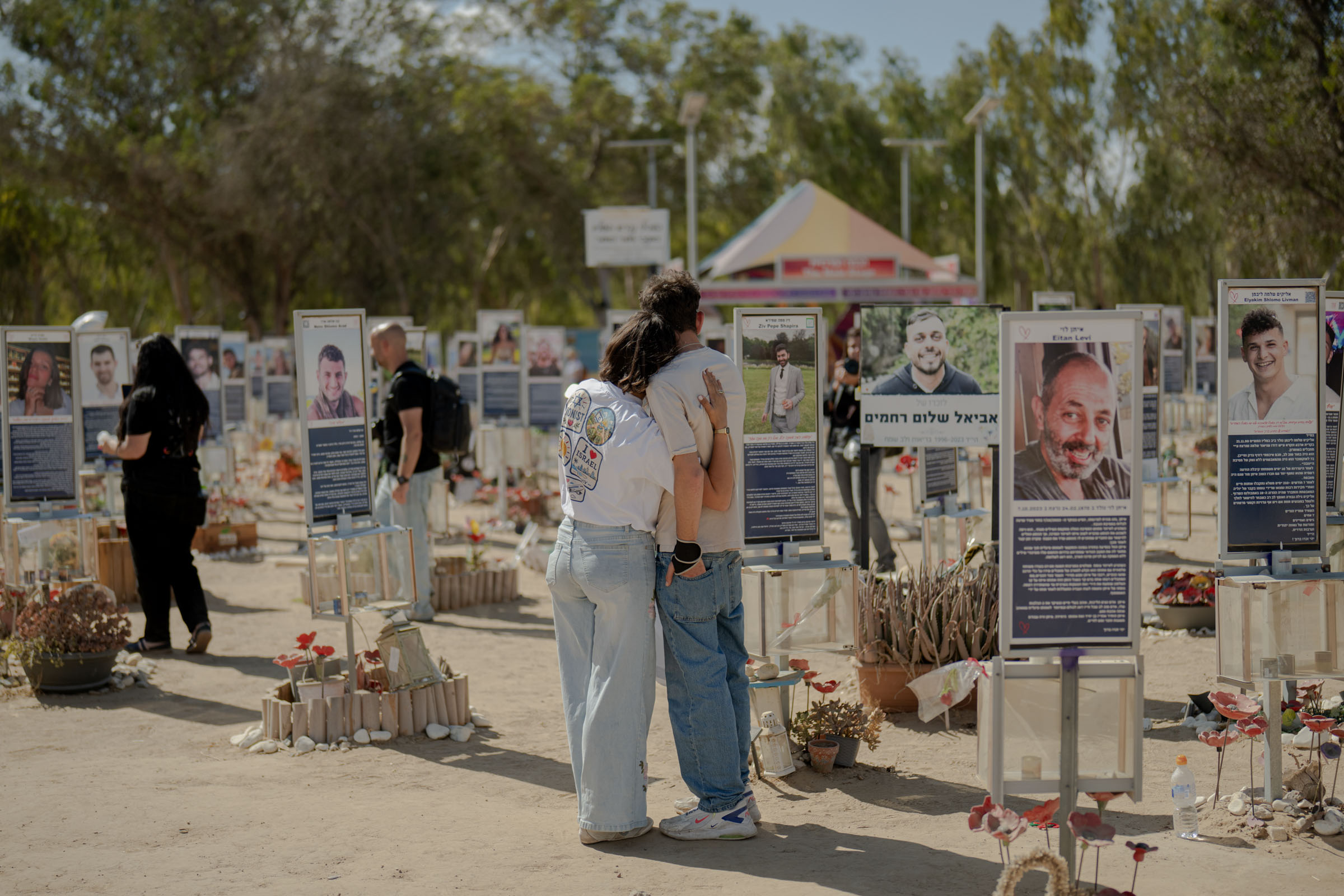
Gadi Eisenkot walks past memorial displays honoring victims at the Nova music festival site as Israel marks the third anniversary of the Oct. 7th 2023 attacks. —Erik Marmor—Getty Images
Three years after Netanyahu’s political obituary was being written, pre-election polls show him running in a dead heat. On the eve of the vote, the nation is suffused with a sense of uncertainty; political analysts say almost anything can happen. Netanyahu and Eisenkot could form a unity government. Netanyahu could cobble together another right-wing coalition, dragging Israel further right. Eisenkot could join forces with Bennett, Lapid, and the Arab parties (20% of Israeli citizens are Palestinian) to oust Netanyahu, producing the closest thing Israel could muster to a center-left government. Or perhaps no bloc will manage to pull together the 61 Knesset seats needed for a majority, plunging Israel into another round of elections and a reprise of the paralysis that produced five contests between 2019 and 2022.
“The most probable scenarios currently are either there will be some sort of unity government, which again is very complicated politically because all of the opposition parties swear they don’t want it under Netanyahu, and I don’t see how Netanyahu is going to sit under them,” says Nimrod Nor, an expert on Israeli politics at Hebrew University. “The other is we’re going to have another election after this one.”
According to two sources familiar with Netanyahu’s thinking, he would prefer to form a unity government with Eisenkot. One reason is legacy. He believes such an alliance offers his best chance to transcend the worst security failure in the nation’s history, and to be remembered not only as the leader who emerged from the slaughter of Oct. 7 to decimate Hamas in Gaza and Hezbollah in Lebanon and persuade an American president to wage war against Iran, but also as the statesman who helped to reconcile a divided nation.
The other reason, the sources say, is personal. Netanyahu has little desire to form another right-wing coalition that would leave him beholden to the radical and uncompromising parties led by Ben-Gvir and Smotrich, both of which he brought into government four years ago to reclaim power. “He thought that he could control Ben-Gvir,” one Netanyahu aide says. “Now he knows that he can’t.”
That is precisely what the Israeli right fears he’s thinking, and what brought me to Neve Daniel. The settlement of capacious red-tiled homes is just across the Green Line that defined Israel’s borders before the Six-Day War of 1967. It was built on land that was a Jewish farm even before Israel was founded in the crucible of the 1948 war. Settler violence against Palestinians has risen sharply during Netanyahu’s tenure, but the militant settlers who make headlines by terrorizing their Palestinian neighbors tend to live on hilltops deeper into the West Bank than this.
But few, if any, of the 700,000 Israelis who live in settlements are leftist. Many regard Netanyahu as a cynical opportunist—a political chameleon who parrots their convictions but will do whatever it takes to survive. Among his many heresies, they say, is a long history of accommodating American presidents: signing the Wye River Memorandum under Bill Clinton to advance the Oslo peace process that aimed to create a Palestinian state; voting for the disengagement from Gaza under Ariel Sharon and George W. Bush; endorsing, at least rhetorically, a two-state solution and imposing a moratorium on settlement construction under Barack Obama; and, under Donald Trump, accepting a ceasefire and hostage-exchange agreement to end the war in Gaza.
Three people in Neve Daniel offer a revealing glimpse of the forces pulling Netanyahu rightward. Each plans to vote for a different party, but they all share an overriding objective: a right-wing government with Netanyahu at its center, constrained by allies who will keep him from drifting toward the middle.
Barak Moore is supporting Zehut, a libertarian nationalist party founded in 2015, whose eclectic platform combines tax cuts, the dismantling of monopolies, and cannabis legalization with an uncompromising vision of Israeli sovereignty and the removal of Palestinians from Gaza. It is something of a right-wing hipster party, blending free-market economics with religious nationalism.
Avi Abelow, 52, an activist who runs the website Pulse of Israel, is voting for Netanyahu’s Likud Party. His complaint is not that the prime minister has gone too far in Gaza, but rather that he has not gone far enough, hamstrung by a security establishment and governing coalition insufficiently committed to the nationalist cause. “We should have conquered all of Gaza and made sure it’s Jewish again,” he says.
The youngest of the three, Hershey Kellner, is a 19-year-old Orthodox Jew who moved to Israel from New Jersey just months before Oct. 7. He is supporting Otzma Yehudit, the far-right party led by Ben-Gvir, whose confrontational politics and open contempt for established norms have made him a hero to some of Israel’s most fervent ideologues. Helner admires Ben-Gvir’s push to expand civilian gun ownership, permit Jewish prayer on the Temple Mount, and introduce the death penalty for terrorists.
To explain his thinking, Kellner invokes one of the most consequential decisions in recent Israeli history: the 2011 deal that freed the Israeli soldier Gilad Shalit in exchange for more than 1,000 Palestinian prisoners. Among them was Yahya Sinwar, who would go on to mastermind the Oct. 7 massacre. Helner believes that sparing Sinwar’s life was a catastrophic mistake. “If you hanged him or put a bullet in the back of his head, not sure how the world would be now,” he says, “but it would definitely be better.”
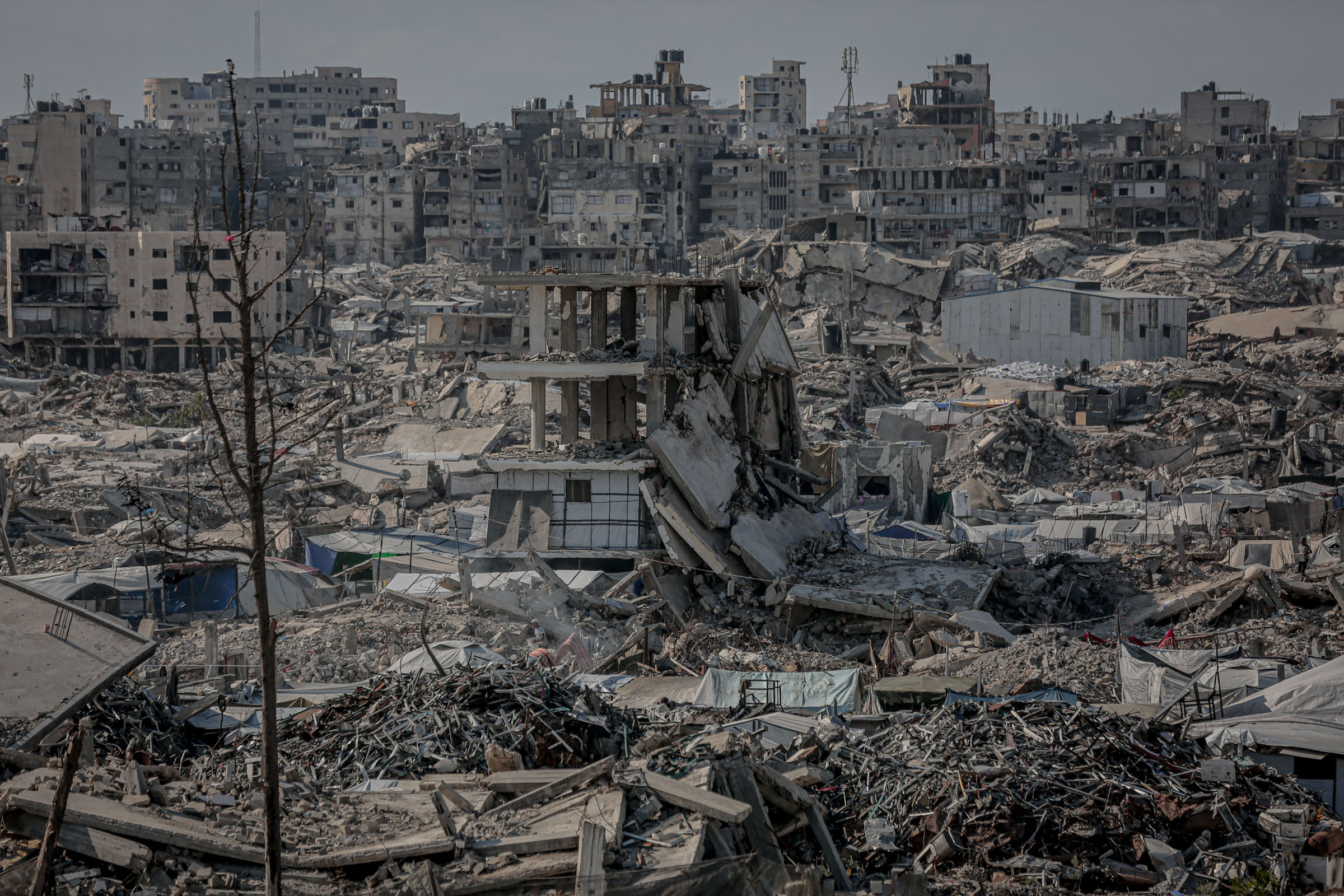
For three years, Israel has been a nation at war, not only with its enemies but with itself. The extraordinary solidarity that followed Oct. 7 has given way to recriminations and ideological divisions, intensified by the trauma of war, the anguish of the hostage crisis, the pain of deepening antisemitism worldwide, and the unresolved question of who bears responsibility for such a stunning security lapse. Though Israel rejects the charge, critics accuse the country of committing a genocide in Gaza, where the dead include both uncounted Hamas fighters and 20,000 children—and of countenancing a thuggish brand of ethnic cleansing in the West Bank. On Oct. 16, masked settlers were filmed attacking Palestinians and European diplomats in the West Bank, and injuring a Washington Post photojournalist.
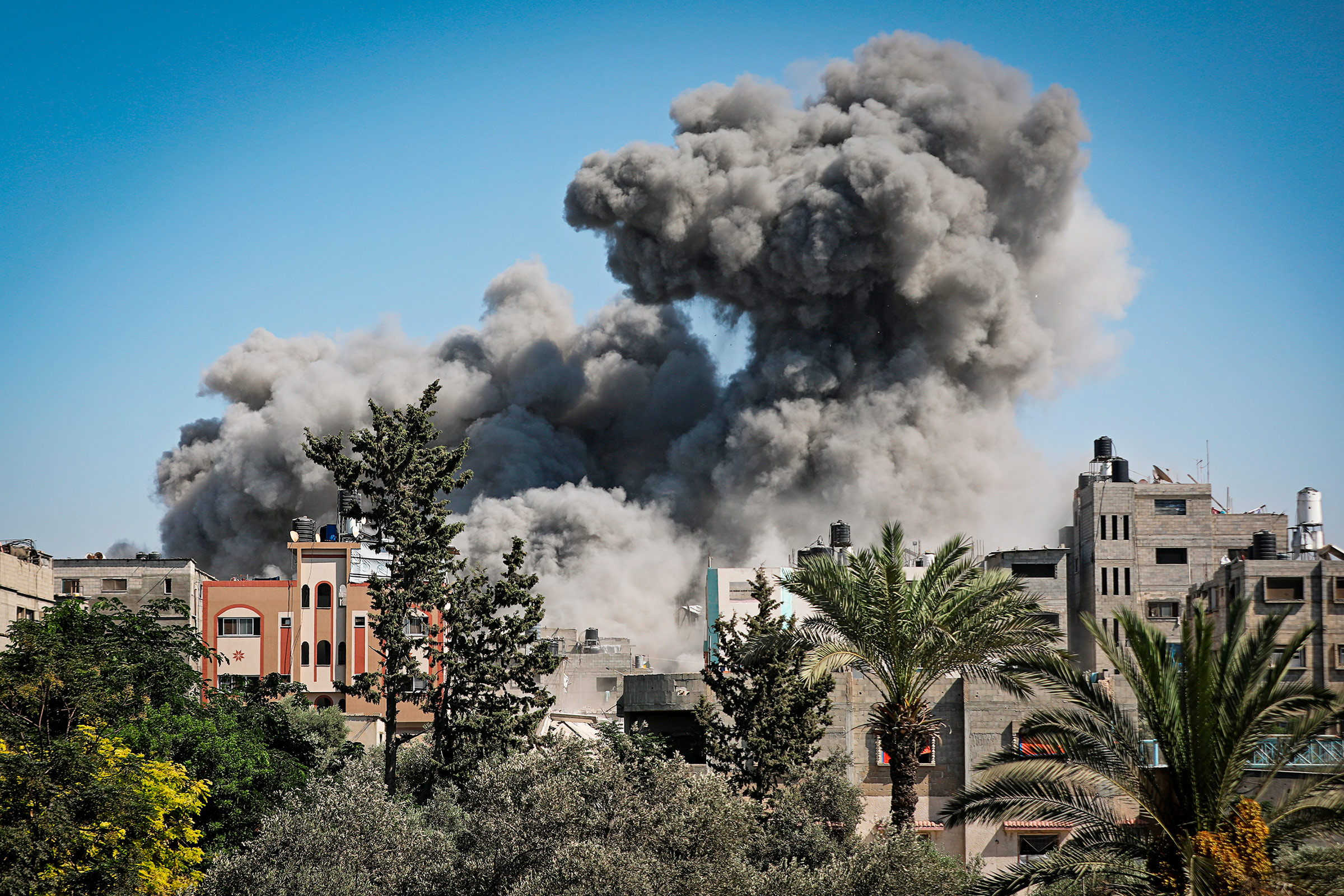
Smoke rises above Gaza after and Israeli air strike on Sept. 8, 2026. —Moiz Salhi—Anadolu/Getty Images
The fault lines run through nearly every aspect of Israeli life. Secular and religious. Liberals and nationalists. Those obliged to serve in the military and the ultra-Orthodox who are not. Those who believe Israel must reach an accommodation with the Palestinians and those who want permanent Israeli control over the West Bank and Gaza. And, not least, those who regard Netanyahu as the indispensable guarantor of Jewish security and those who see him as the principal threat to the country’s democratic character and reputation abroad.
The fear increasingly voiced across Israel’s political and cultural establishment is that another Netanyahu victory could push those divisions toward a societal rupture. After Netanyahu’s coalition moved in early 2023 to restrict the power of the Supreme Court, the prospect of another government dependent on religious and ultra-nationalist parties has raised the specter of an exodus of young Israelis, who see the country’s liberal and democratic traditions slipping away. In a recent survey by the Agam Institute, an Israeli research firm, and the Hebrew University of Jerusalem, 59% of Israelis said they believe internal threats are greater than external ones, while 64% said they were considering leaving Israel, citing insecurity, living costs, and political instability. In a nation of roughly 10 million, even the departure of tens of thousands of highly educated citizens could have consequences far beyond their numbers, draining the country of the talent and investment on which its economic and military strength depends.
There is a deeper irony. Israel was founded as a refuge, a place where a people long subjected to persecution and exile could finally determine their own destiny. Some Israelis now contemplate leaving, not because they have lost faith in the necessity of a Jewish state, but because they fear the political direction of the state created to provide one.
For those contemplating a future abroad, there is an unsettling question: Where, exactly, would they go? Antisemitism has surged across much of the world, with 2025 marking the deadliest year for Jews in the diaspora in more than three decades, according to Tel Aviv University. Israel has become increasingly isolated, condemned in international forums, denounced in the streets of European capitals, and regarded by many critics as a pariah state. The result is a profound paradox: Israelis who fear for their country’s future wonder whether they would be any safer, or more welcome, anywhere else.
It is this siege mentality, the sense of a small nation standing alone against a hostile world, that Netanyahu is counting on to sustain his political survival. He has spent much of his career presenting himself as a leader hardened by history, experienced in diplomacy, and ruthless in the exercise of power. His message: Whatever Israelis think of him personally, whatever blame they assign him for Oct. 7, the world is too dangerous to entrust their security to anyone else.
The chasm between how Israelis see themselves and how much of the outside world sees them has rarely seemed wider. In the new documentary NAZA, Israeli filmmakers draw on the anonymous testimony of 24 soldiers and intelligence officers to expose what they describe as the military’s systematic use of artificial intelligence to identify Hamas targets in Gaza, even when commanders knew that bombing them would kill women and children. Inside Israel, meanwhile, the fifth season of Fauda, the country’s enormously popular television thriller, recreates the atrocities of Oct. 7 in harrowing detail, immersing viewers once again in the terror, grief, and vulnerability of that day.
One production focuses on the suffering Israel inflicted, the other on the suffering Israelis endured. Together, they illuminate the competing narratives of a war that has left Israel increasingly estranged from the world, and many Israelis feeling more besieged than ever. Indications from polls and analysts are that even after voters have their say, no one bloc will have mustered a legislative majority. At that point the leading vote-getter will have weeks to try to gather a coalition, a test of the kind of political leadership at which Netanyahu has long excelled.
For nearly three decades, Netanyahu has been the dominant figure in Israeli public life, his political fortunes rising and falling with the country’s anxieties and ambitions. He has survived scandals, indictments, electoral defeats, and repeated attempts to engineer his ouster. The question is whether a political system he has spent so long mastering can produce a future that no longer revolves around him.
In a country not yet 80 years old, many are ready to chart a new era. “I think that Eisenkot is the one,” says Livna Savir, 72, at a rally for the challenger on a basketball court in Kibbutz Netzer Sereni, outside of Tel Aviv. “It’s a change of direction.” With her children living in the U.S., she laments the impacts of the last three years on a once unified group: “What happened now in our country—it’s not good for the family.”
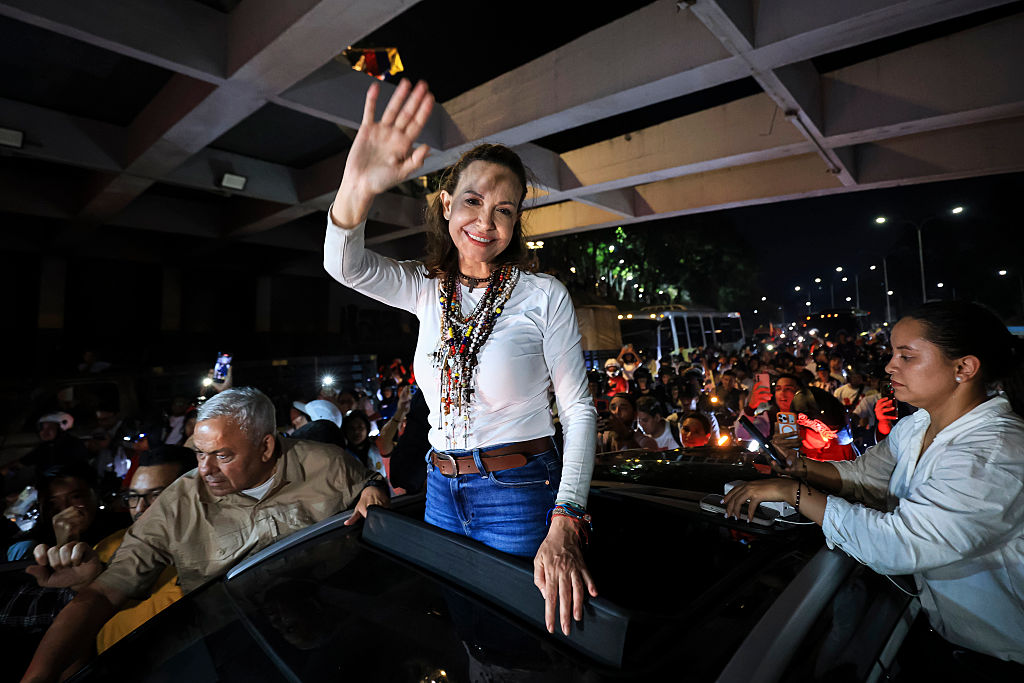
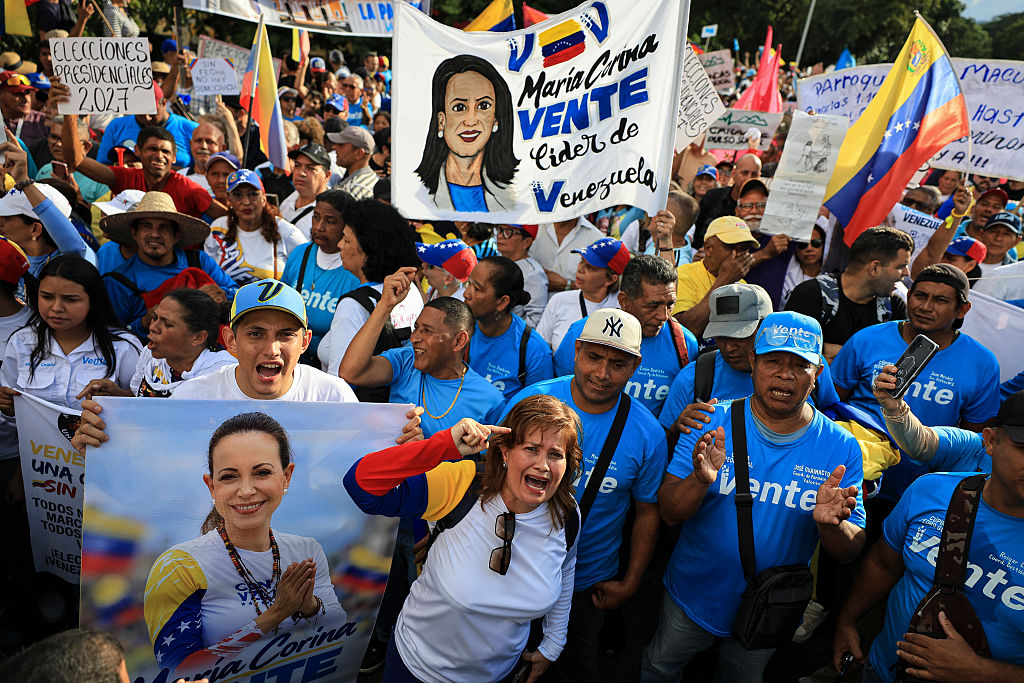
Opposition leader María Corina Machado greets the crowd gathered around her vehicle amidst supporters in Caracas, Venezuela on Oct. 25, 2026 —Jesus Vargas—Getty Images
Machado, who was briefly detained in January 2025 following a protest against autocratic then-President Nicolás Maduro’s swearing-in despite a dubious election victory, went into hiding in Venezuela and emerged in December that year in Norway. Since then, she has been fighting for a return to democracy in her own country, demanding that, following the extraordinary American military operation that captured Maduro, Venezuelans get to have free and fair elections.
The social media accounts of her political movement, Vente Venezuela, as well as her campaign, posted images and videos of Venezuelans crowding the streets of Caracas to welcome her return. The New York Times reported that Machado entered Venezuela from Colombia, citing two anonymized government officials.
Edmundo González Urrutia, another key opposition figure, also posted on social media Sunday that Machado is “on Venezuelan soil” and that he would soon be with her “so that our country truly advances toward freedom.”
Machado’s return adds some urgency to the country’s democratic transition—which the interim Venezuelan government under acting President Delcy Rodríguez, as well as its apparent overseer, the U.S., have both promised. Rodríguez, who was formerly Maduro’s deputy, and U.S. President Donald Trump have both said that elections will be held in the country, but a date has yet to be finalized.
The 59-year-old Machado, meanwhile, has called for elections by July 2027, telling the Financial Times that there was “more than enough time” to prepare for one. She has also said she will contest the presidency. A majority of Venezuelans want her to be President, according to a poll from AtlasIntel and Bloomberg.
Following Maduro’s ouster, Venezuela’s highest court said Rodríguez’s interim presidential appointment could last for up to 90 days, with the National Assembly potentially extending her term for another 90. But the assembly, controlled by the ruling party, did not vote on extending her term, which officially expired in April.
It remains unclear how Machado could hasten elections, given the Venezuelan government is in talks with a different U.S.-backed faction of the opposition. A third round of talks ended this month without reaching a firm election schedule. Venezuelans have since grown impatient and have taken to the streets to protest the delays.
What the U.S. has said about Machado’s return
Asked about Machado’s return to Venezuela, Trump said Sunday he was unaware of it. “I think she's a very nice woman,” Trump told reporters. “She gave me her Nobel Prize, so how can I say anything else? And I hope she’s safe.”
Machado gave Trump her Nobel medal earlier this year in what appeared to be a push to hasten Venezuela's democratic transition. But since Maduro’s arrest and the U.S. elevation of a new Venezuelan government under Rodríguez, tensions between Trump’s Administration and Machado have increased.
The opposition leader has tried to return to the country multiple times, but she has claimed Venezuelan authorities have repeatedly blocked her. Machado has denied suggestions that the U.S. was blocking her return. But her insistence on returning reportedly roiled some in the White House who worry it could spark a political crisis.
U.S. Secretary of State Marco Rubio posted on X that the conditions that allowed Machado’s return to Venezuela were “the direct result of the U.S. supported reconciliation talks which has already seen hundreds of political prisoners freed and hundreds of political opposition figures return from exile.”
But Rubio also hinted that the U.S. expects no further interference in the ongoing discussions: “The United States expects the freedoms of all sectors of Venezuelan politics to continue to be respected. Likewise, we expect all political actors to support these talks which represent the best chance Venezuela has had in thirty years to peacefully achieve not just a free and fair election but an enduring democracy.”
Machado said earlier that, despite not being a part of the discussions between the Venezuelan government, legislative opposition, and the U.S., her movement will not hinder initiatives that “produce real progress.”
The U.S. has argued that Venezuela must ensure political and economic stability before it can hold elections. But critics and other observers have pointed out that the Trump Administration’s approach has instead prioritized doing business with Venezuela over facilitating democratic transition—with Washington announcing a major oil deal with Caracas amid the talks.
“She’s a very nice woman,” Trump said of Machado Sunday. “But we’re doing really well in Venezuela.”
Luiz Inácio Lula Da Silva, incumbent president of Brazil and presidential candidate for the Workers' Party (PT), waves a Brazil flag during a rally ahead of the presidential runoff at Avenida Paulista in Sao Paulo, Brazil, on Oct. 24, 2026. —Alexandre Schneider—Getty Images
Luiz Inácio Lula da Silva has been re-elected to a historic fourth term as Brazil’s President after a tight race with far-right opponent, Flávio Bolsonaro, the son of former President and Donald Trump ally Jair Bolsonaro.
Lula won with 51.8% of the vote to Bolsonaro’s 48.2%, Brazil’s Superior Electoral Court announced. Sunday’s vote was a rematch after neither reached an outright majority in the first round on Oct. 4. Lula had trailed then, becoming now the first presidential candidate since Brazil’s return to democracy in 1985 to finish second in the initial vote and win the run-off.
The election also marks a remarkable win for the global left, as it bucks a trend of right-wing electoral victories across Latin America. Lula will serve for another four-year term beginning on Jan. 5, 2027.
“I want to thank the generosity of the Brazilian youth who took to the streets, who went to the streets to defend democracy,” Lula said in his victory speech on Sunday night. “I want to thank the elderly. I saw scenes today of people being carried by their grandchildren to vote, people unable to move around, people with cancer and other illnesses. And people went to vote because we managed to convince them that voting was very important to ensure democracy in the country.”
“This election was a defeat for denialism, a defeat for lies,” he continued.
Bolsonaro, however, said late on Sunday that he would not concede defeat to Lula and would seek an annulment of the result. The senator for Rio de Janeiro said a ruling by the Supreme Court to extend voting for two hours, citing public transport issues, was “unacceptable.”
Nevertheless, several liberal leaders around the world have already lauded the result.
“Long live democracy, the people of Brazil won,” Mexican President Claudia Sheinbaum said.
Canadian Prime Minister Mark Carney posted, “The relationship between Canada and Brazil has flourished under our partnership. Let’s seize this opportunity to make it even stronger, together — to create major new trade opportunities, protect the environment, and build greater prosperity for both our peoples.”
Lula’s campaign focused on labor reform, welfare benefits, and affordability. At a time when public debt as a share of GDP has risen to its highest level since the pandemic, Lula cited his achievements in lowering poverty rates, as well as reducing unemployment, illiteracy, and deforestation to record lows. He pledged to make public transit free on the weekends, a program that would need congressional approval. He also increased benefits under his signature Bolsa Família program and championed a landmark constitutional amendment shortening the working week, which Congress approved.
Bolsonaro, meanwhile, campaigned on harsher criminal penalties, tougher policing, lower taxes, and cuts to government spending. His campaign highlighted a corruption investigation involving Lula’s son and a pension fraud scandal that spanned both Lula’s and Jair Bolsonaro’s administrations.
Bolsonaro also called for amnesty for his father, Jair Bolsonaro, who is serving a 27-year prison sentence under house arrest after being found guilty of plotting a coup to overturn his defeat in the 2022 election.
In his election night speech, Lula pledged to strengthen federal involvement in public security, expand education and healthcare, and develop Brazil’s technological and artificial intelligence industries.
“This country will not be built by me,” he said. “But by you.”
A blow to the right
Lula’s win pumps the brakes on the broader political shift towards the right in Latin America. Colombia, Peru, Costa Rica, and Chile elected right-wing presidents in recent election cycles, reversing an earlier “pink tide” of left-wing governments.
Lula’s victory also denies Trump another political ally in Latin America, which include Argentinian President Javier Milei and Salvadoran President Nayib Bukele.
Bolsonaro had portrayed himself as an ally of Trump, courting closer ties with Washington and backing U.S. terrorist designations for Brazil’s major criminal gangs. Reuters reported on Saturday, citing current and former U.S. officials, that two U.S. State Department officials had pushed sanctions and other measures intended to weaken Lula and help return the Bolsonaros to power. The State Department did not comment specifically on the reported efforts but told Reuters that “all actions taken by the United States against narco-traffickers and to protect free speech are to defend the rights and lives of the American people. The Brazilian people have the right to choose their leaders through free and fair elections.”
Trump previously expressed support for Jair Bolsonaro and labelled Lula a “radical left lunatic” during Brazil’s 2022 presidential election. He also criticized the criminal prosecution of Bolsonaro, calling it a “witch hunt” and demanding it end.
Trump has not reacted to the election results as of early Monday. After Bolsonaro led in the first round on Oct. 4, Trump called the result “close, but a very, very big victory.” His son, Donald Trump Jr., posted earlier criticizing the Supreme Court’s decision to extend voting hours and what he described as the lack of American mainstream media coverage of it.
Lula had warned that Bolsonaro would surrender Brazil’s sovereignty to Trump.
At the same time, Lula has pursued closer ties with China, Brazil’s largest trading partner and the U.S.’s geopolitical rival, although he rejected subordination and said Brazil was not choosing between the two countries.
“This country will not accept being anyone’s backyard,” Lula said on Sunday night.
Analysts, however, warned that Lula’s political influence could wane despite his re-election. Earlier this month, Brazil elected its most conservative National Congress since the 1980s. Bolsonaro’s Liberal Party (PL) and allied parties could control majorities in both chambers, with more than 280 of 513 seats in the lower house and up to 50 of 81 seats in the Senate.
That could make it difficult for Lula to pass his legislative agenda, analysts said.
But Lula shrugged off those concerns and promised to work with the more conservative Congress to govern for all Brazilians.
“The day after tomorrow, the 27th, I turn 81 years old, and I want to make a commitment in front of the press and in front of you,” Lula said. “I will have the best term a President has ever had in the history of this country”
Gadi Eisenkot’s office is small and sparsely furnished. There are no medals on display, no photographs with foreign dignitaries or political luminaries, none of the trappings of a decorated general who rose to become chief of staff of Israel’s military. The space, tucked inside a commercial building in the Tel Aviv suburb of Ramat HaSharon, is conspicuously devoid of ostentation.
Beside his desk sit three photographs. One is of his son Gal, who was killed fighting in Gaza in Dec. 2023, two months after the war began. Another is a family portrait taken during a visit to Washington, D.C., years earlier, a picture of a family still whole, before the war shattered it. The third shows Gal next to one of his closest friends from their military unit, who was also killed in combat. “He was a settler,” Eisenkot says of his son’s friend. The image conveys a snapshot of contemporary Israel: the son of a centrist military commander and a young man from a West Bank settlement, products of different worlds, serving and dying alongside one another.
As we speak, Eisenkot, dressed in his trademark black polo and black pants, pauses to pick up the photographs. He recalls the days after his son’s death. After three nights of sitting shiva, the Jewish mourning ritual, he left his grieving family to attend a meeting of Benjamin Netanyahu’s war cabinet. “I decided to go forward,” he says.
Now Eisenkot hopes to move not only himself forward but his country. The former general has emerged as a leading challenger to Netanyahu, Israel’s longest-serving prime minister. Polls suggest a close contest, with Eisenkot seeking to assemble a coalition capable of ending Netanyahu’s rule three years after he presided over the worst security failure in Israel’s history, launched the war in Gaza, and led the country into deepening international isolation.
Eisenkot has cultivated a reputation for integrity, competence, and personal rectitude, forging relationships across Israel’s fractured political spectrum. But perhaps his most powerful political asset is his devastating personal loss. In a country scarred by the trauma of Oct. 7 and the war that followed, Eisenkot’s grief is familiar to countless Israelis. His effort to persevere mirrors a nation’s struggle.
The Oct. 27 election will be more than a referendum on Netanyahu. It will test whether Israelis are prepared to chart a different course after three years of bloodshed, recriminations, and cultural fracture. The country is deeply polarized, increasingly castigated by the rest of the world, and confronting a resurgence of antisemitism. Voters will determine not only who governs Israel but what kind of nation Israel will become—and whether its next leader can begin to heal the divisions that have left the world’s only Jewish state facing one of the gravest crises in its history.
Netanyahu, of course, can never be counted out. The consummate political survivor, he has weathered scandals, electoral defeats, and corruption charges. His credibility has suffered, but many Israelis still regard him as the only leader who can protect them in a dangerous region. Eisenkot could assemble a coalition with other opposition figures, including former Prime Minister Naftali Bennett, Yair Lapid, Avigdor Lieberman, and Yair Golan. Netanyahu would depend on the far-right parties led by Itamar Ben-Gvir and Bezalel Smotrich, whose ultra-nationalist politics have found a receptive audience among younger right-wing Israelis.
Israel’s fragmented parliamentary system offers no guarantee of a decisive outcome. Negotiations could drag on for weeks, or fail altogether, sending Israelis back to the polls. Eisenkot tells me he will not serve in a unity government with Netanyahu under any circumstances. He has framed his ambitions around nothing less than the sustenance of the Zionist enterprise: the ability of Jews to live safely in a state of their own in their ancestral homeland. In his telling, that means confronting the threat from Iran; restoring Israel’s standing in the world; preserving the country’s character as a Jewish democracy; and finding an accommodation with the Palestinians, who lay claim to the same land and have their own aspirations to self-determination.
“What holds the country together is the Jewish and democratic ethos of the majority of Israelis,” says Yossi Klein Halevi, a bestselling Israeli author and senior fellow at the Shalom Hartman Institute in Jerusalem. “That's what we're going to have to try to repair. That is really what Eisenkot is offering the country.”
For Eisenkot, the challenge is not merely to replace Netanyahu but to lead Israel beyond the trauma that has consumed it since Oct. 7. He sees a country caught between the imperative to protect itself and the need to recover the democratic values, national solidarity, and international legitimacy that are essential to its survival. “I feel like it’s a historic mission—to save the state of Israel,” he says, invoking his son and the many others who died defending the nation. “We owe it to them to be worthy of the sacrifice they made.”
On Oct. 7, 2023, Eisenkot awoke shortly after 6 a.m., stirred by nothing more than his circadian rhythm. When he turned on the television, he saw the first images of a catastrophe unfolding a short drive south of his home. Thousands of Hamas-led militants were pouring into southern Israel by land, air, and sea. They rampaged through kibbutzim and the streets of Sderot, descended on the Nova music festival, where they murdered civilians, raped women, desecrated the bodies of the dead, and dragged hundreds of hostages back into Gaza. Many filmed themselves carrying out the atrocities, celebrating the carnage as it unfolded. Desperate Israelis called the authorities, pleading for help that would not arrive for hours. By the time security forces regained control, entire communities had been devastated by the worst slaughter of Jews since the Holocaust.
A couple embraces while visiting memorial markers honoring victims at the Nova music festival site as Israel marks the third anniversary of the Oct. 7th 2023 attacks on October 7, 2026 in Re'im, Israel. —Erik Marmor—Getty Images
Eisenkot’s son Gal, 25, was staying at the family home in Herzliya, outside of Tel Aviv, rather than his apartment near Tel Aviv University, where he was studying bioinformatics. He had come home for the holiday of Simchat Torah. Eisenkot woke him. “Gal, come to see the TV,” he said. “There are trucks of Hamas inside Sderot. This means war. Where is your military equipment?”
Gal had completed his compulsory service and was now a reservist, trained as a combat medic. Eisenkot drove him to his unit’s base, where lines of cars were already forming as reservists converged. “I knew right away that Israel, that the world, would never be the same,” Eisenkot says.
Four days later, with a ground invasion of Gaza looming, Netanyahu asked Eisenkot to join a small war cabinet. Eisenkot had served under Netanyahu as chief of the general staff from Feb. 2015 to Jan. 2019, but the two men were now political adversaries. Netanyahu had hoped to project unity to a divided public, much of which had come to distrust or despise him. After months of mass demonstrations against his efforts to curtail the power of the judiciary, he sought to rally the country behind the coming war.
One of Eisenkot’s first priorities in the war cabinet was to prevent the opening of a second front against Hezbollah, the Iranian-backed Shiite militant group in Lebanon. Some of Netanyahu’s senior ministers, particularly Defense Minister Yoav Gallant, favored launching a preemptive offensive against Hezbollah, despite objections from the Biden Administration.Eisenkot argued that Israel needed to concentrate its military resources on defeating Hamas in the south before embarking on another major conflict. On that question, he prevailed.
On another matter, one he considered even more urgent, Netanyahu was less receptive. Hamas had abducted 251 people on Oct. 7, and Eisenkot believed securing their release should take precedence over a full-scale military campaign. It was, in his view, a fundamental obligation of the state, part of the covenant between a country and its citizens. Once Israel plunged into a prolonged ground war, he feared, the prospects of recovering the hostages alive would diminish. “My idea was to do the hostage deal, and after that, defeat Hamas,” Eisenkot tells me.
Netanyahu chose a different course. Israel launched a ground invasion following an extensive aerial bombardment of Hamas’s military infrastructure, including its vast network of subterranean tunnels. Hamas had embedded military facilities and weapons in densely populated areas, deliberately exposing civilians to grave danger. The military campaign that ensued has killed more than 70,000 Palestinians, according to Gaza’s health ministry, which does not distinguish between civilians and combatants.
Two months into the war, Eisenkot suffered a catastrophe of his own. He was at a military headquarters, studying a satellite map showing the positions of Israeli battalions near some of the fiercest fighting in Gaza. Fifteen minutes later, a major general who had once served under his command approached him.
“Gadi, come to me,” the officer said. “Gal is critically injured. Go home”
Eisenkot had spent more than four decades in the Israeli military. He knew what those words meant. If his son were still alive, he would have been told to go to the hospital, not home. “I understood he was dead,” he tells me.
Gal died in combat alongside his friend Eyal Berkowitz, a young man from a West Bank settlement. It was Berkowitz whose photograph Eisenkot had shown me in his office, standing beside Gal.
Thousands attended Gal’s funeral, which was broadcast on national television. Across the country, Israelis watched one of their most decorated commanders mourn the loss of his own son. Eisenkot delivered a eulogy, his voice trembling. “I promise you that we will continue to be a united and happy family, so that your sacrifice and that of the other fallen will not be in vain and that we will be worthy of it,” he said. “I salute you, beloved son.”
Three days later, Eisenkot returned to Netanyahu’s war cabinet. He watched as Netanyahu’s prosecution of the war turned Israel into a pariah state. Images circulated daily on social media of children killed as collateral damage in strikes on Hamas targets. Netanyahu resisted allowing aid into the Strip. The world accused Israel of using starvation as a weapon of war and committing war crimes against a trapped population of 2 million.
Israeli soldiers load tank shells in Be’eri, near the Gaza border, on Oct. 14, 2023, as tens of thousands of troops prepared for a ground offensive aimed at capturing Gaza City and destroying Hamas’s leadership. —Sergey Ponomarev—The New York Times/ReduxA view shows widespread destruction and displacement shelters in Gaza, Palestine on October 21, 2026. —Faiz Qreqa—Middle East Images/AFP/Getty Images
He recalls his final meeting with Netanyahu, in late June 2024, when the prime minister appeared before a special intelligence committee in the Knesset. Eisenkot pressed him on how he intended to end the war. “What is your exit plan?” he asked. Netanyahu offered none, Eisenkot says, insisting instead that Israel would continue fighting until it achieved “total victory.”
Eisenkot reached into his briefcase and pulled out a book: Master of the Game: Henry Kissinger and the Art of Middle East Diplomacy, Martin Indyk’s 2021 study of Kissinger’s statecraft. Indyk, who served in senior diplomatic roles under Presidents Bill Clinton and Barack Obama, was a friend of Eisenkot’s and a longtime critic of Netanyahu. “Have you read this?” Eisenkot asked. Netanyahu said he had not. Eisenkot urged him to do so, arguing that military force without a diplomatic strategy could not deliver a lasting victory.
“Gadi,” Eisenkot recalls Netanyahu replying, “I have a different view about the meaning of the word strategy.”
Eisenkot was enraged by Netanyahu’s refusal to prioritize the hostages. The suspicion among Netanyahu’s critics was that he feared a deal would fracture his coalition, potentially forcing elections that could remove him from power and trigger an inquiry into the failures of Oct. 7—much like the Agranat Commission, established after the 1973 Yom Kippur War, that led to the downfall of Golda Meir. In Eisenkot’s telling, Netanyahu put the preservation of his own power above the lives he was entrusted to protect. “He neglected them,” Eisenkot says.
A spokesperson for the prime minister did not respond to multiple requests for comment.
On June 9, 2024, Eisenkot resigned from the emergency government, ending his eight-month effort to influence the war from within. His departure, alongside that of Benny Gantz, effectively ended the national unity arrangement and precipitated the dissolution of the war cabinet. But the war was not finished exacting its toll on Eisenkot’s family. One nephew had already died fighting in Gaza on the same day of his son’s funeral. Another was killed 11 months later.
Over the next two years, Netanyahu presided over a succession of extraordinary military operations. Israel killed Yahya Sinwar, the Hamas leader who helped mastermind the Oct. 7 massacre, and Ismail Haniyeh, the group’s longtime political chief. It assassinated Hezbollah leader Hassan Nasrallah and dealt devastating blows to the Iranian-backed militia in Lebanon, including through an audacious operation that turned thousands of its members’ pagers into explosive devices. After Donald Trump returned to the White House, Netanyahu persuaded the president to join Israel’s 12-day war against Iran in June 2025, with U.S. forces striking three of Iran’s principal nuclear facilities.
But the military triumphs told only part of the story. For two years, the war in Gaza devastated the Palestinian enclave, killed tens of thousands of people, and left Israeli hostages languishing in captivity. In October 2025, under intense pressure, Netanyahu agreed to a ceasefire and hostage-exchange deal that halted the fighting and secured the release of the remaining living hostages. “Netanyahu dragged it” out, Eisenkot says. “President Trump pushed him to do it.”
Months later, the confrontation with Iran entered a more perilous phase. Netanyahu helped persuade Trump to join a broader war against the Islamic Republic, a conflict that grew difficult to end and intensified criticism of Israel in the United States, including among elements of the American right. Around 60% of U.S. adults now hold an unfavorable view of Israel, according to a 2026 Pew survey.
Now, for the first time since Oct. 7, Netanyahu must face the electorate. Eisenkot thinks Netanyahu has done little to help Israel recover, instead perpetuating the trauma, cultivating a siege mentality and an atmosphere of never-ending conflict that allows him to cast himself as the indispensable wartime leader. “I don’t know how Netanyahu wants to close the story,” Eisenkot says.
He decided he would try to write the ending himself.
Eisenkot photographed in Jerusalem on Oct. 22. —Ofir Berman for TIME
Eisenkot’s strategy has been to assemble a broad coalition. To his right, he envisions Bennett and the secular nationalist Liberman; to his left, Golan, leader of the Democrats, the successor to the historic Labor Party, and Lapid, the former television host who briefly served as prime minister. “I told them, let’s build a big party,” Eisenkot says.
He held a series of talks with Bennett about the prospect of running together, but ultimately declined, calculating that separate campaigns would give the opposition bloc a better chance of expanding their support. Instead, Eisenkot chose to lead his own party, Yashar. Bennett subsequently joined forces with Lapid. “I thought I had the ability to unite Israel, unite this divided country,” Eisenkot says, citing his military experience and relationships across the political spectrum. “It’s not from arrogance but from deep commitment to bring change and defeat Netanyahu.”
Eisenkot’s background also carries significance. Born in Tiberias to Moroccan Jewish immigrants and raised in the southern port city of Eilat, he belongs to Israel’s Mizrahi community, Jews of Middle Eastern and North African descent who have long faced discrimination from the country’s predominantly Ashkenazi establishment. If elected, he would become Israel’s first Mizrahi prime minister.
Eisenkot has campaigned on restoring public trust in government, strengthening Israel’s security, and preserving its foundation as a Jewish democracy. He has pledged to dismantle illegal outposts in the West Bank and crack down on extremist Jewish settlers who terrorize Palestinians, expand military or civilian national service across Israeli society, confront the threat from Iran, pursue a political resolution to the Palestinian conflict, repair Israel’s frayed relationships abroad, and restore national unity.
Travel through the country and the psychological scars of Oct. 7 are difficult to miss. They surface in the impatience of drivers, the intensity of political arguments, the restless energy of a society still living in the shadow of a nightmare. The country seems suspended in its aftermath, unable to separate the horrors of the past from the anxieties of the present. In some ways, it is still Oct. 8, 2023.
During our interview, Eisenkot and I discuss Bessel van der Kolk, the Harvard psychiatrist whose bestselling book, The Body Keeps the Score, explores how overwhelming experiences can leave people psychologically trapped in the past. Trauma, van der Kolk argues, can persist long after the danger has passed, disrupting the ability to integrate painful memories and move forward.
Eisenkot believes Netanyahu has purposefully made that process harder. Nearly three years on, Israel has yet to establish a state commission of inquiry into the failures that allowed the attack to happen. Without an authoritative accounting, Eisenkot argues, the country cannot fully reckon with the catastrophe. He pledges to establish such a commission within his first 14 days in office, with a mandate to investigate not only Oct. 7 but the decade of decisions that preceded it, including his own tenure leading the military.
He points to widespread suspicions that the attack involved some form of betrayal from within, a belief he attributes partly to Netanyahu’s efforts to shift responsibility onto military and intelligence officials. Netanyahu and members of his family have promoted disputed allegations that security officials deliberately withheld warnings before the Oct. 7 attack, including the claim that they failed to wake the prime minister as Hamas launched its assault—part of a broader effort by Netanyahu and his allies to shift responsibility for the security failures onto the military and intelligence establishment.
Recent polls show a close contest, with Yashar running ahead of Likud. But neither Netanyahu’s right-wing alliance nor the parties seeking to replace him appear assured of the 61 seats required for a majority in the 120-member Knesset.
“I think the chances for a unity government are high because we will be more than happy to have Eisenkot joining our coalition,” says Ohad Tal, a Knesset Member running with Smotrich’s Religious Zionism party. “If the other side will have a majority with the Arabs, God save us.”
Forming an alternative majority could require support from Arab parties, a fraught prospect in Israeli politics. Eisenkot will not commit to bringing them into his government. Instead, he has set four conditions for any coalition partner: recognition of Israel as a Jewish and democratic state; adherence to the principles of its Declaration of Independence; acceptance of a national-service obligation for all citizens, with civilian alternatives to military service; and agreement that Hamas is a terrorist organization that must be dismantled. None of the Arab parties has yet to accept the latter tenet.
“I understand that in the Israeli system we must have a big bloc,” Eisenkot says. “It’s a huge challenge. I’m doing my best from morning till night. I’m convinced we’ll defeat Netanyahu.”
People walk past election campaign flags and a car plastered with images of Israeli Prime Minister Benjamin Netanyahu, ahead of the upcoming elections, in Jerusalem on October 16, 2026. —John Wessels—AFP/Getty Images
If Eisenkot succeeds, he says, he will break with Netanyahu’s defining political method: cultivating a siege mentality that pits Israel against the world. “The main challenge is to break Netanyahu’s method with them and us,” Eisenkot tells me. “This is poison to our society.”
Nowhere is that more consequential than in the United States, where support for Israel has deteriorated, particularly among younger Americans. “Netanyahu knows the United States better than all of us, but today he can’t improve Israel’s relationship with the U.S.,” Eisenkot says. “He may have a good relationship with the administration today, but the situation in universities, with American Jewry, with the bipartisan relations, are at their lowest.”
One of Eisenkot’s proposals is to gradually wean Israel off American military assistance. He believes the dependence has become a source of friction in Washington, and runs counter to the Zionist ideal of a Jewish state capable of guaranteeing its own security. “Maybe it will take five to 10 years,” he says, “and it is our interest to do it.”
Eisenkot opposes the establishment of a Palestinian state, a goal long championed by much of the international community. But he also recognizes the profound danger of a one-state future: Israel would face a choice between granting millions of Palestinians citizenship and voting rights, which would end its Jewish majority, or denying them those rights, which would undermine its claim to be a democracy. He wants to prevent the vision of permanent Israeli control advanced by Smotrich and Ben-Gvir. “Smotrich’s vision for one state will be the end of our country,” Eisenkot says.
To avert that outcome, Eisenkot tells me he favors some form of separation in the West Bank, with a reformed Palestinian Authority assuming greater responsibility for Palestinian self-government while Israel retains military control over the territory. His approach to Gaza is different. He endorses the framework of Trump’s 20-point peace plan, which calls for a technocratic Palestinian administration to govern the enclave and envisions a conditional pathway to Palestinian statehood.
“We have two options: the 20 points of President Trump, or to use force,” Eisenkot says. “I prefer the diplomatic option—and I believe I can do it. But if not, I know how to dismantle Hamas with force.”
For all his confidence in working with Trump, Eisenkot and his advisers were surprised when the president endorsed Netanyahu. Trump had previously passed up opportunities to do so, including in an interview with TIME. Some of his closest Middle East advisers, including his son-in-law Jared Kushner, had grown frustrated with the Israeli leader. According to people familiar with the discussions, Fox News host Mark Levin and U.S. Ambassador to Israel Mike Huckabee urged Trump to back Netanyahu in the closing days of the campaign. “Israeli society is independent and will make its own decision,” Eisenkot says. “I have no doubt Trump will accept every democratic choice in Israel.”
Netanyahu’s political operation has circulated a stream of AI-generated videos attacking Eisenkot, including one depicting him in a field approaching a young Israeli soldier who bears a striking resemblance to his dead son. Instead of embracing the soldier, the figure resembling Eisenkot pushes him aside and embraces Mansour Abbas. “I felt contempt,” Eisenkot says when we discuss the video. “That is the lowest he could go.” The invective has only continued. Yinon Magal, a Channel 14 host and pro-Likud commentator, called Eisenkot a “monkey” on air. Netanyahu waited days before describing it as “highly inappropriate.”
Eisenkot sees the election as a test of whether Israel can preserve the democratic and national ideals of the Zionist movement or drift further from them. “My goal is that the Israeli people will be united and proud of their country,” he says. “That global Jewry will be proud of Israel as the national home of the Jewish people.” Many fear an exodus of Israelis should Netanyahu hang on. A Channel 12 poll in July found that 23% saidthey or any of their relatives would leaveif the Israeli premier is reelected.
Eisenkot lacks Netanyahu’s rhetorical flair, polished English, and decades on the world stage. But he argues those advantages have grown less useful as Netanyahu grows increasingly polarizing, at home and abroad. For many critics of Israel, particularly younger ones, the distinction between the country and its longtime leader has become difficult to discern. “We need to return to speaking about sharing the same values,” Eisenkot says. “Nobody speaks about values right now. Everything is about interest, power, more power, and more power.”
As our interview draws to a close, Eisenkot returns once more to the subject of trauma, the force that has shaped his own life and, he believes, the fate of his country. “Netanyahu is unwilling to show the courage needed to end the war from a position of strength,” he says. “It will take years to close the trauma, but we must start now.”
Demonstrators hold Opposition leader Maria Corina Machado's signs during a protest to demand a free presidential election in Caracas, Venezuela on Oct. 22, 2026. —Jesus Vargas—Getty Images
In the capital, Caracas, protesters gathered in Plaza Venezuela and called for presidential elections to be scheduled as early as 2027, as well as the release of all political prisoners in the country.
“We will have presidential elections very soon with María Corina as president,” said former congressman Piero Maroun, who attended the protests, according to independent local news organization Efecto Cocuyo. The Machado-led activist group Vente Venezuela spearheaded the protests, which led to the closure of some streets in Caracas. Others also staged protests in the states of Nueva Esparta, Táchira, and Zulia.
The ruling party that acting President Delcy Rodríguez belongs to, the United Socialist Party of Venezuela, also staged a gathering near the opposition demonstrators in Caracas, though for a women’s march for Breast Cancer Awareness Month.
Protesting has become common for disgruntled Venezuelans since the forced end of Nicolás Maduro’s presidency. Maduro and his predecessor Hugo Chávez heavily cracked down on political dissent. But since Maduro’s removal in January by U.S. forces, protesters have taken to the streets “with increasing frequency,” according to the international civil society alliance CIVICUS, citing data from the Venezuelan Observatory of Social Conflict, which recorded 1,101 protests during just the month of September, or about 37 demonstrations per day. These protests, however, have not necessarily been large.
Until this week. The Thursday protests, which Reuters described as “the first nationwide opposition protest in nearly two years,” coincided with the third anniversary of the opposition’s presidential primary elections, in which Machado emerged victorious.
Machado is still the opposition’s most prominent figurehead in the transition toward a democratic government: in an AtlasIntel survey conducted for Bloomberg News, Machado received 52% support, compared with 19% for Rodríguez. But Machado has her work cut out for her.
The protests also happened as Rodríguez met with Dinorah Figuera, the opposition representative backed by the U.S. State Department in negotiations for a political transition, inside the Venezuelan presidential palace. The three rounds of U.S.-backed talks between the Venezuelan government and Figuera’s faction have yet to yield an agreement on elections.
In a statement reported by El País after the meeting, Rodríguez appeared to reference the opposition protests, saying in Spanish: “There are still very, very small groups that resist and believe that trying to set the country ablaze and block streets is the way for Venezuela to move forward. I recognize the good Venezuelans who, through this dialogue, are promoting necessary changes.”
Since arresting Maduro in an extraordinary military operation in January, the U.S. has been working with an interim government led by Rodríguez, Maduro’s former deputy. Rodríguez and U.S. President Donald Trump both have said elections will eventually be held in the country, though Trump told TIME in late September: “It’s so raw now, you know that I just think it’s too soon.”
Why has an election not yet been scheduled?
The post-Maduro government opened talks in August with the opposition faction led by Figuera, the president of Venezuela’s 2015 National Assembly, to help the country achieve a democratic transition. But the changes are expected to take time.
Domestic opposition and international observers have long slammed Maduro’s 2018 and 2024 re-elections for lacking transparency and fairness, disputing the results and arguing that Machado’s proxy, Edmundo González Urrutia, actually won in the latter. This raised questions about the independence of the Supreme Court and Venezuela’s National Electoral Council, which have been packed with loyalists of the regime.
For the transition, the establishment and the opposition are trying to iron out details of reforming the court and the council. Even if this happens, experts told Reuters that authorities will still need to update voter rolls and ensure that parties can reach a consensus on how subsequent elections would work.
The twin earthquakes that struck Venezuela in June and caused extensive damage also complicated efforts toward stability in the country.
But the U.S. has also set certain prerequisites that could affect how soon elections could happen. President Trump and Secretary of State Marco Rubio outlined that they seek stabilization, economic recovery, and national reconciliation in Venezuela, on top of a political transition. Axios reported that it’s a multi-step process: change the court makeup, reform the electoral commission, and then announce an election date. Rubio also announced other requirements, including a truly free press.
“What would threaten an enduring republic in Venezuela would be that someone is elected and they inherit a complete catastrophe, economic and social, and then the whole project is endangered because now anything can happen,” Rubio said on Sept. 23, following Trump’s meeting with Rodríguez in New York. “We want to do two things at the same time.”
Critics argue that the Trump Administration’s position sidelines the opposition faction led by Machado and instead prioritizes oil agreements and economic stabilization over Venezuela’s democratic transition. In August, Trump announced that Washington agreed to a deal with Caracas, saying it would give the U.S. majority control over more than 65 billion barrels or about a fifth of Venezuela’s oil reserves.
Dhayana Fernández-Matos, a professor of political science at the Federal University of Pelotas in Brazil, told Spain’s broadcaster RTVE last month that an election in Venezuela is not a priority for Trump, as his “primary interest lies in oil and the geopolitical power of controlling the world’s largest proven crude oil reserves.”
TIME’s September interview with Trump hinted at the U.S.’s potential financial bias for a delayed election: after saying that it would be too soon for Venezuela to hold an election, the President said, “A lot of money is being made by us, but a lot of money is also being made by Venezuela, and we have complete control of all of them.”
Itamar Ben-Gvir, Israel's national security minister and head of the far-right Otzma Yehudit (Jewish Power) party, arrives for an event commemorating the Jewish holiday of Sukkot, the Feast of the Tabernacles, in a field outside Kibbutz Nir-Am by the Israel-Gaza border on September 27, 2026. —Ilia Yefimovich—AFP/Getty Images
In a small office in the industrial district of Lod, a city outside Tel Aviv where Israeli forces expelled thousands of Palestinians during the 1948 war, sits the campaign headquarters of Otzma Yehudit, or “Jewish Power.” The ultra-nationalist party is led by Itamar Ben-Gvir, a far-right firebrand once deemed too extreme to serve in Israel’s military. He now sits in Benjamin Netanyahu’s cabinet as national security minister, overseeing the country’s police and prison services.
If Ben-Gvir has his way, the Oct. 27 election will give his party more seats in parliament and himself greater leverage over another right-wing government led by Netanyahu. His ambition is not to replace the prime minister but to make him even more dependent on the hardline parties pushing for Palestinians to leave Gaza and the West Bank—and for Israel to extend sovereignty over the territories.
“I want Netanyahu to be prime minister. He’s a leader. I prefer him a million times over Eisenkot,” Ben-Gvir tells me in a rare interview on Oct. 19, referring to Netanyahu’s chief rival, the former military chief Gadi Eisenkot. Pounding his chest, he adds: “What will really help Netanyahu be right wing is if I, Ben-Gvir, will be a senior minister and it’s a full right-wing government.”
The post he covets is defense minister, which would give him command over Israel’s armed forces and greater authority to pursue his vision for Gaza and the West Bank: fewer constraints on military operations, the “voluntary emigration” of Palestinians from both territories, and the expansion of Israeli control over lands he believes belong to the Jewish people. Netanyahu has resisted giving Ben-Gvir the portfolio. But Ben-Gvir and his allies hope to win enough seats to force Netanyahu to accommodate their demands or risk losing power. He may benefit from the rightward shift of Israeli politics, particularly among younger voters drawn to his confrontational style and uncompromising vision of Jewish sovereignty. In a Channel 12 survey of first-time Jewish voters, nearly three-quarters identified as right-wing or center-right.
Polls suggest a tight contest, with Eisenkot’s centrist Yashar party edging ahead of Netanyahu’s Likud in several recent surveys, but neither the prime minister’s right-wing bloc nor the opposition appears close to the 61 Knesset seats needed to govern. An average of four recent polls puts the two camps at roughly 50 and 53 seats, respectively, leaving Arab parties and smaller factions potentially pivotal. The result could be another fragile coalition; an unlikely unity government between Netanyahu and Eisenkot; or a prolonged deadlock that sends Israelis back to the polls.
Ben-Gvir, dressed in a white shirt and white kippah, speaks halting English. Under his leadership, Israel’s prison service has drawn allegations of abuse for its treatment of Palestinian detainees. But he wants a more direct role in determining Israel’s future in Gaza and the West Bank.
“If Israel wants to continue to live and not be destroyed, we have to capture all of Gaza,” he says. “We have to promote voluntary emigration. Gaza could be a Riviera. It’s a beautiful place. But we can’t have one Hamas member there.” His proposal would have Palestinians leave Gaza for countries willing to receive them, and then allow Israelis to establish settlements in the coastal enclave. It would reverse a defining decision of an earlier right-wing prime minister, Ariel Sharon, who in 2005 withdrew Israeli forces and evacuated more than 8,000 Jewish settlers from Gaza.
Ben-Gvir offers no clear explanation of which countries would accept large numbers of Palestinians, or how their departure could be considered voluntary under the conditions he proposes. “Gaza was always ours,” he says. “Israel is a tiny country. We have to be wider, broader. Hamas are terrorists who don’t just want to destroy Israel. They want to destroy the whole world.”
When I suggest that removing Palestinians from Gaza and resettling it would deepen Israel’s international isolation, he dismisses the concern. “I think that the stronger we are, we won’t be isolated,” he says. “Israel is isolated when it’s weak. If we help the population leave Gaza, we can be very strong.”
Ben-Gvir’s rhetoric and policy designs have drawn widespread condemnation at home and abroad, with critics across the political spectrum accusing him of inciting war crimes and eroding the foundations of Israeli democracy. “He’s a source of immense trouble,” Efraim Halevy, a former head of the Mossad, tells me.
His ambitions in the West Bank are no less sweeping. Ben-Gvir wants Israel to annex the territory, which he, like most Israelis, calls by its biblical names, Judea and Samaria. It is home to 3.3 million Palestinians and partially governed by the Palestinian Authority (PA), created by the 1993 Oslo Accords that envisioned a Palestinian state. Controlled by the Fatah party, the PA has a lightly armed security force that is trained by the U.S. military and historically works with Israel to suppress terror attacks. But Ben-Gvir wants Israeli security control over the area Palestinians envisage as the heartland of a future state. “We need to take away the weapons for the Palestinian Authority,” he says. “As of now, they are training in Jericho. They’re not training to direct traffic, are they? They want to do another Oct. 7.” A spokesperson for the PA did not respond to a request for comment.
The vision goes beyond annexation. Ben-Gvir says he would encourage millions of Palestinians who have lived in the West Bank for generations to pack up and go. “We want sovereignty in Judea and Samaria, where we also want voluntary emigration,” he says. “Just so we understand, we want voluntary emigration—not kicking anyone out. People will choose the option to leave.”
Whether Ben-Gvir can translate those ambitions into official Israeli policy will depend in part on the leverage his party wins on Oct. 27. He is counting on voters to strengthen his hand. “I hope the nation sends its message,” he says.
Ben-Gvir, 50, was born into a relatively secular Jewish family of Iraqi and Kurdish descent in Mevaseret Zion, a suburb of Jerusalem. His mother had belonged to the Irgun, the Jewish underground that fought British rule before Israel’s founding, but his parents were, by all accounts, not ideological zealots. Ben-Gvir took a different path. He became religious at 12 and, amid the violence of the first Palestinian intifada, gravitated toward the teachings of Meir Kahane, the American-born rabbi who advocated expelling Arabs from Israel and the occupied territories. By his teens, he was an activist in Kahane’s movement, which Israel eventually outlawed as a terrorist organization. Ben-Gvir was considered so extreme that the Israeli military barred him from compulsory service.
Today, Ben-Gvir continues to revere Kahane, even as he disavows some of his mentor’s most fanatical positions. “I went to his yeshiva. He did a lot of good things. He protected Jews. He was murdered sanctifying God’s name,” he tells me. “Not everything that he did do I fully agree with. In the past, I thought we should kick out all the Arabs from the land of Israel. Now I think there can be some. I accept that there are some Arabs who live here. And I have no problem with part of them. Those who recognize the State of Israel as the Jewish state. Those who are loyal to the Jewish State.”
As a young adult, Ben-Gvir moved to Kiryat Arba, a Jewish settlement overlooking the Palestinian city of Hebron, where Kahane’s legacy runs particularly deep. According to published accounts, he and his future wife, Ayala, visited the grave of Baruch Goldstein on their first date. Goldstein, an American-born physician and Kahane admirer, had massacred 29 Palestinian Muslims at prayer in Hebron in 1994 before being beaten to death by survivors. For years, Ben-Gvir displayed Goldstein’s portrait in his living room. He became an attorney for Jewish settlers and activists accused of extremist violence. He also acquired a criminal record, including convictions for incitement to racism and supporting a terrorist organization.
For years, Ben-Gvir remained on the fringes of Israeli politics, a familiar presence at settler demonstrations but an unlikely candidate for national office. Over time, he softened some of his rhetoric, publicly distanced himself from Kahane’s demand to remove all Arabs, and cultivated a more approachable persona without abandoning his annexationist aspirations.
His political breakthrough came under Netanyahu. Ahead of the 2022 election, the prime minister helped broker an alliance between Ben-Gvir’s party and Bezalel Smotrich’s Religious Zionism, giving Netanyahu enough seats to assemble a government. Netanyahu’s decision to bring two Jewish supremacists into government became emblematic of Israel’s rightward turn—and one of the factors in its growing international isolation.
As national security minister, Ben-Gvir has pursued a hardline agenda: expanding civilian gun ownership, imposing an increasingly draconian regime onPalestinian prisoners, and pressing for tougher policing of anti-government protests. He wore a noose-shaped pin as he championed legislation imposing the death penalty on Palestinians convicted of deadly terrorist attacks, and released an AI-generated video depicting Palestinian prisoners emerging from Israeli jails emaciated and weeping, a grotesque statement about the conditions of their confinement.
Ben-Gvir also encouraged Jewish prayer at the Jerusalem holy site known to Jews as the Temple Mount and to Muslims as Haram al-Sharif, challenging a decades-old arrangement governing the disputed religious site, which has traditionally permitted non-Muslims to visit but reserved the right to worship there for Muslims. Under Ben-Gvir, Israeli police have increasingly allowed Jews to pray at the site,a deliberate provocation to the Arab world, drawing condemnation from Palestinian and Jordanian authorities. “It used to be an apartheid up there and Jews could not pray,” he tells me. “That could not happen in any normal country. I returned justice to the Temple Mount.”
Ben-Gvir has also become one of the leading voices on the Israeli right seeking to shift responsibility for Oct. 7 away from Netanyahu and onto Israel’s military and intelligence establishment. Among the claims he repeats is that security officials failed to wake the prime minister as the attack unfolded—which is disputed by former security officials.
“Even if he’s not perfect, and even if he made mistakes, and he indeed made mistakes, what screwed him up on Oct. 7 was our intelligence,” Ben-Gvir says of Netanyahu. “The army, the intelligence, the Shin Bet. They are all to blame,” he adds. “Netanyahu is not clear of blame, but there are many people who are more at fault than him.”
Ben-Gvir’s relationship with the prime minister is not exactly warm. “I’m not backing him; I’m not his crony on everything. I think he’s much better than Eisenkot,” Ben-Gvir says. “I want to be next to him. I want him to be very strong. I want to pull him to the right.”
He tells me he would not join a unity government between Netanyahu and Eisenkot, a possibility if neither can assemble a governing coalition. “Governments like that are never good,” he says. “It's dancing in two weddings.” Besides, he adds, “It won’t fulfill my dreams.”
What Ben-Gvir wants from another Netanyahu government would place him at odds with the diplomatic framework advanced by the Trump Administration and its partners in Europe and the Arab world. The American-led Board of Peace envisions Gaza’s reconstruction under Palestinian leadership, the withdrawal of Israeli forces, and a possible path toward Palestinian statehood.
Ben-Gvir, on the other hand, wants Israeli sovereignty and the departure of much of Gaza’s Palestinian population. He cites polling that he says shows 52% of Gazans want to leave the territory, devastated by years of war and Hamas rule. If Israel helps that majority leave, he reasons, those who remain will eventually want to follow. “They will see it is successful for them, they’ll see there’s a future, there’s a life,” he says. “There’s good places in the world. Pretty places.” He offers no evidence that the remaining population would choose to relocate, or how such a migration could be arranged without coercion.
For Ben-Gvir and his allies, the coming election offers a chance to advance a far-reaching transformation of Israeli politics and society—to move the country toward a maximalist vision of a Jewish state, one with expanded territorial ambitions, fewer judicial constraints, and a government less inclined to heed international objections. Ben-Gvir dismisses concerns that such policies would cement Israel’s status as a pariah state. In his telling, the military campaigns against Hamas, Hezbollah, and Iran demonstrate the value of uncompromising power. “We made Israel stronger,” he says. “When Israel is stronger, the world respects that.”
A smartphone screen displays applications developed by Meta, including Facebook and Instagram. —Samuel Boivin—iStock/Getty Images
Social media giant Meta was hit with a class action lawsuit in Australia on behalf of children and teenagers who allegedly suffered harm over the addictive design features and exposure to harmful content on its platforms Facebook and Instagram.
Australian law firm MinterEllison filed the class action in the country’s Federal Court on Oct. 9. The firm announced the suit on Wednesday, saying it seeks to “recover compensation for both current and former users” of the two Meta social media platforms.
The class action, funded by Sydney-headquartered Litigation Lending Services, was brought in the names of eight unnamed lead applicants. Australia’s Federal Court on Monday ordered a gag on reporting any information that could reveal the applicants’ identities and their statements of claim.
“This proceeding raises important questions about the design and operation of social media platforms and their impact on children and teenagers in Australia,” MinterEllison Partner William Nolan said in its press release. “Those questions will now be considered through the Federal Court process.”
TIME reached out to Meta for comment. A spokesperson told Reuters: “We are aware of this claim and we will defend ourselves vigorously.”
The Australian government, which enforced the world’s first social media ban for children under 16, is also set to take action against Meta and other social media companies. In a Bloomberg interview published Tuesday, Communications Minister Anika Wells, a 2026 TIME100 Next honoree, said that the government expects to bring Meta’s Facebook and Instagram, ByteDance’s TikTok, Snapchat, and Google’s YouTube to court for allegedly failing to comply with the country’s laws.
U.S. parallels
The Australian class action follows several civil victories against Meta in the U.S. In March, a Los Angeles jury ordered Meta and Google to pay $6 million in damages to a 20-year-old plaintiff in a bellwether social media addiction trial. In August, a New Mexico court ordered Meta to pay more than $900 million and introduce a slew of reforms to its platforms, including rigorous age verification, time limits for users under 18 years old, and enhanced protection against sextortion and child sexual exploitation. The same month, Meta agreed to pay up to $18 billion to settle a nationwide lawsuit that alleged its platforms were “addictive” by design and harmed children.
Rob Nicholls, a senior researcher at the University of Sydney with expertise on digital regulations, tells TIME in an email that he was “not surprised” with the class action, given the cases in the U.S.
“The U.S. lawsuits were primarily concerned with negligence,” Nicholls tells TIME. “It’s likely that in Australia the suit will be both negligence and the consequences of the supply of an unsafe product.”
Regulatory enforcement
Australia has led the way in trying to rein in social media platforms in the name of child safety. Last year, it enforced a blanket ban on children under 16 from having social media accounts, a move that other countries have followed.
The effort, however, has been criticized by some, including politicians and digital rights advocates, for not being aggressively enough enforced since the ban took effect in December 2025. The latest data from the country’s online regulator, eSafety, shows that 42% of children aged 10 to 15 still own a social media account.
In a podcast published Thursday, Wells, the Communications Minister, said there was a “great initial response” with 5 million accounts deactivated, but that has since “tapered off.” She added that the eSafety Commissioner believes the five platforms in particular could be doing more to comply with the law and the Commission is investigating potential violations.
Asked why there haven’t been any fines yet, Wells said: “Unfortunately, this isn't a police officer on duty pointing a speeding radar at a car and issuing an on-the-spot fine. This is asking the eSafety Commissioner, our independent regulator, to take on some of the biggest, richest, most resourced companies in the world.”
In September, the Australian government increased the fines for noncompliant social media firms. Failing to take “reasonable steps” to prevent underage Australians from creating or keeping accounts could incur a maximum penalty of 109.2 million Australian dollars (around $76 million).
But speaking to Bloomberg, Wells pointed to the multi-billion-dollar settlement Meta agreed to in the U.S. and said, “I’m not convinced that any particular dollar value is going to change it.” For her, the policy should be measured on how it creates cultural change. “And cultural change,” she said, “takes time.”
The national flag of Iran hangs on a building damaged by the U.S.-Israeli attacks in Tehran, Iran, on April 20, 2026. —Shadati—Xinhua/Getty Images
The U.S. and Israel are reportedly developing plans for major strikes on Iran after the U.S. midterm elections in November.
Citing people familiar with the deliberations, the New York Times reported on Wednesday that Defense Secretary Pete Hegseth discussed the possibility of renewed strikes on Iran with Israeli Prime Minister Benjamin Netanyahu in Israel this week. Possible targets of the strikes reportedly include Iran’s energy infrastructure, nuclear facilities, and missile and drone arsenal. TIME has reached out to the White House for comment.
U.S. officials have repeatedly asserted that the Iranian Islamic Revolutionary Guard Corps are teetering on the edge of collapse but are deliberately prolonging the war in an effort to meddle with Republican prospects in the midterm elections. Once the elections are over, President Donald Trump promised last month, the Iranian regime would quickly capitulate.
“I think the war is going to end immediately after the election,” Trump said. “They can’t hold out any longer.”
Renewed strikes could complicate that outlook.
Some officials have reportedly argued that resuming attacks for an intense but limited campaign would hasten Iran’s economic collapse, especially as the country has been squeezed by an ongoing U.S. blockade on Iranian ports and economic sanctions campaign. The officials hope the blow will make Iran more amenable to negotiations.
Trump has at times shared that view.
Last week, Trump told Newsmax he was considering additional military action in Iran, including a possible strike on Iran’s Pickaxe Mountain, a nuclear facility deep underground. His comments came amid reports that he was weighing deploying a 22,000 GBU-43/B Massive Ordnance Air Blast bomb, also known as the “mother of all bombs.”
The President added the war would end soon, be it through negotiation or escalation.
“Do I annihilate the Islamic Republic and do it quickly, never giving them a chance to kill and destroy people and countries again? Do I drive them into hell with no chance of survival and no hope of future greatness or generations?” he said in a speech to the United Nations General Assembly last month.
“But I believe we’ll make a deal,” he added, “right after the election.”
Will the U.S. renew strikes on Iran?
Intensified fighting between the Iran-aligned Houthi rebels and the Saudi and Yemeni governments has threatened to create a broader regional crisis that could be harder to disengage from. The State Department on Wednesday ordered nonemergency government employees and their families to leave Saudi Arabia amid escalating attacks by the Houthis on Saudi infrastructure.
Israel’s Oct. 27 election could also raise the stakes of additional military action. Netanyahu, whom Trump has endorsed, would remain in office until a new government is formed, even if his bloc loses the election, and his government would retain the authority to order strikes during that transition. But renewed strikes before the election, or after an electoral defeat, could invite scrutiny. “One ordered in the last weeks of a deadlocked campaign would be judged in Israel as politics as well as strategy,” Gregg Roman, executive director of the Middle East Forum, wrote in a September analysis.
Nevertheless, the forum assessed that a large-scale Israeli strike on Iranian territory, with or without U.S. participation, was probable before the end of the year. Analysts told the Times Netanyahu could use the prospect of joint strikes to form a unity government that could allow him to stay in power.
“The larger constraint,” Roman argued, “is Washington.”
Trump has not yet approved the proposed strikes, the Times reported.
Trump has also called off plans to renew attacks on Iran before. He reportedly blocked an Israeli plan for a multi-day offensive against Iran earlier this month, and rejected five proposals for major operations against Iran or the Houthis in recent months.
The U.S. and Iran have not exchanged major fighting in recent weeks. The last reported U.S. strikes on Iran were on Sept. 8, even as Iranian attacks on commercial shipping have continued. Earlier this month, Trump ruled out attacking Iran before the midterms.
Tehran’s reluctance to make concessions to the U.S. appears to have strengthened, rather than weakened, over the course of the war. Iranian leaders reiterated this week that they will not directly negotiate with the U.S. unless Washington accedes to certain demands, which include ending its naval blockade and releasing frozen Iranian funds.
The initial U.S. and Israeli bombing campaign on Iran that began the war on Feb. 28, as well as June 2025 attacks during an earlier round of U.S.-Iran nuclear diplomacy, also hardened the Iranian view that the U.S. is not serious about negotiating. Iranian Foreign Minister Abbas Araghchi said in March that the previous disruptions of negotiating rounds had increased distrust in Washington.
Last month, the IRGC published an open letter appealing to American voters to “wrest control” from their government. In the letter, the IRGC said: “Despite all the hardships that our enemies impose on us, we will continue fighting, as we have done for the past 47 years.”
Both the U.S. and Iran appear to believe they hold enough leverage to achieve their goals, and those “dueling perceptions” have impeded progress towards a deal, according to an Oct. 1 analysis by the New York-based nonpartisan research organization The Soufan Center.
Iran’s key point of leverage is its blockade of the Strait of Hormuz, a narrow waterway vital to global energy trade. Iran’s militarization of the strait has disrupted global oil and liquefied natural gas supplies, leading to soaring energy prices and inflation.
Iran’s ability to choke off regional oil exports, however, appears to be waning. Middle East oil exports topped prewar levels last week as shipping companies use alternative routes to bypass the Strait of Hormuz. HSBC Group Chief Executive Georges Elhedery also projected that Hormuz could be “redundant” in five years thanks to investment in alternative logistics routes.
Iranian officials told the Times that they are aware of the U.S. and Israel’s war planning and are developing their own tactics.
Earlier this week, IRGC spokesperson Hossein Mohebbi told the Tehran Times that “even a limited” attack from Washington would provoke a “serious energy crisis” for the world. Iranian Foreign Ministry spokesperson Esmail Baghaei said that an attack on Pickaxe Mountain would be met with a response “just as hard,” if not “stronger.”
And earlier this month, Iranian officials said Iran had prepared potential retaliatory operations that would depart from the U.S. and Israel’s assumptions. Security Chief Mohsen Rezaei told Press TV that Iran could respond to renewed attacks by targeting new targets, including U.S.-linked data centers and AI facilities in the Gulf, as well as subsea communications cables. Last month, Iran threatened to retaliate against any further U.S. attacks by targeting U.S. oil and gas assets in the Gulf.
In a post on Telegram on Sunday, Mahdi Mohammadi, a senior adviser to Iran’s negotiator Gen. Mohammad Bagher Ghalibaf, said, if the U.S. and Israel attack, “they may want to keep it short, but we will not allow it.”
He added on Wednesday: “The war will continue longer and across a wider geography than the enemy calculates.”
Employees work in the sewing section at the Yarn Dyeing Limited factory, amid the energy crisis, in Savar, on the outskirts of Dhaka, Bangladesh, on Sept. 17, 2026. —Mohammad Ponir Hossain—Reuters
It’s 11 a.m. at Ha-Meem Group’s Ashulia garment factory north of Dhaka and every floor is a whirlwind of feverish labor. Industrial jigsaws slice stacks of denim into precise panels, which nearby seamsters then stitch into jeans, skirts, and jackets.
Next comes washing, ironing, and affixing buttons and zips before the brand labels are attached—Gap, American Eagle, and JCPenney are major clients—and the finished garments are stacked into boxes by some of the group’s 90,000 staff, who together produce 9.3 million apparel items every month.
But suddenly the lights flicker, the workshop dims for a moment, and then full illumination returns accompanied by four cacophonic British-made diesel generators, which automatically splutter into life whenever the gas supply weakens.
“In Bangladesh, the grid electricity is bad, there are frequent interruptions,” says Tanul Chakraborty, head of power, energy and environmental sustainability for Ha-Meem Group. “After gas the most reliable energy in Bangladesh is diesel. Grid electricity is third. Almost the entire economy moves on diesel.”
It’s a startling admission given that Bangladesh’s economy is worth $510 billion, South Asia’s second-largest after India. But the nation is in the grip of a severe power crunch, as wars in Ukraine and Iran expose the fragility of its growing dependence on imported fuel. Since Russia’s invasion, industrial gas prices have risen by 150%, and diesel by about 70%. Since the Iran war began, the cost of spot liquefied natural gas (LNG) has nearly tripled.
People line up at a petrol station in Dhaka, Bangladesh, on Sept. 1, 2026, to purchase diesel for generators as an alternative source of electricity amid the power shortage. —Maruf Rahman—NurPhoto/Getty Images
That’s bad news for a garment industry that is the country’s largest source of formal employment, directly providing 4 million jobs and supporting countless more livelihoods, while generating $38.7 billion last year—over 80% of export earnings. (Ha Meem alone accounted for $1 billion of exports.)
But the strain extends across the Global South, where developing nations struggle with a prolonged energy crisis that disproportionately squeezes the planet’s most deprived. In the Philippines, heavy dependence on imported Gulf oil has forced emergency conservation measures, including four-day working weeks, restrictions on official travel, and flight cancellations. Diesel prices have risen 86% in Nigeria and more than 50% in Tanzania and Ethiopia, driving up the cost of farming, trucking, and electricity from generators—and, in turn, the price of staples such as rice and corn.
“The poorest people, who spend the highest share of their income on food and fuels, will be hit the hardest,” Indermit Gill, World Bank Chief Economist, warned in April.
In Dhaka, a sprawling megacity of almost 40 million that is usually defined by relentless momentum, the nights have grown eerily dark. With the national power shortfall exceeding 3,000 megawatts, the government has imposed sweeping cuts, exempting only essential services such as hospitals and pharmacies. Illuminated billboards along busy commercial corridors now dim soon after sunset, while shops close an hour early. The burden is even heavier in rural villages, where residents have recently endured blackouts lasting as long as 16 hours a day.
For ordinary citizens, daily life has become a relentless calculus: Residents are forced to rise before dawn in the hope that their stove's gas pressure might be strong enough to cook. Other quandaries include how long they can run a fan against the suffocating humidity, and how far the queues will stretch at the gas station. As businesses flounder, a secondary crisis looms: global malnutrition monitors warn that 18.1 million Bangladeshis may soon face food insecurity.
Internal missteps have only tightened external bottlenecks. The country of 175 million drastically underinvested in both transmission infrastructure and domestic gas fields, meaning today it relies on imports from the Middle East for almost half of its energy. But between July and August, imports of LNG plummeted 83% largely owing to disruption around the blockaded Strait of Hormuz as well as a blaze that temporarily disabled one of its two floating regasification terminals.
Last month, thousands of opposition supporters staged a long march to pressure Prime Minister Tarique Rahman—who only took office in February, just weeks before the Iran war broke out—to do more to tackle soaring fuel costs.“Energy is the biggest test for the new government and has become a galvanizing point for the opposition,” says Michael Kugelman, resident senior fellow for South Asia at the Atlantic Council.
While the global energy crisis is tied to geopolitics, Bangladesh’s woes are uniquely entwined. Rahman’s Bangladesh Nationalist Party took power following the popular ouster in 2024 of autocratic former Prime Minister Sheikh Hasina, whom India granted sanctuary, deepening the rift between the neighbors.
Bangladesh imports roughly one-sixth of its electricity from India, which hasn’t been shy in wielding that strategic vulnerability as diplomatic leverage. Compounding the disruption, many of the key architects of national energy policy over Hasina’s 15-year reign have been placed on special duties ostensibly due to their ties to her Awami League party.
Bangladesh also finds itself hostage to shifting Great Power rivalry beyond its neighborhood. Dhaka invested $12.65 billion—chiefly via Moscow-backed loans—in its first nuclear power station in the town of Rooppur built by Russian energy giant Rosatom. The plant was supposed to begin operations in July 2024 but faced repeated delays due partly to the Ukraine war, which complicated payments to Russian banks and blocked the arrival of air and maritime cargo. After finally completing its first controlled nuclear reaction on Oct. 11, it is now expected to go into service in December, although months of staged testing will be required before it reaches a touted output of 1,200 MW.
Complicating matters, the U.S. Sanctioning Russia and Iran Act comes into force on Oct. 18, with provisions including sanctions on senior Russian officials and businesses supporting Russia’s energy sectors. This could mean Dhaka has to secure specific U.S. Treasury waivers or approved payment channels to service its plant debt and buy nuclear fuel.
Meanwhile, Washington is dangling its own alternatives. On Sept. 25, Bangladesh and the U.S. signed a memorandum of understanding (MoU) on strategic civil nuclear cooperation that focuses on small modular reactors. That comes on top of an Agreement on Reciprocal Trade inked in February that committed Dhaka to massive purchases of U.S. commodities, including $15 billion worth of U.S. energy products over a 15-year period.
But Bangladesh is also looking to Washington’s superpower rival. Rahman’s first overseas trip in June was to Malaysia and China. In Beijing, the two nations signed 17 agreements and other instruments to mark a “new era” of bilateral relations, with one explicitly covering renewable energy cooperation. But two of the agreements involved corporate groups subject to U.S. sanctions, and the growing ties between Dhaka and Beijing have caused consternation in Washington, State Department sources tell TIME. Bangladesh is also in advanced negotiations with a Chinese state-owned firm to build a third floating LNG terminal.
Seemingly pulled in every direction, Dhaka is desperate to instill more energy independence. The government recently launched a special incentive package for rooftop solar, slashing import duties on solar equipment from 17% to 1%, while particularly encouraging systems paired with battery storage. Bangladesh added some 200 MW of solar capacity to the national grid over the first half-year, according to government figures. However, that rate must be ramped up sixfold to have any hope of achieving ambitious five-year targets.
“We are actually looking into diversification, new areas where we can source energy from,” Shama Obaed Islam, State Minister for Foreign Affairs, told TIME as part of a panel at the 2026 Bay of Bengal Conversation last week. “We have [also] been looking into solar energy [and] making every citizen self-sufficient in energy.”
But while rooftop solar may work well for homes, it is far less useful for energy-intensive factories. Ha-Meem has 29.2 MW installed on its roofs—one of the largest private solar installations nationwide—though Chakraborty says it is only helpful for perhaps four hours per day when the sun is highest at a factory complex that operates around the clock.
Production remains suspended at the dyeing unit of Siba Textile Processing Limited in the Shyampur industrial area of Dhaka, Bangladesh, on Aug. 3, 2026. —Sony Ramani—NurPhoto/Getty Images
Paradoxically, Ha-Meem has seen demand increase since the energy crisis. It has absorbed orders from some of the more than 400 smaller factories forced out of business in the three years till June (as well as from customers shifting production out of China to skirt Trumpian tariffs.) But with Ha-Meem’s energy bills rising from roughly $200,000 to $300,000 every day, and clients refusing to budge on prices, there is a relentless drive to boost efficiency.
In the office of Ha-Meem Senior Executive Director Brig-Gen (Ret.) Mohammad Abdul Moeen, a computer spreadsheet maps every employee against hourly targets. Workers who fall behind are counseled by managers—“maybe she had some problem with the machine,” says Moeen. “She may have just been tired”—and offered additional support and training. Those who consistently fall short are replaced by some of the dozens of applicants clutching résumés who queue up at the factory gate each morning.
“We may be facing some kind of energy crisis but that’s more reason why we cannot compromise with productivity,” says Moeen.
Moeen’s relentless focus on efficiency is easy to fathom. The garment industry is ruthlessly competitive and manufacturers fear that any rise in costs or supply disruption could see orders shift to rival Vietnam, Cambodia, or Pakistan. However, simply securing energy is not alone sufficient; with many Western brands making ambitious sustainability commitments that rely on shifting away from fossil fuels, how power is generated is also a key concern.
And if preserving Bangladesh’s dominant role in global garment production is precarious, diversifying the economy is harder still. The nation has ambitious goals of ramping up existing pharmaceutical and leather industries, and even moving into autos, medical devices, and semiconductors. But competition is tough, and few serious investors are charmed by candlelight meetings.
Last month, Bangladesh unveiled a new energy roadmap that aims to add 12,940 MW of generation capacity via new solar installations and coal-fired projects, alongside modernization of grid distribution networks and a total of 300 new exploration wells to firm up domestic gas supplies (31 have already been drilled.)
“We are satisfied with that plan,” says Mohammad Hatem, president of the Bangladesh Knitwear Manufacturers and Exporters Association, which represents over 2,500 garment factories. “Within three or four years, maybe there will be no more electricity crisis.”
For now, however, Bangladesh’s garment workers—and billions across the Global South—have little choice but to endure given scant signs of relief in oil markets. In recent days, Yemen’s Houthis have intensified missile and drone attacks on Saudi airports, cities, and oil infrastructure, killing civilians in Riyadh, disrupting flights, and provoking Saudi-led strikes that have stoked fears of a wider regional war.
“It’s a difficult situation for the present government,” says Fazlee Shamim Ehsan, managing director of Fatullah Apparels Ltd., which produces 22,000 finished garments per day. “It would be much better if there was no war in the Middle East.”
A "Forever Canadian" lawn sign during a referendum vote in Edmonton, Alberta, Canada, on Oct. 19, 2026. —John Diep—Bloomberg/Getty Images
Albertans voted overwhelmingly to remain in Canada on Monday, but the result may do little to quiet the separatist movement that helped bring the question to the ballot.
Preliminary results early Tuesday showed that roughly 76% of voters rejected beginning the process toward a future binding referendum on separation. While approval would not have authorized Alberta’s independence from Canada, it would have allowed the province to take the next steps in the process of separation.
Even before the vote, most Albertans expected the debate to continue. Polling from the nonprofit Angus Reid Institute, released last week, found that 62% of people in the province think that “there will never be an end to the separatist movement.”
Responding to former Alberta Premier Jason Kenney’s suggestion that the movement should end if the referendum were to fail, Keith Wilson, one of the most prominent separatist leaders, said at a rally on Oct. 17, “That’s not happening."
“We are going to build on our successes, build on our relationships," he added.
Speaking to TIME before the results came in on Monday, Jared Wesley, a professor of political science at the University of Alberta, said that even if the referendum were to fail, “it seems unlikely that separatism as a political strategy, if not an actual objective, is going anywhere soon.”
He added that the next provincial general election is next year, so it’s possible that voters could be faced with a similar question on the ballot then.
“The country is very familiar with western alienation and western grievances—that is a very long-standing political phenomenon in Canada,” Andrew McDougall,an associate professor of political science at the University of Toronto Scarborough, tells TIME. “There’s been a long history of regional tensions in Canada where the west feels disaffected from what, historically, has been the larger and, in many ways, sometimes more prosperous central Canada.”
“The idea, though, of having a vote on separatism—that is a little bit new,” he continues.
The Alberta independence campaign got more traction after the Liberal Party, headed by Prime Minister Mark Carney, won the federal election last year, with many Albertans expressing frustration that their views aren’t sufficiently represented by the Liberal government.
That dissatisfaction, driven in large part by the federal government’s energy policies, comes as Canadian leaders are placing particular emphasis on national unity.
Why did Alberta hold this referendum?
Alberta is an oil-rich province; mining, quarrying, and oil and gas extraction made up about a quarter of the province’s GDP in 2025. But Albertans have expressed dissatisfaction with the level of support the industry has received from Ottawa, criticizing the federal government for blocking pipeline projects, among other industry initiatives.
The feeling among some residents in the province, McDougall says, is “that central Canada is taking advantage of Alberta; that the central government has, at times, through environmental regulations, for example, hindered the development of the oil resources that exist in Alberta.”
He adds that the independence campaign may also have been fueled by Albertans’ dissatisfaction with representation in the federal government.
Alberta is considered a conservative stronghold, but the Liberal Party has led the country for over a decade. The western province has about 5 million residents, compared to 16 million in Ontario and 9 million in Quebec, which means “it could be difficult sometimes for the West to get representation in the government,” McDougall says.
At the beginning of May, separatists turned in a petition with hundreds of thousands of signatures to push for a vote on leaving Canada, while opponents collected signatures in support of staying. A court ruling on May 13 complicated matters: A judge halted the petition, finding that the province could not advance the discussion without consulting First Nations.
The government instead asked voters whether it should take the steps needed to hold an independence referendum later, leading to this month’s vote. Alberta Premier Danielle Smith supported staying in Canada.
Polling suggests that, for many voters, support for the referendum was not necessarily about wanting to leave Canada—it was a way to underscore dissatisfaction with the federal government.
The Angus Reid Institute found that 60% of respondents who were in favor of holding a future independence referendum said their motivation was sending a message to Ottawa, compared with 37% who wanted Alberta to take the necessary steps toward secession.
As early results emerged Tuesday, Wilson, the separatist leader, observed: “It’s fair to say that at least a quarter of Albertans feel that Alberta needs to be treated better.”
Carney stressed unity amid tensions with U.S.
Alberta’s independence referendum came as Carney’s government promotes national unity amid a trade war with the U.S.
McDougall says that the issues behind the referendum are "longstanding grievances,” but the fact that it advanced at a time of strong pro-Canada sentiment is “a little out of step with the times.”
The trade dispute escalated after negotiations between the two nations broke down in August. On Sept. 8, Canada responded to new tariffs from the U.S. with matching, retaliatory levies.
Tensions have continued to escalate in recent weeks as Trump repeatedly insists that Canada is ripping off Americans and should join the U.S.He said at a rally in Arizona on Oct. 14 that Canada will “end up being the 51st state, because it’s the only way it works.”
The following day, Carney spoke at a rally in Calgary, emphasizing the importance of Canadian unity amid outside tensions, though he did not explicitly reference Trump’s remarks.
“The stakes are high. This referendum, it comes at the worst possible time. The world has become more dangerous and divided," Carney said. “There are some outside our borders who are working to break us, so they can own us.”
The speech was another effort by the Carney government to promote national unity, just days before the referendum in Alberta.
The message became especially poignant that weekend when four service members died in a fire at a military base in Alberta. The nation came together to provide resources and support for the province. At a press conference on Sunday, Carney emphasized that “Canadians come together in crisis.”
Wesley says he believes that “the vast majority of Albertans are viewing this referendum through a broader global lens.”
“They know their votes send a message—not just to governments here in Alberta or Ottawa, but to Washington,” Wesley says. “Albertans are overwhelmingly opposed to Trump’s trade war and even more averse to becoming the 51st state. They know that voting to destabilize Canada makes it harder to weather the economic storm and easier to fall into the American orbit.”
“Albertans made a clear choice,” Carney said Tuesday after preliminary results became available. “They chose unity, to build together, and to take care of each other. Above all, Albertans chose Canada.”
Protesters gather around a bus carrying Leader of the Opposition Rahul Gandhi during a demonstration on October 12, 2026 in New Delhi, India. —Ritesh Shukla—Getty Images
Demonstrations have swept across India in recent weeks, fueled by anger over what protesters say is a politically motivated purge of electoral rolls.
The protests were sparked by the removal of some 130 million names from the rolls by election authorities, who have defended the process, saying the exercise was intended to weed out ineligible voters.
But critics of the process, known as the Special Intensive Revision, said it was designed to bolster Prime Minister Narendra Modi’s Bharatiya Janata Party (BJP). They have demanded the resignation of the chief election commissioner, Gyanesh Kumar.
The demonstrations have been met with a heavy-handed response from Indian authorities, who locked down the capital, New Delhi, and detained leaders of the burgeoning Cockroach Janta Party (CJP), a youth-led movement that emerged earlier this year. An Indian court on Monday extended the detention of two Cockroach movement leaders, Ashutosh Ranka and Saurav Das.
The movement proved itself a powerful force in Indian politics this summer when it successfully campaigned for the removal of Education Minister Dharmendra Pradhan, who resigned on July 25.
To discuss the protests and what they mean, TIME spoke with Mukul Kesavan, a historian, novelist, and one of India’s best-known writers.
This interview has been condensed and edited for clarity.
Q: What are these protests actually about? Are they a natural progression from the Cockroach movement’s earlier protests, or something different?
MK: It’s related to the Cockroach movement (CJP) sit-in at Jantar Mantar [a traditional site of protest in the Indian capital] that led to the resignation of the education minister, in that the sit-in created a space for dissent by making Modi’s government back down. But [the Oct. 12 march] was distinct because it was organized by the Congress Party along with other conventional political parties. The CJP had no hand in organizing it, though one of its progressive/left stars, Neha Bora, participated in the march to the Supreme Court. It was also about a distinct issue: the Election Commission’s fiddling with voter rolls.
Q: Police detained the movement’s leaders before the October 10 rally, then detained two of them again at Jantar Mantar days later. What does that tell you about how the government sees this movement?
MK: There has been a reversal of the government’s attitude towards the CJP. At Jantar Mantar 1.0, the government underestimated the cockroaches, thinking it was a sit-in that would peter out. They were ambushed by the massive turnout of the young on July 20. The lesson the government learned from the police violence that discredited it was that it couldn’t afford to let the cockroaches occupy a space where massed citizens confronted the police for phone cameras to record. We’re seeing a strategy of pre-emptive detention to head off that possibility.
Q: India’s elections have long been a source of national pride. Has this episode damaged that image, at home or abroad?
MK: India’s elections were a bit iffy until a man called T.N. Seshan became chief election commissioner in the early 1990s. He was an awkward egomaniac who took his office seriously enough to clean up the whole election process. The Election Commission became a three-member body that was more or less impartial till the Modi government passed a law that gave the government the majority in the three-member panel that appoints the election commissioners. Gyanesh Kumar has been grotesquely partisan and the Special Intensive Revision has so obviously tried to shape the electoral roll to favor the BJP that the institution has been publicly discredited. India begins to resemble electoral autocracies elsewhere like Turkey.
Q: What do these protests tell you about Modi’s position?
MK: It’s the conventional thing to say, but it’s palpable that Modi’s aura of menace and authority has dissipated. The mockery and rudeness of young cockroaches, especially the young women who crowded into Jantar Mantar, did something that solemn ideological opposition had failed to do: it made him seem ridiculous, old and out of touch. I don’t know if the protests tell us anything about his electoral reach: we’ll have to wait for an election to find out. Opposition parties have to find a way of turning this fizz into votes.
Q: Modi has now been in power for 12 years. What are his real achievements? What will historians credit him with?
MK: Some achievements in infrastructure: road building, airports, etc. The kind of things authoritarians do well. It’s hard to know what the economic growth figures mean in terms of general wellbeing. Geopolitically, his time in office has been a disaster: India is on bad terms with all its neighbors, in denial about China and in the doghouse with Trump. It might be more useful to talk about how he has degraded the republic’s institutions—the press, the courts, the election commission—than his achievements. His greatest "achievement" has been to normalize the rhetoric of Hindu supremacy.
Q: India has one of the largest young populations in the world, yet the quality of its education and the prospects for its young people are grim. How does the situation compare to other places where young people are protesting?
MK: With the possible exception of Sri Lanka, all South Asian countries, including the ones that have seen youthful insurrections in recent times like Nepal, Bangladesh and India, have school and university systems that are generally poor, with a few exceptions: elite institutions. This would be bad in itself, but the success of China in improving its educational system at every level makes our failure demoralizing.
Russian President Vladimir Putin, U.S. President Donald Trump, and Chinese President Xi Jinping. —Vyacheslav Prokofyev—Pool/AFP/Getty Images; Aaron Schwartz—Getty Images; Ng Han Guan—Pool/Getty Images
President Donald Trump said on Monday he wants to hold a trilateral summit with Russia’s President Vladimir Putin and Chinese leader Xi Jinping in China to discuss “denuclearization.”
Speaking to reporters at the White House, Trump said such a meeting, which would be the first time the three leaders met outside of a larger multi-leader gathering, would be a “very positive thing for the world.” The U.S. President added: “If they’d like to have it, I think it would be held in China.”
The three leaders are expected to attend the Asia-Pacific Economic Cooperation summit next month in Shenzhen, the southern Chinese tech hub.
Trump was responding to Putin’s reported proposal for a three-way meeting with Trump and Xi. The Wall Street Journal reported, citing unnamed sources familiar with discussions, that Putin suggested the idea to Trump in an Oct. 9 call, seeking the summit to potentially broker an end to the war Russia started in Ukraine more than four years ago, without having a Ukrainian representative at the table.
Kremlin spokesperson Dmitry Peskov confirmed to the Journal that discussions of a potential meeting were underway, and U.S. Secretary of State Marco Rubio also suggested publicly that talks about a meeting were happening.
Trump, however, said that a trilateral summit would focus less on Ukraine: “We would have it to talk about nuclear weapons and denuclearization.”
Since his first presidential term, Trump has mused about scaling back the three countries’ defense spending. In a 2018 social media post, Trump said that he was “certain that, at some time in the future, President Xi and I, together with President Putin of Russia, will start talking about a meaningful halt to what has become a major and uncontrollable Arms Race.” He’s also made clear a goal to “de-nuke the world.”
A possible summit of the 3 biggest nuclear powers
According to the Stockholm International Peace Research Institute (SIPRI), of the estimated 12,187 nuclear warheads in the global inventory as of January 2026, about 9,745 were in military stockpiles for potential use. Of these, Russia has the world’s largest, with the U.S. a close second—together making up 83% of the global stockpile.
China is third with more than 600 nuclear warheads, representing only 6% of the global stockpile, though SIPRI notes Beijing is “expanding its nuclear arsenal faster than any other country.”
The research institute says Russian and U.S. deployments of new nuclear warheads “are likely to rise in the years ahead,” with Moscow’s increase mainly due to military modernization allowing missiles to carry more warheads. Washington’s increase, on the other hand, “could happen as a result of more warheads being deployed to existing launchers, empty launchers being reactivated and new non-strategic nuclear weapons being added to the arsenal.”
“The whole thing is a shame, because I’d love to denuclearize if possible,” Trump told Newsmax on Oct. 15.
In the interview, Trump said the U.S. was discussing denuclearization with Russia and China, but he added that Beijing “was probably less inclined.” During his first term, amid negotiations to extend the New START pact, Trump tried—and failed—to bring China into nuclear arms reduction talks. The U.S. is trying to bring China into the fold again, but Beijing has rejected past U.S. efforts, arguing that the U.S. and Russia must first reduce their larger arsenals.
A possible summit on Ukraine, without Ukraine
Putin’s suggestion of a trilateral summit on Ukraine would leave out a key player in the ongoing war: Ukraine, which unsurprisingly rejected the idea.
“A trilateral meeting between the leaders of Ukraine, the U.S., and Russia could help end the war sooner,” Ukraine’s foreign minister Andrii Sybiha posted Monday on X. “A trilateral meeting between the leaders of Russia, China, and the U.S. would do only the opposite: encourage Putin to continue this war.”
Speaking to reporters Monday, Peskov, the Kremlin spokesperson, said a final peace deal would obviously involve Ukraine: “Of course, a final settlement is impossible without the participation of someone in Kyiv who is prepared to take responsibility.”
But the proposal comes as Russia increasingly appears to be in Trump’s favor. Trump unveiled a diesel deal with Russia earlier this month in an attempt to lower fuel prices, and he also stopped implementing scheduled sanctions on Russia—moves that his allies have criticized. Meanwhile, Trump has pushed Kyiv to stop striking Russian refineries, one of its advantages in the war. He’s also blamed Ukrainian President Volodymyr Zelensky for rising diesel prices and has called on Ukrainians to replace him.

 Login