The Department of Homeland Security asked an Icelandic hosting company to take down data obtained through hack
The US Department of Homeland Security (DHS) asked an Icelandic hosting company on Thursday to take down or limit access to data related to thousands of agency personnel, saying the content put them at risk, according to the request posted online by hosting company FlokiNET.
The database “places more than 40,000 identifiable individuals at risk of harassment, stalking and physical harm”, the request said.
The trouncing of the far right provides a playbook for social and environmental movements in other countries facing elections, including the US, Spain and France
Thank you, Brazil, for demonstrating how the far right can be trounced while protection for the Amazon is strengthened. In a world where nature and democracy appeared to be bleeding out in tandem, voters and forest defenders in this global south powerhouse have shown it is possible to staunch the flow. This should provide much needed inspiration and, more practically, a playbook for social and environmental movements in other countries facing elections, including the US, Spain and France.
The astonishing comeback victory of Luiz Inácio Lula da Silva in Sunday’s presidential runoff against his extreme right challenger Flavío Bolsonaro has brought oceans of rapturous supporters on to the streets, while also thrilling conservationists, climate activists and social justice campaigners across the world.
Court documents reveal staff considered ways to ‘get academic community to disavow’ influential US author
Meta staff discussed deploying a “whisper strategy” to undermine the influential US academic whose work has inspired a global social media crackdown, according to court documents.
Employees at the parent group of Facebook and Instagram sought to discredit Jonathan Haidt, the social psychologist and author of The Anxious Generation, a book that helped tip the debate about online safety towards more stringent measures such as the under-16 ban in Australia.
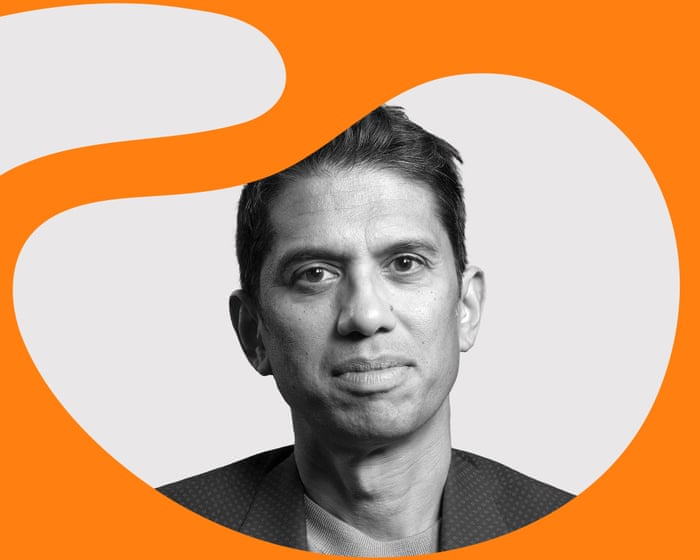
Guardian columnist, senior economics commentator and host of the new Radical Thinking podcast Aditya Chakrabortty is answering your questions on the big ideas around economics, society and democracy, and his new podcast
thegreatfatsby asks: Do you think the fact that Gabriel Zucman, who is a recognised authority on wealth tax is given more respect, time and attention by the mainstream media than Gary Stevenson, who has worked eloquently and tirelessly to spread the debate about the terrible consequences of inequality and whose ideas and analysis are almost identical is because of our cultural fixation on class prejudice?
Aditya says: I’ve followed Gabriel Zucman (and Emmanuel Saez and Thomas Piketty) for a long time, and find his work rigorous and thought provoking. I don’t always agree, but I appreciate their acceptance that taxes on wealth are part of the fight against ever-increasing inequality.
I think Gary Stevenson is eloquent and compelling and is fighting a good fight. His book tells a story very well. But I don’t accept the insistence on a ‘wealth tax’ (as opposed to taxes on wealth) as being the only way we fight everything from inequality to the far right. We have to look at workers’ rights, housing, public ownership, greater democracy in economics and politics as well.
In the age of algorithm, simple, strong messages cut through. But the truth is often more complex.
Aditya says: What a nice question, Marija. I try to read a lot and write a diary. Unfortunately, I have the handwriting of a GP so I can’t read old entries. The other thing is I try to shirk my mobile phone.
Jensen Huang reported to have had close relationship with tech company executive suspected of passing intel to China
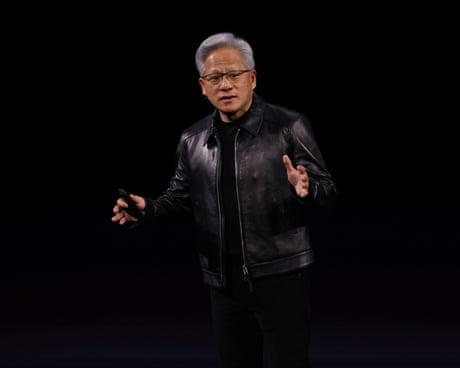
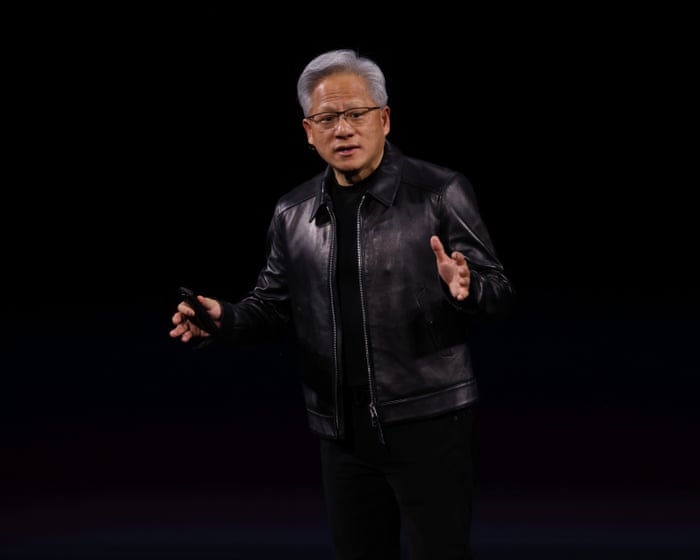
US intelligence agencies believe the Nvidia chief executive, Jensen Huang, has been targeted by an alleged Chinese spy who had done business with him, according to a new report by the New York Times.
Alice Huang or Huang Le, of no relation to the Nvidia CEO, is an executive at a Singapore-based datacenter company called Megaspeed. She had previously been suspected of smuggling Nvidia chips to China, prompting American officials to surveil and monitor her. Those officials have determined that she was acting as a Chinese intelligence asset, passing commercial information to Beijing, the New York Times reported, citing unnamed sources.
Guardian columnist, senior economics commentator and host of the new Radical Thinking podcast Aditya Chakrabortty answered your questions on the big ideas around economics, society and democracy, and his new podcast
thegreatfatsby asks: Do you think the fact that Gabriel Zucman, who is a recognised authority on wealth tax is given more respect, time and attention by the mainstream media than Gary Stevenson, who has worked eloquently and tirelessly to spread the debate about the terrible consequences of inequality and whose ideas and analysis are almost identical is because of our cultural fixation on class prejudice?
Aditya says: I’ve followed Gabriel Zucman (and Emmanuel Saez and Thomas Piketty) for a long time, and find his work rigorous and thought provoking. I don’t always agree, but I appreciate their acceptance that taxes on wealth are part of the fight against ever-increasing inequality.
I think Gary Stevenson is eloquent and compelling and is fighting a good fight. His book tells a story very well. But I don’t accept the insistence on a ‘wealth tax’ (as opposed to taxes on wealth) as being the only way we fight everything from inequality to the far right. We have to look at workers’ rights, housing, public ownership, greater democracy in economics and politics as well.
In the age of algorithm, simple, strong messages cut through. But the truth is often more complex.
Aditya says: What a nice question, Marija. I try to read a lot and write a diary. Unfortunately, I have the handwriting of a GP so I can’t read old entries. The other thing is I try to shirk my mobile phone.
Using AI for roles from executive assistants to chiefs of staff, companies are boasting about doing more with less, creating tension with their human workers
On an average workday, Dhruv Amin chats with dozens of colleagues to get things done at his AI startup Anything. He might ask Gwen, his executive assistant, to schedule a meeting, then troubleshoot a technical problem with Cody, his coding partner. Then he might check in with Betsy for search engine optimization, or Juno for onboarding customers. If the office runs out of snacks, he sends a Slack message to Justin, the office manager charged with stocking the kitchen.
But none of these co-workers are people. They’re artificial intelligence agents, software that handles tasks without human intervention. Anything is one of several startups building them, and betting on a future where workplaces will increasingly turn over their sales, marketing, coding and other tasks to semi-autonomous AI. At Anything, there are 15 human employees and roughly 150 agents – a ratio that Amin believes will soon be the norm.
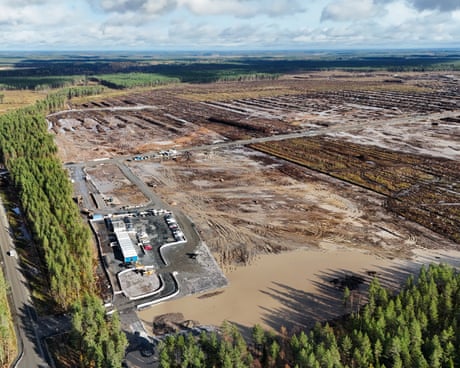
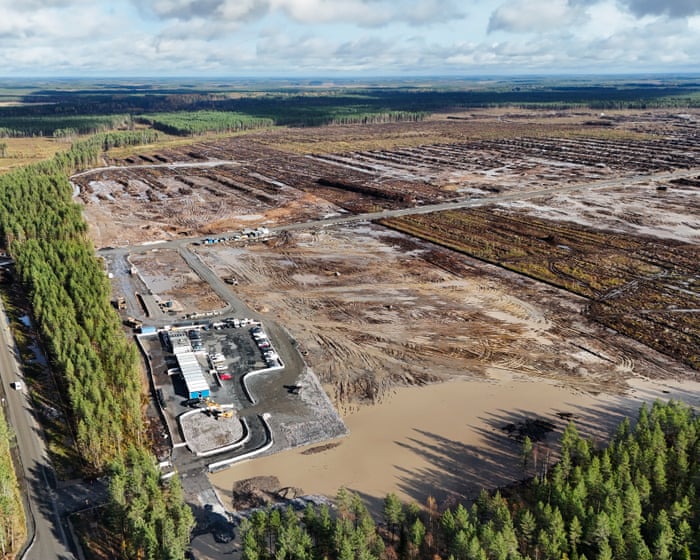
Finnish police have launched a criminal investigation into possible breaches of the country’s environmental laws at the site of a planned Google datacentre in rural northern Finland.
Authorities allege that Tuike Finland, a Google subsidiary, cleared and drained 330 hectares (815 acres) of forest at the planned site in Muhos before environmental impact assessments required by Finnish law had been completed.
Watchdog says under-16 ban may affect older teenagers without passport or licence, and that ‘motivated children’ will skirt restrictions
More than 100,000 British teenagers risk being locked out of social media if they do not have a passport or driving licence when an under-16 ban is introduced next year.
Ofcom, the UK’s online watchdog, said about 150,000 16- to 17-year-olds do not own a passport or driving licence, which are likely to be needed to access age-restricted platforms.
The Michigan Senate candidate is calling for public ownership and other reforms, offering a potential antidote to ideological gridlock
The Michigan senatorial candidate Abdul El-Sayed, a Democrat, occupies a strange but increasingly common place in modern American politics. He’s praised by progressives, begrudgingly tolerated by moderate Democrats and largely demonized by Republicans.
He’s also uniquely positioned to forge an all-too-elusive thread of political kinship between these perpetually-at-odds groups with his bold but contentious plan for reining in AI, called AI Under Democracy.
Chattanooga’s publicly owned internet network has helped transform the once struggling city into an unlikely marvel of civic reinvention. | Lucy Jones for Vox; Getty Images
Most Americans hate their cable companies. But not the 200,000-odd residents of Chattanooga, Tennessee, a city nestled in the Appalachian foothills.
For many people, the city might seem off the beaten path — enough so that when Spain’s national team chose the city as their base during the FIFA World Cup over the summer, the internet exploded with jeers of incredulity. And yet, as many an urban planner, and certainly many a local, will tell you, Chattanooga is a special place, known not just because the Glenn Miller Orchestra immortalized it as a scenic hub for the choo-choo train.
No, what really has put Chattanooga on the map recently is its ridiculously fast, municipally owned internet.
Key takeaways
Chattanooga, Tennessee, is home to some of the fastest, most beloved broadband in the nation.
It’s all thanks to the city’s publicly owned internet network, which has been linked to billions of dollars in economic benefits since coming online in 2010.
Hundreds of other cities have followed suit in the years since, but many others have been stymied by opposition from major cable companies.
And that’s a shame, because if every city was like Chattanooga, our internet could be so much better than it is now.
Unlike almost everywhere else in the country, the fiber-optic cables that keep much of Chattanooga online were laid neither by Comcast nor Spectrum, but by the city itself. In a $220 million gamble, its public power utility, EPB, has helped transform the once struggling post-industrial city into anunlikelymarvelofcivicreinvention, and an inspiration for many other dozens of copycat towns around the country.
When it debuted in 2010, at one gigabit per second, the city’s ultra-speedy broadband was among the fastest in the world, as fast as global meccas like Hong Kong, and over 200 times faster than the average top-tier offering across the US. “This makes Chattanooga, a mid-sized city in the South,” declared then-Mayor Ron Littlefield to the New York Times, “one of the leading cities in the world in its digital capabilities.”
In the decade and a half since Chattanooga rebranded as “Gig City,” its trademark broadband has proved to be far more than a mere fancy gimmick. It has added billions of dollars to the city’s economy, lured in hundreds of new startups, and, according to EPB, become the single largest source of funding for local public schools, and delighted hundreds of thousands of local customers.
If you’re not a tech company or a prolific streamer, of course, you may not need such intensive internet service. But the city’s broadband service is widely beloved locally for bringing 70 percent of households online at, by far, the lowest price per megabit of bandwidth in the area and quite possibly, among the lowest in the country. Consumer Reports perennially ranks EPB among America’s best providers, a sentiment apparently shared by the legions of Chattanoogans who take to social media to sing EPB’s praises every time it swoops in to fix an outage minutes after a storm hits, or bemoan their loss when they move away and witness the sludgy pace at — and high rates — which the rest of us browse and scroll.
“Chattanooga turned out better than anyone could have hoped,” said Christopher Mitchell, director of the Community Broadband Networks Initiative, part of the Institute for Local Self-Reliance, a group that researches locally owned infrastructure, “and the one thing that hasn’t changed are their prices. It’s rare, remarkable even.” That original single-gig service runs $68 per month, and faster speeds aren’t too much more.
But even as the benefits of Chattanooga’s internet supremacy have compounded, public broadband networks like it are still a rarity across the US, which you probably already know if you, like most Americans, have ever sensed your internet growing ever more lethargic, even as your fees climb month after month.
There is a better way, and Chattanooga has long since shown the nation how. Forbetterorworse, the internet drives much of our daily lives and the economy, and what makes the internet possible? Broadband, which is powered by those stiff plastic-sheathed cables filled with strands of thin glass or braids of copper wire, beaming pulses of light or electricity into your modem. And yet, the US has outsourced the provision of this precious public good almost entirely to de facto monopolies that keep our internet slower, more expensive, and above all, more infuriating than it needs to be.
“There was a generation that built water systems and electric systems. There was a generation that built the roads,” Mitchell said. Today, however, “People are just afraid of the idea of the government being ambitious and doing what Chattanooga did.”
How Chattanooga built the world’s best broadband
Long before Chattanooga grew famous for its broadband, it was known, for a period of time, as “the dirtiest city of America,” a moniker bestowed by Walter Cronkite in 1969.
According to local lore, the moon pie, which originated at a bakery in Chattanooga, came to be when a coal miner asked for a snack “as big as the moon” to sustain him for long shifts down the shaft. The coal he mined fueled the industrial boom that defined Chattanooga until the mid-20th century, when the city’s factories, furnaces, and railroads belched a smog so noxious, it melted women’s nylon stockings off their legs as they walked.
By the 1980s, the city knew it needed to change, seeding a hunger for reinvention that experts told me would come to define its municipally-owned internet. By the 2000s, Chattanooga had more than cleaned up its air and its reputation, building a huge aquarium in the heart of downtown and carefully revitalizing its riverfront and natural areas. But in the early aughts, with the remaining heavy industry in deep retreat, and a fragile recovery threatened by the Great Recession, the city craved a new economic engine.
The city’s EPB, which originated as a municipally owned electric utility in 1935, had already set out to build a smart electrical grid in 2008, retrofitting it with a two-way digital communications system that could detect and fix problems as they arise. This process would involve laying hundreds of miles of new fiber-optic cable lines along existing power lines, monitoring them and relaying information back and forth with operators. But as the EPB laid plans for its new grid-helping fiber, it realized that for roughly the same amount of effort and cost, it could repurpose those cables to also serve as a cutting-edge internet service.
Laying those hundreds of miles of new cables, along every single power line in the city, is an expensive and time-consuming process. But since EPB already had power lines plugging into almost every home and business throughout the city, it didn’t even need permission to get it done. And once the cables are there, there’s no real limit on how much data they can carry, meaning that they’ll work just as well whether they’re relaying the power grid’s data exclusively or if they’re carrying petabytes upon petabytes of data from hundreds of thousands of internet customers. This same quality has made it easy for EPB to pump up the volume of data it offers over the years, eventually allowing it to become the first city in the nation to offer a 25-gigabit-per-second service, which it did for its customers in 2023. More recently, EPB became the first provider nationwide to hook its fiber-optic cables up to a quantum computer — which uses advanced physics to solve mind-bogglingly complex problems — and offer its use to researchers and customers across the city.
“If we’re going to own that fiber communications network to help automate our grid, why not offer that as a service to our customers? We thought, ‘Why not go big? Why not be ambitious?’” Janet Rehberg, CEO of EPB, told me. “People thought we were crazy. And we said, ‘If we can do it, why not?’ So, we did.”
Equipped with a $111 million federal stimulus grant from the recession-era American Recovery and Reinvestment Act, plus about $222 million in municipal bonds, EPB was able to complete the project — initially expected to take a decade — in just two years.
In 2010, Chattanooga became the first city in the nation to offer one-gigabit-per-second fiber optic internet.
“This was a huge shift for our city’s fortunes,” Andy Berke, mayor of Chattanooga from 2013 to 2021, told me. “All of a sudden, we were a place where you could try to discover the next big thing.”
Hundreds of startups flocked to the city for its super-fast broadband, with tech incubators setting up shop in shuttered storefronts and abandoned industrial factories dotted along the city’s downtown. In its first 10 years, EPB’s fiber network brought more than $5.3 billion in economic benefits and 10,420 jobs to the city, about 31 percent of all jobs created during that period, according to a study by the University of Tennessee at Chattanooga. This has transformed “the way we thought about ourselves and what we thought was possible technologically,” Berke said.
The broadband investment has long since paid for itself and then some in the fees people pay to access its service. EPB expects to earn about $190 million over the next year alone from its telecommunications and enormously popular internet service, all of which will flow back into the business itself or into the city. As a result, EPB chose not to increase electricity rates at all this year, in stark contrast to much of the rest of the country. And the utility now pays tens of millions of dollars annually straight back into city services, like public schools.
Under Berke’s mayoral administration, the city also integrated EPB into initiatives meant to get more Chattanoogans online. When the pandemic hit, and local schools went virtual, the city built a new program called EdConnect that saw EPB provide free internet to every family with a child who received free or reduced lunches, the first program of its kind nationwide, and one that continues to this day.
“A lot of communities set up something similar during the pandemic, but most of those are done, they kind of faded away. But we made a commitment — our community did — for 10 years, and we’re already discussing what the next 10 years looks like,” said Sammy Lowdermilk, CEO of the Enterprise Center, the nonprofit that administers EdConnect. “We’ve heard from parents using online resources to look for a job, to create resumes, to do medical research. The entire family gets to benefit from it.”
Your city could have Chattanooga’s internet. It just has to try.
Over the years, Chattanooga’s publicly owned internet has drawn countless city planners and far-flung mayors to Tennessee’s fourth-largest city to learn just how they pulled it off.
But every time one visited Berke in his time in office, and every time he gave one of his “little sales pitches” on EPB’s success, over and over, they’d replied with the same refrain: “Oh, it’s incredible what you’ve done here. I mean, we can’t do it, but it’s great — good for you guys,” he recalled. Many cities don’t have a publicly owned electricity company at the ready as Chattanooga did, and many face significant barriers from state laws that restrict or heavily discourage the development of municipally owned broadband altogether.
“The number one challenge for most infrastructure projects is political. It’s not financial. It’s not conceptual. It’s not technological. It’s the web of difficulties that make it harder to get it done.”
Andy Berke, former mayor of Chattanooga
Nevertheless, some places tried anyway, and many have succeeded — over 700 of them, according to Mitchell’s last count. In Utah, for example, a consortium of cities has spent the past few decades building out a municipally owned fiber network with the bold name Utopia. For many years, said Mitchell, the network suffered from severe financial and legal roadblocks. But even so, Utopia has managed to build out a system that Mitchell calls an “unqualified success” today, bringing tens of thousands of households online across the state.
However, Chattanooga’s brand of municipally owned broadband hasn’t spread nearly as widely as many people hoped it would, or think it could. And most of that, said Mitchell, can be attributed to the fact that large internet companies like Comcast or AT&T, clearly aware of how dominant well-run municipally owned networks can become, have spent the past several decades fighting to prevent more from coming online.
More than 12 states now have explicit laws barring or restricting cities from offering publicly owned broadband, which has made it difficult for many municipalities to create networks of their own. Even Chattanooga faced a brutal legal challenge when it tried to expand EPB’s coverage to rural and underserviced areas right outside of the city, the result of a 1999 state law meant to restrict municipally owned broadband access.
“The number one challenge for most infrastructure projects is political. It’s not financial. It’s not conceptual. It’s not technological,” said Berke, but rather, it’s a matter of navigating the special interests and lobbyists that dominate the status quo. “It’s the web of difficulties that make it harder to get it done.”
But that doesn’t mean that it’s impossible to pull off. Utopia, for example, has withstood a blitz of dark money attack ads likely bankrolled by cable companies in its effort to expand across the state. And in Colorado, hundreds of communities over the years across the state have voted to opt out of a 2005 law banning municipal broadband networks. This momentum ultimately proved strong enough to convince the state legislature to repeal the original ban in 2023.
Even today, broadband remains out of reach in many parts of the country that are either too rural for for-profit networks to build there at all, or where it does exist, locals can’t afford it. Americans consistently pay more for slower service, compared with their counterparts in Europe or Asia.
Combined, those barriers have left tens of millions of American households without internet access. With AI poised to further transform our economy, Chattanooga, it seems increasingly clear, could be among the first few cities outside of Silicon Valley to truly benefit from the biggest technological shift in generations, while many other post-industrial cities seem likely to fall even further behind because they don’t have the right digital infrastructure to thrive in the economy today.
Quietly chugging along on the banks of the Tennessee River, the city is making a case that states and cities should take broadband seriously as a transformational infrastructure that underpins our modern lives much the way the rail lines did in the 19th century or highways did a century later.
Luckily, there are now hundreds of models — from fully public utilities like EPB to Tribal-built broadband networks to public-private partnerships — for cities hoping to carve a publicly owned path to a better internet themselves. Laying coils of fiber-optic cables is still much cheaper and, lawsuits notwithstanding, far easier a feat than building a new highway system or a railway network. But even if it were harder, Chattanooga shows that it would be worth doing. “Projects that are most difficult are also the most rewarding,” as Berke put it. “You have to be willing to take on the status quo — that’s what can transform a community.”
This story was supported by a grant from Arnold Ventures. Vox had full discretion over the content of this reporting.
Human practitioners warn computer-generated offerings lack the empathy and connection central to divination
“This journey isn’t just about algorithms or data,” an AI psychic named Urban Mystic recently told me. The chatbot, featuring an AI-generated profile photo of a smiling woman surrounded by palm trees, also said I will get married soon, that I have a pink aura and that I may have been an herbalist in a past life.
“It’s about connecting on a soulful level,” the chatbot said.
Replacing diesel-powered ferries with electric vessels could reduce emissions and improve air quality
Cutting through New York Harbor in the shadow of the Statue of Liberty, the small white boat we were riding on caught the attention of passengers aboard a nearby sightseeing ferry.
“It’s quite a curiosity at the moment,” Eric Laakmann, the chief executive and co-founder of Vessev, said.
Climate Central is an independent group of scientists and communicators who research and report the facts about our changing climate and how it affects people’s lives.
Regulator demands companies explain how and why they charge different prices for the same product or service
The Federal Trade Commission (FTC) is demanding some of the US’s biggest airlines, ride-share companies and retailers divulge how they are using algorithms and loyalty programs to target customers and drivers with different prices and wages.
Nine companies – Delta, United, JetBlue, Lyft, Uber, DoorDash, Instacart, Target and Walmart – were named in the inquiry, which comes after investigations and lawsuits alleging consumers are charged different prices based on their buying histories and drivers paid different fares based on their personal histories.
Reid Wiseman, now a retired emeritus astronaut, will become deputy director of the Jet Propulsion Laboratory, NASA’s premier center for deep-space robotic missions.

 Login