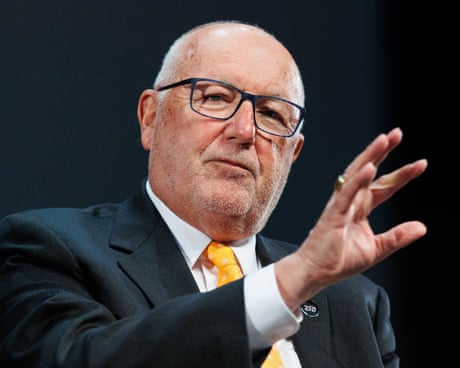
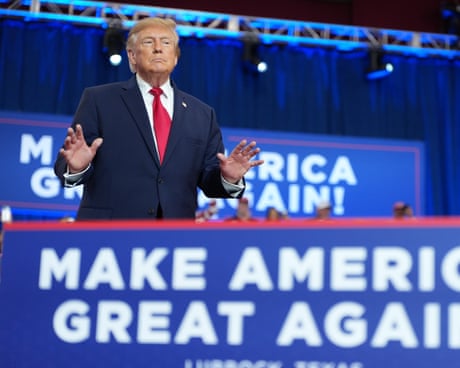
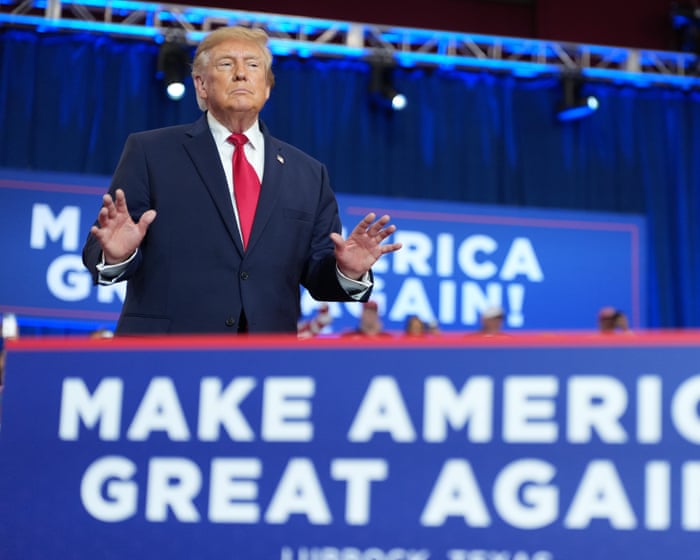
Pete Hoekstra, controversial US ambassador to Canada, has also accused Canadian officials of interfering in US elections
The US ambassador has suggested Canada could be blamed if Republicans perform poorly in next week’s midterm elections, the latest intervention from a controversial figure who has been accused of inflaming a bitter dispute that has angered and baffled residents of both countries.
On Wednesday, CTV news reported that Pete Hoekstra told business leaders at a closed door meeting that if a number of swing races – including Maine and Michigan – go to the Democrats, it could make things harder for Canada because Donald Trump might try to blame the loss on it.
Texas Senate candidate James Talarico, a Democrat, speaks at a public exhibit about the Epstein files in Dallas. | Chitose Suzuki/The Dallas Morning News via Getty Images
This story appeared in Today, Explained, a daily newsletter that helps you understand the most compelling news and stories of the day. Subscribe here.
Eighteen years after his first conviction, and seven years after his much-debated death, the ghost of the convicted sex offender Jeffrey Epstein is suddenly inescapable again.
He’s the subject of scores of midterm campaign ads, each more lurid than the last. A second bill mandating the release of the Epstein files is currently kicking around Congress. And on Monday, House Democrats released a new report alleging that the Justice Department helped cover up details of Epstein’s relationship with President Donald Trump, calling — very aspirationally! — for an independent criminal investigation.
Of course, no one really expects Trump’s attorney general to name a special counsel to investigate the Trump administration. In a statement, one White House spokesperson panned the report as “a desperate attempt by crazed Democrats to distract Americans.” (The timing, just one week before the midterms, does seem pretty fortuitous.)
The document, which runs to 50 pages, draws on public accounts and staff interviews with an unspecified number of survivors, including a former pageant queen who alleges that Trump raped her in 1993. The woman had previously accused Trump of groping her, which a Trump spokesperson dismissed at the time as “fake.”
When it comes to Epstein, however, Democrats don’t need a lot of new material to damage Trump. The scandal, and his administration’s handling of it, continue to cast a long, dark shadow over Republicans.
That’s surprising to me, candidly, because the decades-old dealings of even a very despicable sex offender don’t have any bearing on Americans’ day-to-day costs or experiences. And Trump has been able to brush off a lot of other unsavory behavior and associations.
Many of these young voters “resent the fact that Trump’s basically become part of the establishment” and see the Epstein files as evidence of that, the political analyst Rachel Janfaza recently told Vox. Some also feel burned by Trump’s campaign promise to release the government’s investigative files on Epstein…and his about-face once in office.
Democrats, sensing an opening, are hammering the issue. Relentlessly so. According to data from the tracker AdImpact cited by NBC News, there are currently more than 500 campaign ads airing across the country that include the words “pedophile” or “predator.”
Many of them reference Epstein or the so-called Epstein files, and three-quarters are backed by Democrats. One recent ad featuring an Epstein survivor, and targeted at Kansas Republican Roger Marshall, slams the incumbent senator’s September 2025 vote to block a procedural measure that would have released the Epstein files. (The Senate later moved to release the files by unanimous consent.)
Another ad, this one in Maine, claims that Epstein’s “business partner” funneled $3 million to Sen. Susan Collins’s super PAC. (Importantly, the connection between Epstein and this purported partner is so tenuous as to be nonexistent.)
These ads will fade after Tuesday, of course. But you haven’t heard the last word on this. Should Democrats win control of either chamber, they’ll gain the power to subpoena witnesses and documents for yet more Epstein investigations.
Some Democratic leaders in the House are already salivating over that prospect.
One link for later
➨ Ask better questions than “what do you do?” Small talk is often dominated by idle chatter about traffic, weather, or jobs. To actually get to know your conversation partner, try leading with questions that get at their interests: what a friend’s friend is reading, for example, or what a barista’s favorite beverage is. You can even draft a little list of go-to questions in advance to deploy in conversation when you need them. Just don’t treat the exercise like a checklist. The real key to better small talk is being curious.
Before you go…
Did you know…that concrete is the second-most-used material on Earth? (The first is water!) Mixing and pouring concrete is responsible for a huge share of global emissions, but there are efforts underway to make it more sustainable.
Today’s trivia: An arroyo is a stream — or at least, a streambed — found in what type of environment? (You can find this and other brain puzzles in Vox’s daily crossword. Look for the answer in tomorrow’s edition.)
Yesterday’s trivia: Yesterday we asked you for the name of the lovable yellow dog in the comic strip Garfield. That would be Odie, whose look evolved over the years as illustrator Jim Davis sought to distinguish him from his iconic canine rival Snoopy.
Republicans have condemned the presence of two Dan Sullivans on the ballot, calling it a ploy to split votes
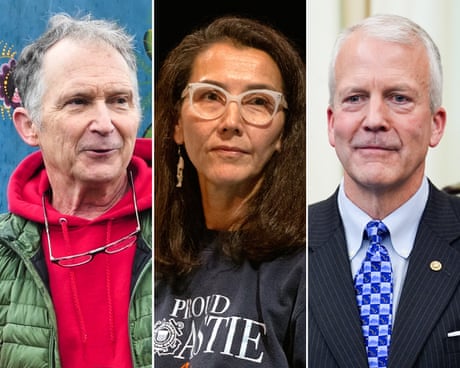
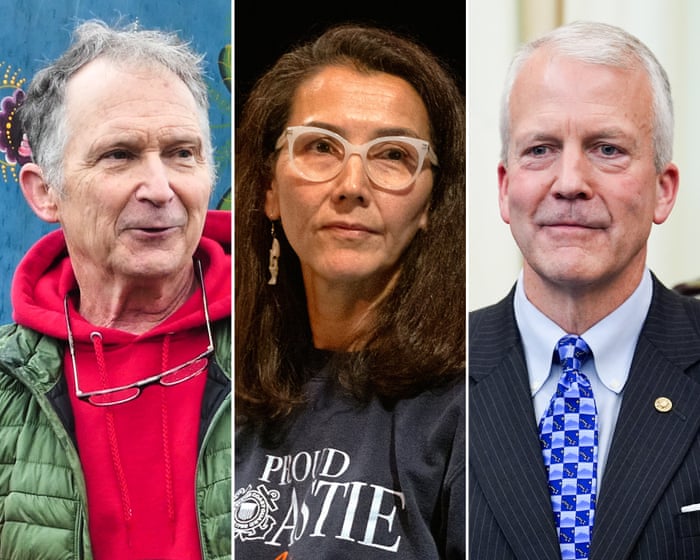
Alaska Democrat Mary Peltola’s campaign was behind an effort to recruit a challenger with almost the same name as the Republican US senator Dan Sullivan, both of whom will appear on the ballot in next week’s midterm elections, the New York Times reported on Wednesday.
Republicans have condemned the presence in the race of two candidates named Dan Sullivan – one the two-term US senator, the second a retiree living in south-eastern Alaska with scant political experience – calling the newcomer a ploy by Democrats to cost the incumbent re-election by splitting his supporters.
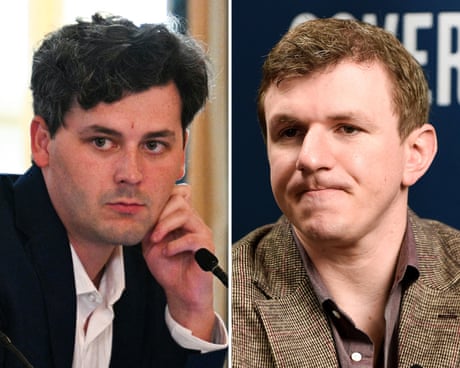
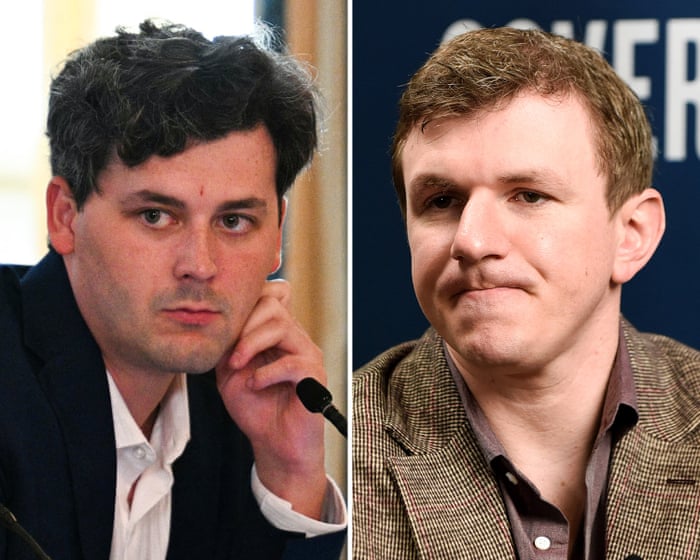
James O’Keefe and Cam Higby were trying to show vulnerabilities in allowing a voter to vouch for another
Two rightwing influencers have been charged with felonies in Minneapolis over attempts in the state’s election primary to disguise themselves in what they called “Muslim garb” and claim they were local voters.
James O’Keefe and Cam Higby went to polling places in Minnesota during the state’s August primary in an attempt to show vulnerabilities in the practice of “vouching”, where a registered voter from the same precinct can vouch for another voter’s eligibility.
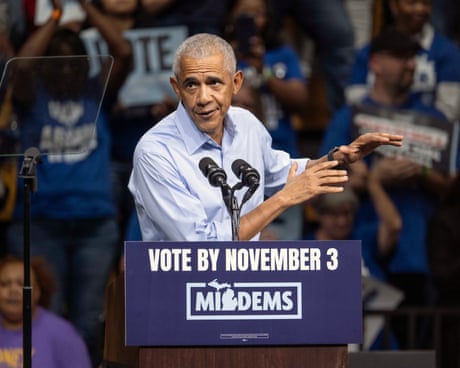
Barack Obama versus Donald Trump. It is the presidential election that never happened but has come to define an era of US politics.
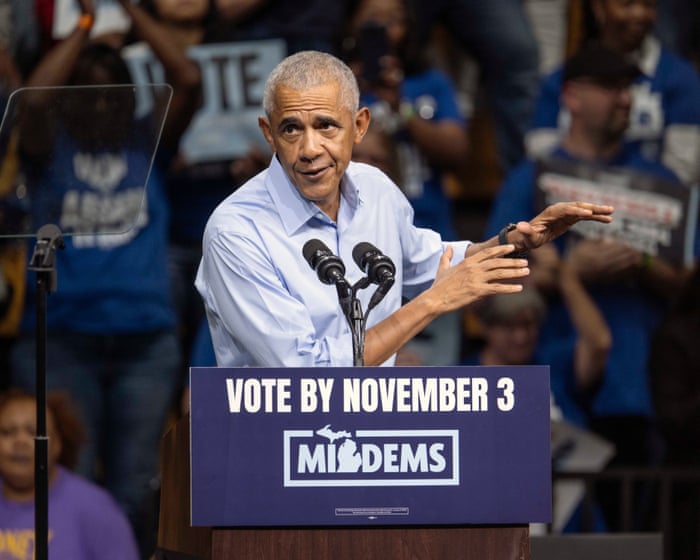
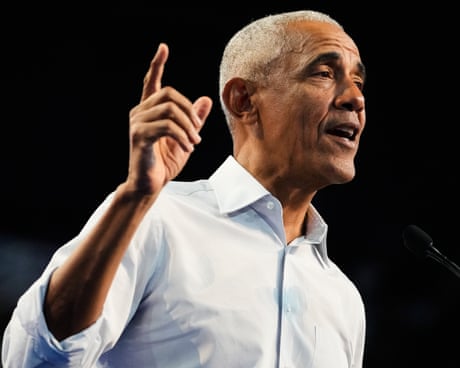
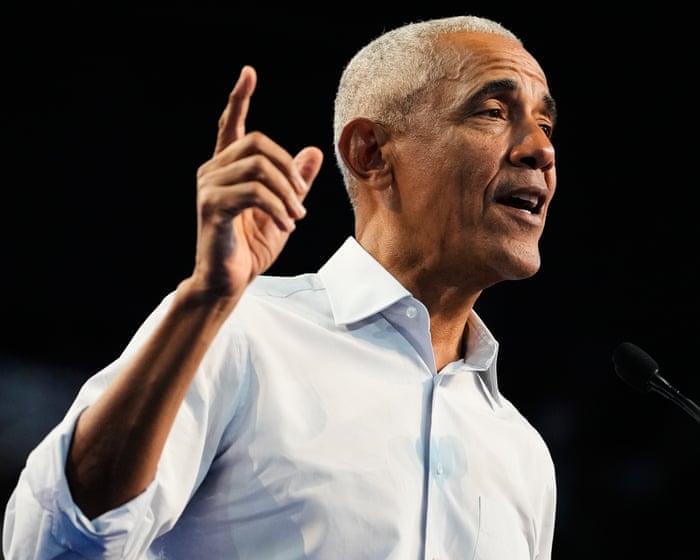
Obama is back on the campaign trail for the midterms, still electrifying crowds, earning shouts of “We love you!” and skewering his successor. “What’s up with the gold?” he asked a crowd in Detroit. “I mean, he’s got the White House looking like Saddam Hussein opened a Cheesecake Factory.” This has, predictably, set off a mini culture war involving questions of elitism and the tastefulness of chain restaurants.
Circumstances are ripe for change in this onetime Republican stronghold given the current dissatisfaction with Trump agenda, experts say
Donald Trump has repeatedly asked voters to pretend that he is on the ballot in November’s crucial midterm elections. And in the comfortable confines of Arizona’s most affluent and fiercely contested congressional district, Trump is definitely on voters’ minds.
But whether that helps or hurts the warring congressional candidates in this sun-drenched swath of suburbia, where Teslas and walled-in luxury homes dominate, depends on who you ask.
US health secretary falsely claims at Mike Rogers rally that Arabs have never won major prizes in science or literature
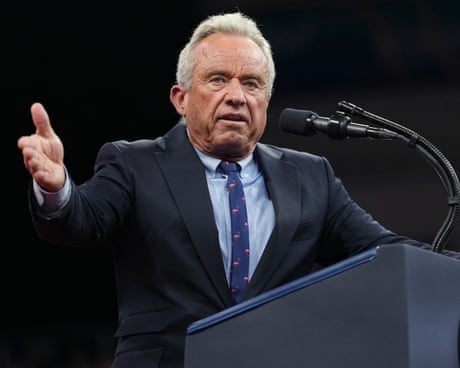
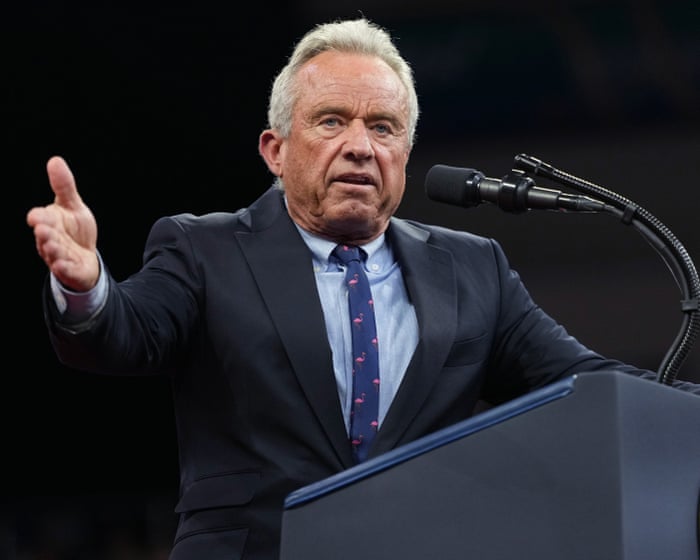
Robert F Kennedy Jr, the US health secretary, faced backlash on Wednesday for a “wildly racist tirade” during a campaign stop in Michigan in which he falsely asserted that Arabs never won leading awards in science or literature.
Kennedy was speaking at the Monday night event in Grand Rapids in support of Mike Rogers, the Republican US Senate candidate trailing his Democratic midterms opponent Abdul El-Sayed, who is Muslim, in polling.
For months, Mary Peltola’s campaign for Alaska’s Senate seat has denied any connection to a separate campaign launched by a man who, coincidentally, shares the exact same name as Peltola’s Republican opponent, Dan Sullivan.
New reporting from the New York Times undercuts that claim. The outlet reported, based on interviews, obtained text messages and legal filings, that the Peltola campaign had not only recruited Mr Sullivan (not the Republican), but had sought out a number of Dan Sullivans across the state for potential candidacy, as well as others who could peel votes away from Peltola’s main opponent.
President at Texas campaign rally hails deal struck with post-Maduro government as ‘greatest oil victory in history’
Donald Trump suggested Venezuela would become the 51st state of the United States on Tuesday as the president showed off a tanker he claimed had “one million barrels of oil on it” from the country, nine months after deposing its president.
At a campaign rally in Corpus Christ, Texas, Trump touted a US oil deal with Venezuela, which the US attacked in January, capturing its long-serving leader Nicolás Maduro.
Speaking to reporters on the tarmac before departing for a campaign event in Michigan, JD Vance responded to a question about President Trump’s remarks branding Democratic Senate candidate Abdul El-Sayed as a “jihadist.”
Vance, who has sparred with the progressive El-Sayed repeatedly on the campaign trail, took a somewhat softer tone. But he didn’t walk away from Trump’s remarks.
The day after former President Barack Obama and Michigan Senate candidate Abdul El-Sayed campaigned together in Detroit, President Donald Trump launched an anti-Muslim attack against El-Sayed. | Emily Elconin/Bloomberg via Getty Images
This story appeared in The Logoff, a daily newsletter that helps you stay informed about the Trump administration without letting political news take over your life. Subscribe here.
Welcome to The Logoff: Donald Trump’s midterm barnstorming is getting uglier and more desperate.
What’s happening? At a campaign rally in Port Huron, Michigan, on Sunday, Trump launched a new round of anti-Muslim attacks against Michigan Democratic Senate nominee Abdul El-Sayed, describing him as a “jihadist” who “should never be allowed inside the halls of our great beautiful Capitol.”
“If Abdul and the Democrats win,” Trump told supporters, “they will open the floodgates and invite hordes of jihadists to our shores, creating a nightmare of violence and terror until you cannot even have a Christmas.”
What’s the context? Trump’s speech marks the crescendo — so far — of what has become an increasingly Islamophobic midterm campaign by the Republican Party, centered on El-Sayed.
Former Rep. Mike Rogers, Michigan’s Republican Senate nominee, has repeatedly tried to link El-Sayed to the Muslim Brotherhood, and Republicans have also attempted to wield Islamophobia against the Democratic Party as a whole.
On Sunday, Texas Gov. Greg Abbott told Fox News that his Democratic opponent, Gina Hinojosa, “supports Sharia law,” while at the Republican midterm convention in September, Texas Sen. Ted Cruz said that “communism” and “Islamism” were allying against Republicans.
What’s the big picture? In addition to his overt Islamophobia, Trump’s presence on the campaign trail in the final few weeks of the midterm elections has been decidedly strange and surprisingly heavy on physical descriptions of Sen. Jon Husted (R-OH).
Now, with just eight days to go, Trump’s itinerary features rallies in Mississippi, Texas, Ohio, South Carolina, and Florida — all Republican states where the party has found itself, to one degree or another, with a tougher-than-expected Senate race on its hands.
It’s hardly the travel schedule of a president who feels good about his party’s chances— such as in Michigan, where El-Sayed is leading in most recent polls.
And with that, it’s time to log off…
US elections may not be until next week, but two other countries held theirs over the weekend: Serbia and Brazil. As my colleague Caitlin Dewey reports in Vox’s Today, Explained newsletter, both resulted in surprise victories over right-wing nationalist parties, with Serbia ousting its incumbent strongman, Aleksandar Vučić.
Brazilian President Luiz Inácio Lula da Silva’s victory over Flávio Bolsonaro is also especially good news for the climate: As the New York Times reported earlier this month, the fate of the Amazon rainforest may well have hinged on the outcome of the election.
Thanks for reading, have a great evening, and we’ll see you tomorrow!
“It is a very real dynamic that you could have all these videos about Jon Ossoff, and it's not seen as detracting away from his overall message or his seriousness as a politician,” The 19th’s Grace Panetta said on Vox’s Today, Explained podcast. | Elijah Nouvelage/Getty Images
Democrats have been emphasizing lots of issues in the runup to the 2026 midterms: The Iran war. The state of the economy and healthcare. Corruption. And…hotness.
Specifically, their candidates: The internet is awash in clips of Michigan candidate Abdul El-Sayed pumping iron and podcasters proclaiming that “America deserves a hot president” in a video interspersed with photos of Georgia Sen. Jon Ossoff.
Having a good-looking candidate is by no means a new tactic — famously, it may have helped John F. Kennedy win election over Richard Nixon — but the online left is adapting that strategy for the internet and fandom age.
Grace Panetta, a politics reporter for The 19th, wrote about how “thirst edits” of Ossoff in particular are proliferating online. Panetta says the organic origins of a lot of these videos are of particular interest to Democratic operatives, who see it as a way to gain back ground they lost on the internet after the 2024 election.
Panetta spoke with Today, Explained co-host Sean Rameswaram about who’s thirsting over Democratic politicians in the first place, how 2026’s hot candidates are different from those of yore, and whether it’s actually giving them a boost.
Below is an excerpt of their conversation, edited for length and clarity. There’s much more in the full podcast, so listen to Today, Explained wherever you get your podcasts, including Apple Podcasts, Pandora, and Spotify.
Where are these edits coming from?
Regular online creators. And it’s important to note at the outset that these are not paid partnerships. The campaign is not paying these influencers to make edits about how they think their candidate’s really attractive.
That’s partly why I wanted to dig into it, because it’s organic. These are just online creators wanting to draw visibility and attention to a candidate that they really like.
Jon Ossoff is currently running for reelection in these midterms. How do we know for sure that he isn’t somehow behind the campaign?
I spoke to several creators who make these videos and they said that they’re doing it for the love of the game and they’re just supporters. His campaign did not give me a quote or a statement for this story. So it’s fair to assume that he’s not directly involved and he doesn’t repost these videos.
But as people pointed out to me, his campaign knows that they have an attractive, compelling candidate. And they’ve previously been vaunted for their digital strategy this cycle of putting out very high-quality livestreams of his rallies. There’s a lot of material for an enterprising TikToker who wants to make these edits or clips. They have a lot to work with.
His campaign, as one person put it, is definitely playing into that, but not directly engaging. It’s a fine line to walk.
Is it just an Ossoff thing or is this going on with other candidates? I do recall that Abdul El-Sayed hits the gym.
Famously so. Yes, he hits the gym. I just watched so many videos for this story. I also came across a fair number of Gavin Newsom edits. There are people who think he gives sort of a Patrick Bateman, American Psycho vibe.
There are also official Democratic accounts, including the TikTok account for the DNC, the headquarters account, which was formerly Kamala HQ, who have been posting edits of Ossoff and also Abdul El-Sayed, who kind of leans into this gym-bro persona.
The headquarters account posted a side-by-side of Ossoff and Abdul El-Sayed with the caption, “There are 69 days until election day.”
Nice.
Yes. There are also lots of edits of Mamdani, and former President Barack Obama. Obama nostalgia content goes hard on the internet. So you’re seeing these more official side Democratic campaign accounts leaning into it and playing up their candidates.
Having an attractive candidate is nothing new. You mentioned Obama. JFK was famously dashing. What feels different about what you’re seeing now on social media?
I think this is really a culmination of a lot of different things happening right now in politics and specifically within the Democratic Party.
After their loss in 2024, there was a lot of conversation about the gerontocracy, how we’re governed by a lot of really old people, for the most part, in this century. And also about Democrats’ digital strategy and the aftermath of 2024.
One thing that a lot of people in that digital space have been talking about is how Republicans and the Trump campaign really capitalized on getting that organic engagement on platforms like TikTok and Instagram, where a lot of Americans are now going to get at least some of their news, and also engaging with and encouraging the creation of this kind of organic content on platforms and from creators that are not always expressly political or official-side.
“A candidate’s messaging strategy is only as good as the content and only if it meets people where they are and actually speaks to a real need people have.”
As one Democrat I talked to put it, she thinks it’s a way for Democrats to win back the internet and to really create a contrast with the Republicans. And she said to have fun on the internet because Republicans are having fun on the internet and it appears to be working for them, or at least it was in 2024.
Is there something about this being something on the left that makes it sort of tricky? This is, broadly speaking, objectification, right?
It is a fine line between thirst and objectification. And there is also a gendered element to it that it is mostly men that these types of videos are being made about.
Now, granted, a lot of people make sort of hype edits or positive content about AOC because she’s a very popular female politician on the left, but it’s true that women candidates are held to higher standards in terms of how they present themselves and how their supporters portray them.
It is a very real dynamic that you could have all these videos about Jon Ossoff, and it’s not seen as detracting away from his overall message or his seriousness as a politician.
Is there a drawback of focusing on looks? Does it make the Democratic Party or these candidates seem superficial or not that serious?
President Trump has been the defining figure in our politics for 10 years now. And he is famously very, very image focused and image obsessed. We live in a very image-obsessed society, and I think there’s kind of a bipartisan acknowledgement of that.
And looks matter to people in all kinds of ways. They do matter in politics, they do matter to voters. Whether you like that that’s the case or not, it is the reality. And I think the way that a lot of people on the left see this is, people want to look at attractive people. People take attractive people more seriously and are more willing to listen to them. So we should play into that and play that up.
That’s also been the case on the right. President Trump famously loves people out of “central casting.” There’s been this whole movement on the right about making conservatism sexy again. And especially at the beginning of the second Trump term, you had all these influencers talking about how the second Trump term was going to usher in this great age of hotness, which is of course very based on sort of stereotypical male-centered Eurocentric beauty standards.
I think the genie’s out of the bottle on this one in terms of the fact that our politics and society is very image-obsessed. And I think the left, being locked out of power, realizes they have to play on those terms and they have fun doing it.
You could look at it as giving “Kamala is brat,” which famously did not work. Is it working in any tangible way for Ossoff, for Abdul El-Sayed, or anyone else?
I think a lot of the time in politics, the success of a message is really dependent on the broader political situation. I think a part of the reason that the Kamala’s brat thing didn’t work is people were like, “Okay, that’s great, but my gas is too expensive and prices are too high and I’m not happy with how things have gone under the Biden administration, so I don’t really care.” I don’t know that specific digital strategy makes or breaks a campaign or candidate, but it feeds into a bunch of larger factors.
Something that a lot of people I spoke to said they liked about Jon Ossoff is how he is incredibly serious in Senate hearings. He doesn’t grandstand. He really holds Trump administration officials’ feet to the fire.He’s been very focused in his role in the Senate and on the campaign trail about calling out corruption. He’s a very, very gifted speaker and orator.
So I think a candidate’s messaging strategy is only as good as the content and only if it meets people where they are and actually speaks to a real need people have. And I think people are really unhappy with the second Trump term and politicians being super old and out of touch, and it’s a perfect storm of factors that makes it work for him.
ELLSWORTH, Kansas — David Rankin has never been one for putting up campaign lawn signs. As a lifelong Republican in a town of 3,000 — where Donald Trump has won by 50-point margins since 2016 — he’snever seen a reason toput a candidate’s name in his yard.
But recently, Rankin and his wife Dina did something new. Frustrated with their senators in Washington, DC, they went out to their front lawn and hammered in a sign in support of the Rev. Adam Hamilton, a Methodist megachurch pastor running for US Senate — and a Democrat.
As signs of a midterm blue wave rise around the country, perhaps no state has been more surprising to watch than Kansas, a state that hasn’t elected a Democrat to the Senate in 94 years. A string of polls nowshow the incumbent GOP Sen. Roger Marshall locked in a tight race for survival, buffeted by low approval ratings, a string of personalcontroversies, poor campaigning, and Trump’s unpopularity over healthcare cuts, fuel costs, beef prices, and tariffs.
Kansas is now a toss-up, attracting both nationalattention and last-minute cash investments from the national parties.Pundits have pointed to a range of reasons: the national backlash against the president; the unusual weakness of Marshall’s candidacy;the persistence of pocketbook issues for Kansas voters.
But there’s also something more interesting afoot, a difference that may have its own national repercussions.Hamilton’s campaign is a rare instance of a Democrat deliberately rallying people of faith, boldly proclaiming the Gospels, openly talking about Jesus Christ, and asking voters to find — and embrace — a profoundly Democratic message in the beliefs they profess every Sunday.
“Our faith is respectful…it reflects the ideas of justice and fairness, things that are just fundamental to the Bible,” Hamilton told me in early October. “Two thousand verses in the Bible talk about poverty and taking care of the poor. That’s not what you hear from Christian nationalists.”
That was part of the draw for the Rankins. They had known about Hamilton for a while. Friends had been to his church, and David — a retired choir director — told me that his own Presbyterian congregation had used Hamilton’s books and various sermon series as part of their Bible study. So when they found out Hamilton had decided to run earlier this year — as a Democrat, no less — they prepared themselves for the possibility that they might have to break with their political partythis year.
“Things are not right right now. They’re not right in Washington and we have to do better,” Rankin told me. “His faith is just going to make him better as he serves us.”
If Hamilton, and a handful of other candidates of faith in nearby Iowa and Texas, win, it could signal a shift in US politics — or at least a tremor in one of its most rock-solid certainties. One of the defining stories of the last century has been the realignment of religion, religious life, and religious voters on the political spectrum — and the complete shift of evangelicals toward the GOP. From the 1960s to the 1980s, Democrats could routinely count on majority support among white evangelical Protestants in congressional elections, and at least substantial support from them at the presidential level. But by the 1990s — with Americans becoming more evangelical and evangelicals becoming more Republican — the GOP had effectively locked in a permanent voting bloc, especially powerful in the heartland and the South.
Meanwhile the opposite has been true for the Democratic Party: Rapid liberalization and secularization has moved nonreligious and anti-religious voterstoward the Democrats, while religious Democratic voters tend to come from smaller progressive churches. The shift has onlyaccelerated in recent years, as Trump has consolidated evangelical voters,while white college-educated voters — who are largely secular — moved left. And when blue-state Democrats try to deploy faith-based messages, they get derided or dismissed as awkward, disingenuous, or off-brand.
The result: In recent years, Democrats have mostly ceded religious voters, outreach, and messaging to Republicans. That has made it almost impossible for the party to compete in red and rural states, where white evangelical voters make up a substantial share of the electorate. In turn, Democrats have faced increasingly long odds to win thoseSenate seats, or expand the electoral map in presidential contests.
Whether he wins or losesin Kansas, Hamilton’s overperformingcampaign poses a high-stakes question for Democrats nationally: Can a true moderate, a self-described radical centrist, and an openly religious person offer a road map for reclaiming Christianity and winning back religious voters?
Maybe Hamilton does represent such a playbook. But to watch him on the trail, you find another fact that makes his path look much harder for other Democrats to walk.
It’s not just that Hamilton is a religious Democrat, or even that he’s mastered a message for religious swing voters hoping to reconcile their faith with a Democratic candidate. He’s also a deeply talented public speaker, well-connected community leader, and authoritative religious voice willing — unlike most pastors — to wade directly into electoral politics. He is, in other words, a unicorn.
He’s the leader of a very unique church — not just a politician “affiliated” with Christianity or training to join the clergy, but an established figure in an established institutional denomination that insulates him against attacks on his faith and character. (One of those came from no less than Vice President JD Vance, whoattackedHamilton in September as “dressed in the skin suitofour religion.”) The skills that come with leading a megachurch also lend themselves easily to campaigning — but might not be replicable for others, at least not to this extent. And Hamilton has managed to ease concerns from secular or nonreligious liberals, without compromising his centrist, at times heterodox, religious and political beliefs.
His campaign could change control of Congress. But beyond that, it also offers a new, possibly more effective, political language for Democrats in a post-Trump world.
On a recent Thursday in Hutchinson, Kansas, Adam Hamilton found himself therapizing a crowd of several hundred. “Republicans for Hamilton” pins floated in the audience at this downtown theater in the middle of the state, as he diagnosed the problems in Washington that have bled into Kansas. Members of the US Senate, Hamilton said gently, had become like Dorothy’s traveling companions in The Wizard of Oz: They’d lost their minds, their hearts, and their courage.
Along the way, he said,they, and President Donald Trump, had torn apart the fabric of the community, turning neighbors into suspicious strangers. Heads nodded in agreement; those closest to me sighed and lowered their heads. Hamilton recounted something a mother once asked him: to be “somebody who’s going to help me not hate my neighbors with the red caps anymore.”
“And she wasn’t talking about Chiefs fans,” he quipped. Laughter broke the silence.
To see Hamilton in action feels like being thrown back to a forgotten era of politics: His tone is conciliatory. He’s eager to dispense with the “extremes.” He slips into preaching about “radical love,” and he’s comfortable quoting scripture and referencing Christian teachings when answering policy questions. Time permitting, he shakes hands and greets everyone in a room.
His public persona is built far less on his political experience—this is his first race — than on his three decades of experience leading a megachurch.In his own telling, tending to the middle has been a defining part of his life’s work.
His faith journey started in high school. Raised nominally Catholic, he embraced atheism as he watched his parents go through a divorce and after his grandmother died by suicide. After a late night of smoking weed with a friend, he heard a knock at the door: a Pentecostal missionary was inviting him to church. Though not necessarily sold on this movement, he did meet his wife LaVon at church — and they married a week after graduating.
Yet around this time, he says he felt a stirring to become a pastor. He enrolled at the evangelical Oral Roberts University to train as a preacher, but was thrown into despair, disillusionment, and doubt when his two best friends died in an accident. Seeking counsel and comfort from Pentecostal pastors and leaders, he was met with platitudes (“Everything happens for a reason”) and unanswered questions — and so began a journey that led him to John Wesley, the English theologian, and the movement he founded, Methodism.
“I carry my pocket testament with me everywhere,” Hamilton told me, pulling out his copy of the Gospels and the epistles of John, as he tends to do on the trail. “This is my defining story. This book and its story define how I understand what it means to be human and is at the center of my life.”
He was just 25 when he founded the Church of the Resurrection, commissioned by his bishops in the United Methodist Church to start a church “for thinking people.”
The point was to “use your intellect and not check your brain at the door,” he says on the stump. “And have a heart. Focus on both a spiritual life, but also on living out faith and justice in the world. These things go hand in hand.”
And so it came to pass that a congregation that started off meeting in the chapel of a funeral home in the 1990s grew into Kansas’s largest church, and the largest Methodist congregation in the country. The church now has nine locations across two states counting about 24,000 membersbetween them, anchored by a spaceship-looking complex in Leawood, a Kansas City suburb.
Hamilton, and members of the church, are quick to point out the radical centrism of the church: It’s split roughly evenly between Republicans, Democrats, and independents. Hamilton himself is a former Republican. The Leawood location features both a 3,500-capacity sanctuary, with a full orchestra and 80-person choir for traditional services, a smaller space for modern, nondenominational-inspired worship, and a chapel.
And though the spotlight of the campaign has brought scrutiny, media visits, and broadsides from out of state, it’s also Hamilton’s experience in the church, combined with an unpopular and inexperienced GOP incumbent, that have made the race competitive.
The light pouring through the Swedish chapel’s windows in Lindsborgseemed to amplify the hundreds of singing voices. Hamilton, stumping at the front of the room, had broken out into song — “All Creatures of Our God and King” a hymn based on St. Francis of Assisi’s 800-year-old prayer — and the crowd at this Lutheran college quickly joined in.
How I reported this story
I’d had my eye on Adam Hamilton for a few months. I was hoping to cover his primary campaign, but given his religious and politically moderate background, it wasn’t clear that he would win.
When he did, I saw a chance to explore a question central to my beat: How does politics influence American religion, and how can religion influence the two major parties — especially today’s Democrats?
I reported this story from Kansas — flying into Kansas City and driving nearly 200 miles to a bookstore in Salina, where Hamilton was scheduled to speak and meet supporters. I spent the rest of the day following his campaign to Lindsborg (about 45 minutes away) and Hutchinson (another 30 minutes away).
The next day, I was off to Garden City in the far west of the state for another campaign stop (another 200 miles away), stopping for a meal in Hanston on my way back to Ellsworth in central Kansas for another event. I spent the following day in Salina and stopped in Topeka, before heading to Overland Park, where I attended a Sunday service at Hamilton’s church before returning to DC in the evening. In all, I covered about 900 miles of roads in four days, crisscrossing the state of Dorothy and Toto and talking to dozens of voters.
“You just got to take the time to do that,” he said after the final alleluia.
Before the song, he had been speaking about the Christian roots of his campaign: the Biblical call to do justice, love mercy, and walk humbly, all for the sake of God’s creation. Oftentimes life, and especially politics, make it hard to see the beauty in nature, he was saying, and the complexity in everything.
Hamilton’s popularityin both his church andamong Kansas voters owes a great deal to the fact that he’s a moderate. Coming from the coasts, that word, used around Hamilton, doesn’t quite mean what I expected.A “moderate” in American Democratic politics usually describes a longtime Democrat who carves out a middle lane on very specific issues — usually defense or reducing the deficit. But Hamilton has no trouble with complicated, unfixed, occasionally heterodox views, including on hot-button social issues.
Take a question a woman in the chapel asked him about abortion: What does he think about reproductive rights in a state like Kansas?
He’s spent the last twodecadeswriting and talking about his evolving thoughts on abortion. He calls himself “pro-life with a heavy heart,” telling the woman that, as a pastor, he feels “personally moral tension when it comes to abortion.”
But he would be taking on a different role as a US senator, Hamilton said. Crisis pregnancies “lead me to have compassion, and say there needs to be legal and safe access to abortion,” he said. On this issue, politicians are usually pressured to take absolutist positions to satisfy their party’s base, but Hamilton sees his own view as representing what most Kansans actually want. People here have already voted multiple times to preserve abortion access, he said, and when an effort to undo abortion rights protections in the state constitution was on the ballot in 2022, it lost by nearly 20 points. He said he believed at the time that the legislature should not “be making that decision for women who are facing really difficult situations.”
This particulartension comes from his mother’s own experience: Worried she wouldn’t be able to support or raise a child at 17, her father, a TWA pilot, had encouraged her to travel to Switzerland for an abortion when she got pregnant. She considered it, but ultimately refused, leading to her being kicked out of her home and moving in with Hamilton’s 16-year-old father. Even today she tells Hamilton to remember her story — “I just can’t imagine how much poorer the world would be if I had gotten on that airplane and you had never been born.”
“There are things that are clearly black and white, but there’s a lot where there’s room; I may not ever get to where you are, but I can see where you’re coming from and I can respect you for that,” Hamilton said to me and other reporters after the chapel event. “People on the extremes on either end, they don’t want me telling the story about my mom. … But in the broad center, the folks who are on the left say, ‘You know what? That’s real. I know that you’re going to solidly make sure that there’s abortion rights.’ And on the right, people say, ‘I appreciate the fact that you understand the moral tension.’”
He applies a similar mindset to LGBTQ issues. His own church welcomes gay and lesbian people, even as he accepts that individual Methodist congregations can choose their own approach (he advocated for that middle ground while trying to prevent a schism between the mainstream UMC and a traditionalist and conservative offshoot that broke off in 2023).
On the trail, Hamilton hews to the middle on other policy issues as well, raising concerns about the national debt, endorsing border security and ICE’s “original” purpose, letting local communities decide on AI data centers, and critiquing “far-left climate” activism. He’s running ads condemning socialism and the extremes of both sides. And he peppers his speeches with the phrase “independent-minded Democrat.”
In the same way, Hamilton is not afraid to evangelize. He’s both eager and willing to talk about his faith, to preach the Gospel, and to share his personal journey to God, while also reassuring liberal, nonreligious people, and Democrats broadly that he believes in the separation of church and state. He isn’t one of those Christians, he seems to suggest, but he is still uncompromisingly Christian.
“We’re not running to force our religion on other people, but we are running as people who say our Gospel calls us to something different,” he said. When comparing the core priorities of the GOP — fiscal responsibility, limited government, personal civil liberties, and a strong defense — with the core priorities of Democrats — social safety nets, education, the elderly, making sure that vulnerable people are cared for — the space to be a gospel-reading Democrat is quite obvious, he said.
“Jesus never talked about civil liberties,” Hamilton said. “He never talked about fiscal responsibility, a strong defense or limited government. But he did talk about, ‘I was hungry and you gave me something to eat. I was thirsty and you gave me something to drink.’ … Which of these two sounds more like Jesus in the Gospels?”
Which is where the lessons for other Democrats appear plainly. Hamilton thinks the party he joined earlier this year could learn a few things from his campaign, and those of other people of faith running as Democrats across the country.
“Sometimes they have inadvertently alienated religious voters who are just right of center who would easily have come on board if they felt like they were welcomed,” he said. “The Democratic Party would be far stronger and wiser if they were openly willing to say, ‘Of course we embrace people of faith and we need them.’”
And it’s that ability, to combine faith with moderation and openness, that is compelling to the voters across the political spectrum I talked with.
“I’m a Christian and I feel that in Christianity we feed the hungry, clothe the poor, all those things that I read in the New Testament. And I feel that he gets that,” Susan Combs, a 73-year-old registered Republican, told me. “This Christian nationalism that is going on is not really, to me personally, it’s not what Christianity is about.”
She and others pointed to Hamilton and Texas Democratic Senate nominee James Talarico, a Presbyterian seminarian, as examples of a kind of Christian political revival. Both of them, plus a handful of other Democrats running on openly faith-based messages, present case studies for strategists, scholars, and others who are watching the campaign for political lessons.
When Talarico and Hamilton use religious language, “it really stands out, even though it’s really more of a return to what we’ve seen in the past,” Dave Campbell, a religion and politics scholar at the University of Notre Dame, said. “The trick with religious language is that people from within a religious community, they pick up on the subtleties. Do they really speak the way I do? Do they really understand the world the way I do? And if you don’t really understand those nuances, your rhetoric can come off as not only inauthentic, but even offensive.”
The former Baptist pastor, religious researcher, and professor RyanBurge noted that Democrats will likely not be able to pull many white evangelical Christians into their coalition.
But his own examination of the data shows that there’s ample room for Democrats to grow their margins among white Catholics and mainline Protestant voters— those who belong to old non-evangelical institutional churches like the Presbyterian, Episcopalian, Lutheran, and Methodist churches.
These voters will remain up for grabs in future elections — though outreach may only work in certain states that still have strong mainline traditions. “You can’t win in a place like Arizona — that’s not where your base is,” Burge said. But traditional denominations are still strong in the heartland and farm country.“A place like Kansas, Iowa, Nebraska, even Missouri to some extent, Wisconsin — those are the kind of places I think that message would do well,” Burge said. “It wouldn’t do well nationwide, though.”
Burge told me the key for Democrats to be competitive in religious spaces again will be to win over old mainliners “who used to be a Bill Clinton voter, even an early Obama voter, who got lost by the progressivism of the Democratic Party on social issues. That’s the kind of voter that you can win back, the 75-year-old Lutheran, Presbyterian.”
The bigger question, Burge told me, is an uncomfortable one Democrats as a party must face: that the secular far left is loud, but not large. “A lot of those people [who are religiously unaffiliated] are actually open to the idea of religion,” he said. Even among those who don’t identify with any particular organized religion, atheists only make up less than one in five.
“A lot of [religiously unaffiliated people] do believe in something. Those people are not going to be turned off by some religious talk,” Burge said. “At some point you’ve got to say to the loud secular left, ‘Hey, we appreciate you and we want your votes, of course, but you’re going to vote for us anyway. We need the votes of Catholics and mainline Protestants and those kinds of people. They’re the ones we’re going for.”
At a rally in the Kansas City suburbs in September, Vice President JD Vance unintentionally delivered an in-kind donation to Hamilton’s campaign. He leveled an attack liberal and mainline Protestant Christians have long fielded from the religious right: that Hamilton’s faith was just “left-wing radicalism dressed in the skin suit of our religion.”
“That is not Christianity,” Vance, a Catholic convert who grew up in evangelical, Pentecostal, and nondenominational faith traditions, said of Hamilton, also calling him “a guy who would insult your faith and spit on your religion to accrue donations to himself.”
By contrast, he described Marshall as “a proud Christian” with “real faith and real principles.” Marshall also attends a mainline Christian church.
More than 100 Methodist clergy came to Hamilton’s defense in the wake of the broadside, urging Marshall, and Vance, to be more careful on the campaign. “When you attack Adam’s pastoral ministry, his home congregation, and our denomination as a whole, you sow seeds of division and dissent,” they wrote. “You tear at the fabric that is the body of Christ.”
The pastor of Marshall’s old church called Hamilton “a middle-of-the-road pastor” who is “pretty good at loving his enemies.”
Trump himself recently called him “a Radical Left LUNATIC Dumocrat,” who is “is not one us [evangelicals].”
But the personal attacks on his faith, and the defenses, may have only underscored one of Hamilton’s perceived advantages. In Kansas, at least, moral character has become one of the defining stories of the race. It’s no coincidence that Hamilton’s big break came in September, when a major New York Times investigation upended the race by reporting that Marshall — a former OB-GYN —had sued more than 700 former patients, some of them new mothers, for unpaid medical bills. Many were charged 18 percent interest, and 81 were arrested in debt-collection cases.Campaign ads interviewing doctors who said Marshall’s practices were unusual and Marshall’s former patients soon inundated Kansas airwaves.
“It is ridiculous to suggest that Dr. Marshall ever arrested patients,” Abbi Enders, Marshall’s campaign press secretary, wrote in response to a question from Vox about the article. “The Kansas Bill of Rights states, ‘No person shall be imprisoned for debt,’ proving this to be a blatant lie.” Many of the arrests in the cases of Marshall’s former patients were due to missed court dates.
That story broke right before Hamilton trounced Marshall during a debate at the Kansas state fair. Videos of Marshall being drowned out by booing crowds spread quickly — while competing clips of Hamilton talking about being both liberal and conservative also went viral during this window.
Hamilton’s favorability has become a prominent example of another shift in Trump-era American politics: the sense that Republicans are now losing the character war, nominating deeply flawed candidates who project strength and bluster at the expense of integrity, decency, and other qualities people trust.Across red states like Alaska, Iowa, Kansas, Ohio, and Texas, Democrats have held an edge in polling when voters were asked which party’s candidate has better moral character.
In Kansas,more stories would soon drip out, contributing to the deteriorating public image of Marshall: reports that Marshall’s primary residence was in Florida, not Kansas; an unpaid cookie bill from a 2020 campaign event; allegations of inappropriate usage of officials funds or taxpayer money for campaign purposes.
The result: Hamilton leading the field of key toss-up Senate races with the highest net favorability ratings in a CNN average of polls from September and October.
Republicans have fired back, going after his religion and church. Vance and Marshall attacked his church’s participation in a Pride festival. Marshall campaign ads have criticized the church’s handling of decades-old child sexual abuse allegations against a former volunteer at a church camp, alleging that Hamilton “protected a pedophile.” Trump, at his rally in Wichita last week, delivered his own spin on these accusations, saying Hamilton “used church dollars to fund anti-religious transgender activity,” and “shielded a child sexual predator at his church.”
Marshall has continued calling Hamilton a far-left, “woke megachurch CEO,” and went after his church again at a debate last week, asking if he was “leading from the middle when one in four churches left his denomination? Is that what you call leading from the middle when you split the Methodist church?”
“People know what I’ve stood for — they know I’m not some woke, far left, whatever,” Hamilton said in an interview. “And I feel at peace about it.” Still, “that’s 24,000 other people in my church that you’re attacking and you’re attacking every other mainline Christian across the state of Kansas as you’re doing that.”
When asked about this charge in an email, Marshall’s press secretary did not respond.
When Hamilton discusses religious liberty and the separation of church and state, he makes something clear: “I’m not running to be the chaplain of the Senate.”
Over the days that I followed him, he repeated this line, usually in response to liberal-leaning voters curious or skeptical about endorsing someone so vocally religious.
“If anything, that might have been a negative,” Sally Gillihan, a Democrat, told me in Hutchinson. “I was really worried that that’s what he was relying on, that’s what he was going to go to bat for.” After hearing him talk about policy, religious freedom, and restoring normalcy, those fears went away.
Others, including Sam Buttram, a 2020 Marshall voter who works in the cattle industry, told me that Hamilton’s religiosity wasn’t a selling point for him, but that it’s “a lot of what makes him who he is,” which makes him trust his character. “I just wish more politicians were like him…independent-minded, wanting to do the right thing for the people instead of worried about staying in office or agreeing with some other politician.”
Ultimately, Hamilton’s unexpected campaign success so far might be due to the combination of all this — not only his faith, but the impression that many voters have that he is guided not by right or left but his own values, as evidenced by his heterodox views and moderate temperament. In his case, those values are informed by his faith, but for other Democrats in other red states, they might not need to be.
Still, that might not make it any easier for Democrats trying to emulate the Hamilton playbook.
Much of Hamilton’s success, Burge told me, is due to his unique position. “People don’t realize how good megachurch pastors are at stuff like [campaigning]. When you’re used to talking to 2,000, 3,000 people every weekend, you are a politician,” he said. “It’s a superpower though. … You’ve got to be a one in a million kind of person.”
Florida A&M University students of Alpha Phi Alpha, Inc. walk to the election polls on October 15, 2026, in Tallahassee, Florida. | Jeffery D. Adams/Florida A&M University via Getty Images
If there is a Democratic wave in next week’s midterm elections, one of the biggest reasons for that will be young voters.
While voters of all ages have soured on President Donald Trump and the Republican Party since his 2024 victory, polls show that the decline has been particularly pronounced among the young people who’d backed him in surprising numbers just two years ago. That election result prompted endless conversation about a “vibe shift” among Gen Z, and whether younger voters had turned against “woke” progressives, become radicalized by “manosphere” podcasts and TikTok algorithms, or lashed out against Biden-era gerontocracy.
But the story looks very different heading into November. A Pew Research Center poll released earlier this month found that, of people aged 19–34 who voted for Trump over Kamala Harris, only 49 percent approve of his job performance as president. (In contrast, among Trump 2024 voters aged 50 and above, about 75 percent still approve of him.)
Pew also found earlier this year that partisan identification among young adults has shifted — or, rather, reverted.
In 2022 and 2023, Democrats had a 17-point advantage among adults aged 18–29 — 55 percent of them said they were Democrats or leaned toward Democrats, while just 38 percent said they were Republican or leaned toward the GOP.
In 2024, that gap closed, and Republicans actually took a slight edge, 47 percent to Democrats’ 46 percent. But now, in 2026, Democrats are back to a 16-point advantage, getting 54 percent of young voters compared to the GOP’s 38 percent.
And it isn’t just that fewer young people are saying they’re Republican. Those who remain Republican are also saying they’re less likely to vote this year.
According to the Harvard Youth Poll released last week, 50 percent of Democrats aged 18–29 say they’ll definitely vote, but only 34 percent of Republicans in that age range say the same. That’s a 16-point partisan gap; the biggest this poll found in recent midterm cycles.
The core reasons for all this in a sense aren’t too surprising. Like older voters, young voters say they’re most concerned about issues like the cost of living, corruption in government, overseas wars, and the cost of health care.
But the swings — and the feelings of betrayal and disappointment among prior Trump supporters — have been particularly dramatic among the young, which raises the question of what about their experience and outlook is influencing their politics in particular.
To answer that, I spoke to advocates and political consultants focused on young voters. Here’s what they see as the origins — and limits — of the coming youthquake.
How to think about the Gen Z “Trump regretters”
Rachel Janfaza, founder of the Gen Z-focused strategy firm The Up and Up, told me that we should think about young people who voted for Trump in 2024 as really three separate cohorts.
First, she said, are the “hardcore MAGA young people who still stand by the president, just like the older MAGA folks.” They supported him in 2024, and they still do.
Second, she said, are the young people who “are very much on the America First train” but who “resent the fact that Trump’s basically become part of the establishment, whether it comes to building a White House ballroom, or the Epstein files, or starting new wars” — and have moved away from him as a result.
These young people are much less likely to move toward Democrats, but many of them could be disillusioned and not bother to vote this year.
Third, she said, is “a large cohort of young people, predominantly young men, who were never hardcore MAGA, but who voted for Trump in 2024 because they were frustrated by the political conversation at large.”
“They were frustrated by their economic situation; they were tired of political correctness and the pendulum swinging too far in the direction of ‘wokeness,’” Janfaza continued. These people, she said, now feel “politically homeless.”
Tina Tang of the Democratic-aligned firm Navigator Research has conducted many focus groups interviewing young people who now regret voting for Trump. She told me that many of those “Trump regretters” said they’d initially hoped he would bring change to the political system generally, and that he’d deliver on his promises about the economy and jobs.
“Young voters are especially worried about jobs right now,” Tang said. “That was actually one of the biggest frustrations we heard from young voters this time around: frustration with the job market. We hear a lot about how he promised a lot of things; he promised the economy was going to get better, that costs were going to come down, that there would be more jobs.”
Young people are pragmatists. They’re losing faith in the system because they think it isn’t delivering.
Several of those I interviewed also urged caution about the common trope that young people tend to be strongly progressive or liberal, a longtime assumption that led many observers to be caught off guard by their swing toward Republicans in 2024.
Indeed, the Harvard Youth poll released this week found that 25 percent of 18- to 29-year-olds thought of themselves as liberal, 23 percent as conservative, and about 46 percent as something in between.
Santiago Mayer, founder of the progressive youth-focused group Voters of Tomorrow, told me that while Gen Z voters often have liberal values and policy views, they often didn’t define politics in ideological terms: “I think for a lot of things many of us would consider progressive, for them, they are common sense, and they’re not necessarily analyzing these issues through a political lens.”
Indeed, Mayer said that while the politicians who are most appealing to young voters can vary in ideology, “the one thing they have in common is that they are very pragmatic and very practical. They are talking about how they’re going to improve things today and how they’re actually going to create material, tangible change in young people’s lives.”
Tang of Navigator Research concurred, telling me that young people are “absolutely still very skeptical of both parties.” She added: “What we hear from young people a lot is: they want to see results.”
And the results they crave are, above all, about the economy and cost of living. Janfaza told me that there’s been a longtime misconception among pundits that young voters are obsessed with identity and the culture war — but, she argues, that was never quite true, and it’s even less true now.
“Now, climate and abortion do not even make it into the top issues that young people are saying they care about,” Janfaza said. “And it doesn’t mean that they don’t care about those issues, but the economic concern just ranks much higher.”
Indeed, she believes that the “flirtation with socialism” among some young voters is really more about policies such as affordable housing, affordable health care, and affordable education — as well as a promise to break with the status quo. “That’s really what young people are hungry for.”
Key to young people’s worldview is that they’re feeling increasingly pessimistic about that status quo. One striking finding in the Harvard Youth Poll was that, when asked whether they expected to be financially better or worse off than their parents when they reach their age, more said worse — a first-time finding for the poll.
“I think you see that in the numbers that there’s a level of nihilism amongst young voters,” Mayer said. “They’re basically giving Democrats another chance. But I worry that this is kind of our last chance to get them to believe in democracy.”
And, he worried, if Democrats don’t deliver actual improvements to their lives, “they’ll be gone for good.”
It’s an anxious moment for American voters: Will we have a free and fair election — or not? | Spencer Platt/Getty Images
Election Day is almost here — but even after the first Tuesday after the first Monday in November, the election won’t really be over. The vote count will take days or even weeks in some states. President Donald Trump seems certain to raise objections to results he doesn’t like — he’s already getting started in Alaska — and he has threatened to marshal the forces of the federal government in his efforts.
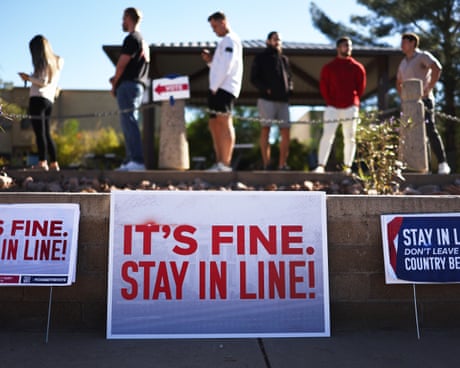
It’s an anxious moment for American voters: Will we have a free and fair election — or not? Luckily, says Eliza Sweren-Becker, deputy director in the Brennan Center’s Voting Rights and Elections Program, there is still one thing that every American 18 and older can do to make sure their voice is heard: vote.
“I think that is the intent. It’s to create a lack of confidence. It’s to discourage voters from participating,” Sweren-Becker told Vox’s Astead Herndon on America, Actually. “But the only way that that campaign to undermine our confidence and to sow distrust actually works is if voters stay home. The way to defeat that attempt to shake voters’ trust in democracy is just to participate.”
Sweren-Becker spoke with Astead about what states could do to speed up their vote counts and ensure everyone has a chance to cast their ballot, the need to restore the Voting Rights Act, and the long-term impact of Trump’s election denialism.
Below is an excerpt of their conversation, edited for length and clarity. There’s much more in the full show, so listen to America, Actually wherever you get your podcasts or watch it on Vox’s YouTube channel.
Let’s start with Election Day. More than a dozen states count late-arriving ballots. President Donald Trump has used the shifting vote counts as pretense to further his own election interference claims.
How prepared should folks be for a long wait in November for results? And how that could impact confidence in the results?
You’re absolutely right that we may get results out of states or in certain races in the days following Election Day. Voters should not expect to have the final result on Election Day.
And when you hear reporting on the news that somebody’s ahead or somebody’s behind, remember: They haven’t counted all the votes yet.
The critical thing is we need to count every vote, and every person’s vote needs to be counted.
So while it is true that some states allow ballots to arrive after Election Day, they all have to be cast by Election Day. The Supreme Court just this year said that it’s totally appropriate for states to set their own ballot receipt deadlines. We have to be patient, as an American electorate, to get the proper results to count every ballot and make sure all the voices are heard.
But isn’t it kinda wild that we can’t get results on election night? I saw Donald Trump cite the Brazilian presidential election, and while I know he’s doing that from a self-interested place, I did think for a second: Why does it take so long for us to put these results together?
I could totally understand why people would prefer the results faster. And candidly, could states do better at preparing and counting faster? Sure. But they have limited resources. They are working their butts off to prepare for the election with the staff that they have, and then they work tremendously hard to count properly, accurately, as fast as they can.
Could states change their policies to allow them, in some places, to pre-process ballots, to allow them to get to results faster? Sure. I’m not saying states shouldn’t change their policies to create more efficiency here. But given the rules of the road that we have, we need to make sure that every properly cast ballot is counted.
If I’m someone who is concerned about election security and free and fair elections, what should I be looking out for?
So, for example, I have heard that there is some anxiety about mail voting.
If you want to cast a mail ballot, just know that you probably have a bunch of options in your state as to how you can cast it. You can certainly rely on the mail and have USPS deliver that ballot, but of course, we know occasionally mail gets delayed. Your state may have ballot drop boxes. You may have ballot drop-off at election officials’ offices, or even at polling places.
Find out your options.
Yes, definitely find out your options. Voters should also check their voter registration status. Make sure it’s up to date with their current address. Of course, if you’re not registered to vote and you still have time in your state to register, please do register.
Everyone should participate. Our democracy works best the more of us that can participate. If your registration date has not passed, don’t forget to register to vote. Vote with your friends, vote with your community, vote with your family. Voting should be joyful. It’s a civic experience that I think is really fun.
I try to take my kids with me to vote because it’s exciting. They get stickers. Everyone loves stickers.
It’s half the reason I go.
It’s also a reminder. You get your sticker, other people see you, they know it’s Election Day, maybe they go out to vote.
It’s a way to be part of your community and invest in your community and to choose who you want to be a leader of your community.
What about after Election Day?
Earlier this year, Democrats and Republicans in Congress circulated a letter asking members to commit to recognizing state-certified winners and “oppose any attempt to refuse or delay a seating of a member-elect.” We saw House Speaker Mike Johnson delay the swearing-in of an Arizona representative last year,
That seems to me like maybe a preview of what might be to come. How fearful should we be of these post-election attempts to block members from being seated?
I think those scenarios are highly unlikely. I understand why folks are worried about them, but the reality is, states have their own certification processes, which are laid out in state law and that are mandatory for them to follow. It is not discretionary whether states certify their elections. So once there is a new Congress, we have confidence that they will be seated according to how the voters actually cast their ballots.
I want to end by thinking about Trump’s consistent questioning of the integrity of our election system. If he ultimately doesn’t try to actually steal the election, what is the long-term impact of his relentless focus on it and support for policies like the Save America Act?
Just because we have won in many courts against this administration doesn’t delude me into thinking that this administration is just going to stop in this years-long campaign to sow doubt in our election systems.
I think that is the intent. It’s to create a lack of confidence. It’s to discourage voters from participating. And to some degree, I think the administration has succeeded in creating some confusion about the rules or a lack of confidence. But the only way that that campaign to undermine our confidence and to sow distrust actually works is if voters stay home.
The way to defeat that attempt to shake voters’ trust in democracy is to participate in our democracy and to turn out and to make their voices heard regardless of party, regardless of candidate. To say that we will not be made to fear participation in our democracy, but we are going to continue to seize it and take joy in it and show that we deserve a stronger representative democracy that serves all Americans.
What are things that could happen to inspire trust in our electoral system? Are there reforms that you think might make the public feel a reinvigorated sense of confidence?
There are certainly things that Congress could do to create a national floor of voter access and ensure that someone’s right to vote doesn’t depend on what state they live in. That includes basic reforms like same-day registration, online voter registration, universal access to mail voting that doesn’t require strict satisfaction of certain excuse requirements, which still exists in many states.
I think it’s time for Congress to ban partisan gerrymandering. I also think it’s time to restore the Voting Rights Act, and Congress can enact a statutory right to vote that is meaningfully enforceable so that voters can go to court if their voting rights have been burdened, and they can get a real remedy.
That has been really undermined by the Supreme Court, but Congress can and should respond. They have it within their power. The Constitution gives Congress the power to set rules for elections. They should.
Former Rep. Mary Peltola, a Democratic from Alaska and US Senate candidate, speaks during the 2026 Alaska Fisheries Debate with Senator Dan Sullivan, a Republican from Alaska, not pictured, in Kodiak, Alaska, on September 12, 2026. | Nathaniel Wilder/Bloomberg via Getty Images
President Donald Trump’s Justice Department filed a lawsuit on Thursday seeking to block former Democratic Rep. Mary Peltola’s victory in the 2026 US Senate election. If you’re confused by this development, you should be. Because the election won’t happen for more than a week.
The case arises out of an odd candidacy that might undercut incumbent Republican Sen. Dan S. Sullivan’s reelection bid against Peltola. A man named Dan J. Sullivan also secured a spot on the ballot, and Republicans fear that the not-Senator Sullivan’s presence on the ballot might trick voters who wish to vote for the incumbent into voting for the not-senator instead.
In the abstract, it’s a fair concern. But there are two reasons to doubt that not-Senator Sullivan will attract many voters who actually wanted to vote for the Republican. According to a sample ballot published by Alaska’s Division of Elections, Sen. Sullivan will be identified as a “Registered Republican” and as the “Incumbent,” so voters will be told which Dan Sullivan to vote for if they wish to reelect the one who is actually a senator.
Additionally, Alaska uses ranked-choice voting, a system where voters rank candidates in order of preference, and votes cast for losing candidates are redistributed to voters’ next choice. So an Alaska voter who wants to reelect the Dan Sullivan who is actually a senator, but who is confused as to which Dan Sullivan is the incumbent, can simply rank both Dans Sullivan as their top two choices, and the ranked choice system should ensure that their vote is counted as a vote for Senator Sullivan (and against Peltola).
The question of whether not-Senator Sullivan may appear on the ballot, moreover, has already been litigated. Initially, the Alaska Division of Elections, which is led by a Republican, attempted to disqualify the not-senator because it concluded that he did not seek election to the Senate in “good faith.” Not-Senator Sullivan sued, and an Alaska court ordered him reinstated as a candidate because “the Division’s decision to exclude Mr. Sullivan from the primary ballot was based on a ‘good-faith’ requirement that does not appear in the U.S. Constitution, the Alaska Statutes, or the implementing regulations adopted by the Division” — that is, there is not actually a law that prevents the not-senator from running, even if he is intentionally running as a spoiler candidate.
This lower court order was affirmed by the Alaska Supreme Court last June. If Republicans thought that this decision violates federal law, they could have asked the Division of Elections — which, again, is run by a Republican — to appeal to the US Supreme Court.
Instead, they appear to have let the issue lie until less than two weeks before Election Day, when Trump’s Justice Department filed a new, federal lawsuit claiming that not-Senator Sullivan’s presence on the ballot is somehow illegal, and asking a federal court to preemptively block a Peltola victory in the upcoming election. Trump says that he personally told the Justice Department to file this suit.
It is difficult to find an actual legal argument, much less a persuasive one, anywhere in the Trump DOJ’s complaint initiating the lawsuit. Trump’s lawsuit also runs afoul of something called the “Purcell principle” — a concept that, ironically, the Supreme Court reaffirmed the same day that the Trump administration filed its suit — which says that federal courts should be reluctant to intervene in election-related disputes when the election itself is about to happen.
It is likely, in other words, that the Trump administration’s attempt to overturn a Democratic victory that hasn’t even happened yet will fail. But the mere existence of this new lawsuit, which is known as United States v. Alaska, is an ominous sign that the Trump administration will use every tool in its shed to overturn Democratic victories in the upcoming election.
So what are the actual legal arguments in the Alaska case?
It is a bit of a stretch to even describe the Justice Department’s complaint in this case as a “legal” document, as the complaint does not so much as point to any law that either not-Senator Sullivan or the state of Alaska may have violated, and instead vaguely alludes to legal sources that use terms like “integrity.”
Specifically, the Justice Department points to a federal law which says that it has four purposes, one of which is to “protect the integrity of the electoral process.” It also points to the Supreme Court’s decision in Bullock v. Carter (1972), which said that “a State has an interest, if not a duty, to protect the integrity of its political processes from frivolous or fraudulent candidacies.”
But the statute that Trump’s lawyers quote, the National Voter Registration Act of 1993, does not concern which candidates’ names should appear on the ballot. As its name suggests, it is a law about voter registration, and it imposes requirements on states, such as requiring them to register voters when those voters obtain a driver’s license.
Similarly, while Bullock does include a single line indicating that states may enact laws targeting “frivolous or fraudulent candidacies,” nothing in the opinion suggests that sharing another candidate’s name makes someone’s candidacy frivolous or fraudulent. The decision itself concerned unusually high fees charged to a candidate for public office in Texas, and the Court concluded that Texas’s fees were unconstitutional.
The line about “frivolous or fraudulent candidacies,” meanwhile, was included to clarify that states still have some power to regulate ballot access. While Bullock concluded that Texas’s fees were excessive, the opinion also suggests that states may impose more reasonable filing fees on candidates to discourage unserious candidates from seeking office. Alaska, for example, charges a modest filing fee of $100 to US Senate candidates.
The Trump DOJ’s entire argument, in other words, appears to turn on the fact that it identified two legal sources that use the word “integrity” in contexts that bear little resemblance to the Alaska case.
Nevertheless, Trump’s lawyers claim that the court must prevent Alaska from certifying a Peltola victory “pending an investigation to determine whether votes cast for Daniel J. Sullivan were meant to be cast for Senator Sullivan.”
This lawsuit also cannot be squared with one of the Republican Party’s favorite legal doctrines
Even if Trump’s Justice Department had a persuasive argument that leaving not-Senator Sullivan on the ballot is illegal, they should still lose Alaska because they waited too long to file the case.
In Purcell v. Gonzalez (2006), the Supreme Court warned that “court orders affecting elections, especially conflicting orders, can themselves result in voter confusion and consequent incentive to remain away from the polls,” and it added that this “risk will increase” as Election Day draws closer. More recent decisions, many of them joined only by the Court’s Republicans, have read this “Purcell principle” quite expansively to forbid federal courts from issuing election-related decisions in the months leading up to an election. Justice Brett Kavanaugh has even claimed that Purcell prevents federal courts from issuing election-related decisions as soon as nine months before the general election date.
Supreme Court decisions invoking Purcell to shut down lower court orders altering a state’s election rules are now very common in the weeks leading up to an election. On Thursday, for example, the Court relied on the Purcell principle to block a lower court order that would have made it easier for college students to vote in New Hampshire. The Court began its decision with this line: “This Court has repeatedly emphasized that lower federal courts should ordinarily not alter the election rules on the eve of an election.”
Trump’s DOJ, meanwhile, did not even file its lawsuit seeking to preemptively invalidate a Peltola victory until less than two weeks before Election Day. If Purcell means anything, it must mean that a federal court cannot force Alaska to kick a candidate off the ballot mere days before a federal election.
President Donald Trump and Sen. Dan Sullivan (R-AK) at a campaign rally in Wasilla, Alaska, on October 13, 2026. | Kent Nishimura / AFP via Getty Images
This story appeared in The Logoff, a daily newsletter that helps you stay informed about the Trump administration without letting political news take over your life. Subscribe here.
Welcome to The Logoff: The Trump administration is getting a head start on litigating the midterms.
What’s happening? The administration is asking a federal district court in Alaska to potentially block the certification of Alaska’s US Senate race, should incumbent Sen. Dan Sullivan, a Republican, lose to his Democratic challenger, Mary Peltola.
It’s the first major lawsuit of the 2026 midterms aimed at directly challenging the results, and very likely a sign of things to come after polls close on November 3.
What is the administration arguing? Sullivan is currently in a close race against Peltola, a former US representative who polls suggest may hold a slight lead. But the race is complicated by the presence of a second Dan Sullivan, Daniel J. Sullivan, on the ballot (no relation).
According to the lawsuit, which names Alaska’s state elections director and several state elections entities as defendants, the election could be “tainted by the inclusion on the ballot of Daniel J. Sullivan.”
The suit asks that “Defendants not certify any election result that may be impacted by voter confusion,” which it defines as a loss by the incumbent Sullivan in the event that the other Sullivan attracts enough votes to alter the outcome of the election.
What’s the context? The second Dan Sullivan’s appearance on the ballot has already been litigated. After he was initially disqualified from the ballot, the Alaska Supreme Court ruled that he should be included, and he finished third in the state’s August primary (the top four vote-getters appear on Alaska’s general election ballot).
How worried about this should I be? For now, not very. Trump filing lawsuits disputing election results was all but inevitable, even if it’s surprising to see him start this early.
None of that means he’ll succeed: Trump and his allies filed dozens of election lawsuits in 2020 and were largely laughed out of court. (Plus, this particular lawsuit has been assigned to a judge appointed by President Barack Obama.)
And with that, it’s time to log off…
Hi readers, happy Friday! Here’s some good news to add to a recent string of encouraging headlines about cancer treatment: A new vaccine may reduce the risk of melanoma, the deadliest form of skin cancer, by more than 40 percent, according to the Washington Post. You can read all about it here with a gift link.
Thanks for reading, have a great weekend, and we’ll see you on Monday!
A male Northern Bobwhite Quail forages for seeds on the ground in south Texas. | Jon G. Fuller/VWPics/Universial Images Group via Getty
When millions of voters fill out their ballots in November, they won’t just be choosing elected representatives. Many states are offering the chance to impact conservation and wildlife as well, through ballot measures focused on things like dedicating more money to habitat protection or mitigating the impacts of climate change. One couldeven reshape wildlife management in one of the country’s most picturesque mountain states — and also lead to the indiscriminate deaths of all kinds of wild animals.
And while ballot measures might seem like small potatoes in the grand scheme of electoral politics, they could have an outsized impact this year. The Trump administration has been systematically rolling back protections for endangered species, taking a hammer to longstanding pillars of climate regulation, and cutting funding to agencies like the National Park Service and National Forest Service, both of which oversee vast stretches of wildlife habitats. In many cases, states have had to step up, putting more resources into conserving the habitats and species within their borders, and ballot measures can help shape those decisions.
Here are the seven ballot measures that could transform ecosystems across the country this election:
This ballot measure would shorten environmental review periods for “essential projects” like housing, water systems, clean energy, and medical facilities, among others. In a state that’s been struggling to build what it needs fast enough, this could help speed essential clean energy projects that could help slow climate change. On the other hand, reducing California Environmental Quality Act review time, as this proposition would do, could also lead to increased habitat destruction, leading advocacy organizations like the Sierra Club to oppose it.
This amendment might seem a little in the weeds — and mostly in the interest of farmers and ranchers looking for tax breaks. But it would double (from 2,000 acres to 4,000 acres) the amount of land an owner can get tax breaks from if they protect it under the state’s Conservation Use Valuation Assessment program. As Yanshu Li, an Associate Professor of Forest Economics at the University of Georgia, told me, the amendment could incentivize landowners to set aside larger tracts of their property for wildlife habitat conservation, which would benefit species like the nine-banded armadillo and the northern bobwhite quailthat call these habitats home.
Question 6 would create a “Nature for All Fund,” routing existing taxes on sporting goods, recreational vehicles, and money spent at golf courses to conservation. That fund could then be used on natural resource conservation, making it the first time the state has a dedicated funding source for conservation projects.
This proposition, similar to Massachusetts’, would direct existing sales taxes on sporting goods to a state fund dedicated to conservation and wildfire prevention. In a state where wildfires have torn through more than 2 million acres in the past decade, dozens of conservation groups are supporting this measure to protect habitats and species.
Here, voters are being asked to approve up to $500 million in bonds that can be used to fund water-related infrastructure projects like water treatment, waste disposal, and wetlands infrastructure. A boost to wetlands under the Arkansas proposal could help animals that live in those habitats, which are often overlooked in this region.
This measure would allow for $55 million in bonds to fund environmental and recreational projects. The largest chunk of this change — $25 million — would go to helping to protect the state from the impacts of climate change. Another $7 would be devoted to protecting Narragansett Bay and its watersheds, which would include funding to “restore natural habitats and control invasive aquatic plants,” according to the Rhode Island Current.
These ballot measures are all relatively straightforward so far, but there’s one question up to voters this fall that puts wild animals front-and-center — and is splitting hunters and anglers down an ethical centerline. Which takes us back to Colorado:
On its surface, this amendment seems fairly innocuous. It asks voters to enshrine “the right to hunt, fish, and harvest fish and wildlife by traditional methods” in the state’s constitution. Hunting and fishing are already big in Colorado, and they’re protected by statute, so this may not seem like a major change. But, as Rebecca Niemiec, co-director of Colorado State University’s Animal-Human Policy Center and a Colorado Parks and Wildlife commissioner, speaking for herself, told me, neither the text of the bill nor its proponents define what “traditional methods” of hunting and fishing would be allowed under this amendment.
“Read plainly, traditional methods could be interpreted to include practices like poisoning, leg hold traps, gill nets, or baiting and hounding,” Niemiec said. Many of these practices injure or maim animals, including ones that aren’t targeted: Steel-jawed traps and poisons don’t discriminate between, say, a deer, a wolf, and a lynx. All of these practices have been outlawed in Colorado over the years, either through other ballot measures or regulatory changes; in 1992, for example, Coloradans voted to ban hunting bears using bait and hounds, and four years later they banned leg-hold traps and snares.
The new amendment also continues on to propose: “establishing hunting and fishing as the preferred means of managing fish and wildlife populations.” This would leave far less room for wildlife agencies like CPW to make nuanced decisions or roll out alternative programs, like birth control or animal relocation. It also reduces their ability to take into account the preferences of people who value wildlife for reasons other than hunting.
“Biological science can inform decisions about how many animals can be killed without threatening a population,” Niemiec said. “But it can’t tell us what hunting practices are ethical, or how to balance hunting opportunities with the public’s desire to see wildlife alive — and protected from unnecessary suffering.”
The push for these constitutional protections, Niemiec told me, is part of a larger backlash against conservation groups. But in this case, it’s not as simple as hunter vs. non-hunter: Plenty of hunters and anglers support taking ethical considerations into account when making decisions about how to manage wildlife, and some hunting groups in Colorado have publicly spoken out against the amendment.
“If we’re going to enshrine anything in the Constitution, it should say we should be balancing the diversity of public interest in wildlife in all of our management decisions,” Niemiec said. “We need innovative methods, not traditional methods, if we’re going to deal with the complex challenges that our wildlife is facing moving forward in the state and throughout the country.”
Pro-Palestinian Jewish American demonstrators rally outside AIPAC’s the Manhattan headquarters in February 2024. | Selcuk Acar/Anadolu via Getty Images
This story appeared in Today, Explained, a daily newsletter that helps you understand the most compelling news and stories of the day. Subscribe here.
Israel felt inescapable in the midterm primaries, especially for Democrats, where centrists and progressives clashed — memorably! — over military aid, Gaza, and (of course) AIPAC.
But with the Election Day almost upon us, the subject seems less prominent. When I Googled “Israel US elections” this morning, all the top results concerned next week’s Israeli parliamentary elections.
In less than two weeks, however, Americans will also head to the polls. They’ll decide which party controls Congress, along with a slew of state and local offices. The stakes are arguably unusually high: Voters will choose whether to check the power of a president who has bulldozed over historical norms and limits.
As we count down to that momentous and potentially messy day, I’m partnering with my colleague Astead Herndon and Vox’s The Midterms, Actually team for weekly editions on the biggest issues shaping the midterms. We’re breaking down one issue each week and suggesting further reading and races to watch in November.
You know the first part of this story already, because we’ve discusseditquitea lot: Americans’ views of Israel have nosedived over the past 18 months.
That shift helped shape the Democratic primaries and will likely figure prominently in the coming presidential contest. But how much Israel matters in a general midterm election, to people outside the political left…well, November will really test that.
Voters rarely rank Israel policy among their top priorities. In a poll that the Associated Press and NORC Center for Public Affairs Research conducted earlier this month, about 80 percent of registered voters said Congress should highly prioritize the cost of living during its next term, and roughly 70 percent said the same about ending the Iran war. By comparison, less than a third of voters said they prioritized cutting off aid to Israel.
There’s another way that Israel factors into US elections, of course — and that’s in fundraising. The American Israel Public Affairs Committee (AIPAC) has become one of the biggest spenders in US elections and a repeat flash point in this year’s Democratic primaries.
But in the general election, even AIPAC has been overshadowed by the GOP’s big-business donors, many of them in tech, who have given Republicans a historic spending advantage in this year’s contests. On Wednesday, the lobbying group actually announced it would no longer endorse political candidates or make direct campaign contributions.
In either case, whatever happens in the midterms won’t likely transform US policy toward Israel. President Donald Trump is still in charge of foreign policy, after all, and even if Democrats take back the House, they’ll have little ability to reverse his agenda.
But a Democratic majority would gain “new congressional tools to act on Israel-Palestine issues,” Hady Amr, the former US Special Representative for Palestinian Affairs, wrote in a new analysis for Chatham House. Those tools aren’t flashy (think: hearings, funding restrictions, and reporting requirements), but they could certainly set the stage for a broader policy shift under a Democratic president.
Races to watch:
Florida’s Senate race, where Democrat Angie Nixon has criticized her party’s ties to the pro-Israel lobby;
➨ Gather ye roast spuds while ye may. Vegan restaurants appear to be experiencing a downturn of sorts: According to one online directory, the number of establishments fell from 1,717 last October to 1,509 now. But the news isn’t entirely or unambiguously bad. One added pressure on plant-based restauranters, for instance, is growing competition from mainstream restaurants that have started offering vegan dishes.
Before you go…
Did you know…that North America’s largest wind farm has more than 900 turbines, each as tall as the Statue of Liberty, and encompasses an area roughly the size of Chicago? It just came online in June.
Today’s trivia: What’s the plural of Prius, as in Toyota’s hybrid hatchback car? (You can find this and other brain puzzles in Vox’s daily crossword. Look for the answer in tomorrow’s edition.)
Yesterday’s trivia: Yesterday we asked after the definition of the word “cartomancy.” That’s the practice of fortune-telling or divination using a deck of cards. Witchy!
President Donald Trump looks on as Ohio Republican gubernatorial candidate Vivek Ramaswamy speaks during an October 12 election rally in Youngstown, Ohio. | Alex Wong/Getty Images
This story appeared in Today, Explained, a daily newsletter that helps you understand the most compelling news and stories of the day. Subscribe here.
There are low blows, and then there are rock-bottom blows. The latest attack ad in the Ohio governor’s race is undoubtedly the latter.
Republican gubernatorial candidate Vivek Ramaswamy is spending $4 million to air a 60-second spot, which features the long-estranged mother of his opponent, Amy Acton, repeatedly calling her daughter a liar as somber instrumental music plays in the background.
The accusation is pretty dark, given the circumstances of Acton and her mother’s estrangement. Acton has disclosed in interviews that she was sexually abused by her stepfather between the ages of 10 and 12 — an allegation backed up by actual, contemporaneous evidence.
Police and court documents obtained by the Associated Press show that Acton’s stepfather was arrested and charged with her rape in July 1978, when she was 12 years old; he left the state after posting bond and died in Pennsylvania in 2004 without facing trial.
According to both Acton and her mother, who remained married to Acton’s stepfather until his death, the two haven’t spoken in the almost 50 years. But that rift didn’t deter Acton’s mother from insisting, in the new Ramaswamy ad, that Acton had “lied her entire life” and was unfit to serve as governor. And it certainly hasn’t prevented Ramaswamy’s campaign from trumpeting the ad as proof that Acton is a “serial fabulist.”
This may be the ugliest ad in what has arguably become the country’s ugliest midterm election. Even before this latest attack, Ohio Republicans had branded Acton “violent” and “unstable,” sometimes portraying her as a drunk or a horror-movie character. One longtime political observer in the state called the tenor of the campaign “alarming,” noting that Ohio is no stranger to negative ads — but that this cycle’s ads were markedly more personal.
That’s not just an Ohio phenomenon, either. In Michigan, Democratic Senate candidate Abdul El-Sayed has faced nonstop attacks on his religion, including accusations that he belongs to an Islamic terrorist group. In Texas, Republicans have variouslysuggested that Senate candidate James Talarico is effeminate, gay, transgender…and/or pedophilic.
Broader studies of how politicians communicate also suggest that political rhetoric in the US has grown measurably more negative over time. One new paper, published last month in the journal American Political Science Review, analyzed 4.7 million tweets, 2.4 million Facebook posts, and 184,000 email newsletters written by members of Congress between 2009 and 2022. Across three channels, the researchers found, the vibes grew increasingly partisan and negative.
That isn’t to suggest that US political rhetoric is the worst it’s ever been. (We had a Civil War in this country, after all.) But it’s certainly the worst it’s been since I’ve been old enough to vote, and there’s no reason to hope that it’ll slow down.
President Donald Trump is part of the problem: When he first began campaigning for the White House more than 10 years ago, he adopted a bare-knuckled tone that helped shift rhetorical norms in US politics. It would appear they never shifted back.
But social media also bears some blame, the research suggests. Across platforms, political posts that skew partisan and negative tend to attract the most engagement — a powerful currency in modern politics. In one study published in 2022 that analyzed posts to X, formerly Twitter, between 2009 and 2019, researchers found not only that “uncivil” tweets earned the most engagement, but that politicians who got lots of likes and retweets on their nasty posts went on to make more of them.
That might help explain, in part, why many Republican officials seem undaunted — even emboldened — by the blowback to this new Ramaswamy ad. The ad might be “dastardly” and “pretty damn low,” as critics have put it. But for some politicians, the outrage may be well worth the attention.
One link for later
➨ Notice the change you want to see in the world. The hostility in our politics can feel overwhelming. Depressing. Utterly insolvable. But you can advance the cause of civility by not only modeling respect and consideration in your own interactions, but also noting those behaviors in other people. “Looking for the good moments of behavior that you see out in the world, starts to remind you that they’re there,” one etiquette expert told Vox. Think of it as a small antidote to hopelessness.
Before you go…
Did you know…that elephants are one of the few animals to show interest in their dead? They frequently linger, and sometimes become agitated, around the remains of other elephants.
Today’s trivia: Cartomancy is a form of what seasonally relevant practice? (You can find this and other brain puzzles in Vox’s daily crossword. Look for the answer in tomorrow’s edition.)
Yesterday’s trivia: Yesterday we asked you for the currency of Poland. That would be the złoty, which — as of this writing — is worth about 26 cents.

 Login