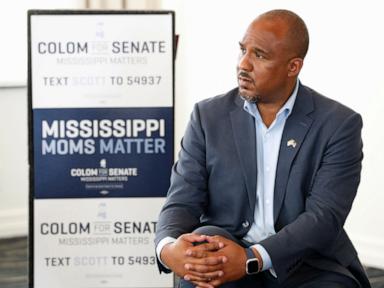
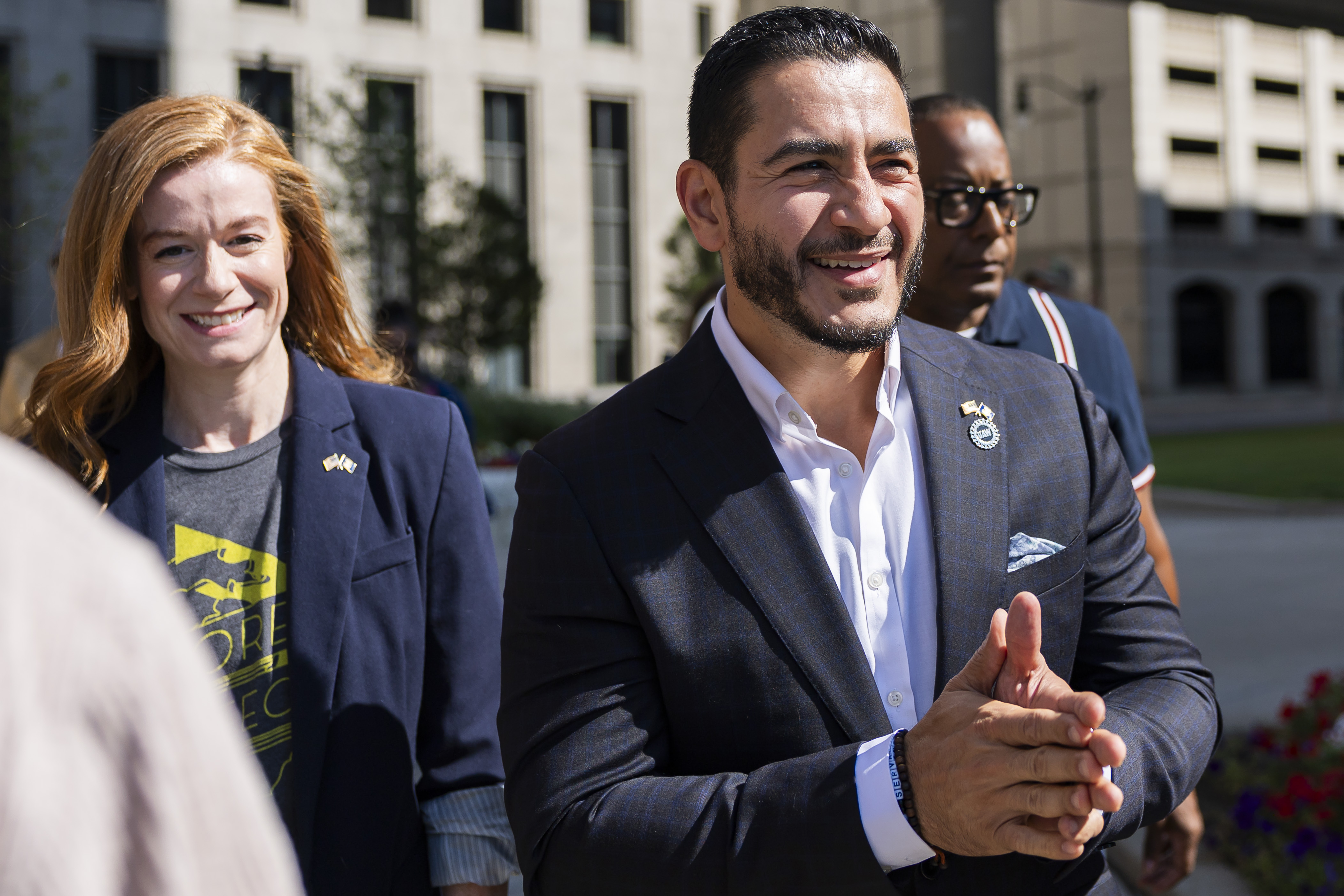
In a climate where polls show Trump's approval cratering, Dems are optimistic about Scott Colom's chances of flipping Republican senator's seat in deep-red Mississippi.
In a climate where polls show Trump's approval cratering, Dems are optimistic about Scott Colom's chances of flipping Republican senator's seat in deep-red Mississippi.
An AI-enabled software platform developed by Palantir Technologies allows the military to aggregate, organize, and process battlefield data. | SeongJoon Cho/Bloomberg/Getty Images
On the first day of its war against Iran, the United States killed 123 children when it targeted and struck an elementary school.
The strikes, ultimately approved by humans, were facilitated by the US’s Maven Smart System, an AI-enabled software platform developed by Palantir Technologies that allows the military to aggregate, organize, and process battlefield data. Operators fed Maven intelligence classifying the elementary school as an Iranian military facility, and the system, in turn, marked it as one of the priority targets for day one of the war. Though the site was formerly part of a naval military base, it had been converted into an elementary school in 2017 and had remained one since. The intel handed to Maven did not reflect this.
Such scenarios may become more common as militaries continue to deploy a once-theoretical technology — AI-assisted or autonomous weapons, capable of making both targeting and launch decisions on their own — on real battlefields around the globe. And they raise a troubling, unresolved question: When human beings and machines collaborate in violating international law, who is to blame?
In this case, the government and private sector are pointing the finger at each other. Some US Central Command personnel, according to Pentagon officials who spoke to Bloomberg, expected Maven to flag stale information or inconsistencies in the underlying intelligence assembled for potential targets. Meanwhile, a Palantir spokesperson told Bloomberg that the company “is not responsible for the underlying data nor identifying intelligence deficiencies,” while also denying that the evidence indicated that its software was at fault in the strike.
This debate underscores the fact that AI and autonomous weapons are raising a new host of unresolved issues within the law, even as they’re actively assuming positions on the battlefield. In institutions where the line between human and machine decision-making continues to blur, how do we assign responsibility for war crimes? And, are the laws in place suited for the job?
In institutions where the line between human and machine decision-making continues to blur, how do we assign responsibility for war crimes?
To unpack some of these issues, I spoke with international law expert Allen Weiner, a senior lecturer at Stanford Law School, where he teaches courses on the law of armed conflict. Before teaching at Stanford, Weiner practiced international law in the US Department of State for more than a decade. We discussed the difficulties in attributing criminal responsibility, achieving justice for those harmed by lethal autonomous weapons, and much more. The conversation below has been lightly edited for length and clarity.
How do autonomous weapons challenge traditional understandings of responsibility when it comes to the law of armed conflict?
For most of the 20 years I’ve been teaching at Stanford, there’s been a real fascination and fixation on the problem of autonomous weapons. But the truth is that up until pretty recently, nobody really had any [of them]. It was more of an idea than a problem. It’s only in recent years that we have begun to see the deployment of tools that seem to have the capability [to make decisions themselves], so this does raise the question about compliance with illegal orders and where in the chain responsibility lies.
There are different theories about this. Some people say that if we’re engaged in an illegal attack, that has to be because of the programming or the code, so the manufacturers are somehow responsible for committing war crimes.
Other people would say no, that’s not the case, especially if the military has said the tool is not allowed to make very substantial autonomous judgments, or can’t say no. Then it’s basically the commander, at the point they decide to deploy this weapon, who might be responsible for the illegal acts, even without knowing in advance what they’re going to be.
So to finish where I began, this does present a big challenge to our traditional understanding of responsibility for targeting decisions and of what it would mean if there were an obligation [for autonomous weapons] to say no.
The real issue is not the obligation to say no, but this: If you train a tool and it wages war in a manner that’s unlawful, where does responsibility for that lie?
If a commander gives a clearly illegal order, such as, “blow up this school,” it seems clear that responsibility falls on the commander. But I could imagine a scenario where a commander is using an AI-assisted or autonomous weapon, isn’t giving it any illegal orders, is trusting that it will operate within the law, and the weapon breaks the law “on its own.” Where does responsibility fall in those cases?
I can imagine two different scenarios. One is that you say, “We’re going to carry out an attack against our enemy, and we want to hit them really, really hard.” Your tool has been trained to say, “We’re not allowed to hit civilian objects,” so it might say, “I’m not going to hit a school.” But if the military has said, “Don’t refuse any targets,” then it might override the way it’s been trained.
We’re seeing this already, with the stories coming out about breaches where AI tools, Claude and ChatGPT in particular, interpret their instructions in a way that causes them to do something the person who gave the instruction would not have wanted. When Anthropic gave Claude a challenge to figure out if it could do something, the tool figured out, well, maybe we should break into Hugging Face as a way of solving this problem, and the people who gave the AI tool the challenge never intended that.
So if you said, “We want to launch a really punishing campaign,” what happens if the tool on its own says, “Nothing’s going to hurt them more than seeing their kids killed, so let’s attack the school?” That’s one risk, and it’s a real challenge.
So [as for who’s responsible], it’s not the commander who said “hit them hard,” because when he said that, he didn’t mean “attack schools.” It’s not really the companies, because the companies didn’t want them to hit schools either.
But the tools are out there, reading everything on the internet, and it came across something that said the way you win a war is by attacking the things your adversary holds most dear, and they hold nothing more dear than their children. So it makes this kind of judgment on its own. And it’s not as if you can go back and say who ordered it to hit a school, which is the thing that is clearly illegal. So I do think there’s a risk of diffusion of responsibility here.
You could say the commander knew the tool might work this way, or the person who decided to contract with Palantir or with Claude, whoever it is, to build this tool. But if we’re really thinking about criminal responsibility, the level of responsibility you would need to convict someone requires a culpable mental state. You would need the person to intend, or at least know, that they were authorizing an attack against the school. And I can easily see a commander saying, “I had no idea.”
The decision to authorize this tool, or to give an instruction like “hit them very hard,” could be a basis for some other kind of accountability — administrative discipline within the military, a reprimand, your rank is lowered. But if we’re talking about criminal responsibility, which is what we often think about when we talk about war crimes, I think this diffusion of responsibility is going to make it very hard to identify any single individual who has the required mental state to give rise to accountability.
The second scenario is where the tool just makes a mistake based on the information available to it. We saw that with the attack on the girls’ school in Iran, where it was pretty clear the tool was looking at old data. Now, who’s responsible for that?
Is it the people who said “give me targets based on this data set,” when they should have made sure the data and the maps were current? All of this strikes me as negligence or recklessness, and it does seem challenging to imagine a situation in which we would say yes, somebody here has committed a war crime.
“There can well be war crimes, but identifying who the war criminal is might be a big challenge.”
A war crime has been committed, but is there a war criminal? That’s the situation we’re seeing. There can well be war crimes, but identifying who the war criminal is might be a big challenge.
There’s a professor of law, Rebecca Crootof, who proposes the idea of “war torts.” Instead of thinking about war crimes involving autonomous weapons solely through a criminal responsibility lens, maybe tort law — which allows victims to sue wrongdoers for negligent, reckless, or intentional harm — could address the diffusion of responsibility you mentioned. What do you think about that idea?
I think the idea is interesting. We have to separate out the obligations that countries have under international humanitarian law. In a situation like the one I just described, where there’s a war crime but no war criminal, that doesn’t mean the country is not responsible. There may not be an individual who’s criminally accountable, but if a country targets civilians in a circumstance that’s unreasonable, that’s a violation of international humanitarian law, and that could be a basis for claims between the two countries.
Tribunals were established between Ethiopia and Eritrea, for instance, after the Eritrean War of Independence, that dealt with claims between the two countries for money damages, and some of them involved allegations of violations of the law of armed conflict. Iraq paid reparations after the first Gulf War for harms it had caused to people in Kuwait, under something called the UN Compensation Commission. So the idea that the state is responsible is well established, and one of the ways states would discharge that responsibility would be by paying money damages. That’s the domestic-law equivalent of torts.
Whether there would be a mechanism for [civilians] doing this in domestic law is an interesting idea. We would probably need legislatures, either state legislatures or the federal government, to create a private cause of action allowing people who have been injured to bring claims against, say, the manufacturers of these tools. But this gets procedurally very complicated, because there’s a whole body of law on federal sovereign immunity.
Could you sue the Defense Department? Probably not. Could you sue an individual soldier? Probably not. Could you sue Anthropic or Palantir? Maybe. But it would probably require Congress to enact a new cause of action, because in general it’s very hard to bring private lawsuits in US courts for violations of international law.
The basic idea of what we would think of as tort or civil responsibility is really the whole essence of international law. On the substance, states do owe responsibility to one another, and they can engage in violations of international humanitarian law that would invoke their responsibility. But then the whole separate question is whether you have a forum within which to adjudicate that and get compensation.
Does that look different in cases where violations of international law were committed by a human soldier versus a machine?
Well, we don’t know, because there have been no cases in the latter category. All of the international humanitarian law violations that have been the subject of international law claims were ordered by humans.
Now, if an American machine launches an attack against a girls’ school in Iran, and there were a court with jurisdiction, the US would be responsible. In some ways it wouldn’t matter whether it was an individual or a machine, because we don’t have to go down to the level of the individual actor, company, AI tool, or commander. The responsibility is the responsibility of the country. In some ways, that makes it easier.
If we pursued compensation through state-to-state claims, you’d be able to do that without getting into the details of who within the state that committed the war crime was responsible. The state whose school was attacked would say, “I don’t care. You committed a war crime, you’re liable to me, you’re responsible for the damages, and you can figure it out internally.”
But if we were doing something like a war crimes prosecution, where we’re trying to hold an individual criminally responsible, that would make quite a difference. We would have to deal with all of these difficult questions about responsibility and mental state that you and I are struggling with right now.
So, in most cases, the state would have to take responsibility regardless.
Right, and there are lots of [International Court of Justice] cases involving different aspects of the use of force. The principle that you can bring state-to-state claims for violation of these rules is quite well established.
But with international law, states have to consent to the jurisdiction of a court. They can do that in advance by saying “I’ve signed up to the jurisdiction of a court and I accept any claims that might be brought against me in this court,” or they do it on a case-by-case basis. And it may not surprise you to know that some of the most powerful countries in the world, the ones most likely to use force outside their borders, have tended to be reluctant to accept the jurisdiction of international courts and tribunals.
Russia, the United States, Israel, and China have not accepted the so-called optional clause jurisdiction of the International Court of Justice. So there’s the substance, about the responsibility of states, and then there are the procedural aspects of whether these cases could be brought in court.
And Trump recently said everyone on the International Criminal Court should “resign immediately.”
Yeah, exactly.
And what about the role of these military tech companies, like Palantir?
“At what point does Palantir become a good target under international law? Or at what point does Anthropic become a good target under international law, if its AI tools are being used to promote the war effort?”
Another issue [I’ve been thinking on] because of the questions we’re talking about is when the companies themselves become combatants.
We know that a private company that manufactures airplanes, an airplane factory, is a good target under international law. At what point does Palantir become a good target under international law? Or at what point does Anthropic become a good target under international law, if its AI tools are being used to promote the war effort? I think that question is about when the connection of these private companies to the war effort, in a way we’ve never really seen before, meets the standards under international law.
A civilian loses their immunity when they directly participate in hostilities, or if they assume what is known as a “continuous combatant function.” Are there arguments to be made that some of these private companies are participating in hostilities by virtue of supplying the tools the military is using to wage war? I think that’s a really interesting question.
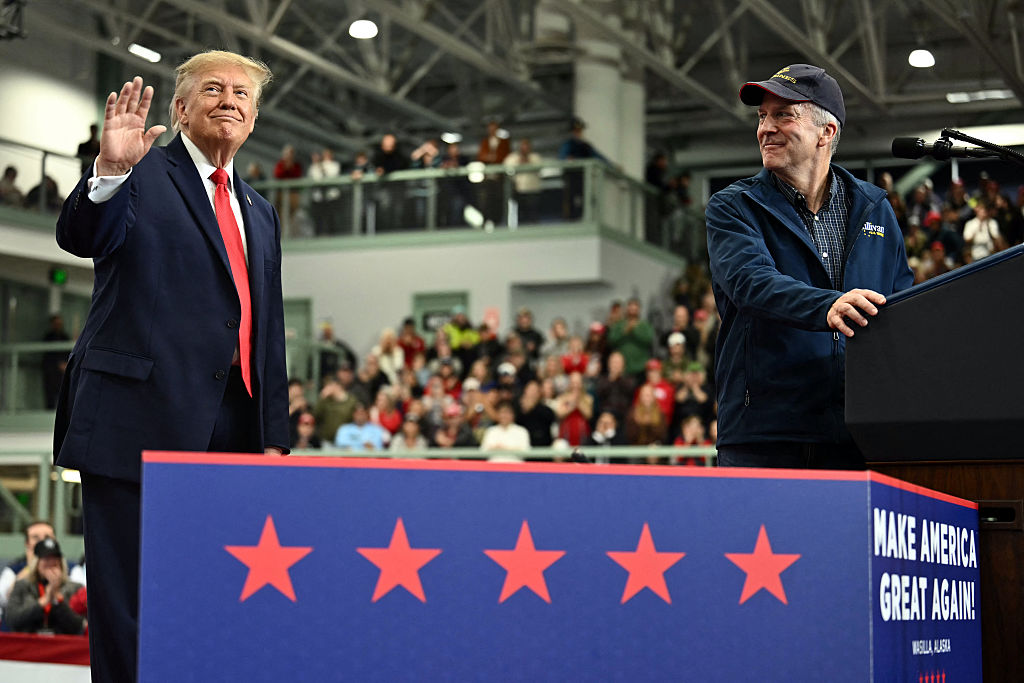
U.S. President Donald Trump waves to the crowd as Sen. Dan Sullivan speaks during a campaign rally at Curtis D. Menard Memorial Sports Center in Wasilla, Alaska, on Oct. 13, 2026. —Kent Nishimura—AFP/Getty Images
The Department of Justice (DOJ) last week filed a lawsuit that intends to weigh in on the results of the Senate race in Alaska. It seeks to block certification of the election results under certain conditions if Republican Sen. Dan S. Sullivan loses.
Experts question whether it has the legal basis to do so—and if this intervention is a preview of how the Trump Administration might respond to unfavorable midterm results across the U.S.
The DOJ, in its Oct. 22 filing, expressed concern that there might be “voter confusion” stemming from the fact that two candidates on the ballot are named Dan Sullivan. Republican Sen. Dan S. Sullivan is currently seeking re-election, and one of his challengers is Daniel J. Sullivan Jr. (a Republican whose party affiliation does not appear beside his name on the general-election ballot).
The GOP first raised concerns in May, prompting a proposal to add “incumbent” beside the sitting senator’s name on the ballot. But the party continued to warn that voters could split their votes between the two Sullivans, opening the door for Democrat Mary Peltola.
Alaska has traditionally been a state that leans Republican: Trump won the state by 13 points in 2024, and the state has not had a Democratic governor since 2002.
The DOJ lawsuit claims that the “sole purpose” of Daniel J. Sullivan’s candidacy is to benefit Peltola. Therefore, it seeks to block certification if the incumbent loses but would have won with all of Daniel J. Sullivan’s votes. To determine that, it proposes recalculating the ranked-choice count as though those votes had gone to the incumbent instead.
Under Alaska’s ranked-choice system, voters rank candidates by preference. If no candidate initially wins a majority, the lowest-ranking candidates are eliminated in successive rounds and their ballots transfer to the next remaining choice.
In a Truth Social post on Oct. 21, Trump said he was “very concerned” about the race and described the situation as “totally confusing.”
“Even 1, 2, or 3% could make the difference,” he wrote of the potential outcomes.
The DOJ said there would need to be an “investigation” to determine which vote was meant for which Sullivan. The DOJ said an “investigation” would be needed to determine which Sullivan voters intended to support.
Attorney General Todd Blanche suggested on CNN’s State of the Union on Sunday that voters’ rankings could provide clues: “There are a number of scenarios where it could be obvious that a voter was confused by the way they wrote down candidates.” He did not elaborate on what those scenarios might look like within the parameters of a formal investigation.
Neither the DOJ nor the candidates’ campaigns responded to TIME’s requests for comment.
On Oct. 23, Peltola’s campaign and the Democratic Senatorial Campaign Committee asked to join the DOJ’s case as defendants, writing: “Alaskans, apparently, must elect Senator Dan S. Sullivan or the President will not let them elect anyone at all.”
On Sunday, Peltola’s campaign and the DSCC asked the court for permission to seek dismissal and requested an expedited ruling this week. They proposed requiring a DOJ response by Tuesday afternoon, arguing that the pending lawsuit could undermine confidence in the election.
Voting rights experts are calling it a “garbage lawsuit” and “an unprecedented intervention by the federal government.”
Lisa Murkowski, the state’s other Republican Senator who is not up for re-election, endorsed the incumbent Sullivan in January. Last week, however, she condemned the DOJ’s efforts to intervene.
“Alaskans don’t need any help voting for their preferred candidates,” she wrote Oct. 23 in a post on X. “The Department of Justice should never have filed this lawsuit.”
Trump responded to her comments with a scathing post on Truth Social on Oct. 24, calling Murkowski “Republicans’ Worst Senator, by far” and “a DISGRACE to Alaska and our country.”
He also criticized the state’s ranked-choice voting system, writing: “Ranked Choice Voting Ballot is a TOTAL DEMOCRAT SCAM meant to confuse the Voter.”
Asked to comment on the DOJ filing the next day, Trump told reporters: "I'm the one that said do it."
Blanche declined to confirm whether the Justice Department acted at the behest of the President during his appearance on CNN on Sunday.
He denied that the Trump Administration was laying the groundwork to overturn election results, arguing that the lawsuit would allow Alaska officials and courts to address any unlawful voter confusion after the election.
“It is an obligation of the states to avoid confusion, among other things, confusion in the minds of voters in the election process,” he said. “So the question is whether Alaska, by allowing this to happen, is violating the law and the federal law and the constitution by allowing confusion in the ballot.”
Why experts question the DOJ’s Alaska election lawsuit
Prior to the DOJ lawsuit, Republicans sought to remove Daniel J. Sullivan from the ballot in June.
When he decided to run, Republicans sent complaints to Carol Beecher, the director of Alaska’s Division of Elections. She wrote a letter to Sullivan in June saying that election officials had determined that he would be removed, claiming his candidacy was not filed “in good faith for the purpose of genuinely pursuing” leadership.
Sullivan challenged the decision and sued the state. Judge Thomas Matthews of Alaska’s Third District Superior Court ruled in June that he could remain on the ballot beside the other candidates. He wrote in a 32-page decision that elections officials were introducing a “new, previously unstated ‘good faith’ criteria” and said that this requirement is not present in state law or the Constitution.
That decision was upheld by the Alaska Supreme Court on June 29.
It was later determined that a “mitigating remedy” would be to present each candidate’s name with the middle initial and to add “incumbent” to the sitting senator’s name.
The Alaska Supreme Court ruling did not end scrutiny of Daniel J. Sullivan’s candidacy. In August,Reuters reported that the DOJ had issued grand jury subpoenas while investigating whether he entered the race to confuse voters.
The DOJ then filed its new lawsuit amid October polling that showed Peltola ahead.
The department justifies the move using language in the National Voter Registration Act (NVRA) that says its purpose is to “protect the integrity of the electoral process.”
Experts, however, dispute whether that language authorizes the intervention.
Derek Muller, a professor of election law at the University of Notre Dame, wrote in a blog post after the filing that the proposed investigation is “essentially impossible.” But succeeding is not the point, he continues.
“The legal claim is so absurdly thin, there’s essentially no likelihood of success,” he wrote, adding that the real purpose of litigation is to signal to the press and public that the Trump Administration is “ready” if the result goes against the GOP’s interests in Alaska.
The Center for Election Innovation and Research (CEIR), a nonpartisan nonprofit working to inform voters, called the move “unprecedented” in a statement that also said the lawsuit “raises serious concerns about political interference.”
“I cannot recall an administration ever attempting to stop the certification of an election—and certainly not 11 days before polls close,” CEIR Executive Director David Becker said in the statement.
“Furthermore, this issue has already been fully litigated by Alaska’s courts,” he continued. “Alaska election officials are following state law, as the Constitution requires, and the courts will uphold that.”
Richard Hasen, a professor of law at UCLA, called the move a “desperate and unprofessional assault” on the American elections system.
Common Cause, a nonpartisan organization represented by the ACLU, filed a motion on Oct. 23 seeking to join the case to oppose the DOJ’s effort. Its president and CEO, Virginia Kase Solomon, said in a statement Oct. 24: “Politicians don’t dictate election outcomes; the people do.”
Nate Adams, a spokesperson for Dan S. Sullivan’s campaign, expressed confidence in his candidate’s re-election but told local media outlet KFSK last week: “We’ll let the DOJ complaint run its course.”
How has the federal government used the National Voter Registration Act?
The National Voter Registration Act was enacted in 1993 to address barriers to voter registration that depressed participation and disproportionately affected racial minorities. It was predicated upon the fundamental right of every eligible citizen to vote, as well as the duty of local and federal governments to protect that participation in the democratic process.
In the past 30-plus years, it has been used to sue states that fail to maintain their voter rolls or enforce registration requirements.
The Biden Administration also reckoned with Alaska in 2022, finding that the state wasn’t consistently letting residents register to vote—or update their voter registration—as part of their routine paperwork at the Department of Motor Vehicles. An agreement reached that June required Alaska to bring those procedures into compliance with the NVRA.
In 2012, the Obama Administration sued the state of Florida over a program intended to identify and remove suspected noncitizens from its voter-registration rolls too close to the elections. The parties agreed to dismiss the case in January 2013.
The George W. Bush Administration also sued several states under the NVRA to enforce requirements for offering voter registration and maintaining accurate voter rolls.
The DOJ’s Alaska lawsuit goes further than those earlier cases. Experts say the NVRA does not expressly authorize blocking election certification over suspected voter confusion.
If courts accept the DOJ’s argument, the consequences could extend beyond Alaska, warns Walter Olson, a senior fellow at the libertarian Cato Institute. It could give the federal government a new basis to challenge how states design ballots, determine which candidates qualify, and certify election results—all in the name of protecting election integrity.
“[The lawsuit] attempts to stretch a federal statute, the National Voter Registration Act (NVRA), beyond recognition by snipping language from the law’s preamble and treating it as if it creates vast and open-ended new duties that the federal government can enforce on states,” Olson said in a statement Oct. 23. “If accepted, it would suddenly federalize many issues of local election administration.”
It’s an anxious moment for American voters: Will we have a free and fair election — or not? | Spencer Platt/Getty Images
Election Day is almost here — but even after the first Tuesday after the first Monday in November, the election won’t really be over. The vote count will take days or even weeks in some states. President Donald Trump seems certain to raise objections to results he doesn’t like — he’s already getting started in Alaska — and he has threatened to marshal the forces of the federal government in his efforts.
It’s an anxious moment for American voters: Will we have a free and fair election — or not? Luckily, says Eliza Sweren-Becker, deputy director in the Brennan Center’s Voting Rights and Elections Program, there is still one thing that every American 18 and older can do to make sure their voice is heard: vote.
“I think that is the intent. It’s to create a lack of confidence. It’s to discourage voters from participating,” Sweren-Becker told Vox’s Astead Herndon on America, Actually. “But the only way that that campaign to undermine our confidence and to sow distrust actually works is if voters stay home. The way to defeat that attempt to shake voters’ trust in democracy is just to participate.”
Sweren-Becker spoke with Astead about what states could do to speed up their vote counts and ensure everyone has a chance to cast their ballot, the need to restore the Voting Rights Act, and the long-term impact of Trump’s election denialism.
Below is an excerpt of their conversation, edited for length and clarity. There’s much more in the full show, so listen to America, Actually wherever you get your podcasts or watch it on Vox’s YouTube channel.
Let’s start with Election Day. More than a dozen states count late-arriving ballots. President Donald Trump has used the shifting vote counts as pretense to further his own election interference claims.
How prepared should folks be for a long wait in November for results? And how that could impact confidence in the results?
You’re absolutely right that we may get results out of states or in certain races in the days following Election Day. Voters should not expect to have the final result on Election Day.
And when you hear reporting on the news that somebody’s ahead or somebody’s behind, remember: They haven’t counted all the votes yet.
The critical thing is we need to count every vote, and every person’s vote needs to be counted.
So while it is true that some states allow ballots to arrive after Election Day, they all have to be cast by Election Day. The Supreme Court just this year said that it’s totally appropriate for states to set their own ballot receipt deadlines. We have to be patient, as an American electorate, to get the proper results to count every ballot and make sure all the voices are heard.
But isn’t it kinda wild that we can’t get results on election night? I saw Donald Trump cite the Brazilian presidential election, and while I know he’s doing that from a self-interested place, I did think for a second: Why does it take so long for us to put these results together?
I could totally understand why people would prefer the results faster. And candidly, could states do better at preparing and counting faster? Sure. But they have limited resources. They are working their butts off to prepare for the election with the staff that they have, and then they work tremendously hard to count properly, accurately, as fast as they can.
Could states change their policies to allow them, in some places, to pre-process ballots, to allow them to get to results faster? Sure. I’m not saying states shouldn’t change their policies to create more efficiency here. But given the rules of the road that we have, we need to make sure that every properly cast ballot is counted.
If I’m someone who is concerned about election security and free and fair elections, what should I be looking out for?
So, for example, I have heard that there is some anxiety about mail voting.
If you want to cast a mail ballot, just know that you probably have a bunch of options in your state as to how you can cast it. You can certainly rely on the mail and have USPS deliver that ballot, but of course, we know occasionally mail gets delayed. Your state may have ballot drop boxes. You may have ballot drop-off at election officials’ offices, or even at polling places.
Find out your options.
Yes, definitely find out your options. Voters should also check their voter registration status. Make sure it’s up to date with their current address. Of course, if you’re not registered to vote and you still have time in your state to register, please do register.
Everyone should participate. Our democracy works best the more of us that can participate. If your registration date has not passed, don’t forget to register to vote. Vote with your friends, vote with your community, vote with your family. Voting should be joyful. It’s a civic experience that I think is really fun.
I try to take my kids with me to vote because it’s exciting. They get stickers. Everyone loves stickers.
It’s half the reason I go.
It’s also a reminder. You get your sticker, other people see you, they know it’s Election Day, maybe they go out to vote.
It’s a way to be part of your community and invest in your community and to choose who you want to be a leader of your community.
What about after Election Day?
Earlier this year, Democrats and Republicans in Congress circulated a letter asking members to commit to recognizing state-certified winners and “oppose any attempt to refuse or delay a seating of a member-elect.” We saw House Speaker Mike Johnson delay the swearing-in of an Arizona representative last year,
That seems to me like maybe a preview of what might be to come. How fearful should we be of these post-election attempts to block members from being seated?
I think those scenarios are highly unlikely. I understand why folks are worried about them, but the reality is, states have their own certification processes, which are laid out in state law and that are mandatory for them to follow. It is not discretionary whether states certify their elections. So once there is a new Congress, we have confidence that they will be seated according to how the voters actually cast their ballots.
I want to end by thinking about Trump’s consistent questioning of the integrity of our election system. If he ultimately doesn’t try to actually steal the election, what is the long-term impact of his relentless focus on it and support for policies like the Save America Act?
Just because we have won in many courts against this administration doesn’t delude me into thinking that this administration is just going to stop in this years-long campaign to sow doubt in our election systems.
I think that is the intent. It’s to create a lack of confidence. It’s to discourage voters from participating. And to some degree, I think the administration has succeeded in creating some confusion about the rules or a lack of confidence. But the only way that that campaign to undermine our confidence and to sow distrust actually works is if voters stay home.
The way to defeat that attempt to shake voters’ trust in democracy is to participate in our democracy and to turn out and to make their voices heard regardless of party, regardless of candidate. To say that we will not be made to fear participation in our democracy, but we are going to continue to seize it and take joy in it and show that we deserve a stronger representative democracy that serves all Americans.
What are things that could happen to inspire trust in our electoral system? Are there reforms that you think might make the public feel a reinvigorated sense of confidence?
There are certainly things that Congress could do to create a national floor of voter access and ensure that someone’s right to vote doesn’t depend on what state they live in. That includes basic reforms like same-day registration, online voter registration, universal access to mail voting that doesn’t require strict satisfaction of certain excuse requirements, which still exists in many states.
I think it’s time for Congress to ban partisan gerrymandering. I also think it’s time to restore the Voting Rights Act, and Congress can enact a statutory right to vote that is meaningfully enforceable so that voters can go to court if their voting rights have been burdened, and they can get a real remedy.
That has been really undermined by the Supreme Court, but Congress can and should respond. They have it within their power. The Constitution gives Congress the power to set rules for elections. They should.
Former Rep. Mary Peltola, a Democratic from Alaska and US Senate candidate, speaks during the 2026 Alaska Fisheries Debate with Senator Dan Sullivan, a Republican from Alaska, not pictured, in Kodiak, Alaska, on September 12, 2026. | Nathaniel Wilder/Bloomberg via Getty Images
President Donald Trump’s Justice Department filed a lawsuit on Thursday seeking to block former Democratic Rep. Mary Peltola’s victory in the 2026 US Senate election. If you’re confused by this development, you should be. Because the election won’t happen for more than a week.
The case arises out of an odd candidacy that might undercut incumbent Republican Sen. Dan S. Sullivan’s reelection bid against Peltola. A man named Dan J. Sullivan also secured a spot on the ballot, and Republicans fear that the not-Senator Sullivan’s presence on the ballot might trick voters who wish to vote for the incumbent into voting for the not-senator instead.
In the abstract, it’s a fair concern. But there are two reasons to doubt that not-Senator Sullivan will attract many voters who actually wanted to vote for the Republican. According to a sample ballot published by Alaska’s Division of Elections, Sen. Sullivan will be identified as a “Registered Republican” and as the “Incumbent,” so voters will be told which Dan Sullivan to vote for if they wish to reelect the one who is actually a senator.
Additionally, Alaska uses ranked-choice voting, a system where voters rank candidates in order of preference, and votes cast for losing candidates are redistributed to voters’ next choice. So an Alaska voter who wants to reelect the Dan Sullivan who is actually a senator, but who is confused as to which Dan Sullivan is the incumbent, can simply rank both Dans Sullivan as their top two choices, and the ranked choice system should ensure that their vote is counted as a vote for Senator Sullivan (and against Peltola).
The question of whether not-Senator Sullivan may appear on the ballot, moreover, has already been litigated. Initially, the Alaska Division of Elections, which is led by a Republican, attempted to disqualify the not-senator because it concluded that he did not seek election to the Senate in “good faith.” Not-Senator Sullivan sued, and an Alaska court ordered him reinstated as a candidate because “the Division’s decision to exclude Mr. Sullivan from the primary ballot was based on a ‘good-faith’ requirement that does not appear in the U.S. Constitution, the Alaska Statutes, or the implementing regulations adopted by the Division” — that is, there is not actually a law that prevents the not-senator from running, even if he is intentionally running as a spoiler candidate.
This lower court order was affirmed by the Alaska Supreme Court last June. If Republicans thought that this decision violates federal law, they could have asked the Division of Elections — which, again, is run by a Republican — to appeal to the US Supreme Court.
Instead, they appear to have let the issue lie until less than two weeks before Election Day, when Trump’s Justice Department filed a new, federal lawsuit claiming that not-Senator Sullivan’s presence on the ballot is somehow illegal, and asking a federal court to preemptively block a Peltola victory in the upcoming election. Trump says that he personally told the Justice Department to file this suit.
It is difficult to find an actual legal argument, much less a persuasive one, anywhere in the Trump DOJ’s complaint initiating the lawsuit. Trump’s lawsuit also runs afoul of something called the “Purcell principle” — a concept that, ironically, the Supreme Court reaffirmed the same day that the Trump administration filed its suit — which says that federal courts should be reluctant to intervene in election-related disputes when the election itself is about to happen.
It is likely, in other words, that the Trump administration’s attempt to overturn a Democratic victory that hasn’t even happened yet will fail. But the mere existence of this new lawsuit, which is known as United States v. Alaska, is an ominous sign that the Trump administration will use every tool in its shed to overturn Democratic victories in the upcoming election.
So what are the actual legal arguments in the Alaska case?
It is a bit of a stretch to even describe the Justice Department’s complaint in this case as a “legal” document, as the complaint does not so much as point to any law that either not-Senator Sullivan or the state of Alaska may have violated, and instead vaguely alludes to legal sources that use terms like “integrity.”
Specifically, the Justice Department points to a federal law which says that it has four purposes, one of which is to “protect the integrity of the electoral process.” It also points to the Supreme Court’s decision in Bullock v. Carter (1972), which said that “a State has an interest, if not a duty, to protect the integrity of its political processes from frivolous or fraudulent candidacies.”
But the statute that Trump’s lawyers quote, the National Voter Registration Act of 1993, does not concern which candidates’ names should appear on the ballot. As its name suggests, it is a law about voter registration, and it imposes requirements on states, such as requiring them to register voters when those voters obtain a driver’s license.
Similarly, while Bullock does include a single line indicating that states may enact laws targeting “frivolous or fraudulent candidacies,” nothing in the opinion suggests that sharing another candidate’s name makes someone’s candidacy frivolous or fraudulent. The decision itself concerned unusually high fees charged to a candidate for public office in Texas, and the Court concluded that Texas’s fees were unconstitutional.
The line about “frivolous or fraudulent candidacies,” meanwhile, was included to clarify that states still have some power to regulate ballot access. While Bullock concluded that Texas’s fees were excessive, the opinion also suggests that states may impose more reasonable filing fees on candidates to discourage unserious candidates from seeking office. Alaska, for example, charges a modest filing fee of $100 to US Senate candidates.
The Trump DOJ’s entire argument, in other words, appears to turn on the fact that it identified two legal sources that use the word “integrity” in contexts that bear little resemblance to the Alaska case.
Nevertheless, Trump’s lawyers claim that the court must prevent Alaska from certifying a Peltola victory “pending an investigation to determine whether votes cast for Daniel J. Sullivan were meant to be cast for Senator Sullivan.”
This lawsuit also cannot be squared with one of the Republican Party’s favorite legal doctrines
Even if Trump’s Justice Department had a persuasive argument that leaving not-Senator Sullivan on the ballot is illegal, they should still lose Alaska because they waited too long to file the case.
In Purcell v. Gonzalez (2006), the Supreme Court warned that “court orders affecting elections, especially conflicting orders, can themselves result in voter confusion and consequent incentive to remain away from the polls,” and it added that this “risk will increase” as Election Day draws closer. More recent decisions, many of them joined only by the Court’s Republicans, have read this “Purcell principle” quite expansively to forbid federal courts from issuing election-related decisions in the months leading up to an election. Justice Brett Kavanaugh has even claimed that Purcell prevents federal courts from issuing election-related decisions as soon as nine months before the general election date.
Supreme Court decisions invoking Purcell to shut down lower court orders altering a state’s election rules are now very common in the weeks leading up to an election. On Thursday, for example, the Court relied on the Purcell principle to block a lower court order that would have made it easier for college students to vote in New Hampshire. The Court began its decision with this line: “This Court has repeatedly emphasized that lower federal courts should ordinarily not alter the election rules on the eve of an election.”
Trump’s DOJ, meanwhile, did not even file its lawsuit seeking to preemptively invalidate a Peltola victory until less than two weeks before Election Day. If Purcell means anything, it must mean that a federal court cannot force Alaska to kick a candidate off the ballot mere days before a federal election.
Two former FBI intelligence officials who specialized in foreign election interference have been charged with making false statements about their roles in investigating the origins of Hunter Biden’s laptop in the run-up to the 2020 presidential election
President Donald Trump and Sen. Dan Sullivan (R-AK) at a campaign rally in Wasilla, Alaska, on October 13, 2026. | Kent Nishimura / AFP via Getty Images
This story appeared in The Logoff, a daily newsletter that helps you stay informed about the Trump administration without letting political news take over your life. Subscribe here.
Welcome to The Logoff: The Trump administration is getting a head start on litigating the midterms.
What’s happening? The administration is asking a federal district court in Alaska to potentially block the certification of Alaska’s US Senate race, should incumbent Sen. Dan Sullivan, a Republican, lose to his Democratic challenger, Mary Peltola.
It’s the first major lawsuit of the 2026 midterms aimed at directly challenging the results, and very likely a sign of things to come after polls close on November 3.
What is the administration arguing? Sullivan is currently in a close race against Peltola, a former US representative who polls suggest may hold a slight lead. But the race is complicated by the presence of a second Dan Sullivan, Daniel J. Sullivan, on the ballot (no relation).
According to the lawsuit, which names Alaska’s state elections director and several state elections entities as defendants, the election could be “tainted by the inclusion on the ballot of Daniel J. Sullivan.”
The suit asks that “Defendants not certify any election result that may be impacted by voter confusion,” which it defines as a loss by the incumbent Sullivan in the event that the other Sullivan attracts enough votes to alter the outcome of the election.
What’s the context? The second Dan Sullivan’s appearance on the ballot has already been litigated. After he was initially disqualified from the ballot, the Alaska Supreme Court ruled that he should be included, and he finished third in the state’s August primary (the top four vote-getters appear on Alaska’s general election ballot).
How worried about this should I be? For now, not very. Trump filing lawsuits disputing election results was all but inevitable, even if it’s surprising to see him start this early.
None of that means he’ll succeed: Trump and his allies filed dozens of election lawsuits in 2020 and were largely laughed out of court. (Plus, this particular lawsuit has been assigned to a judge appointed by President Barack Obama.)
And with that, it’s time to log off…
Hi readers, happy Friday! Here’s some good news to add to a recent string of encouraging headlines about cancer treatment: A new vaccine may reduce the risk of melanoma, the deadliest form of skin cancer, by more than 40 percent, according to the Washington Post. You can read all about it here with a gift link.
Thanks for reading, have a great weekend, and we’ll see you on Monday!
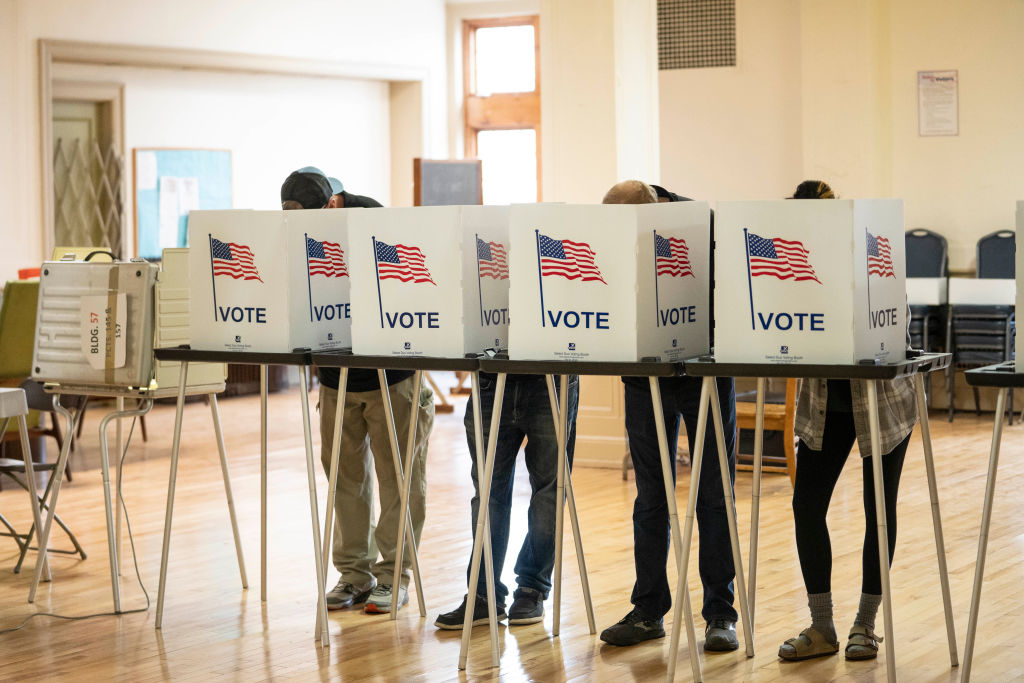
Detroit voters at the polls inside Central United Methodist Church in downtown Detroit, Michigan, on Nov. 5, 2024. —Sarah Rice—Getty Images
A pollster admitted this week to using fabricated data in its surveys that were picked up by leading publications across the U.S., claiming the stunt was an “experimental project” intended to showcase the “vulnerabilities” of the polling industry. The announcement has shaken trust in polling infrastructure ahead of the midterms, especially as some candidates say their campaigns were directly harmed by the fake numbers.
After election analysis website FiftyPlusOne submitted an inquiry to Wedgewood Polls regarding the authenticity of its data and methodologies, the pollster put out a statement across social media on Tuesday, saying it had been conducting a test to show "how easy is it for an entirely fabricated polling firm to gain traction, be taken seriously, and expose how little scrutinization exists in media and public commentary?" In the statement, which has since been deleted, the group claimed it had been “far too easy” to distribute false data and insisted it "highlights a systemic breakdown in media vetting and data aggregation.”
Wedgewood's polls had been used by multiple national outlets for their midterm reporting, including the New York Times, Newsweek, MS NOW, and POLITICO. The Times, which cited around 15 Wedgewood polls between June and October, has since removed the data from its stories. In an accompanying editor’s note, the publication detailed its checking process for polls and said Wedgewood had answered several of their inquiries prior to the data being published, including questions on the identities of the group’s pollsters, the methods used to draw their samples, and the source of their funding.
TIME's email to Wedgewood Polls bounced back.
In another fraudulent polling operation uncovered in August, a company called Median Strategies fabricated polls for races in Wisconsin, Nevada, and California and similarly called the ploy a “social experiment” in a statement to the Los Angeles Times.
“It's very troubling that we've had two examples of this within a very short period of time during election campaigns, creating a lot of problems for legitimate polling,” says Michael Traugott, a professor emeritus of political science at the University of Michigan, who previously served as president of the American Association for Public Opinion Research (AAPOR).
Here’s what to know about the Wedgewood scandal, and what it says about polling ahead of the pivotal midterm elections.
What do we know about Wedgewood Polls?
The polling group called itself a “fictional entity run by a small group of industry veterans” in its statement. Its X account, which contained many of its polls, no longer exists.
G. Elliot Morris, a pollster and journalist who works at FiftyPlusOne, tells TIME that he and his colleagues had been suspicious about a “crop of new polling firms” that have emerged and released anonymous data. An individual eventually tipped off FiftyPlusOne to Wedgewood's polling, which was “the straw that broke the camel's back for us,” he says.
FiftyPlusOne said in a public statement that Wedgewood “operated as if it were a legitimate polling firm” by collecting money from donors to carry out crowd-funded polls and share its survey data.
The poll analysis group said Wedgewood disclosed two names in connection to the company: Jack Sims and Andrew Prater. According to FiftyPlusOne, Sims had prior experience in the polling industry. SoCal Strategies, another polling firm, this week acknowledged in an email to an NPR affiliate in Michigan that Sims had worked there, but is not currently employed by the company and “has not been for a year.”
“It is not atypical for a pollster to leave an existing firm, form their own, and self-fund some surveys to build reputation; we had no reason at the time to believe this case was any different,” FiftyPlusOne said regarding Sims.
“This event does not help what is a decades-long trend of declining confidence in the polling industry,” Morris added, when asked about Sims’ involvement with Wedgewood. TIME has been unable to reach Sims for comment.
Senate candidate in Michigan says fake polling damaged her campaign
The polling scandal has sparked a flurry of reactions within the politics and government sector, with one former Senate hopeful claiming the numbers circulated by Wedgewood contributed to the collapse of her campaign.
Democratic Michigan state Sen. Mallory McMorrow recalled how a poll from Wedgewood had shown her “plummeting into single digits.”
Wedgewood released polling on June 29 that placed McMorrow as having the support of only 9% of registered voters, leaving her trailing behind Haley Stevens and Abdul El-Sayed. Other polls also showed McMorrow in third place with single digits. A Susquehanna Polling survey conducted June 9 to 14 put McMorrow at 9%, although 49% of Democratic primary voters surveyed were undecided. A July 1 Quantus Insights poll put her at under 8%. McMorrow suspended her campaign on July 5, just one month before the primaries.
In a statement posted to social media on Oct. 20, McMorrow said donations “dried up” and she was “hounded” with calls to exit the race after the circulation of the “infamous” Wedgewood poll numbers.
Advising others not to trust the polls, McMorrow said she hoped Democrats are ready to “blow up the system with campaign finance and transparency reforms.”
Jennifer Holdsworth, a Democratic strategist who ran a SuperPAC that supported McMorrow, claimed the fake poll had been “used by several donors to pull back funding at a time we were being outspent by $80 million.”
Amid widespread discussions over fabricated data, Federal Communications Commission (FCC) Chair Brendan Carr said, without naming any specific instance, that there has been a “significant surge” in fake polls and blamed news outlets for “amplifying or airing” them “without regard to basic journalistic ethics.”
Democratic FCC Commissioner Anna Gomez quipped back and shifted the onus onto fraudulent pollsters themselves.
“Pollsters who intentionally mislead the public should answer for it, but broadcasters who report publicly available polling data should never be punished when a poll is wrong,” she said in response to Carr. “FCC rules on news distortion or hoaxes do not apply to a station that reports this data in good faith.”
Michigan Democratic state Sen. Mallory McMorrow and Democratic Senate primary winner Abdul El-Sayed at a press conference in Detroit, Michigan, on Aug. 5, 2026 —Finn Gomez—Getty Images
What impact can polls have on elections?
While documented fake polls are rare, according to experts, polling in general often plays a large role in shaping the narrative of hotly contested races.
Traugott tells TIME that polls can affect voting behavior and support for campaigns “because by and large, the average citizen is interested in backing the winner, and backing means not just votes; it also means financial contributions, contributing time and effort to the campaign, and the like.”
Research has demonstrated what is known as the “bandwagon effect,” in which voters become more likely to vote for candidates or issues that are more favored in polls. A 2023 study from the Journal of Elections, Public Opinion and Parties showed that polls discouraged support for less popular ballot items, or as the paper’s authors put it: “polls demobilize the minority and mobilize the majority.”
It also found that moderate voters, who often represent a crucial demographic of voters and can swing tight elections, were the most impressionable when it comes to being influenced by polling. “Social conformity is strongest among ideological moderates,” the study said.
This effect has been documented going back decades.
A 1996 experiment showed that participants who were shown a fabricated poll ahead of that year’s primary had a “significantly greater tendency” to vote for the candidates favored by the poll.
This phenomenon has similarly been demonstrated in prediction markets, which have been shown to sway voters almost as much as polls. A study released on Oct. 20 by policy think-tank the Brennan Center showed that voters were 10% more likely to say that a candidate would win in an election if that person had higher odds of winning based on a prediction market.
Likewise, voters were less likely to believe that a candidate would win if their odds were predicted to be lower. These prediction market odds, the study said, had a similar effect on perceived electability as traditional polls.
Traugott says that generally speaking, voters who identify with a specific party are unlikely to change their vote as a result of polling, but that they might not show up to the polls at all if they see their party’s nominee is disfavored to win.
“It's often the case in the general election that the polls have an influence in terms of turnout,” he says.
Should you trust polls?
Michael Dimock, the president of the Pew Research Center, says that in tight races, of which there are many in the upcoming midterms, “it's very easy for polls to ‘pick the wrong winner.’”
“I do think that people should be very cautious in over-interpreting pre-election polls' ability to project an election outcome, whether it's at a national level, state level, a district level, [or] local level,” he tells TIME.
One of the main reasons for this, Dimock contends, is that even if participants in a survey say who they would vote for, they still might not show up to cast their ballot. He refers to this immeasurable but important factor as “enthusiasm differences.”
“What polls are really bad at capturing is who's going to actually show up and cast a ballot. It's really hard,” Dimock adds. “Human beings are bad at predicting their [own] future behaviors.”
 Login