
❌

Reading view

What We Know So Far About the Elementary School Shooting in Bend, Oregon

Police tape is placed outside Silver Rail Elementary school in Bend, Oregon, on Oct. 15, 2026. —Joe Kline—AP

The 16-year-old suspect who opened fire at an elementary school in Bend, Oregon, on Thursday, has been identified as Griffin J. John II. The assailant killed three children and a teacher before he was shot dead by a community member, police said. 

Bend Police Chief Mike Krantz identified the suspect in a press conference late Friday, adding that John was a former special education student at the school, Silver Rail Elementary School. He was not enrolled in the school district at the time of the shooting. 

In a press conference on Thursday, Krentz said that the children killed were ages 5, 8, and 11. A 7-year-old and a 54-year-old teacher were transported to St. Charles Bend hospital with critical injuries. As of Friday, the 7-year-old is alive and in “serious but stable” condition, according to officials.

The police also shared the names of two of the victims on Friday: 5-year-old Rhoam Summer and 25-year-old teacher Megan Lambert.

Krantz said a community member saw the suspect entering the school, pursued him inside, and shot him. Officials have not publicly named the bystander, but family members identified him as Kaylub Giamanco, 36, whose two daughters attend the school. His brother, Kyle Giamanco, told NBC News that Kaylub was on a break from work when he drove past and saw the gunman entering the building. Kyle said his brother has a concealed-carry permit.

The chief said the suspect forced his way into the school by firing at locked doors.

He fired 15 rounds and had 44 more in a backpack, the police said, adding that it would have been a much deadlier attack if not for a teacher who threw a phone at the shooter, and the bystander, a father of two students at the school, who killed the attacker.

FBI Director Kash Patel posted on social media that the agency’s Portland field office is assisting in the investigation. “We will make every resource they need available,” he added.

A vigil was held Thursday evening in the wake of the shooting.

Community members grieve during a candlelight vigil at Drake Park in Bend, Ore., on Oct. 15, 2026. —Mathieu Lewis-Rolland—Getty Images

“A school should be a safe place where children can learn and feel secure,” Bend Mayor Melanie Kebler said at the press conference. “What happened today should never happen.”

Oregon Gov. Tina Kotek said at the same conference that her heart was “absolutely broken” over the incident: “No parent should have to have this kind of day, and no community should have to live through this kind of day.” She also thanked the community member who pursued the shooter.

CNN’s analysis of incidents reported by the Gun Violence Archive, Education Week, and Everytown for Gun Safety shows that the shooting at Silver Rail Elementary marks the 36th on K-12 school grounds this year. It is the 52nd school shooting in the country this year.

What happened?

In the press conference Friday, officers provided a clearer picture of what happened during the shooting. The assailant jumped over the fence by the school’s playground and shot through the glass panes on the side doors in order to get into the building.

He then entered a mixed special education classroom and opened fire.

Krantz said that at 12:59 p.m., police received a 911 call from a person in a vehicle who reported being shot at multiple times by someone “with a long gun.” 

Multiple calls followed, reporting that a shooter had entered Silver Rail Elementary School, which is about 120 miles southeast of Portland. The school enrolls more than 400 students from kindergarten to 5th grade. 

Krantz said police directed the school to go into lockdown at 1:01 p.m. and first responding officers arrived a minute later. Upon entering the school building, Krantz said, officers confirmed that the suspect was dead and found the four other people who died from their injuries, and their families have been notified.

Officers located a Maverick 88-pump and 12-gauge shotgun near the suspect, as well as a backpack with the added ammunition.

How are politicians reacting?

Oregon’s Republican candidate for governor, state senator Christine Drazan, posted on social media that her heart was with the affected families, students, and teaching staff. “We have to commit to protecting our kids,” she added. “We have to put a complete stop to shootings at our schools. This has to end.”

Rep. Janelle Bynum, a Democrat who represents the district that includes Bend, said in a statement: “Our babies are supposed to do arts and crafts at school, not use their desks as cover from gunfire. They’re supposed to make friends, not mourn them.”

U.S. Senator Ron Wyden (D, Ore.) lamented in a statement that the victims in Silver Rail Elementary School and their loved ones faced the “awful consequences” of another school shooting in the country. He added that the “best way to honor” them is to “at long last pass common-sense gun laws that reduce the risks of more children, parents, teachers and staff forced to live in fear of similar nightmares for their schools.”

When asked about the shooting on Friday, President Donald Trump praised the bystander who shot and killed the suspect.

“We had a great hero who went in and did the business. He took care of business,” Trump said. “It’s a terrible thing, but thank goodness for a man that had a gun and knew how to use it.”
  •  

Trump Cancels Livestream of Fort Hood Firing Squad Execution Amid Bipartisan Pushback

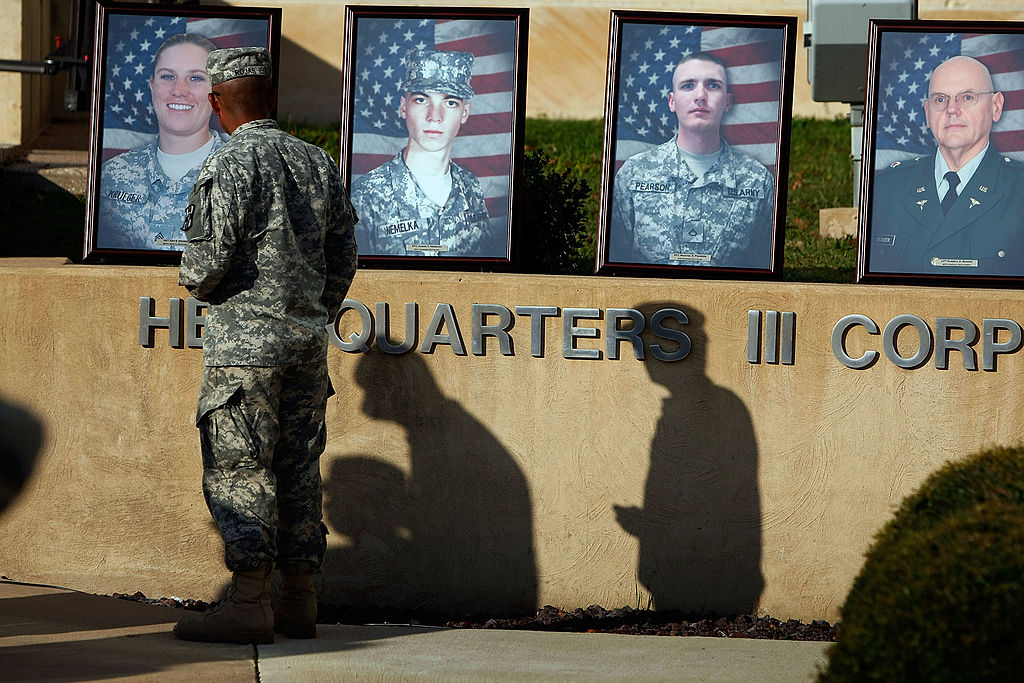
A U.S. Army soldier looks at photographs of the 13 people killed in the Fort Hood shooting during a memorial service at the Texas base on Nov. 10, 2009. —Joe Raedle—Getty Images

President Donald Trump on Thursday called off plans to livestream the firing squad execution of Fort Hood shooter Nidal Malik Hasan following a wave of fierce bipartisan backlash. 

In a post on Truth Social, the President said he thought streaming the execution “might have been a strong deterrent for the World to witness how America deals with Terrorists and SCUM,” but that “many very good and well meaning people would rather not watch him die.”

The families of victims may view the execution “if they so choose,” Trump added. 

The execution remains scheduled for Dec. 3 and marks the first U.S. military firing squad execution since World War II.

Read More: Are Firing Squad Executions Seeing a Revival in the U.S.?

Defense Secretary Pete Hegseth announced on Oct. 8 that the execution of Hasan would be livestreamed, sparking fierce backlash from both sides of the aisle. 

Vice President JD Vance said earlier this month, “I don’t know that that’s actually going to happen,” when asked about the livestream. He also said that he would not watch the livestream if it took place.

House Speaker Mike Johnson also said he would not watch the execution. In an interview with CBS News earlier this month, he said he had colleagues "who have concerns,” over the livestream, one of them being “that you would create a video that would be a recruiting tool for future terrorists."  

In addition to many Democrats in Congress, several Republican lawmakers also expressed their disapproval over the plans.. 

“I absolutely support the sentence of death, but live-streaming executions is what jihadists do,” said Republican Rep. Austin Scott of Georgia, a member of the House Armed Services Committee, in a post on X. “America is better than that.”

Republican Rep. John Curtis of Utah said that “a civilization erodes when it cultivates an appetite for executions as a form of entertainment,” in a post on X in which he urged Hegseth to “reconsider” his decision. “Secretary Hegseth’s plan to livestream the Fort Hood execution risks feeding that appetite.”

Republican Sen. Thom Tillis of North Carolina, an outspoken GOP critic against Hegseth, called the livestream “beyond disgusting. Public executions are what oppressive dictatorships like Iran and Afghanistan do. It should not be happening in America.”

Trump had reconsidered livestreaming Hasan’s execution this week after learning that he is paralyzed from the waist down, according to sources familiar with the matter who spoke to CNN.

Polling shows a majority of Americans disapprove of livestreamed executions

A majority of Americans also opposed the livestream of Hasan’s execution. According to an ABC News/Washington Post/Ipsos poll, eight in ten Americans said the execution should not be livestreamed. 

Majorities across party lines opposed the livestream, with 91% of Democrats, 83% of Independents, and 64% of Republicans, according to the poll. 

Another YouGov poll found that 69% of respondents opposed broadcasting executions to the public, including 52% of Republicans, 67% of independents, and 87% of Democrats. 

Among those who supported the death penalty, 55% opposed livestreaming executions. 

In general, support for the death penalty has declined in the U.S. According to a Gallup poll, 52% of Americans supported capital punishment for convicted murderers in 2025, down from around 80% in 1994.

What was Hasan convicted of?

Hasan, a former U.S. Army major and psychiatrist, was convicted of killing 13 people and injuring 32 in a mass shooting at Fort Hood in Texas in 2009. 

He opened fire inside a processing center where soldiers were preparing for deployments overseas, killing 12 soldiers and one civilian employee. Pvt. Francheska Velez, 21, was three months pregnant when she was shot and killed by Hasan.

Hasan said that he was motivated by opposition to U.S. operations in Afghanistan and support for the Taliban. 

“I was on the wrong side but I switched sides,” Hasan said in 2013.

  •  

Can the Public See DOGE’s Records? The Supreme Court Takes Up a Key Fight

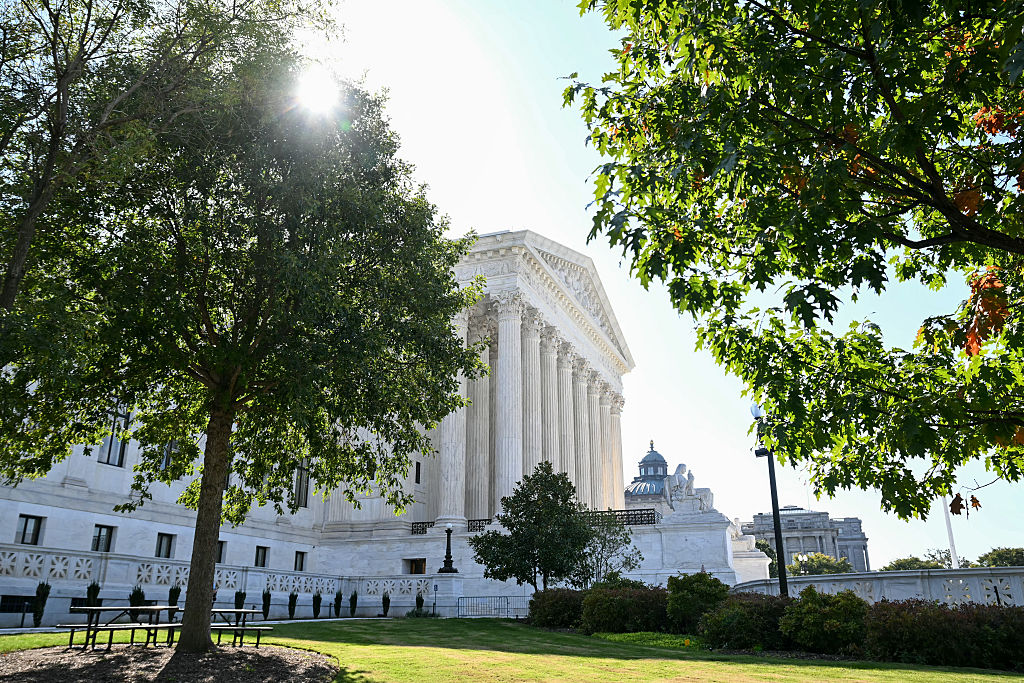
A view of the U.S. Supreme Court in Washington, D.C., on Oct. 14, 2026. —Saul Loeb—AFP/Getty Images

The U.S. Supreme Court said Tuesday that it will take up a case to decide whether a watchdog organization can obtain information to help establish whether the now-defunct Department of Government Efficiency (DOGE) is subject to a federal public records law.

It’s the latest update on a lawsuit filed by a nonprofit called Citizens for Responsibility and Ethics in Washington (CREW) that argues DOGE, the initiative that was spearheaded by Tesla CEO Elon Musk, is subject to the Freedom of Information Act (FOIA). 

The Trump Administration has argued that FOIA does not apply to DOGE because it was not a federal agency—it was a presidential advisory body.

Signed into law in 1966 by President Lyndon B. Johnson, FOIA grants “the public the right to request access to records from any federal agency,” according to the federal government’s website. Johnson said at the time that he hoped the government would, in upholding the law, weigh national security, individual privacy, confidential government deliberations, and the benefit of a well-informed constituency.

“The founding principle of FOIA is that it’s crucial in a democracy to have an informed citizenry,” says Sara Creighton, an associate professor at Georgetown Law and the former Deputy Chief Counsel at American Oversight, a government transparency nonprofit. “The whole idea is that we need an informed voting public.”

Justices have agreed to hear arguments over whether, and to what extent, discovery can proceed for CREW v. DOGE Service. This phase of the legal process allows opposing parties to collect information, including records and depositions, with which to make their cases.

Experts say this decision will not only affect the pending lawsuit, but may also have ramifications for the future of government transparency.

How did the DOGE records case reach the Supreme Court?

CREW filed an FOIA request seeking expedited processing for information about DOGE on Jan. 24, 2025, seeking insights about its structure and communications with other agencies. When it didn’t receive the documents it requested, the organization sued.

“The law is clear about how government records should be preserved so that, when the public requests them, they are easily and readily accessible. If the administration valued transparency, following records laws would be a priority,” CREW President Noah Bookbinder said in a statement announcing the lawsuit on Feb. 20, 2025. “Instead, US DOGE Service and OMB are acting as though the law does not apply to them. It does.”

“The fight ultimately in the DOGE case, and what CREW was hoping to test with its litigation, was whether DOGE [is] subject to FOIA,” says Ryan Mulvey, a senior policy counsel at the Americans for Prosperity Foundation.

On April 15, 2025, Judge Christopher Cooper ruled on behalf of the U.S. District Court for the District of Columbia that the case could proceed to discovery. The Department of Justice, however, filed an emergency appeal in May 2025 asking the Supreme Court to intervene. The Supreme Court paused the discovery orders on May 23, 2025. On June 6, 2025, it directed the appeals court to narrow the requests, finding that those concerning DOGE’s recommendations and whether agencies followed them were “not appropriately tailored.”

CREW then pared back its requests for discovery, and the U.S. Court of Appeals for the D.C. Circuit upheld them. The Trump Administration again filed a request to the Supreme Court, arguing that the lower court was not adhering to the previous ruling by granting “wide-ranging and intrusive discovery.”

In response, the Supreme Court agreed this week to take up the question of whether the case can proceed to discovery. It’s unclear at this point when oral arguments would begin, but a ruling is expected by the end of term in late June or early July 2027.

What could the Supreme Court’s DOGE ruling mean for public access?

The Supreme Court’s ruling will determine if CREW can access the information that could help it make its case that DOGE acted as a federal authority that is subject to FOIA, according to Creighton. If not, the nonprofit may have difficulty pursuing its argument. 

“Because so much about how DOGE operated … was not publicly explained, discovery is the only way to unearth key facts about DOGE’s operations and exercises of authority,” says Margaret Kwoka, the Frank R. Strong Chair in Law at Ohio State University’s Moritz College of Law, who joined a brief supporting CREW as an outside legal expert. “Those details will illuminate whether it is in fact exercising independent authority or whether it is acting as an advisor to the President.”

The outcome of the case could have implications beyond the current Administration, Creighton says.

“Whether an entity is subject to FOIA really determines how much information the public gets to know about it, and whether [entities] have any obligation to disclose their documents to the public,” Creighton says. 

The current issue before the Supreme Court pertains to discovery, but Creighton warns that if the Supreme Court ultimately rules that DOGE is not subject to FOIA, that could potentially “open the door for future presidents to create entities inside the Executive Office of the President that do significant work—even potentially work relating to the work of agencies who are usually subject to FOIA—but allow that work to be outside the scope of FOIA.”

CREW did not respond to TIME’s request for comment, but it has previously said that government transparency is at stake.

“The lower courts have uniformly ruled that CREW is entitled to discovery in this case to help the court determine whether DOGE wields the type of authority that would make it subject to FOIA,” CREW’s chief counsel, Nikhel Sus, told POLITICO in a statement on Tuesday. “We will continue to pursue transparency for the American people, who deserve to know the details of the Trump Administration’s efforts to unilaterally remake the federal government.”

Solicitor General D. John Sauer, meanwhile, argued in his filing to the Supreme Court that the appeals court ruling “intrudes into the autonomy and confidentiality of presidential advisors and augurs time-consuming and burdensome discovery litigation.” 

He further claimed that the lower court decision “threatens to burden future presidential administrations” with similar legal cases.

The White House referred TIME to the Department of Justice, which did not immediately respond to a request for comment.

What other records lawsuits has the Trump Administration faced?

The DOGE dispute is among several legal battles over access to, and preservation of, government records under the Trump Administration.

In 2025, American Oversight filed a lawsuit asking the court to order multiple national security officials to preserve official communications that were exchanged on the encrypted messaging app Signal. The request was filed after it came to light that the officials were exchanging messages regarding planned military strikes in Yemen. The case is still ongoing.

In April, the same group, along with the American Historical Association, sued the Trump Administration over a legal opinion released by the Department of Justice that claimed the Presidential Records Act—which stipulates that presidential records be preserved and transferred to the National Archives when the President leaves office—is unconstitutional. That case is also ongoing.

While those cases remain ongoing, American Oversight has secured a win in another records dispute. In August, a federal judge struck down an Energy Department policy that would have permitted it to close pending FOIA requests filed earlier than Oct. 1, 2024, unless requesters reaffirmed their interest within 30 days. The court sided with the watchdog group.

  •  
❌