❌

Reading view

Carney Warns U.S. Is Trying to ‘Break’ Canada as Trump Revives ‘51st State’ Threat
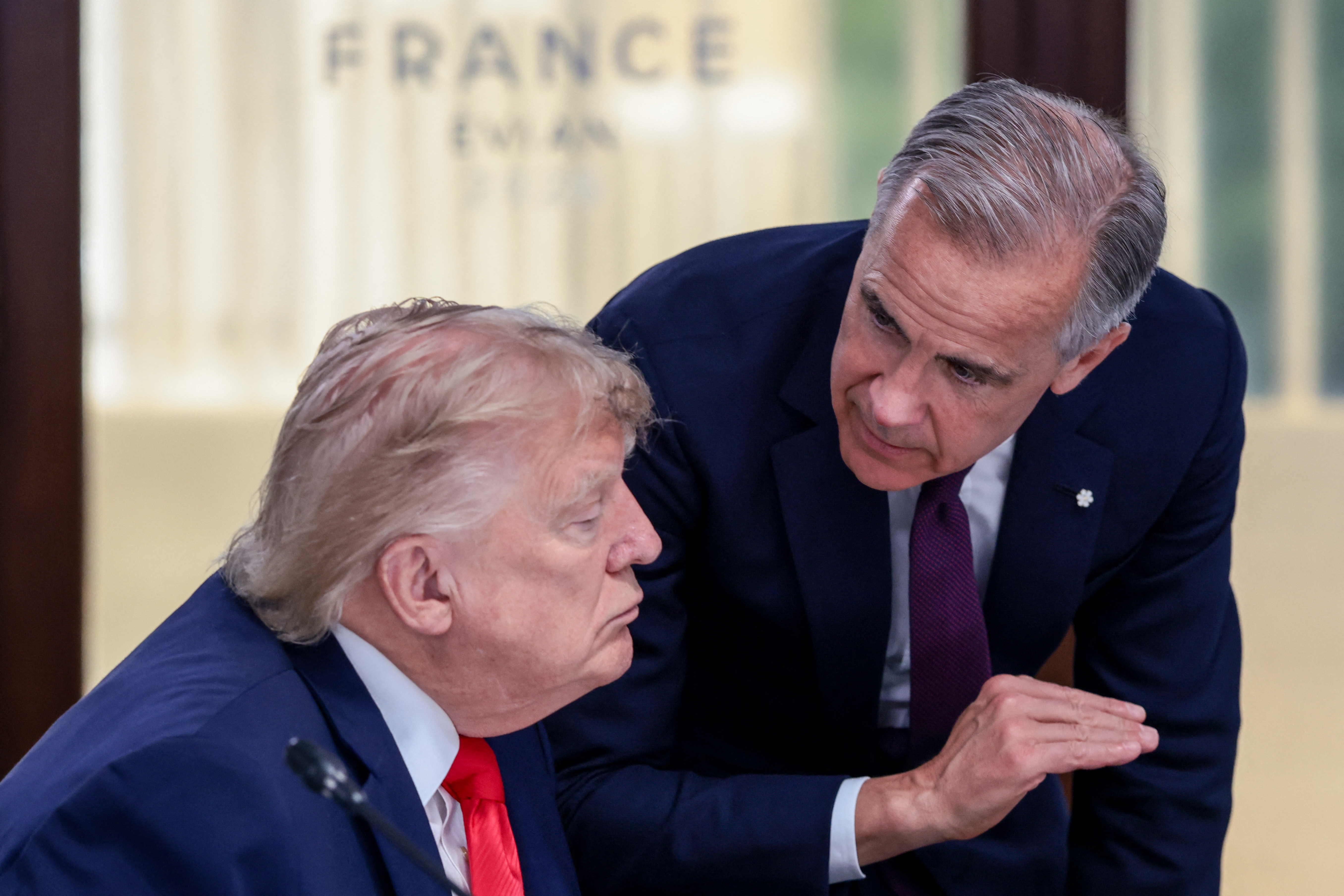
U.S. President Donald Trump and Canadian Prime Minister Mark Carney at the G7 summit, in Evian, France, on June 16, 2026. —Evelyn Hockstein—Getty Images

Canadian Prime Minister Mark Carney on Thursday warned that the United States is trying to sow discord as he urged Albertans not to vote for a separation referendum.

“The stakes are high. This referendum, it comes at the worst possible time. The world has become more dangerous and divided,” Carney said at a rally in Calgary ahead of Monday’s vote, which will see residents decide whether the oil-rich province should hold a referendum on independence. “There are some outside our borders who are working to break us, so they can own us.”

While Carney didn’t explicitly name the U.S., the remarks echoed his previous warnings of the dangers of American dominance. Carney's statement came a day after U.S. President Donald Trump revisited his ambitions to annex Canada, telling the crowd at a rally in Arizona that the country will “end up being the 51st state, because it's the only way it works.” Trump again accused Canada of treating the U.S. “very badly” and vowed he won’t allow it to happen anymore as “it’s a whole different ballgame now [that] Trump is in town.”

The U.S. and Canada remain in a contentious trade standoff after negotiations collapsed in August. Canada’s retaliatory tariffs came into effect last month, matching the economic pressure imposed by the U.S. Carney has encouraged Canadians to band together and take back their economic power by choosing Canadian products over those made in the U.S. The trade tussle comes after months of Trump repeatedly threatening Canada’s sovereignty—a move that has stoked tensions between the U.S. Administration and Canadian officials.

In light of Trump’s most recent remarks about possible annexation, Canada’s former deputy Prime Minister Chrystia Freeland said it would be dangerous to deepen or maintain close economic ties with a neighbor that “openly says they want to take you over.”

Carney admitted in an interview with the New York Times last month that he had studied the risk of a U.S. invasion, given Trump’s charged rhetoric. “I think you have a responsibility in these roles to look at extreme tail risk,” he said. “That’s just risk management. That’s not a base case, but it would be irresponsible not to [prepare].”

Amid the U.S.-Canada tensions, Carney is desperately trying to promote his “Canada Strong” strategy—one that he hopes will very much include Alberta. Polling conducted by 338Canada suggests that as of Oct. 11, 75% of Albertans would vote to remain part of Canada. But Carney’s resolve is being tested on more than one front, after the separatist Parti Québécois won Quebec's provincial election earlier this month. Incoming Premier Paul St-Pierre Plamondon has already stated his intention to hold a referendum on Quebec independence. While he has vowed not to initiate a vote so long as Trump is in office, the looming presence of a separatist movement undoubtedly complicates matters for Carney at a time when he is striving to show that Canada is strong enough to prosper without relying on the American market.

With the U.S. and Canada locked in a trade stalemate, and with annexation threats once again dominating the conversation, here’s a look at the reality Carney is facing as he deals with both domestic and international pressures.

Trump's remarks complicate Carney’s unity efforts

Trump’s accusations that Canada has taken advantage of the U.S. on matters of trade and security date back to before Carney became Prime Minister in March 2025, meaning the friction we’re currently seeing goes deeper than a simple clash between Trump and Carney. Trump would often refer to Carney's predecessor Justin Trudeau as the "governor" of the "great state of Canada."

In terms of any physical threat facing Canada, Patrick Leblond, a professor of public and international affairs at the University of Ottawa, says that Carney “put it best when he talked about tail risk” in his interview with the Times. “It’s the financial term for something that has potentially high impact, but low probability,” Leblond explains.

Trump’s economic actions and threats have proven to be far more damaging than his annexation remarks, experts note.

“He has weaponized market access to the U.S.,” says Leblond. “What we can expect is more economic pressure from the White House in the coming months. Trump and his acolytes certainly [appear to] see Canada as a small, weak country that the United States should try to squeeze further.”

The U.S. is Canada’s largest trading partner, with almost $2.6 billion worth of goods and services passing across the border daily in 2024. According to the Office for the U.S. Trade Representative, trade between the two was down 4.6% from 2024 to 2025, but still saw $872.3 billion worth of goods and services cross the border.

Still, there are concerns that any suggestion of annexation, however unlikely it may be, could damage Carney’s high-stakes domestic campaign to unite the country.

On the home front, the success of a separatist party in Quebec is another threat to the unity that Carney is striving for. However, despite the Parti Québécois' victory (they fell five seats short of securing a majority government), the desire for separatism among Quebec residents remains low—with only 31% in favor of sovereignty for the province, according to data from 338 Canada released on Oct. 11.

“If Quebec is on a path to separation or not, it would never be because they were looking for further alignment with the United States,” argues Lori Turnbull, a professor in political science at Dalhousie University. “Quebec has a variety of cultural protections in the Canadian federation. They would have none of that in the United States.”

The more immediate risk for Carney lies in Alberta, with residents preparing to vote on whether the province should hold a referendum on independence.

Carney, who was raised in Edmonton, Alberta, on Thursday framed the referendum as an opportunity for voters to “stand up for Alberta, the heart of Canada” and “recognize that we're all responsible for each other.”

Ahead of the vote, residents express their views with signs outside their homes in Edmonton, Alberta, on Sep. 28, 2026. —John Diep—Getty Images

How Trump’s threats could also help Carney

The pressure and rhetoric from the U.S. could actually work in Carney’s favor, experts tell TIME.

“The effect of Trump's comments has been unifying,” says Turnbull. Despite discussions of independence in Alberta and Quebec, she says “there isn't widespread panic that the country is coming apart.”

In fact, research conducted by the Environics Institute for Survey Research in 2025 found that “in almost every province, the proportion of residents who are very attached to Canada is greater than the proportion who are very attached to their province.”

Between Trudeau’s resignation on Jan. 6, 2025, and a federal election in Canada months later on April 28, Carney’s Liberal Party went from 20% to 42.8% in the polls, according to CBC, with Carney’s message of defiance in the face of Trump proving to be a rallying point.

This falls in line with depleting favorable views of the U.S. among Canadians. In July, 44% of Canadians had a favorable opinion of China compared to 33% of Canadians who held the same view of the U.S., according to a Pew Research Center survey. “When China is more popular than the U.S. in a country like Canada, you have to ask yourself: ‘What's going on?’” says Leblond.

Continued annexation threats could bring Canadians even closer together.  “Already, trust is very low, and [more threats] would confirm even more that the United States is [perhaps] not a trustworthy partner at this time,” Leblond argues.

Since the U.S.-Canada trade war reignited in August, Carney has seen his domestic approval rating bounce back up. On Oct. 15, it stood at 62% according to Poliwave, compared to 56% in mid-July. Carney’s resistance against American economic pressures could help his cause, particularly in possible separatist provinces.

“In August, when Carney walked out of the negotiations with the U.S., the highest levels of support for him were found in Quebec,” says Leblond. Indeed, Carney’s approval rating in Quebec grew from 76% to 80% between Aug. 17, and Sep. 7, the highest in any province, according to Liaison Strategies.

Turnbull says the support behind Carney’s decision to walk away from negotiations prompted a strong sense of “patriotism and loyalty.” 

That attitude among Canadians has been reflected in the burgeoning “Buy Canadian” movement, in which consumers across the country have joined a boycott of U.S. products in an effort to feed back into the Canadian economy. 

Carney strengthens international alliances to end reliance on American market 

In September, European Commission president Ursula von der Leyen invited Canada to work toward becoming the bloc’s first “associate member,” in what she described as an “urgent” reimagining of partnerships.

While addressing the European Parliament as a guest of honor in Strasbourg, France, Carney insisted “Europe and Canada are stronger together” and said “Canada and the European Union can anchor our ground to hold our values while forming a protective canopy under which our citizens can thrive.”

Trump called the unique membership proposal “laughable” and has threatened economic punishments if the E.U. moves forward with von der Leyen’s plan.

Carney’s shift towards other partnerships “doesn't mean that Canada is not going to do business with the U.S., but it's no longer a preferred partner,” says Leblond, noting that Carney wants to build relations with partners that “share the same values in terms of rules-based trade and investment.”

In January, after meeting with Chinese President Xi Jinping, Carney announced a new strategic partnership with China, focused on “energy, agri-food, and trade.” Carney agreed to cut his country’s 100% tariff on Chinese electric cars in return for lower tariffs on Canadian farm products, including canola seeds, a major Canadian export.

These stronger international ties that diversify trade and security away from the U.S. are proving popular on the homefront, according to data. 

According to Abacus Data, a survey conducted in September found that 49% of Canadians would support Canada joining the E.U. An Ipsos poll conducted in January, in light of Carney’s visit to China, found that 54% of Canadians also said they support stronger trade ties with China.

  •  

Katie Zacharia Out as Trump's Press Secretary After 5 Days

Katie Zacharia is exiting her job as White House Press Secretary after just five days in the position, according to a person familiar with the situation. President Donald Trump on Friday said to reporters that he told Zacharia to reconsider her role, amid reports that she had already been relieved of the job.

“I said to her honestly, if I were you, I'd reconsider,” Trump said outside of the White House, adding, “Katie, do you need this? I don’t think you need this.”

Trump said that the decision was ultimately hers, and that he would speak with Zacharia following a trip to Georgia. “I just want her to be happy,” he said.

Zacharia’s brief stint as press secretary is bound to draw comparisons to Anthony Scaramucci’s 11-day run as Trump's White House communications director in 2017. Then-White House Chief of Staff John Kelly fired Scaramucci after he had given a fiery interview to The New Yorker in which he attacked his colleagues. In Washington parlance, the tenures of prominent White House officials have since been jokingly measured in “Scaramuccis.”

Trump said that Zacharia has been treated “pretty nastily” and “very unfairly” by the media since taking over for former Press Secretary Karoline Leavitt. 

“I said you should reconsider because you don't want to go through this,” he said in reference to the critical media response Zacharia received following her first press briefing on Tuesday.

Trump called Zacharia “an attorney” in his Truth Social post announcing her position, and Zacharia has described herself as a lawyer. But when asked by a reporter where she had passed the bar, Zacharia responded “when I moved to China.” She later said that she had misheard the question. Zacharia then acknowledged while speaking on Fox that she had failed the bar exam.

"You went to Pepperdine law school but you did not pass the bar exam, correct?" Fox host Sean Hannity asked Zacharia on Thursday.

"Correct," Zacharia replied.

When asked whether she regretted never having told the White House that she failed the bar, Zacharia responded “those questions weren’t asked,” and “I’m being hired as White House press secretary, not White House counsel.”

Zacharia previously worked as a general counsel at a the conservative non-profit Fix California. She also has experience working as a communications adviser at Trump Media and Technology Group, which houses the President’s social media platform Truth Social. She previously worked as a spokesperson for former Homeland Security Secretary Kristi Noem, and is a regular on conservative media outlets like Fox News and Newsmax.

Zacharia received a wave of criticism following her first press briefing, which lasted just 14 minutes and during which she only took questions from three reporters. 

Leavitt, the youngest press secretary in White House history, stepped down in August after returning from maternity leave. She recently joined Fox News as an on-air contributor. 


  •  

A door to single-payer healthcare could open after November 3

Sign that says healthcare is a human right
Protest signs seen at protect Medicaid lights up Capitol amid budget showdown, on May 7, 2025, in Washington, DC. | Leigh Vogel/Getty Images for Caring Across Generations

Twelve years ago, Vermont Democrats tried to make their state the first in the nation to have a single-payer government-financed healthcare system — a bold experiment to push the limits of American health coverage when Obamacare was just being launched.

Their plan failed, and rebooting it became politically impossible, even in Vermont: The Democrats lost the governorship to Republican Phil Scott for what turned out to be a decade.

This year, that could finally change. A progressive political newcomer named Amanda Janoo is taking on Scott in what polls show is a tight governor’s race.

And if she wins, the state could be poised to try a whole new national experiment: One of Janoo’s central campaign promises is to create a pioneering health system where the state pays the full tab for primary and preventive care, while leaving the rest to the existing system.

Key takeaways

  • Amanda Janoo, the Democratic nominee for governor of Vermont, wants to move primary and preventive healthcare to a single-payer system — where the state would pay providers for such care, make it free for patients, and cut insurers out.
  • Previous attempts to pass or enact full single-payer systems have failed at the state level, including in Vermont in 2014.
  • Janoo is trying to focus first on this one relatively smaller slice of the health system, but hopes it could be a starting point to full single-payer reform eventually.
  • Yet even this more limited reform faces difficult political and practical challenges.

Janoo’s candidacy is an example of the policy experiments that are becoming possible nationwide in a projected “blue wave” year, when Democrats could sweep into power in a number of states. But in the healthcare universe, her plan is also an example of how even progressive policy idealists are trying to learn from past failures and focus on what they think can actually be achieved.

Compared to the sweeping ambition of Vermont’s 2014 effort, or Bernie Sanders’s signature “Medicare-for-all” idea, Janoo’s proposal for single-payer has very specific limits. Under Janoo’s proposal for “universal primary and preventive care” (she typically avoids the term “single-payer”), the state government would pay for Vermonters seeing primary care providers such as doctors and nurse practitioners. This government coverage would be universal and free for patients, and insurance companies would be cut out.

However, other parts of the health system — such as hospitals, specialists, and prescription drug companies — would remain under the existing insurance system, for now.

Every effort so far to enact full single-payer at the state level has failed — even in blue states, bills and ballot initiatives have regularly gone down to defeat. Vermont’s previous single-payer experiment made it the furthest — it was signed into law but abandoned before being implemented, when the governor concluded it was unworkable. Wherever it’s gained steam, politicians and voters have blanched at the high costs of moving their health systems onto state budgets, and the high taxes that would be necessary to fund them.

Now, Janoo is making an attempt to refurbish single-payer as something more achievable, by cutting off a smaller slice of it.

“I think it’s clear at this point that a profit-oriented healthcare system is a terrible idea,” Janoo told me in an interview on Monday. But after assessing that the state budget made it “unrealistic” to do single-payer immediately, she concluded, “we could do universal primary and preventive care,” financed by a tax on the wealthiest.

Indeed, single-payer for primary care seems more achievable precisely because primary care is a relatively less expensive part of the healthcare system. But Janoo hopes it will pay major dividends — that better preventive care will improve Vermonters’ health, reducing costs elsewhere in the system by, for instance, making some hospital visits unnecessary.

In speaking to health policy experts about this idea, I heard much sympathy for the goal of universal primary care, but many questions about the details. Would Janoo’s plan be sufficient to bring more primary care doctors to Vermont — and, not unrelatedly, would it pay them more? Would her hoped-for cost savings from preventive care actually materialize? Is picking up the tab for a relatively less expensive part of the healthcare system the best use of sparse state funding?

These questions are becoming national ones, as healthcare gains traction as a political issue again. It isn’t just Vermont where primary care reform ideas are gaining steam: Democrats in Minnesota, Washington state, and elsewhere have discussed them. “There is growing interest in a number of states across the country in doing a universal primary care for all program,” Kevin Grumbach, a family physician and a professor of family and community medicine at the University of California San Francisco, told me. Even Scott, Janoo’s opponent, signed a law calling for a study of universal primary care.

One dividing line emerging, though, is whether to keep insurers involved, or to clear them out with a single-payer system, as Janoo wants. Insurers are unpopular with the public, but they can be a formidable political opponent when they argue that the benefits voters currently enjoy might be lost. Scott has said that the idea of universal primary care is appealing — but that if universal is “just code for single payer, I’m not interested. We’ve already been through that.”

Yet Janoo is hoping that single-payer for primary care will be a stepping stone — a trial run for eventually making the rest of the state’s health system single-payer down the road.

“I think about this often,” Janoo told me. “How do you build the new system as you transition the old — or hospice the old?”

Amanda Janoo is tired of “corporate neoliberal bullshit”

Janoo has long been an unorthodox economic policy thinker. Her rise is part of a broader trend in which progressives and leftists are winning primaries and gaining influence in the Democratic Party — but she doesn’t fit the prototype of the democratic socialist candidates in New York City, Colorado, and elsewhere who’ve gotten much attention this year. Instead, she comes from a different strand of the left, a movement based on a dissident strain of economics and openly skeptical of the benefits of economic growth.

Dating back to when she graduated from college in 2010, in the aftermath of the financial crisis, she was part of a younger cohort rebelling against what seemed the glaring failures of the economic establishment. “The one thing coming out of university I was clear on was that neoliberalism was the worst,” Janoo said on a podcast last year. “This whole idea that governments should just take a hands-off approach to the economy and trust in sort of the disciplinary powers of the global free market to lead them to infinite growth seemed highly problematic and very anti-democratic.”

So for graduate school, Janoo attended Cambridge to study development economics under the “heterodox” economist Ha-Joon Chang. She then spent several years working abroad in international development for the United Nations and other organizations, before moving back to Vermont and working as an economic policy consultant.

In recent years, Janoo became deeply involved with the “well-being economy” movement: an international group of advocates, academics, and experts who criticize what they deem modern capitalism’s obsession with economic growth, and say the “well-being” of humans and the environment should be prioritized instead. They overlap with the “degrowth” movement, which outright argues economic growth should be reduced; last year, Janoo led a workshop at a DeGrowth Institute event on “Degrowth Policy Design.”

Trump’s return to power horrified Janoo. “I’m feeling angry about the rise of fascism and the growing threat of world war, because I feel like we don’t have time for this shit,” she said in a speech at an environmental event last year. ”The planet is on fire and ecosystems are collapsing, and that should really be the focus of all of our attention.” But, she said, “I believe I was born in this moment of history for a reason” and vowed “to fight for democracy — for life.”

So Janoo decided to jump in the race for governor of Vermont. While she is not running on a degrowth platform, her campaign is deeply informed by aspects of the movement’s thought: skepticism about growth’s benefits, a sense that untrammeled capitalism is leading the world to disaster, and that localism provides a better way. For instance, candidates for governor typically pledge that they’d help bring business investment in, but Janoo said in a July debate: “A lot of the problems we’re facing is because we focus so much on attracting external business.” 

“Our economy is not super-diversified, and it is not really centered in the most essential kinds of goods and services you want to make sure people have access to no matter what happens — because honestly, things are bad now and they’re going to get worse,” Janoo told me. “I feel a little bit like a collective prepper right now. My motto is, protect what we love, produce what we need.”

In the Democratic primary, Janoo’s opponent, Aly Richards, had closer ties to the party establishment and led in fundraising. But Janoo ran as a progressive outsider; she promised to advance a “more economically populist vision” instead of “corporate neoliberal bullshit.” Her health plan became a point of contrast with Richards, who said she wouldn’t run on “magical thinking,” and that she wanted a version of universal primary care that would keep insurance companies involved. Janoo won the primary by 2.5 percentage points.

Now, she’s facing Governor Scott, who’s long been viewed as politically untouchable in the state — in 2024, he won his fifth two-year term by a margin of 52 points. But polls show a much closer race this time around, and Janoo could have a national blue wave at her back. If that wave helps carry her into the governor’s mansion. And if she makes it there, Vermont will have its first Democratic trifecta in a decade — and with it, the opportunity for major progressive policy change.

Amanda Janoo’s plan: Single-payer for primary care

Advocates for primary care reform argue that it should be at the top of Democrats’ agenda, in Vermont and elsewhere, because the system is in crisis.

Primary care providers are overwhelmed and underfunded, they say — and, as a result, there aren’t enough. Grumbach, the family physician and UCSF professor, said “the workload, the lack of resources, and the gap in compensation” — as compared to more highly paid specialists — “has made it very hard to recruit people coming out of medical school to want to be family doctors like me.” 

Patients, then, are having trouble finding doctors they like, and aren’t getting sufficient access to preventive care that could help them be healthier. “The emergency rooms are functioning and doing a lot of the work that normally primary care would do,” Janoo told me. “People are waiting a really long time to see anyone, and so often health issues that could have been caught sooner become more serious and dangerous.” 

Finally, both providers and patients complain that insurance companies make the preceding problems worse, by adding administrative burdens and bureaucratic hassle. 

So what would Janoo’s plan do?

First, her plan would guarantee free, government-paid primary and preventive healthcare for all in the state, by cutting insurers out of that part of the system.

Second, she wants to phase out the “fee-for-service” model of care, where primary care providers are paid based on specific services. She’s suggested, instead, either government-paid annual salaries, or per-patient per-month payments.

Third, she wants to try and try and make sure there are more primary care providers in the state, via more spending. “We would need some relocation incentives, so maybe $100 grand if you want to move here, or a student loan repayment program,” she told me. “My hope would also be that we could be a place for foreign-trained medical professionals to come here and be safe and accepted and to bring some cultural diversity,” she added.

As for how it would be paid for, Janoo proposes an income tax increase on the wealthiest Vermonters that, she said, would be comparable to the tax break they got in President Trump’s One Big Beautiful Bill Act last year. Though she hasn’t settled on a final amount, she hopes these new taxes would raise hundreds of millions of dollars.

Would Janoo’s plan work in practice?

In speaking with health policy experts both inside and outside Vermont, though, I heard various questions and doubts about Janoo’s plan.

Some of the problems mix the practical and political. For instance, under this plan, primary care visits would be free, but tests such as MRIs would likely still require the existing insurance system, as would most prescription drugs. Janoo acknowledged to me that deciding how many things the government should pay for would “always be a challenge,” but said her first priority was access to getting people at least some healthcare.

There are also questions about whether this primary spending is really targeted at patients’ most urgent problems. Erasing the copay for your doctor visit might be nice, but those copays weren’t driving people into medical bankruptcy. Janoo’s reform plan leaves the bulk of hefty health spending from hospitals and treatments for very sick people untouched.

The core challenge to Janoo’s reform will be the one that has dogged single-payer reform attempts everywhere: money.

Other questions are about whether Janoo’s hoped-for benefits from better preventive care — she’s said the state could save as much as $300 million a year — will materialize.

“There’s no question that better access to primary and preventive care makes people healthier in the end,” Larry Levitt, executive vice president of the health policy nonprofit KFF, told me. “But advocates have long tried to sell prevention as saving money. I think it’s more likely that it costs money, but keeps people healthier.” One reason for this, he said, is that better preventive care could help identify more underlying illnesses and conditions in patients, and spur more spending to try and address them.

The shift to a salaried model for providers could bring other practical challenges. Though Janoo hopes that ditching fee-for-service will free up providers to see more patients, others suspect a guaranteed salary might incentivize them to see fewer, and wonder what role the government would play in trying to hold such providers accountable.

Finally, I also heard some disconnect between what providers said they wanted, and what Janoo thought they wanted. When we talked, she told me her impression was that primary care providers were most eager for changes in their work environment. “I’ve asked them, ‘If you could get paid a good annual salary — like, average for the nation — and you didn’t have to deal with insurance and the fee-for-service structure, would you do that?’ They say, ‘Absolutely.’”

Yet Grumbach told me that, for the primary care system, “Problem number one is not enough money, problem two is not enough money, and problem three is not enough money.” In his telling, it’s more money that’s the real key to incentivize more new doctors to practice primary care, and help pay other staff and health workers who could actually deliver good preventive care.

If so, the core challenge to Janoo’s reform will be the one that has dogged single-payer reform attempts everywhere: money.

If the government takes on the responsibility of paying primary care providers and setting salaries for them, providers will want those salaries to be high. If they aren’t high enough, the shortfall in primary care providers will worsen. But the higher such salaries are, the higher the taxes the state would need to raise to pay them. Essentially, taxpayers would be asked to shore up doctors’ salaries to keep them in the state — turning the healthcare argument from one kind of difficult political issue to another.

Getting the balance right would be a challenge for the government, with much at stake. But Janoo says her background in industrial policy has convinced her that it’s possible. Furthermore, she hopes, it will be just a starting point for the full single-payer system she still thinks is urgently needed.

“​​My hope is, when I’m governor, that I can start to work with some of our neighboring states,” Janoo said. “Because if we could create a New England-wide system, we could move to universal healthcare really quickly. “I think it’s a moment where people recognize we need a universal healthcare system.”

And, she added, “If we had done it previously, it would be much cheaper than it is now.”

  •  

What Is Starshield, SpaceX's Military Version of Starlink, and Why Is It So Important to Ukraine?

Ukrainian servicemen walk along a road to military positions in Donetsk Oblast, Ukraine, on Aug. 22, 2026. —Alex Nikitenko/Global Images Ukraine—Getty Images

Ukrainian forces said Wednesday its battlefield efforts had been hampered overnight after losing some access to SpaceX’s military-grade satellite Internet service, which has become a lifeline as Kyiv weathers Moscow's attacks.

Starlink offers Internet connectivity from satellites in low-Earth orbit. Its sister service Starshield, a military version developed for the Pentagon, relies on the Starlink network and has recently been used by Ukrainian forces to strengthen its far-reaching drone strike missions and air defenses.

Serhiy Beskrestnov, a military technology expert who advises Ukrainian President Volodymyr Zelensky, said speed restrictions had been imposed on the "military package" of Starshield services, leading to the “failure” of several military missions. “Our defense forces have not received any warnings about this restriction,” he said. Beskrestnov claimed the restrictions, which he said applied to devices traveling over 100 miles per hour and using Starshield, were “related to the current political situation.” He did not offer further details.

Tensions are high between the U.S. and Ukraine, as Zelensky has been vocal in his disapproval of U.S. President Donald Trump’s plan to import diesel from Russia, despite previous sanctions prohibiting it. The move has also caused a split in Trump’s own party, with several Republican lawmakers urging him to reverse course. After making the deal with Russian President Vladimir Putin last week, Trump announced an “energy cease-fire” between Russia and Ukraine—but Zelensky swiftly accused Moscow of violating any such agreement and Ukraine has, in turn, resumed strikes on Russian oil refineries, despite pressure from Washington. Trump called Ukraine's fresh wave of strikes on Russian refineries a "disgrace" in an interview that aired Thursday.

Speaking from the U.K., Zelensky said Wednesday it was a “pity” Ukrainian forces had experienced “difficulties” with Starlink services and intelligence, adding that he was surprised by the developments in Ukraine’s partnership with the U.S. In an interview on Piers Morgan Uncensored, Zelensky suggested he believed Starlink had been slowed down to damage him, and warned “people will die, if attacks will continue and if Starlink will not work … it’s not helpful.” He said he hoped the restriction was only a “mistake,” suggesting it was perhaps "a huge technical problem” at SpaceX.

However, in another interview, Zelensky said: "It was not a technical problem, it was the will.”

SpaceX founder and CEO Elon Musk addressed the matter, insisting that Starlink and Starshield are different. He cited the U.S. authorities as being in control of the latter’s usage determinations.

“Starshield systems are owned and controlled by the U.S. government. Any limits on speed or usage are decided by the U.S. military and ultimately POTUS,” he said on X. “Starlink is a commercial service owned and controlled by SpaceX. Usage of Starlink is limited to civilian or defensive activities and cannot be used for offensive military action, as doing so would be inappropriate for a commercial company.”

When approached for comment, a senior U.S. official told TIME: “No such request was ever made by the President.”

Reuters, citing three U.S. officials, later reported that the decision came from inside the White House.

TIME has reached out to the White House for further comment.

Meanwhile, Ukrainian national news agency Ukrinform reported Thursday, citing sources within the Ministry of Defense, that the Starshield service had resumed. TIME has reached out to Ukraine’s Ministry of Defense for comment.

The discourse has raised questions about what Starshield is and how uniquely important it has become on the Ukrainian battlefield.

What is Starshield?

Starshield is a program developed by Musk’s SpaceX that draws on the satellite and launch capability behind Starlink, its commercial satellite Internet network, to support national security operations.

According to SpaceX, Starshield is designed for government use, with an initial focus on three areas: Earth observation, communications, and hosted payloads. 

“Starlink is basic interconnectivity, it's like the Internet. Starshield essentially grows out of the experience of Starlink,” Mark Hilborne, a senior lecturer in defense studies at King’s College London, tells TIME.

But the military value of that connectivity extends far beyond access to the Internet, Hilborne adds.

“In and of itself, satellite communications are not military technology, but it enables the military to communicate and amass a real-time, multi-domain picture of the battlefield, which some argue nobody else actually has at this stage,” he says.

Both systems also offer high-speed connectivity because of the satellite technology underpinning them. 

“Starlink and Starshield are low on the Earth’s orbit, and they have a very high bandwidth, so lots of information can pass through those satellites, with virtually no delay on the signal,” Hilborne says.

There are more than 10,000 satellites in the Starlink network, while Hilborne says Starshield uses “a much smaller number of satellites.” However, the exact number of satellites associated with Starshield remains unknown, with experts telling TIME that such details are closely guarded due to national security considerations.

“They keep the contracting details on these things classified,” says Todd Harrison, a senior fellow at the American Enterprise Institute.

SpaceX, on its website, says Starshield is “designed to support U.S. National Defense use cases for the Department of Defense and other government partners.”

How is Starshield different from Starlink?

While both systems rely on closely related satellite technology, they differ in the services they provide and how they are intended to be used.

“Starshield refers to military services that actually operate through Starlink,” Harrison explains, comparing the services to “two different brands of a cell phone provider, even though your phone calls are going through the same towers.”

Starshield offers additional capabilities designed for military operations, including more advanced encryption and satellite imaging, experts tell TIME.

“It's got another extra set of capabilities over and above Starlink,” Hilborne says. “They use some of the same technologies, but it would be highly encrypted, and they have different sensors that allow them to image what they call ‘Earth observation.’ That can give a radar imaging of the Earth [which] has advantages over optical pictures.”

Yet experts say the distinction between the two systems is not always clear, particularly given how closely their underlying technology and operations are connected.

How important is Starshield for Ukraine?

Starshield and the satellite communications technology underpinning it have become vital to Ukraine’s military operations against Russia.

Hilborne describes the technology as “highly critical” to Ukraine, explaining that any restrictions could cut communications with military equipment traveling above that speed, leaving operators without the information needed to guide their missions, as once that speed threshold is exceeded, the connection “suddenly cuts off and it's flying blind,” he says.

The consequences are particularly serious for Ukrainian drone operations, which rely on communications for both strikes against Russian targets and defensive missions against incoming attacks.

“It's really critical for drones, both the offensive medium range strikes, but also affects Ukraine's ability to fly defensive drones against the incoming Russian drones,” says Hilborne. 

Beyond its role in drone missions, experts say satellite communications also offer important advantages over other forms of battlefield connectivity.

Harrison notes that “the big benefit of using satellite-based communications is that you can communicate over longer distances in a variety of terrain, and it does have some jam-resistant features to overcome electronic forms of attack.”

  •  

Who Are the Houthis and Why Are They Attacking Saudi Arabia’s Airports?

Supporters of the Houthis gather during a protest against Saudi intervention in Yemen, in Sanaa, on Oct. 9, 2026. —Mohammed Huwais—Getty Images

The European Union and Gulf Cooperation Council on Thursday announced the postponement of a joint summit set to take place in ‌Saudi Arabia next week, amid safety concerns prompted by Houthi attacks on airports in the kingdom.

Citing the “continued attempts by the terrorist Houthi militia to target the Kingdom of Saudi Arabia and its civilian infrastructure, which threatens the security and safety of innocent civilians,” the council said the Gulf-European Summit will be rescheduled.

The postponement comes after Yemen’s Houthi rebels on Wednesday vowed to forge ahead with the attacks on Saudi Arabia’s airports and oil facilities, just hours after striking oil giant Saudi Aramco’s headquarters.

“Operations toward Saudi depths will continue in the coming days,” said Houthi military spokesman Yahya Saree, describing the locations as “legitimate targets” and framing their attacks as a direct response to Saudi strikes on Yemen. Saudi-led forces said they had intercepted a ballistic missile fired by the Houthis towards Riyadh on Wednesday and local journalists reported hearing “loud blasts” in the Saudi capital.

The escalation follows weeks of fighting between the Iran-backed Houthis and the Saudi-backed government of Yemen, shattering a four-year informal cease-fire in the country's civil war. The conflict reignited amid the widespread fallout of the U.S.-Iran war, bringing further instability to the Gulf region. In September, the Houthis said they had captured the strategic Perim Island that sits in the Bab el-Mandeb Strait, a critical maritime chokepoint. They also seized other islands in a bid to tighten their grip on the Red Sea coastline. Amid fears that a stronger Houthi position along the coast could further constrain global energy supplies, Saudi-backed forces recaptured key areas around the strait in early October. The Houthis have since ramped up their focus on Saudi Arabia’s airports and energy infrastructure.

Tuesday night’s attack on Aramco’s executive offices in the eastern city of Dhahran caused a limited fire, Saudi’s Ministry of Energy confirmed. No injuries were reported. TIME has reached out to Aramco and the Saudi government’s media office for further information. Saudi authorities said several missiles and drones had been intercepted elsewhere, and that falling debris injured four people in the capital of Riyadh. Saudi Arabia launched strikes on an oil depot on the outskirts of Yemen’s capital Sanaa on Tuesday, as the tit-for-tat attacks escalated.

The Saudi strike on the oil depot appeared to be in response to the Houthis’ attack on King Khalid International Airport in ​Riyadh on Saturday that killed 13 people and left over 300 injured. A projectile hit that same airport on Sunday, killing one person, Saudi Arabia's General Authority of Civil Aviation (GACA) confirmed. The week before, an attack on Abha International Airport killed two people and wounded 28, said GACA.

Saudi Arabia is the world’s top purchaser of American weapons, according to the Stockholm International Peace Research Institute. However, it is struggling to defend itself against the Houthis, who are positioned to strike deep into the kingdom. The Saudis are currently investigating how their defense systems failed to stop the deadly attacks. Experts cite the vast mass of Saudi land as one reason why defensive measures may have failed. The Saudi border with Yemen stretches more than 800 miles. “Expecting a country the size of Saudi Arabia to intercept every missile is simply unrealistic. No defense can guarantee complete protection,” said Ali Shihabi, a Saudi analyst, in an online post.

Operations at King Khalid remain suspended in the wake of the attacks. Etihad Airways, Qatar Airways, and Philippine Airlines are among the carriers to announce a suspension of flights to ​Riyadh.

The U.S. embassy in Riyadh has warned Americans in the country of “potential flight cancelations, airspace closures, and travel disruptions,” stipulating that U.S. government employees now require “special authorization” to use any airport in the country.

President Donald Trump on Tuesday said the Houthis “are behaving very badly.” In a Truth Social post, he continued, “I thought they learned their lesson a year ago when we bombed the hell out of them and, at their request, stopped,” seemingly referencing the U.S. strikes between March and May last year, which came in response to the Houthis attacking vessels in the Red Sea and disrupting global trade. Weeks after the strikes began, a cease-fire between the U.S. and the Houthis was reached via Omani mediations.

On Saturday, Trump suggested that the U.S. may join Saudi strikes on the Houthis. Asked about the possibility of U.S. strikes, a senior U.S. official told TIME that Washington is “in continuous dialogue with Saudi Arabia and the Republic of Yemen Government regarding regional stability and we will always fulfill our commitments to our partners.”


As tensions in the region continue to escalate, here’s what to know about the Houthis, their history with Saudi Arabia, and why they are attacking airports.

Who are the Houthis?

The Houthis are a political and armed group in Yemen that first emerged in the 1990s and have been fighting the country’s internationally recognized government for around two decades. The group is a revivalist movement for Zaidism, a branch of Shi‘ite Islam. The Zaidi muslim population in the country represents around 35% of the Yemeni population.

The Houthi movement was largely born from a transformation of the Believing Youth Forum (BYF), according to the Carnegie Endowment for International Peace. The group became known as the Houthis in honor of their founder and leader, Hussein al-Houthi. Before he was killed by Yemeni forces in 2004, al-Houthi had developed the group into a more militarized movement. The group is now led by his brother, Abdul-Malik al-Houthi.

Civil war broke out in 2014 after the Houthis seized Sanaa, forcing the government to flee to the southern city of Aden. Since then, the group has been engaged in fighting against a Saudi-led coalition supporting Yemen’s government. The Houthis currently have control of most of the country’s west, including Sanaa. 

Experts compare the Houthis to authoritarian regimes on account of the social restrictions imposed in areas under the group’s control and alleged human rights abuses. 

“The Houthis are dominated with very ideological and radical ideas, like a Zaidi ISIS. They have similarities also with the Taliban in terms of social control," says Mahmoud Shehrah, a Yemeni political analyst at London-based think tank Chatham House. 

How are the Houthi rebels linked to Iran?

The Houthis hold strong ties to Iran, often taking action in line with Tehran’s objectives. 

“Since 2009, Iran [has] started to speed up weapons supplies, training, but also a lot of funding to the Houthis,” says Farea Al-Muslimi, a Yemeni research fellow at Chatham House, noting that links between the two began as early as the 1990s.

The Houthis are often considered part of Iran’s proxy network, known as the “Axis of Resistance,” which also includes Hezbollah in Lebanon, the Islamic Resistance network in Iraq, and previously the Assad regime in Syria, until its collapse in December 2024.

In response to the Israel-Hamas war, the Yemeni militia launched several strikes on shipping vessels in the Red Sea, disrupting global trade in late 2023 and the early months of 2024. The U.S. and U.K. joined forces in January 2024 for a series of strikes on Houthi targets across Yemen in retaliation for the attacks on unarmed vessels. The U.S. carried out an additional campaign against Houthi targets later that year.

The Houthis entered the Iran war in March by firing a barrage of ballistic missiles at southern Israel. In the months since, the group’s advances along the Red Sea are widely considered to serve the interests of Iran. A Houthi blockade in the region against Saudi Arabia was declared in July, and several vessels have been attacked. The threat that the Houthis could bring another critical maritime chokepoint to a standstill, much like Iran has done with the Strait of Hormuz, could give Tehran significant leverage in its negotiations with Washington.

However, experts say it’s not entirely accurate to call the Houthis a direct proxy.

"The Houthis are one of the more independent regional allies of Iran in the Middle East. They have their own independent interests, even though their interests converge regionally and globally,” says Fawaz Gerges, a professor of international relations at the London School of Economics.

Even so, the Houthis have become increasingly vital for Iran. “With the fall of Assad, with the weakening of Hezbollah, the Houthis became the most important regional ally Iran has,” says Al Muslimi, pointing specifically toward the Houthis' ability to disrupt trade in the Red Sea.

What do the Houthis want?

The group’s goals have changed over time, as regional developments have unfolded, experts note.

“The Houthi's ultimate goal is to be a regional power,” says Al-Muslimi. With regard to the reignited civil war, the Houthis ultimately want an end to what they call a Saudi blockade of ports and airports in their territory.

“The Houthis want to have the skies and the ports of the country open for trade, for goods and services,” says Gerges. “They want money to flow into the coffers of the Houthis.”

The civil war has had a disastrous effect on Yemen, with nearly half of the population in government-controlled areas facing high levels of acute food insecurity, according to the United Nations. “The current situation is very dire for the Yemeni population, but also for the ability of the Houthis to rule Yemen effectively,” says Gerges.

“The Houthis want to consolidate rule and regime. They want to be recognized as the legitimate government in Sanaa, as opposed to being considered a non-state actor,” he adds.

When did the Houthis and Saudi Arabia begin fighting again?

A cease-fire brokered by the United Nations in April 2022 largely held for over four years, before collapsing in July. The Houthis claimed Saudi Arabia had launched strikes on Sanaa Airport, targeting a Houthi delegation returning from Iran. In a move they framed as retaliatory, the Houthi rebels launched ballistic missiles toward Saudi Arabia. 

“The Houthis saw this as a golden opportunity to change the balance of power against Saudi Arabia and Yemen itself and launch a lightning offensive,” says Gerges.

Following further strikes on Houthi targets later that month, the militia group began striking oil refineries in Saudi Arabia, belonging to the state-owned petroleum company Aramco.

In September, strikes on oil refineries and other related facilities ramped up, and Saudi Arabia’s airports became a target.

Fighters loyal to the Houthi militant group during a rally in Sanaa, Yemen, on Sep. 10, 2026. —Mohammed Huwais—Getty Images

Why are the Houthis attacking Saudi airports?

Prior to the 2022 cease-fire, attacks on airports were largely considered a signature move of the Houthis.

In a highly-publicized attack, the group struck Abha International Airport in June 2019, injuring at least 26 people, Saudi authorities said. The strike earned international condemnation and was deemed a possible war crime by Human Rights Watch.

Now, after fatal strikes on ​Riyadh’s King Khalid International Airport, the Houthis have threatened to keep targeting airports. The main motivation behind these attacks is the economic and geopolitical pressure they apply to Saudi Arabia, experts say.

“The Houthis want to put severe pressure on the Saudi Arabia economy, airport infrastructure, and security,” says Shehrah. “They want to squeeze Saudi Arabia's arms to push them to a political settlement.”

The unrest threatens to have a strong economic and political impact on Saudi Crown Prince Mohammed Bin Salman's governance. The disruption is “costly” to him, says Al-Muslimi, who notes that Bin Salman is eager for Saudi Arabia to be seen as a “safe harbor.” 

The financial and reputational damage of these strikes has also put the Saudi public on the frontline of the conflict. It’s a “shock, because it's the first time in years that such major attacks have targeted deep inside Saudi Arabia,” says Gerges.

“The Houthis are trying to exert tremendous pressure on the leaders of Saudi Arabia to force them to accept conditions for lifting the blockade on Yemen and recognizing their legitimacy,” he continues. “Although, I doubt that the Saudi leadership will concede to Houthi demands… this would be seen as a surrender and humiliation."

  •  

The surprisingly hopeful quest to fix concrete

High-angle view of construction workers
Concrete, one of the dirtiest substances ever concocted, could help save the planet | Aleksei Zotov/UCG/Universal Images Group via Getty Images

No, Rome was not built in a day, but it was built at breathtaking speed, its temples, amphitheaters, and aqueducts rising with the help of a magical blend of volcanic ash and lime. Today, that miraculous mortar has a less than enchanting name: concrete.

“Romans lived through a true architectural revolution, and at the foundation of this revolution, literally, was a concrete discovery,” said Admir Masic, a materials science professor at MIT who made waves a few years ago for unearthing the fast-hardening secret sauce for why Roman concrete is so durable. “They were able to take a pile of dirt and mix it together, add water, and turn it into solid rock of any arbitrary size. It literally changed everything.” 

ROME, ITALY - MARCH 30: A general picture shows the main facade of the Pantheon in Piazza della Rotonda on March 30, 2024 in Rome, Italy. Featuring 25.000 archaeological sites and locations, including some of the major and outstanding monuments of antiquity, the historic centre of Rome was declared a World Heritage Site by UNESCO in 1980. (Photo by Emanuele Cremaschi/Getty Images) Tourists visit the Colosseum area on a summer day in Rome, Italy, on July 4, 2026. (Photo by Andrea Ronchini/NurPhoto via Getty Images)

And yet, for a millennia after the fall of Rome, the world largely forgot about concrete, until, in the 18th century, an English mason found that mixing limestone and clay could form a paste that hardened underwater. Another few decades later, concrete as we now know it was reborn, and once again, it changed everything. 

In the centuries since, concrete has come to reshape our way of life, with disastrous results for the climate. What early concrete evangelists didn’t realize was that the modern way of producing the substance released giant amounts of carbon dioxide into the atmosphere. As it has become increasingly central to modernity, it has helped fuel environmental catastrophe.

Today, however, a new generation of concretophiles like Masic have pored over the poured mixture in search of another miracle, a greener, more durable kind of concrete. And they’ve found multiple answers, from concrete that can heal its own cracks — as the Pantheon has for millennia — to electroconductive concrete capable of storing energy to a blend that allows concrete to soak up more CO2 than it emits. 

Together, they suggest that in a not-so-distant future, concrete — yes, concrete — one of the dirtiest substances ever concocted, could help save the planet, transforming our built environment while actually intervening in the climate for the better. 

How concrete built (and polluted) the modern world

It’s no wonder that luminaries of the neo-concrete age, Thomas Edison among them, marveled at the stuff just as their Roman predecessors had. They saw it as a harbinger of utopia, of a world in which anything and everything — a home, an interstate highway, a water pipe, a subway system, or a grand piano — could be molded and poured for a fraction of ordinary costs. 

Thomas Alva Edison (top left) and the construction (top right) and finished view of his concrete home. (Photo by George Rinhart/Corbis via Getty Images)

“As to concrete dogs to stand warningly in the front yard and concrete cats to purr stonily under a concrete kitchen range,” the New York Times teased Edison in 1911 when he described his plans for a concrete home finished with concrete furnishings, “he made no announcement.”

The beguiled inventor’s utopian vision of a world remade by concrete would come true in more ways than he realized. Yes, it changed the way we build forever. Muddy roads and rotting wooden sidewalks gave way to smooth gray pavement, and newly cast sewer systems saved millions of lives in the deathly dirty cities of the early industrial era. Concrete, when poured over rods of steel, proved strong enough to prop up colossal skyscrapers that Julius Caesar could only have dreamed of. 

But there was a trade-off: Every time Edison fired up his trademark 150-foot kilns, scorching the limestone inside into blistering pebbles of cement clinker, he released hundreds of tons of carbon dioxide into the atmosphere. 

Yankee Stadium was built not by Babe Ruth’s swing alone, but with around 30,000 cubic yards of Edison concrete, whose creation released at least 5,400 tons of CO2, the equivalent of driving a gas-powered car 12.5 million miles, or to the moon and back more than two dozen times. But this is nothing compared with the roughly 30 billion tons of concrete the world now uses each year, enough to have turned the gluey gray goo into the second-most used material on Earth. (The first is water. Glug glug.) 

The Anthropocene has been built atop a foundation of concrete, its weight eclipsing the biomass of all living things, and its annual carbon tab responsible for up to 8 percent of global emissions, the equivalent of the entire country of India. Critically, unlike the astonishingly enduring remnants of Rome, our modern concrete decays quickly, so it must be repoured time and time again, which only makes it more environmentally catastrophic. 

But it doesn’t have to be this way, not anymore. 

“The future of concrete is to think differently, to go away from claiming that cement is bad,” Masic told me. “Our goal is to turn this around and make concrete part of the solution instead of being a problem.”

This is why we can have nice concrete

Per ton, concrete actually emits far less CO2 by volume than other materials like aluminum, steel, plastic, or glass. 

The problem is that we use so much of it, even a slightly negative footprint can quickly become enormous. But “the upside is,” said Sabbie Miller, a professor at UC Davis who focuses on sustainable concrete, “if you’re able to come up with some small change, then those small changes will also scale” in ways “that could have a huge effect on modern society and its burdens on the environment.” 

One of those solutions takes a cue from the Romans, who made concrete differently than we do today. Their once-mysterious method ensured that hulking structures like the Colosseum or the Aqua Virgo, an aqueduct built during Augustus’ reign and still in use today, could survive for millennia while New York City’s Brooklyn-Queens Expressway or the Washington Bridge crumble after just a few decades of use. 

Bumper-to-bumper traffic along the Brooklyn Queens Expressway below the Brooklyn Promenade

It’s not just that we drive cars over our concrete freeways while the Colosseum has been mostly free of even the bulkiest chariot wheels for millennia. The answer, according to Masic’s research, lies in the Romans’ ingenious recipe for cement, the glue that binds concrete together. When the ancients brewed a batch of cement, they left big white chunks of dormant lime in the final mixture. Later, if a crack formed, any water would react with the idle lime, filling the fissure with new stone. Our modern concrete has no such lime clasts, meaning that if water seeps into a crack, it degrades the structure from within, rusting the rebar that made our big towers possible, leading to a grim condition known as “concrete cancer.” 

Masic has recently turned his research into a startup called DMAT that reserves unreacted lime in concrete, giving it self-healing properties he says could extend a structure’s lifespan by about 50 percent, which in and of itself would reduce its carbon footprint by 40 percent. If the construction industry normalized such concrete or other mixtures that emit, say, half as much CO2 as usual, it would keep hundreds of millions of tons of it out of the atmosphere each year. 

But why stop there? Some startups have gotten much better in recent years at producing concrete capable of quite literally breathing in more CO2 than it emits in a process that takes advantage of concrete’s natural porousness. It could, in theory, turn our cities into concrete rainforests by turning the material into a storage reservoir. As Miller put it, “what if we can use our concrete to undo some of our environmental damages that we’ve already caused?” 

In the Bahamas, the startup Partanna has already built what it’s called the world’s first carbon net-negative home, an unassuming 1,250-square-foot abode that the company claims will sequester 182.6 tons of CO2 in its lifetime, the equivalent of hundreds of trees. Meanwhile, Masic’s lab has been piloting ways to turn concrete into a giant battery, capable of storing solar power during the day and releasing it at night, a green innovation that could cancel out its own carbon footprint within a few years of use. 

Masic believes that electroconductivity could be key to catalyzing a new era of concrete — more so even than his neo-Roman ventures. “It might hold the secret,” he said,  “for turning a bad guy into something amazing.” 

But as promising as these innovations are, it will take time for them to ripple out from model homes and into the concrete that actually surrounds us. American concrete startups have lost billions of dollars in federal funding and expected procurement contracts under the Trump administration. Some states, most notably California, are helping to pick up the slack, but investment still lags behind potential. There’s also the challenge of convincing builders running on paper thin margins that their old ways of doing things might fit better in a new mould. 

But concrete’s staggering scale means that we can’t afford to keep pouring it without considering its ugly trade-offs. More importantly, perhaps, we can’t afford to miss out on the opportunity that such a mammoth, transformative material presents to change everything yet again. 

  •  

Trump’s bizarre new transit plan could hurt the families who need it most

Vintage illustration of travellers enjoying a futuristic train trip; screen print, 1952.
The Trump administration’s transit policies won’t “make travel family-friendly again” in the ways that matter most. | GraphicaArtis/Getty Images

“We should look for love!” Transportation Secretary Sean Duffy bellowed while flanked by his nine children at the Great American State Fair in June: “Get married, and have lots of kids!”

In a brazen attempt to make Duffy’s ethos a matter of policy, the Trump administration announced a strange new plan earlier this month tying a huge tranche of federal funding for public transit to high fertility and marriage rates. 

Sean Duffy, US secretary of transportation, joined by his family, speaks during a kickoff celebration for the Great American State Fair on the National Mall in Washington, DC, US, on Wednesday, June 24, 2026. The Great American State Fair, held to celebrate America's 250th anniversary, will be held on the National Mall from June 24th through July 10th. Photographer: Tierney L. Cross/Bloomberg via Getty Images

If the plan goes into effect, then communities with a high number of traditional nuclear families could get a 10 percent funding boost to build new trains, bus routes, and ferry lines. “If you want federal funding,” Duffy’s Transportation Department said in a statement, then “your project needs to align with where communities and families are actually growing.”

Trump, who has dubbed himself the “fertilization president,” and his bevvy of neopatriarchal trad–pilled deputies have long nursed a fixation with the country’s declining birth rate. But dubious as this new policy may be, it stumbles upon a genuine pain point in the nation’s public transit systems: They are not nearly as family friendly as they should be. And regardless of whether these discomfitingly pronatalist guidelines ever go into effect as written — and they probably will — they raise important questions about how American families use our transit systems now, and the policies could actually make their lives easier in the long run.

The same woes that affect all riders — long wait times, inaccessible stations, inadequate reach, and crowded rush hours — often doubly affect families. That’s one reason why so many of them have fled the nation’s densest, most transit-oriented cities in search of suburbs where they need not lug a stroller up yet another broken escalator to reach a subway platform.

Families who can’t afford to trade in their MetroCards and bus passes for minivans may find themselves priced into housing served by especially substandard transit options, funneling them into brutal, hours-long commutes. According to one landmark study, the single strongest factor in predicting social mobility in the US is neither crime nor test scores nor the presence of “traditional” two-parent households, but access to adequate transportation. With every extra minute a child spends commuting to school, they become less likely to move out poverty as an adult.

And for that reason alone, American families with kids do deserve special attention when it comes to how and where and why we build public transit. On this, the Trump administration got something right, even if they got there for all the wrong reasons — ones that I, a childless woman of childbearing age, find vaguely ethnonationalist, and above all, personally creepy. 

But families often need public transportation most in the places where it’s otherwise hardest to raise kids — which is to say in dense cities rather than in already car-centric suburbs. In that sense, especially, In fact, it might make circumstances even worse for the families that really rely on public transit every day.

What family-friendly public transit actually looks like

Marriage and birth rates might sound like a reasonable proxy for where families live, but in reality, according to an analysis by the Urban Institute, the places with the most “traditional” nuclear families tend to be whiter and wealthier than the population at large, and are much more likely to get around by car, not trains or buses. 

We are talking about the suburbs here, which, while certainly deserving of their own transit infrastructure, rarely rely on trains or buses the way that a carless family living on the outer edges of a major city might. And yet the Trump administration has typically treated those very communities — some of which do, in fact, have high birth rates — with contempt or even outright antipathy. 

Consider Chicago’s Red Line, the busiest corridor of the city’s L rail system, which serves some 138 million people per year. The line has long been in need of expansion, and a $5.7 billion extension close to 60 years in the making finally broke ground earlier this year. It will add 5.5 more miles of track with four new stations in the city’s southernmost neighborhoods.

People working on an above ground subway

For over half a century, families in the far South Side of Chicago have cobbled together grueling commutes that force them to transfer from buses and trains to reach downtown Chicago, which helps explain why unemployment and poverty rates in the area remain so stubbornly high. Communities like Roseland, where many of the new stations will be built, are considered to be among the most challenging places in the nation to raise a child, but thousands of local families still find ways to do so.

Roseland has a much higher birth rate than the national average, meaning that in theory, Duffy’s transportation department should be itching to send extra funds to transit projects there. But first they have to be willing to fund it at all, and if past policies hold, they may be reluctant to do just that. Just last year, the Trump administration opted to freeze federal funds already allocated to the Red Line extension, plunging the long-awaited project into yet another prolonged period of infrastructural purgatory. 

That move plays into a broader pattern: The Trump administration has hampered dozens of transit projects like the Red Line, seemingly in its broader push to starve Democratic-led cities of federal infrastructure dollars. While a federal judge eventually intervened to allow the Red Line extension to proceed, if the Trump administration’s new guidelines go into effect after public comments close in November, then more projects like it in other urban communities will likely be deprioritized. 

Ultimately, it is the suburbanites who are most poised to benefit from the Trump administration’s proposed policy.

An example is FrontRunner 2X in Utah, a commuter rail project that will slash travel time for Utahns traveling across the state, and will also help Salt Lake City shoulder an influx of tourists when it hosts the Olympics in 2034. It received federal support through the same tranche of funding as Chicago’s Red Line extension. In stark contrast with that more urban initiative, FrontRunner 2X has been the rare public transit project to receive continued support under the Trump administration.

Utah has some of the highest birth and marriage rates in the country, so it’s not a stretch of the imagination to say that if the Trump administration has its way, then the United States will see more projects like FrontRunner 2X get funded, while others like the Red Line extension face bureaucratic bottlenecks and funding freezes. Roseland’s high birth rate notwithstanding, the neighborhood has some of the lowest marriage rates in the country, meaning that even if a project there did manage to eke out federal support, then according to this new calculus, it would still receive significantly less funding from the federal government than a place like the suburbs of Salt Lake City where married families with children are more common.   

Long Island Railroad trains sit at its station

Trump’s new pronatalist transit agenda is, at the very least, an indication that after two years spent twiddling their thumbs, firing Amtrak executives, and venerating cars big and small, he may finally be building a semi-coherent transit strategy. And his Transportation Department has allowed a few genuinely family-friendly upgrades for the country’s transit infrastructure to proceed, including grants to add space for strollers on trains and buses.

But you can’t claim to support American families while siphoning federal dollars away from the projects that could actually be transformational to their lives. I am not one to decry a commuter rail renaissance, but it shouldn’t come at the expense of places where American families — the ones Duffy says he’s so keen on having more babies — don’t have any other choice but to wait an hour for the bus to get to work. 

  •  

Dream of Birds – documentary

What happens when a forest loses its birdsong? Following clues hidden in the sounds birds make while asleep, Argentinian physicist Gabriel Mindlin uncovers a hidden extinction – not of species, but of memory – and sets out to revive vanished melodies before they disappear forever. Part detective story, part cutting-edge science, Mindlin’s mission leads him to the dusty 1960s archives of Buenos Aires naturalist, confirming that some songs no longer echo in the biosphere. So he deploys “robot tutors” to see whether young birds can learn and spread the old songs once again.

Read more on this topic: Trill seekers: can scientists use AI and tutors to help birds remember lost songs?

Continue reading...

© Photograph: Martín Benchimol

© Photograph: Martín Benchimol

© Photograph: Martín Benchimol

  •  

What if making your neighborhood safer means breaking the rules?

People in traffic vests paint a sidewalk
Across the country, civic paralysis has compelled a legion of guerrilla urbanists to take their city’s matters into their own hands. | Carlin Stiehl/Los Angeles Times via Getty Images

Jonathan Hale was ready to lay down his paint rollers. Hale, a law student turned viral road safety advocate, had run into legal trouble for painting his own DIY crosswalks across some of Los Angeles’s most dangerous intersections. In a meeting with LA Mayor Karen Bass earlier this year, he told her that if the city could commit to making its own streets safer for pedestrians, then he would stop his own vigilante activism. 

“Dude, you’re the mayor. Do something about this. It’s you, dude,” he recalls insisting to Bass — in so many words — after she apologized for his arrest on vandalism charges for a paint job last December. For months, Hale upheld his end of the bargain and stopped painting, believing in her office’s emailed assurances that a new executive order was coming soon. 

But, eventually, after weeks of unresponsiveness, Hale grew tired of waiting, just as he had the first time he picked up a stencil and a bucket of white paint. “We’re so focused on looking for reasons why we can’t do stuff instead of ways that we can,” he said, “and it’s just paralyzed our institutions.” 

Across the country, such civic paralysis has compelled a legion of guerrilla urbanists to take their city’s matters into their own hands. In Boston, a group of cyclists used strips of green and white duct tape to build a bike lane at an intersection where a truck struck and killed 36-year-old Louisa Gag in July. In Nashville, Kansas City, and across the Bay Area, volunteers have built and installed their own public benches at bus stops where city officials had slowly removed places to sit, after years spent curating increasingly hostile public spaces. 

Every time one of these friendly neighborhood vigilantes paints a crosswalk, fills a pothole, or builds a bench, they remind us that it is not actually that hard — or even that expensive — to do many of the simple things that can make our cities safer and more pleasant places to live. Though our local governments may seem incapable of getting these basic tasks done, they are probably less constrained by money than they are by a sluggish status quo. And in some cases, they’re so afraid of being sued that they’d rather build nothing at all. 

“We see the fear of litigation and liability” so thoroughly sabotaging mundane municipal projects that “a crosswalk takes half-a-million dollars in five years to do when it’s really a bucket of paint in an afternoon,” said Anthony Garcia, a Miami-based urban planner who, with his longtime collaborator Mike Lydon, pioneered the study of tactical urbanism, or low-cost, quick-fix interventions often led by ordinary citizens themselves. Both Garcia and Lydon now advise cities nationally on how to integrate the practices of guerrilla urbanists into the ways they govern and pilot their own new policies. “You don’t have to hold a crosswalk to the same standard that you hold a bridge,” Garcia said.

It can be inspiring when a random citizen feels compelled to pick up a paintbrush and finish what their city can’t seem to start, but it is also an infuriating embodiment of just how stunted some of our most basic systems of governance have become. These industrious urban vigilantes show that making our cities more livable can be an easy, and even joyous practice. But if their work is going to serve as more than mere symbolism, cities themselves will need to learn from their example — or, as some municipalities have recently demonstrated, find new ways to collaborate.

“The point of the crosswalks is the protest. It’s to draw awareness to the issue,” not to create a permanent class of illicit crosswalk painters, Hale told me. “We need to hold the government to a higher standard.”

The quasi-legal case for taking your street into your own hands

While there are some reasons that a municipality would take longer to install a bench or paint a crosswalk than a crew of local residents — compliance with regulations and the installation of proper signage comes to mind — they rarely need to take as long as they often do now.

Take Los Angeles, where even the most basic road safety projects can take years to build, racking up eye-popping bills along the way. Some of these delays have proved deadly. For over a decade, the city sat on funds to improve a perilous intersection in Koreatown, according to Streetsblog, an intersection where, last summer, a drunk driver hit and killed 9-year-old Nadir Gavarrete. 

As the city twiddled its thumbs in the days that followed, the Crosswalk Collective LA — a DIY group that gave Hale his start — started painting. It wasn’t until three months after Gavarrete was killed that the city scrubbed the guerrilla crosswalks, replacing them with “official” crosswalks and a tiny, temporary traffic circle. A permanent solution is supposedly on its way this year.

People painting a crosswalk in LA

It shouldn’t take this long, and though cities like LA have the resources and expertise to pull off more permanent and often more effective solutions than a group of vigilantes could, it also shouldn’t take a profound tragedy to convince them to finally act. And just as importantly, they should be capable of also making the sort of small, low-cost, even temporary interventions in the interim, ones that don’t require bespoke planning and a prolonged procurement process.  

As much as Hale has come to enjoy painting crosswalks along with the group he founded, People’s Vision Zero, he does so not as a hobby, but as an expression of discontent with a government that rarely seems to take the safety of his streets as seriously as he’d like them to. Painting a rogue bike lane or giving bus riders a place to sit might not do all that much to fix what’s wrong with our cities directly, but every single DIY urbanist I’ve spoken to has told me that their efforts have helped them reclaim a sense of collective agency over how their cities function, after years of frustration with seemingly impenetrable civic institutions. 

“It’s very easy to feel small, and that nothing that you do matters,” said Carter Lavin, co-founder of the TransBay Coalition, a transit advocacy group with ties to the San Francisco Bay Area Bench Collective, but “one thing about building benches is that every screw you drive, every board you sand makes your neighbor’s life better, and it does it for hundreds of people.”

A bench on a street in LA

Unfortunately, getting a city to formalize these often quasi-legal urban interventions is no easy feat, as Pastor Robin Owen, a local nonprofit leader in Nashville who writes a Substack called Jesus Urbanist, knows all too well.

For the past year, Owen has been embroiled in a cat-and-mouse game with the city of Nashville in which she and her growing bunch of bench-building acolytes install a DIY bench that the city later removes, after which they replace it with another bench, which the city will inevitably remove again. For many municipalities, getting rid of useful changes proves far easier than simply implementing them in the first place.

As ill-fated as that dance might seem, it can still feel more meaningful to locals, Owen told me, than the even more hapless task of prodding the government to get something done itself. 

“When you care about a place and want to make it better, you’ve very likely spent hours in meetings or emailing elected officials, and progress is just really complicated and slow,” she told me, “and building a bench and then putting it on a street corner, you actually do something that impacts someone’s life.”

How cities can learn to build the simple stuff quickly

Advocates tell me that in almost every case they would much prefer to work with their city governments than against them. And sometimes they do: For well over a decade, the local transit advocacy group Reconnect Rochester has partnered with Rochester, New York to lay out boxy, brightly colored “bus stop cubes” at transit corridors around the city. Critically, these boxes were permitted.

Someone sitting on a bus stop cube in Rochester

“If we were to have just kind of gone out there and done this in the dark of night without following any sort of process,” Mary Staropoli, co-executive director of Reconnect Rochester, told me, “I think those bus stop cubes would have been quickly removed.”

Owen has tried for months to convince her city to issue a similar permit for her benches. Nashville happens to boast one of the nation’s only programs dedicated explicitly to facilitating tactical urbanism, which should have made this an unusually straightforward process. And yet, because of a new requirement compelling such projects to pay for liability insurance, she says that she cannot obtain a permit without paying thousands of dollars to protect benches that cost just $35 a pop to build. 

With the exception of some disability protections, cities are indeed far likelier to get sued over the infrastructure they build than over the infrastructure they never bothered to build at all. A crosswalk that never gets painted is one less crosswalk to worry about. A bench that never gets built can’t lead to a lawsuit. But if they never get built at all, then they also have no chance of protecting a pedestrian from a speeding car, or giving an elderly commuter a place to sit. 

“There is this massive moral disconnection where cities are not concerned about liability when it comes to people dying in traffic violence, but are concerned about liability when citizens take action ourselves,” Owen said. “We should be more concerned about our moral liability of people having to suffer as they navigate our cities.” 

Nevertheless, when a citizen paints a crosswalk or builds a bench, whether as a stopgap as an act of protest, it can also exert a sort of “productive tension” on a city, said Lydon, one that can compel a static government to act much more quickly than it would otherwise, even if such changes takes time to materialize.

It wasn’t until a group of local wheelchair users took sledgehammers to sidewalks and began pouring their own cement ramps in the 1970s that Berkeley, California became one of the first cities in the nation to mandate curb cuts, now a hallmark of nationally mandated accessible design that benefit almost everyone at some point: parents pushing strollers, travelers pulling roller bags, and the rest of us in one way or another. 

And in another famous example, a graduate student named Matt Tomasulo zip tied a few dozen wayfinding signs to street poles around Raleigh, North Carolina in 2012, telling passerby how far away various destinations were by walking. While the city initially tore down the signs, they proved popular enough that Raleigh changed course, eventually integrating them into its own planning.

“We’ve documented this over and over,” Lydon said, noting the shift that comes when a city stops fighting a guerrilla intervention and opts to embrace or iterate upon it instead. “You can do these small things, and it can very much lead to transformational change.”

  •  

ICE detainees sprayed with toxic cleaner during COVID crisis to get six-figure payout in settlement

Hundreds of detainees said they suffered lasting health issues when guards sprayed a toxic cleaning agent during the early stages of the COVID-19 pandemic.

© Allen J. Schaben/Los Angeles Times

Adelanto, CA - Sept. 9, 2026: An exterior view of the Adelanto ICE Processing Center in Adelanto Wednesday, Sept. 9, 2026. Allen J. Schaben / Los Angeles Times)
  •  

The Republicans worried that AI will bring an “age of darkness”

Florida Gov. Ron DeSantis speaks during a press conference on June 6, 2023 in Wildwood, Florida
Florida Gov. Ron DeSantis speaks during a press conference on June 6, 2023 in Wildwood, Florida. | Paul Hennessy/Anadolu Agency via Getty Images

If President Donald Trump had his way, the Republican Party would be top-to-bottom the party of AI — or, in his preferred branding, “super intelligence.”

But down in the very state where Trump has his “winter White House,” two Republicans have put forth a very different vision for the party’s future — and have been far more eager to take on the artificial intelligence industry.

Key takeaways

  • Gov. Ron DeSantis and his attorney general, James Uthmeier, have become vocal critics of the AI industry over the past year, warning of the technology’s dangers to children and to humanity as a whole.
  • This sets them apart from Trump, who has championed the industry and downplayed its dangers.
  • DeSantis tried to pass an “AI bill of rights” with child safety restrictions, but his effort was foiled by other Florida Republicans with close White House ties.
  • Uthmeier has filed a wide-ranging lawsuit against OpenAI and the company’s CEO, Sam Altman.
  • The two are betting that public backlash against AI will grow deeper, including among Republicans — and they’re hoping they’ll be able to steer the party in a post-Trump world.

Most notable is the term-limited Gov. Ron DeSantis, who devoted much of his final year in office to a failed effort to pass an “AI bill of rights,” which would have imposed tougher restrictions regarding child safety and other topics. He’s warned that AI could “set off an age of darkness and deceit,” blasted “tech oligarchs” for putting people at risk, and called Anthropic “very creepy” for exploring whether AI could be conscious.

“He clearly understands what the risks are, and I find he’s also very good at calling bullshit on disingenuous arguments from the Silicon Valley lobby,” Max Tegmark, an MIT physicist who co-founded the Future of Life Institute, an AI safety nonprofit, told me. (DeSantis hosted Tegmark at two events in Florida this year.)

The other is DeSantis’s handpicked attorney general, James Uthmeier, a longtime close ally who is now trying to win the AG’s office in his own right — and who filed a high-profile lawsuit against OpenAI in June. Last week, Uthmeier asked the judge in the case to block OpenAI from developing new models unless they had “independent third-party guardrails and approval.”

“The danger of these AI systems is real and growing,” Forrest Saunders, a spokesperson for Uthmeier, told me. “Florida and the nation have seen case after case of violence, child exploitation, and models that operate beyond their developer’s control.” He added that Uthmeier “welcomes innovation, but Floridians will not be the test subjects.”

With AI cresting as a national anxiety — or a national opportunity, depending who you talk to — both major parties are still finding their footing on the issue. And though Trump is clearly trying to get Republicans in lockstep behind the industry, a very strong current is pulling the other way, responding to populist concerns and parents’ complaints to stake out a much more skeptical position. Florida has emerged as a bellwether for what Republican policies might look like if conservative America turns decisively against AI, especially as Trump’s political clock runs out.

DeSantis and Uthmeier aren’t unique in the GOP for having concerns about AI — a handful of House members and senators want further action, and populist opposition to data centers has bubbled up in races around the country.

But the two have gone furthest in taking on the industry directly — and they’ve done so even though it puts them on the wrong side of Trump. 

In recent days, I spoke to several Florida political observers and advocates on the AI issue. Most believe that DeSantis and Uthmeier are affirmatively trying to stake out what the GOP’s position on AI should be in a post-Trump future, and to better align with an electorate that’s turning sharply against the industry, despite what the president may say. 

“He’s trying to skate where the puck is going,” Jeff Brandes, a former Republican state senator, told me. (DeSantis’s office did not respond to a request for comment.)

Beyond the quest for political advantage, the stakes are very real. Will there actually be a significant and influential force on the right that takes the concerns about advanced AI’s harms seriously — and is willing to act to try and rein them in, before they do great damage? 

DeSantis and Uthmeier are hoping the answer is yes — and that they will be the ones leading that charge.

Ron DeSantis’s quest for an AI bill of rights

In this case, the politics and the personal are intertwined. DeSantis occupies a unique place within the party at this particular moment that’s given him an incentive to buck the national consensus on the right, especially when it comes to Trump, and explore an independent approach.

In his first decade in politics, DeSantis had a charmed rise. In 2012, he embraced the Tea Party to win a seat in Congress; in 2017, he bear-hugged Trump to get his endorsement for governor. He then became a national conservative star for opposing pandemic-era public health restrictions and waging war on “wokeness,” winning his 2022 reelection in a nearly 20-point landslide.

“He is always out front, even ahead of other Republicans, on issues that he makes more important,” Peter Schorsch, editor of Florida Politics, told me. “I would joke with people that I didn’t know how to spell ESG or DEI before he brought these to the forefront.”

But what followed was a failed presidential primary campaign that put DeSantis on the wrong side of Trump and then sent him back to Florida with an uncertain political future. 

Ron DeSantis

Early last year, just weeks after a report that DeSantis’s wife Casey was considering running to succeed him as governor, Trump publicly urged Rep. Byron Donalds to enter the race, promising his “Complete and Total Endorsement.”

Also early last year, DeSantis, who had long run roughshod over Republican legislators, was faced with a new thorn in his side: an ambitious new state house speaker, Daniel Perez, who was more interested in cultivating the Trump White House than the governor. Perez took a far more assertive stance in shaping legislation and rejecting some of the governor’s demands than his predecessors; he also publicly blessed an investigation into a charity tied to Casey DeSantis. A bitterly personal feud between Perez and DeSantis ensued.

In the midst of all this, last summer, DeSantis got AI-pilled. 

In July 2025, DeSantis announced that he was going to develop a state plan to deal with the rise of artificial intelligence. “We can’t just turn the reins over to a bunch of tech overlords,” he said. (DeSantis had long been a critic of major tech and social media companies on the grounds that they are too “woke” or politically hostile to conservatives and their ideas.)

At another event that month, DeSantis said: “I think this is, like, the biggest issue that’s facing our society.” He mentioned AI’s potential impacts on the economy, on jobs, on students, and on the spread of “false narratives” as troubling to him.

“I welcome technologies that will enhance the human experience. I do not welcome things that are going to supplant the human experience,” DeSantis said in September.

His interest in state action put him on the opposite side of the Trump administration, which was advocating for a 10-year moratorium on state regulation of AI — arguing that forcing the industry to abide by a patchwork of state regulations would slow its growth. (David Sacks, a key Trump adviser on AI, championed this argument.)

Last December, at the Florida mega-retirement community the Villages, DeSantis rolled out his proposed “AI bill of rights.” It did not focus on existential or civilizational risks, but instead more practical concerns around child safety. Megan Garcia, a Florida mother whose 14-year-old son died by suicide after conversing with a chatbot “companion,” appeared at the press conference.

As introduced in the Florida state senate, the bill would have required that parents consent to minors speaking to companion chatbots and forced companies to disclose when users weren’t speaking to a human, among other provisions. The state senate passed it in March.

But it was dead on arrival in the Florida House of Representatives — where Perez had aligned himself closely with the White House. “We do believe that the federal government should take care of AI, and whatever legislation or policy has to pass on a national level,” Perez said. 

Brendan Steinhauser, who heads the AI safety advocacy group Alliance for Secure AI, told me that he saw Perez at a Mar-a-Lago fundraiser around this time, and asked him about safety risks. “He leaned to me and whispered, ‘We’re with you, but the president has made it clear not to move forward on this stuff,’” Steinhauser said. “So, the White House basically put the kibosh on that effort.” 

DeSantis complained publicly that Perez was pursuing a “personal agenda” and thwarting badly needed legislation. It was to no avail — the bill didn’t move. But Perez did — Trump nominated him as ambassador to Brazil in June, and he was confirmed in August. (A request for comment from Perez, submitted to the State Department, received no response.)

James Uthmeier’s lawsuit against OpenAI

Though DeSantis hit a wall in the legislature, his attorney general was soon waging his own battle against OpenAI in court.

The attorney general is an elected position in Florida, but when Marco Rubio vacated his Senate seat to become secretary of state, DeSantis filled the seat with the state AG, Ashley Moody.

Then, to fill the newly vacant AG job, DeSantis chose one of his closest aides, who had served as his general counsel, chief of staff, presidential campaign manager, and chief of staff again — Uthmeier. 

Florida Attorney General James Uthmeier

Uthmeier is a Florida native who had worked in Rubio’s Senate office; he graduated from Georgetown Law School in 2014. After that he joined the firm Jones Day and worked with Don McGahn; when McGahn was named White House counsel in Trump’s first term, Uthmeier went with him to the new administration, ending up at the Commerce Department. Then, in 2019, he headed back to his home state to work for the new governor, DeSantis, and has been close by his side ever since.

Now, though, DeSantis is term-limited, and Uthmeier is trying to get Florida voters to elect him for a full term as AG on his own. (Trump’s allies had reportedly urged then-Speaker Perez to challenge Uthmeier in the GOP primary, hoping to supplant a DeSantis ally; Perez demurred, and Uthmeier won the nomination unopposed.)

To make his mark, Uthmeier has filed several high-profile and politically charged lawsuits — for instance, he sued Starbucks over its corporate diversity politics (the company recently settled), and Pfizer about the safety of its Covid-19 vaccine. He’s also subpoenaed the NFL over its “Rooney Rule,” which requires teams to interview minority candidates for top coaching and operations jobs.

He’s also become the face of the administration’s challenge to the AI industry. In April, Uthmeier stood in front of a podium with an “Investigating OpenAI” sign, announcing he’d opened a criminal investigation into the company.

The impetus was a shooting at Florida State University last year that killed two people and injured six others; the accused shooter had consulted ChatGPT about various topics related to his plans hours before the attack.

“If ChatGPT were a person, it would be facing charges for murder,” Uthmeier said then. “This criminal investigation will determine whether OpenAI bears criminal responsibility for ChatGPT’s actions.”

There have been no criminal charges yet. But in June, Uthmeier filed a wide-ranging civil lawsuit against OpenAI, alleging deceptive business practices, negligence, fraudulent misrepresentation, and other legal violations, because the company marketed ChatGPT as safe when they knew it could be quite dangerous. The suit also named OpenAI CEO Sam Altman personally as a defendant. (Disclosure: Vox Media is one of several publishers that have signed partnership agreements with OpenAI. Our reporting remains editorially independent.)

Like DeSantis’s AI bill of rights, Uthmeier’s lawsuit originally focused on practical concerns and real-world harms that have already occurred, like the shooting. “Since its release in 2022, ChatGPT has advised teenagers on how to kill themselves, mix unsafe combinations of drugs, become anorexic, helped plan one mass shooting and one multiple homicide in Florida alone,” one filing in the lawsuit reads.

But after the summer’s ominous parade of AI headlines — such as OpenAI agents autonomously hacking the company Hugging Face, and new statements from current and former AI lab employees warning the technology could cause human extinction — Uthmeier turned up the heat, asking the judge in the suit for an injunction blocking OpenAI from developing new models without independent third-party safety evaluation.

“Defendants claim they cannot stop barreling forward with their potentially civilization-ending endeavors unless they are forced to do so by the government. They have asked the government to tie them to the mast” he wrote in a filing last week. “Plaintiff brings good news to the Defendants: The Florida Attorney General is answering your cry for help with a motion to enjoin you from harming Floridians with your reckless, unacceptably risky product.”

“Though a reasonable person would say there is no amount of money worth a 10% chance of the extinction of the human race, Defendants see it differently. They are intent on growing their $1 trillion valuation,” the filing continues. “It is only by the grace of the Almighty that one of Defendants’ AI agents hasn’t compromised a water supply or shut down a power grid — yet.”

OpenAI has not yet filed a response on the merits in this suit, but a company spokesperson has previously said that, in the case of the Florida State University shooter, ChatGPT “provided factual responses to questions with information that could be found broadly across public sources on the internet, and it did not encourage or promote illegal or harmful activity.”

The future

Uthmeier, age 38, is viewed in the state as a potential rising star with a talent for getting headlines, who could well have a long career in state GOP politics — if he wins in November, that is.

While DeSantis has been credited for changing Florida from a swing state to a solidly Republican one, some recent polls have raised the possibility it might swing back. A September survey by St. Pete Polls found Uthmeier ahead of his Democratic challenger, Miami attorney and former state Rep. José Javier Rodríguez, by just a single-point margin. 

And though DeSantis and Uthmeier have become major AI critics, the Floridian topping this year’s GOP ticket, Rep. Byron Donalds, is currently being hammered with attacks about his statement last year that the state needs to “embrace” data centers. He’s been nicknamed “Data Center Donalds” by his Democratic opponent, former Rep. David Jolly, who has also been close in some recent polls.

As for DeSantis, few expect the 48-year old to go quietly into retirement. When asked over the spring whether he’d run for president in 2028, he told reporters, “You never know.” 

Brandes, the former Florida state senator, told me that he thinks DeSantis’s AI push is about “looking for wedge issues where he can have a different opinion from Trump’s successors as he prepares for whatever future ’28 or ’32 provides for him.”

That is: The Republican Party of 2026 might still be too influenced by Trump to go fully anti-AI. But if Trump’s influence ebbs, if the populist backlash against AI spreads further, and especially if there are more worrying AI-related reports or incidents with real-world harms, perhaps there could be an opening on the right for a leader who’s taken the problem seriously, even when it meant going against powerful figures in his party.

  •  
❌