
❌

Reading view

Billionaires Are the Symptom, Not the Disease
—CSA Images—Getty Images

After nearly a century, America has rediscovered the wealth tax. This November, Californians will vote on Proposition 40, a union-backed initiative levying a one-time 5% tax on the net worth of the state's billionaires. Senator Bernie Sanders and Representative Ro Khanna have introduced a federal version; a dozen states have advanced millionaire or billionaire taxes this year; and Maine, Washington, Hawaii, and Rhode Island have all enacted one. Not since the Progressive Era has taxing the rich had this much momentum.

The energy is easy to understand. The 25 wealthiest Americans pay a “true tax rate” of just 3.4%—a fraction of what nurses and teachers pay—while holding about 2% of the nation's wealth. That’s nearly as much as the entire bottom half of the country combined. 

This spring, Forbes counted a record 3,428 billionaires worth $20.1 trillion, up $4 trillion since last year. Elon Musk topped the list at $839 billion, and this summer he became history's first trillionaire. At the same time, workers' share of economic output fell to 52.8%, the lowest since records began in 1947. Today, billionaire wealth is at an all-time high while labor's share is at an all-time low. 

One obvious response is to tax the fortunes at the top and redistribute those funds. But I worry that the wealth-tax movement is aimed at the wrong target. Billionaires create a lot of damage, to be sure. As Alex Gibney’s new documentary Musk lays out, the Tesla and SpaceX CEO spent nearly $300 million helping elect a president and then slashed federal agencies, including several investigating his own companies. Still, he and his tech-bro pals are not themselves the underlying reason for our economic dysfunction. 

In my view, the root cause is corporate power—the way modern corporations are owned, governed, and permitted to organize markets and politics to their own advantage—and how relentlessly that power has concentrated over the past 50 years. The evidence is everywhere. Since the late 1990s, three-quarters of American industries have grown more concentrated. Corporate margins have roughly tripled since 1980, and after-tax profits—below 10% of GDP for virtually all of 1950 to 2010—now exceed 12%, near the record. Economist Thomas Philippon calculates that weakened competition costs the typical household about $300 a month.

Since 1970, when Milton Friedman declared that a corporation's only social responsibility is profit, businesses have been re-engineered around delivering the most value possible to shareholders. Today, the bulk of many senior executives’ pay comes in the form of stock options and share buybacks (when a company spends its earnings to buy up its own stock and lift the price), which now send over a trillion dollars a year to shareholders rather than into wages or investment. Before 1982, this practice was viewed as market manipulation. In the following decades, the forces that once pushed back against inequality were gutted: union membership fell from 20% of American workers to 10%, and antitrust enforcement was consistently muted. 

This is where billionaires come in. Nobody earns $839 billion from a paycheck. A fortune of that scale can only be made by accumulating equity. That is, gains from corporate profits. Profit is simply what remains after wages are held down, taxes are minimized, and costs are pushed onto workers, communities, and the environment. It makes little difference whether the claim to those profits comes from founding a company or, as with hedge-fund and private-equity fortunes, from the fruit of corporations other people built. Because the richest tenth of Americans own nearly 90% of household stock-market wealth, every dollar shifted from paychecks to profit flows almost undiluted to the top.

You don't have to look hard for examples. The Walton fortune rests on wages so low that a federal watchdog found Walmart among the biggest employers of workers on Medicaid and food stamps. In other words, taxpayers are subsidizing the payroll beneath a dynastic fortune. Amazon founder and CEO Jeff Bezos's wealth compounded over years during which Amazon paid no federal income tax on billions in profit while fighting its warehouse workers' union drives. In each case, the fortune is substantially extracted from workers and the public, not the market reward it is billed as.

None of this would last without help from Washington. Over the past half century, political spending has become a core business strategy and arguably the highest-return investment a large company can make. 

In a 1971 memorandum, future Supreme Court justice Lewis Powell urged the Chamber of Commerce to put business on a political war footing. Today, lobbying has grown into a multibillion-dollar industry and business now outspends labor and public-interest groups 34-to-one. Since Citizens United removed the last meaningful limits on business political spending in 2010, every election has cost more than the last—nearly $16 billion in 2024, mostly corporate money. 

Under President Donald Trump, the exchange has become impossible to ignore. Corporations lined up with seven-figure donations to his inaugural fund; oil executives, who were asked point-blank for $1 billion at a Mar-a-Lago dinner, have watched climate rules fall ever since; Paramount paid $16 million to settle a lawsuit legal experts dismissed while its merger awaited federal approval; and the crypto industry, having spent more than $130 million on the 2024 races, saw the enforcement cases against it evaporate, and this fall is spending hundreds of millions on 2026 midterm races.

This is why a politics aimed only at billionaires will miss the mark. I support wealth taxes, and I hope Proposition 40 passes. Yet wealth taxes only claw back winnings after the fact. This year's Forbes’ Billionaires list added 390 newcomers. Taxing Musk, Bezos, and other billionaires does not touch the executives, boards, investment funds, and political machines that keep minting new ones.

What would it mean to take aim at the root cause of inequality instead? First, we must recognize that the shareholder-primacy firm is a policy choice—the product of lobbying and lawmaking since the 1970s—and policy choices can be remade by rebuilding labor power through labor-law reform and sectoral bargaining, reviving antitrust, and getting corporate money out of politics. Early American corporate charters, after all, were granted for limited public purposes and could be revoked when abused.

It also means redesigning ownership itself. In my research on alternative corporate models, I have studied companies that are deliberately structured so that no one can extract a dynastic fortune, because the equity is legally locked to purpose. When Patagonia's founder moved the company into a purpose trust in 2022, such extraction became impossible by design; Bosch has been majority-owned by a foundation for decades and competes ferociously. Steward ownership, employee ownership, and benefit corporations are working alternatives operating in thousands of companies around the world and address wealth concentration at its source.

The wealth-tax debate, in other words, is about how to redistribute the gains that came from corporate power. But we need to redistribute corporate power itself.

None of this argues against Proposition 40 or its state and federal counterparts. Vote for them, pass them, let the revenue fund healthcare and schools. It is an argument about where attention needs to be focused next. History tells us that previous American confrontations with concentrated wealth, from Progressive Era trustbusters to the New Deal, succeeded not merely by taxing the winners but by restructuring corporate power through antitrust enforcement, securities regulation, and protecting labor rights. 

The real question facing America is whether corporations exist to serve society, or society exists to serve corporations. A politics that stops at the wealth tax has already conceded the answer.
  •  

Human Judgement Is the Most Powerful Technology in the AI Age

—Andrii Shyp—Getty Images

In Ukraine, a Russian drone guided by artificial intelligence killed three civilians at a gas station, including a 19-year-old university student. In Gaza, an AI-assisted intelligence tool helped Israeli forces locate a Hamas commander. The subsequent airstrike killed him and, according to independent estimates, at least 125 other people.

Different wars. Different circumstances. But a deeply troubling question: As machines become more involved in decisions of life and death, are we losing sight of the human beings whose lives hang in the balance?

That question brought me back this month to a small white house in Reykjavík, Iceland.

Forty years ago, Ronald Reagan and Mikhail Gorbachev met at Höfði House, representing rival nuclear superpowers divided by decades of distrust. They left without an agreement. Yet their willingness to talk, listen, and imagine what had seemed impossible helped lay the groundwork for historic nuclear arms reductions.

I remember that moment vividly. I was a young Icelandic exchange student living in the United States, watching two world leaders meet in my small home country. I could never have imagined that 40 years later, as President of Iceland, I would return to that same house to ask a new generation of leaders to find the courage to talk.

The enduring lesson of Reykjavík is not simply about nuclear weapons or diplomacy. It is about the extraordinary power of human connection and dialogue. And we urgently need to remember it.

Never have we possessed more sophisticated tools to communicate, yet our ability to understand one another seems increasingly fragile. We are connected across continents in milliseconds, but too often separated by fear, anger, and mistrust.

Our technologies can transform medicine, education, and human prosperity. Yet they can also accelerate conflict, undermine democracy, and challenge human control.

Crucial questions for the AI age

Thanks to new technologies like AI, our power has grown exponentially. But has our wisdom kept pace?

Over the past week, Iceland has explored that question not only through another conventional summit, but through a journey from remembrance to dialogue, and from dialogue to responsibility.

We began with a traveling exhibition from the Hiroshima Peace Memorial Museum and the testimony of a survivor of the atomic bombing. More than 80 years later, she still vividly recalls what she describes as the sudden appearance of a thousand suns, followed by unimaginable destruction, decades of devastating illness, and the stigma endured by survivors. No discussion of nuclear deterrence should ever lose sight of the human lives behind those words.

We then confronted the promises and dangers of artificial intelligence with technology experts, including Tristan Harris and Aza Raskin. The central question was not simply what AI can do, but what we should allow it to do—and who gets to decide.

Perhaps the most important conversations, however, happened far from the conference halls.

Across Iceland, young people invited fellow citizens to put down their phones and sit together to discuss the future they want to create. Students, parents, grandparents, teachers, and neighbors talked about education, belonging, technology, nature, and peace.

The young people were not asking adults to arrive with all the answers. They wanted to be heard. To be taken seriously. To have a voice in decisions that will shape their lives long after today's leaders have left office.

They understood something we too often forget: decisions made far from the people they affect are rarely wise ones.

I found that both humbling and hopeful.

Because dialogue is more than exchanging opinions. At its best, it is an act of recognition: I see you. Your experience matters. Your future matters. Even when we disagree, we share responsibility for what comes next.

The demands of dialogue

The purpose of dialogue is not always consensus. It is connection. And connection is where trust begins. Without trust, even the most brilliant solutions struggle to take root.

We carried that spirit back to Höfði House, where leaders from politics, technology, science, business, and civil society gathered to ask what responsible leadership demands of us today.

The result was A Call from Reykjavík, signed by three women presidents and open to others who wish to join. It calls for meaningful human control over powerful technologies, insists that decisions about war and nuclear weapons remain firmly in human hands, and places peace and responsibility to future generations at the heart of leadership.

The following day, in a public conversation moderated by renowned journalist Christiane Amanpour, President Nataša Pirc Musar of Slovenia, former Irish President Mary Robinson and I reflected on the choices before humanity.

Forty years after two powerful men met in Reykjavík, three women—indeed, three world leaders—came together to continue the conversation. Not because women have all the answers. We do not. But because progress requires more voices, more perspectives, and a willingness to listen across differences. And because the future must never belong only to those who currently hold power.

I do not believe dialogue is a soft alternative to leadership. I believe it is one of its most demanding forms.

It takes courage to listen to someone with whom we profoundly disagree. Humility to acknowledge what we do not know. And strength to resist reducing complex human challenges to slogans, enemies, or simple answers.

Dialogue does not mean abandoning our values, excusing aggression, or accepting injustice. Nor is it a substitute for action. It is how we begin to build the trust and understanding that make lasting action possible.

AI-assisted warfare

The wars in Ukraine and Gaza remind us of the devastating human cost of conflict. AI-assisted warfare adds another dimension: the danger of placing ever greater distance between those making decisions and those living with their consequences.

We must not surrender human judgment, accountability, or conscience to machines.

But technology alone is not the problem, and technology alone cannot provide the answer. We also need stronger human infrastructure: relationships, institutions, shared values, and habits of cooperation that allow us to respond collectively to danger.

We must equip the next generation not only with technical skills, but with the deeply human capacities to shape our future: listening, critical thinking, empathy, courage, and collaboration. In an age of intelligent machines, these may be our most essential skills.

Iceland is a small nation. We cannot dictate the course of global affairs. But perhaps our size reminds us of something larger nations sometimes forget: no one can build a peaceful future alone.

Forty years ago, Reykjavík showed that even the deepest divisions need not determine our destiny. Today, we need a new Reykjavík moment. Not one confined to a single house, summit, or handful of world leaders.

We need it in parliaments and boardrooms, classrooms and communities, across generations and between nations in conflict. Wherever fear has replaced curiosity, wherever people have stopped listening, wherever power has outrun wisdom.

The world does not lack intelligence, information, or ambition. What we too often lack is the courage to truly connect.

Of course, dialogue alone will not save us. But without it, I struggle to see how we can save ourselves. 

The future will not be shaped only by the power of our technology or our weapons, but by the quality of our conversations—and the courage of the choices that follow.

Fortunately, we still have time. And we still have each other.

  •  

Why is France Burning?

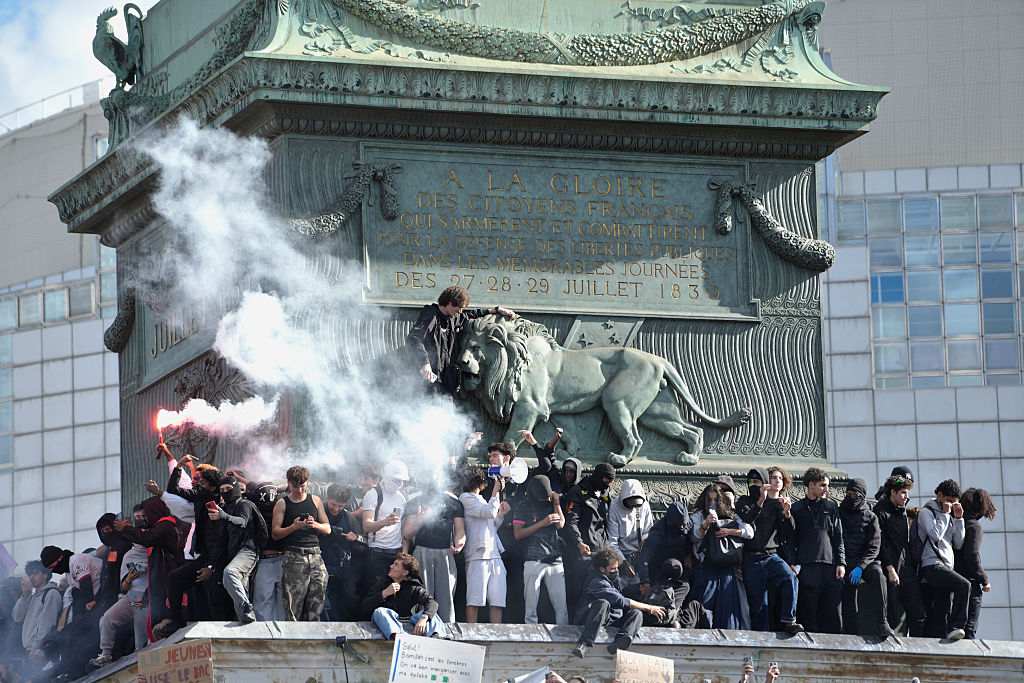
Young protesters at Place de la Bastille on October 08, 2026 in Paris, France. —Remon Haazen-Getty Images

The French like to take to the streets, and they do it often.

On Sept. 17, students at Lycée Saint-Exupéry, a rather underprivileged high school in the Paris suburb of Créteil, erupted in protest over the abysmal conditions of their institution: chronic shortfall of teachers, poor facilities, long declining quality of education. Two weeks later, a wave of protests had swept cities across France. Students from hundreds of schools and scores of universities joined the protests, backed by their parents, teachers, and trade unions. More than 160,000 students and trade unionists protested across France on Tuesday in the third week of demonstrations.

France has never seen so many violent incidents in a movement made up largely of high school students. So far, over 200 students, 85 school staff, and 700 police officers have been injured in clashes across the country. Protesters have broken into schools and, in some cases, set fire to occupied or blockaded buildings. On Oct. 5, a 15-year-old boy had his hand blown off by a police grenade during a protest in Lens in northern France, an incident that crystallized the heavy-handed response authorities had adopted from the earliest days of the protest. More than 6,000 protesters have been arrested, most of them minors, and later released without charge.

The protests erupted after nearly a decade of Macronisme, the right-of-center, top-down governing style that President Emmanuel Macron of France incarnates. And they express a broader discontent: anger over disparities in school quality, university admissions decisions, and latent racial discrimination, and a sense among young people that those in power were not listening to them, that the country offered them little hope for the future.

The protests are also occurring amid a wider crisis of political confidence in the country. France is holding its presidential elections in April 2027, and the far-right and far-left are leading the opinion polls. The frontrunner is Marine Le Pen, who has worked for years to make her far-right party, the National Rally, more electable while campaigning on immigration, crime, and denunciation of an out-of-touch political class. Her party is already the largest opposition party in parliament, and a snap legislative election following the presidential vote could entrench it further. 

On the other side is Jean-Luc Mélenchon, the leader of France Unbowed, a far-left party, who is  promising a sweeping redistribution of power and resources toward the working class. Both have built much of their appeal on opposition to the political establishment, the promise to wish away budget constraints, and deep hostility toward the European Union. 

If France today feels like it is at a crossroads, it is because it is. The postwar model of a large welfare and regulatory state, run by a class of civil servants charged with modernizing the economy, tempering market forces and defining the common good, has run its course. 

The collapse of postwar France

France now runs one of Europe’s largest budget deficits: its public debt stands at 119.3 % of GDP and is expected to rise next year. Fears of a crippling financial crisis are growing. Borrowing costs have risen so high that France is drawing comparisons with Greece, whose debt crisis in 2010 threatened the survival of the Eurozone. And with economic growth stagnating, there is no easy way out.

If anything, France would need to spend more: on defense, as Russia grows more threatening, the war in Ukraine continues, and the United States retreats from its traditional role as Europe’s security guarantor; on new technologies, as the country that once produced Concorde and high-speed trains now trails in high-tech innovation and AI; on strained public services, from schools to hospitals to neglected neighborhoods; and on infrastructure capable of withstanding the growing effects of climate change.

Successive French governments have promised to turn things around and allow for these badly needed investments in the country’s future, but none has succeeded.

The French malaise goes deeper. Inequality has been one of the students’ central grievances. They are not wrong. As in many countries, economic inequalities in France have widened over the past two decades under the combined effects of globalization, industrial decline, and the growing concentration of inherited wealth.

In Capital in the Twenty-First Century, the French economist Thomas Piketty showed how wealth perpetuates across generations and widens the divide between those who own capital and everyone else. This concentration of wealth and power remains deeply resented: for many, President Macron’s original sin is still his brief stint at the Rothschild investment bank before entering politics.

But the most injurious form of inequality lies elsewhere: in the power of France’s national meritocratic myth, which holds that people broadly owe their social position largely to their academic performance. At the top of that system sit the highly competitive grandes écoles, the elite institutions of higher education that have produced leaders in politics, culture, and business. 

What makes the myth so corrosive is not that academic achievement goes unrewarded but that it remains a pretty reliable path to better jobs, higher status, and positions of power. In such a system, students from underfunded public schools face a profound disadvantage compared with peers who attend better-resourced schools and whose better-educated parents know how to navigate the system.

Private schools offer another route, but are still frowned upon as a way to buy an advantage. It is no surprise that the protests broke out in Créteil, a working-class suburb just outside Paris, where schools are chronically under-resourced.

We shall always have Paris

Racial and geographic discrimination also contribute to the crisis of France. The collection of ethno-racial statistics is prohibited by French law; it is a laudable restriction in principle but problematic in practice. Visible minorities remain vastly underrepresented among France’s political and business elites.

Families with immigrant backgrounds, many with roots in African and Asian countries once colonized by France, are disproportionately concentrated on urban peripheries, where jobs are scarce and residents often face discrimination from employers elsewhere.

Islamophobia has also grown over the last decade amid conflicts in the Middle East and a string of Islamist-inspired terrorist attacks. Rhetoric once largely confined to the far right has seeped into the mainstream right, where calls for “order” and “security” often carry an anti-immigrant charge. Macron’s references to the “decivilization” of some young people and former Interior Minister Bruno Retailleau’s description of immigrants’ participation in the protests that followed the police killing of a teenager in 2023 as a “regression towards ethnic origins” are emblematic of that shift.

There is another problem with France’s meritocratic ideal: Paris. Political power, economic opportunity, cultural prestige, and elite education remain extraordinarily concentrated in the capital. The result is a deep economic divide between Paris and the rest of the country and an elite that lives largely among its own, surrounded by people with similar educations, careers, and assumptions, and cut off from much of the country.

The Yellow Vest revolt of 2018 to 2019 was an earlier social explosion of precisely that resentment. It is hardly surprising that students are denouncing the unequal distribution of resources between Paris and the rest of the country, or that the protests began in Créteil, close enough to the capital for the contrast to be impossible to miss.

When students from my own former school, the elite Lycée Henri-IV, where I was a rather poor student, joined the movement in its third week, I noticed how carefully they described themselves as protesting “in solidarity” with less privileged schools. They knew which side of the divide they were on. So much for meritocracy.

Racing to the Elysée

Where does this leave France? With the presidential elections approaching next April, political parties are scrambling to position themselves in relation to a protest movement that has shown no sign of abating. On Oct. 6, more than a quarter-million people took to the streets as high school students were joined by university students, teachers, parents and trade unions. An even wider “national day of protest” is planned for Oct. 17.

Both familiar and new dynamics will shape the election. The familiar one is the runoff dilemma: voters may once again be asked to support a candidate from the opposite political camp simply to prevent Le Pen from reaching the Élysée. Le Pen made the runoff in both 2017 and 2022 and is leading the polls by a large margin. This time, however, the field trailing her is unusually fragmented. Two former prime ministers under Macron, Édouard Philippe and Gabriel Attal, are in the race; Philippe is competing with Mélenchon for second place, while Attal trails both.

Whatever the outcome, the presidential vote may resolve little. A president from the far-right National Rally could find herself governing without a stable parliamentary majority or broad support among the public or within the civil service. A compromise candidate from the center or left could face the same fractured parliament that has bedeviled the final years of Macron’s presidency, during which France has had five prime ministers in two years.

What is new is the extent to which France is being reshaped by forces now familiar across the globe: a crisis of confidence in democracy, conservative billionaires building media empires and financing ideological movements, polarizing social media, foreign interference in elections, and growing voter distrust of supranational institutions, including the European Union.

France, unlike the United States, places strict limits on campaign spending, but money still shapes the broader political ecosystem. Pierre-Édouard Stérin, a self-described “conservative libertarian,” has committed substantial resources to organizations seeking to advance right-wing and far-right agendas. The industrialist Vincent Bolloré has assembled a vast media empire that includes CNews, a Fox News-style channel that has become an important platform for the nationalist right.

Europe on the line

Whatever the result of the Presidential elections, the outlook is troubling for Europe. A Le Pen or Mélenchon presidency would test European cohesion on everything from Ukraine and relations with Russia to migration, budgets, and the authority of the European Union. But even a more centrist president would likely lack a strong enough coalition to govern effectively, mirroring the current situation in Germany, where Chancellor Friedrich Merz is hobbled by unpopularity and a surge in support for the far-right Alternative for Deutschland.

With France and Germany together accounting for roughly 40% of the E.U. economy, political weakness in both capitals would deprive Europe of its traditional engine at a particularly dangerous moment. Europe faces mounting pressure on three fronts: China’s industrial onslaught, reflected in an annual trade deficit of roughly €360 billion; Russia’s war against Ukraine and escalating “gray warfare” operations; and the American turn against the postwar international order on which Europe has long depended. All this comes as Europe must also prepare for the profound disruptions of climate change and AI.

The remedy laid out by Mario Draghi, famed for rescuing the euro during his tenure as president of the European Central Bank, calls for greater integration of the single market, more investment and industrial consolidation, and a greater capacity to act collectively. France is indispensable to any such reforms. A politically paralyzed France would leave Europe weaker at precisely the moment when it can least afford it.

The revolution still to come

At the heart of the French Revolution of 1789 was the abolition of the privileges of the aristocracy and clergy. Close to two and a half centuries later, privilege remains deeply embedded in French society, dispersed across an array of almost caste-like social and professional groups, from journalists, lawyers, and intellectuals to civil servants and unionized workers, each with its own advantages, protections, pension arrangements, and claims on state resources. The result is a politics in which almost everyone agrees that reform is urgently needed, provided someone else pays, and their own group’s advantages remain untouched.

If this sounds like an overreading of 1789, consider Macron’s own choice of title for the book that launched his presidential bid: Révolution. His presidency may not have proved entirely revolutionary, yet many of his larger prescriptions have aged well: governments around the world have embraced state-led industrial policy, greater strategic autonomy, and reduced dependence on fossil fuels, while distrust of American hegemony and calls for deeper European integration have gained traction as the postwar order fragments.

Macron can also claim some credit for preserving, and in places renewing, France’s traditional strengths: an electricity system powered largely by nuclear energy, global leadership in luxury goods, tourism and hospitality, and a deep reservoir of scientific talent, now exemplified by Mistral, Europe’s closest thing to a world-class AI contender.

A skilled diplomat and relentless advocate for the multilateral system, Macron has also taken principled stands on Ukraine, Gaza, Lebanon, debt relief for the world’s poorest countries, and climate change, while carefully navigating France’s relationships with America and China. France’s permanent seat on the U.N. Security Council gives it diplomatic weight far beyond the country’s economic size, a status French diplomats ironically describe as “flying first class on an economy ticket.”

Yet neither these prescriptions nor these assets have been enough to reverse France’s decline over the past two decades. Perhaps what has been missing is a revolution not so much in policy as in political culture: a new social compact in which the sacrifices required to adjust to France’s reduced means and diminished relative power are accepted because the burdens are seen to be shared fairly. If such a revolution is to come, it is less likely to start in the Élysée or the ministries than among the students in the streets demanding to be heard.


  •  
❌