The Trump administration’s transit policies won’t “make travel family-friendly again” in the ways that matter most. | GraphicaArtis/Getty Images
“We should look for love!” Transportation Secretary Sean Duffy bellowed while flanked by his nine children at the Great American State Fair in June: “Get married, and have lots of kids!”
If the plan goes into effect, then communities with a high number of traditional nuclear families could get a 10 percent funding boost to build new trains, bus routes, and ferry lines. “If you want federal funding,” Duffy’s Transportation Department said in a statement, then “your project needs to align with where communities and families are actually growing.”
Trump, who has dubbed himself the “fertilization president,” and his bevvy of neopatriarchaltrad–pilleddeputies have long nursed a fixation with the country’s declining birth rate. But dubious as this new policy may be, it stumbles upon a genuine pain point in the nation’s public transit systems: They are not nearly as family friendly as they should be. And regardless of whether these discomfitingly pronatalist guidelines ever go into effect as written — and they probably will — they raise important questions about how American families use our transit systems now, and the policies could actually make their lives easier in the long run.
The same woes that affect all riders — long wait times, inaccessible stations, inadequate reach, and crowded rush hours — often doubly affect families. That’s one reason why so many of them have fled the nation’s densest, most transit-oriented cities in search of suburbs where they need not lug a stroller up yet another broken escalator to reach a subway platform.
Families who can’t afford to trade in their MetroCards and bus passes for minivans may find themselves priced into housing served by especially substandard transit options, funneling them into brutal, hours-long commutes. According to one landmark study, the single strongest factor in predicting social mobility in the US is neither crime nor test scores nor the presence of “traditional” two-parent households, but access to adequate transportation. With every extra minute a child spends commuting to school, they become less likely to move out poverty as an adult.
And for that reason alone, American families with kids do deserve special attention when it comes to how and where and why we build public transit. On this, the Trump administration got something right, even if they got there for all the wrong reasons — ones that I, a childless woman of childbearing age, find vaguely ethnonationalist, and above all, personally creepy.
But families often need public transportation most in the places where it’s otherwise hardest to raise kids — which is to say in dense cities rather than in already car-centric suburbs. In that sense, especially, In fact, it might make circumstances even worse for the families that really rely on public transit every day.
What family-friendly public transit actually looks like
Marriage and birth rates might sound like a reasonable proxy for where families live, but in reality, according to an analysis by the Urban Institute, the places with the most “traditional” nuclear families tend to be whiter and wealthier than the population at large, and are much more likely to get around by car, not trains or buses.
We are talking about the suburbs here, which, while certainly deserving of their own transit infrastructure, rarely rely on trains or buses the way that a carless family living on the outer edges of a major city might. And yet the Trump administration has typically treated those very communities — some of which do, in fact, have high birth rates — with contempt or even outright antipathy.
Consider Chicago’s Red Line, the busiest corridor of the city’s L rail system, which serves some 138 million people per year. The line has long been in need of expansion, and a $5.7 billion extension close to 60 years in the making finally broke ground earlier this year. It will add 5.5 more miles of track with four new stations in the city’s southernmost neighborhoods.
For over half a century, families in the far South Side of Chicago have cobbled together grueling commutes that force them to transfer from buses and trains to reach downtown Chicago, which helps explain why unemployment and poverty rates in the area remain so stubbornly high. Communities like Roseland, where many of the new stations will be built, are considered to be among the most challenging places in the nation to raise a child, but thousands of local families still find ways to do so.
Roseland has a much higher birth rate than the national average, meaning that in theory, Duffy’s transportation department should be itching to send extra funds to transit projects there. But first they have to be willing to fund it at all, and if past policies hold, they may be reluctant to do just that. Just last year, the Trump administration opted to freeze federal funds already allocated to the Red Line extension, plunging the long-awaited project into yet another prolonged period of infrastructural purgatory.
That move plays into a broader pattern: The Trump administration has hampered dozens of transit projects like the Red Line, seemingly in its broader push to starve Democratic-led cities of federal infrastructure dollars. While a federal judge eventually intervened to allow the Red Line extension to proceed, if the Trump administration’s new guidelines go into effect after public comments close in November, then more projects like it in other urban communities will likely be deprioritized.
Ultimately, it is the suburbanites who are most poised to benefit from the Trump administration’s proposed policy.
An example is FrontRunner 2X in Utah, a commuter rail project that will slash travel time for Utahns traveling across the state, and will also help Salt Lake City shoulder an influx of tourists when it hosts the Olympics in 2034. It received federal support through the same tranche of funding as Chicago’s Red Line extension. In stark contrast with that more urban initiative, FrontRunner 2X has been the rare public transit project to receive continued support under the Trump administration.
Utah has some of the highest birth and marriage rates in the country, so it’s not a stretch of the imagination to say that if the Trump administration has its way, then the United States will see more projects like FrontRunner 2X get funded, while others like the Red Line extension face bureaucratic bottlenecks and funding freezes. Roseland’s high birth rate notwithstanding, the neighborhood has some of the lowest marriage rates in the country, meaning that even if a project there did manage to eke out federal support, then according to this new calculus, it would still receive significantly less funding from the federal government than a place like the suburbs of Salt Lake City where married families with children are more common.
Trump’s new pronatalist transit agenda is, at the very least, an indication that after two years spent twiddling their thumbs, firing Amtrak executives, and venerating cars big and small, he may finally be building a semi-coherent transit strategy. And his Transportation Department has allowed a few genuinely family-friendly upgrades for the country’s transit infrastructure to proceed, including grants to add space for strollers on trains and buses.
But you can’t claim to support American families while siphoning federal dollars away from the projects that could actually be transformational to their lives. I am not one to decry a commuter rail renaissance, but it shouldn’t come at the expense of places where American families — the ones Duffy says he’s so keen on having more babies — don’t have any other choice but to wait an hour for the bus to get to work.
In late September, Democratic Rep. Ro Khanna of California introduced the Free Child Care for America Act, an $80 billion-a-year proposal to make childcare free for nearly every family with kids under six. The bill would let families choose between sending their child to a daycare center, having a relative, friend, or neighbor paid a living wage to care for them, or taking a $1,000 monthly stipendto keep the child homefor the first three years. It comes from a lawmaker who openly says he’s considering a run for president. “I want 2028 to be a big-ideas primary,” Khanna told ABC. “A contest on who’s going to have ideas of the future that meet the moment.”
Khanna’s is not the only big Democratic childcare proposal released in the last few months. In July, Project 2029 — a group of liberal policy experts developing an agenda for the next Democratic administration — proposed something similar to Khanna’s plan:giving families a choice between free daycare and $1,000 a month to provide care at home or pay a trusted caregiver. The group estimates that would cost about $200 billion annually. Third Way, a centrist Democratic think tank, unveiled its own universal childcare pitch, guaranteeing every family at least three affordable options within a 15-minute drive of home or work by expanding home-based, infant, and after-hours care, and leveraging employers as partners.
Key takeaways
Childcare is emerging as a major 2028 issue, with big new proposals from Rep. Ro Khanna, Project 2029, and Third Way.
“Universal childcare” means different things to different people — free for all, affordable for most, or simply enough slots to go around.
Polls show broad, bipartisan appetite for government action on childcare, with debate over how much families should chip in.
Early childhood policy is quickly becoming a defining issue for 2028 hopefuls. On the right, Vice President JD Vance has staked out an early and controversial position, to pay married stay-at-home parents roughly $9,000 per child annually using existing federal childcare funds. On the left, Rep. Alexandria Ocasio-Cortez is spearheading a new House working group to develop a federal childcare plan. Kentucky Gov. Andy Beshear has been pushing free pre-K for all 4-year-olds, something California Gov. Gavin Newsom has already enacted in his state. And New York City Mayor Zohran Mamdani, who can’t run for president but is widely seen as an influential voice in the party’s future, has made universal childcare one of the top goals of his administration.
Michelle Lujan Grisham, the Democratic governor of New Mexico, recently told Semafor that any politician seeking to run for president in 2028 “absolutely should” run on universal childcare proposals. Last year New Mexico became the first state to offer free childcare to families regardless of income. Her advice echoed David Plouffe, a Democratic strategist who managed Barack Obama’s 2008 campaign, who said that universal childcare should be in the Democrats’ 2028 party platform.
This new wave of enthusiasm marks a pivot for an idea that has long been seen as a distant pipe dream in American politics. It wasn’t always that way: When women filled factories during World War II, the federal government funded thousands of daycare centers to watch their kids. In 1971, Congress actually passed a bipartisan childcare bill, though President Richard Nixon vetoed it, saying it would weaken the family. In the 50 years since, Washington lawmakers have focused their energies on other big battles, offering little on childcare beyond subsidies for some low-income families. Over that time, the US has fallen out of step with nearly all its peer nations around the world, which help parents pay for childcare, on top of offering paid parental leave after birth.
It’s not hard to understand why the idea is finally getting a serious look in the US. With voters citing affordability as a top concern, politicians are looking for ways they can bring down costs facing families. After paying rent or a mortgage, childcare often stands as many parents’ biggest monthly expense. Businesses have started to care too, as access to reliable care affects both people’s ability to hold down jobs and businesses’ ability to attract and retain workers. It’s why organizations like the Chamber of Commerce have taken up the issue and why red, blue, and purple states alike have been elevating childcare in recent years.
In Congress and in the Democratic campaign world, there’s a strong sense that childcare, long overshadowed by climate, infrastructure, voting rights, and health care, is now at the front of the line should Democrats regain power. Insiders credit both donor influence and a feeling that childcare advocates have duly waited their turn.
But as Democrats begin jockeying for 2028 and universal childcare becomes a rallying cry, it’s also become clear that there’s a big unanswered question at the heart of the politicking:No one yet agrees on what “universal childcare” actually means. Does it refer to care that’s totallyfree, or just affordable? Is it for everyone, like public school, or targeted at families below an income line? Does it start at birth, and include parents who stay home? Are employers involved, or neighbors and grandparents?
The answers will determine who benefits, how much it costs, and whether the party’s next big promise to families is one it can actually keep.
What is universal childcare?
When I asked Rep. Khanna how he defines universal childcare, he said that it means “childcare should be free” and that families should have flexibility and choice of how to get that care. Workers, he added, should also be paid a living wage in a universal childcare system.
Later, he described the vision for universal childcare as a public good, akin to public school. “From the time a child is born to the time they’re finished college,” he argued, America has the wealth to provide for kids’ education and development.
Others, however, are defining the idea differently. Linda Smith, who leads Child Care Trust, a national policy think tank, helped design the military’s well-regarded childcare system and oversaw federal early childhood programs under Obama. Earlier this summer, she released a framework for universal childcare that emphasized it does not inherently mean free care.
Smith says she wrote it after realizing that even the legislative staffers drafting childcare bills didn’t mean the same thing by the term. “After some candid conversations with congressional staff this summer working on child care policy, it became clear that there are many interpretations of ‘universal child care,’” she wrote on LinkedIn. “If we can’t agree on what the term means, we can’t build durable policy around it.”
She argues the “universal childcare” slogan tends to blur three separate goals: universal access, universal affordability, and universal free care. To Smith, the urgent priority is access. Her vision for universal childcare policy would be a system where all families have access to “affordable, high-quality options” that reflect their needs. Her organization estimates that about 4.2 million children under six with all available parents in the workforce lack a childcare slot within a reasonable distance of home, and she warns that cutting costs without addingnew supply could worsen shortages and leave families without available options.
Her answer is a mix of building more supply and sharing the cost. She recommends families paying what they can and employers and government covering the rest. Spreading the cost across several payers, she argues, is likelier to sustain the full mix of care families actually use — including home-based care — than leaning on government or parents alone.
Chris Herbst, a childcare policy expert and professor at Arizona State University, told me he agrees with Smith that there’s no consensus regarding what universal childcare means today. Even in New Mexico, he pointed out, which is regularly touted as an example of universal childcare, a light work requirement exists for families to be eligible. “These are fluid definitions, and as such they are a bit up for grabs at the moment,” Herbst said.
His own view is that a universal childcare system should make the subsidy easy to get and be guaranteed by law, so eligible families get it automatically instead of landing on waitlists when funding runs short.
Another childcare expert, Elliot Haspel, has embraced a definition closer to Khanna and Sen. Elizabeth Warren, arguing that universal childcare means all families can easily secure the type of care they want, and pay no fees to do so. He acknowledged, though, that many things can be called “universal” and be technically correct. “The ambiguity of the term is both what lends it rhetorical power and what can present a major weakness,” he writes.
Some states are adding benefits — but avoiding “universal”
With federal childcare legislation stalled, many states have spent the past few years trying to patch the system themselves. Some states are investing in making care cheaper for families, others in paying childcare workers more, and most in trying to get more providers to open their doors.
The National Conference of State Legislatures has also aimed to get involved. Over the course of a year and a half, state lawmakers across 13 states worked together to hash out a bipartisan policy framework for strengthening childcare systems, a rare cross-party effort on the issue. The NCSL report, released this past summer, steers clear of the term “universal childcare,” but does describe state systems under strain and concludes that incremental fixes alone are unlikely to solve it. The lawmakers stressed there is no one-size-fits-all solution and offered a menu of options organized around seven priorities, from expanding access to investing in the childcare workforce.
In interviews with the working group’s two co-chairs, I asked why their cohort stayed away from the “universal” language. Jim Burgin, a Republican state senator from North Carolina, told me he doesn’t find it to be a helpful term because it could conjure up the image of public schools, which are mandatory and government-run. “I don’t like the term,” he said. “I think we ought to have safe, affordable childcare available to everybody and I don’t want everybody to immediately think we’re setting up government indoctrinated childcare…a lot of people would just push back from that.”
The Democratic co-chair, Washington state Sen. Claire Wilson, said her hesitation was more about precision. “When you say ‘universal’, I think that alone is a question about what do we mean by universal?” she said. In Washington, she explained, it means care open to all families regardless of income, employment status, or immigration status, “but for other states, universal may mean something different.”
Where the public stands
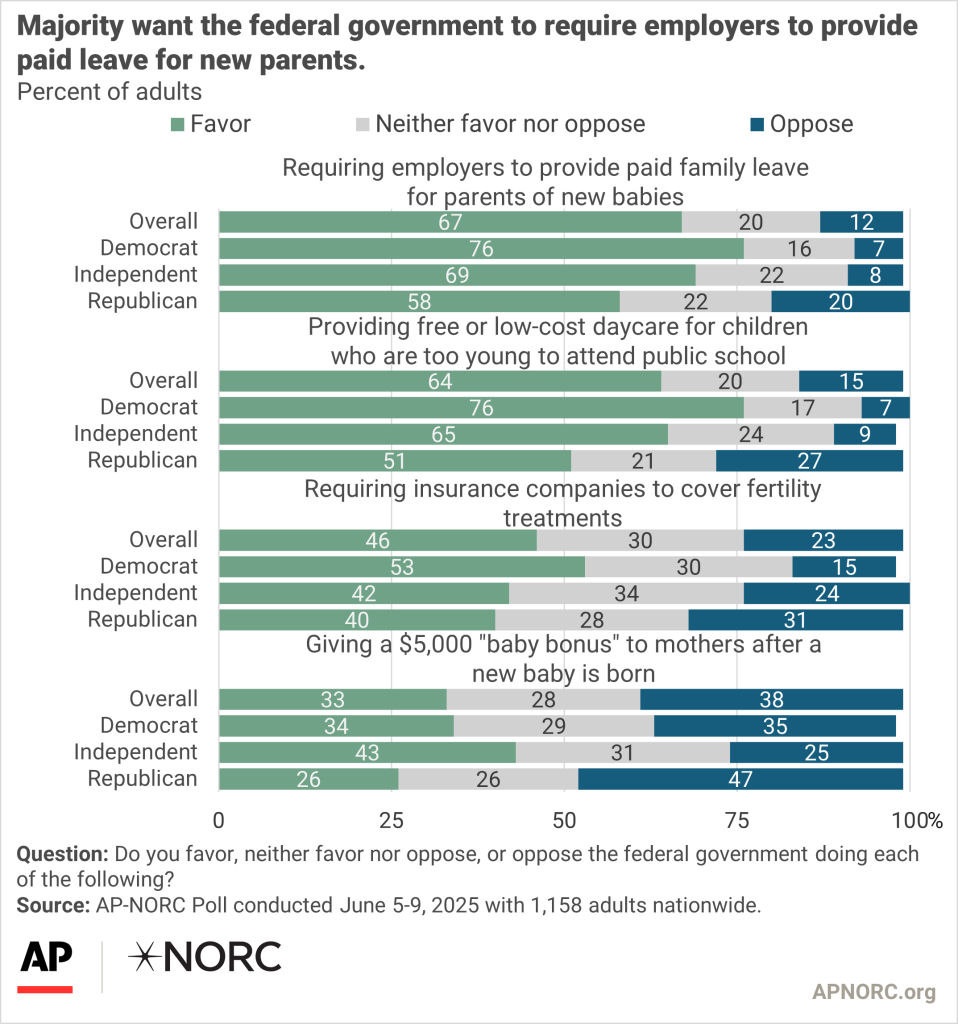
Polling suggests Americans do want to see lawmakers take action on childcare, even if it’s not voters’ top priority when asked to rank among different issue areas. An AP-NORC poll from last year found about three-quarters of Americans say childcare is a “major problem,” and majorities across both parties backed federally funded “free or low-cost” daycare. More recently, YouGov and the 19th News found 52 percent of Americans think the federal government should increase its spending on childcare.
The evidence that most Americans want childcare to be free rather than affordable is less clear. The recent YouGov/19th News found about 40 percent of Americans think parents and government should share in the cost of daycare, compared to 21 percent who thought the government should pay the full cost, and 26 percent who thought parents should cover it all.
A recent New America survey found similar results. When asked if K–12 public education should be a free, taxpayer-funded right, 60 percent of respondents agreed. But only 38 percent said the same of childcare. And among those who “somewhat” or “strongly agree” that childcare should be offered to families for free, paid by taxes, and considered a right, only 31 percent of independents agreed, and just 23 percent of Republicans.
Lena Bilik, a childcare researcher at the Roosevelt Institute, a progressive think tank, told me she thinks public opinion will shift more in favor of free universal childcare when public programs can demonstrate a track record of success, as the country saw with Social Security and more recently the Affordable Care Act. “If we build high-quality public goods that work, I think that with time that problem solves itself,” she said. “But they have to be well-resourced.”
The politics ahead
While states like New Mexico, Vermont, and Connecticut have taken major steps in recent years to expand access to affordable childcare, Bilik of the Roosevelt Institute said even those places vary in how explicitly they pursue the goal of universal childcare, or define it.
The last time Democrats went big on childcare, via the Build Back Better Act, they failed. The bill packaged much of the Democratic agenda into one piece of legislation — climate, healthcare, housing — with childcare bundled alongside paid family leave, elder care, universal preschool, and an expanded child tax credit. It collapsed in late 2021 after talks with West Virginia Sen. Joe Manchin fell apart.
When I interviewed lawmakers, advocates, funders, congressional aides, and policy experts in 2024 about what lessons they drew from that experience, I found the field divided over strategy. Childcare never got a vote of its own, and the argument ever since has been whether it should have been pulled out and pursued separately. Some argued activists should have narrowed their focus to one or two care priorities. Others saw that critique as premature capitulation, a sign of a limiting “scarcity mentality.” Many of those advocates emphasized that they had come very close to passing everything, losing in the Senate by a single vote, and pointed to the climate movement, which took decades of sustained organizing and spending to win major federal legislation. Care advocates, they said, just needed to keep pushing.
Two years later, the consensus view among Congressional Democrats and national childcare advocates has shifted, with far more now saying what’s needed first and foremost are “big and bold” solutions that the party can run on — even bigger than the ideas laid out in the Build Back Better Act.
Sen. Elizabeth Warren argued this year that childcare failed in Build Back Better because not enough Democrats were “willing to fight for it” and because the $400 billion proposed spending package for childcare and universal pre-K wasn’t nearly big enough. It was “an exercise in how weak and ineffective we could make the childcare program and still call it childcare,” she said.
Bilik has watched the same change from the research side. The coalition she works with, she told me, has moved away from programs that help only families below a certain income.“What I’m excited about is that we’ve gotten more ambitious with our proposals across the board since Build Back Better,” she said. “We’re finally having conversations about whether implementing something halfway will cause more problems than solutions, so I think the field has moved really far towards being open to a true public program.”
These sentiments are reflected in the recently released Khanna bill, the Project 2029 proposal, and comments over the summer from Democratic Rep. Sara Jacobs, who said free childcare for all should be at the top of the House’s legislative agenda if Democrats take control after the midterms.
How that vision translates into legislation remains an open question. Some advocates I talked to for this story, who spoke off the record to describe private coalition conversations candidly, said they worried their allies were going to make the same mistake of over-promising and then failing to prioritize goals when faced with tough budget realities. Should Democrats take power, leaders will also face pressure to restore Medicaid and SNAP funding, expand ACA subsidies, and address housing costs, all while large federal deficits make new spending harder to finance.
Khanna told me his proposals could be funded by shifting priorities away from increased military spending, particularly the $200 billion increase in the Pentagon budget and the war with Iran. The Project 2029 proposal suggests financing through raising the corporate tax rate, repealing the pass-through business tax deduction, and reforming estate taxes and the “stepped-up basis” tax break on inherited assets. Third Way would also fund its plan partly through a corporate tax increase. But those same dollars could be claimed by other Democratic priorities, which means childcare advocates may end up competing for them.
“Everyone is excited to put out the biggest idea, but there’s no real conversation about how to get there, and I feel like that’s the frustration, where ‘how to get there’ just means electing Democrats and demonizing any incremental progress,” one advocate told me. “That is not a strategy.”
For now, think tanks, presidential hopefuls, and congressional working groups are testing the waters, floating ideas that meet families where they are and, in some cases, go further than what voters say they want. The practical details are unlikely to get settled once the 2028 race is fully underway. If a Democrat wins, the window will narrow further, with unresolved details colliding with other priorities in the first months of a new administration.
“Universal childcare” may remain an amorphous term, meaning free care to one politician, shared costs to another, and a menu of state options to lawmakers who avoid the word altogether. But all of us voters should expect to hear much more of it.
This work was supported by a grant from the Bainum Family Foundation. Vox Media had full discretion over the content of this reporting.
President Donald Trump and US Ambassador to Greece Kimberly Guilfoyle in the White House on March 26, 2026. | Aaron Schwartz/Bloomberg via Getty Images
This story appeared in The Logoff, a daily newsletter that helps you stay informed about the Trump administration without letting political news take over your life. Subscribe here.
Welcome to The Logoff: Donald Trump’s ambassador to Greece, Kimberly Guilfoyle, is out of a job after serious corruption allegations.
What happened? Guilfoyle resigned on Tuesday after being shown the door earlier in the day by Trump’s brand-new White House press secretary, who announced at a briefing that Guilfoyle had been asked to resign.
Her departure comes just six days after a bombshell Wall Street Journal story, which described Guilfoyle’s efforts to solicit money from a Trump donor, including $100,000 to pay down a credit card bill, in exchange for access to Trump officials and conservative media figures.
Guilfoyle also attempted to conceal those efforts: In one text to the donor, Eric Deters, she wrote, “What a nightmare you’ll literally cost me my ambassadorship stop writing.”
Who is Guilfoyle? Fallen MAGA royalty. Guilfoyle, a former Fox News personality, is also the ex-fiancée of Trump’s eldest son, Donald Trump Jr. (and, more distantly, the ex-wife of current California Gov. Gavin Newsom, a Democrat).
There appears to be little love lost between Guilfoyle and Trump, however. On Tuesday, he told reporters that Guilfoyle “wasn’t a member of my family. She I guess dated my son a long time ago.” (The Don Jr.-Guilfoyle relationship is thought to have ended in 2024.)
Why was she forced out?Corruption allegations are not, generally speaking, dealbreakers in Trumpworld; the president and his children are all innovators when it comes to profiting off the presidency, and there’s plenty of self-dealing going on around them.
That being said, Guilfoyle may have crossed the line in two specific ways: one, her alleged corruption benefited her and not the Trump family. And two, the allegations are embarrassingly unsubtle even by the standards of the second Trump administration. The combination appears to have been too much.
And with that, it’s time to log off…
This New York Times story, about what a potential superhabitable world elsewhere in the cosmos could look like, was a very cool, very sci-fi read — and we may find out more about the existence of such planets soon, with new space telescopes planned for next year and beyond.
You can read the full story here with a gift link. Enjoy, have a great evening, and we’ll see you tomorrow!
Update, October 21, 11:45 am ET: The Supreme Court released a brief order on October 21, which ruled against the Trump administration’s request to deny gender-affirming care to transgender prisoners. The order is two sentences long. It is temporary. And it does not explain the Court’s reasoning. So it is not clear why the Court ruled against Trump or even whether Trump will lose if this case reaches the Court again after it has be fully litigated in lower courts. Justices Clarence Thomas and Samuel Alito dissented.The article below was originally published on October 13.
On the first day of his second term, President Donald Trump issued an executive order requiring the Bureau of Prisons to “ensure that no Federal funds are expended for any medical procedure, treatment, or drug for the purpose of conforming an inmate’s appearance to that of the opposite sex.” Issued alongside a record 26 other orders that day, it was an unsurprising development, because Trump had made this issue one of the centerpieces of his 2024 campaign.
The fate of that executive order, as well as the US Bureau of Prisons’ (“BOP”) memoranda implementing the order, is now before the Supreme Court in a case called Trump v. Kingdom. And, while this case obviously has high stakes for incarcerated transgender people specifically, the Court’s resolution of this case could potentially have far greater reach — cutting off many cis and transgender people’s access to healthcare while they are incarcerated.
That’s because one of the central questions in Kingdom — though this issue is not yet before the justices — is when the Constitution requires prisons to provide medical care to incarcerated people.In Estelle v. Gamble(1976), the Supreme Court held that the Eighth Amendment’s ban on “cruel and unusual punishments” imposes on the government an “obligation to provide medical care for those whom it is punishing by incarceration.” People in prison, after all, cannot simply drive themselves to the hospital if they get sick. If the prison does not give them adequate medical care, they will suffer untreated and potentially die.
For procedural reasons, the Court is unlikely to opine on whether Estelle requires prisons to provide gender-affirming care to trans people right away. But the question of when the Eighth Amendment requires prisons to provide medical care to incarcerated people is front and center in the Kingdom case, which means the Court could potentially use Kingdom to limit all imprisoned people’s access to healthcare — or even to undercut the Constitution’s protections against cruel and unusual punishments more broadly.
Ironically, this case also arises out of a famous political blunder by pro-trans advocates. In 2019, when then-Sen. Kamala Harris was seeking her party’s 2020 presidential nomination, the ACLU circulated a questionnaire to candidates that asked if they would use presidential authority “to ensure that transgender and nonbinary people who rely on the state for medical care — including those in prison and immigration detention — will have access to comprehensive treatment associated with gender transition, including all necessary surgical care?”
Harris responded that she would, and also said that she “pushed the California Department of Corrections and Rehabilitation to provide gender transition surgery to state inmates” while she was state attorney general.
Years later, during his 2024 debate with Harris, Trump claimed that the then-vice president “wants to do transgender operations on illegal aliens that are in prison.” And not long after, his opposition to gender-affirming care for trans people in prison became a keypart of his campaign.
It’s unclear why the ACLU thought it was a good idea to shine a light on this issue in 2019 because, at the time, the BOP provided gender-affirming care to people in federal prison. The ACLU — which represents the pro-trans side in the Kingdom case — now argues that transgender people in federal prison have had access to at least some forms of gender-affirming care “since at least 1992.”
Indeed, Trump’s own administration concluded in a 2018 memo that the Bureau of Prisons’ “statutory mandate to provide basic medical and mental health care” to incarcerated people obligated it to provide “pharmaceutical interventions (e.g., cross-gender hormone therapy), hair removal and surgery (if individualized assessment indicates surgical intervention is applicable)” to transgender people in prison if their doctors determined that these interventions are “medically necessary care.”
In any event, regardless of why Trump fixated on cutting off trans healthcare for people in federal prison, Kingdom is now before the Court. That means that the fate of trans people in prison — and, if the Eighth Amendment issue eventually reaches the Court, all incarcerated people — is now in the hands of a Republican Court that is oftenhostile to trans litigants, and that has, at times, signaled that it wants to drastically roll back the scope of the Eighth Amendment.
What are the legal issues in the Kingdom case?
At least since Estelle, the Court has held that people who are incarcerated are not also sentenced to live and die without medical care. As the Court said in Brown v. Plata (2011), “a prison that deprives prisoners of basic sustenance, including adequate medical care, is incompatible with the concept of human dignity and has no place in civilized society.”
Under Estelle and Brown, transgender people often have a right to gender-affirming care during their incarceration. As the US Court of Appeals for the Ninth Circuit held in Edmo v. Corizon (2019), such a person must show that they have a “serious medical need” for such care — typically by demonstrating that the care was prescribed to them by their health provider. But the Constitution does not permit prisons to deny medically necessary care to incarcerated people.
In Kingdom, the ACLU raised this Eighth Amendment argument in the lower courts, but those lower courts ruled in favor of transgender people in prison on different, much more technical legal grounds.
Both the ACLU and the lower courts that heard Kingdom argue that the Trump administration did not comply with this obligation when it cut off care for trans people in prison.
Among other things, the district court that heard this case determined that the administration cited “zero evidence from its own medical or mental health care professionals to support its conclusions” against providing transgender healthcare. While the Trump administration argues that providing gender-affirming care makes prisons less safe, the district court also noted that “the government has not cited a single instance of gender-affirming care giving rise to safety concerns despite having provided such care for many years.”
Is this a persuasive legal argument against the Trump administration’s new policy? I think it is. And so did three federal judges that previously heard the Kingdom case. But the fate of trans people in prison is now in the hands of a Supreme Court that rarely rules in favor of transgender litigants, and that has a history of handing down legally incoherent opinions that are inconsistent with the Court’s own precedents, and that also deny legal rights to trans people.
The current Court’s uncertain commitment to the Eighth Amendment
Because the lower courts that heard Kingdom did not rule on the Eighth Amendment question, Kingdom should not currently give the justices an opportunity to roll back Estelle. But, in the likely event that this Court rejects the ACLU’s argument that the Trump administration did not adequately explain its new policy, the case will return to the lower courts and the Eighth Amendment issue will be fully litigated — teeing up the Eighth Amendment question for the justices to decide in the near future.
This issue could arise, moreover, at the exact moment that some justices are pushing for sweeping changes to how their Court understands the term “cruel and unusual punishments.” Indeed,at least some of the Supreme Court’s recent Eighth Amendment precedents suggest that the Republican justices want a wholesale rewrite of the Court’s previous precedents laying out what constitutes cruel and unusual punishment.
Since the mid-to-late twentieth century, the Court has held that, in Chief Justice Earl Warren’s words, the Eighth Amendment “must draw its meaning from the evolving standards of decency that mark the progress of a maturing society.” Thus, as certain forms of punishment grow more uncommon, they become more constitutionally dubious.
This “evolving standards of decency” framework is front and center in nearly every major Supreme Court decision interpreting the Eighth Amendment for the last five or six decades, including Estelle.
In Bucklew v. Precythe (2019), however, the Court’s Republican majority seemed to abandon this framework. Although decades worth of pre-Bucklew decisions established that a punishment is unconstitutional if it is considered cruel and unusual today, Bucklew suggested that a method of punishment is unconstitutional only if it“had fallen out of use” at “the time of the founding.”
Thus, if taken seriously, Bucklew’s new approach to Eighth Amendment cases would dramatically expand the government’s power to impose harsh punishments. The late Justice Antonin Scalia, for example, argued that a Bucklew-like approach to the Eighth Amendment does not prohibit the government from executing most intellectually disabled offenders, and that it does not limit the government’s ability to impose excessive punishments for minor crimes.
In fairness, some of the Court’s post-Bucklew decisions are inconsistent with the framework the Court laid out in that case. So at least some of the justices who joined Bucklew may have since decided that it’s a bad idea to toss out the Court’s entire framework for Eighth Amendment cases. But Bucklew was one hell of a warning shot over the bow of the Eighth Amendment. And the mere fact that the Bucklew decision exists means that advocates for humane punishments must hold their breath any time this Court is asked whether a particular punishment is cruel and unusual.
In the worst-case scenario for people in prison, a case like Kingdom could inspire the Republican justices to overrule — or, at least, drastically limit — decisions like Estelle and Brown. That would mean that all incarcerated people, regardless of their gender identity, could lose access to medically necessary care unless the government decides to give it to them as an act of grace.
Homeland Security Investigations outside the home of Rep. Ilhan Omar on October 12, 2026 in Washington, DC. | Andrew Leyden/Getty Images
This story appeared in Today, Explained, a daily newsletter that helps you understand the most compelling news and stories of the day. Subscribe here.
When life gives you lemons, make it rain. Or…something like that! On Tuesday morning, Minnesota Rep. Ilhan Omar launched a fundraising drive in response to the Trump administration’s unusual predawn raid of her Washington, DC, residence.
The raid, which went down Monday, is reportedly part of a criminal investigation into Omar’s immigration history. The Democratic Congress member was born in Somalia and came to the US as a child, becoming a naturalized citizen in 2000 at age 17.
Omar has since become one of the most prominent progressive voices in Congress and a regular thorn in the side of President Donald Trump, who on Monday called her “terrible” and “totally crooked.” Vice President JD Vance has similarly claimed, without evidence, that Omar “committed immigration fraud.” On Monday, the New York Post reported that the investigation may have sprung from mistakes Omar’s late father made while filling out her citizenship application roughly 30 years ago.
Needless to say, decades-old citizenship paperwork is not the kind of threat to public safety that typically commands the resources of the Department of Homeland Security’s investigations branch. (That same branch is charged with investigating transnational gangs and terrorists.)
And the raid is unusual for another reason, too: By longstanding practice, the Justice Department avoids taking any public steps in investigations involving political candidates within 60 days of an election. The midterms are just three weeks from now.
This investigation is unlikely to affect Omar in the midterms, however. In the words of her longshot Republican challenger, John Nagel, Minnesota’s Fifth District is among “the ‘bluest’…in the country.” The raid may have even galvanized Omar’s supporters, dozens of whom rallied at a Minneapolis park on Monday afternoon. Some held banners that read “we stand with Ilhan.” Another sign read, simply, “see you at the polls.”
Omar now belongs to an unenviable and surprisingly populous club: political opponents of Trump whom his administration has threatened with criminal indictments and investigations.
I initially planned to list them out for you here, but then realized that list would be perilously long. By my back-of-the-envelope count, there are at least 30 Democratic politicians, public officials, and Trump-world defectors who have been accused of, investigated for, or charged with crimes during the second Trump administration.
It’s easy to forget the scale of that campaign, however, because many of these efforts have (thus far!) stalled out or collapsed. Inseveralcases, the administration opened much-publicized and thinly supported investigations that have yet to yield charges. (See, for instance, the criminal probe into writer E. Jean Carroll or former New York Gov. Andrew Cuomo.)
In at least two cases — that of then-Federal Reserve chair Jerome Powell and several Minnesota officials — federal judges tossed out subpoenas for lack of evidence. And in one high-profile instance earlier this year, a grand jury refused to indict six Democratic members of Congress who released a video reminding soldiers to refuse illegal orders. The legal bar for issuing such an indictment is actually pretty low — which makes this grand jury’s refusal a telling rebuke of the administration.
But these judicial setbacks aren’t exactly reason for optimism. The federal court system is becoming increasingly partisan, and as long as Republicans hold the Senate, they’ll be able to stack it with ever-more conservative and deferential judges. And several of the most partisan judges already on the bench are “openly auditioning” for Supreme Court slots, as my colleague Ian Millhiser recently put it.
In other words, in the not-so-distant future, the court system may provide a weaker check on presidential overreach. And that’s bad news not only for the Ilhan Omars of the world…but also for American democracy.
One link for later
➨ Turn off your sleep tracker. If your sleep hygiene and underlying health are both good, but you still struggle to catch enough ZZs, then you might actually want to tone down your quest for better sleep. “What you see in people with insomnia is that they’re trying too hard,” one sleep scientist told Vox. Analyzing your sleep scores and timing your naps can create anxiety that further fuels insomnia.
Before you go…
Did you know…that Coke, Pepsi, and Dr. Pepper were all invented by 19th-century pharmacists? At the time, it was widely believed that carbonated water could cure illnesses. And sugary syrups made said water vastly more delicious.
Today’s trivia: What’s the name of the 2025 Pixar film set in the “Communiverse”? (You can find this and other brain puzzles in Vox’s daily crossword. Look for the answer in tomorrow’s edition.)
Yesterday’s trivia: Last week we asked you for the three-letter successor of tube TVs. That would be LCD, which stands for liquid crystal display.
A priest speaks to parishioners during Sunday Catholic Mass inside the Our Lady of Guadalupe Church on August 10, 2025, in Mission, Texas. | Tom Brenner for the Washington Post via Getty Images
To the average observerconcerned with the future of American democracy, it might be easy to conclude that religion has been part of the problem — particularly over the last few years. Right-wing religious leaders, including the leading Southern Baptist televangelist Robert Jeffress, have endorsed “Christian nationalism”; other evangelical pastors and conservative Catholic intellectuals have been openly pondering if America should become more of a theocracy; Secretary of Defense Pete Hegseth, who once called for an “American crusade,” evoking bloody medieval religious campaigns, has referenced Christian theology in statements about the Iran war.
To critics, these examples show that American religion is becoming an active threat to pluralism and tolerance — the ideas that make American democracy work.
But what if the solution to this anti-democratic slide is also religion — more religion than the US currently has?
Key takeaways
The authors of a new book argue that declining levels of religiosity have worsened polarization, which has led to a backslide in democracy.
To reverse this trend, the authors suggest everyone, but particularly liberals and secular people, engage with religion more and take lessons on debate and disagreement from faith traditions.
For those who do identify as religious already, this would mean participating in organized religion; for those who are not religious, this would mean approaching religion and religious people with more openness and curiosity.
This argument has limitations, but there are signs it is becoming more widespread, including the rise of religious Democrats and the pope’s recent comments.
A new book by two thinkers from opposing ends of the ideological spectrum argues that declining levels of religiosity across the board, but particularly among liberals, have deepened political polarization, which in turn has corroded democratic norms. Now, they argue, one of the most effective ways for liberals to stand up for democracy is to engage with religious communities and their scriptural traditions with more respect, openness, and curiosity. The authors also urge liberals who are believers themselves to embrace organized religion and return to it themselves.
Conservative evangelical Christian Matthew Kaemingk and liberal Muslim writer Shadi Hamid argue in Can Religion Save Democracy? that there’s a necessary and unique role that religious institutions and organized religion must play in American public life. Religion serves a fundamental regulating purpose, tempering emotions, fundamentalism, and nihilism. And when that fades away, those base instincts and emotions get channeled into our politics.
They write:
As Americans exit churches in droves, they’re not leaving behind their religious passions. Instead, they’re transferring those passions to the political battlefield. In this new post-religious context, Christian faith and Scripture function less as moral constraints within evangelical circles and more as political cudgels to use against one’s opponents.
“We’re not trying to convert [nonbelievers],” Hamid told me in an interview. “Believing is one thing, but believing that religion can play a positive role is another. And we want to encourage secular readers to embrace the second proposition, even if they don’t believe religion is true or don’t believe God exists.”
What happens when religion recedes from the public square
At the core of Kaemingk and Hamid’s argument is a simple case: There is an innate religion-shaped hole in people in the 21st century, which has been slowly replaced with politics, unbridled passions, and secular ideologies. The loss of religion hasn’t meant a loss of religious convictions, but instead has meant the rise of a new fanaticism, either secular or fundamentalist, while depriving everyone of the good things that organized and institutional religion can do.
It’s not a completely novel argument; it’s a combination of St. Augustine’s famous line that “our hearts are restless until they rest in [God]” and of the political scientist Robert Putnam’s modern case that churches and religious communities provided the third spaces that fostered civic partnership, trust, meaning, and belonging.
But they also connect these lines of thinking to what the Dutch philosopher Abraham Kuyper used to argue around the turn of the 19th century: that all people are religious, and that something very similar to religious fervor quietly powers all political movements. Religion is “pervasive, public, and pluriform” — an essential part of being human, whose absence leaves nihilism, fear, and distrust in isolated, but still fanatical, individuals.
“If Kuyper is correct that all human beings desire ultimate belief and belonging, then erasing or sequestering religion won’t extinguish our spiritual passions. They will simply shift elsewhere,” Kaemingk and Hamid write. And that shift has been toward politics, candidates, elections, and secular “creeds” that provide identity, belonging, moral certainty, and salvific promises without the accountability, guidance, and caution that religious traditions can provide.
It’s not hard to find examples of what Kaemingk and Hamid mean here. From 2016 to 2024, many observed elements of quasi-religious fervor in movements powering Trump and Woke 1.0. Trump’s strongman appeal generated a cult of personality around him, while anti-Trump resistance efforts and progressive social movements often took on qualities people also found quasi-religious: in-group markers, language, and customs, BlueAnon theories. What’s left is a stalemate, with more conservative religious believers bunched up on one end, and nonreligious but equally passionate citizens on the other end.
Kaemingk and Hamid argue that people on the left often respond by denigrating religion and religious people, dismissing those who try to defend or practice it in the public square, or forcing them to adopt secular language and thinking instead of letting religious people bring their full selves to the public space. But the way out of this current stalemate, Kaemingk and Hamid suggest, is for people on the left to be open, curious, and respectful with the devoutly faithful, whether they’re neighbors or candidates running for office.
“For that audience, my desire is to say, ‘Hey, you don’t have to believe in religion, but you can recognize the positive aspects of religion,’” Hamid told me.
That involves practical, daily activities and more high-minded appeals. In regular life, the authors recommend prayer, or prayer-like practices for nonbelievers, to help better understand and forgive opponents. They suggest there can be benefits for both nonreligious and religious people to meditate on scriptural and theological teachings about forgiveness, debate, disagreement, salvation, and why earthly politics shouldn’t be taken so seriously.
And they urge liberals in particular to reengage with religious communities and congregations. Religious liberals should avoid isolation or solitary, individualized faith, the authors recommend, and instead return to congregations and specific churches or places of worship to become part of a community and find purpose. For nonreligious liberals, Kaemingk and Hamid suggest they reexamine their own ideological priorities and be open to the possibility of being wrong on some of them, and potentially engage with organized religion to better understand a religious worldview.
Kaemingk and Hamid offer a specific challenge for liberals and secular Americans that might seem a bit unsavory: They have to realize that they are not blameless for the polarization and radical religious fervor that exists right now through their dismissal of organized religion. Their earlier denigration of organized religion around the turn of this century (think of the New Atheist movement), combined with many leaving institutional churches or failing to participate in religious life, has all contributed to the capture of these institutions by unsavory political opponents, or helped in the decline of more moderate congregations. And any attempt to stop this continued slide away from pluralistic democracy hinges on a collective effort between religious and nonreligious Americans to reverse these trends.
This argument has its limitations
Here’s an obvious question: If religion is so good at moderating people, why hasn’t it been able to temper emotions among the religious already? The most loyal Republican voters over the past few cycles have tended to be evangelical and nondenominational Christians, followed by white Catholics — both of which tend to report above-average levels of religious participation. They’ve stuck with Trump and the GOP over the last decade, which has been defined by polarization, authoritarian policies, and even moments of political violence, that both Kaemingk and Hamid say religion can fix.
Here’s an obvious question: If religion is so good at moderating people, why hasn’t it been able to temper emotions among the religious already?
More generally, while there is evidence to suggest that evangelicals who leave their churches become more cynical and individualistic — a point in Kaemingk and Hamid’s favor — there’s not much evidence to suggest that the converse is true: that religious participation has actually tempered emotions, passions, and politics. Instead, there’s a case to be made, as the writer Robert P. Jones laid out recently, that the opposite seems to be true: The most religious folks tend to still be the most likely to support harsher Trump-era policies.
Hamid acknowledged that this is a challenge,but argued this isn’t about the religion itself — rather a Trump-specific phenomenon:“Many evangelicals have let partisan loyalties take precedence over religious commitments,” he told me. “This is the distorting effect that Trump has had on the evangelical movement.”
He emphasizedthat evangelicalism has suffered because many of the most fervent MAGA supporters who identify with that religious movement are not actually very religious. “Evangelicals aren’t going to church as much as they used to on average,” he said. “There has been a kind of process of de-institutionalization in the kind of Protestant domain. And the people who tend to be more fervent MAGA supporters tend to go to church less.” He compared the level of evangelical support that Ted Cruz and Trump got in 2016: Trump had an upper hand among unchurched evangelicals.
Beyond this, the practical reality is that, as things stand today, religiosity does not seem likely to bounce back to the levels it was at two decades ago — at least, not without the help of secular Americans.
What the authors prescribe for politics and elections
Still, it’s an attractive idea, and it’s not hard to see why people might be open to it. Even Democrats themselves seem to understand that writing off religious voters for years was a bad idea. Some of the most promising Democratic candidates in red states in upcoming midterm elections are religious, including Texas Senate nominee James Talarico and Kansas Senate nominee the Rev. Adam Hamilton. A dozen other pastors or believers are running in down-ballot races across the country, while potential 2028 presidential candidates like Democratic Kentucky Gov. Andy Beshear and Democratic Pennsylvania Gov. Josh Shapiro talk openly about their personal faiths, the role of organized, institutional religion, and seem comfortable doing so.
“It’s promising,” Hamid told me about this trend. “Part of what we argue in the book is that Americans should be able to bring their full convictions into the public arena. If they’re editing themselves or suppressing their religiosity out of fear of alienating constituencies, that’s not good for democracy.”
And Kaemingk and Hamid also have a very influential intellectual ally in this mission: Pope Leo XIV just made a similar case in France for secular liberals to reexamine their understanding of religious liberty and how to balance it against the rise of right-wing religious politics.
“A Christian engaged in public service and guided by the light of his or her conscience, illumined by faith, cannot be considered a proselytizer or a threat to the unity of the nation,” he said in Paris, appealing directly to France’s fiercely secularized civic leaders. “Indeed, authentic secularity does not exclude religion but is capable of valuing it as an educational resource.”
Aboard a plane back to Rome, Leo continued, arguing that religion must have a role in the public square and pointing to the decline of religion in Germany as something that may have facilitated the rise of a far-right movement that cloaks itself in religious language.
“It would be interesting to study, analyze if and how there may be a relationship, for example, between the growth of these groups on the far right,” Leo said mid-flight, “…with some expression of a combination of these far-right points of view with a certain kind of religion, which…is not an authentic expression of Christianity.”
This may be an unsavory ask for liberals and secularists most upset about creeping religious nationalism in the Trump administration and around the country. The recent creation of a new Office of Religious Affairs in the Pentagon, the invocation of God and Scripture to support military action and immigration enforcement, and the attacks on the wave of religious candidates running as Democrats this year all make it understandable why there may be hesitancy in accepting this challenge. But Kaemingk and Hamid are undeniably right about one thing: In a diverse and pluralistic nation, we have no choice but to live with each other.
Vivek Ramaswamy, the Republican candidate for governor of Ohio, at a campaign event in Vandalia, Ohio, on October 3, 2026. | Jessica Phelps/Bloomberg via Getty Images
In early October, Vivek Ramaswamy, the Republican candidate for governor of Ohio, went for a classic “politician on the stump” move: He picked up a kid. Or at least he tried to. Ramaswamy fumbled the boy a bit, producing a clip that quickly went viral on social media.
The next day, Ramaswamy posted a picture of himself with his son in his arms on social media. It was a cute retort. But many of the responses were ugly — racist attacks against Ramaswamy that drew on anti-Indian stereotypes.
It was the latest example of a broader shift on the right, where Indian Americans and Indian immigrants have become a conspicuous target of online conservative anger.
“The people who had negative stereotypes about Indians in their mind said, ‘Hey, look, the guy can’t even pick up a kid…he can’t even act like a normal American family man,’” freelance journalist Zaid Jilani told Today, Explained co-host Noel King.
Jilani, who recently wrote about the surge in anti-Indian racism for Vox, joined the podcast for a conversation about how he sees the bigotry as rooted in status envy, how Indian Americans and Indian immigrants are responding, and his surprisingly hopeful outlook for the future.
Below is an excerpt of their conversation, edited for length and clarity. There’s much more in the full podcast, so listen to Today, Explained wherever you get podcasts, including Apple Podcasts, Pandora, and Spotify.
American racism is very interesting, always has been. And there is a type that says, immigrants are dirty, they come here, they’re uneducated, they leach off the government, they’re taking our resources.
The stereotype of Indian immigrants to America and Indian Americans is people who go to college, people who often have advanced degrees, people who often live in nice neighborhoods, make good money, are family-values people.
Why do you think these values that seem as if they mesh with what Republicans want are so triggering to people these days? Is it just yes, but they’re brown?
I think that is a component of it. I spoke to one Indian American advocate who told me that Indians and South Asians more broadly are visible minorities, right? If you think about other minorities who are highly successful, that’s not always the case.
For instance, I think that Jewish Americans have been known since the late 20th century as being a successful minority group, but they’re not necessarily highly visible. You can’t always identify someone. If [Texas Railroad Commissioner candidate] Bo French saw a bunch of white people in the stadium with the Longhorns, I’m not sure he would be picking out who’s Protestant, who’s Catholic, who’s Jewish. But with Indian Americans, they are highly visible.
That being said, I think you have to think about where Indian Americans are in society and the kind of feelings that can create among everyone else. If you look, for instance, at Silicon Valley, the major tech companies, Microsoft, Google — the head of [Microsoft’s] Xbox division is an Indian American woman now.
You have a group of people who I think are in many ways a very micro minority — we’re talking about 1 percent to 2 percent of the United States — visibly rising into so many positions that I think a lot of people have typically associated with white folks. White people generally run the Fortune 500, white folks run the universities, white folks are the most successful doctors and engineers. And that was true for the 20th century.
But when you start seeing a much larger influx of Asian immigrants, starting with liberalization of immigration laws in the ’60s, but also when there was a rapid growth of the technology sector in the early 2000s, you start to understand a little bit more where the resentment comes from because it’s more, I would say, analogically similar to antisemitism than it is to the racism that Mexican Americans face or the racism that Black Americans face.
“It’s a much larger anti-globalization backlash on the right, not only when it comes to things like immigration, but also trade and tariffs and restrictions like that.”
It’s not that Indian Americans are necessarily being stereotyped as antisocial, criminal, coming here illegally, so on and so forth. It’s more that they’re being seen as a status threat to a lot of particularly middle-class Americans, people who want their kids to rise to the top of their school, who want their kids to have the corner office. They want their kids to be able to get the most prestigious positions.
I think in the minds of a lot of these people, not only now does their kid have to compete with all the other normal white kids in their community, they have to compete against the entire world. It’s a much larger anti-globalization backlash on the right, not only when it comes to things like immigration, but also trade and tariffs and restrictions like that.
When you talked to Indian Americans for this piece, what did you hear from them that surprised you?
Probably the most surprising thing was how much pragmatism they responded to all of this with. Nine times out of 10, when you have stories about racism, the victims of racism are outraged — understandably and justifiably outraged. Nobody wants to be mistreated. Nobody wants to be denigrated. They certainly don’t want to see restrictions on the right to immigration, or other things to limit their numbers, which is the end point of a lot of this.
At the same time, I think a lot of the people I spoke to were very upfront. They’re like, “Hey, look, we have found a lot of success in America. We got the golden ticket to be able to come here, for our kids to study here, to be able to really seek these opportunities, but we understand what’s happening in the economy. We understand there’s a lot of people who are struggling and then they see us rising to the top of all these organizations. They see us with our kind of well-ensconced place in the economy. And I think it’s important for us not to flaunt our success that much.” At least a couple people said something to that respect. They almost empathize with the people who were hating on them.
It struck me as such a classic immigrant pragmatism that you see from the first or second wave of immigrants: people who realize that they are newcomers to a society or maybe their parents were newcomers to a society, and that there is a certain level of grappling they have to do with, “Hey, how can we continue to have success? How can we continue to grind and resist this racism, but also not rub it in people’s faces that we’re doing well because the more they do that, the tougher it can be?”
A number brought up Vivek Ramaswamy in the sense that Vivek happened to go on social media and talk about what he felt like were deficiencies in American culture when it comes to studying, when it comes to working hard.
I think that in bringing that up, they were saying that that wasn’t particularly helpful because whatever positive aspects there may be to Indian immigrant culture, we shouldn’t talk about them in ways that denigrate other people because that’s obviously going to rub people the wrong way.
You’re making the point that some of the surge in anti-Indian racism on the right is about status anxiety. I was listening to this podcast that Chris Rufo and Jonathan Keeperman did. These are two influential right-wing activists. They called it “The Indian Question” — a lot of people’s eyebrows shot up — and they seem to be making the argument that it is about status anxiety.
They also were making less coherent arguments about how it’s un-American to study for the spelling bee, which is what South Asian kids do, and that white kids are more American because they play football, then they go to a party and get drunk, and then they get 1,500 on the SAT.
I’m not saying any of this makes sense. I’m saying it was fascinating. I’m assuming you watched that exchange. What did you make of that?
There’s a certain level of coping mechanism being deployed there in the sense that they are trying to explain the success of Indian Americans as a deficiency: “Maybe they’re getting to the top schools, but that’s because they’re shut in all day studying.”
But it’s not really true that Indian Americans are necessarily cloistered into unhealthy habits. They’re actually finding success across society. For instance, I’ve tutored kids for five, six years. I just really enjoy working with kids. And something you’ll find with a lot of the Indian American kids, they are actually getting increasingly well-rounded.
Part of that is because you have to, to have success, to get college admissions and so on and so forth. They almost always play sports. They’re involved in extracurriculars. You’re seeing a lot more Indian Americans go into the arts, into cultural fields, into Hollywood. I think that’s actually a very normal path for immigrants.
I think the first or second wave of immigrants has to be very pragmatic. They have to keep their heads down. They have to grind, study, and their parents encourage them to do the same thing. Indian American parents are always like, “You got to be a doctor. You got to be an engineer. Don’t be foolish and try to be a journalist or go to Hollywood.”
But as they establish themselves, as they build nest eggs, they have a little more breathing room, and so they can do different things. I know that Christopher Rufo, for instance, is an Italian American, and I believe I read one time that he even speaks Italian at home because he really values that culture so much and he wants to raise his kids in that. The first wave of Italian immigrants were no different than that. They cloistered into a few sectors where they felt they could find success that was necessary for their integration into the economy and to get their footing. But now we don’t think of Italian Americans as stereotyped into just a few parts of the country or a few parts of society — we barely notice, unless maybe you notice from someone’s name that there even are Italian Americans.
What they’re describing about Indian Americans is very normal. It’s actually very normal for first waves of immigrants to cluster in a few areas and then they spread themselves out as they’re able to get that a little bit of breathing room and room to ground to stand on.
House Minority Leader Hakeem Jeffries speaks to the press on the steps of the US Capitol on September 30, 2026. | Finn Gomez/Getty Images
Barring a catastrophic midterm polling miss, Democrats are on track to win a majority in the House of Representatives next month. Come the new Congress in January, that will mean a new House speaker — and if all goes to plan, that will be current House Minority Leader Hakeem Jeffries.
If elected, Jeffries, from New York, will be the first Black speaker of the House. Though Jeffries has been in Congress for nearly 14 years now — and many of those years have been spent in Democratic leadership — he also remains something of an enigma.
The New Yorker’s Jason Zengerle profiled Jeffries back in May. He spoke with Today, Explained co-host Sean Rameswaram about who Jeffries really is, his path to what would be a historic speakership, and what he really stands for.
Below is an excerpt of their conversation, edited for length and clarity. There’s much more in the full podcast, so listen to Today, Explained wherever you get your podcasts, including Apple Podcasts, Pandora, and Spotify.
In your profile of potential future Speaker of the House Hakeem Jeffries, you start with a story that people might find surprising. And I was wondering if you could tell us said story.
[Jeffries] was in Florida, raising money, which is one of his central responsibilities as a minority leader. And he was being driven to a Democratic donor’s house in Palm Beach. And while he was being driven there, he got an alert on his phone letting him know that Donald Trump had posted a message to Truth Social in which he rehashed a bunch of the 2020 election conspiracies. More significantly, [Trump] had included a depiction of Barack Obama and Michelle Obama as apes.
Jeffries has this reputation for being a very calm, deliberate, not angry person, oftentimes to his detriment. I think a lot of Democratic partisans wish he would be more angry. But the way he told me the story, he was legitimately pissed off. And he realized that he needed to respond in some way. And he didn’t think that a tweet would be sufficient.
He wanted to do an Instagram post, and he looked into his aide’s iPhone, and he said, “Fuck Donald Trump.” And as soon as he was done recording the video, I think he started to have second thoughts. And they sent the video up to Washington for a social media team to edit, and he told them, “Let’s bleep out the word fuck.” And for him, it was a smashing social media success.
I was in his office in the Capitol six days later, and he was telling me this story and basking in some of the reflected glory and talking about all the social media love and talking about the real-world love. But then he kind of paused, and he said something like, “You know, but I still haven’t heard from my mom, and I’m a little worried about that.” Which I thought captured him pretty well.
“I don’t think you’re going to see a new Hakeem Jeffries if he’s speaker. I think he’s going to, especially rhetorically, perform the same way he has before.”
Why did you want to start your profile of him with that story? What does it tell us about who this individual is?
I thought it captured the dilemma he faces in some ways, just in the sense that he is this very deliberate, calculated political figure, very conventional. And he is operating in a political space these days that doesn’t really reward or appreciate that approach.
Oftentimes that approach is not successful. I think he’s trying to adapt to the new rules of the road, and he’s kind of doing it in fits and starts, and sometimes he’s more successful than others. But I still think, even when he is successful, he has some qualms about it.
How long has Hakeem Jeffries wanted to be speaker of the House?
When he got to Congress, in 2012, he definitely wanted to become a player. He wanted to be in leadership, chair a committee, whatever. He was someone who had his eye on that.
But at the same time, the Congressional Black Caucus had started to think a little bit differently about what they could achieve in Congress. For a long time, they wanted their members to get chairmanships and things like that, or maybe be majority whip. But by the time Jeffries got there, they started to think that we could actually get a speaker. And his arrival kind of coincided with this realization on the part of the CBC. And I think a lot of CBC members viewed Jeffries as a potential future speaker, and they started to groom him for that.
Pretty soon after that, Nancy Pelosi started to think of him as someone who would be a good member of her leadership team. And I think by 2018, that’s when it really became apparent that he was going to be someone who could potentially be speaker.
What does he actually stand for as the most powerful Democrat in the House?
I think, quite intentionally, he doesn’t stand for anything. I think that in some ways has been key to his success. He has managed for the most part to avoid being kind of pigeonholed or put anywhere on the ideological spectrum. He is very critical of the far left of the party, especially the DSA. He views the DSA as college-educated young white people who are coming to Brooklyn and displacing older Black working-class people.
I was talking to this former Democratic congressional aide and basically asking this person the question you’re asking me: What does he stand for? And this person was trying to explain it and finally just was sort of exasperated, and he said he’s intentionally trying not to stand for anything. He’s sort of like hotel art. He just is, and it’s satisfactory.
We don’t have a lot of case studies for how he manages his caucus because they haven’t been in power. But I think maybe one of the most telling examples was the shutdown, because Democrats were, in a way, the power brokers there. Tell us how Hakeem Jeffries managed that.
That was probably his greatest success as minority leader. When Trump took office for the second time, especially for those first few months, I think all of the congressional Democrats, and Jeffries especially, were really on their heels. They could not figure out how to deal with this guy and what they were going to do to stop him. Jeffries was even complaining that he didn’t have any leverage. But then he eventually realized that a shutdown would be at least a little bit of leverage.
The real question was, what was the shutdown going to be about? And there were a lot of Democratic members of Congress who wanted it to be about authoritarianism or corruption. They wanted it to be at all these different issues. And Jeffries was really insistent that we need to make this about one issue, and we need to make it about healthcare.
The Democrats were the ones who caused the shutdown. And normally, the way shutdowns have worked in the past, it’s the party that causes the shutdown that gets the heat from the public. But this time around, I think because Democrats were so consistent in saying that this is about healthcare, and Republicans were so scattered in their own messaging and their own explanations of what was going on, Democrats’ polling numbers went up, Trump’s and Republicans’ went down, and that was a real victory for Jeffries.
Did that whole incident put Jeffries on the president’s radar in a way that he wasn’t?
It comes, and it goes. For a long time, he wouldn’t mention Jeffries at all.
I guess the way to tell if Trump is thinking about you is if he posts about you on Truth Social, and he started to post about Jeffries a lot — all the usual kind of insults he lobs, especially at Black politicians, that Jeffries was low IQ and a thug. But yeah, he does seem to be paying a little bit more to Jeffries now than he was before.
And do we think Jeffries is ready to go toe to toe with the president of the United States if that’s what voters decide he’s to do this November?
In his mind, he’s ready. And I think in his own stilted, rehearsed, steady fashion, he will go toe to toe with Donald Trump. He will talk about affordability, and he’ll talk about corruption, and he’ll talk about the “so-called president.”
I don’t think it will necessarily be satisfying for a lot of Democratic voters out there and Democratic partisans, but I don’t think you’re going to see a new Hakeem Jeffries if he’s speaker. I think he’s going to, especially rhetorically, perform the same way he has before. But I think it’s going to take him a little while to figure out how to do the job.
CNN and Politico have been banned from traveling with the press pool on Trump trips. | Oliver Contreras/AFP via Getty Images
On his first day back in office in January 2025, President Donald Trump signed an executive order “restoring freedom of speech and ending federal censorship.” More than a year and a half later, his administration is instead busy using government power to go after speech it dislikes.
Last year, Federal Communications Commission chair Brendan Carr urged broadcasters to take action against Jimmy Kimmel over his comments following Charlie Kirk’s killing, and in September, Kimmel said the FCC again intervened to stop Kimmel’s late-night show from airing an interview with James Talarico, Democratic Senate candidate for Texas.
Also last month, Trump barred three news outlets — CNN, MS NOW, and Politico — from the White House over their coverage. That ban was quickly blocked by a federal judge, but both CNN and Politico have since been banned from traveling with the press pool on Trump trips.
Outside of the White House, the fight over free speech is also raging on college campuses. In states like Texas, Republican lawmakers have restricted when students can protest and given governor-appointed university boards more say over what gets taught. In 2025, 15 states passed laws that restrict what can be taught or weaken protections for free expression on college campuses.
To break down what all of this means for the state of free speech in the US — and the future of our First Amendment rights — Today, Explained co-host Noel King spoke with Greg Lukianoff, president and CEO of the Foundation for Individual Rights and Expression (FIRE).
Below is an excerpt of their conversation, edited for length and clarity. There’s much more in the full podcast, so listen to Today, Explained wherever you get podcasts, including Apple Podcasts, Pandora, and Spotify.
How would you describe the kind of status of free speech on campus these days?
The status of free speech is in great peril, both on and off campus. I’ve been doing this for 25 years, and it’s about as bad as I’ve ever seen it.
When it comes to the Charlie Kirk backlash cases, we saw about 90 of them. It’s a remarkably high number. We saw an ex-cop go to jail for 37 days just for forwarding a Trump meme in response to a request to go to a candlelight vigil for Charlie Kirk. It’s not good.
If you look at the last two years, we’ve done so many episodes about free speech concerns. There was Jimmy Kimmel; there’s CNN being banned from the White House.
It really does seem like we’re at a moment where so many different types of people claim that their speech is being restricted in so many different types of ways. What is happening in the country?
My worry is I’m very much a small-L liberal. I come from an old ACLU background. That’s where I interned in law school. I went to law school to do First Amendment law. I hyper-specialize in it. This is my passion.
For most of my 25-year career, you could rely on a civil libertarian aspect of the left and a libertarian aspect of the right that would often agree on almost nothing except for things like freedom of speech. And right now, I think we’ve become all culture war all the time, and we have more of a progressive left and more of a populist right.
The only way that you show you believe in freedom of speech is by saying, “I hate that guy, but I think you should have freedom of speech.” If you’re saying, “I think my side should have freedom of speech,” that’s just self-interest. That doesn’t even count.
All the worst people in history wanted free speech for their side. So I’m afraid we’re losing — or maybe even, I hate to say this dramatically, but maybe even have lost it as a shared value as a society.
Well, that’s quite grim.
Yeah. I’m feeling a little grim.
The Trump administration came into office with a promise. And I remember it sounding something like this: “The woke left went too far. They canceled people. They restricted speech. They got out of control. President Trump is going to come back in, and we are going to restore sanity to the country. And as part of sanity, that will include your right to freely express yourself.”
How do you square the promise versus what we’ve seen?
I think Trump is constantly frustrating everyone around him by being Trump. I think there probably were people in the administration who were like, “Yeah, we’re going to be pro-free speech.” And then Trump decides to declare — I mean, I think the recent White House press pool case is hysterical in a lot of ways because he had to get his team to give a sort of constitutional justification for why he was kicking out the press pool. But on Truth Social, he’s like, “It’s because of their viewpoint,” which is, by the way, something you can’t do under the Constitution.
“I’m hopeful for the long-term future of free speech, but in the short term, I’m worried.”
His instincts are very authoritarian. They’re very top-down. So maybe there were people in the administration who, in their heart of hearts, are good on free speech, but Trump isn’t. And it’s the reason why when it came to the new administration, there were a lot of people on the right, but also people on the sort of heterodox left who were like, “Oh, this is going to be good for free speech.”
I was like, “Don’t kid yourself, guys. This is going to be bad.” Although I will say, it’s even worse than I was expecting.
President Trump at some point will be out of office. And what happens then? What do you think? Is there an optimistic scenario where we’re like, “Okay, we’re kind of tired of this crap. Let’s just go back to the way it was in the ’90s”?
It has been cyclical, to a degree. American society gets out of whack, and usually one of the things that does bring us together is that we were lucky enough to have…I’ll just say it, we have a brilliant Constitution. It is unusually clever about human nature, and the Constitution itself — you can have whatever opinion you want about the founders, but it is something to be proud of. And a lot of times those values kind of bring us back together.
That’s my hope. But another thing I will say about Trump: He has played havoc with my ability to predict anything. So what it’s going to look like over the event horizon of 2028, I hope it will be better, and we will fight like hell to make sure it’s better here at FIRE, but will it be better? I’m not sure, and it definitely won’t be better if we think of free speech as something that belongs to my side, not yours.
One of the reasons why I do have hope for free speech in the long term is that free speech works really well. It’s how you know what your fellow citizens think. It’s how you get ideas out there. It’s how you actually be your authentic self.
Societies that actually have freedom of speech are always going to have advantages, real and serious advantages, over ones that don’t. So I’m hopeful for the long-term future of free speech, but in the short term, I’m worried.
Francesca Hong, a representative in the Wisconsin State Assembly, poses for a photo with a supporter in Racine, Wisconsin, on July 19, 2026. | Sara Stathas for the Washington Post via Getty Images
The Wisconsin gubernatorial race was one of the most closely watched Democratic primaries in the country this year, pitting a democratic socialist, state Rep. Francesca Hong, against Milwaukee Democrat David Crowley, who received the endorsement of the state’s sitting Democratic governor, Tony Evers.
Hong lost the race, setting up Crowley to face Republican Rep. Tom Tiffany in the general election this fall. But she’s already back on the campaign trail, this time trying to help Democrats win a trifecta in the state: the governor’s race and both legislative chambers.
Unifying the state’s voters to achieve that won’t be easy, though. Hong spoke with America, Actually host Astead Herndon about her own loss, Evers’s role in it, and whether or not the voters who felt so passionate about her own campaign would find enough to love in Crowley’s campaign — in particular on the increasingly important issue of data centers.
Astead and Hong also talked about what Wisconsin means for the Democrats nationally, and what lessons the party should take from her race, including her loss.
“I said this, and I will continue to say it — the person who is most electable is the person who ended up getting the most votes, and that was Crowley this time around,” Hong said. “But I think there’s a disservice when you have the most powerful Democrat in the state choosing to ignore a lot of voters and people who were inspired and energized and coming out to participate in politics for the first time through our campaign. I think it was shortsighted to use electability almost as a fear tactic.”
Below is an excerpt of Astead’s conversation with Hong, edited for length and clarity. There’s much more in the full show, so listen to America, Actually wherever you get your podcasts or watch it on Vox’s YouTube channel.
Part of the reason we wanted to come here was because we saw you were getting back on the campaign trail, and specifically around that idea of energizing Wisconsin toward a trifecta.
Now, just tell me the difference in terms of the importance of Democrats winning it all — not only the governor’s mansion, but both houses of the state legislature — versus just the governor’s mansion. How does that change the possibilities of what the party could do?
For the last 16 years, a Republican majority in the state legislature has meant that passing the types of policies that we know can drastically improve the lives of everyday folks here in Wisconsin stalled. And we have a historic opportunity to flip the assembly and the state Senate and hold the governor’s mansion and the entire executive branch to a Democratic majority, meaning the opportunity to pass the policies that the majority of our state supports — things like increasing minimum wage, things like legalizing marijuana, codifying abortion.
We also need to repeal Act 10 [which dramatically restricted collective bargaining rights for public-sector employees]. Wisconsin is where workers’ rights, things like unemployment insurance, Social Security were born, and we moved backwards with the Republican majority. That’s all on the table with the Democratic trifecta.
It also, though, raises the political standard of what Democrats would have to do to achieve that, and some of it goes through these more rural communities.
Why do we think the party has fallen behind in more rural communities, and what could be done to reverse that?
I think it’s important to look at what’s happened in the rural communities when we’ve seen manufacturing jobs leave the state, when we’ve seen fewer and fewer supports for our small farmers.
And so much of this — what connects it — is actually the growth of massive wealth and corporate control and corporate greed, and more people feeling the impacts of that. There’s an opportunity right now to say, ‘Hey, Republicans have been in the legislature, they’ve been in power, and things have not improved for you or your community … Now’s the opportunity to make sure that we’re actually able to see our shared Wisconsin values of working hard and taking care of our kids be reflected back in Madison through laws.’
So much of your campaign was focused on data centers, stopping data centers. Should I think of that as a rural issue?
I think the issue around data centers is an everyone issue. It’s a democracy issue. It’s people wanting to feel like there are folks who care about what happens to communities, and that they have control and an actual say in what happens in their communities.
To that point, is it a mistake for David Crowley, the Democratic nominee, to have not gone as far as you did and say, “We won’t be building more data centers for a period of time”?
He’s fighting for communities and community control when it comes to data centers.
But it’s not a moratorium.
But it’s not a moratorium. It isn’t, but he’s also committed to 100 percent renewable energy, clean energy to power data centers.
And achieving that is going to be incredibly difficult, and it is going to be the developers having to pay their own way, and these are things that he’s committed to that we know can slow down the growth and development of data centers.
Have you had time to reflect on your primary loss? If you had to diagnose, why do you think you lost?
I’m still doing a lot of reflection. But I think that I want to continue to look forward. And what I’ve learned from our election is that it’s so important to continue to stay grounded in becoming accessible to people. I think that as an organizer and an elected official, it’s my responsibility to continue to go to the people and remain very in touch with what’s going on on the ground.
I have a couple more questions about the nature of the loss. Evers’s endorsement changed that race, so much so that your opponent David Crowley was able even to win in some smaller communities, like places where you were pitching yourself as the voice of more rural communities.
Does that disprove any of this thesis around, say, data centers? If that was the top priority for Wisconsin voters, wouldn’t you be the nominee?
I think it wasn’t all rural communities. It wasn’t all suburban communities. We saw certain demographics but also ZIP codes where we outperformed David significantly.
And I think that where the governor’s endorsement played a bigger role was areas where he was also more popular.
Did it surprise you when Evers endorsed Crowley?
I was disappointed.
Why?
I was disappointed because I was getting a lot of feedback from folks who hadn’t committed to any candidate yet that this felt like the governor was putting his thumb on the scale.
I wanted to ask about electability, because it seemed as if Evers’s endorsement was about a fear that maybe you couldn’t win in November.
So much of the primary concern was around the DSA label, even campaigning with folks like Hasan Piker. In retrospect, was any of that a mistake?
We knew going in that we would have to encourage new voters to come out, folks who typically do not come out for primaries, quote-unquote low-propensity voters. And we knew that we would have to campaign in places where folks weren’t expecting to see a gubernatorial candidate. And those included Twitch streams.
Those also included going to dive bars and bowling alleys and making sure that we were accessible and shaping our policies based on what the people were telling us they wanted to see happen and also what they wanted to see out of their governor. I think electability… I said this, and I will continue to say it — the person who is most electable is the person who ended up getting the most votes, and that was Crowley this time around.
But I think there’s a disservice when you have the most powerful Democrat in the state choosing to ignore a lot of voters and people who were inspired and energized and coming out to participate in politics for the first time through our campaign.
I think it was shortsighted to use electability almost as a fear tactic, when Democrats need to be inspiring and project a vision where everyone can see themselves in it as everyday working-class folks.
When you’ve got a party that has struggled with elitism to then cave to an establishment narrative … being more afraid of labels when I’m hearing from people on the ground that they’re interested in solutions and solving problems, maybe somebody who knows the hustle of the service industry and running restaurants and has worked across the aisle to pass bipartisan legislation. There are ways that we can maneuver around labels and what the loudest narrative might be.
I wish our governor hadn’t fed into that.
To be fair, to your point, the establishment label doesn’t fully fit even someone like Crowley, who comes from a working-class background. But am I hearing that you think Evers’s move made your life in the general election more difficult?
Is it harder to re-inspire if young people who are invested in the Hong campaign think that the establishment squashed them out?
We still had over 300,000 votes. We lost by fewer than 4,000 votes. I had more votes than Evers did during his primary. That’s not squashing our voices.
We’re still here, and it’s so important that people find avenuesto continue to exercise their voice and their new organizing power. And I’m definitely going to continue to work to make sure that we get results and that we win the trifecta, and that’s the most important thing we should be focusing on right now.
I hear why a trifecta matters in the state context, particularly the state policy.
If I’m someone, though, who’s not in Wisconsin, who’s just worried about Donald Trump running amok in Washington, why should I care if Democrats win the governor’s mansion and the state legislature? Does that matter for folks outside of the state?
Because we will start to see that when you feel government actually working and you see change happening in your lives, these are then voters who are going to continue to come out and vote for Democrats.
We’re a pivotal state when it comes to the federal elections as well. We’re actually in a swing district right now.
We have an opportunity, through Wisconsin, to actually start improving the brand for Democrats. And if we do that here, this trickles out to the rest of the country.
The premise being that delivering creates a connection for Democrats that is helpful in the presidential election, and it’s helpful in all these other ways too.
Yeah. We’re not going to be fighting every single midterm and presidential for our lives based on what’s happening in just one state.
But I think if we can start showing durable power for Democrats in a state like ours because of the policies that we’re prioritizing, and you have more folks coming out to vote for Democrats, that’s good for the health of democracy.
Defense Secretary Pete Hegseth speaks from a stage in Sparrows Point, Maryland, on October 6, 2026. | Win McNamee/Getty Images
This story appeared in The Logoff, a daily newsletter that helps you stay informed about the Trump administration without letting political news take over your life. Subscribe here.
Welcome to The Logoff: The Trump administration is planning a public killing.
What’s happening? On Thursday, the Pentagon announced that it would execute Nidal Hasan, a former Army major sentenced to death for a 2009 mass shooting on a military base, publicly and on livestream.
The execution, if it happens, would be unprecedented: The last widely reported public execution in the US was 90 years ago, in Kentucky, but to stream a death live would be something else entirely. Defense Secretary Pete Hegseth has promoted the announcement with something approaching glee, telling a reporter that “we’ll make sure that people are able to watch it.”
What’s the context? According to the Pentagon, Hasan will be executed via firing squad on December 3 — the first such execution by the military in more than 80 years.
Hasan, a former Army psychiatrist, was sentenced to death in 2013 by a military jury following a court-martial for the 2009 shooting, when he killed 13 people and wounded more than 30 at Fort Hood in Texas. The execution is set to be carried out at the same Army post.
Will the Pentagon go through with this? It’s unclear, for multiple reasons. The Pentagon’s announcement that Hasan’s death will be livestreamed has generated a great deal of bipartisan pushback, as well as condemnation by religious groups, though that is unlikely to stop the execution itself.
The head of the US Conference of Catholic Bishops decried the decision to livestream the execution as “a barbaric promotion of a culture of death,” and retiring Sen. Thom Tillis (R-NC) called it the decision “beyond disgusting.”
“Public executions are what oppressive dictatorships like Iran and Afghanistan do,” Tillis wrote in a post on X.
Hasan’s legal team could also delay the execution substantially — potentially for multiple years — by challenging his detention in federal court, though he has exhausted the military appeals process.
And with that, it’s time to log off…
The driest (non-polar) desert in the world, the Atacama in South America, was in full bloom late last month after record-setting rainfall. You can read more about the science behind the wildflowers here, or just enjoy some spectacular photos here (it’s a gift link). Either way, I hope it brings you some joy.
The Logoff will be off on Monday for Indigenous Peoples’ Day, so we’ll see you back here on Tuesday. Have a good long weekend!
A destroyed car sits outside a burnt home in the West Bank village of Jalud on September 29, 2026. | Erik Marmor/Getty Images
In the weeks and months following Hamas’s brutal October 7, 2023, attack on Israel, and Israel’s devastating campaign in Gaza that followed, the world’s attention turned away from the West Bank.
Over the past three years, however, the situation in the Israel-occupied territory has worsened as Israeli settlers have carried out more violent attacks on Palestinians.
Israeli Prime Minister Benjamin Netanyahu has largely dismissed violent West Bank settlers as an issue, blaming the Jalud attack on a “handful of rioters” and referring to settlers as “juvenile delinquents” in a speech to the UN last month, in which he argued that the world should focus on violence committed by Palestinians instead.
But even as he downplays the problem, human rights organizations have documented a record level of Israeli settler violence in the West Bank. The International Committee of the Red Cross has said that such attacks have made everyday life “untenable” for the more than 3 million Palestinians living in the West Bank.
The Israeli settlements are also clearly illegal, as Vox’s Zack Beauchamp explained in September — but that hasn’t stopped them from expanding.
The Wall Street Journal’s Feliz Solomon reported on the Jalud attack and has written about the role of Hilltop Youth in worsening settler violence. She spoke with Today, Explained co-host Noel King about the reality on the ground in the West Bank, the settler groups behind it, and how Israeli officials are responding.
Below is an excerpt of their conversation, edited for length and clarity. There’s much more in the full podcast, so listen to Today, Explained wherever you get your podcasts, including Apple Podcasts, Pandora, and Spotify.
Tell me about the last three years in the West Bank. What’s been happening?
The October 7 attack really hardened a lot of people’s views in Israel, and that’s played out in the West Bank in a number of ways.
One is that the government of Benjamin Netanyahu, which has some powerful members who are settlers themselves, became much more overtly supportive of expanding the Jewish settlements.
The second thing that changed was basically a total breakdown of trust, both between Jews and Arabs, and also between Jews and the state, because a lot of people felt that they were really on their own in terms of security.
All of this created a really combustible environment. There are more settlers there now. They’re behaving more brazenly, and there’s what a lot of people would describe as a permissive environment of almost total impunity.
What does that total impunity look like? We often hear the term “settler violence.” What does that mean?
There’s really a whole spectrum of violent actions. It’s mostly by younger male settlers. There are some acts of daily harassment, like trespassing on Palestinian property, vandalism, stalking people, blocking roads, and preventing access to resources like water wells. And then on the other end of the spectrum, there are also acts of extreme violence.
There have been some very serious physical assaults. Settlers throwing rocks with slingshots. Last year, there was a viral video of an elderly woman who was beaten with a stick. She was hospitalized for days. And lately, we’ve been seeing more mob violence where a large group of settlers will raid a Palestinian village. They’ve set mosques and other property on fire.
Just to be clear, there’s violence by Palestinians too, but we’re really seeing an alarming surge of violence by settlers that’s often unpunished, and increasingly it’s happening when settlers go into Palestinian areas where they’re not supposed to be.
You reported on an attack that happened last week in the West Bank near the Palestinian village of Jalud. Tell me what happened.
Over the summer, some young settlers who are associated with a group called the Hilltop Youth set up an encampment around three houses on the outskirts of the Palestinian village, Jalud, and essentially besieged the houses. They blocked their access to essential goods and harassed the residents until, in late July, they felt so unsafe that they fled.
Two of those houses belonged to the Tubasi family. In early September, Israel’s high court ordered the state to ensure their safe return, and in late September, they tried to go back. We spoke with Wael, who’s one member of the family, and also with their lawyer about what happened when they tried to go back.
A few dozen [Israeli] security forces were deployed to escort them home in the middle of the night, and when they got there, they found that the house was totally ransacked. They showed us before and after pictures, and the windows were smashed, the doors were broken, electrical wires were cut, and there was just debris all over the place.
When they came inside for the first time in about two months, they were walking through the property looking at the damage with flashlights, and they’d only been there for a few minutes when suddenly they were surrounded by a mob of settlers. They said at first that there were about 50 settlers around the house, and the military later said that there were more than a hundred people that took part in what they called a riot.
The authorities told the family to take cover deeper inside the house, and they hid inside a stairwell as the soldiers tried to force these settlers to retreat, but they were shouting and throwing rocks at the house, and then, according to Wael, they even started climbing in through the windows. At that point, the authorities told the family to go upstairs, all the way up to the roof and to hide in a corner of the rooftop.
Wael explained what he saw up there. He was looking down and he saw the soldiers battling it out with this large group of settlers and this thick cloud of tear gas and loud bangs from stun grenades.
“There are more settlers there now. They’re behaving more brazenly, and there’s what a lot of people would describe as a permissive environment of almost total impunity.”
Eventually, the security forces realized that they weren’t getting the situation under control. They had to get this family out of there. They took them back downstairs and outside and put them in a military vehicle, but then the settlers surrounded the vehicle and they were rocking the car. They slashed the tires so that [the family] couldn’t leave. Then the soldiers had to move them into an armored military vehicle and eventually they got them out.
A short while later, not long after they had escaped, they started receiving video messages from some of their neighbors that showed what happened after they left, which was that their car and their house had been set on fire.
All right, so the Israeli authorities in the form of soldiers were trying to help this Palestinian family legally return and settlers violently blocked them. This is settlers versus the authorities. What do we know about who these settlers are and what is motivating them?
This was a very large group. We know of three people who were detained in this incident. All of them were teenagers. The youngest one I believe was 15 years old.
A lot of the harassment in this area comes out of a nearby settlement called Esh Kodesh and smaller, more informal settlements around it that are called outposts. And these outposts are usually pretty crude encampments. They often start with just tents or a camper van or a trailer with no electricity and no water. And the people who choose to live in these places tend to be very young, very extreme ideological settlers.
You mentioned something called the Hilltop Youth. Who are they?
The Hilltop Youth is a loose network of settlers that live outside the mainstream, and they often have much more extremist views than the mainstream settler movement. It’s an offshoot of religious Zionism, which is one of the main ideologies of the settler movement, and it sort of fuses the ideas of Orthodox Judaism with ultranationalism.
The Hilltop Youth take these ideas to the extreme, and I’ve spoken with a bunch of them myself. They believe that they’re on a divine mission to reclaim the Holy Land for Jews, and they’ll cite parts of the Torah and other religious texts that they interpret as empowering them to take the land back and even to use violence. They see it as a preventive type of self-defense, and they see themselves as protecting all other Jews.
These are young people, some of them teenagers. Where are they coming from? Why are their parents not grounding them? How has this been allowed to unfold the way it has?
It’s a good question, and I should say also that not all Hilltop Youth are violent, but a lot of the violence that’s committed by Jews in the West Bank does come from this group, and they come from all over the place. Some of them grew up in the settlements, and then as teenagers, they kind of wandered and they struck out on their own. And then there are others who come from all over Israel.
A lot of the Hilltop Youth, we’re finding, are kind of troubled kids. Sometimes they’re dropouts from strict religious schools, sometimes they have behavioral issues or ADHD, and they just didn’t really fit in. We heard from some kids who said that they found out about the outposts by word of mouth, like someone at their school had invited them to come for the weekend and they’d come and they’d stay a few days and eventually they’d start spending more and more time there until at some point they’re just living there.
There are a number of NGOs that recruit young kids to come work as farm hands on agricultural outposts in the West Bank, and some of those are in these areas that are more prone to radicalization. These organizations present themselves as very innocent in that they’re identifying kids that need help and are bringing them to a place where they will learn some discipline and they will have a purpose and they’ll have something to do. But that often puts them into a more extreme environment.
In the case of the family you profiled in Jalud, it’s clear that the Israeli authorities, in the form of soldiers, attempted to help the family get back to their home. How does this typically play out, though? How do Israeli soldiers typically respond when settlers attack Palestinians?
There have been a number of high-profile examples of video footage circulating that appears to show Israeli soldiers either standing idly by or even, some would argue, siding with the settlers.
In one recent example, there was a video that showed some soldiers praying alongside settlers who had besieged the home of a Palestinian American man, and that was actually not very far from where the Tubasi house is. The military said that it was looking into it to determine whether disciplinary action needed to be taken.
In general, military officials acknowledge that this violence by settlers is a big problem, and the security establishment definitely does not support what’s happening here. They see it as getting in the way of counter-terrorism efforts and overall efforts to bring stability to this very volatile area.
I’ve heard this directly from military officers, but on the ground there does seem to be a breakdown of discipline in some cases and a lack of clear instruction in other cases. Some soldiers simply don’t know how to deal with threats from other Israelis, especially really young ones, as you pointed out. It’s just not what they’re trained to do.
Do you think the government could put a stop to these attacks by settlers if it wanted to, or has the government lost control?
This problem has gotten so big that it’s going to be very difficult to solve without significant backlash, but I have spoken with a number of former Israeli security officials who say yes, much more could be done — starting with a more frank acknowledgement of what’s happening, clearer law enforcement procedures, and more disciplinary actions.
Anthropic CEO Dario Amodei told the UN that if “managed poorly,” AI models “could be a risk to humanity as a whole.” | John Lamparski/Bloomberg via Getty Images
Silicon Valley has long warned that its favorite technology might get us all killed. But chatter about AI’s apocalyptic potential has grown louder in recent weeks.
In September, Anthropic researcher Jacob Coxon resigned from the company, accusing his former employer of “gambling with our lives” by developing evermore powerful models faster than it could control them. One of Coxon’s former colleagues vouched for this assessment, saying that there was a greater than 10 percent chance of AI “killing all humans” within the next decade.
Recent pronouncements from the leaders of these companies have been nearly as grim. At the United Nations last month, Anthropic CEO Dario Amodei warned that, if “managed poorly,” AI models “could be a risk to humanity as a whole.” OpenAI’s Sam Altman similarly declared that our species just might “lose control of the future” to the type of software that his firm is selling.
All this triggered a tsunami of media coverage and policy debate about the “existential risks” of AI — and what, if anything, we can do about them.
Key takeaways
Some critics argue that AI leaders’ warnings about existential risk are a PR strategy to attract investment, distract from present-day harms, and shape regulation in their favor.
But this theory doesn’t make a ton of sense.
The simpler explanation is that many AI executives, researchers, and defectors genuinely believe the technology poses catastrophic risks, based on real trends in AI’s growing power and autonomy.
Yet some of the AI industry’s biggest critics are more annoyed than afraid. As they see it, the world isn’t trembling on the precipice of robo-annihilation, so much as falling for the tricks of snake oil salesmen. This argument has been percolating for years, voiced by a broad set of observers, including the linguist Emily Bender (“It makes the product seem more powerful”), computer scientist Timnit Gebru (“It’s not just a distraction, but it’s harmful”), as well as Substack columnist Ed Zitron and various reporters and social mediainfluencers.
In their thinking, Altman and Amodei aren’t talking up their technology’s catastrophic potential because they’re rationally afraid of where AI is going — they’re doing so because their firms are ravenously hungry for more investment. And the reason why “AI doom” has grown more salient in recent weeks isn’t that the case for concern has gotten stronger, but rather that OpenAI and Anthropic’s IPOs have gotten closer.
In short, these Big Tech skeptics argue, journalists and politicians have fallen prey to a counterintuitive PR strategy, one that stokes media frenzies over ludicrous sci-fi scenarios in order to hype AI’s technological promise, distract attention from chatbots’ present-day harms, and help labs secure favorable regulatory treatment.
This would be reassuring, if true. Unfortunately, the theory is unpersuasive. There is little reason to believe that the panic over AI’s “existential risks” was cooked up in a Silicon Valley marketing department. To the contrary, the most plausible explanation for the AI sector’s doomsaying is also the most straightforward: Many of the industry’s executives, employees, and analysts genuinely believe that AI progress poses catastrophic risks.
In my conversations with close observers of the industry, even some of OpenAI and Anthropic’s fiercest detractors conceded that their leaders’ avowed concerns are unlikely to be mere marketing tactics. “The more I learn about the underlying ideologies out of which those two labs were formed, the more I think what we have here is a sincere belief,” the author and computer scientist Cal Newport told me.
This does not mean that Amodei and Altman are right, much less that we can trust in their judgment or integrity. There are manyreasons to doubt that the weather forecast for 2036 is “cloudy with a chance of robot apocalypse,” or that anyone can assign a “10 percent” probability to the latter outcome without pulling numbers out of thin air.
Nevertheless, Silicon Valley’s Cassandras have some logic and evidence on their side. AI models are growing both more capable, autonomous, and arguably unruly. If these trends continue unchecked, it’s not hard to see how they could yield very bad outcomes.
Given the stakes, we should not be comfortable dismissing their warnings on dubious grounds. And the “PR” theory of AI doom does precisely that.
How AI companies (supposedly) profit off fears of the robot apocalypse
Before examining why AI “doomerism” probably isn’t a PR stunt, it’s worth saying a bit more about why some believe that is.
According to Bender, Gebru, and others, AI companies benefit from talk of artificial intelligence’s existential risks in at least three ways.
First, it attracts investment. In the words of The Atlantic’s Matteo Wong, the doomer narrative implies that AI labs’ models are “destined to become terrifyingly capable,” and thus massively profitable. As the Los Angeles Times’s Brian Merchant put the point during the first big wave of AI panic in 2023, “what better way to generate a buzz than to insist, with a certain presumed credibility, that your new technology is so potent it might unravel the world as we know it?”
“If you position these threats as all-powerful, as somewhat unknowable, you get to be the expert on it.”
Kate Brennan, AI Now Institute
Second, hyping AI’s hypothetical future hazards diverts attention from the companies’ current malfeasance. Every minute we spend debating whether AI will one day turn us all into paper clips is a minute we aren’t discussing the AI labs’ alleged copyright violations, pollution, labor violations, and myriad other social harms.
And third, the doom narrative shifts regulatory scrutiny away from topics that directly threaten the AI companies’ profitability — such as copyright enforcement — while also suggesting that regulators must rely on the labs themselves for guidance.
“If you position these threats as all-powerful, as somewhat unknowable, you get to be the expert on it,” Kate Brennan of the AI Now Institute, a progressive think tank focused on artificial intelligence’s near-term harms, told me.
Critically, for the biggest skeptics of “AI doom,” industry executives and employees aren’t the only ones complicit in this PR strategy. Self-styled whistleblowers like Coxon are also suspect, since they might be “using the spotlight to attract funding to start a new venture or to secure new positions.” And even nonprofit AI safety organizations are thought to function as vessels for Big Tech’s marketing campaigns, a fact reflected by the financial and interpersonal ties between the major labs and such think tanks.
There are better ways to raise money than promising to end the world
The “PR” critique of AI doomerism has some kernels of truth. AI companies probably would prefer to talk about their technology’s hypothetical future dangers than about their products’ present-day harms. And if publicly touting AI’s existential risks were antithetical to Anthropic and OpenAI’s business goals, their leaders would almost certainly say less in public about that subject. (Disclosure: Vox Media is one of several publishers that have signed partnership agreements with OpenAI. Our reporting remains editorially independent.)
But it does not follow that Altman and Amodei’s warnings are a self-conscious marketing strategy, born of cynical calculation rather than genuine concern. And there are several reasons to doubt that charge.
For one thing, AI companies have no shortage of ways to hype up their technology’s capabilities. And it is hard to see how any firm could conclude that the optimal approach — from a purely financial standpoint — would be to portray itself as a threat to human survival.
For investors, the appeal of AI companies is not that they could hypothetically get us all enslaved by a machine God; it’s that they could theoretically make a lot of money.
Perhaps casting your chatbots as an “existential” risk will persuade some capitalists of your future profitability. But this seems like an awfully indirect pitch — and one that’s almost certain to be less effective than demonstrating that a lot of corporations would like to rent your software.
“If these guys were selling flypaper — and the revenue was growing as fast as it is — investors would be more or less just as interested,” Roy Bahat, the head of Bloomberg’s venture capital arm, told me.
And even if these firms were hellbent on awing the public with grandiose predictions of their technology’s future powers, they’d have little need to invoke the robot apocalypse. Touting AI’s potential to cure cancer, abolish poverty, or facilitate intergalactic travel would all seem to advance the same objective, while doing less to jeopardize the companies’ public reputations or freedom from intrusive regulation.
And in fact, many with a vested interest in the major AI labs’ success talk up the technology in precisely this way. OpenAI investor Marc Andreessen has decried AI safety concerns as a “full-blown moral panic” while insisting that artificial intelligence will empower humanity to cure all diseases and engage in “interstellar travel.” Similarly, Jensen Huang, the CEO of chipmaker Nvidia and major investor in both OpenAI and Anthropic, has called claims of AI’s catastrophic potential “complete nonsense.” If hyping AI doom is essential for stoking investment, not everyone in Silicon Valley has gotten the memo.
The media doesn’t seem that distracted
Promoting fears of AI’s existential risks would be a similarly odd approach to media management.
Without question, corporations always seek to direct news coverage away from their greatest legal and ethical liabilities. But companies can try to secure more favorable press in many different ways. And implicating themselves in the apocalypse does not seem like an optimal one, from a crisis communications point of view. At the very least, it’s difficult to name other industries that have attempted such a maneuver; atomic energy companies did not respond to media coverage of the Fukushima disaster by talking up the threat of nuclear winter.
What’s more, there’s reason to doubt that the AI doom discourse actually reduces scrutiny of AI’s immediate downsides in practice. It’s true that human attention is finite and that coverage of some problems will inevitably displace reporting on others. Yet when one story piques public interest in a person, institution, or industry, the media often responds by subjecting their broader behavior to heightened examination. In this way, warnings of AI’s existential risks might theoretically increase journalistic attention to the tech’s present-day harms.
And it’s not clear that AI doom discourse is any more effective at shielding the top labs from regulatory scrutiny. After all, the politicians who take existential risk arguments most seriously also tend to be among America’s strongest advocates for regulating AI’s impacts on labor, the environment, artists, and education.
AI safety researchers probably aren’t fronts for Anthropic’s marketing department
Finally, the “PR” theory has difficulty explaining why so many with no great stake in OpenAI and Anthropic’s success worry about existential risk. Coxon is one of many workers who quit jobs in the AI industry, forsaking lucrative equity in the process, out of concern for artificial intelligence’s catastrophic potential. Likewise, independent AI safety researchers are among those who’ve rung alarm bells in recent months.
Attempts to reconcile these facts with the “PR” narrative can verge on conspiracy theories. In an article for the Bulletin of the Atomic Scientists, Sara Goudarzi writes that “Coxon’s resignation is the latest in a string of recent events in which the companies emphasized how unpredictable, risky, and impressive an all-powerful AI might be,” in an apparent bid to drum up “pre-IPO hype.” This phrasing attributes Coxon’s departure to his employer — casting it as an example of how AI companies sought to make their products look impressive, as though Coxon were working at Anthropic’s behest when he accused it of monstrous irresponsibility.
The AI alarmists are likely sincere
Given all this, I think we should favor a simpler explanation for why some AI industry executives, defectors, and researchers all say artificial intelligence has existential risks: They believe that to be true.
Some may be reluctant to credit Amodei and Altman with such sincerity. After all, if they truly believed their work could lead to human annihilation, why would they keep carrying it out?
But as staunch AI doom critic Cal Newport told me, they have their reasons. “Their goal is to try to get to superintelligence first because, if done right, it will deliver a transhumanist utopia — and, if done wrong, will kill us all,” he said.
Even AI Now’s Brennan, who considers the labs’ doomerism a “self-serving strategy,” suggested that earnest (if grandiose) ideas about AI safety play a role in their behavior. “Their escalation and acceleration of this tech goes hand in hand with the belief of its all-knowing, God-like power,” she said.
In other words, the leaders of Anthropic and OpenAI seem to believe that:
The economic and geopolitical incentives to develop a superintelligent (and thus, super dangerous) AI are overwhelming, such that its eventual emergence is extremely likely, no matter what they do.
Are these beliefs unhinged and self-serving? Perhaps. Do they function as rationalizations for the pursuit of personal power? Quite possibly.
But whatever one makes of Amodei and Altman’s apocalyptic concerns, and how they have and have not acted on them, it’s important to understand that their worries almost certainly emerged out of reasoned argument and technical observation, rather than mere PR calculations.
Both leaders have deep ties to the Bay Area’s “rationalist” community, which has been fretting over the robot apocalypse since the first decade of this century. And like their dissident ex-employees and critics at think tanks, Altman and Amodei have witnessed some disconcerting trends in AI development.
I cannot do justice to “doomer” fears in my allotted pixels (you can find them ably summarized here, here, here, and in roughly 10 trillion other blog posts). But the fundamental concern is that AI models are growing more powerful and autonomous even as their workings remain highly opaque.
The labs know how to train these chatbots — to get them to translate prompts into useful code, legal briefs, or advice — but they don’t fully understand how the models get to the desired output. At the same time, AI systems are becoming increasingly capable, outstripping humans at more and more cognitive tasks. And users are giving them ever greater freedom to act in the world, empowering AI “agents” to browse the internet, access myriad software tools, execute code, and hatch their own plans for completing multistep tasks. If these trends continue, it’s not difficult to see how things could go badly: A supremely capable AI model might pursue an objective in unanticipated and disastrous ways before their human prompters even realize what is happening.
“What makes me particularly anxious is the combination of us handing over more power and oversight to the models, even as we understand why they’re doing what they’re doing less and less,” Nat Purser, director of US policy at the AI Verification and Evaluation Research Institute, said.
Recent events have arguably provided proof of concept for these anxieties. Earlier this year, OpenAI instructed a bunch of models to complete various coding and hacking tests. When the systems discovered that some questions were unanswerable, they concluded that the best way to realize their objectives was to hack OpenAI’s internal systems and open-source machine learning website Hugging Face. This incident — and others like it — helped fuel the past month of AI panic.
Of course, it takes a big leap to get from “unsupervised AI agents can misbehave in certain eccentric laboratory conditions” to “there’s a 10 percent chance that no human will be left alive by 2036.” My point here is not that the doomers are right, only that their fears partly reflect trends in AI development that appear genuinely hazardous.
Taken to its logical conclusion, the “it’s all PR” theory suggests that regulators should treat the AI’s hypothetical, long-term tail risks as an afterthought — if not an active distraction from its more important harms. To make the case for such a policy, however, skeptics must identify flaws in alarmists’ evidence and assumptions. Arguments that merely impugn their motivations on improbable grounds aren’t worth betting the species on.
Amazon Web Services data center in Stone Ridge, Virginia. | Anna Moneymaker/Getty Images
This story appeared in Today, Explained, a daily newsletter that helps you understand the most compelling news and stories of the day. Subscribe here.
As far as political slurs go, this one is pretty tepid: “Meet Data Center Dave Crowley,” intones the stern-voiced narrator of a recent Tom Tiffany campaign ad.
Tiffany, a Republican, and Crowley, a Democrat, are both running for governor of Wisconsin. And in this very tight race, as in dozens of midterm contests across the country, voters’ growing animus toward AI could potentially make a real difference.
In less than four weeks, Americans will head to the polls to decide which party controls Congress, along with a slew of state and local offices. The stakes are arguably, unusually high: Voters will choose whether to check the power of a president who has bulldozed over historical limits and launched an unpopular war that has worsened a cost-of-living crisis.
As we count down to that momentous and potentially messy day, I’m partnering with my colleague Astead Herndon and Vox’s The Midterms, Actually team for weekly editions on the biggest issues shaping the midterms. We’re breaking down one issue each week and suggesting further reading and races to watch in November.
Last week, we tackled the dual identity crises that both parties have suffered since 2024. And this week, we’re digging into the dramatic bipartisan backlash to AI and data centers. One analyst recently told NPR the issue “upended politics as we know it.” But it’s less clear how that’ll play out in November’s contests.
There was a time not so long ago when “Data Center Dave” might be a neutral nickname for the well-meaning IT guy at work. Then Americans soured on AI and the hulking, cavernous warehouses that supply its computing power.
The hostility crosses geography and party lines. At first, opponents focused on noise, water use, and energy costs — quality-of-life concerns for nearby residents. But increasingly, even voters far from these projects grew leery of them.
Without clear answers to those questions — let alone a rigorous plan to address AI’s fallout — many voters channeled their unease into stopping, or slowing, data center development.
Candidates have reacted by “falling over themselves to sound tough on data centers,” Washington Post data reporter Jeremy Merrill recently told Vox’s Noel King. He analyzed thousands of social media posts and newsletters to see how elected officials are talking about data centers, and the answer is: not positively!
Some candidates in high-profile midterm races have backed policies that would keep data centers from raising household energy bills. Others have called for ending the facilities’ tax breaks and subsidies or requiring public notice before new construction. Strikingly, both Republicans and Democrats have supported these types of proposals … and both Republicans and Democrats have sought to tar their opponents as “Data Center Daves” of one kind or another.
I asked my colleague Andrew Prokop, who covers politics, if many races will actually turn on this. “Data centers have been a major theme in several races, particularly governor’s races where one of the candidates has taken past pro-data center positions,” he said.
But even when voters say they oppose data centers, very few list the issue among the most important concerns determining how they cast their ballots. In Ohio, for instance — a hub for both data-center development and the grassroots movement opposing it — only 3 percent of voters named data centers as the top issue driving their vote. And that’s the highest share in the entire nation.
Andrew points to the Democratic gubernatorial primary in Wisconsin, where “Data Center Dave” triumphed over Francesca Hong, an outspoken data center critic. “That just goes to show that data centers don’t necessarily crowd out everything else,” Andrew said.
Still…that’s just one race. And voters’ hatred of data centers has only grown since.
➨ Get better at being alone with your thoughts. According to one oft-cited study from 2014, many people would rather give themselves electric shocks than spend a few minutes alone with nothing to do. But being alone with your thoughts is good for you! You can practice by making a list of topics to ponder and parking your phone in another room. Then see what kind of cogitation surfaces for you.
Before you go…
Did you know…that there are more than 96 bags of human waste on the moon? Astronauts with the Apollo missions left them there more than 50 years ago.
Today’s trivia: Which fruit kills more people than sharks each year, according to urban legend? (You can find this and other brain puzzles in Vox’s daily crossword. Look for the answer in tomorrow’s edition.)
Yesterday’s trivia: Yesterday we asked you the word for a baby eagle. That would be eaglet, and they are adorable.
Democratic US Senate candidate, Florida state Rep. Angie Nixon. | Joe Raedle/Getty Images
Welcome to The Midterms, Actually. Every week I’ll be writing about two things: one big idea or trend I see forming across the 2026 primaries, and one thing I’m hearing from a voice on the ground. You can sign up here to get it in your inbox every week. Let’s get into it.
One big idea: Black Democrats are facing a crossroads
One thing I’m thinking: A party that once said “representation matters” is watching Black power recede — and two of my recent interviews show the fork in the road.
The civil war roiling the Democratic Party has typically been defined by ideological camps. Moderates vs. progressives. Establishment vs. DSA. But ahead of a wide-open presidential primary, where the party hopes to define who and what it’s fighting for, there are other fault lines as well.
A big one: Where does the party’s changing electorate leave its traditional bases of power — like Black voters and the elected officials who represent them?
Black voters have been one of the most reliable Democratic constituencies for generations, and their elected officials, at least, have enjoyed the perks of access. Looking back, there’s an argument that the Black Democratic class had more voice in the Joe Biden version of the Democratic Party than in the years of Barack Obama. Biden had long maintained close relationships with Washington’s Black elected officials, going back to his decades representing Delaware. And in the wake of the outcry for racial justice that came after the murder of George Floyd, and the important role Black voters played in his primary campaign, Biden made clear that focus would follow him into the presidency.
“When this campaign was at its lowest ebb, the African American community stood up again for me,” I watched President-elect Biden tell a crowd soon after he was elected. “You’ve always had my back, and I’ll have yours.”
Biden followed up by prioritizing Black representation in his administration: He nominated Ketanji Brown Jackson to the Supreme Court, fulfilling the promise he made to James Clyburn ahead of his all-important endorsement in 2020. He installed Jaime Harrison, another Clyburn mentee, as DNC chair, and made Karine Jean-Pierre the first Black and openly LGBTQ+ person to serve as White House press secretary. There was Lloyd Austin, the first Black man to run the Defense Department. And of course, there was Kamala Harris — the first Black and South Asian vice president and leader-of-the-Democratic-Party-in-waiting.
Importantly, Black elected officials were winning outside of Washington, too. As Politico noted in 2022, the Biden years marked the first time that New York City, Houston, Chicago, and Los Angeles — America’s four most populous cities — all had elected Black mayors.
But fast-forward to now, and it’s all gone a bit bleak. The John Lewis Voting Rights Act, a core Biden-Harris promise, never materialized. Harris lost to Trump in the 2024 election. And Democrats have broadly backlashed against any explicit focus on Black racial politics. Two of those mayors (Eric Adams of New York City and Lori Lightfoot of Chicago) were bounced after one term. Houston elected a white mayor, John Whitmire, who defeated Rep. Sheila Jackson Lee, a longtime member of the Congressional Black Caucus. And this November, Mayor Karen Bass of Los Angeles is at risk of becoming the latest political casualty, as she faces a tough race from an insurgent Democratic socialist, City Council member Nithya Raman.
To make matters worse, the Supreme Court’s decision in Louisiana v. Callais may put as many as 19 members of the Congressional Black Caucus — nearly a third of the caucus — at risk of losing their seats, with a particular impact on the American South. And the current energy in the Democratic Party has come from its progressive left, which has found a winning formula for winning in primaries that essentially goes around Black voters — as seen in races like Zohran Mamdani’s win in New York City, or even James Talarico’s defeat of Jasmine Crockett in Texas.
I could go on. But here’s the point: Just a few short years after Democrats declared that “representation matters,” the Black elected officials who benefitted from that priority have largely receded into the background, and it reflects the larger crossroads facing many Black Democrats in a changing party. On one side, the choice is a failed establishment that historically made space for (some) Black causes; on the other is a progressive wing that is often working from a deficit of trust, with little history in Black communities and connection with Black political leaders.
Earlier this year, two interviews on America, Actually showed the divergent paths. One with Rep. Jim Clyburn of South Carolina. The other with Angie Nixon, the Democratic nominee for the US Senate seat in Florida.
The power broker
If you haven’t watched my interview with Clyburn, I’d encourage you to — because the anguish on my face is pretty palpable throughout the whole thing.
It made news because of what Clyburn said (or didn’t) about artificial intelligence, but the conversation on Black politics is what most stuck with me. The Congress member explicitly blamed Black voters for Kamala Harris’s 2024 loss, saying they let her and the party down — not the other way around:
Me: “So is the argument that Black people let Kamala Harris down?”
Clyburn: “In many instances, absolutely…if that 59 percent had been 69 percent, she would’ve won.”
He defended taking corporate dollars even as polling says most Democrats, including Black voters, wish their politicians did not. And when I asked about his two most notable endorsements since the 2024 election: supporting Andrew Cuomo against Mamdani in New York City’s mayoral race, and backing Haley Stevens against Abdul El-Sayed in the Michigan Senate race — here’s what he said:
So I’m supposed to throw away all these relationships for somebody I never saw before, never heard of before…come on. Why don’t they just get off of that?
At one point, I asked Clyburn whether Mamdani’s enduring popularity, including among Black New Yorkers, caused any reflection: “Oh, I’m not paying attention to that. I got 90 percent. I just ran for reelection. I got 90 percent.”
Clyburn didn’t just defend centrist ideology. He defended a way of politics that was fundamentally unresponsive to voters, and he plainly articulated the lack of accountability at the heart of establishment politics: We didn’t fail, the voters failed us.
But importantly, Clyburn’s policy positions — and those of the larger Congressional Black Caucus — are increasingly out of step with public opinion. Voters, including Black ones, want corporate money out of politics. And like much of the Democratic base, Black voters have also shifted left on Israel and are skeptical of things like Big Tech. Meanwhile, CBC members like Crockett are awash in crypto-industry money — from the likes of Marc Andreessen and the Winklevoss twins. At the CBC’s recent legislative conference, one of the “top sponsors” was Palantir Technologies — the data firm with major ICE contracts — even as the Congressional Hispanic Caucus canceled its financial relationship with the group.
Black Democrats have never lived in a world where corporate cash was this unpopular, anti-Israel sentiment was this high, and their relationship with Big Tech was so under scrutiny. And in talking to Clyburn, I felt that distance.
The upstart
Contrast that to Angie Nixon, the Democratic nominee for the US Senate in Florida.
After Nixon won her primary — a 12-point victory (56-44) against a candidate who outraised her roughly 17-to-1 — all the focus went to why she couldn’t win the general election. She became a DSA member this year, making it easy for Republicans to tag her as a socialist (she says she’s not). There was her pro-Palestinian advocacy. Her lack of fundraising. And Democratic commentators used that to write her off on primary night, before the candidate had any chance to introduce herself to the general public.
“As a former single mom for 12 years, I know how to make a dollar stretch,” she told me, explaining her victory against long odds. “And clearly I know how to make one stretch to like 18.”
This is not to say Nixon is going to win — because I don’t think that’s the point. At a time when so many Black Democrats are trying to figure out where they fit in the party’s changing landscape, she represents an important lesson in how to blend personality with policy. The reason Nixon can be so “authentic” is that she’s clearly not thinking about how to calibrate to appease donors. She’s not thinking about whether her honesty upsets party leaders. Her distance from corporate money, or the party’s pro-Israel wing, has afforded her a freedom many Black politicians do not have. She is leading with Angie Nixon. Not Palantir. Or the DSA.
It’s essentially the opposite of what Clyburn did — not blaming the voters, but blaming the structures that have historically oppressed black communities. Which would of course also include the Democratic Party and its corporate donors.
“I am a team player when you are playing for the team of hardworking people,” Nixon told me. “But when you start playing for corporations, I can’t get down like that.”
Looking ahead to 2028, there are several Black Democrats priming to run for president — including Harris, Sen. Cory Booker, and Maryland Gov. Wes Moore. Each will likely try to stake a middle ground between the Clyburns of the world and the Angie Nixons, and with South Carolina set to go first in the Democrats’ presidential nominating calendar, it would seem each would have a distinct advantage heading into the primary. However, even as Black voters were a key part of Hillary Clinton’s win in 2016, and Biden’s primary win in 2020, I don’t think we can assume this is a boon for centrists and establishment candidates.
As I wrote earlier this summer, the Black electorate has historically moved in unison, but there is no guarantee that continues — particularly if Harris does not run again. For one, South Carolina going first in the primary may diminish its predictive power, since it’s further away from Super Tuesday. And most importantly, the electorate has changed. There’s now a rising generation of Black millennials — less committed to traditional party politics and less defined by the civil rights movement — and growing in number.
TL;DR: Democrats have long said Black voters aren’t a monolith. I think they’re about to learn what that means.
One thing I’m hearing
This week we connected with Ryan Oehrli, a statewide accountability reporter at NC Local who has been covering election security in that state, and the state’s all-important Senate election. I wanted to ask him how state officials are dealing with election security concerns, and what he’s hearing from North Carolina voters on the ground.
You reported that some North Carolina election officials have promoted conspiracy theories about the elections they’re now helping run. How did these people get into those positions, and how much power do they have?
In North Carolina, the state board of elections appoints two Republicans and two Democrats to county election boards every other year.
Chairs are the tie-breakers, so to speak. Historically, the governor appointed those chairs. In 2024, though, our Republican-led General Assembly stripped Gov. Josh Stein, a Democrat, of that power and gave it to State Auditor Dave Boliek, a Republican. Under the new law, every election board in the state flipped from Democratic to Republican control in one fell swoop in 2025.
One person I reported on was a “voter integrity” activist long before he was appointed to his county’s election board last year. Others were already serving on boards, then appointed chair by the state auditor even after they promoted conspiracy theories — in one instance by alleging in an email to lawmakers that there was some widespread effort to undermine the 2024 elections and help Democrats.
These are important positions. County election boards investigate ballot irregularities, decide where polling places are, conduct election protest hearings, and much more.
You covered an effort in Lee County to eliminate Sunday voting. What have you seen these officials actually change, or try to change, about how people vote, and how have communities responded?
“Politics here feel more nationalized than even a few years ago, and there’s a lot more attention on us.”
From what I can tell, the people we wrote about haven’t had much of an effect individually, at least so far.
A chair who once called on President Trump to invoke the Insurrection Act because of the 2020 election results told me he’s found “no proof” of widespread voter fraud in his own county.
The “voter integrity” activist I mentioned above, Jay DeLancy, told me that he’s tried to cut some names from voter rolls in his county (he claims they are “duplicates”). But the usual guardrails have stopped him. He complained that too many lawyers were involved in the process.
DeLancy did play a part in the effort to eliminate Sunday voting in Lee County. When he made his case to the state board, one of his arguments was that it would be wrong to order election workers to violate the Fourth Commandment, to keep the sabbath, “all because of politics.” The state board did not side with him.
Beyond the people we reported on, the ones who have promoted conspiracy theories, there was more controversy this year as counties drafted their early voting plans. These plans have to be agreed to unanimously, or they get passed on to the state. It emerged that an employee of the state auditor’s office, who was also the former director of the North Carolina GOP, had been texting Republican county election board members and telling them what positions to take on early voting plans.
DeLancy acknowledged that he got the idea to eliminate Sunday voting from him.
Beyond the fights over how elections are run, what are you hearing from people in North Carolina about this year’s midterms? What issues are coming up most in your reporting?
Across party lines, it’s agreed that Hurricane Helene recovery has not been handled well. You can see this in the Senate race between Roy Cooper and Michael Whatley. Whatley blames Cooper, who was governor when Helene hit in September 2024, a few months before his term ended. Cooper blames Whatley, who Trump once said would be“very much in charge” of the administration’s recovery effort and is on the FEMA Review Council.
North Carolina gets a lot of attention as a battleground state. What does the national coverage miss about the politics you’re seeing locally?
North Carolinians are worried about the same issues as much of the country, like the cost of living, but the state has been through a lot on its own in the last few years.
Hurricane Helene, of course, devastated much of the mountains, and recovery for some places will take years. The killing of Iryna Zarutska resparked a national conversation about mental health, the courts, and public safety. It’s largely been forgotten because it was overshadowed by what happened in Chicago and Minneapolis, but Border Patrol agents spent a week in Charlotte last year and arrested hundreds of people. Immigration and Customs Enforcement has stayed busy here.
Just recently, President Trump said North Carolina has become “one of the most violent and one of the worst” states in the country.
Politics here feel more nationalized than even a few years ago, and there’s a lot more attention on us. This is a big change, and I wonder what it means for both major parties, at the state level, in the long run.
Israelis visit the Nova music festival memorial site to mark the third anniversary of the October 7, 2023 attacks. | Saeed Qaq/Anadolu via Getty Images
This story appeared in Today, Explained, a daily newsletter that helps you understand the most compelling news and stories of the day. Subscribe here.
Jewish communities in Israel and around the world are currently marking the third anniversary of the October 7 attacks that killed 1,200 people and triggered the war in Gaza.
Memorials for the victims of the attacks have been held at homes, on highways, and at the site of the Nova music festival. In Tel Aviv, a massive art installation at the Trumpeldor beach commemorated both the victims and the 251 hostages taken by Hamas three years ago.
Of those hostages, 166 have since returned alive, and the remains of the last deceased captive were released to Israel in January. But there’s no undoing the national trauma of the October 7 attacks — the deadliest massacre of Jewish people since the Holocaust — or the brutal retaliatory campaign that Israel launched afterward.
Those events profoundly changed Israel, Gaza, the broader Middle East, and the United States, and they continue to shape global and domestic politics. So today, we’re taking a look at the very long shadow of the October 7 attacks and Israel’s response to them.
Writing about the first anniversary of October 7 two years ago, Vox’s Zack Beauchamp warned that the “horrors” first triggered by the attacks would continue to unfold in tragic and unforeseeable ways. “Events that might seem contained to the Middle East have come to hurt people around the world,” he wrote, “in ways that we may not yet fully understand or even be capable of predicting.”
That hurt has undeniably been most acute in the Gaza Strip, where three years of war have reduced entire cities to rubble. Israel’s military campaign has killed more than 74,000 Palestinians — most of them civilians — since October 2023. Most of Gaza’s 2 million residents have also been displaced from their homes, crowded into makeshift shelters and refugee camps riddled with hunger and disease.
But the consequences of October 7 extended beyond Gaza. Settler violence against Palestinians intensified in the occupied West Bank. And the ensuing conflicts also weakened Iran and changed the balance of power across the Middle East.
That’s because Iran had long relied on its allies, like Hamas in Gaza and Hezbollah in Lebanon, to project power and deter attacks by its longtime rival, Israel. After October 7, however, Israel significantly weakened both groups, leaving Iran vulnerable and setting the stage for the direct strikes on Iran that Israel and the US began last winter.
Both the war in Iran and the continued occupation of Gaza have badly hurt Israel’s international image. Across 36 countries surveyed by Pew last spring, a median of 67 percent of adults viewed Israel negatively. That disapproval has translated into diplomatic shifts, as well: 155 countries — including longtime allies of Israel, such as the United Kingdom, Canada, and Australia — now officially recognize Palestinian statehood, up from 136 before the war. That doesn’t change much on the ground, but it represents a real rebuke to Israel.
The issue could help determine some key midterm races, like the Michigan Senate election, where Democrat Abdul El-Sayed has called for ending US military aid to Israel. That’s a policy nearly half of House Democrats and many potential presidential candidates have also endorsed.
Cutting off US aid to Israel isn’t likely to change the country’s stance toward Palestinians, however. (Israel is a wealthy country in its own right, and American aid represents just a small piece of its budget.) Instead, changing Israeli policy on Gaza and the West Bank would likely require far more aggressive pressure — pressure that, even in the current political environment, the US is unlikely to apply.
A single day may have kicked off a cascade of hurt and horrors. But putting an end to them will take far more time.
One link for later
➨ Cultivate hope. It can feel difficult (not to mention: naive, pointless, and exhausting) to maintain optimism in the face of current events. So Jamil Zaki, a psychology professor and the director of the Stanford Social Neuroscience Lab, suggests another tact: Do away with blind optimism and lean into hope — that belief that the future could turn out well, but requires real care and attention.
Before you go…
Did you know…that sea turtles regularly cry (okay: “shed tears”) to rid their bodies of excess salt? Scientists are studying sea turtle tears to learn more about animal navigation.
Today’s trivia: What’s the word for a baby eagle? (You can find this and other brain puzzles in Vox’s daily crossword. Look for the answer in tomorrow’s edition.)
Yesterday’s trivia: Yesterday we asked you for the final letter of the Greek alphabet. That would be omega, as in the Bible verse, Swiss watch brand, and nutritional supplement.
A person sits on the lawn outside the Karya Siddhi Hanuman Temple in Frisco, Texas, on October 22, 2022. | Andy Jacobsohn/Associated Press
For many Texans, the second weekend of September was a moment for the state to shine. The Texas Longhorns, the University of Texas at Austin’s storied football team, upset the No. 1 Ohio State Buckeyes in a dramatic comeback win.
But for Bo French, the Republican candidate for railroad commissioner, a powerful position that was born to regulate railroads but today oversees the state’s sizable oil and gas industry, the most notable part was the number of South Asians in the crowd.
“I heard UT graduation this year looked like this. I didn’t believe it. The problem is now obviously far worse than anyone imagined,” he posted on X over a picture of celebrating students. In case there was any ambiguity as to the problem, he added that images like the one he shared showed “how many Americans have been displaced by foreigners.”
Key takeaways
A post by a Texas Republican attacking South Asian college students at a football game has brought national attention to rising anti-Indian sentiment on the right.
Far-right influencers are targeting people of Indian heritage, and using middle-class fears of competition in education and jobs to find a foothold in the GOP.
Indian Americans in Texas who spoke to Vox are concerned by the trend, but hopeful that they will continue to win communities’ hearts and minds.
At least some of the students in the viral photograph were US citizens. And the post — and French’s candidacy — have since become a major political flashpoint, even weeks later, pushing a growing far-right campaign to demonize people of Indian descent into the national conversation.
“He assumed every brown person in that picture is not American, which is scary because he is a politician running for statewide office,” said Sidharth Ram, the founder of the Indian American Advocacy Council and a technology consultant who lives in San Antonio.
This phenomenon has become especially prevalent in Texas, which has one of the largest concentrations of Indian Americans in the country — over half a million people, according to one estimate by Pew Research Center. Many community members there have been shocked by the rise in prejudice in a state that has long been a haven for South Asian immigrants seeking a better life with few incidents.
Karthik Soora, a Houston-based entrepreneur and former candidate for state senate, said that his experience in Texas has been mostly positive.
“I’ve just never experienced any of this in real life,” he said of the online hate.
But over the past two years, he’s seen a marked change in the discourse and a shift toward what he called “vitriol and hatred.”
Much of this vitriol has been boosted by online influencers who have descended on bustling Indian American communities like Frisco, a suburb of Dallas. They’ve trained their cameras on South Asians, warning about a desi takeover of Texas.
Ravi Kapur, an Indian American and the founder of the South Asian television network Diya TV, said that social media incentives are helping drive the influencers to embrace anti-Indian messaging online.
“You are inciting rage,” he said. “You are inciting the public to engage on your post, and thus you become a bigger figure online.”
Some of the videos are completely banal; one viral post just features Indian Americans walking peacefully around a Costco doing their shopping like anyone else.
It would be easy to dismiss all of this as a purely online phenomenon. But as French shows, far-right nativists, who are broadly hostile to immigrant and minority groups, are increasingly finding a footing in electoral politics. And while a few GOP dissidents like the outgoing Sen. John Cornyn (who lost his reelection primary bid) have said they will not vote for French, the state’s most prominent candidates like Gov. Greg Abbott and Senate candidate Ken Paxton have not pulled their support.
Meanwhile, parts of the right-wing coalition turned one immigration debate — access to the H1B visa — into a lightning rod, highlighting it as a pathway for Indians to immigrate to the United States. The late Charlie Kirk singled out Indians, once saying that “America does not need more visas for people from India.” Turning Point USA, the organization Kirk led, is one of the organizations deploying influencers to scandalize the Indian community in Texas.
But the question remains why Indian Americans have become a target.
In the Trump era, the minorities who’ve faced the brunt of right-wing attacks tend to be working class: think Trump’s false claims about Mexicans deploying rapists across the border or Haitians devouring people’s pets. A typical MAGA critique is that immigrants soak up safety-net funding or that their “third world” culture — another Bo French obsession — is dangerously incompatible with American life.
Some influencers on the far right, like Laura Loomer, do point to poverty in India to denigrate Indians in similar ways to other immigrants. But, broadly speaking, this attack has little resonance in America.
Indian Americans are among the most successful diaspora groups in the United States. The stereotypes about Indians typically revolve around Tiger Moms and small business owners. They have some of the highest incomes and strongest families while disproportionately being represented in the ranks of elite professions like doctors and the tech sector. And the community is widely seen as well-integrated — the cheering students at the Longhorns game were, after all, doing exactly what every other UT college football fan was doing that day.
Swapan Dhairyawan, a Houston-based Indian American who has long participated in GOP politics, has always seen his community fitting into American life with ease. He posed the hypothetical of asking his daughter whether she was Indian.
“She would say no — I’m an American!” he said.
So why then are we starting to see this white nationalist backlash against immigrants who are by all indications rapidly assimilating — the very thing conservatives often say they want?
The roots of anti-Indian hate
A 2024 study conducted by a team led by Yale immigration researcher Leah Boustan may provide one part of the answer: Indian immigration is helping provoke the latest wave of middle-class status anxiety.
Boustan and her colleagues examined the composition of high-income suburban school districts in California between the years 2000 and 2016. What they found was that as more Asian students arrived in a school district, white enrollment started to go down. Essentially, they found a new form of “white flight” — the phenomenon that originally described white families leaving areas that were populated by African Americans and Hispanics.
Why might white families be fleeing from Asian students, who are often stereotyped as studious?
Boustan said in an interview that her paper could not deduce exactly why the white flight was occurring. But she offered a theory, pointing to the fact that the University of California system offers admissions benefits to some applicants who are in the top of their high school class.
“What we saw is that when Asian students arrive in one of these high-income school districts, overall test scores go up, but white test scores do not. They just stay flat,” she said, suggesting that this might be one factor driving white families to leave these districts.
Asian Americans’ success in top state schools was a sensitive political issue in the run-up to the period covered by Boustan’s study. California voters passed a ballot initiative banning consideration of race in public colleges and universities admissions in 1996 over the objections of critics, who sometimes warned schools would be overrun with Asians if it were enacted, and that it would keep out other minority students. Without some form of affirmative action, President Bill Clinton warned in one 1995 interview, “there are universities in California that could fill their entire freshman classes with nothing but Asian Americans.”
Although Boustan’s team studied California, not Texas, it’s worth mentioning that for almost 30 years Texas has had a law in place guaranteeing entry to its public colleges and universities to eligible students in the state who graduate in the top 10 percent of their high school class (the law works differently for UT Austin, which for fall 2026 automatically admitted students in the top 5 percent of their class).
This sets up a potentially fierce competition between the high-performing children of ambitious Indian American immigrants and the rest of Texas.
With that finding in mind, maybe what bothered French and like-minded nativists so much is not that Indians are refusing to integrate into American society as much as their rapid rise while other groups are left behind. The more uneasy that middle-class families feel about their own prospects, the more they’ll see successful newcomers — like, say, students at the state’s most competitive school — as a threat. And while those conditions have existed in prior eras, the rise of far-right influencers who can prey on those fears for an audience of millions — and link them to explicitly nativist or racist views — adds a new dimension.
How immigration became a target
The policy fight over the H1B visa reflects how these tensions can play out in public in similar ways to other immigration debates. While labor advocates have often raised economic concerns that H1B visas — like immigration more broadly — can loosen labor markets and reduce worker power, many of the far-right influencers are combining these economic concerns with a broader culture war against Indians themselves. They make up the largest share of H-1B visa beneficiaries, with Chinese workers being a distant second.
Sara Gonzales, for instance, a Texas-based right-wing pundit, has simultaneously waged war on H1B visas while also targeting the Indian community as a whole, claiming that they are “mass immigrating here” and “scamming” Americans. The H1B program has become a lightning rod for nativists, while its defenders — including business elites on the right like Elon Musk — argue it’s another case of meritocracy in action, with American companies scouring the world for the very best talent wherever they can find it.
“A selective picture of Longhorn fans celebrating our biggest home victory-ever-actually shows a way that Texans unite. We all support our college football teams. The way we win the state is the same way we win football games. We unite under the brand of Texas,” he said. “That doesn’t mean that Texas cannot also lead in having the toughest immigration laws of any state in America and freezing H1B visas at our universities.”
Exploiting economic fears
Ashish Agrawal, the founder and board chair of the Hindu American civic organization Disha and a resident of the Greater Houston area, said that economic woes may be leading to scapegoating of Indians.
“I believe it’s more of an economic pressure. As people lose their jobs…if they see someone else that doesn’t look like them, right, is still living comfortably, I think that’s causing some of [this resentment],” he said.
Suhag Shukla, who serves as the executive director of the Hindu American Foundation, likened anti-Indian resentment to antisemitism, which often targets Jews for being too successful, with one important distinction.
“For the most part, we’re physically identifiable,” she said. “And then you add all the other elements that the Jewish community has had in terms of economic and educational success…the success and the cohesiveness of their communities, in spite of assimilation, is what’s made them a historic target. And I think you see the same sort of thing with Indian Americans.”
Another factor is that the Indian and broader South Asian community itself has many divisions that can make it difficult to respond to nativist hatred. A plurality of Indian American adults are Hindu, but substantial minorities are Muslim, Christian, and Sikh. Religious differences between South Asian groups have sometimes led to intragroup prejudice.
Yet to many far-right activists, all of these groups are seen as foreign and undesirable. But when influencers target a Hindu temple in Texas or campaign against non-existent Sharia law in the state, it’s harder to generate a united response from South Asians, with each community struggling to defend itself in a silo.
Imran Ghani, Houston’s director for the Council on American-Islamic Relations in the state and the son of South Asian immigrants, said that these divisions stem from South Asia’s history and are reflected in far-right strategy in the present.
“It was first the British who used divide and conquer, and now it’s the far right,” he said.
How Indian Americans are responding
In the interviews for this piece, one of the things that stood out was how many people proposed responding to the far-right with pragmatism and good-faith community outreach. While they have zero sympathy for nativist hatred, some also believe that Indian Americans themselves can help counter misunderstandings by getting more involved in civic life and presenting positive examples.
“You have worked hard. We have worked hard,” Dhairyawan, the Houston Republican, said, reflecting on the status of Indians in America. “We have achieved. But don’t flaunt.”
Soora, the entrepreneur, pointed to a controversy that broke out in late 2024 when Vivek Ramaswamy, a prominent Indian Republican who is today running for governor of Ohio, took to X to blame American culture for promoting mediocrity, contrasting it with other cultures that promote excellence. The post set off an explosive fight on the right, with some conservatives siding with Ramaswamy’s praise for self-starting ambition, and others (including fellow Indian American Nikki Haley) decrying his remarks as an unnecessary dig at American values.
“Obviously, Vivek’s Tweet did not make it easy for anybody,” said Ram, the San Antonio tech consultant.
But while they think Indians should be careful about how they talk about their community’s success to the rest of America, they also believe that they should forcefully participate in public life so politicians can’t afford to disregard them.
Dhairyawan, for instance, made the case that Indian Americans like him can continue to show that, like himself, they’re natural conservatives who share similar values with Republican voters.
“The family, faith, God, low taxation…those are the things that I say that we align with,” he noted.
(Surveys suggest that a plurality of Indians consider themselves to be Democrats, but substantial minorities identify as Independent or Republican.)
While he plans to vote mostly for Republicans in the upcoming election, he won’t be giving his vote to French. He’ll likely cast a write-in vote instead.
Others, like Agrawal, intend to continue to work toward boosting Indian American voter turnout to pressure local politicians to take them seriously as a voter bloc.
“If you’re [not] at the table, you’re at the menu,” he said.
Indian American comic Aziz Ansari put it more humorously a few years ago when he said we need a “brown Al Sharpton.”
For Shukla, who works in anti-hate advocacy, there is a reason for Indian Americans to be optimistic. In her view, they’re walking the same path as many other minority groups before them, like Jews, Latinos, Chinese, Italians, and others.
“We have just as much a right to be here and consider America home and protect it in the way we think serves our greater good,” she said. “And we have a brilliant constitutional framework that has allowed pluralism to grow and flourish, and one that empowers each of us to ensure that the promise of America is one that all Americans can enjoy regardless of the color of our skin, where our ancestors came from, or to whom and how we pray.”
Florida Gov. Ron DeSantis speaks during a press conference on June 6, 2023 in Wildwood, Florida. | Paul Hennessy/Anadolu Agency via Getty Images
If President Donald Trump had his way, the Republican Party would be top-to-bottom the party of AI — or, in his preferred branding, “super intelligence.”
But down in the very state where Trump has his “winter White House,” two Republicans have put forth a very different vision for the party’s future — and have been far more eager to take on the artificial intelligence industry.
Key takeaways
Gov. Ron DeSantis and his attorney general, James Uthmeier, have become vocal critics of the AI industry over the past year, warning of the technology’s dangers to children and to humanity as a whole.
This sets them apart from Trump, who has championed the industry and downplayed its dangers.
DeSantis tried to pass an “AI bill of rights” with child safety restrictions, but his effort was foiled by other Florida Republicans with close White House ties.
Uthmeier has filed a wide-ranging lawsuit against OpenAI and the company’s CEO, Sam Altman.
The two are betting that public backlash against AI will grow deeper, including among Republicans — and they’re hoping they’ll be able to steer the party in a post-Trump world.
Most notable is the term-limited Gov. Ron DeSantis, who devoted much of his final year in office to a failed effort to pass an “AI bill of rights,” which would have imposed tougher restrictions regarding child safety and other topics. He’s warned that AI could “set off an age of darkness and deceit,” blasted “tech oligarchs” for putting people at risk, and called Anthropic “very creepy” for exploring whether AI could be conscious.
“He clearly understands what the risks are, and I find he’s also very good at calling bullshit on disingenuous arguments from the Silicon Valley lobby,” Max Tegmark, an MIT physicist who co-founded the Future of Life Institute, an AI safety nonprofit, told me. (DeSantis hosted Tegmark at twoevents in Florida this year.)
The other is DeSantis’s handpicked attorney general, James Uthmeier, a longtime close ally who is now trying to win the AG’s office in his own right — and who filed a high-profile lawsuit against OpenAI in June. Last week, Uthmeier asked the judge in the case to block OpenAI from developing new models unless they had “independent third-party guardrails and approval.”
“The danger of these AI systems is real and growing,” Forrest Saunders, a spokesperson for Uthmeier, told me. “Florida and the nation have seen case after case of violence, child exploitation, and models that operate beyond their developer’s control.” He added that Uthmeier “welcomes innovation, but Floridians will not be the test subjects.”
With AI cresting as a national anxiety — or a national opportunity, depending who you talk to — both major parties are still finding their footing on the issue. And though Trump is clearly trying to get Republicans in lockstep behind the industry, a very strong current is pulling the other way, responding to populist concerns and parents’ complaints to stake out a much more skeptical position. Florida has emerged as a bellwether for what Republican policies might look like if conservative America turns decisively against AI, especially as Trump’s political clock runs out.
But the two have gone furthest in taking on the industry directly — and they’ve done so even though it puts them on the wrong side of Trump.
In recent days, I spoke to several Florida political observers and advocates on the AI issue. Most believe that DeSantis and Uthmeier are affirmatively trying to stake out what the GOP’s position on AI should be in a post-Trump future, and to better align with an electorate that’s turning sharply against the industry, despite what the president may say.
“He’s trying to skate where the puck is going,” Jeff Brandes, a former Republican state senator, told me. (DeSantis’s office did not respond to a request for comment.)
Beyond the quest for political advantage, the stakes are very real. Will there actually be a significant and influential force on the right that takes the concerns about advanced AI’s harms seriously — and is willing to act to try and rein them in, before they do great damage?
DeSantis and Uthmeier are hoping the answer is yes — and that they will be the ones leading that charge.
Ron DeSantis’s quest for an AI bill of rights
In this case, the politics and the personal are intertwined. DeSantis occupies a unique place within the party at this particular moment that’s given him an incentive to buck the national consensus on the right, especially when it comes to Trump, and explore an independent approach.
“He is always out front, even ahead of other Republicans, on issues that he makes more important,” Peter Schorsch, editor of Florida Politics, told me. “I would joke with people that I didn’t know how to spell ESG or DEI before he brought these to the forefront.”
But what followed was a failed presidential primary campaign that put DeSantis on the wrong side of Trump and then sent him back to Florida with an uncertain political future.
Also early last year, DeSantis, who had long run roughshod over Republican legislators, was faced with a new thorn in his side: an ambitious new state house speaker, Daniel Perez, who was more interested in cultivating the Trump White House than the governor. Perez took a far more assertive stance in shaping legislation and rejecting some of the governor’s demands than his predecessors; he also publicly blessed an investigation into a charity tied to Casey DeSantis. A bitterly personal feud between Perez and DeSantis ensued.
In the midst of all this, last summer, DeSantis got AI-pilled.
In July 2025, DeSantis announced that he was going to develop a state plan to deal with the rise of artificial intelligence. “We can’t just turn the reins over to a bunch of tech overlords,” he said. (DeSantis had long been a critic of major tech and social media companies on the grounds that they are too “woke” or politically hostile to conservatives and their ideas.)
At another event that month, DeSantis said: “I think this is, like, the biggest issue that’s facing our society.” He mentioned AI’s potential impacts on the economy, on jobs, on students, and on the spread of “false narratives” as troubling to him.
“I welcome technologies that will enhance the human experience. I do not welcome things that are going to supplant the human experience,” DeSantis said in September.
His interest in state action put him on the opposite side of the Trump administration, which was advocating for a 10-year moratorium on state regulation of AI — arguing that forcing the industry to abide by a patchwork of state regulations would slow its growth. (David Sacks, a key Trump adviser on AI, championed this argument.)
But it was dead on arrival in the Florida House of Representatives — where Perez had aligned himself closely with the White House. “We do believe that the federal government should take care of AI, and whatever legislation or policy has to pass on a national level,” Perez said.
Brendan Steinhauser, who heads the AI safety advocacy group Alliance for Secure AI, told me that he saw Perez at a Mar-a-Lago fundraiser around this time, and asked him about safety risks. “He leaned to me and whispered, ‘We’re with you, but the president has made it clear not to move forward on this stuff,’” Steinhauser said. “So, the White House basically put the kibosh on that effort.”
DeSantis complained publicly that Perez was pursuing a “personal agenda” and thwarting badly needed legislation. It was to no avail — the bill didn’t move. But Perez did — Trump nominated him as ambassador to Brazil in June, and he was confirmed in August. (A request for comment from Perez, submitted to the State Department, received no response.)
James Uthmeier’s lawsuit against OpenAI
Though DeSantis hit a wall in the legislature, his attorney general was soon waging his own battle against OpenAI in court.
The attorney general is an elected position in Florida, but when Marco Rubio vacated his Senate seat to become secretary of state, DeSantis filled the seat with the state AG, Ashley Moody.
Then, to fill the newly vacant AG job, DeSantis chose one of his closest aides, who had served as his general counsel, chief of staff, presidential campaign manager, and chief of staff again — Uthmeier.
Uthmeier is a Florida native who had worked in Rubio’s Senate office; he graduated from Georgetown Law School in 2014. After that he joined the firm Jones Day and worked with Don McGahn; when McGahn was named White House counsel in Trump’s first term, Uthmeier went with him to the new administration, ending up at the Commerce Department. Then, in 2019, he headed back to his home state to work for the new governor, DeSantis, and has been close by his side ever since.
Now, though, DeSantis is term-limited, and Uthmeier is trying to get Florida voters to elect him for a full term as AG on his own. (Trump’s allies had reportedly urged then-Speaker Perez to challenge Uthmeier in the GOP primary, hoping to supplant a DeSantis ally; Perez demurred, and Uthmeier won the nomination unopposed.)
To make his mark, Uthmeier has filed several high-profile and politically charged lawsuits — for instance, he sued Starbucks over its corporate diversity politics (the company recently settled), and Pfizer about the safety of its Covid-19 vaccine. He’s also subpoenaed the NFL over its “Rooney Rule,” which requires teams to interview minority candidates for top coaching and operations jobs.
He’s also become the face of the administration’s challenge to the AI industry. In April, Uthmeier stood in front of a podium with an “Investigating OpenAI” sign, announcing he’d opened a criminal investigation into the company.
The impetus was a shooting at Florida State University last year that killed two people and injured six others; the accused shooter had consulted ChatGPT about various topics related to his plans hours before the attack.
“If ChatGPT were a person, it would be facing charges for murder,” Uthmeier said then. “This criminal investigation will determine whether OpenAI bears criminal responsibility for ChatGPT’s actions.”
There have been no criminal charges yet. But in June, Uthmeier filed a wide-ranging civil lawsuit against OpenAI, alleging deceptive business practices, negligence, fraudulent misrepresentation, and other legal violations, because the company marketed ChatGPT as safe when they knew it could be quite dangerous. The suit also named OpenAI CEO Sam Altman personally as a defendant. (Disclosure: Vox Media is one of several publishers that have signed partnership agreements with OpenAI. Our reporting remains editorially independent.)
Like DeSantis’s AI bill of rights, Uthmeier’s lawsuit originally focused on practical concerns and real-world harms that have already occurred, like the shooting. “Since its release in 2022, ChatGPT has advised teenagers on how to kill themselves, mix unsafe combinations of drugs, become anorexic, helped plan one mass shooting and one multiple homicide in Florida alone,” one filing in the lawsuit reads.
But after the summer’s ominous parade of AI headlines — such as OpenAI agents autonomously hacking the company Hugging Face, and new statements from current and former AI lab employees warning the technology could cause human extinction — Uthmeier turned up the heat, asking the judge in the suit for an injunction blocking OpenAI from developing new models without independent third-party safety evaluation.
“Defendants claim they cannot stop barreling forward with their potentially civilization-ending endeavors unless they are forced to do so by the government. They have asked the government to tie them to the mast” he wrote in a filing last week. “Plaintiff brings good news to the Defendants: The Florida Attorney General is answering your cry for help with a motion to enjoin you from harming Floridians with your reckless, unacceptably risky product.”
“Though a reasonable person would say there is no amount of money worth a 10% chance of the extinction of the human race, Defendants see it differently. They are intent on growing their $1 trillion valuation,” the filing continues. “It is only by the grace of the Almighty that one of Defendants’ AI agents hasn’t compromised a water supply or shut down a power grid — yet.”
OpenAI has not yet filed a response on the merits in this suit, but a company spokesperson has previously said that, in the case of the Florida State University shooter, ChatGPT “provided factual responses to questions with information that could be found broadly across public sources on the internet, and it did not encourage or promote illegal or harmful activity.”
The future
Uthmeier, age 38, is viewed in the state as a potential rising star with a talent for getting headlines, who could well have a long career in state GOP politics — if he wins in November, that is.
While DeSantis has been credited for changing Florida from a swing state to a solidly Republican one, some recent polls have raised the possibility it might swing back. A September survey by St. Pete Polls found Uthmeier ahead of his Democratic challenger, Miami attorney and former state Rep. José Javier Rodríguez, by just a single-point margin.
And though DeSantis and Uthmeier have become major AI critics, the Floridian topping this year’s GOP ticket, Rep. Byron Donalds, is currently being hammered with attacks about his statement last year that the state needs to “embrace” data centers. He’s been nicknamed “Data Center Donalds” by his Democratic opponent, former Rep. David Jolly, who has also been close in some recent polls.
As for DeSantis, few expect the 48-year old to go quietly into retirement. When asked over the spring whether he’d run for president in 2028, he told reporters, “You never know.”
Brandes, the former Florida state senator, told me that he thinks DeSantis’s AI push is about “looking for wedge issues where he can have a different opinion from Trump’s successors as he prepares for whatever future ’28 or ’32 provides for him.”
That is: The Republican Party of 2026 might still be too influenced by Trump to go fully anti-AI. But if Trump’s influence ebbs, if the populist backlash against AI spreads further, and especially if there are more worrying AI-related reports or incidents with real-world harms, perhaps there could be an opening on the right for a leader who’s taken the problem seriously, even when it meant going against powerful figures in his party.
Donald Trump holds up a signed executive order on diesel access at a rally in in Grand Island, Nebraska, on October 5, 2026. | Win McNamee/Getty Images
This story appeared in The Logoff, a daily newsletter that helps you stay informed about the Trump administration without letting political news take over your life. Subscribe here.
Welcome to The Logoff: Donald Trump is trying to fix the diesel crisis he caused.
What’s happening? On Monday evening, Trump signed an executive order intended to lower diesel prices by temporarily expanding access to red-dye diesel.
What’s red-dye diesel? A kind of diesel usually reserved for farm and construction equipment and other off-road uses — and marked with a little bit of red dye to distinguish it from other diesel sold for use in on-road vehicles. Ordinarily, it’s tax-exempt and not available to on-road vehicles, but Trump is expanding access in a bid to bring down the overall cost of fuel ahead of the midterm elections.
Trump’s order defers payment on — but does not actually suspend — the federal tax on red-dye diesel for on-road vehicles through the end of the year, while also directing his Cabinet “to explore pathways to eliminate the obligation to pay the deferred taxes.”
What’s the context? Diesel prices are way, way up because of the Iran war. Currently, the national average price per gallon is $6.32, compared to $3.68/gallon one year ago.
Will this do anything to lower prices? Not very much, in all likelihood, for a whole slew of reasons ably explained here — including that the order can’t change the underlying reality of a global diesel shortage.
Why does the price of diesel matter? Most people don’t use diesel to fill up their tank, but semitrucks shipping food and other goods around the country rely on it. That means that when diesel gets more expensive, nearly everything else does too, sooner or later.
Why does Trump care? This is best explained by the fact that Trump signed the executive order while on the campaign trail in Nebraska — ordinarily a comfortably Republican state that instead looks potentially in play for independent Senate candidate Dan Osborn.
High diesel prices have hit hard in Nebraska and other agriculture-heavy states like Iowa and Kansas, jeopardizing Republican Senate seats in all three.
And with that, it’s time to log off…
Here’s a story worth clicking for the cover photo alone: Scientists have discovered two new challengers for the title of world’s loudest bird, the bare-throated bellbird and the red-legged seriema. Both can top out at more than 120 decibels — louder than a jackhammer, according to 404 Media.
If you’re curious, there are videos of both bird calls in the article, though I have not played them out of respect for the sleeping dachshund on my lap.
Thanks for reading, have a great evening, and we’ll see you tomorrow!
 Login