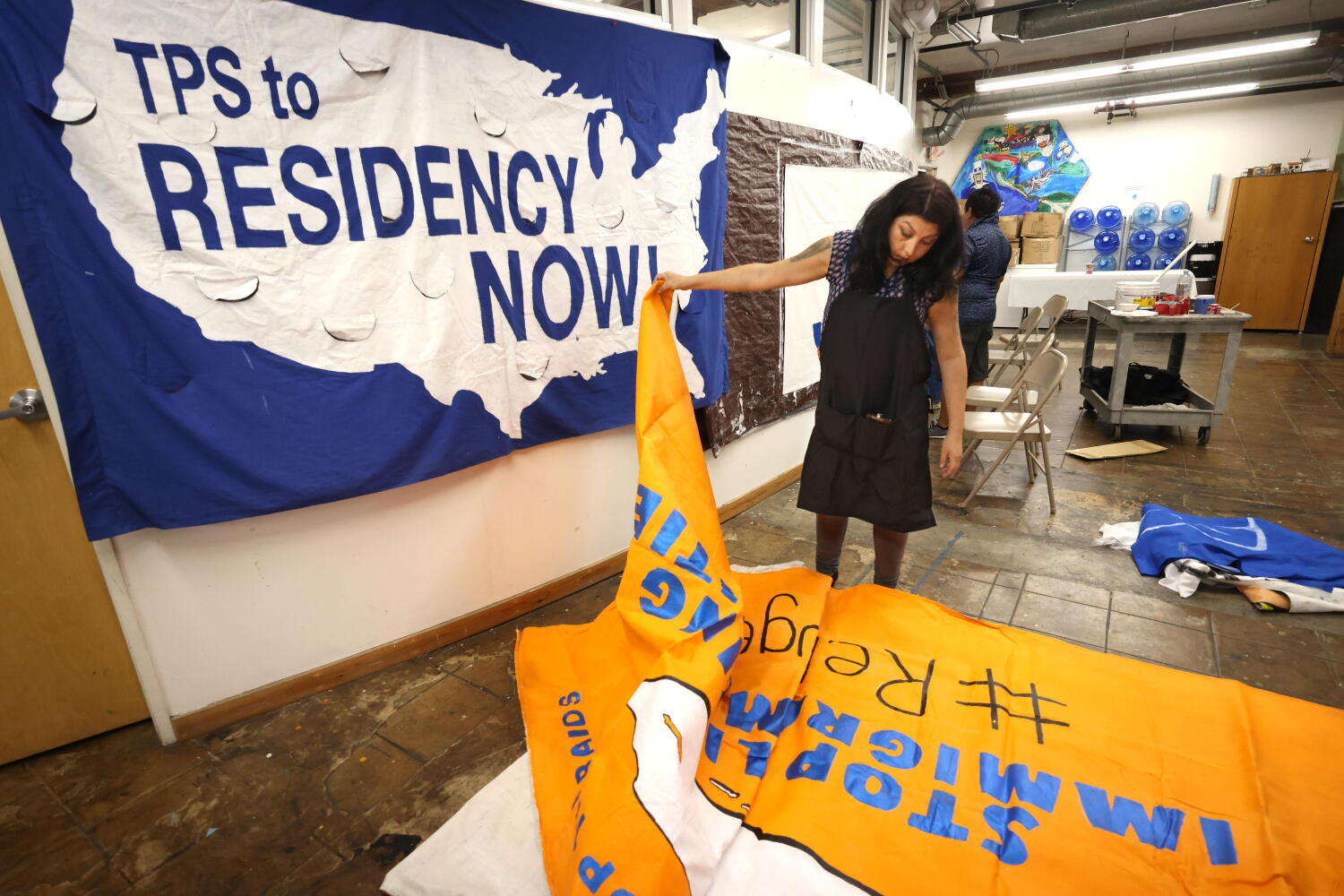
The Trump administration still hasn't reached a decision, plunging the Salvadoran community into uncertainty and raising questions about what has prompted the delay.
LOS ANGELES, CA - SEPTEMBER 9, 2026 - - Rocio Veliz, Parent and Youth Senior Organizer at Central American Resource Center (CARECEN,) looks over banners with one stating, "TPS Residency Now!" at CARECEN in Los Angeles on September 9, 2026. TPS banners are being made for Fiesta de Central America this Saturday in MacArthur Park. Temporary Protected Status for immigrants from El Salvador is set to expire tomorrow on Sept. 9. Around 170,000 Salvadoran immigrants could face deportation if the Trump administration does not move to extend the program. The Trump administration and the Department of Homeland Security have yet to publish an announcement ending or extending the program. El Salvador was first designated for TPS in 2001, after major earthquakes damaged parts of the region. It is the longest-running TPS designation in U.S. history, so many immigrants under the program have built their lives here over decades and have U.S. citizen children. (Genaro Molina/Los Angeles Times)
The Ukrainian capital’s left and right banks are connected by eight bridges — and Russia has been targeting both its North and South bridges in recent days.
For many people, using AI chatbots is incredible at first. It makes them feel productive, confident, maybe even smarter. But later, there’s a hangover. Perhaps there are problems with their memory, or certain skills, like writing or coding, don’t seem to be as sharp as they once were. Maybe they feel like they can’t solve problems or make decisions or remember facts as well as they could before they had the help of AI.
Susette Brooks, a marketing director living in Philadelphia, said she started using AI tools reluctantly but ultimately relented. She let AI write some of her emails, which lightened her workload, but then the dulling effects sank in. “I felt my writing and thinking decline as it was happening,” said Brooks, who has an MFA in nonfiction writing. “I had a harder time recalling information and synthesizing ideas.”
When you use external tools to reduce the cognitive effort required to do a task, you’re doing something called cognitive offloading. If you’ve ever used a calculator to do a math problem or used a calendar to remember an appointment, you’ve engaged in cognitive offloading. Tools like Claude and ChatGPT can do math problems and remember your appointments, but they can also write your term papers or create your work presentations. This is cognitive offloading at a scale we’ve never seen before.
Cognitive offloading isn’t necessarily bad. It’s actually what makes it possible for humans to be so productive. But as you outsource more and more cognitive tasks, you can start to become forgetful or see certain skills, like writing, start to decline.
There’s a term for this: de-skilling. This is an old economics term that has emerged as a bit of a buzzword used to describe the perceived downward spiral of competency that’s accompanied the proliferation of AI tools. And it certainly sounds bad, especially if you’re a novice who needs to build skills. De-skilling can affect your critical thinking, your writing abilities, and your creative process. It can also affect your recall, as relying too heavily on AI tools can make it harder to remember things.
Key takeaways
AI can make you more productive while quietly making you less capable on your own.
Offloading more tedious or mind-numbing tasks is less likely to make you feel dumber.
The long-term solution isn’t necessarily less AI. It’s being more intentional about the tasks you use AI for.
Young people, at least, are worried about the long-term consequences of frictionless thinking. A recent survey by Gallup and researchers from the University of Pennsylvania found that 68 percent of Gen Z adults in the United States are concerned that offloading too many cognitive tasks is robbing them of important skill-building. About the same percentage of those surveyed worry that AI discourages them from critical thinking and social learning. Some 37 percent of US adults under 30 say that AI will have a negative effect on them personally, according to a Pew Research Center study published in June. And yet, more than half of Gen Z Americans use AI on a weekly basis.
The paradox of AI is that, even if we feel like using these tools is bad for us, saving time and avoiding the friction of thinking is too tempting. We’re hardwired to seek out the path of least resistance, according to Daniel Willingham, a psychology professor at the University of Virginia, because cognitive activity is so taxing, and may or may not get you to the right solution. Memory, on the other hand, is efficient and effective — you know that something worked in the past, and it will work again.
“Our mind is really set up to save you from having to think,” Willingham told me. “Thinking is what you do when you’re in trouble.”
The good news is that experts say it’s possible to use AI in a way that helps you save time and protects your cognitive abilities instead of diminishing them. Here’s their advice.
It’s not your imagination — too much AI use can erode your skills over time
Derek Salyers, a content creator in Ohio, started using AI to get more done, faster. But over time, two things happened. First, the work got worse. “A lot of what I was putting out became AI slop, for lack of a better term,” Salyers told me. And then, his brain got worse, too.
“When you get used to the AI making the decision, you stop pausing to actually think about things,” Salyers said. “And if you were never really present with it, you don’t remember it later. I wasn’t forgetting things because my memory got worse; I was forgetting because I was never really thinking in the first place.”
This effect is showing up in classrooms, too. One study of nearly 1,000 high school students found that those using ChatGPT scored 48 percent higher on a math test than their peers who didn’t have access to the AI tool. But when they were tested again without the chatbot, their scores were 17 percent lower than the students in the control group who had never had ChatGPT access. Similarly, researchers at the University of California Irvine looked at longitudinal data from online tests starting in 2015, and found that students spent less time and performed better on the text-based questions after the introduction of ChatGPT. (ChatGPT is very good at helping with text-based questions.) But when those students were later given offline tests, without the ability to use AI help, they performed worse.
All of these students, it appears, were offloading the cognitive work to AI, which provided short-term gains. But in the long term, their thinking skills suffered.
Your basic cognitive abilities, like your working memory and selective attention, are quite resilient.
Evan Risko is a psychology professor at the University of Waterloo in Canada who co-authored the foundational paper on cognitive offloading a decade ago. He recently told me there’s not a lot of research into what’s going on in our brains when we’re cognitive offloading, but scientists are gaining a pretty clear picture of the pros and cons of doing it. The advantages vary depending on the task, but in general, cognitive offloading allows us to extend our imperfect memory systems, which you’ve probably done if you’ve ever set a reminder for yourself. The downside, Risko said, comes in offloading mental processes that are important. “Then we risk compromising our cognitive performance,” he said.
Your basic cognitive abilities, like your working memory and selective attention, are quite resilient. But as Risko and his colleagues explained in a paper this year — bluntly titled “Is AI making us stupid?” — other skills, like doing arithmetic and flying planes, are learned behaviors. You first have to acquire them and then, in order to retain them, you have to practice. AI use can compromise both the acquisition and retention of these skills — and people might not even realize this is happening to them, because AI makes them believe they’re more capable than they really are.
“People may have difficulty realizing that their skills are decaying or that they are failing to learn when using AI tools because the output and their performance with AI is at a high level,” said Brooke Macnamara, a psychology professor at Purdue University who co-authored the “Is AI making us stupid?” paper. “They may not realize that if the AI tool were unavailable how low their independent performance might be.”
Be intentional about the tasks you use AI for
The most important step to preserving your cognitive performance is to ask yourself if you should be using AI for a given task at all.
“Just because AI is a tool that’s available to us and it can accomplish a lot of tasks for us, it doesn’t mean that we should always use it,” Anjali Singh, a human-AI interaction researcher at the University of Texas at Austin, told me. Writing, for example, is something that a lot of people are now using AI for. But offloading that work means that you lose out on the independent thinking and reasoning that goes into expressing your thoughts. You also miss the chance to improve your writing skills if you don’t actually write.
“We keep outsourcing these kinds of skills to AI over time and do not engage in those activities ourselves, then the de-skilling occurs,” Singh told me. “And that is I think probably one of the main reasons people could be feeling that they’re getting dumber as they’re using AI over time.”
“We are not getting these moments to reflect.”
Anjali Singh, Univeristy of Texas
It might seem counterintuitive, but it’s actually best to use AI for things you’re already pretty good at, the tasks you’re fully capable of performing yourself. A recent working paper by MIT economist David Autor and his colleagues (note: Several of them work for Google, who funded the study) describes how giving AI tools to 133 patent lawyers and then taking away those tools led to different outcomes, depending on the lawyers’ level of experience. All lawyers saw performance gains while using the AI tools, but those gains disappeared for the younger lawyers when the tools went away. Experienced lawyers, however, performed better afterward than their counterparts who never had access to AI tools.
A similar effect showed up in a recent experiment by Middlebury College researchers. In the first session, more than 200 undergraduates learned about an unfamiliar topic and then wrote an analytical essay, some with the help of an off-the-shelf AI tool. They performed a similar test a week later, except this time none of the students had access to AI. The students who had AI access improved across the board, but what’s telling is that there appeared to be two types of AI users: augmentation users, who used AI to improve their work, and automation users, who just had AI do the work for them. The augmentation group performed better than everyone.
“Using AI to deepen or develop one’s own thinking on or understanding of a topic, rather than letting AI do all of the thinking, seems like the best way to use these tools,” Lauren Richmond, a cognitive science professor at Stony Brook University in New York, told me.
Tell your chatbot to treat you like a student
If you, like me, have ever fallen down a rabbit hole while trying to understand the geopolitical nuances that led to the outbreak of World War I and ended up staring blankly at a mountain of text feeling more confused than when you started, you know that using AI to learn doesn’t always go as planned. You may have also had the experience of writing prompts or asking questions and then receiving a long, overly detailed response. That can initially seem satisfying, but it’s often too much text to digest at once, so maybe you ask another question — and get back another wall of text.
Older ways of accessing information, like reading books or even using Google to do research, happened more slowly, and that gave us time to process the information, Singh from UT Austin said. But that’s gone now. “We are not getting these moments to reflect,” she said.
If you find yourself drowning in content, that’s also a sign that you’re probably not expert enough in the material, or you’re not being intentional enough about your approach.
It starts in the settings. Here, you should explain that you’re trying to build skills, not offload them, and instruct the AI to challenge you and engage with you. If you’re using ChatGPT, you can plug in custom instructions by going into the personalization tools. Claude has similar options called Instructions for Claude.
If you’re explicitly trying to learn something new, you might also try some of the tools these companies have designed for this. OpenAI has study mode in ChatGPT. Anthropic offers Claude for Education. Google has Gemini for Students. Instead of simply providing answers, these tools act more like tutors, by asking questions, working through problems, and encouraging you to come up with solutions on your own.
Slow down and embrace friction
Something that’s both tempting and dangerous about AI is how fast it can do work. Vibe coding an app can take minutes, rather than days of manual coding. That’s very appealing if you have too much on your plate and want to get through it all quickly.
“The workload was so heavy and crazy, you have no time to think,” Joei Chen, a former brand director at a tech company, told me. “So you just throw stuff into AI and say, ‘What do you think?’”
At the same time, creating more code does not necessarily lead to more finished software, according to a recent Wharton School study. That increased productivity also doesn’t necessarily lead to happier workers. And the faster you move, the more critical thinking you’re going to offload. “Your boss asks you, ‘What does Claude think of this?’” Chen said, so AI “inadvertently becomes the final boss.”
Slowing down and forcing yourself to do more critical thinking is an easy way to hold onto some agency — not to mention some brain power. One easy way to do this is to make your interactions with AI more collaborative than transactional. For example, if you are going to use AI to help you write something, ask for five options of a draft instead of one, and then read each of them yourself and decide which is the best.
“Ask for feedback, hints, examples, explanations, advice, practice questions.”
Evan Risko, University of Waterloo
“Just the simple act of comparing things stimulates a great deal of the critical thinking processes that we kind of care about,” said Advait Sarkar, an AI researcher at the University of Cambridge, “and has beneficial effects for things like developing your judgment, your own awareness of what you don’t already know, and stimulating your recall.”
The word that came up again and again as I talked to experts about how to use AI without getting dumber was metacognition, or thinking about thinking. A lot of AI users let metacognition take a back seat to whatever content is flowing freely from a chatbot. And it can happen fast.
While letting AI do all of the thinking for you is tempting, Matt Beane, an associate professor at the University of California Santa Barbara and author of The Skill Code: How to Save Human Ability in an Age of Intelligent Machines, told me that approaching AI this way “is your worst enemy.” To counteract this, you have to introduce more friction.
“You must be very aggressive about how you experiment with it,” Beane said. Risko, the cognitive offloading expert, echoed this advice. “Ask for feedback, hints, examples, explanations, advice, practice questions,” he said.
The best test for judging whether you’re offloading too much thinking to AI and the technology is chipping away at your skillset: Stop using AI and use your brain, and see what happens. You don’t have to stop forever, but you should, for example, spend a day writing emails without AI’s help to see if you’re as fluent as you used to be. Or revert to using Google for research and confirm that you can still find facts without a chatbot finding them for you. Build an app with your own code and see if it flows naturally.
You might be troubled to find that AI made you worse at something. But you’re not actually dumber than you were before, and you can rebuild your lost skills the old-fashioned way: read, write, do arithmetic. If something requires thinking, go ahead and think.
New York Gov. Kathy Hochul and New York Attorney General Letitia James at a news conference in New York City on October 2, 2026. | Michael Nagle/Bloomberg via Getty Images
In October 2024, students at Cornell University received a campus crime alert about a reported sexual assault. At the time, it was just a campus story. Nearly two years later, on September 16, the victim, known only as “Jane Doe,” filed a civil lawsuit that brought national attention to her story. People across the country are asking what happened and why criminal charges never followed.
Doe alleges that seven men drugged and sexually assaulted her at the Chi Phi fraternity house two years ago. Her lawsuit also accuses the university, fraternity and sorority organizations, and a local bar of failing to protect her.
The lawyers for several of the men have denied the allegations and any wrongdoing. Cornell says its disciplinary actions led to suspensions and expulsions for some of the young men, and that the Chi Phi fraternity remains barred from campus.
Doe went to campus police in November 2024, and the district attorney’s office reviewed her account and declined to bring charges. Tompkins County District Attorney Matthew Van Houten has said that what she described to Cornell police didn’t meet the state’s requirements for criminal charges.
To break down why Van Houten didn’t pursue the case at the time and what should have happened instead, Today, Explained co-host Noel King spoke with Lauren Hersh, a former Brooklyn prosecutor who led the office’s sex trafficking unit and CEO of World Without Exploitation, about how authorities handled Jane Doe’s allegations, the limits of New York’s consent laws, and what needs to change.
Hersh also explains where she believes the case should go next and what a special prosecutor can do to investigate (the interview took place prior to James’s appointment).
Below is an excerpt of Hersh’s conversation with Noel edited for length and clarity. There’s much more in the full podcast, so listen to Today, Explained wherever you get podcasts, including Apple Podcasts, Pandora, and Spotify.
I want to start with what we know in 2024. A young woman who we know as “Jane Doe” goes to the Cornell campus police and says she had gone to a frat house while under the influence of alcohol.
At the frat house, she was given more alcohol and ketamine. Several men had sex with her while she was intoxicated. This is what she tells Cornell campus police. What, in your view, is supposed to happen next?
There are a number of things that could happen. What I would say about these cases is there is no perfect scenario of what is supposed to happen, because what is critically important is we listen to the desire of the survivor.
We want to take this at her pace. We want to be guided by her wishes. We want her to decide if she is ready to go forward, if she wants to speak to campus police, the Title IX office, if she wants to speak to the local law enforcement. There are a lot of variables here, but for me, what is critically important is that we’re listening to the survivor and what she ultimately wants to happen.
In the present day, the district attorney who was involved has said that his office reviewed Jane Doe’s statement at the time and found at the time that what she described didn’t meet the legal definition of a crime.
I think people want to understand, Lauren, how is that possible?
To be really candid with you, Noel, this is an area that seems super unclear to me because the role of the district attorney in that moment is to investigate.
When you first get a case file, you first get a victim statement, and especially with facts as horrific as these facts are, or our understanding of this six-page document that the DA read — I would never say that this is a clear-cut case where there’ll be a conviction at the end. We never know that.
What I can say with 100 percent certainty is if you get a document like that, as a prosecutor, that is a significant investigative lead. And so, as a prosecutor, what I believe to be good practice is starting to pull the layers back, trying to understand what transpired here. Interviewing the victim. That feels critical. That never happened. We now know that there are all these text messages that were shared between these boys, and the prosecutor’s now saying, “I didn’t know about the text messages.”
It’s my understanding that there were a lot of boys on that particular text thread. And so a good investigator would have gone to that fraternity house and tried to interview some of those boys, tried to understand what were the contemporaneous statements made at that time. Were there any text messages? Was there any social media activity? And I believe that had they done that in a timely fashion, they likely would have come up with these text messages at that time and not two years later.
What you’re saying is interesting because the DA has come out publicly and defended himself by saying, essentially, the details of this lawsuit, which was filed in September of this year, are different from the details in the young woman’s 2024 statement to the police.
He has used that in his defense, right? “Here’s what I knew at the time versus what this young woman is saying today.” I think I hear you saying that maybe that’s not an excuse?
You’re asking about the inconsistent statements, and I find it troubling that the DA is leading with this notion that the victim has inconsistent statements because that feels to me like here we are making excuses and blaming the victim.
To my knowledge, the DA has not yet interviewed this victim. Perhaps he’s talking about the civil complaint, which I would think is written in a way where she has worked with her lawyer to put this together. And the initial statement, the initial six-page document that the DA read, my understanding is that it is basically a summary of a conversation.
Inconsistencies come in all shapes and sizes, so it’s hard to know exactly what we’re talking about here, but it is very common for there to be some inconsistencies. That is not a dealbreaker, despite the fact that this prosecutor wants the public to believe that it is.
What do you make of the prosecutor speaking publicly in the way that he is at this moment?
I find it rather confusing. I’m not really understanding why he is doing a media tour rather than sitting in his office doing the work, interviewing this particular victim, interviewing witnesses, seeing what evidence actually exists.
It seems to me that the DA has gotten to a conclusion before he’s done the work in actually investigating the case, and it is deeply troubling. And I think the governor should consider appointing a special prosecutor because I am not certain, based on this media tour, that this DA is able to give this particular survivor a full and fair investigation of the facts.
Drugs and alcohol are central to this case, right? The young woman admits she had been drinking and she was using ketamine. Under New York law, how does that affect whether or not someone is believed to be capable of consenting to sex?
New York law is actually really problematic here. It’s a place where I believe we are desperate for a legislative fix. I think that there have been a lot of advocates who’ve been championing a correction to this voluntary intoxication loophole for a lot of years, and we’ve not been able to get it.
New York law makes it very, very hard to prosecute a person when the victim is voluntarily intoxicated, but not unconscious, and this new law would allow the prosecutors the ability to bring cases when the victim is so severely intoxicated but not physically helpless and where a reasonable person should have known the victim’s condition.
In this particular case, based on what we’re hearing, she was in a condition where a reasonable person should have known her condition. And so in this particular instance, the DA is right. This is a very, very hard case to prove in this moment, but I’m a big believer. We don’t not prosecute cases because they’re hard cases. But at the same time, we know that a change to the law is critically important.
You clearly want more investigation here. What questions do you want asked? Who do you want to be [interviewed]?
Before I say who and how and what that investigation looks like, I think it’s really important to say that when two years have passed and the DA did not investigate these cases immediately, we have a big problem on our hands.
The fact that the DA did not investigate this from the moment he found out about this, it’s really problematic because as we know, evidence disappears, memories fade. When you’re dealing on a college campus with a specific culture, there may be a narrative that takes hold. And so it’s important to talk about the time lapse and how that harms the case.
That said, I still believe that the investigation is critically important. I don’t believe that this DA is the right person to do the investigation. I think a special prosecutor should be appointed. And then I think that the prosecutor and law enforcement should be interviewing everybody who was in that fraternity on that night. Anybody who saw this victim before, saw this victim after. Were there any statements in the immediate aftermath of her leaving that fraternity? Was there an outcry witness? We know that some text messages have come to light. Are there other text messages? I suspect that there are.
I’d want to interview as many of those boys as possible to understand what was going on because some of those text messages that have come to light — one says, “Free pussy” — don’t sound like a mindset that is engaging in consensual sex.
I think it is critically important that we understand all of the correspondence of that night. I think we want to see what is out there that helps us get closer to understanding what transpired that night.
I’ve seen two lines of thinking about this. One is that this is a horrific incident that never should have happened, but it is in some ways singular. But I’ve seen another line of thinking that says, “No, this is a systemic failure. This kind of thing goes on on college campuses, and the steps that follow the outcomes are often the same.”
I wonder if you think this is a systemic failure, and if you think it is, what would need to be done to fix this problem?
That’s a big question. I do think it’s a systemic failure. I also think it’s a cultural failure. And the reason that I would say this is because I don’t think this is isolated to this specific college campus. I think that sexual assault is happening across the country on college campuses everywhere.
In terms of additional systemic failures, I’ve been working with the Epstein survivors for the last year and a half, so I’ve seen so many systemic failures, so many prosecutorial failures, so much failure with law enforcement. I think that this is yet another example of prosecutorial failure.
I think the law enforcement failed this young person — the fact that there’s no investigation that happened immediately in the aftermath of this incident, no investigation. We just continue to fail survivors all over the place, and we have to start doing better.
Alcohol-free beer is becoming more popular, even at Germany's icon Oktoberfest. One reason for the trend: It tastes better than earlier nonalcoholic beers.
Trump is rallying in Republican strongholds such as Texas, Oklahoma and Alabama, betting that his presence will be enough to energize voters who might be thinking of sitting out the election.
The alleged attacker, Hamam al-Hammami, had been banned from flying with Oman Air because of concerns about his radical views, a person familiar with the matter said.
Anthropic’s Christopher Olah shakes hands with Pope Leo XIV at the Vatican on May 25, 2026. | Alberto Pizzoli / AFP via Getty Images
This story appeared in Today, Explained, a daily newsletter that helps you understand the most compelling news and stories of the day. Subscribe here.
Hi readers, happy Friday! It’s been a big week for the AI debate — not the one about whether it will cause the robot apocalypse, though there’s still plenty to worry about there, but instead about whether the technology is conscious.
The folks at Anthropic, the AI company behind the large language model Claude, certainly seem to think it is — or at least, they’re extremely open to the possibility.
As the New York Times reported earlier in the week, the company has spent the last year grappling with the question by speaking with religious thinkers from many faith traditions in an effort to chart a moral course for the LLM (that is, to keep it from killing us all, so maybe it is all one big debate).
In the process, the Times reports, some of those thinkers observed that members of the Anthropic team were “relating to [Claude] like a conscious being” and even, according to it, a degree of “moral status.”
On the flip side of this debate is Pope Leo XIV, who decidedly does not seem to buy into AI consciousness arguments. His “Magnifica Humanitas” encyclical earlier this year argued that AI will never be able to replace humanity — and reportedly “alarmed” Anthropic’s co-founder, Christopher Olah.
Since then, Pope Leo has continued to emphasize the differences between humans and machines this week. “There is an ontological difference, even before an aesthetic one, between art and what a machine can generate through statistical calculation based on millions of images created by others,” he posted on Friday. “Algorithms lack the spark of humanity.”
Loneliness machines
Conscious or no (and that’s a no from me), it’s hard to argue that tech companies don’t want you to interact with their models like people. That includes OpenAI and Meta, both of whom introduced “cute” new AI agents — called Dots and Muse, respectively — last month.
As my colleague Adam Clark Estes reported this week, though, the promise of a companionable, always-there AI might not be the best idea in the world — especially for children. A new study, still under review, suggests that AI use may be causing loneliness in middle schoolers.
Adam spoke with the lead researcher on the study, UNC Chapel Hill professor Anne Maheux, who explained that “middle school students using AI for emotional intimacy and companionship developed greater loneliness over time.”
According to Maheux, one big point where AI chatbots fail compared to human beings is “friction,” or the complicated push-and-pull dynamic of any connection with a real human being. By contrast, chatbots are “sycophantic, highly agreeable, anthropomorphized,” she says, which can lead to kids “developing expectations or understandings of interactive relationships that are actually fundamentally at odds with a normal human relationship.”
People, in other words, still matter, no matter how much the AI companies want us to build our lives around machines instead.
One link for later
➨ Why is horror so fun? It’s October, which means you might be planning a horror movie marathon or a trip to a haunted house/forest/corn maze/what have you in the near future. It’ll probably be a great time — but why? Terrifying yourself doesn’t intuitively sound like fun, but humans love to seek out frights, whether that means ghost stories or a rollercoaster. In 2024, Vox’s Unexplainable podcast spoke with some researchers trying to figure it out.
Before you go…
Did you know…that Disney’s “Magic Kingdom” in Florida is way, way better than most of the US at managing a complex network of underground cables and pipes? My colleague Sara Herschander dug into why, and whether other American cities can catch up.
Today’s trivia: What musical note is equivalent to a G sharp? (You can find this and other brain puzzles in Vox’s daily crossword. Look for the answer in Monday’s edition.)
Yesterday’s trivia: Yesterday, we asked you which constellation contains the North Star and the Little Dipper. That would be Ursa Minor, the Little Bear.
“In what world,” New York Gov. Kathy Hochul asked on Friday, “would the police learn from a victim that she’d been literally gang raped while she was intoxicated by five men in a fraternity house and not elevate those allegations to the district attorney?”
Hochul was speaking about the case of a former Cornell student who said she was raped by several members of the university’s Chi Phi fraternity in 2024. At the time, the district attorney filed no criminal charges.
The case has rocked the nation and forced a renewed reckoning over how sexual assault is dealt with in higher education. While the district attorney has defended his handling of the case, many politicians and legal expertsare now examining whether certain details of the alleged victim’s account were neglected, and prosecutors have reopened the case.
Amy Wang is a staff reporter at the Washington Post who’s been covering the story over the past week. She spoke with Today, Explained co-host Noel King about what allegedly happened on the night in question, what happened afterward, and what we still don’t know.
Since the two spoke, New York state Attorney General Letitia James has also been assigned to oversee the case and said it is now “an active criminal investigation.” As new information comes to light, further legal action could be taken.
Below is an excerpt of the conversation between King and Wang, edited for length and clarity. There’s much more in the full podcast, so listen to Today, Explained wherever you get podcasts, including Apple Podcasts, Pandora, and Spotify.
In October of 2024, a young woman went to a fraternity house near Cornell University’s campus. Who is this young woman, and why did she go to the frat house that night?
The young woman is only identified in documents as Jane Doe, so we don’t know her name. She was, at the time, 20 years old. She was a sophomore at Cornell. And around 11 pm on the night of October 19, 2024, this Jane Doe goes to a bar on campus, and then, after that, goes to the Chi Phi fraternity house to hang out with a friend.
She said that she was already pretty intoxicated at that point, and she’d had maybe 10 drinks in about three hours. Her friend at the fraternity house hands her a beer. After that is where she alleges that another member of the fraternity pressured her into taking drugs, specifically ketamine and marijuana, and drinking more alcohol. She alleges that two members of the fraternity assaulted her, and that one of them later sent a Snapchat message out to active Chi Phi members. The message is pretty graphic, but essentially invites them to join in, and several did.
In about three weeks, this young woman was going to go to the Cornell campus police and report what happened that night. But in the interim, what was going on? What was happening?
We now know, based on reporting by the New York Times and CBS News, this young woman was a member of a campus sorority, so she went to a member of her sorority and was trying to make sense of what happened. She was still processing it in real time. She wasn’t using, according to their reporting, the word “rape” or “assault.” And she was also seeing rumors circulating around campus about what had taken place at the fraternity house and was growing concerned about how they portrayed her.
She, in the interim, also received a text message from one of the seven men at the fraternity essentially apologizing for how things went down the other night. She is not yet accusing them of assault, but is chatting, even seeks to reassure him in that first message.
On October 22, she then makes an appointment at the campus health clinic because she had what she thought was a UTI and wanted to be tested because she told the doctor that she had gone through a traumatic experience.
According to the New York Times reporting, you could see her thinking about what happened kind of evolve over those few weeks. She at some point says that this is starting to ruin her life, and she’s sleeping and crying and she’s feeling ashamed. She’s just really grappling with what had taken place, trying to make sense of it. By November 3 is when, according to these investigative documents that were obtained by the Times, she kind of comes to this conclusion that what happened at the party at Chi Phi was assault.
She texts one of the seven fraternity members and says, “This was not consensual. I was given more ketamine than I can remember,” and that she was uncomfortable. A few days later, November 7th, 2024, according to these documents, she goes to the ER and asks for a rape kit. And the following day is when she goes to Cornell University Police.
When she goes to the police, how does she characterize what happened to the police? What does she tell them?
What she tells the police is that she believes she was assaulted, and she tells the police that it had started out as something that was consensual. And then at the end she says, “I can say with 100 percent confidence I was raped.” She tells police she was extremely uncomfortable and that she kept taking ketamine in part because she thought she might black out and pass out. She had thought of at least two of the men as her friends. After the events of that night, she is then confronted with rumors that were spreading across campus, sort of depicting her as loose and blaming her essentially.
What happens after Jane Doe talks to the police? What do they do?
When she talks to Cornell University Police, they summarize what she said in a six-page statement that she then signs. And that is the statement that is submitted to the Tompkins County district attorney.
And the district attorney would be the person who would bring charges or decide not to bring charges. What does he decide?
Yes, so the district attorney decides not to bring charges in 2024 based on, he has said, the sworn statement that she signs to police.
The DA says no charges for the seven men. Were they disciplined in any way?
We don’t know exactly how each of the men were disciplined. Cornell has said that they faced a range of disciplinary measures, including expulsions and suspensions. One of the details that had gone particularly viral about this is that the disciplinary measures included for some of the students to write essays. Cornell has not denied that, but it has specifically denied that the students only had to write essays as a disciplinary measure. The university has cited privacy laws and said it really can’t release any more specifics about how individual students were punished or not punished.
What did Jane Doe do after first talking to the police and then learning the DA wasn’t going to press charges?
After she goes to police, we know she remains on campus and she has to continue seeing some of these men. And she also participates in the school’s Title IX investigation, which takes place over several months and concludes at some point in 2025.
I want to ask you about the DA. He is out in public defending his decision to not press charges in 2024. How is he defending himself?
The DA is a big part of the story. This is the Tompkins County District Attorney. His name is Matthew Van Houten. And he has said that in 2024, based on the written statement from Jane Doe, they did not have what they needed to press criminal charges.
It’s important to note that we, as in the public, we’ve not actually seen a copy of Jane Doe’s sworn statement. The DA issued a press release in which he summarizes that statement. And in that summary, he describes her characterization of this as voluntary and conscious and consensual. That is at odds with some of the investigative documents that we’ve seen reported since then, including that transcript of Jane Doe’s interview with Cornell Police in which she very confidently says that she believes she was raped and even says that she was physically hit during that night.
The DA said that he did not see, before the lawsuit, the screenshot of the Snapchat message where the frat members are talking pretty crudely about the situation, and he also says he didn’t see the transcript of the interview between Jane Doe and police.
We now know the names of the seven men who were there that night. Have they said anything?
The seven men themselves have not publicly said anything, and the lawyers for three of those seven men have publicly denied the allegations. One of them says that his client went into the room, but immediately left and didn’t participate in the assault.
This is a story that is developing very quickly, and it seems like new information is coming out just about every day. What do we know about what happens next?
So there’s at least two things going on here. There is the reopened criminal investigation.
Separately, there’s the civil lawsuit that Jane Doe filed last month, and that is not dependent in any way on how the criminal investigation goes, but that will also proceed against the university, the seven fraternity members, and the fraternity itself.
Supporters of Prime Minister Benjamin Netanyahu call him “Mr. Security.” Critics said this week’s FlyDubai incident, a day after he warned of a possible attack against Israel, was another security lapse on his watch.
 Login