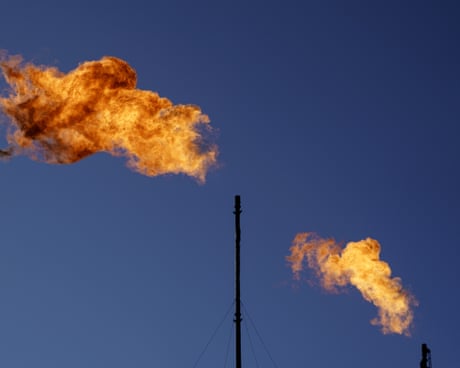
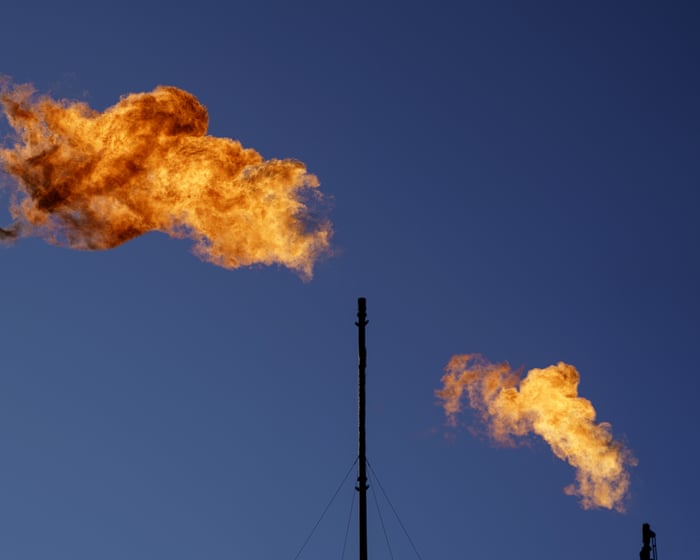
Secretive state begins repairs on ageing facilities after being revealed as worst country for leaks of potent greenhouse gas
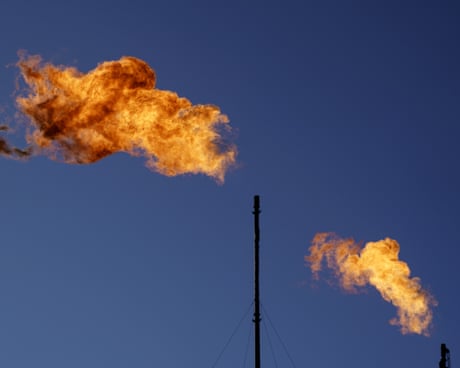
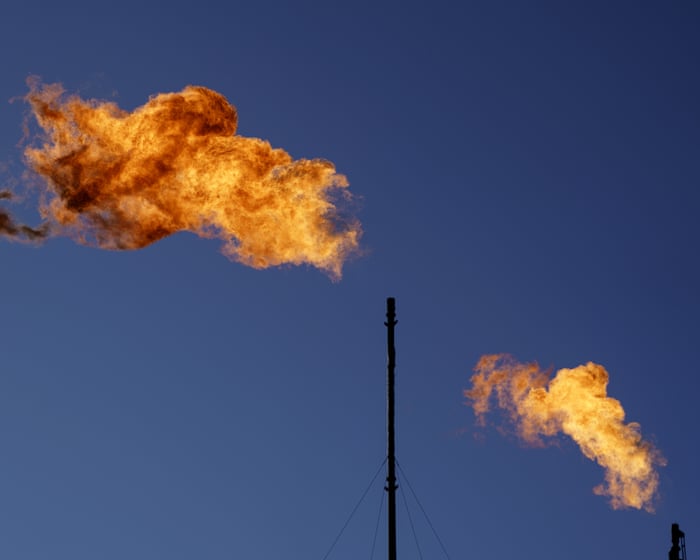
Turkmenistan has started plugging the mega-leaks of methane that spew from its ageing oil and gas facilities, the latest UN data shows, in a move hailed as a breakthrough.
Methane, also called natural or fossil gas, is a potent greenhouse gas. It traps 80 times more heat than carbon dioxide and causes 25% of global heating today. Stopping leaks can be quick and cheap and, because methane breaks down in the atmosphere far quicker than CO2, this has a rapid impact, with some experts calling it the climate “emergency brake”.
Secretive state begins repairs on ageing facilities after being revealed as worst country for leaks of potent greenhouse gas
Turkmenistan has started plugging the mega-leaks of methane that spew from its ageing oil and gas facilities, the latest UN data shows, in a move hailed as a breakthrough.
Methane, also called natural or fossil gas, is a potent greenhouse gas. It traps 80 times more heat than carbon dioxide and causes 25% of global heating today. Stopping leaks can be quick and cheap and, because methane breaks down in the atmosphere far quicker than CO2, this has a rapid impact, with some experts calling it the climate “emergency brake”.
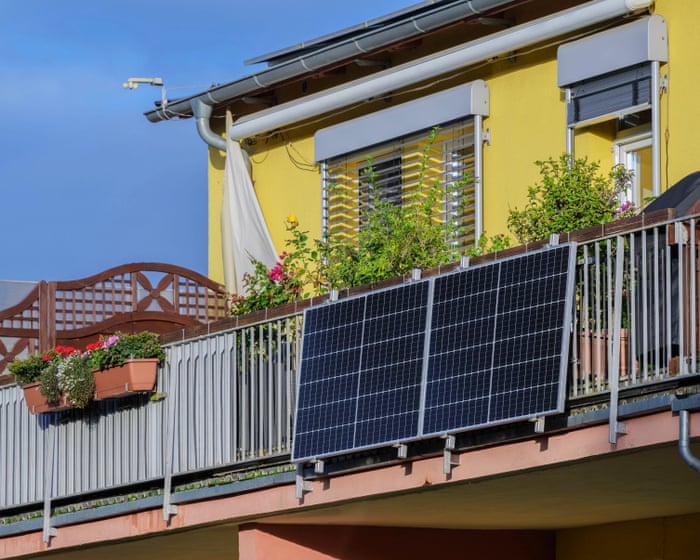
Millions of Australians could be saving up to $370 a year on energy bills and doing their bit for the climate crisis if Labor followed the UK’s lead in legalising plug-in solar panels, an advocacy group has said.
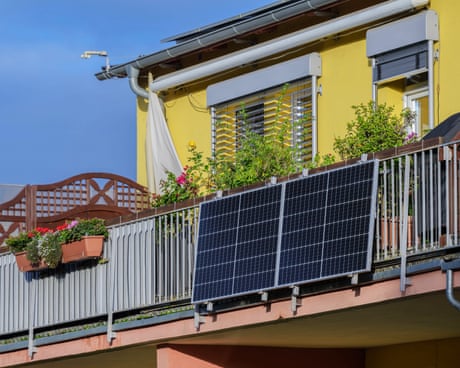
Plug-in solar refers to small standalone solar units that could be attached to balconies or used in back yards and plugged into power points, offsetting the energy used by household appliances.
Campaigners say ‘seismic shift’ follows years of pressure to sever ties with oil and gas firm
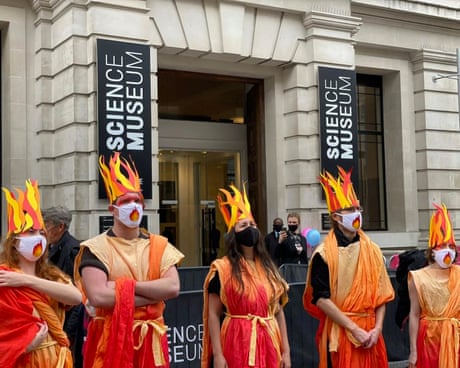
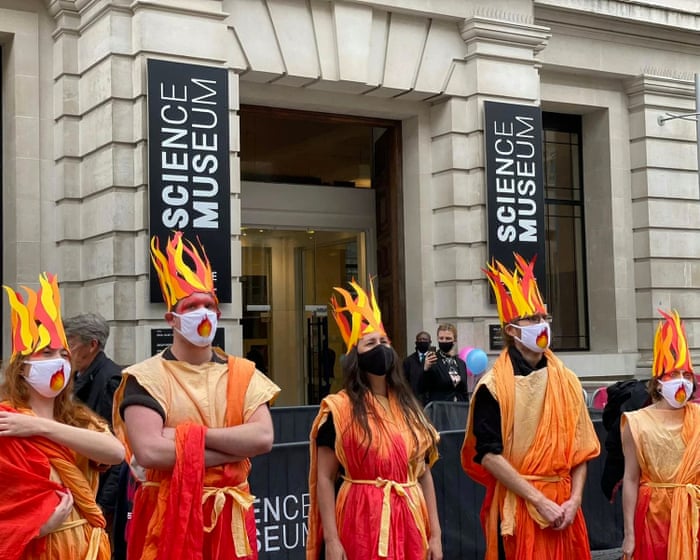
The London Science Museum has ended its decades-long partnership with the oil and gas company BP in what has been described as a “seismic shift” for the museum.
The Science Museum Group academy, which was established in 2018 to provide training and resources, announced on Friday that it would be ending its partnership with BP. In a statement, the director and chief executive of the Science Museum Group, Sir Ian Blatchford, said the partnership had “drawn to a close at the end of the current contract term”.
After months of fuel and water shortages, Cubans are facing a dire public health crisis. | Yamile Lage/AFP via Getty Images
Since January, many Cubans have lived a life of near-constant darkness. The Trump administration’s oil blockades have led the country into a worsening energy crisis, collapsing what was already an eroding national power grid.
Daily blackouts have plunged the Cuban nationalized, universal health system, once the pride of the country, into a humanitarian crisis. For months, hospitals have been without necessary power and ambulances strapped for fuel. Piles of trash line the streets, increasing the risk of disease. Cold storage issues threaten lifesaving vaccines, and a combination of the frail economy and US sanctions has left pharmacy shelves almost empty.
The public health crisis exposes an often overlooked aspect of the way we tend to think about the promise of universal healthcare. Having accessible and free medical services is only one part of the solution. While Cuba’s once-vaunted health system is bound up in its own history and national context, it still demonstrates that public health of all kinds can only be as resilient as the electricity, water, transportation, refrigeration, supply chains, and institutions that enable it.
An old prototype for universal healthcare
Not long ago, Cuba’s health system was seen as a promising model for successful free universal healthcare. In the years following Fidel Castro’s rise to power, health authorities focused on the integration of healthcare delivery models into a single public system. The Castro government aimed to expand services once concentrated in Havana into rural areas, such that the entire population would have access to basic care services. In 1974, the government launched community-based polyclinics that placed primary care specialists in almost every Cuban community.
Sign up here to explore the big, complicated problems the world faces and the most efficient ways to solve them.
Over the decades that followed, that widened access to healthcare led to significant, measurable returns. Infant mortality in the country has dropped from 37 per 1,000 live births right after the revolution to seven per 1,000 live births in 2024. Infectious and parasitic disease mortality also improved, dropping from a rate of 45.4 per 100,000 inhabitants in 1970 to 9.8 per 100,000 inhabitants in 2019, according to data reported by the Cuban Public Health Ministry.
It’s not entirely surprising that the successful Cuban national health model has been the site of curiosity and enthusiastic scrutiny in American health equity circles, despite vast differences in state ideologies. The US has never ensured that every citizen has affordable access to healthcare, and large disparities persist in low-income and rural populations. The chokehold of private insurance has ensured that, unlike nearly every other country in the world, the US has largely rejected the prospect of universal care. Even historic gains in insurance coverage have faced rollback threats under the One Big Beautiful Bill.
On certain key metrics, the US also falls far behind Cuba, which boasted 9.5 physicians to 1,000 people in 2021. That same year, the US reported just 3.7 physicians to every 1,000 people. The 2019 measles epidemic demonstrated a gap in childhood vaccination rates as well: 92 percent of childrenages 13 to 17 in the US received two doses or more of the measles, mumps, and rubella vaccine. In Cuba, the childhood completion rates were well over 99 percent, and the country has not seen a measles outbreak since 1993.
From its early years, the Cuban health system has functioned against a background of economic decline particular to the country, one attributable to a complex combination of external pressures, among them US blockades, a complicated economic reliance on Venezuela, a struggling state-run economy, and a flailing industry heavily impacted by the Covid-19 pandemic.
While other sectors faced attrition, Cuba’s health system, at least, appeared capable of weathering these crises. During the pandemic, the country proved to be a model in global health, having developed a homegrown Covid-19 vaccine rapidly and reaching a 95 percent vaccination rate. Its robust supply of trained health professionals made headlines when Cuban healthcare workers provided essential pandemic aid to a small town in Italy.
So why has this system proved to be so fragile now?
New blockades deal the final blow after Hurricane Melissa
Torrents of rain and flooding from the Category 3 Hurricane Melissa hit Cuba in October of last year, affecting much of the island’s eastern provinces. More than 735,000 people were evacuated, and the environmental disaster has put the country’s basic health infrastructure in a precarious state.
In the storm’s wake, a combination of flooding and damaged water systems increased the spread of viral infections of arboviral diseases such as dengue and oropouche. A report by the Pan American Health Organization published in March placed water, food, and vector-borne diseases in the “very high” health risk categories. Apart from damaged water and sanitation infrastructure, the report describes how disruptions to health service access, routine surveillance of disease vectors, and environmental conditions that breed mosquito-borne disease outbreaks have dramatically increased the risk of infectious disease spread.
For years, Cuba’s economy was propped up in large part by its relationship with Venezuela. In exchange for support from Cuba’s highly trained professionals — especially healthcare workers — Venezuela long provided a critical supply of crude oil, which helped the country keep the lights on even in the face of US sanctions.
That partnership ended in January after the nighttime capture of former Venezuelan President Nicolás Maduro, and the sweeping Trump oil blockade soon after has dealt a challenge too difficult for the energy infrastructure to withstand.
Already struggling to recover from other disasters, Cuba plunged further into its present crisis. Mario Cruz Peñate, Pan American Health Organization representative for Cuba, said that while the public health situation has been evolving for a while, he has seen more acute upheavals as sanctions persist, causing mass blackouts that have made it impossible to sustain vital health services and emergency care.
Disease control continues to struggle post-Melissa, with aid organizations worrying about communicable food- and water-borne diseases, such as hepatitis A and diarrhea, that can be caused by unrefrigerated food. On the administrative level, limited transportation resources and electricity have led to a dearth of vaccine supplies, which typically require cold rooms for transfer and storage.
Continuity of care, in particular, has been affected for the worse. More than 100,000 elective and reconstructive surgeries have been postponed, for example, because of a lack of supplies and a backlog of emergency surgeries. At a briefing in May, representatives of the UN Office for the Coordination of Humanitarian Affairs and the World Health Organization reported that over 32,000 pregnant women faced limited access to diagnostics and limited amounts of the stable electricity needed to sustain neonatal units. Prenatal care faces delays because of the lack of everything from testing supplies to available facilities. And now, even once successful improvements in health indicators have fallen: a report from the Center for Economic and Policy Research measured an increase in infant mortality rates from 4.0 to 9.9 per 1,000 births between 2018 and 2025.
For humanitarian aid organizations, alleviating this health crisis also poses a stark challenge. Cruz Peñate ascribes this to availability, timing, and opportunity to distribute aid supplies, all of which have been made inconsistent by the ongoing blockade.
“The response to the situation in Cuba has to increase; we have to scale up the response. All the support we can manage to receive will be important,” Cruz Peñate said. “Here in Cuba there is really a situation that needs attention.”
Is Cuba now an outdated prototype for universal healthcare?
While Cuba’s healthcare system was never bound to map precisely onto the US, some of its most notable successes — the high physician-to-patient ratio, the almost entirely vaccinated population, the ample health screenings — still remain desirable. And yet those very accomplishments have crumbled under the threat of extreme weather events and the country’s inability to restore its broken power grid.
Trump targeted even more petroleum suppliers in his latest round of sanctions on July 23, leaving Cuba scrambling still further to revitalize its energy sector. Those same sanctions also took aim at the Cuban healthcare export economy, alleging that it involves forced labor.
Earlier this month, Cuba’s government loosened constraints on a handful of private operations, including pharmaceuticals and elder-care facilities, in response to the shortage of medicine in the country. With state-stocked shelves running empty, the new decree allows private pharmacies with Cuban health registration to fill in the medicine gap. Similarly, privatized elder facilities are also allowed to operate at a capped rate of 60 people per home, with mandatory visits from state physicians.
The government still prohibits private sector medical and dental care, and Cuban officials remain adamant that the “socialist state enterprise keeps its central role,” so it’s difficult to claim that the country’s medical model is being pressured towards privatization. But the erosion of some of its elements still speaks to a state-run health system under strain.
We often think of healthcare itself as an equation of medical services along with healthcare personnel and the authorities — government, industry, or both — that control it. But the crisis facing Cuba gets at the dependence of all of these factors on the broader energy ecosystem. Even a once-promising healthcare model can quickly collapse when a crucial component is missing: fuel.
The Bab el-Mandeb Strait is a vital trade route linking the Red Sea, Gulf of Aden, Arabian Sea, Suez Canal, and the Mediterranean. | Gallo Images/Orbital Horizon/Copernicus Sentinel Data 2026
There was a backup plan for getting oil out of the Middle East. We may need another one.
Key takeaways
After staying relatively quiet for much of the Iran war, Yemen’s Houthi rebels launched a major escalation last last week by carrying out attacks on Saudi tankers and oil infrastructure, threatening a return to the campaign against Red Sea shipping last seen during the Gaza war in 2023 and 2024.
A “double chokehold” on Mideast energy has been one of the nightmare scenarios of the Iran war. With traffic through the Strait of Hormuz at a standstill, Saudi Arabia has dramatically increased the amount of oil it ships out through the Red Sea — one of the main reasons why oil prices have not risen as much as many expected during this conflict.
Though they are allies of Iran, the Houthis have their own agenda and say their campaign is targeting Saudi Arabia specifically, but there’s a real risk it could expand, and test the global energy industry’s ability to adapt.
On July 20, the Iran-backed Yemeni rebel movement known as the Houthis declared a “blockade” against their long-time enemy Saudi Arabia, and a short time later attacked two Saudi oil tankers in the Red Sea. Shortly afterward, several ships carrying Saudi crude oil through the Red Sea made abrupt U-turns to avoid going near the Yemeni coast.
With Iran now blocking shipping throughthe Strait of Hormuz, the Red Sea was supposed to be an alternative way to get oil out of the Middle East and to the world market. Now, though, the importance of the route has merely created fresh leverage in the long-simmering conflictbetween the Houthis and their longtime enemies in Saudi Arabia. These attacks were a major factor in pushing oil back over $100 a barrel last week.
The Houthis have their own agenda partly unrelated to the Iran conflict. But in launching the Iran conflict, the US has inadvertently given them outsized influence in the region: The sea lane they control is more important than ever. Now, in opening up a new front, they may have just made the war harder to end.
This release valve is one reason why the price of oil — and the price of gas for American drivers — has not risen as much as many experts expected when the Hormuz crisis began shortly after the US-Israel strikes on Iran.
But now, that release valve is also under threat, putting the region and the world in what shipping experts call a “double chokehold.”
The Houthis have used their location to cause chaos before: In 2023 and 2024, they attacked over 100 ships they accused of links to Israel, and dramatically drove down shipping through the Red Sea. Those attacks stopped after the Israel-Hamas ceasefire last year, but shipping has still not fully recovered.
President Donald Trump has threatened both the Houthis and Iran with “major military punishment” over the attacks in recent days. And the attacks also make it likelier that the conflict in Iran could make oil pricier than ever, increasing political pressure on Trump.
What do the Houthis want?
The Houthis are a member of Iran’s network of regional proxies, known as the “Axis of Resistance,” along with Hezbollah, Hamas, and a number of Iraqi militias. But most experts believe that while they rely on Iranian support, they operate independently and don’t take their marching orders from Tehran.
Officially known as Ansar Allah, the Houthis are members of the minority Zaydi sect of Shia Islam. They’ve been fighting for control of Yemen since the 1990s and took over Yemen’s capital city, Sanaa, in 2014, though most countries do not recognize them as Yemen’s legitimate government.
The Houthis fought a brutal decade-long war against Yemen’s internationally recognized government and an international coalition led by Saudi Arabia, which ended with a UN-mediated ceasefire in 2022.
The Saudi-Houthi peace has largely held since then, even as the Houthis gained global notoriety during the Gaza war. When this year’s war began, many expected the Houthis to join the fight against Iran’s enemies, the United States and Israel, but for the first few weeks of the conflict, they were conspicuously quiet. Their impact was felt in a different way, though.
Iran’s success in using cheap drones and missiles to effectively shut down the Strait of Hormuz almost certainly drew on lessons gained from the Houthi campaign in the Red Sea in 2023 and 2024.
In March, the Houthis made their first move toward actively joining the Iran war when they launched a round of missiles at Israel. But things really escalated in mid-July when they began launching attacks on Saudi Arabia in response to an attack on the Sanaa airport, which they blamed on the Saudis. (The initial attack was claimed by Yemen’s internationally-backed government.)
The Houthis have now entered the conflict, but it would be a mistake to view them just as Iranian proxies. They have their own demands and agenda in this fight.
“When the whole Iran war started, they were kind of observing and waiting for the right moment,” said Mohammed al-Basha, a US-based security analyst and Yemen expert. Basha suspects that the Houthis saw the leverage and concessions Iran had gained throughout the region and wanted to exert some leverage of their own. “Their aggressiveness went from zero to 60 last week,” he said. “They’re all in.”
All in for what, exactly? The Houthis’ demands from the Saudis include billions in reparations payments and full control of their coastline and airspace. In the long term, they aim to be Yemen’s internationally recognized government.
The Saudis, then, who fought a brutal and unpopular war against the Houthis that ended in a stalemate, are faced with the unappealing choice between placating the group by agreeing to its demands or a return to war.
What about the US? The US carried out more than 1,000 airstrikes over 52 days against the Houthis in 2025. While this campaign, known as Operation Rough Rider, caused significant damage to the group’s infrastructure, it did not succeed in fully restoring shipping in the Red Sea.
Trump has threatened retaliation, but given concerns over munitions stockpiles, the US capacity to retaliate, much less expand this war to a new front, is probably limited.
How many chokeholds is too many?
For the moment, the Bab el-Mandeb is not completely closed — shipping is down around 22 percent since the blockade was declared, but 28 ships were able to transit the strait on Monday. The Houthis maintain that their blockade targets only Saudi Arabia, but Chinese supertankers have been allowed to leave the Red Sea carrying Saudi oil.
But shippers recall that during the Houthis’ last Red Sea campaign in 2024, they were theoretically only targeting ships linked to Israel, but had a pretty broad definition of “linked to Israel.” Under these circumstances, many shippers, and more importantly their insurers, might not want to take the risk.
“We’ve seen what the Houthis can do,” said Noam Raydan, an expert on energy and maritime shipping at the Washington Institute for Near East Policy. “We know that they can sink ships. We know that they can hit a ship with drones, missiles, and then even board the ship. We know that they can hijack a vessel. This is why a lot of operators, in my opinion, would really be hesitant right now to go through the Bab al-Mandab.”
There’s also still the risk that this new front in the war could escalate. Iran’s government has asked the Houthis to shut the Bab el-Mandeb entirely if the US launches airstrikes against Iran’s power network, which Trump has repeatedly threatened to do.
This adds a new complicating factor to the larger conflict in the Middle East. The fact that the price of oil never rose as high as many experts had predicted during Operation Epic Fury, the initial strikes in the spring and early summer, is probably one reason why Trump has often seemed willing to continue the conflict, rather than cutting a quick deal on Iran’s terms. But Saudi Arabia’s access to the Red Sea is one important reason whyoil has not reached $120 or even $200 a barrel. A full closure of the Bab el-Mandeb would test even the ever-adaptable global oil industry’s ability to adapt.
It’s possible the Saudis may still be able to cut a deal with the Houthis that ends the attacks. But it’s also clear that for the foreseeable future, two of the Middle East’s most important energy chokepoints are going to be under continual threat of closure by adversaries of the United States.
For now, oil can still leave the Red Sea via the Suez Canal at its northern end, then head toward Asia around the southern tip of Africa. (Since the largest tankers aren’t able to transit the Suez while fully loaded, this is a complicated process that involves them pumping their oil into a pipeline, then meeting it at the other end in the Mediterranean.)
“It just gets harder and harder,” said Robin Mills, CEO of the Dubai-based energy analysis firm Qamar Energy. “Can they get all of the oil from Yanbu out through the Suez? I think they probably can but it’s a little bit tight. If [the Houthi campaign] were to expand, it becomes more of a problem.”
The disruptions at sea will increase interest in workaround projects such as a proposed pipeline from Iraq to Turkey, bypassing sea routes entirely, but these are still a long way off. The Houthis and their allies in Iraq also demonstrated this week that they can attack oil infrastructure and pipelines in addition to ships.
The oil and shipping industries are nothing if not adaptable. Previous disruptions, whether the tanker that ran aground in Suez in 2021, the container ship pileups caused by the Covid-19 pandemic, or the Houthis’ previous Red Sea campaign, have been temporary. Goods eventually find their way to market, even if that means another month sailing around Africa.
But as the number of armed conflicts grow, and actors like the Houthis and Iran learn how to effectively weaponize the global economy’s chokepoints to punish much larger and more powerful adversaries, the stresses on the system are growing, and the question becomes whether there’s a breaking point.
President Donald Trump meets with Crown Prince and Prime Minister Mohammed bin Salman of Saudi Arabia during a bilateral meeting in the Oval Office of the White House on November 18, 2025, in Washington, DC. | Win McNamee/Getty Images
The Trump administration may have just signed an agreement so controversial that President Donald Trump himself is opposed to it.
On Wednesday, the US and Saudi Arabia signed a 30-year, multibillion-dollar nuclear energy cooperation agreement. The terms of the deal signed by Secretary of Energy Chris Wright and his Saudi counterpart have not been released, but some of the details discussed by officials in reporting by the Wall Street Journal and New York Times earlier this week raised eyebrows, mainly the fact that in addition to helping the Saudis construct nuclear reactors, the US could potentially help the Saudis construct facilities to enrich their own uranium.
Key takeaways
The US and Saudi Arabia signed a landmark civilian nuclear deal this week, which President Donald Trump then undermined by adding new conditions after the signing.
Saudi Arabia has notably balked at safeguards that were included in other similar deals, and for the first time ever, the US is helping another country build a facility to enrich its own uranium.
Saudi Arabia has suggested in the past that it would seek to acquire its own nuclear weapon if Iran ever developed one. Experts fear the deal could put the region on the path to a nuclear arms race.
The timing is particularly awkward with the US currently at war with Saudi Arabia’s rival Iran, in large part due to concerns about that country’s nuclear enrichment program.
“It’s unprecedented in the history of US nuclear policy,” said Matthew Kroenig, senior fellow at the Atlantic Council and author of the book, Exporting the Bomb. “Never before have we helped another country build a uranium enrichment facility. All the way back to Eisenhower, the deal has been: If you want nuclear energy, terrific. We’re happy to help you, but you can’t make the fuel because once you make the fuel, it’s too dangerous.”
Whether the deal will even happen is getting less clear.The agreement was already going to face significant opposition in Congress, where it must be sent for review, but Trump added to the confusion on Thursday morning with a Truth Social post that contradicted much of what had been reported the day before. Trump wrote that there would be “no enrichment of material” under the deal and that the agreement is “totally subject to Saudi Arabia joining the very respected and successful Abraham Accords,” referring to the series of diplomatic normalization agreements between Israel and a number of Muslim countries signed during Trump’s first term. This was not reported in any of the media accounts earlier in the week, which were based on statements from US officials.
Saudi Arabia has long insisted that it will not normalize relations with Israel until the creation of a Palestinian state, and if they had caved on that position prior to the agreement, it seems unlikely that no one would have mentioned it before today. At a press briefing on Thursday, White House spokesperson Karoline Leavitt affirmed that the deal would be “off” unless Saudi Arabia joined the Abraham Accords. Asked for clarification on the discrepancy between Wednesday’s reporting and Trump’s announcement on Thursday, the White House press office referred Vox to Leavitt’s statement.
At the moment, there’s more confusion than clarity around the deal, and what it means for the future of both the Middle East and global efforts to control nuclear weapons.
What’s standing between Saudi Arabia and a nuke?
This idea behind the Saudi deal isn’t new: Both the first Trump administration and the Biden administration pursued a civilian nuclear deal with the kingdom. It’s been a controversial notion for just as long, given Saudi Arabia’s often aggressive foreign policy, human rights record — including the high-profile murder of US citizens — and the fact that Crown Prince Mohammed bin Salman has said in the past that his country would seek to build its own nuclear bomb if Iran ever acquired one.
Saudi Arabia insists that its interest in nuclear energy is purely peaceful — part of a larger goal to diversify its economy away from oil and gas and to generate power for a nascent artificial intelligence industry. Proponents in the US argue that a deal would deepen ties between the US and an important security partner. It would also, they argue, head off the risk of Saudi Arabia cooperating instead with China or Russia to build a nuclear program and be a potential windfall for the US nuclear power industry.
The US has previously entered into 29 nuclear cooperation agreements — commonly known as “123 deals” for Section 123, the legislation that governs them — involving 49 countries. The deals require countries to submit to a number of safeguards to prevent them from weaponizing these nuclear programs, including requiring US consent for any enrichment of uranium for the US-built nuclear plants.
In more recent US deals, most countries have agreed to give the International Atomic Energy Agency even more stringent inspection authorities. Some have gone further: Under the deal signed with the United Arab Emirates in 2009 and Taiwan in 2013, the countries agreed to forswear any enrichment of uranium on their soil, including for projects in which the United States is not involved. This has been called the “gold standard” for nuclear sharing deals, and it’s what the US pushed for in previous nuclear sharing negotiations with Saudi Arabia.
The Saudis have long balked at some of the stricter provisions in some more recent US deals, such as additional IAEA inspections and a pledge to enrich no uranium at all. The kingdom has argued these are intrusive infringements on its sovereignty, particularly given that Iran was allowed to continue enriching under previous agreements with the US. But, Kroenig said, there’s little plausible reason to oppose these restrictions if Saudi Arabia is only interested in civilian energy.
“They probably haven’t decided to build nuclear weapons yet, but it seems like they want the option,” Kroenig said.
Saudi Arabia is not going to build a bomb overnight. It’s not even going to start enriching uranium for some time. Under the deal — at least the version that was reported earlier this week by the Wall Street Journal — US companies would immediately begin work on building nuclear power plants when the deal goes into force, while US and Saudi officials would conduct a two-year study to determine “value of enrichment for Saudi Arabia.” (This, notably, would likely be concluded during Trump’s term.)
In this respect, the deal may in fact be tougher than the never-concluded Biden agreement, which reportedly would have allowed enrichment to begin immediately.
If the study concludes Saudi Arabia needs to enrich, the enrichment facility would be constructed in a secretive “black box” to prevent the Saudis from acquiring sensitive technology. If the US objects to Saudi enrichment after the study, the Saudis couldn’t enrich for another 10 years. After that, it’s not clear what happens.
The safeguards do not mollify many nonproliferation experts.
“Skeptical is a mild way of putting it,” said James Acton, co-director of the Nuclear Policy Program at the Carnegie Endowment.“Even if you black-box the technology, Saudi Arabia could still nationalize the facility. This is a country that has overtly declared an interest in proliferation. Once it’s on Saudi soil, you have very limited options to stop it from misusing that technology if it decides to do so.”
The most difficult and expensive part of building a nuclear device is uranium enrichment, and the US will have helped Saudi Arabia a long way down that path. That doesn’t mean the kingdom is necessarily planning to build a bomb, but if it decides on that course of action down the road, it will have a significant head start.
“Saudi Arabia’s nuclear program does not pose a near-term proliferation risk,” said Kelsey Davenport, director for nonproliferation policy at the Arms Control Association. Rather than trying to quickly build a bomb, she suggested that “the more likely scenario is that Saudi Arabia will continue to acquire the capabilities that would be necessary to weaponize and move to the threshold of nuclear weapons, which would enable a rapid move to build the deterrent if the decision were made.”
This, she added, would both complicate ongoing nuclear talks with Iran and “set a terrible precedent” for future nuclear agreements.
What happens now?
“Look, there are some benefits to the deal,” said Robert Einhorn, a former State Department special adviser for nonproliferation and arms control. “It will give a boost to the US nuclear industry. It will help cement US-Saudi strategic relations. It will deny Russia and China a foothold in an important element of the Saudi economy. But the Trump administration will have to work hard to convince the Congress and the American public that the shortcomings of the deal are not disqualifying.”
That process starts this week. The agreement will now be submitted to Congress for a 90-day review period. This isn’t a formal treaty that requires approval. Congress has to pass a joint resolution opposing it.
The deal is likely to draw opposition on both sides of the aisle. In 2019, then-Republican Sen. Marco Rubio (FL), now secretary of state, sponsored legislation that would require any 123 agreement with Saudi Arabia to be affirmatively approved by Congress. (“I miss Sen. Rubio,” Rep. Brad Sherman (D-CA), a co-sponsor of the House version of the bill, said during a hearing on Wednesday.)
In addition to security concerns, the potential conflicts of interest around the bill may also draw scrutiny. Tom Barrack, a close Trump confidante who is now US ambassador to Turkey and an adviser on Middle East policy, was investigated by federal authorities and was the subject of a House probe during Trump’s first term for lobbying for nuclear deals with Saudi Arabia and the UAE while he had significant real estate investments in those countries and ties to the government.
ProPublica also reported in 2019 that Barrack had sought a major financial stake in Westinghouse, the nuclear reactor builder. The Wall Street Journal wrote that Westinghouse Electric is likely to be one of the main beneficiaries of the deal to build nuclear reactors in the Kingdom.
It still seems unlikely that opponents of the deal in Congress will be able to cobble together a veto-proof majority to block it. The better question is whether Trump is effectively blocking it. If he is really going to insist on Saudi Arabia joining the Abraham Accords, that could be a nonstarter for Mohammed bin Salman.
A new nuclear world takes shape
Events in recent years have led Saudi leaders to doubt the extent to which the US would really come to their aid in a worst-case scenario. There have been mixed reports about whether Saudi Arabia backed or opposed Trump’s decision to launch this year’s war on Iran — the Saudi government denies supporting it — but either way, if this war ends with Iran’s regime still in place, in possession of its uranium stockpile, and in control of the world’s most critical energy chokepoint, the doubts in Riyadh about America’s reliability will only increase, along with their nuclear ambitions.
In the coming weeks, the White House will make the case that this deal is safer and more comprehensive than the ones the US would not agree to in the Biden administration and Trump’s first term. But that argument will be harder to make against the notion that Saudi Arabia’s incentive to build a bomb has only grown since then.

 Login
Login