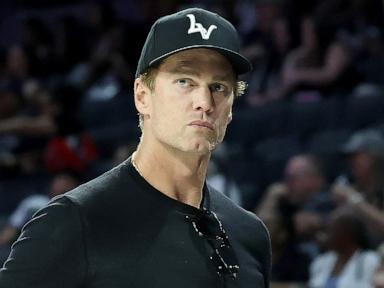
At least one in four NFL players has CTE when they die, according to a new study that examined the brains of former pro players. CTE is a brain disease thought to be caused by years of sustained head trauma and can only be diagnosed after an autopsy of the brain. Amna Nawaz spoke with Dr. Chris Nowinski of the Concussion and CTE Foundation, and a co-author of this study.
Michael Coats Jr. of the Cleveland Browns tackles Ray Davis of the Buffalo Bills during a preseason game on August 22, 2026. | Nick Cammett/Getty Images
This story appeared in Today, Explained, a daily newsletter that helps you understand the most compelling news and stories of the day. Subscribe here.
Football season kicks off soon, and there’s an elephant on the field. Not the University of Alabama’s pachydermal mascot, alas — but a new study on the incidence of brain injury in football players.
The startling paper, published this morning in the journal BMJ, examined the brains of 235 of the 878 former NFL players who died between 2016 and 2021. It found that at least one in four of those players — and, in all likelihood, many more than that — had chronic traumatic encephalopathy (CTE) at their time of death.
CTE is an ugly disease. It’s a progressive, degenerative brain disorder caused by repeated blows to the head. It can be debilitating in its advanced stages, with symptoms including memory loss, confusion, depression, erratic behavior, and personality changes.
Researchers have long linked CTE to the recurrent head trauma common in football and other contact sports. But this study offers one of the clearest estimates yet of just how widespreadthe disease is. It’s not a freak occurrence confined to an unlucky few — it’s a significant occupational hazard, akin to black lung disease in coal miners.
Federal regulators have intervened to protect coal miners and other people in hazardous jobs, of course — but they’ve stayed on the sidelines when it comes to sports. Football is an American institution, after all. And regulators have few obvious ways to make the game safer.
Last year, the Trump administration also advanced a claim that, in my mind, gets straight to the heart of the moral dilemma of being a football fan. The Occupational Safety and Health Administration proposed formally excluding from standards enforcement hazards that are “inherent and inseparable from the core nature of a professional activity.” (That proposal has not been finalized yet.)
Is danger inherent to the “core nature” of football? And, if it is, how do fans reconcile their love of the sport with the substantial harm that it inflicts?
“Part of what makes football interesting is that it refuses to resolve itself morally,” the cultural critic Chuck Klosterman told Vox earlier this year. “It doesn’t let you land comfortably on one side or the other.”
Klosterman, who recently published a book about football, is one of these people who believes that danger is inherent to the sport: Remove it, he said, and the stakes diminish — the whole game gets less meaningful.
At the same time, football arguably does a lot of good, too: It creates shared rituals and civic pride; it gives millions of people a sense of belonging in an otherwise atomized world.
So where does that leave fans? Somewhere uncomfortable, I suppose. But we can draw a couple practical conclusions: Kids should not play tackle football. And both the NFL and college football programs should keep working to improve helmets and cut down on contact, especially in practices.
One link for later
➨ Treat yourself to a PSL. Yep: It’s (somehow, already) that time again. Since Starbucks debuted the divisive seasonal beverage in 2003, it’s become “a straw man for discussions about capitalism, seasonal creep, and the meaning of ‘basic.’”
Before you go…
Did you know…that humans’ closest invertebrate relative is the lowly sea squirt? As one biologist put it to Vox: “They just decided to take a different route on evolution.”
Today’s trivia: What is the state bird of Minnesota, recently embraced by anti-ICE protesters as a popular symbol of their movement? (You can find this and other brain puzzles in Vox’s daily crossword. Look for the answer in tomorrow’s edition.)
Yesterday’s trivia: Yesterday we asked you for the traditional, three-letter nickname for students and graduates of Yale. That would be “Eli,” as in “Elihu Yale” — the wealthy 18th-century merchant whose donations helped found the school.
When the NFL season kicks off next month, millions of Americans will gather around their televisions to watch athletes of comic book proportions crash into each other at breathtaking speeds. Inevitably, those players’ heads will smash into each other, leaving them dazed on the field. And according to a major new study, these repeated head-on collisions may eventually lead to a degenerative brain disease for many — if not most — of the players long after they’ve left the field.
For years now, America has been reckoning with the tension between its love for football and the growing evidence of its dangers. Those concerns can be boiled down to three letters: CTE, or chronic traumatic encephalopathy, which is the progressive brain disease that can lead to dementia, depression, suicide, and other serious mental health problems.
One major question over the past 20 years has been: Exactly how often does playing football lead to CTE? What are the risks for peewee players versus pros? How quickly does the brain deteriorate once the disease takes hold? And new research, published this week in BMJ, has provided us with some staggering answers. After analyzing the death records for hundreds of former NFL players, the co-authors concluded that at least 25 percent of the former players who died between 2016 and 2021 had CTE at the time of their death.
And the actual prevalence could be much higher, but more players’ brains would have to be given over to scientists for a CTE assessment for us to know for sure. Because among the 338 players whose brains were donated and studied, the CTE rate was an astonishing 93 percent. The question is, according to the researchers: Is that percentage skewed because the players exhibiting CTE symptoms were more likely to offer up their brain for research? Or, as the authors suggest is possible, is the real CTE rate closer to 90 percent? Only further research will be able to tell us, but even the latest estimate — one in four — is cause for concern.
It’s a stark reminder of football’s risks, delivered right on the cusp of a new season for pro, college, and high school teams around the country. And according to the Aspen Institute’s annual State of Play report, there are signs that the game’s future may actually be at risk.
More and more American parents are steering their kids away from tackle football. How long can an elite league like the NFL last when the pool of players is getting smaller and smaller — at the same time the scientific evidence of its dangers is becoming clearer and clearer?
The youth football pipeline is drying up
Despite the latest research, the NFL is going to be fine in the short term. Professional football is the biggest TV show in the country: Last year, 83 of the top 100 rated TV shows were NFL games, up from 72 in 2024. The next Super Bowl will almost certainly attract more than 100 million viewers and end up the single most-watched TV program in the US for the whole year. Football is one thing that transcends politics in an increasingly polarized America.
But with each new piece of evidence about the physical and mental costs of playing football, football’s long-term dominance looks less and less certain. Already, if you dig into the trend lines for youth participation, they reveal a real threat to the sport’s future.
Let’s start with the good news for football enthusiasts: Flag football has become more and more popular among kids, supported by investments and promotion by the NFL itself and expert consensus that it’s much safer than tackle, especially when it comes to head injuries. According to the Aspen Institute’s State of Play survey, flag football participation among kids ages 6 to 12 grew by 13.6 percent from 2019 to 2024, while tackle football play dropped 7 percent among the same age group over that time.
But it’s participation among the next age group that may be most revealing. According to the Aspen Institute, tackle football participation rates among Americans ages 13 to 17 — the prime age for middle school and high school teams — decreased 9 percent from 2019 to 2024. It has even fallen behind tennis among the teenage cohort. Many of the tweens who play flag football may never strap on a helmet to play tackle.
Even if fewer kids play tackle football year over year, the sport may still subsist on its promises of upward mobility for people who come from poorer backgrounds. With the recent introduction of compensation for college players, elite athletes can make millions of dollars in income before they even reach the NFL. It may be no surprise, then, that the young people still playing tackle football are more likely to be lower-income and live in conservative states.
Another study found that Black and Hispanic parents, who on average earn less money than their white counterparts, are more likely to see football as a path to college scholarship or even a professional career; the Washington Post reported in 2023 that the proportion of white players at the college level is falling while the percentage of Black players is rising. Football players are often thought of as modern gladiators: participants disproportionately from lower classes aspiring to riches and glory in a violent game for the viewing pleasure of the general public. That’s becoming more and more true as we learn more about its dangers.
As the annual hoopla around the NFL kickoff makes clear, football’s cultural dominance remains unrivaled among professional sports. But this new study has left even me, a lifelong football fan, wondering how much longer it can, and should, last.
Indiana Fever players Caitlin Clark, left, and Sophie Cunningham, right, during a WNBA game against the Atlanta Dream on August 16, 2026, in Atlanta, Georgia. | Rich von Biberstein/Icon Sportswire via Getty Images
On the court, the WNBA is thriving. After 30 years, its players are receiving a historic payout, along with a massive TV distribution deal that will mean more games, and hopefully even more fans. But off the court, all that attention has some downsides. Most recently, it means that the culture war has come for the WNBA.
Specifically, the league has found itself at the center of a debate over transgender athletes and women’s sports, one that Indiana Fever guard Sophie Cunningham ignited last month.
Cunningham, 30, has gained a reputation as an “enforcer” for her All-Star teammate, Caitlin Clark. In July, she told ESPN that “I think that I am here to extend love, but I also think that with love is truth, being honest. And I want to protect young girls in a locker room or young girls in sport who shouldn’t have to go against biological men.”
No known trans athletes have ever played in the WNBA, but that hasn’t much deterred pundits from weighing in. It’s the latest instance of the WNBA playing a central role in conversations about race and gender — even as most of the outrage is happening outside the court, while players and coaches would rather focus on basketball.
To get a better sense of what’s going on in the league — and why — Today, Explained co-host Noel King spoke with Ringer staff writer Seerat Sohi, who covers the NBA, WNBA, and women’s college basketball, about why the WNBA can’t seem to escape the culture wars.
Below is an excerpt of their conversation, edited for length and clarity. There’s much more in the full podcast, so listen to Today, Explained wherever you get your podcasts, including Apple Podcasts, Pandora, and Spotify.
What is it about the WNBA ?
The WNBA is a league that invites, frankly, a lot of distraction, both because of its own institutional failures — I do think the WNBA really struggles at telling its own story and has at times run away from its own story — but I think in general, the WNBA has become fertile ground for the culture wars, as we put them, because the league has exploded in popularity at the same moment in the country where we are embroiled in this cultural, political, legal fight over what the role of women is in society.
Let’s break this down to the two pieces you mentioned. You referenced institutional failures. What do you mean?
The WNBA, from the top down, has been understaffed, and it has historically been marketed in a way that is obsessed with trying to bring in some apocryphal average American, the nuclear family. And at the same time, this has been a league that has been defined by people who have historically existed on the margins. They are female athletes at a time when historically female athletes were not paid much attention to, and in fact were mocked.
It’s the league that is primarily Black, that is openly queer, that is politically outspoken. And the league has always tried to toe the line of marketing the faces that feel more like a girl-next-door type of vibe.
To the point that early on, we can look at, for example, Sue Bird, who, when she entered the league [in 2002], was encouraged to not come out.
And if you look back at pictures of her, she is dressed in a way that not only is it feminine, but it is also not the issue. The issue is that she’s very clearly uncomfortable in her own skin. Diana Taurasi, whose jersey was just retired — if you look back at her awards, it’s the same thing.
Fast-forward to 2026, these are queer icons who are highly marketable in the media environment that we are in right now, but the WNBA has always been behind the eight ball in that regard because it has run away from its identity.
So by institutional failures, what we mean is maybe a lack of bravery or a lack of spine. You also said this exploded because the WNBA is of great interest at this moment to right-wing figures. What do you mean by that?
The right cares about the WNBA in the same way that it cares about who becomes a Disney princess. It understands the power of a good story. It understands symbolism. To see women on that stage thriving, to see them sweaty, to see them wanting, to see them be the main character instead of the object of somebody else’s affection or interest, to see them be the subject and be the ones that are going for something as opposed to being on the sidelines.
That in and of itself alone is very, very powerful. And then you think about where the WNBA is politically. This has always been a league that has been very outspoken. This is a league that in 2020 helped flip a Georgia Senate election and actually ousted their then-owner of the Atlanta Dream who spoke out against the Black Lives Matter movement.
I always understood the WNBA to have a smaller fan base. But the situation with Sophie Cunningham has made me realize it is much larger and much more middle-of-the-road than I would have thought. Did something change recently? Did the fan base of the WNBA grow?
[Indiana Fever All-Star] Caitlin Clark was an explosive figure. Caitlin Clark was really a gateway drug for WNBA fans. The sheer amount of eyeballs that she has brought to the game, the attention, her logo threes. She is the type of player that makes children out of all of us. And then there’s also this right-wing movement that has latched onto her as a symbol.
Why is that? For someone who doesn’t watch many games, what’s going on?
Caitlin is white and straight. That is a demographic that I guess you could say is maybe underrepresented in the WNBA. And there was a feeling when she came into the league that she wasn’t welcomed in the same way that maybe other stars in the past have been. There was a sense that maybe there was some resentment.
Now, I don’t know if that’s true. I would imagine, look, these are human beings that we’re talking about. There was probably a spectrum of feelings when you think about it. This was a league that didn’t have charter flights. Caitlin Clark comes in, they get charter flights.
Now, obviously that’s great for the players, but I also think that there was a feeling of, “Oh wait, the WNBA could have done these things that we’ve been advocating for for a long time. Now they’re finally listening because Caitlin is here.”
She is, ironically, an organic phenomenon that is bringing to light the manufactured failures of the WNBA in the past.
Caitlin Clark goes to the WNBA. The WNBA grows its fan base to include people who traditionally were not watching. And then what is the leap from that fact? More people at games, more eyeballs on games. More eyeballs on players, to a conservative movement seizes upon the WNBA and says, “We’re gonna make something out of this.” How did you see that play out?
It started with the 2023 college national title game, when Caitlin was still in college. And she went up against Angel Reese from LSU. LSU won that game. And after the game, Angel Reese did the “You can’t see me” taunt by John Cena, and it was actually something that Caitlin did [previously] in the Elite Eight. It was taken as trash talk. Angel then repeated that symbol to Caitlin after they won and pointed at her ring.
In the aftermath of that, Angel Reese was called all kinds of things by not only conservative commentators — a lot of this was conservative commentators, but you also had people like Keith Olbermann, who’s a former SportsCenter anchor and probably somebody who’s a little bit more in the middle of the road, calling her classless.
I think a lot of the WNBA fans took those things to be dog whistles, that it was a form of racism. And there was also just overt racism. There were just words that you and I would not say and would not repeat here that were thrown at Angel Reese, who has also dealt with a lot of vitriol since that moment.
That moment changed both of their lives, frankly. And that was really the inciting incident. From then on, I think that there were a lot of people in the new media landscape that recognized that the WNBA was a fault line for a lot of our modern discourse in America.
It is a league that you can use as a proxy to talk about race, gender fluidity, femininity, DEI, labor politics. It is probably the most modern American league that we have.
And if you look back at the history of sports, I think Americans have always used sports as a proxy to talk about things that aren’t actually about the sport. And the WNBA is really just the latest vessel of that.
FIFA President Gianni Infantino looks on after the World Cup final between Spain and Argentina on July 19, 2026, in East Rutherford, New Jersey. | Marvin Ibo Guengoer — GES Sportfoto/Getty Images
The 2026 FIFA World Cup wasn’t perfect, but it was still pretty great. Legions of fans got to experience the US (and Canada, and Mexico), and Americans embraced visiting teams in turn. There was lots of extremely good football (soccer), and Cinderella teams like Cape Verde had a chance to shine.
Not even two weeks later, though, FIFA president Gianni Infantino is doing his best to kill the good vibes. He has a new proposal to sell stakes in the World Cup to private equity, attempting to capitalize on an enormously profitable tournament — with record revenue of about $15 billion in this year’s edition.
Specifically, his plan would create a new entity to run the World Cup, with FIFA the majority owner. Up to 21 percent of the company would be offered to private shareholders, in a major departure from FIFA’s current, ostensibly non-profit model.
And so far, nearly everyone hates it. Many of FIFA’s 211 member associations are in outright revolt; one of its six regional confederations, UEFA, which represents European football, has threatened to boycott FIFA events if the plan goes forward. “We will never lend this model our legitimacy,” UEFA wrote in a statement released Thursday.
Go a little deeper
UEFA is not the only governing body in football that has condemned Infantino’s plan to bring private money into the World Cup, though it has led the charge. Concacaf — which represents North and Central America, plus the Caribbean — and the Asian Football Confederation have also come out against the idea.
Collectively, they make up nearly two-thirds of FIFA’s member associations, which creates a real math problem for Infantino — the plan would require approval from a majority of FIFA members to take effect.
The intensity of the backlash has raised questions about Infantino’s future. As the Athletic reported on Thursday, he’s up for reelection as FIFA president in March, but he may no longer have an easy time of it. On Friday, FIFA’s chief operating officer described the proposal as “the project of one person” — Infantino — in a statement coming out against it.
For now, though, FIFA and Infantino say they plan to forge ahead with a “consultation period” for the plan. It sets up an even higher-stakes version of the battle over “hydration breaks” — which double as lucrative commercial breaks — that Roger Bennett, founder of the soccer podcast Men in Blazers, described to Vox in June.
“Ultimately,” Bennett told Vox, “the whole game of football is currently in a battle between its roots and the commercial imperative that comes from being as big as it is. … It is the last megaphone which is faintly audible around the world. And when you have something that big, it becomes deeply desirous to make as much money as you can out of it.”
One link for later
➨ Bail on plans the right way. If you’re currently staring down a weekend engagement you’d rather not attend, Vox’s Allie Volpe has some pointers on canceling without injury or offense. For starters, you can only bail on casual events with someone you either know very well or not that well at all. And you should offer an honest excuse before attempting to reschedule.
Before you go…
Did you know…that, until 2016, scientists routinely excluded female mice from medical research? The National Institutes of Health now requires that researchers include both sexes to help guarantee that drugs work safely for both men and women.
Today’s trivia: What’s the Vietnamese word for “festival”? (You can find this and other brain puzzles in Vox’s daily crossword. Look for the answer in tomorrow’s edition.)
Yesterday’s trivia: Yesterday we asked you to identify the “ugli” fruit. Ugli is the registered trademark for the Jamaican tangelo, a natural — and honestly, perfectly good-looking — hybrid that was discovered in the wild in the early 1900s.
This story appeared in Today, Explained, a daily newsletter that helps you understand the most compelling news and stories of the day. Subscribe here.
 Login
Login