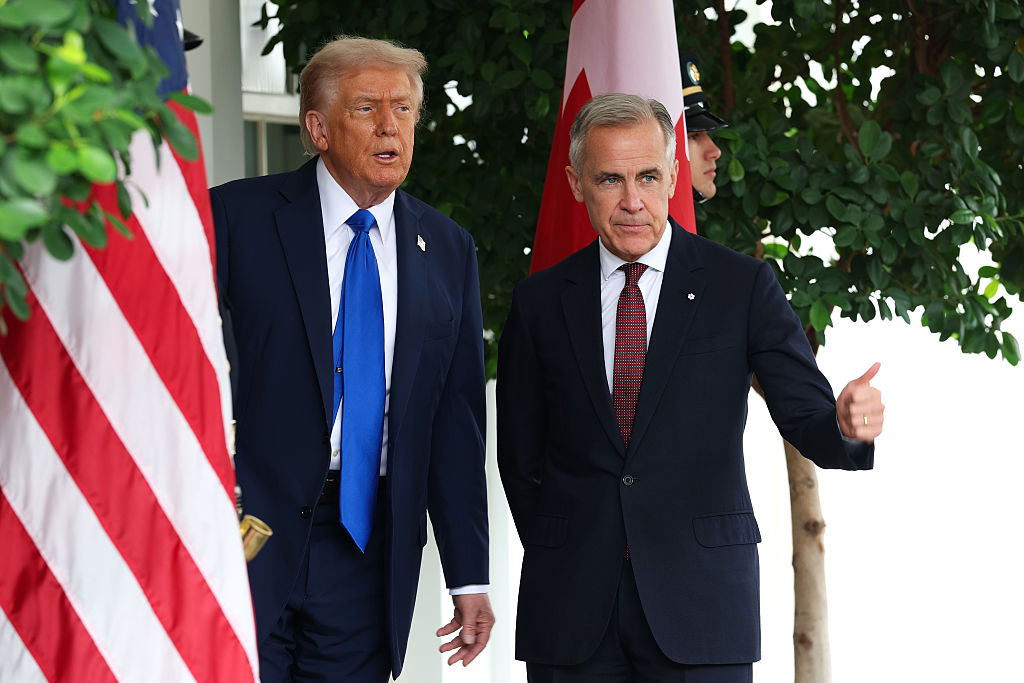
Dominic LeBlanc, Canada's minister in charge of trade with the United States, exits the office of U.S. Trade Representative Jamieson Greer after a meeting in Washington, D.C., on Aug. 20, 2026. —Mandel NGAN—AFP
Trade talks between the United States and Canada collapsed Friday. With President Donald Trump’s 50% tariffs taking effect the following day, Prime Minister Mark Carney quickly responded with retaliatory measures that go into effect in September.
U.S. Customs and Border Protection sent out guidance for importers saying that the tariffs, which Trump first announced last month, would go into effect Saturday. They impact about $20 billion of Canadian goods, including hockey sticks, building materials, clothing, beer, and cheese.
Negotiators from both countries had worked for weeks to reach a trade deal, leading up to a three-day extension of the original tariff deadline. At the time, Trump suggested that an agreement had been reached, writing on Truth Social on Tuesday that he had “paused” the tariffs because the two countries “have a DEAL!”
But in a statement just before midnight on Friday, Carney said that “progress has not been enough to meet our objectives for Canadians.”
“As a result, this evening, I have decided to suspend trade negotiations with the U.S. and have directed Canada’s negotiators to return to Ottawa,” the Prime Minister said. He accused the Trump Administration of introducing last-minute changes to the deal that he said were “unfair, uneconomic, and called into question the reliability of any deal.”
Following the collapse of the negotiations, Trump took to Truth Social on Sunday and said that Canada “wants the benefits of being a State, without being one” and that it has “also charged our great farmers, for many years, massive amounts of Tariffs. No more!!!”
It’s unclear what Trump meant in his latest tirade, though the U.S. President has previously floated the idea of making Canada the U.S.’s 51st state.
U.S. Trade Representative Jamieson Greer said on social media on Saturday that Canada had “declined to finalize the trade deal under the terms agreed earlier this week.”
“New demands and walk backs of other commitments by Canada have upended the careful balance reached in the past days,” Greer said. “This is a missed opportunity for Canada to partner with the United States.”
Carney vowed that the tariffs would not go unanswered. Speaking at a news conference Saturday, he announced dollar-for-dollar tariffs on U.S. goods.
“We cannot accept what they have offered, and we will not give what they have asked,” he said.
The retaliatory tariffs will touch U.S. sectors including steel, dairy, appliances, agricultural equipment, pulp and paper, and electronics, and they will go into effect Sept. 8.
The growing rift between the U.S. and Canada
Polling conducted before the talks collapsed suggests that most Canadians supported taking a hard line in negotiations with the U.S.
An Angus Reid Institute poll from July found that 65% of Canadians say that their government should approach the U.S. either cautiously, as a potential threat, or as an enemy.
Reflecting similar sentiments, a Léger poll from this month showed that 56% of Canadian respondents want the federal government to make no further concessions to Washington in ongoing trade and tariff negotiations—compared to 31% who favor flexibility.
While the new import taxes will only apply to about 5% of what Canada ships to the U.S. each year, the breakdown in negotiations further fractures an already strained relationship between the two countries and their leaders. Trump and Carney have taken swipes at each other since the U.S. President returned to office last January.
After an article claimed that the country was in a “technical recession” this summer,Trump revived his call to make Canada the 51st state in the U.S.
Carney then mocked Trump at a housing policy event in Toronto on Aug. 5 when his teleprompter stopped working.
“Unlike a certain world leader, I do not view this as a conspiracy,” Carney told reporters, referencing Trump's claims of “sabotage” after a teleprompter malfunctioned during his address at the United Nations General Assembly last September.
Later that day, Trump called Canada’s leadership “nasty” during an event at Red Rock Casino Resort in Las Vegas as trade negotiations were ongoing.
"Yes, it's a tough negotiation,” Carney said in response. “You can change the adjective and say 'nasty,' but for Canada it's a question of Canadian jobs, it's a question of the future of Canadian enterprises.”
With negotiations suspended and matching tariffs on the way, the rift has moved beyond rhetoric into a widening trade war.
Attendees at a Trump rally in Racine, Wisconsin, on June 18, 2024. | Scott Olson/Getty Images
It’s the Democrats who have mostly had to answer questions about electability this midterm season, but why are there so few questions about the “E” word for the other side?
Gas prices are still skyrocketing. A number of Republican candidates, such as Ohio Rep. Max Miller and former Texas Attorney General Ken Paxton, who’s running for a Senate seat, are mired in scandal. The Iran war was unpopular from the start, but it is getting even less popular as it drags on. And Trump’s approval rating recently hit 33 percent, the lowest of his presidency yet.
On this week’s episode of America, Actually, host Astead Herndon speaks with one of Trump’s most vocal defenders, conservative influencer CJ Pearson, about whether we’re seeing Trump’s brand slip even among his supporters and the young people who helped him win in 2024, and how that could affect the midterm elections.
Pearson, a conservative content creator and influencer, first went viral when he posted himself, then 12 years old, criticizing Barack Obama in a YouTube video. Now 24, Pearson is one of MAGA’s most prominent Black voices.
In this episode, Astead and Pearson discussed how Republicans should answer questions about whether voters’ lives are better than they were two years ago; whether Trump still has any cultural cachet left over from his last presidential campaign; and when Pearson started to see young Republicans turning away from the MAGA movement.
Below is an excerpt of Astead’s conversation with Pearson, edited for length and clarity. There’s much more in the full show, so listen to America, Actually wherever you get your podcasts or watch it on Vox’s YouTube channel.
That “E” word’s been thrown around a lot about Democrats, but we want to think about how Republicans are on their own. If you could rate Donald Trump’s second term one through 10, what would you give it?
I think the president’s doing incredibly well for the American people. Promises made, promises kept in many ways.
I think if you look at this president who ran on securing our southern border, he’s done it. You look at this president who’s talked about bringing down costs, he’s brought down the cost of dairy, eggs. He’s achieved that.
And I think also this president is only just getting started. He ran on “no tax on tips.” He did that. He ran on “no tax on overtime.” He did that. Oftentimes I tell people the challenge of this administration is keeping up the messaging at the same pace as the accomplishments of this president.
And so I think that there’s a lot more work to do. Thankfully, we have two more years to do it.
Can I get a number?
I think he’s doing well. I will say I grew up in a place where there’s always room for improvement, so I’ll give him an eight.
You’re giving him an eight. I wanted to just start there because Trump’s approval rating has fallen, as I’m sure you have seen. Why do you think the country isn’t maybe on the same page as you?
I think a lot of people are focused on their pocketbooks, right? They’re focused on domestic issues, and I think that we have been very internationally focused over the course of the past few months as we’ve navigated and dealt with the Iran conflict.
But I think that as we get ready to get through this last wave of primaries, I think you’re going to see a change in his messaging and a reset at the midterm convention in Dallas next month in September.
And I think you’re going to hear this president talking about how he’s made America more affordable, how he’s kept Americans safe, far safer than they were under President Joe Biden.
And I think that you’ll see those numbers start to change. And a reminder, the only poll that matters is on Election Day. There are many polls that had Kamala Harris beating President Trump, in 2024, and that didn’t happen.
Yeah, I don’t want to be overly poll-reliant, but we’ve heard some of this directly from Republicans even.
We were at Donald Trump’s UFC event in DC talking to young men, and even there we heard people really come to be critical on three issues specifically: tariffs, the Iran war, and the handling of the Epstein files.
You mentioned the question of affordability. Donald Trump has said, quote, “I love the inflation.” And when asked by reporters about the public strain that has come from the conflicts with Iran, he said, “I don’t think about Americans’ financial situation. I don’t think about anybody.”
How can you say that Republicans are gonna run on affordability if the president’s saying he doesn’t care if Americans’ lives are unaffordable?
Well, I’ve often said that we can’t cede this entire affordability debate to the Democrats. The reason that I think a lot of young people are giving a little bit, even a flirtatious nod to the DSA and their socialist and communist candidates, is because they’re talking about an issue that’s top of mind for them.
In the same way that when President Trump won in 2024, he was talking about issues that were top of mind of the American voter, which was the cost of living.
And so I think that we need to get back to that messaging. I think that this president has continued to deliver on that front. Costs are coming down.
The economy is resurging. We’re seeing economic and global investment in this country unlike anything we’ve seen before. In Oklahoma, we’re bringing back manufacturing with the aluminum smelting plant.
But the president’s not saying this. The president’s saying, “I love the inflation, and I don’t think about Americans’ financial situation.” Do those words help Republican midterm candidates?
Well, I think the president has a lot of time to say a lot more things because Election Day is pretty far away from now. I think we have two or three months left, and I think the president will make this case.
But I think what will also make the case is that the candidates that the Democrats are running and nominating all across this country, who are now affiliating themselves with the socialist movement, are not actually fighting for things that will actually ever work.
Socialism has never worked anywhere it’s been tried, and I think that this is going to be an election between common sense versus crazy. Do you wanna run a candidate that hates Thanksgiving?
For the record, that candidate lost in the primary. She will not be on the ballot in November.
She did. She almost was there, though, and that’s the thing. I’m glad common sense won the day in Wisconsin, that the good people there love turkey.
I know that you say that the argument is based on how Democrats are out of touch, but we have talked about some ways in which Donald Trump has not lived up to folks’ expectations, particularly on things like prices and on things like the Iran war.
How does the GOP overcome that electability question? What is their message when folks ask, is their life better than two years ago?
I think we’ve got to lock in. I think we also need to prosecute the case that it’s going to be a lot worse under the Democrats if these crazy communists get into office. And so I think that when you’re looking at costs, we need to make that argument central. We need to make that what we lead with.
And I think that we have to pump the brakes on a lot of the international stuff. And I think that we need to talk about the things that are actually affecting people’s everyday lives at grocery stores, at gas stations, wherever it may be. And I think that is how we can kind of turn the ship around.
When we talk about the Democratic candidates, you’re saying the DSA candidates are far left, and we’ve certainly explored some electability questions for them and some ways that I think they might have stances that are misaligned with the American people. But so does Donald Trump, and he’s endorsed scandal-plagued candidates like Ken Paxton in Texas, like Max Miller in Ohio.
Why is that not just as much a sign of a conservative version of extremism, just as you are arguing that there’s a Democratic or leftist version of that?
Because I think you’re talking about folks who have dealt with issues in their personal lives, not necessarily their voting record.
Okay, maybe I should say Tom Tiffany, who didn’t vote to certify the 2020 election, but I imagine you agree with him.
Well, no, I think that was six years ago. I don’t think about 2020 anymore. I think about 2026 and I think about 2028. So when I look at that … it’s important that we really make the case for crazy communism versus common sense. And I think that the American people are not going to vote for that.
I guess I’m saying, does Donald Trump win the commonsense argument? Like, isn’t crazy versus commonsense an argument that Democrats can make and say Donald Trump is said crazy?
No, because I think Donald Trump definitely wins the common sense argument when we’re running against folks who belong to a party that is now, you know, waging a war against Thanksgiving, who believe that biological men should be playing women’s sports. Again, these are 80/20 issues, and so I actually really like our odds here.
It’s going to be hard, right? It’s always hard for the party that controls the White House to fare all too well in any midterm election. But I think that we’re going to overperform. I think we’re going to hold onto the Senate. The House will be a dogfight, but I like our chances.
Construction of Trump’s East Wing ballroom continues at the White House on August 18, 2026. | Win McNamee/Getty Images
This story appeared in The Logoff, a daily newsletter that helps you stay informed about the Trump administration without letting political news take over your life. Subscribe here.
Welcome to The Logoff: President Donald Trump’s ballroom is still happening.
What’s the latest? On Friday, Supreme Court Chief Justice John Roberts stayed a lower court injunction threatening to halt construction on Trump’s East Wing ballroom, hours before it would have taken effect.
The order came from Roberts alone, and it isn’t final. But the new stay will remain in place “pending further order” (likely, the Court’s full decision), allowing construction to continue for now. It’s the latest in a series of escapes for the project, despite adverse rulings in lower courts.
What have other judges said? Earlier this month, the DC Circuit Court of Appeals upheld a previous district court ruling that Trump had exceeded his authority in unilaterally pursuing the ballroom project and would need to seek congressional approval to continue. (Trump, meanwhile, has attempted to justify the project on national security grounds, describing it as a “Military Complex” and its opponents as “TREASONISTS.”)
Both the appeals court decision and the previous district court decision had been paused, however, to allow the appeals process to play out. That pause would have expired on Friday, but for Roberts’s order.
How far along is the project? Trump has been working fast. According to Trump’s solicitor general, the ballroom was already 65 percent complete last week, standing around 70 feet tall and five stories below ground. Crews have been working on the project nearly around the clock — 20 hours per day, seven days a week.
What else should I know? When the full Supreme Court does weigh in, it could have implications far beyond just the ballroom.
As my colleague Ian Millhiser explained earlier this week, the ability of the plaintiffs challenging the ballroom to bring their case in the first place hinges on the “aesthetic injury” theory of standing, which also underpins a great deal of US environmental law. If the Court clears the way for the ballroom, those laws could go with it.
And with that, it’s time to log off…
Hi readers, happy Friday! If you’re looking for something to do this weekend, you could take my colleague Adam Clark Estes’s suggestion and rescue some of your favorite photos from your phone’s camera roll by printing them out. He explains why it’s worth doing — and how to do it — here (it’s a gift link).
Have a great weekend, and we’ll see you back here on Monday!
Data centers are being opposed by Democrats and Republicans in key 2026 elections. | Sarah Rice/Bloomberg via Getty Images
This story appeared in Today, Explained, a daily newsletter that helps you understand the most compelling news and stories of the day. Subscribe here.
Do the words “data center” make you want to drop everything and call your congressional representative? You’re not alone, if we judge the nation’s mood by the actions of politicians who poll-test what they eat for breakfast (and there are worse ways).
This looks like the week that the data center backlash broke containment and became the defining issue of this political moment.
In the Texas governor’s race, Democrat Gina Hinojosa went up with an ad against Republican Gov. Greg Abbott over data centers with the punchline: “Greg Abbott is selling you out.” In a critical toss-up House race, Rep. Marcy Kaptur (D-OH) launched an attack against her Republican challenger over his support for data centers. Pennsylvania Gov. Josh Shapiro, a likely contender for the 2028 Democratic presidential nomination who had previously touted data center investments, signed an executive order to limit their construction. He also bashed his opponent on data centers in a new campaign ad — a response to the Republican attacking him over those same facilities.
In my home state of Ohio, national Republicans are so worried about data centers damaging Sen. Jon Husted’s reelection chances that they sent a memo this week to top AI companies to warn that they could lose the seat because of the issue. And Mike Rogers, the Republican trying to win the Michigan Senate race for the GOP, went so far as to endorse a moratorium on data center building.
Go a little deeper
In one image, this is why politicians are screaming at anyone who will listen that they loathe these data centers just as much as you do and want to stop Big Tech from building any more. It is a stunning turnaround: The percentage of Americans who “strongly oppose” a data center being constructed in their area has more than doubled in a single year.
As Molly Taft documented in a recent feature story for Wired, the relationship between the ubiquitous data-center backlash and the fears about AI is becoming hard to ignore: Most people still say they oppose data centers even when they don’t live anywhere near one, and most people opposed to data centers are also more likely to be skeptical of AI. And those sentiments are clearly bipartisan, which is why you have a Democrat and a Republican in the Michigan Senate race striking the same tone on data centers.
The merits of both sides in the data-center debate are probably more nuanced than the political slogans popping up around it. But this phenomenon is clearly about something bigger than the brick-and-mortar buildings that have become these political boogeymen. As Marina Bolotnikova put it in a story for Vox earlier this summer: Americans don’t know how to fight AI. So they’re fighting data centers instead.
And now the politicians are following their lead.
One link for later
➨ Print your photos like it’s the 1990s. When everybody carries a camera in their pocket and snaps candids as casually as taking a sip of water, it’s easy to become jaded about all those pictures. Don’t be. The best way to appreciate them, Adam Clark-Estes argues in his latest piece on living in our tech-dominated world, is to print those images out like you did a few decades ago. Cherish your memories by holding them in your hands.
Before you go…
Did you know…Cuba has more than twice as many doctors per capita as the United States? But that hasn’t stopped the island nation’s healthcare system from deteriorating to the point of crisis, as Ananya Rupanagunta writes for Vox.
Today’s trivia: What’s the insect stage after larva? (You can find this and other brain puzzles in Vox’s daily crossword. Look for the answer in tomorrow’s edition.)
Yesterday’s trivia: Yesterday we asked you for the name of the Survivor contestant who holds the franchise’s record for most appearances. That would be Cirie Fields, who appeared on six seasons between 2006 and 2026.
President Donald Trump takes a question from reporters during an event in the Oval Office of the White House in Washington, D.C., on Aug. 10, 2026. —Anna Moneymaker—Getty Images
President Donald Trump announced on Friday that he has coordinated a new deal to lower beef prices in the U.S.
“Today, I concluded a deal to substantially lower the price of ground beef for working American families,” he said in a Truth Social post. “For the next 90 days, the United States will allow up to 300,000 metric tons of product for ground beef to be imported with no out of quota tariff. We have a commitment that this beef will be sold at 25 percent below current market prices.”
“This deal will reduce prices for Americans while giving space for our Great American Beef Herd to grow again,” he continued.
An “out of quota tariff” is a higher tariff that is triggered if the amount of a product imported into the U.S. exceeds a certain quantity.
It’s unclear who the deal is with or which countries will be importing the beef into the U.S. A White House official told TIME that Trump secured an agreement with foreign beef exporters to sell beef at a 25% discount, which will be passed on to American consumers, in exchange for Trump lifting the out of quota tariff on lean beef trimmings that will be used for ground beef production. The White House official added that the President plans to sign an Executive Order regarding the deal within the next couple of weeks.
Both Trump and the White House official cited the soaring price of beef as the motivation behind the new deal. Last month, the average price of ground beef for American consumers was about $6.885 per pound—a jump of roughly 57% from just five years earlier, according to data shared by the Federal Reserve Bank of St. Louis. The price of uncooked ground beef went up by 9% in July, compared to the same time last year, according to data released by the U.S. Bureau of Labor Statistics last month.
Beef prices have skyrocketed in large part because of supply shortages: American cattle herd sizes are at a low not seen in years, even as consumer demand for beef remains high in the country.
The American Farm Bureau Federation reported last month that, while the total cattle inventory went up a bit at the start of July for the first in eight years, the beef cow herd dropped to 28.5 million head, decreasing by about 1% compared to the same time last year, making it the “smallest July inventory on record,” with data dating back to 1973. Experts attribute the pressure on herds largely to droughts driven by climate change.
The deal that Trump announced on Friday isn’t the first time his Administration has made efforts to try and address the soaring price of beef for consumers. The President also signed an Executive Order earlier this year aimed at increasing the amount of lean beef trimmings imported from Argentina by 80,000 metric tons per year.
Experts, however, cast doubt on whether boosting beef imports from Argentina will be effective at lowering the cost on Americans, saying that the boost in imports would make up too small a portion of the overall supply in the U.S. to have a significant impact. And the cattle industry has objected to such efforts in the past, expressing concerns that those moves would undermine producers within the U.S.
Colin Woodall—the CEO of the National Cattlemen’s Beef Association, a trade association for cattle farmers and ranchers—said in a statement on Friday that he was “disappointed” by Trump’s announcement.
“While America’s cattle producers share the goal of keeping groceries affordable for consumers, flooding the market with government-subsidized, below-market beef is not the way to rebuild the American cattle herd,” Woodall said. “We are already working to rebuild after years of ongoing drought, high input costs and other challenges that have reduced U.S. cattle numbers. Today’s announcement and other market interventions throw cold water on the prospect of herd expansion and sacrifices long-term stability for short term messaging.”
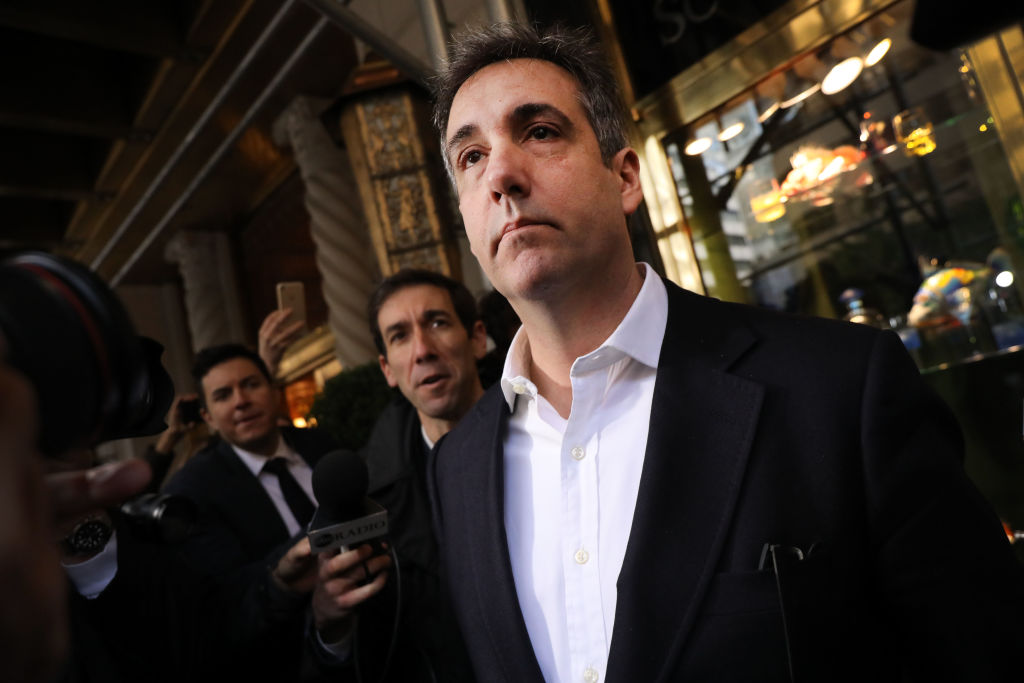
Michael Cohen, the former personal attorney to President Donald Trump, departs his Manhattan apartment for prison on May 6, 2019. —Spencer Platt—Getty Images
President Donald Trump on Thursday buried the hatchet with his former attorney Michael Cohen, appearing on Cohen’s radio show in what was the first public exchange between the two men in eight years.
Trump and Cohen have a tumultuous history. Cohen worked as Trump’s personal lawyer dating back to the mid-2000s. But he severed ties with Trump around 2018, when he pleaded guilty to federal crimes, including campaign finance violations, and said he had made payments to two women at Trump’s direction in an effort to keep them from speaking publicly about alleged affairs with the then-presidential candidate. He went on to serve a three-year sentence following his guilty plea. Cohen later made a number of explosive claims about Trump in testimony in front of Congress, and served as a key witness in the criminal hush money trial that resulted in Trump’s conviction on 34 felony counts.
“You and I have obviously traveled a pretty rocky road together,” Cohen said to Trump on his radio show 77 WABC-AM in New York on Thursday. The program will air in its entirety on Sunday.
Trump did not dwell too much on the past during the portion of the show that aired on Thursday, but voiced sympathy and appreciation for Cohen.
"They weaponized you like nobody's ever been weaponized, like few have been," Trump told his former lawyer. “They weaponized a lot of people, and I respect the fact that you recanted everything you said. And that’s a big — that’s a big thing that you did. That’s a very big thing.”
The men’s conversation also criss-crossed through a range of other topics related to Iran, the economy, and Democrats.
Cohen appeared on CNN ahead of the airing of the program and commented on his relationship, and conversation, with Trump.
“How is it possible after all of what took place? All of the name calling, the years of the public war, the verbal missiles that we threw at one another. How is it possible that the two of us can ever sit down again?” Cohen told CNN anchor Jake Tapper. “The answer is that we forgave.”
When asked to define the current state of his relationship with the President, Cohen remarked, “it’s being resuscitated.”
Cohen was also pressed on whether he has asked Trump for a pardon.
“I have not,” Cohen first responded. But he went on to clarify that he did submit a pardon application to President Joe Biden, which he later altered after Trump took back office.
“What I did is I took that same application with the same documentation, and I just rewrote the cover letter, removing the name of President Joe Biden and inserting the name President Donald Trump,” Cohen said.
Cohen also took to his Substack on Thursday to speak about making amends with Trump, which he said made people “furious.” Referencing the Bible, Cohen asserted that Colossians 3:13—a passage that reads, ”Forgive as the Lord forgave you”—was the “foundation” of what transpired between him and Trump.
“We forgave,” Cohen wrote. “Forgiveness doesn’t require amnesia. It requires the courage to stop allowing yesterday to dictate tomorrow.”
Cohen’s remarks ring in stark contrast to previous words he has offered about the President.
In 2019, after pleading guilty, Cohen was called by the House Oversight and Reform Committee to further detail his role as Trump’s attorney and said Trump “is a racist. He is a conman. He is a cheat.” When asked how many times Trump had asked him to threaten an individual or entity on his behalf, Cohen responded that Trump had done so on over 500 occasions throughout their professional relationship.
The following year, Cohen published Disloyal: A Memoir: The True Story of the Former Personal Attorney to President Donald J. Trump, a 432-page tell-all about the years he spent as Trump’s lawyer and fixer.
“I knew Trump better than anyone else did,” Cohen wrote at one point in the book. “I knew him better than even his family did, because I bore witness to the real man, in strip clubs, shady business meetings, and in the unguarded moments when he revealed who he really was: A cheat, a liar, a fraud, a bully, a racist, a predator, a con man.”
And in 2024, Cohen was the prosecution’s main witness in Trump’s criminal trial over charges of falsifying business records related to hush money payments made to Daniels when Trump was running for President for the first time in 2016.
“What I was doing, I was doing at the direction of and benefit of Mr. Trump,” Cohen said on the stand in 2024.
Demonstrators outside the US Supreme Court in Washington, DC, on October 15, 2025. | Eric Lee/Bloomberg via Getty Images
On Tuesday, a federal appeals court struck down a South Carolina law that permits all voters over age 65 to vote by mail but allows younger voters to do so only if they meet a set of specific criteria. The United States Court of Appeals for the Fourth Circuit’s decision in Grant v. Belangia held that the state’s law violates the 26th Amendment.
But three different federal appeals courts have now splitthreeways on how to read it, which makes it likely that the Supreme Court will have to step in soon and determine, for the first time, what a relatively new constitutional amendment actually means. And if that happens, it will have significant implications for the increasingly partisan war over how difficult it should be to vote by mail.
Key takeaways
The Supreme Court has never interpreted the 26th Amendment, which limits age discrimination in voting.
Three courts, however, have now split on whether it allows states to make it easier for older voters — and only older voters — to vote by mail.
This issue has significant partisan stakes because Democrats are more likely than Republicans to vote by mail.
The Fourth Circuit’s opinion in Grant holds that the 26th Amendment prohibits “unequal allocation of voting access based on age,” and thus, if elderly voters can vote by mail, younger voters must be allowed to do so as well. Both the Fifth and the Seventh Circuits, which previously ruled on similar challenges to Texas and Indiana absentee voting laws, disagree with this view.
The question of whether states may have different absentee voting rules for older voters first flared up in 2020, during the Covid-19 pandemic. Many voters were afraid to go to the polls, for fear that they might become infected if they voted alongside others in an indoor polling place. And this led to a pair of lawsuits claiming that Texas must allow younger voters to vote absentee, lest they be effectively denied the ability to safely cast a ballot altogether.
Ultimately, however, the Fifth Circuit, which oversees federal litigation out of Texas, rejected the claim that only allowing older people to vote by mail violates the 26th Amendment.
The stakes of this fight have diminished, since few voters are still afraid to physically go to the polls in 2026, but they are still significant. During Covid, many Democrats got in the habit of voting by mail, while President Donald Trump campaigned against mail voting. So Democrats are now more likely to cast mailed ballots than Republicans, and any law that makes it easier to vote by mail is thus likely to benefit the Democratic Party, at least around the margins.
Indeed, the Republican Party understands this imbalance as well as anyone. While Trump spreads false claims that “mail-in voting means mail-in cheating,” his party was busy urging the Supreme Court to toss out thousands of mailed ballots in future elections.
The question in Watson v. Republican National Committee (2026) was whether federal law requires ballots that are mailed prior to Election Day, but that arrive shortly thereafter, to be trashed. The GOP’s legal arguments in Watson were risible — Republicans claimed that it’s actually been illegal to count these ballots since 1845, and they just happened to discover this 181-year-old legal requirement at the exact same time that Trump decided that voting by mail is bad — but it’s notable that Watson was a 5–4 decision despite the implausibility of the GOP’s arguments.
Four justices, all Republicans, would have given their party what it asked for in Watson.
Given these partisan stakes, it’s likely that lawyers from both parties will push the Supreme Court to interpret the 26th Amendment in a way that favors their clients’ interests — with Democrats pushing for an expansive interpretation of the right to vote and Republicans pushing for as many restrictions on voting by mail as possible. And it is equally likely that the Court will have to take up this issue soon, because the justices are especially likely to take up legal disputes that divide federal courts of appeals.
The three-way split on how to read the 26th Amendment
The 26th Amendment emerged from the crucible of the Vietnam War and a draft that conscripted many young people into combat who could not vote. Many of the amendment’s proponents chanted the slogan “old enough to fight, old enough to vote,” and this message swayed lawmakers across the country. According to the Fifth Circuit, the amendment was “approved by Congress in March of 1971 and ratified by June,” making it the “most quickly ratified constitutional amendment in our history.”
The broad initial support for this amendment may explain why there’s been so little litigation over what it means. Pretty much everyone agrees that it permits Americans as young as 18 to vote, so young voters typically haven’t had to file lawsuits to gain access to the ballot.
But the Amendment is also broadly worded, providing that the right to vote “shall not be denied or abridged” based on age — at least for voters who are at least 18. That raises a difficult legal question: What happens if a state does not outright prohibit young people from voting, but it makes it more difficult for them to do so than it does for older voters?
The Fourth Circuit’s answer to this question is straightforward. Grant reads the 26th Amendment as a broad prohibition on age discrimination. If a 70-year-old voter is allowed to cast a ballot in a particular way, then a 19-year-old voter must be allowed to do the same.
As Grant notes, the 26th Amendment’s “denied or abridged” language mirrors several other amendments, including the 15th Amendment, which provides that the right to vote shall not be “denied or abridged” because of race, and the 19th Amendment, which says it shall not be “denied or abridged” based on sex.
Both of these amendments have historically been understood to broadly ban discrimination. A state could not permit white people to vote by mail, but not Black people, nor could it apply a similar regime to men but not women. So that suggests that the 26th Amendment applies a similarly broad ban on age discrimination in elections.
The Fourth Circuit also points to the Supreme Court’s decision in South Carolina v. Katzenbach (1966), which said that the 15th Amendment invalidates “state voting qualifications or procedures which are discriminatory on their face or in practice.” So that also suggests that the words “denied or abridged” should be read to broadly ban discrimination.
Meanwhile, the Seventh Circuit’s decision in Tully v. Okeson (2023) reached a different conclusion. Tully notes that, two years before the 26th Amendment was ratified, the Supreme Court held that laws limiting who can vote absentee “do not themselves deny” voters “the exercise of the franchise,” as voters who cannot vote by mail may still be able to vote by other means.
The Seventh Circuit also pointed to the Supreme Court’s decision in Harman v. Forssenius (1965), which construed the 24th Amendment’s statement that the right to vote “shall not be denied or abridged … by reason of failure to pay any poll tax or other tax.” Harman states that the right to vote is “abridged” when a state imposes “onerous procedural requirements which effectively handicap exercise of the franchise,” and that state election laws are unconstitutional when they impose a “material requirement” solely on people who refuse to pay a poll tax.
Thus, according to the Seventh Circuit, mere discrimination against younger voters isn’t enough to violate the 26th Amendment. A state must impose a sufficiently “onerous” or “material” requirement on them, and Tully concluded that a restriction on absentee voting wasn’t enough if the state also provides sufficient avenues where a voter can cast their ballot in person.
The Fifth Circuit’s decision in Texas Democratic Party v. Abbott (2020) resembles Tully, but with some subtle differences. That Court held that the right to vote is “denied” only if the law “absolutely prohibits them from voting,” and it held that a law “abridges” a person’s right to vote only when it “makes voting more difficult for that person than it was before the law was enacted or enforced.”
To justify this interpretation, the Fifth Circuit points to the Supreme Court’s decision in Reno v. Bossier Parish School Board (2000), which said that “it makes no sense to suggest that a voting practice ‘abridges’ the right to vote without some baseline with which to compare the practice.” Bossier Parish established that, at least in some circumstances, that baseline should be “the status quo” that existed before a state amended its law to insert a provision that is being challenged in court.
So it’s safe to say that the Supreme Court’s past decisions construing the words “deny or abridge” point in several directions. Proponents of the Fourth, Fifth, or Seventh Circuit’s divergent approaches to the 26th Amendment can all find support for their proposed rule in the Court’s precedents. And the Court has never definitively ruled on how to read the words “deny or abridge” as they are specifically used in the 26th Amendment.
That means that, when the justices do take up this question, they have more or less maximal discretion. A justice who wants to read the 26th Amendment expansively will have no trouble finding authoritative sources that they can cite in their opinion, and a justice who wants to limit access to voting by mail will also be able to find plenty of sources that they can cite to justify a narrow reading of the 26th Amendment.
So how is the Supreme Court likely to read the 26th Amendment?
Realistically, this Court is likely to construe the 26th Amendment narrowly. This is, after all, a 6-3 Republican Court.
Indeed, the question of whether states may discriminate in favor of older voters did reach the Supreme Court during the pandemic. After the Fifth Circuit construed the 26th Amendment narrowly in a preliminary ruling in the Texas Democratic Party case, Democrats asked the justices to issue a temporary decision that would have expanded absentee ballot access during the pandemic, but the Court denied the request.
The fact that the Court denied this temporary relief does not necessarily mean that it will embrace a narrow reading of the 26th Amendment once it gives the issue a full hearing. But it does suggest that most of the justices weren’t troubled by age discrimination in absentee voting, even at the height of the pandemic when there were serious concerns that people denied absentee ballots may not be able to safely vote.
The 5-4 vote in the Watson case is also an ominous sign for anyone hoping that the Court may make it easier to vote by mail, as it is difficult to exaggerate just how weak the Republican Party’s arguments were in Watson, but four justices voted to invalidate lawfully cast absentee ballots regardless.
In Watson, the Republican Party claimed that three federal laws setting the date for federal elections, the oldest of which was enacted in 1845, prohibited states from counting ballots that are mailed before Election Day, but that arrive afterwards. States have counted late-arriving ballots since the Civil War, and, as Justice Amy Coney Barrett pointed out in her majority opinion, there are several federal laws that simply assume that states are allowed to decide whether to count late-arriving ballots.
The fact that four justices voted in Watson to limit absentee balloting, despite the fact that the GOP was barely able to articulate an argument for its position, suggests that these four justices would also vote to limit absentee balloting in a 26th Amendment case. So that means that proponents of a narrow reading of this amendment only need to pick up one more vote. And, unlike in the Watson case, there actually are legal arguments in favor of the more conservative position on the 26th Amendment. The Fifth and Seventh Circuits both made plausible, if not exactly airtight, arguments for reading this amendment narrowly.
Still, the Fourth Circuit’s more expansive reading of the amendment is also quite plausible. So it is at least possible that the five justices who formed the majority in Watson could agree with the Fourth Circuit’s reading. Given that the Court has previously said so little about the 26th Amendment, we’re essentially in uncharted territory — on an issue that could potentially shape the outcomes of future elections.
Sailors prepare to assist an F/A-18 Hornet jet for takeoff while steam billows from the catapult aboard USS Theodore Roosevelt in the South China Sea on April 10, 2018. | Ted Aljibe/AFP via Getty Images
This story appeared in The Logoff, a daily newsletter that helps you stay informed about the Trump administration without letting political news take over your life. Subscribe here.
Welcome to The Logoff: The Trump administration’s meddling with the US military is getting more direct — and potentially more dangerous.
What’s going on? Fresh on the heels of coverage last week about the plight of the USS Abraham Lincoln (now on its way home), a flurry of recent stories underscores just how much the Trump administration is micromanaging the Pentagon.
Last week, President Donald Trump directed the Defense Department to overhaul the aircraft carrier mechanism for launching jets — by reverting from electromagnetic catapults to old-fashioned steam catapults.
And on Thursday, the Wall Street Journal reported that the Army is axing its new drone assault battalion, which was established in January. The decision to do so comes from Defense Secretary Pete Hegseth’s new acting chief of staff of the Army, who took over the role after Hegseth forced out its previous occupant this spring.
What’s the context? Neither of these moves seem poised to help the military succeed at its core objectives. As naval expert Bryan Clark pointed out Wednesday in the Washington Post, the catapult switch won’t only limit the next generation of aircraft carriers, but cost an exorbitant amount of money — contrary to Trump’s insistence that steam is “much less expensive” — and delay the rollout of new ships (badly needed, as the Lincoln debacle proves). Trump may also name one after himself.
If possible, the demise of the drone unit makes even less sense. Innovative drone designs and tactics are revolutionizing warfare in Ukraine and elsewhere; being ahead of the curve on these changes has allowed Ukraine to hold its own against a numerically superior opponent.
And it’s very clear that the US hasn’t mastered these tactics yet: As the Journal reported last week, Ukrainian drone operators flattened the US in war games held earlier this year.
Why does this matter? To be clear, Trump is the commander in chief. None of this is beyond his authority as president. But the steam catapults in particular are a strange obsession that would normally be well below his pay grade, and none of it gives the impression of a steady hand at the rudder.
And with that, it’s time to log off…
Here’s some good news from my colleague Constance Grady: The kids might be all right. Or at least, they might be reading more thanks to a new generation of “middle-grade books,” and that’s a step in the right direction. You can read her story about what those are and what’s changing here with a gift link.
Thanks for reading, have a great evening, and we’ll see you back here tomorrow!
A sign displays the national debt at a bus stop in Washington, D.C. on August 20, 2026. | Anna Moneymaker/Getty Images
This story appeared in Today, Explained, a daily newsletter that helps you understand the most compelling news and stories of the day. Subscribe here.
America’s national debt cleared $40 trillion for the first time ever on Wednesday, a number so comically large as to feel imaginary. Seriously — look at it in all of its comma-strewn glory: $40,203,821,194,241. And because the US racks up tens of thousands of dollars of new debt every second, that number was outdated even as I typed it.
On some level, the steady ballooning of the national debt is basic math, familiar to anyone with a budget of their own. The government’s expenses — particularly the costs of Social Security and Medicare — are growing, while successive rounds of tax cuts have reduced the revenue available to cover them. As the government accumulates more debt, it also has to spend more just to cover the interest.
But national debt also functions very differently from household debt, because a government is very different from an individual or family. For one thing, it doesn’t have a set lifespan or retirement age, which means it can roll its debt over indefinitely. For another, government borrowing can boost the economy’s productivity in the future, which changes some trade-offs. Rising national debt isn’t a big deal if the economy is growing alongside it.
That isn’t the case right now, though…and it hasn’t been for a couple of years. America’s debt is outpacing its economic growth, with increasingly tangible consequences for your personal finances.
How the national debt makes your life more expensive
The mechanisms here are a little wonky, but — in short — when the federal government borrows more money, it tends to push up borrowing costs for businesses and consumers. Government deficit spending can increase competition for loans — because the government is now borrowing more in addition to individuals and businesses — as well as prompt investors to demand higher rates on long-term loans and contribute to inflation, which can lead the Fed to nudge rates higher.
As a result, mortgages, car loans, credit cards, and business loans all become more expensive. The Yale Budget Lab estimates that the increase in federal debt over the past decade has added roughly $2,500 a year to the cost of a mortgage on a typical home.
That’s not a trivial amount of money. And over the life of a 30-year loan, it adds up to roughly $76,000, which — if HGTV does not deceive me — is enough for a down payment on a modest lakefront home.
Unfortunately, the solutions for slowing the growth of the national debt are not terribly popular. You could hike taxes, for instance. Or you could overhaul Social Security, which runs $1.38 trillion a year. But few politicians have historically had the stomach for the combination of spending cuts and tax increases that righting this ship requires.
One link for later
➨ Put a price tag on your memories. (Or maybe…don’t?) In the era of super-pricey concert tickets, some fans are shelling out tens of thousands of dollars to see live shows. Vox spoke to one man who’s spent $15,000 on Beyoncé tickets alone. “My mom’s big motto in life was, ‘We’re making memories,’” he said, by way of explanation.
Today’s trivia: Which competitor from the reality TV show Survivor holds the record for most appearances in the long-running franchise — though she’s never actually won? (You can find this and other brain puzzles in Vox’s daily crossword. Look for the answer in tomorrow’s edition.)
Yesterday’s trivia: Yesterday we asked you for Jackie Robinson and Jackie Joyner-Kersee’s shared alma mater. Both trailblazing athletes attended UCLA, albeit 40 years apart.
Tina Peters was convicted of seven counts related to election interference in 2024. Now, she’s fielding an offer from a county that’s become a hotbed of voting-related conspiracy theories.
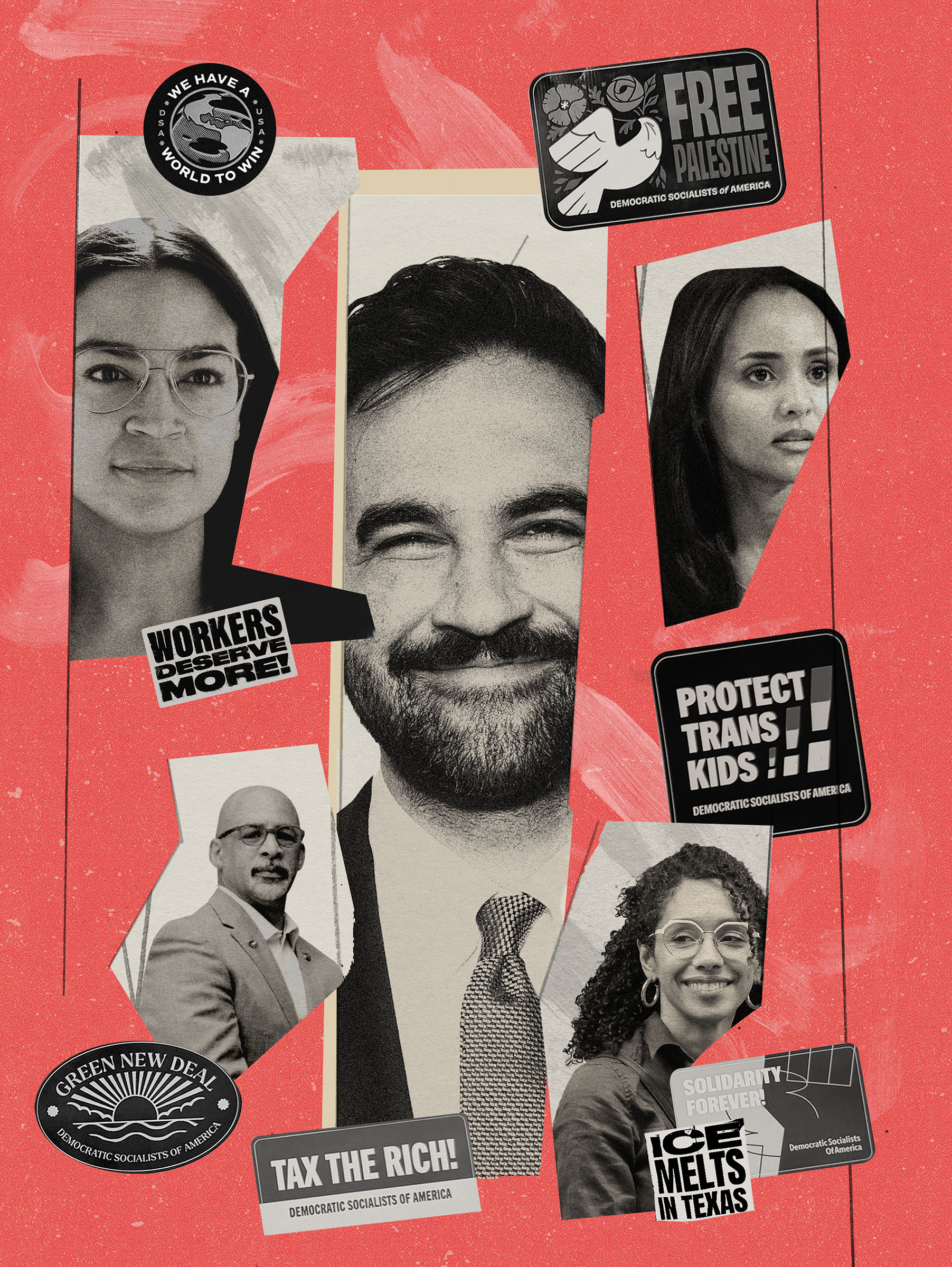
Clockwise from top left: Alexandria Ocasio-Cortez, Zohran Mamdani, Melat Kiros, Darializa Avila Chevalier, and Chris Rabb —Photo illustration by Mark Harris for TIME
Phones rise across the room as Chris Rabb steps to the front. It is the second day of the national summit for the Democratic Socialists of America (DSA) in Chicago, and Rabb is fresh off an upset that launched the movement’s summer winning streak, defeating party-backed rivals in a Democratic congressional primary outside Philadelphia.
Activists in red shirts move closer to take selfies. Some wear DSA’s rose insignia; others have slogans about ICE or Gaza stretched across their chests. “All right, comrades,” Rabb says, using the group’s preferred form of address with a satisfied grin. He asks whether anyone is actually from his district. A few hands go up. For everyone else, Rabb explains, he intends to be their “bonus rep”: another vote and voice for the causes they have spent years trying to push from the margins of Democratic politics to the center of the national debate.
Then Rabb, who at 56 is among the oldest people at the summit, tells the room what he thinks is happening. “As someone who’s been around the block a few times, I’ve never, ever felt this level of electricity,” Rabb says. “Do not take this for granted. Do not let people try to gaslight you and tell you you do not have power.” The room erupts.
There is plenty feeding the confidence. By the time DSA members gather in Chicago in early August, Republicans are gleefully calling it the “Summer of Socialism.” The organization’s membership has surged past 120,000. Its candidates and allies have toppled establishment-backed Democrats in Congressional primaries from New York to Colorado to Florida. Zohran Mamdani, a longtime DSA member, is running New York City. Socialists have captured or are poised to win mayoralties in Seattle and Washington, D.C., while Nithya Raman is headed for a November runoff in Los Angeles. DSA could enter the next Congress with its largest contingent ever. Abdul El-Sayed won Michigan’s Democratic Senate primary with the backing of prominent socialists and a platform that mostly mirrors DSA’s, though he told TIME he doesn’t claim the movement’s mantle. DSA member Alexandria Ocasio-Cortez is a way-too-early favorite in the notional 2028 Democratic presidential primary, according to prediction markets. “This feels like seeds that were planted years ago are now bearing fruit,” Ashik Siddique, DSA’s 38-year-old national co-chair, tells me from a sofa tucked beside the meeting rooms where about 600 democratic socialists gathered for the weekend.
For a movement that counted only a few thousand members a decade ago, the transformation is remarkable. Bernie Sanders made democratic socialism legible to millions of Americans; AOC gave it a younger national face; Mamdani demonstrated that a socialist could defeat the Democratic establishment, govern a major city, and then help elect more socialists behind him. But with the midterms looming, the question is now how far the model travels.
Less than two weeks after the summit, the swing state of Wisconsin supplied an answer DSA members did not want: Francesca Hong, a democratic socialist state legislator, narrowly lost the Democratic primary for governor to Milwaukee County executive David Crowley, who had briefly dropped out of the race just weeks before Election Day. The primary’s finish was dominated by scrutiny of Hong’s since-renounced positions on everything from abolishing the police to canceling Thanksgiving. To establishment Democrats, the outcome suggests DSA’s popularity remains limited to areas where Democrats already dominate. “We aren’t seeing DSA win in places that are core to winning the majority,” former Democratic National Committee chairman Jaime Harrison tells me after Hong’s loss. “Their platform is not the top agenda for the folks who live in those communities.” A week later, an upset in a red state challenged that thinking, as DSA member Angie Nixon defeated establishment favorite Alex Vindman for the Democratic Senate primary in Florida, despite being outraised more than 16 to 1. Republicans, meanwhile, are eager to paint the entire party with a far-left brush in hopes of stemming the blue wave both sides see forming on the horizon this November.
Yet DSA is ascendant inside a Democratic Party that needs what the movement is producing: volunteers, enthusiasm, disciplined organizing, and a message that connects with the economic anxieties of young voters. A third of Democrats and Democratic-leaning voters now identify as democratic socialists, according to a CNN poll released July 30.
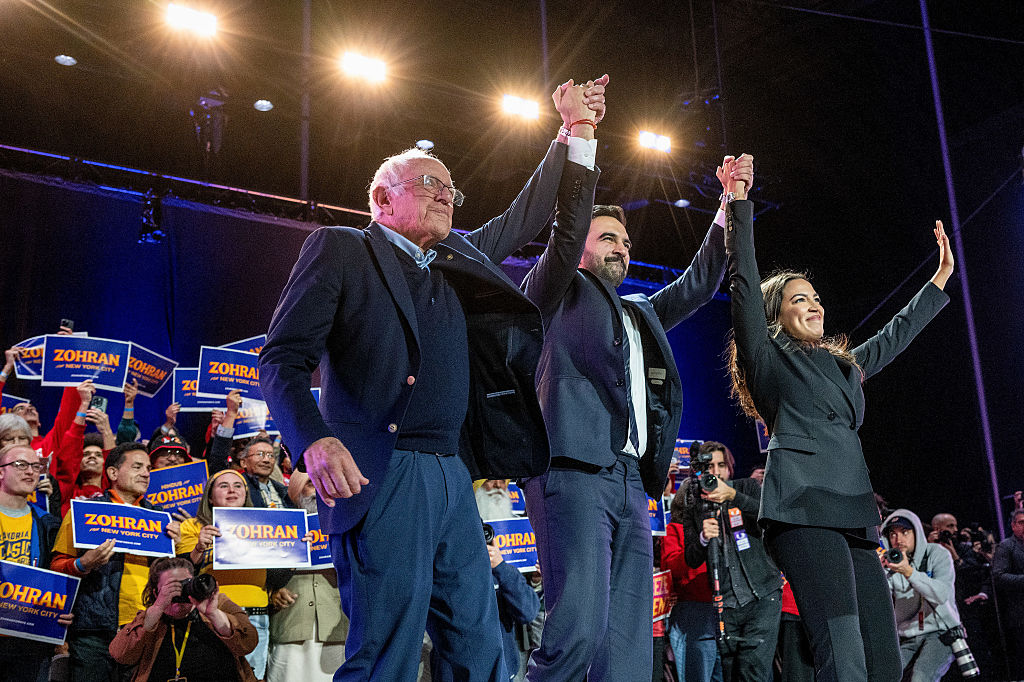
From left, Bernie Sanders, Zohran Mamdani, and Alexandria Ocasio-Cortez campaign on Oct. 26, 2025 —Victor J. Blue—Bloomberg via Getty Images
But DSA carries liabilities of its own. Its national platform goes far beyond what successful candidates typically advertise: the group favors abolishing the Senate, eliminating police and prisons, dismantling ICE, closing overseas military bases, and bringing large corporations under public ownership. Republicans are eager to attach those positions to every Democrat in the country. Some Democrats are just as eager to keep their distance. “There are candidates who have won primaries and call themselves communists,” says Matt Bennett of the centrist Democratic think tank Third Way, which is preparing a $15 million effort to discredit democratic socialism ahead of 2028. “It’s much harder to push back when there’s a grain of truth to the charge.”
The stakes are about to become more concrete. Along with almost certainly increasing their numbers in Congress, DSA is set to take the reins of the U.S. capital. Critics in both parties will be searching for proof that the winners of these insurgent campaigns are too radical, too idealistic, or simply inept. But to DSA leaders, it’s an unprecedented opportunity to show Democrats, and the country, that its agenda for everything from housing costs and labor protections to immigration and foreign policy is what voters are looking for heading into 2028. “We’re bringing a meaningfully different style and substance to politics,” Siddique says. “We’re proving it works, and it’s raising everyone’s expectations. People look to New York and D.C. or Los Angeles or Minneapolis, and they are increasingly feeling like, wow, we could do what they did here.”
At the opening session in Chicago, Kaitlin Marone asks who in the room was already a member in 2016. A few hands rise. The DSA field organizer moves the date forward to 2020. Nearly half the room raises theirs. Then Marone asks everyone to turn to their comrades and explain why they joined.
The conversations offer clues to DSA’s sudden relevance. Members talk about rent and health care, Donald Trump and immigration enforcement, Israel and Gaza, jobs that do not pay enough and homes they cannot afford. Others describe a Democratic Party they no longer believe is capable of addressing the problems shaping their lives.
There is plenty at the summit to remind visitors that this is an avowedly socialist organization. A bookseller in the hallway sells Marxist literature; The Communist Manifesto sells out by evening. Nearby, organizers decorate a “Free Stuff!” booth with fake bags of money and gold bars. But many of the grievances drawing people toward DSA no longer sound especially fringe. For Katie Sims, DSA’s 28-year-old electoral chair, the revelation came after graduating from Cornell in 2020 and looking at what a job would pay, then what rent and health insurance would cost. “I was like, none of these numbers add up,” Sims says. Polls show younger Americans are increasingly pessimistic about reaching the basic milestones available to their parents: homeownership, financial security, raising a family without amassing crushing debt. But, while Mamdani was elected mayor of New York with 51% of the vote, the people DSA has attracted are disproportionately young, white, urban, and college educated—hardly a representative sample of the working class the organization hopes to organize.
Many DSA members first arrive angry about a landlord, a hospital bill, student debt, or a war overseas. By connecting all of those problems to one larger one—the rapid concentration of wealth and power—DSA has given those frustrations a home and a vocabulary, and, increasingly, a way to organize around them. The movement has been adept at identifying places where Democratic voters are moving before the party establishment does, and then organizing the people who are already there.
Israel has provided another opening. Democratic voters, particularly younger ones, have moved sharply against Israel’s conduct in Gaza, while many elected Democrats have been slower to follow. DSA, which long called for ending U.S. military aid to Israel, was poised for the shift in public opinion. Sara Almosawi, a 24-year-old daughter of working-class parents from Iraq and Indonesia, joined DSA after Sanders ended his 2020 presidential campaign. “My parents immigrated here to follow the American Dream, and I don’t think that really panned out,” she says. In college, she helped lead campus protests against the war in Gaza and is now national co-chair of the Young Democratic Socialists of America.
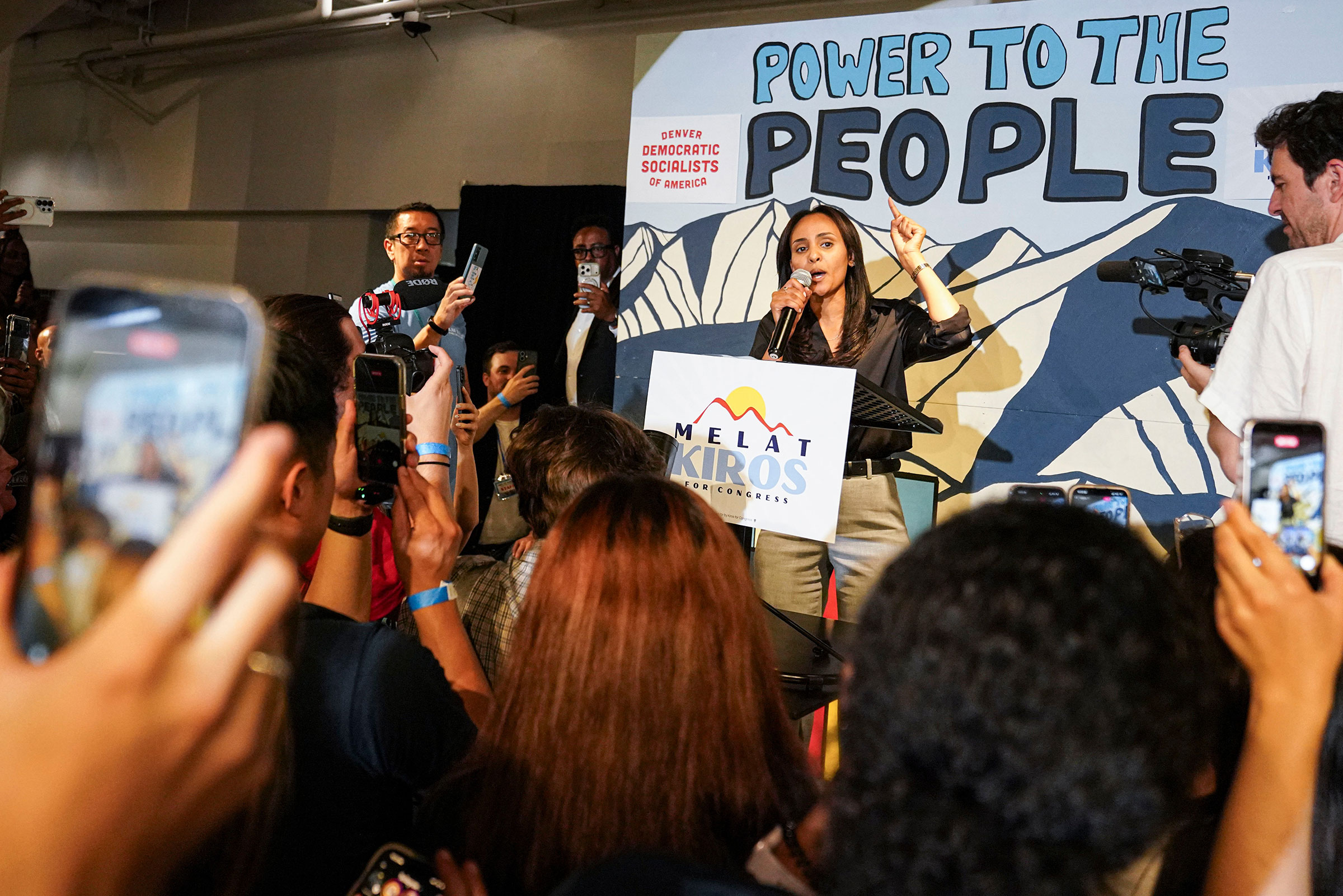
Melat Kiros won the Democratic nomination for Colorado’s first congressional district in June —Rebecca Slezak—AP
That pipeline is beginning to reach elected office. Darializa Avila Chevalier, 32, organized at Columbia before winning a congressional primary this summer with opposition to U.S. support for Israel at the center of her campaign. Other DSA-backed candidates have campaigned on more affordable housing, stronger unions, Medicare for All, and tighter restrictions on data centers—issues where the organization argues Democrats are too cautious or constrained by donors.
Mamdani has emerged as the movement’s most effective translator. His campaign took ideas long associated with DSA, including free public buses, city-run grocery stores, and freezing rent, and framed them around an argument almost anyone could understand: life in New York had become too expensive, and government should make it cheaper. By pairing that affordability message with outspoken opposition to U.S. support for Israel, he turned two forces drawing younger voters toward the socialist left into a coherent political identity. “The mood changed right after Mamdani won,” Sims says. “The answer to ‘could we build it’ is yes.”
On the first night of the summit, about 50 socialists pack into a dimly lit bar on Chicago’s South Side to discuss the next presidential election. Alexandria Ocasio-Cortez is not there, but her name and face appear on signs and pins scattered around the unofficial “DSA for AOC” gathering, where members squeeze into booths and spill onto the patio. After spending the day talking about labor organizing and how to build a lasting movement, the conversation turns to what might be possible in 2028. “We’re in the moment of the presidential question,” Sims tells the crowd, standing on a chair as comrades cheer. “Doesn’t it just make sense now?”
Ocasio-Cortez has not ruled out running for President, and DSA leaders I speak with regard an endorsement from the group as close to inevitable if she does. They say no other working politician has her mix of a national following, massive fundraising network, and talent for pressing socialist ideals. A few other names are floated, including progressive Representative Ro Khanna of California and United Auto Workers president Shawn Fain. (Neither is a socialist.) Jeremy Cohan, a longtime New York DSA organizer, argues that AOC alone could merge Obama-style organizing with Sanders-style politics. “It has never really been tried,” he says. “And I think that could change the country.”
But Ocasio-Cortez also demonstrates the challenges ahead if the movement aims to mature. The national organization declined to renew its endorsement of her in 2024 after disagreements over her vote defending Israel's right to exist and past support for strengthening the Iron Dome, even as its New York chapter continued supporting her. Some members worry that a presidential campaign would pull her toward the Democratic mainstream; others wonder whether demanding ideological fidelity would squander the influence they spent a decade building.
Even as they debate rallying behind her, Ocasio-Cortez acknowledges that many DSA ideas remain broadly toxic. Asked after Hong’s loss about her past calls to defund the police and other provocative statements from 2020, Ocasio-Cortez (who made some herself) wryly quoted fellow DSA member and New York City councilman Chi Ossé: “Woke 1 was crazy.”
The dispute reflects a larger question: What exactly does DSA want to do with the power it is accumulating? Even DSA’s leaders disagree over how far to go. At a June meeting in St. Louis, its National Political Committee debated for hours whether to add support for abolishing the Senate to the platform. Advocates argue the upper chamber is a fundamentally undemocratic institution because each state, regardless of population, gets two Senators. “This is not the time to put that demand forward,” someone argued. The proposal passed by one vote. Cliff Connolly, a 31-year-old member of DSA’s Marxist Unity Group who pushed for its inclusion, envisions a system in which the House chooses the executive, eliminating a presidency he believes has accumulated monarchical power. “The person will no longer be the king of America, like Donald Trump is today,” Connolly tells me at the summit, wearing a Che Guevara T-shirt.
The distance between that vision and the campaigns DSA is winning captures the central contradiction of its success. DSA-endorsed candidates have triumphed by running on some of the group’s issues while eschewing others. But if candidates aren’t aligning with core components of DSA’s platform, former DNC chair Harrison asks, “how does that reflect on the DSA, then?”
Some members fear focusing too much on electoral success risks reducing DSA to another faction within the Democratic Party. “Electoral politics will not save us,” Rabb says in Chicago. “It’s only a component of collective liberation. You’re never going to hear me saying voting is all that matters.” Some have called for the DSA to become its own party rather than running on the Democratic ballot. But DSA leaders say the recent streak of wins has strengthened the pragmatists. “Our members want to keep doing what’s working,” Siddique says, “which is just running as Democrats.”
If its nominees win in November, DSA’s tiny congressional presence could become something resembling a bloc. It would still amount to a handful of seats in a 435-member House. But in a chamber governed by narrow margins, a handful can matter. Hakeem Jeffries, who is positioned to become Speaker if the Democrats control the House, could find himself in repeated negotiations with the DSA caucus over close votes on everything from funding for Israel to avoiding a government shutdown.
And then there is 2028. An Ocasio-Cortez campaign could force the organization to face the compromises required to elect a President. Members imagine Ocasio-Cortez building on Mamdani’s momentum and Sanders’ strong showing in two presidential primaries, giving the movement a national vehicle for turning its ideas into power without compromising its overarching goal: a socialist United States. “We need a fighting unified left,” Diana Kingsbury, a 31-year-old community organizer from Santa Rosa, Calif., tells me as light rain begins to fall on the patio of the Chicago bar. “We need to have muscles behind our issues. Otherwise, what are we doing?”
Heidi Overton during an executive order signing in the Oval Office of the White House in Washington, D.C., on Aug. 10, 2026. —Bonnie Cash—UPI/Bloomberg/Getty Images
President Donald Trump announced on Wednesday that he was tapping Dr. Heidi Overton to lead the U.S. Food and Drug Administration (FDA), the health agency responsible for overseeing the safety and effectiveness of products including food, drugs, and medical devices.
“Dr. Heidi has been a ROCKSTAR in my Administration, where she has worked directly with Secretary Kennedy, Dr. Oz, and team, to deliver on the MOST TRANSFORMATIVE Health Agenda in History,” the President said in a Truth Social post. “We need her leadership at the FDA now to ensure that the U.S. remains the WORLD LEADER for Scientific Discovery and CURES.”
He went on to say that, in the role, Overton would work with Health and Human Services Secretary Robert F. Kennedy Jr. and Centers for Medicare and Medicaid Services Administrator Dr. Mehmet Oz “to RAPIDLY deliver on my priorities of FASTER Cures, INCREASED American Innovation, MAJOR Clinical Trial Reforms, LOWER Drug Prices, and even more MAHA WINS!”
If confirmed by the Republican-controlled Senate, Overton would take over the role previously held by Dr. Marty Makary, who stepped down from the position in May amid growing pushback from both outside of and within the White House.
Here’s what to know about Overton.
She’s a physician—and used to work at a conservative think tank
Overton, who has both an MD and PhD, used to be the chief policy officer at a conservative think tank called the America First Policy Institute. She is also a board-certified physician in public health and general preventive medicine, according to her bio on the institute’s website.
She currently works for the White House in another role
Overton already works in Trump’s White House, and has recently been in attendance at several events where the President has promoted his Administration’s health policies. She currently serves on the White House Domestic Policy Council, which “supervises the development, coordination, and execution of domestic policy in the White House” and “offers advice to the President and represents his priorities to Congress,” according to the White House website.
Last week, she was in the Oval Office with the President when he signed an Executive Order calling for children across the country to receive fewer immunizations—a move that was widely denounced by medical organizations and doctors. During the Oval Office signing, Trump said that concern over rising autism rates was one of the motivations behind the Executive Order. Research overwhelmingly demonstrates that vaccines are both safe and effective, and years of studies have found no link between vaccines and autism.
“While I respect Dr. Overton’s experience as a physician, I have strong concerns about her nomination to be FDA Commissioner,” he said on X. “Her lack of managerial experience does not prepare her well for leading a large organization that is already dealing with staffing and morale issues. Additionally, Dr. Overton’s active role in last week’s nonsensical vaccine executive order calls into question her commitment to standing up for sound science and protecting children’s health. That alone is almost disqualifying.”
She is a vocal opponent of abortion
Overton has publicly expressed anti-abortion views. After the Supreme Court overturnedRoe v. Wade in 2022, Overton celebrated the ruling, calling it a “huge victory for life.” She has written several articles for the America First Policy Institute opposing abortion, including one in 2023 that lamented the Biden Administration’s efforts to expand access to abortion pills, which she claimed “are far more dangerous to women.” Years of research have shown that abortion pills are both safe and effective.
After Trump was elected to a second term, many abortion providers and advocates voiced fears that he would appoint someone to lead the FDA who would restrict or revoke access to abortion pills. Several reproductive rights organizations condemned Trump’s nomination of Overton to lead the FDA on Wednesday.
“Donald Trump is trying to put an anti-abortion extremist in charge of any agency that could seriously undermine reproductive healthcare—including the agency that could roll back access to mifepristone nationwide,” Reproductive Freedom for All President and CEO Mini Timmaraju said in a statement. She went on to accuse Overton of having “spread junk science about medication abortion.”
“Her nomination is another alarming step in Trump’s plan to weaponize every part of the federal government to restrict abortion nationwide,” Timmaraju continued.
Anti-abortion organizations, meanwhile, threw their support behind Overton.
“We believe Dr. Overton has an opportunity to help strengthen restrictions on the chemical abortion regimen,” Sarah Zagorski, senior director of public relations and communications for the anti-abortion group Americans United for Life, said in a statement.
Kennedy has praised her
In a post on X on Wednesday, Kennedy said that he was “confident” that he and Trump “chose the best person for the job” at the FDA. He said that he has witnessed Overton “challenge assumptions, demand excellence, and turn bold ideas into meaningful results.”
“At the @FDA, she will make our food supply safer, modernize drug approvals, unleash American medical innovation, accelerate access to lifesaving treatments, bring greater transparency and accountability to the agency, and restore Gold Standard Science as the foundation of every decision,” Kennedy said.
Sources tell WIRED that Elon Musk is expected to spend up to $200 million in the midterms. It could be a big boost for GOP Senate candidate Ken Paxton, who’s struggled to raise cash.
President Donald Trump speaks with Canadian Prime Minister Mark Carney at the G7 summit, in Evian, France, on June 16, 2026. | Evelyn Hockstein/AFP via Getty Images
This story appeared in The Logoff, a daily newsletter that helps you stay informed about the Trump administration without letting political news take over your life. Subscribe here.
Welcome to The Logoff: President Donald Trump’s planned Canada tariffs are off — for now.
What happened? Trump had previously threatened 50-percent tariffs on about $20 billion worth of Canadian goods, but delayed them late on Tuesday, hours before they were set to take effect.
In a social media post, he wrote that the tariffs were on hold for “a three day period, based on the fact that Canada and the U.S.A., subject to the finalization of documents, have a DEAL!”
Is there actually a deal? We’ll find out in the next three days. Trump’s claims should always be taken with a grain of salt, and Canadian Prime Minister Mark Carney said only that “substantial progress” had been made toward a deal, with “important work still to be done.”
On Wednesday, the Wall Street Journal reported that the US could reduce previous tariffs on Canadian goods —which applied to cars, steel, and aluminum — as part of a potential trade deal. Trump has also suggested that a deal could resurrect the Keystone XL oil pipeline.
Can Trump still impose new tariffs? He can. Earlier this year, the Supreme Court struck down Trump’s use of a specific law, the International Emergency Economic Powers Act, to impose tariffs. In doing so, the Court ended many of his most sweeping tariffs and took away his favorite way to impose them.
He has plenty of other tools to keep at it, though, albeit on a more limited basis. Trump was threatening to use a never-tested section of the 1930 Smoot-Hawley Tariff Act to impose his most recent Canada tariffs. (Other existing Canadian tariffs fall under yet another law.)
What’s the big picture? This trade fight could preview an even bigger one to come, as the US, Mexico, and Canada attempt to renegotiate the US-Mexico-Canada Agreement that Trump struck in his first term. Trump declined to renew the deal last month, kicking off new negotiations.
And with that, it’s time to log off…
We got some incredibly good news about cancer treatment on Wednesday from the pharma companies Moderna and Merck, which announced a successful trial of an mRNA vaccine for melanoma, a particularly dangerous type of skin cancer.
The idea of using vaccines — and specifically mRNA, which helped produce Covid vaccines in record time — to treat cancer isn’t new, but the Moderna and Merck trial is a big step on the path to getting a cancer vaccine approved by the FDA.
As always, thanks for reading, and we’ll see you back here tomorrow!
Rep. Randy Fine talks with reporters outside the US Capitol in April. | Tom Williams/Getty Images
This story appeared in Today, Explained, a daily newsletter that helps you understand the most compelling news and stories of the day. Subscribe here.
Name a disgraced former Congress member, not originally from Florida, whose time in office was marred by shady financial dealings and who ran in yesterday’s GOP primary for Florida’s 19th District.
…This is, amazingly, a trick question. Because TWO candidates who fit that bill ran in FL-19, and neither of them won. (They were Madison Cawthorn and Chris Collins.)
Florida is — how do I put this? — one hell of a drug. And its primary results were no less surprising or chaotic. On the Democratic side, a socialist candidate for Senate came out of (literal) left field to topple an opponent who out-fundraised her 16 to 1. Meanwhile, progressive challengers lost decisively in twoother races.
On the Republican side, President Donald Trump’s picks won most of their contests, including the race to succeed Gov. Ron DeSantis. But two endorsed candidates also lost in surprising upsets. Republicans ousted Rep. Cory Mills, for instance, who has been accused of assaulting one woman he dated and threatening another. And Trump’s pick in FL-19, Catalina Lauf, fell not to Cawthorn or Collins, but to the founder of a conservative talk-radio station. Florida!!!
That race — the Republican primary in Florida’s Sixth Congressional District — pitted an open Islamophobe (Rep. Randy Fine, who won) against an avowed antisemite (the manosphere influencer Dan Bilzerian).
Both men are shocking in their bigotry, even for a party that has inured itself to shock. Bilzerian, a self-described sex addict and former professional poker player, has fantasized about “exterminating Israel” and “revisiting” the ideologies that precipitated the Holocaust. Fine, meanwhile, has repeatedly compared Muslims to dogs and said that Israel should let Gazans starve.
How did men with such repugnant views emerge as this race’s top finishers? The first reason is dark, but fairly obvious: a significant share of Republicans hold Islamophobic or antisemitic opinions.
The second reason is maybe more interesting: Republicans increasingly treat any perceived limit on speech as an intolerable form of censorship. That new norm has made it less likely that party leaders will condemn hateful views, since the appearance of policing speech is often considered just as bad as bigotry or extremism. As a pair of conservative writers warned in the New York Times last week, this reflex has created “a subculture of racism, sexism and antisemitism” in the GOP.
Some on the left hold hateful views too, of course. But Democrats don’t have those same norms against policing speech.
One link for later
➨ Stop trying to “sell” yourself to new people. That’s advice from my colleague Allie Volpe’s evidence-backed guide to optimizing your online dating profile, but I’d argue it applies to most social interactions. Other all-purpose gems from Allie: be selective with how much you share about yourself and convey your willingness to get to know other people.
Before you go…
Did you know…that the length of the average middle-grade book ballooned from 175 pages in 2006 to 290 pages a decade later? It’s one of the unexpected reasons that kids aren’t reading as much as they used to.
Today’s trivia: Jackie Robinson and Jackie Joyner-Kersee attended the same college. What college was that? (You can find this and other brain puzzles in Vox’s daily crossword. Look for the answer in tomorrow’s edition.)
Yesterday’s trivia: Yesterday we asked you which Dutch astronomer theorized “a cloud that constantly creates comets.” (Say that three times fast!) That would be Jan Oort, namesake of the Oort Cloud — an immensely distant band of billions of icy objects that are thought to surround our solar system.
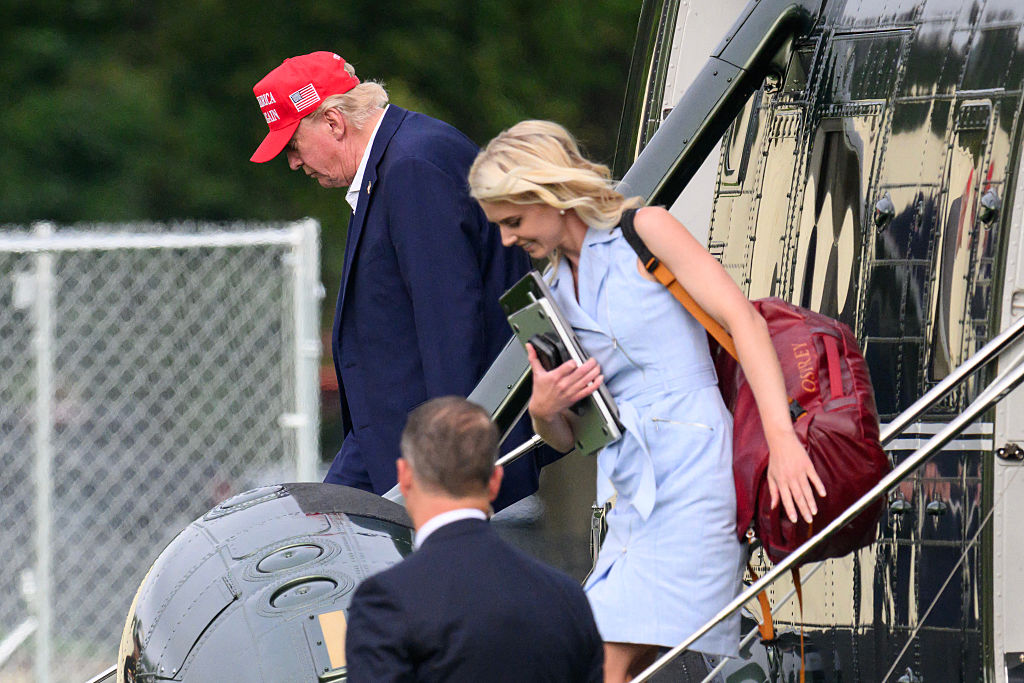
President Donald Trump and aide Natalie Harp (R) exit Marine One on the Ellipse near the White House on Aug. 16, 2026. —Mandel Ngan—AFP/Getty Images
A previously little-known White House aide has garnered growing public attention in recent days after Sen. Jon Ossoff mentioned her while levying an attack on President Donald Trump.
The Georgia Democrat said that Trump “doesn’t want to do the job” of President. Instead, Ossoff continued, “He wants to build his ballroom and travel with Natalie.”
Ossoff was referring to 35-year-old Natalie Harp, a longtime aide to Trump. When asked about Ossoff’s comments, Trump likened the Democrat to “Pee-wee Herman” and said he “would much rather do other things.”
Ossoff has stood by his remark about Trump and Harp. Appearing on MS NOW this week, the Georgia Senator said: “It’s been amazing to watch this White House melt down over this all week.”
So who is Harp, and what is her role in the White House? Here’s what to know.
Harp said that Trump saved her life
In 2019, Harp went on Fox News and thanked Trump for signing the Right to Try law the year before. She told the network that she had stage 2 bone cancer, and that the new law allowed her to access experimental treatments, which she said saved her life.
After hearing her recount her experience, Trump asked her to give a speech at the 2020 Republican National Convention, according to the New York Times.
“When I failed the chemotherapies that were on the market, no one wanted me in their clinical trials,” she said at the event. “They didn’t give me the right to try experimental treatments, Mr. President. You did, and without you, I’d have died waiting for them to be approved.”
But after the convention, the Washington Post reported that medical experts cast doubt on Harp’s claims.Harp has said that she was treated with “an FDA-approved immunotherapy drug for an unapproved use,” and experts said that the federal legislation that Trump signed in 2018 wouldn’t have made that drug accessible to Harp because the medication had already been approved.
About two years after her speech at the Republican National Convention, she became a member of Trump’s staff.
She used to work for a far-right news channel
Before Harp joined Trump’s team, she worked as an anchor for a far-right news channel called One America News Network for a couple years. While working for the network, she propagated Trump’s false claims that the 2020 election was “stolen” from him.
Her official title is ‘special assistant to the President and executive assistant to the President’
In Harp’s role, officially called the “special assistant to the President and executive assistant to the President,” she works closely with Trump. Many of the Truth Social posts that the President shares are ones that he dictated to her to type and hit “post” on.
According to the Times, which cited two people who were aware of the situation, Harp hit the “send” button on the enraged messages that Trump sent to the billionaire and major Republican donor Miriam Adelson in 2024—messages that nearly lost him Adelson’s backing.
Harp was also the one who transcribed dozens of social media posts that Trump dictated to her one day in which he attacked the writer E. Jean Carroll, who alleged that Trump raped her in the 1990s, the Times reported.
Some of Harp’s colleagues have dubbed her the “human printer” because she is known for carrying a portable printer as she trails Trump around so she can give him whatever information he wants or needs in print copies.
When appearing on MS NOW this week, Ossoff accused Harp of “printing out Donald Trump’s daily dose of delusion and flattery.”
She was one of the select number of people who was on Trump’s secret flight out of Turkey
When Trump left Turkey in July on a secret, alternate plane after receiving an Iranian assassination threat, only a few people working in the White House were on his flight, including Harp, CBS News reported. Defense Secretary Pete Hegseth was also on the plane with Trump and Harp, as were a couple other aides. Other higher-up members of his Administration, such as Secretary of State Marco Rubio and Treasury Secretary Scott Bessent, were on the other plane—the one that the Administration had said that Trump would travel on, and that members of the White House press corps were on.
When asked by the Timesabout Harp’s role in the White House and why she was selected to be among the few staffers on the secret flight, White House Press Secretary Karoline Leavitt said: “Natalie Harp is one of the most loyal and hardest-working aides on President Trump’s team.”
CNN Condemns Trump's Attacks on Journalist Kristen Holmes Following Heated Oval Office Response
The nature of her relationship with Trump has been a subject of scrutiny
According to the Times, Harp wrote Trump several letters in 2023 that concerned some people near him. In the letters, which reporters at the Times viewed, Harp wrote messages including: “You are all that matters to me” and “I don’t ever want to let you down.” She called Trump her “Guardian and Protector in this Life,” and thanked him, the outlet reported.
“I want to bring you joy,” she wrote in one of the letters, according to the Times, “to feel like we can get through a day without ever having to talk ‘work.’”
The news outletalso reported, citing two sources with knowledge of the remark, that Trump said at one point in 2023 that Harp was the only person on his team who cared about him.
Harp’s estranged brother, Preston Harp, was asked about the Times’ reporting about the 2023 letters when he appeared on CNN this week. He replied: “I’d say since she was like 16, she’s had an obsession with, gosh, how do I explain this? She’s written letters to other Presidents. Let me put it that way. And so like, her dream came true finally.” When asked which Presidents she wrote letters to, he said: “I didn’t see the letter, but George Bush obviously, during the Iraq war.”
He also described his sister’s relationship with Trump as an “infatuation” but said, “I don’t think it’s a physical attraction.”
“I think that Trump’s best friends are people who are his fan club,” he said. “And so she’s his biggest fan. And so that’s probably why he likes her. And she’s good looking. She’s got a good personality. I don’t know.”
“I mean she thinks that he saved her life, so, like, somebody living with that kind of gratitude—that must feel pretty good,” he continued.
Harp has not publicly spoken about her relationship with Trump in the wake of Ossoff’s comments, but other White House aides and Republicans have jumped to her defense.
In a statement to TIME, White House spokesperson Davis Ingle called Ossoff’s comments “cringeworthy” and criticized the Senator’s voting record, in addition to defending Harp.
“Natalie Harp is one of the most loyal and hardest working aides on President Trump’s team,” Ingle said in the statement.
Eric Trump, one of the President’s sons, slammed CNN’s interview with Preston Harp on Wednesday.
“What absolute trash,” he said in a post on X. “Natalie is an incredible young woman — a cancer survivor, a genuinely good person, and arguably one of the hardest-working people in the White House. She’s deeply committed to my father, to her job, and to this country.”
Demonstrators against the construction of a section of the US-Mexico border wall during a protest at Santa Elena Canyon in Big Bend National Park, Texas, on Aug. 12, 2026. —Kaylee Greenlee—Bloomberg/Getty Images
That section of the project, which extends across challenging terrain in Texas’ Big Bend National Park that has historically seen relatively few attempted border crossings, has faced pushback from everyone from public lands advocates to congressional lawmakers to local residents.
The Trump Administration has been pushing the construction of the border wall in Big Bend despite the public outcry, going so far as to bypass a score of environmental laws to expedite the project.
But on Monday, after months of opposition, Customs and Border Patrol (CBP) Commissioner Rodney Scott announced that CBP had paused “all construction” in the park while he visited the site to conduct a “personal, on-the-ground evaluation.” In post on X, Scott wrote that he would be working to “evaluate the terrain and listen to local leadership, community members and stakeholders” over the next “couple of days.”
Texas Gov. Gregg Abbott also said on Mondaythat he had spoken with Department of Homeland Security (DHS) Secretary Markwayne Mullin, who Abbott said had “committed” to not building “a wall or a fence” in Big Bend. Abbott said there were “other tools” to ensure border security.
Here’s what to know about the Trump Administration’s efforts to build the border wall in Big Bend, and the opposition the project is confronting.
What the Trump Administration is seeking to build in Big Bend
Big Bend National Park sits in a remote southwest corner of Texas along the U.S.-Mexico border in Brewster County. The Administration has sought to build 17 miles of barriers across that section of the border as part of the larger border wall project.
Perhaps the most recognizable image of Trump’s wall is the “primary wall,” a structure built from tall steel bollards up to 30 feet tall that makes up the first line of the barrier system that would be encountered by those travelling north from Mexico. The section of the project planned to run through Big Bend, however, would look notably different, according to Scott.
“CBP is building one new access road, improving existing roads, installing detection technology, and placing vehicle barriers in limited, strategic locations,” he said. “We are NOT building a 30-foot wall or stadium lighting through Big Bend National Park, Big Bend Ranch State Park, or the Black Gap Wildlife Management Area.”
The portion of the wall in the park would be made up of a non-contiguous “vehicle barrier system,” according to the CBP, which consists of “steel posts supported by continuous steel rails,” power cables, cameras, roads for patrol cars, and shelters along the border.
According to the agency’s Smart Wall tracker, an interactive and frequently updated map that shows the status of the border wall, CBP has several construction projects interspersed along the border labeled as a “vehicle barriers … technology & patrol road.” A couple of these are located at the southern tip of the park; one sits far west near Presidio County, while others are located at the eastern edge of the park. These sites are in the Chihuahuan Desert, which presents a difficult landscape to navigate filled with steep canyons and mountainous terrain.
A controversial push to speed construction
In June, the Trump Administration waived more than 20 environmental and preservation laws intended to protect Big Bend’s landscape in order to accelerate the construction of the border wall in the park.
To do so, the Administration invoked a section of the Illegal Immigration Reform and Immigrant Responsibility Act of 1996, which allows the government to bypass laws that obstruct the building of border wall.
DHS defended the move at the time by describing Big Bend as an “area of high illegal entry” and saying that “there is presently an acute and immediate need” to build more barriers.
Migrant encounters are relatively rare at the section of the border that runs through the park, however—and have become more so in recent years. The park includes roughly 118 miles of what’s known as the Big Bend Sector of the border, which spans 517 miles from Sierra Blanca, Texas, to Sanderson, Texas, and covers roughly one-quarter of the full length of the U.S.-Mexico boundary. CBP recorded a 74% decrease in border crossings through its Big Bend Sector between fiscal years 2023 and 2025, with apprehensions dropping from 11,823 to 3,096. There were a total of 237,538 migrant encounters along the U.S.-Mexico border in FY 2025, meaning that the 3,096 apprehensions in that sector accounted for just 1.3% of the total number. And CBP’s planned border wall in the park would only cover a fraction of a fraction of the full sector.
The Administration’s move to bypass the environmental laws triggered immediate opposition. Bob Krumenaker, the park’s most recent former superintendent, called the news “devastating” to Marfa Public Radio and referred to it as “giving CBP unfettered authority to do anything they want within the national park.” Legal challenges also followed in the form of multiple federal lawsuits, while members of Congress made efforts to block DHS’s funding for projects in Big Bend.
Why the project has faced opposition, and from who
Grassroots organizations, conservation groups, businesses, local communities, and lawmakers have also made efforts to fight against the construction of the border wall in Big Bend.
Much of the opposition stems from concern over the park’s natural landscape, which is home to an array of wildlife and is effectively undeveloped. Other groups oppose the construction because they view the park as a cultural and heritage site, while still others have voiced concerns for the impact the planned barrier construction could have on the tourism economy there.
A seriesoflawsuits have been filed in an effort to block DHS’s plans to construct the border wall in Big Bend.
One lawsuit from the Center for Biological Diversity challenged DHS’s waiving of laws to carry out construction in the park. “Until now no administration has been heartless enough to waive laws in a national park like Big Bend, so we’re suing to uphold the U.S. Constitution and protect this crown jewel,” Laiken Jordahl, national public lands advocate at the Center for Biological Diversity, said in a statement according to a news release.
The Center for Biological Diversity had previously filed a lawsuit that argued the construction would “devastate the region’s wildlife, recreation economy, and natural and cultural heritage.”
Another lawsuit, filed by The People of La Junta for Preservation and Far
Flung Outdoor Center, a tribal nonprofit and an outdoor recreation company, argued that the construction will cause damage to archaeological sites associated with indigenous peoples and could threaten protected religious freedoms.
Groups have also mounted protests and sent letters to lawmakers to call for the planned construction to be halted.
In March, the grassroots organization No Big Bend Wall sent a letter to several leaders on congressional committees on behalf of 132 organizations asking that the use of any federal funding for the border wall in Big Bend be prohibited.
All the Democratic members of the Texas delegation in Congress sent a letter to Mullin later that same month voicing “staunch opposition” to the wall.
“This proposal threatens preservation of one of America’s crown jewels, Texas’ largest state park, and the state’s only congressionally-designated Wild & Scenic River,” the lawmakers wrote. “Construction and maintenance of a border wall segment and the associated roads, secondary barriers, power lines, towers, and lighting will disrupt natural biodiversity, river dynamics subject to routine flash flooding, and one of the darkest night sky areas in the world.”
Over the following two months, more than 2,000 people rallied at the Texas Capitol building in Austin, and seven former superintendents of Big Bend National Park urged Mullin not to waive federal laws to build the border wall in the park.
In early August, video showed heavy machinery bulldozing the land at Big Bend. A bipartisan group of Texas House lawmakers soon after sent a letter to Gov. Greg Abbott on Thursday in which they urged him to halt the Big Bend construction, citing “damage to one of Texas’ most pristine and irreplaceable landscapes” that they said had already begun with the movement of bulldozers and construction equipment into the park.
Last Wednesday, a large crowd of protesters gathered in the park chanting “No road. No wall. No wire. No way," as they held hands in a circle. They also held a large banner that read “NO WALL,” along with a series of other wildlife-themed flags and signs.
More than 140 local businesses, recreation groups, and outfitters who rely on the tourism economy in the park also penned a letter on Aug. 4 to Cornyn, Cruz, and Abott asking them to halt the border construction to preserve the vibrant tourism economy that lives within the park.
Scott released a statement last week in response to the public reaction specifying that “what people are seeing right now is survey and design work—NOT construction of a wall through the park.”
Following Scott’s later announcement that CBP would be pausing construction on the wall in Big Bend, the National Parks Conservation Association (NPCA), which has pushed back against the Big Bend construction, lamented the damage that it said the project has already done to the park’s lands.
“The people have spoken, and they do not want the Trump administration to bulldoze America’s national parks for border infrastructure,” said NPCA President and CEO Tiernan Sittenfeld in a statement. “Unfortunately, the federal contractors’ bulldozers have already inflicted tremendous damage to one of America’s most iconic national parks. Their heavy equipment has torn through miles of priceless wild landscape, wreaking havoc on sensitive wildlife and irreplaceable habitat.”
President Donald Trump and North Korea's Kim Jong Un talk before a meeting in the demilitarized zone on June 30, 2019, in Panmunjom, Korea. | Brendan Smialowski/AFP via Getty Images
Can President Donald Trump pen a new chapter in his love story with North Korea’s Kim Jong Un?
In Trump’s first term, the two leaders, in Trump’s words, “fell in love” after exchanging letters and held three historic meetings, but failed to make much progress toward the goal of denuclearizing the heavily armed hermit state.
Now, Trump appears to be trying to recapture the magic, reportedly urging aides to set up a meeting with Kim as soon as this fall. This news comes soon after Trump’s Truth Social post on Sunday announcing he had ordered the US military to “substantially reduce” joint military exercises with ally South Korea in part because it would send “a signal that is totally inappropriate and hostile, to a Country that, as long as Donald J. Trump has been President, has been unthreatening and respectful” — North Korea.
Key takeaways
Trump is trying to restart talks with North Korea’s Kim Jong Un, scaling back a planned joint military exercise with South Korea and instructing aides to prioritize setting up a new meeting.
Trump’s three historic meetings with Kim were a diplomatic high point of his first term, but since Trump returned to office, the North Koreans have been rebuffing American advances.
Much has chanced in North Korea since the last time the two met: The country is wealthier, less isolated, and more militarily secure. A Trump meeting might not have the same appeal it once did.
Trump has claimed, without elaborating, that Kim has responded to this overture, but there’s been no public response from Pyongyang yet.
Trump’s outreach didn’t come entirely out of nowhere. Trump has made clear since the beginning of his term that he would like to meet with Kim again, and there was speculation that a meeting might happen when Trump traveled to South Korea for a summit last fall. North Korea’s UN Mission in New York has also rebuffed several attempts by US officials to deliver a personal letter from Trump seeking to restart dialogue.
In the midst of an unpopular conflict with Iran that seems unlikely to end in anything resembling a victory, it makes sense that Trump might be reaching back to what he sees as one of the foreign policy high points of his first term. “Kim Jong Un has always treated me with great respect,” Trump told reporters on Monday. “I understand him. He understands me.”
Beyond reconnecting with an old friend, it’s not entirely clear what Trump actually wants out of North Korea. But if his goal is a new diplomatic breakthrough, that will be even harder than it was the first time: The country is a much different place than it was the last time the two leaders sat down and even if they were to meet again, Kim seems even less likely to make real concessions.
Like it or not, North Korea is a nuclear power now
“There is no chance that North Korea is going to denuclearize. Zero chance,” said Joseph Yun, a veteran US-North Korea negotiator who recently served as acting US ambassador to South Korea. “They have seen what happened to Iran. They have seen what happened to Ukraine. The way they see it, their nuclear weapons are what protects them.” Last year, the country’s official news agency dismissed denuclearization as an “unrealizable pipe dream.”
On top of that, North Korea is in a much stronger negotiating position than it was the last time these two leaders met for a photo op.
“It’s a very different North Korea now. It’s stronger geopolitically, and Kim is stronger domestically.”
Jung Pak, served as US special representative for North Korea in the Biden administration
In 2018, North Korea was heavily isolated and struggling under an international sanctions regime that was at least officially — if not always in practice — supported by China and Russia as well as the United States. For a young leader still looking to establish his internal legitimacy and international standing, a meeting with the sitting US president was a major coup.
But things improved dramatically for North Korea after the pandemic.After it began lifting its Covid-era lockdown — one of the toughest in the world — North Korea has become what the Wall Street Journal has called“the world’s most unlikely growth story.”
The country’s economy has grown for three straight years, and while it’s still an impoverished country where nearly half the population is malnourished, Pyongyang is by all accounts booming, with thousands of new homes built along with a surge in Western-style restaurants and ride-hailing apps.
“North Korea emerged from the pandemic stronger, despite the odds,” said Jung Pak, who served as US special representative for North Korea in the Biden administration. “It’s a very different North Korea now. It’s stronger geopolitically, and Kim is stronger domestically.”
North Korea has been one of the main beneficiaries of the war in Ukraine, sending thousands of soldiers and munitions to help the Russian war effort. While thousands of those troops have died, the North Korean regime has gained billions of dollars in revenue and military aid from Russia in response, as well as invaluable battlefield experience for its commanders and weapons systems.
Russian President Vladimir Putin has come through for the North Koreans in other ways. In 2024, Russia vetoed the mandate of the UN body that monitored the enforcement of international sanctions on North Korea, effectively shredding the international sanctions regime. In 2025, trade between North Korea and China, its main economic partner, rose 25 percent.
The regime has found other innovative ways of raising revenue, reportedly netting billions through cybercrime targeted at foreign banks and cryptocurrency exchanges.
Kim is also less desperate for legitimacy these days. In September 2025, he stood alongside Xi Jinping and Vladimir Putin at a massive military parade in Beijing, a powerful demonstration of unity among three US adversaries. These days, Kim likely feels he’s the one being wooed. Xi’s high profile trip to Pyongyang in June was interpreted by many as a sign that China, warily eyeing the increasingly close relationship between Russia and North Korea, was looking to shore up its ties with its longtime ally.
Domestically, when the world’s first millennial dictator took power after his father died in 2011, many wondered how long he would last. Today, he’s feeling secure enough to be thinking about long-term handoff plans, publicly positioning his 13-year-old daughter as his future successor.
Kim is clearly not desperate to meet with Trump, and these days, the United States has fewer means to pressure him. Without Chinese and Russian support, the US can only dial up international sanctions so much. As for military pressure, the US has been moving military assets out of the Korean peninsula to the Middle East and recently redeployed its last aircraft carrier out of Asia.
As Trump’s actions this week demonstrate, he’s not all that interested in working with US allies in the region to pressure the North Koreans. But if he were considering pairing his warm overtures to Kim with a stick, a “fire and fury” threat wouldn’t pack the same punch today.
Is there any reason for new US-North Korea talks?
Still, there are reasons Kim might want to sit down with Trump again. North Korea would still like US sanctions lifted. Kim’s influential sister has stated that the regime is looking for the US to formally accept its status as a nuclear power, as Russia has now done.
Former US State Department North Korea negotiator Joel Wit suspects that given Trump’s desperation for talks, Pyongyang might try to press its advantage even further.
“If I was a North Korean, I would ask the United States for what I would call a ‘peace agenda,’” he said. “That would mean more than just reducing the size of US-[South Korean] exercises. It could include cutting back on US troops in South Korea or even Guam.”
Trump, who has repeatedly, including in his recent Truth Social post, made clear that he sees the US military presence in South Korea as a waste and the South Koreans as coddled, wealthy freeloaders, might be amenable to concessions like this.
But what could the US get out of talking to North Korea if denuclearization is off the table? Some analysts have suggested a limited deal might be possible, which could see North Korea dismantle its reactors or some of its centrifuges, slowing down the growth of its nuclear program if not eliminating it.
Pak also noted that given North Korea’s refusal to engage in nearly any diplomacy with the US since 2019, just holding talks and building some confidence between the two sides would be progress. “The meeting itself would be the win,” Pak said.
On the other hand, holding talks that do not explicitly aim at eliminating North Korea’s nuclear program would be seen as effectively accepting that North Korea is a nuclear power now. At this point, there’s a strong realist case to be made for accepting North Korea’s nuclear status and proceeding from there, but it’s hard to square with the administration’s stance on Iran’s nuclear program.
It’s also likely that the kind of incremental concessions North Korea might, in the best of circumstances, be willing to offer, would not satisfy a US president with a penchant for grand bargains.
In his first term, just the fact that Trump and Kim sat down made history. Now that that’s been accomplished, they may find that, like many a romance a few years in, they’ve run out of things to talk about.
Immigration and Customs Enforcement (ICE) agents patrol LaGuardia Airport in New York City on March 23, 2026, as they assist at busy security checkpoints amid a Department of Homeland Security shutdown that has lasted more than a month. —Zhang Fengguo/Xinhua—Getty Images
Laurie was on her way to a gate at the airport where she worked as a manager when a colleague called with a warning: Immigration and Customs Enforcement (ICE) agents had turned up again and were asking airline staff to help locate a passenger.
She had years of experience cooperating with federal law enforcement. But the encounters she was accustomed to followed a protocol: airline managers were notified in advance, officers arrived in uniform with their badges visible and judicial warrants were presented for passenger arrests.
Multiple gate agents working at airports in Colorado, Texas and Arizona have told TIME that ICE agents have become a recurring presence in recent weeks. With protocols for handling such encounters unclear or inconsistently applied, airline employees like Laurie say they are increasingly being left to decide for themselves how to respond.
She knew how consequential that decision could be.
Ten days earlier, two men in plain clothes had approached a gate agent, identified themselves only as federal officers and asked the employee to summon a passenger. Laurie, who was the manager on duty, had received no advance notice of their arrival. She approached the men and asked for identification.
She said the officers told her they were ICE agents and showed their badges, which had not been visible. An announcement went out over the airport’s public address system. A woman approached the desk, and the officers took her into custody.
Laurie asked to see a warrant and the men told her it was in their car. She followed as they escorted the passenger to an unmarked vehicle with an out-of-state license plate, where the officers showed her an administrative warrant rather than a judicial warrant signed by a judge.
“Well, this isn't a criminal. This is immigration, it's different,” the agents told her, before handcuffing the passenger and driving away.
Laurie asked TIME to use a pseudonym because she fears government retaliation and was not authorized by her employer to speak publicly. TIME reviewed video footage of the incident filmed by Laurie.
“Because I hadn't seen this before, I was kind of freaking out, thinking, ‘What do I do?’” she said.
ICE ramps up its presence at airports
Airline employees around the country are confronting similar questions as ICE expands its presence at U.S. airports. Gate agents say officers have asked them to help identify or locate passengers, provide information from internal airline systems and grant access to restricted areas such as jet bridges and, in some cases, aircraft. The requests have left some workers uncertain about when they are required to assist federal officers and when doing so could conflict with airline security protocols.
Atlanta Police Department officers look on as travelers wait in long lines at Hartsfield-Jackson Atlanta International Airport on March 23, 2026, as travel disruptions continue during a partial government shutdown that has left hundreds of TSA agents working without pay or quitting their jobs. —Megan Varner—Getty Images
The increase in airport enforcement comes as ICE seeks to meet a White House goal of 2,000 arrests a day, a target confirmed by an ICE official not authorized to speak publicly. Last month, it was reportedthat the agency was making an average of 20 to 40 arrests a day at airports, targeting, among others, travelers with expired visas and pending asylum cases.
Videos of airport arrests have also circulated widely online. On July 21, two plainclothes ICE agents arrested Chantal Morales Rojas, a 27-year-old woman from Ecuador, at the jet bridge at Denver International Airport, according to a widely shared video. That same day, ICE arrested an Ethiopian faculty member from the University of Maryland at Dallas Fort Worth International Airport.
The operations have been aided by expanded sharing of travelers’ information between federal agencies. Since May 2025, ICE has been obtaining traveler information through the Transportation Security Administration under a previously undisclosed data-sharing program, according to a declassified memo released by the watchdog group American Oversight. The New York Times reported that the program gives ICE access to the names and birth dates of passengers the agency believes may be subject to immigration arrest.
The administration has also broadened its use of administrative warrants. Previous administrations used such warrants to arrest people who were already in deportation proceedings. Under the Trump administration, they have also been used in cases involving immigrants who are actively applying to renew their immigration status.
“In the past, people like that have never been prioritized for deportation if they pose no other public safety threat, given that they're taking steps to get into compliance with the law,” said Nayna Gupta, policy director at the American Immigration Council.
Backlogs and processing delays in the immigration system can put immigrants at risk of losing legal protections while their applications are pending, she said.
ICE agents can also make arrests without a warrant in certain circumstances if they have probable cause to believe someone is in the country without legal status and is likely to escape if not immediately arrested. Gupta said that authority has been abused in previous immigration operations.
In a statement, the Department of Homeland Security said that law enforcement officers are “simply enforcing our nation’s laws and following all applicable laws and established policies.”
“When DHS components operate in the same transportation environment, they coordinate as appropriate to support public safety, security, and lawful operations while minimizing disruption to the traveling public,” the statement continued.
Some recent airport arrests have faced scrutiny in court. Jodi Ziesemer, an immigration lawyer who represents four immigrants arrested by ICE at Denver International Airport in separate cases, said two of her clients were told that the officers arresting them did not know why they were being detained. In one case, she said, ICE could not initially establish the reason for the arrest.
“I asked ICE why they had arrested her, and they told me they thought that maybe she had a deportation order from 2002, but they couldn't find any other paperwork about it because it wasn't a digital file, so they detained her first, and then they started looking for some paperwork about her,” Ziesemer said. The client spent six weeks in a detention center before a federal judge ordered her release.
How airline employees are responding
The encounters have also raised concerns about the position in which they place airlines and their employees. A Phoenix couple is suing United Airlines for false imprisonment and negligence over the carrier’s role in an ICE arrest at Phoenix Sky Harbor International Airport.
“I've gone to agents who have been involved with any ICE agent,” Laurie said. “Most of them are just like, ‘I don't want to be doing this. Like, why are we helping them?’”
After the first arrest she witnessed, Laurie raised her concerns with airline leadership and asked for guidance.
“We haven't gotten a clear security directive,” she explained. “There's never been an official written directive about ICE."
Laurie says she was still waiting for guidance when ICE agents returned to the airport looking for another passenger. This time, she made a different choice. She called the supervisor at the gate, asked for the passenger’s phone number and called the woman herself.
“I know this is going to sound extremely radical, or crazy,” she recounted telling the woman, “but ICE is there at the gate, and they're looking for you."
There was a pause. “Are you serious?” the woman asked.
“Yes,” Laurie said. “I know this is crazy, but I promise you. I'm being serious.”
“Should I leave?” the woman asked. “I think it might be best if you do,” Laurie said.
When Laurie reached the gate, the woman she had called approached her. She appeared to be in her late 20s and was traveling with a family member. Laurie said the two stepped into a bathroom to speak privately, where the passenger said she did not understand why ICE was looking for her.
“Why is this happening? I have all my papers,” she asked.
After calling a relative, the woman decided not to take the flight. She returned with the hood of her jacket pulled over her head, thanked Laurie and left the gate with her family member.
The ICE agents arrived after she was gone. Laurie recognized two of them from an earlier encounter. About 10 minutes later, one approached her, showed his badge and asked whether she could confirm that the passenger had checked in. Laurie refused, telling him airline employees could not provide passenger information.
As the flight neared final boarding, another ICE officer accused Laurie of interfering with the operation and pressed her to help locate the passenger. Laurie declined to say whether the woman was on the flight's passenger list and told the officer he would need to contact the airline’s corporate security department for information. “You're going to need a subpoena,” she said. No arrests were made at the gate that day.
The next day, the passenger called her.
She had made it home. And she was with her child.
"I was extremely scared that ICE would take another person in front of me, but also for myself and how I was jeopardizing my job and safety," Laurie said. "But I would 100% do it again, without a moment of hesitation."
President Donald Trump welcomes Canadian Prime Minister Mark Carney outside the West Wing of the White House on Oct. 7, 2025, in Washington, D.C. —Anna Moneymaker––Getty Images
President Donald Trump announced late Tuesday a temporary pause on 50% tariffs on Canada as both countries race to finalize a trade deal.
The President’s announcement came hours before a series of tariffs set to cover about $20 billion worth of imports into the U.S. from Canada were set to take effect.
“I have paused the 50% tariffs against Canada, that were scheduled to kick in tomorrow morning for a three day period, based on the fact that Canada and the U.S.A., subject to the finalization of documents, have a deal!” Trump said on social media.
Canadian Prime Minister Mark Carney released a statement moments later, confirming that there had been “intensive discussions” with the U.S. to “address outstanding trade issues.”
“Substantial progress has been made, although there is important work still to be done,” he said.
The tariffs will now be paused until Aug. 21, subject to the finalization of an agreement between the two countries.
U.S. Trade Representative Jamieson Greer said the deal will include "comprehensive market access for all American goods, economic security commitments, digital trade alignment," along with other provisions.
Trump added in his social media post that the Keystone XL pipeline—a cross-border oil pipeline project between the U.S. and Canada that was canceled by former President Joe Biden in 2021 after pushback from environmentalists, Native American tribes, and Indigenous advocates—"may be awoken from the grave," but did not provide further details.
The President later posted what appeared to be an AI-generated image of himself dragging the Keystone pipeline out of the ground.
Neither side has provided further confirmation about the contents of the agreement.
TIME has reached out to both the White House and the Prime Minister's office for comment.
U.S. and Canada push toward a deal
Carney said earlier this week that he planned to speak with the U.S. President ahead of the tariff deadline. The announcement follows a period of negotiations between the two sides.
During a tour of a tire factory in Iowa last week, Greer told reporters that the U.S. and Canada were engaged in “constructive negotiations” but warned that if a “country retaliates” they would “take action.”
Canada's minister responsible for U.S. trade, Dominic LeBlanc, and chief trade negotiator Janice Charette have been in Washington since last week for talks.
The negotiations unfolded against a backdrop of ongoing grievances between the two countries, including Trump’s repeated statements about his desire to annex Canada and make it the 51st U.S. state—an idea Carney has strongly pushed back against.
In August, Carney took a swipe at Trump, mocking the U.S. President after a teleprompter malfunctioned in the middle of an on-camera speech.
The tense relationship between the pair has also played out over the Gordie Howe International Bridge—a cross-border bridge connecting the two countries that has repeatedly become a source of disagreement between Washington and Ottawa.
How U.S.-Canada trade tensions escalated
The last-minute tariff pause comes after more than a year of escalations between the two countries.
In February 2025, the White House hit Canada with a 25% tariff on most goods and 10% on energy resources, citing what it regarded as inadequate progress in curbing cross-border illegal immigration and drug trafficking.
Canada then imposed tariffs on some vehicle imports from the U.S. in April 2025, amid a larger trade war sparked by Trump’s global tariffs—the majority of which were struck down by a Supreme Court ruling earlier this year.
The 50% tariff hike on a range of Canadian goods was announced in July, with Trump signing a series of proclamations citing Canada’s “discriminatory treatment” of American products.
The new levy, a retaliation for Canada’s tariffs, would apply to a range of Canadian goods, including electronics, sports equipment, and essential oils.
According to economists, the tariffs could have had significant economic consequences if enacted. TD Economics estimated that, if maintained, they could reduce Canadian GDP growth by 0.3 to 0.6 percentage points over the following year.
A Canadian Federation of Independent Business survey of 1,833 firms found that 77% of affected exporters expected revenue losses, while 35% expected their revenue to fall by at least half.
In a new proclamation issued Tuesday suspending the tariffs, Trump said: “Canada has expressed a commitment to remove the discriminations or unreasonable and unequal impositions.”
In a statement late Tuesday, the Distilled Spirits Council of the U.S. applauded Trump's announcement and called for "a negotiated solution that gets American spirits back on retail shelves in all Canadian provinces and returns the spirits sector to a zero-for-zero tariff framework."
The new tariffs were set to apply despite the U.S.-Mexico-Canada trade agreement (USMCA)—which had shielded Canadian industries from earlier U.S. tariffs.
The USMCA, which was signed by Trump in 2018, is a trilateral agreement that eliminated or reduced tariffs on goods traded between the nations of North America. It governs nearly $2 trillion in annual trade among the three countries.
In early July, the U.S. declined to renew the U.S.-Mexico-Canada Agreement for a 16-year term. Rather than terminate it outright, this puts the USMCA under annual review. Trade experts told TIME that the move is expected to carry profound long-term economic consequences.

 Login
Login
.jpg?branch=production)