Tina Peters was convicted of seven counts related to election interference in 2024. Now, she’s fielding an offer from a county that’s become a hotbed of voting-related conspiracy theories.
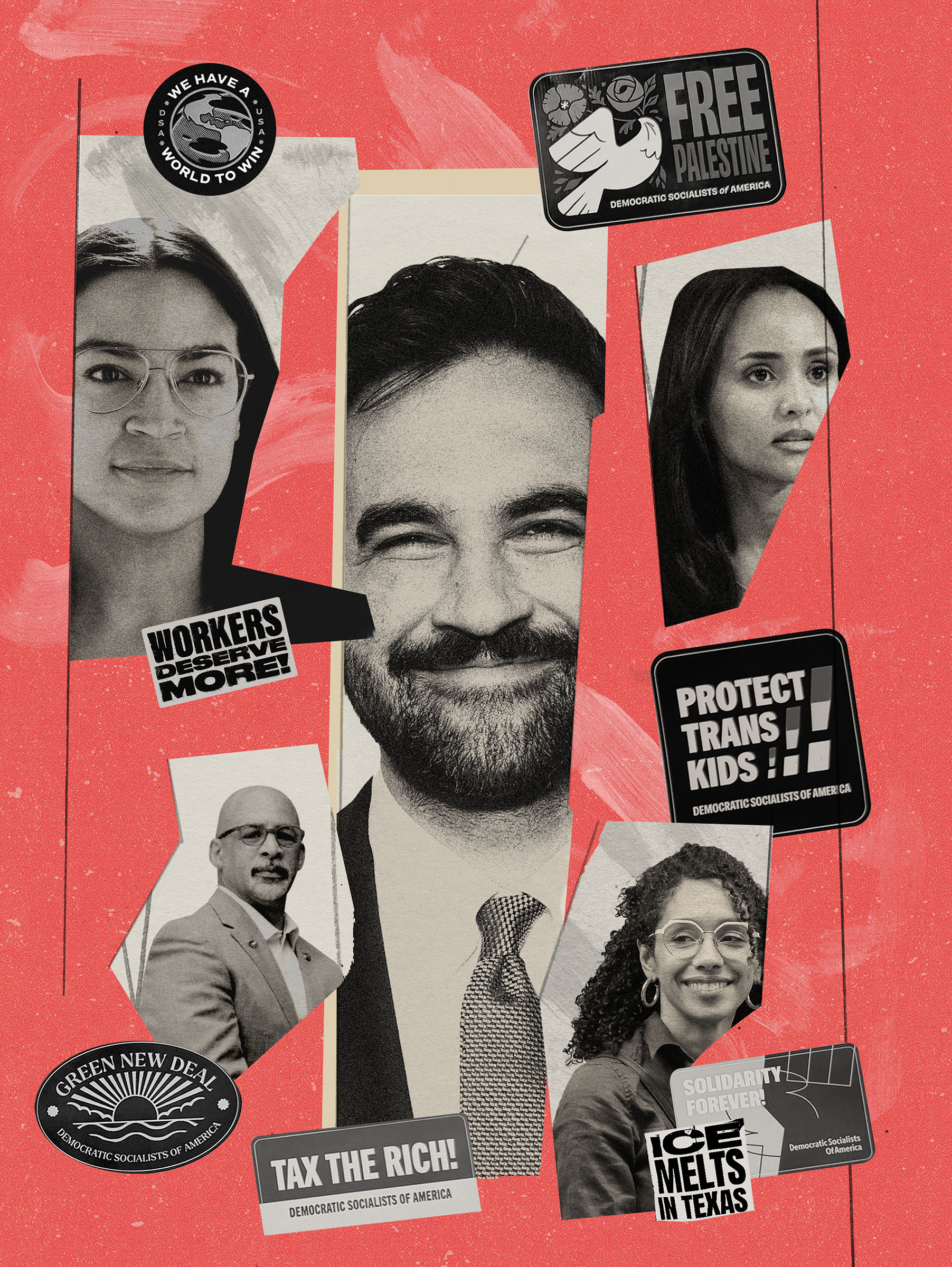
Clockwise from top left: Alexandria Ocasio-Cortez, Zohran Mamdani, Melat Kiros, Darializa Avila Chevalier, and Chris Rabb —Photo illustration by Mark Harris for TIME
Phones rise across the room as Chris Rabb steps to the front. It is the second day of the national summit for the Democratic Socialists of America (DSA) in Chicago, and Rabb is fresh off an upset that launched the movement’s summer winning streak, defeating party-backed rivals in a Democratic congressional primary outside Philadelphia.
Activists in red shirts move closer to take selfies. Some wear DSA’s rose insignia; others have slogans about ICE or Gaza stretched across their chests. “All right, comrades,” Rabb says, using the group’s preferred form of address with a satisfied grin. He asks whether anyone is actually from his district. A few hands go up. For everyone else, Rabb explains, he intends to be their “bonus rep”: another vote and voice for the causes they have spent years trying to push from the margins of Democratic politics to the center of the national debate.
Then Rabb, who at 56 is among the oldest people at the summit, tells the room what he thinks is happening. “As someone who’s been around the block a few times, I’ve never, ever felt this level of electricity,” Rabb says. “Do not take this for granted. Do not let people try to gaslight you and tell you you do not have power.” The room erupts.
There is plenty feeding the confidence. By the time DSA members gather in Chicago in early August, Republicans are gleefully calling it the “Summer of Socialism.” The organization’s membership has surged past 120,000. Its candidates and allies have toppled establishment-backed Democrats in Congressional primaries from New York to Colorado to Florida. Zohran Mamdani, a longtime DSA member, is running New York City. Socialists have captured or are poised to win mayoralties in Seattle and Washington, D.C., while Nithya Raman is headed for a November runoff in Los Angeles. DSA could enter the next Congress with its largest contingent ever. Abdul El-Sayed won Michigan’s Democratic Senate primary with the backing of prominent socialists and a platform that mostly mirrors DSA’s, though he told TIME he doesn’t claim the movement’s mantle. DSA member Alexandria Ocasio-Cortez is a way-too-early favorite in the notional 2028 Democratic presidential primary, according to prediction markets. “This feels like seeds that were planted years ago are now bearing fruit,” Ashik Siddique, DSA’s 38-year-old national co-chair, tells me from a sofa tucked beside the meeting rooms where about 600 democratic socialists gathered for the weekend.
For a movement that counted only a few thousand members a decade ago, the transformation is remarkable. Bernie Sanders made democratic socialism legible to millions of Americans; AOC gave it a younger national face; Mamdani demonstrated that a socialist could defeat the Democratic establishment, govern a major city, and then help elect more socialists behind him. But with the midterms looming, the question is now how far the model travels.
Less than two weeks after the summit, the swing state of Wisconsin supplied an answer DSA members did not want: Francesca Hong, a democratic socialist state legislator, narrowly lost the Democratic primary for governor to Milwaukee County executive David Crowley, who had briefly dropped out of the race just weeks before Election Day. The primary’s finish was dominated by scrutiny of Hong’s since-renounced positions on everything from abolishing the police to canceling Thanksgiving. To establishment Democrats, the outcome suggests DSA’s popularity remains limited to areas where Democrats already dominate. “We aren’t seeing DSA win in places that are core to winning the majority,” former Democratic National Committee chairman Jaime Harrison tells me after Hong’s loss. “Their platform is not the top agenda for the folks who live in those communities.” A week later, an upset in a red state challenged that thinking, as DSA member Angie Nixon defeated establishment favorite Alex Vindman for the Democratic Senate primary in Florida, despite being outraised more than 16 to 1. Republicans, meanwhile, are eager to paint the entire party with a far-left brush in hopes of stemming the blue wave both sides see forming on the horizon this November.
Yet DSA is ascendant inside a Democratic Party that needs what the movement is producing: volunteers, enthusiasm, disciplined organizing, and a message that connects with the economic anxieties of young voters. A third of Democrats and Democratic-leaning voters now identify as democratic socialists, according to a CNN poll released July 30.
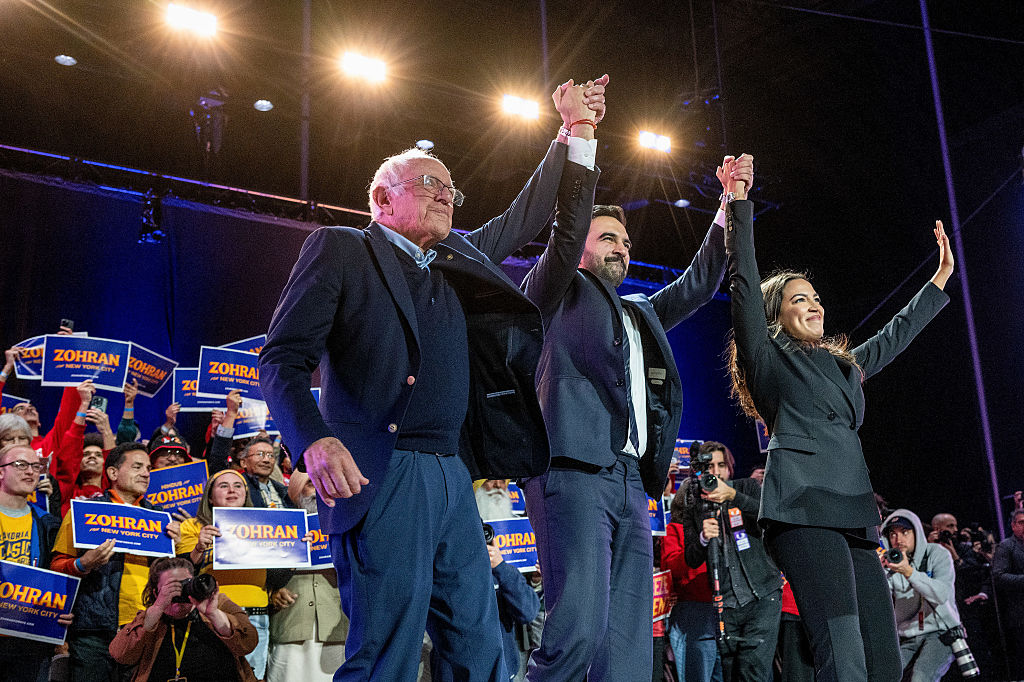
From left, Bernie Sanders, Zohran Mamdani, and Alexandria Ocasio-Cortez campaign on Oct. 26, 2025 —Victor J. Blue—Bloomberg via Getty Images
But DSA carries liabilities of its own. Its national platform goes far beyond what successful candidates typically advertise: the group favors abolishing the Senate, eliminating police and prisons, dismantling ICE, closing overseas military bases, and bringing large corporations under public ownership. Republicans are eager to attach those positions to every Democrat in the country. Some Democrats are just as eager to keep their distance. “There are candidates who have won primaries and call themselves communists,” says Matt Bennett of the centrist Democratic think tank Third Way, which is preparing a $15 million effort to discredit democratic socialism ahead of 2028. “It’s much harder to push back when there’s a grain of truth to the charge.”
The stakes are about to become more concrete. Along with almost certainly increasing their numbers in Congress, DSA is set to take the reins of the U.S. capital. Critics in both parties will be searching for proof that the winners of these insurgent campaigns are too radical, too idealistic, or simply inept. But to DSA leaders, it’s an unprecedented opportunity to show Democrats, and the country, that its agenda for everything from housing costs and labor protections to immigration and foreign policy is what voters are looking for heading into 2028. “We’re bringing a meaningfully different style and substance to politics,” Siddique says. “We’re proving it works, and it’s raising everyone’s expectations. People look to New York and D.C. or Los Angeles or Minneapolis, and they are increasingly feeling like, wow, we could do what they did here.”
At the opening session in Chicago, Kaitlin Marone asks who in the room was already a member in 2016. A few hands rise. The DSA field organizer moves the date forward to 2020. Nearly half the room raises theirs. Then Marone asks everyone to turn to their comrades and explain why they joined.
The conversations offer clues to DSA’s sudden relevance. Members talk about rent and health care, Donald Trump and immigration enforcement, Israel and Gaza, jobs that do not pay enough and homes they cannot afford. Others describe a Democratic Party they no longer believe is capable of addressing the problems shaping their lives.
There is plenty at the summit to remind visitors that this is an avowedly socialist organization. A bookseller in the hallway sells Marxist literature; The Communist Manifesto sells out by evening. Nearby, organizers decorate a “Free Stuff!” booth with fake bags of money and gold bars. But many of the grievances drawing people toward DSA no longer sound especially fringe. For Katie Sims, DSA’s 28-year-old electoral chair, the revelation came after graduating from Cornell in 2020 and looking at what a job would pay, then what rent and health insurance would cost. “I was like, none of these numbers add up,” Sims says. Polls show younger Americans are increasingly pessimistic about reaching the basic milestones available to their parents: homeownership, financial security, raising a family without amassing crushing debt. But, while Mamdani was elected mayor of New York with 51% of the vote, the people DSA has attracted are disproportionately young, white, urban, and college educated—hardly a representative sample of the working class the organization hopes to organize.
Many DSA members first arrive angry about a landlord, a hospital bill, student debt, or a war overseas. By connecting all of those problems to one larger one—the rapid concentration of wealth and power—DSA has given those frustrations a home and a vocabulary, and, increasingly, a way to organize around them. The movement has been adept at identifying places where Democratic voters are moving before the party establishment does, and then organizing the people who are already there.
Israel has provided another opening. Democratic voters, particularly younger ones, have moved sharply against Israel’s conduct in Gaza, while many elected Democrats have been slower to follow. DSA, which long called for ending U.S. military aid to Israel, was poised for the shift in public opinion. Sara Almosawi, a 24-year-old daughter of working-class parents from Iraq and Indonesia, joined DSA after Sanders ended his 2020 presidential campaign. “My parents immigrated here to follow the American Dream, and I don’t think that really panned out,” she says. In college, she helped lead campus protests against the war in Gaza and is now national co-chair of the Young Democratic Socialists of America.
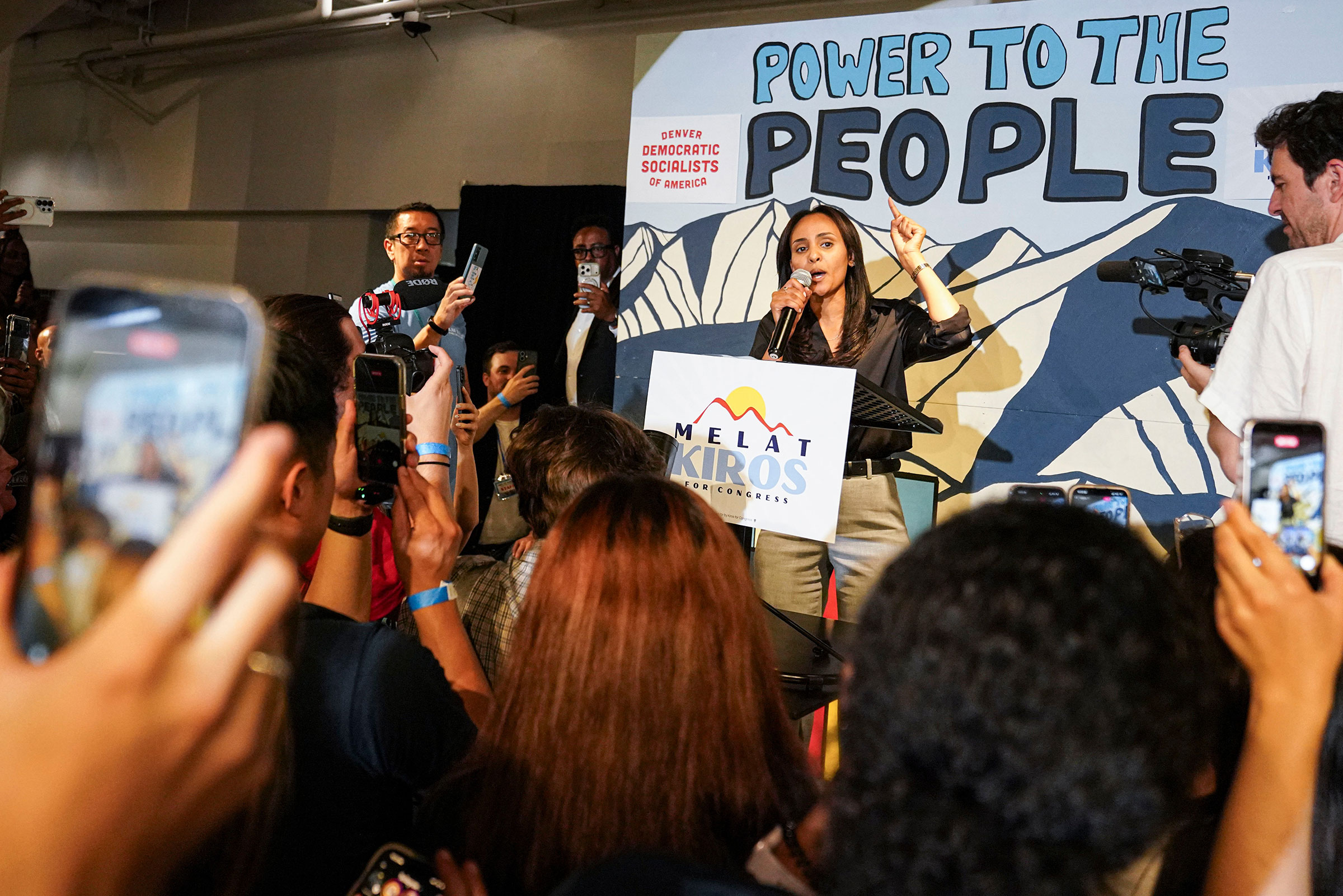
Melat Kiros won the Democratic nomination for Colorado’s first congressional district in June —Rebecca Slezak—AP
That pipeline is beginning to reach elected office. Darializa Avila Chevalier, 32, organized at Columbia before winning a congressional primary this summer with opposition to U.S. support for Israel at the center of her campaign. Other DSA-backed candidates have campaigned on more affordable housing, stronger unions, Medicare for All, and tighter restrictions on data centers—issues where the organization argues Democrats are too cautious or constrained by donors.
Mamdani has emerged as the movement’s most effective translator. His campaign took ideas long associated with DSA, including free public buses, city-run grocery stores, and freezing rent, and framed them around an argument almost anyone could understand: life in New York had become too expensive, and government should make it cheaper. By pairing that affordability message with outspoken opposition to U.S. support for Israel, he turned two forces drawing younger voters toward the socialist left into a coherent political identity. “The mood changed right after Mamdani won,” Sims says. “The answer to ‘could we build it’ is yes.”
On the first night of the summit, about 50 socialists pack into a dimly lit bar on Chicago’s South Side to discuss the next presidential election. Alexandria Ocasio-Cortez is not there, but her name and face appear on signs and pins scattered around the unofficial “DSA for AOC” gathering, where members squeeze into booths and spill onto the patio. After spending the day talking about labor organizing and how to build a lasting movement, the conversation turns to what might be possible in 2028. “We’re in the moment of the presidential question,” Sims tells the crowd, standing on a chair as comrades cheer. “Doesn’t it just make sense now?”
Ocasio-Cortez has not ruled out running for President, and DSA leaders I speak with regard an endorsement from the group as close to inevitable if she does. They say no other working politician has her mix of a national following, massive fundraising network, and talent for pressing socialist ideals. A few other names are floated, including progressive Representative Ro Khanna of California and United Auto Workers president Shawn Fain. (Neither is a socialist.) Jeremy Cohan, a longtime New York DSA organizer, argues that AOC alone could merge Obama-style organizing with Sanders-style politics. “It has never really been tried,” he says. “And I think that could change the country.”
But Ocasio-Cortez also demonstrates the challenges ahead if the movement aims to mature. The national organization declined to renew its endorsement of her in 2024 after disagreements over her vote defending Israel's right to exist and past support for strengthening the Iron Dome, even as its New York chapter continued supporting her. Some members worry that a presidential campaign would pull her toward the Democratic mainstream; others wonder whether demanding ideological fidelity would squander the influence they spent a decade building.
Even as they debate rallying behind her, Ocasio-Cortez acknowledges that many DSA ideas remain broadly toxic. Asked after Hong’s loss about her past calls to defund the police and other provocative statements from 2020, Ocasio-Cortez (who made some herself) wryly quoted fellow DSA member and New York City councilman Chi Ossé: “Woke 1 was crazy.”
The dispute reflects a larger question: What exactly does DSA want to do with the power it is accumulating? Even DSA’s leaders disagree over how far to go. At a June meeting in St. Louis, its National Political Committee debated for hours whether to add support for abolishing the Senate to the platform. Advocates argue the upper chamber is a fundamentally undemocratic institution because each state, regardless of population, gets two Senators. “This is not the time to put that demand forward,” someone argued. The proposal passed by one vote. Cliff Connolly, a 31-year-old member of DSA’s Marxist Unity Group who pushed for its inclusion, envisions a system in which the House chooses the executive, eliminating a presidency he believes has accumulated monarchical power. “The person will no longer be the king of America, like Donald Trump is today,” Connolly tells me at the summit, wearing a Che Guevara T-shirt.
The distance between that vision and the campaigns DSA is winning captures the central contradiction of its success. DSA-endorsed candidates have triumphed by running on some of the group’s issues while eschewing others. But if candidates aren’t aligning with core components of DSA’s platform, former DNC chair Harrison asks, “how does that reflect on the DSA, then?”
Some members fear focusing too much on electoral success risks reducing DSA to another faction within the Democratic Party. “Electoral politics will not save us,” Rabb says in Chicago. “It’s only a component of collective liberation. You’re never going to hear me saying voting is all that matters.” Some have called for the DSA to become its own party rather than running on the Democratic ballot. But DSA leaders say the recent streak of wins has strengthened the pragmatists. “Our members want to keep doing what’s working,” Siddique says, “which is just running as Democrats.”
If its nominees win in November, DSA’s tiny congressional presence could become something resembling a bloc. It would still amount to a handful of seats in a 435-member House. But in a chamber governed by narrow margins, a handful can matter. Hakeem Jeffries, who is positioned to become Speaker if the Democrats control the House, could find himself in repeated negotiations with the DSA caucus over close votes on everything from funding for Israel to avoiding a government shutdown.
And then there is 2028. An Ocasio-Cortez campaign could force the organization to face the compromises required to elect a President. Members imagine Ocasio-Cortez building on Mamdani’s momentum and Sanders’ strong showing in two presidential primaries, giving the movement a national vehicle for turning its ideas into power without compromising its overarching goal: a socialist United States. “We need a fighting unified left,” Diana Kingsbury, a 31-year-old community organizer from Santa Rosa, Calif., tells me as light rain begins to fall on the patio of the Chicago bar. “We need to have muscles behind our issues. Otherwise, what are we doing?”
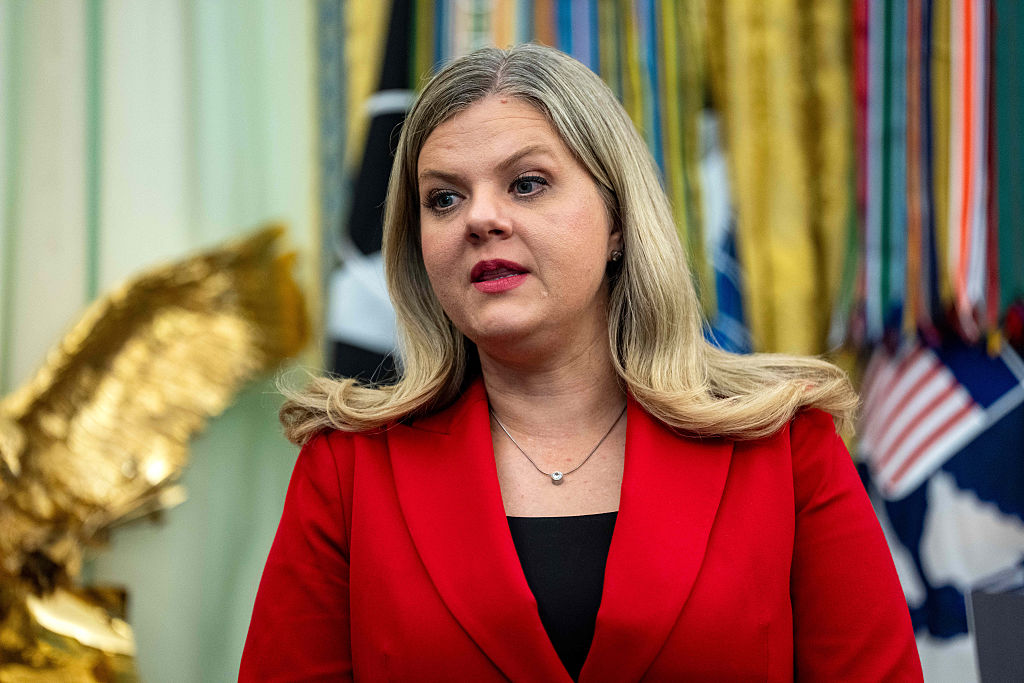
Heidi Overton during an executive order signing in the Oval Office of the White House in Washington, D.C., on Aug. 10, 2026. —Bonnie Cash—UPI/Bloomberg/Getty Images
President Donald Trump announced on Wednesday that he was tapping Dr. Heidi Overton to lead the U.S. Food and Drug Administration (FDA), the health agency responsible for overseeing the safety and effectiveness of products including food, drugs, and medical devices.
“Dr. Heidi has been a ROCKSTAR in my Administration, where she has worked directly with Secretary Kennedy, Dr. Oz, and team, to deliver on the MOST TRANSFORMATIVE Health Agenda in History,” the President said in a Truth Social post. “We need her leadership at the FDA now to ensure that the U.S. remains the WORLD LEADER for Scientific Discovery and CURES.”
He went on to say that, in the role, Overton would work with Health and Human Services Secretary Robert F. Kennedy Jr. and Centers for Medicare and Medicaid Services Administrator Dr. Mehmet Oz “to RAPIDLY deliver on my priorities of FASTER Cures, INCREASED American Innovation, MAJOR Clinical Trial Reforms, LOWER Drug Prices, and even more MAHA WINS!”
If confirmed by the Republican-controlled Senate, Overton would take over the role previously held by Dr. Marty Makary, who stepped down from the position in May amid growing pushback from both outside of and within the White House.
Here’s what to know about Overton.
She’s a physician—and used to work at a conservative think tank
Overton, who has both an MD and PhD, used to be the chief policy officer at a conservative think tank called the America First Policy Institute. She is also a board-certified physician in public health and general preventive medicine, according to her bio on the institute’s website.
She currently works for the White House in another role
Overton already works in Trump’s White House, and has recently been in attendance at several events where the President has promoted his Administration’s health policies. She currently serves on the White House Domestic Policy Council, which “supervises the development, coordination, and execution of domestic policy in the White House” and “offers advice to the President and represents his priorities to Congress,” according to the White House website.
Last week, she was in the Oval Office with the President when he signed an Executive Order calling for children across the country to receive fewer immunizations—a move that was widely denounced by medical organizations and doctors. During the Oval Office signing, Trump said that concern over rising autism rates was one of the motivations behind the Executive Order. Research overwhelmingly demonstrates that vaccines are both safe and effective, and years of studies have found no link between vaccines and autism.
“While I respect Dr. Overton’s experience as a physician, I have strong concerns about her nomination to be FDA Commissioner,” he said on X. “Her lack of managerial experience does not prepare her well for leading a large organization that is already dealing with staffing and morale issues. Additionally, Dr. Overton’s active role in last week’s nonsensical vaccine executive order calls into question her commitment to standing up for sound science and protecting children’s health. That alone is almost disqualifying.”
She is a vocal opponent of abortion
Overton has publicly expressed anti-abortion views. After the Supreme Court overturnedRoe v. Wade in 2022, Overton celebrated the ruling, calling it a “huge victory for life.” She has written several articles for the America First Policy Institute opposing abortion, including one in 2023 that lamented the Biden Administration’s efforts to expand access to abortion pills, which she claimed “are far more dangerous to women.” Years of research have shown that abortion pills are both safe and effective.
After Trump was elected to a second term, many abortion providers and advocates voiced fears that he would appoint someone to lead the FDA who would restrict or revoke access to abortion pills. Several reproductive rights organizations condemned Trump’s nomination of Overton to lead the FDA on Wednesday.
“Donald Trump is trying to put an anti-abortion extremist in charge of any agency that could seriously undermine reproductive healthcare—including the agency that could roll back access to mifepristone nationwide,” Reproductive Freedom for All President and CEO Mini Timmaraju said in a statement. She went on to accuse Overton of having “spread junk science about medication abortion.”
“Her nomination is another alarming step in Trump’s plan to weaponize every part of the federal government to restrict abortion nationwide,” Timmaraju continued.
Anti-abortion organizations, meanwhile, threw their support behind Overton.
“We believe Dr. Overton has an opportunity to help strengthen restrictions on the chemical abortion regimen,” Sarah Zagorski, senior director of public relations and communications for the anti-abortion group Americans United for Life, said in a statement.
Kennedy has praised her
In a post on X on Wednesday, Kennedy said that he was “confident” that he and Trump “chose the best person for the job” at the FDA. He said that he has witnessed Overton “challenge assumptions, demand excellence, and turn bold ideas into meaningful results.”
“At the @FDA, she will make our food supply safer, modernize drug approvals, unleash American medical innovation, accelerate access to lifesaving treatments, bring greater transparency and accountability to the agency, and restore Gold Standard Science as the foundation of every decision,” Kennedy said.
Sources tell WIRED that Elon Musk is expected to spend up to $200 million in the midterms. It could be a big boost for GOP Senate candidate Ken Paxton, who’s struggled to raise cash.
President Donald Trump speaks with Canadian Prime Minister Mark Carney at the G7 summit, in Evian, France, on June 16, 2026. | Evelyn Hockstein/AFP via Getty Images
This story appeared in The Logoff, a daily newsletter that helps you stay informed about the Trump administration without letting political news take over your life. Subscribe here.
Welcome to The Logoff: President Donald Trump’s planned Canada tariffs are off — for now.
What happened? Trump had previously threatened 50-percent tariffs on about $20 billion worth of Canadian goods, but delayed them late on Tuesday, hours before they were set to take effect.
In a social media post, he wrote that the tariffs were on hold for “a three day period, based on the fact that Canada and the U.S.A., subject to the finalization of documents, have a DEAL!”
Is there actually a deal? We’ll find out in the next three days. Trump’s claims should always be taken with a grain of salt, and Canadian Prime Minister Mark Carney said only that “substantial progress” had been made toward a deal, with “important work still to be done.”
On Wednesday, the Wall Street Journal reported that the US could reduce previous tariffs on Canadian goods —which applied to cars, steel, and aluminum — as part of a potential trade deal. Trump has also suggested that a deal could resurrect the Keystone XL oil pipeline.
Can Trump still impose new tariffs? He can. Earlier this year, the Supreme Court struck down Trump’s use of a specific law, the International Emergency Economic Powers Act, to impose tariffs. In doing so, the Court ended many of his most sweeping tariffs and took away his favorite way to impose them.
He has plenty of other tools to keep at it, though, albeit on a more limited basis. Trump was threatening to use a never-tested section of the 1930 Smoot-Hawley Tariff Act to impose his most recent Canada tariffs. (Other existing Canadian tariffs fall under yet another law.)
What’s the big picture? This trade fight could preview an even bigger one to come, as the US, Mexico, and Canada attempt to renegotiate the US-Mexico-Canada Agreement that Trump struck in his first term. Trump declined to renew the deal last month, kicking off new negotiations.
And with that, it’s time to log off…
We got some incredibly good news about cancer treatment on Wednesday from the pharma companies Moderna and Merck, which announced a successful trial of an mRNA vaccine for melanoma, a particularly dangerous type of skin cancer.
The idea of using vaccines — and specifically mRNA, which helped produce Covid vaccines in record time — to treat cancer isn’t new, but the Moderna and Merck trial is a big step on the path to getting a cancer vaccine approved by the FDA.
As always, thanks for reading, and we’ll see you back here tomorrow!
Rep. Randy Fine talks with reporters outside the US Capitol in April. | Tom Williams/Getty Images
This story appeared in Today, Explained, a daily newsletter that helps you understand the most compelling news and stories of the day. Subscribe here.
Name a disgraced former Congress member, not originally from Florida, whose time in office was marred by shady financial dealings and who ran in yesterday’s GOP primary for Florida’s 19th District.
…This is, amazingly, a trick question. Because TWO candidates who fit that bill ran in FL-19, and neither of them won. (They were Madison Cawthorn and Chris Collins.)
Florida is — how do I put this? — one hell of a drug. And its primary results were no less surprising or chaotic. On the Democratic side, a socialist candidate for Senate came out of (literal) left field to topple an opponent who out-fundraised her 16 to 1. Meanwhile, progressive challengers lost decisively in twoother races.
On the Republican side, President Donald Trump’s picks won most of their contests, including the race to succeed Gov. Ron DeSantis. But two endorsed candidates also lost in surprising upsets. Republicans ousted Rep. Cory Mills, for instance, who has been accused of assaulting one woman he dated and threatening another. And Trump’s pick in FL-19, Catalina Lauf, fell not to Cawthorn or Collins, but to the founder of a conservative talk-radio station. Florida!!!
That race — the Republican primary in Florida’s Sixth Congressional District — pitted an open Islamophobe (Rep. Randy Fine, who won) against an avowed antisemite (the manosphere influencer Dan Bilzerian).
Both men are shocking in their bigotry, even for a party that has inured itself to shock. Bilzerian, a self-described sex addict and former professional poker player, has fantasized about “exterminating Israel” and “revisiting” the ideologies that precipitated the Holocaust. Fine, meanwhile, has repeatedly compared Muslims to dogs and said that Israel should let Gazans starve.
How did men with such repugnant views emerge as this race’s top finishers? The first reason is dark, but fairly obvious: a significant share of Republicans hold Islamophobic or antisemitic opinions.
The second reason is maybe more interesting: Republicans increasingly treat any perceived limit on speech as an intolerable form of censorship. That new norm has made it less likely that party leaders will condemn hateful views, since the appearance of policing speech is often considered just as bad as bigotry or extremism. As a pair of conservative writers warned in the New York Times last week, this reflex has created “a subculture of racism, sexism and antisemitism” in the GOP.
Some on the left hold hateful views too, of course. But Democrats don’t have those same norms against policing speech.
One link for later
➨ Stop trying to “sell” yourself to new people. That’s advice from my colleague Allie Volpe’s evidence-backed guide to optimizing your online dating profile, but I’d argue it applies to most social interactions. Other all-purpose gems from Allie: be selective with how much you share about yourself and convey your willingness to get to know other people.
Before you go…
Did you know…that the length of the average middle-grade book ballooned from 175 pages in 2006 to 290 pages a decade later? It’s one of the unexpected reasons that kids aren’t reading as much as they used to.
Today’s trivia: Jackie Robinson and Jackie Joyner-Kersee attended the same college. What college was that? (You can find this and other brain puzzles in Vox’s daily crossword. Look for the answer in tomorrow’s edition.)
Yesterday’s trivia: Yesterday we asked you which Dutch astronomer theorized “a cloud that constantly creates comets.” (Say that three times fast!) That would be Jan Oort, namesake of the Oort Cloud — an immensely distant band of billions of icy objects that are thought to surround our solar system.
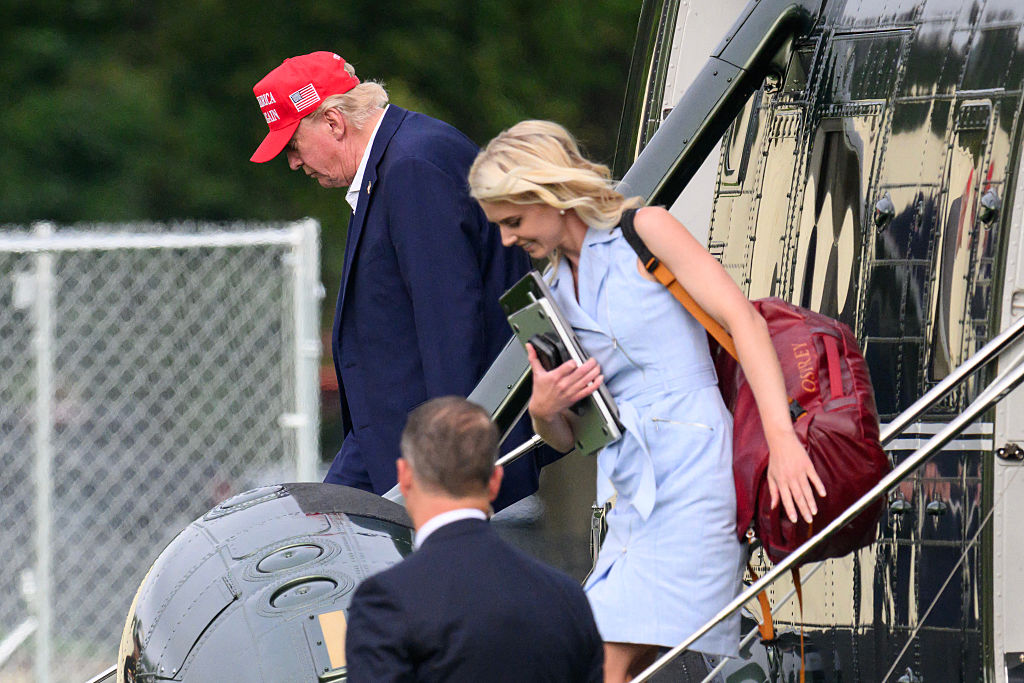
President Donald Trump and aide Natalie Harp (R) exit Marine One on the Ellipse near the White House on Aug. 16, 2026. —Mandel Ngan—AFP/Getty Images
A previously little-known White House aide has garnered growing public attention in recent days after Sen. Jon Ossoff mentioned her while levying an attack on President Donald Trump.
The Georgia Democrat said that Trump “doesn’t want to do the job” of President. Instead, Ossoff continued, “He wants to build his ballroom and travel with Natalie.”
Ossoff was referring to 35-year-old Natalie Harp, a longtime aide to Trump. When asked about Ossoff’s comments, Trump likened the Democrat to “Pee-wee Herman” and said he “would much rather do other things.”
Ossoff has stood by his remark about Trump and Harp. Appearing on MS NOW this week, the Georgia Senator said: “It’s been amazing to watch this White House melt down over this all week.”
So who is Harp, and what is her role in the White House? Here’s what to know.
Harp said that Trump saved her life
In 2019, Harp went on Fox News and thanked Trump for signing the Right to Try law the year before. She told the network that she had stage 2 bone cancer, and that the new law allowed her to access experimental treatments, which she said saved her life.
After hearing her recount her experience, Trump asked her to give a speech at the 2020 Republican National Convention, according to the New York Times.
“When I failed the chemotherapies that were on the market, no one wanted me in their clinical trials,” she said at the event. “They didn’t give me the right to try experimental treatments, Mr. President. You did, and without you, I’d have died waiting for them to be approved.”
But after the convention, the Washington Post reported that medical experts cast doubt on Harp’s claims.Harp has said that she was treated with “an FDA-approved immunotherapy drug for an unapproved use,” and experts said that the federal legislation that Trump signed in 2018 wouldn’t have made that drug accessible to Harp because the medication had already been approved.
About two years after her speech at the Republican National Convention, she became a member of Trump’s staff.
She used to work for a far-right news channel
Before Harp joined Trump’s team, she worked as an anchor for a far-right news channel called One America News Network for a couple years. While working for the network, she propagated Trump’s false claims that the 2020 election was “stolen” from him.
Her official title is ‘special assistant to the President and executive assistant to the President’
In Harp’s role, officially called the “special assistant to the President and executive assistant to the President,” she works closely with Trump. Many of the Truth Social posts that the President shares are ones that he dictated to her to type and hit “post” on.
According to the Times, which cited two people who were aware of the situation, Harp hit the “send” button on the enraged messages that Trump sent to the billionaire and major Republican donor Miriam Adelson in 2024—messages that nearly lost him Adelson’s backing.
Harp was also the one who transcribed dozens of social media posts that Trump dictated to her one day in which he attacked the writer E. Jean Carroll, who alleged that Trump raped her in the 1990s, the Times reported.
Some of Harp’s colleagues have dubbed her the “human printer” because she is known for carrying a portable printer as she trails Trump around so she can give him whatever information he wants or needs in print copies.
When appearing on MS NOW this week, Ossoff accused Harp of “printing out Donald Trump’s daily dose of delusion and flattery.”
She was one of the select number of people who was on Trump’s secret flight out of Turkey
When Trump left Turkey in July on a secret, alternate plane after receiving an Iranian assassination threat, only a few people working in the White House were on his flight, including Harp, CBS News reported. Defense Secretary Pete Hegseth was also on the plane with Trump and Harp, as were a couple other aides. Other higher-up members of his Administration, such as Secretary of State Marco Rubio and Treasury Secretary Scott Bessent, were on the other plane—the one that the Administration had said that Trump would travel on, and that members of the White House press corps were on.
When asked by the Timesabout Harp’s role in the White House and why she was selected to be among the few staffers on the secret flight, White House Press Secretary Karoline Leavitt said: “Natalie Harp is one of the most loyal and hardest-working aides on President Trump’s team.”
CNN Condemns Trump's Attacks on Journalist Kristen Holmes Following Heated Oval Office Response
The nature of her relationship with Trump has been a subject of scrutiny
According to the Times, Harp wrote Trump several letters in 2023 that concerned some people near him. In the letters, which reporters at the Times viewed, Harp wrote messages including: “You are all that matters to me” and “I don’t ever want to let you down.” She called Trump her “Guardian and Protector in this Life,” and thanked him, the outlet reported.
“I want to bring you joy,” she wrote in one of the letters, according to the Times, “to feel like we can get through a day without ever having to talk ‘work.’”
The news outletalso reported, citing two sources with knowledge of the remark, that Trump said at one point in 2023 that Harp was the only person on his team who cared about him.
Harp’s estranged brother, Preston Harp, was asked about the Times’ reporting about the 2023 letters when he appeared on CNN this week. He replied: “I’d say since she was like 16, she’s had an obsession with, gosh, how do I explain this? She’s written letters to other Presidents. Let me put it that way. And so like, her dream came true finally.” When asked which Presidents she wrote letters to, he said: “I didn’t see the letter, but George Bush obviously, during the Iraq war.”
He also described his sister’s relationship with Trump as an “infatuation” but said, “I don’t think it’s a physical attraction.”
“I think that Trump’s best friends are people who are his fan club,” he said. “And so she’s his biggest fan. And so that’s probably why he likes her. And she’s good looking. She’s got a good personality. I don’t know.”
“I mean she thinks that he saved her life, so, like, somebody living with that kind of gratitude—that must feel pretty good,” he continued.
Harp has not publicly spoken about her relationship with Trump in the wake of Ossoff’s comments, but other White House aides and Republicans have jumped to her defense.
In a statement to TIME, White House spokesperson Davis Ingle called Ossoff’s comments “cringeworthy” and criticized the Senator’s voting record, in addition to defending Harp.
“Natalie Harp is one of the most loyal and hardest working aides on President Trump’s team,” Ingle said in the statement.
Eric Trump, one of the President’s sons, slammed CNN’s interview with Preston Harp on Wednesday.
“What absolute trash,” he said in a post on X. “Natalie is an incredible young woman — a cancer survivor, a genuinely good person, and arguably one of the hardest-working people in the White House. She’s deeply committed to my father, to her job, and to this country.”
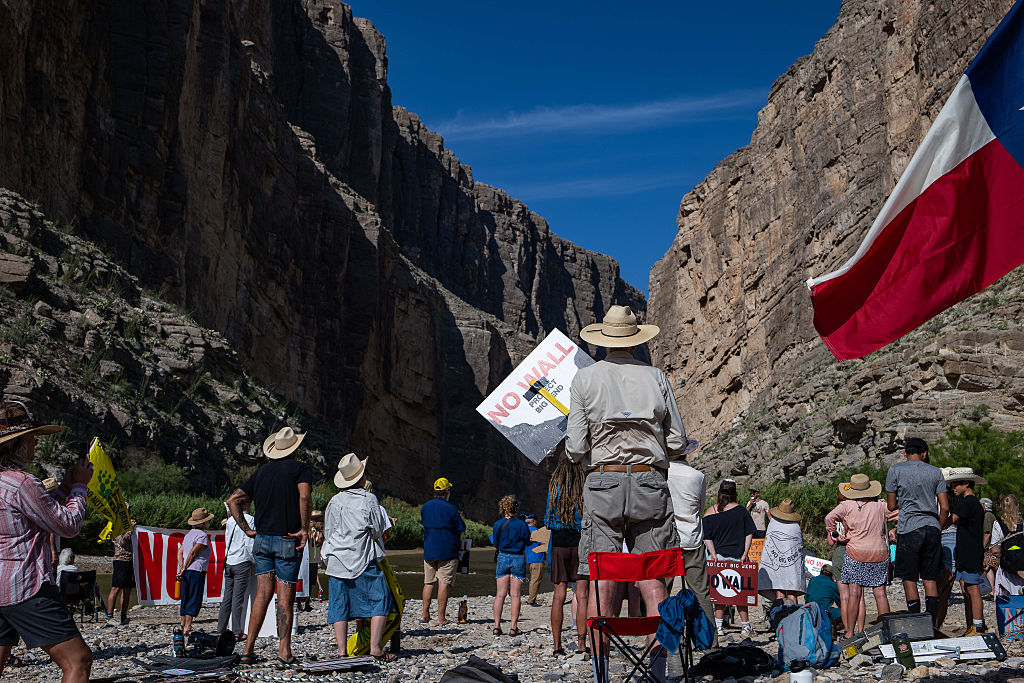
Demonstrators against the construction of a section of the US-Mexico border wall during a protest at Santa Elena Canyon in Big Bend National Park, Texas, on Aug. 12, 2026. —Kaylee Greenlee—Bloomberg/Getty Images
That section of the project, which extends across challenging terrain in Texas’ Big Bend National Park that has historically seen relatively few attempted border crossings, has faced pushback from everyone from public lands advocates to congressional lawmakers to local residents.
The Trump Administration has been pushing the construction of the border wall in Big Bend despite the public outcry, going so far as to bypass a score of environmental laws to expedite the project.
But on Monday, after months of opposition, Customs and Border Patrol (CBP) Commissioner Rodney Scott announced that CBP had paused “all construction” in the park while he visited the site to conduct a “personal, on-the-ground evaluation.” In post on X, Scott wrote that he would be working to “evaluate the terrain and listen to local leadership, community members and stakeholders” over the next “couple of days.”
Texas Gov. Gregg Abbott also said on Mondaythat he had spoken with Department of Homeland Security (DHS) Secretary Markwayne Mullin, who Abbott said had “committed” to not building “a wall or a fence” in Big Bend. Abbott said there were “other tools” to ensure border security.
Here’s what to know about the Trump Administration’s efforts to build the border wall in Big Bend, and the opposition the project is confronting.
What the Trump Administration is seeking to build in Big Bend
Big Bend National Park sits in a remote southwest corner of Texas along the U.S.-Mexico border in Brewster County. The Administration has sought to build 17 miles of barriers across that section of the border as part of the larger border wall project.
Perhaps the most recognizable image of Trump’s wall is the “primary wall,” a structure built from tall steel bollards up to 30 feet tall that makes up the first line of the barrier system that would be encountered by those travelling north from Mexico. The section of the project planned to run through Big Bend, however, would look notably different, according to Scott.
“CBP is building one new access road, improving existing roads, installing detection technology, and placing vehicle barriers in limited, strategic locations,” he said. “We are NOT building a 30-foot wall or stadium lighting through Big Bend National Park, Big Bend Ranch State Park, or the Black Gap Wildlife Management Area.”
The portion of the wall in the park would be made up of a non-contiguous “vehicle barrier system,” according to the CBP, which consists of “steel posts supported by continuous steel rails,” power cables, cameras, roads for patrol cars, and shelters along the border.
According to the agency’s Smart Wall tracker, an interactive and frequently updated map that shows the status of the border wall, CBP has several construction projects interspersed along the border labeled as a “vehicle barriers … technology & patrol road.” A couple of these are located at the southern tip of the park; one sits far west near Presidio County, while others are located at the eastern edge of the park. These sites are in the Chihuahuan Desert, which presents a difficult landscape to navigate filled with steep canyons and mountainous terrain.
A controversial push to speed construction
In June, the Trump Administration waived more than 20 environmental and preservation laws intended to protect Big Bend’s landscape in order to accelerate the construction of the border wall in the park.
To do so, the Administration invoked a section of the Illegal Immigration Reform and Immigrant Responsibility Act of 1996, which allows the government to bypass laws that obstruct the building of border wall.
DHS defended the move at the time by describing Big Bend as an “area of high illegal entry” and saying that “there is presently an acute and immediate need” to build more barriers.
Migrant encounters are relatively rare at the section of the border that runs through the park, however—and have become more so in recent years. The park includes roughly 118 miles of what’s known as the Big Bend Sector of the border, which spans 517 miles from Sierra Blanca, Texas, to Sanderson, Texas, and covers roughly one-quarter of the full length of the U.S.-Mexico boundary. CBP recorded a 74% decrease in border crossings through its Big Bend Sector between fiscal years 2023 and 2025, with apprehensions dropping from 11,823 to 3,096. There were a total of 237,538 migrant encounters along the U.S.-Mexico border in FY 2025, meaning that the 3,096 apprehensions in that sector accounted for just 1.3% of the total number. And CBP’s planned border wall in the park would only cover a fraction of a fraction of the full sector.
The Administration’s move to bypass the environmental laws triggered immediate opposition. Bob Krumenaker, the park’s most recent former superintendent, called the news “devastating” to Marfa Public Radio and referred to it as “giving CBP unfettered authority to do anything they want within the national park.” Legal challenges also followed in the form of multiple federal lawsuits, while members of Congress made efforts to block DHS’s funding for projects in Big Bend.
Why the project has faced opposition, and from who
Grassroots organizations, conservation groups, businesses, local communities, and lawmakers have also made efforts to fight against the construction of the border wall in Big Bend.
Much of the opposition stems from concern over the park’s natural landscape, which is home to an array of wildlife and is effectively undeveloped. Other groups oppose the construction because they view the park as a cultural and heritage site, while still others have voiced concerns for the impact the planned barrier construction could have on the tourism economy there.
A seriesoflawsuits have been filed in an effort to block DHS’s plans to construct the border wall in Big Bend.
One lawsuit from the Center for Biological Diversity challenged DHS’s waiving of laws to carry out construction in the park. “Until now no administration has been heartless enough to waive laws in a national park like Big Bend, so we’re suing to uphold the U.S. Constitution and protect this crown jewel,” Laiken Jordahl, national public lands advocate at the Center for Biological Diversity, said in a statement according to a news release.
The Center for Biological Diversity had previously filed a lawsuit that argued the construction would “devastate the region’s wildlife, recreation economy, and natural and cultural heritage.”
Another lawsuit, filed by The People of La Junta for Preservation and Far
Flung Outdoor Center, a tribal nonprofit and an outdoor recreation company, argued that the construction will cause damage to archaeological sites associated with indigenous peoples and could threaten protected religious freedoms.
Groups have also mounted protests and sent letters to lawmakers to call for the planned construction to be halted.
In March, the grassroots organization No Big Bend Wall sent a letter to several leaders on congressional committees on behalf of 132 organizations asking that the use of any federal funding for the border wall in Big Bend be prohibited.
All the Democratic members of the Texas delegation in Congress sent a letter to Mullin later that same month voicing “staunch opposition” to the wall.
“This proposal threatens preservation of one of America’s crown jewels, Texas’ largest state park, and the state’s only congressionally-designated Wild & Scenic River,” the lawmakers wrote. “Construction and maintenance of a border wall segment and the associated roads, secondary barriers, power lines, towers, and lighting will disrupt natural biodiversity, river dynamics subject to routine flash flooding, and one of the darkest night sky areas in the world.”
Over the following two months, more than 2,000 people rallied at the Texas Capitol building in Austin, and seven former superintendents of Big Bend National Park urged Mullin not to waive federal laws to build the border wall in the park.
In early August, video showed heavy machinery bulldozing the land at Big Bend. A bipartisan group of Texas House lawmakers soon after sent a letter to Gov. Greg Abbott on Thursday in which they urged him to halt the Big Bend construction, citing “damage to one of Texas’ most pristine and irreplaceable landscapes” that they said had already begun with the movement of bulldozers and construction equipment into the park.
Last Wednesday, a large crowd of protesters gathered in the park chanting “No road. No wall. No wire. No way," as they held hands in a circle. They also held a large banner that read “NO WALL,” along with a series of other wildlife-themed flags and signs.
More than 140 local businesses, recreation groups, and outfitters who rely on the tourism economy in the park also penned a letter on Aug. 4 to Cornyn, Cruz, and Abott asking them to halt the border construction to preserve the vibrant tourism economy that lives within the park.
Scott released a statement last week in response to the public reaction specifying that “what people are seeing right now is survey and design work—NOT construction of a wall through the park.”
Following Scott’s later announcement that CBP would be pausing construction on the wall in Big Bend, the National Parks Conservation Association (NPCA), which has pushed back against the Big Bend construction, lamented the damage that it said the project has already done to the park’s lands.
“The people have spoken, and they do not want the Trump administration to bulldoze America’s national parks for border infrastructure,” said NPCA President and CEO Tiernan Sittenfeld in a statement. “Unfortunately, the federal contractors’ bulldozers have already inflicted tremendous damage to one of America’s most iconic national parks. Their heavy equipment has torn through miles of priceless wild landscape, wreaking havoc on sensitive wildlife and irreplaceable habitat.”
President Donald Trump and North Korea's Kim Jong Un talk before a meeting in the demilitarized zone on June 30, 2019, in Panmunjom, Korea. | Brendan Smialowski/AFP via Getty Images
Can President Donald Trump pen a new chapter in his love story with North Korea’s Kim Jong Un?
In Trump’s first term, the two leaders, in Trump’s words, “fell in love” after exchanging letters and held three historic meetings, but failed to make much progress toward the goal of denuclearizing the heavily armed hermit state.
Now, Trump appears to be trying to recapture the magic, reportedly urging aides to set up a meeting with Kim as soon as this fall. This news comes soon after Trump’s Truth Social post on Sunday announcing he had ordered the US military to “substantially reduce” joint military exercises with ally South Korea in part because it would send “a signal that is totally inappropriate and hostile, to a Country that, as long as Donald J. Trump has been President, has been unthreatening and respectful” — North Korea.
Key takeaways
Trump is trying to restart talks with North Korea’s Kim Jong Un, scaling back a planned joint military exercise with South Korea and instructing aides to prioritize setting up a new meeting.
Trump’s three historic meetings with Kim were a diplomatic high point of his first term, but since Trump returned to office, the North Koreans have been rebuffing American advances.
Much has chanced in North Korea since the last time the two met: The country is wealthier, less isolated, and more militarily secure. A Trump meeting might not have the same appeal it once did.
Trump has claimed, without elaborating, that Kim has responded to this overture, but there’s been no public response from Pyongyang yet.
Trump’s outreach didn’t come entirely out of nowhere. Trump has made clear since the beginning of his term that he would like to meet with Kim again, and there was speculation that a meeting might happen when Trump traveled to South Korea for a summit last fall. North Korea’s UN Mission in New York has also rebuffed several attempts by US officials to deliver a personal letter from Trump seeking to restart dialogue.
In the midst of an unpopular conflict with Iran that seems unlikely to end in anything resembling a victory, it makes sense that Trump might be reaching back to what he sees as one of the foreign policy high points of his first term. “Kim Jong Un has always treated me with great respect,” Trump told reporters on Monday. “I understand him. He understands me.”
Beyond reconnecting with an old friend, it’s not entirely clear what Trump actually wants out of North Korea. But if his goal is a new diplomatic breakthrough, that will be even harder than it was the first time: The country is a much different place than it was the last time the two leaders sat down and even if they were to meet again, Kim seems even less likely to make real concessions.
Like it or not, North Korea is a nuclear power now
“There is no chance that North Korea is going to denuclearize. Zero chance,” said Joseph Yun, a veteran US-North Korea negotiator who recently served as acting US ambassador to South Korea. “They have seen what happened to Iran. They have seen what happened to Ukraine. The way they see it, their nuclear weapons are what protects them.” Last year, the country’s official news agency dismissed denuclearization as an “unrealizable pipe dream.”
On top of that, North Korea is in a much stronger negotiating position than it was the last time these two leaders met for a photo op.
“It’s a very different North Korea now. It’s stronger geopolitically, and Kim is stronger domestically.”
Jung Pak, served as US special representative for North Korea in the Biden administration
In 2018, North Korea was heavily isolated and struggling under an international sanctions regime that was at least officially — if not always in practice — supported by China and Russia as well as the United States. For a young leader still looking to establish his internal legitimacy and international standing, a meeting with the sitting US president was a major coup.
But things improved dramatically for North Korea after the pandemic.After it began lifting its Covid-era lockdown — one of the toughest in the world — North Korea has become what the Wall Street Journal has called“the world’s most unlikely growth story.”
The country’s economy has grown for three straight years, and while it’s still an impoverished country where nearly half the population is malnourished, Pyongyang is by all accounts booming, with thousands of new homes built along with a surge in Western-style restaurants and ride-hailing apps.
“North Korea emerged from the pandemic stronger, despite the odds,” said Jung Pak, who served as US special representative for North Korea in the Biden administration. “It’s a very different North Korea now. It’s stronger geopolitically, and Kim is stronger domestically.”
North Korea has been one of the main beneficiaries of the war in Ukraine, sending thousands of soldiers and munitions to help the Russian war effort. While thousands of those troops have died, the North Korean regime has gained billions of dollars in revenue and military aid from Russia in response, as well as invaluable battlefield experience for its commanders and weapons systems.
Russian President Vladimir Putin has come through for the North Koreans in other ways. In 2024, Russia vetoed the mandate of the UN body that monitored the enforcement of international sanctions on North Korea, effectively shredding the international sanctions regime. In 2025, trade between North Korea and China, its main economic partner, rose 25 percent.
The regime has found other innovative ways of raising revenue, reportedly netting billions through cybercrime targeted at foreign banks and cryptocurrency exchanges.
Kim is also less desperate for legitimacy these days. In September 2025, he stood alongside Xi Jinping and Vladimir Putin at a massive military parade in Beijing, a powerful demonstration of unity among three US adversaries. These days, Kim likely feels he’s the one being wooed. Xi’s high profile trip to Pyongyang in June was interpreted by many as a sign that China, warily eyeing the increasingly close relationship between Russia and North Korea, was looking to shore up its ties with its longtime ally.
Domestically, when the world’s first millennial dictator took power after his father died in 2011, many wondered how long he would last. Today, he’s feeling secure enough to be thinking about long-term handoff plans, publicly positioning his 13-year-old daughter as his future successor.
Kim is clearly not desperate to meet with Trump, and these days, the United States has fewer means to pressure him. Without Chinese and Russian support, the US can only dial up international sanctions so much. As for military pressure, the US has been moving military assets out of the Korean peninsula to the Middle East and recently redeployed its last aircraft carrier out of Asia.
As Trump’s actions this week demonstrate, he’s not all that interested in working with US allies in the region to pressure the North Koreans. But if he were considering pairing his warm overtures to Kim with a stick, a “fire and fury” threat wouldn’t pack the same punch today.
Is there any reason for new US-North Korea talks?
Still, there are reasons Kim might want to sit down with Trump again. North Korea would still like US sanctions lifted. Kim’s influential sister has stated that the regime is looking for the US to formally accept its status as a nuclear power, as Russia has now done.
Former US State Department North Korea negotiator Joel Wit suspects that given Trump’s desperation for talks, Pyongyang might try to press its advantage even further.
“If I was a North Korean, I would ask the United States for what I would call a ‘peace agenda,’” he said. “That would mean more than just reducing the size of US-[South Korean] exercises. It could include cutting back on US troops in South Korea or even Guam.”
Trump, who has repeatedly, including in his recent Truth Social post, made clear that he sees the US military presence in South Korea as a waste and the South Koreans as coddled, wealthy freeloaders, might be amenable to concessions like this.
But what could the US get out of talking to North Korea if denuclearization is off the table? Some analysts have suggested a limited deal might be possible, which could see North Korea dismantle its reactors or some of its centrifuges, slowing down the growth of its nuclear program if not eliminating it.
Pak also noted that given North Korea’s refusal to engage in nearly any diplomacy with the US since 2019, just holding talks and building some confidence between the two sides would be progress. “The meeting itself would be the win,” Pak said.
On the other hand, holding talks that do not explicitly aim at eliminating North Korea’s nuclear program would be seen as effectively accepting that North Korea is a nuclear power now. At this point, there’s a strong realist case to be made for accepting North Korea’s nuclear status and proceeding from there, but it’s hard to square with the administration’s stance on Iran’s nuclear program.
It’s also likely that the kind of incremental concessions North Korea might, in the best of circumstances, be willing to offer, would not satisfy a US president with a penchant for grand bargains.
In his first term, just the fact that Trump and Kim sat down made history. Now that that’s been accomplished, they may find that, like many a romance a few years in, they’ve run out of things to talk about.
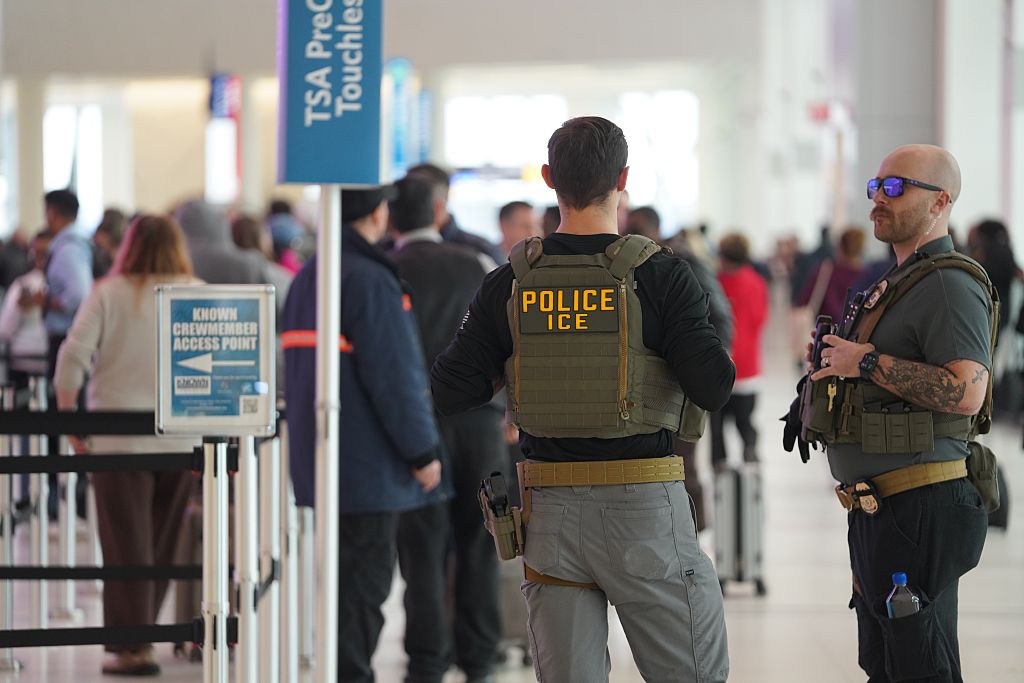
Immigration and Customs Enforcement (ICE) agents patrol LaGuardia Airport in New York City on March 23, 2026, as they assist at busy security checkpoints amid a Department of Homeland Security shutdown that has lasted more than a month. —Zhang Fengguo/Xinhua—Getty Images
Laurie was on her way to a gate at the airport where she worked as a manager when a colleague called with a warning: Immigration and Customs Enforcement (ICE) agents had turned up again and were asking airline staff to help locate a passenger.
She had years of experience cooperating with federal law enforcement. But the encounters she was accustomed to followed a protocol: airline managers were notified in advance, officers arrived in uniform with their badges visible and judicial warrants were presented for passenger arrests.
Multiple gate agents working at airports in Colorado, Texas and Arizona have told TIME that ICE agents have become a recurring presence in recent weeks. With protocols for handling such encounters unclear or inconsistently applied, airline employees like Laurie say they are increasingly being left to decide for themselves how to respond.
She knew how consequential that decision could be.
Ten days earlier, two men in plain clothes had approached a gate agent, identified themselves only as federal officers and asked the employee to summon a passenger. Laurie, who was the manager on duty, had received no advance notice of their arrival. She approached the men and asked for identification.
She said the officers told her they were ICE agents and showed their badges, which had not been visible. An announcement went out over the airport’s public address system. A woman approached the desk, and the officers took her into custody.
Laurie asked to see a warrant and the men told her it was in their car. She followed as they escorted the passenger to an unmarked vehicle with an out-of-state license plate, where the officers showed her an administrative warrant rather than a judicial warrant signed by a judge.
“Well, this isn't a criminal. This is immigration, it's different,” the agents told her, before handcuffing the passenger and driving away.
Laurie asked TIME to use a pseudonym because she fears government retaliation and was not authorized by her employer to speak publicly. TIME reviewed video footage of the incident filmed by Laurie.
“Because I hadn't seen this before, I was kind of freaking out, thinking, ‘What do I do?’” she said.
ICE ramps up its presence at airports
Airline employees around the country are confronting similar questions as ICE expands its presence at U.S. airports. Gate agents say officers have asked them to help identify or locate passengers, provide information from internal airline systems and grant access to restricted areas such as jet bridges and, in some cases, aircraft. The requests have left some workers uncertain about when they are required to assist federal officers and when doing so could conflict with airline security protocols.
Atlanta Police Department officers look on as travelers wait in long lines at Hartsfield-Jackson Atlanta International Airport on March 23, 2026, as travel disruptions continue during a partial government shutdown that has left hundreds of TSA agents working without pay or quitting their jobs. —Megan Varner—Getty Images
The increase in airport enforcement comes as ICE seeks to meet a White House goal of 2,000 arrests a day, a target confirmed by an ICE official not authorized to speak publicly. Last month, it was reportedthat the agency was making an average of 20 to 40 arrests a day at airports, targeting, among others, travelers with expired visas and pending asylum cases.
Videos of airport arrests have also circulated widely online. On July 21, two plainclothes ICE agents arrested Chantal Morales Rojas, a 27-year-old woman from Ecuador, at the jet bridge at Denver International Airport, according to a widely shared video. That same day, ICE arrested an Ethiopian faculty member from the University of Maryland at Dallas Fort Worth International Airport.
The operations have been aided by expanded sharing of travelers’ information between federal agencies. Since May 2025, ICE has been obtaining traveler information through the Transportation Security Administration under a previously undisclosed data-sharing program, according to a declassified memo released by the watchdog group American Oversight. The New York Times reported that the program gives ICE access to the names and birth dates of passengers the agency believes may be subject to immigration arrest.
The administration has also broadened its use of administrative warrants. Previous administrations used such warrants to arrest people who were already in deportation proceedings. Under the Trump administration, they have also been used in cases involving immigrants who are actively applying to renew their immigration status.
“In the past, people like that have never been prioritized for deportation if they pose no other public safety threat, given that they're taking steps to get into compliance with the law,” said Nayna Gupta, policy director at the American Immigration Council.
Backlogs and processing delays in the immigration system can put immigrants at risk of losing legal protections while their applications are pending, she said.
ICE agents can also make arrests without a warrant in certain circumstances if they have probable cause to believe someone is in the country without legal status and is likely to escape if not immediately arrested. Gupta said that authority has been abused in previous immigration operations.
In a statement, the Department of Homeland Security said that law enforcement officers are “simply enforcing our nation’s laws and following all applicable laws and established policies.”
“When DHS components operate in the same transportation environment, they coordinate as appropriate to support public safety, security, and lawful operations while minimizing disruption to the traveling public,” the statement continued.
Some recent airport arrests have faced scrutiny in court. Jodi Ziesemer, an immigration lawyer who represents four immigrants arrested by ICE at Denver International Airport in separate cases, said two of her clients were told that the officers arresting them did not know why they were being detained. In one case, she said, ICE could not initially establish the reason for the arrest.
“I asked ICE why they had arrested her, and they told me they thought that maybe she had a deportation order from 2002, but they couldn't find any other paperwork about it because it wasn't a digital file, so they detained her first, and then they started looking for some paperwork about her,” Ziesemer said. The client spent six weeks in a detention center before a federal judge ordered her release.
How airline employees are responding
The encounters have also raised concerns about the position in which they place airlines and their employees. A Phoenix couple is suing United Airlines for false imprisonment and negligence over the carrier’s role in an ICE arrest at Phoenix Sky Harbor International Airport.
“I've gone to agents who have been involved with any ICE agent,” Laurie said. “Most of them are just like, ‘I don't want to be doing this. Like, why are we helping them?’”
After the first arrest she witnessed, Laurie raised her concerns with airline leadership and asked for guidance.
“We haven't gotten a clear security directive,” she explained. “There's never been an official written directive about ICE."
Laurie says she was still waiting for guidance when ICE agents returned to the airport looking for another passenger. This time, she made a different choice. She called the supervisor at the gate, asked for the passenger’s phone number and called the woman herself.
“I know this is going to sound extremely radical, or crazy,” she recounted telling the woman, “but ICE is there at the gate, and they're looking for you."
There was a pause. “Are you serious?” the woman asked.
“Yes,” Laurie said. “I know this is crazy, but I promise you. I'm being serious.”
“Should I leave?” the woman asked. “I think it might be best if you do,” Laurie said.
When Laurie reached the gate, the woman she had called approached her. She appeared to be in her late 20s and was traveling with a family member. Laurie said the two stepped into a bathroom to speak privately, where the passenger said she did not understand why ICE was looking for her.
“Why is this happening? I have all my papers,” she asked.
After calling a relative, the woman decided not to take the flight. She returned with the hood of her jacket pulled over her head, thanked Laurie and left the gate with her family member.
The ICE agents arrived after she was gone. Laurie recognized two of them from an earlier encounter. About 10 minutes later, one approached her, showed his badge and asked whether she could confirm that the passenger had checked in. Laurie refused, telling him airline employees could not provide passenger information.
As the flight neared final boarding, another ICE officer accused Laurie of interfering with the operation and pressed her to help locate the passenger. Laurie declined to say whether the woman was on the flight's passenger list and told the officer he would need to contact the airline’s corporate security department for information. “You're going to need a subpoena,” she said. No arrests were made at the gate that day.
The next day, the passenger called her.
She had made it home. And she was with her child.
"I was extremely scared that ICE would take another person in front of me, but also for myself and how I was jeopardizing my job and safety," Laurie said. "But I would 100% do it again, without a moment of hesitation."
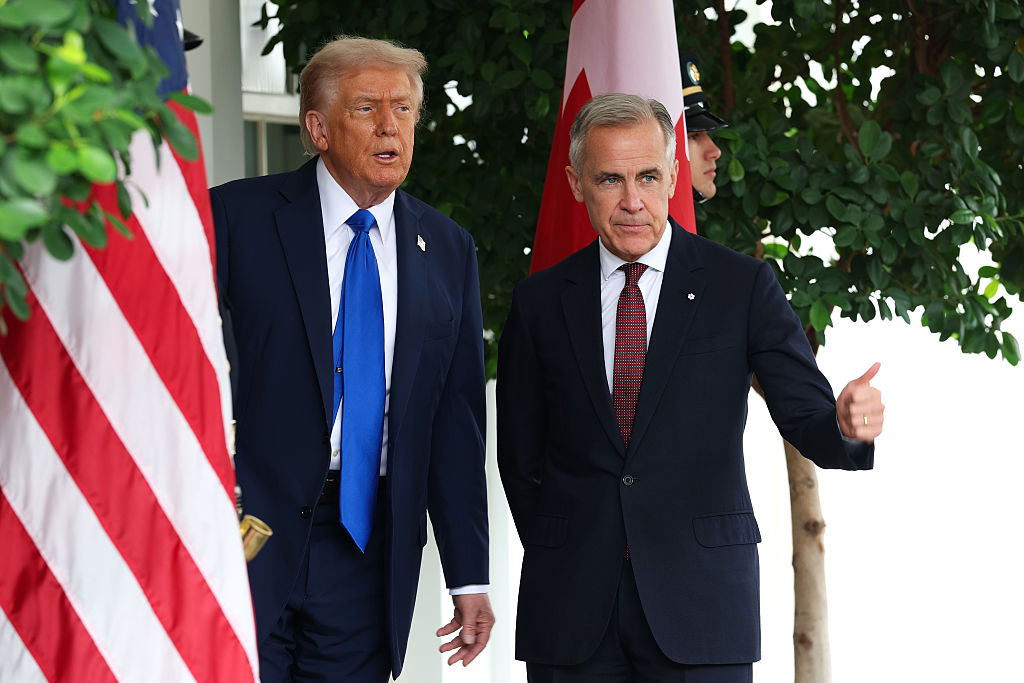
President Donald Trump welcomes Canadian Prime Minister Mark Carney outside the West Wing of the White House on Oct. 7, 2025, in Washington, D.C. —Anna Moneymaker––Getty Images
President Donald Trump announced late Tuesday a temporary pause on 50% tariffs on Canada as both countries race to finalize a trade deal.
The President’s announcement came hours before a series of tariffs set to cover about $20 billion worth of imports into the U.S. from Canada were set to take effect.
“I have paused the 50% tariffs against Canada, that were scheduled to kick in tomorrow morning for a three day period, based on the fact that Canada and the U.S.A., subject to the finalization of documents, have a deal!” Trump said on social media.
Canadian Prime Minister Mark Carney released a statement moments later, confirming that there had been “intensive discussions” with the U.S. to “address outstanding trade issues.”
“Substantial progress has been made, although there is important work still to be done,” he said.
The tariffs will now be paused until Aug. 21, subject to the finalization of an agreement between the two countries.
U.S. Trade Representative Jamieson Greer said the deal will include "comprehensive market access for all American goods, economic security commitments, digital trade alignment," along with other provisions.
Trump added in his social media post that the Keystone XL pipeline—a cross-border oil pipeline project between the U.S. and Canada that was canceled by former President Joe Biden in 2021 after pushback from environmentalists, Native American tribes, and Indigenous advocates—"may be awoken from the grave," but did not provide further details.
The President later posted what appeared to be an AI-generated image of himself dragging the Keystone pipeline out of the ground.
Neither side has provided further confirmation about the contents of the agreement.
TIME has reached out to both the White House and the Prime Minister's office for comment.
U.S. and Canada push toward a deal
Carney said earlier this week that he planned to speak with the U.S. President ahead of the tariff deadline. The announcement follows a period of negotiations between the two sides.
During a tour of a tire factory in Iowa last week, Greer told reporters that the U.S. and Canada were engaged in “constructive negotiations” but warned that if a “country retaliates” they would “take action.”
Canada's minister responsible for U.S. trade, Dominic LeBlanc, and chief trade negotiator Janice Charette have been in Washington since last week for talks.
The negotiations unfolded against a backdrop of ongoing grievances between the two countries, including Trump’s repeated statements about his desire to annex Canada and make it the 51st U.S. state—an idea Carney has strongly pushed back against.
In August, Carney took a swipe at Trump, mocking the U.S. President after a teleprompter malfunctioned in the middle of an on-camera speech.
The tense relationship between the pair has also played out over the Gordie Howe International Bridge—a cross-border bridge connecting the two countries that has repeatedly become a source of disagreement between Washington and Ottawa.
How U.S.-Canada trade tensions escalated
The last-minute tariff pause comes after more than a year of escalations between the two countries.
In February 2025, the White House hit Canada with a 25% tariff on most goods and 10% on energy resources, citing what it regarded as inadequate progress in curbing cross-border illegal immigration and drug trafficking.
Canada then imposed tariffs on some vehicle imports from the U.S. in April 2025, amid a larger trade war sparked by Trump’s global tariffs—the majority of which were struck down by a Supreme Court ruling earlier this year.
The 50% tariff hike on a range of Canadian goods was announced in July, with Trump signing a series of proclamations citing Canada’s “discriminatory treatment” of American products.
The new levy, a retaliation for Canada’s tariffs, would apply to a range of Canadian goods, including electronics, sports equipment, and essential oils.
According to economists, the tariffs could have had significant economic consequences if enacted. TD Economics estimated that, if maintained, they could reduce Canadian GDP growth by 0.3 to 0.6 percentage points over the following year.
A Canadian Federation of Independent Business survey of 1,833 firms found that 77% of affected exporters expected revenue losses, while 35% expected their revenue to fall by at least half.
In a new proclamation issued Tuesday suspending the tariffs, Trump said: “Canada has expressed a commitment to remove the discriminations or unreasonable and unequal impositions.”
In a statement late Tuesday, the Distilled Spirits Council of the U.S. applauded Trump's announcement and called for "a negotiated solution that gets American spirits back on retail shelves in all Canadian provinces and returns the spirits sector to a zero-for-zero tariff framework."
The new tariffs were set to apply despite the U.S.-Mexico-Canada trade agreement (USMCA)—which had shielded Canadian industries from earlier U.S. tariffs.
The USMCA, which was signed by Trump in 2018, is a trilateral agreement that eliminated or reduced tariffs on goods traded between the nations of North America. It governs nearly $2 trillion in annual trade among the three countries.
In early July, the U.S. declined to renew the U.S.-Mexico-Canada Agreement for a 16-year term. Rather than terminate it outright, this puts the USMCA under annual review. Trade experts told TIME that the move is expected to carry profound long-term economic consequences.
After months of fuel and water shortages, Cubans are facing a dire public health crisis. | Yamile Lage/AFP via Getty Images
Since January, many Cubans have lived a life of near-constant darkness. The Trump administration’s oil blockades have led the country into a worsening energy crisis, collapsing what was already an eroding national power grid.
Daily blackouts have plunged the Cuban nationalized, universal health system, once the pride of the country, into a humanitarian crisis. For months, hospitals have been without necessary power and ambulances strapped for fuel. Piles of trash line the streets, increasing the risk of disease. Cold storage issues threaten lifesaving vaccines, and a combination of the frail economy and US sanctions has left pharmacy shelves almost empty.
The public health crisis exposes an often overlooked aspect of the way we tend to think about the promise of universal healthcare. Having accessible and free medical services is only one part of the solution. While Cuba’s once-vaunted health system is bound up in its own history and national context, it still demonstrates that public health of all kinds can only be as resilient as the electricity, water, transportation, refrigeration, supply chains, and institutions that enable it.
An old prototype for universal healthcare
Not long ago, Cuba’s health system was seen as a promising model for successful free universal healthcare. In the years following Fidel Castro’s rise to power, health authorities focused on the integration of healthcare delivery models into a single public system. The Castro government aimed to expand services once concentrated in Havana into rural areas, such that the entire population would have access to basic care services. In 1974, the government launched community-based polyclinics that placed primary care specialists in almost every Cuban community.
Sign up here to explore the big, complicated problems the world faces and the most efficient ways to solve them.
Over the decades that followed, that widened access to healthcare led to significant, measurable returns. Infant mortality in the country has dropped from 37 per 1,000 live births right after the revolution to seven per 1,000 live births in 2024. Infectious and parasitic disease mortality also improved, dropping from a rate of 45.4 per 100,000 inhabitants in 1970 to 9.8 per 100,000 inhabitants in 2019, according to data reported by the Cuban Public Health Ministry.
It’s not entirely surprising that the successful Cuban national health model has been the site of curiosity and enthusiastic scrutiny in American health equity circles, despite vast differences in state ideologies. The US has never ensured that every citizen has affordable access to healthcare, and large disparities persist in low-income and rural populations. The chokehold of private insurance has ensured that, unlike nearly every other country in the world, the US has largely rejected the prospect of universal care. Even historic gains in insurance coverage have faced rollback threats under the One Big Beautiful Bill.
On certain key metrics, the US also falls far behind Cuba, which boasted 9.5 physicians to 1,000 people in 2021. That same year, the US reported just 3.7 physicians to every 1,000 people. The 2019 measles epidemic demonstrated a gap in childhood vaccination rates as well: 92 percent of childrenages 13 to 17 in the US received two doses or more of the measles, mumps, and rubella vaccine. In Cuba, the childhood completion rates were well over 99 percent, and the country has not seen a measles outbreak since 1993.
From its early years, the Cuban health system has functioned against a background of economic decline particular to the country, one attributable to a complex combination of external pressures, among them US blockades, a complicated economic reliance on Venezuela, a struggling state-run economy, and a flailing industry heavily impacted by the Covid-19 pandemic.
While other sectors faced attrition, Cuba’s health system, at least, appeared capable of weathering these crises. During the pandemic, the country proved to be a model in global health, having developed a homegrown Covid-19 vaccine rapidly and reaching a 95 percent vaccination rate. Its robust supply of trained health professionals made headlines when Cuban healthcare workers provided essential pandemic aid to a small town in Italy.
So why has this system proved to be so fragile now?
New blockades deal the final blow after Hurricane Melissa
Torrents of rain and flooding from the Category 3 Hurricane Melissa hit Cuba in October of last year, affecting much of the island’s eastern provinces. More than 735,000 people were evacuated, and the environmental disaster has put the country’s basic health infrastructure in a precarious state.
In the storm’s wake, a combination of flooding and damaged water systems increased the spread of viral infections of arboviral diseases such as dengue and oropouche. A report by the Pan American Health Organization published in March placed water, food, and vector-borne diseases in the “very high” health risk categories. Apart from damaged water and sanitation infrastructure, the report describes how disruptions to health service access, routine surveillance of disease vectors, and environmental conditions that breed mosquito-borne disease outbreaks have dramatically increased the risk of infectious disease spread.
For years, Cuba’s economy was propped up in large part by its relationship with Venezuela. In exchange for support from Cuba’s highly trained professionals — especially healthcare workers — Venezuela long provided a critical supply of crude oil, which helped the country keep the lights on even in the face of US sanctions.
That partnership ended in January after the nighttime capture of former Venezuelan President Nicolás Maduro, and the sweeping Trump oil blockade soon after has dealt a challenge too difficult for the energy infrastructure to withstand.
Already struggling to recover from other disasters, Cuba plunged further into its present crisis. Mario Cruz Peñate, Pan American Health Organization representative for Cuba, said that while the public health situation has been evolving for a while, he has seen more acute upheavals as sanctions persist, causing mass blackouts that have made it impossible to sustain vital health services and emergency care.
Disease control continues to struggle post-Melissa, with aid organizations worrying about communicable food- and water-borne diseases, such as hepatitis A and diarrhea, that can be caused by unrefrigerated food. On the administrative level, limited transportation resources and electricity have led to a dearth of vaccine supplies, which typically require cold rooms for transfer and storage.
Continuity of care, in particular, has been affected for the worse. More than 100,000 elective and reconstructive surgeries have been postponed, for example, because of a lack of supplies and a backlog of emergency surgeries. At a briefing in May, representatives of the UN Office for the Coordination of Humanitarian Affairs and the World Health Organization reported that over 32,000 pregnant women faced limited access to diagnostics and limited amounts of the stable electricity needed to sustain neonatal units. Prenatal care faces delays because of the lack of everything from testing supplies to available facilities. And now, even once successful improvements in health indicators have fallen: a report from the Center for Economic and Policy Research measured an increase in infant mortality rates from 4.0 to 9.9 per 1,000 births between 2018 and 2025.
For humanitarian aid organizations, alleviating this health crisis also poses a stark challenge. Cruz Peñate ascribes this to availability, timing, and opportunity to distribute aid supplies, all of which have been made inconsistent by the ongoing blockade.
“The response to the situation in Cuba has to increase; we have to scale up the response. All the support we can manage to receive will be important,” Cruz Peñate said. “Here in Cuba there is really a situation that needs attention.”
Is Cuba now an outdated prototype for universal healthcare?
While Cuba’s healthcare system was never bound to map precisely onto the US, some of its most notable successes — the high physician-to-patient ratio, the almost entirely vaccinated population, the ample health screenings — still remain desirable. And yet those very accomplishments have crumbled under the threat of extreme weather events and the country’s inability to restore its broken power grid.
Trump targeted even more petroleum suppliers in his latest round of sanctions on July 23, leaving Cuba scrambling still further to revitalize its energy sector. Those same sanctions also took aim at the Cuban healthcare export economy, alleging that it involves forced labor.
Earlier this month, Cuba’s government loosened constraints on a handful of private operations, including pharmaceuticals and elder-care facilities, in response to the shortage of medicine in the country. With state-stocked shelves running empty, the new decree allows private pharmacies with Cuban health registration to fill in the medicine gap. Similarly, privatized elder facilities are also allowed to operate at a capped rate of 60 people per home, with mandatory visits from state physicians.
The government still prohibits private sector medical and dental care, and Cuban officials remain adamant that the “socialist state enterprise keeps its central role,” so it’s difficult to claim that the country’s medical model is being pressured towards privatization. But the erosion of some of its elements still speaks to a state-run health system under strain.
We often think of healthcare itself as an equation of medical services along with healthcare personnel and the authorities — government, industry, or both — that control it. But the crisis facing Cuba gets at the dependence of all of these factors on the broader energy ecosystem. Even a once-promising healthcare model can quickly collapse when a crucial component is missing: fuel.
Protesters gather for a statewide data center day of action at the Wisconsin State Capitol on February 12, 2026, in Madison, Wisconsin. | Wisconsin Watch via Getty Images
The general election for Wisconsin governor is now a week old. But the past seven days of debate between the race’s Republican and Democratic candidates can be paraphrased in just two lines:
“My opponent is a shill for Big Tech who wants to build data centers over Wisconinites’ farms, parks, preserves, graves — and, possibly, Lambeau Field.”
“I know you are, but what am I?”
The Republican nominee, Congressman Tom Tiffany, has been the aggressor in this argument. Tiffany has branded his Democratic rival David Crowley as “Data Center David,” spotlighting the Milwaukee County Executive’s past support for turning Wisconsin into a “data hub” for “the entire globe.” In the Republican’s telling, Crowley is a corporate stooge eager to let Wisconsin’s “lakes run dry” and its “family farms” get “paved over,” just to generate higher profits for his Silicon Valley paymasters.
Key takeaways
• Republican Tom Tiffany has made data centers the focus of Wisconsin’s governor’s race. • But his policies on hyper scale development aren’t much different than David Crowley’s. • Some Wisconsin labor unions and municipalities benefit a lot from data center projects. • Crowley and Tiffany have held off on embracing a moratorium for that reason.
Crowley has returned fire. The Democrat has insisted that every Wisconsin community should have veto power over any data center project within its territory — and that new computing campuses anywhere in the state must comply with strict regulations. Meanwhile, Crowley has argued that Tiffany is the race’s true corporate shill, noting that the member of Congress voted for tax cuts that benefit Big Tech (paid for with cuts to Medicaid and food stamps), permitting reforms that made data centers easier to build, and a ban on state and local AI regulations. “Congressman Tiffany loves data centers,” Crowley warned in a recent statement.
Meanwhile, it’s not clear how much they actually disagree on what they would do about the issue as governor.
The Wisconsin governor’s race has quickly become the most prominent flashpoint in the national war over data centers. And it’s not hard to tell which side is winning. On Tuesday, Josh Shapiro, the moderate Democratic governor of Pennsylvania, announced a suite of measures to slow and block “predatory” data center developments, after having previously led efforts to attract them.
If the public’s views on data centers are increasingly clear, the substantive issues remain unsettled. And the politics are more complicated than polling alone would indicate: Key constituencies in both the Democratic and Republican parties remain invested (literally and figuratively) in hyperscale development. Even as Tiffany and Crowley spar over who would do more to curb the data center menace, their actual policies quietly reflect these tensions.
How data centers became a flashpoint in Wisconsin
On first glance, Crowley and Tiffany’s back-and-forth on data centers looks odd in multiple respects. For one thing, Republicans do not typically accuse Democrats of trying too hard to spur corporate investment — nor of doing too little to protect the environment. For another, Crowley and Tiffany seem to appear to largely agree about data center policy, which makes their emphasis on the issue sound a bit strange.
Upon closer inspection, however, Tiffany’s emphasis on the subject isn’t hard to understand.
Crowley just barely defeated socialist Assembly member Francesca Hong in the Democratic gubernatorial primary. And data center policy was among the key divides in that contest, according to Crowley himself: Hong championed a statewide moratorium on data centers, while Crowley merely favored imposing tight guardrails on their development.
What’s more, Crowley really did tout the potential benefits of data center development in the past. And he is closely allied with sitting Democratic Governor Tony Evers, who enacted large tax subsidies for new computing campuses in the state. Thanks in part to that largesse, Wisconsin witnessed a sudden wave of hyperscale (in other words, AI) data center development over the past two years.
Thus, by staking out a more (ostensibly) hardline, anti-data center position, Tiffany hopes to fracture the Democratic coalition — and isolate Crowley from the 76 percent of Wisconsin voters who say that the server farms’ costs outweigh their benefits.
In reality, however, the distinctions between Crowley and Tiffany’s positions on data center construction are much narrower than the latter’s attacks suggest. And to the extent that Crowley is more sympathetic to hyperscale development, this has less to do with his alleged fealty to Big Tech than his support for organized labor.
Crowley and Tiffany mostly agree about data centers
Crowley and Tiffany’s positions on data centers heavily overlap.
Neither candidate supports a statewide moratorium. Both say that local communities should have the power to veto new computing campuses; that data centers must pay the full price of their energy needs (including the costs of any new power and transmission infrastructure that their consumption necessitates); and that companies should not be allowed to enter into nondisclosure agreements with local governments that temporarily conceal negotiations over new data center developments from the public.
Likewise, as their respective attacks suggest, Crowley and Tiffany were both friendlier to the AI industry in the past, before the backlash to artificial intelligence — and the infrastructure it requires — took off. Crowley really did express a desire for Wisconsin to become a global leader in artificial intelligence. Tiffany, meanwhile, has indeed voted to cut taxes on AI companies and shield them from state and local regulations. And the Republican is aligned with an even more unabashed champion of data centers than Evers, President Donald Trump.
Further, many of the distinctions between Crowley and Tiffany’s data center platforms reflect perennial left-right divides on other issues, rather than any difference in each candidate’s degree of chumminess with Big Tech.
For example, Crowley wants to require data center projects to finance new renewable energy installations — both so that they can meet their own power needs in a sustainable way and so that Wisconsin’s broader electric grid becomes less dependent on coal.
Tiffany also recognizes that data center development could be leveraged to fund new renewable energy. But he sees this as a bug, not a feature: After all, new solar and wind farms could eat up Wisconsin’s precious farmland, which Tiffany has sworn to protect. The Republican instead prefers for new data centers to run on coal, thereby propping up that embattled industry.
Crowley is more pro-data center in one way
All this said, Tiffany’s platform is genuinely less pro-data center than Crowley’s in one respect: The Republican has promised to end all taxpayer subsidies for data centers in Wisconsin.
Crowley’s position is comparatively nuanced. In an interview with the Milwaukee Journal Sentinel in July, the Democrat said, “I do not believe Wisconsin should automatically roll back all data center tax incentives, but I do believe we need a more rigorous review of whether taxpayers are receiving sufficient value for the incentives being provided.”
In response to Tiffany’s recent attacks, Crowley has embraced far more adversarial rhetoric towards the tech industry in general and the AI sector in particular. And he has called for imposing a set of requirements on new data center development so numerous and profound, it is unclear whether many companies would be interested in pursuing new projects under his leadership, subsidies or no subsidies.
Nevertheless, as of this writing, Crowley has yet to abandon his July position on tax incentives. Instead, he has countered Tiffany’s charges on that front by noting that, in supporting Donald Trump’s tax bill, his Republican opponent effectively “signed over $70 billion in tax handouts to the same companies now steamrolling over our local communities with data centers.”
This is a fair hit. But it’s also a little evasive. How high the corporate tax rate should be federally — and whether Wisconsin should offer tax breaks to data center developments — are two different questions.
And Wisconsin’s subsidies to hyperscalers are not small. Under Evers, the state exempted large data center projects from sales taxes. This means that a data center developer need not pay taxes — to either the state or localities — on construction materials, IT equipment, on-site power infrastructure, cooling systems, or electricity.
Critically, these exemptions do not sunset: Tech companies don’t just avoid sales taxes when initially building their data centers. Rather, they pay no taxes on their facilities’ electricity consumption forever, while also avoiding any levies when updating their servers or other equipment.
All this adds up. According to a report from Wisconsin’s Legislative Fiscal Bureau, the state is poised to forgo $1.5 billion in sales tax revenue during the construction of certified data center projects, and then another $369 million annually after the facilities are fully operating. This is an especially sensitive issue in Wisconsin, where voters are still upset over an effort to lure tech manufacturer Foxconn to the state in Trump’s first term, a costly gambit that failed to deliver on its promised benefits.
To be clear, the Fiscal Bureau’s projections do not mean that data centers are likely to subtract billions of dollars from Wisconsin’s state and local budgets. Even if the hyperscale facilities are exempt from sales levies they must still pay property taxes. And their owners could owe corporate taxes while their construction workers and permanent employees will pay income taxes.
Their spending also generates business — and thus, income tax obligations — for other Wisconsin enterprises, such as utilities. On net, the projects will almost certainly increase the amount of revenue available to Wisconsin state and local governments. The debate is over whether the projects could have generated even more revenue, in the absence of subsidies — or whether these developments would have gone to a different state, had Wisconsin not made their funders such a sweetheart deal.
The evidence on that question is mixed. On the one hand, tax subsidies of some kind were plausibly necessary to spur hyperscale data center investment in Wisconsin. At present, 38 states provide tax incentives to data center developers.
On the other hand, Wisconsin’s subsidies are unusually generous. States commonly spare servers and capital equipment from sales taxes, but many do not extend that exemption to electricity. And the indefinite nature of Wisconsin’s subsidies is also far from standard. In nearby Illinois, data center projects enjoy a sales tax exemption for only 20 years.
Meanwhile, Wisconsin has some structural assets that might make it appealing to tech companies, even if it offered far lower subsidies. Due to its proximity to the Great Lakes, Wisconsin boasts abundant water. And it also has relatively cool temperatures, which limit hyperscalers’ cooling costs.
Crowley has not ruled out dramatically scaling back the state’s subsidies. But unlike Tiffany, he has thus far declined to endorse abolishing those subsidies in their entirety.
In Wisconsin, banning data centers is not the pro-union position
At this point, you might be asking why Crowley doesn’t simply go “full populist” on data centers. Why give Tiffany any room to get to the Democratic Party’s left on this issue? Why not shore up your left flank by simply calling for a statewide moratorium — or at a minimum, for ending all data center tax breaks? After all, roughly three-quarters of Wisconsinites think the facilities are net harmful to the state.
In Tiffany’s telling, the answer to these questions is simple: Crowley is a bought-off puppet of the AI industry. But this is almost certainly wrong.
In truth, Crowley’s refusal to fully disavow data center construction likely reflects his ties to labor, not capital.
In his attack ad, Tiffany alleges that Crowley’s campaign is funded by “the people building” data centers and then flashes this image:
Tiffany’s claim is true — but in a misleadingly literal sense: The figure cited appears to be a reference to Crowley’s support from Wisconsin’s building trades unions. As of August 13, unions representing Wisconsin electricians, pipefitters, carpenters, construction workers, and other laborers had collectively contributed $412,000 to Crowley’s campaign. The Democrat has received no comparable support from corporate PACs of any kind, much less AI industry-affiliated ones.
The building trades are strongly supportive of data center construction — and for good reason. A data center serving OpenAI and Oracle in Port Washington, Wisconsin is being built through an explicit partnership with the Wisconsin Building Trades Council.
Separately, the Democrat has evinced concern for municipalities that do desire data center development, saying that Wisconsin can protect its ratepayers and environment “while also not preempting communities that have done their due diligence to allow for different types of economic development investments.”
For some Wisconsin communities, the fiscal benefits of data center development can be profound.
Consider Port Washington: In recent decades, the city’s manufacturing base shrank — and its business tax revenues declined with it. As a result, homeowners shouldered more and more of the burden of financing local government. But its new hyperscale data center promises to dramatically change its finances. According to the city’s Mayor Ted Neitzke, the project is expected to add between $1.3 and $1.8 billion in property value to a municipality whose entire existing valuation is scarcely over $1 billion.
By doubling the tax base, the data center could finance property tax cuts or public service expansions for Port Washington residents. Many of Wisconsin’s other post-industrial towns face similar challenges — and thus, could reap similar benefits from data center development. This may be why neither Crowley nor Tiffany have felt comfortable endorsing a moratorium, despite their increasingly populist rhetoric about data centers and AI.
For most voters, data centers aren’t central
Add it up, and you have two candidates who are balancing the interests of the data center boom’s material beneficiaries against its growing political toxicity — and giving more and more weight to the latter.
It is unclear whether data centers will remain at the forefront of governors’ race as the campaign enters its homestretch. Although hyperscale facilities are increasingly unpopular in Wisconsin, they also are not a top-tier concern for the vast majority of the state’s voters. In a July poll from Marquette Law School, only 5 percent of Wisconsin voters named “data centers” as the state’s most important issue, putting it behind inflation, “illegal immigration,” health insurance, property taxes, “jobs and the economy,” and housing affordability.
Nevertheless, the fact that Crowley and Tiffany are sparring over who dislikes data centers the most — months after both expressed positive sentiments about the facilities — shows which way the wind is blowing.
Senator Lindsey Graham, a Republican from South Carolina and chairman of the Senate Judiciary Subcommittee on Crime and Terrorism, makes an opening statement during a hearing with former Acting Attorney General Sally Yates in Washington, D.C., on May 8, 2017. —Andrew Harrer—Bloomberg/Getty Images
South Carolina Sen. Lindsey Graham countered President Donald Trump’s previous comments about who was responsible for the hacks that influenced the 2016 presidential election during his opening remarks at a Senate Judiciary subcommittee hearing Monday,saying there was “no doubt in his mind” Russians were involved,
Graham cited intelligence findings that Russian operatives tried to interfere in the election by hacking into the Democratic National Committee computer network as well as the emails of Hillary Clinton campaign chairman John Podesta.
“I think every American should be concerned about what the Russians did. From my point of view, there’s no doubt in my mind it was the Russians involved in all the things I just described — not some 400-pound guy sitting on a bed, or any other country,” Graham said. “Russia is up to no good when it comes to democracies all over the world.”
Graham’s comments appeared to reference statements made by Trump during a presidential debate in September.
Sally Yates delivered her opening statement about the concerns she raised regarding one of President Donald Trump's national security adviser Michael Flynn and his connections with Russia
“I mean, it could be Russia, but it could also be China. It could also be lots of other people. It also could be somebody sitting on their bed that weighs 400 pounds,” Trump said at the time. “You don’t know who broke into DNC.”
Trump again raised the possibility that China orchestrated the DNC hack in an interview last month, though he offered no evidence to back the allegation.
Former U.S. Secretary of State Hillary Clinton talks to Editor-in-Chief and CEO of TIME Edward Felsenthal about creating a better future at the TIME 100 Summit in New York, on April 23, 2019. —Krisanne Johnson for TIME
Assistant and Senior Adviser to the President Jared Kushner speaks to Brian Bennett, Senior White House Correspondent for TIME during an interview at the TIME100 Summit in New York, on April 23, 2019. —Krisanne Johnson for TIME
U.S. President Donald Trump speaks during the initial meeting of the Presidential Advisory Commission on Election Integrity at the Eisenhower Executive Office Building in Washington, on July 19, 2017. —Andrew Harrer—Bloomberg/Getty Images
More women than men say that their interest in politics has increased since President Trump’s election, according to a new poll.
A Pew Research Center poll released Thursday found that 58 percent of women say they are more interested in politics since November, compared to 46 percent of men. Overall, 52 percent of Americans say their interest in politics has spiked since the election.
Trump won the election by strong support from male voters, winning men by 12 points. According to exit polls, the 2016 election was decided by the largest gender gap in recorded history.
Interest has spiked the most among Democratic women–63 percent of Democratic women say they are more attentive to politics, compared to 54 percent of Republican women. Democratic women are also most likely to say that they have gone to a political event since the election. The Women’s March–which happened the day after Trump’s inauguration in protest of the president–was likely the largest political rally in U.S. history.
Overall, Democrats are about three times as likely as Republicans to say they have been to a political gathering–22 percent compared to 7 percent.
Details of the new administration are prolific on news and social media, and Americans say it's stressing them out
For the majority of the country, the election of Trump is still stressful to talk about. The poll found that 59 percent of the country feels it’s “stressful and frustrating” to talk about politics with people who don’t share their opinion of Trump. More women (64 percent) than men (54 percent) feel this way.
Rep. Cory Mills, R-Fla., attends the House Armed Services Committee hearing titled "Department of Defense FY2027 Budget Request," in Rayburn building on Wednesday, April 29, 2026 —Tom Williams—CQ-Roll Cal
Florida Rep. Cory Mills, the incumbent representing the state’s 7th District, lost his Republican primary on Tuesday to former TV anchor Ryan Elijah after a controversial campaign for a third term in Congress.
President Donald Trump notably gave Mills his “Complete and Total Endorsement” on Feb. 10, when he wrote a social media post describing the candidate as “an America First Patriot.” But it didn’t seem to outweigh ongoing allegations of sexual misconduct, accusations of mishandling campaign finances, and questions about his military record.
“Whether [Mills] wants it to be or not, obviously the allegations against him have become the defining thing that people are talking about,” says Kevin Wagner, professor of political science at Florida Atlantic University.
“The president's endorsement is powerful,” he says, “but it doesn't prevent voters from making a calculation on what they think of him individually in that seat.”
The controversies that came to define Cory Mills’s campaign
Going into the primary, the latest polling showed Elijah with 44% of the vote, while 27% backed Mills and 19% remained undecided. That meant there was no assured winner heading into Tuesday, Wagner says, with the number of undecided voters suggesting a lot of “volatility” in the race.
Incumbents are often the strong frontrunners in re-election campaigns for Congress, but Mills has been embroiled in a string of scandals in the past year. Last October, there was a court-issued injunction against him after a former girlfriend accused Mills of threatening to release explicit videos of her. The judge found that the woman in question, Lindsay Langston, provided evidence in support of her claim that Mills caused "substantial emotional distress." He wrote in his ruling that he did not find Mills's "testimony concerning the intimate videos to be truthful." In a separate incident in February 2025, D.C. police responded to a report that Mills had assaulted a woman with whom he was in a relationship. The woman later retracted her account, according to Politico, and police did not charge Mills.
In November 2025, the House Ethics Committee opened an investigation into Mills. Its review included allegations of sexual misconduct, as well as allegations that he may have "omitted or misrepresented required information in his financial disclosure statements." The Committee emphasized that the investigation itself did not indicate that any violation had occurred, and Mills has repeatedly denied any wrongdoing.
Mills's military record also came under scrutiny when several veterans disputed the account provided in his recommendation for a Bronze Star, which he was awarded in 2021 for his actions in Operation Iraqi Freedom in 2003. In 2025, five individuals who served with him claimed that they did not recall his presence at the incidents for which he was awarded the medal. According to NOTUS, Mills attributed the discrepancies to differing recollections amid the chaos of wartime.
His campaign was hurt further this month after two of his fellow incumbent lawmakers in the state, Reps. Anna Paulina Luna and Mike Haridopolos, endorsed Elijah. Then, last week, Gov. Ron DeSantis told reporters that he does not support Mills.
“I have not endorsed Cory Mills and I do not support Cory Mills,” he said.
Trump also appeared to distance himself last week when he reposted endorsements for all of the Republicans up for election in Congress on Truth Social—except Mills.
David Jolly and Byron Donalds Will Compete in Florida Governor Race After Primary Wins
What to know about Florida’s 7th District race in November
While the 7th District will likely stay red in November, attention is turning to how Florida’s redrawn congressional map could reshape its midterm races.
The new map, signed into law by DeSantis in May 2026, redrew 21 of the state’s 28 districts, looking to reduce the number of Democratic-leaning districts from eight to four—affecting Democratic incumbents like Kathy Castor in Tampa, as well as Debbie Wasserman Schultz and Jared Mokowitz in South Florida.
While District 7 was not radically redrawn, Aubrey Jewett, professor of political science at the University of Central Florida, says that since this new map favors Republicans, flipping the 7th District could help offset any losses elsewhere in the state.
Elijah will go up against Democratic candidate and military veteran Bale Dalton in November, who is endorsed by Pete Buttigieg. Jewett says Dalton could be a viable candidate.
And if Dalton were to win, he says: “That might help not only the Florida congressional delegation pick up a Democratic seat, but of course, yeah, maybe at the national level, might offset some of these losses that they're expecting.”
Current polling and election forecastsshow that Democrats are favored to take back the majority in the House of Representatives in November, which would be consistent with an existing pattern where the sitting President’s party typically loses seats in midterm elections.
Dan Bilzerian attends Ignite's Angels and Devils Pre-Valentine's Day Party on February 13, 2019, in Bel Air, California. | Randall Michaelson/Getty Images for Ignite
You might think that such a person would obviously be the most repugnant candidate in tonight’s FL-6 primary. But then there’s Dan Bilzerian, the right-wing influencer who challenged him.
Bilzerian is an open antisemite and Holocaust denier with millions of social media followers who has said that “most of the problems today are caused by Jewish supremacy.” He has called the mastermind of the October 7 attacks a “hero” and fantasized about personally killing Israelis. During the campaign, he regularly called Fine a “fat Jew” and released an AI-generated music video on X that muses about a second Holocaust: “Jewish supremacist, Satan’s creepy little minions / should we revisit that Austrian painter’s opinions?”
Lest the reference be too subtle, the line is overlaid over a graphic of Adolf Hitler wearing a painter’s apron.
House leaders in both parties condemned the antisemitic attacks and Fine won easily, but Bilzerian appeared poised to finish with about 19 percent of the vote with over 90 percent of ballots counted, making him the top vote-getter out of four Republicans challenging the incumbent.
This should all be a giant flashing warning sign for the GOP’s post-Trump future.
As on the Democratic side, divides over Gaza and October 7 have created a schism inside the GOP. But the right has rejected the very idea of gatekeeping against bigotry as either “woke” or needlessly divisive. For all his anti-Muslim statements, Fine is a Republican in good standing, with President Donald Trump’s “complete and total” endorsement to prove it. And he and others with similarly vicious views have turned the right’s debate over the Middle East into an increasingly nasty fight over American Muslims and Jews themselves.
Fine and Bilzerian may be unusually blunt and cruel. But the tendencies they represent have much wider purchase in the GOP — and could end up derailing its future.
How the country’s worst primary came to be
Prior to 2025, Randy Fine was a Florida state legislator best known nationally for his intervention in the most recent Republican presidential primary — during which he initially endorsed Gov. Ron DeSantis, but then flipped to Trump. In 2025, he ran for the US House in a special election to replace Mike Waltz, the member of Congress Trump initially picked to serve as national security adviser.
Fine coasted to victory in the GOP primary, but underperformed Trump by about 10 points in the general election. That was still easily good enough to win, as FL-6 is very red, but it pointed to Fine’s weakness as a candidate.
“He repels people,” DeSantis said in a press conference after the special election.
Since joining the House, Fine has made a name for himself for two things: his unshaking personal devotion to Trump and his frequent bigoted comments about Palestinians and Muslims, which he revels in using to generate controversy.
After his February comment about dogs — “the choice between dogs and Muslims is not a difficult one” — prompted outrage from leading Democrats and civil rights groups, Fine went on the far-right TV station NewsMax to suggest that the United States should force Muslims out of the country. On his social media accounts, he started posting images of dogs superimposed on a Gadsden “don’t tread on me” flag.
As Fine was making a name for himself through explicit anti-Muslim bigotry, Bilzerian was doing the same with antisemitism.
Bilzerian, who retains a fortune of uncertain size from his prior career as a professional poker player, is best known for the hard-partying lifestyle portrayed on his Instagram. A manosphere influencer and self-proclaimed sex addict, he has claimed to be dating 50 women at once and to have suffered two heart attacks at age 25 due to a combination of sleep deprivation, Viagra, and cocaine abuse. He currently has 29 million followers on Instagram and 2.1 million on Twitter.
In November 2024, he did an interview with Piers Morgan — still pinned to his Twitter profile — that served as a kind of mainstream coming-out party for his antisemitic worldview. In the interview, he said, among other things, that Jews control the media, exaggerated the Holocaust, and killed JFK. He has escalated into eliminationist antisemitism from there.
When he entered the primary in the spring, Bilzerian framed his challenge against Fine entirely around the congressman’s religion. “This fat jew @RepFine…has no place in our govt,” Bilzerian wrote in a March post. “When I unseat him I’m going to draft laws to have anyone putting Israel before America tried for treason.”
Fine, ever the class act, responded by going after Bilzerian’s dual Armenian citizenship. “We don’t want Armenians to be able to serve in Congress,” he said in a May interview. The ensuing campaign has seen Bilzerian posting a pro-Holocaust video, a swastika spray-painted on a Fine campaign sign, and Fine attempting to get Bilzerian investigated by the FBI.
In a year full of ugly primaries across the country, this is without question the ugliest and most hateful.
What the Fine-Bilzerian race says about the right’s future
The scary thing about Florida’s Sixth District is that it might not be an isolated incident.
Among elected Republicans, Randy Fine may have made the most violently offensive anti-Muslim comments — but he is not the only one doing so. In fact, one of the most striking trends among congressional Republicans in the past year has been an uptick in more of them talking like Randy Fine.
Sen. Tommy Tuberville (R-AL) posted on Facebook that “Islam is not a religion. It’s a cult.” Former Rep. Andy Ogles (R-TN) posted on X that “Muslims don’t belong in American society.” Rep. Nancy Mace (R-SC) tweeted that “every single Muslim holding public office in America is a Trojan horse.” Rep. Chip Roy (R-TX) declared there should be “no more Muslims” in Texas, and (per a Washington Post count) posted on the topic 244 times in the first three-and-a-half months of the year on the topic. Rep. Barry Moore (R-AL) even introduced legislation — called The CRUSADE Act — that would effectively require Muslim immigrants to disavow the Islamic legal-moral code, called sharia, as a condition of receiving a visa.
This isn’t entirely new territory for Republicans. In 2010, there was also a wave of right-wing panic about sharia conquering American law that led to over a dozen state-level attempts to ban it. Trump’s proposal to impose a “total and complete ban” on Muslim immigration was, of course, a huge part of his message in his first campaign. And the national security team in his first administration was heavily influenced by a group of anti-Islam activists who called themselves “counter-jihadists.”
What’s new about the current wave of Republican Islamophobia is the explicitness. In the past, Republicans typically differentiated between ordinary Muslims and extremists, claiming to merely be targeting the latter even when their proposals would have restricted the former’s rights. Today, however, Republican officials have become increasingly comfortable dispensing with this fig leaf — saying that Muslims and Islam are the problem, period.
This is rooted in some combination of genuine bigotry and a cynical read of the GOP primary electorate. Polls consistently show high levels of hostility to Islam and Muslims among Republican voters; in May, for example, the pollster PRRI released a survey showing that 76 percent of Republicans agreed that “the values of Islam are at odds with American values and the American way of life.”
Disturbingly, Bilzerian’s antisemitic strategy might be similarly in tune with elements of the GOP base.
Antisemitism is still far less tolerated within the Republican Party — in fact, condemnation of Bilzerian has been notably bipartisan and his support on Tuesday, while unnervingly high, was nowhere near enough to threaten Fine. But his hyper-online cohort of far-right influencers has been growing in relevance, especially among Gen Z conservatives, who (per recent polling) form the demographic epicenter of America’s growing antisemitism problem.
In fact, Bilzerian wasn’t even the most prominent extremist candidate in Florida on Tuesday. That would be James Fishback, the GOP candidate for governor who ran a longshot campaign against Rep. Byron Donalds that was frequently accused of racism and antisemitism and had a visible following among young “groypers.” He appeared set to finish with around 10 percent of the vote with over 90 percent of ballots counted. Both are following the trail blazed by Nick Fuentes, the right-wing livestreamer who has made a name for himself as a leading voice of antisemitism.
Increasingly, this overt antisemitism is becoming a normal part of the lexicon in certain corners of right-wing media. Tucker Carlson, who has long taken care to hide his more inflammatory ideas under layers of innuendo and plausible deniability, recently accused Jewish conservative Ben Shapiro of wanting everyone to eat “goyslop” — an antisemitic term popular with far-right young people that implicitly accuses Jews of ruining the lives of non-Jewish Americans. Candace Owens, the right-wing podcaster second only to Carlson in reach, has been even more brazen.
And while their clashes with the White House over the Iran war have recently alienated Trump, it’s still an open question what will happen when his influence wanes and whether the next Republican nominee — whether it’s Vice President JD Vance or someone else — will bring these figures in from the cold.
There is, of course, both Islamophobia and antisemitism on the Democratic side as well. But there are also some antibodies in that the party has, however imperfectly, long made anti-bigotry one of its core values — many of the critiques of “Woke 1” were about excesses in this regard.
By contrast, Republicans have turned on the very idea of imposing guardrails, making it harder to repel candidates who cross the line into hate. Last week, a pair of conservative writers — professor Greg Conti and journalist Aaron Sibarium — warned that this rejection was setting the party up for disaster.
“Frustrated by the suppression of mainstream, center-right views, conservatives increasingly reject as cancel culture any public repudiation of genuinely fringe ideas, creating a subculture of racism, sexism and antisemitism that did not exist to the same degree even five years ago,” they wrote in the New York Times.
The Fine-Bilzerian race shows that this concern is not hypothetical. Trends on the right are moving swiftly to normalize the unthinkable, to make it so two candidates in a primary race could think that the gutterest of gutter bigotry could be a ticket to victory (or at least, enhanced stardom).
If things keep going this way, the future of the Republican Party could end up looking a lot like Florida’s Sixth.
The Tongass National Forest is seen during sunset on Prince of Wales Island, Alaska, on June 30, 2021. | Salwan Georges/The Washington Post via Getty Images
This story appeared in The Logoff, a daily newsletter that helps you stay informed about the Trump administration without letting political news take over your life. Subscribe here.
Welcome to The Logoff: The Trump administration is trying to open up more public lands to logging,
What’s happening? On Tuesday, the administration filed a proposal to repeal the “roadless rule,” a 2001 regulation protecting nearly 45 million acres of national forests not just from having roads built through them, but from logging.
The majority of the forests that would be affected fall in 10 Western states: Alaska, Arizona, California, Montana, Nevada, New Mexico, Oregon, Utah, Washington, and Wyoming, while two — Colorado and Idaho — have their own state-level roadless protections.
The next step in the rulemaking process is a 30-day public comment period, after which the repeal can be finalized — though it’s likely to face legal challenges that could delay implementation.
Why is the Trump administration doing this? According to the Agriculture Department, the change is intended to reduce the “regulatory burden” and return decisions about forest management to a more local level; the US Forest Service and some Republican governors in affected states have pointed to fire management concerns and the need to clear out accumulated fuel in forests.
As Wall Street Journal reporter Robbie Gramer pointed out, however, only a tiny fraction of wildfires start in roadless areas of national forests (unsurprisingly, given the relative lack of people).
Why are public lands advocates alarmed? Opponents of the repeal say ending the rule could irreversibly damage some of America’s most pristine forests and cause a long list of environmental harms. They have good reason to be wary: In 2025, Trump signed an executive order directing the “immediate expansion” of timber production in the US, including a 25 percent increase in logging in federal forests.
And with that, it’s time to log off…
The Smithsonian National Zoo is welcoming three new red panda cubs, who were born earlier this summer. According to the zoo, right now, the cubs are “really just balls of fur that eat and sleep.” But they’re also pretty dang cute, and the zoo shared some photos here. Enjoy, and we’ll see you back here tomorrow!

 Login
Login