❌

Reading view

Why Catholic Bishops Are Apologizing Over 'Exploited' Trump Meeting
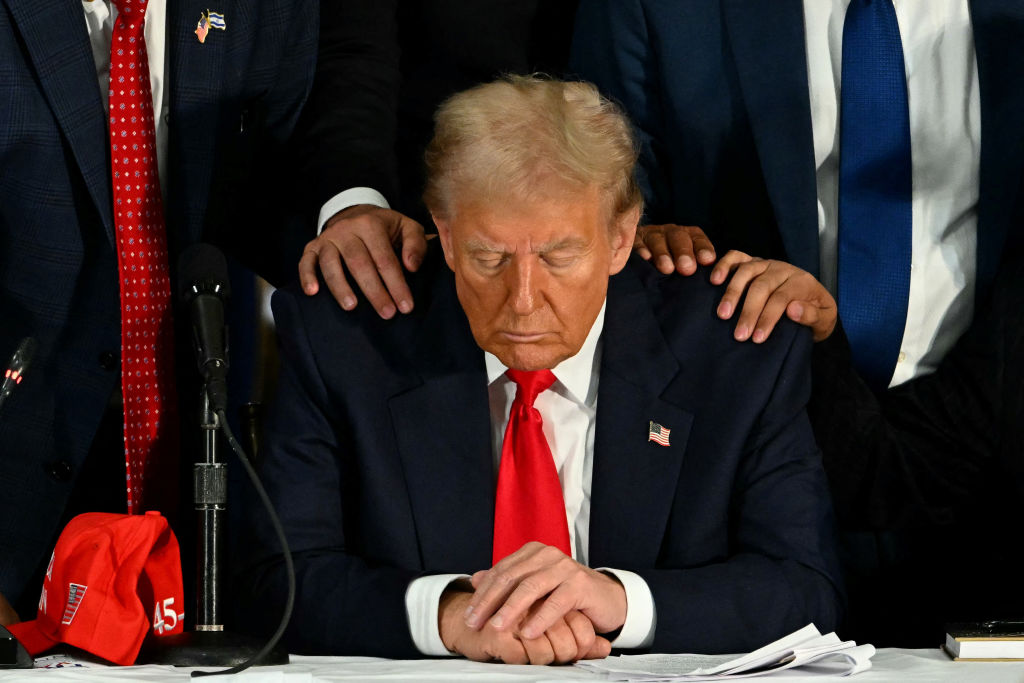
President Donald Trump prays during a roundtable discussion at the Trump National Doral Miami resort in Miami, Florida, on Oct. 22, 2024. —Chandan Kanna—Getty Images

A video of Catholic bishops praying around President Donald Trump during a meeting at the White House last week has sparked debate, with some bishops claiming their attendance was “exploited” for political purposes less than two weeks before the midterm elections.

The 12 clergymen joined Trump on Thursday in the Oval Office, for what Archbishop Jeffrey Grob of Milwaukee has said was intended to be a private meeting to discuss matters such as immigration enforcement, religious worker visas, and human dignity. But in a “public apology” issued Sunday, Grob expressed deep regret over the meeting that he suggested was used as a "political photo opportunity” after White House officials shared images and footage of a moment of prayer. The video, which Grob claims was posted without the bishops’ consent, has been viewed over 1.8 million times on X alone.

Grob said he had received “many questions” over the encounter and wanted to emphasize that the meeting “was in no way an endorsement of the President, his policies, or his party.” He said his invite to the meeting had been extended by Heritage Foundation, the think tank behind the conservative policy playbook Project 2025, and that he had been informed ahead of time there may be an opportunity to pray privately with the President. “Several photos were taken and we were ushered out [after the prayer]. Unbeknownst to the group of bishops, a video was also taken. But permission for the public distribution or posting of either the video or photos was not given by the bishops,” he claimed, insisting the bishops “should never have been put in that position by the White House.”

The White House did not directly respond to questions over whether permission was obtained from the bishops prior to the video and photos being shared. Spokesperson Taylor Rogers told TIME “there has never been a greater President for Catholic Americans than President Trump, and his strong record proves it,” citing the pardoning of “pro-life activists” as one such example.

https://x.com/MargoMartin47/status/2113343568823894180

Bishop William Joensen of Des Moines also issued a statement suggesting that the meeting had been ”exploited.” Acknowledging that “there are many things tied to this present [Trump] Administration that are blatantly at odds with our Catholic faith,” Joensen said he attended the gathering as the advance communication he had received “indicated that we were to have a conversation and that key officials would be interested in hearing our perspective.”

“None of us bishops were unaware that our meeting was on the cusp of a national election,” he said. “Yet in no way did any of us intend by our involvement to endorse any political party or any individual candidate.”

He added: “I wish I had been more shrewd and less simple, like those who exploited our meeting for partisan political purposes. I pray I am more prudent and wise going forward, even as I remain resolute in my openness to engaging and praying for political leaders at all levels.”

Archbishop James Golka of Denver, who led the prayer in the Oval Office, has also addressed the matter after people raised questions over the timing of the video.

“I understand that many people saw the video, posted by the Administration twelve days before an election, as an endorsement. That was never my intention,” Golka told Denver Catholic magazine. “The bishops of the United States teach that the Church cannot champion any candidate or party. I hold to that.” 

He continued: “I’ve had a lot of people, really good friends, ask me, ‘What were you doing?’ ‘Why did you do that?’ I just answer: ‘I was being a Catholic priest. We pray for people.'”

Other clergymen in attendance included the former Archbishop of Kansas City Joseph Naumann. In a statement to TIME, his successor, Archbishop Shawn McKnight, said Naumann’s presence at the White House “was in his own individual capacity” and that “his actions and presence at that event were not on behalf of, or representative of, myself or the Archdiocese of Kansas City in Kansas.”

A separate statement from Archbishop Emeritus Naumann’s office said of the event: “The bishops were assured that no photographs would be made public. They came to have a discussion on important policy matters. As Catholic bishops, they pray with everyone, but do not endorse candidates or political parties.”

The U.S. Conference of Catholic Bishops (USCCB), meanwhile, has distanced itself from the gathering. A spokesperson for the group told TIME that “the meeting was not organized by the U.S. Conference of Catholic Bishops” and emphasized it was “not affiliated” in any way. 

Trump described the meeting as “really good” when speaking with reporters Friday, calling the bishops a “nice group of people” who “mostly prayed” in the Oval Office. Amid the online discourse, White House Faith Office director Jenny Korn defended the gathering, describing it as “not politics,” but “policy in action ending with meaningful prayer with, and for, the President. 

The controversy comes as the Trump Administration seeks to maintain support among Catholic voters ahead of the midterms. According to data circulated by the Pew Research Center in 2025, 20% of U.S. adults describe themselves as Catholic. Trump's approval rating among Catholics has fallen to 30% as of October 2026, compared to the 47% he held when he returned to the White House in January 2025, per the D.C.-based think tank.

When asked about the drop in support from Catholic voters in an Oct. 22 interview, Vice President J.D. Vance, a Catholic convert, said that while he believes Catholics, and Americans in general, are not “displeased with the direction” of the country, he acknowledges that “a lot more work needs to happen.” 

“The Catholic vote is absolutely critical in electoral politics in the United States, and particularly in the midterms,” says David Gibson, director of the Center of Religion and Culture at Fordham University. He adds that while certain religious groups may stick more with a particular political party, the “Catholic vote can shift between Republicans and Democrats much more easily than any other religious bloc.”

Trump won a majority of Catholic voters in the 2024 presidential election, taking 55% of the Catholic vote to former Vice President Kamala Harris’ 43%, according to the Pew Research Center. With Republicans attempting to retain control of both chambers of Congress amid tight races, Catholic voters could prove an important voting bloc.

Yet the Administration has also faced growing tensions with Pope Leo XIV in recent months. Trump and the first American-born Pope have repeatedly clashed over policy disagreements, particularly Leo's opposition to the Administration's immigration crackdown and the Iran war.

“The dynamics are shifting. For the past few years, the white Catholic vote was very solidly with the Republicans and with Trump, but Catholics are growing disaffected with him,” says Gibson. “Now you have an American Pope, from Chicago, the Midwest, and he is widely popular. American Catholics identify with him, and Trump has not ceased picking fights with the Pope, and American Catholics [could be] getting kind of fed up with it.”

American Catholic leaders have raised concerns over Trump's policies

In January, three Catholic Cardinals issued a “rare joint statement on the morality of U.S. foreign policy.”

Archbishop of Chicago Blase Cupich, Archbishop of Washington Robert McElroy, and Archbishop of Newark Joseph Tobin said the “events in Venezuela, Ukraine, and Greenland have raised basic questions about the use of military force and the meaning of peace.” They argued that the “building of just and sustainable peace” is being “reduced to partisan categories that encourage polarization and destructive policies.” The statement bolstered remarks Pope Leo had made earlier that month, in which he warned against a “diplomacy based on force.”

Trump’s war with Iran has prompted further warnings from American Catholic leaders.

Archbishop of Oklahoma City Paul Coakley, who serves as president of the USCCB, earlier this year joined Pope Leo in urging Trump to pursue a negotiated settlement to the war.

The Trump Administration’s immigration enforcement practices have also prompted debate. Upon returning to the White House, Trump rescinded previous government guidance that restricted immigration arrests in sensitive locations, including schools, churches, and hospitals. Immigration enforcement efforts subsequently intensified, with arrests reported outside churches, drawing backlash from religious leaders.

In November 2025, the USCCB approved a special message opposing indiscriminate mass deportations by an overwhelming vote of 216 in favor and five against. The bishops also raised concerns about detention conditions, family separation, the loss of legal status, and “the lack of access to pastoral care.”

The message was later echoed by other Catholic leaders across the country. In December 2025, the Catholic bishops of Wisconsin issued a statement that expressed “strong concern” over what they referred to as “the indiscriminate nature of the current federal immigration enforcement.” 

Gibson says that although the USCCB used to have a somewhat friendly relationship with the Republican party, particularly on the pursuit to overturn Roe v. Wade, relations have grown increasingly frayed during Trump’s return to the White House. He points to the USCCB’s argument that the Administration has denied visas for priests and bishops, and the announced cuts to the resettlement of refugees for Catholic charities.

However, Catholic bishops have diverse views on politics and the Trump Administration.

Last year, Bishop Robert Barron was among those selected to serve on Trump's Religious Liberty Commission.

The 2025 National Study of Catholic Priests found that from a sample of 1,164 priests, 30% identified as somewhat to very liberal, 36% as moderate, and 34% as somewhat to very conservative.
  •  

How French Police 'Lost Control' of Escalating Protests

France’s Interior Minister Laurent Nuñez on Monday admitted that police “lost control” in some cities over the weekend as violent protests erupted across the country, while French President Emmanuel Macron called for a review of the police response to the rioting and looting.

Nuñez said there had been a "lack of anticipation" ahead of the demonstrations on Saturday and acknowledged that policing numbers had fallen short in some areas as hundreds of thousands took to the ​streets to protest over, what they say are, underfunded public services and rising cost-of-living pressures. The demonstrations followed weeks of ‌student protests that had also seen some violence.

In the wake of the chaotic scenes, Nuñez offered his resignation to Macron because he "felt responsible” for how things unfolded. Macron refused to accept it, due to “the need for a continuous command of the police,” the Élysée Palace told TIME. Instead, Macron has called for the Interior Ministry to “take all necessary steps to ensure transparency over planning and intelligence failures” and to put an end to the barricades and looting.

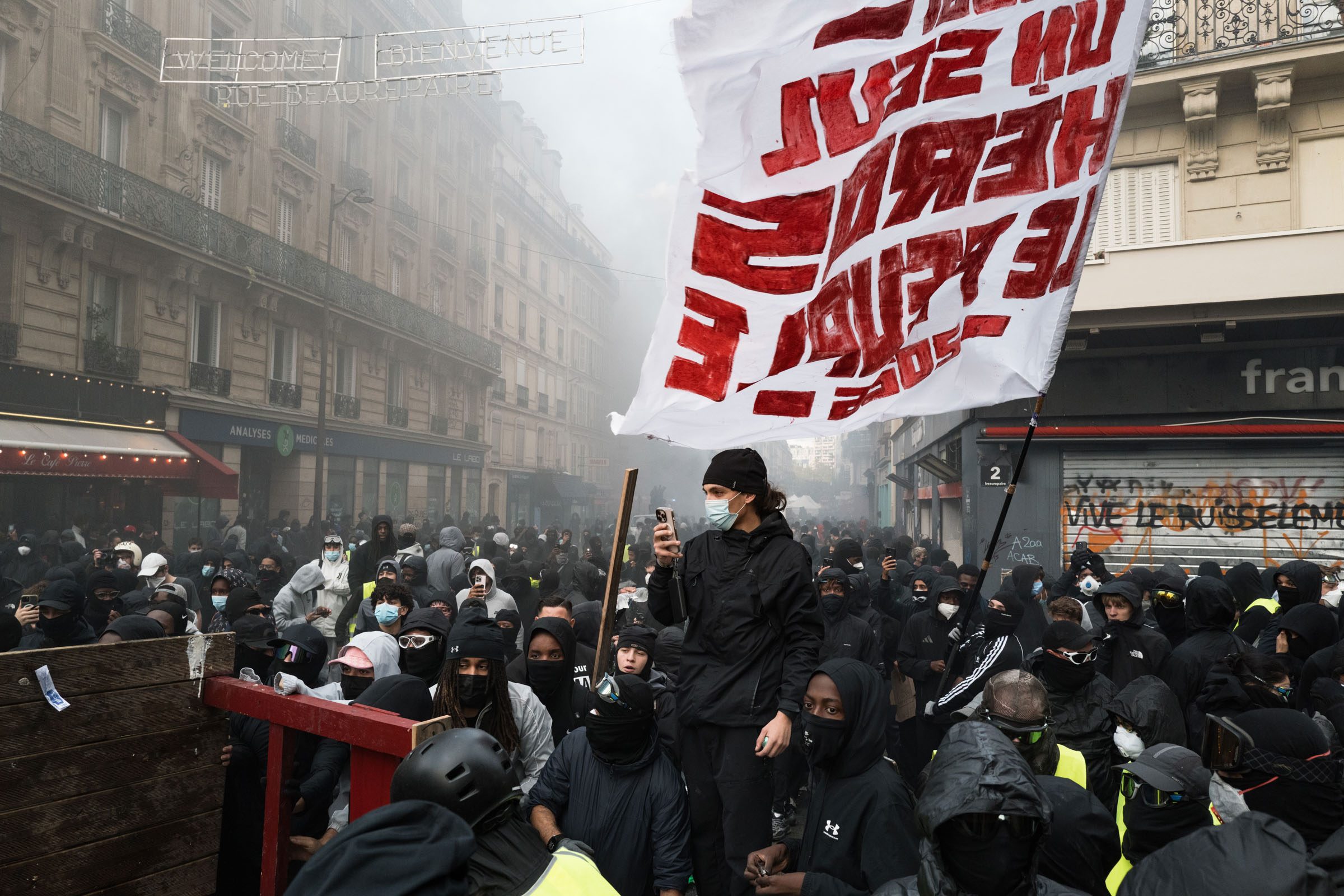
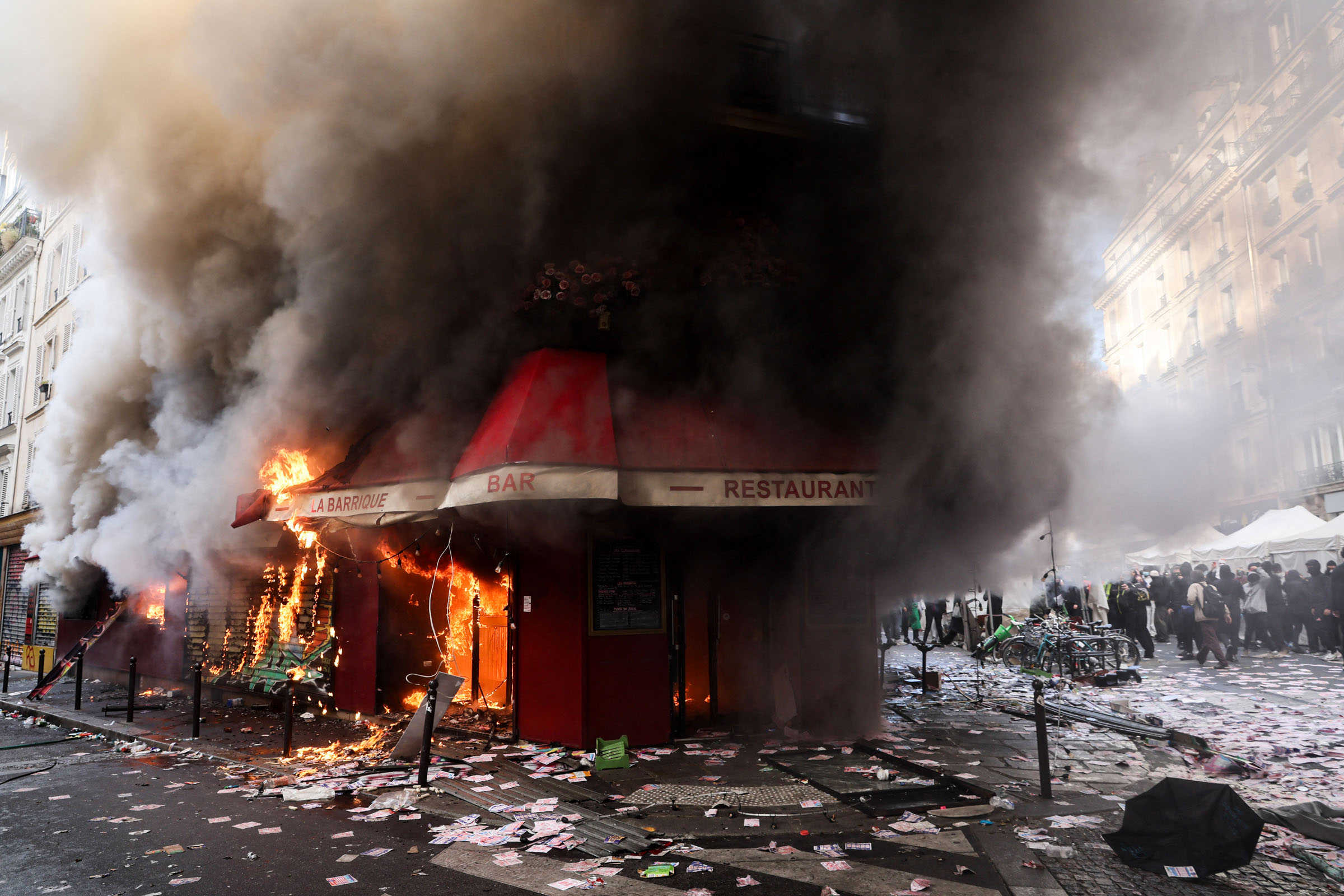
As France aims to regain full control of its streets, French Prime Minister Sébastien Lecornu has extended local mayors the power to enforce “partial curfews,” in an effort to protect businesses and people. "My determination to restore order is absolute," Lecornu told reporters, emphasizing that localized curfews were preferred over a national enforcement at this time. Paris authorities have since issued overnight curfews in two areas of the capital. The Interior Ministry reported that around 550,000 people had taken to the streets on Saturday. A French trade union put the number at over 800,000. Nuñez on Sunday said that more than 2,000 people had been arrested and over 600 police officers and firefighters injured. In Paris, at least 300 businesses were vandalised, Dominique Restino, the head of the Paris chamber of commerce, told BFM television.

Clashes occur between protesters throwing projectiles and police responding with tear gas during a demonstration against the high cost of living in Paris, France, on Oct. 17, 2026 —Jerome Gilles—NurPhoto/Getty Images

Alongside the violence in the capital, what started out as peaceful protests in Marseille and Lyon also turned violent as rioters descended. Authorities in Marseille on Monday imposed a temporary ban on public gatherings and demonstrations. French unions have already called for a new round of strikes and marches on Nov. 5.

Various buildings and official monuments have been targeted across the country.

A historic town hall in the French city of Limoges was damaged in what appeared to be an arson attack on Saturday. One of the main tourist offices in the city of Lyon was set ablaze. In Bordeaux, the prefect's residence was attacked, according to local authorities.

Macron condemned the "unbridled violence" as he addressed the nation Sunday evening. “Those who looted will have to pay for the damage, and those who sought to bring down the Republic will be held accountable,” he vowed in a televised speech.

Smoke rises from the bar 'La Barrique' on the sidelines of a demonstration against the "high cost of living," in Paris on Oct. 17, 2026 —Kiran Ridley—AFP/Getty Images

Isa Obradovich, a French-Peruvian American artist living in Paris, has participated in a number of protests since the movement went nationwide in early October. The 22-year-old says the demonstrations have become increasingly charged amid escalating clashes between protesters and police.

“I had to walk through clouds of tear gas to get home and clouds of smoke from fires,” she says of her journey home from the protests this weekend.

Obradovich notes the property damage in her own neighborhood, sharing that some of the stores she regularly visits were impacted by the protests.

“You can also see that there has been more property damage. [Some] grocery stores in my neighborhood were closed yesterday. One of them because they had boarded up the walls, and the other one because the windows of the storefront had been smashed and all the stuff inside had been ruined. I walked past as shop owners and employees were standing there looking at the devastation,” she says.

The Federation of Trade and Retail told TIME that “nearly 3,000 shops and businesses of all sizes across France have been affected by the violence over the weekend.” The French government has said it will create a fund to financially assist shops that were impacted by the riots.

Lawmakers clash over where the blame lies

Lecornu has blamed far-left agitators for the unrest. "There is, after all, a far-left movement that wants to cause—we can’t put it any more strongly—profound unrest in the country in ⁠the run-up to the presidential election," he said.

Jean-Luc Mélenchon, leader of France’s far-left party, France Unbowed, pushed back against this framing and insisted the protest movement is “the result of ten disastrous years in which President Macron has disorganized the state and public services.” TIME has reached out to Macron’s offices for comment.

The discord between lawmakers and the uncertainty in the government with Nuñez’s resignation attempt hanging over the proceedings comes just six months ahead of France’s next presidential election, where Mélenchon will no doubt be hoping to beat centrist contenders to the runoff. 

France’s public debt has climbed to a record $4 trillion in Macron’s two terms, according to figures shared by France’s National Institute of Statistics and Economic Studies in late June. The fiscal dilemma has heightened scrutiny on government spending and has sparked questions over “Macronisme,” the right-of-center, top-down governing style that Macron emulates. Further adding to the economic pressures, French government bonds dropped after the weekend of unrest.

Antonio Fatas, a professor of economics at Insead, the European business school, has said the political and economic situation is serious. “I am very worried about the economic situation because growth is low and it is difficult to see how the dynamics change. Then you have the debt numbers, which are bad, and the financial markets are thinking the government is not in control,” he told the Guardian.

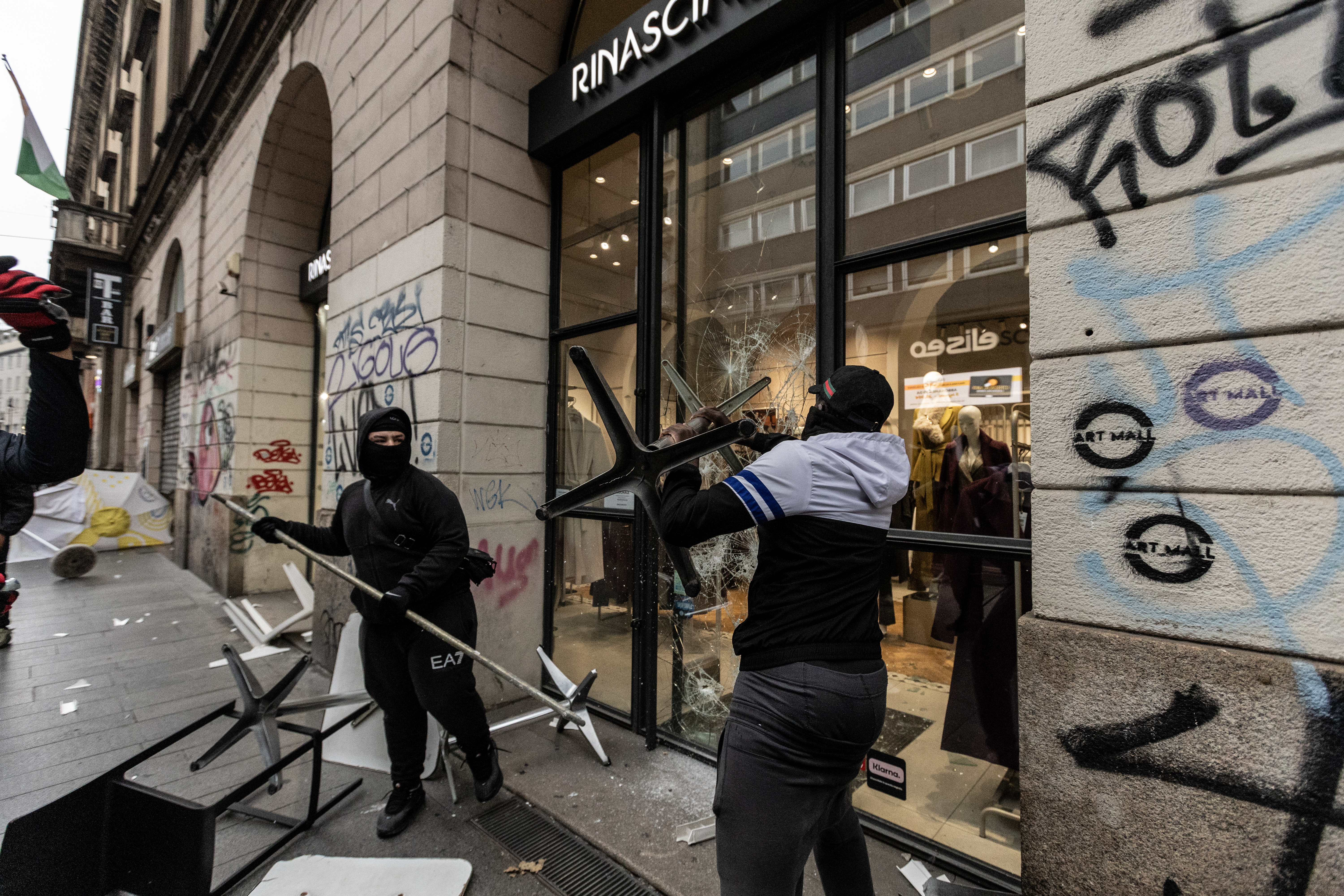
People vandalize a shop during protests in Milan, Italy, on Oct. 18, 2026. —Andrea Carrubba—Getty Images
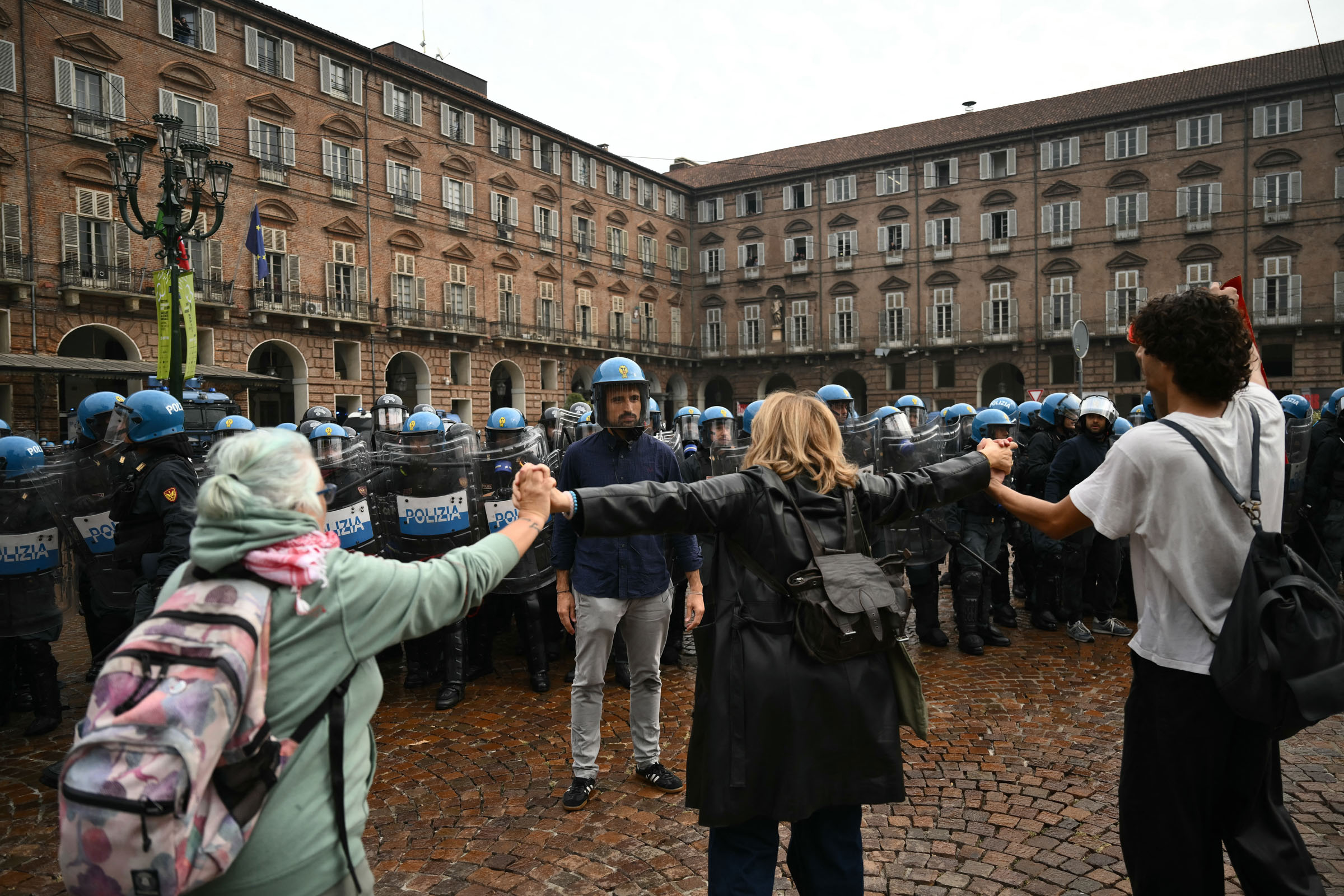
Teachers stand between anti riot Police and students at Piazza Castello in the center of Turin during the 'No Meloni Day', a national day of marches across Italy inspired by what is happening in France and Spain, to protest against the cost of living, the School Decree, the condition of school buildings and demanding increased funding, on Oct. 16, 2026. —Marco Bertorello—AFP/Getty Images

Demonstrations spread across France

Throughout September, students across France blockaded schools and demonstrated against, what they say is, a poorly-funded high school system. The protests went nationwide on Oct. 6, when more than 250,000 people took to streets across the country with teachers, parents, and union activists joining marches.

The demonstrations have drawn comparisons to the May 1968 protests, which were initiated by a student movement and led to millions of workers striking and nearly toppled the government.

In the years since, there have been numerous protest uprisings in Paris, including the Yellow Vest movement of 2018 and the pension reform protests of 2023.

What distinguishes the unrest that unfolded over the weekend is how the pockets of violence dispersed, says Fabien Jobard, a researcher at the French National Centre for Scientific Research. He says that the rioters moved away from the main demonstrations, seemingly catching the police off guard and making it all the more difficult to contain the unrest. That, coupled with the French authorities’ own admittance of failing to anticipate the full scale of the protests, meant that “it was too late to gather enough police forces in different places,” adds Jobard.

On Saturday, as some sought to revive the Yellow Vest movement, protesters draped a yellow vest over the Marianne statue at the Place de la République. 

The group that helped coordinate the action on its website described the mobilization as a convergence of student protests and wider economic grievances, bringing together high school and university students, farmers, firefighters, workers, teachers, healthcare workers, climate activists, residents of working-class neighborhoods, and retirees.

Alongside concerns over school funding and cost-of-living pressures, there is mounting backlash over fuel prices, which have significantly increased since the onset of the Iran war due to continued disruption in the Strait of Hormuz.

Obradovich describes it as an “intersectional protest movement,” arguing that “the root of all of these problems boils down to this government system taking away funding from public services.”

In his speech addressing the nation, Macron said order must be restored, but also recognized protesters’ concerns. He said his government was working with fuel distributors to ensure a “tangible impact on prices.” He added that the voices of young people “must be heard” and referenced how the Minister of National Education had set up an online portal where students can share their ideas to improve the education system.

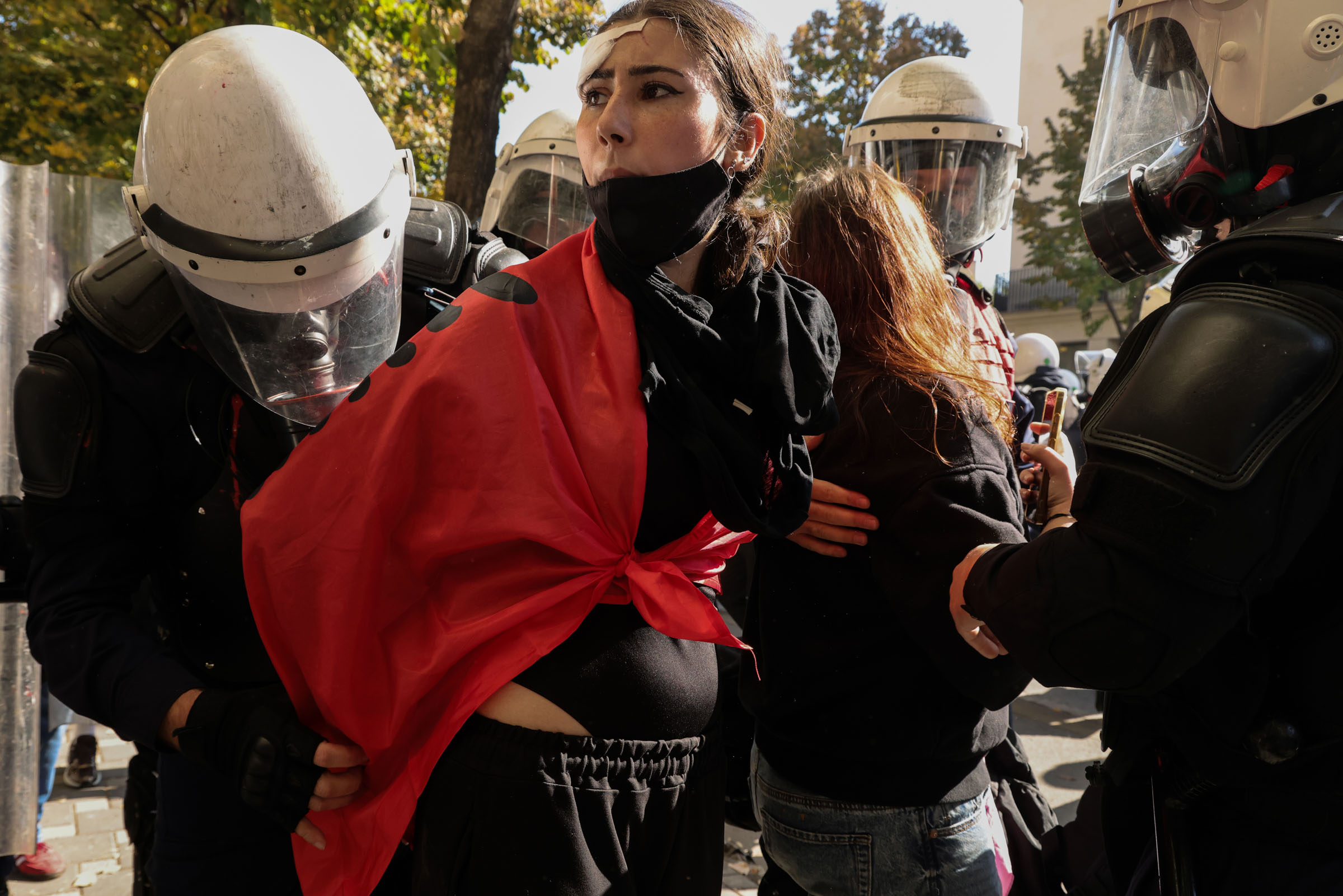
Albanian riot police detain a demonstrator during renewed clashes outside the Ministry of Education in Tirana, Albania, on Oct. 18, 2026. —Vlasov Sulaj—NurPhoto/Getty Image

Thousands protest in other European cities

France was not alone in dealing with demonstrations over the weekend, as protesters also took to the streets in other European countries.

In Portugal, protesters marched in Lisbon, Porto, and Coimbra as they called for better pensions, improved public services, and affirmative government action to combat rising living costs.

In Milan, police clashed with protesters as some threw stones and looted shops during demonstrations against underfunded services and the rising cost of living.

Italian Prime Minister Giorgia Meloni condemned "the violence of criminals who, even through organized groups, exploit demonstrations to seek confrontation and sow chaos." There were further clashes between police and protesters in Bologna and Turin.

Unrest also broke out in Brussels, Belgium, on Saturday afternoon, as antifascist activists took to the streets. The demonstrations turned violent, prompting police intervention amid reports of property damage.

In Albania, protests spilled over to a sixth day on Sunday, with student-led demonstrations marching against, what they argue is, an underfunded education system, and allegations of government corruption. Police and protesters clashed in the capital of Tirana, as Prime Minister Edi Rama staunchly rejected calls for his resignation.

Albania’s current demonstrations come months after a protest movement rallied against a planned luxury development linked to Jared Kushner, U.S. President Donald Trump’s son-in-law. The initial marches in May were borne out of environmental concerns, but protests developed amid allegations of corruption and discontent over cost-of-living pressures.

  •  

What Is Starshield, SpaceX's Military Version of Starlink, and Why Is It So Important to Ukraine?

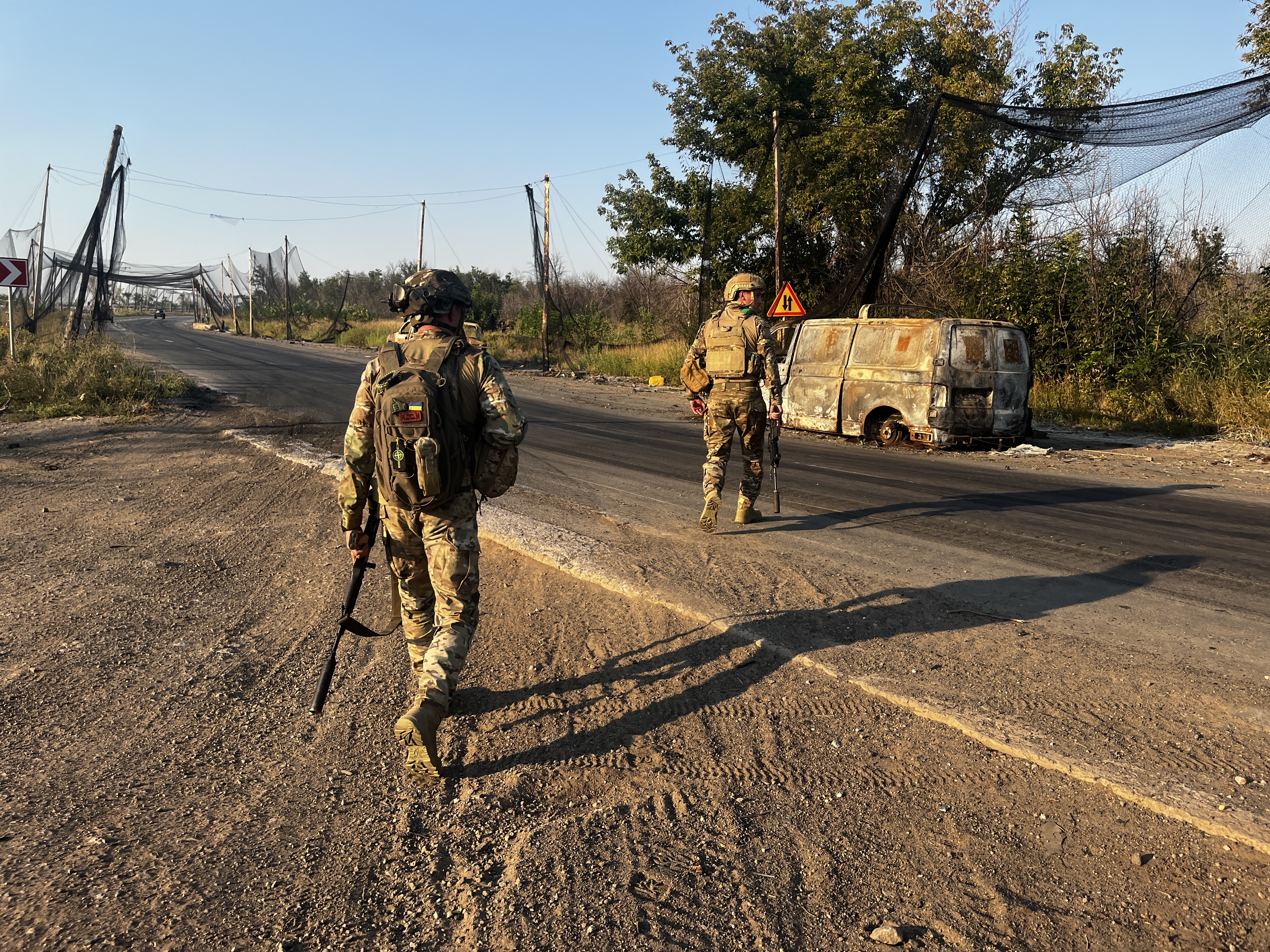
Ukrainian servicemen walk along a road to military positions in Donetsk Oblast, Ukraine, on Aug. 22, 2026. —Alex Nikitenko/Global Images Ukraine—Getty Images

Ukrainian forces said Wednesday its battlefield efforts had been hampered overnight after losing some access to SpaceX’s military-grade satellite Internet service, which has become a lifeline as Kyiv weathers Moscow's attacks.

Starlink offers Internet connectivity from satellites in low-Earth orbit. Its sister service Starshield, a military version developed for the Pentagon, relies on the Starlink network and has recently been used by Ukrainian forces to strengthen its far-reaching drone strike missions and air defenses.

Serhiy Beskrestnov, a military technology expert who advises Ukrainian President Volodymyr Zelensky, said speed restrictions had been imposed on the "military package" of Starshield services, leading to the “failure” of several military missions. “Our defense forces have not received any warnings about this restriction,” he said. Beskrestnov claimed the restrictions, which he said applied to devices traveling over 100 miles per hour and using Starshield, were “related to the current political situation.” He did not offer further details.

Tensions are high between the U.S. and Ukraine, as Zelensky has been vocal in his disapproval of U.S. President Donald Trump’s plan to import diesel from Russia, despite previous sanctions prohibiting it. The move has also caused a split in Trump’s own party, with several Republican lawmakers urging him to reverse course. After making the deal with Russian President Vladimir Putin last week, Trump announced an “energy cease-fire” between Russia and Ukraine—but Zelensky swiftly accused Moscow of violating any such agreement and Ukraine has, in turn, resumed strikes on Russian oil refineries, despite pressure from Washington. Trump called Ukraine's fresh wave of strikes on Russian refineries a "disgrace" in an interview that aired Thursday.

Speaking from the U.K., Zelensky said Wednesday it was a “pity” Ukrainian forces had experienced “difficulties” with Starlink services and intelligence, adding that he was surprised by the developments in Ukraine’s partnership with the U.S. In an interview on Piers Morgan Uncensored, Zelensky suggested he believed Starlink had been slowed down to damage him, and warned “people will die, if attacks will continue and if Starlink will not work … it’s not helpful.” He said he hoped the restriction was only a “mistake,” suggesting it was perhaps "a huge technical problem” at SpaceX.

However, in another interview, Zelensky said: "It was not a technical problem, it was the will.”

SpaceX founder and CEO Elon Musk addressed the matter, insisting that Starlink and Starshield are different. He cited the U.S. authorities as being in control of the latter’s usage determinations.

“Starshield systems are owned and controlled by the U.S. government. Any limits on speed or usage are decided by the U.S. military and ultimately POTUS,” he said on X. “Starlink is a commercial service owned and controlled by SpaceX. Usage of Starlink is limited to civilian or defensive activities and cannot be used for offensive military action, as doing so would be inappropriate for a commercial company.”

When approached for comment, a senior U.S. official told TIME: “No such request was ever made by the President.”

Reuters, citing three U.S. officials, later reported that the decision came from inside the White House.

TIME has reached out to the White House for further comment.

Meanwhile, Ukrainian national news agency Ukrinform reported Thursday, citing sources within the Ministry of Defense, that the Starshield service had resumed. TIME has reached out to Ukraine’s Ministry of Defense for comment.

The discourse has raised questions about what Starshield is and how uniquely important it has become on the Ukrainian battlefield.

What is Starshield?

Starshield is a program developed by Musk’s SpaceX that draws on the satellite and launch capability behind Starlink, its commercial satellite Internet network, to support national security operations.

According to SpaceX, Starshield is designed for government use, with an initial focus on three areas: Earth observation, communications, and hosted payloads. 

“Starlink is basic interconnectivity, it's like the Internet. Starshield essentially grows out of the experience of Starlink,” Mark Hilborne, a senior lecturer in defense studies at King’s College London, tells TIME.

But the military value of that connectivity extends far beyond access to the Internet, Hilborne adds.

“In and of itself, satellite communications are not military technology, but it enables the military to communicate and amass a real-time, multi-domain picture of the battlefield, which some argue nobody else actually has at this stage,” he says.

Both systems also offer high-speed connectivity because of the satellite technology underpinning them. 

“Starlink and Starshield are low on the Earth’s orbit, and they have a very high bandwidth, so lots of information can pass through those satellites, with virtually no delay on the signal,” Hilborne says.

There are more than 10,000 satellites in the Starlink network, while Hilborne says Starshield uses “a much smaller number of satellites.” However, the exact number of satellites associated with Starshield remains unknown, with experts telling TIME that such details are closely guarded due to national security considerations.

“They keep the contracting details on these things classified,” says Todd Harrison, a senior fellow at the American Enterprise Institute.

SpaceX, on its website, says Starshield is “designed to support U.S. National Defense use cases for the Department of Defense and other government partners.”

How is Starshield different from Starlink?

While both systems rely on closely related satellite technology, they differ in the services they provide and how they are intended to be used.

“Starshield refers to military services that actually operate through Starlink,” Harrison explains, comparing the services to “two different brands of a cell phone provider, even though your phone calls are going through the same towers.”

Starshield offers additional capabilities designed for military operations, including more advanced encryption and satellite imaging, experts tell TIME.

“It's got another extra set of capabilities over and above Starlink,” Hilborne says. “They use some of the same technologies, but it would be highly encrypted, and they have different sensors that allow them to image what they call ‘Earth observation.’ That can give a radar imaging of the Earth [which] has advantages over optical pictures.”

Yet experts say the distinction between the two systems is not always clear, particularly given how closely their underlying technology and operations are connected.

How important is Starshield for Ukraine?

Starshield and the satellite communications technology underpinning it have become vital to Ukraine’s military operations against Russia.

Hilborne describes the technology as “highly critical” to Ukraine, explaining that any restrictions could cut communications with military equipment traveling above that speed, leaving operators without the information needed to guide their missions, as once that speed threshold is exceeded, the connection “suddenly cuts off and it's flying blind,” he says.

The consequences are particularly serious for Ukrainian drone operations, which rely on communications for both strikes against Russian targets and defensive missions against incoming attacks.

“It's really critical for drones, both the offensive medium range strikes, but also affects Ukraine's ability to fly defensive drones against the incoming Russian drones,” says Hilborne. 

Beyond its role in drone missions, experts say satellite communications also offer important advantages over other forms of battlefield connectivity.

Harrison notes that “the big benefit of using satellite-based communications is that you can communicate over longer distances in a variety of terrain, and it does have some jam-resistant features to overcome electronic forms of attack.”

  •  
❌