
❌

Reading view

Polls Point to a Blue Wave. Here's Why Republicans Say They're Wrong

Talk to Republicans around Washington and battleground states about the midterms and their talking points are all but in chorus: the polls are wrong and undercounting GOP voters. 

Talk to Democrats, and it’s giddy optimism mixed with an equal measure of trepidation, but for a whole other reason: all those predictions of a blue wave could give thousands of their voters permission to stay home. 

“We’ve all been burned,” says one former staffer on Democratic campaigns.

The polls currently show Democrats may be on the verge of an historic blowout. President Donald Trump has the lowest approval ratings of his two terms in office and threatens to be a drag on most Republicans on the ballot. Democrats are in a strong position to snag a majority in the House and the Senate is still in play, but ideological fractures and a party brand that’s in the gutter stand to undermine their showing. Republicans, meanwhile, are on track to outspend Democrats in some pivotal races. 

A particularly messy election season could mean the polls are way off—or mostly on target.

Why the polls might be wrong
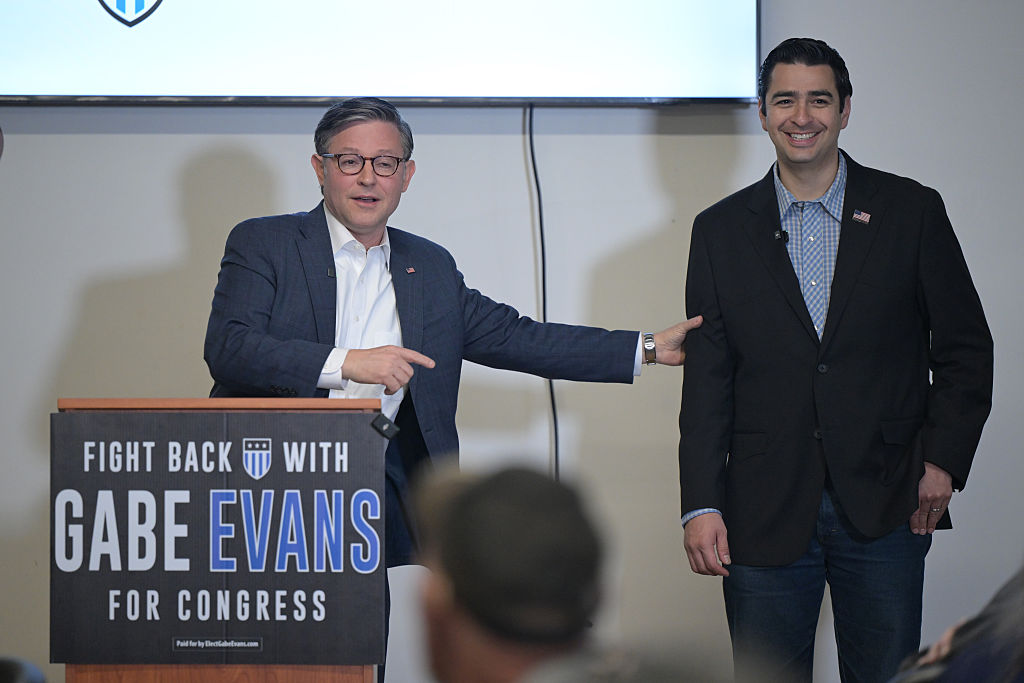
House speaker Mike Johnson, left, stumps for Rep. Gabe Evans, who is in a closely watched race against Democrat Manny Rutinel, on Oct. 22, 2026, in Longmont, Colo. —Hyoung Chang—The Denver Post

"I'm telling you, these polls are off. All of them. They use faulty analysis," said House Speaker Mike Johnson over the weekend, as he fights to save the House and his job.

It’s been the drumbeat of the GOP talking-head circuit in recent weeks, as party leaders try to buck up a decidedly unenthusiastic base with talk of rigged surveys that overcount Democratic voters. That enthusiasm gap is quantifiable; about three-quarters of Democratic voters say voting this year is “extremely” important while roughly 6 in 10 Republicans say the same, according to Associated Press polling.

And yet, there is some truth to the notion that pollsters have trouble with Republicans, who are more likely to ignore pollsters’ calls or even mislead them. Past pre-election surveys have repeatedly over-hyped Democrats’ chances of winning. In the last three presidential races, the election results underestimated Trump’s strength heading into Election Day. Republicans are emphasizing that trend, even though similar errors don’t usually occur in midterm election years.
“Let’s ask Hillary Clinton how fake the fake polls are. We don’t pay those polls any mind,” rapper Nicki Minaj recently said aboard Air Force One in a video clip posted by a senior White House official. “Obviously, they are to deter our voters from going out and casting their vote.”

More recently, some polls have been off, but not in a way that necessarily helps the Republicans’ argument. Last year’s polling in New Jersey’s and Virginia’s gubernatorial races actually underestimated Democrats’ chances; both went blue. 

Read more: Your Questions About Voting in the 2026 Midterm Elections, Answered

Why the polls might be right

No matter how loudly Republican talking heads say the polls are overcounting Democrats, that historically is just not the case in years when a presidential race is not on the ballot.

The polls have been pretty accurate in recent midterm elections, and when they’ve been off, it hasn’t always been in Democrats’ favor. In 2022, Democrats narrowly outperformed expectations, leading to a Red Wave that proved smaller than Republicans had hoped. While that was portrayed as a big polling miss by some, in reality, the polls were largely on track, despite some regional exceptions.

A big reason why polls are more accurate in midterm elections is because figuring out who is most likely to make it to the polls is less of a challenge for pollsters. In off-year, low-turnout elections, politics doesn't dominate the zeitgeist. “SNL isn’t opening with a skit on the Nebraska Senate race,” another Democratic strategist says. In other words, it’s easier to pinpoint those voters who are dialed into an election when the White House isn’t in play. After all, many people can’t even name their member of Congress, let alone have a strong opinion on them. As much as Trump keeps saying he’s on the ballot this fall, he objectively is not.

Both sides are acting like the polls are accurate

While Republicans insist polls are underestimating their support, their allocation of resources suggests they believe what the polls in key battlegrounds are telling them. For instance, as polls showed Democrat Roy Cooper well ahead of Republican Michael Whatley in North Carolina’s Senate race, Republicans largely pulled their funding, a clear sign they believed that Cooper’s victory is all but assured.

But the current environment remains unsettled at best. How else to explain that red states like Texas, Iowa, and even Kansas may actually elect a Democrat to the U.S. Senate? Even so, Republicans are dismissing polling trends in many battlegrounds, and instead citing selected polls that show them still in contention or at least within the margin of sampling error.

Nationally, the generic ballot certainly favors Democrats and Trump is undeniably a drag on Republicans who have to stand with their party’s leader or face his wrath. Some Republican nominees have turned out to be lackluster and underperforming national party leaders’ expectations. Others, such as Vivek Ramaswamy in Ohio’s race for Governor, have stepped in it and seem unable to clean their shoes. (So badly did a Ramaswamy attack ad backfire, the non-partisan Cook Political Report last week moved that race from a “Toss Up” to “Lean Democrat.”)

We’re on the verge of taking back control of the House,” Democratic Leader Hakeem Jeffries said over the weekend. But first, Democrats understand, they have to show up and not take the polling as permission to stay home on Election Day.

That’s not to say Democrats are fielding an immaculate set of candidates. A misfire in Maine’s Senate race forced the party to swap candidates after the nomination had seemingly been settled. National Democrats didn’t get their favored candidate in Michigan’s Senate race either. The polling in both states shows tighter contests than Democrats had hoped for.

Still, there’s no bigger megaphone in politics right now than Trump, and he is barnstorming the map trying to turn out his people, the folks who are widely understood to eschew pollsters’ calls. While Trump appears to be a drag on the national ticket, he still is popular with his base. A CNBC poll released Monday shows the President with an 82% approval rating among Republicans and at 90% among those who identify with the MAGA movement. Those are numbers that has Republicans praying at least that poll is correct.
  •  

'We Now Deserve to Lose': Ramaswamy Ad Deepens GOP Panic in Ohio

The fierce and bipartisan backlash to gubernatorial candidate Vivek Ramaswamy's decision to feature his opponent's estranged mother in an ad left Republicans in Ohio and Washington reeling on Wednesday, as both Ramaswamy and Vice President J.D. Vance doubled down on the divisive strategy.

Publicly, Republicans were mounting a defense, led by Vance, who is from Ohio and was campaigning in Cincinnati on Wednesday, treating the ad as a game-changing October surprise. On Thursday, President Trump joined in, saying in a social media post that Ramaswamy should keep the ad running and "let everyone listen to the mother of a defective, dishonest, and incapable Candidate, explain how the daughter is a DISASTER who, uncontrollably, lies, cheats, and steals!"

But privately, old-guard Republicans were baffled that Ramaswamy would dare to deploy Democratic nominee Amy Acton’s own mother, who has not spoken to her daughter since 1978 when she defended Acton’s stepfather who was indicted for raping Acton as a child. Some predicted the ad was likely to draw more empathy and interest in Acton from voters, and turn them away from Ramaswamy. 

“We’ve lost the plot,” says one Republican strategist. “We had a real good chance and then we do this two weeks out.”

Adds a second: “We now deserve to lose this race.”

The addition of this ad so close to Election Day roiled races in Ohio up and down the ballot. “I would not have run that ad,” Republican Sen. Jon Husted, running in a tight and expensive race for re-election against Sherrod Brown in Ohio, told The Associated Press on Wednesday. Other players in the state's Republican circles say the ad has all the pieces of a misfire, especially among women.

Recent polls have shown Acton leading but not running away with the race. A Marist University poll released this week showed her up seven points. But Ohio is a state where President Donald Trump won three times, never with fewer than eight points to spare. If elected, Acton would be the first Democrat to become Governor since 2007.

Ramaswamy’s campaign said it was putting $4 million into making sure the ad gets seen, with a goal of targeting persuadable voters still undecided between the billionaire entrepreneur and Acton, the former state health chief who steered Ohio through the pandemic. But the risk of it backfiring is incredibly high with no time to recover.

Ramaswamy’s campaign includes several operatives who previously worked for Vance, who sidestepped questions about the ad’s message on Wednesday as he urged  Republicans to not allow such hard-nosed messaging to distract them from the stakes of the election. “I’m a little bit disgusted when I see Republicans across the country who are whining more about that advertisement than they are about what the congressional Democrats and other Democrats want to do to the United States of America,” he told reporters. “So I would say to Ohio Republicans: do you actually think that Amy Acton is unfit to serve as Governor of the state of Ohio? I do.”

By Wednesday afternoon, it was clear Vance might be in a decided minority. “I don’t have to agree with Amy Acton’s politics to believe that exploiting someone’s childhood trauma is wrong,” wrote Republican Lydia Mihalik, a member of Ohio Gov. Mike DeWine’s Cabinet. On Thursday morning, DeWine himself joined in the pile on, telling reporters at the Statehouse in Columbus that the ad was “deeply, deeply troubling" and urging Ramaswamy's campaign to take it down, The Associated Press reported.

Mike Murphy, a strategist who was in Sen. John McCain’s inner circle when he ran for President in 2000 and headed Gov. Jeb Bush’s super PAC in 2016, wrote a brutal assessment of the ad on social media, saying it “is looking more and more like political suicide.”

And former South Carolina Gov. Nikki Haley, who ran against Ramaswamy in the 2020 presidential primaries and was a frequent critic of him, was even more direct. “He’s a bad guy,” she said. “It’s a shame he continues to get away with it.”

In an editorial endorsement of Acton published Wednesday, The Columbus Dispatch roundly condemned the video: “It should go without saying that sexual violence against children should not be politicized or taken as lightly as Ramaswamy appears to take it.”

For its part, Acton’s campaign began an ad of its own calling out Ramaswamy’s effort to make her childhood a campaign issue after a half century in the past. 

"I received a lot of abuse, but Amy always got the worst of it,” Acton’s brother, Phil Stearns, says in a new 30-second ad released Wednesday. “She continued to receive that abuse because she knew she had to protect me from that, and if she hadn't done that, who knows where I would have ended up.” 

"She was 11- and 12-years-old, and to think that that's somehow a talking point—shame on Vivek,” Stearns continues. “The contempt he has for Amy is the contempt he has for Ohio. He's not fit to lead."

  •  

Ramaswamy Facing Tougher Fight Than Republicans Had Expected in Ohio

Vivek Ramaswamy listens as Vice President JD Vance speaks during a rally for Ramaswamy and other Republican candidates on Oct. 09, 2026 in Lima, Ohio. —Samuel Corum—Getty Images

On the day Vivek Ramaswamy made official his run for Ohio Governor, President Donald Trump did not dally.
“He will be a GREAT Governor of Ohio, will never let you down, and has my COMPLETE AND TOTAL ENDORSEMENT!” the President wrote on Truth Social on Feb. 24 of last year, within hours of Ramaswamy kicking off his campaign.

Trump’s post essentially cleared what had been expected to be a crowded GOP field, boxing out the likes of state Attorney General Dave Yost, state Treasurer Robert Sprague, and Lieutenant Governor Jim Tressel in a state where Republicans felt dominant. It also effectively gave Ramaswamy almost two years to focus on keeping the Governor’s mansion in GOP hands. But the very connections to Trumpism that fueled Ramaswamy’s fast political rise are now giving his party reason to worry, as polls show him trailing Democrat Amy Acton, a former state health chief and a first-time candidate.

“Something is happening here. I just can’t tell you what,” says one Ohio Democratic strategist, reflecting the apprehension pervasive in both parties right now.

On the campaign trail, Ramaswamy occasionally moderates his image as the brash MAGA warrior railing against “the woke left,” pitching tax cuts and economic development when he’s with suburban crowds and chamber of commerce types. But he can still come off at times as a pugilistic troll. He has promised to be "the most conservative Governor in Ohio's history,” defying Ohio’s history of moderate conservatives who have governed the Heartland homebase. He has embraced AI data centers in a state where they are far from popular. And he has not shrunk from Trumpian hardline immigration policies, especially when he appears with Trump. 

"As Americans, we believe in merit, that the best person gets the job, regardless of their skin color, that you are judged not on the color of your skin, but on the content of your character and your contributions,” Ramaswamy said during an Oct. 12 rally with Trump in Youngstown, where Acton grew up. “That is who we are as Americans."

Ramaswamy has not developed a thicker skin than when he ran for the White House just two years ago. In July, when confronted by hecklers at Xavier University in Cincinnati, he simply walked off stage: “Peace out, see you guys.”

The polls still show a close-range contest, but in the increasingly nasty ad war, the spending suggests a far more lopsided fight. Ramaswamy and his supporters have now run $101 million in ads against Acton, with $36 million of that coming from Ramaswamy himself. 

Acton and groups supporting her have spent about one-third of the Ramaswamy media wave, much of it describing Ramaswamy as a “swindler” who conned his way to a fortune and harnessing anti-billionaire sentiment.

“This is a guy who has been flying around the state on his corporate jet. Ohio is not a huge state geographically. It’s a state that’s incredibly driveable,” says David Cohen, the director of the Applied Politics Program at the University of Akron. “He was the worst possible choice for Republicans, not that they really had a choice.”

Dr. Amy Acton speaks with supporters during a rally in Cincinnati on April 28, 2026. —Jon Cherry_Getty Images

A loss for Ramaswamy would be a stunning reversal of fortunes for Ohio Republicans. Once seen as a quintessential swing state, Trump won Ohio during all three of his presidential bids with margins between eight and 11 points.

If Democrats can show a rebound in Ohio, the state may actually wind up back on the must-visit list for 2028 contenders from both parties. After all, states like Georgia and Arizona were also once solidly red until break-out candidates—backed by party spending—upended those assumptions.

 “Calm down,” says a consultant who has worked with Ohio candidates in past cycles, when asked about Democrats’ optimism. “It’s still Ohio.” 

Ramaswamy’s rise via Trump

For a while there two years ago, Ramaswamy seemed like the most obvious heir to Trumpism. When he launched his presidential bid in 2025, he couched it in effusive praise for the then-former President, to the point that he sometimes sounded like a Trump surrogate in the GOP debates that Trump refused to attend.

After a weak showing in Iowa, Ramaswamy ended his campaign and quickly folded into the broader MAGA-verse. He was chosen by Trump to help Elon Musk upend the federal government at the Department of Government Efficiency, before dropping out of that partnership.

But the talent for going viral that helped Ramaswamy gain a national profile has proved less successful this election cycle in Ohio. Social media videos of him hitting tennis balls and baseballs while listing his policy proposals have provided a font of online mockery. He hastily left Ohio State’s season opener after being booed and heckled. Later, he faced criticism for having worn a knock-off Ohio State jersey to the game. 

Ramaswamy has also struggled to navigate his identity as a Hindu and the son of immigrants from India in the modern GOP. In the gubernatorial primary, auto entrepreneur Casey Putsch ignored Trump’s endorsement of Ramaswamy and vied for the nomination, pitching himself as an “America First” alternative to Ramaswamy. In one YouTube spot,  Putsch hoisted a rifle and challenged Ramaswamy to a game of “cowboys and Indians.” 

While Ramaswamy easily won his party’s nomination, almost one-in-five votes in the primary were for Putsch, a hint that Ramaswamy’s appeal had its limits even within his own party. “One of the storylines here is a man who is Indian American and whose religion is Hindu,” says Christopher Devine, a political science professor at the University of Dayton, says. “There are a lot of members of the Republican base who may have difficulty voting someone of his demographic profile.”

Amid efforts by both campaigns to push policy ideas like tax cuts and education reform, the ad war has boiled down to attacks portraying Ramaswamy as a conman and Acton as a drunk. The latter is based on an August 2019 incident in which police responded to an incident in Acton’s home that Acton has accused Ramaswamy of dramatically mischaracterizing, to the point that she refused to share a debate stage with him. Ramaswamy has also refuted allegations his fortune came from misleading investors.

On Tuesday, the race took an even nastier turn. An anti-Acton video surfaced online starring Acton’s mother, who has not spoken to her daughter since 1978. In the ad, she calls her daughter a “liar”—not over the candidate’s allegations that she was molested and raped by her stepfather, who was indicted, but her claims she spent time as a homeless youth.

“Don’t let her become your Governor,” Acton’s mother Donna Arthur says in the video. “If you think she’ll make your life better, you’re fooling yourself. It will only get worse.” It is not at all clear who created the ad, who funded it, or if it is destined for broadcast. Still, its existence was a stunning escalation in a race that may set the new standard for mudslinging, so much so that Philip Stearns, Acton’s brother, released a statement calling the ad “a despicable low.”

Devine says the tone of the attacks is a shift from the Senate race, where former Democratic Sen. Sherrod Brown and current Republican Sen. Jon Husted both have extensive records for each side to focus on. “In the Governor’s race, there’s no record to pick apart. Without much of a track record in politics to run on, they’re focusing on personal attacks against the other,” Devine says.

Ohio polling raises questions 

As polling consistently shows an advantage for Acton, Republicans are increasingly arguing that the polls may be wrong by just enough to give Ramaswamy the win. One proof point is 2018, when some polls showed Brown winning re-election by double digits. By the time votes were cast, Brown won by less than seven points

Republicans, heading into a make-or-break stretch of voting, are repeating those statistics to make the case that the polling once again is under-counting Republican voters. 

Cohen, the political science professor, doesn’t share that view of skewed polling: “I’m not skeptical at all. All of the polls are trending in the right direction for Acton.” 

Democrats, for their part, are viewing the race as a tie, at best. Among their reasons for concern is Ohio’s poor track record when women are on the ballot. The state’s voters have never elected a woman as Governor and rejected both Hillary Clinton and Kamala Harris as presidential contenders. 

Yet given the strong headwinds against Republicans’ national brand, they can’t hide their bullishness toward the races for Governor and Senate, where polls show Brown up over Husted. “I haven’t felt this good, like we have a chance, in a while,” says a second Ohio Democratic strategist. But, he adds, given how tight both races may be, no one should expect an early race call once the polls close.

  •  
❌