❌

Reading view

Himalayan Communities Are Relying on Centuries-Old Water Solutions In the Face of Climate Change

A man-made structure, called an ice stupa, rises up against the winter skies in India's Ladakh region. —Ajith Kumar—Getty Images

The word Laya describes the natural rhythm that has carried the people of the Himalayas through monsoons and drought for centuries. Across the peaks and glaciers, the populated mid-hills and the foothills, communities have harmonized their calendars to the pulsing of water.

Where annual rain falls in just four months, these master engineers funnel rooftop rainwater through handmade bamboo piping into gravel pits to recharge underground wells, maintaining them at the annual festivals. They adapt to the climate by unearthing ancient subterranean medieval stone spout networks for drinking, washing, and bathing.

But there’s another Sanskrit word used in Hindi called Pralaya, passed down through oral tradition like Himalayan myth. It means the melting away of places that no longer exist. 

“Recent flooding in Nepal was a pralaya,” says hydrometeorologist and environmental scientist Ngamindra Dahal, chairperson of the Nepal Water Conservation Foundation (NWCF) and executive board member of the South Asian Meteorological Association. “We’ve never witnessed anything like it.”

Himalayans have fallen out of sync with nature at no fault of their own. As earth’s largest swath of ice outside the poles thaws from the unprecedented rapid global warming, high- and mid-mountain villages across eight countries of the Hindu Kush and Himalayan mountain regions have entered a new world of extremes: too little and too much water. 

The Himalayas are losing glacier mass 65% faster than a decade ago. The impacts will be felt by 2 billion Asians across 12 major downstream river basins by 2050. And by 2100, it’s projected that 80% of glacier mass will be lost. The reality of dangerous cloudburst floods and water scarcity is, however, already being felt.

On Aug. 26, a 55 million-ton, 93-m.p.h. ice-rock avalanche triggered by a glacier collapse in Nepal near the Tibet border killed more than 1,400 people, with thousands more still missing. Meanwhile, the Nepali government will drain four massive glacial lakes to reduce the danger of yet another catastrophic flood.

The vulnerable, historically low-polluting country has been waiting for a response to its request for compensation from high-emitting nations for the damage created in part by this climate disaster. And on Oct. 22, Nepal became the first country approved for a provisional payout from the U.N.’s Loss and Damage Fund, securing over $21.6 million for recovery from the catastrophic floods. Meanwhile, with deepening uncertainty about the planet’s most basic natural resource, Himalayan people forge on charting their own solutions to save their homes by reviving ancient water systems, building artificial glaciers, and uncovering hidden flood risks. 

“The Himalaya is often described as Asia's water tower, but that metaphor is dangerously passive if it makes the mountains sound like a stable reservoir. What the laya-to-pralaya concept clarifies is that the Himalaya is a living, dynamic system—and that climate change is compressing geological time,” says Dahal. “What once happened across generations may now happen within one.” 

Reviving Lifelines 

For centuries, perennial springs, or mool, have dictated how Himalayan communities live their lives. But that trusted relationship is breaking down. Still, resilient Nepali communities are adapting to the shifting environment of melting snow and ice and unpredictable monsoon rain by reclaiming historic infrastructure. 

To combat water shortages often from erratic rainfall shifts disrupted by climate change, they’re reviving an ancient network of underground terracotta canals that channel water to sunken stone spouts, some chiseled as early as the 6th century. Known as hiti or dhara, these water systems connect to ponds that absorb monsoon rain, recharging the groundwater table to keep spouts flowing during dry season. In places like the Kathmandu Valley, local governments are actively restoring and rerouting this massive ancient spring network, originally engineered by the Licchavi and Malla dynasties and now threatened by climate change and rapid urbanization. 

Through the NWCF and an intergovernmental organization protecting mountain environments and cultures called the International Center for Integrated Mountain Development, Dahal is replenishing water supplies by taking inventory of more recent drying springs to gauge a new baseline of water availability. 

"A community may have adequate water in its landscape but lack the investment to bring it to households,” says Dahal. “Conversely, a community may have taps everywhere but an increasingly unreliable source.”

He’s teaching local communities how to revive and reroute their drying life sources based on changing water movement underground, by tracking seasonal flow rates, water quality, and geographic elevations. Once new water patterns are mapped, Dahal helps communities design localized water-sharing agreements and storage, and adapt household rainwater harvesting systems—in a grass-roots water governance model aligned with the Nepal government adaptation plan. “When a pipe breaks, you repair the pipe; when a tank collapses, you rebuild the tank,” says Dahal. “But when the spring itself stops flowing, repairing the infrastructure solves nothing.”

Hidden Risk

Up in Nepal’s Limi Valley, families are confronting a different kind of uncertainty. Tashi Lhazom recalls being 13, studying at a Kathmandu boarding school, when she received a phone call from her remote high-alpine village. On the other line her mother simply said, “You better study hard because you have nothing to eat here anymore.”

An avalanche had struck her 1,000 year-old ancestral valley—just two years after a massive glacial lake outburst flood (GLOF), a sudden violent release of water from a melting glacial lake—and had taken with hundreds of the yaks that were her nomadic herding family’s generational livelihood. This went against everything Limi Valley indigenous villagers had known about trusting the mountain Gods.  

“My people believed the Gods were angry with them for being greedy. That was their cultural rationalization,” explains Lhazom, now 26. When what villagers assumed was another catastrophic GLOF washed away bridges and a hydropower plant in the Limi Valley in May 2025, Lhazom was ready to do something about it.

“I couldn’t let the community blame itself for something it was not responsible when I knew it was those emitting greenhouse gases who were partially to blame,” says Lhazom, one of the first from Limi Valley to earn a college degree and now an activist among a wave of Gen Zs fighting climate destruction in Nepal. 

She tracked down climate scientists and politicians, urging them to investigate the cause of the flood, until a field team finally agreed to come. After Lhazom directed them around closed flooded roads to local water sources, they trekked upstream, reaching glacial terrain at 17,000 ft. to learn the truth: It wasn’t a GLOF this time.

Instead, thawing permafrost—the ice that acts as glue to bind mountain rock—was without warning, draining trapped small “thermokarst” lakes, releasing massive volumes of underground water down the slope. As a result of their investigation, that 2025 Limi Valley flood was reclassified as Nepal’s first-ever recorded thermokarst lake flood. 

After sharing drone footage, photos, and satellite images with the scientists who proved the flood mechanism, Lhazom became co-author of a September 2025 comment paper in the Communications Earth and Environment Journal alerting the world to this overlooked risk.

It led to an acknowledgement and warning in a July 2026 scientific paper about the increased risk of thermokarst lake floods due to climate change—not just in the Himalayas, but across Peru, China, and other high-alpine mountain environments. And from it, a newly defined dangerous hazard category, called Small Alpine Lake Outbursts (SALOs), emerged. 

“Limi is fortunate enough to know they are in danger, but there are hundreds of ‘Limi Valleys’ across the Himalaya. There are still villages whose mountains have not been studied. They don't know if they are living in danger or not,” says Lhazom, whose 2024 film documenting the Limi Valley flooding, No Monastery No Village, was screened at Banff.

But most importantly to Lhazom, she was able to convince her Indigenous people of the Limi Valley that the flooding was not their fault. Since finally putting them on the map, Lhazom has been working to help secure government funds to resettle the remaining families away from danger on nearby ancestral land. 

As Nepal’s politicians scramble after this year’s floods to reform the legal framework for disaster relocation, Lhazom is traveling high in the mountains to deliver relief for the victims among 33,000 now in need of permanent resettlement after being banned from rebuilding their homes along the permanently destabilized high-risk mountainside. 

“The frozen water banks we know are melting, and that means flooding that can sweep an entire village away within a fraction of a second. Our water sources are getting thinner and fewer and that is a grave concern,” says Lhazom. “But what’s most heartbreaking for these mountain people is knowing they can never go home.”

Generational families have no choice but to accept the erasure of their ancient Indigenous settlements. “The mountain is more than land. It is our identity, our history. The water spirits we worship inspired our folk songs and Indigenous wisdom, and polluting means you are being disrespectful to the water spirits,” says Lhazom. “It’ll be a challenge to convince the people to live in safer places, but I don't want them to be in a place that could kill them.”

Growing Artificial Glaciers 

Northwest of Lhazom’s home, in Ladakh, India, where –40°winds whip through a remote desert on an 11,500-ft. shelf in the shadow of the Himalaya’s highest northern peaks, the people rely on a single water source: melting glacial ice, now covered in soot from vehicles carrying adventure tourists acclimating in its capital of Leh. 

The region’s unbearably beautiful and dry glacial-dependent settlements could become the next Himalayan ghost villages—joining the 2,000 already abandoned from drying glaciers, water scarcity, drought, and unpredictable monsoons in places like Spiti and the Uttarakhand, India, and the Upper Mustang of Nepal. 

But here in the “Third Pole,” climate activist and mechanical engineer Sonam Wangchuk is blending modern technology with his traditional knowledge. In 2015, inspired by stories of his ancestors moving “parent” glaciers into a cave to make “baby” glaciers—based on the early work of “the Iceman of India”—Wangchuk developed the science to revive the ancient cultural practice of grafting glaciers. He grew new ice to reverse water scarcity in Ladakh. 

He ran a mile a mile-long pipe from a glacier spring down a steep slope; at the bottom in the shade the water shot straight into the air and, in the dead of winter, froze. Over a month, the ice grew into a multistory conical artificial glacier fountain he called an ice stupa after the sacred Buddhist dome-shaped shrines. Rather than wasting down the mountain, his invention preserves a critical water supply for an extra month through June when farmers need it most for planting. 

Word of Wangchuk’s ice storage traveled, and he built ice stupas in numerous Himalayan villages facing water scarcity, even allowing a community from Ladakh’s abandoned village of Kulum to return home. 

Beneath this elegant solution lurked a critical flaw. The pipes feeding the stupas were freezing. But working with longtime colleague Surya Balasubramanian, who earned his PhD in Switzerland in ice reservoir behavior, Wangchuk last year brought the ice stupas back to life through automation. By integrating solar-powered, computer-controlled sensor networks and motorized valves, the water flow could be turned off remotely to prevent the pipes from icing, ensuring 80% of the incoming spring water is frozen and stored.

“We innovated a method to either spray water from fountains or drain the pipes using valves controlled by weather and pipeline sensors,” says Balasubramania, who in 2023 independently launched Acres of Ice to scale the ice stupas. 

Today, they’ve built or supported 160 ice stupas across Ladakh, Nepal, Mongolia, Kyrgyzstan, Chile, and Pakistan, each standing up to 12 stories and capable of storing 3.2 million gallons.  

But the fight may never be over for Wangchuk, who knows the temporary nature of his adaptation strategy won’t outlive the glaciers. He is now testing a new application: sourcing water for his stupa from a dangerous glacial lake to help prevent it from collapsing and sending a massive GLOF wave down the mountain—and using natural refrigeration to refreeze the lakes. 

With the growing threat of climate-induced glacier collapse, intensifying monsoons, and prolonged dry spells, the Hindu Kush-Himalaya region is nearing a tipping point. As global temperatures rise, the people who have learned to adapt to harsh conditions for centuries have little control over the destabilization of their ancestral homes. Still, they look to nature for a way forward through simple innovation to make every drop of water count. The question is: Will it be enough? 

“There’s very little that can be done at this point to protect against glaciers in vulnerable places in the Himalayas, so these communities suffer and pay the price for what the rest of the world does,” says Wangchuk. “The recent avalanche in Nepal is an alarm bell for the rest of the world to mend our ways on this planet.”  
  •  

The Key Climate Issues to Watch In The Midterm Elections

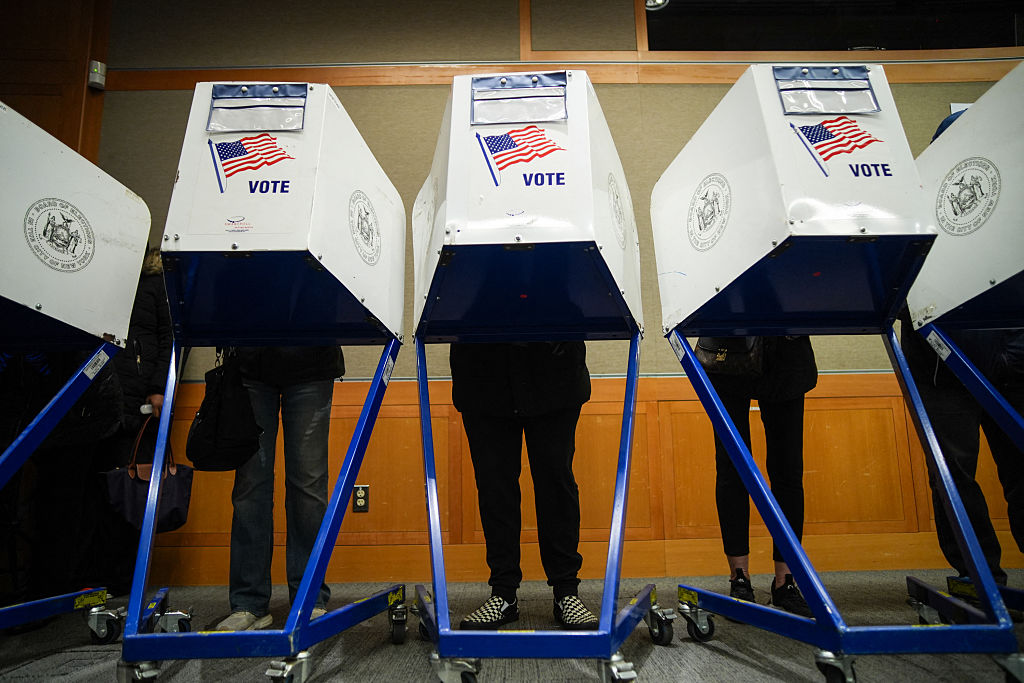
People cast their ballots on the first day of early voting for the U.S. midterm elections, in New York, on Oct. 24, 2026. —Ryan Murphy—Getty Images

With the midterms approaching, the climate crisis doesn’t seem to be top of mind for most voters. In a recent poll, voters told Gallup that, among 11 issues, the economy, health care, and the war in Iran are the top of their concerns when it comes to this election season. 

That doesn’t mean climate isn’t on the ballot. The midterms come as the U.S. has faced a slew of climate rollbacks under the first two years of the Trump Administration, including withdrawing from the Paris Agreement, rolling back the landmark endangerment finding, and leasing public lands for oil and gas drilling. With Democrats being significantly more likely to view climate action as a priority, many in the climate movement are hopeful that if the Democrats take back some leadership in Congress, as it could prove essential in helping to prevent further rollbacks.

“A new government could stop the bleeding,” says Malcolm Araos, assistant professor at the Wagner School of Public Service at New York University, whose work focuses on the politics of climate policy. “A new Congress, or new Senate can't reverse [many of the climate rollbacks], but they could investigate why [they were] repealed, and they could stop things like that from happening in the future.”

All 435 seats in the House of Representatives will be determined on Tuesday, Nov. 3, while 35 Senate seats are up for election. Democrats need a net gain of four seats to take control of the Senate.

Why local elections matter these midterms

With a low likelihood of federal climate policy under Trump, regardless of the outcome of the midterms, state races are where most environmental advocates are looking. That’s because state-level elections still leave open the potential for local climate action—especially if Democrats can manage a “trifecta” and win the governor’s mansion and a majority in both chambers, says Geoffrey Henderson, assistant professor of environmental policy and planning at the University of Michigan. “We've seen in recent history that when we have Democratic trifectas at the state level, that lends itself to an opportunity to pass pretty transformative climate policies,” he says. “It's often underrated how important state level races are, because there are states like Michigan that are not currently Democratic trifectas, but that could shift back in that direction…and that can really unlock major policy change.”

Since President Trump took office, several states, including California, Virginia, and Colorado have pushed forward climate policies despite federal rollbacks. 

Climate ballot measures to watch in the midterm elections 

A number of climate measures are also on the ballot in several states. In Colorado, Amendment 82 will have voters deciding on the constitutional right to buy and sell natural gas—a measure that critics say, if passed, could challenge climate policies in the state by promoting fossil fuel reliance.

On the other hand, in Michigan, a ballot measure hopes to limit utilities from influencing political campaigns. (Michigan utility companies have previously lobbied against community solar expansion.) Voters in Eugene, Ore., meanwhile, will be asked to decide whether to tax large corporate retailers to fund climate resilience projects. (The measure is modeled after a similar program passed in neighboring Portland in 2018.) 

These all serve as bellwether cases, says Henderson. “These ballot measures are in some ways testing theories of how each side is going to approach state level climate policy.” 

How could the Iran war and data center concerns in the midterms impact climate policy?

Two issues of concern for voters—the war in Iran and data center construction—could also prove an opportunity for climate-friendly policies like renewable energy investments. “These moments of crisis when energy is really really expensive [can] lead to these switches to renewable energy,” says Araos. As the war laid bare the precarity of fossil fuels, many communities around the world began turning to renewable energy for greater energy security. 

Voters in 10 states, including California, Kansas, and Ohio, will decide whether to curb data center development in local communities, a fight that’s been resonating with climate advocates. “Data centers have drawn a grassroots bipartisan opposition, and climate groups are very much aligned with that opposition because data centers are major energy users, and in many cases they're major water users,” says Henderson. “I think it is really a climate issue as well as local land use issue, an issue of costs and water availability, and there's an opportunity here for climate advocates to to be a part of a broader coalition.” 

  •  

Skip the small talk: Make game-changing connections at TechCrunch Founder Summit with Braindate

At TechCrunch Founder Summit 2026, happening November 4 at SoWa Power Station in Boston, networking powered by Braindate is designed to make those conversations easier to find, whether they are in 1:1 or small-group on-site meetings. Register before the event starts to save up to $100 on your pass, plus get a second for free.
  •  

Democrats can do something about energy prices — without winning the midterms

A white three-vaned wind turbine standing on a wide plain with blue sky and puffy clouds behind it.

A great deal is at stake in next week’s midterm elections. The partisan makeup of the new Congress will shape future spending bills, congressional investigations, and judicial nominations, among other things.

And yet, the most consequential bill of the next 12 months — and the one that speaks most directly to voters’ concerns about the cost-of-living — might well pass before the new Congress is seated.

The Bipartisan American Affordability and Jobs Act of 2026 (BAAJA) could dramatically reshape America’s energy system. And the bill’s supporters plan to pass it during the House and Senate’s lame-duck session — the months between next week’s elections and the new Congress’s arrival. 

The bill is long and complex, revising the rules governing everything from how ocean-powered turbines are licensed to what some geothermal plants must pay in royalties. 

That said, the legislation’s fundamental aim is simple: to make building all forms of energy infrastructure easier. 

The BAAJA has united fossil fuel companies and green energy firms in its favor — while cleaving the climate movement in two.

Key takeaways

  • The Bipartisan American Affordability and Jobs Act would make it easier to build new power plants and transmission lines.
  • The bill benefits fossil fuel companies, but it would likely do even more to accelerate the growth of clean energy.
  • Environmentalists are divided over the bill, with critics warning that it would weaken important environmental protections.
  • The bill has one potentially serious flaw that Congress should fix. But with that change, it would be a win for the climate and consumers alike.

Some climate hawks contend that the legislation pares back vital environmental regulations, while clearing the way for new gas pipelines and power plants that will drive up America’s emissions. “This is not the permitting deal that we were promised,” Jeremy Symons, president of the Center for Energy and Environmental Analysis, told me, citing its “historic environmental protection rollbacks.”

Others insist that the bill is a net-win for decarbonization. In their account, permitting reforms will do more to facilitate a buildout of green energy than to lock in America’s dependence on fossil fuels. 

“Fossil is the incumbent technology and fuel mix,” Jane Flegal, a senior fellow at the center-left Searchlight Institute, said. “A system that makes it easier for everyone to build should advantage the nonincumbent.”

I think Flegal’s side has this right. The Bipartisan American Affordability and Jobs Act will likely help renewables erode fossil fuels’ share of the electricity market. By itself, the legislation will not ensure a timely transition to a green electricity system. But it will get us a little further down that road, while also making energy more affordable for US consumers — which might well be the midterm electorate’s top priority.

This said, the current draft of the bill does contain one potentially major — and seemingly, accidental — flaw. Assuming Congress fixes that issue, climate hawks should join hands with Big Oil and push for the BAAJA’s imminent passage.

A carbon-free electric grid requires a lot of infrastructure 

The climate case for permitting reform begins with a simple observation: If you want to decarbonize America’s energy grid, you need to build a metric fudge-ton of new infrastructure.

Today, low-carbon energy sources provide about 43 percent of our nation’s electricity. Thus, even if America embraced “degrowth” — and froze its electricity consumption at current levels — zeroing out the power sector’s carbon emissions would require constructing a gargantuan number of new wind, solar, battery storage, and geothermal (and/or nuclear) projects. 

But of course, America is not actually going to freeze its use of electricity. And mainstream climate hawks don’t even want it to. After all, if every SUV owner replaces their gas guzzler with an EV, then demand for electricity will rise. And decarbonizing home heat or heavy industry will have the same effect. Indeed, to an extent, this basic process is already playing out.

“We’re seeing quite rapid demand growth,” Flegal said. “And that is not only — or even primarily — because of data centers. It’s because of broader structural trends toward electrifying our economy and onshoring manufacturing.”

Taking demand growth into account, a study from the National Renewable Energy Laboratory (NREL) estimated that getting to a carbon-free electric grid by 2035 would require generating roughly 2,000 gigawatts of wind and solar energy; today, we generate roughly 396 gigawatts. 

The challenge appears even more formidable when measured in land. According to Princeton’s 2021 Net Zero America estimate, in a “high electrification” scenario, the US will need wind and solar developments that collectively span nearly 600,000 square kilometers of land — roughly the size of California and Washington state combined.

And even this may undersell the scale of the task. Achieving net zero does not only require constructing immense quantities of wind turbines and solar panels — complemented by battery storage and firm power sources like nuclear or geothermal — but also a vast network of new transmission lines.

America’s transmission infrastructure is already inadequate to our current electricity needs. But a carbon-free grid would demand far more high-voltage lines than today’s. This is because fossil fuel plants are more geographically flexible than renewable ones. Per unit of power generated, gas plants require a small fraction of the land that wind and solar do. And in regions with mature pipeline networks, gas plants can be located in a wide range of places. For these reasons, it’s not that difficult to site carbon power facilities near major population centers or existing transmission lines.

By contrast, wind and solar farms need to be located in areas with both favorable weather conditions and a great deal of affordable land. Such sites are often far from the urban areas where electricity is most needed. Therefore, to replace fossil fuels with renewable energy, America will need a lot more transmission lines. According to NREL, to achieve a 100 percent clean electric grid by 2035 would require building between 1,400 and 10,000 miles of high-capacity transmission lines annually; in 2024, America built just 888 miles.

Given all this, a permitting system that’s biased toward stasis is one that’s biased toward fossil fuels: The harder it is to build new power plants and transmission lines, the longer our electric grids will need to rely on carbon energy.

This world was built for fossil fuels

Alas, the current permitting regime does, in fact, make building power infrastructure really hard.

There are myriad regulatory obstacles to energy development at the state, local, and federal levels. But one major hurdle is the National Environmental Policy Act (NEPA), a law that requires federal agencies to study the ecological consequences of projects before authorizing their construction. 

When first enacted, NEPA was not intended to dramatically impede infrastructure development. Indeed, the law does not actually hold proposed projects accountable to any particular environmental standard; it merely requires that a thorough study of the relevant ecological effects be carried out. 

But litigators successfully turned NEPA into a tool for obstructing projects — one used by both sincere environmentalists and opportunistic NIMBYs. Such lawyers argued that if the government’s study of a development failed to account for some significant environmental impact, then its authorization was invalid and needed to be redone. When courts started accepting this argument, federal agencies began drafting more and more comprehensive environmental impact statements (EIS), in hopes of preempting legal challenges. In the early 1970s, an EIS could be as short as 10 pages; by the 2010s, the average statement had ballooned to 661.  

Such extravagant due diligence takes time. As of 2024, the median federal EIS took more than two years to complete. And even so, NEPA lawsuits have continued to flourish.

A Stanford study published in 2023 examining 355 major infrastructure developments found that 28 percent of the projects requiring an EIS ended up facing litigation before construction. And the median NEPA lawsuit takes 19 months to resolve — despite the fact that, in the vast majority of cases, courts ultimately fail to identify any legal flaw requiring a new study, according to an analysis from the Breakthrough Institute. All this doesn’t merely slow projects down; by driving up expected costs, it also prevents many from being pursued in the first place.

A second obstacle to energy development is the exhaustive — yet somewhat anarchic — process for permitting interstate transmission lines. These lines must generally secure approval from authorities in every state whose borders they cross. The federal government already recognizes the impracticality of this arrangement when it comes to natural gas infrastructure: Uncle Sam has claimed the authority to site an interstate natural gas pipeline, in defiance of states’ wishes. But Washington lacks similar powers with respect to transmission projects.

High-voltage lines are further stymied by an absence of procedures for divvying up their costs. Over time, a single transmission project can lower electricity prices across several states. But precisely which jurisdictions will derive the most benefit isn’t always clear ahead of time. And this makes it hard for utilities to agree on how to allocate the lines’ upfront costs, which can nip the developments in the bud.

How the permitting reform bill addresses these problems

The Bipartisan American Affordability and Jobs Act tackles both of these barriers to energy deployment (along with many others).

To clear the way for new high-voltage lines, the bill empowers the Federal Energy Regulatory Commission (FERC) to overrule states that reject or obstruct new transmission projects. (Technically, FERC already has this authority in certain designated corridors. But current restrictions on this power are so binding that the agency has never actually sited a transmission line over state opposition in practice.)

As importantly, the legislation requires regional grid planners to adopt a common set of methods for estimating which jurisdictions will benefit most from a new transmission line (and thus, how much their respective utilities should chip in for it). This will hopefully foster greater consensus. But if it doesn’t, the bill opens up an alternative path to approval: Developers can go above the regional planners’ heads and ask the federal government to approve the line and impose a cost-allocation scheme.

Meanwhile, the legislation also constrains the reach of NEPA litigation. Under current law, after an environmental review is completed, plaintiffs can file lawsuits over that review’s purported flaws for up to six years. Under the BAAJA, they’d have only 150 days. Plaintiffs would also be required to demonstrate direct harm and show that they raised their objections during the review’s public comment process. Most consequentially, the law forbids judges from freezing projects solely because their environmental impact statements were inadequate. Instead, construction would be allowed to continue while federal agencies corrected their review’s deficiencies.

Cutting red tape is good for green energy

By reducing our permitting system’s bias toward the status quo, these reforms make the green transition a bit more possible. Renewables are rapidly growing more cost-competitive. And battery technology is steadily advancing. In a world where new energy infrastructure is relatively easy to build, green power has a good chance of dominating grids in the long run.

But there’s also cause for thinking that the BAAJA’s reforms will disproportionately benefit green projects in the near term. 

With transmission, the case is simple: When you look at today’s interconnection queue — which is to say, the backlog of projects seeking connection to the grid — you see that wind, solar, and storage (an enabling technology for weather-dependent renewable power) account for nearly 85 percent of pending capacity. Building out transmission infrastructure should reduce such backlogs, primarily benefiting green technologies in the process.

And the NEPA reforms are likely to benefit renewables more than fossil fuels, even in the short run. To see why, consider the following:

  • As mentioned, solar and wind are extremely land-intensive. The former covers between 10 and 20 times as much ground as a typical gas plant (even when drilling needs are taken into account), in order to generate the same amount of energy; wind farms can require up to 200 times as much. 
  • Many of the areas that are best-suited to renewable generation — those with abundant sunlight, wind, and open space — are in the western United States, where the federal government owns a large share of all undeveloped land.
  • If an energy project is built on federal land, it must go through the NEPA process.

For these reasons, carbon energy development probably isn’t as burdened by NEPA as the renewable kind. Gas and coal plants just don’t need as much land in general — and less federally owned western acreage in particular. 

According to Daniel Palken, an energy expert at the philanthropy Arnold Ventures, NEPA’s suppressive impact on green development is well-illustrated by any map of wind and solar power in the US. (Disclosure: Vox has received a grant from Arnold Ventures. This story was not funded by that grant, and Vox has full discretion over the content of its reporting.)

“If you look at where the wind and solar congregates, it carefully builds in the negative spaces between where all the federal land is out west,” Palken told me. “Most of the West is de facto off-limits because they just don’t want to go through the process.”

“The NEPA provisions are described as Republican asks,” he added. “But it’s hard to avoid the conclusion that they asymmetrically aid renewables.”

More broadly, the notion that a lax permitting environment can enable a rapid expansion of green energy — and with it, a shift away from carbon power — isn’t just some distant hypothetical. Rather, that scenario has already played out in one of America’s most pro-oil states.

Texas has scant federal or state-owned lands and no NEPA-like environmental review process. “They’re the only state where you don’t need siting permission from either the state or localities to site a large energy project,” Palken said. “And they have had very forward-looking, long-range transmission planning policies.”

Thanks in part to this permitting environment, wind and solar power have flourished in the Lone Star State, rendering its electric grid far less carbon-intensive. In 2003, natural gas and coal generated 86 percent of the power on Texas’s main grid, while wind and solar supplied less than 1 percent. By 2025, renewables’ share had soared to nearly 38 percent, while fossil fuels’ had fallen to 54 percent.

The real problem with the BAAJA

To be sure, Texas is no climate hawk’s idea of utopia. Its permissive regulatory regime has enabled a remarkable green buildout. But by failing to regulate carbon pollution, that regime has also allowed a rise in Texas’s overall emissions, as gains in population, prosperity, and industrial investment have led to higher electricity consumption.

Given this, environmentalists reasonably deem permitting reform inadequate for achieving timely decarbonization. 

“Clean energy will not win in the marketplace at the scale and speed needed unless fossil fuels are held accountable for their pollution,” Symons, of the Center for Energy and Environmental Analysis, told me. “Gas and clean energy are growing hand in hand.”

Such concerns animate environmentalists’ objections to the current bill. Two of their complaints warrant attention here — the first because it is widely held but unpersuasive, the second because it is compelling but easily addressed.

Environmentalists’ less convincing objection to the Bipartisan American Affordability and Jobs Act goes like this: Democrats have no good reason to accept the current legislation’s trade-offs. After all, the party will almost certainly have more power in the next Congress than it does in today’s. With control of the House — and perhaps also the Senate — Democrats would have more leverage in negotiations. And they could use this clout to secure permitting relief for green energy projects without throwing as many bones to Big Oil.

“A system where you’re allowed to build the most economic energy resources with fewer encumbrances, fewer delays, and fewer restrictions is, almost by definition, a more affordable system.”

Daniel Palken, energy expert

But there are a couple of problems with this reasoning. For one, permitting reform will still require President Donald Trump’s sign-off in 2027, even in Democrats’ rosiest midterm scenario. And it isn’t remotely clear that the White House will feel compelled to offer Democrats a more environmentally friendly permitting reform bill just because the party captured Congress (especially since the Democratic majorities will likely be inundating the administration with subpoenas and corruption investigations). 

For another, however imperfect the legislation may be, it still creates a permitting environment that’s more favorable to green development than the status quo. If Congress passes permitting reform now, the green buildout will likely be further along by 2029 — or whenever Democrats next take full control of the government, at which point they can tweak permitting and environmental rules how they see fit.

The more compelling critique of the BAAJA concerns its “project certainty” provisions. Ironically, this part of the bill was actually a Democratic priority. And it was conceived as a response to the Trump administration’s capricious cancellation of renewable energy permits. 

Essentially, the “project certainty” section would prohibit federal agencies from revoking or modifying previously issued permits — or “otherwise interfering with the construction or operation” of permitted projects, unless they uncover a violation of existing law.

But some environmental lawyers fear that the bill’s language is vague and broad enough to threaten the EPA’s future rulemaking authorities: If a Democratic administration tightened air pollution standards, that might “interfere with the construction or operation” of a permitted gas plant. Courts might therefore rule that such regulations are unlawful. 

This is genuinely concerning. But it would also be easy for legislators to preempt this scenario with a few tweaks to the bill’s wording. 

“I think there is a pretty narrow technical fix to be made that ensures the project certainty section is doing what the drafters wanted it to do,” Flegal said, “which was not to prevent future regulatory action but just to make it harder to rescind legally issued permits.”

When in doubt, err on the side of lowering energy costs

Assuming the “project certainty” details are ironed out, the BAAJA should be good for the climate. And it’s all-but guaranteed to be beneficial for consumers. 

According to one analysis, the legislation’s transmission provisions alone would save US households well over $1.1 billion annually on their electric bills. 

Further, even the bill’s most regrettable consequences from a climate perspective — such as its facilitation of new natural gas pipelines — would likely be positive for affordability. In particular, such infrastructure could help ease high home heating costs in colder, energy-scarce states like Maine — an issue that some Democratic candidates are explicitly running on.

“A system where you’re allowed to build the most economic energy resources with fewer encumbrances, fewer delays, and fewer restrictions is, almost by definition, a more affordable system,” Palken said.

Thus, to green America’s grid — and save Americans’ money — Congress needs to cut red tape. They should waste little time in doing so.

  •  

Ohio’s Data-Center Revolt Is Upending the Midterms

Patty Spillman and Jen Belt drive through the outskirts of Grove City, Ohio, mapping the battle lines of a war they’ve waged for months. Pointing out the window of Belt’s blue Chrysler mini-van, Spillman notes the precise borders of a proposed 310-acre data-center campus. She singles out the electrical substation and towering power lines, and recounts the personal histories of neighbors who got offers to sell their land to Headwaters Site Development, the Texas-based company proposing to construct a cloud-computing storage facility on this patch of rural farmland about 10 miles outside Columbus. In between fields of drying corn-stalks and short rows of soybeans, some farmers have planted “no data center” signs on their lawns.

Spillman’s 165-year-old farm sits across the street from the proposed complex. A soft-spoken retired bus driver, Spillman, 63, is a Republican who voted for President Donald Trump three times. Belt, a 51-year-old artist and marketing contractor, is a Democrat. For months, they’ve co-led a group called Protect Grove City, which mobilized a community effort to thwart the proposed data center. The residents’ concerns are legion: water usage, noise and environmental concerns, energy costs, the cloak of secrecy hanging over the project. “This is our community. What if we don’t want you here?” says Spillman, whose mother-in-law turned down an above-market offer from Headwaters of around $1.5 million for 30 acres of land.

Community pushback prompted the Grove City council to pass a yearlong moratorium on data-center construction. In November, Grove City residents will vote on a proposal to go even further, making all large developments subject to voter approval. The issue has upended the intimate politics of this conservative community of 45,180. Community Facebook groups are filled with bickering, angry residents have filled council meetings, and activists filed freedom-of-information requests seeking answers about city officials’ communications about the referendum. Grove City’s longtime mayor, Richard “Ike” Stage, and other local leaders have fought against their efforts, saying the ballot initiative to restrict development would hurt economic growth.

—TIME illustration (Source image: Wong Yu Liang–Getty Images)

Buy a copy of The AI Election issue here

The fervor against data centers is spreading across the state. Ohio has some 200 data centers, making it one of the biggest hubs in the country. In a former swing state that went red in the Trump era, Republicans admit the groundswell of political opposition to data centers has created a political opening for Ohio Democrats in the upcoming midterm elections.

“I’m as Republican as they get, but it’s going to be a tough year for Republicans in the state of Ohio,” says Nick Owens, a former county GOP chair and Trump delegate at the 2024 Republican National Convention. Owens is now working with the anti-data-center group Conserve Ohio. “I can get on my phone right now and text or call 10 or 12 people from 10 different corners of the state, from all different political backgrounds, from all different socio-economic backgrounds,” Owens says, “because we’re all united about this.”

A national Gallup poll published in May found that more than 70% of voters oppose building an AI data center in their area. In Ohio, where the average household’s electric bill climbed some 15% in the past year and more than 66% over the past decade, the sentiment is even more negative. A September survey by Bowling Green State University found that nearly 80% of Ohioans support a moratorium on data centers. More than 100 local governments in Ohio have reportedly enacted data-center moratoriums; in November, at least 10 will vote on adding a data-center ban to their charters, while two others will decide whether to recall mayors who cut data-center deals. In the eyes of opponents, the facilities—and the powerful AI industry that backs them—have come to represent an attack on their safety, jobs, pocketbooks, and quality of life.

Patty Spillman —Maddie McGarvey for TIME
Jen Belt, Spillman and Belt lead Protect Grove City, which fights the Headwaters project —Maddie McGarvey for TIME

It’s not clear just how potent the issue will be at the polls in November. By themselves, data centers don’t rank as a top-tier national campaign issue, according to voters—in a recent Pew Research Center survey, the economy, the future of democracy, health care, education, and immigration made up the top five. But Democratic candidates have sought to connect data centers to many of those themes. They’re promising to ease affordability concerns by cracking down on high electricity bills through data-center restrictions, pledging to strengthen democracy by fighting Silicon Valley’s opaque deals to get facilities built, casting AI companies as puppet masters in an unequal economy, and painting their political rivals as corrupt leaders seeking to curry favor from powerful companies. This election cycle, $137.6 million has been spent on broadcast ads about data centers, with Democrats making up 77% of that estimated spending, according to the analytics firm AdImpact.

Some Democrats believe data centers could be a decisive issue in tight races, especially in red states like Texas, Iowa, and Ohio. In those states and others, voters have told pollsters they trust Democrats more on the issue. President Donald Trump has positioned himself as one of the industry’s biggest champions, deriding opponents of data centers as “backwards and poor.” The wave of populist anger has “become the one thing that unites Americans right now,” says Megan Mullin, a UCLA political-science professor. “They connect to bigger themes that are becoming really important in American politics—around affordability, around energy affordability, around suspicion and discomfort about AI, about populist resistance to the accumulation of wealth and tech titans.”


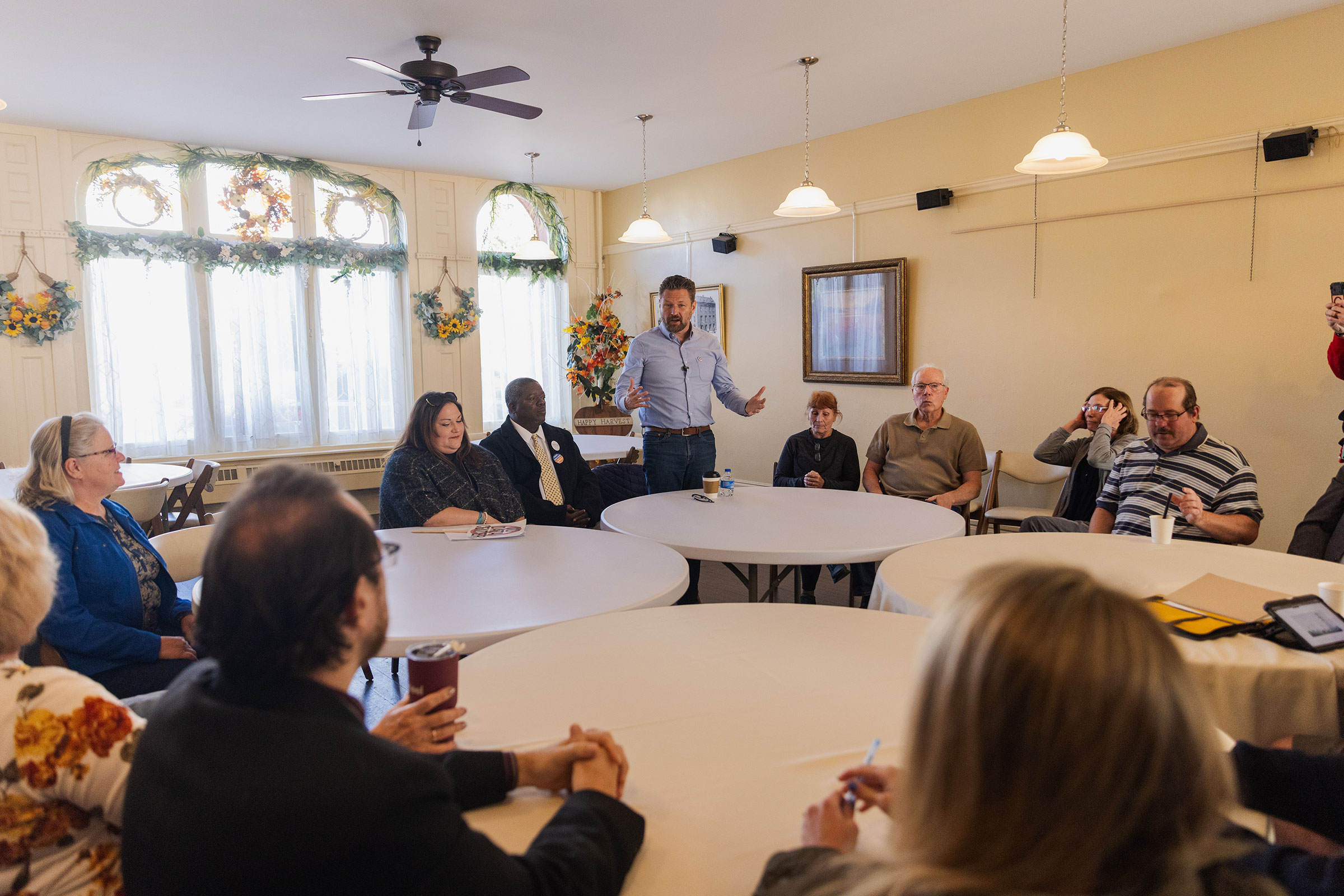
In early October, Don Leonard, the Democratic candidate in Ohio’s 15th Congressional District, arrives at the Schmidlapp Free School Library in Piqua. The space is decorated for fall with artificial flowers, and filled with activists and community leaders ready to detail the latest data-center controversy.

Meta, which has been rapidly building out its data-center infrastructure to fuel its AI push, made plans to erect a $1 billion campus in the area. The company hashed out the deal in secret last year, according to city documents and news reports, using a private LLC and nondisclosure agreements with local officials. After Meta was outed as the company behind the data center, the social media giant and Piqua government officials said the project would bring economic investment to the region. In a statement, Meta told TIME the company is reviewing its use of nondisclosure agreements.

Leonard heard from Alisha Lange, 42, who worried about contamination of her well water. Lange, a registered Republican, was among those angered by the secrecy surrounding the project and revelations that several city officials had been awarded $3,000 bonuses by the city after winning Meta’s business. In response, outraged residents successfully petitioned to add a measure to the November ballot designed to recall Piqua’s mayor and other elected officials.

Don Leonard leads a round table discussion about data centers in Piqua, Ohio on Oct. 7 —Maddie McGarvey for TIME

A former city and regional planning professor at The Ohio State University, Leonard, 48, sports a stubbly beard and speaks with a deliberate unpretentiousness. Normally, a progressive candidate wouldn’t stand much of a shot in a congressional district that’s been represented by Republicans for the past 15 years. The incumbent, former coal-industry lobbyist Mike Carey, won by 13 points two years ago. But by the time Leonard won the primary in May, residents in the district, which includes Grove City, were aflame over data centers. Leonard pushed his team to add a data-center question to their polling. They found more than 70% of likely voters in the 15th District wanted greater say over where data centers are located and how they operate. “If we were going to message on it, we had to confirm quantitatively what we knew from listening to the constituents,” Leonard explains in an interview at a modern co-working space in Columbus. “Which is that data centers are one of the most bipartisan issues in Central Ohio right now.”

Leonard sees data centers as “the mascot for predatory capitalism,” forcing communities to absorb increased electricity costs and environmental threats as their local landscapes are remade by huge companies based far away. He says the developments have exacerbated the anxieties of residents who watched neighbors lose solid factory jobs to outsourcing and suspect they’ll once again be the losers in an AI-driven economy. “There’s a feeling like we didn’t even govern the last revolution—globalization—and now they’re hoisting another one on us,” Leonard says. “They’re doing it in our backyard. They’re attacking our way of life.”

It’s not clear whether the backlash will be enough to catapult Leonard into contention in a solidly Republican district. There has been no non-partisan polling in the race, nor any public debates, and Carey holds a clear fundraising advantage, raking in $4 million to Leonard’s $1.2 million, according to campaign filings, though a recent influx of spending against Leonard is a sign Republicans may be a little nervous.

But in other races in Ohio, Democrats spy a clear opportunity. 


On a crisp fall day, Sherrod Brown takes the microphone during a small rally outside a Franklin County strip mall. He begins with talking points about economic inequality that he could have fed this crowd of Democratic organizers and voters at any point during his 18 years representing the state in the Senate. But then Brown pivots to an attack line that might have landed with a thud even a year ago. “These data centers are in Ohio now thanks to Jon Husted,” Brown says of his Republican opponent. “They come into communities. They gulp up the land. They swallow the water. Then they get these huge tax breaks.”

After three terms in Washington, Brown was defeated in 2024, when Trump won Ohio for the third straight time. The cornerstone of his comeback bid this year has been the data-center issue. In stump speeches, social media posts, and advertisements blaring across television, Brown blames Husted for the role he played as lieutenant governor in fostering data-center growth in the state, which gave data centers an estimated $2.5 billion in incentives, including breaks on sales and property taxes, from 2017 to 2024, according to a report by the Ohio Chamber of Commerce. (The report also estimates that the centers brought in twice as much in revenue to the state’s coffers.)

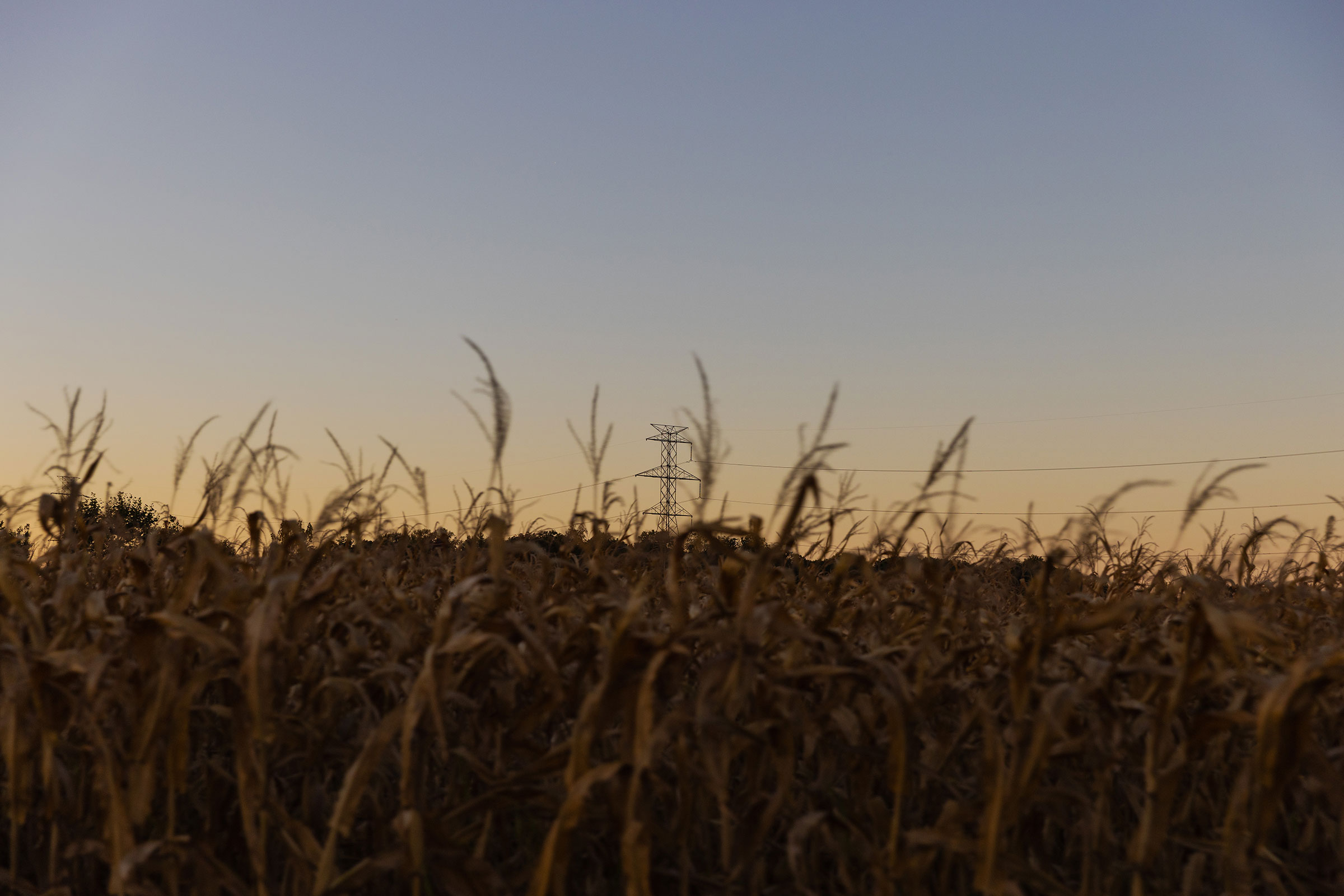
Power lines run along a cornfield at the site of a proposed data center development in Grove City —Maddie McGarvey for TIME

Back then, Husted, like other political leaders in both parties, often celebrated tech companies like Google and Amazon, which built the sprawling campuses, as a boost to Ohio’s economy. Husted campaign spokesperson Amy Natoce called Brown’s critiques hypocritical, noting that in 2015 the former Senator himself praised an Amazon Web Services data-center project in Ohio, calling it “great news.”

Now Husted is playing defense on the issue, sponsoring a Senate bill designed to get data centers to pay for electrical-system upgrades that was ultimately blocked by Democrats. Data centers should be a local decision, he says. Polls show the race as a toss-up. But a recent New York Times/Siena poll found that Ohio was one of five right-leaning states—Alaska, Iowa, Kansas, and Texas are the others—where Democrats are outperforming expectations in Senate races, in part because voters said they thought the Democratic candidate would do a better job on data centers.

The party is eager to press that advantage. Dr. Amy Acton, the Democratic candidate for Ohio governor, has called for a conditional moratorium on data centers until they meet certain requirements, such as covering the cost of their own electricity, meeting environmental standards, and participating in community-benefit agreements. Vivek Ramaswamy, the Republican nominee, wants to force hyperscale data centers to cover electricity costs and abide by air- and water-quality standards. Acton has assailed Ramaswamy for not committing to selling off his investments in tech and AI stocks, calling these holdings a conflict of interest.

A similar pattern is playing out in other states. In Texas, both Democratic Senate nominee James Talarico and his Republican opponent Ken Paxton have proposed tighter restrictions on data centers and accused each other of being supported by tech-aligned donors. The state’s Republican governor Greg Abbott, who is locked in a surprisingly tight race of his own, has imposed a temporary moratorium on new data centers until an audit is complete. In Iowa, data centers have been a flash point in the race between Democratic Senate nominee Josh Turek and Republican nominee Ashley Hinson, with Turek proposing restrictions and Hinson emphasizing the need for local control.


Ike Stage first became the mayor of Grove City in 1988. A retired banker who helped set up the local chamber of commerce, he credits cheapish land, a convenient location, and a business-friendly climate for the steady stream of calls he’s fielded from developers over the years. Companies like medical manufacturer American Nitrile have moved in, along with three hospitals and two scientific-research facilities. “Not many cities can say that,” Stage says in an interview at city hall, where brightly colored maps of the area adorn the walls.

Stage has aspirations for Grove City to grow further. In 2018, it adopted a vision that included better transportation options, more parks, and mixed-use developments. Officials also eyed more than 9,000 acres of agricultural and vacant land they thought could be turned into “light industrial-style development.”

Seven years later, Headwaters Site Development, founded by former Google data-center infrastructure leader Michael Lebow, had a similar thought. It contacted property owners in a rural area just south of Grove City’s limits. One of the homesteads belonged to Patty Spillman’s family, which rejected the deal. “Most of us turned them down,” Spillman says. But not all. By this spring, Headwaters had found enough homeowners willing to sell to cobble together the necessary land.

Mayor Richard Stage opposes putting major new development projects up for referendum —Maddie McGarvey for TIME

During two information sessions at a local food bank in April, Headwaters representatives pitched locals on what they called Project Maple. Headwaters says it plans to sell the $6.9 billion project to an unidentified tech company, and pledged to support community-friendly zoning requirements that would be assumed by the buyer, such as a 100-ft. height limit, concealing landscaping, and noise levels that aren’t louder than a dishwasher. Headwaters says the project would bring 250 permanent jobs, pay for its own energy costs, and take precautions to keep water usage low. But according to advocates, Head-waters’ refusal to say which tech company would ultimately buy the facility was unnerving. “They just skirted around giving us straight answers about anything,” Jen Belt recalls. “A lot of people left mad.” 

The anger emboldened the activists. Belt circulated a petition calling for the city council to reject any upcoming data-center applications. The group posted negative information about the facilities on their personal social media pages, as well as in popular Facebook groups, and put up no data centers signs near the proposed site.

The following month, Grove City councilman Mohamed Omar, 26, announced he was working on legislation to impose a 12-month moratorium on local data centers. Headwaters responded by sending a letter to city council members, arguing that such a moratorium could violate its due process rights. (Lebow says the company has no plans to sue.)

Yet the implied legal threat intensified the community pushback against the project on the eve of the moratorium vote. In June, the moratorium passed 6-1. Emboldened, the anti-data-center advocates with Protect Grove City decided the one-year moratorium wasn’t enough, and wrote a proposed amendment to the city’s charter, which functions like a governing constitution. It would prohibit the city from approving zoning applications for developments that occupy at least 50 acres, use more than 20 megawatts of power at peak capacity, or consume more than 500,000 gallons of water per day unless a majority of voters have backed the project in a public referendum. To drum up support, they canvassed local farmers’ markets, parks, and sporting events to ask people to sign a petition to put the measure on the ballot in November. Within a few weeks, they secured enough signatures.

Councilman Mohamed Omar, who opposes data center development, in Grove City —Maddie McGarvey for TIME

City officials nervously tracked news coverage of the data-center backlash across Ohio and beyond, according to emails obtained by TIME. The charter amendment wouldn’t just inhibit the Headwaters project, they warned. It would fundamentally change how any future development deals are approved, and perhaps inhibit existing organizations, including churches, a hospital, and schools, from expanding by imposing overly burdensome processes. Critics contend residents already have opportunities to weigh in on upcoming developments through the normal city approval process. “It’s going to affect business. It’s going to affect our schools. It’s going to affect our taxes,” says Steve Funk, 70, who runs a car dealership in Grove City.

The city has been sending mailers to residents explaining the amendment’s potential effects. Residents have gotten into bitter personal disputes over the amendment in Facebook groups. “It’s bad,” says Omar. “It almost feels like the city is torn.”

To Stage, tech companies have done a poor job trumpeting the benefits the facilities bring to local communities, allowing residents’ anxieties about the industry to flourish. He likens the backlash to the fears Americans had about railroad expansion during the 19th century, when rural farmers worried about the effect the technology might have on their livestock. Americans eventually got used to trains. But Stage also recognizes that he’s on the short side of public opinion. Stage is up for re-election next year. “I’ve won most elections pretty handily, and I’ve been through 11 of them,” he says. “But you never, never make that assumption.” —With reporting by Leslie Dickstein

  •  

7 days until TechCrunch Founder Summit: Save up to $100 on your pass before doors open

In just 7 days, TechCrunch Founder Summit takes over Boston’s SoWa Power Station on November 4. Your chance to save up to $100 on tickets is running out, and the opportunity to learn and connect directly with experienced founders, investors, and startup leaders is almost here.
  •  

The Ultrawealthy Produce More Carbon Pollution Than Nearly Half of Humanity

A private jet lands at Los Angeles International Airport in California, on June 14, 2026. —Etienne Laurent—Getty Images

The ultrawealthy are responsible for more carbon pollution than more than half of humanity, according to a new report published Monday by Oxfam, a global organization fighting against inequality. 

“​​We are seeing the ways that the ultra rich in the U.S. and around the world contribute disproportionately to creating the climate crisis,” says Rachel Carle, senior advisor on climate justice at Oxfam America. “They are also insulated from the impacts of the climate crisis, and are profiting off of the disasters that they have created.”

Billionaires and the ultra-rich are burning more carbon than than most of the world. The world’s richest 1%—just 8 million people who make, on average, $442,000 a year—produce far more emissions than the poorest 3.5 billion, states the report. Someone in the richest 0.1% emits 48 times more CO2 than the average person in the U.S. over the course of a year. 

Oxfam used climate attribution models and a consumption-based emissions dataset developed by the Stockholm Environment Institute to calculate emissions by income group. Keeping emissions in check is a key part of addressing the climate crisis. This month, the United Nations warned that, in order to keep warming below 2°C, urgent action must be taken to drastically reduce global emissions by 18% by 2030.

Research has long shown that wealthier countries drive a disproportionate share of global emissions. But emissions disparities exist within countries as well. The U.S., for example, is the second largest carbon emitter behind China—but not everyone is responsible for the same share of emissions. The report finds that, in just under four months (118.3 days), someone in the richest 0.1% living in the U.S., those making an average of $1.98 million a year, emits more CO2 than what someone in the poorest half of the country (those making an average of $25,600 a year), has emitted over the last 30 years. 

One of the biggest sources of emissions? Private jets—which, in 2025, were responsible for 16 million metric tons of CO2, the emissions equivalent of the annual energy use of over 2 million homes. The U.S. has the highest concentration of private jet use—with the majority of all private jets (68%) taking off from the U.S. Combined, all of the world’s private jets emit more in 2 seconds than someone in the world’s poorest 50%, those annually making an average of $1,500, would emit in a year. According to the report, last year private jets spent more than 6.5 million hours in the air. 

“We see that the ultrarich consume differently than everyday people,” says Carle, who adds that the ultrarich are also far more likely to invest in polluting companies. A list of 217 companies that “profit from either creating climate disasters, preparing for them, or recovering from them,” analyzed in the report shows they made $1.8 billion on average in 2025, and paid out more than $1 billion to shareholders.

This has a direct impact on the climate, the report finds. The researchers constructed emissions pathway models to attribute the emissions of different income groups, and found that the richest 1% are responsible for 20% of global warming since 1990—20 times more than their share of the world’s population. Someone from the richest 1% contributed 34 times more than the average person to extreme heat events, the report states, and one year's worth of emissions from the richest 1% will cause an estimated 1.9 million excess heat deaths. 

Yet, the ultrawealthy are less likely to face the impacts of their emissions. Those with lower incomes are significantly more likely to suffer from the impacts of climate disasters and extreme weather events—and often lack the funds to recover from disasters. Wealthy individuals, on the other hand, are more likely to live in safer locations or have the funds to ride out a disaster—purchasing private resources, like firefighters and generators, or paying a premium for emergency shelter. 

The authors suggest taxing the emissions of the super-rich. This could be done through taxes on high-emitting luxury items and activities, like private jet use, to disincentivize their use, suggests the report, or via windfall taxes on profits from fossil fuel companies. The report envisions that these taxes could be used to help level the playing field when it comes to climate adaptation, like increasing climate financing in the Global South, or investing in adaptation measures around the world.

“We hope that people take away that there are  a lot of opportunities to  address inequality in ways that protect the planet and protect communities,” says Carle. “Polluters need to pay for the harm that they’ve caused.” 

  •  

Clean Energy Has a Lot Riding on the AI Data Center Boom

Power lines near the Gravelines Nuclear Power Station in Gravelines, France on Sept. 15 —Sameer Al-Doumy / AFP—Getty Images

Recent weeks have brought red flag after red flag for investment in AI and the related data center boom. Bond yields soared for AI infrastructure giant CoreWeave, a sign that investors view the buildout as increasingly risky. And Meta’s reporting of negative free cash flow for the quarter to fund its infrastructure buildout while saying it might need to raise even more capital to fund its AI buildout not only hit its own stock but contributed to a price decline across the big tech companies. 

These developments raised questions across Wall Street about whether too much is being spent too quickly on data center expansion. How questions over data center investment play out has big implications for how companies and investors approach the future of energy and, by extension, climate. A pullback in the pace of new data centers could ease pressure to build fossil generation, but it would also weaken the commercial case for clean energy technologies that need big, reliable buyers who are willing to pay a premium for power.  

Most obviously, a dent in the AI buildout would translate directly into a slowdown in related electricity demand growth. In advanced economies like the U.S., data centers will account for 20% of that growth through 2030. By then, data centers are expected to account for 3% of global electricity demand, according to data from the International Energy Agency. 

Some climate advocates may initially rejoice at slowing electricity demand. Even as renewable energy expands, grids around the world still rely on fossil fuels. In the U.S. in particular, AI demand has sparked a wave of building new natural gas infrastructure. In the short term, slowing demand would mean lower emissions from the existing system than today’s baseline assumptions and less investment in new natural gas infrastructure. 

But a slowing data center build out leaves less mature technologies at risk. From advanced geothermal to new ways of producing nuclear power, big tech companies have been willing to pay more to lock in reliable power sources, thereby accelerating the market for these new efforts. Even unproven technologies like nuclear fusion have received a big financial boost from tech firms speculating that they might help solve their power challenges and give them a competitive leg up in the AI race. In a tighter financial environment with lower projected electricity demand, both the incentive and the financial capacity to make bold bets diminish. 

To be clear, data centers are not the only source of growing electricity demand. New manufacturing continues to create the need for power. The need for air conditioning has ramped up in many emerging markets, particularly in the Global South, creating new grid pressures. And electric vehicles continue to take off in many markets outside the U.S. 

Even as gas remains resilient, much of the power built to meet demand will come from clean sources, including and especially solar and battery storage. Solar is increasingly cost competitive. And this year’s spike in fuel prices—particularly natural gas—has made local power more appealing. But the companies behind growing sectors like air conditioning and EVs are less involved in local power systems and lack the capital to really shape them like the world’s wealthiest tech companies have. In short, clean energy will take a hit without the backing of big tech.  

It’s too soon to tell whether, in the long run, this week’s AI infrastructure recalibration will be a blip in time or part of a much broader realignment. But it’s something that anyone invested in clean energy and climate should be watching closely.   

  •  

Wild animals can’t vote. Here’s where they’re on the ballot anyway.

A small brown bird with a white head that has a black stripe in line with its eye stands on a branch, looking for seeds.
A male Northern Bobwhite Quail forages for seeds on the ground in south Texas. | Jon G. Fuller/VWPics/Universial Images Group via Getty

When millions of voters fill out their ballots in November, they won’t just be choosing elected representatives. Many states are offering the chance to impact conservation and wildlife as well, through ballot measures focused on things like dedicating more money to habitat protection or mitigating the impacts of climate change. One could even reshape wildlife management in one of the country’s most picturesque mountain states — and also lead to the indiscriminate deaths of all kinds of wild animals. 

And while ballot measures might seem like small potatoes in the grand scheme of electoral politics, they could have an outsized impact this year. The Trump administration has been systematically rolling back protections for endangered species, taking a hammer to longstanding pillars of climate regulation, and cutting funding to agencies like the National Park Service and National Forest Service, both of which oversee vast stretches of wildlife habitats. In many cases, states have had to step up, putting more resources into conserving the habitats and species within their borders, and ballot measures can help shape those decisions. 

Here are the seven ballot measures that could transform ecosystems across the country this election: 

California — Proposition 45: Cutting pesky environmental reviews, also maybe cutting habitats  

This ballot measure would shorten environmental review periods for “essential projects” like housing, water systems, clean energy, and medical facilities, among others. In a state that’s been struggling to build what it needs fast enough, this could help speed essential clean energy projects that could help slow climate change. On the other hand, reducing California Environmental Quality Act review time, as this proposition would do, could also lead to increased habitat destruction, leading advocacy organizations like the Sierra Club to oppose it. 

Georgia — Amendment 1: Tax breaks for conservation land (maybe)

This amendment might seem a little in the weeds — and mostly in the interest of farmers and ranchers looking for tax breaks. But it would double (from 2,000 acres to 4,000 acres) the amount of land an owner can get tax breaks from if they protect it under the state’s Conservation Use Valuation Assessment program. As Yanshu Li, an Associate Professor of Forest Economics at the University of Georgia, told me, the amendment could incentivize landowners to set aside larger tracts of their property for wildlife habitat conservation, which would benefit species like the nine-banded armadillo and the northern bobwhite quail that call these habitats home. 

Massachusetts — Question 6: A fund for nature

Question 6 would create a “Nature for All Fund,” routing existing taxes on sporting goods, recreational vehicles, and money spent at golf courses to conservation. That fund could then be used on natural resource conservation, making it the first time the state has a dedicated funding source for conservation projects.

Colorado — Proposition 137: More money for restoration and wildfire prevention

This proposition, similar to Massachusetts’, would direct existing sales taxes on sporting goods to a state fund dedicated to conservation and wildfire prevention. In a state where wildfires have torn through more than 2 million acres in the past decade, dozens of conservation groups are supporting this measure to protect habitats and species.

Arkansas — Issue 4: Waterworks and waterways 

Here, voters are being asked to approve up to $500 million in bonds that can be used to fund water-related infrastructure projects like water treatment, waste disposal, and wetlands infrastructure. A boost to wetlands under the Arkansas proposal could help animals that live in those habitats, which are often overlooked in this region. 

Rhode Island — Question 5: New money for climate resilience and habitat protection

This measure would allow for $55 million in bonds to fund environmental and recreational projects. The largest chunk of this change — $25 million — would go to helping to protect the state from the impacts of climate change. Another $7 would be devoted to protecting Narragansett Bay and its watersheds, which would include funding to “restore natural habitats and control invasive aquatic plants,” according to the Rhode Island Current. 

These ballot measures are all relatively straightforward so far, but there’s one question up to voters this fall that puts wild animals front-and-center — and is splitting hunters and anglers down an ethical centerline. Which takes us back to Colorado: 

Colorado — Amendment 83: A constitutional right to hunt…traditionally

On its surface, this amendment seems fairly innocuous. It asks voters to enshrine “the right to hunt, fish, and harvest fish and wildlife by traditional methods” in the state’s constitution. Hunting and fishing are already big in Colorado, and they’re protected by statute, so this may not seem like a major change. But, as Rebecca Niemiec, co-director of Colorado State University’s Animal-Human Policy Center and a Colorado Parks and Wildlife commissioner, speaking for herself, told me, neither the text of the bill nor its proponents define what “traditional methods” of hunting and fishing would be allowed under this amendment.

“Read plainly, traditional methods could be interpreted to include practices like poisoning, leg hold traps, gill nets, or baiting and hounding,” Niemiec said. Many of these practices injure or maim animals, including ones that aren’t targeted: Steel-jawed traps and poisons don’t discriminate between, say, a deer, a wolf, and a lynx. All of these practices have been outlawed in Colorado over the years, either through other ballot measures or regulatory changes; in 1992, for example, Coloradans voted to ban hunting bears using bait and hounds, and four years later they banned leg-hold traps and snares. 

The new amendment also continues on to propose: “establishing hunting and fishing as the preferred means of managing fish and wildlife populations.” This would leave far less room for wildlife agencies like CPW to make nuanced decisions or roll out alternative programs, like birth control or animal relocation. It also reduces their ability to take into account the preferences of people who value wildlife for reasons other than hunting. 

“Biological science can inform decisions about how many animals can be killed without threatening a population,” Niemiec said. “But it can’t tell us what hunting practices are ethical, or how to balance hunting opportunities with the public’s desire to see wildlife alive — and protected from unnecessary suffering.” 

The push for these constitutional protections, Niemiec told me, is part of a larger backlash against conservation groups. But in this case, it’s not as simple as hunter vs. non-hunter: Plenty of hunters and anglers support taking ethical considerations into account when making decisions about how to manage wildlife, and some hunting groups in Colorado have publicly spoken out against the amendment. 

“If we’re going to enshrine anything in the Constitution, it should say we should be balancing the diversity of public interest in wildlife in all of our management decisions,” Niemiec said. “We need innovative methods, not traditional methods, if we’re going to deal with the complex challenges that our wildlife is facing moving forward in the state and throughout the country.”

  •  

How the biggest renewable energy project in US history finally got built

A bright red and blue collage of a wind turbine in motion in front of a red monotone landscape

When the sun goes down, the wind picks up in central New Mexico, whipping through arid canyons with a ghostly howl that for centuries, locals have likened to the wails of the folkloric ghost La Llorona. 

A few hours east of Albuquerque, this June, those gusts began powering the largest wind farm this continent has ever seen, twirling over 900 colossal steel turbines. Each is as tall as the Statue of Liberty, scattered across a patch of desert roughly the size of Chicago. They plug into a 550-mile transmission line stitched across the Southwest and are now powering over one million homes — as far away as California. 

A wind turbine at sunrise

The SunZia Wind and Transmission project is a rare 21st-century triumph of American infrastructure, an engineering marvel that generates more electricity than the Hoover Dam. When the turbines came online this spring, they immediately broke records for wind-generated power in California’s energy supply, where solar power may rule the day, but the winds of New Mexico increasingly fuel the night.

Key takeaways

  • SunZia, the largest clean energy megaproject in US history, finally came online this June, sending New Mexico wind power to customers in Arizona and California.
  • For over a decade and a half, the project was delayed by permitting issues, lawsuits, and above all, an energy market that wasn’t ready for the power it had to offer.
  • With the nation’s electricity demand skyrocketing, SunZia’s collaboration with conservationists may offer a blueprint for getting more megaprojects built.

After years of stagnant power growth, the US is absolutely starving for more electricity, with demand projected to rise by 25 percent by the end of this decade, and a staggering 78 percent by 2050. Enormous as this challenge might seem, it may ultimately be the catalyst the country needs to dramatically dial up its renewable energy infrastructure, so that the years to come are powered not by gas or coal, but by clean energy sources like the sun and the wind. By next summer, the project will have prevented about 9 million metric tons of carbon dioxide from entering the atmosphere, according to Pattern Energy, the project’s developer. 

For decades, however, it seemed the project would remain little more than a spectral dream. 

“It works!” This was the call Hunter Armistead, Pattern’s CEO, remembers getting from his head engineer when the turbines came online for the very first time. “We were creating power, and it was showing up 550 miles away in Phoenix, almost as if it was magic.” During the ribbon-cutting for the wind farm, some construction workers showed off massive new turbine tattoos. “It’s their pride that for the rest of their lives, they can drive by and tell their kid, ‘I did this,’” Armistead said.

But SunZia almost didn’t get built at all. It is not just the project’s scale that makes it remarkable, but the utter morass its developers slogged through to bring it online. The project spanned five presidential administrations, an ownership change, a major reroute, and a standoff with a US military base. 

It also involved a series of lawsuits from local tribal communities and environmental advocates, some of which remain pending even as the turbines now finally whirl. Building any renewable megaproject requires vast amounts of space, and hyperspecific natural conditions, like a wind that blows at night or a reliably sun-soaked desert plain. Then getting that energy to major cities means traversing some of the most pristine, spectacular natural corridors this nation has left, and particularly in the Southwest, rubbing up against the sacred lands of local tribal communities. 

The decades-long saga to settle some of these tensions has turned SunZia into a helpful lesson, and for many, deserved or not, it became the ultimate poster child for permitting reform. And for many years, the country’s need for power didn’t seem to call for such a wildly ambitious project anyway. But in the interim, as the world changed, SunZia changed too, becoming — at least in some places — a better and more collaborative project than it was when it began. And now, with a nation finally focused on building more clean energy megaprojects, it can offer a glimpse of what’s to come, even a blueprint of what could be.

The real reason(s) it took so long for SunZia to get built

When SunZia was first proposed in 2006, the same year Twitter went online, coal was still the most important electricity source in America, and the nation’s appetite for electricity had remained nearly flat year after year.

And for the next 17 years, SunZia flailed, never even breaking ground. It ping-ponged between financial and regulatory purgatories that most commentators have attributed to endless permitting delays. There were, for example, a few state-level permitting debacles, with New Mexico rejecting SunZia’s initial transmission route in 2018. Even after such interstate power lines get federal approval, they often need to wait years longer for approvals from every state in which their project passes.

Sen. Martin Heinrich of New Mexico, for one, has cited SunZia as a key impetus for his co-sponsoring the Senate’s new plan for permitting reform. This would make it easier for the federal government to coordinate approval processes for interstate transmission lines, ensuring that they happen concurrently and preventing one state from dragging its heels. 

The project had faced one particularly large and sticky permitting challenge: getting the power through the White Sands Missile Range. But this, and other challenges, were eventually resolved relatively quickly. And to David Hayes, who served as deputy secretary of the Department of the Interior during the Obama administration, this suggests that financing hamstrung the project even more than red tape. 

“The facts are the facts, and they got their permit,” said Hayes — all the way back in 2015, not long after the Obama administration put SunZia on a “fast-track” to approval. “So we finally got the permit done. Hooray, right? And then nothing happens. Nothing happens.” 

construction workers building transmission line

Part of that was the fact that the two states where SunZia wanted to build its transmission lines were not entirely on board. But it was also the sheer expense involved in building the project, especially given that the federal approval required burying parts of the transmission line near the missile range. Moreover, even if everything went perfectly with the project’s permitting process, it might have been impossible to build SunZia back then, said Armistead, because “we really didn’t have the market need for it.” 

The US simply wasn’t as ravenous for new electricity as it is right now, and the importance of building out the future of energy was not enticing enough for investors on its own.

But, refusing to die a slow death of a thousand permitting blockades or financial setbacks, SunZia instead evolved. Pattern Energy, initially only in charge of developing the wind farm portion of the project, took over the transmission line project in 2022. Around that time, SunZia applied for a revised federal permit, one that would circumvent the missile range, and within less than two years — a relative sprint for federal bureaucracy — they had a new approval in hand. Then came $11 billion in financing from several global financial institutions, pension funds, and clean energy investors. Then, a few years of construction time later, the Americas’ biggest wind farm was finally switched on.

And more massive projects like this will be needed because nowadays, “there is no longer the excuse” of a market unready for high volumes of clean energy, Armistead told me. “It is game time, and we’re supposed to get this done.”

What America’s biggest clean energy project got right

One of the secrets to SunZia’s ultimate success in New Mexico was the project’s ability to strike compromises, even with some of its earliest critics. In some cases, a bunch of birds. 

Right about now, the earliest migratory birds, like the crimson-capped sandhill crane, have begun arriving at their Southwestern wintering grounds, not far from some of SunZia’s newly operational high-voltage transmission lines.

This crane had nearly gone extinct before, driven in part by an explosion of new hydroelectric dams in the early 20th century, whose construction dried out local wetlands. SunZia’s initial route, which was planned across one of the most congested flyways in the country, threatened them again, birders feared, alongside other migratory species who might accidentally fly into the new power lines, a threat believed to kill millions of birds nationwide each year. 

A transmission line in sunset

While SunZia’s original developer, the Southwestern Power Group, was largely unmoved by those concerns, said Sarah Rose, vice president of climate at the National Audubon Society, the nonprofit found an unusually receptive partner to compromise when Pattern Energy took over. 

“They took their role as a project developer really seriously,” she said, “and I think they engaged with us with a lot of integrity and a lot of good faith.” Under a rerouting plan, original power lines were moved north, erected next to existing infrastructure, or affixed with visual warning systems or bird diverters. Not only did the changes make the bird advocates happy, but they were enough to help convince the New Mexico Public Regulation Commission, which had rejected SunZia’s permit application a few years earlier in part due to these concerns, to unanimously approve the project in 2022. 

To be clear, not everybody believed Pattern always made the appropriate compromises, especially in Arizona, where SunZia’s route remained unchanged under the new management. Peter Else, a local environmentalist, has spent years fighting SunZia in court over its intrusion into the scenic San Pedro Valley, a region that is sacred to Indigenous communities such as the Tohono O’odham Nation and San Carlos Apache Tribe. To see it marred by more power lines through the landscape has been like “mourning a death,” Else said, “like an ecological homicide.” 

He would have liked to see SunZia try to run the valley’s new power lines alongside existing ones, as it managed to do in parts of New Mexico, a process that Armistead told me would not have been possible because the Arizona portion of the line “was already put to bed,” and the original federal permit had found the valley to be “the least impactful and best route.” A lawsuit from the Tohono O’odham Nation and San Carlos Apache Tribe accusing SunZia and the Department of the Interior of failing to protect the valley remains pending. 

Of course, climate change threatens many of these regions more than a single power line. In the two decades it took SunZia to begin pumping clean energy across state lines, waves of extreme heat have taken tens of thousands of American lives, and the entire Southwest has continued in a megadrought unseen in the past 1,200 years. 

These are some of the very concerns that SunZia seeks, in part, to combat. And if we want to avoid even more heat deaths, extreme droughts, more flash floods, and more habitat destruction, then we probably will need a lot more facilities like it, some of which will require hard tradeoffs. 

But they aren’t doomed always to. It may have taken SunZia over a decade to learn that lesson, but for future megaprojects, the blueprint may already be there. The nearby 280-mile high-voltage Southline Transmission Project spanning parts of Arizona and New Mexico is set to begin construction next year, and it’s been so intentional about minimizing its ecological and cultural impact that even Else praised it as a good idea. And this approach could pave the way for even more essential large-scale projects like it. “If more folks could come to the table looking for solutions as opposed to expecting conflict,” Rose said, “I think we would be able to move a lot more quickly.” Ideally, it won’t take another 20 years.

This story was supported by a grant from Arnold Ventures. Vox had full discretion over the content of this reporting.

  •  

Five Facts You Need To Know From The U.N.'s Major Emissions Gap Report

Emissions from the United States have far exceeded that of all other countries notes the UNEP Emissions Gap report. —Jon Cherry—Getty Images

The goal of limiting global warming to below 1.5°C above pre-industrial levels is largely out of reach. That’s according to the United Nations Environmental Program’s (UNEP) 2026 Emissions Gap report released on Wednesday, considered the definitive assessment of global climate action. 

“We’ve spent decades postponing cuts to emissions and now we’re facing the consequences,” Anne Olhoff, director of the UNEP-Copenhagen Climate Centre, and one of the report’s authors, said after the report’s publication. “The world can still attain the goals of the Paris Agreement but we must work hard to not only meet but surpass our most ambitious climate targets. The longer we wait, the larger the risk that we jeopardize the temperature goal.” 

While the report’s warning is stark, that doesn’t mean that all hope is lost. Coordinated efforts to reduce emissions can still have a meaningful impact on climate change, it says—but action must be taken quickly. 

Here are the biggest takeaways from the Emissions Gap report. 

The 1.5°C target is mostly out of reach 

Under the 2015 Paris Agreement, the world agreed to halt planetary warming at 2°C above pre-industrial temperatures and to pursue efforts to limit warming by 1.5°C. Doing so would provide a greater chance at avoiding the worst impacts of climate change. The window to avoid overshooting the 1.5°C goal, however, is now closed, the report finds. 

But that doesn’t mean that there’s no hope for climate action. It is still possible to limit the overshoot and bring temperatures back below 1.5 degrees by the end of the century. Every fraction of a degree of warming above 1.5°C increases climate impacts, making the goal to limit as much warming beyond 1.5°C all the more important.  

The world is on track to reach 2.8°C of warming by 2100

Under the terms of the Paris Agreement, countries must submit updated climate pledges, known as Nationally Determined Contributions (NDCs), which outline specific goals to reduce national emissions. Based on the policies currently in place under the NDCs submitted by over 150 nations, the planet is on track to reach 2.8°C of warming by the end of the century. 

Based on this, today’s report concludes that global climate pledges are falling short. If countries meet their new NDCs, which set upgraded targets for 2035 and were due last year, global warming is still projected to reach 2.6°C by the end of the century. 

Both scenarios would have devastating consequences—dramatically transforming sea levels and ecosystems, and triggering compounding climate extremes such as higher temperatures and drought, increasing the likelihood of wildfires. 

We need to cut carbon emissions by 18% in the next four years

The report notes that it is still possible to peak warming at 1.7°C or 1.8°C. Doing so would require major changes. We would need to cut emissions by 18% by 2030, 45% by 2035, and 69% by 2040, relative to 2025 levels. This would require sustained emissions cuts along with carbon dioxide removal. 

“Every additional fraction of a degree and additional year of warming above 1.5°C increases climate impacts and risks, such as the deadly floods, heat waves, and wildfires that have plagued many nations this year,” said UNEP executive director Inger Andersen. “So, we must pull out all the stops to minimize peak warming and return to 1.5°C by the end of the century.”

The U.S. is a major outlier for emissions

While emissions growth has slowed down in most G20 countries, emissions in the United States “far exceeded that of all other countries," the report says. That’s due to the increased electricity demand, in part due to data centers, and new policies that encouraged the use of fossil fuels like coal over clean energy sources. 

The report includes a statement from the State Department, noting that the U.S. "does not endorse or agree with its analysis or conclusions, and has not provided comments to this report."

The Trump Administration’s decision to withdraw from the Paris Agreement also worsened the climate projections, as estimates no longer include climate action that would have been taken under the United States’s NDC targets.

The U.S. is the second largest emitter of climate-warming greenhouse gases, behind China, which has quickly become a world leader in renewable energy (while also ramping up coal production.)

Climate policies are reducing emissions

Since the adoption of the Paris Agreement just over a decade ago, global renewable electricity capacity has grown three times faster than anticipated, while solar PV build-out has increased seven times faster. If these trends were to continue, and coupled with more policies to support clean energy, the world would be on track to reach its renewable energy goals.

The report examined more than 200 climate policies and found that they target emission reductions across a wide range of sectors and countries. That’s an encouraging sign the report notes. All that’s left is for these solutions to be scaled faster. 

“We have a wealth of success stories showing that emissions can be cut quickly,” said Andersen. “It is now up to nations to urgently put in place policies that spark fast, deep and sustained emissions reductions, and put the world on track for a more stable climate and more stable economies and societies.”

  •  

Can We Eat Our Way Out Of An Ecological Disaster?

A green crab caught on the Harraseeket River, June 19, 2026, in Freeport, Maine. —Robert F. Bukaty—AP Photo

When Rachel Bowman first tried to bring lionfish to restaurants and grocery stores in the Florida Keys in 2012, it was a hard sell. “We weren’t getting that much money for them, and it took a little convincing,” says the commercial lionfish hunter. That’s because the invasive lionfish—flamboyant enough that Bowman likens it to a Mardi Gras drag queen—wasn’t traditionally on the menu. 

Native to the tropical waters of the Indo-Pacific, lionfish have infiltrated the western Atlantic, Caribbean, and Gulf of Mexico, where they have become a destructive invasive species ever since the first was recorded near Miami in 1985, likely after being released from the home aquarium trade. With few predators in these new habitats, a single fish can produce more than 2 million eggs a year. Studies have found that just one lionfish can reduce the replenishment of native fish populations on some reefs by nearly 80%.

In 2016, Bowman sold the first lionfish to Whole Foods in South Florida. “That was the ground-breaker,” she says, “because if Whole Foods is promoting something, then people know it’s good. We went from $2 per lb. to $10 per lb. pretty much overnight.” Now, 10 years later, through Keys Fisheries, her fish is sold in stores, and lionfish appears on restaurant menus throughout the area—and in doing so, millions of native reef fish have been saved from predation. 

Bowman’s work is part of a growing trend that’s not just about introducing new dishes to the local food scene; creating a market for invasive species may also bring ecological benefits for the local environment. 

Invasive species are considered one of the five most critical direct drivers of biodiversity loss, according to the Intergovernmental Science-Policy Platform on Biodiversity and Ecosystem Services (IPBES), whose most recent report in 2023 notes that the global economic toll of dealing with these species cost more than $423 billion in 2019. Once established, invasive species are often impossible to eradicate because they reproduce rapidly, spread across vast, interconnected environments, and often go unchecked until they are established. And the challenge of managing invasive species is particularly acute in the ocean, says Helen Roy, a professor at the U.K. Centre for Ecology & Hydrology and the University of Exeter and a co-chair of the IPBES assessment. It’s a consequence of the openness and connectedness of marine systems, she says. 

A pot of green crab. —Courtesy Lisa Nichols

In 2004, conservation biologist Joe Roman coined the term “invasivorism” to describe the idea of eating invasive species to help control their populations. Since then, a growing movement across North America is attempting to transform ecological menaces into culinary commodities, from Florida to Hawai’i, British Columbia, Maine, and the Mississippi River basin. That movement is still expanding: in 2025, for example, 70 restaurants and fish markets across the U.S. participated in Green Crab Week, a national campaign encouraging diners to eat the invasive European green crab.

The goal, says Isabelle Côté, a marine ecologist at Simon Fraser University, is often “functional eradication”: reducing an invasive population to a level where its ecological impacts are considered acceptable. That’s where our dinner tables can help, by turning the removal of the species into an economic opportunity. 


David Standridge’s philosophy is all about harvesting what’s plentiful and turning it into something delicious. Since 2022, the James Beard Award-winning executive chef of The Shipwright’s Daughter in Mystic, Conn., has processed more than 10,000 lbs of green crab, making it a menu mainstay.

Commonly considered one of the world’s worst invasive species, the green crab has successfully invaded every continent except Antarctica. The species, native to Western Europe and Africa, has few predators, aggressively hunts its prey, and can consume a wide variety of shellfish, including oysters, clams, mussels, lobsters, and other crabs. One crab can eat more than 40 juvenile soft-shell clams in a day, while also destroying seagrass habitats. And a single green crab can produce up to 185,000 eggs per year, while its larval life stage allows young crabs to drift considerable distances in ocean currents, spreading from one invaded area to another.

Rather than a nuisance, Standridge describes the green crab as tremendously flavorful, producing a beautiful stock that can be used across dishes. “We use them not to eliminate green crab, but to take some pressure off the ecosystem,” he says. Getting green crab onto the menu, however, wasn’t so straightforward. 

When Standridge first tried to source the species in 2020, he discovered that Connecticut, like many states, classified green crab as bait and technically couldn’t be sold for human consumption. He finally found a supplier to help in 2021, and then in 2025, a change to a single line of state code allowed green crab and other species on the bait list to be harvested and sold as food. Parks says the market is beginning to take shape. Suppliers across New England now regularly carry green crab alongside other seafood, making it more accessible to chefs. 

The green crab’s global spread is only expected to increase with climate change, says Mary Parks, executive director of GreenCrab.org, a nonprofit organization building culinary markets for the invasive species while raising awareness of its impact. “We used to have these really cold winters and those helped keep green crab populations in check,” says Parks. “But with winters getting warmer and warmer, that population control got taken out of the picture.” 

On the other side of the continent, in 2020, the first green crabs were detected on Haida Gwaii, an archipelago off the coast of British Columbia. To slow the species’ establishment, the Council of the Haida Nation launched a full-scale trapping and mitigation program. Over five years, 36 crews removed nearly 2 million crabs, including more than 1.3 million from the Honna and Tarundl estuaries alone. The scale of the invasion has made control difficult, and harvester and marine economic development coordinator Eli Gladstone hopes a viable market for the crabs could help reduce their numbers. But he cautions that commercial demand alone won’t be enough: trapping will also need to become more efficient, and some continued public investment may be necessary.


Communities across the U.S. have been grappling with the ecological and economic impacts of introduced species for decades.

In the 1950s, bluestripe snapper, also known in Hawai’i by its Tahitian name, ta’ape, was introduced to O’ahu, when roughly 3,000 fish were released to bolster fishing opportunities and establish a new food source. But ta’ape, native to the South Pacific, never became a sustained part of Hawai’i’s seafood market. By the 1980s, the overabundant fish was largely considered a “trash fish,” prompting the state’s Department of Aquatic Resources to launch a market-development project in 1985 that used consumer education and supermarket promotions to try to build demand. The effort failed to gain lasting traction: supply was inconsistent, and demand tapered off after the project ended. 

Freediver and spearfisher Kimi Werner has seen firsthand just how dramatically the ta’ape has come to dominate the reefs. Where schools of snappers in their native ecosystems might number just a handful, she says Hawai’i’s ta’ape, with its electric-blue stripes and lemon-yellow skin, can blanket the seafloor. “You can see the power of numbers taking over these habitats where native fish belong,” she says.

Since 2019, Conservation International Hawai’i, in partnership with local businesses and organizations including the nonprofit Chef Hui, has been trying to turn that abundance into an opportunity: promoting ta’ape as a food source to reduce its numbers while supporting local fishers and food security. The approach is starting to resonate across Hawai’i’s tourism industry, says Jhana Young, sustainable seafood senior manager with Conservation International Hawai’i. Hotels now serve the fish to staff and guests; Hilton Hawaiian Village alone purchases about 500 lbs a month. In 2025, an average of 27 commercial fishers sold approximately 42,000 lbs of ta’ape statewide, 47% more than in 2018. And a March 2026 “Eat the Invaders” tournament removed more than 1,200 lbs of invasive reef fish from Maunalua Bay in a single weekend, nearly 90% of it ta’ape. Where fishers once received an average of just $0.65 per lb. for ta’ape in the 1980s (about $2.63 today), says Young, today some O’ahu fishers receive as much as $6 per lb.

“When we started, ta’ape was a fish people threw back or used for bait,” says Amanda Corby Noguchi, co-founder of Chef Hui. “Now we regularly get organizations, schools, and hotel properties reaching out to us wanting to be part of it, not the other way around.”

Kimi Werner harvests ta'ape. —Courtesy Justin Turkowski

But creating a market for an invasive species also raises the question of whether it can genuinely serve conservation goals—or simply become another fishery. Young argues that it can redirect existing fishing pressure toward a species whose removal benefits the ecosystem. “Fishers are always going to fish. By helping create markets for a species that didn’t exist before, it helps point fishers in the direction of a choice that is ultimately better for nature’s long-term balance.”


More than 4,000 miles away, in the lower Mississippi River basin, Asian carp populations have proliferated since the species was imported to the U.S. from China in the 1970s. They were brought in to control nuisance algae in wastewater-treatment plants and aquaculture ponds, as well as for human consumption. Within a decade, they had escaped confinement and spread into the Mississippi River basin and its major tributaries, including the Illinois and Missouri rivers, disrupting aquatic food webs, harming native fish communities, and interfering with commercial and recreational fishing. The invasive Asian carp is one of the most urgent, far-reaching, and complex environmental challenges facing the U.S., according to the U.S. Fish and Wildlife Service (USFWS). And experts now worry about their potential to reach the Great Lakes. 

For Angie Yu, founder of Two Rivers Fisheries in Wickliffe, Ky., the potential of invasive carp was obvious. Yu grew up in China, where carp is a dietary staple—so commonplace, she says, that it is eaten “just like chicken.” When she first read about the Asian carp problem in 2010, she saw an opportunity others in the U.S. had largely overlooked: a fish considered “trash” by many Americans but which had an established market in Asia. She began connecting the fish with Asian markets, eventually exporting to 12 countries. Before the pandemic, nearly 90% of the company’s products were destined for overseas markets. But then shipping disruptions, rising fuel costs, and steep international tariffs made exporting increasingly difficult, prompting Yu to turn her attention to building a domestic market. She has since developed a use-everything model for the fish, making meatballs, patties, dumplings, along with pet food, as well as fish meal and fertilizer from the trimmings, guts, and other waste, while finding uses for the skin and bones. Her carp is now sold in Asian supermarkets across the U.S., and her processing plant can handle up to 40,000 lbs of carp a day. “The fish is not trash,” she says, “it’s a treasure.”

The question now is whether commercial demand for invasive Asian carp can grow large enough to meaningfully reduce their populations. For Peter Stoett, a professor at Ontario Tech University and co-chair of the IPBES Assessment on Invasive Alien Species and Their Control, the key is to “measure the population, not the market.” A growing commercial fishery, more restaurants serving an invasive species, or thousands of pounds harvested may signal that a market is working—but not necessarily that the ecosystem is recovering. Reductions in an invasive species’ numbers or biomass, he says, are the clearest indicators of whether management is working. But measuring that requires sustained monitoring: “Money must be spent monitoring these populations or we won’t know if targets are being met.”

Stoett argues that if a market is used to encourage removal, the commercial activity should exist because the species needs to be reduced, contained, or eradicated—not because the goal is to establish a sustainable fishery for that species. In other words, the conservation objective has to come first, with the market serving as a tool rather than becoming the goal itself. As populations decline, he says, there needs to be ongoing dialogue among scientists, industry, local communities, and government about whether incentives should continue, change, or eventually end.

In Kentucky, there is some evidence that removal efforts are having an effect. The Kentucky Department of Fish and Wildlife Resources has increased its fishing incentive to $0.15 per lb. for invasive carp harvested from Kentucky Lake and Barkley Lake, citing evidence that management efforts are reducing populations in both lakes. Most of the carp processed by Yu comes from those same two lakes. Meanwhile, according to a USFWS spokesperson, around 30 million lbs of invasive carp are removed from Midwestern waters each year.

The idea of harvesting and eating invasive species can sound like an elegant solution: turn an ecological problem into dinner and let appetite do the work. But Roy cautions against treating consumption as a panacea for control. The ecological payoff from harvesting is rarely proportional to the share of a population removed. Taking half of a population, for example, does not necessarily mean halving its impact on the ecosystem.

That does not make the markets emerging around lionfish, green crab, ta’ape, and carp meaningless. They can provide food and income, engage communities and, in some cases, redirect fishing pressure toward invasive or overabundant species whose removal can benefit ecosystems. But Roy stresses that these benefits must be considered separately from the ecological damage caused by an invasion: “There’s no simple sum here.”

Creating demand could theoretically give people an incentive to keep an invasive species abundant, although Côté says she is not aware of evidence that this has happened. And while “nothing beats prevention,” says Stoett, once an aquatic or marine invasion is established and containment is the only realistic option, a market for their safe consumption could provide another tool—one whose economic benefits can be weighed against the ecological impacts of the invasion. The goal, ultimately, is not to eat our way out of an ecological disaster. It is to make sure that, when we eat an ecological problem, we are actually helping to reduce it.


In front of foraging chef Robin Kort’s home on Galiano Island in British Columbia’s Salish Sea, is a sea urchin barren—an underwater desert where kelp once swayed but has since been devoured by the urchins that cover the seafloor like a spikey carpet. Unlike lionfish or Asian carp, red and green sea urchins are native to the region. But when their populations become too abundant, they can have invasive-like effects. 

Urchins are remarkably effective grazers. Marine ecologist Anne Salomon, a professor of applied marine ecology and social-ecological system science at Simon Fraser University, says urchins and kelp can coexist when food is plentiful. But when food becomes scarce, urchins form what she calls “active feeding fronts,” stripping away vegetation that provides food, shelter, and habitat for a wide range of marine life. Selective harvesting can help restore kelp forests, Salomon says, but doing so effectively requires sustained effort.  

“We have this commercial fishery around sea urchin, and we have, in Vancouver, a huge population that likes eating them,” says Kort, who calls uni “the parmesan of the sea,” describing it as cheesy, creamy, and versatile enough for both sweet and savory dishes. Last year, Kort helped launch an Eat the Invaders event, bringing chefs together to channel people’s appetite for delicious food by cooking with invasive and overabundant species. Part of her effort is to incentivize more harvesting of the older, less desirable but more destructive urchins. “Humans’ greatest power is the amount of stuff we can eat, basically, if we want to,” she says. “So can we use that superpower for good?”

  •  
❌