Login

Who Are the Houthis and Why Are They Attacking Saudi Arabia’s Airports?
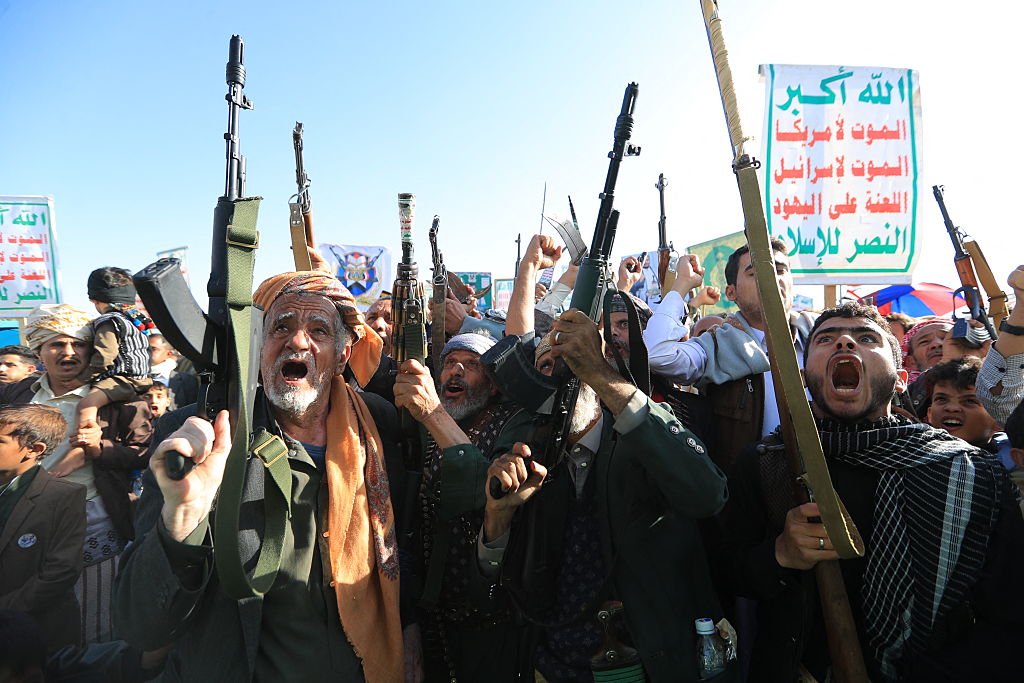
The European Union and Gulf Cooperation Council on Thursday announced the postponement of a joint summit set to take place in Saudi Arabia next week, amid safety concerns prompted by Houthi attacks on airports in the kingdom.
Citing the “continued attempts by the terrorist Houthi militia to target the Kingdom of Saudi Arabia and its civilian infrastructure, which threatens the security and safety of innocent civilians,” the council said the Gulf-European Summit will be rescheduled.
The postponement comes after Yemen’s Houthi rebels on Wednesday vowed to forge ahead with the attacks on Saudi Arabia’s airports and oil facilities, just hours after striking oil giant Saudi Aramco’s headquarters.
“Operations toward Saudi depths will continue in the coming days,” said Houthi military spokesman Yahya Saree, describing the locations as “legitimate targets” and framing their attacks as a direct response to Saudi strikes on Yemen. Saudi-led forces said they had intercepted a ballistic missile fired by the Houthis towards Riyadh on Wednesday and local journalists reported hearing “loud blasts” in the Saudi capital.
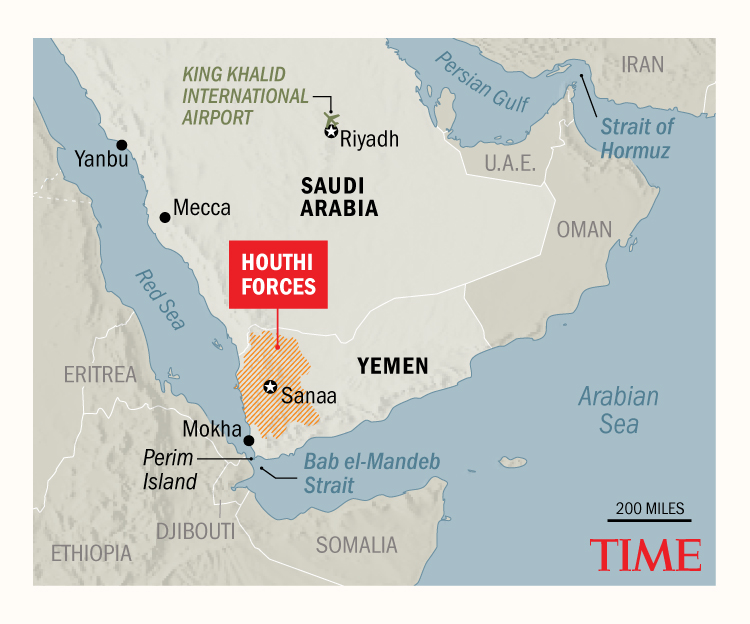
The escalation follows weeks of fighting between the Iran-backed Houthis and the Saudi-backed government of Yemen, shattering a four-year informal cease-fire in the country's civil war. The conflict reignited amid the widespread fallout of the U.S.-Iran war, bringing further instability to the Gulf region. In September, the Houthis said they had captured the strategic Perim Island that sits in the Bab el-Mandeb Strait, a critical maritime chokepoint. They also seized other islands in a bid to tighten their grip on the Red Sea coastline. Amid fears that a stronger Houthi position along the coast could further constrain global energy supplies, Saudi-backed forces recaptured key areas around the strait in early October. The Houthis have since ramped up their focus on Saudi Arabia’s airports and energy infrastructure.
Tuesday night’s attack on Aramco’s executive offices in the eastern city of Dhahran caused a limited fire, Saudi’s Ministry of Energy confirmed. No injuries were reported. TIME has reached out to Aramco and the Saudi government’s media office for further information. Saudi authorities said several missiles and drones had been intercepted elsewhere, and that falling debris injured four people in the capital of Riyadh. Saudi Arabia launched strikes on an oil depot on the outskirts of Yemen’s capital Sanaa on Tuesday, as the tit-for-tat attacks escalated.
The Saudi strike on the oil depot appeared to be in response to the Houthis’ attack on King Khalid International Airport in Riyadh on Saturday that killed 13 people and left over 300 injured. A projectile hit that same airport on Sunday, killing one person, Saudi Arabia's General Authority of Civil Aviation (GACA) confirmed. The week before, an attack on Abha International Airport killed two people and wounded 28, said GACA.
Saudi Arabia is the world’s top purchaser of American weapons, according to the Stockholm International Peace Research Institute. However, it is struggling to defend itself against the Houthis, who are positioned to strike deep into the kingdom. The Saudis are currently investigating how their defense systems failed to stop the deadly attacks. Experts cite the vast mass of Saudi land as one reason why defensive measures may have failed. The Saudi border with Yemen stretches more than 800 miles. “Expecting a country the size of Saudi Arabia to intercept every missile is simply unrealistic. No defense can guarantee complete protection,” said Ali Shihabi, a Saudi analyst, in an online post.
Operations at King Khalid remain suspended in the wake of the attacks. Etihad Airways, Qatar Airways, and Philippine Airlines are among the carriers to announce a suspension of flights to Riyadh.
The U.S. embassy in Riyadh has warned Americans in the country of “potential flight cancelations, airspace closures, and travel disruptions,” stipulating that U.S. government employees now require “special authorization” to use any airport in the country.
President Donald Trump on Tuesday said the Houthis “are behaving very badly.” In a Truth Social post, he continued, “I thought they learned their lesson a year ago when we bombed the hell out of them and, at their request, stopped,” seemingly referencing the U.S. strikes between March and May last year, which came in response to the Houthis attacking vessels in the Red Sea and disrupting global trade. Weeks after the strikes began, a cease-fire between the U.S. and the Houthis was reached via Omani mediations.
On Saturday, Trump suggested that the U.S. may join Saudi strikes on the Houthis. Asked about the possibility of U.S. strikes, a senior U.S. official told TIME that Washington is “in continuous dialogue with Saudi Arabia and the Republic of Yemen Government regarding regional stability and we will always fulfill our commitments to our partners.”
As tensions in the region continue to escalate, here’s what to know about the Houthis, their history with Saudi Arabia, and why they are attacking airports.
Who are the Houthis?
The Houthis are a political and armed group in Yemen that first emerged in the 1990s and have been fighting the country’s internationally recognized government for around two decades. The group is a revivalist movement for Zaidism, a branch of Shi‘ite Islam. The Zaidi muslim population in the country represents around 35% of the Yemeni population.
The Houthi movement was largely born from a transformation of the Believing Youth Forum (BYF), according to the Carnegie Endowment for International Peace. The group became known as the Houthis in honor of their founder and leader, Hussein al-Houthi. Before he was killed by Yemeni forces in 2004, al-Houthi had developed the group into a more militarized movement. The group is now led by his brother, Abdul-Malik al-Houthi.
Civil war broke out in 2014 after the Houthis seized Sanaa, forcing the government to flee to the southern city of Aden. Since then, the group has been engaged in fighting against a Saudi-led coalition supporting Yemen’s government. The Houthis currently have control of most of the country’s west, including Sanaa.
Experts compare the Houthis to authoritarian regimes on account of the social restrictions imposed in areas under the group’s control and alleged human rights abuses.
“The Houthis are dominated with very ideological and radical ideas, like a Zaidi ISIS. They have similarities also with the Taliban in terms of social control," says Mahmoud Shehrah, a Yemeni political analyst at London-based think tank Chatham House.
How are the Houthi rebels linked to Iran?
The Houthis hold strong ties to Iran, often taking action in line with Tehran’s objectives.
“Since 2009, Iran [has] started to speed up weapons supplies, training, but also a lot of funding to the Houthis,” says Farea Al-Muslimi, a Yemeni research fellow at Chatham House, noting that links between the two began as early as the 1990s.
The Houthis are often considered part of Iran’s proxy network, known as the “Axis of Resistance,” which also includes Hezbollah in Lebanon, the Islamic Resistance network in Iraq, and previously the Assad regime in Syria, until its collapse in December 2024.
In response to the Israel-Hamas war, the Yemeni militia launched several strikes on shipping vessels in the Red Sea, disrupting global trade in late 2023 and the early months of 2024. The U.S. and U.K. joined forces in January 2024 for a series of strikes on Houthi targets across Yemen in retaliation for the attacks on unarmed vessels. The U.S. carried out an additional campaign against Houthi targets later that year.
The Houthis entered the Iran war in March by firing a barrage of ballistic missiles at southern Israel. In the months since, the group’s advances along the Red Sea are widely considered to serve the interests of Iran. A Houthi blockade in the region against Saudi Arabia was declared in July, and several vessels have been attacked. The threat that the Houthis could bring another critical maritime chokepoint to a standstill, much like Iran has done with the Strait of Hormuz, could give Tehran significant leverage in its negotiations with Washington.
However, experts say it’s not entirely accurate to call the Houthis a direct proxy.
"The Houthis are one of the more independent regional allies of Iran in the Middle East. They have their own independent interests, even though their interests converge regionally and globally,” says Fawaz Gerges, a professor of international relations at the London School of Economics.
Even so, the Houthis have become increasingly vital for Iran. “With the fall of Assad, with the weakening of Hezbollah, the Houthis became the most important regional ally Iran has,” says Al Muslimi, pointing specifically toward the Houthis' ability to disrupt trade in the Red Sea.
What do the Houthis want?
The group’s goals have changed over time, as regional developments have unfolded, experts note.
“The Houthi's ultimate goal is to be a regional power,” says Al-Muslimi. With regard to the reignited civil war, the Houthis ultimately want an end to what they call a Saudi blockade of ports and airports in their territory.
“The Houthis want to have the skies and the ports of the country open for trade, for goods and services,” says Gerges. “They want money to flow into the coffers of the Houthis.”
The civil war has had a disastrous effect on Yemen, with nearly half of the population in government-controlled areas facing high levels of acute food insecurity, according to the United Nations. “The current situation is very dire for the Yemeni population, but also for the ability of the Houthis to rule Yemen effectively,” says Gerges.
“The Houthis want to consolidate rule and regime. They want to be recognized as the legitimate government in Sanaa, as opposed to being considered a non-state actor,” he adds.
When did the Houthis and Saudi Arabia begin fighting again?
A cease-fire brokered by the United Nations in April 2022 largely held for over four years, before collapsing in July. The Houthis claimed Saudi Arabia had launched strikes on Sanaa Airport, targeting a Houthi delegation returning from Iran. In a move they framed as retaliatory, the Houthi rebels launched ballistic missiles toward Saudi Arabia.
“The Houthis saw this as a golden opportunity to change the balance of power against Saudi Arabia and Yemen itself and launch a lightning offensive,” says Gerges.
Following further strikes on Houthi targets later that month, the militia group began striking oil refineries in Saudi Arabia, belonging to the state-owned petroleum company Aramco.
In September, strikes on oil refineries and other related facilities ramped up, and Saudi Arabia’s airports became a target.
Why are the Houthis attacking Saudi airports?
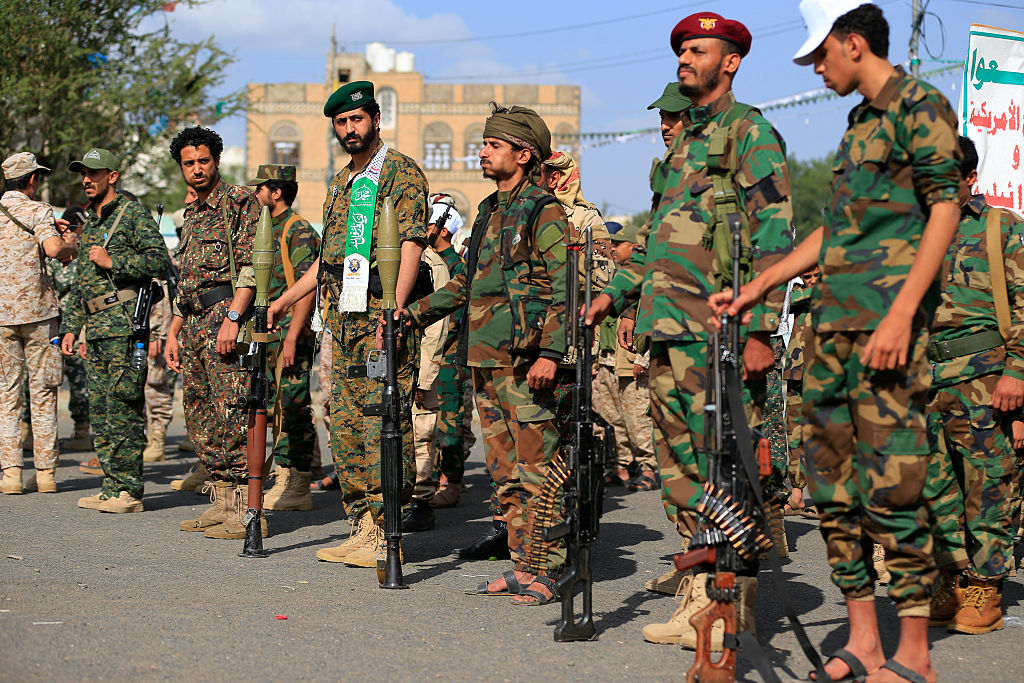
Prior to the 2022 cease-fire, attacks on airports were largely considered a signature move of the Houthis.
In a highly-publicized attack, the group struck Abha International Airport in June 2019, injuring at least 26 people, Saudi authorities said. The strike earned international condemnation and was deemed a possible war crime by Human Rights Watch.
Now, after fatal strikes on Riyadh’s King Khalid International Airport, the Houthis have threatened to keep targeting airports. The main motivation behind these attacks is the economic and geopolitical pressure they apply to Saudi Arabia, experts say.
“The Houthis want to put severe pressure on the Saudi Arabia economy, airport infrastructure, and security,” says Shehrah. “They want to squeeze Saudi Arabia's arms to push them to a political settlement.”
The unrest threatens to have a strong economic and political impact on Saudi Crown Prince Mohammed Bin Salman's governance. The disruption is “costly” to him, says Al-Muslimi, who notes that Bin Salman is eager for Saudi Arabia to be seen as a “safe harbor.”
The financial and reputational damage of these strikes has also put the Saudi public on the frontline of the conflict. It’s a “shock, because it's the first time in years that such major attacks have targeted deep inside Saudi Arabia,” says Gerges.
“The Houthis are trying to exert tremendous pressure on the leaders of Saudi Arabia to force them to accept conditions for lifting the blockade on Yemen and recognizing their legitimacy,” he continues. “Although, I doubt that the Saudi leadership will concede to Houthi demands… this would be seen as a surrender and humiliation."