
Reading view

‘We Don’t Need Canada’: Trump Escalates Trade War With Threat of 50% Auto Tariffs

President Donald Trump threatened to raise automobile tariffs on Canada to 50% as the trade rift and political slanging match between the neighboring nations escalated.

Trump announced Monday morning that U.S. tariffs on all Canadian cars and trucks, automotive parts, and steel will increase to 50% starting Jan. 1, 2027.

“Build in the U.S. and there are zero tariffs. Canada will be treated like a State no longer! On trade, and in other ways, also, they are among the worst nations in the world to deal with,” he said on social media.

Trump’s comments came after trade talks between the two countries broke down, with each side accusing the other of making eleventh-hour demands that derailed negotiations.

“They feel entitled, and yet, we don’t need Canada, they need us!” the President said, repeating his accusation that “Canada has been ripping off the United States of America for years.”

Trump previously touted the nearly finished deal between the two countries last Tuesday.

However, negotiations broke down on Friday, and the Administration's 50% tariffs on about $20 billion worth of imports into the U.S. from Canada took effect Saturday.

Canadian Prime Minister Mark Carney vowed to match the U.S.’s tariffs “dollar for dollar.”

“We are stronger now than when the United States started this trade war. More unified, more determined, and more ambitious,” Carney said during a press conference Saturday, referring to the year-long trade rift that has come to affect both countries.

“Last spring, I warned that America is trying to break us so that they can own us. And promised: “That will never, ever happen.” We are keeping that promise. Canada is becoming stronger and less dependent on America.”

Both sides have since blamed the other for making unreasonable demands late in the negotiating process.

“While we believed, earlier this week, that we were moving toward a mutually beneficial agreement, in recent days, the U.S. proposed new terms that were uneconomic, unfair, and undermined the net benefits to Canada, calling into question the reliability of any deal,” Carney said on Saturday. “In short, they asked too much and offered too little.”

U.S. Trade Representative Jamieson Greer, meanwhile, framed the breakdown in negotiations as leaving the U.S. with little choice but to retaliate against Canada.

“We’ve said enough, and so we’ve taken countermeasures. Our interest is in protecting American workers and protecting American supply chains,” he told "Fox & Friends" on Saturday.

Greer said the Republican Administration had offered to cut tariffs on steel, autos, and lumber, “things that are sensitive for them. And they’ve always had the best deal, and they still would have an even better deal, but they didn’t want that.”

As a result, he said, “We’re moving forward with measures that respond to Canadian retaliation.”

The broader 50% tariffs that took effect Saturday were initially announced in July, and would affect around 5% of trade between the U.S.-Canada.

Shortly after the collapse of the talks, Trump took to Truth Social on Sunday and said that Canada “wants the benefits of being a State, without being one” and that it has “also charged our great farmers, for many years, massive amounts of tariffs. No more!!!”

Despite not being clear what the President meant, Trump has repeatedly expressed his desire to annex Canada and make it the 51st U.S. state—an idea Carney has strongly rejected.

Canada retaliates as U.S. lawmakers warn of higher costs

The collapse of the deal and escalating trade tensions between Washington and Ottawa have been met with both praise and criticism on either side of the border.

Ontario Premier Doug Ford praised Carney for standing firm and refusing to accept what he described as a “bad deal.”

“It was a bad deal for Ontario. It was a bad deal for the auto sector, the steel sector and manufacturing sector,” he said. “We never started this fight, but I can assure you we're going to win.”

On the U.S. side, Trump has faced criticism from both sides of the aisle.

Democratic Sen. Amy Klobuchar of Minnesota said Trump’s tariffs “have created higher costs and chaos.”

“His 50% tariffs on Canadian goods will raise prices. And now Canada is retaliating dollar for dollar, which will hurt Minnesota farmers, businesses, and workers,” she said Monday of the newly announced tariffs.

Republican Sen. Susan Collins of Maine similarly warned that the “on-again/off-again trade talks between the U.S. and Canada lead to higher costs, risk, and uncertainty for Maine businesses.”

“If the Administration proceeds with these tariffs, they will increase costs for Maine families, as most businesses will have no choice but to pass on the tariffs to their customers through higher prices,” she said Saturday after trade talks broke down, urging “both sides to return to the negotiating table.”

Democratic Gov. Abigail Spanberger of Virginia warned that this latest round of automobile tariffs will have “devastating consequences.”  

“President Trump’s new 50% tariffs on Canada will disrupt supply chains and raise costs for Virginia businesses of every size and in every industry, and retaliatory tariffs will hurt Virginians,” she said Monday.
  •  

Backlash After Hakeem Jeffries Holds Private Meeting With Jared Kushner Ahead of Midterms

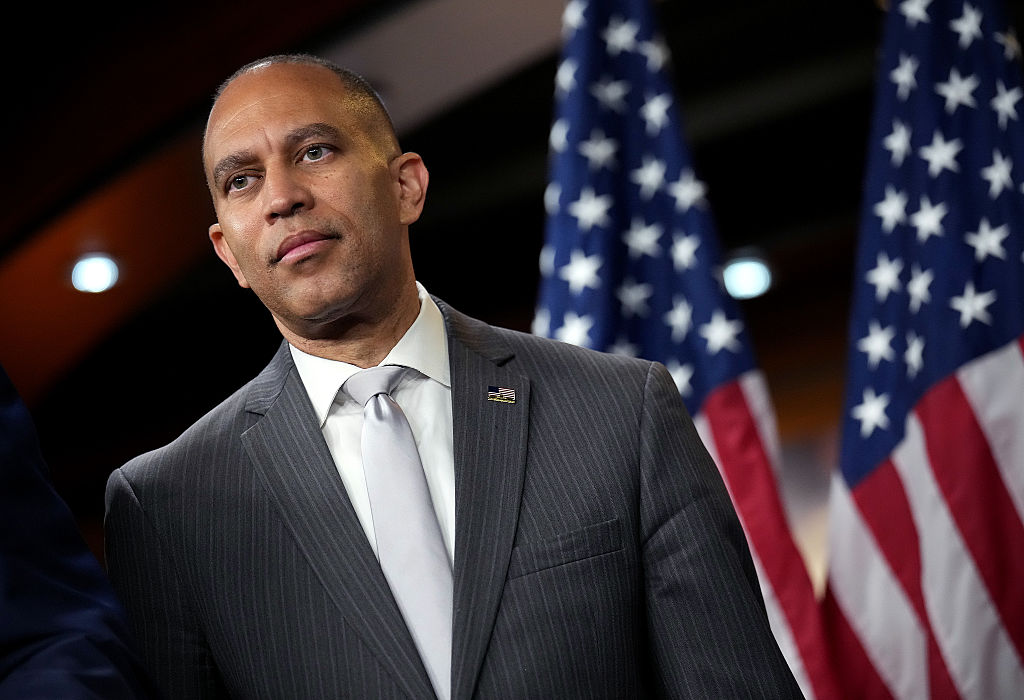
House Minority Leader Hakeem Jeffries speak at a press conference at the U.S. Capitol on June 11, 2025 in Washington, D.C. —Kevin Dietsch––Getty Images

House Minority Leader Hakeem Jeffries met privately with President Donald Trump’s son-in-law and adviser Jared Kushner in recent weeks, prompting criticism from some Democrats ahead of approaching midterm elections, according to reports.

Although Kushner, who served as a senior West Wing adviser during Trump’s first term, does not have a formal role in the current Administration, he has remained involved in Trump’s diplomatic efforts in the Middle East and Russia.

During the meeting, the pair were said to have discussed housing, immigration, and the high cost of living as potential areas of common ground.

The report comes less than three months before the November midterms, when Democrats are favored to retake control of the House from Republicans, who currently hold both chambers of Congress. A Democratic victory would put Jeffries in line to become speaker and give the party greater oversight powers to investigate the Trump Administration.

The meeting—an unusual instance of a top Democrat and a Trump confidant coming together to discuss potential areas of agreement—has drawn scrutiny from some within Democratic circles. It was first reported Sunday by The New York Times and has since been confirmed by multiple outlets.

“Throughout this Congress, Republicans have adopted a my-way-or-the-highway approach to governing that has failed the American people," Jeffries says in a statement to TIME. "To stop the madness, we have repeatedly made clear that an extremist approach will not work and will be met with forceful opposition. The American people want bold change and that’s what House Democrats will deliver.”

“In every conversation that we have with the Trump administration, we will continue to make it explicitly clear that the affordability crisis is not a hoax and nothing short of transformational policy change is acceptable. We are fighting for an affordable America. The question is whether Republicans will join us,” the statement reads.

TIME has also reached out to the White House and Kushner for comment.

Asked whether he supported the meeting during an interview on NBC’s Meet the Press on Sunday, Democratic Sen. Chris Van Hollen of Maryland said: “I’m in favor of people meeting with whoever they want to discuss ideas. But it’s one thing to have a meeting. It’s another thing to see something real come out of that.”

Tommy Vietor, a former aide to President Barack Obama and now a co-host of the podcast Pod Save America, was far less diplomatic.

“Jared Kushner has no actual government job, he just uses his family connections to get money from Gulf autocrats and fund corrupt deals. The only way Jeffries should work with him is with demands for documents and subpoenas,” Vietor said.

House Speaker Mike Johnson said Sunday that he first learned of the meeting that same day, when reports began circulating in the media.

"I don't know what that's about," Johnson said on Fox News. "I know Jared has interests and lots of other things going on. He's not really directly involved in the admin, at least in the day-to-day in the White House."

Johnson, however, remained confident that Republicans could retain control of the House.

“I’m telling you what, you better not bet against the House Republicans,” he said.

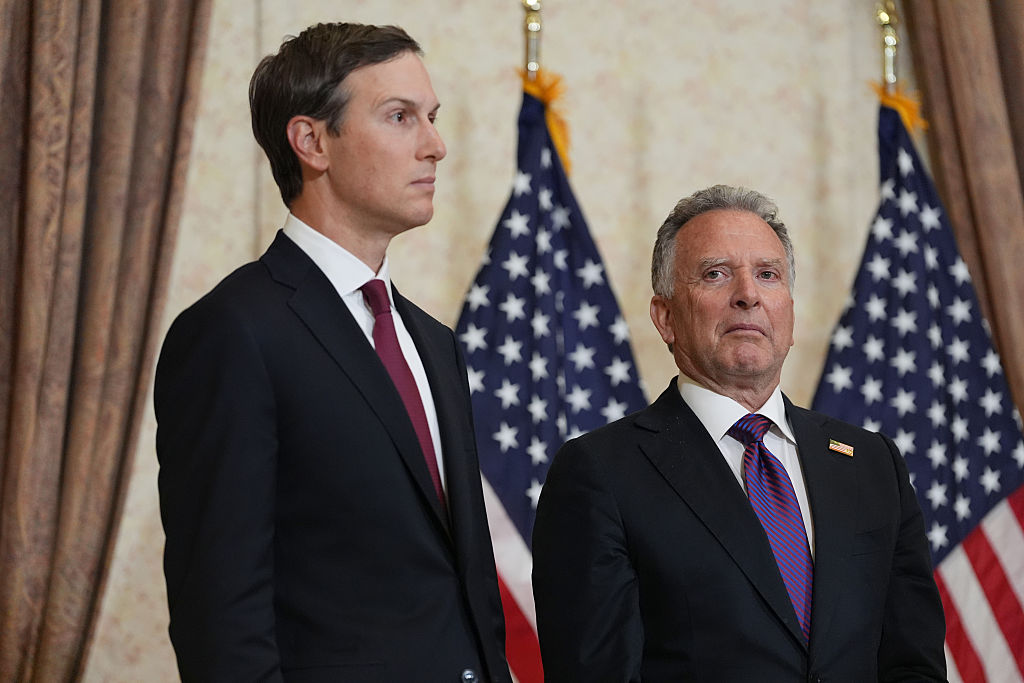
Jared Kushner, left, and Steve Witkoff, Special Envoy for Peace Missions listen as Vice President JD Vance speaks during a news conference after meeting with representatives from Pakistan and Iran, April 12, 2026 in Islamabad, Pakistan. —Jacquelyn Martin––Pool/Getty Images

Trump has met with the top Democratic leaders of the House and Senate only once since returning to office, when the President attempted last year to reach an agreement to prevent a government shutdown. Those talks ultimately failed, leading to the longest government shutdown in U.S. history.

The relationship between Trump, Jeffries, and other members of the Democratic leadership has often been marked by conflict and back-and-forth name-calling.

In late April, Trump called Jeffries a “low IQ person” and attacked Senate Minority Leader Chuck Schumer over their opposition to the Iran war, branding them “traitor Democrats.”

Jeffries, in turn, called Trump the “dumbest President ever” in response to the President’s insults during a press conference.

Trump has continued to attack the top House Democrat as "low IQ" and a "thug” branding him as a “danger” to the country.

More recently, however, Trump’s tone toward Jeffries appears to have softened. In an interview earlier this month with Punchbowl News, the President said he could work with the Democratic leader and described him as a "nice guy."

"People are harsh on me. I'm harsh on them. It's part of the world," Trump said. "I'd probably get along with him very well."

Since returning to the White House, Trump has often sought to bypass Congress and pursue policy through executive action, from curbing birthright citizenship to the implementation of tariffs.

That dynamic could change if Democrats take control of the House, where Republicans currently hold a slim majority of 218 Republicans to 212 Democrats and one independent.

A Democratic-controlled House would give the party the power to block parts of Trump’s legislative agenda, launch high-profile congressional investigations, issue subpoenas, and initiate impeachment proceedings.

Trump—who was impeached twice during his first term—has urged voters to back Republicans in the midterms, arguing that Democrats would use their power to impeach him again.

“I’m going to be impeached. They're going to impeach me. They have no idea why,” he told a crowd during a rally in South Carolina last Friday.

The latest Emerson College polling, released August 20, found congressional Democrats leading Republicans by nearly 8 points. A separate Reuters/Ipsos poll released Aug. 17 found Democrats ahead by 5 points. All 435 House seats are up for election in November.

  •  
❌