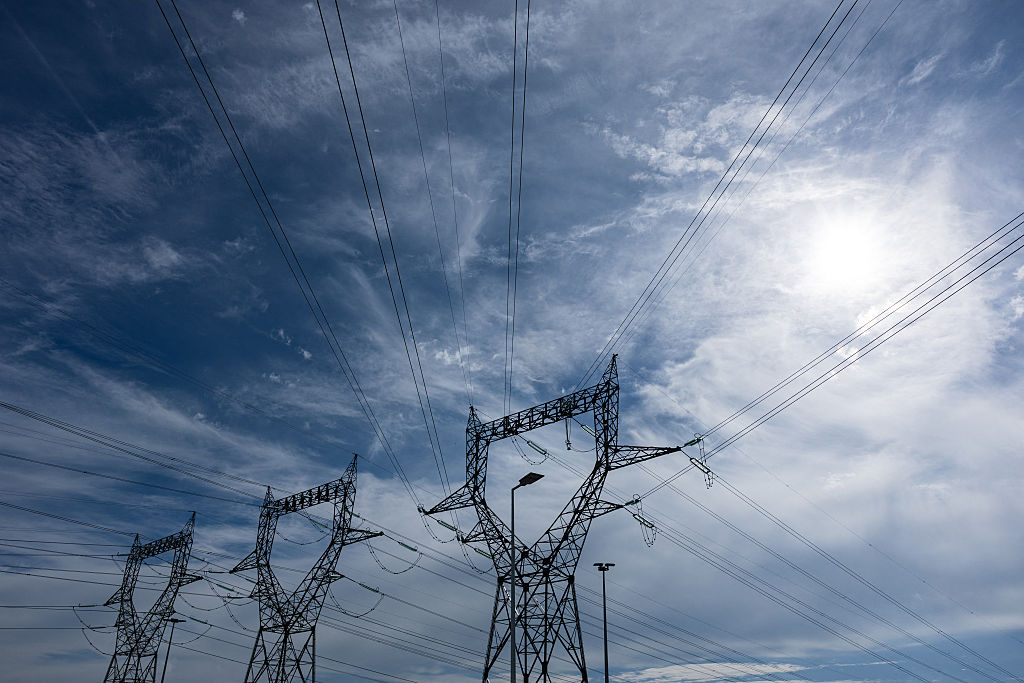
Power lines near the Gravelines Nuclear Power Station in Gravelines, France on Sept. 15 —Sameer Al-Doumy / AFP—Getty Images
Recent weeks have brought red flag after red flag for investment in AI and the related data center boom. Bond yields soared for AI infrastructure giant CoreWeave, a sign that investors view the buildout as increasingly risky. And Meta’s reporting of negative free cash flow for the quarter to fund its infrastructure buildout while saying it might need to raise even more capital to fund its AI buildout not only hit its own stock but contributed to a price decline across the big tech companies.
These developments raised questions across Wall Street about whether too much is being spent too quickly on data center expansion. How questions over data center investment play out has big implications for how companies and investors approach the future of energy and, by extension, climate. A pullback in the pace of new data centers could ease pressure to build fossil generation, but it would also weaken the commercial case for clean energy technologies that need big, reliable buyers who are willing to pay a premium for power.
Most obviously, a dent in the AI buildout would translate directly into a slowdown in related electricity demand growth. In advanced economies like the U.S., data centers will account for 20% of that growth through 2030. By then, data centers are expected to account for 3% of global electricity demand, according to data from the International Energy Agency.
Some climate advocates may initially rejoice at slowing electricity demand. Even as renewable energy expands, grids around the world still rely on fossil fuels. In the U.S. in particular, AI demand has sparked a wave of building new natural gas infrastructure. In the short term, slowing demand would mean lower emissions from the existing system than today’s baseline assumptions and less investment in new natural gas infrastructure.
But a slowing data center build out leaves less mature technologies at risk. From advanced geothermal to new ways of producing nuclear power, big tech companies have been willing to pay more to lock in reliable power sources, thereby accelerating the market for these new efforts. Even unproven technologies like nuclear fusion have received a big financial boost from tech firms speculating that they might help solve their power challenges and give them a competitive leg up in the AI race. In a tighter financial environment with lower projected electricity demand, both the incentive and the financial capacity to make bold bets diminish.
To be clear, data centers are not the only source of growing electricity demand. New manufacturing continues to create the need for power. The need for air conditioning has ramped up in many emerging markets, particularly in the Global South, creating new grid pressures. And electric vehicles continue to take off in many markets outside the U.S.
Even as gas remains resilient, much of the power built to meet demand will come from clean sources, including and especially solar and battery storage. Solar is increasingly cost competitive. And this year’s spike in fuel prices—particularly natural gas—has made local power more appealing. But the companies behind growing sectors like air conditioning and EVs are less involved in local power systems and lack the capital to really shape them like the world’s wealthiest tech companies have. In short, clean energy will take a hit without the backing of big tech.
It’s too soon to tell whether, in the long run, this week’s AI infrastructure recalibration will be a blip in time or part of a much broader realignment. But it’s something that anyone invested in clean energy and climate should be watching closely.
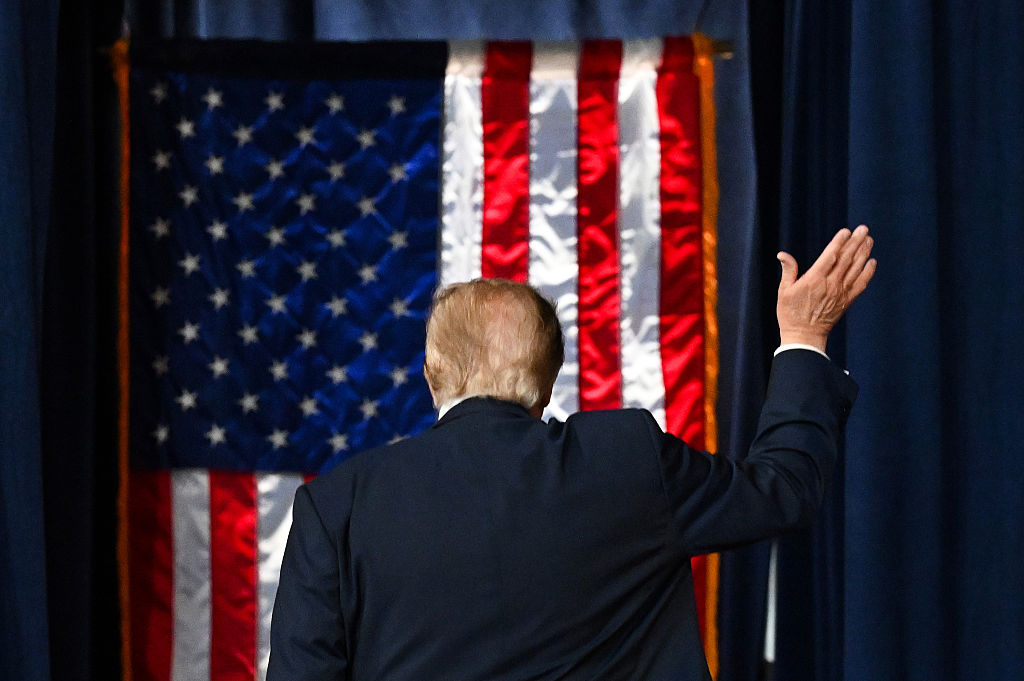
President Donald Trump delivered remarks on Oct. 10, 2026 in Clarksville, Tenn. —Roberto Schmidt—Getty Images
Not content with renaming an international gulf and a cross-border lake, on Oct. 10, U.S. President Donald Trump recently floated the idea of renaming the Atlantic or Pacific Ocean as “Trump Ocean” or the “Ocean of the Americas” at a political rally in Clarksville, Tenn.
“We need an ocean. So, I was thinking of either the Atlantic or the Pacific,” he said to laughter and applause. “We call it ‘Trump Ocean’ or ‘Ocean of the Americas,’ something like that.”
Then, at an Oct. 21 rally in South Carolina, Trump said he asked Google’s CEO, Sundar Pichai, to rename the Atlantic Ocean on Google Maps. According to Trump, Pichai replied, “Please don’t ask us to do that.”
“So, I'll probably pass,” Trump said. “I think let's keep it the Atlantic Ocean.”
While Google has not issued a formal statement on the matter, Trump’s obsession with naming places for himself or America is remarkable. In our view, it reflects a textbook case of “toponymic narcissism”—the use of place naming to remake the world in one’s own image.
Let’s not fool ourselves: Trump knows a thing or two about branding. In fact, his business career has largely revolved around marketing the Trump brand on hotels, golf courses, and even golden sneakers. We shouldn’t be surprised to find him following the same playbook in his second presidential term.
Yet the world map is not a private real estate development. Nor can place names be reduced to a branding exercise. Place names have a greater civic purpose as shared global symbols that should transcend the personal glorification and political interests of any individual leader.
Place names form part of our intangible cultural heritage with cultural significance that will outlive the cartographic whims of President Trump. They shape our geographical imaginations and the way people perceive and understand the world. Geographical naming also has important consequences for education, international relations, and the types of messages we wish to project to the world.
For instance, it is notable that Trump has focused much of his renaming energy on places with Indigenous names, such as Lake Ontario and the Gulf of Mexico. In the case of the Atlantic Ocean, this could also be seen as an attempt to erase an etymology that points through Greece to North Africa. The name derives from the Greek for “Ocean of Atlas,” referring to the mythology of a giant who lives in the Atlas Mountains of northwestern Africa.
As place name scholars, we have spent decades studying the cultural, social, and political aspects of place naming. There is a long history of political leaders and cartographers using place naming to assert raw power by rewriting the world map. In one sense, Trump’s renaming shenanigans are simply the latest flashy example in this broader story of mapping and politics.
But Trump is not merely renaming places to project American power on the world stage. He is also making a mockery of the very act of place naming itself—and, along with it, the international norms that inform the map-making process.
The international community must reaffirm its commitment to respecting the cultural value of place naming and to articulate responsible place-naming principles, especially for geographical features that are shared across international borders. In an open letter co-authored with place name experts around the world, we propose five key principles for responsible place naming:
The first principle is recognizing that place names are culturally significant forms of intangible heritage and shared resources whose stewardship carries responsibilities extending beyond the interests of any particular government, leader, institution, or generation.
Given the cultural significance of place names, our second principle highlights the need for meaningful public participation in place naming decisions. Place names that are changed arbitrarily and without due process should not be recognized by the international community.
Thirdly, place names should not be used to proclaim cultural superiority, advance territorial ambitions, or assert exclusive national ownership over geographical spaces shared among different peoples.
Places should generally not be named for living people. Instead, place naming should serve the public interest rather than promoting the personal legacies of those seeking to commemorate themselves as a form of self-aggrandizement.
Lastly, we recognize that a shared geography need not always have a single name, since multiple place names can bear witness to the layered histories, languages, and attachments through which places acquire meaning. However, this recognition should not extend to condoning the unilateral renaming of shared geographic features without international dialogue among affected countries and communities.
If Trump moves forward with attempting to rename the Atlantic or Pacific Ocean, the international community should stand united in rejecting this attention-seeking act of cartographic malpractice and defend the cultural value of place naming as a cornerstone of our shared world map and geographical imagination.
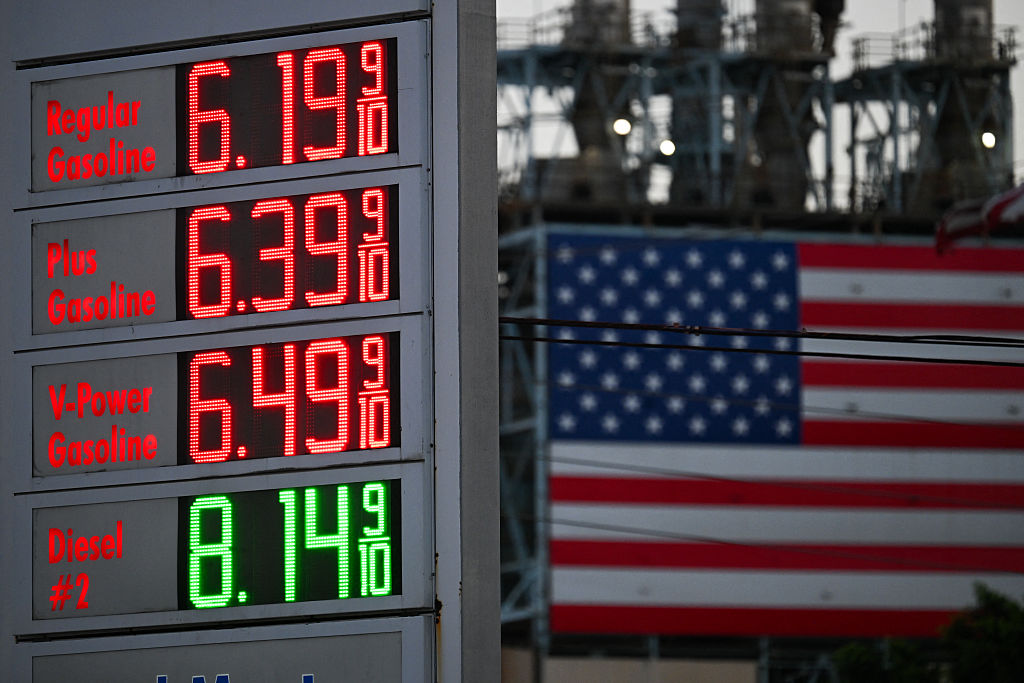
Gas prices at a Shell gas station above $6 a gallon for regular gasoline and $8 a gallon for diesel are displayed across from a U.S. flag outside of the Marathon Petroleum Corp. Los Angeles Refinery in Carson, Calif., on Sept. 22, 2026. —Patrick T. Fallon—AFP/Getty Images
President Donald Trump has invoked a Cold War-era law in an effort to boost oil production and lower energy prices.
In a presidential memorandum issued Thursday, Trump determined that petroleum production, refining, and related activities are essential to national defense under the 1950 Defense Production Act. The determination follows Trump’s declaration of a national energy emergency in January 2025.
“Ensuring resilient domestic petroleum production, refining, and logistics capacity is central to United States defense readiness,” the memo reads. “Without immediate Federal action, United States defense capabilities will remain vulnerable to disruption.”
The memo comes as the price of gas and diesel has soared across the country amid supply disruptions caused by the U.S. and Israel’s war against Iran. Brent crude futures rose 1.2% to $114.47 a barrel early Friday, extending gains after Thursday hit a five-month high. U.S. diesel pump prices averaged $6.32 a gallon, slightly higher than Thursday but below the September record, according to AAA. The high energy prices, and related inflation, have become a defining issue for voters in the coming midterm elections.
Here’s what to know.
What does the memo mean for energy production?
The memo means that energy production shortfalls are seen as a national defense risk.
The memo invokes Section 303 of the Defense Production Act, a law that allows the federal government to intervene in private industry for national defense. Section 303 allows the President to make purchases, purchase commitments, provide financial support and equipment, and expand production through other measures.
The memorandum also removes certain Section 303 requirements through an emergency waiver, including ordinary congressional notification and authorization constraints.
While the memo does not specify which projects could be funded, Vice President J.D. Vance said last week that the Administration would use the Defense Production Act to expand capacity at a Delek U.S. Holdings-owned refinery in Texas.
Without taking action, the memo said, U.S. industry would be unable to provide sufficient energy services in a “timely manner due to constrained financing, long lead times, permitting and infrastructure bottlenecks, and supply chain limitations.”
Has the Defense Production Act been invoked before?
Enacted during the Korean War, the Defense Production Act was first used to expand domestic industries in critical materials, such as aluminum and titanium, for national defense.
Section 303 of the act was also used during the pandemic to fund domestic production of medicines and vaccines. Former President Joe Biden also invoked the statute to support clean energy manufacturing and supply chains, including minerals used in electric vehicle batteries and the production of of energy-efficient heat pumps and insulation.
In April, more than a month after Iran began disrupting shipping through the Strait of Hormuz in retaliation for U.S.-Israeli Feb. 28 strikes, Trump invoked the act to declare petroleum, natural gas, coal, electricity grid, and other energy infrastructure essential to national defense. Citing April’s natural gas determination, the Department of Energy on Monday committed up to $42 million to advance the proposed Constitution Pipeline linking Pennsylvania and New York. The department also announced up to $50 million last week for transmission upgrades in Virginia and West Virginia, citing April’s grid determination.
Last year, Trump signed legislation providing $1 billion for Defense Production Act activities, including energy projects deemed critical to national security.
Trump’s use of Section 303 of the act for fossil fuel projects has drawn criticisms from environmentalists, with the Center for Biological Diversity calling the April memoranda, which waived congressional notification, “unlawful.” Nevertheless, the statute expressly includes energy production and construction in its definition of national defense.
How else has Trump tried to lower energy prices?
The Trump Administration has pursued a number of other measures aimed at lowering energy prices since the Iran War began. Earlier this month, Trump signed an executive order temporarily expanding access to tax-exempt dyed diesel, which is typically reserved for off-road farm and construction vehicles. The Group of 7 countries, including the U.S., also agreed to release 100 million barrels of diesel and crude oil reserves to the world over four months.
In August, the Administration extended the Jones Act waiver for another 90 days, allowing foreign-flagged ships to transport oil and certain other commodities between U.S. ports.
For many of these measures, industry analysts and stakeholders have said the reduction in energy prices is likely to be limited and possibly short-lived. Analysts estimated that the Jones Act waiver was expected to reduce gasoline prices by only pennies per gallon. Capital Economics economist Hamad Hussain said the reserve release could lower diesel prices temporarily, but would not resolve the underlying supply crunch. And analysts warned that the dyed diesel measure would have a limited effect on most consumers since the tax-exempt fuel isn’t widely available at ordinary commercial pumps. A Council on Foreign Relations analysis also suggested that damaged Russian refining capacity may make a near-term effect of the Russia deal on diesel markets unlikely, although Trump said the agreement would supply more than 300,000 tons of diesel to U.S. and global markets immediately.
Meanwhile, oil exports from the Middle East topped prewar levels last week, marking a rebound in regional oil shipments despite continuing security risks. Ships sailing through the Strait of Hormuz, however, still face attacks from Iran, while the Bab el-Mandeb Strait near Yemen has been threatened by the Houthi rebels. Analysts previously told TIME in June that the risk of further attacks and damage to facilities could delay a full-scale recovery.
Thursday’s memorandum could support investment in fuel capacity, but it’s uncertain how quick or measurable an effect it will have on energy prices. Gas prices still depend heavily on globally traded crude, according to the U.S. Energy Information Administration, although they can be influenced by domestic refining and distribution conditions. The U.S. was the largest crude producer globally last year, averaging 13.6 million barrels of crude a day.
Analysts warned, after the April memorandum, that federal support would not necessarily translate into immediate price relief.
“Until the pipes are in the ground and the fuel is flowing or transported, it may not be able to be called a true structural shift,” Cyrus Brooks, director of marketing at energy research firm RBAC, wrote in April.
Still, Brooks said of the April action that federal recognition of energy as important to national security could support important infrastructure investment, potentially relieving a bottleneck in domestic fuel production, refining or transportation.
“Energy security seems to be the brightest neon sign flashing,” he wrote. “Not because it’s everything, but because nothing works without it.”
Governors have no shortage of ideas about how to improve education. But before deciding what to change, they need an honest answer to a more basic question: How are our students doing?
That sounds simple. It isn’t.
We governed Tennessee at different times and from different political parties. But we learned the same lesson: you cannot improve what you are unwilling to measure honestly.
Governors will get the chance to see how students in their state are doing in a critical,often-overlooked subject: civics. But they have to sign up by the end of January to get state-level results on the National Assessment of Educational Progress civics assessment, also known as the Nation’s Report Card, or NAEP.
For newly elected governors, that will mean making a quick decision shortly after taking office. It shouldn’t be a hard one, though.
U.S. students get limited instruction, particularly in early grades, about how our government works, the rights and responsibilities of citizens, and how to apply civics knowledge beyond the classroom. Governors can help change that by prioritizing and measuring what students know and can do in civics.
What we know now is limited but concerning: only 1 in 5 eighth graders in U.S. schools reached the NAEP Proficient level on the most recent Nation's Report Card in civics, meaning the vast majority of students likely struggle to identify the separation of powers and checks and balances spelled out in the Constitution.
Unlike in subjects like reading and math, we don't have state-specific information about how our own students are doing compared to students in other states in civics. That puts leaders at a disadvantage when trying to improve schools and communities and help young people develop the civic knowledge and skills they need to excel academically, in the workforce, and in their communities.
But beginning in 2028, if they meet the January deadline, states can get state-specific results in eighth-grade civics rather than just national averages. Tennessee's academic progress over the past two decades serves as an example of why all states should capitalize on this opportunity. In 2007, Tennessee’s extremely low Nation's Report Card scores in reading and math, which contradicted our own state assessment results, served as a wake-up call. Our state got to work raising K-12 expectations, increasing the rigor of our end-of-year state tests, and improving classroom practices.
The strategy worked: Between 2011 and 2015, Tennessee became the fastest-improving state on NAEP. And progress continues. Recently, for the first time, the state ranked in the top quarter of states for reading and math achievement.
This is why we believe NAEP is a particularly valuable tool. It’s considered the gold standard in assessments and is the only common yardstick that measures student learning across the country. It lets us know whether students today are doing better or worse than kids in those same grades did two years or two decades ago and how students in our state are doing compared to other states.
We didn't always have the benefit of state-level NAEP results. NAEP didn’t produce any state-specific data at all until the 1980s, when Tennessee joined other southern states in a pilot program to determine whether valid state results could be obtained from NAEP data. That paved the way toward a federal requirement 25 years ago that results for all 50 states in 4th- and 8th-grade reading and math be reported publicly.
That was a win for states and kids. But today, we have to ask ourselves, what about those other essential things that children learn in school besides reading and math?
States now have an opportunity to answer that question in civics. We hope they'll take it. We know from experience how valuable it is to have an honest, independent measure of how students are doing. Good policy requires good information. And good leadership requires being willing to confront what that information tells us.
Although the case is considered exceptional, investigators are working to determine how the infection occurred and whether the pathogen played a role in the patient’s death.
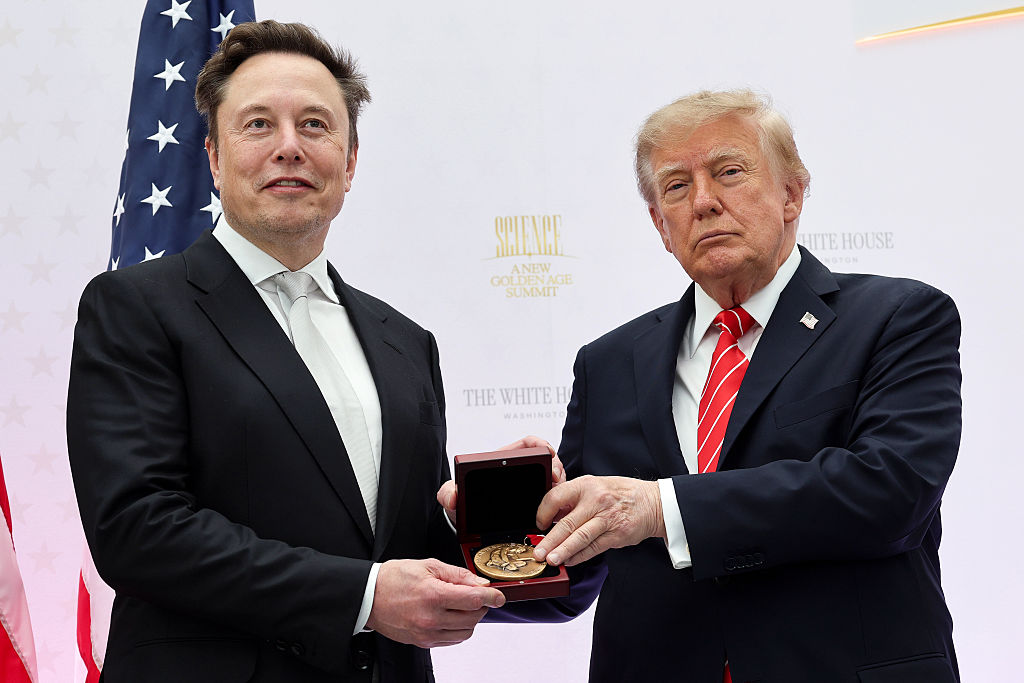
Tesla and SpaceX CEO Elon Musk receives the National Medal of Science from President Donald Trump at the Institute of Peace on October 08, 2026 in Washington, DC. —Win McNamee-Getty Images
For the past week, President Donald Trump and his aides have traded accusations with Elon Musk, the CEO of SpaceX, over who restricted Ukraine’s access to a military-grade version of Starlink, SpaceX’s satellite network product that Ukrainian forces depend on to intercept incoming Russian projectiles and target Russian launchers.
Musk blamed Trump and the U.S. military for the decision, writing on X, “Any limits on speed or usage are decided by the US military and ultimately POTUS.” Trump insisted that his administration did not disrupt Ukraine’s access to the network. Secretary of State Marco Rubio argued that decisions about Ukraine’s access to the network were in the hands of SpaceX and Musk and not the White House. The Wall Street Journal and CBS News reported that the decision had been Musk’s.
On Mar. 9, 2025, Musk had promised that, whatever his disagreements with U.S. policy toward Ukraine, “Starlink will never turn off its terminals. We would never do such a thing or use it as a bargaining chip.” Critics have raced to blame Musk alone, casting him as the puppeteer behind the throne, the first business titan to achieve what William Randolph Hearst, Marcus Alonzo Hanna, and J.P. Morgan only aspired to: a latter-day Cornelius Vanderbilt, who is reputed to have scoffed, “Law? What do I care about the law? Hain’t I got the power?”
That gets the story backward. Musk’s businesses are uniquely dependent on the blessings of Washington: a fifth of SpaceX’s revenue comes directly from federal agencies, its satellites require federal authorization to launch and operate, and the possible merger of Tesla and SpaceX will live or die by the decisions of federal regulators.
Confronted with a White House that appeared determined to squeeze Ukraine, whatever its public denials, Musk faced a familiar choice for anyone dependent on political patronage: capitulate, resist, or retreat into ambiguity. He chose ambiguity, revealing the limits of his power. The wealthiest man in the world still answers to someone else.
The finger-pointing creates a haze of ambiguity, giving both men plausible deniability. The apparent aim is to force Ukraine into a settlement by depriving it of the means to resist: a way to secure a quick, short-term peace and lower oil prices at the expense of Ukrainian sovereignty and international law.
But that calculation mistakes capitulation for stability. Rewarding President Vladimir Putin of Russia could encourage him to test NATO’s resolve in theBaltic states, Poland, Finland, or Sweden, raising the risk of a direct confrontation with the alliance. It would also signal to other U.S. adversaries that sufficient pressure can fold Washington’s commitments.
For now, Trump could claim to have brokered peace between Russia and Ukraine, even if the peace he delivers is the silence of a defeated country. Musk can evade responsibility by presenting himself as merely one supplier among many across the defense industry whose failures have weakened Ukraine’s defenses. He could point to weapons manufacturer RTX, whose Patriot interceptors are so scarce that Ukraine reportedly ran out of them this month, or to delays in delivering F-16s manufactured by Lockheed Martin that were promised two years earlier.
Faustian bargains
Beneath the public quarrel lies a familiar pattern: surrender political independence and retain the freedom to accumulate extraordinary wealth. The historians who have studied Putin’s Russia most closely would recognize the pattern instantly. Timothy Snyder has written that Russia’s oligarchs “were tamed, but not by a neutral state.” Rather, “Putin himself became the head oligarch, the boss of bosses.” Anne Applebaum echoed the insight and described Putin as making himself “godfather to all of the other oligarchs.”
Putin laid out the terms of that bargain on Jul. 28, 2000, when he met with 21 of Russia's richest men in the Kremlin, less than three months after his inauguration. The message was simple. The fortunes they had amassed in the chaos of the 1990s were theirs to keep, as long as they stayed out of politics entirely. Keep your distance from power, and the state would leave you alone.
Those who refused the deal faced immediate reprisals. Boris Berezovsky and Vladimir Gusinsky, whose television networks refused to bend the knee, were driven into exile within the year. Gusinsky’s NTV was seized by state-controlled Gazprom. Mikhail Khodorkovsky, then Russia’s richest man, funded opposition parties and lectured the Kremlin on corruption. In Oct. 2003 he was pulled off his plane at a Siberian airport and arrested. He spent a decade in prison and watched his oil company,Yukos, dismantled and its assets transferred to state-controlled companies.
Those who accepted the deal are the ones who got rich, and they have never been richer. Forbes counted a record 155 Russian billionaires this year, the fourth straight year that number has grown, with a combined fortune of $696.5 billion—up 11% from the previous year, even as Putin’s war against Ukraine entered its fifth year. Their collective wealth reportedly now exceeds the bank term deposits of the rest of Russia’s population: 155 oligarchs with fortunes greater than the savings of roughly 146 million ordinary Russians.
“Oligarchies are unstable,” Snyder has observed. “Members disappear.” For those who might have forgotten the terms of Putin’s bargain, an instructive reminder came in 2023, when Yevgeny Prigozhin, the head of the Wagner Group, did the one thing the bargain forbade: he challenged the Kremlin’s authority. Prigozhin seized a military headquarters in Rostov-on-Don and sent his forces toward Moscow. His column advanced to within 125 miles of the capital before he agreed to stand down under a deal brokered by Aleksandr Lukashenko, the Belarusian dictator.
Putin publicly called the mutiny treason, then appeared to forgive him. Two months later, on Aug. 23, 2023, Prigozhin’s private jet crashed north of Moscow, killing everyone aboard. The Kremlin denied involvement, the U.S. intelligence concluded that the plane had been blown up, and The Wall Street Journal later reported that the operation had been ordered by Putin’s Security Council chief. Putin’s eulogy, delivered the next day, described Prigozhin as a man who had “made serious mistakes in life.” No oligarch in Russia needed the rest of the sentence spelled out.
Prigozhin’s fate is only the most spectacular entry on a longer, murkier list. Since the invasion of Ukraine began in 2022, at least 85 Russian businessmen and officials have reportedly died in unexplained or violent circumstances, many of them figures in the energy industry. Among the dead are three Lukoil executives: board member Alexander Subbotin, who died in May 2022 after a visit to a “shaman” outside Moscow; chairman Ravil Maganov, who fell from a sixth-floor window that September; and vice president Vitaly Robertus, who was found dead in his office in March 2024.
In April 2022, two former energy and banking executives were found dead alongside their families. Vladislav Avayev, a former Gazprombank vice president, was found shot dead in his Moscow apartment with his wife and 13-year-old daughter. Sergei Protosenya, a former Novatek executive, was found hanged at a rented villa in Lloret de Mar, Spain, with his wife and daughter stabbed to death inside. Catalan police concluded that Protosenya had killed his family, then himself. His son rejected that finding, insisting that his father had been in good spirits and had no reasons to kill them and himself.
Transneft vice president Andrei Badalov fell from a 17th-floor window in July 2025. The Moscow Times has counted 18 such fatal falls from windows since 2002. Three days later, Russia’s transport minister, Roman Starovoit, was found shot dead in his car hours after Putin fired him. Another transport official died of supposedly acute heart failure the same day.
A shadow over America
Putin’s Russia offers an extreme and grotesque example of the bargain. Yet some critics see an emerging American version, in a far less violent form.Snyder and Applebaum have warned that Western billionaires risk repeating the mistakes of Russia’s oligarchs under Boris Yeltsin, believing they can manage a strongman for profit, only to discover that he is managing them.
Musk spent more than $277 million to help elect Donald Trump, took a desk in the West Wing, and ran the Department of Government Efficiency like a man who believed he was co-president. When that arrangement flamed out in May 2025, he tried to exercise independent political power by turning against Trump, calling his signature legislation, the Big Beautiful Bill, a “disgusting abomination.” Musk threatened to form a third political party and then briefly launched one. He even taunted Trump about Jeffrey Epstein, posting that the president “is in the Epstein files.”
After Trump publicly mused about terminating his contracts, Musk quickly retreated. He deleted the posts, and conceded that they “went too far.” He returned to the fold, shook Trump’s hand at Charlie Kirk’s memorial, accepted the National Medal of Science from him this month, and became the biggest known donor of the 2026 midterms, giving at least $366 million to Republican groups. He has grown vastly richer in the process: SpaceX’s June IPO made him the world’s first trillionaire, while the company remains the U.S. government’s dominant launch provider, with competitors such as Blue Origin winning only a fraction of the contracts.
Musk’s retreat illustrates the bargain: surrender the freedom to oppose the president and preserve the ability to enrich yourself. By that measure, Musk’s political defeat has come with an extraordinary financial windfall. He won by losing. The throttling of Starlink in Ukraine appears to fit this pattern. Last week, after Trump demanded that Ukraine stop striking Russian refineries and Kyiv did not comply, its access to a military-grade version of Starlink was restricted and responsibility disappeared into a haze of accusation and denial.
The costs of such Faustian bargains fall on everyone excluded from them. In Russia, soldiers die at the front by the hundreds of thousands while politically compliant billionaires accumulate obscene fortunes. In Ukraine, drone operators lost contact with their interceptors in mid-flight last week while Russian missiles were in the air; the consequences of a disrupted connection are immediate and potentially fatal. Other customers face the question: can a contract with Starlink be relied upon?
In America, democratic government rests on the principle that neither political office nor private places anyone above the law. Businesses must be free to challenge a president without fearing retaliation, and their owners must remain accountable for their conduct. Those protections help distinguish America from an authoritarian dictatorship like Putin’s Russia.
The Starlink saga does not suggest that America has become Russia. But it raises a troubling question: is political obedience becoming the price of commercial success in America? Putin’s oligarchs struck that bargain in 2000 and have been collecting on it ever since. Whether Americans accept a version of it will depend on how forcefully our institutions and business leaders defend our freedom to say no.
Mark Zuckerberg in front of an image of the mascot for Meta's AI assistant, Muse. —Andrej Sokolow—Picture Alliance/Getty Images
In mid-October, 82-year-old Eileen Fay learned that her medication costs were in danger of skyrocketing. The federal government was preparing to change its rules on low-value imports, threatening her ability to purchase cheaper prescription medications for blood thinning and heart failure from Canada. Fay didn’t know what to do.
So she turned to Muse, Meta’s new AI agent, which she had started using a few weeks earlier. After Fay described her situation to the agent, Muse returned a two-page fact sheet comparing the cost and coverage of several Medicare Part D plans. It then suggested the two best options, including one Fay had never heard of—a plan that could save her more than $6,000 a year. Fay says she checked the work and found the information accurate.
“I’m not saying I couldn’t have done it—but I would have had to use a calculator trying to figure out the cost of nine different medications, and it would have been very complex,” Fay says. “And she did it in 10 minutes, and I was like, ‘I’m sold.’”
Fay is one of millions who have adopted Muse since its September launch. The app reached 10 U.S. million downloads in just 40 days—compared with 3.7 million U.S. downloads for ChatGPT during the equivalent period—and has over 2.5 million daily active users, according to Sensor Tower. It is also retaining users at a higher rate than its AI competitors. Crucially, Muse—which comes with a cuddly avatar—was designed by Meta to be beginner-friendly, and to win over people unfamiliar with AI. “Muse is built for moms,” Alexandr Wang, Meta’s chief AI officer, posted on X in September. Meta is also aggressively marketing Muse to Instagram, Facebook, and WhatsApp users.
As a result, many older users who may have only had glancing interactions with AI have become avid users. Meta has not released demographic information about Muse’s usership, and did not respond to a request for comment. But early data suggests Muse may be finding a particularly receptive audience among older adults. The analytics firm Apptopia estimated in September that Muse’s U.S. user base skewed older than any other AI chatbot, with 46% of its users aged 46+.
This dynamic has excited technologists—and raised serious concerns from privacy experts. Meta has long been criticized for its data privacy practices, and on Wednesday, a New Mexico judge ordered the company to pay $25 billion for violating the state’s consumer protection laws. “A cute AI agent can bring levity to the serious business of providing access to personal data, making older adults let their guard down,” says S. Shyam Sundar, the director of Penn State’s Center for Socially Responsible Artificial Intelligence. “This is worrisome because the technology has gotten so good lately in maintaining a credible interaction.”
‘I have my own Andy’
Fay lives in Cranford, N.J., and was told about Muse by her son Gene Fay, who runs a cybersecurity company. At first, she didn’t know what she would use the app for. But one of the big differences between Muse and other apps is that it proactively reaches out to users to suggest actions and learn more about them.
“And the more Siobhán got to know me, the more Siobhán was able to give me what I wanted,” Fay says, referring to the name she gave the agent, a nod to her Irish heritage. Meta encourages its users to name their AIs—and encourages its AIs to think like humans. “You are not a chatbot,” Muse’s internal instructions read. “You are becoming someone.”
After several weeks of use, Fay says that she rarely uses Google anymore, and instead verbally chats with Siobhán several times a day to maintain her calendar and to-do lists. “I find I have to keep reminding myself that this is not a friend who’s getting to know me better,” Fay says. “It’s a tool that is working for me.” She asked Siobhán to help her shine pennies for a Christmas ornament; to plan a trip north to see fall foliage; and to keep tabs on a data center being built near her house. “Siobhán is my right-hand person now. Kind of like The Devil Wears Prada, I have my own Andy.”
Notably, Fay also asked Siobhán to help prepare for her interview with TIME. Siobhán fed her a couple of quippy responses—including “I love what AI does for me, but we should be honest about what it takes to run it”—that she ultimately did not use in the interview. It then, unprompted, followed up with Fay to ask how the interview went. “Did you feel good about it?” the agent asked.
Her son, Gene, says that the amount that Muse knows about him and his mother’s lives is a “little bit scary.” “But the reality is we all use other apps like Waze which know where we live and go,” he says. “People will talk about privacy, but when the benefits are so big, people will give up privacy all day long.”
Reconstructing a Life
Another early adopter of Muse is Lestan D’Souza, 49, who more closely fits the expected profile of an AI user. D’Souza is the founder and CTO of Reknew, an AI enterprise company. D’Souza has tested many of the agents that have experienced fads over the last year, like OpenClaw and Hermes Agent. But Muse, he says, is different.
“With Muse, the barrier to entry is very low; it feels so responsive and more and more capable,” he says.
Muse has perhaps had an even greater impact on D’Souza’s mother-in-law, Julie Buchanan, who tried the app at his suggestion last month. Buchanan is a 71-year-old retiree in Dallas, Texas, who doesn’t like using her computer for long stretches because she is legally blind.
Buchanan decided she wanted Muse to help her write her memoir. She began telling Muse stories about her life in great detail. She refers to Muse as Ember, a name suggested by the agent. And the deeper she delved into her past, the more she felt like Ember was serving as her therapist. “It’s crazy to say, but Ember seems more compassionate to me than therapists I’ve had,” she says. “Those people don’t always speak, and I like feedback.”
Professional psychologists have cautioned the publicagainst using unlicensed AI chatbots as therapists. Mental health experts have voiced concerns about chatbots’ sycophancy, lack of clinical nuance, and ability to reinforce delusional beliefs.
But Buchanan says that Ember doesn’t always agree with her, and that it has drawn connections between different “bad decisions” she made over the course of her life, allowing her to see its larger contours more clearly. “I never really looked at my life as so chaotic, but it really was,” she says. “It's making me better understand why things are the way they are in my head.”
Buchanan chats with Ember for half-hour stretches before she tires of looking at her screen. “When I talk to Ember, I feel validated. I feel like I've gotten something accomplished and something's heard me,” she says. “I'm not expecting that this is something I'm just gonna do for a small period of time, then drop it.”
Privacy concerns
The very same design elements that make Muse so appealing to AI newcomers are also raising privacy concerns. In order to be helpful, Muse constantly builds extensive dossiers of users and their desires, social relationships, and messaging behaviors, TIME’s Harry Booth reported this month. For instance, it learns what time of day a user might be more likely to respond to the agent, and then messages them accordingly.
Muse users have posted online about forming romantic relationships with their Muses. And security researchers have found vulnerabilities in the app, including one that allowed an attacker to access user data, the Information reported. Critics are also wary of Meta’s shaky track record on privacy: In 2019, the FTC imposed a $5 billion penalty, alleging that the company undermined consumer privacy in order to monetize users through targeted advertising.
Sundar, at Penn State, has written several reports on older adults’ adoption of new technology over the last decade. While he has yet to publish any research on Muse specifically, he pointed to a study which measured the impact of a robot’s level of cheeriness. “Cuteness can serve as an ice-breaker and help ease seniors’ concerns over handing over important tasks to an agent, much like a bubbly human assistant,” he wrote in an email to TIME.
Michael Stokes, senior vice president of emerging technologies at the cybersecurity company Veilant, says that individuals should carefully choose what access they want to give Meta. “My advice is to start small. Connect only the accounts a task requires, and disconnect them when the job is done,” he wrote to TIME in an email.
Stokes recommends that users turn off the option that lets Meta train its AI on conversations, and periodically review what the assistant has saved about them. “AI assistants can be helpful,” he wrote. “But the information you share with them can reveal more than you realize, including details about family and friends who never agreed to share their information.”
When the sun goes down, the wind picks up in central New Mexico, whipping through arid canyons with a ghostly howl that for centuries, locals have likened to the wails of the folkloric ghost La Llorona.
A few hours east of Albuquerque, this June, those gusts began powering the largest wind farm this continent has ever seen, twirling over 900 colossal steel turbines. Each is as tall as the Statue of Liberty, scattered across a patch of desert roughly the size of Chicago. They plug into a 550-mile transmission line stitched across the Southwest and are now powering over one million homes — as far away as California.
The SunZia Wind and Transmission project is a rare 21st-century triumph of American infrastructure, an engineering marvel that generates more electricity than the Hoover Dam. When the turbines came online this spring, they immediately broke records for wind-generated power in California’s energy supply, where solar power may rule the day, but the winds of New Mexico increasingly fuel the night.
Key takeaways
SunZia, the largest clean energy megaproject in US history, finally came online this June, sending New Mexico wind power to customers in Arizona and California.
For over a decade and a half, the project was delayed by permitting issues, lawsuits, and above all, an energy market that wasn’t ready for the power it had to offer.
With the nation’s electricity demand skyrocketing, SunZia’s collaboration with conservationists may offer a blueprint for getting more megaprojects built.
After years of stagnant power growth, the US is absolutely starving for more electricity, with demand projected to rise by 25 percent by the end of this decade, and a staggering 78 percent by 2050. Enormous as this challenge might seem, it may ultimately be the catalyst the country needs to dramatically dial up its renewable energy infrastructure, so that the years to come are powered not by gas or coal, but by clean energy sources like the sun and the wind. By next summer, the project will have prevented about 9 million metric tons of carbon dioxide from entering the atmosphere, according to Pattern Energy, the project’s developer.
For decades, however, it seemed the project would remain little more than a spectral dream.
“It works!” This was the call Hunter Armistead, Pattern’s CEO, remembers getting from his head engineer when the turbines came online for the very first time. “We were creating power, and it was showing up 550 miles away in Phoenix, almost as if it was magic.” During the ribbon-cutting for the wind farm, some construction workers showed off massive new turbine tattoos. “It’s their pride that for the rest of their lives, they can drive by and tell their kid, ‘I did this,’” Armistead said.
But SunZia almost didn’t get built at all. It is not just the project’s scale that makes it remarkable, but the utter morass its developers slogged through to bring it online. The project spanned five presidential administrations, an ownership change, a major reroute, and a standoff with a US military base.
It also involved a series of lawsuits from local tribal communities and environmental advocates, some of which remain pending even as the turbines now finally whirl. Building any renewable megaproject requires vast amounts of space, and hyperspecific natural conditions, like a wind that blows at night or a reliably sun-soaked desert plain. Then getting that energy to major cities means traversing some of the most pristine, spectacular natural corridors this nation has left, and particularly in the Southwest, rubbing up against the sacred lands of local tribal communities.
The decades-long saga to settle some of these tensions has turned SunZia into a helpful lesson, and for many, deserved or not, it became the ultimate poster child for permitting reform. And for many years, the country’s need for power didn’t seem to call for such a wildly ambitious project anyway. But in the interim, as the world changed, SunZia changed too, becoming — at least in some places — a better and more collaborative project than it was when it began. And now, with a nation finally focused on building more clean energy megaprojects, it can offer a glimpse of what’s to come, even a blueprint of what could be.
The real reason(s) it took so long for SunZia to get built
When SunZia was first proposed in 2006, the same year Twitter went online, coal was still the most important electricity source in America, and the nation’s appetite for electricity had remained nearly flat year after year.
Sen. Martin Heinrich of New Mexico, for one, has cited SunZia as a key impetus for his co-sponsoring the Senate’s new plan for permitting reform. This would make it easier for the federal government to coordinate approval processes for interstate transmission lines, ensuring that they happen concurrently and preventing one state from dragging its heels.
The project had faced one particularly large and sticky permitting challenge: getting the power through the White Sands Missile Range. But this, and other challenges, were eventually resolved relatively quickly. And to David Hayes, who served as deputy secretary of the Department of the Interior during the Obama administration, this suggests that financing hamstrung the project even more than red tape.
“The facts are the facts, and they got their permit,” said Hayes — all the way back in 2015, not long after the Obama administration put SunZia on a “fast-track” to approval. “So we finally got the permit done. Hooray, right? And then nothing happens. Nothing happens.”
Part of that was the fact that the two states where SunZia wanted to build its transmission lines were not entirely on board. But it was also the sheer expense involved in building the project, especially given that the federal approval required burying parts of the transmission line near the missile range. Moreover, even if everything went perfectly with the project’s permitting process, it might have been impossible to build SunZia back then, said Armistead, because “we really didn’t have the market need for it.”
The US simply wasn’t as ravenous for new electricity as it is right now, and the importance of building out the future of energy was not enticing enough for investors on its own.
But, refusing to die a slow death of a thousand permitting blockades or financial setbacks, SunZia instead evolved. Pattern Energy, initially only in charge of developing the wind farm portion of the project, took over the transmission line project in 2022. Around that time, SunZia applied for a revised federal permit, one that would circumvent the missile range, and within less than two years — a relative sprint for federal bureaucracy — they had a new approval in hand. Then came $11 billion in financing from several global financial institutions, pension funds, and clean energy investors. Then, a few years of construction time later, the Americas’ biggest wind farm was finally switched on.
And more massive projects like this will be needed because nowadays, “there is no longer the excuse” of a market unready for high volumes of clean energy, Armistead told me. “It is game time, and we’re supposed to get this done.”
What America’s biggest clean energy project got right
One of the secrets to SunZia’s ultimate success in New Mexico was the project’s ability to strike compromises, even with some of its earliest critics. In some cases, a bunch of birds.
Right about now, the earliest migratory birds, like the crimson-capped sandhill crane, have begun arriving at their Southwestern wintering grounds, not far from some of SunZia’s newly operational high-voltage transmission lines.
This crane had nearly gone extinct before, driven in part by an explosion of new hydroelectric dams in the early 20th century, whose construction dried out local wetlands. SunZia’s initial route, which was planned across one of the most congested flyways in the country, threatened them again, birders feared, alongside other migratory species who might accidentally fly into the new power lines, a threat believed to kill millions of birds nationwide each year.
While SunZia’s original developer, the Southwestern Power Group, was largely unmoved by those concerns, said Sarah Rose, vice president of climate at the National Audubon Society, the nonprofit found an unusually receptive partner to compromise when Pattern Energy took over.
“They took their role as a project developer really seriously,” she said, “and I think they engaged with us with a lot of integrity and a lot of good faith.” Under a rerouting plan, original power lines were moved north, erected next to existing infrastructure, or affixed with visual warning systems or bird diverters. Not only did the changes make the bird advocates happy, but they were enough to help convince the New Mexico Public Regulation Commission, which had rejected SunZia’s permit application a few years earlier in part due to these concerns, to unanimously approve the project in 2022.
To be clear, not everybody believed Pattern always made the appropriate compromises, especially in Arizona, where SunZia’s route remained unchanged under the new management. Peter Else, a local environmentalist, has spent years fighting SunZia in court over its intrusion into the scenic San Pedro Valley, a region that is sacred to Indigenous communities such as the Tohono O’odham Nation and San Carlos Apache Tribe. To see it marred by more power lines through the landscape has been like “mourning a death,” Else said, “like an ecological homicide.”
He would have liked to see SunZia try to run the valley’s new power lines alongside existing ones, as it managed to do in parts of New Mexico, a process that Armistead told me would not have been possible because the Arizona portion of the line “was already put to bed,” and the original federal permit had found the valley to be “the least impactful and best route.” A lawsuit from the Tohono O’odham Nation and San Carlos Apache Tribe accusing SunZia and the Department of the Interior of failing to protect the valley remains pending.
Of course, climate change threatens many of these regions more than a single power line. In the two decades it took SunZia to begin pumping clean energy across state lines, waves of extreme heat have taken tens of thousands of American lives, and the entire Southwest has continued in a megadrought unseen in the past 1,200 years.
These are some of the very concerns that SunZia seeks, in part, to combat. And if we want to avoid even more heat deaths, extreme droughts, more flash floods, and more habitat destruction, then we probably will need a lot more facilities like it, some of which will require hard tradeoffs.
But they aren’t doomed always to. It may have taken SunZia over a decade to learn that lesson, but for future megaprojects, the blueprint may already be there. The nearby 280-mile high-voltage Southline Transmission Project spanning parts of Arizona and New Mexico is set to begin construction next year, and it’s been so intentional about minimizing its ecological and cultural impact that even Else praised it as a good idea. And this approach could pave the way for even more essential large-scale projects like it. “If more folks could come to the table looking for solutions as opposed to expecting conflict,” Rose said, “I think we would be able to move a lot more quickly.” Ideally, it won’t take another 20 years.
This story was supported by a grant from Arnold Ventures. Vox had full discretion over the content of this reporting.
Democrats have tended to voice sympathy with the accuser, saying that they stand with her and other victims. Rep. Alexandria Ocasio-Cortez (D-NY) said there was “a culture of rape, sexual assault, and pedophilia” in elite institutions across the country. Michigan Senate candidate Abdul El-Sayed said Cornell “protected her abusers, letting them off with a slap on the wrist.”
Key takeaways
In the wake of the Cornell rape allegations, advocates for victims of rape and sexual assault are renewing a push for New York to close what they call the “voluntary intoxication loophole” in state law.
This proposed change would make it easier for prosecutors to argue that people can be too intoxicated to consent to sex, even if they are conscious and haven’t explicitly said no.
But this reform effort has met resistance from key parts of the progressive coalition who are skeptical of the criminal justice system; they fear new tough laws will be weaponized against minority groups and contribute to mass incarceration.
New York Gov. Kathy Hochul said the accuser was “failed” by local police and county prosecutors who did not bring charges, so Hochul appointed state Attorney General Letitia James to take over the investigation. Days before that appointment, James posted on social media that “what this young woman has been forced to endure is horrific and unacceptable,” adding: “To her, and to all survivors: you’re not alone. We stand with you.”
Some Republicans, meanwhile, are accusing Democrats of rushing to judgment. Saritha Komatireddy, who is running for attorney general of New York against James, said in a debate that James had “screwed this one up by prejudging it.” The investigation, Komatireddy said, “requires someone who approaches the case with fairness, impartiality and integrity.” And right-wing commentators like Megyn Kelly and Ben Shapiro have questioned the accuser’s story.
But beyond the procedural fight over this particular investigation, many Democrats have also called for changing the law to make cases like it that involve drugs or alcohol easier to prosecute in general.
This might seem like a clean issue for the party, in line with prior progressive efforts to crack down on sexual assault via Title IX and expanding statute of limitations laws.
However, it’s not so simple: According to my conversations with experts and advocates involved in these reform conversations, this is where the Democratic unity begins to fray, because of a divide between two key parts of the progressive coalition.
The impulse to create stronger protections for victims has crashed into the left’s longstanding suspicion of the criminal justice system. And as a result, a coherent policy response has been hard to craft — and may end up being impossible to get agreement on.
On one side are advocacy groups for women and for victims of rape or sexual assault. They argue that current law — in New York and other states — makes it far too difficult to successfully prosecute perpetrators, and that it should be changed. They’ve advocated for closing what they call the “voluntary intoxication loophole,” which they say makes it harder to prosecute abusers of victims who have willingly consumed drugs or alcohol.
On the other side are various progressive or left constituencies that are deeply skeptical of the criminal justice system. These constituencies — which include key figures in New York’s Black political establishment, public defenders, supporters of criminal justice reform, and members of the Democratic Socialists of America — are united by a shared antipathy to mass incarceration and what they see as disproportionate police targeting of minority communities.
The former camp argues that false rape and sexual assault allegations are vanishingly rare, that these crimes are hugely underpunished, and that the law needs to be updated to make these prosecutions easier. But the latter camp argues that Black and other nonwhite men are oftenfalsely accused, and that it would be unwise to hand prosecutors another tool they could use to put men in jail in cases where ascertaining consent is more difficult.
It’s a fraught debate. Modern-day progressives have strongly backed the Me Too movement as well as campaigns for racial justice and criminal justice reform. Progressives want to be on the side of victims against the privileged and powerful — but sometimes, they have different ideas about who falls into which category.
The legal issues around “voluntary intoxication” and rape charges, explained
The current controversy in New York focuses on efforts to close what advocates call the “voluntary intoxication loophole” in rape and sexual assault law.
Every state says rape is a crime. Every state says it’s a crime to have sex with someone who is unconscious. And every state says it’s a crime to have sex with someone who is incapacitated due to unknowingly being dosed with drugs.
But what about someone who chooses to drink or take drugs, who remains conscious, and who doesn’t outright refuse consent? Should there be a standard by which the law deems that person incapable of meaningfully consenting, because they are too intoxicated?
Many states have long had laws on the books saying yes — that someone who voluntarily drinks or does drugs can reach a state where they are too mentally impaired to consent to sex, even if they’re conscious and capable of communicating. But about half of states don’t have such a law, according to the Associated Press. And this hasn’t been an especially partisan issue to this point, with a mix of red and blue states adopting each standard.
The push to change the law in New York predates the Cornell case, and goes back to the late 2010s. At that time, the Me Too movement had put Manhattan District Attorney Cyrus Vance Jr. in the hot seat, with advocates criticizing him for not initially prosecuting Harvey Weinstein and arguing he was soft on rape and sex crimes generally.
In the midst of pivoting on the issue (he had Weinstein indicted in 2018), Vance claimed that, in certain of these cases, his office was hamstrung by what he called a “loophole” in New York law involving intoxication. “Prosecutors cannot bring sex crime charges in cases where the victim became voluntarily intoxicated and was unable to consent,” he wrote in a letter. So really, Vance said, it was on the legislature to change the law.
Quickly, critics argued that Vance had misstated the law, saying it was not actually true that a loophole allowed people to rape voluntarily intoxicated New Yorkers with impunity. Vance’s office later acknowledged that his initial comments were “inartfully put.”
The problematic cases, Vance’s team argued, were about victims who were “too intoxicated to consent” but who were also at least partially conscious and didn’t outright express their unwillingness — this, they said, was the “gap in the law.” “There’s a real problem that we have with people getting drunk and then being taken advantage of,” Vance said.
So some Democrats and groups advocating for victims of sexual assault and rape kicked off an effort to change that law, in New York and elsewhere. Their favored bill says that lack of consent can be established if an alleged victim is “temporarily incapable of appraising or controlling their conduct” — and if the accused knew or reasonably should have known that.
Critics argue, though, that such bills go too far, and could make it easier to prosecute sexual encounters that, to the accused, seemed consensual.
“The proposed legislation fails to provide any objective guidance about when a partner is too intoxicated to legally agree to engage in sexual conduct,” the New York State Association of Criminal Defense Lawyers said in an emailed statement.
Skeptics of the bill outlined several scenarios that concerned them, including scenarios where one person seems to consent but later decides that, in retrospect, they were too intoxicated for it to have truly been consensual.
“You get all these scenarios where two people meet up at a bar and they both become voluntarily intoxicated,” said Yung-Mi Lee, a public defender and a former president of New York’s criminal defense lawyers association. “So then, if someone later says, ‘I was voluntarily incapable of appraising my conduct, I lost my inhibitions,’ they could say, ‘You committed a rape against me.’”
To advocates for victims’ rights, these concerns are overstated. “The burden that’s placed on a victim of sexual violence is such a large burden to bear in the first place that these changes to the law are really just slightly opening the door,” Rebecca Zipkin of the advocacy group World Without Exploitation told me.
“The current situation is not working to provide justice for survivors,” Stefan Turkheimer of RAINN, a network for rape and abuse survivors, told me. “The status quo is not okay.”
Why it hasn’t passed in New York
Versions of the voluntary intoxication bill have been signed into law in recent years in Minnesota, Michigan, and Texas. The bill has also repeatedly passed the New York state Senate by overwhelming margins. But it has never been brought to a vote in the lower chamber, the New York state Assembly.
That’s because, advocates for the bill told me, they’ve faced resistance from some influential parts of the Democratic Party and progressive coalition.
Indeed, the skeptics are said to include two factions that are often at odds: New York’s Black political establishment and the Democratic Socialists of America.
Assembly Speaker Carl Heastie controls which bills come to a vote in his chamber. He was an architect of the state’s sweeping bail reform law, a critic of what he called the existing “racist and classist system,” and has said he would be “a failure as a Black man” if he did not pass criminal justice reform.
“It is generally known that Speaker Heastie does not believe in creating new crimes because he believes New York suffers from overincarceration,” Lizzie Asher, an advocate for changing the law and a co-founder of the Justice Without Exclusion Coalition, told me. (Heastie has said that he did not bring the bill to a vote because it lacked enough support among his chamber’s Democrats.)
Assembly member Latrice Walker is another champion of criminal justice reform; she even did a hunger strike in 2023 to protest rollbacks to the bail reform law. She spoke out about her concerns about the voluntary intoxication bill earlier this year, telling the New York Times that while she wanted survivors to get justice, she was “cautious about the creation of new laws and our duty to preserve due process protections.”
Zipkin and other advocates have also pointed to the six DSA-affiliated members of the assembly, who are associated with a general skepticism about the criminal justice system and incarceration, as a potential obstacle. None are currently listed as cosponsors of the bill. Back when Zohran Mamdani was in the assembly, he too declined to sign on, advocates noted.
The DSA as an organization is very critical toward the police and prison system; many DSA members have called for defunding or abolishing the police in the past, and the DSA’s national platform still holds out “fully abolishing the police and prison system” as a long-term goal.
These objections may be harder to maintain amidst a wave of outrage around the Cornell case. Speaker Heastie announced he was creating a working group to reexamine the voluntary intoxication issue. The group includes Walker, whose office told Vox she would not comment on the law while “they undertake their important work.” Heastie told the group to give him recommendations by the end of the year, for consideration in New York’s 2027 legislative session.
Is this a bigger divide among progressives?
The divide is coming into public view due to national attention on the Cornell case — but it’s long predated the current moment.
Back in 2016, a California judge gave Brock Turner, a Stanford swimmer convicted of sexually assaulting an unconscious woman behind a dumpster, a six-month jail sentence. Advocates for victims’ rights were furious at what they deemed an inexcusably lenient punishment; nationwide outrage and an ultimately successful campaign to recall the judge ensued.
But some progressive supporters of criminal justice reform felt queasy about the idea of punishing a judge for not locking up a defendant long enough. Skeptical of the criminal justice system and the value of incarceration, they worried this public fury would incentivize judges to be harsher across the board.
“What ultimately will happen is that the people that we represent — people of color, minorities, the disenfranchised, the poor in our communities that make up the people ensnared in our criminal justice system — they’re the ones that are going to bear the cost of this recall,” Sajid Khan, a public defender in Santa Clara County, California, said in 2018.
In practice, these two groups of advocates have generally managed to coexist in the progressive coalition. That’s in part because the Me Too cases that get the most attention have tended to be from white-collar work environments or college campuses, rather than in the dispossessed or marginalized populations that criminal justice reformers are more typically focused on.
But some argue that there’s a more fundamental tension here. Aya Gruber, a professor at the USC Gould School of Law, has written a book arguing that feminists’ efforts to ensure rape and domestic violence are punished more severely have, in practice, ended up contributing to racist mass incarceration.
“I just think it is a really dangerous thing to start expanding the criminal law in ways that grant all this power to prosecutors,” Gruber told me. “This idea that somehow all this cultural power is going to be used against already privileged people and thus have some sort of egalitarian aspect to it makes it very tempting. But we can identify populations that are more heavily policed, and they are generally not privileged populations.”
The national flag of Iran hangs on a building damaged by the U.S.-Israeli attacks in Tehran, Iran, on April 20, 2026. —Shadati—Xinhua/Getty Images
The U.S. and Israel are reportedly developing plans for major strikes on Iran after the U.S. midterm elections in November.
Citing people familiar with the deliberations, the New York Times reported on Wednesday that Defense Secretary Pete Hegseth discussed the possibility of renewed strikes on Iran with Israeli Prime Minister Benjamin Netanyahu in Israel this week. Possible targets of the strikes reportedly include Iran’s energy infrastructure, nuclear facilities, and missile and drone arsenal. TIME has reached out to the White House for comment.
U.S. officials have repeatedly asserted that the Iranian Islamic Revolutionary Guard Corps are teetering on the edge of collapse but are deliberately prolonging the war in an effort to meddle with Republican prospects in the midterm elections. Once the elections are over, President Donald Trump promised last month, the Iranian regime would quickly capitulate.
“I think the war is going to end immediately after the election,” Trump said. “They can’t hold out any longer.”
Renewed strikes could complicate that outlook.
Some officials have reportedly argued that resuming attacks for an intense but limited campaign would hasten Iran’s economic collapse, especially as the country has been squeezed by an ongoing U.S. blockade on Iranian ports and economic sanctions campaign. The officials hope the blow will make Iran more amenable to negotiations.
Trump has at times shared that view.
Last week, Trump told Newsmax he was considering additional military action in Iran, including a possible strike on Iran’s Pickaxe Mountain, a nuclear facility deep underground. His comments came amid reports that he was weighing deploying a 22,000 GBU-43/B Massive Ordnance Air Blast bomb, also known as the “mother of all bombs.”
The President added the war would end soon, be it through negotiation or escalation.
“Do I annihilate the Islamic Republic and do it quickly, never giving them a chance to kill and destroy people and countries again? Do I drive them into hell with no chance of survival and no hope of future greatness or generations?” he said in a speech to the United Nations General Assembly last month.
“But I believe we’ll make a deal,” he added, “right after the election.”
Will the U.S. renew strikes on Iran?
Intensified fighting between the Iran-aligned Houthi rebels and the Saudi and Yemeni governments has threatened to create a broader regional crisis that could be harder to disengage from. The State Department on Wednesday ordered nonemergency government employees and their families to leave Saudi Arabia amid escalating attacks by the Houthis on Saudi infrastructure.
Israel’s Oct. 27 election could also raise the stakes of additional military action. Netanyahu, whom Trump has endorsed, would remain in office until a new government is formed, even if his bloc loses the election, and his government would retain the authority to order strikes during that transition. But renewed strikes before the election, or after an electoral defeat, could invite scrutiny. “One ordered in the last weeks of a deadlocked campaign would be judged in Israel as politics as well as strategy,” Gregg Roman, executive director of the Middle East Forum, wrote in a September analysis.
Nevertheless, the forum assessed that a large-scale Israeli strike on Iranian territory, with or without U.S. participation, was probable before the end of the year. Analysts told the Times Netanyahu could use the prospect of joint strikes to form a unity government that could allow him to stay in power.
“The larger constraint,” Roman argued, “is Washington.”
Trump has not yet approved the proposed strikes, the Times reported.
Trump has also called off plans to renew attacks on Iran before. He reportedly blocked an Israeli plan for a multi-day offensive against Iran earlier this month, and rejected five proposals for major operations against Iran or the Houthis in recent months.
The U.S. and Iran have not exchanged major fighting in recent weeks. The last reported U.S. strikes on Iran were on Sept. 8, even as Iranian attacks on commercial shipping have continued. Earlier this month, Trump ruled out attacking Iran before the midterms.
Tehran’s reluctance to make concessions to the U.S. appears to have strengthened, rather than weakened, over the course of the war. Iranian leaders reiterated this week that they will not directly negotiate with the U.S. unless Washington accedes to certain demands, which include ending its naval blockade and releasing frozen Iranian funds.
The initial U.S. and Israeli bombing campaign on Iran that began the war on Feb. 28, as well as June 2025 attacks during an earlier round of U.S.-Iran nuclear diplomacy, also hardened the Iranian view that the U.S. is not serious about negotiating. Iranian Foreign Minister Abbas Araghchi said in March that the previous disruptions of negotiating rounds had increased distrust in Washington.
Last month, the IRGC published an open letter appealing to American voters to “wrest control” from their government. In the letter, the IRGC said: “Despite all the hardships that our enemies impose on us, we will continue fighting, as we have done for the past 47 years.”
Both the U.S. and Iran appear to believe they hold enough leverage to achieve their goals, and those “dueling perceptions” have impeded progress towards a deal, according to an Oct. 1 analysis by the New York-based nonpartisan research organization The Soufan Center.
Iran’s key point of leverage is its blockade of the Strait of Hormuz, a narrow waterway vital to global energy trade. Iran’s militarization of the strait has disrupted global oil and liquefied natural gas supplies, leading to soaring energy prices and inflation.
Iran’s ability to choke off regional oil exports, however, appears to be waning. Middle East oil exports topped prewar levels last week as shipping companies use alternative routes to bypass the Strait of Hormuz. HSBC Group Chief Executive Georges Elhedery also projected that Hormuz could be “redundant” in five years thanks to investment in alternative logistics routes.
Iranian officials told the Times that they are aware of the U.S. and Israel’s war planning and are developing their own tactics.
Earlier this week, IRGC spokesperson Hossein Mohebbi told the Tehran Times that “even a limited” attack from Washington would provoke a “serious energy crisis” for the world. Iranian Foreign Ministry spokesperson Esmail Baghaei said that an attack on Pickaxe Mountain would be met with a response “just as hard,” if not “stronger.”
And earlier this month, Iranian officials said Iran had prepared potential retaliatory operations that would depart from the U.S. and Israel’s assumptions. Security Chief Mohsen Rezaei told Press TV that Iran could respond to renewed attacks by targeting new targets, including U.S.-linked data centers and AI facilities in the Gulf, as well as subsea communications cables. Last month, Iran threatened to retaliate against any further U.S. attacks by targeting U.S. oil and gas assets in the Gulf.
In a post on Telegram on Sunday, Mahdi Mohammadi, a senior adviser to Iran’s negotiator Gen. Mohammad Bagher Ghalibaf, said, if the U.S. and Israel attack, “they may want to keep it short, but we will not allow it.”
He added on Wednesday: “The war will continue longer and across a wider geography than the enemy calculates.”
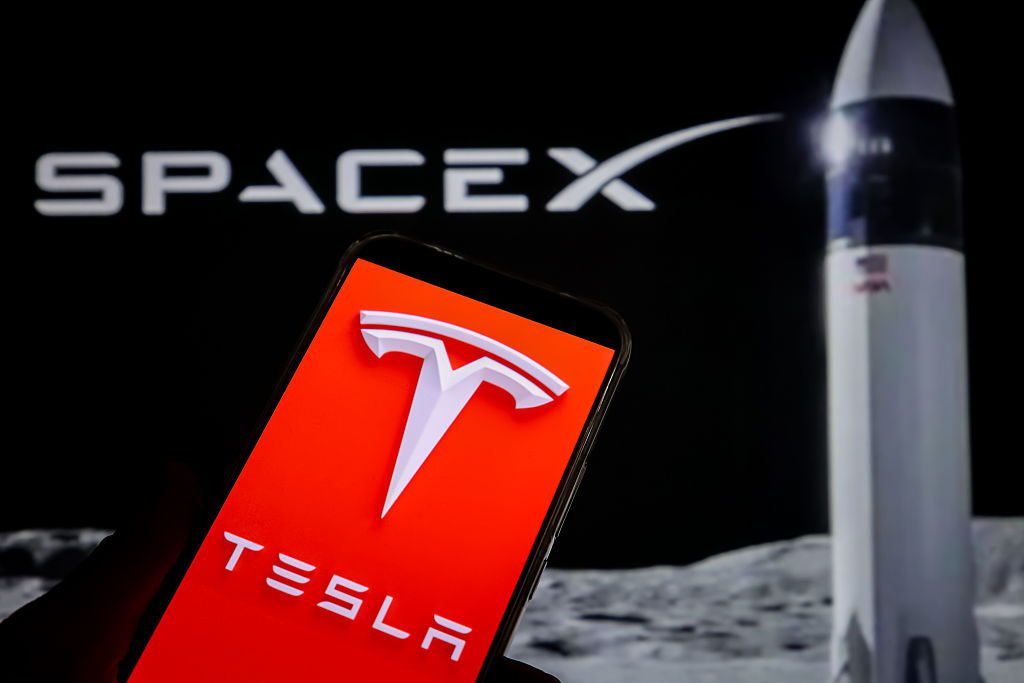
The logo of Tesla is displayed on a smartphone screen with the SpaceX logo in the background. —VCG—Getty Images
The world’s richest man has publicly backed a potential combination of SpaceX and Tesla in what could be the biggest merger in history.
On Tuesday, Elon Musk, the CEO and largest shareholder of both companies, said the electric vehicle maker and the rocket company had formed special committees at the request of shareholders to discuss the idea.
“I do think there’s a lot of merit to combining the companies as we are pretty much in the superintelligence singularity, and there’s a lot to be gained from cooperating,” Musk told SpaceX investors on a conference call.
“I think it would be a good idea, but it’s really up to the special committees of both companies,” he added.
The committees, which are made up of independent directors, would need to agree on the transaction terms of any deal before putting it to shareholders for a vote. Musk said his conflict of interest prevents him from participating in their discussions.
Musk has previously teased a Tesla-SpaceX merger. On a July 22 earnings call, Musk said there was “more and more overlap” between Tesla and SpaceX as the companies expand into artificial intelligence and robotics. Last week, Barclays analysts suggested that a merger could be announced before Tesla’s annual shareholder meeting in December.
Tuesday’s call was the first confirmation that the companies were formally exploring a combination.
A merger could create a company worth around $3.5 trillion, putting it among the world’s most valuable companies. It could also become the biggest merger ever by deal value, potentially surpassing SpaceX’s record-setting $250 billion acquisition of Musk-owned AI company xAI in February. SpaceX is currently valued at about $2 trillion, and Tesla at $1.5 trillion. A deal could also help propel Musk back into trillionaire ranks, depending on its terms and how investors value the combined company. Musk owns around 48% of SpaceX and 20% of Tesla.
The shares of both companies rose in after-hours trading on Tuesday. SpaceX, which went public in June, reported a quarterly net profit of $4.4 billion. Musk told investors he expects annual recurring revenue of between $500 billion and $1 trillion by the end of 2027.
Some analysts, however, have warned of regulatory and geopolitical hurdles, particularly in terms of Tesla’s Chinese operations and SpaceX’s U.S. defence work. Morningstar analysts said a merger could raise U.S. national security concerns involving the combined company’s supply chain. JPMorgan analysts also flagged regulatory approval in China as a potential stumbling block.
Any deal could also face congressional scrutiny, which could intensify if Democrats win control of either chamber in the coming midterm elections. Democratic lawmakers have previously questioned Musk over conflicts of interest and raised national security concerns about reported Chinese investments in SpaceX. Democrats have also challenged major acquisitions in the past on consumer protection grounds. In June, Sen. Elizabeth Warren (D, Mass.) criticized SpaceX’s IPO, citing Musk’s concentrated voting power and weak investor protections—concerns that could resurface in a Tesla-SpaceX merger.
Why a merger matters
A merger could bring two of Musk’s biggest businesses under one corporate umbrella, making it easier for the companies to move investments and resources between projects. “This would allow him to run all their operations under one roof without tripping on as many governance issues,” wrote Morningstar analysts Seth Goldstein and Nicolas Owens in June. “For example, Musk could move Tesla software developers or engineers to work on SpaceX AI projects, and vice versa, or have Tesla and SpaceX supply one another without the need for related party transaction disclosures or risking shareholder lawsuits claiming the resources of one firm are being diverted for the benefit of the other.”
Analysts noted that Tesla’s robotaxis could benefit from Starlink connectivity, while its autonomous vehicles and Optimus humanoid robots could more closely integrate SpaceX’s AI technology. SpaceX’s planned orbital data centers, meanwhile, could potentially benefit from access to Tesla’s battery and energy storage products.
A combined company could also mean greater control of several stages of the AI value chain, from chip design and planned manufacturing to computing infrastructure, AI software, and its deployment in vehicles and robots.
The companies already collaborate. In March, they announced Terafab, a joint semiconductor manufacturing project intended to produce chips for Tesla’s vehicles and humanoid robots and SpaceX’s planned AI satellites. SpaceX technologies have also been used in some Tesla products, including the new Roadster prototype, which uses SpaceX-developed thrusters.
David Nicholson, chief technology advisor at market research firm The Futurum Group, told the BBC that a merger also appears to align with Musk’s long-held ambition of colonizing Mars. Musk previously outlined plans to send Tesla’s Optimus robots to the planet aboard SpaceX’s Starship spacecraft.
A merger could also strengthen Musk’s influence over Tesla’s direction. Barclays estimated that a SpaceX acquisition of Tesla could give Musk around 37% of the combined company while controlling around 56% of its voting power. He currently controls around 82% of voting power at SpaceX and 20% at Tesla. That could represent either a benefit or a risk for shareholders, as decision-making would become faster but have fewer checks.
“One thing I don’t think people talk enough about with SpaceX and Tesla as well: You do still have a huge amount of key-man risk here,” wrote Morningstar analyst David Sekera earlier this month. “God forbid anything were to happen to Elon Musk.”
“The President has the most effective endorsement in American, or international, political history,” said Vance, when asked in an interview if he would also be extending an endorsement ahead of the election on Oct. 27. “I endorse American candidates and that’s where I'm focused on, is the midterms, so I'm not getting involved in the Israeli elections.”
When pushed for an answer, Vance added: “I'm not anti-endorsing [Netanyahu], I'm not pro-endorsing him.”
Vance’s response stood in stark contrast to Trump's endorsement, as he put his “complete and total” support behind the Israeli leader, while praising his endurance as a “great warrior” Prime Minister.
Referencing the Iran war, Trump said: “If Israel has the wrong leader, which would be anyone other than Bibi [Netanyahu], America will have to do this work ourselves, and I am not inclined to do so.” He went on to say that Netanyahu has been “strong, brave, and brilliant in the face of tremendous opposition, including that coming from even Israel” and “despite all of that, he has endured.”
Many are viewing the Israeli election as a referendum on Netanyahu, who has faced heavy criticism over his handling of the Hamas-led attack against Israel on Oct. 7, 2023. The subsequent Israel-Hamas war has led to a humanitarian crisis in Gaza. Netanyahu’s government has also been called to task over the reports of settler violence against Palestinian villages in the occupied West Bank.
Ahead of the elections, Defense Secretary Pete Hegseth reportedly met with Netanyahu on Monday during an unannounced visit to Israel, Axios said, citing two sources with knowledge.
The Pentagon declined to comment when contacted. TIME has also reached out to the Israeli embassy and Netanyahu’s office for comment.
Vance, meanwhile, has previously issued warnings to Israel regarding its relationship with the U.S. In June, he chastised members of Bibi’s cabinet who had voiced disapproval over Washington negotiating with Tehran to end the Iran war, which started in February with joint U.S. and Israeli strikes.
“Donald J. Trump is the only head of state in the entire world who is sympathetic to the nation of Israel at this moment in time. And he happens to be the head of state of the world’s superpower,” Vance said as he led a White House press briefing. “If I was in the Cabinet of the Israeli government, I might not be attacking the only powerful ally that I have anywhere left in the entire world.”
While Vance has said his focus is on American candidates ahead of the U.S. midterms, he has previously campaigned avidly overseas.
Vance’s campaigning for international candidates
Vance traveled to Hungary in April ahead of parliamentary elections as the Trump Administration put its full support behind then-Prime Minister Viktor Orbán, who was up for re-election against opposition leader Péter Magyar. (Pro-European conservative Magyar went on to win the election, ending Orbán’s 16-year rule.)
“Together the President of the United States and the Prime Minister of Hungary have been able to do amazing things,” Vance told reporters at a press conference in Budapest. “We want to build upon those amazing things. And of course, I want to help as much as I possibly can, the Prime Minister, as he faces this election season.” Vance later delivered remarks at a rally for Orbán.
Vance also notably met with Alice Weidel, co-leader of the far-right Alternative for Germany (AfD) party, in February 2025, days before a German election.
During that trip, Vance spoke at the Munich Security Conference and used the platform to voice his concerns about Europe, claiming that free speech across the continent was “in retreat.”
He criticized what is known as the “firewall” approach in Germany—the agreement among other political parties that they will not work with the AfD. “Democracy rests on the sacred principle that the voice of the people matters. There is no room for firewalls,” he said.
President Trump’s complicated relationship with Netanyahu
Trump’s endorsement of Netanyahu comes after the pair have shared an, at times, contentious relationship in recent months.
Asked about possible endorsement last week, Trump told reporters “we haven’t even thought about it,” prompting many to wonder if he may stay silent ahead of the consequential Israeli election.
In June, Trump told reporters that Netanyahu has to be “more responsible with respect to Lebanon,” amid concerns the renewed fighting with Hezbollah could derail the U.S.-Iran peace agreement. (Which later collapsed in light of continued clashes over the Strait of Hormuz.)
“I'm not happy with the way Israel has handled themselves with Lebanon and with Hezbollah,” Trump told reporters at the G7 summit in France. “It just goes on forever,” he continued, seemingly referencing the exchanging of strikes between Israeli forces and the Hezbollah militant group. “When that happens, it throws a negative light on the big deal, the deal with Iran.”
Trump said he has an “unbelievable relationship” with Netanyahu, but claimed “Israel would have been blown up a long time ago, had I not gotten involved.”
Days before his public remarks, Trump reportedly called Netanyahu “f-cking crazy” during a fraught phone call after Netanyahu ordered an attack on a Hezbollah stronghold in Beirut in retaliation for alleged attacks on Israel by Hezbollah.

 Login