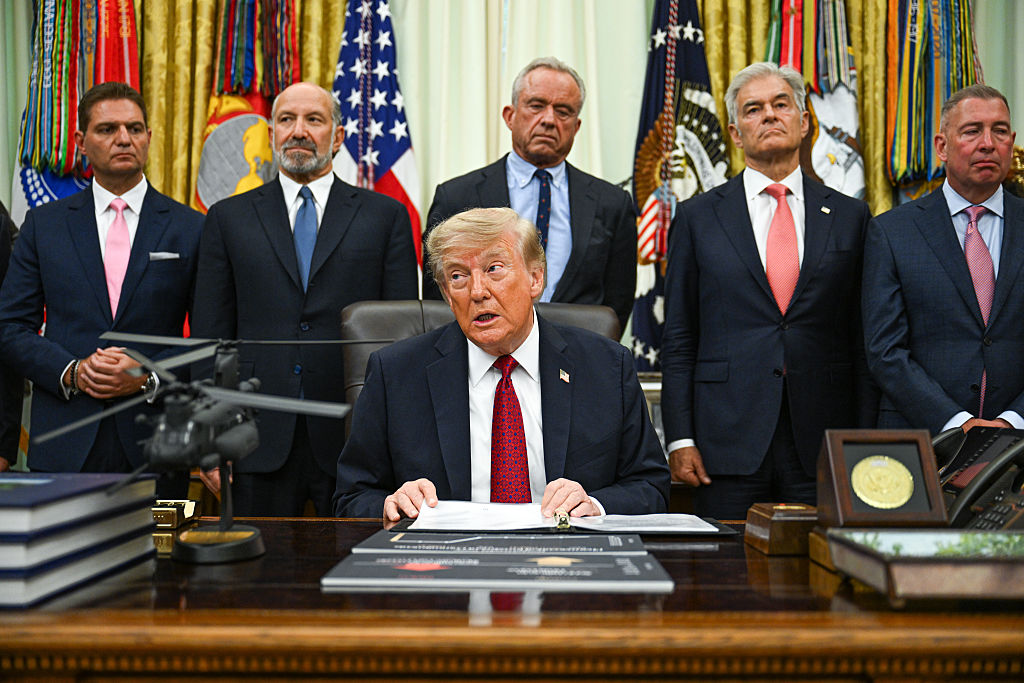
The Trump Administration on Aug. 31 announced that nine mid-sized pharmaceutical companies had agreed to lower the prices that Medicaid programs pay for drugs, bringing the total number of companies that made deals to lower prices to 26.
The agreements are for so-called “most-favored-nation” prices, meaning that Medicaid will pay the same prices for drugs that other countries, primarily in Europe, pay. The Trump Administration also said that some most-favored-nation prices would be available on TrumpRx.gov, where patients can access drugs by paying cash rather than going through insurance.
“For decades, Americans paid the highest drug prices anywhere in the world by far,” Trump said at a press conference, where executives from the new companies stood behind him. “We now pay the lowest price paid by other countries anywhere in the world.”
The nine companies—Alcon, Astellas Pharma, BeOne Medicines, BridgeBio, CSL, Kyowa Kirin, Sun Pharma, Teva Pharmaceuticals, and UCB—are in addition to the 17 drug companies that agreed to most-favored-nation deals at the end of 2025. The administration says that these deals cover 90% of the drugs used by Americans.
Companies have also agreed to move some pharmaceutical production to the U.S., the administration said. In exchange, the companies will receive relief from pharmaceutical tariffs.
Lowering drug prices has been a top priority for the Trump Administration. Research from 2024 suggests that people in the U.S. pay 3-4 times what consumers in other countries pay for the same drugs.
On May 12, 2025, President Trump signed an executive order directing the administration to take steps to bring American drug prices in line with those paid in comparable countries. He then sent letters in July to 17 leading pharmaceutical manufacturers outlining steps they should take to bring down their prices.
On Sept. 30, 2025, Trump announced an agreement with Pfizer to bring most-favored-nation pricing to Medicaid; by the end of December, 13 other companies had agreed to deals.
What does the deal mean for drug prices?
For most people, this announcement won’t change costs, experts say. That’s because it applies to Medicaid, and most Medicaid users already don’t pay very much for drugs. The announcement does mean that state and federal governments will see some savings, which will be welcomed as they see big cuts from H.R. 1, the One Big Beautiful Bill Act. “The main benefit here is not to the patients using the drugs, but to the fiscal health of the program,” says Luca Maini, assistant professor of health care policy at Harvard Medical School.
Of course, it’s hard to know even how much the deal will save to Medicaid programs, he says. That’s because the terms of the deals are not publicly available, and neither are the prices Medicaid pays.
One research letter in JAMA from July estimated that the most-favored-nation policies from 17 pharmaceutical companies that had already been agreed to would lead to $8.6 billion in savings a year for Medicaid programs.
But those savings are likely only for the short term, says one of that study’s authors, Dr. Thomas Hwang, an assistant professor at Brigham and Women’s Hospital. “Long-term savings are likely illusory,” he says. That’s because evidence suggests that after most-favored-nation deals, companies often raise prices in other countries so that the prices that the U.S. compares its prices to will be higher.
Already, the U.K. has agreed to cover drugs at higher prices than it did previously, says Dr. Suhas Gondi, an instructor at Harvard Medical School. He predicts that pharmaceutical companies will try to game the agreement by deciding not to launch new drugs in some countries so they won’t have to compare prices to that country.
“What you can be confident in is that the industry is going to do what it can to limit the impact through not only pricing, but delaying market entry in some other countries,” Gondi says.
Maini’s research has found that in Europe, when governments implement so-called reference pricing—essentially most-favored-nation pricing—drug makers delay debuting drugs in some lower-income countries so they don’t have to match the prices there.
There may be some other negatives to this deal, Hwang says. Some pharmaceutical companies have suggested in earnings reports that by agreeing to most-favored-nation prices with Medicaid, they won’t have to lower prices for drugs in Medicare, which is a much bigger program than Medicaid. That means that this voluntary agreement exempts pharmaceutical companies from what would have been a much more costly requirement. “That’s why I think this could be a bad deal for the government and taxpayers,” he says.
How could the administration lower drug prices for everyone?
Although administration officials have suggested that this deal and past ones would also lead to lower prices for consumers on sites like TrumpRx.gov, previous reporting by the New York Times suggests that this is not the case. Reporters there found that despite the administration’s rhetoric about deals with pharmaceutical companies that lowered prices for everyone, U.S. consumers still pay much higher prices for drugs on TrumpRx than other consumers around the world pay.
The most-favored-nation announcement does not do much to address the root causes of why drug prices are so high in the United States, says Hwang. One way that drug companies keep prices high is by extending patents on blockbuster drugs, a method that is not available in many other countries. For instance, the patents for some GLP-1 medications expired in 2026 in India, China, and Brazil, allowing generic versions to be made.
One way that the Trump Administration could have done more to lower prices for more people would be to allow Medicare to negotiate prices with drugmakers directly, Hwang says. Until the Inflation Reduction Act in 2022, Medicare was not allowed to negotiate prices with pharmaceutical companies at all; the law allowed the government to negotiate prices on a few drugs.
If Medicare had broader authority to negotiate—say, the authority to talk with manufacturers at the beginning of a drug’s life cycle—prices for drugs through that program could drop significantly, says Hwang. But allowing Medicare to negotiate directly with drug companies would require an act of Congress, and might not be politically palatable at this time.
“I understand the Trump Administration’s push for most-favored-nation policies,” he says. “It’s an administratively easier pathway than lower drug prices for all payers.”

 Login
Login